EP0066333A2 - Nichtlinearer Widerstand und Verfahren zu seiner Herstellung - Google Patents
Nichtlinearer Widerstand und Verfahren zu seiner Herstellung Download PDFInfo
- Publication number
- EP0066333A2 EP0066333A2 EP82200616A EP82200616A EP0066333A2 EP 0066333 A2 EP0066333 A2 EP 0066333A2 EP 82200616 A EP82200616 A EP 82200616A EP 82200616 A EP82200616 A EP 82200616A EP 0066333 A2 EP0066333 A2 EP 0066333A2
- Authority
- EP
- European Patent Office
- Prior art keywords
- sintered body
- post
- earth metal
- temperature
- metal
- Prior art date
- Legal status (The legal status is an assumption and is not a legal conclusion. Google has not performed a legal analysis and makes no representation as to the accuracy of the status listed.)
- Granted
Links
- 238000004519 manufacturing process Methods 0.000 title claims description 8
- 238000007254 oxidation reaction Methods 0.000 claims abstract description 30
- 239000000919 ceramic Substances 0.000 claims abstract description 14
- 229910052751 metal Inorganic materials 0.000 claims abstract description 14
- 239000002184 metal Substances 0.000 claims abstract description 14
- 229910052784 alkaline earth metal Inorganic materials 0.000 claims abstract description 13
- 229910044991 metal oxide Inorganic materials 0.000 claims abstract description 12
- 150000004706 metal oxides Chemical class 0.000 claims abstract description 12
- -1 alkaline earth metal titanate Chemical class 0.000 claims abstract description 8
- 150000001342 alkaline earth metals Chemical class 0.000 claims abstract description 5
- 229910052761 rare earth metal Inorganic materials 0.000 claims abstract description 5
- 150000002910 rare earth metals Chemical group 0.000 claims abstract description 5
- 238000005245 sintering Methods 0.000 claims description 18
- 238000000034 method Methods 0.000 claims description 15
- 239000000463 material Substances 0.000 claims description 11
- 239000000203 mixture Substances 0.000 claims description 10
- 230000001590 oxidative effect Effects 0.000 claims description 7
- 229920006395 saturated elastomer Polymers 0.000 claims description 4
- 239000011230 binding agent Substances 0.000 claims description 3
- 229910052712 strontium Inorganic materials 0.000 claims description 3
- 239000000126 substance Substances 0.000 claims description 3
- 239000004372 Polyvinyl alcohol Substances 0.000 claims description 2
- 150000002739 metals Chemical class 0.000 claims description 2
- 229910052758 niobium Inorganic materials 0.000 claims description 2
- 229920002451 polyvinyl alcohol Polymers 0.000 claims description 2
- 238000003825 pressing Methods 0.000 claims description 2
- CIOAGBVUUVVLOB-UHFFFAOYSA-N strontium atom Chemical compound [Sr] CIOAGBVUUVVLOB-UHFFFAOYSA-N 0.000 claims description 2
- 229910052721 tungsten Inorganic materials 0.000 claims description 2
- XLYOFNOQVPJJNP-UHFFFAOYSA-N water Chemical compound O XLYOFNOQVPJJNP-UHFFFAOYSA-N 0.000 claims description 2
- FGUUSXIOTUKUDN-IBGZPJMESA-N C1(=CC=CC=C1)N1C2=C(NC([C@H](C1)NC=1OC(=NN=1)C1=CC=CC=C1)=O)C=CC=C2 Chemical compound C1(=CC=CC=C1)N1C2=C(NC([C@H](C1)NC=1OC(=NN=1)C1=CC=CC=C1)=O)C=CC=C2 FGUUSXIOTUKUDN-IBGZPJMESA-N 0.000 claims 1
- RTAQQCXQSZGOHL-UHFFFAOYSA-N Titanium Chemical compound [Ti] RTAQQCXQSZGOHL-UHFFFAOYSA-N 0.000 claims 1
- 239000000470 constituent Substances 0.000 claims 1
- NJLLQSBAHIKGKF-UHFFFAOYSA-N dipotassium dioxido(oxo)titanium Chemical compound [K+].[K+].[O-][Ti]([O-])=O NJLLQSBAHIKGKF-UHFFFAOYSA-N 0.000 claims 1
- 229910052746 lanthanum Inorganic materials 0.000 claims 1
- FZLIPJUXYLNCLC-UHFFFAOYSA-N lanthanum atom Chemical compound [La] FZLIPJUXYLNCLC-UHFFFAOYSA-N 0.000 claims 1
- 239000010955 niobium Substances 0.000 claims 1
- GUCVJGMIXFAOAE-UHFFFAOYSA-N niobium atom Chemical compound [Nb] GUCVJGMIXFAOAE-UHFFFAOYSA-N 0.000 claims 1
- WFKWXMTUELFFGS-UHFFFAOYSA-N tungsten Chemical compound [W] WFKWXMTUELFFGS-UHFFFAOYSA-N 0.000 claims 1
- 239000010937 tungsten Substances 0.000 claims 1
- OGIDPMRJRNCKJF-UHFFFAOYSA-N titanium oxide Inorganic materials [Ti]=O OGIDPMRJRNCKJF-UHFFFAOYSA-N 0.000 description 11
- 239000010410 layer Substances 0.000 description 10
- 150000002500 ions Chemical class 0.000 description 6
- 239000007789 gas Substances 0.000 description 4
- 229910010252 TiO3 Inorganic materials 0.000 description 3
- GWEVSGVZZGPLCZ-UHFFFAOYSA-N Titan oxide Chemical compound O=[Ti]=O GWEVSGVZZGPLCZ-UHFFFAOYSA-N 0.000 description 3
- 230000001419 dependent effect Effects 0.000 description 3
- 230000003647 oxidation Effects 0.000 description 3
- VYPSYNLAJGMNEJ-UHFFFAOYSA-N Silicium dioxide Chemical compound O=[Si]=O VYPSYNLAJGMNEJ-UHFFFAOYSA-N 0.000 description 2
- 229910010413 TiO 2 Inorganic materials 0.000 description 2
- 150000001768 cations Chemical class 0.000 description 2
- 238000012512 characterization method Methods 0.000 description 2
- 239000002019 doping agent Substances 0.000 description 2
- 238000002474 experimental method Methods 0.000 description 2
- PCHJSUWPFVWCPO-UHFFFAOYSA-N gold Chemical compound [Au] PCHJSUWPFVWCPO-UHFFFAOYSA-N 0.000 description 2
- 239000010931 gold Substances 0.000 description 2
- 229910052737 gold Inorganic materials 0.000 description 2
- 239000007788 liquid Substances 0.000 description 2
- 239000000843 powder Substances 0.000 description 2
- 239000004065 semiconductor Substances 0.000 description 2
- 239000007858 starting material Substances 0.000 description 2
- 241001295925 Gegenes Species 0.000 description 1
- 229910021193 La 2 O 3 Inorganic materials 0.000 description 1
- 229910002367 SrTiO Inorganic materials 0.000 description 1
- 229910004415 SrWO4 Inorganic materials 0.000 description 1
- 239000000370 acceptor Substances 0.000 description 1
- 239000012790 adhesive layer Substances 0.000 description 1
- QVGXLLKOCUKJST-UHFFFAOYSA-N atomic oxygen Chemical compound [O] QVGXLLKOCUKJST-UHFFFAOYSA-N 0.000 description 1
- 230000015572 biosynthetic process Effects 0.000 description 1
- 229910010293 ceramic material Inorganic materials 0.000 description 1
- 238000006243 chemical reaction Methods 0.000 description 1
- 230000007423 decrease Effects 0.000 description 1
- 238000011161 development Methods 0.000 description 1
- 230000018109 developmental process Effects 0.000 description 1
- 238000010586 diagram Methods 0.000 description 1
- XKENYNILAAWPFQ-UHFFFAOYSA-N dioxido(oxo)germane;lead(2+) Chemical compound [Pb+2].[O-][Ge]([O-])=O XKENYNILAAWPFQ-UHFFFAOYSA-N 0.000 description 1
- 230000005684 electric field Effects 0.000 description 1
- 230000005496 eutectics Effects 0.000 description 1
- 239000008187 granular material Substances 0.000 description 1
- 229910052760 oxygen Inorganic materials 0.000 description 1
- 239000001301 oxygen Substances 0.000 description 1
- 239000002994 raw material Substances 0.000 description 1
- 238000010405 reoxidation reaction Methods 0.000 description 1
- 229910000018 strontium carbonate Inorganic materials 0.000 description 1
- VEALVRVVWBQVSL-UHFFFAOYSA-N strontium titanate Chemical compound [Sr+2].[O-][Ti]([O-])=O VEALVRVVWBQVSL-UHFFFAOYSA-N 0.000 description 1
- 230000007704 transition Effects 0.000 description 1
- 238000007740 vapor deposition Methods 0.000 description 1
- 238000012982 x-ray structure analysis Methods 0.000 description 1
Images


Classifications
-
- C—CHEMISTRY; METALLURGY
- C04—CEMENTS; CONCRETE; ARTIFICIAL STONE; CERAMICS; REFRACTORIES
- C04B—LIME, MAGNESIA; SLAG; CEMENTS; COMPOSITIONS THEREOF, e.g. MORTARS, CONCRETE OR LIKE BUILDING MATERIALS; ARTIFICIAL STONE; CERAMICS; REFRACTORIES; TREATMENT OF NATURAL STONE
- C04B35/00—Shaped ceramic products characterised by their composition; Ceramics compositions; Processing powders of inorganic compounds preparatory to the manufacturing of ceramic products
- C04B35/01—Shaped ceramic products characterised by their composition; Ceramics compositions; Processing powders of inorganic compounds preparatory to the manufacturing of ceramic products based on oxide ceramics
- C04B35/46—Shaped ceramic products characterised by their composition; Ceramics compositions; Processing powders of inorganic compounds preparatory to the manufacturing of ceramic products based on oxide ceramics based on titanium oxides or titanates
- C04B35/462—Shaped ceramic products characterised by their composition; Ceramics compositions; Processing powders of inorganic compounds preparatory to the manufacturing of ceramic products based on oxide ceramics based on titanium oxides or titanates based on titanates
- C04B35/465—Shaped ceramic products characterised by their composition; Ceramics compositions; Processing powders of inorganic compounds preparatory to the manufacturing of ceramic products based on oxide ceramics based on titanium oxides or titanates based on titanates based on alkaline earth metal titanates
- C04B35/47—Shaped ceramic products characterised by their composition; Ceramics compositions; Processing powders of inorganic compounds preparatory to the manufacturing of ceramic products based on oxide ceramics based on titanium oxides or titanates based on titanates based on alkaline earth metal titanates based on strontium titanates
-
- C—CHEMISTRY; METALLURGY
- C01—INORGANIC CHEMISTRY
- C01G—COMPOUNDS CONTAINING METALS NOT COVERED BY SUBCLASSES C01D OR C01F
- C01G23/00—Compounds of titanium
- C01G23/003—Titanates
- C01G23/006—Alkaline earth titanates
-
- C—CHEMISTRY; METALLURGY
- C04—CEMENTS; CONCRETE; ARTIFICIAL STONE; CERAMICS; REFRACTORIES
- C04B—LIME, MAGNESIA; SLAG; CEMENTS; COMPOSITIONS THEREOF, e.g. MORTARS, CONCRETE OR LIKE BUILDING MATERIALS; ARTIFICIAL STONE; CERAMICS; REFRACTORIES; TREATMENT OF NATURAL STONE
- C04B35/00—Shaped ceramic products characterised by their composition; Ceramics compositions; Processing powders of inorganic compounds preparatory to the manufacturing of ceramic products
- C04B35/01—Shaped ceramic products characterised by their composition; Ceramics compositions; Processing powders of inorganic compounds preparatory to the manufacturing of ceramic products based on oxide ceramics
- C04B35/46—Shaped ceramic products characterised by their composition; Ceramics compositions; Processing powders of inorganic compounds preparatory to the manufacturing of ceramic products based on oxide ceramics based on titanium oxides or titanates
- C04B35/462—Shaped ceramic products characterised by their composition; Ceramics compositions; Processing powders of inorganic compounds preparatory to the manufacturing of ceramic products based on oxide ceramics based on titanium oxides or titanates based on titanates
-
- C—CHEMISTRY; METALLURGY
- C04—CEMENTS; CONCRETE; ARTIFICIAL STONE; CERAMICS; REFRACTORIES
- C04B—LIME, MAGNESIA; SLAG; CEMENTS; COMPOSITIONS THEREOF, e.g. MORTARS, CONCRETE OR LIKE BUILDING MATERIALS; ARTIFICIAL STONE; CERAMICS; REFRACTORIES; TREATMENT OF NATURAL STONE
- C04B35/00—Shaped ceramic products characterised by their composition; Ceramics compositions; Processing powders of inorganic compounds preparatory to the manufacturing of ceramic products
- C04B35/622—Forming processes; Processing powders of inorganic compounds preparatory to the manufacturing of ceramic products
- C04B35/626—Preparing or treating the powders individually or as batches ; preparing or treating macroscopic reinforcing agents for ceramic products, e.g. fibres; mechanical aspects section B
- C04B35/62605—Treating the starting powders individually or as mixtures
- C04B35/6261—Milling
- C04B35/6262—Milling of calcined, sintered clinker or ceramics
-
- C—CHEMISTRY; METALLURGY
- C04—CEMENTS; CONCRETE; ARTIFICIAL STONE; CERAMICS; REFRACTORIES
- C04B—LIME, MAGNESIA; SLAG; CEMENTS; COMPOSITIONS THEREOF, e.g. MORTARS, CONCRETE OR LIKE BUILDING MATERIALS; ARTIFICIAL STONE; CERAMICS; REFRACTORIES; TREATMENT OF NATURAL STONE
- C04B35/00—Shaped ceramic products characterised by their composition; Ceramics compositions; Processing powders of inorganic compounds preparatory to the manufacturing of ceramic products
- C04B35/622—Forming processes; Processing powders of inorganic compounds preparatory to the manufacturing of ceramic products
- C04B35/626—Preparing or treating the powders individually or as batches ; preparing or treating macroscopic reinforcing agents for ceramic products, e.g. fibres; mechanical aspects section B
- C04B35/62605—Treating the starting powders individually or as mixtures
- C04B35/62645—Thermal treatment of powders or mixtures thereof other than sintering
- C04B35/62675—Thermal treatment of powders or mixtures thereof other than sintering characterised by the treatment temperature
-
- C—CHEMISTRY; METALLURGY
- C04—CEMENTS; CONCRETE; ARTIFICIAL STONE; CERAMICS; REFRACTORIES
- C04B—LIME, MAGNESIA; SLAG; CEMENTS; COMPOSITIONS THEREOF, e.g. MORTARS, CONCRETE OR LIKE BUILDING MATERIALS; ARTIFICIAL STONE; CERAMICS; REFRACTORIES; TREATMENT OF NATURAL STONE
- C04B35/00—Shaped ceramic products characterised by their composition; Ceramics compositions; Processing powders of inorganic compounds preparatory to the manufacturing of ceramic products
- C04B35/622—Forming processes; Processing powders of inorganic compounds preparatory to the manufacturing of ceramic products
- C04B35/626—Preparing or treating the powders individually or as batches ; preparing or treating macroscopic reinforcing agents for ceramic products, e.g. fibres; mechanical aspects section B
- C04B35/63—Preparing or treating the powders individually or as batches ; preparing or treating macroscopic reinforcing agents for ceramic products, e.g. fibres; mechanical aspects section B using additives specially adapted for forming the products, e.g.. binder binders
- C04B35/632—Organic additives
- C04B35/634—Polymers
- C04B35/63404—Polymers obtained by reactions only involving carbon-to-carbon unsaturated bonds
- C04B35/63416—Polyvinylalcohols [PVA]; Polyvinylacetates
-
- H—ELECTRICITY
- H01—ELECTRIC ELEMENTS
- H01C—RESISTORS
- H01C7/00—Non-adjustable resistors formed as one or more layers or coatings; Non-adjustable resistors made from powdered conducting material or powdered semi-conducting material with or without insulating material
- H01C7/10—Non-adjustable resistors formed as one or more layers or coatings; Non-adjustable resistors made from powdered conducting material or powdered semi-conducting material with or without insulating material voltage responsive, i.e. varistors
- H01C7/105—Varistor cores
- H01C7/108—Metal oxide
- H01C7/115—Titanium dioxide- or titanate type
-
- C—CHEMISTRY; METALLURGY
- C01—INORGANIC CHEMISTRY
- C01P—INDEXING SCHEME RELATING TO STRUCTURAL AND PHYSICAL ASPECTS OF SOLID INORGANIC COMPOUNDS
- C01P2002/00—Crystal-structural characteristics
- C01P2002/50—Solid solutions
- C01P2002/52—Solid solutions containing elements as dopants
- C01P2002/54—Solid solutions containing elements as dopants one element only
-
- C—CHEMISTRY; METALLURGY
- C04—CEMENTS; CONCRETE; ARTIFICIAL STONE; CERAMICS; REFRACTORIES
- C04B—LIME, MAGNESIA; SLAG; CEMENTS; COMPOSITIONS THEREOF, e.g. MORTARS, CONCRETE OR LIKE BUILDING MATERIALS; ARTIFICIAL STONE; CERAMICS; REFRACTORIES; TREATMENT OF NATURAL STONE
- C04B2235/00—Aspects relating to ceramic starting mixtures or sintered ceramic products
- C04B2235/02—Composition of constituents of the starting material or of secondary phases of the final product
- C04B2235/30—Constituents and secondary phases not being of a fibrous nature
- C04B2235/32—Metal oxides, mixed metal oxides, or oxide-forming salts thereof, e.g. carbonates, nitrates, (oxy)hydroxides, chlorides
- C04B2235/3224—Rare earth oxide or oxide forming salts thereof, e.g. scandium oxide
- C04B2235/3227—Lanthanum oxide or oxide-forming salts thereof
-
- C—CHEMISTRY; METALLURGY
- C04—CEMENTS; CONCRETE; ARTIFICIAL STONE; CERAMICS; REFRACTORIES
- C04B—LIME, MAGNESIA; SLAG; CEMENTS; COMPOSITIONS THEREOF, e.g. MORTARS, CONCRETE OR LIKE BUILDING MATERIALS; ARTIFICIAL STONE; CERAMICS; REFRACTORIES; TREATMENT OF NATURAL STONE
- C04B2235/00—Aspects relating to ceramic starting mixtures or sintered ceramic products
- C04B2235/02—Composition of constituents of the starting material or of secondary phases of the final product
- C04B2235/30—Constituents and secondary phases not being of a fibrous nature
- C04B2235/32—Metal oxides, mixed metal oxides, or oxide-forming salts thereof, e.g. carbonates, nitrates, (oxy)hydroxides, chlorides
- C04B2235/3231—Refractory metal oxides, their mixed metal oxides, or oxide-forming salts thereof
- C04B2235/3232—Titanium oxides or titanates, e.g. rutile or anatase
-
- C—CHEMISTRY; METALLURGY
- C04—CEMENTS; CONCRETE; ARTIFICIAL STONE; CERAMICS; REFRACTORIES
- C04B—LIME, MAGNESIA; SLAG; CEMENTS; COMPOSITIONS THEREOF, e.g. MORTARS, CONCRETE OR LIKE BUILDING MATERIALS; ARTIFICIAL STONE; CERAMICS; REFRACTORIES; TREATMENT OF NATURAL STONE
- C04B2235/00—Aspects relating to ceramic starting mixtures or sintered ceramic products
- C04B2235/02—Composition of constituents of the starting material or of secondary phases of the final product
- C04B2235/30—Constituents and secondary phases not being of a fibrous nature
- C04B2235/32—Metal oxides, mixed metal oxides, or oxide-forming salts thereof, e.g. carbonates, nitrates, (oxy)hydroxides, chlorides
- C04B2235/3231—Refractory metal oxides, their mixed metal oxides, or oxide-forming salts thereof
- C04B2235/3251—Niobium oxides, niobates, tantalum oxides, tantalates, or oxide-forming salts thereof
-
- C—CHEMISTRY; METALLURGY
- C04—CEMENTS; CONCRETE; ARTIFICIAL STONE; CERAMICS; REFRACTORIES
- C04B—LIME, MAGNESIA; SLAG; CEMENTS; COMPOSITIONS THEREOF, e.g. MORTARS, CONCRETE OR LIKE BUILDING MATERIALS; ARTIFICIAL STONE; CERAMICS; REFRACTORIES; TREATMENT OF NATURAL STONE
- C04B2235/00—Aspects relating to ceramic starting mixtures or sintered ceramic products
- C04B2235/02—Composition of constituents of the starting material or of secondary phases of the final product
- C04B2235/30—Constituents and secondary phases not being of a fibrous nature
- C04B2235/32—Metal oxides, mixed metal oxides, or oxide-forming salts thereof, e.g. carbonates, nitrates, (oxy)hydroxides, chlorides
- C04B2235/3231—Refractory metal oxides, their mixed metal oxides, or oxide-forming salts thereof
- C04B2235/3258—Tungsten oxides, tungstates, or oxide-forming salts thereof
-
- C—CHEMISTRY; METALLURGY
- C04—CEMENTS; CONCRETE; ARTIFICIAL STONE; CERAMICS; REFRACTORIES
- C04B—LIME, MAGNESIA; SLAG; CEMENTS; COMPOSITIONS THEREOF, e.g. MORTARS, CONCRETE OR LIKE BUILDING MATERIALS; ARTIFICIAL STONE; CERAMICS; REFRACTORIES; TREATMENT OF NATURAL STONE
- C04B2235/00—Aspects relating to ceramic starting mixtures or sintered ceramic products
- C04B2235/65—Aspects relating to heat treatments of ceramic bodies such as green ceramics or pre-sintered ceramics, e.g. burning, sintering or melting processes
- C04B2235/656—Aspects relating to heat treatments of ceramic bodies such as green ceramics or pre-sintered ceramics, e.g. burning, sintering or melting processes characterised by specific heating conditions during heat treatment
-
- C—CHEMISTRY; METALLURGY
- C04—CEMENTS; CONCRETE; ARTIFICIAL STONE; CERAMICS; REFRACTORIES
- C04B—LIME, MAGNESIA; SLAG; CEMENTS; COMPOSITIONS THEREOF, e.g. MORTARS, CONCRETE OR LIKE BUILDING MATERIALS; ARTIFICIAL STONE; CERAMICS; REFRACTORIES; TREATMENT OF NATURAL STONE
- C04B2235/00—Aspects relating to ceramic starting mixtures or sintered ceramic products
- C04B2235/65—Aspects relating to heat treatments of ceramic bodies such as green ceramics or pre-sintered ceramics, e.g. burning, sintering or melting processes
- C04B2235/656—Aspects relating to heat treatments of ceramic bodies such as green ceramics or pre-sintered ceramics, e.g. burning, sintering or melting processes characterised by specific heating conditions during heat treatment
- C04B2235/6567—Treatment time
-
- C—CHEMISTRY; METALLURGY
- C04—CEMENTS; CONCRETE; ARTIFICIAL STONE; CERAMICS; REFRACTORIES
- C04B—LIME, MAGNESIA; SLAG; CEMENTS; COMPOSITIONS THEREOF, e.g. MORTARS, CONCRETE OR LIKE BUILDING MATERIALS; ARTIFICIAL STONE; CERAMICS; REFRACTORIES; TREATMENT OF NATURAL STONE
- C04B2235/00—Aspects relating to ceramic starting mixtures or sintered ceramic products
- C04B2235/65—Aspects relating to heat treatments of ceramic bodies such as green ceramics or pre-sintered ceramics, e.g. burning, sintering or melting processes
- C04B2235/658—Atmosphere during thermal treatment
- C04B2235/6582—Hydrogen containing atmosphere
-
- C—CHEMISTRY; METALLURGY
- C04—CEMENTS; CONCRETE; ARTIFICIAL STONE; CERAMICS; REFRACTORIES
- C04B—LIME, MAGNESIA; SLAG; CEMENTS; COMPOSITIONS THEREOF, e.g. MORTARS, CONCRETE OR LIKE BUILDING MATERIALS; ARTIFICIAL STONE; CERAMICS; REFRACTORIES; TREATMENT OF NATURAL STONE
- C04B2235/00—Aspects relating to ceramic starting mixtures or sintered ceramic products
- C04B2235/65—Aspects relating to heat treatments of ceramic bodies such as green ceramics or pre-sintered ceramics, e.g. burning, sintering or melting processes
- C04B2235/658—Atmosphere during thermal treatment
- C04B2235/6588—Water vapor containing atmospheres
-
- C—CHEMISTRY; METALLURGY
- C04—CEMENTS; CONCRETE; ARTIFICIAL STONE; CERAMICS; REFRACTORIES
- C04B—LIME, MAGNESIA; SLAG; CEMENTS; COMPOSITIONS THEREOF, e.g. MORTARS, CONCRETE OR LIKE BUILDING MATERIALS; ARTIFICIAL STONE; CERAMICS; REFRACTORIES; TREATMENT OF NATURAL STONE
- C04B2235/00—Aspects relating to ceramic starting mixtures or sintered ceramic products
- C04B2235/65—Aspects relating to heat treatments of ceramic bodies such as green ceramics or pre-sintered ceramics, e.g. burning, sintering or melting processes
- C04B2235/66—Specific sintering techniques, e.g. centrifugal sintering
- C04B2235/661—Multi-step sintering
- C04B2235/662—Annealing after sintering
- C04B2235/663—Oxidative annealing
-
- C—CHEMISTRY; METALLURGY
- C04—CEMENTS; CONCRETE; ARTIFICIAL STONE; CERAMICS; REFRACTORIES
- C04B—LIME, MAGNESIA; SLAG; CEMENTS; COMPOSITIONS THEREOF, e.g. MORTARS, CONCRETE OR LIKE BUILDING MATERIALS; ARTIFICIAL STONE; CERAMICS; REFRACTORIES; TREATMENT OF NATURAL STONE
- C04B2235/00—Aspects relating to ceramic starting mixtures or sintered ceramic products
- C04B2235/70—Aspects relating to sintered or melt-casted ceramic products
- C04B2235/74—Physical characteristics
- C04B2235/76—Crystal structural characteristics, e.g. symmetry
- C04B2235/768—Perovskite structure ABO3
-
- C—CHEMISTRY; METALLURGY
- C04—CEMENTS; CONCRETE; ARTIFICIAL STONE; CERAMICS; REFRACTORIES
- C04B—LIME, MAGNESIA; SLAG; CEMENTS; COMPOSITIONS THEREOF, e.g. MORTARS, CONCRETE OR LIKE BUILDING MATERIALS; ARTIFICIAL STONE; CERAMICS; REFRACTORIES; TREATMENT OF NATURAL STONE
- C04B2235/00—Aspects relating to ceramic starting mixtures or sintered ceramic products
- C04B2235/70—Aspects relating to sintered or melt-casted ceramic products
- C04B2235/74—Physical characteristics
- C04B2235/78—Grain sizes and shapes, product microstructures, e.g. acicular grains, equiaxed grains, platelet-structures
- C04B2235/786—Micrometer sized grains, i.e. from 1 to 100 micron
-
- Y—GENERAL TAGGING OF NEW TECHNOLOGICAL DEVELOPMENTS; GENERAL TAGGING OF CROSS-SECTIONAL TECHNOLOGIES SPANNING OVER SEVERAL SECTIONS OF THE IPC; TECHNICAL SUBJECTS COVERED BY FORMER USPC CROSS-REFERENCE ART COLLECTIONS [XRACs] AND DIGESTS
- Y10—TECHNICAL SUBJECTS COVERED BY FORMER USPC
- Y10T—TECHNICAL SUBJECTS COVERED BY FORMER US CLASSIFICATION
- Y10T29/00—Metal working
- Y10T29/49—Method of mechanical manufacture
- Y10T29/49002—Electrical device making
- Y10T29/49082—Resistor making
-
- Y—GENERAL TAGGING OF NEW TECHNOLOGICAL DEVELOPMENTS; GENERAL TAGGING OF CROSS-SECTIONAL TECHNOLOGIES SPANNING OVER SEVERAL SECTIONS OF THE IPC; TECHNICAL SUBJECTS COVERED BY FORMER USPC CROSS-REFERENCE ART COLLECTIONS [XRACs] AND DIGESTS
- Y10—TECHNICAL SUBJECTS COVERED BY FORMER USPC
- Y10T—TECHNICAL SUBJECTS COVERED BY FORMER US CLASSIFICATION
- Y10T29/00—Metal working
- Y10T29/49—Method of mechanical manufacture
- Y10T29/49002—Electrical device making
- Y10T29/49082—Resistor making
- Y10T29/49085—Thermally variable
Definitions
- the invention relates to a nonlinear resistor with a ceramic sintered body based on a polycrystalline, with a small amount of a metal oxide doped to produce an N-type conductivity alkaline earth metal titanate with electrodes arranged on opposite surfaces.
- the invention further relates to a method for producing such a resistor.
- non-linear resistors are understood to mean resistors with NTC characteristics (resistance value decreases with increasing temperature regardless of the measuring voltage) and resistors with VDR characteristics (resistance value only depends on the applied voltage).
- a voltage-dependent resistor is known from German patent application P 30 19 969.0, which is based on N-doped strontium titanate, to which a small proportion of a lead germanate phase was added before sintering, which leads to the formation of insulating grain boundary layers in the polyxrystalline structure of the sintered body.
- This known resistor can only be used to a limited extent because of its relatively high field strength - a current density of, for example, about 3 mA / cm 2 only occurs in fields of about 6 K V / cm; it is not suitable, for example, for modern semiconductor switching circuits that work with low voltages.
- the invention is based on the task, not one linear resistor according to the preamble of the claim and a method for its production in such a way that not only a non-linear resistor with a low field strength is obtained, but that this resistor is designed either as a VDR or as an NTC resistor.
- a manufacturing process for the sintered body of the type mentioned above is carried out according to the invention in such a way that the ceramic body is sintered first in a reducing atmosphere and that this sintered body is subsequently reoxidized in an oxidizing atmosphere, preferably in air, the sintered body being selected by selecting the postoxidation temperature and the postoxidation duration
- the non-linear resistance curve can be adjusted in such a way that an initially existing NTC characteristic can only be observed gradually at ever higher temperatures and changes to a VDR characteristic in the area of the operating temperature of the resistor.
- the sintered body By sintering in a reducing atmosphere, the sintered body is made semiconducting throughout, and then grain edge regions of the semiconducting grains of the polycrystalline structure of the sintered body are converted by post-oxidation by forming high-resistance oxide layers. Depending on the level of the post-oxidation temperature and the post-oxidation duration, sintered bodies can be produced in this way in which the NTC character or the VDR character predominates.
- strontium is chosen as the earth metal and La 2 O 3 , Nb 2 0 5 or W0 3 as the doping metal oxides.
- the doping metal oxides are installed in the PerowsKit grid of the SrTi03 by reaction during the pre-sintering to produce the sintered body.
- other metal oxides are also possible, e.g.
- the doping ions are installed either on Sr or Ti sites in the PerowsKit lattice of SrTi0 3 .
- the doped alkaline earth metal titanate is converted into a sinterable, finely powdered state by grinding in a ball mill and by pressing to a generally disc-shaped body condensed. Only when sintering takes place in a reducing atmosphere, do the donor charges contribute directly to the conductivity. This state is known as electron compensation.
- These electron-compensated materials have a specific resistance of the order of 1 ⁇ . cm.
- the invention is based on the finding that the electronically compensated conductive ceramic can be converted into the highly insulating, empty, compensated form by post-oxidation.
- the pure electron K ompens Being corresponding to a PerowsKitKeramiK with NTC characteristics, and the purely vacancy-compensated shape corresponding to a PerowsKitKeramiK with VDR properties are producible many transition states.
- Reaction-Kinetic experiments on electron-compensated semiconducting Ba 1-x La x TiO 3 (x ⁇ 0.005 to 0.02) have shown that the oxidation always begins at the grain boundaries, whereby a semiconducting ceramic material with highly insulating grain edge layers is formed.
- Very analogous processes take place in the oxidation of semiconducting N-doped SrTi0 3 .
- a particular advantage that is achieved with the invention is, in addition to the adjustability of the characteristic curve of the resistors containing a ceramic sintered body according to the present application, the low field strength of resistors with VDR characteristics.
- the resistors with VDR characteristics according to the present application are characterized by a field strength which is lower by the fax gate ⁇ 20.
- varistors with sintered bodies according to the subject of the application particularly suitable for modern semiconductor circuits that operate at low voltages.
- the varistors with sintered bodies with La as well as with Nb and W doping show the mentioned low field strength.
- the sintered body has a slight excess of TiO 2 and that it has insulating layers formed by post-oxidation. These insulating layers can have a gradient from the edge zones of the sintered body to the thickness of the sintered body.
- the Ti0 2 excess of the starting material for the sintered body leads not only to the sintering conditions, but essentially to the sintering temperature, and in addition to the concentration of the doping, to grain growth.
- the grain size of the polycrystalline structure has a decisive influence on the field strength of the non-linear resistor. In general, the smaller the grain size, the higher the field strength of the resistor.
- the ⁇ value should preferably be as small as possible, because with a small value for ⁇ starx current changes only lead to small voltage changes at the non-linear resistor.
- a sintering phase above 1400 ° C forms a liquid sintering phase with the SrTiO 3 - it is assumed that this is the EuteKtiKum SrTi0 3 -Ti0 2 occurring at ⁇ 1440 ° C, which is also due to the addition of dopants Can occur at lower temperatures.
- a liquid sintering phase of this type favors the desired coarse grain growth.
- the raw materials are weighed in an amount corresponding to the desired composition and wet mixed in a ball mill, for example made of agate, for 2 hours. Then pre-sintered for 15 h at 1150 o C.
- the pre-sintered powders are ground again wet (1 h in a ball mill, e.g. made of agate).
- the ground material is then dried and the powders thus obtained are then mixed with the aid of a suitable binder, e.g. a 10% aqueous polyvinyl alcohol solution, granulated.
- a suitable binder e.g. a 10% aqueous polyvinyl alcohol solution
- the granules become shaped bodies suitable for ceramic resistances, e.g. to slices one
- the compacts are then sintered at a temperature of 1460 ° C. over a period of 4 hours in a reducing atmosphere.
- the atmosphere can consist, for example, of mixed gas saturated with water vapor of 90 vol.% N 2 and 10 vol.% H 2 . Since the oxygen partial pressure of the mixed gas is determined by the ratio of the two partial pressures p H / P H 0 ' , the mixed gas was saturated with H 2 0 at ⁇ 25 0 C, 2 in order to create an always comparable reduction atmosphere.
- coarse-grained structures preferably occur at sintering temperatures above 1440 ° C.
- the reducing sintering should take place in a tightly closing furnace, e.g. a tube furnace is suitable. Excess reducing gas should flow out via a bubble counter in order to create a constant sintering atmosphere.
- Sintered bodies produced in this way are semiconducting and no longer show open porosity.
- the resistance of the sintered body is typically a few ohms in the selected geometry before the reoxidation. This results in a specific resistance of approx. 10 ⁇ cm.
- FIGS. 2a to 2c further show that when the post-oxidation temperature increases, the ⁇ value drops very sharply, that is to say typical VDR behavior begins.
- the threshold voltage can be varied over a wide range at approximately constant.
- Fig. 3 the current and temperature dependency of the electrical resistor for the non-linear resistors according to the invention is shown schematically.
- the logarithm of the electrical resistance ln (R) is plotted against the reciprocal temperature 1 / T.
- Area I indicates pure NTC behavior
- area II indicates VDR behavior.
- Table 1 shows the numerical values of the non-linearity factor ⁇ and the threshold voltage U 1mA for individual doping and post-oxidation temperatures .
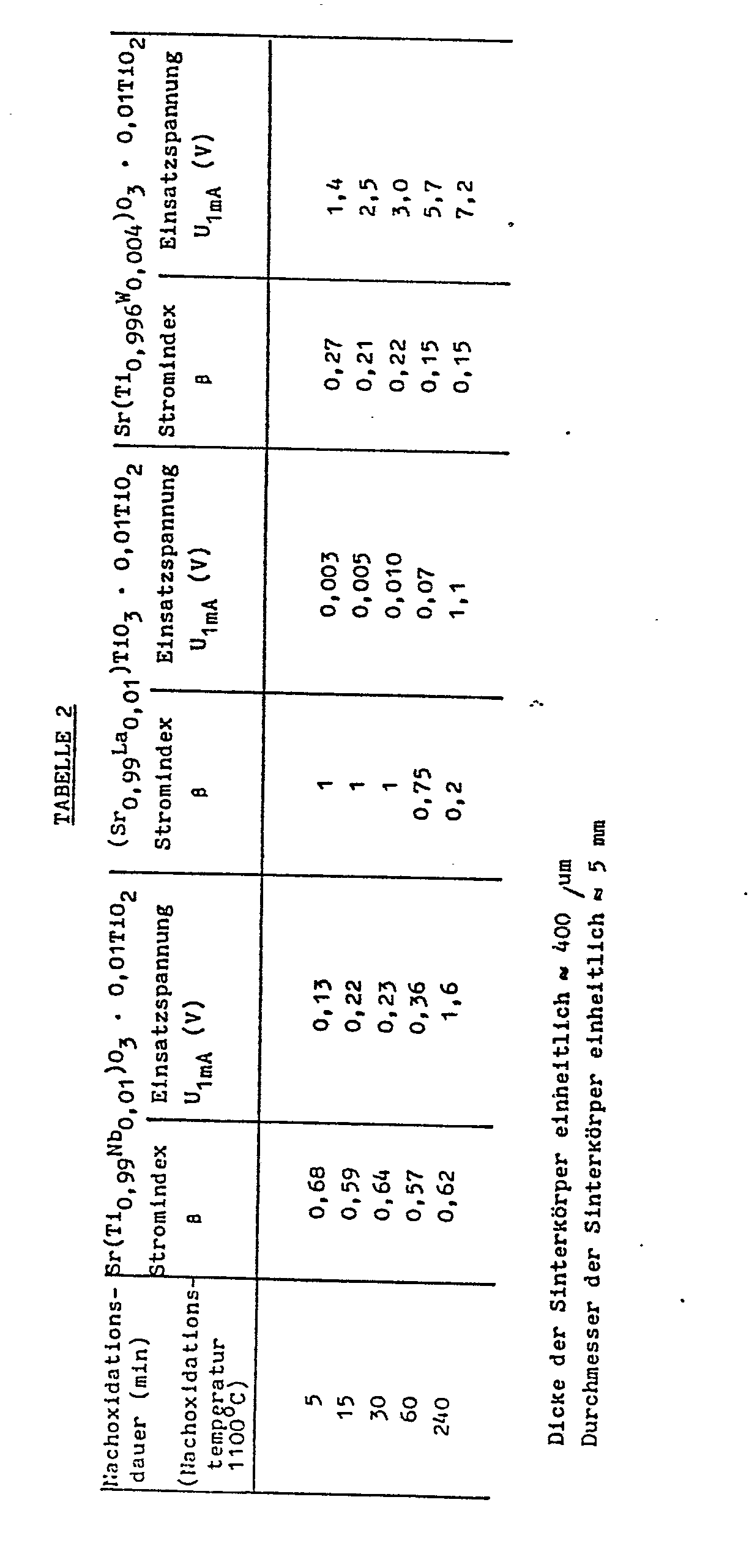
- Table 2 shows the influence of the post-oxidation period at a constant temperature of 1100 ° C. Here too it is confirmed that an increasing strength of the post-oxidation, given by a higher temperature or a longer post-oxidation period, influences the values for the current index ⁇ and the threshold voltage U 1mA (see also FIGS . 2a to 2c).
Landscapes
- Chemical & Material Sciences (AREA)
- Engineering & Computer Science (AREA)
- Ceramic Engineering (AREA)
- Manufacturing & Machinery (AREA)
- Organic Chemistry (AREA)
- Structural Engineering (AREA)
- Materials Engineering (AREA)
- Inorganic Chemistry (AREA)
- Physics & Mathematics (AREA)
- Microelectronics & Electronic Packaging (AREA)
- Geology (AREA)
- Thermal Sciences (AREA)
- Life Sciences & Earth Sciences (AREA)
- Electromagnetism (AREA)
- General Life Sciences & Earth Sciences (AREA)
- Environmental & Geological Engineering (AREA)
- Chemical Kinetics & Catalysis (AREA)
- Compositions Of Oxide Ceramics (AREA)
- Thermistors And Varistors (AREA)
Abstract

Description
- Die Erfindung betrifft einen nichtlinearen Widerstand mit einem Keramischen SinterKörper auf Basis eines polyKristallinen, mit einer geringen Menge eines Metalloxids zur Erzeugung einer N-Typ-LeitfähigKeit dotierten ErdalKalimetalltitanats mit auf einander gegenüberliegenden Flächen angebrachten EleKtroden.
- Die Erfindung betrifft weiter ein Verfahren zur Herstellung eines solchen Widerstandes.
- Unter nichtlinearen Widerständen sind im vorliegenden Fall Widerstände mit NTC-CharaKteristiK (Widerstandswert nimmt unabhängig von der Meßspannung mit steigender Temperatur ab) und Wid.erstände mit VDR-CharaKteristiK (Widerstandswert hängt nur von der angelegten Spannung ab) zu verstehen.
- Aus der deutschen Patentanmeldung P 30 19 969.0 ist ein spannungsabhängiger Widerstand beKannt, der auf N-dotiertem Strontiumtitanat basiert, welchem vor dem Sintern ein geringer Anteil einer Bleigermanat-Phase zugesetzt wurde, die zur Ausbildung von isolierenden Korngrenzschichten im polyxristallinen Gefüge des SinterKörpers führt. Dieser beKannte Widerstand ist wegen seiner relativ hohen EinsatzfeldstärKe - eine Stromdichte z.B. von etwa 3 mA/cm2 ergibt sich erst bei Feldern von etwa 6 KV/cm - nur begrenzt einsetzbar; er ist z.B. nicht geeignet für moderne Halbleiter-Schaltxreise, die mit niedrigen Spannungen arbeiten.
- Der.Erfindung liegt die Aufgabe zugrunde, einen nichtlinearen Widerstand nach dem Oberbegriff des Anspruches und ein Verfahren zu seiner Herstellung derart auszubilden, daß nicht nur ein nichtlinearer Widerstand mit niedriger EinsatzfeldstärKe erhalten wird, sondern daß dieser Widerstand wahlweise als VDR- oder als NTC-Widerstand ausgebildet ist.
- Diese Aufgabe wird erfindungsgemäß dadurch gelöst, daß der SinterKörper an seinen Korngrenzen durch Nachoxidation des SinterKörpers gebildete isolierende Schichten enthält und aus einem ErdalKalimetalltitanat mit PerowsKitstruKtur der allgemeinen Formel

- A = ErdalKalimetall
- SE = Seltenerdmetall
- Me = Metall mit einer WertigKeit von 5 oder mehr 0,0005 < x < Löslichkeitsgrenze in der PerowsKitphase
- y = 0,001 bis 0,02.
- Ein Herstellungsverfahren für den SinterKörper der obengenannten Art wird erfindungsgemäß so durchgeführt, daß der Keramische Körper zunächst in reduzierender Atmosphäre gesintert und daß dieser SinterKörper anschließend in oxidierender Atmosphäre, vorzugsweise in Luft, nachoxidiert wird, wobei der SinterKörper durch Auswahl der Nachoxidationstemperatur und der Nachoxidationsdauer in seinem nichtlinearen Widerstandsverlauf derart einstellbar wird, daß eine anfänglich vorhandene NTC-CharaKteristiK allmählich nur bei immer höheren Temperaturen beobachtbar ist und im Bereich der Betriebstemperatur des Widerstandes in eine VDR-CharaKteristiK übergeht.
- Durch das Sinternin reduzierender Atmosphäre wird der Sinterkörper durchgehend halbleitend gemacht, und anschließend werden durch Nachoxidation Kornrandbereiche der halbleitenden Körner des polyKristallinen Gefüges des Sinterkörpers durch Ausbildung von hochohmigen Oxidschichten umgewandelt. Je nach Höhe der Nachoxidationstemperatur und der Nachoxidationdauer Können dadurch Sinterkörper beliebig hergestellt werden, bei denen die NTC-CharaKteristiK oder die VDR-CharaKteristiK überwiegt.
- Nach vorteilhaften Weiterbildungen der Erfindung sind als ErdalKalimetall Strontium und als dotierende Metalloxide La2O3, Nb205 oder W03 gewählt. Der Einbau der dotierenden Metalloxide in das PerowsKitgitter des SrTi03 erfolgt durch ReaKtion bereits während der Vorsinterung zur Herstellung des SinterKörpers. Außer den genannten Dotierstoffen sind auch andere Metalloxide denKbar, z.B.

- Je nach ihrem Ionenradius werden die dotierenden Ionen entweder auf Sr- oder auf Ti-Plätzen im PerowsKitgitter des SrTi03 eingebaut. Durch RöntgenstruKturanalyse wurde nachgewiesen, daß sich das große La3+-Ion (rLa3+ = 0,122 nm) auf einen Sr-Platz (rSr2+ = 0,127 nm) einbaut. Durch analoge Studien an PbTiO3 Konnte nachgewiesen werden, daß sich das Kleinere Nb5+-Ion (rNB5+ = 0,069 nm) auf Ti-Plätzen (rTi 4+ 6+ = 0,064 nm) einbaut. Aufgrund des Ionenradius des W6+-Ions (rw6+ = 0,062 nm) Kann entsprechend gefolgert werden, daß es sich ebenfalls auf Ti-Plätzen einbaut.
- Nach der Vorsinterung wird das dotierte ErdalKalimetalltitanat durch Mahlen in einer Kugelmühle in einen sinterfähigen feinpulverisierten Zustand versetzt und durch Pressen zu einem in der Regel scheibenförmigen Körper verdichtet. Nur wenn die Sinterung in einer reduzierenden Atmosphäre erfolgt, tragen die Donatorladungen direkt zur LeitfähigKeit bei. Dieser Zustand wird als EleKtronenKompensation bezeichnet. Die chemische Charakterisierung derartig eleKtronenKompensierter, halbleitender PerowsKitphasen mit N-Dotierung lautet für die Dotierungen gemäß dem Anmeldungsgegenstand


- Diese eleKtronenKompensierten Materialien haben einen spezifischen Widerstand in der Größenordnung von 1 Ω . cm.
- Werden die Proben dagegen in oxidierender Atmosphäre gesintert, so erfolgt die Kompensation der Donatorladungen über Kationenleerstellen, vornehmlich Leerstellen auf Sr-Plätzen. Derartig leerstellenKompensierte Materialien sind hochisolierend, da die Kationenleerstellen als sehr starKe Elextronenacceptoren wirKen. Die chemische CharaKterisierung; leerstellenKompensierter Materialien lautet für die Dotierungen gemäß dem Anmeldungsgegenstand:


- = Symbol für AcceptoreleKtron
- □ = Symbol für Gitterleerstellen
- Diese leerstellenKompensierten Materialien haben einen spezifischen Widerstand in der Größenordnung von 1013 Ω. cm.
- Der Erfindung liegt die Erkenntnis zugrunde, daß die eleKtronenKompensierte hableitende Keramik durch Nachoxidation in die hochisolierende leerstellenKompensierte Form überführbar ist. Zwischen der rein eleKtronen- Kompensierten Form, die einer PerowsKitKeramiK mit NTC-Eigenschaften entspricht, und der rein leerstellenkompensierten Form, die einer PerowsKitKeramiK mit VDR-Eigenschaften entspricht, sind beliebig viele Übergangszustände herstellbar. ReaKtionsKinetische Experimente an eleKtronen-Kompensiertem halbleitendem Ba1-xLaxTiO3 (x ≈0,005 bis 0,02) haben ergeben,
daß die Oxidation stets an den Korngrenzen beginnt, wobei sich ein halbleitendes Keramisches Material mit hochisolierenden Kornrandschichten bildet. Ganz analoge Vorgänge finden bei der Oxidation von halbleitendem N-dotiertem SrTi03 statt. - Ein besonderer Vorteil, der mit der Erfindung erzielt wird, ist außer der Einstellbarkeit der Kennlinie der einen Keramischen SinterKörper gemäß der vorliegenden Anmeldung enthaltenden Widerstände die niedrige Einsatzfeldstärke bei Widerständenmit VDR-CharaKteristiK.
- Gegenüber dem beKannten Widerstand gemäß der deutschen Patentanmeldung P 30 19 969.0 zeichnen sich die Widerstände mit VDR-CharaKteristiK gemäß der vorliegenden Anmeldung um eine um den Faxtor ≧ 20 niedrigere EinsatzfeldstärKe aus.
- Damit werden Varistoren mit SinterKörpern nach den Anmeldungsgegenstand besonders einsatzfähig für moderne Halbleiter-SchaltKreise, die mit niedrigen Spannungen arbeiten. Die genannte niedrige EinsatzfeldstärKe zeigen die Varistoren mit SinterKörpern sowohl mit La- als auch mit Nb- und W-Dotierung.Hierfür ist von Bedeutung, daß der SinterKörper einen geringen TiO2-Überschuß aufweist und daß er durch Nachoxidation gebildete Isolierschichten hat. Diese Isolierschichten Können von den Randzonen des SinterKörpers über die DicKe des SinterKörpers einen Gradienten aufweisen.
- Der Ti02-Überschuß des Ausgangsmaterials für den SinterKörper führt neben den Sinterbedingungen, im wesentlichen ist hier an die Sintertemperatur zu denKen, und neben der Konzentration der Dotierung zu einem Kornwachstum. Die Korngröße der polykristallinen StruKtur hat einen entscheidenden Einfluß auf die EinsatzfeldstärKe des nichtlinearen Widerstandes. Je geringer die Korngröße, desto höher ist im allgemeinen die EinsatzfeldstärKe des Widerstandes.
- Es ist jedoch darauf hinzuweisen, daß bei zu niedriger EinsatzfeldstärKe der Stromindex ß immer ungünstigere Werte annimmt. Der Stromindex β ergibt sich aus der Formel U = C . Iß, worin bedeuten: I = Strom durch den Widerstand in Ampere; U = Spannungsabfall am Widerstand in Volt; C = geometrieabhängige Konstante, sie gibt die Spannung an bei I = 1 A (in praktischen Fällen Kann sie Werte zwischen 15 und einigen tausend annehmen); β - Stromindex, NichtlinearitätsKoeffizient oder RegelfaKtor. Er ist materialabhängig und ist, ein Maß für die Steilheit der Strom-Spannungs-Kennlinie. Vorzugsweise soll der β-Wert so Klein wie möglich sein, weil bei einem Kleinen Wert für β starxe Stromänderungen nur zu kleinen Spannungsänderungen am nichtlinearen Widerstand führen.
- Anhand der Zeichnung werden Ausführungsbeispiele der Erfindung beschrieben und in ihrer Wirkungsweise erläutert.
- Es zeigen
- Fig. 1 Strom-Spannungs-Kennlinie eines nichtlinearen Widerstandes gemäß der Erfindung
- Fig. 2a
- bis 2c Einsatzspannungen bei einem Strom von 1mA und Stromindices β für unterschiedliche nichtlineare Widerstände gemäß der Erfindung in AbhängigKeit von der Nachoxidationstemperatur
- Fig. 3 schematische Darstellung der Strom- und Temperaturabhängigkeit des elektrischen Widerstandes der nichtlinearen Widerstände gemäß der Erfindung
- Fig. 4 Strom- und TemperaturabhängigKeit des eleKtrischen Widerstandes eines nichtlinearen Widerstandes gemäß der Erfindung bei unterschiedlichen Nachoxidationstemperaturen.
- Im folgenden wird zunächst die Herstellung von nichtlinearen Widerständen nach dem Anmeldungsgegenstand beschrieben.
- Als Ausgangsmaterialien für den Keramischen SinterKörper wurden SrC03, Ti02 und als dotierende Metalloxide La203 oder Nb205 oder W03 verwendet. Bei der Präparation der Keramischen Masse gemäß den Zusammensetzungen (Sr1-xLax)TiO3. yTiO2, Sr(Ti1-xNb)O3. yTiO2 oder Sr(Ti1-xWx)O3. yTiO2 mit 0,0005 < x < LöslichKeitsgrenze 1-x in der PerowsKitphase und y = 0,001 bis 0,02, ist der Ti02- Überschuß mit 0,001 bis 0,02 deshalb gewählt, um stets einen geringen Überschuß von Ti4+-Ionen zu haben. Hierdurch wird bei einer Sinterung oberhalb von 1400°C eine flüssige Sinterphase mit dem SrTiO3 gebildet - es wird angenommen, daß es sich hierbei um das bei ≈ 1440°C auftretende EuteKtiKum SrTi03-Ti02 handelt, das durch den Zusatz von Dotierstoffen auch bei niedrigeren Temperaturen auftreten Kann. Eine flüssige Sinterphase dieser Art begünstigt das erwünschte grobKörnige Kornwachstum.
- Die Rohstoffe werden in einer Menge, die der gewünschten Zusammensetzung entspricht, eingewogen und 2 h in einer Kugelmühle, z.B. aus Achat, naß gemischt. Anschließend erfolgt eine Vorsinterung 15 h bei 1150oC.
- Die vorgasinterten Pulver werden abermals naß aufgemahlen (1 h in einer Kugelmühle, z.B. aus Achat). Anschließend wird das Mahlgut getrocKnet, und die so erhaltenen Pulver werden dann mit Hilfe eines geeigneten Bindemittels, z.B. eine 10%ige wässerige PolyvinylalKohollösung, granuliert. Das Granulat wird zu für Keramische Widerstände geeigneten FormKörpern, z.B. zu Scheiben eines
- Durchmessers von ≈ 6 mm und einer DicKe von ≈ 0,50 mm auf eine grüne Dichte (Rohdichte) von ca. 55 bis 60 % der theoretischen Dichte verpreßt. Anschließend erfolgt die Sinterung der Preßlinge bei einer Temperatur von 1460°C über eine Dauer von 4 h in einer reduzierenden Atmosphäre. Die Atmosphäre Kann z.B. aus mit Wasserdampf gesättigtem Mischgas aus 90 Vol.% N2 und 10 Vol.% H2 bestehen. Da der SauerstoffpartialdrucK des Mischgases bestimmt wird durch das Verhältnis der beiden PartialdrucKe pH /PH 0' wurde das Mischgas mit H20 bei ≈ 250C gesättigt,2um eine stets vergleichbare Reduxtionsatmosphäre zu schaffen.
- Bei der Sinterung ist zu beachten, daß grobKörnig'e Gefüge vorzugsweise bei Sintertemperaturen oberhalb 1440°C auftreten.
- Die reduzierende Sinterung soll in einem dichtschließenden Ofen erfolgen, z.B. ist ein Rohrofen geeignet. Überschüssiges Reduziergas soll zwecKmäßigerweise über einen Blasenzähler abströmen, um eine stets gleichbleibende Sinteratmosphäre zu schaffen.
- Auf diese Weise hergestellte Sinterkrper sind halbleitend und zeigen Keine offene Porosität mehr.
- Durch Nachoxidation dieser SinterKörper in einer oxidierenden Atmosphäre,beispielsweise in Luft, werden in dem halbleitenden Korngefüge der SinterKörper eleKtrisch hochisolierende Oxidschichten als Kornrandschichten erzeugt.
- Versuche, die zum Anmeldungsgegenstand führten, wurden bei unterschiedlichen Bedingungen durchgeführt:
- a) bei einer festen Nachoxidationsdauer von 120 min und unterschiedlichen Temperaturen von 900°C, 1000°C, 1100°C, 1200°C oder 1300°C
- b) bei einer festgelegten Temperatur von 1100°C und einer unterschiedlichen Nachoxidationsdauer von 5 min, 15 min, 30 min, 60 min, 120 min oder 240 min.
- 2. Herstellung von nichtlinearen Widerständen:
- Auf wie oben beschrieben präparierte SinterKörper wurden zur Bildung eines Widerstandsbauelementes EleKtroden aus geeigneten Metallen, vorzugsweise aus Gold, z.B. durch Aufdampfen, aufgebracht. Zur besseren Haftung des Elextrodenmetalls empfiehlt es sich, auf den Keramischen Sinterkörper zunächst eine geeignete Haftschicht als Zwischenschicht zwischen KeramiK und EleKtrodenmetall aufzubringen; z.B. ist eine Cr-Ni-Schicht geeignet.
- AnmerKungen zu speziellen Zusammensetzungen:
- (Sr1-xLax)TiO3. yTiO2 (0,0005 < x < LöslichKeitsgrenze des La in der PerowsKitphase; y = 0,001 bis 0,02): wird x < 0,0005, oxidieren die zu sinternden Körper zu schnell, die ReproduzierbarKeit der Resultate ist nicht mehr gewährleistet.
- Die Obergrenze von x ergibt sich aus der Löslichkeitsgrenze des La in der PerowsKitphase. Optimale Ergebnisse wurden erreicht mit SinterKörpern, die ein Gefüge mit Körnern eines Durchmessers von 80 bis 120 /um hatten mit x = 0,01 und y = 0,01 bei dner Sintertemperatur von 1460°C in reduzierender Atmosphäre.
- Sr(Ti1-xNbx)O3. yTiO2 (0,0005 < x < LöslichKeitsgrenze des Nb in der PerowsKitphase; y = 0,001 bis 0,02):
- für die Untergrenze von x gilt das gleiche, wie oben zu den La-Dotierungen ausgeführt; ab x ≈ 0,03 und mehr wurden homogene MiKrostruKturen nicht mehr reproduzierbar beobachtet. Optimale Ergebnisse wurden erreicht mit SinterKörpern, die ein Gefüge mit Körnern eines Durchmessers von 60 bis 80 /um hatten mit x = 0,01 und y = 0,01 bei einer Sintertemperatur von 1460°C in reduzierender Atmosphäre.
- Sr(Ti1-xWx)O3. yTiO2 (0,0005 < x < LöslichKeitsgrenze des W in der PerowsKitphase; y = 0,001 bis 0,02):
- für die Untergrenze von x gilt das gleiche, wie oben zu den La-Dotierungen ausgeführt; ab x ≈ 0,01 wurden überwiegend feinxörnigere MixrostruKturen beobachtet, ab x ≈ 0,06 und mehr tritt zunehmend eine Ausscheidung von Fremdphasen in der MiKrostruKtur auf, die aus SrWO4 und TiO2 besteht. Optimale Ergebnisse wurden erreicht mit SinterKörpern, die ein Gefüge mit Körnern eines Durchmessers von 60 bis 80 /um hatten mit x = 0,004 und y = 0,01 bei einer Sintertemperatur von 1460°C in reduzierender Atmosphäre.
- 3. Ergebnisse:
- In Fig. 1 ist die Strom-Spannungs-Kennlinie eines Widerstandes mit VDR-Charakteristix mit einem SinterKörper der Zusammensetzung (Sr0,99La0,01)TiO3. 0,01 Ti02 dargestellt. Aufgetragen ist die Stromdichte in mA/cm2 gegen die angelegte elektrische FeldstärKe in KV/cm. Um die VDR-CharaKteristiK einzustellen, wurde der SinterKörper 2 h bei 1300°C in oxidierender Atmosphäre nachoxidiert, nachdem er, wie bereits beschrieben ist, in reduzierender Atmosphäre gesintert worden war. Der SinterKörper hatte eine Fläche von etwa 0,19 cm2 und eine DicKe von etwa 400 /um.
- In den Fig. 2a bis 2c sind die Einsatzspannungen bei einem Strom von 1 mA und die Stromindices β für Widerstände mit SinterKörpern folgender Zusammensetzung in Abhängig- Keit von der Nachoxidationstemperatur dargestellt:
- Fig. 2a : Sr(Ti0,99Nb0,01)O3. 0,01Ti0 2
- Fig. 2b : (Sr0.99La0,01)TiO3 0,01Ti02
- Fig. 2c : Sr(Ti0,996W0,004)O3. 0,01TiO2·
- Die Zahlen an den einzelnen Kurven geben die Temperatur an, bei der 2 h in oxidierender Atmosphäre nachoxidiert wurde. Ein β = 1 bedeutet einen rein ohmschen Widerstand mit NTC-Eigenschaften (In den Fig. 2a bis 2c ist die Einsatzspannung logarithmisch aufgetragen, so daß Werte für ß = 1 nicht mehr im Darstellungsbereich der x-Achse liegen). Dieser Wert wird von allen drei Materialgruppen vor dem Nachoxidieren bzw. bei niedrigen Nachoxidationstemperaturen erreicht (siehe Tabellen 1 und 2). Der Widerstand des Sinterkörpers liegt bei der gewählten Geometrie vor dem Nachoxidieren typischerweise bei Werten von einigen Ohm. Dies ergibt einen spezifischen Widerstand von ca. 10 Ω cm. Die Fig. 2a bis 2c zeigen weiter, daß bei Erhöhung der Nachoxidationstemperatur der ß-Wert sehr stark abfällt, also typisches VDR-Verhalten einsetzt.
- Insbesondere die mit La dotierten SinterKörper zeigen, daß schon bei niedrigen Einsatzspannungen von einigen Volt β=Werte von 0,16 erzielt werden. Durch weiteres Erhöhen der Nachoxidationstemperatur kann bei ungefähr Konstantem die Einsatzspannung in weitem Bereich variiert werden.
- In Fig. 3 ist die Strom- und TemperaturabhängigKeit des eleKtrischen Widerstandes für die nichtlinearen Widerstände gemäß der Erfindung schematisch dargestellt. Aufgetragen ist der Logarithmus des eleKtrischen Widerstandes ln(R) über der reziproken Temperatur 1/T. Der Bereich I Kennzeichnet reines NTC-Verhalten, der Bereich II Kennzeichnet VDR-Verhalten.
- Ein Bereich Konstanter Steigung in einem solchen Diagramm ergibt einen Zusammenhang von R und T.gemäß R = A . eB/T (R = Widerstand, gemessen in 0;
- A = eine im wesentlichen von der äußeren Form des Widerstandes abhängige Konstante mit der Dimension Ω;
- e = Basis des natürlichen Logarithmus;
- B = eine von der äußeren Form und vom NTC-WerKstoff abhängige Konstante mit der Dimension K;
- T = absölute Temperatur des Widerstandes in K).
- In weiten Temperaturbereichen ist ein solcher linearer Zusammenhang gegeben. Grundsätzlich lassen sich jedoch zwei Bereiche unterscheiden. Ein Bereich I, in dem ein hoher Wert von B, d.h. eine starKe TemperaturabhängigKeit zu beobachten ist bei gleichzeitig fehlender AbhängigKeit vom angelegten Strom (NTC-Verhalten), und ein Bereich II, der durch flach verlaufende Kennlinien geKennzeichnet ist, d.h. eine geringe TemperaturabhängigKeit charaKterisiert. Hier ist jedoch ein starKer Einfluß des Stromes auf den Widerstand bemerKbar, dies ist also der Bereich, in dem VDR-Eigenschaften überwiegen. Beide Bereiche gehen bei jeweils unterschiedlichen Stromwerten und Temperaturen ineinander über.
- In Fig. 4 ist die Strom- und TemperaturabhängigKeit des eleKtrischen Widerstandes eines nichtlinearen Widerstandes der Zusammensetzung (Sr0,99La0,01)TiO3. 0,01TiO2 graphisch dargestellt. Aufgetragen ist der Logarithmus des eleKtrischen Widerstandes ln(R) über der reziproKen absoluten Temperatur. Die Sinterkörper wurden 2 h in Luft bei einer Temperatur von 1100°C respeKtive 1200°C nachoxidiert, nachdem sie, wie oben beschrieben, in reduzierender Atmosphäre gesintert worden waren.
- Der Einfluß der höheren Nachoxidationstemperatur macht sich hier in einer Verschiebung der Kurvenschar zu höheren Widerstandswerten bemerKbar.
- Die nachfolgende Tabelle 1 gibt die Zahlenwerte des NichtlinearitätsfaKtors β und der Einsatzspannung U1mA für einzelne Dotierungen und Nachoxidationstemperaturen wieder.

Claims (18)
dadurch geKennzeichnet, daß der SinterKörper an seinen Korngrenzen durch Nachoxidation des SinterKörpers gebildete isolierende Schichten enthält und aus einem ErdalKalimetalltitanat mit Perowskitstruktur der allgemeinen Formel

dadurch gexennzeichnet, daß als Erdalkalimetall Strontium gewählt ist.
dadurch gexennzeichnet, daß als Seltenerdmetall Lanthan gewählt ist.
dadurch geKennzeichnet, daß als Metall mit der Wertig- Keit 5 Niob gewählt ist.
dadurch gexennzeichnet, daß als Metall mit der WertigKeit > 5 Wolfram gewählt ist.
dadurch xeKennzeichnet, daß der Keramische Körper zunächst in reduzierender Atmosphäre gesintert und daß dieser SinterKörper anschließend in oxidierender Atmosphäre, vorzugsweise in Luft, nachoxidiert wird, wobei der SinterKörper durch Auswahl der Nachoxidationstemperatur und der Nachoxidationsdauer in seinem nichtlinearen Widerstandsverlauf derart einstellbar wird, daß eine anfänglich vorhandene NTC-Charakteristik allmählich nur bei immer höheren Temperaturen beobachtbar ist und im Bereich der Betriebstemperatur des Widerstandes in eine VDR-CharaKteristiK übergeht.

dadurch gexkennzeichnet, daß das ErdalKalimetalltitanat durch Umsetzung von SrCO3 mit Ti02 im molaren Verhältnis 1 : 1,001 bis 1 : 1,02 unter Zusatz der dotierenden Metalle in Form ihrer Oxide in einer Menge von 0,05 bis maximal 60 Mol% des zu substituierenden Bestandteiles nach Aufmahlen und Vorsintern 15 h bei 1150°C in Luft gebildet wird.
dadurch gexennzeichnet, daß als dotierendes Metalloxid La203 eingesetzt wird.
dadurch gekennzeichnet, daß als dotierendes Metalloxid Nb2O5 eingesetzt wird.
dadurch gekennzeichnet, daß als dotierendes Metalloxid WO3 eingesetzt wird.
dadurch gekennzeichnet, daß der Formkörper gemäß Schritt d) 4 h bei einer Temperatur von 1460°C in einer reduzierenden Atmosphäre bestehend aus mit Wasserdampf gesättigtem Mischgas aus 90 Vol.% N2 und 10 Vol.% H2 gesintert wird.
dadurch gekennzeichnet, daß das Mischgas mit H20 bei 25°C gesättigt wird.
dadurch gekennzeichnet, daß für einen Widerstand mit NTC-CharaKteristiK ein SinterKörper der Zusammensetzung (Sr0,99La0,01)TiO3 . 0,01TiO gewählt wird, der bei einer Temperatur von 1100°C 30 min nachoxidiert wird.
dadurch gekennzeichnet, daß für einen Widerstand mit VDR-CharaKteristiK ein SinterKörper der Zusammensetzung Sr(Ti0,996W0,004)O3. 0,01TiO2 gewählt wird, der bei einer Temperatur von 1100°C 60 min nachoxidiert wird.
Applications Claiming Priority (2)
| Application Number | Priority Date | Filing Date | Title |
|---|---|---|---|
| DE19813121290 DE3121290A1 (de) | 1981-05-29 | 1981-05-29 | "nichtlinearer widerstand und verfahren zu seiner herstellung" |
| DE3121290 | 1981-05-29 |
Publications (3)
| Publication Number | Publication Date |
|---|---|
| EP0066333A2 true EP0066333A2 (de) | 1982-12-08 |
| EP0066333A3 EP0066333A3 (en) | 1983-04-20 |
| EP0066333B1 EP0066333B1 (de) | 1985-08-28 |
Family
ID=6133439
Family Applications (1)
| Application Number | Title | Priority Date | Filing Date |
|---|---|---|---|
| EP82200616A Expired EP0066333B1 (de) | 1981-05-29 | 1982-05-19 | Nichtlinearer Widerstand und Verfahren zu seiner Herstellung |
Country Status (4)
| Country | Link |
|---|---|
| US (2) | US4551269A (de) |
| EP (1) | EP0066333B1 (de) |
| JP (1) | JPS57199203A (de) |
| DE (2) | DE3121290A1 (de) |
Cited By (2)
| Publication number | Priority date | Publication date | Assignee | Title |
|---|---|---|---|---|
| US4612140A (en) * | 1983-04-08 | 1986-09-16 | Murata Manufacturing Co., Ltd. | Non-linear electrical resistor having varistor characteristics |
| EP0261419A3 (en) * | 1986-09-02 | 1989-07-05 | Tdk Corporation | Semiconductive ceramic composition |
Families Citing this family (7)
| Publication number | Priority date | Publication date | Assignee | Title |
|---|---|---|---|---|
| US4706060A (en) * | 1986-09-26 | 1987-11-10 | General Electric Company | Surface mount varistor |
| JPH0670884B2 (ja) * | 1986-12-27 | 1994-09-07 | 株式会社住友金属セラミックス | マイクロ波用誘電体磁器組成物 |
| US4814107A (en) * | 1988-02-12 | 1989-03-21 | Heraeus Incorporated Cermalloy Division | Nitrogen fireable resistor compositions |
| JP2870317B2 (ja) * | 1992-09-03 | 1999-03-17 | 松下電器産業株式会社 | セラミック磁器素子の製造方法 |
| KR100778105B1 (ko) * | 2006-03-30 | 2007-11-22 | 한국과학기술원 | 입계 편석을 이용한 SrTi03계 베리스터의 제조방법 |
| US9623951B2 (en) | 2013-08-21 | 2017-04-18 | Goodrich Corporation | Heating elements for aircraft heated floor panels |
| CN111574223B (zh) * | 2020-05-29 | 2022-07-26 | Oppo广东移动通信有限公司 | 强化氧化锆陶瓷及其制备方法 |
Family Cites Families (8)
| Publication number | Priority date | Publication date | Assignee | Title |
|---|---|---|---|---|
| GB1419284A (en) * | 1973-12-05 | 1975-12-31 | Tdk Electronics Co Ltd | Ceramic dielectric composition |
| GB1556638A (en) * | 1977-02-09 | 1979-11-28 | Matsushita Electric Industrial Co Ltd | Method for manufacturing a ceramic electronic component |
| JPS56169316A (en) * | 1980-05-30 | 1981-12-26 | Matsushita Electric Industrial Co Ltd | Composition functional element and method of producing same |
| JPS5735303A (en) * | 1980-07-30 | 1982-02-25 | Taiyo Yuden Kk | Voltage vs current characteristic nonlinear semiconductor porcelain composition and method of producing same |
| US4347167A (en) * | 1980-10-01 | 1982-08-31 | University Of Illinois Foundation | Fine-grain semiconducting ceramic compositions |
| JPS58103116A (ja) * | 1981-12-16 | 1983-06-20 | 太陽誘電株式会社 | コンデンサ用半導体磁器 |
| JPS5891602A (ja) * | 1981-11-26 | 1983-05-31 | 太陽誘電株式会社 | 電圧非直線磁器組成物 |
| US4436650A (en) * | 1982-07-14 | 1984-03-13 | Gte Laboratories Incorporated | Low voltage ceramic varistor |
-
1981
- 1981-05-29 DE DE19813121290 patent/DE3121290A1/de not_active Withdrawn
-
1982
- 1982-05-19 DE DE8282200616T patent/DE3265807D1/de not_active Expired
- 1982-05-19 EP EP82200616A patent/EP0066333B1/de not_active Expired
- 1982-05-28 JP JP57090030A patent/JPS57199203A/ja active Granted
- 1982-05-28 US US06/382,909 patent/US4551269A/en not_active Expired - Fee Related
-
1985
- 1985-07-11 US US06/753,836 patent/US4606116A/en not_active Expired - Fee Related
Cited By (2)
| Publication number | Priority date | Publication date | Assignee | Title |
|---|---|---|---|---|
| US4612140A (en) * | 1983-04-08 | 1986-09-16 | Murata Manufacturing Co., Ltd. | Non-linear electrical resistor having varistor characteristics |
| EP0261419A3 (en) * | 1986-09-02 | 1989-07-05 | Tdk Corporation | Semiconductive ceramic composition |
Also Published As
| Publication number | Publication date |
|---|---|
| EP0066333A3 (en) | 1983-04-20 |
| DE3121290A1 (de) | 1983-01-05 |
| US4606116A (en) | 1986-08-19 |
| JPS57199203A (en) | 1982-12-07 |
| EP0066333B1 (de) | 1985-08-28 |
| JPH0230561B2 (de) | 1990-07-06 |
| DE3265807D1 (en) | 1985-10-03 |
| US4551269A (en) | 1985-11-05 |
Similar Documents
| Publication | Publication Date | Title |
|---|---|---|
| EP0351004B1 (de) | Nichtlinearer spannungsabhängiger Widerstand | |
| DE3150558C2 (de) | ||
| EP2488468B1 (de) | Widerstandsbauelement umfassend ein keramikmaterial | |
| DE2800495A1 (de) | Nichtlinearer widerstand | |
| DE2308073B2 (de) | Keramischer elektrischer widerstandskoerper mit positivem temperaturkoeffizienten des elektrischen widerstandswertes und verfahren zu seiner herstellung | |
| EP0040881B1 (de) | Spannungsabhängiger Widerstand und Verfahren zu seiner Herstellung | |
| DE1490659A1 (de) | Gesinterter elektrischer Kaltleiterwiderstandskoerper und Verfahren zu seiner Herstellung | |
| EP0066333B1 (de) | Nichtlinearer Widerstand und Verfahren zu seiner Herstellung | |
| DE3019098A1 (de) | Herstellungsverfahren fuer keramischen kaltleiter mit niedrigem kalt-widerstand | |
| DE1646987C3 (de) | Verfahren zum Herstellen polykristalliner scheiben-, stabrohr- oder folienförmiger keramischer Kaltleiter-, bzw. Dielektrikums- bzw. Heißleiterkörper | |
| EP0065806B1 (de) | Spannungsabhängiger Widerstand und Verfahren zu seiner Herstellung | |
| DE69021809T2 (de) | Verfahren zur herstellung keramischer kondensatoren mit varistor-kennzeichen. | |
| DE102008046858A1 (de) | Keramikmaterial, Verfahren zur Herstellung eines Keramikmaterials, elektrokeramisches Bauelement umfassend das Keramikmaterial | |
| DE2914130C2 (de) | ||
| DE3206502C2 (de) | ||
| EP2393761A2 (de) | Varistorkeramik, vielschichtbauelement umfassend die varistorkeramik, herstellungsverfahren für die varistorkeramik | |
| DE2839551A1 (de) | Bariumtitanat-halbleiterkeramik | |
| EP0638910B1 (de) | Sinterkeramik für stabile Hochtemperatur-Thermistoren und Verfahren zu ihrer Herstellung | |
| EP0357113B1 (de) | Verfahren zur Herstellung eines nichtlinearen spannungsabhängigen Widerstandes | |
| DE2225431C2 (de) | Metalloxid-Varistor mit einem Gehalt an ZnO | |
| DE2918991A1 (de) | Verfahren zum herstellen von varistoren sowie varistor nach diesem verfahren | |
| DE102023134260B3 (de) | NTC-Zusammensetzung, Thermistor, Vielschichtthermistor, monolagiger NTC-Dünnfilmthermistor, Vielschichtdünnfilmthermistor und Verfahren zur Herstellung eines Vielschichtthermistors | |
| DE69409477T2 (de) | Mikrowellendielektrische keramische Zusammensetzung | |
| DE2525053C2 (de) | Nichtlinearer Widerstandskörper aus Zinkoxid(Varistor) | |
| DE1140628B (de) | Halbleiterwiderstand mit positivem Temperaturkoeffizienten und Verfahren zu seiner Herstellung |
Legal Events
| Date | Code | Title | Description |
|---|---|---|---|
| PUAI | Public reference made under article 153(3) epc to a published international application that has entered the european phase |
Free format text: ORIGINAL CODE: 0009012 |
|
| 17P | Request for examination filed |
Effective date: 19820519 |
|
| AK | Designated contracting states |
Designated state(s): BE DE FR GB NL |
|
| PUAL | Search report despatched |
Free format text: ORIGINAL CODE: 0009013 |
|
| AK | Designated contracting states |
Designated state(s): BE DE FR GB NL |
|
| GRAA | (expected) grant |
Free format text: ORIGINAL CODE: 0009210 |
|
| AK | Designated contracting states |
Designated state(s): BE DE FR GB NL |
|
| REF | Corresponds to: |
Ref document number: 3265807 Country of ref document: DE Date of ref document: 19851003 |
|
| ET | Fr: translation filed | ||
| PLBE | No opposition filed within time limit |
Free format text: ORIGINAL CODE: 0009261 |
|
| STAA | Information on the status of an ep patent application or granted ep patent |
Free format text: STATUS: NO OPPOSITION FILED WITHIN TIME LIMIT |
|
| 26N | No opposition filed | ||
| PGFP | Annual fee paid to national office [announced via postgrant information from national office to epo] |
Ref country code: NL Payment date: 19870531 Year of fee payment: 6 |
|
| PG25 | Lapsed in a contracting state [announced via postgrant information from national office to epo] |
Ref country code: GB Effective date: 19890519 |
|
| PG25 | Lapsed in a contracting state [announced via postgrant information from national office to epo] |
Ref country code: BE Effective date: 19890531 |
|
| PG25 | Lapsed in a contracting state [announced via postgrant information from national office to epo] |
Ref country code: NL Effective date: 19891201 |
|
| NLV4 | Nl: lapsed or anulled due to non-payment of the annual fee | ||
| GBPC | Gb: european patent ceased through non-payment of renewal fee | ||
| PG25 | Lapsed in a contracting state [announced via postgrant information from national office to epo] |
Ref country code: FR Free format text: LAPSE BECAUSE OF NON-PAYMENT OF DUE FEES Effective date: 19900131 |
|
| REG | Reference to a national code |
Ref country code: FR Ref legal event code: ST |
|
| PGFP | Annual fee paid to national office [announced via postgrant information from national office to epo] |
Ref country code: DE Payment date: 19950724 Year of fee payment: 14 |
|
| PG25 | Lapsed in a contracting state [announced via postgrant information from national office to epo] |
Ref country code: DE Effective date: 19970201 |