EP0066419A2 - Verfahren zur Gewinnung von Uran - Google Patents
Verfahren zur Gewinnung von Uran Download PDFInfo
- Publication number
- EP0066419A2 EP0066419A2 EP82302567A EP82302567A EP0066419A2 EP 0066419 A2 EP0066419 A2 EP 0066419A2 EP 82302567 A EP82302567 A EP 82302567A EP 82302567 A EP82302567 A EP 82302567A EP 0066419 A2 EP0066419 A2 EP 0066419A2
- Authority
- EP
- European Patent Office
- Prior art keywords
- uranium
- separator
- slurry
- nitric acid
- aqueous
- Prior art date
- Legal status (The legal status is an assumption and is not a legal conclusion. Google has not performed a legal analysis and makes no representation as to the accuracy of the status listed.)
- Granted
Links
Images
Classifications
-
- C—CHEMISTRY; METALLURGY
- C22—METALLURGY; FERROUS OR NON-FERROUS ALLOYS; TREATMENT OF ALLOYS OR NON-FERROUS METALS
- C22B—PRODUCTION AND REFINING OF METALS; PRETREATMENT OF RAW MATERIALS
- C22B60/00—Obtaining metals of atomic number 87 or higher, i.e. radioactive metals
- C22B60/02—Obtaining thorium, uranium, or other actinides
- C22B60/0204—Obtaining thorium, uranium, or other actinides obtaining uranium
- C22B60/0208—Obtaining thorium, uranium, or other actinides obtaining uranium preliminary treatment of ores or scrap
-
- C—CHEMISTRY; METALLURGY
- C22—METALLURGY; FERROUS OR NON-FERROUS ALLOYS; TREATMENT OF ALLOYS OR NON-FERROUS METALS
- C22B—PRODUCTION AND REFINING OF METALS; PRETREATMENT OF RAW MATERIALS
- C22B60/00—Obtaining metals of atomic number 87 or higher, i.e. radioactive metals
- C22B60/02—Obtaining thorium, uranium, or other actinides
-
- C—CHEMISTRY; METALLURGY
- C22—METALLURGY; FERROUS OR NON-FERROUS ALLOYS; TREATMENT OF ALLOYS OR NON-FERROUS METALS
- C22B—PRODUCTION AND REFINING OF METALS; PRETREATMENT OF RAW MATERIALS
- C22B60/00—Obtaining metals of atomic number 87 or higher, i.e. radioactive metals
- C22B60/02—Obtaining thorium, uranium, or other actinides
- C22B60/0204—Obtaining thorium, uranium, or other actinides obtaining uranium
- C22B60/0217—Obtaining thorium, uranium, or other actinides obtaining uranium by wet processes
- C22B60/0221—Obtaining thorium, uranium, or other actinides obtaining uranium by wet processes by leaching
- C22B60/0226—Obtaining thorium, uranium, or other actinides obtaining uranium by wet processes by leaching using acidic solutions or liquors
- C22B60/0239—Obtaining thorium, uranium, or other actinides obtaining uranium by wet processes by leaching using acidic solutions or liquors nitric acid containing ion as active agent
-
- C—CHEMISTRY; METALLURGY
- C22—METALLURGY; FERROUS OR NON-FERROUS ALLOYS; TREATMENT OF ALLOYS OR NON-FERROUS METALS
- C22B—PRODUCTION AND REFINING OF METALS; PRETREATMENT OF RAW MATERIALS
- C22B60/00—Obtaining metals of atomic number 87 or higher, i.e. radioactive metals
- C22B60/02—Obtaining thorium, uranium, or other actinides
- C22B60/0204—Obtaining thorium, uranium, or other actinides obtaining uranium
- C22B60/0217—Obtaining thorium, uranium, or other actinides obtaining uranium by wet processes
- C22B60/0221—Obtaining thorium, uranium, or other actinides obtaining uranium by wet processes by leaching
- C22B60/0247—Obtaining thorium, uranium, or other actinides obtaining uranium by wet processes by leaching using basic solutions or liquors
-
- C—CHEMISTRY; METALLURGY
- C22—METALLURGY; FERROUS OR NON-FERROUS ALLOYS; TREATMENT OF ALLOYS OR NON-FERROUS METALS
- C22B—PRODUCTION AND REFINING OF METALS; PRETREATMENT OF RAW MATERIALS
- C22B60/00—Obtaining metals of atomic number 87 or higher, i.e. radioactive metals
- C22B60/02—Obtaining thorium, uranium, or other actinides
- C22B60/0204—Obtaining thorium, uranium, or other actinides obtaining uranium
- C22B60/0217—Obtaining thorium, uranium, or other actinides obtaining uranium by wet processes
- C22B60/0252—Obtaining thorium, uranium, or other actinides obtaining uranium by wet processes treatment or purification of solutions or of liquors or of slurries
- C22B60/026—Obtaining thorium, uranium, or other actinides obtaining uranium by wet processes treatment or purification of solutions or of liquors or of slurries liquid-liquid extraction with or without dissolution in organic solvents
-
- C—CHEMISTRY; METALLURGY
- C22—METALLURGY; FERROUS OR NON-FERROUS ALLOYS; TREATMENT OF ALLOYS OR NON-FERROUS METALS
- C22B—PRODUCTION AND REFINING OF METALS; PRETREATMENT OF RAW MATERIALS
- C22B60/00—Obtaining metals of atomic number 87 or higher, i.e. radioactive metals
- C22B60/02—Obtaining thorium, uranium, or other actinides
- C22B60/0204—Obtaining thorium, uranium, or other actinides obtaining uranium
- C22B60/0217—Obtaining thorium, uranium, or other actinides obtaining uranium by wet processes
- C22B60/0252—Obtaining thorium, uranium, or other actinides obtaining uranium by wet processes treatment or purification of solutions or of liquors or of slurries
- C22B60/0265—Obtaining thorium, uranium, or other actinides obtaining uranium by wet processes treatment or purification of solutions or of liquors or of slurries extraction by solid resins
Definitions
- This invention relates to recovering uranium from an aqueous calcium fluoride slurry.
- U.S. Patent Specification No. 2,965,440 discloses the recovery of uranium from an ore containing iron.
- the ore is ground to a suitable particle size and is then roasted to produce a uranium-iron complex.
- the complex can then be magnetically separated from the remainder of the ore.
- a waste stream is produced which contains uranium, fluoride, ammonium, and nitrate ions.
- a calcium hydroxide or lime slurry is added which precipitates calcium fluoride.
- the ammonium diuranate waste stream is processed in an ammonia stripping column, and the calcium fluoride slurry which is produced is sent to a settling lagoon where excess water is decanted and run off.
- Some of the uranium remains in the calcium fluoride slurry as insoluble calcium uranate. This calcium uranate waste not only creates an expensive disposal problem but also represents a loss of a valuable resource.
- the present invention resides in a method of recovering uranium from an aqueous calcium fluoride slurry containing less than 100 ppm of iron which comprises passing said slurry through a high gradient magnetic separator; and removing uranium from said separator.
- This procedure is simple, reasonably inexpensive, does not require large amounts of capital, and can produce a uranium product which can be added directly to already existing uranium processes.
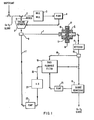
- a dispersant in line 1 is added to a calcium fluoride slurry in line 2.
- the slurry passes through ball mill 3 which grinds up any large particles which may be present, then pump 4 forces the slurry into cyclone separator 5 which separates the slurry into large particles which are recycled in line 6 and finer particles which are passed through line 7 and valve 8 to high gradient magnetic separator 9.
- the magnetic separator comprises an iron box 10 containing poles 11 and 12 of an electromagnet between which is a porous ferromagnetic intermediate 13. As the calcium fluoride slurry passes through the separator, the uranium in the slurry adheres to the porous ferromagnetic intermediate.
- the remaining slurry goes to detector 14 which provides a signal when the separator has become saturated with uranium so that the uranium now passes through the separator.
- the slurry then passes through valve 15 to sludge de- waterer 16 which removes some of the water.
- the remainder of this slurry becomes waste sludge.
- valves 8 and 15 are turned so that carbonate leach solution in line 17 now passes into the separator, dissolving the uranium which adheres to the porous ferromagnetic intermediate.
- the carbonate leach solution containing the uranium passes through valve 15 and line 18 to filter 19 which removes any large particles which may be present.
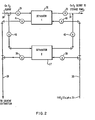
- nitric acid is used to remove the uranium from the separator and two separators are used to provide a continuous batch operation.
- the calcium fluoride slurry passes through line 30 through valve 31 in the separator 32 through valve 33 and line 34 to a storage pond. While that is occurring, nitric acid in line 35 passes through valve 36 into separator 37 dissolving uranium on the porous ferromagnetic intermediate of that separator. The dissolved uranium passes through valve 38 and line 39 where it is sent to a solvent extractor.
- valves 31, 33, 36, and 38 are closed and valves 40, 41, 42, and 43 are opened.
- nitric acid now passes through line 35 through valve 40, dissolves the uranium in separator 32, then passes through valve 41 and out line 39.
- the calicum fluoride slurry now passes through valve 42 into separator 37 through valve 43 and out line 34.
- the initial calcium fluoride slurry may contain 1 to 10 percent solids, of which at least 95 percent by weight is calcium fluoride, and the rest is water, and from 1 to 1000 ppm uranium, usually in the form of some type of calcium uranate.
- the uranium in these slurries may be enriched in uranium 235, making it particularly valuable.
- the invention will work with any liquid slurry of calcium fluoride which contains an insoluble uranium compound. This slurry must have less than 100 parts per million of iron present because the iron is dissolved with the uranium and would contaminate it in the subsequent processes. Such contamination would make it necessary to reprocess the uranium in the form of uranium hexafluoride in order to separate it from the iron. In the absence of iron, however, the product of this invention can be directly fed into the solvent extraction process.
- a dispersant may be added to the calcium fluoride slurry to aid in breaking up the larger size particles.
- the dispersants include detergents such as sodium sulfurate of a naphthalene-formaldehyde condensation product, 5 to 8 percent sodium sulfate in a condensed organic acid, and complex polymerized organic salts of sulfuric acids of alkyl-aryl type.
- the preferred dispersant is a sodium sulfurate of a naphthalene-formaldehyde condensation product sold by Stepan Chemical Company as "Stepantan A". From 0.01 to 0.02 percent by weight of a dispersant may be used if desired.
- the ball mill or other means of reducing the particle size in the slurry is necessary only if large particles are present.
- the particles in the slurry should be no larger than about 5 microns.
- the process of this invention requires the use of a high gradient magnetic separator.
- a high gradient magnetic separator two poles of a magnet are spaced less than about three inches apart, and the spacing between them is filled with a porous ferromagnetic intermediate.
- the separator must have a magnetic field of greater than 10 kilogauss in order to remove the uranium particles, which are only very weakly magnetic. Generally greater than 75 kilowatts of power are required and the magnet should have a coil diameter of less than 40 centimeters.
- a separator can typically take up to 3 tons per hour of solids throughput.
- the separator traps the calcium uranate, for example, CaU0 4 , particles on the intermediate, which should have a porosity of greater than 50%. If nitric acid is not used the intermediate can be made of steel wool, but if nitric acid is used stainless steel wool is needed as ordinary steel wool is attacked by nitric acid.
- the calcium fluoride slurry is run through the separator until a detector indicates that the separator has become saturated and uranium is now passing through the separator.
- a suitable detector can be a Geiger counter or similar device, but a fluorimetor is preferred as they are the most sensitive to uranium.
- the flow rate through the separator should be less than about 10 gallons per minute as higher rates may wash the uranium off the intermediate.
- the uranium can be removed from the intermediate in the separator by a variety of means. For example, almost any carbonate solution which is from 2 to 5 molar will dissolve the uranium in the separator. While sodium or any other alkali metal carbonate can be used, ammonium carbonate is preferred as it is more compatible with subsequent processes.
- the preferred method of removing the uranium is to back wash with an aqueous solution of nitric acid.
- the nitric acid wash should have a pH of greater than about 2 in order to avoid dissolving the calcium fluoride and should have a pH of less than about 3 or it will not dissolve the uranium.
- the leachate can be sent directly to a solvent extraction system using, for example, di-2-ethylhexyl phosphoric acid-trioctyl phosphine oxide (DEPA-TOPO) in an organic solvent such as kerosene, as is well known in the art.
- DEPA-TOPO di-2-ethylhexyl phosphoric acid-trioctyl phosphine oxide
- the uranium can be removed from the carbonate solution on an ion exchange column as is also well known in the art. The uranium can then be removed from the ion exchange column with a solution of nitric acid which is then sent to a solvent extraction process.
- the extra step of extraction on an ion exchange column is avoided when nitric acid is used to remove the uranium from the separator.
- An aqueous calcium fluoride solution containing 2 percent solids and 15 parts per million uranium as calcium uranate can be passed through a separator as shown in Figure 1 containing a stainless steel wool intermediate.
- the separator can have a field of 20 kilogauss, a power of 150 kilowatts, and a coil diameter of 30 centimeters. Two tons per hour of slurry can be passed through the separator.
- a fluorimeter indicates that uranium is no longer being detained on the intermediate, the calcium fluoride flow is terminated and the intermediate is washed with a 10% solution of nitric acid.
- the uranium in the nitric acid is then extracted using the DEPA-TOPO extractant.
Landscapes
- Engineering & Computer Science (AREA)
- Chemical & Material Sciences (AREA)
- General Life Sciences & Earth Sciences (AREA)
- Life Sciences & Earth Sciences (AREA)
- Geology (AREA)
- Manufacturing & Machinery (AREA)
- Environmental & Geological Engineering (AREA)
- Materials Engineering (AREA)
- Mechanical Engineering (AREA)
- Metallurgy (AREA)
- Organic Chemistry (AREA)
- Manufacture And Refinement Of Metals (AREA)
- Inorganic Compounds Of Heavy Metals (AREA)
- Solid-Sorbent Or Filter-Aiding Compositions (AREA)
Applications Claiming Priority (2)
| Application Number | Priority Date | Filing Date | Title |
|---|---|---|---|
| US26668181A | 1981-05-22 | 1981-05-22 | |
| US266681 | 1981-05-22 |
Publications (3)
| Publication Number | Publication Date |
|---|---|
| EP0066419A2 true EP0066419A2 (de) | 1982-12-08 |
| EP0066419A3 EP0066419A3 (en) | 1983-11-02 |
| EP0066419B1 EP0066419B1 (de) | 1986-09-03 |
Family
ID=23015572
Family Applications (1)
| Application Number | Title | Priority Date | Filing Date |
|---|---|---|---|
| EP82302567A Expired EP0066419B1 (de) | 1981-05-22 | 1982-05-20 | Verfahren zur Gewinnung von Uran |
Country Status (7)
| Country | Link |
|---|---|
| EP (1) | EP0066419B1 (de) |
| JP (1) | JPS5930651B2 (de) |
| KR (1) | KR900000397B1 (de) |
| DE (1) | DE3272997D1 (de) |
| ES (1) | ES512466A0 (de) |
| YU (1) | YU106082A (de) |
| ZA (1) | ZA822690B (de) |
Cited By (2)
| Publication number | Priority date | Publication date | Assignee | Title |
|---|---|---|---|---|
| US4726895A (en) * | 1986-03-28 | 1988-02-23 | Edward Martinez | Process for concentration of gold and uranium magnetically |
| CN110614087A (zh) * | 2017-03-09 | 2019-12-27 | 中国工程物理研究院核物理与化学研究所 | 一种具备抗菌性能的海水提铀吸附剂及其制备方法 |
Families Citing this family (1)
| Publication number | Priority date | Publication date | Assignee | Title |
|---|---|---|---|---|
| KR101322083B1 (ko) * | 2007-05-30 | 2013-10-25 | 주식회사 케이씨씨 | 납석으로부터 철분 제거 방법 |
Family Cites Families (4)
| Publication number | Priority date | Publication date | Assignee | Title |
|---|---|---|---|---|
| US2965440A (en) * | 1957-01-11 | 1960-12-20 | Tripp Res Corp | Method of beneficiating uranium ores by forming ferromagnetic uranium values and magnetically separating same |
| US3394997A (en) * | 1965-04-12 | 1968-07-30 | Gen Electric | Method of preparing uranium diuranate |
| US3676337A (en) * | 1970-07-09 | 1972-07-11 | Massachusetts Inst Technology | Process for magnetic separation |
| GB1555670A (en) * | 1977-12-12 | 1979-11-14 | Atomic Energy Authority Uk | Magnetic separation of particles from liquids in a process for reprocessing nuclear fuel |
-
1982
- 1982-04-20 ZA ZA822690A patent/ZA822690B/xx unknown
- 1982-05-18 YU YU01060/82A patent/YU106082A/xx unknown
- 1982-05-20 EP EP82302567A patent/EP0066419B1/de not_active Expired
- 1982-05-20 DE DE8282302567T patent/DE3272997D1/de not_active Expired
- 1982-05-21 ES ES512466A patent/ES512466A0/es active Granted
- 1982-05-22 KR KR8202264A patent/KR900000397B1/ko not_active Expired
- 1982-05-22 JP JP57087187A patent/JPS5930651B2/ja not_active Expired
Cited By (4)
| Publication number | Priority date | Publication date | Assignee | Title |
|---|---|---|---|---|
| US4726895A (en) * | 1986-03-28 | 1988-02-23 | Edward Martinez | Process for concentration of gold and uranium magnetically |
| CN110614087A (zh) * | 2017-03-09 | 2019-12-27 | 中国工程物理研究院核物理与化学研究所 | 一种具备抗菌性能的海水提铀吸附剂及其制备方法 |
| CN110614088A (zh) * | 2017-03-09 | 2019-12-27 | 中国工程物理研究院核物理与化学研究所 | 一种具备抗菌性能的海水提铀吸附剂及其制备方法 |
| CN110614088B (zh) * | 2017-03-09 | 2022-08-02 | 中国工程物理研究院核物理与化学研究所 | 一种具备抗菌性能的海水提铀吸附剂及其制备方法 |
Also Published As
| Publication number | Publication date |
|---|---|
| DE3272997D1 (en) | 1986-10-09 |
| KR900000397B1 (ko) | 1990-01-25 |
| KR830010211A (ko) | 1983-12-26 |
| ES8403976A1 (es) | 1984-04-01 |
| YU106082A (en) | 1985-03-20 |
| ES512466A0 (es) | 1984-04-01 |
| JPS5930651B2 (ja) | 1984-07-28 |
| JPS57200224A (en) | 1982-12-08 |
| EP0066419A3 (en) | 1983-11-02 |
| EP0066419B1 (de) | 1986-09-03 |
| ZA822690B (en) | 1983-06-29 |
Similar Documents
| Publication | Publication Date | Title |
|---|---|---|
| KR930002530B1 (ko) | 희토류 광석의 처리 방법 | |
| US7282187B1 (en) | Recovery of metal values | |
| US4886648A (en) | Process for the recovery of germanium from solutions that contain it | |
| CN111876598B (zh) | 一种共萃取分离铀铌的方法 | |
| CN111020242A (zh) | 一种从独居石精矿中冶炼分离铀、钍和稀土的工艺方法 | |
| CA2205482A1 (en) | Metal and fluorine values recovery from mineral ore treatment | |
| JPH02236236A (ja) | 金属の回収方法 | |
| US4241027A (en) | Reductive stripping process for the recovery of either or both uranium and vanadium | |
| Hirato et al. | Concentration of uranyl sulfate solution by an emulsion-type liquid membrane process | |
| GB1596730A (en) | Crud handling circuit | |
| EP0066419B1 (de) | Verfahren zur Gewinnung von Uran | |
| CN111087114A (zh) | 钽铌生产废水的处理方法 | |
| US3835213A (en) | Co-extraction and separate recovery of uranium and thorium from acid solutions | |
| CA1279197C (en) | Cobalt recovery method | |
| CN1261107A (zh) | 由氟碳铈矿原料制取铈的除氟处理方法 | |
| CN113149269A (zh) | 一种钽铌湿法冶金废水处理方法 | |
| EP0729437A4 (de) | ||
| JPH01249623A (ja) | 希土類元素とコバルトを含有する残留物の処理方法 | |
| US4231866A (en) | Recovery of organic and aqueous phases from solvent extraction emulsions | |
| CN211350122U (zh) | 钽铌生产废水的处理装置 | |
| RU2612107C2 (ru) | Способ извлечения скандия из скандийсодержащего продуктивного раствора | |
| JP3159220B2 (ja) | 使用済核燃料からのウラン、プルトニウム及びネプツニウムの回収方法 | |
| US5077020A (en) | Metal recovery process using waterglass | |
| RU2200992C2 (ru) | Способ переработки урансодержащих твердых и/или жидких отходов | |
| US3198599A (en) | Recovery of uranium and/or vanadium values from ores containing the same |
Legal Events
| Date | Code | Title | Description |
|---|---|---|---|
| PUAI | Public reference made under article 153(3) epc to a published international application that has entered the european phase |
Free format text: ORIGINAL CODE: 0009012 |
|
| AK | Designated contracting states |
Designated state(s): BE CH DE FR GB IT LI SE |
|
| PUAL | Search report despatched |
Free format text: ORIGINAL CODE: 0009013 |
|
| AK | Designated contracting states |
Designated state(s): BE CH DE FR GB IT LI SE |
|
| 17P | Request for examination filed |
Effective date: 19840308 |
|
| GRAA | (expected) grant |
Free format text: ORIGINAL CODE: 0009210 |
|
| AK | Designated contracting states |
Kind code of ref document: B1 Designated state(s): BE CH DE FR GB IT LI SE |
|
| REF | Corresponds to: |
Ref document number: 3272997 Country of ref document: DE Date of ref document: 19861009 |
|
| ET | Fr: translation filed | ||
| ITF | It: translation for a ep patent filed | ||
| PLBE | No opposition filed within time limit |
Free format text: ORIGINAL CODE: 0009261 |
|
| STAA | Information on the status of an ep patent application or granted ep patent |
Free format text: STATUS: NO OPPOSITION FILED WITHIN TIME LIMIT |
|
| 26N | No opposition filed | ||
| PGFP | Annual fee paid to national office [announced via postgrant information from national office to epo] |
Ref country code: FR Payment date: 19890321 Year of fee payment: 8 |
|
| PGFP | Annual fee paid to national office [announced via postgrant information from national office to epo] |
Ref country code: SE Payment date: 19890328 Year of fee payment: 8 |
|
| PG25 | Lapsed in a contracting state [announced via postgrant information from national office to epo] |
Ref country code: GB Effective date: 19890520 |
|
| PG25 | Lapsed in a contracting state [announced via postgrant information from national office to epo] |
Ref country code: LI Effective date: 19890531 Ref country code: CH Effective date: 19890531 Ref country code: BE Effective date: 19890531 |
|
| PGFP | Annual fee paid to national office [announced via postgrant information from national office to epo] |
Ref country code: DE Payment date: 19890630 Year of fee payment: 8 |
|
| GBPC | Gb: european patent ceased through non-payment of renewal fee | ||
| REG | Reference to a national code |
Ref country code: CH Ref legal event code: PL |
|
| PG25 | Lapsed in a contracting state [announced via postgrant information from national office to epo] |
Ref country code: SE Effective date: 19900521 |
|
| PG25 | Lapsed in a contracting state [announced via postgrant information from national office to epo] |
Ref country code: FR Effective date: 19910131 |
|
| PG25 | Lapsed in a contracting state [announced via postgrant information from national office to epo] |
Ref country code: DE Effective date: 19910201 |
|
| REG | Reference to a national code |
Ref country code: FR Ref legal event code: ST |
|
| EUG | Se: european patent has lapsed |
Ref document number: 82302567.1 Effective date: 19910115 |