EP0066483A1 - Method for the preparation of aliphatic or aromatic nitriles - Google Patents
Method for the preparation of aliphatic or aromatic nitriles Download PDFInfo
- Publication number
- EP0066483A1 EP0066483A1 EP82400803A EP82400803A EP0066483A1 EP 0066483 A1 EP0066483 A1 EP 0066483A1 EP 82400803 A EP82400803 A EP 82400803A EP 82400803 A EP82400803 A EP 82400803A EP 0066483 A1 EP0066483 A1 EP 0066483A1
- Authority
- EP
- European Patent Office
- Prior art keywords
- formula
- silica
- hydrofluoric acid
- impregnation
- carried out
- Prior art date
- Legal status (The legal status is an assumption and is not a legal conclusion. Google has not performed a legal analysis and makes no representation as to the accuracy of the status listed.)
- Granted
Links
- -1 aromatic nitriles Chemical class 0.000 title claims abstract description 7
- 238000000034 method Methods 0.000 title claims description 26
- 238000002360 preparation method Methods 0.000 title claims description 13
- 125000001931 aliphatic group Chemical group 0.000 title 1
- VYPSYNLAJGMNEJ-UHFFFAOYSA-N Silicium dioxide Chemical compound O=[Si]=O VYPSYNLAJGMNEJ-UHFFFAOYSA-N 0.000 claims abstract description 72
- KRHYYFGTRYWZRS-UHFFFAOYSA-N Fluorane Chemical compound F KRHYYFGTRYWZRS-UHFFFAOYSA-N 0.000 claims abstract description 40
- 239000000377 silicon dioxide Substances 0.000 claims abstract description 35
- DYDNPESBYVVLBO-UHFFFAOYSA-N formanilide Chemical compound O=CNC1=CC=CC=C1 DYDNPESBYVVLBO-UHFFFAOYSA-N 0.000 claims abstract description 22
- 239000000243 solution Substances 0.000 claims abstract description 14
- 239000007864 aqueous solution Substances 0.000 claims abstract description 13
- QAOWNCQODCNURD-UHFFFAOYSA-N Sulfuric acid Chemical compound OS(O)(=O)=O QAOWNCQODCNURD-UHFFFAOYSA-N 0.000 claims abstract description 12
- 239000003054 catalyst Substances 0.000 claims abstract description 10
- 238000001035 drying Methods 0.000 claims abstract description 7
- ZHNUHDYFZUAESO-UHFFFAOYSA-N Formamide Chemical compound NC=O ZHNUHDYFZUAESO-UHFFFAOYSA-N 0.000 claims abstract description 6
- 239000004115 Sodium Silicate Substances 0.000 claims abstract description 6
- 125000003118 aryl group Chemical group 0.000 claims abstract description 6
- 125000004432 carbon atom Chemical group C* 0.000 claims abstract description 6
- NTHWMYGWWRZVTN-UHFFFAOYSA-N sodium silicate Chemical compound [Na+].[Na+].[O-][Si]([O-])=O NTHWMYGWWRZVTN-UHFFFAOYSA-N 0.000 claims abstract description 6
- 229910052911 sodium silicate Inorganic materials 0.000 claims abstract description 6
- 239000004215 Carbon black (E152) Substances 0.000 claims abstract description 5
- 150000001408 amides Chemical class 0.000 claims abstract description 5
- 229930195733 hydrocarbon Natural products 0.000 claims abstract description 5
- 125000001997 phenyl group Chemical group [H]C1=C([H])C([H])=C(*)C([H])=C1[H] 0.000 claims abstract description 4
- WEVYAHXRMPXWCK-UHFFFAOYSA-N Acetonitrile Chemical compound CC#N WEVYAHXRMPXWCK-UHFFFAOYSA-N 0.000 claims description 30
- 238000005470 impregnation Methods 0.000 claims description 13
- UHOVQNZJYSORNB-UHFFFAOYSA-N monobenzene Natural products C1=CC=CC=C1 UHOVQNZJYSORNB-UHFFFAOYSA-N 0.000 claims description 8
- NLFBCYMMUAKCPC-KQQUZDAGSA-N ethyl (e)-3-[3-amino-2-cyano-1-[(e)-3-ethoxy-3-oxoprop-1-enyl]sulfanyl-3-oxoprop-1-enyl]sulfanylprop-2-enoate Chemical compound CCOC(=O)\C=C\SC(=C(C#N)C(N)=O)S\C=C\C(=O)OCC NLFBCYMMUAKCPC-KQQUZDAGSA-N 0.000 claims description 6
- LMBFAGIMSUYTBN-MPZNNTNKSA-N teixobactin Chemical compound C([C@H](C(=O)N[C@@H]([C@@H](C)CC)C(=O)N[C@@H](CO)C(=O)N[C@H](CCC(N)=O)C(=O)N[C@H]([C@@H](C)CC)C(=O)N[C@@H]([C@@H](C)CC)C(=O)N[C@@H](CO)C(=O)N[C@H]1C(N[C@@H](C)C(=O)N[C@@H](C[C@@H]2NC(=N)NC2)C(=O)N[C@H](C(=O)O[C@H]1C)[C@@H](C)CC)=O)NC)C1=CC=CC=C1 LMBFAGIMSUYTBN-MPZNNTNKSA-N 0.000 claims description 6
- CIUQDSCDWFSTQR-UHFFFAOYSA-N [C]1=CC=CC=C1 Chemical group [C]1=CC=CC=C1 CIUQDSCDWFSTQR-UHFFFAOYSA-N 0.000 claims description 5
- 239000011148 porous material Substances 0.000 claims description 5
- 125000001424 substituent group Chemical group 0.000 claims description 5
- IJGRMHOSHXDMSA-UHFFFAOYSA-N Atomic nitrogen Chemical compound N#N IJGRMHOSHXDMSA-UHFFFAOYSA-N 0.000 claims description 4
- 239000003085 diluting agent Substances 0.000 claims description 4
- 229910052731 fluorine Inorganic materials 0.000 claims description 4
- 239000011734 sodium Substances 0.000 claims description 4
- DGAQECJNVWCQMB-PUAWFVPOSA-M Ilexoside XXIX Chemical compound C[C@@H]1CC[C@@]2(CC[C@@]3(C(=CC[C@H]4[C@]3(CC[C@@H]5[C@@]4(CC[C@@H](C5(C)C)OS(=O)(=O)[O-])C)C)[C@@H]2[C@]1(C)O)C)C(=O)O[C@H]6[C@@H]([C@H]([C@@H]([C@H](O6)CO)O)O)O.[Na+] DGAQECJNVWCQMB-PUAWFVPOSA-M 0.000 claims description 2
- 125000000217 alkyl group Chemical group 0.000 claims description 2
- 229910052757 nitrogen Inorganic materials 0.000 claims description 2
- 238000002791 soaking Methods 0.000 claims description 2
- 229910052708 sodium Inorganic materials 0.000 claims description 2
- 238000005507 spraying Methods 0.000 claims description 2
- 239000000470 constituent Substances 0.000 claims 1
- 239000011261 inert gas Substances 0.000 claims 1
- 125000000951 phenoxy group Chemical group [H]C1=C([H])C([H])=C(O*)C([H])=C1[H] 0.000 claims 1
- 238000001556 precipitation Methods 0.000 abstract description 2
- 238000010438 heat treatment Methods 0.000 abstract 1
- 150000002430 hydrocarbons Chemical class 0.000 abstract 1
- 239000000126 substance Substances 0.000 abstract 1
- JFDZBHWFFUWGJE-UHFFFAOYSA-N benzonitrile Chemical compound N#CC1=CC=CC=C1 JFDZBHWFFUWGJE-UHFFFAOYSA-N 0.000 description 33
- SUSQOBVLVYHIEX-UHFFFAOYSA-N phenylacetonitrile Chemical compound N#CCC1=CC=CC=C1 SUSQOBVLVYHIEX-UHFFFAOYSA-N 0.000 description 16
- IIBOGKHTXBPGEI-UHFFFAOYSA-N N-benzylformamide Chemical compound O=CNCC1=CC=CC=C1 IIBOGKHTXBPGEI-UHFFFAOYSA-N 0.000 description 14
- 150000001875 compounds Chemical class 0.000 description 12
- KXDAEFPNCMNJSK-UHFFFAOYSA-N Benzamide Chemical compound NC(=O)C1=CC=CC=C1 KXDAEFPNCMNJSK-UHFFFAOYSA-N 0.000 description 10
- 150000002825 nitriles Chemical class 0.000 description 7
- XLYOFNOQVPJJNP-UHFFFAOYSA-N water Substances O XLYOFNOQVPJJNP-UHFFFAOYSA-N 0.000 description 7
- LSBDFXRDZJMBSC-UHFFFAOYSA-N 2-phenylacetamide Chemical compound NC(=O)CC1=CC=CC=C1 LSBDFXRDZJMBSC-UHFFFAOYSA-N 0.000 description 6
- 238000006243 chemical reaction Methods 0.000 description 5
- PAYRUJLWNCNPSJ-UHFFFAOYSA-N Aniline Chemical compound NC1=CC=CC=C1 PAYRUJLWNCNPSJ-UHFFFAOYSA-N 0.000 description 4
- BDAGIHXWWSANSR-UHFFFAOYSA-N methanoic acid Natural products OC=O BDAGIHXWWSANSR-UHFFFAOYSA-N 0.000 description 4
- AEKVBBNGWBBYLL-UHFFFAOYSA-N 4-fluorobenzonitrile Chemical compound FC1=CC=C(C#N)C=C1 AEKVBBNGWBBYLL-UHFFFAOYSA-N 0.000 description 3
- KRHYYFGTRYWZRS-UHFFFAOYSA-M Fluoride anion Chemical compound [F-] KRHYYFGTRYWZRS-UHFFFAOYSA-M 0.000 description 3
- 239000000203 mixture Substances 0.000 description 3
- 239000002904 solvent Substances 0.000 description 3
- OSWFIVFLDKOXQC-UHFFFAOYSA-N 4-(3-methoxyphenyl)aniline Chemical compound COC1=CC=CC(C=2C=CC(N)=CC=2)=C1 OSWFIVFLDKOXQC-UHFFFAOYSA-N 0.000 description 2
- KRZCOLNOCZKSDF-UHFFFAOYSA-N 4-fluoroaniline Chemical compound NC1=CC=C(F)C=C1 KRZCOLNOCZKSDF-UHFFFAOYSA-N 0.000 description 2
- 230000015572 biosynthetic process Effects 0.000 description 2
- 230000003197 catalytic effect Effects 0.000 description 2
- 238000006115 defluorination reaction Methods 0.000 description 2
- 238000004821 distillation Methods 0.000 description 2
- 235000019253 formic acid Nutrition 0.000 description 2
- 238000004519 manufacturing process Methods 0.000 description 2
- 239000000741 silica gel Substances 0.000 description 2
- 229910002027 silica gel Inorganic materials 0.000 description 2
- 235000012239 silicon dioxide Nutrition 0.000 description 2
- 0 *c1cccc(C(F)(F)F)c1 Chemical compound *c1cccc(C(F)(F)F)c1 0.000 description 1
- LJFDXXUKKMEQKE-UHFFFAOYSA-N 2,4-difluorobenzonitrile Chemical compound FC1=CC=C(C#N)C(F)=C1 LJFDXXUKKMEQKE-UHFFFAOYSA-N 0.000 description 1
- YOYAIZYFCNQIRF-UHFFFAOYSA-N 2,6-dichlorobenzonitrile Chemical compound ClC1=CC=CC(Cl)=C1C#N YOYAIZYFCNQIRF-UHFFFAOYSA-N 0.000 description 1
- BNBRIFIJRKJGEI-UHFFFAOYSA-N 2,6-difluorobenzonitrile Chemical compound FC1=CC=CC(F)=C1C#N BNBRIFIJRKJGEI-UHFFFAOYSA-N 0.000 description 1
- MRDUURPIPLIGQX-UHFFFAOYSA-N 2-(2-chlorophenyl)acetonitrile Chemical compound ClC1=CC=CC=C1CC#N MRDUURPIPLIGQX-UHFFFAOYSA-N 0.000 description 1
- DAVJMKMVLKOQQC-UHFFFAOYSA-N 2-(2-fluorophenyl)acetonitrile Chemical compound FC1=CC=CC=C1CC#N DAVJMKMVLKOQQC-UHFFFAOYSA-N 0.000 description 1
- JHQBLYITVCBGTO-UHFFFAOYSA-N 2-(4-fluorophenyl)acetonitrile Chemical compound FC1=CC=C(CC#N)C=C1 JHQBLYITVCBGTO-UHFFFAOYSA-N 0.000 description 1
- GDHXJNRAJRCGMX-UHFFFAOYSA-N 2-fluorobenzonitrile Chemical compound FC1=CC=CC=C1C#N GDHXJNRAJRCGMX-UHFFFAOYSA-N 0.000 description 1
- IGPAZROMUKCCRP-UHFFFAOYSA-N 2-phenyl-2-(trifluoromethoxy)acetonitrile Chemical compound FC(F)(F)OC(C#N)C1=CC=CC=C1 IGPAZROMUKCCRP-UHFFFAOYSA-N 0.000 description 1
- VIUDTWATMPPKEL-UHFFFAOYSA-N 3-(trifluoromethyl)aniline Chemical compound NC1=CC=CC(C(F)(F)F)=C1 VIUDTWATMPPKEL-UHFFFAOYSA-N 0.000 description 1
- OGOBINRVCUWLGN-UHFFFAOYSA-N 3-(trifluoromethyl)benzonitrile Chemical compound FC(F)(F)C1=CC=CC(C#N)=C1 OGOBINRVCUWLGN-UHFFFAOYSA-N 0.000 description 1
- JZTPKAROPNTQQV-UHFFFAOYSA-N 3-fluorobenzonitrile Chemical compound FC1=CC=CC(C#N)=C1 JZTPKAROPNTQQV-UHFFFAOYSA-N 0.000 description 1
- DRNJIKRLQJRKMM-UHFFFAOYSA-N 4-(trifluoromethyl)benzonitrile Chemical compound FC(F)(F)C1=CC=C(C#N)C=C1 DRNJIKRLQJRKMM-UHFFFAOYSA-N 0.000 description 1
- IVYMIRMKXZAHRV-UHFFFAOYSA-N 4-chlorophenylacetonitrile Chemical compound ClC1=CC=C(CC#N)C=C1 IVYMIRMKXZAHRV-UHFFFAOYSA-N 0.000 description 1
- CVNOWLNNPYYEOH-UHFFFAOYSA-N 4-cyanophenol Chemical compound OC1=CC=C(C#N)C=C1 CVNOWLNNPYYEOH-UHFFFAOYSA-N 0.000 description 1
- XDJAAZYHCCRJOK-UHFFFAOYSA-N 4-methoxybenzonitrile Chemical compound COC1=CC=C(C#N)C=C1 XDJAAZYHCCRJOK-UHFFFAOYSA-N 0.000 description 1
- DRSHXJFUUPIBHX-UHFFFAOYSA-N COc1ccc(cc1)N1N=CC2C=NC(Nc3cc(OC)c(OC)c(OCCCN4CCN(C)CC4)c3)=NC12 Chemical compound COc1ccc(cc1)N1N=CC2C=NC(Nc3cc(OC)c(OC)c(OCCCN4CCN(C)CC4)c3)=NC12 DRSHXJFUUPIBHX-UHFFFAOYSA-N 0.000 description 1
- YCKRFDGAMUMZLT-UHFFFAOYSA-N Fluorine atom Chemical compound [F] YCKRFDGAMUMZLT-UHFFFAOYSA-N 0.000 description 1
- BPQQTUXANYXVAA-UHFFFAOYSA-N Orthosilicate Chemical compound [O-][Si]([O-])([O-])[O-] BPQQTUXANYXVAA-UHFFFAOYSA-N 0.000 description 1
- 239000002253 acid Substances 0.000 description 1
- 150000001555 benzenes Chemical class 0.000 description 1
- 229910052681 coesite Inorganic materials 0.000 description 1
- 229910052906 cristobalite Inorganic materials 0.000 description 1
- 230000000694 effects Effects 0.000 description 1
- 230000007717 exclusion Effects 0.000 description 1
- 238000002474 experimental method Methods 0.000 description 1
- 239000011737 fluorine Substances 0.000 description 1
- 150000003948 formamides Chemical class 0.000 description 1
- 239000007789 gas Substances 0.000 description 1
- 239000000499 gel Substances 0.000 description 1
- 239000000017 hydrogel Substances 0.000 description 1
- 239000000543 intermediate Substances 0.000 description 1
- 229910044991 metal oxide Inorganic materials 0.000 description 1
- 150000004706 metal oxides Chemical class 0.000 description 1
- CMRLEIHOFQKMCW-UHFFFAOYSA-N n-(2,6-dichlorophenyl)formamide Chemical compound ClC1=CC=CC(Cl)=C1NC=O CMRLEIHOFQKMCW-UHFFFAOYSA-N 0.000 description 1
- SXEVZVMJNXOXIJ-UHFFFAOYSA-N n-(4-methoxyphenyl)formamide Chemical compound COC1=CC=C(NC=O)C=C1 SXEVZVMJNXOXIJ-UHFFFAOYSA-N 0.000 description 1
- YDLAQBRNNOLMIH-UHFFFAOYSA-N n-[(4-chlorophenyl)methyl]formamide Chemical compound ClC1=CC=C(CNC=O)C=C1 YDLAQBRNNOLMIH-UHFFFAOYSA-N 0.000 description 1
- UCSLZLQTEBLGCM-UHFFFAOYSA-N n-[[2-(trifluoromethoxy)phenyl]methyl]formamide Chemical compound FC(F)(F)OC1=CC=CC=C1CNC=O UCSLZLQTEBLGCM-UHFFFAOYSA-N 0.000 description 1
- TZAZXQZADJAQFS-UHFFFAOYSA-N n-hydroxy-n-methylformamide Chemical compound CN(O)C=O TZAZXQZADJAQFS-UHFFFAOYSA-N 0.000 description 1
- 150000004760 silicates Chemical class 0.000 description 1
- RMAQACBXLXPBSY-UHFFFAOYSA-N silicic acid Chemical compound O[Si](O)(O)O RMAQACBXLXPBSY-UHFFFAOYSA-N 0.000 description 1
- 239000007787 solid Substances 0.000 description 1
- 229910001220 stainless steel Inorganic materials 0.000 description 1
- 239000010935 stainless steel Substances 0.000 description 1
- 229910052682 stishovite Inorganic materials 0.000 description 1
- 238000006557 surface reaction Methods 0.000 description 1
- 238000003786 synthesis reaction Methods 0.000 description 1
- 229910052905 tridymite Inorganic materials 0.000 description 1
Classifications
-
- B—PERFORMING OPERATIONS; TRANSPORTING
- B01—PHYSICAL OR CHEMICAL PROCESSES OR APPARATUS IN GENERAL
- B01J—CHEMICAL OR PHYSICAL PROCESSES, e.g. CATALYSIS OR COLLOID CHEMISTRY; THEIR RELEVANT APPARATUS
- B01J27/00—Catalysts comprising the elements or compounds of halogens, sulfur, selenium, tellurium, phosphorus or nitrogen; Catalysts comprising carbon compounds
- B01J27/06—Halogens; Compounds thereof
- B01J27/08—Halides
- B01J27/12—Fluorides
-
- C—CHEMISTRY; METALLURGY
- C07—ORGANIC CHEMISTRY
- C07C—ACYCLIC OR CARBOCYCLIC COMPOUNDS
- C07C253/00—Preparation of carboxylic acid nitriles
- C07C253/20—Preparation of carboxylic acid nitriles by dehydration of carboxylic acid amides
Definitions
- the present invention relates to a process for the preparation of aromatic or aliphatic nitriles.
- An object of the present invention is to provide a process for the preparation of aromatic or aliphatic nitriles which overcomes the aforementioned drawbacks of the prior art.
- Another object of the present invention is to provide a process for the preparation of aromatic or aliphatic nitriles from amides of formula (III).
- the present invention therefore relates to a process for preparing tion of aromatic or aliphatic nitriles of formula: in which Ar represents a benzene radical and A represents a valence bond or a hydrocarbon radical containing from 1 to 6 carbon atoms, characterized in that a formanilide or formamide of formula : or an amide of formula: where Ar and A have the above meaning in the presence of a catalyst prepared by impregnation using an aqueous hydrofluoric acid solution, having an HF concentration of less than about 5% by weight, of a silica obtained at starting from sodium silicate and sulfuric acid, the weight ratio of hydrofluoric acid contained in the aqueous solution to the silica being less than approximately 5%, then drying.
- the term “impregnation of the silica” means bringing the latter into contact with an aqueous solution of hydrofluoric acid.
- the procedure is carried out by soaking the silica in the aqueous hydrofluoric acid solution.
- the operation is carried out by spraying the aqueous hydrofluoric acid solution on the silica.
- the quantity of hydrofluoric acid solution introduced into the silica will be approximately equal to the total pore volume of the treated silica.
- a silica having a specific surface of between 200 and 350 m2 / g, a total pore volume of between 50 and 100 cm3 / g, an average pore diameter of between 70 and 110 A; an exchange pH of less than approximately 7 and a sodium content expressed as Na 2 0 of less than approximately 1% by weight relative to the silica.
- the impregnation is carried out using an aqueous hydrofluoric acid solution having a concentration of between 0.04 and 4X by weight.
- the impregnation is preferably carried out at ambient temperature under atmospheric pressure.
- the drying is preferably carried out at a temperature between 150 and 600 ° C for 1 to 24 hours.
- the silica will advantageously comprise, after drying, between 0.3 and 3 ⁇ by weight of fluorine introduced by impregnation.
- the silicas to be impregnated are conventionally obtained by precipitation of sodium silicate using sulfuric acid (see for example the French patent published under the number 2,093,196).
- benzene radical (Ar) means the phenyl radical and the phenyl radicals comprising one or more substituents.
- substituents that may be mentioned are the alkyl and alkoxy radicals having from 1 to 6 carbon atoms, the phenyl and phenoxy radicals and the radicals F, CF 3 , OCF 3 , SCF 3 , OH, Cl, Br, CN.
- the process according to the invention is more particularly suited to the use of compounds of formula II or III in which the phenyl radical contains one or more fluorinated substituents F, CF3, OCF 3 or SCF 3 . Indeed, in this case, a small amount of products is obtained resulting from the defluorination reactions.
- the process is even more suitable for using the compounds of formula II comprising a fluorinated radical.
- compounds of formula II comprising a fluorinated radical.
- formula II which may be used in the process of the invention, the following compounds may be mentioned: formanilide, 3-trifluoromethyl-formanilide, 4-trifluoromethyl-formanilide, 4-methoxy-formanilide, 4-hydroxy-formanilide, fluoro- 2 formanilide, fluoro-3 formanilide, fluoro-4 formanilide, chloro-2 formanilide, chloro-3 formanilide, chloro-4 formanilide, chloro-2 trifluoromethyl-5 formanilide, trifluoromethyl-3 chloro-4 formanilide, phenoxy-3 formanilide, bistrifluorométhyl -3.5 formanilide, 2,6-dichloro-formanilide, 2,6-difluoro-formanilide, 2,4-difluoro-formanilide, trifluoromethylthio-3 formanilide, benzylformamide, trifluoromethyl-3 benzyl formamide, trifluoro
- Nonlimiting examples of compounds III are the following: trifluoromethyl-3 benzamide, trifluoromethyl-4 benzamide, fluoro-2 benzamide, fluoro-3 benzamide, fluoro-4 benzamide, trifluoromethyl-3 phenylacetamide, fluoro-4 phenylacetamide, trifluoromethoxy-4 phenylacetamide .
- the operation is carried out in the presence of an inert gaseous diluent preferably consisting of nitrogen and / or C0 2 and / or acetonitrile.
- acetonitrile in an amount such that the molar percentage of compound of formula II or III in acetonitrile is between 2 and 20 and preferably between 5 and 10.
- the temperature will preferably be between 510 and 530 ° C. when a compound of formula II is used between 450 and 480 ° C. when a compound of formula III is used.
- 0n generally operates at atmospheric pressure although pressures higher or lower than atmospheric pressure are not excluded from the scope of the invention.
- the process according to the invention is carried out by passing, preferably, between 0.2 and 4 moles of compound II or III per hour and per liter of catalyst.
- Compounds III can be prepared by any technique known to those skilled in the art.
- A is a hydrocarbon radical such as -CH 2 -
- the compounds II can be obtained by reaction at 0-100 ° C. in the presence of hydrofluoric acid between the corresponding benzene derivative ArH and the hydroxymethylformamide OH-CH 2 -NHCHO .
- the ratio of hydrofluoric acid to ArH is between 5 and 50 and that of ArH to OH-CH 2 -NHCHO is between 0.5 and 2.
- the silicate solution is poured into the vigorously stirred sulfuric acid solution while maintaining the temperature between 15 and 20 ° C. We stop when we poured 1900 g of sodium silicate. The solution gels in a few minutes. The hydrogel is crushed and then washed with a stream of water at pH between 6 and 7 for 24 hours. The solids obtained are dried at 200 ° C for 24 hours.
- a sample of the silica thus treated, after drying for 24 hours at 200 ° C has the following characteristics:
- the reactor is opened and 90 cm3 of an aqueous solution containing 45% of HF are added.
- the aqueous solution is circulated through the bed of silica gel.
- the silica gel is then dried for 24 hours at 200 ° C.
- the reaction temperature is maintained at 530 ° C throughout the catalytic bed.
- the selectivity for nitrile is 91.6%.
- the fluoride content in the raw mixture leaving the reactor is 350 ppm.
- the selectivity is defined as being the ratio of the nitrile formed to the formanilide which has reacted with the exclusion of the formanilide transformed into the corresponding aniline since the latter, in an industrial process can be transformed quantitatively by the formic acid to the starting formanilide then recycled.
- silica prepared according to example la a 2250 g of the silica prepared according to example la a are introduced into a reactor containing three liters of water. Silica is completely submerged. The whole is heated until a pressure of 1 bar is obtained in the reactor. This pressure is maintained for 3 hours. The silica is dried for 3 hours at 200 ° C.
- Example 1c By operating as in Example 1c, a mixture of 17.9 kg of metatrifluoromethylbenzylformamide and 71.6 kg of acetonitrile is introduced continuously over 150 hours.
- the reaction temperature is maintained at 530 ° C throughout the catalytic bed.
- the selectivity for nitrile is 98%.
- the fluoride content is 350 ppm.
- Silica prepared according to Example 2a is introduced into a rotating bowl. 350 g of an aqueous solution containing 20 g of HF are sprayed onto the rotating grains. The grains are then dried at 200 ° C for 24 hours.
- the selectivity for nitrile is 95X.
- the fluoride content is 60 ppm.
Landscapes
- Chemical & Material Sciences (AREA)
- Organic Chemistry (AREA)
- Engineering & Computer Science (AREA)
- Materials Engineering (AREA)
- Chemical Kinetics & Catalysis (AREA)
- Organic Low-Molecular-Weight Compounds And Preparation Thereof (AREA)
- Catalysts (AREA)
- Low-Molecular Organic Synthesis Reactions Using Catalysts (AREA)
Abstract
Description
La présente invention a pour objet un procédé de préparation de nitriles aromatiques ou aliphatiques.The present invention relates to a process for the preparation of aromatic or aliphatic nitriles.
Elle concerne plus particulièrement la préparation de nitriles de formule générale :



On connait dans l'art antérieur le brevet français 1 250 165 qui décrit la préparation de nitriles à partir de composés du type (II) par réaction de ces derniers à une température comprise entre 460 et 560°C en phase gazeuse au contact, comme catalyseurs, d'acide silicique actif ou de silicates renfermant un oxyde métallique.We know in the prior art French patent 1,250,165 which describes the preparation of nitriles from compounds of type (II) by reaction of the latter at a temperature between 460 and 560 ° C. in the gas phase on contact, such as catalysts, active silicic acid or silicates containing a metal oxide.
Les expériences effectuées par la demanderesse avec des catalyseurs du type de ceux décrits dans le brevet français précité montrent que la sélectivité obtenue n'est pas suffisante pour une exploitation industrielle optimale du procédé. De plus, lorsque des nitriles de formule I dont le radical Ar comporte un substituant fluoré sont recherchés, on assiste à la formation de produits secondaires lourds ce qui diminue la durée de vie du catalyseur par encrassement de la surface et on observe des réactions de défluoration ce qui donne naissance à des composés très difficilement séparables du produit recherché.The experiments carried out by the applicant with catalysts of the type of those described in the aforementioned French patent show that the selectivity obtained is not sufficient for optimal industrial exploitation of the process. In addition, when nitriles of formula I whose radical Ar contains a fluorinated substituent are sought, there is the formation of heavy secondary products which reduces the lifetime of the catalyst by fouling of the surface and defluorination reactions are observed. which gives rise to compounds which are very difficult to separate from the desired product.
Un objet de la présente invention est de fournir un procédé de préparation de nitriles aromatiques ou aliphatiques palliant les inconvénients précités de l'art antérieur.An object of the present invention is to provide a process for the preparation of aromatic or aliphatic nitriles which overcomes the aforementioned drawbacks of the prior art.
Un autre objet de la présente invention est de fournir un procédé de préparation de nitriles aromatiques ou aliphatiques à partir d'amides de formule (III).Another object of the present invention is to provide a process for the preparation of aromatic or aliphatic nitriles from amides of formula (III).
La présente invention a donc pour objet un procédé de préparation de nitriles aromatiques ou aliphatiques de formule :


On entend, au sens de la présente invention, par imprégnation de la silice, la mise en contact de cette dernière avec une solution aqueuse d'acide fluorhydrique.For the purposes of the present invention, the term “impregnation of the silica” means bringing the latter into contact with an aqueous solution of hydrofluoric acid.
Selon un mode de réalisation particulier, on opère par trempage de la silice dans la solution aqueuse d'acide fluorhydrique.According to a particular embodiment, the procedure is carried out by soaking the silica in the aqueous hydrofluoric acid solution.
Selon un autre mode de réalisation particulier, on opère par pulvérisation de la solution aqueuse d'acide fluorhydrique sur la silice.According to another particular embodiment, the operation is carried out by spraying the aqueous hydrofluoric acid solution on the silica.
Dans l'un et l'autre cas, la quantité de solution d'acide fluorhydrique introduite dans la silice sera environ égale au volume poreux total de la silice traitée.In both cases, the quantity of hydrofluoric acid solution introduced into the silica will be approximately equal to the total pore volume of the treated silica.
La demanderesse a constaté que pour une bonne mise en oeuvre de l'invention, il était préférable d'imprégner une silice ayant une surface spécifique comprise entre 200 et 350 m2/g, un volume poreux total compris entre 50 et 100 cm3/g, un diamètre moyen des pores compris entre 70 et 110 A ; un pH d'échange inférieur à environ 7 et une teneur en sodium exprimée en Na20 inférieure à environ 1% en poids par rapport à la silice.The Applicant has found that for a good implementation of the invention, it was preferable to impregnate a silica having a specific surface of between 200 and 350 m2 / g, a total pore volume of between 50 and 100 cm3 / g, an average pore diameter of between 70 and 110 A; an exchange pH of less than approximately 7 and a sodium content expressed as Na 2 0 of less than approximately 1% by weight relative to the silica.
Selon un autre mode de réalisation préférentiel de l'invention, l'imprégnation est réalisée à l'aide d'une solution aqueuse d'acide fluorhydrique ayant une concentration comprise entre 0,04 et 4X en poids.According to another preferred embodiment of the invention, the impregnation is carried out using an aqueous hydrofluoric acid solution having a concentration of between 0.04 and 4X by weight.
L'imprégnation est de préférence réalisée à température ambiante sous pression atmosphérique.The impregnation is preferably carried out at ambient temperature under atmospheric pressure.
Le séchage est de préférence réalisé à une température comprise entre 150 et 600°C pendant 1 à 24 heures.The drying is preferably carried out at a temperature between 150 and 600 ° C for 1 to 24 hours.
La silice comprendra avantageusement après séchage entre 0,3 et 3X en poids de fluor introduit par imprégnation.The silica will advantageously comprise, after drying, between 0.3 and 3 × by weight of fluorine introduced by impregnation.
Les silices à imprégner sont obtenues classiquement par précipitation de silicate de sodium à l'aide d'acide sulfurique (voir par exemple le brevet français publié sous le numéro 2 093 196).The silicas to be impregnated are conventionally obtained by precipitation of sodium silicate using sulfuric acid (see for example the French patent published under the number 2,093,196).
Au sens de la présente invention, on entend par radical benzénique (Ar) le radical phényle et les radicaux phényle comportant un ou plusieurs substituants. 0n peut citer comme exemples de tels substituants les radicaux alkyle et alkoxy ayant de 1 à 6 atomes de carbone, les radicaux phényle et phénoxy et les radicaux F, CF3, OCF3, SCF3, OH, Cl, Br, CN.Within the meaning of the present invention, the term benzene radical (Ar) means the phenyl radical and the phenyl radicals comprising one or more substituents. Examples of such substituents that may be mentioned are the alkyl and alkoxy radicals having from 1 to 6 carbon atoms, the phenyl and phenoxy radicals and the radicals F, CF 3 , OCF 3 , SCF 3 , OH, Cl, Br, CN.
Le procédé selon l'invention est plus particulièrement adapté à la mise en oeuvre de composés de formule II ou III dont le radical phényle comporte un ou plusieurs substituants fluorés F, CF3, OCF3 ou SCF3. En effet, dans ce cas, on obtient une faible quantité de produits résultant des réactions de défluoration.The process according to the invention is more particularly suited to the use of compounds of formula II or III in which the phenyl radical contains one or more fluorinated substituents F, CF3, OCF 3 or SCF 3 . Indeed, in this case, a small amount of products is obtained resulting from the defluorination reactions.
Le procédé est encore plus adapté à la mise en oeuvre des composés de formule II comportant un radical fluoré. Parmi ces derniers, on peut citer le métatrifluorométhylformanilide


On peut citer comme autres exemples de formule II pouvant être mis en oeuvre dans le procédé de l'invention, les composés suivants: formanilide, trifluorométhyl-3 formanilide, trifluorométhyl-4 formanilide, méthoxy-4 formanilide, hydroxy-4 formanilide, fluoro-2 formanilide, fluoro-3 formanilide, fluoro-4 formanilide, chloro-2 formanilide, chloro-3 formanilide, chloro-4 formanilide, chloro-2 trifluorométhyl-5 formanilide, trifluorométhyl-3 chloro-4 formanilide, phénoxy-3 formanilide, bistrifluorométhyl-3,5 formanilide, dichloro-2,6 formanilide, difluoro-2,6 formanilide, difluoro-2,4 formanilide, trifluorométhylthio-3 formanilide, benzylformamide, trifluorométhyl-3 benzyl formamide, trifluorométhyl-4 benzylformamide, fluoro-4 benzylformamide, chloro-4 benzylformamide, fluoro-2 benzylformamide, chloro-2 benzylformamide, trifluorométhoxy-2 benzylformamide, trifluorométhoxy-4 benzylformamide, trifluorométhylthio-2 benzylformamide, trifluorométhylthio-4 benzylformamide, fluoro-2 méthyl-5 benzylformamide, fluoro-3 méthyl-6 benzylformamide, chloro-2 trifluorométhoxy-5 benzylformamide, trifluorométhoxy-2 chloro-5 benzylformamide, difluoro-2,5 benzylformamide, difluoro-2,4 benzylformamide.As other examples of formula II which may be used in the process of the invention, the following compounds may be mentioned: formanilide, 3-trifluoromethyl-formanilide, 4-trifluoromethyl-formanilide, 4-methoxy-formanilide, 4-hydroxy-formanilide, fluoro- 2 formanilide, fluoro-3 formanilide, fluoro-4 formanilide, chloro-2 formanilide, chloro-3 formanilide, chloro-4 formanilide, chloro-2 trifluoromethyl-5 formanilide, trifluoromethyl-3 chloro-4 formanilide, phenoxy-3 formanilide, bistrifluorométhyl -3.5 formanilide, 2,6-dichloro-formanilide, 2,6-difluoro-formanilide, 2,4-difluoro-formanilide, trifluoromethylthio-3 formanilide, benzylformamide, trifluoromethyl-3 benzyl formamide, trifluoromethyl-4 benzylformamide, fluoro-4 benzylformamide, 4-chloro benzylformamide, 2-fluoro benzylformamide, 2-chloro benzylformamide, 2-trifluoromethoxy-benzylformamide, trifluoromethoxy-4 benzylformamide, trifluoromethylthio-2 benzylformamide, trifluoromethylthio-4 benzylformamide, 2-fluoro-methyl ben zylformamide, fluoro-3 methyl-6 benzylformamide, chloro-2 trifluoromethoxy-5 benzylformamide, trifluoromethoxy-2 chloro-5 benzylformamide, difluoro-2,5 benzylformamide, difluoro-2,4 benzylformamide.
Des exemples non limitatifs de composés III sont les suivants : trifluorométhyl-3 benzamide, trifluorométhyl-4 benzamide, fluoro-2 benzamide, fluoro-3 benzamide, fluoro-4 benzamide, trifluorométhyl-3 phénylacétamide, fluoro-4 phénylacétamide, trifluorométhoxy-4 phénylacétamide.Nonlimiting examples of compounds III are the following: trifluoromethyl-3 benzamide, trifluoromethyl-4 benzamide, fluoro-2 benzamide, fluoro-3 benzamide, fluoro-4 benzamide, trifluoromethyl-3 phenylacetamide, fluoro-4 phenylacetamide, trifluoromethoxy-4 phenylacetamide .
On peut ainsi préparer selon le procédé de l'invention, les composés de formule I suivants : benzonitrile, trifluorométhyl-3 benzonitrile, trifluorométhyl-4 benzonitrile, méthoxy-4 benzonitrile, hÿdroxy-4 benzonitrile, fluoro-2 benzonitrile, fluoro-3 benzonitrile, fluoro-4 benzonitrile, chloro-2 benzonitrile, chloro-3 benzonitrile, chloro-4 benzonitrile, chloro-2 trifluorométhyl-5 benzonitrile, trifluorométhyl-3 chloro-4 benzonitrile, phénoxy-3 benzonitrile, bis-trifluorométhyl-3,5 benzonitrile, dichloro-2,6 benzonitrile, difluoro-2,6 benzonitrile, difluoro-2,4 benzonitrile, trifluorométhylthio-3 benzonitrile, trifluorométhoxy-4 benzonitrile, phénylacétonitrile, trifluorométhyl-3 phénylacétonitrile, trifluorométhyl-4 phénylacétonitrile, fluoro-4 phénylacétonitrile, chloro-4 phénylacétonitrile, fluoro-2 phénylacétonitrile, chloro-2 phénylacétonitrile, trifluorométhoxy-2 phénylacétonitrile, trifluorométhoxy-4 phénylacétonitrile, trifluorométhylthio-2 phénylacétonitrile, trifluorométhylthio-4 phénylacétonitrile, fluoro-2 méthyl-5 phénylacétonitrile, fluoro-3 méthyl-6 phénylacétonitrile, chloro-2 trifluorométhoxy-5 phénylacétonitrile, trifluorométhoxy-2 chloro-5 phénylacétonitrile, difluoro-2,5 phénylacétonitrile, difluoro-2,4 phénylacétonitrile.The following compounds of formula I can thus be prepared according to the process of the invention: benzonitrile, 3-trifluoromethyl benzonitrile, 4-trifluoromethyl benzonitrile, 4-methoxy benzonitrile, 4-hydroxy-benzonitrile, 2-fluoro benzonitrile, 3-fluoro benzonitrile , fluoro-4 benzonitrile, chloro-2 benzonitrile, chloro-3 benzonitrile, chloro-4 benzonitrile, chloro-2 trifluoromethyl-5 benzonitrile, trifluoromethyl-3 chloro-4 benzonitrile, phenoxy-3 benzonitrile, bis-trifluoromethyl-3,5 benzonitrile , 2,6-dichloro benzonitrile, 2,6-difluoro benzonitrile, 2,4-difluoro benzonitrile, trifluoromethylthio-3 benzonitrile, trifluoromethoxy-4 benzonitrile, phenylacetonitrile, trifluoromethyl-3 phenylacetonitrile, trifluoromethyl-4 phenylacetonitrile, 4-fluoro-phenylacetonitrile, 4-chloro-phenylacetonitrile, 2-fluoro-phenylacetonitrile, 2-chloro-phenylacetonitrile, trifluoromethoxy-2-phenylacetonitrile, trifluoromethoxy-4-phenylacetonitrile, trifluoromethylitron-2-phenol fluoro-3-methyl-6 phenylacetonitrile, chloro-2 trifluoromethoxy-5 phenylacetonitrile, trifluoromethoxy-2 chloro-5 phenylacetonitrile, difluoro-2,5 phenylacetonitrile, difluoro-2,4 phenylacetonitrile.
Selon une manière avantageuse, mais non obligatoire, de mettre en oeuvre l'invention, on opère en présence d'un diluant gazeux inerte constitué de préférence par l'azote et/ou le C02 et/ou l'acétonitrile.According to an advantageous, but not compulsory, way of implementing the invention, the operation is carried out in the presence of an inert gaseous diluent preferably consisting of nitrogen and / or C0 2 and / or acetonitrile.
On préfère utiliser l'acétonitrile en quantité telle que le pourcentage molaire de composé de formule II ou III dans l'acétonitrile soit compris entre 2 et 20 et de préférence entre 5 et 10.It is preferred to use acetonitrile in an amount such that the molar percentage of compound of formula II or III in acetonitrile is between 2 and 20 and preferably between 5 and 10.
La température sera, préférentiellement comprise entre 510 et 530°C quand on mettra en oeuvre un composé de formule II entre 450 et 480°C quand on mettra en oeuvre un composé de formule III.The temperature will preferably be between 510 and 530 ° C. when a compound of formula II is used between 450 and 480 ° C. when a compound of formula III is used.
0n opère généralement à la pression atmosphérique bien que des pressions supérieures ou inférieures à la pression atmosphérique ne soient pas exclues du domaine de l'invention.0n generally operates at atmospheric pressure although pressures higher or lower than atmospheric pressure are not excluded from the scope of the invention.
0n met en oeuvre le procédé selon l'invention en faisant passer, de préférence, entre 0,2 et 4 moles de composé II ou III par heure et par litre de catalyseur.The process according to the invention is carried out by passing, preferably, between 0.2 and 4 moles of compound II or III per hour and per liter of catalyst.
Les composés III peuvent être préparés par toute technique connue de l'homme de l'art.Compounds III can be prepared by any technique known to those skilled in the art.
La préparation des composés II quand A est un lien valentiel se fait, d'une façon bien connue dans l'art antérieur, par réaction de l'aniline correspondante avec l'acide formique.The preparation of compounds II when A is a valence bond is done, in a manner well known in the prior art, by reaction of the corresponding aniline with formic acid.
Dans le cas où A est un radical hydrocarboné comme -CH2- les composés II peuvent être obtenus par réaction à 0-100°C en présence d'acide fluorhydrique entre le dérivé benzénique correspondant ArH et l'hydroxyméthylformamide OH-CH2-NHCHO. Le rapport de l'acide fluorhydrique à ArH est compris entre 5 et 50 et celui de ArH à OH-CH2-NHCHO est compris entre 0,5 et 2. Cette préparation fait l'objet d'une demande de brevet au nom de la demanderesse.In the case where A is a hydrocarbon radical such as -CH 2 - the compounds II can be obtained by reaction at 0-100 ° C. in the presence of hydrofluoric acid between the corresponding benzene derivative ArH and the hydroxymethylformamide OH-CH 2 -NHCHO . The ratio of hydrofluoric acid to ArH is between 5 and 50 and that of ArH to OH-CH 2 -NHCHO is between 0.5 and 2. This preparation is the subject of a patent application in the name of the applicant.
D'autres caractéristiques et avantages de la présente invention apparaitront plus clairement à la lecture des exemples qui vont suivre. Ces exemples ne sauraient en aucune manière être considérés comme une limitation de l'invention.Other characteristics and advantages of the present invention will appear more clearly on reading the examples which follow. These examples should in no way be considered as a limitation of the invention.
a) On prépare une solution acide contenant 1 kg d'acide sulfurique à 98 X et 1 kg d'eau puis une deuxième solution de silicate de soude de densité 1,185 (Si02/Na20 = 3,3).a) An acid solution is prepared containing 1 kg of sulfuric acid at 98 X and 1 kg of water, then a second solution of sodium silicate of density 1.185 (SiO2 / Na20 = 3.3).
La solution de silicate est versée dans la solution d'acide sulfurique vigoureusement agitée tout en maintenant la température entre 15 et 20°C. On s'arrête lorsqu'on a versé 1900 g de silicate de soude. La solution gélifie en quelques minutes. L'hydrogel est concassé puis lavé par un courant d'eau à pH compris entre 6 et 7 pendant 24 heures. Les solides obtenus sont séchés à 200°C pendant 24 heures.The silicate solution is poured into the vigorously stirred sulfuric acid solution while maintaining the temperature between 15 and 20 ° C. We stop when we poured 1900 g of sodium silicate. The solution gels in a few minutes. The hydrogel is crushed and then washed with a stream of water at pH between 6 and 7 for 24 hours. The solids obtained are dried at 200 ° C for 24 hours.
Les caractéristiques de la silice obtenue sont les suivantes :

0) 2250 g de cette silice sont introduits dans un réacteur contenant 3 litres d'eau. La silice est totalement immergée. L'ensemble est chauffé jusqu'à obtention dans le réacteur d'une pression relative de 0,7 bars que l'on maintient 3 heures. 0 ) 2250 g of this silica are introduced into a reactor containing 3 liters of water. The silica is completely submerged. The whole is heated until a relative pressure of 0.7 bars is obtained in the reactor which is maintained for 3 hours.
Un échantillon de la silice ainsi traitée, après séchage pendant 24 heures à 200°C a les caractéristiques suivantes :

On ouvre le réacteur et on ajoute 90 cm3 d'une solution aqueuse à 45 X d'HF. On fait circuler la solution aqueuse à travers le lit de gel de silice. On sèche ensuite le gel de silice 24 heures à 200°C.The reactor is opened and 90 cm3 of an aqueous solution containing 45% of HF are added. The aqueous solution is circulated through the bed of silica gel. The silica gel is then dried for 24 hours at 200 ° C.
Les caractéristiques de la silice obtenue sont les suivantes :

Dans un réacteur tubulaire en acier inoxydable d'un litre rempli du catalyseur préparé selon a et b, on introduit en continu en 150 heures, un mélange de 16,1 kg de métatrifluorométhylformanilide et 64,6 kg d'acétonitrile.Into a one liter stainless steel tubular reactor filled with the catalyst prepared according to a and b, a mixture of 16.1 kg of metatrifluoromethylformanilide and 64.6 kg of acetonitrile is continuously introduced over 150 hours.
La température réactionnelle est maintenue à 530°C tout au long du lit catalytique.The reaction temperature is maintained at 530 ° C throughout the catalytic bed.
'On récupère après distillation du solvant et de l'eau formée :
- 12 kg de métatrifluorométhylbenzonitrile
- 1,25 kg de métatrifluorométhylaniline
- 0,2 kg.du formanilide non transformé
- 1,2 kg de produits lourds
- 12 kg of metatrifluoromethylbenzonitrile
- 1.25 kg metatrifluoromethylaniline
- 0.2 kg. Of unprocessed formanilide
- 1.2 kg of heavy products
La sélectivité en nitrile est de 91,6%. La teneur en fluorures dans le mélange brut sortant du réacteur est de 350 ppm.The selectivity for nitrile is 91.6%. The fluoride content in the raw mixture leaving the reactor is 350 ppm.
Dans cet exemple, comme dans les exemples ultérieurs, la sélectivité est définie comme étant le rapport du nitrile formé au formanilide ayant réagi à l'exclusion du formanilide transformé en aniline correspondante puisque cette dernière, dans un procédé industriel peut être transformée quantitativement par l'acide formique en formanilide de départ alors recyclé.In this example, as in the following examples, the selectivity is defined as being the ratio of the nitrile formed to the formanilide which has reacted with the exclusion of the formanilide transformed into the corresponding aniline since the latter, in an industrial process can be transformed quantitatively by the formic acid to the starting formanilide then recycled.
2250 g de la silice préparée suivant l'exemple la a sont introduits dans un réacteur contenant trois litres d'eau. La silice est totalement immergée. L'ensemble est chauffé jusqu'à obtenir dans le réacteur une pression relative à 1 bar. Cette pression est maintenue pendant 3 heures. La silice est séchée 3 heures à 200°C.2250 g of the silica prepared according to example la a are introduced into a reactor containing three liters of water. Silica is completely submerged. The whole is heated until a pressure of 1 bar is obtained in the reactor. This pressure is maintained for 3 hours. The silica is dried for 3 hours at 200 ° C.
Cette silice ainsi traitée a les caractéristiques suivantes :
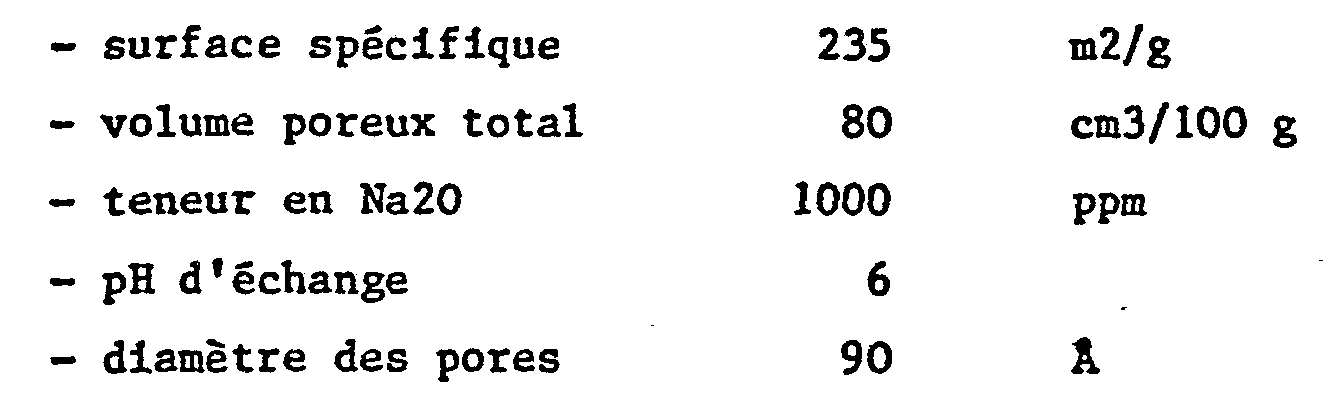
500 g de cette silice sont introduits dans un bol tournant. On pulvérise sur les grains en rotation, 550 g d'une solution aqueuse contenant 10 g d'HF. Ces grains sont ensuite séchés à 200°C pendant 24 heures.500 g of this silica are introduced into a rotating bowl. 550 g of an aqueous solution containing 10 g of HF are sprayed onto the rotating grains. These grains are then dried at 200 ° C for 24 hours.
La silice obtenue a les caractéristiques suivantes :

En opérant comme dans l'exemple lc, on introduit en continu en 150 heures, un mélange de 17,9 kg de métatrifluorométhylbenzylformamide et 71,6 kg d'acétonitrile.By operating as in Example 1c, a mixture of 17.9 kg of metatrifluoromethylbenzylformamide and 71.6 kg of acetonitrile is introduced continuously over 150 hours.
La température réactionnelle est maintenue à 530°C tout au long du lit catalytique.The reaction temperature is maintained at 530 ° C throughout the catalytic bed.
On récupère après distillation du solvant et de l'eau formée :
- 14,3 kg de métatrifluorométhylphénylacétonitrile
- 1,1 kg de métatrifluorométhylbenzylamine
- 0,55 kg du benzylformamide non transformé
- 0,33 kg de produits lourds
- 14.3 kg of metatrifluoromethylphenylacetonitrile
- 1.1 kg of metatrifluoromethylbenzylamine
- 0.55 kg of unprocessed benzylformamide
- 0.33 kg of heavy products
La sélectivité en nitrile est de 98%.The selectivity for nitrile is 98%.
La teneur en fluorure est de 350 ppm.The fluoride content is 350 ppm.
De la silice préparée selon l'exemple 2a est introduite dans un bol tournant. On pulvérise sur les grains en rotation 350 g d'une solution aqueuse contenant 20 g d'HF. Les grains sont ensuite séchés à 200°C pendant 24 heures.Silica prepared according to Example 2a is introduced into a rotating bowl. 350 g of an aqueous solution containing 20 g of HF are sprayed onto the rotating grains. The grains are then dried at 200 ° C for 24 hours.
La silice obtenue présente les caractéristiques suivantes :

En opérant comme dans l'exemple lc on introduit en continu en 300 h. à 520°C, 45 kg de parafluoroformanilide et 180 kg d'acétonitrile.By operating as in example lc, continuous introduction is carried out over 300 h. at 520 ° C, 45 kg of parafluoroformanilide and 180 kg of acetonitrile.
Après distillation du solvant et de l'eau formée, on récupère :
- 32,8 kg de parafluorobenzonitrile
- 4,3 kg de parafluoroaniline
- 0,5 kg du formanilide non transformé
- 2 kg de produits lourds
- 32.8 kg of parafluorobenzonitrile
- 4.3 kg of parafluoroaniline
- 0.5 kg of unprocessed formanilide
- 2 kg of heavy products
La sélectivité en nitrile est de 95X.The selectivity for nitrile is 95X.
La teneur en fluorures est de 60 ppm.The fluoride content is 60 ppm.
Claims (14)


Priority Applications (1)
| Application Number | Priority Date | Filing Date | Title |
|---|---|---|---|
| AT82400803T ATE10365T1 (en) | 1981-05-15 | 1982-05-03 | PROCESS FOR THE PRODUCTION OF AROMATIC OR ALIPHATIC NITRILES. |
Applications Claiming Priority (2)
| Application Number | Priority Date | Filing Date | Title |
|---|---|---|---|
| FR8109695A FR2505831A1 (en) | 1981-05-15 | 1981-05-15 | PROCESS FOR THE PREPARATION OF AROMATIC OR ALIPHATIC NITRILES |
| FR8109695 | 1982-05-15 |
Publications (2)
| Publication Number | Publication Date |
|---|---|
| EP0066483A1 true EP0066483A1 (en) | 1982-12-08 |
| EP0066483B1 EP0066483B1 (en) | 1984-11-21 |
Family
ID=9258492
Family Applications (1)
| Application Number | Title | Priority Date | Filing Date |
|---|---|---|---|
| EP82400803A Expired EP0066483B1 (en) | 1981-05-15 | 1982-05-03 | Method for the preparation of aliphatic or aromatic nitriles |
Country Status (9)
| Country | Link |
|---|---|
| US (1) | US4438042A (en) |
| EP (1) | EP0066483B1 (en) |
| JP (1) | JPS5821658A (en) |
| AT (1) | ATE10365T1 (en) |
| BR (1) | BR8202762A (en) |
| CA (1) | CA1175859A (en) |
| DE (1) | DE3261270D1 (en) |
| FR (1) | FR2505831A1 (en) |
| HU (1) | HU196952B (en) |
Cited By (1)
| Publication number | Priority date | Publication date | Assignee | Title |
|---|---|---|---|---|
| EP0502301A1 (en) * | 1991-01-28 | 1992-09-09 | Phillips Petroleum Company | Composition and method of making high porosity, high strength compositions |
Families Citing this family (3)
| Publication number | Priority date | Publication date | Assignee | Title |
|---|---|---|---|---|
| FR2505676A1 (en) * | 1981-05-15 | 1982-11-19 | Rhone Poulenc Spec Chim | FLUORINE-CONTAINING SILICA CATALYSTS AND PROCESS FOR THEIR PREPARATION AND THEIR APPLICATION TO THE PREPARATION OF NITRILES |
| FR2620447B1 (en) * | 1987-09-15 | 1990-01-26 | Sanofi Sa | PROCESS FOR THE PREPARATION OF DI-N-PROPYLACETONITRILE |
| JPH0478024U (en) * | 1990-11-20 | 1992-07-08 |
Citations (1)
| Publication number | Priority date | Publication date | Assignee | Title |
|---|---|---|---|---|
| FR1250165A (en) * | 1960-02-26 | 1961-01-06 | Basf Ag | Process for the production of nitriles |
Family Cites Families (1)
| Publication number | Priority date | Publication date | Assignee | Title |
|---|---|---|---|---|
| US4324698A (en) | 1980-10-20 | 1982-04-13 | Texaco Inc. | Fluorided cracking catalyst |
-
1981
- 1981-05-15 FR FR8109695A patent/FR2505831A1/en not_active Withdrawn
-
1982
- 1982-05-03 EP EP82400803A patent/EP0066483B1/en not_active Expired
- 1982-05-03 AT AT82400803T patent/ATE10365T1/en not_active IP Right Cessation
- 1982-05-03 DE DE8282400803T patent/DE3261270D1/en not_active Expired
- 1982-05-13 BR BR8202762A patent/BR8202762A/en unknown
- 1982-05-13 JP JP57079256A patent/JPS5821658A/en active Granted
- 1982-05-14 US US06/378,226 patent/US4438042A/en not_active Expired - Fee Related
- 1982-05-14 HU HU821531A patent/HU196952B/en not_active IP Right Cessation
- 1982-05-14 CA CA000402998A patent/CA1175859A/en not_active Expired
Patent Citations (1)
| Publication number | Priority date | Publication date | Assignee | Title |
|---|---|---|---|---|
| FR1250165A (en) * | 1960-02-26 | 1961-01-06 | Basf Ag | Process for the production of nitriles |
Cited By (1)
| Publication number | Priority date | Publication date | Assignee | Title |
|---|---|---|---|---|
| EP0502301A1 (en) * | 1991-01-28 | 1992-09-09 | Phillips Petroleum Company | Composition and method of making high porosity, high strength compositions |
Also Published As
| Publication number | Publication date |
|---|---|
| HU196952B (en) | 1989-02-28 |
| BR8202762A (en) | 1983-04-19 |
| CA1175859A (en) | 1984-10-09 |
| DE3261270D1 (en) | 1985-01-03 |
| EP0066483B1 (en) | 1984-11-21 |
| JPS5821658A (en) | 1983-02-08 |
| JPS6121625B2 (en) | 1986-05-28 |
| ATE10365T1 (en) | 1984-12-15 |
| US4438042A (en) | 1984-03-20 |
| FR2505831A1 (en) | 1982-11-19 |
Similar Documents
| Publication | Publication Date | Title |
|---|---|---|
| EP0065447B1 (en) | Fluor-containing silica catalysts; their preparation, and their use in the preparation of nitriles | |
| EP0733614B1 (en) | Reagent and process useful for attaching a substituted difluoromethyl group onto a compound with at least one electrophilic function | |
| EP0066482B1 (en) | Method for the preparation of aliphatic or aromatic nitriles | |
| EP0770051B1 (en) | Aromatic ether acylation process | |
| EP0066483B1 (en) | Method for the preparation of aliphatic or aromatic nitriles | |
| EP0260185B1 (en) | Catalytic process for producing mercaptans from thioethers | |
| EP0665188A1 (en) | Process for making zeolites containing titanium | |
| EP0049186B1 (en) | Process for the preparation of fluorobenzonitriles | |
| JP3512459B2 (en) | Method for producing perfluoroalkane | |
| EP0130876B1 (en) | Process for the simultaneous halogenation and fluorination of aromatic compounds | |
| EP0045710B1 (en) | Process for the selective preparation of meta-chlorinated anilines | |
| EP0770050B1 (en) | Aromatic ether acylation process | |
| EP0140783B1 (en) | Process for the preparation of meta-substituted anilines | |
| EP0248746B1 (en) | Process for the preparation of 4-fluoro-anilines from 4-halogen-nitrobenzenes | |
| CA2027016C (en) | Process for preparing 2,2-difluoro-1,3-benzodioxole | |
| EP0102305B1 (en) | Process for the preparation of metachlorinated anilines | |
| EP0310527B1 (en) | Process for manufacturing amines from olefines | |
| EP0067080B1 (en) | N-fluorinated benzyl amides and process for their preparation | |
| FR2519979A1 (en) | PROCESS FOR THE PREPARATION OF TRIFLUOROMETHOXY OR TRIFLUOROMETHYLTHIOPHENYLSULFONES | |
| EP0239557B1 (en) | Process for halogenating tea silicate catalysts | |
| EP0113625B1 (en) | Process for the preparation of trifluoromethylated benzenic compounds | |
| EP0251941A1 (en) | Process for preparing paranitrophenol | |
| FR2579592A1 (en) | PROCESS FOR THE PREPARATION OF 1.1 DIFLUORO PERHALOGENOALCOXYL OR 1.1 DIFLUORO PERHALOGENOTHIOALKYL AROMATIC DERIVATIVES | |
| BE871155A (en) | PROCESS FOR THE PREPARATION OF AZOIC COMPOUNDS | |
| CH666680A5 (en) | PROCESS FOR THE PREPARATION OF DECABROMODIPHENYLETHER. |
Legal Events
| Date | Code | Title | Description |
|---|---|---|---|
| PUAI | Public reference made under article 153(3) epc to a published international application that has entered the european phase |
Free format text: ORIGINAL CODE: 0009012 |
|
| 17P | Request for examination filed |
Effective date: 19820921 |
|
| AK | Designated contracting states |
Designated state(s): AT BE CH DE FR GB IT LU NL SE |
|
| ITF | It: translation for a ep patent filed | ||
| GRAA | (expected) grant |
Free format text: ORIGINAL CODE: 0009210 |
|
| AK | Designated contracting states |
Designated state(s): AT BE CH DE FR GB IT LI LU NL SE |
|
| REF | Corresponds to: |
Ref document number: 10365 Country of ref document: AT Date of ref document: 19841215 Kind code of ref document: T |
|
| REF | Corresponds to: |
Ref document number: 3261270 Country of ref document: DE Date of ref document: 19850103 |
|
| PG25 | Lapsed in a contracting state [announced via postgrant information from national office to epo] |
Ref country code: LU Free format text: LAPSE BECAUSE OF NON-PAYMENT OF DUE FEES Effective date: 19850531 |
|
| PLBE | No opposition filed within time limit |
Free format text: ORIGINAL CODE: 0009261 |
|
| STAA | Information on the status of an ep patent application or granted ep patent |
Free format text: STATUS: NO OPPOSITION FILED WITHIN TIME LIMIT |
|
| 26N | No opposition filed | ||
| PGFP | Annual fee paid to national office [announced via postgrant information from national office to epo] |
Ref country code: FR Payment date: 19890301 Year of fee payment: 8 |
|
| PGFP | Annual fee paid to national office [announced via postgrant information from national office to epo] |
Ref country code: DE Payment date: 19890303 Year of fee payment: 8 |
|
| PGFP | Annual fee paid to national office [announced via postgrant information from national office to epo] |
Ref country code: LU Payment date: 19890307 Year of fee payment: 8 |
|
| PGFP | Annual fee paid to national office [announced via postgrant information from national office to epo] |
Ref country code: SE Payment date: 19890427 Year of fee payment: 8 |
|
| PGFP | Annual fee paid to national office [announced via postgrant information from national office to epo] |
Ref country code: GB Payment date: 19890430 Year of fee payment: 8 |
|
| PGFP | Annual fee paid to national office [announced via postgrant information from national office to epo] |
Ref country code: BE Payment date: 19890517 Year of fee payment: 8 |
|
| PGFP | Annual fee paid to national office [announced via postgrant information from national office to epo] |
Ref country code: CH Payment date: 19890519 Year of fee payment: 8 |
|
| PGFP | Annual fee paid to national office [announced via postgrant information from national office to epo] |
Ref country code: AT Payment date: 19890524 Year of fee payment: 8 |
|
| PGFP | Annual fee paid to national office [announced via postgrant information from national office to epo] |
Ref country code: NL Payment date: 19890531 Year of fee payment: 8 |
|
| PG25 | Lapsed in a contracting state [announced via postgrant information from national office to epo] |
Ref country code: GB Effective date: 19900503 Ref country code: AT Effective date: 19900503 |
|
| PG25 | Lapsed in a contracting state [announced via postgrant information from national office to epo] |
Ref country code: SE Effective date: 19900504 |
|
| PG25 | Lapsed in a contracting state [announced via postgrant information from national office to epo] |
Ref country code: LI Effective date: 19900531 Ref country code: CH Effective date: 19900531 Ref country code: BE Effective date: 19900531 |
|
| BERE | Be: lapsed |
Owner name: RHONE-POULENC SPECIALITES CHIMIQUES Effective date: 19900531 |
|
| PG25 | Lapsed in a contracting state [announced via postgrant information from national office to epo] |
Ref country code: NL Effective date: 19901201 |
|
| GBPC | Gb: european patent ceased through non-payment of renewal fee | ||
| NLV4 | Nl: lapsed or anulled due to non-payment of the annual fee | ||
| PG25 | Lapsed in a contracting state [announced via postgrant information from national office to epo] |
Ref country code: FR Effective date: 19910131 |
|
| REG | Reference to a national code |
Ref country code: CH Ref legal event code: PL |
|
| PG25 | Lapsed in a contracting state [announced via postgrant information from national office to epo] |
Ref country code: DE Effective date: 19910201 |
|
| REG | Reference to a national code |
Ref country code: FR Ref legal event code: ST |
|
| EUG | Se: european patent has lapsed |
Ref document number: 82400803.1 Effective date: 19910115 |