EP0067360A2 - Verfahren zur Herstellung von Pyrrolen - Google Patents
Verfahren zur Herstellung von Pyrrolen Download PDFInfo
- Publication number
- EP0067360A2 EP0067360A2 EP82104788A EP82104788A EP0067360A2 EP 0067360 A2 EP0067360 A2 EP 0067360A2 EP 82104788 A EP82104788 A EP 82104788A EP 82104788 A EP82104788 A EP 82104788A EP 0067360 A2 EP0067360 A2 EP 0067360A2
- Authority
- EP
- European Patent Office
- Prior art keywords
- reaction
- weight
- palladium
- catalyst
- potassium
- Prior art date
- Legal status (The legal status is an assumption and is not a legal conclusion. Google has not performed a legal analysis and makes no representation as to the accuracy of the status listed.)
- Granted
Links
Classifications
-
- B—PERFORMING OPERATIONS; TRANSPORTING
- B01—PHYSICAL OR CHEMICAL PROCESSES OR APPARATUS IN GENERAL
- B01J—CHEMICAL OR PHYSICAL PROCESSES, e.g. CATALYSIS OR COLLOID CHEMISTRY; THEIR RELEVANT APPARATUS
- B01J23/00—Catalysts comprising metals or metal oxides or hydroxides, not provided for in group B01J21/00
- B01J23/38—Catalysts comprising metals or metal oxides or hydroxides, not provided for in group B01J21/00 of noble metals
- B01J23/54—Catalysts comprising metals or metal oxides or hydroxides, not provided for in group B01J21/00 of noble metals combined with metals, oxides or hydroxides provided for in groups B01J23/02 - B01J23/36
- B01J23/56—Platinum group metals
- B01J23/63—Platinum group metals with rare earths or actinides
-
- B—PERFORMING OPERATIONS; TRANSPORTING
- B01—PHYSICAL OR CHEMICAL PROCESSES OR APPARATUS IN GENERAL
- B01J—CHEMICAL OR PHYSICAL PROCESSES, e.g. CATALYSIS OR COLLOID CHEMISTRY; THEIR RELEVANT APPARATUS
- B01J23/00—Catalysts comprising metals or metal oxides or hydroxides, not provided for in group B01J21/00
- B01J23/38—Catalysts comprising metals or metal oxides or hydroxides, not provided for in group B01J21/00 of noble metals
- B01J23/48—Silver or gold
-
- B—PERFORMING OPERATIONS; TRANSPORTING
- B01—PHYSICAL OR CHEMICAL PROCESSES OR APPARATUS IN GENERAL
- B01J—CHEMICAL OR PHYSICAL PROCESSES, e.g. CATALYSIS OR COLLOID CHEMISTRY; THEIR RELEVANT APPARATUS
- B01J23/00—Catalysts comprising metals or metal oxides or hydroxides, not provided for in group B01J21/00
- B01J23/38—Catalysts comprising metals or metal oxides or hydroxides, not provided for in group B01J21/00 of noble metals
- B01J23/54—Catalysts comprising metals or metal oxides or hydroxides, not provided for in group B01J21/00 of noble metals combined with metals, oxides or hydroxides provided for in groups B01J23/02 - B01J23/36
- B01J23/56—Platinum group metals
- B01J23/60—Platinum group metals with zinc, cadmium or mercury
-
- B—PERFORMING OPERATIONS; TRANSPORTING
- B01—PHYSICAL OR CHEMICAL PROCESSES OR APPARATUS IN GENERAL
- B01J—CHEMICAL OR PHYSICAL PROCESSES, e.g. CATALYSIS OR COLLOID CHEMISTRY; THEIR RELEVANT APPARATUS
- B01J23/00—Catalysts comprising metals or metal oxides or hydroxides, not provided for in group B01J21/00
- B01J23/38—Catalysts comprising metals or metal oxides or hydroxides, not provided for in group B01J21/00 of noble metals
- B01J23/54—Catalysts comprising metals or metal oxides or hydroxides, not provided for in group B01J21/00 of noble metals combined with metals, oxides or hydroxides provided for in groups B01J23/02 - B01J23/36
- B01J23/56—Platinum group metals
- B01J23/64—Platinum group metals with arsenic, antimony, bismuth, vanadium, niobium, tantalum, polonium, chromium, molybdenum, tungsten, manganese, technetium or rhenium
- B01J23/656—Manganese, technetium or rhenium
-
- B—PERFORMING OPERATIONS; TRANSPORTING
- B01—PHYSICAL OR CHEMICAL PROCESSES OR APPARATUS IN GENERAL
- B01J—CHEMICAL OR PHYSICAL PROCESSES, e.g. CATALYSIS OR COLLOID CHEMISTRY; THEIR RELEVANT APPARATUS
- B01J23/00—Catalysts comprising metals or metal oxides or hydroxides, not provided for in group B01J21/00
- B01J23/70—Catalysts comprising metals or metal oxides or hydroxides, not provided for in group B01J21/00 of the iron group metals or copper
- B01J23/89—Catalysts comprising metals or metal oxides or hydroxides, not provided for in group B01J21/00 of the iron group metals or copper combined with noble metals
-
- C—CHEMISTRY; METALLURGY
- C07—ORGANIC CHEMISTRY
- C07D—HETEROCYCLIC COMPOUNDS
- C07D207/00—Heterocyclic compounds containing five-membered rings not condensed with other rings, with one nitrogen atom as the only ring hetero atom
- C07D207/02—Heterocyclic compounds containing five-membered rings not condensed with other rings, with one nitrogen atom as the only ring hetero atom with only hydrogen or carbon atoms directly attached to the ring nitrogen atom
- C07D207/30—Heterocyclic compounds containing five-membered rings not condensed with other rings, with one nitrogen atom as the only ring hetero atom with only hydrogen or carbon atoms directly attached to the ring nitrogen atom having two double bonds between ring members or between ring members and non-ring members
- C07D207/32—Heterocyclic compounds containing five-membered rings not condensed with other rings, with one nitrogen atom as the only ring hetero atom with only hydrogen or carbon atoms directly attached to the ring nitrogen atom having two double bonds between ring members or between ring members and non-ring members with only hydrogen atoms, hydrocarbon or substituted hydrocarbon radicals, directly attached to ring carbon atoms
- C07D207/323—Heterocyclic compounds containing five-membered rings not condensed with other rings, with one nitrogen atom as the only ring hetero atom with only hydrogen or carbon atoms directly attached to the ring nitrogen atom having two double bonds between ring members or between ring members and non-ring members with only hydrogen atoms, hydrocarbon or substituted hydrocarbon radicals, directly attached to ring carbon atoms with only hydrogen atoms or radicals containing only hydrogen and carbon atoms directly attached to the ring nitrogen atoms
Definitions
- the invention relates to a process for the preparation of pyrroles by reacting pyrrolidines at 160 to 400 ° C. in the presence of supported palladium catalysts which contain basic compounds and / or elements of group Ib, IIb, VIIb, cobalt and / or nickel.
- heterocycles which are hydrogenated stages of heteroaromatic compounds
- palladium catalysts on silica gel supports for the dehydrogenation, for example at 350-500 ° C., of saturated heterocyclic compounds to heteroaromatics (British Patent 1,393,086), especially pyrrolidines to pyrroles (US Pat. No.
- the reaction can be represented using N-methylpyrrolidine by the following formulas:
- the advantages of the process according to the invention are that catalysts are used which allow almost complete conversions of the pyrrolidines used to be sought at temperatures below 300 ° C. To achieve pyrroles, the pyrroles are obtained in excellent yields and good purity. It is particularly advantageous that the claimed catalysts have a very long lifespan, so that there is no decrease in activity even after continuous use of more than 1200 operating hours (see Example 1). If, despite this largely insensitivity of the catalysts according to the invention, there are impairments in the activity which can be caused, for example, by supplying contaminated starting products, complete regeneration can be brought about by burning off at 300 ° C. and subsequent activation with hydrogen at 300 ° C.
- Preferred starting materials II and accordingly preferred end products I are those in the formulas of which the individual radicals R can be the same or different and each represent a hydrogen atom or an alkyl radical having 1 to 10, advantageously 1 to 6, carbon atoms.
- the abovementioned radicals can also be substituted by groups which are inert under the reaction conditions, for example alkyl or alkoxy groups each having 1 to 4 carbon atoms.
- the following starting materials II are suitable: pyrrolidine; in the 1-, 2-, 3-, 4-, 5-position by the methyl, ethyl, propyl, isopropyl, butyl, isobutyl, sec-butyl, tert-butyl, pentyl , Hexyl group substituted pyrrolidines; pyrrolidines substituted in the 1,2-, 1,3-, 2,4-, 2,5-, 2,3-position by the aforementioned substituents, in 1,2,3-, 1,3,4-, 1, 2.5, 1.2.4, 2.3.4, 3.4.5 position.
- pyrrolidines substituted by the aforementioned substituents homologous pyrrolidines substituted in the 1,2,3,4-, 1,2,3,5-, 2,3,4,5-position; pyrrolidines substituted in all positions; pyrrolidine, N-methylpyrrolidine, 2-methylpyrrolidine, 3-methylpyrrolidine, N-ethylpyrrolidine, N-hexylpy.rrolidine, N-decylpyrrolidine, 2,5-dimethylpyrrolidine, 2,4-dimethylpyrrolidine, 2,3,4-trimethylpyrrolidine are preferred 2,3,4,5-tetramethylpyrrolidine, 2,5-diethylpyrrolidine, 2,5-di-n-butylpyrrolidine.
- the reaction is carried out at a temperature of 160 to 400 ° C., preferably 160 to 300 ° C., in particular 200 to 300 ° C., without pressure or under pressure, discontinuously or preferably continuously.
- the pyrrolidines II can be fed to the reaction zone without solvent or in a solvent which is indifferent under the reaction conditions.
- solvents examples include: aromatic hydrocarbons, for example toluene, ethylbenzene, o-, m-, p-xylene, isopropylbenzene; Alkanols and cycloalkanols such as ethanol, methanol, n-butanol, isobutanol, tert-butanol, n-propano1, isopropanol, amyl alcohol, cyclohexanol, 2-methyl-4-pen- tanol, ethylene glycol monoethyl ether, 2-ethylhexanol, methylglycol, n-hexanol, isohexyl alcohol, isoheptyl alcohol, n-heptanol, ethylbutanol, nonyl alcohol, dodecyl alcohol, methylcyclohexanol, especially those with 1 to 4 carbon atoms; Ethers, for example ethy
- tertiary amines and basic zinc compounds can also be used. Volatile bases are expediently fed into the reaction zone together with the starting material.
- tert-amines can also be used simultaneously as solvents in the process according to the invention.
- Possible basic compounds are, for example: potassium hydroxide, sodium hydroxide, potassium carbonate, sodium carbonate, lithium hydroxide, lithium carbonate, sodium bicarbonate, potassium bicarbonate, calcium hydroxide, calcium oxide, barium oxide, magnesium hydroxide, magnesium oxide, barium oxide, calcium carbonate, magnesium carbonate, magnesium bicarbonate, magnesium acetate, zinc hydroxide, zinc oxide, zinc carbonate , Zinc bicarbonate, zinc acetate, sodium formate, sodium acetate, sodium propionate, sodium butyrate, sodium isobutyrate, potassium formate, potassium acetate, potassium propionate, potassium butyrate, potassium isobutyrate, sodium methylate, sodium ethylate, sodium propylate, sodium isopropylate, Sodium butylate, sodium isobutylate, sodium sec-butoxide, sodium tert-butoxide, sodium ethylene glycolate, sodium propylene (1,2) glycolate, sodium propylene (1,3) glycolate, sodium diethylene glycolate, sodium triethylene glycolate,
- the oxides, hydroxides or carbonates of the alkali metals, preferably of lithium, of the alkaline earth metals, preferably of magnesium and calcium, of the rare earth metals, preferably of cerium, praseodymium and neodymium, are preferred.
- the reaction is expediently carried out in the presence of a basic compound in an amount of from 0.001 to 10,000, preferably from 0.01 to 1,000,% by weight of basic compound, based on the amount by weight of starting material II.
- Group Ib for example copper, silver, IIb, for example zinc or cadmium
- VIIb for example manganese, cobalt and / or nickel
- the palladium content of the catalyst, based on the support material, is generally from 0.05 to 15 percent by weight.
- the weight ratio of the additives to palladium can advantageously be from 0.02 to 10,000: 1, preferably 0.02 to 100: 1.
- the catalyst is expediently used in the form of strands with a diameter of 3 mm and a length of 10 mm or as a powder (vortex grain). Weight ratios of 0.001 to 1000: 1, preferably 0.01 to 100: 1 palladium, based on the starting material II, are expediently selected.
- the reaction can be carried out as follows: A mixture of starting material II and supported palladium catalyst, optionally together with solvent, is kept at the reaction temperature for 1 to 10 hours.
- the end product I is converted from the reaction mixture in a conventional manner, e.g. separated by filtration and fractional distillation.
- the process is carried out continuously in the gas phase, it being possible for the catalyst to be arranged in a fixed bed or as a fluidized bed.
- the starting products can be passed over the catalyst together with a carrier gas, such as nitrogen or preferably hydrogen, the ratio of pyrrolidine to carrier gas advantageously being able to be varied in molar ratios from 1: 1 to 1:20.
- the catalyst system used according to the process of the invention contains, on the one hand, palladium and, on the other hand, active additives, where the additives can be present alone or in a mixture with one another alongside the palladium.
- the active constituents of the catalyst are applied to a support which can consist of aluminum oxide, silica, aluminum silicate, magnesium silicate, activated carbon or spinels of aluminum, chromium or iron, where the additives which give the catalyst its properties, can be on the surface of the catalyst or together with an indifferent carrier material in the form of a mixture can represent the carrier or can form a common crystal lattice with the original carrier by subsequent annealing;
- a support which can consist of aluminum oxide, silica, aluminum silicate, magnesium silicate, activated carbon or spinels of aluminum, chromium or iron, where the additives which give the catalyst its properties, can be on the surface of the catalyst or together with an indifferent carrier material in the form of a mixture can represent the carrier or can form a common crystal lattice with
- the activity and the life of the catalysts are very significantly influenced by the additives contained in the support.
- Aluminum oxide is preferably used as the carrier.
- the additives can be applied together with the palladium by impregnating the support material with solutions of, for example, nitrates, chlorides, carbonates, formates or oxalates. Subsequent thermal treatment, which is expediently carried out between 400 and 600 ° C., leads to the conversion into the oxide form. If, when alumina supports with suitable metals (Mg, Zn, Co, Mn, Li) are obtained spinel formation, must be heated appropriately according to the impregnation at a temperature 900-1300 0 C and then the palladium is to be applied.
- Some carrier additives such as calcium oxide or magnesium oxide, can be mixed with a carrier such as aluminum oxide and then, after joint annealing at 400 to 600 ° C., form a new carrier on which the palladium can be deposited.
- the pyrroles made by the process of the invention are e.g. as corrosion inhibitors (US Pat. No. 3,008,965), for the production of pesticides, dyes (Kirk-Othmer Encycl. Chem. Technol., 2nd Ed. 1968, Volume 16, pages 841-858; Ullmanns Encycl. d. techn. Chem. (1963), volume 14, pages 505-510) or medicaments (FR-PS 1 574 570).
- corrosion inhibitors US Pat. No. 3,008,965
- dyes Kirk-Othmer Encycl. Chem. Technol., 2nd Ed. 1968, Volume 16, pages 841-858; Ullmanns Encycl. d. techn. Chem. (1963), volume 14, pages 505-510
- medicaments FR-PS 1 574 570
- a catalyst in the form of strands (3 mm in diameter, 10 mm in length) containing 0.5% by weight of palladium on a mixture of 19.4% by weight of magnesium oxide and 80.6% by weight of aluminum oxide was placed in a tubular reactor with a capacity of 1.2 liters , filled and heated to 250 ° C. 100 grams of N-methylpyrrolidine and 50 liters of hydrogen per hour were passed in cocurrent per hour over this catalyst bed. The reaction pro. product was cooled as soon as it left the reactor. According to gas chromatographic analysis, it consisted of 98.5 percent by weight of N-methylpyrrole and 1.5 percent by weight of N-methylpyrrolidine.
- Example 2 The procedure was as in Example 1, but using a catalyst which contained 0.5 percent by weight of palladium on 19.4 percent by weight of calcium oxide and 80.6 percent by weight of aluminum oxide. 96 grams of end product (99% of theory) with a boiling point of 115 ° C./1013 mbar are obtained from 100 grams of starting material.
- Example 2 The procedure was as in Example 1, but using a catalyst which contained 1.0% by weight of palladium and 0.5% by weight of praseodymium oxide on aluminum oxide, and the reaction was carried out at a reaction temperature of 230 ° C.
- Example 8 The procedure was as in Example 8, but a catalyst was used which contained 0.5% by weight of palladium and 5.0% by weight of silver on aluminum oxide. Under these conditions, 94.5 percent by weight of N-methylpyrrolidine was converted to N-methylpyrrole (94.5% of theory).
- Example 2 The procedure was as in Example 1, except that a 50 percent solution of N-methylpyrrolidine in N-methylmorpholine (as the basic compound) was used as the starting material every hour. Using this procedure, 96 grams of N-methylpyrrole (99% of theory) were formed from 100 grams of N-methylpyrrolidine.
Landscapes
- Chemical & Material Sciences (AREA)
- Organic Chemistry (AREA)
- Engineering & Computer Science (AREA)
- Materials Engineering (AREA)
- Chemical Kinetics & Catalysis (AREA)
- Catalysts (AREA)
- Pyrrole Compounds (AREA)
- Low-Molecular Organic Synthesis Reactions Using Catalysts (AREA)
- Organic Low-Molecular-Weight Compounds And Preparation Thereof (AREA)
Abstract
Description
- Die Erfindung betrifft ein Verfahren zur Herstellung von Pyrrolen durch Umsetzung von Pyrrolidinen bei 160 bis 400oC in Gegenwart von Palladiumträgerkatalysatoren, die basische Verbindungen und/oder Elemente der Gruppe Ib, IIb, VIIb, Cobalt und/oder Nickel enthalten.
- Es ist bekannt, daß Heterocyclen, die hydrierte Stufen von heteroaromatischen Verbindungen darstellen, durch Dehydrierung an Palladium- oder Platin-Trägerkatalysatoren, z.B. bei 300 bis 350°C in die entsprechenden Heteroaromaten über- führt werden können (Houben-Weyl, Methoden der Organischen Chemie, Band 4/2, Seiten 338 - 341, N.D. Zelinsky, J.K. Jurjew, Chem. Ber., Band 64 (1931), Seiten 101 - 103). Besonders hervorgehoben werden Palladiumkatalysatoren auf Kieselgelträgern für die Dehydrierung, z.B. bei 350 - 500°C, von gesättigten heterocyclischen Verbindungen zu Heteroaromaten (Britische Patentschrift 1 393 086), speziell von Pyrrolidinen zu Pyrrolen (US-Patentschrift 3 522 269). Auffallend ist, daß bei Verwendung von Silikagel als Trägermaterial relativ hohe Reaktionstemperaturen (350 - 500°C) angewendet werden müssen, um befriedigende Umsätze zu erreichen. Die Umsetzung von Pyrrolidin und N-substituierten Homologen des Pyrrolidins zu den entsprechenden Pyrrolen an Palladiumkatalysatoren auf Aluminiumoxidträgern wird in der US-Patentschrift 3 008 965 beschrieben. Nach dieser Arbeitsweise werden im Temperaturbereich von 175 - 350°C Umsätze zwischen 45 und 65 % erreicht, die nach 12 bis 15 Stunden Betriebszeit zu sinken beginnen, wobei der Abfall des Umsatzes durch stufenweise Steigerung der Reaktionstemperatur auf 350°C abgefangen wird. Palladiumkatalysatoren auf gemischten Si02-A1203-Trägern sind nach den Angaben in der vorher zitierten US-Patentschrift weniger aktiv als Palladiumkatalysatoren auf reinen A1203-Trägern.
-
E s wurde nun gefunden, daß man Pyrrole der Formel
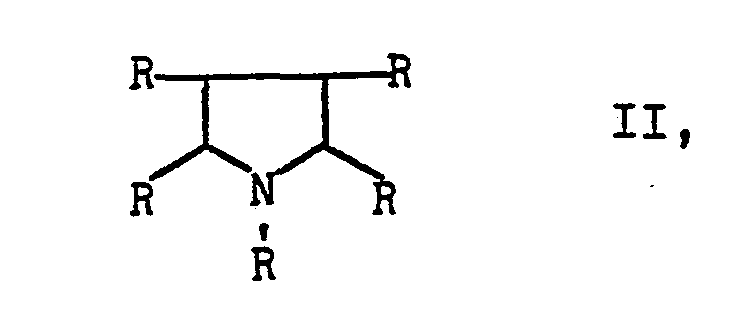
- Weiterhin wurde gefunden, daß man das Verfahren vorteilhaft durchführt, wenn man in Anwesenheit von tertiären Aminen umsetzt.
- Die Umsetzung kann unter Verwendung von N-Methylpyrrolidin durch die folgenden Formeln wiedergegeben werden:

- Die Vorteile des erfindungsgemäßen Verfahrens bestehen darin, daß Katalysatoren zur Anwendung kommen, die es erlauben, bei Temperaturen unterhalb von 300°C fast vollständige Umsätze der eingesetzten Pyrrolidine zu den gesuchten Pyrrolen zu erreichen,wobei die Pyrrole in ausgezeichneten Ausbeuten und guter Reinheit anfallen. Vorteilhaft ist insbesondere, daß die beanspruchten Katalysatoren eine sehr lange Lebenszeit haben, so daß selbst nach einer Dauerbeanspruchung von über 1 200 Betriebsstunden kein Aktivitätsabfall zu verzeichnen ist (siehe Beispiel 1). Sollten trotz dieser weitgehenden Unempfindlichkeit der erfindungsgemäßen Katalysatoren Beeinträchtigungen der Aktivität vorkommen, die beispielsweise durch Zufuhr verunreinigter Ausgangsprodukte verursacht sein können, läßt sich durch Abbrennen bei 3000C und anschließende Aktivierung mit Wasserstoff bei 3000C eine vollständige Regenerierung herbeiführen. Beim Arbeiten mit Temperaturen oberhalb von 300°C erweisen sich die verwendeten Katalysatoren als sehr stabil und langlebig, obwohl keine Notwendigkeit besteht, in diesem hohen Temperaturbereich zu arbeiten, da unterhalb von 300°C quantitative Umsätze und sehr gute Ausbeuten zu erzielen sind. Verzichtet man auf hohe Umsatzraten und führt den nicht umgesetzten Ausgangsstoff wieder in die Reaktionszone zurück, sind Reaktionstemperaturen um 200°C und darunter ausreichend.
- Die Bildung von Nebenprodukten, wie beispielsweise von instabilen Pyrrolinen, die durch Folgereaktionen (z.B. Polymerisationen) für höhermolekulare Ablagerungen auf der Katalysatoroberfläche verantwortlich sein können, Crack-oder Sintervorgänge, die ebenfalls zu Veränderungen an der Oberfläche von Katalysatoren führen können, werden nicht beobachtet. Alle diese vorteilhaften Ergebnisse des erfindungsgemäßen Verfahrens sind im Hinblick auf den Stand der Technik überraschend.
- Bevorzugte Ausgangsstoffe II und dementsprechend bevorzugte Endstoffe I sind solche, in deren Formeln die einzelnen Reste R gleich oder verschieden sein können und jeweils ein Wasserstoffatom oder einen Alkylrest mit 1 bis 10, vorteilhaft 1 bis 6 Kohlenstoffatomen bedeuten. Die vorgenannten Reste können noch durch unter den Reaktionsbedingungen inerte Gruppen, z.B. Alkyl- oder Alkoxygruppen mit jeweils 1 bis 4 Kohlenstoffatomen, substituiert sein.
- So kommen beispielsweise folgende Ausgangsstoffe II in Betracht: Pyrrolidin; in 1-, 2-, 3-, 4-, 5-Stellung durch die Methyl-, Ethyl-, Propyl-, Isopropyl-, Butyl-, Isobutyl-, sek.-Butyl-, tert.-Butyl-, Pentyl-, Hexyl-gruppe substituierte Pyrrolidine; in 1,2-, 1,3-, 2,4-, 2,5-, 2,3-Stellung durch vorgenannte Substituenten substituierte Pyrrolidine-, in 1,2,3-, 1,3,4-, 1,2,5-, 1,2,4-, 2,3,4-, 3,4,5-Stellung. durch vorgenannte Substituenten substituierte Pyrrolidine; homologe in 1,2,3,4-, 1,2,3,5-, 2,3,4,5-Stellung substituierte Pyrrolidine; in allen Stellungen substituierte Pyrrolidine; bevorzugt sind Pyrrolidin, N-Methylpyrrolidin, 2-Methylpyrrolidin, 3-Methylpyrrolidin, N-Ethylpyrrolidin, N-Hexylpy.rrolidin, N-Decylpyrrolidin, 2,5-Dimethylpyrrolidin, 2,4-Dimethylpyrrolidin, 2,3,4-Trimethylpyrrolidin, 2,3,4,5-Tetramethylpyrrolidin, 2,5-Diethylpyrrolidin, 2,5-Di-n-butylpyrrolidin.
- Die Umsetzung wird bei einer Temperatur von 160 bis 400°C, vorzugsweise 160 bis 300°C, insbesondere 200 bis 300°C, drucklos oder unter Druck, diskontinuierlich oder bevorzugt kontinuierlich durchgeführt. Die Pyrrolidine II können lösungsmittelfrei oder in einem Lösungsmittel gelöst, das unter den Reaktionsbedingungen indifferent ist, der Reaktionszone zugeführt werden. Als Lösungsmittel kommen beispielsweise in Frage: aromatische Kohlenwasserstoffe, z.B. Toluol, Ethylbenzol, o-, m-, p-Xylol, Isopropylbenzol; Alkanole und Cycloalkanole wie Ethanol, Methanol, n-Butanol, Isobutanol, tert.-Butanol, n-Propano1, Isopropanol, Amylalkohol, Cyclohexanol, 2-Methyl-4-pen- tanol, Ethylenglykolmonoethylether, 2-Ethylhexanol, Methylglykol, n-Hexanol, Isohexylalkohol, Isoheptylalkohol, n-Heptanol, Ethylbutanol, Nonylalkohol, Dodecylalkohol, Methylcyclohexanol, insbesondere solche mit 1 bis 4 Kohlenstoffatomen; Ether, z.B. Ethylpropylether, Methyl-tert.-butylether, n-Butylethylether, Di-n-butylether, Diisobutyl= ether, Diisoamylether, Diisopropylether, Anisol, Phenetol, Cyclohexylmethylether, Diethylether, Ethylenglykoldimethylether, Tetrahydrofuran, Dioxan; bevorzugt sind Toluol, Xylole, Diethylbenzol, Ethanol, n-Butanol, Methylglykol, Ethylglykol, 1,2-Dimethoxyethan; und entsprechende Gemische. Zweckmäßig verwendetman das Lösungsmittel in einer Menge von 80 bis 10 000 Gewichtsprozent, vorzugsweise von 100 bis 600 Gewichtsprozent, bezogen auf Ausgangsstoff II.
- Als basische Verbindungen werden im allgemeinen Verbindungen der Alkali-, Erdalkalimetalle und/oder Metalle der Seltenen Erden verwendet. Es können aber auch tertiäre Amine und basische Zinkverbindungen verwendet werden. Flüchtige Basen werden zweckmäßig zusammen mit dem Ausgangsstoff der Reaktionszone zugeführt. So können beispielsweise tert.- Amine nach dem erfindungsgemäßen Verfahren auch noch gleichzeitig als Lösungsmittel verwendet werden. Es kommen z.B. als basische Verbindungen in Frage: Kaliumhydroxid, Natriumhydroxid, Kaliumcarbonat, Natriumcarbonat, Lithiumhydroxid, Lithiumcarbonat, Natriumbicarbonat, Kaliumbicarbonat, Calciumhydroxid, Calciumoxid, Bariumoxid, Magnesiumhydroxid, Magnesiumoxid, Bariumoxid, Calciumcarbonat, Magnesiumcarbonat, Magnesiumbicarbonat, Magnesiumacetat, Zinkhydroxid, Zinkoxid, Zinkcarbonat, Zinkbicarbonat, Zinkacetat, Natriumformiat, Natriumacetat, Natriumpropionat, Natriumbutyrat, Natriumisobutyrat, Kaliumformiat, Kaliumacetat, Kaliumpropionat, Kaliumbutyrat, Kaliumisobutyrat, Natriummethylat, Natriumethylat, Natriumpropylat, Natriumisopropylat, Natriumbutylat, Natriumisobutylat, Natrium-sek.-butylat, Natrium-tert.-butylat, Natriumethylenglykolat, Natriumpropy- len-(1,2)-glykolat, Natriumpropylen-(1,3)-glykolat, Natriumdiethylenglykolat, Natriumtriethylenglykolat, Natriumdi- propylen-(1,2)-glykolat, Kaliumethylat, Kaliumethylat, Kalium-n-propylat, Kaliumisopropylat, Kalium-n-butylat, Kalium-isobutylat, Kalium-sek.-butylat, Kalium-tert.-butylat, Kaliumethylenglykolat, Kaliumpropylen-(1,2)-glykolat, Kaliumpropylen-(1,3)-glykolat, Kaliumdiethylenglykolat, Kaliumtriethylenglykolat, Kaliumdipropylen-(1,2)-glykolat; Trimethylamin, Triethylamin, Tripropylamin, Triisopropyl-' amin, Tributylamin, Triisobutylamin, Tri-sek.-butylamin, Triamylamin, Trihexylamin, N,N-Dimethylanilin, N,N-Diethylanilin, N,N-Dipropylanilin, N,N-Dimethyltoluidin, N,N-Diethyltoluidin, N,N-Dipropyltoluidin, N-Methylpiperidin, N-Ethylpiperidin, N-Methylmorpholin, N-Ethylmorpholin, N-Methylhexamethylenimin, N-Ethylhexamethylenimin. Bevorzugt sind die Oxide, Hydroxide oder Carbonate der Alkalimetalle, vorzugsweise des Lithiums, der Erdalkalimetalle, vorzugsweise des Magnesiums und Calciums, der Seltenerdmetalle, vorzugsweise des Cers, Praseodyms und Neodyms. Die Umsetzung wird zweckmäßig in Gegenwart einer basischen Verbindung in einer Menge von 0,001 bis 10 000, vorzugsweise von 0,01 bis 1 000 Gew.% basischer Verbindung, bezogen auf die Gewichtsmenge von Ausgangsstoff II, durchgeführt.
- Als Zusatzelemente verwendet man solche der Gruppe Ib, z.B. Kupfer, Silber, IIb, z.B. Zink oder Cadmium, VIIb, z.B. Mangan, Cobalt und/oder Nickel; bevorzugt sind Nickel, Cobalt, Mangan, Zink und Silber. Zweckmäßig ist das Gewichtsverhältnis von 0,001 bis 1 000 : 1, bevorzugt 0,01 bis 100 : 1 Zusatzelement, bezogen auf den Ausgangsstoff II.
- Der Palladiumgehalt des Katalysators, bezogen auf das Trägermaterial, liegt in der Regel bei 0,05 bis 15 Gewichtsprozent. Das Gewichtsverhältnis der Zusätze zu Palladium kann zweckmäßig von 0,02 bis 10 000 : 1, bevorzugt 0,02 bis 100 : 1 betragen. Man verwendet den Katalysator zweckmäßig in Form von Strängen mit einem Durchmesser von 3 mm und einer Länge von 10 mm oder als Pulver (Wirbelkorn). Zweckmäßig wählt man Gewichtsverhältnisse von 0,001 bis 1 000 : 1, vorzugsweise 0,01 bis 100 : 1 Palladium, bezogen auf den Ausgangsstoff II.
- Die Reaktion kann wie folgt durchgeführt werden: Ein Gemisch von Ausgangsstoff II und Palladiumträgerkatalysator, gegebenenfalls zusammen mit Lösungsmittel, wird während 1 bis 10 Stunden bei der Reaktionstemperatur gehalten. Aus dem Reaktionsgemisch wird der Endstoff I in üblicher Weise, z.B. durch Filtration und fraktionierte Destillation, abgetrennt. Das Verfahren wird in einer bevorzugten Ausführungsform kontinuierlich in der Gasphase durchgeführt, wobei der Katalysator in einem Festbett oder als Wirbelbett angeordnet sein kann. Die Ausgangsprodukte können zusammen mit einem Trägergas, wie beispielsweise Stickstoff oder vorzugsweise Wasserstoff, über den Katalysator geleitet werden, wobei das Verhältnis von Pyrrolidin zu Trägergas zweckmäßig in Molverhältnissen von 1 : 1 bis 1 : 20 variiert werden kann.
- Das nach dem Verfahren der Erfindung verwendet Katalysatorsystem enthält einerseits Palladium und andererseits aktive Zusätze, wobei die Zusätze allein oder im Gemisch miteinander neben dem Palladium vorliegen können. Die aktiven Bestandteile des Katalysators sind auf einem Träger aufgebracht, der aus Aluminiumoxid, Kieselsäure, Aluminiumsilikat, Magnesiumsilikat, Aktivkohle oder Spinellen des Aluminiums, Chroms oder Eisens bestehen kann, wobei die Zusätze, die dem Katalysator seine Eigenschaften verleihen, sich an der Oberfläche des Katalysators befinden können oder zusammen mit einem indifferenten Trägermaterial in Form einer Mischung den Träger darstellen können oder mit dem ursprünglichen Träger durch nachträgliches Tempern ein gemeinsames Kristallgitter bilden können; beispielsweise ergibt sich bei Aluminiumoxidträgern die Bildung von typischen Spinellgittern mit Oxiden bestimmter Metalle, z.B. Li, Mg, Zn, Mn, Co. Die Aktivität und die Lebensdauer der Katalysatoren werden sehr wesentlich durch die im Träger_, enthaltenen Zusätze beeinflußt. Vorzugsweise wird Aluminiumoxid als Träger verwendet. Die Zusätze können gemeinsam mit dem Palladium durch Tränken des Trägermaterials mit Lösungen von z.B. Nitraten, Chloriden, Carbonaten, Formiaten oder Oxalaten aufgebracht werden. Durch anschließende thermische Behandlung, die zweckmäßig zwischen 400 und 600°C durchgeführt wird, erfolgt die Überführung in die Oxidform. Soll bei Aluminiumoxidträgern mit geeigneten Metallen (Mg, Zn, Co, Mn, Li) Spinellbildung erzielt werden, muß zweckmäßig nach der Tränkung auf eine Temperatur von 900 bis 1 3000C erhitzt werden und anschließend das Palladium aufgebracht werden. Manche Trägerzusätze, wie beispielsweise Calciumoxid oder Magnesiumoxid, lassen sich mit einem Träger wie Aluminiumoxid mischen und bilden dann nach gemeinsamen Tempern bei 400 bis 600°C einen neuen Träger, auf dem das Palladium niedergeschlagen werden kann.
- Vorteilhafte Herstellmöglichkeiten für den Katalysator sind:
- a) Auf strang- oder pulverförmiges y-Aluminiumoxid wird Palladium zusammen mit Zusatz (Mangan-, Zink-, Silber-, Seltenerdmetallverbindungen (basische Verbindungen)in der gewünschten Menge durch Tränken mit beispielsweise deren Nitratlösungen und anschließendes Eindampfen bis zur Trockne aufgebracht. Danach wird 6 Stunden bei 550°C getempert und im Wasserstoffstrom bei 200°C reduziert.
- b) Auf strang- oder pulverförmiges y-Aluminiumoxid wird zunächst die gewünschte Menge des Zusatzes (Mangan-, Zink-, Cobalt-, Magnesium-, Lithiumverbindungen) durch Tränken mit entsprechenden wäßrigen Nitrat- oder Formiatlösungen aufgebracht und bei 150oC getrocknet. Der derart vorbehandelte Träger wird nun entweder 6 Stunden lang auf 5500C erhitzt oder, wenn Spinellbildung erreicht werden soll, 6 Stunden lang bei 1 050°C geglüht. Nun wird der-Träger mit wäßriger Palladiumnitratlösung getränkt und durch 7-stündiges Erhitzen bei 200°C im Wasserstoffstrom reduziert. Wurde zum Tränken Palladium-(II)-chlo- ridlösung genommen, wird zweckmäßig mit alkalischer Formalinlösung oder 5-prozentiger Hydrazinlösung reduziert.
- c) y-Aluminiumoxid und ein basisches Oxid (MgO, Ca0) werden in dem gewünschten Mengenverhältnis intensiv miteinander vermischt (beispielsweise in einem Kneter). Diese Mischung wird 6 Stunden lang auf 450°C erhitzt, anschließend mit Palladiumnitratlösung getränkt und 7 Stunden lang bei 300°C im Wasserstoffstrom reduziert.
- Die nach dem Verfahren der Erfindung hergestellten Pyrrole werden z.B. als Korrosionsinhibitoren (US-PS 3 008 965), zur Herstellung von Schädlingsbekämpfungsmitteln, Farbstoffen (Kirk-Othmer Encycl. Chem. Technol., 2nd Ed. 1968, Band 16, Seiten 841 - 858; Ullmanns Encycl. d. techn. Chem. (1963), Band 14, Seiten 505 - 510) oder Arzneimitteln (FR-PS 1 574 570) verwendet. Bezüglich der Verwendung wird auf vorgenannte Veröffentlichungen verwiesen.
- In einen Rohrreaktor mit einem Fassungsvermögen von 1,2 Liter wurde ein Katalysator in Form von Strängen (3 mm Durchmesser, 10 mm Länge), der 0,5 Gewichtsprozent Palladium auf einer Mischung aus 19,4 Gewichtsprozent Magnesiumoxid und 80,6 Gewichtsproznet Aluminiumoxid enthält, eingefüllt und auf 250°C erhitzt. Über dieses Katalysatorbett wurden stündlich 100 Gramm N-Methylpyrrolidin und 50 Liter Wasserstoff pro Stunde im Gleichstrom hindurchgeleitet. Das Reaktionspro-. dukt wurde, sobald es den Reaktor verließ, abgekühlt. Es bestand nach gaschromatographischer Analyse aus 98,5 Gewichtsprozent N-Methylpyrrol und 1,5 Gewichtsprozent N-Methylpyrrolidin. Nach einer destillativen Aufarbeitung des Reaktionsproduktes erhielt man aus 100 Gramm Ausgangsstoff 94,5 Gramm N-Methylpyrrol (Kp 1013 mbar = 115°C) in einer Ausbeute von 97 % der Theorie. Der Katalysator zeigte nach 1 200 Stunden Betriebszeit noch keinen Aktivitätsverlust.
- Man verfuhr entsprechend Beispiel 1, verwendete aber einen Katalysator, der 0,5 Gewichtsprozent Palladium auf 19,4 Gewichtsprozent Calciumoxid und 80,6 Gewichtsprozent Aluminiumoxid enthielt. Man erhält aus 100 Gramm Ausgangsstoff 96 Gramm Endstoff (99 % der Theorie) vom Kp 115°C/1013 mbar.
- Man verfuhr entsprechend Beispiel 1, verwendete aber einen Katalysator, der 1,0 Gewichtsprozent Palladium und 0,5 Gewichtsprozent Praseodymoxid auf Aluminiumoxid enthielt und arbeitete bei einer Reaktionstemperatur von 230°C. Als Ausgangsstoff wurde Pyrrolidin genommen, das unter den angegebenen Reaktionsbedingungen zu 93 Gewichtsprozent zum Pyrrol (Kp 1013 mbar = 130°C) (93 % der Theorie) umgesetzt wurde, der Rest bestand aus unumgesetztem Ausgangsstoff (Selektivität: praktisch 100 %).
- Man verfuhr entsprechend Beispiel 1, verwendete aber einen Katalysator, der 1,0 Gewichtsprozent Palladium auf Lithium-Aluminiumspinell enthielt und hielt eine Reaktionstemperatur von 275°C ein. N-Hexylpyrrolidin wurde unter diesen Bedingungen zu 98,3 Gewichtsprozent zum N-Hexylpyrrol (98,3 % der Theorie) (Kp 1013 mbar = 213°C) umgesetzt.
- Man verfuhr entsprechend Beispiel 1, verwendete aber einen Katalysator, der 1,0 Gewichtsprozent Palladium auf Cobalt-Aluminiumspinell enthielt und arbeitete bei einer Reaktionstemperatur von 275°C. 2-Methylpyrrolidin wurde unter diesen Bedingungen zu 97,7 Gewichtsprozent zum 2-Methylpyrrol (97,7 % der Theorie) (Kp 1013 mbar = 148°C)umgesetzt.
- Man verfuhr entsprechend Beispiel 1, verwendete aber einen Katalysator, der 1,0 Gewichtsprozent Palladium auf Zink-Aluminiumspinell enthielt und arbeitete bei einer Reaktionstemperatur von 275°C. 3-Methylpyrrolidin wurde unter diesen Bedingungen zu 95,8 Gewichtsprozent zum 3-Methylpyrrol (95,8 % der Theorie) (Kp 986 mbar = 143°C) umgesetzt.
- Man verfuhr entsprechend Beispiel 1, verwendete aber einen-Katalysator, der 1,0 Gewichtsprozent Palladium auf Magnesium-Aluminiumspinell enthielt und arbeitete bei einer Reaktionstemperatur von 275°C. 2,4-Dimethylpyrrolidin wurde unter diesen Reaktionsbedingungen zu 98,7 Gewichtsprozent zum 2,4-Dimethylpyrrol (98,7 % der Theorie) (Kp 1013 mbar = 165°C) umgesetzt.
- In einen Wirbelbettreaktor mit einem Fassungsvermögen von 1,3 Liter wurde 1 Liter Katalysator eingefüllt. Der Katalysator hatte die Zusammensetzung 0,5 Gewichtsprozent Palladium, 1,0 Gewichtsprozent Mangan, 5,0 Gewichtsprozent Cer-(IV)-oxid auf Aluminiumoxid und besaß eine Korngröße von 0,2 bis 0,6 mm. Die Temperatur des Reaktors wurde auf 230°C eingestellt und eine entsprechend vorerhitzte Mischung aus 100 Liter Wasserstoff und 100 Liter Stickstoff pro Stunde eingeleitet. Durch die so erzeugte Katalysator-Wirbelschicht wurden stündlich 100 Gramm gasförmiges N-Methylpyrrolidin geführt. Das durch Abkühlung gewonnene Reaktionsprodukt bestand aus 96,7 Gewichtsprozent N-Methylpyrrol (96,7 % der Theorie) und 3,3 Gewichtsprozent N-Methylpyrrolidin.
- Man verfuhr entsprechend Beispiel 8, verwendete aber einen Katalysator, der 0,5 Gewichtsprozent Palladium und 5,0 Gewichtsprozent Silber auf Aluminiumoxid enthielt. N-Methylpyrrolidin wurde unter diesen Bedingungen zu 94,5 Gewichtsprozent in N-Methylpyrrol (94,5 % der Theorie) umgewandelt.
- Man verfuhr entsprechend Beispiel 1, setzte aber stündlich als Ausgangsstoff eine 50-prozentige Lösung von N-Methylpyrrolidin in N-Methylmorpholin (als basische Verbindung) ein. Aus 100 Gramm N-Methylpyrrolidin wurden nach dieser Verfahrensweise 96 Gramm N-Methylpyrrol (99 % der Theorie) gebildet.
Claims (2)


Priority Applications (1)
| Application Number | Priority Date | Filing Date | Title |
|---|---|---|---|
| AT82104788T ATE13424T1 (de) | 1981-06-12 | 1982-06-01 | Verfahren zur herstellung von pyrrolen. |
Applications Claiming Priority (2)
| Application Number | Priority Date | Filing Date | Title |
|---|---|---|---|
| DE3123302 | 1981-06-12 | ||
| DE19813123302 DE3123302A1 (de) | 1981-06-12 | 1981-06-12 | "verfahren zur herstellung von pyrrolen" |
Publications (3)
| Publication Number | Publication Date |
|---|---|
| EP0067360A2 true EP0067360A2 (de) | 1982-12-22 |
| EP0067360A3 EP0067360A3 (en) | 1983-08-17 |
| EP0067360B1 EP0067360B1 (de) | 1985-05-22 |
Family
ID=6134526
Family Applications (1)
| Application Number | Title | Priority Date | Filing Date |
|---|---|---|---|
| EP82104788A Expired EP0067360B1 (de) | 1981-06-12 | 1982-06-01 | Verfahren zur Herstellung von Pyrrolen |
Country Status (4)
| Country | Link |
|---|---|
| EP (1) | EP0067360B1 (de) |
| JP (1) | JPS58960A (de) |
| AT (1) | ATE13424T1 (de) |
| DE (2) | DE3123302A1 (de) |
Cited By (4)
| Publication number | Priority date | Publication date | Assignee | Title |
|---|---|---|---|---|
| US4762929A (en) * | 1984-03-22 | 1988-08-09 | Basf Aktiengesellschaft | Aromatization of saturated nitrogen-containing heterocycles |
| EP0608688B1 (de) * | 1993-01-23 | 1998-04-22 | BASF Aktiengesellschaft | Verfahren zur Reinigung von Rohpyrrolen |
| EP1046639A1 (de) * | 1999-04-23 | 2000-10-25 | Basf Aktiengesellschaft | Verfahren zur Herstellung von Pyrrolen |
| US6538139B1 (en) | 2001-09-11 | 2003-03-25 | Basf Aktiengesellschaft | Preparation of pyrrole and pyridine |
Families Citing this family (6)
| Publication number | Priority date | Publication date | Assignee | Title |
|---|---|---|---|---|
| JPS60131292U (ja) * | 1984-02-08 | 1985-09-03 | 東海工機株式会社 | 反転機 |
| JPS60157092U (ja) * | 1984-03-23 | 1985-10-19 | 株式会社 アマダ | 溶接用反転機 |
| JPH02145566A (ja) * | 1988-11-28 | 1990-06-05 | Agency Of Ind Science & Technol | ピロール系化合物及びその製造方法 |
| JP2855579B2 (ja) * | 1991-02-20 | 1999-02-10 | ヤンマーディーゼル株式会社 | 幅可変の排土ブレード構造 |
| CN102494495B (zh) * | 2011-11-21 | 2014-12-17 | 合肥美的电冰箱有限公司 | 用于冰箱的抽屉和具有该抽屉的冰箱 |
| CN107573272A (zh) * | 2017-10-09 | 2018-01-12 | 迈奇化学股份有限公司 | 一种n‑甲基吡咯的制备方法 |
Family Cites Families (5)
| Publication number | Priority date | Publication date | Assignee | Title |
|---|---|---|---|---|
| GB515865A (en) * | 1938-07-01 | 1939-12-15 | George William Johnson | Improvements in the manufacture and production of pyrroles |
| GB832855A (en) * | 1957-11-01 | 1960-04-13 | Ici Ltd | Catalytic dehydrogenation of n-methylpyrrolidine |
| US3008965A (en) * | 1959-10-21 | 1961-11-14 | Ansul Chemical Co | Dehydrogenation of nitrogen heterocyclics |
| US3522269A (en) * | 1967-09-13 | 1970-07-28 | Cilag Chemie | Dehydrogenation of pyrrolidine to pyrrole |
| GB1393086A (en) * | 1971-06-09 | 1975-05-07 | Ici Ltd | Palladium on silica catalyst |
-
1981
- 1981-06-12 DE DE19813123302 patent/DE3123302A1/de not_active Withdrawn
-
1982
- 1982-06-01 DE DE8282104788T patent/DE3263728D1/de not_active Expired
- 1982-06-01 EP EP82104788A patent/EP0067360B1/de not_active Expired
- 1982-06-01 AT AT82104788T patent/ATE13424T1/de not_active IP Right Cessation
- 1982-06-04 JP JP57094997A patent/JPS58960A/ja active Granted
Cited By (5)
| Publication number | Priority date | Publication date | Assignee | Title |
|---|---|---|---|---|
| US4762929A (en) * | 1984-03-22 | 1988-08-09 | Basf Aktiengesellschaft | Aromatization of saturated nitrogen-containing heterocycles |
| EP0608688B1 (de) * | 1993-01-23 | 1998-04-22 | BASF Aktiengesellschaft | Verfahren zur Reinigung von Rohpyrrolen |
| EP1046639A1 (de) * | 1999-04-23 | 2000-10-25 | Basf Aktiengesellschaft | Verfahren zur Herstellung von Pyrrolen |
| US6162928A (en) * | 1999-04-23 | 2000-12-19 | Basf Aktiengesellschaft | Preparation of pyrroles |
| US6538139B1 (en) | 2001-09-11 | 2003-03-25 | Basf Aktiengesellschaft | Preparation of pyrrole and pyridine |
Also Published As
| Publication number | Publication date |
|---|---|
| JPH03387B2 (de) | 1991-01-07 |
| JPS58960A (ja) | 1983-01-06 |
| DE3263728D1 (en) | 1985-06-27 |
| EP0067360A3 (en) | 1983-08-17 |
| ATE13424T1 (de) | 1985-06-15 |
| EP0067360B1 (de) | 1985-05-22 |
| DE3123302A1 (de) | 1983-01-05 |
Similar Documents
| Publication | Publication Date | Title |
|---|---|---|
| EP1473083B1 (de) | Verfahren zur Herstellung von aktivierten Methathesekatalysatoren | |
| EP0067360B1 (de) | Verfahren zur Herstellung von Pyrrolen | |
| EP0585680A1 (de) | Verfahren zur katalytischen Isomerisierung von alpha-Alkenolen unter Verwendung von organischen Derivaten von Rheniumoxiden | |
| DE2461076A1 (de) | Verfahren zur reinigung von umsetzungsgemischen | |
| DE2517859C3 (de) | Verfahren zur Herstellung von 2-Methyl-1-buten-4-al | |
| EP0267438B1 (de) | Verfahren zur Herstellung von ungesättigten Nitrilen | |
| EP0125415B1 (de) | Verfahren zur Herstellung von Pyrrolen | |
| DE3248432C2 (de) | ||
| EP2415762B1 (de) | Verfahren zur Herstellung von Aminoarylalkylverbindungen | |
| DE4233235A1 (de) | Verfahren zur Herstellung von Octadienolen | |
| EP0088963A1 (de) | Verfahren zur Herstellung von Pyrazolen durch katalytische Dehydrierung von Pyrazolinen | |
| DE2649590B2 (de) | Verfahren zur Herstellung von Alkylphenylsulfiden | |
| DE2816946A1 (de) | Verfahren zum dehydrieren einer alkylaromatischen verbindung zu der entsprechenden alkenylaromatischen verbindung und dafuer verwendbarer katalysator | |
| DE2938698A1 (de) | Verfahren zur herstellung von cis-2,6-dimethylmorpholin | |
| EP0968159B1 (de) | Verfahren zur herstellung von styrolen | |
| EP1291081B1 (de) | Verfahren zur Herstellung von Pyrrolen | |
| EP0930293B1 (de) | Verfahren zur Herstellung von N-Alkenylcarbonsäureamiden | |
| EP1295887B1 (de) | Verfahren zur Herstellung von reinen Aryllithiumverbindungen | |
| EP0675129A1 (de) | Verfahren zur Herstellung von heterosubstituierten Acetalen | |
| DE2921551C3 (de) | Verfahren zur Herstellung von Dimethylformamid | |
| EP0001384B1 (de) | Verfahren zur ortho-Alkylierung von Phenolen | |
| DE19756748C2 (de) | Verfahren zur Herstellung von Carbamaten | |
| EP1046639B1 (de) | Verfahren zur Herstellung von Pyrrolen | |
| EP0763030A1 (de) | Verfahren zur herstellung von heterocyclischen aldehyden | |
| DE19715203A1 (de) | Katalysator und Verfahren zur Seitenkettenalkylierung |
Legal Events
| Date | Code | Title | Description |
|---|---|---|---|
| PUAI | Public reference made under article 153(3) epc to a published international application that has entered the european phase |
Free format text: ORIGINAL CODE: 0009012 |
|
| AK | Designated contracting states |
Designated state(s): AT BE CH DE FR GB IT LI NL |
|
| 17P | Request for examination filed |
Effective date: 19821211 |
|
| PUAL | Search report despatched |
Free format text: ORIGINAL CODE: 0009013 |
|
| AK | Designated contracting states |
Designated state(s): AT BE CH DE FR GB IT LI NL |
|
| ITF | It: translation for a ep patent filed | ||
| GRAA | (expected) grant |
Free format text: ORIGINAL CODE: 0009210 |
|
| AK | Designated contracting states |
Designated state(s): AT BE CH DE FR GB IT LI NL |
|
| REF | Corresponds to: |
Ref document number: 13424 Country of ref document: AT Date of ref document: 19850615 Kind code of ref document: T |
|
| REF | Corresponds to: |
Ref document number: 3263728 Country of ref document: DE Date of ref document: 19850627 |
|
| ET | Fr: translation filed | ||
| PLBE | No opposition filed within time limit |
Free format text: ORIGINAL CODE: 0009261 |
|
| STAA | Information on the status of an ep patent application or granted ep patent |
Free format text: STATUS: NO OPPOSITION FILED WITHIN TIME LIMIT |
|
| 26N | No opposition filed | ||
| ITTA | It: last paid annual fee | ||
| PGFP | Annual fee paid to national office [announced via postgrant information from national office to epo] |
Ref country code: FR Payment date: 20010515 Year of fee payment: 20 |
|
| PGFP | Annual fee paid to national office [announced via postgrant information from national office to epo] |
Ref country code: CH Payment date: 20010521 Year of fee payment: 20 Ref country code: AT Payment date: 20010521 Year of fee payment: 20 |
|
| PGFP | Annual fee paid to national office [announced via postgrant information from national office to epo] |
Ref country code: NL Payment date: 20010522 Year of fee payment: 20 |
|
| PGFP | Annual fee paid to national office [announced via postgrant information from national office to epo] |
Ref country code: GB Payment date: 20010604 Year of fee payment: 20 |
|
| PGFP | Annual fee paid to national office [announced via postgrant information from national office to epo] |
Ref country code: DE Payment date: 20010628 Year of fee payment: 20 |
|
| PGFP | Annual fee paid to national office [announced via postgrant information from national office to epo] |
Ref country code: BE Payment date: 20010713 Year of fee payment: 20 |
|
| BE20 | Be: patent expired |
Free format text: 20020601 *BASF A.G. |
|
| REG | Reference to a national code |
Ref country code: GB Ref legal event code: IF02 |
|
| PG25 | Lapsed in a contracting state [announced via postgrant information from national office to epo] |
Ref country code: LI Free format text: LAPSE BECAUSE OF EXPIRATION OF PROTECTION Effective date: 20020531 Ref country code: GB Free format text: LAPSE BECAUSE OF EXPIRATION OF PROTECTION Effective date: 20020531 Ref country code: CH Free format text: LAPSE BECAUSE OF EXPIRATION OF PROTECTION Effective date: 20020531 |
|
| PG25 | Lapsed in a contracting state [announced via postgrant information from national office to epo] |
Ref country code: NL Free format text: LAPSE BECAUSE OF EXPIRATION OF PROTECTION Effective date: 20020601 Ref country code: AT Free format text: LAPSE BECAUSE OF EXPIRATION OF PROTECTION Effective date: 20020601 |
|
| REG | Reference to a national code |
Ref country code: GB Ref legal event code: PE20 Effective date: 20020531 |
|
| REG | Reference to a national code |
Ref country code: CH Ref legal event code: PL |
|
| NLV7 | Nl: ceased due to reaching the maximum lifetime of a patent |
Effective date: 20020601 |