EP0067382A2 - Chloressigsäurecyclohexylamide, ihre Herstellung, ihre Verwendung zur Bekämpfung von Unkräutern und Mittel dafür - Google Patents
Chloressigsäurecyclohexylamide, ihre Herstellung, ihre Verwendung zur Bekämpfung von Unkräutern und Mittel dafür Download PDFInfo
- Publication number
- EP0067382A2 EP0067382A2 EP82104909A EP82104909A EP0067382A2 EP 0067382 A2 EP0067382 A2 EP 0067382A2 EP 82104909 A EP82104909 A EP 82104909A EP 82104909 A EP82104909 A EP 82104909A EP 0067382 A2 EP0067382 A2 EP 0067382A2
- Authority
- EP
- European Patent Office
- Prior art keywords
- methyl
- formula
- acid
- dimethyl
- parts
- Prior art date
- Legal status (The legal status is an assumption and is not a legal conclusion. Google has not performed a legal analysis and makes no representation as to the accuracy of the status listed.)
- Granted
Links
- 0 CC(*)NC1C(*I)CCCC1C Chemical compound CC(*)NC1C(*I)CCCC1C 0.000 description 1
- GLWUGVPWHBKPJU-UHFFFAOYSA-N CC1C(N=C)=C(C)CCC1 Chemical compound CC1C(N=C)=C(C)CCC1 GLWUGVPWHBKPJU-UHFFFAOYSA-N 0.000 description 1
Classifications
-
- C—CHEMISTRY; METALLURGY
- C07—ORGANIC CHEMISTRY
- C07D—HETEROCYCLIC COMPOUNDS
- C07D231/00—Heterocyclic compounds containing 1,2-diazole or hydrogenated 1,2-diazole rings
- C07D231/02—Heterocyclic compounds containing 1,2-diazole or hydrogenated 1,2-diazole rings not condensed with other rings
- C07D231/10—Heterocyclic compounds containing 1,2-diazole or hydrogenated 1,2-diazole rings not condensed with other rings having two or three double bonds between ring members or between ring members and non-ring members
- C07D231/12—Heterocyclic compounds containing 1,2-diazole or hydrogenated 1,2-diazole rings not condensed with other rings having two or three double bonds between ring members or between ring members and non-ring members with only hydrogen atoms, hydrocarbon or substituted hydrocarbon radicals, directly attached to ring carbon atoms
-
- C—CHEMISTRY; METALLURGY
- C07—ORGANIC CHEMISTRY
- C07D—HETEROCYCLIC COMPOUNDS
- C07D233/00—Heterocyclic compounds containing 1,3-diazole or hydrogenated 1,3-diazole rings, not condensed with other rings
- C07D233/54—Heterocyclic compounds containing 1,3-diazole or hydrogenated 1,3-diazole rings, not condensed with other rings having two double bonds between ring members or between ring members and non-ring members
- C07D233/56—Heterocyclic compounds containing 1,3-diazole or hydrogenated 1,3-diazole rings, not condensed with other rings having two double bonds between ring members or between ring members and non-ring members with only hydrogen atoms or radicals containing only hydrogen and carbon atoms, attached to ring carbon atoms
-
- C—CHEMISTRY; METALLURGY
- C07—ORGANIC CHEMISTRY
- C07D—HETEROCYCLIC COMPOUNDS
- C07D249/00—Heterocyclic compounds containing five-membered rings having three nitrogen atoms as the only ring hetero atoms
- C07D249/02—Heterocyclic compounds containing five-membered rings having three nitrogen atoms as the only ring hetero atoms not condensed with other rings
- C07D249/08—1,2,4-Triazoles; Hydrogenated 1,2,4-triazoles
-
- C—CHEMISTRY; METALLURGY
- C07—ORGANIC CHEMISTRY
- C07D—HETEROCYCLIC COMPOUNDS
- C07D307/00—Heterocyclic compounds containing five-membered rings having one oxygen atom as the only ring hetero atom
- C07D307/02—Heterocyclic compounds containing five-membered rings having one oxygen atom as the only ring hetero atom not condensed with other rings
- C07D307/04—Heterocyclic compounds containing five-membered rings having one oxygen atom as the only ring hetero atom not condensed with other rings having no double bonds between ring members or between ring members and non-ring members
- C07D307/10—Heterocyclic compounds containing five-membered rings having one oxygen atom as the only ring hetero atom not condensed with other rings having no double bonds between ring members or between ring members and non-ring members with substituted hydrocarbon radicals attached to ring carbon atoms
- C07D307/12—Radicals substituted by oxygen atoms
-
- C—CHEMISTRY; METALLURGY
- C07—ORGANIC CHEMISTRY
- C07D—HETEROCYCLIC COMPOUNDS
- C07D307/00—Heterocyclic compounds containing five-membered rings having one oxygen atom as the only ring hetero atom
- C07D307/02—Heterocyclic compounds containing five-membered rings having one oxygen atom as the only ring hetero atom not condensed with other rings
- C07D307/04—Heterocyclic compounds containing five-membered rings having one oxygen atom as the only ring hetero atom not condensed with other rings having no double bonds between ring members or between ring members and non-ring members
- C07D307/10—Heterocyclic compounds containing five-membered rings having one oxygen atom as the only ring hetero atom not condensed with other rings having no double bonds between ring members or between ring members and non-ring members with substituted hydrocarbon radicals attached to ring carbon atoms
- C07D307/14—Radicals substituted by nitrogen atoms not forming part of a nitro radical
-
- C—CHEMISTRY; METALLURGY
- C07—ORGANIC CHEMISTRY
- C07D—HETEROCYCLIC COMPOUNDS
- C07D307/00—Heterocyclic compounds containing five-membered rings having one oxygen atom as the only ring hetero atom
- C07D307/02—Heterocyclic compounds containing five-membered rings having one oxygen atom as the only ring hetero atom not condensed with other rings
- C07D307/34—Heterocyclic compounds containing five-membered rings having one oxygen atom as the only ring hetero atom not condensed with other rings having two or three double bonds between ring members or between ring members and non-ring members
- C07D307/38—Heterocyclic compounds containing five-membered rings having one oxygen atom as the only ring hetero atom not condensed with other rings having two or three double bonds between ring members or between ring members and non-ring members with substituted hydrocarbon radicals attached to ring carbon atoms
- C07D307/52—Radicals substituted by nitrogen atoms not forming part of a nitro radical
-
- C—CHEMISTRY; METALLURGY
- C07—ORGANIC CHEMISTRY
- C07D—HETEROCYCLIC COMPOUNDS
- C07D317/00—Heterocyclic compounds containing five-membered rings having two oxygen atoms as the only ring hetero atoms
- C07D317/08—Heterocyclic compounds containing five-membered rings having two oxygen atoms as the only ring hetero atoms having the hetero atoms in positions 1 and 3
- C07D317/10—Heterocyclic compounds containing five-membered rings having two oxygen atoms as the only ring hetero atoms having the hetero atoms in positions 1 and 3 not condensed with other rings
- C07D317/14—Heterocyclic compounds containing five-membered rings having two oxygen atoms as the only ring hetero atoms having the hetero atoms in positions 1 and 3 not condensed with other rings with substituted hydrocarbon radicals attached to ring carbon atoms
- C07D317/28—Radicals substituted by nitrogen atoms
Definitions
- the present invention relates to chloroacetic acid cycloalkylacetamides, processes for their preparation, herbicides which contain the compounds and processes for controlling unwanted vegetation with these compounds.
- Chloroacetic acid cycloalkylacetamides e.g. N-allyl - chloroacetic acid cyclohexylamide
- the alkyl or alkyl radical of an alkyloxy or alkyloxy carbonyl group in the radicals R 2 or R 3 means , depending on the number of carbon atoms mentioned, for example the following groups: methyl, ethyl, n-propyl, iso-propyl, n-, iso-, sec. - or tert-butyl, pentyl or hexyl and their isomers.
- alkenyl is understood to mean in particular vinyl, 1-methylvinyl-1 or 2-methylvinyl-1 or allyl and alkynylethynyl or propin-1-yl-1.
- cyclopropyl, cyclobutyl, cyclopentyl or cyclohexyl are suitable as cycloalkyl radicals of a cycloalkyloxy or a cycloalkylmethoxy group.
- the dioxolanyl radical is to be understood in particular as the 1,3-dioxolan-yl-1 group, which can be substituted in the 4- and / or in the 5-position by a methyl, ethyl or propyl group.
- Azol-1-yl represents pyrazol-1-yl or 1,2,4-triazol-l-yl.
- the substituents R 1 can be in the cis, trans and cis / trans positions relative to the nitrogen atom.
- the compounds of the formula I can therefore be present in sterically pure form or as isomer mixtures.
- the compounds II are combined with chloroacetic anhydride or preferably with chloroacetyl chloride, preferably in a solvent which is inert to the reactants, to give the chloroacetic acid cyclohexyl implemented amid.
- Organic or inorganic bases such as trialkylamines, pyridines, hydrogen carbonates, carbonates or alkali metal hydroxides can be used.
- Suitable diluents are preferably water-immiscible solvents such as halogenated hydrocarbons, for example methylene chloride, chloroform, chlorobenzene, or hydrocarbons, for example cyclohexane, heptane, toluene, xylene.
- Chloroacetyl chloride is used in a stoichiometric amount and the base in at least a stoichiometric amount, based on the N-substituted cyclohexylamine of the formula II used.
- the reactions with chloroacetyl chloride are carried out at -20 to + 150 ° C, preferably at 0 to 110 ° C.
- the starting compounds of formula II can be prepared by reacting a cyclohexylamine of the formula in which R 1 has the meaning given, with an alkylating agent of the formula in which R 2 and R 3 have the meaning given above and X represents a leaving group such as chloride, bromide, iodide, p-toluenesulfonate, benzenesulfonate, trifluoroacetate.
- Suitable diluents are aprotic dipolar solvents such as nitriles, e.g. B.
- amides such as dimethylformamide
- protic solvents such as alcohols, such as ethanol, isopropanol and water and mixtures of these solvents.
- inorganic bases such as carbonates, hydrogen carbonate, alkali metal hydroxides and organic bases such as trialkylamines and also the cyclohexylamine of the formula II used as the reactant can be used.
- at least 1 mol of cyclohexylamine of the formula II and at least 1 mol of inorganic or organic base are used per mol of alkylating agent of the formula III.
- the reaction temperatures are 25 to 150 ° C.
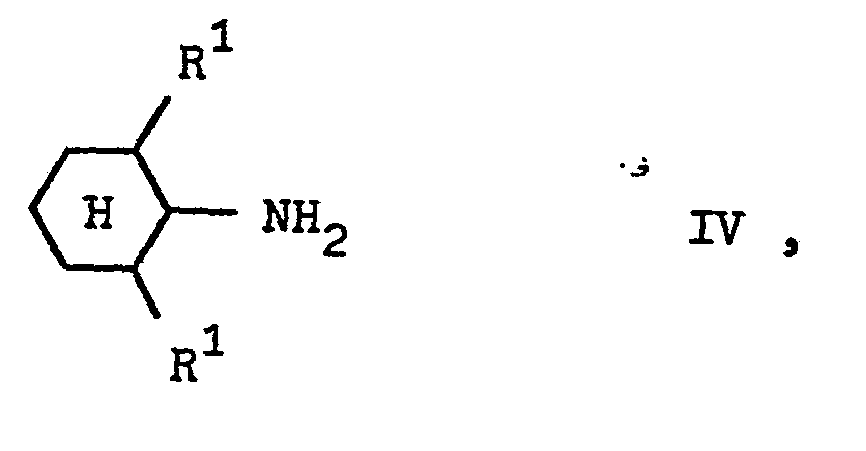
- the N-substituted cyclohexylamines of the formula IV are usually isolated by fractional distillation, if appropriate after release from their salts and, if appropriate, removal of water-miscible solvents.
- a part of the N-substituted cyclohexylamides of the formula II, in which R 3 is not linked to the CH group either via an oxygen atom or via a nitrogen atom, can also be prepared by reacting a cyclohexylamine of the formula IV with a carbonyl compound of the formula in which R 2 has the meaning given and R 3 is not connected to the carbonyl group via a 0 atom or an N atom, is reacted with elimination of water and the Schiff base formed is reacted with catalytically excited hydrogen or a hydrogen transfer agent such as complex hydrides , for example NaBH 4 or LiAlH 4 , to an N-substituted ten cyclohexylamine of formula II reduced and reacted with chloroacetyl chloride in the manner described above.
- a hydrogen transfer agent such as complex hydrides , for example NaBH 4 or LiAlH 4
- the water of reaction formed in the preparation of the Schiff base is advantageously removed by azeotropic distillation with the usual entraining agents, e.g. Hydrocarbons such as n-pentane, n-hexane, cyclohexane, benzene, toluene, xylene, methylene chloride or chloroform.
- entraining agents e.g. Hydrocarbons such as n-pentane, n-hexane, cyclohexane, benzene, toluene, xylene, methylene chloride or chloroform.
- Suitable catalysts for the hydrogenation of Schiff bases are noble metal catalysts such as palladium or platinum on suitable supports and Raney nickel at temperatures between 20 to 200 ° C., preferably at 50 to 150 ° C., and hydrogen pressures between 10 to 500 bar.
- the compounds of the formula IV which have not yet been described can be prepared in a particularly simple manner and in sterically uniform form by hydrogenating amination of 2,6-dialkylphenols and subsequent separation by distillation.
- the reaction b) is carried out in the presence of organic or inorganic bases such as trialkylamines, pyridines, hydrogen carbonates, alkali metal carbonates or alkali metal hydroxides at 20 to 120 ° C.
- organic or inorganic bases such as trialkylamines, pyridines, hydrogen carbonates, alkali metal carbonates or alkali metal hydroxides at 20 to 120 ° C.
- the compounds of the formula III are obtained by reacting a cyclohexylamine of the formula II with formaldehyde to give a formimine of the formula in which R 1 has the meaning given above, and subsequent addition of chloroacetyl chloride to the formimine.
- cyclohexylamine of the formula IV is mixed with an aqueous solution with at least a molar amount of formaldehyde, optionally using a diluent, such as, for example, hydrocarbons or halogenated hydrocarbons, at -5 to 100 ° C., preferably 0 to 50 ° C, especially room temperature, implemented.
- a diluent such as, for example, hydrocarbons or halogenated hydrocarbons
- the Schiff base is then dried and, if appropriate after distillation of at least a molar amount of chloroacetyl chloride at 0 to 100 ° C., optionally in the presence of a diluent which is inert to the reactants, added to the N-chloromethylchloroacetic acid cyclohexylamide of the formula III.
- This intermediate product can be isolated as an oil in stoichiometric work. However, it is simpler to react the crude product in the reaction solution with an alcohol or glycol monoether or pyrazole or 1,2,4-triazole using a base.
- 1 to 10 mol of alcohol preferably 2 to 5 mol of alcohol, or 1 to 2 mol of pyrazole or triazole are used, based on 1 mol of Schiff base used, and at least 1 mol of base, preferably, for binding the hydrogen chloride released tertiary amines, for example triethylamine, are used.
- This reaction step is carried out at temperatures from 0 to 100 ° C., preferably at room temperature.
- chloroacetic acid cyclohexylamides of the formula I according to the invention excess alcohol or azole and amine hydrochloride formed are removed by washing with water and, after drying and evaporation of the solvent, the crude product is further purified, if appropriate by distillation or recrystallization.
- mineral oil fractions from medium to high boiling points such as kerosene or diesel oil, furthermore coal tar oils etc., as well as oils of vegetable or animal origin, aliphatic, cyclic and aromatic hydrocarbons, e.g. Benzene, toluene, xylene, paraffin, tetrahydronaphthalene, alkylated naphthalenes or their derivatives, e.g.
- strongly polar solvents e.g. Dimethylformamide, dimethyl sulfoxide, N-methylpyrrolidone and water into consideration.
- Aqueous application forms can be prepared from emulsion concentrates, pastes or wettable powders (wettable powders), oil dispersions by adding water.
- emulsions, pastes or oil dispersions the substances as such or dissolved in an oil or solvent can be homogenized in water by means of wetting agents, adhesives, dispersants or emulsifiers.
- wetting agents, adhesives, dispersants or emulsifiers and possibly solvents or oil can also be formed from the active substance existing concentrates are prepared that are suitable for dilution with water.
- Powders, materials for spreading and dusts can be prepared by mixing or grinding the active substances together with a solid carrier.
- Granules for example coated granules, impregnated granules and homogeneous granules, can be prepared by binding the active ingredients to solid carriers.
- Solid carriers are, for example, mineral earths such as silica gel, silicas, silica gels, silicates, talc, kaolin, attack clay, limestone, lime, chalk, talum, bolus, loess, clay, dolomite, diatomaceous earth, Calcium and magnesium sulfate, magnesium oxide and ground plastics.
- the new substances act against the following weeds:
- the crop plants and the unwanted plants were treated before emergence. However, it can also be used if the crop plants have already been established, but the weeds and grasses have not yet emerged, or if they are in the process of emergence or in early adolescent stages (follow-up application). If certain crop plants already standing are somewhat sensitive to the active ingredients, application techniques can also be used in which the herbicidal compositions are sprayed in such a way that the leaves of sensitive crop plants are not hit, if possible, while they reach the uncovered ground and the unwanted germinating and growing in it Reach plants (post-directed, lay-by, under-leaf spraying).
- the herbicides according to the invention can still be used in large numbers of crop plants for eliminating undesired plants.
- the application rates can vary between 0.1 and 10 kg / ha and more, depending on the type of soil and control measures.
Landscapes
- Chemical & Material Sciences (AREA)
- Organic Chemistry (AREA)
- Agricultural Chemicals And Associated Chemicals (AREA)
- Organic Low-Molecular-Weight Compounds And Preparation Thereof (AREA)
- Cosmetics (AREA)
- Polysaccharides And Polysaccharide Derivatives (AREA)
Abstract

Description
- Die vorliegende Erfindung betrifft Chloressigsäurecycloalkylacetamide, Verfahren zu deren Herstellung, Herbizide, die die Verbindungen enthalten sowie Verfahren zur Bekämpfung unerwünschten Pflanzenwuchses mit diesen Verbindungen.
- Chloressigsäurecycloalkylacetamide, wie z.B. das N-Allyl--chloressigsäurecyclohexylamid, sind bereits seit längerer Zeit als Herbizide bekannt (BE-PS 532 981).
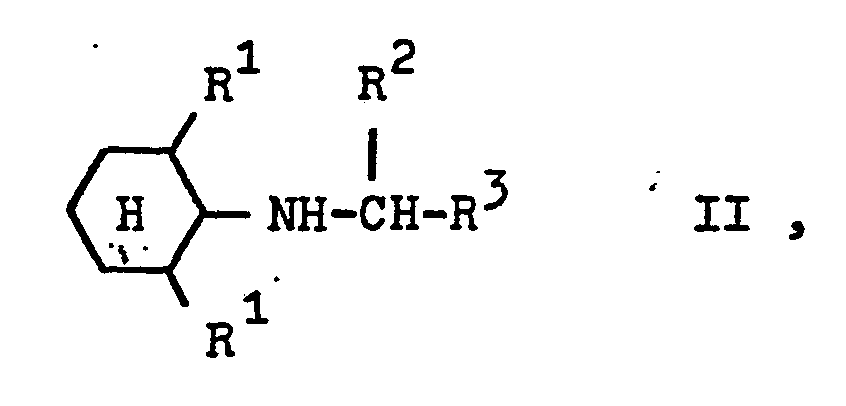
- Es wurde nun gefunden, daß Chloressigsäurecyclohexylamide der Formel I

- R1 Methyl oder Ethyl,
- R2 Wasserstoff oder C1-3-Alkyl und
- R3 ein gegebenenfalls durch C1-4-Alkoxi C1--Alkoxi- carbonyl substituiertes C1-6-Alkyl, C2-3-Alkenyl, C2-3-Alkinyl, Furanyl, Tetrahydrofuranyl, gegebenenfalls durch Halogen substituiertes Phenyl, (Bis-C1-6--alkoxi)-methyl, gegebenenfalls durch C1-3-Alkyl substituiertes Dioxolanyl oder Dioxanyl oder - falls R 2 Wasserstoff bedeutet - auch C1-8-Alkyloxi, C3-6-Alkenyloxi, C3-6-Alkinyloxi, C3-6-Cycloalkyl- methoxi, C4-6-Cycloalkyloxi, C1-6-Alkyloxiethoxi,
- Tetrahydrofuranylmethoxi, Tetrahydropyranylmethoxi oder Azol-1-yl
- bedeuten, wesentlich verbesserte herbizide Eigenschaften besitzen und gleichzeitig noch einen hohen Verträglichkeitsgrad für Kulturpflanzen aufweisen.
- Unter Alkyl oder Alkylrest einer Alkyloxi- oder Alkyloxicarbonylgruppe bei den Resten R2 oder R3 sind je nach Zahl der genannten Kohlenstoffatome beispielsweise folgende Gruppen zu verstehen: Methyl, Ethyl, n-Propyl, iso-Propyl, n-, iso-, sec.- oder tert.-Butyl, Pentyl oder Hexyl und ihre Isomeren.
- Unter Alkenyl ist je nach Zahl der genannten Kohlenstoffatome bei R3 insbesondere Vinyl, 1-Methylvinyl-1 oder 2-Methylvinyl-1 oder Allyl und unter Alkinyl Ethinyl oder Propin-1-yl-1 zu verstehen.
- Als Cycloalkylreste einer Cycloalkyloxi- bzw. einer Cycloalkylmethoxi-Gruppe kommen je nach Zahl der genannten Kohlenstoffatome Cyclopropyl, Cyclobutyl, Cyclopentyl oder Cyclohexyl in Frage.
- Unter dem Dioxolanyl-Rest ist insbesondere die 1,3-Dioxolan-yl-l-Gruppe zu verstehen, die in 4- und/oder in 5-Stellung durch eine Methyl-, Ethyl- oder Propylgruppe substituiert sein kann. Azol-1-yl steht für Pyrazol-1-yl oder 1,2,4-Triazol-l-yl.
- In den Verbindungen der Formel I können die Substituenten R1 zum Stickstoffatom in cis-, trans- und cis/trans-Stellung stehen. Die Verbindungen der Formel I können daher in sterisch reiner Form oder als Isomerengemische vorliegen.
- Die Verbindungen der Formel I können hergestellt werden, indem man
- a) ein N-substituiertes Cyclohexylamin der Formel II

- b) - falls R2 Wasserstoff und R3 C1-8-Alkyloxi, C3-6--Alkenyloxi, C3-6-Alkinyloxi, C3-6-Cycloalkylmethoxi, C4-6-Cycloalkyloxi, C1-6-Alkyloxiethoxi, Tetrahydrofuranylmethoxi, Tetrahydropyranylmethoxi oder Azol-1-yl bedeuten - ein N-Chlormethylchloressigsäurecyclohexylamid der Formel III

- b) angegebene Bedeutung besitzt, umsetzt.
- Gemäß a) werden die Verbindungen II mit Chloressigsäureanhydrid oder vorzugsweise mit Chloracetylchlorid, vorzugsweise in einem gegenüber den Reaktanden inerten Lösungsmittel, zu den erfindungsgemäßen Chloressigsäurecyclohexyl- amiden umgesetzt. Dabei können organische oder anorganische Basen wie Trialkylamine, Pyridine, Hydrogencarbonate, Carbonate oder Alkalihydroxide verwendet werden. Als Verdünnungsmittel kommen vorzugsweise mit Wasser nicht mischbare Solventien wie Halogenkohlenwasserstoffe, z.B. Methylenchlorid, Chloroform, Chlorbenzol, oder Kohlenwasserstoffe, z.B. Cyclohexan, Heptan, Toluol, Xylol, in Frage. Chloracetylchlorid wird in stöchiometrischer Menge und die Base in mindestens stöchiometrischer Menge, bezogen auf eingesetztes N-substituiertes Cyclohexylamin der Formel II, verwendet. Die Umsetzungen mit Chloracetylchlorid werden bei -20 bis +150°C, vorzugsweise bei 0 bis 110°C durchgeführt.
- Die Ausgangsverbindungen der Formel II können hergestellt werden durch Umsetzungen eines Cyclohexylamins der Formel


- Ein Teil der N-substituierten Cyclohexylamide der Formel II, in der R3 weder über ein Sauerstoffatom noch über ein Stickstoffatom mit der CH-Gruppe verknüpft ist, kann auch dadurch hergestellt werden, daß man ein Cyclohexylamin der Formel IV mit einer Carbonylverbindung der Formel

- Das bei der Herstellung der Schiff'schen Base gebildete Reaktionswasser wird zweckmäßigerweise durch azeotrope Destillation entfernt mit den üblichen Schleppmitteln, z.B. Kohlenwasserstoffe wie n-Pentan, n-Hexan, Cyclohexan, Benzol, Toluol, Xylol, Methylenchlorid oder Chloroform.
- Als Katalysatoren für die Hydrierungen der Schiff'schen Basen eignen sich Edelmetallkatalysatoren wie Palladium oder Platin auf geeigneten Trägern sowie Raney-Nickel bei Temperaturen zwischen 20 bis 200°C, vorzugsweise bei 50 bis 150°C, und Wasserstoffdrucken zwischen 10 bis 500 bar.
- Die noch nicht beschriebenen Verbindungen der Formel IV lassen sich in besonders einfacher Weise und in sterisch einheitlicher Form durch hydrierende Aminierung von 2,6-Dialkylphenolen und anschließende destillative Trennung herstellen.
- Die Reaktion b) wird in Gegenwart organischer oder anorganischer Basen wie Trialkylaminen, Pyridinen, Hydrogencarbonaten, Alkalicarbonaten oder Alkalihydroxiden bei 20 bis 1200C durchgeführt.
- Die Verbindungen der Formel III sind durch Umsetzung von einem Cyclohexylamin der Formel II mit Formaldehyd zu einem Formimin der Formel

- Zur Herstellung der Schiff'schen Base der Formel VII wird 1 Mol Cyclohexylamin der Formel IV mit einer wäßrigen Lösung mit mindestens molarer Menge an Formaldehyd gegebenenfalls unter Verwendung eines Verdünnungsmittels, wie z.B. Kohlenwasserstoffe oder Halogenkohlenwasserstoffe bei -5 bis 100°C, vorzugsweise 0 bis 50°C, insbesondere Raumtemperatur, umgesetzt. Die Schiff'sche Base wird anschließend getrocknet und gegebenenfalls nach Destillation an mindestens eine molare Menge Chloracetylchlorid bei 0 bis 100°C, gegebenenfalls in Gegenwart eines Verdünnungsmittels, das gegenüber den Reaktionspartnern inert ist, zur N-Chlormethylchloressigsäurecyclohexylamid der Formel III addiert. Dieses Zwischenprodukt kann bei stöchiometrischem Arbeiten als öl isoliert werden. Einfacher ist es jedoch, das Rohprodukt in der Reaktionslösung mit einem Alkohol oder Glykolmonoether oder Pyrazol bzw. 1,2,4-Triazol unter Verwendung einer Base umzusetzen. Im allgemeinen werden, bezogen auf 1 Mol eingesetzte Schiff'sche Base, 1 bis 10 Mol Alkohol, vorzugsweise 2 bis 5 Mol Alkohol, bzw. 1 bis 2 Mol Pyrazol bzw. Triazol eingesetzt und zum Binden des freiwerdenden Chlorwasserstoffs mindestens 1 Mol Base, vorzugsweise tertiäre Amine, z.B. Triethylamin, verwendet. Dieser Reaktionsschritt wird bei Temperaturen von 0 bis 100°C, vorzugsweise bei Raumtemperatur, durchgeführt. Zur Isolierung "der erfindungsgemäßen Chloressigsäurecyclohexylamide der Formel I werden Überschuß an Alkohol bzw. Azol und gebildetes Aminhydrochlorid durch Waschen mit Wasser entfernt und nach Trocknen und Verdampfen des Lösungsmittels das Rohprodukt gegebenenfalls durch Destillation oder Umkristallisation weiter gereinigt.
- Die im folgenden aufgeführten Beispiele beschreiben die verschiedenen Herstellungsmöglichkeiten der erfindungsgemäßen Chloressigsäurecyclohexylamide. In den Beispielen verhalten sich Gewichtsteile zu Volumenteile wie Kilogramm zu Liter.
-
- a) Herstellung des Ausgangsmaterials In einen Rührautoklaven mit einem Inhalt von 10.000 Raumteilen werden 1.650 Gewichtsteile 2,6-Dimethylphenol und 150 Gewichtsteile eines pulverförmigen Katalysators, der 10,0 Gew.% Palladium, 5,0 Gew.% Praseodymoxid auf Aluminiumoxid enthält, eingefüllt. Der Autoklav wird verschlossen und es werden 1.370 Gewichtsteile Ammoniak aufgepreßt. Nun wird auf 250oC erhitzt und durch Zufuhr von Wasserstoff ein Druck von 300 bar eingestellt. Man hält so lange auf Reaktionstemperatur, bis konstanter Druck erreicht ist (ca. 10 Stunden). Anschließend läßt man abkühlen, filtriert und erhält 1.691 Gewichtsteile (98,5 %) 2,6-Dimethylcyclohexylamin, die nach gaschromatographischer und NMR-Analyse folgende Isomerenverteilung haben:
- 56 % trans,trans-2,6-Dimethylcyclohexylamin
- 14 % cis,cis-2,6-Dimethylcyclohexylamin
- 30 % cis,trans-2,6-Dimethylcyclohexylamin
- Die Trennung der Isomeren gelingt durch fraktionierte Destillation an einer Kolonne mit 45 Trennstufen. Die einzelnen isomeren Formen sind in über 95%iger Reinheit'bei folgenden Siedetemperaturen erhalten worden:
- trans,trans-2,6-Dimethylcyclohexylamin,
- Kp/1012 mbar = 166°C
- cis,cis-2,6-Dimethylcyclohexylamin,
- Kp/1012 mbar = 1680C
- cis,trans-2,6-Dimethylcyclohexylamin,
- Kp/1012 mbar = 172°C
- Zu einer Lösung von 63,5 Gewichtsteilen trans,trans--2,6-Dimethylcyclohexylamin in 150 Volumenteilen Acetonitril wurde eine Mischung aus 29,8 Gewichtsteilen Propargylbromid und 20 Volumenteilen Acetonitril unter Stickstoff und Rühren zugetropft bei 20 bis 25°C, 1 h nachgerührt und 5 h unter Rückfluß erhitzt. Nach Verdampfen des Acetonitrils wurde der Rückstand zwischen 100 Volumenteilen Methylenchlorid und 150 Volumenteilen einer 10%igen Kaliumhydroxidlösung verteilt, die organische Phase abgetrennt und dreimal mit je 100 Volumenteilen Methylenchlorid extrahiert. Nach dem Verdampfen des Methylenchlorids aus den vereinigten organischen Phasen erhielt man durch fraktionierte Destillation im Vakuum unter Stickstoff 28,0 Gewichtsteile N-(Propargyl)-trans, trans-2,6-dimethylcyclohexylamin, Sdp.: 93 bis 96°C/ 18 mbar (

- Zu einer Mischung von 25,7 Gewichtsteilen N-(Propar- gyl)-trans,trans-2,6-dimethylcyclohexylamin in 150 Volumenteilen Toluol und 81,2 Gewichtsteilen 10%ige Natronlauge wurden bei 0°C unter intensiver Vermischung 19,4 Gewichtsteile Chloracetylchlorid in Vermischung 19,4 Gewichtsteile Chloracetylchlorid in 20 Volumenteilen Toluol in 30 Minuten zugetropft und 3 h bei 20°C nachgerührt. Aus der Toluolphase isolierte man nach Waschen mit Wasser, Trocknen und Verdampfen durch Destillation des Rückstands 22,7 Gewichtsteile N-(Propargyl)-N-(trans,trans-2,6-dimethylcyclohexyl)-α-chloracetamid, Kp. 132 bis 134°C/ 0,4 mbar (Fp. 59 bis 62°C).
- Zu einer Lösung von 76,2 Gewichtsteilen trans,trans--2,6-Dimethylcyclohexylamin in 200 Volumenteilen n-Hexan wurden unter Stickstoff und Rühren und Rückfluß 52,8 Gewichtsteile Methoxyaceton in 1 h zugetropft und gleichzeitig 10,5 Volumenteile Wasser durch azeotrope Destillation in etwa 3 h enternt. Nach dem Verdampfen des n-Hexans isolierte man durch Destillation des Rückstandes unter Stickstoff 83,0 Gewichtsteile Methoxy-isopropyliden-trans.trans--2,6-dimethylcyclohexylamin; Kp. 107 bis 109°C/ 17 mbar (

- In eine Lösung von 76,0 Gewichtsteilen Methoxy--isopropyliden-trans,trans-2,6-dimethylcyclohexylamin in 250 Volumenteilen Methanol wurden bei 10 bis 25°C 29,7 Gewichtsteile NaBH4 in 2 h unter Rühren eingetragen (Eiskühlung) und 1,5 h unter Rückfluß erhitzt. Nach dem Verdampfen des Methanols und Verteilen des Rückstandes zwischen Methylenchlorid und Wasser isolierte man durch Destillation der organischen Phase 64,0 Gewichtsteile N-(1-Meth- oxy-prop-2-yl)-trans,trans-2,6-dimethylcyclohexylamin, Kp. 117 bis 118°C/22 mbar.
- Zu einer Lösung von 19,9 Gewichtsteilen N-(1-Meth- oxy-prop-2-yl)-trans,trans-2,6-dimethylcyclohexylamin in 100 Volumenteilen Toluol wurde unter Stickstoff bei 80°C eine Lösung von 12,4 Gewichtsteilen Chloracetylchlorid in 20 Volumenteilen Toluol in 15 Minuten zugetropft. Anschließend wurde 3 h unter Rückfluß und unter Durchleiten von Stickstoff erhitzt. Nach dem Abkühlen wurde nacheinander mit 200 Volumenteilen Wasser, 50 Volumenteilen 2N HCl, 50 Volumenteilen NaHCO3-Lösung und 50 Volumenteilen Wasser gewaschen und getrocknet. Nach Verdampfen des Toluols isolierte man 20,5 Gewichtsteile N-(1-Methoxy-prop-2-yl)-N--(trans,trans-2,6-dimethylcyclohexyl)- -chloracetamid, Fp. 120 bis 122°C (Methanol).
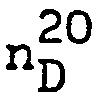
- Zu einer Lösung von 152,0 Gewichtsteilen trans,trans--2,6-dimethylcyclohexylamin in 450 Volumenteilen Methylenchlorid wurden bei 25 bis 28°C unter Stickstoff und unter Rühren 110,0 Gewichtsteile einer 37%igen Formalin-Lösung in 30 min zugetropft und 4 h nachgerührt. Die organische Phase wurde abgetrennt und zweimal mit je 100 Volumenteilen Wasser gewaschen und getrocknet. Nach dem Verdampfen des Methylenchlorids isolierte man durch Destillation unter Stickstoff 136,0 Gewichtsteile trans,trans-2,6-Dimethyl- cyclohexylformimin, Kp. 59 bis 60°C/20 mbar (nD = 1,4634).
- Zu einer Lösung von 124,3 Gewichtsteilen Chloracetylchlorid in 100 Volumenteilen Cyclohexan wurde unter Eiskühlung und Rühren sowie unter Ausschluß von Feuchtigkeit eine Lösung von 152,9 Gewichtsteilen trans,trans-2,6-Dimethylcyclohexylformimin in 100 Volumenteilen Cyclohexan bei 20 bis 25°C zugetropft und 16 h bei 25°C nachgerührt.
- Zu dieser Mischung wurde nach Verdünnen mit 200 Volumenteilen Cyclohexan eine Mischung aus 184,0 Gewichtsteilen Ethanol und 112,0 Gewichtsteilen Triethylamin unter Eiskühlung und Rühren bei 20 bis 25°C zugetropft und 24 h bei Raumtemperatur nachgerührt. Nach dreimaligem Waschen des Ansatzes mit je 150 Volumenteilen Wasser, Trocknen und Verdampfen des Cyclohexans isolierte man 295,0 Gewichtsteile Öl, aus dem durch Destillation unter Stickstoff 262,0 Gewichtsteile N-(Ethoxymethyl)-N-(trans,trans-2,6-dimethylcyclohexyl)--α-chloracetamid, Kp. 122 bis 124°C/0,5 mbar (
- Analog Beispiel 1 a), 2 a) und 3 a) lassen sich die in den folgenden Tabellen aufgeführten Ausgangsverbindungen herstellen bzw. wurden hergestellt:


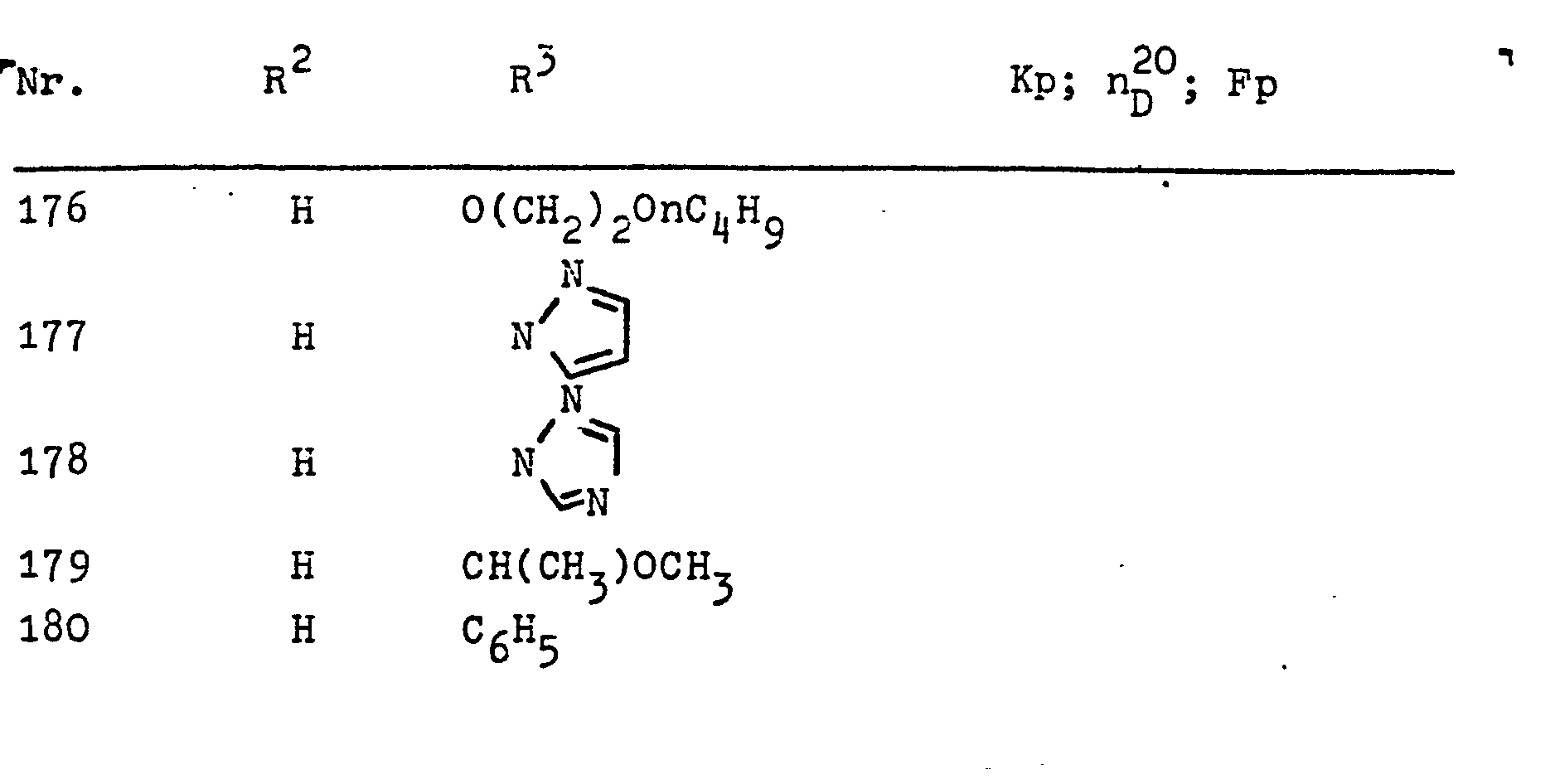
- Analog Beispiel 1 b), 2 b) und 3 b) lassen sich die in den folgenden Tabellen aufgeführten Verbindungen herstellen bzw. wurden hergestellt:




- 'Die neuen Wirkstoffe besitzen insbesondere eine starke herbizide Aktivität und eine gute Verträglichkeit gegen Kulturpflanzen.
- Ihre Anwendung erfolgt z.B. in Form von direkt versprühbaren Lösungen, Pulvern, Suspensionen oder Dispersionen, Emulsionen, öldispersionen, Pasten, Stäubemitteln, Streumitteln, Granulaten durch Versprühen, Vernebeln, Verstäuben, Verstreuen oder Gießen. Die Anwendungsformen richten sich ganz nach den Verwendungszwecken.
- Zur Herstellung von direkt versprühbaren Lösungen, Emulsionen, Pasten und öldispersionen kommen Mineralölfraktionen von mittlerem bis hohem Siedepunkt, wie Kerosin oder Dieselöl, ferner Kohlenteeröle usw., sowie öle pflanzlichen oder tierischen Ursprungs, aliphatische, cyclische und aromatische Kohlenwasserstoffe, z.B. Benzol, Toluol, Xylol, Paraffin, Tetrahydronaphthalin, alkylierte Naphthaline oder deren Derivate, z.B. Methanol, Ethanol, Propanol, Butanol, Chloroform, Tetrachlorkohlenstoff, Cyclohexanol, Cyclohexanon, Chlorbenzol, Isophoron, stark polare Lösungsmittel, z.B. Dimethylformamid, Dimethylsulfoxid, N-Methylpyrrolidon und Wasser in Betracht.
- Wäßrige Anwendungsformen können aus Emulsionskonzentraten, Pasten oder netzbaren Pulvern (Spritzpulvern), öldispersionen durch Zusatz von Wasser bereitet werden. Zur Herstellung von Emulsionen, Pasten oder Öldispersionen können die Substanzen als solche oder in einem öl oder Lösungsmittel gelöst mittels Netz-, Haft-, Dispergier- oder Emulgiermittel in Wasser homogenisiert werden. Es können aber auch aus wirksamer Substanz Netz-, Haft-, Dispergier-oder Emulgiermittel und eventuell Lösungsmittel oder öl bestehende Konzentrate hergestellt werden, die zur Verdünnung mit Wasser geeignet sind.
- An oberflächenaktiven Stoffen sind zu nennen:
- Mkali-, Erdalkali-, Ammoniumsalze von Ligninsulfonsäure, Naphthalinsulfonsäuren, Phenolsulfonsäuren, Alkylarylsulfonate, Alkylsulfate, Alkylsulfonate, Alkali- und Erdalkalisalze der Dibutylnaphthalinsulfonsäure, Laurylethersulfat, Fettalkoholsulfate, fettsaure Alkali- und Erdalkalisalze, Salze sulfatierter Hexadecanole, Heptadecanole, Octadecanole, Salze von sulfatiertem Fettalkoholglykolether, Kondensationsprodukte von sulfoniertem Naphthalin und Naphthalinderivaten mit Formaldehyd, Kondensationsprodukte des Naphthalins bzw. der Naphthalinsulfonsäuren mit Phenol und Formaldehyd, Polyoxyethylen-octylphenolether, ethoxyliertes Isooctylphenol-, Octylphenol-, Nonylphenol, Alkylphenylpolyglykolether, Tributylphenylpolyglykolether, Alkylarylpolyetheralkohole, Isotridecylalkohol, Fettalkoholethylenoxid-Kondensate, ethoxyliertes Rizinusöl, Polyoxyethylenalkylether, ethoxyliertes Polyoxypropylen, Laurylalkoholpolyglykoletheracetal, Sorbitester, Lignin, Sulfitablaugen und Methylcellulose.
- Pulver, Streu- und Stäubemittel können durch Mischer oder gemeinsames Vermahlen der wirksamen Substanzen mit einem festen Trägerstoff hergestellt werden.
- Granulate, z.B. Umhüllungs-, Imprägnierungs- und Homogengranulate, können durch Bindung der Wirkstoffe an feste Trägerstoffe hergestellt werden. Feste Trägerstoffe sind z.B. Mineralerden wie Silicagel, Kieselsäuren, Kieselgele, Silikate, Talkum, Kaolin, Attaclay, Kalkstein, Kalk, Kreide, Talum, Bolus, Löß, Ton, Dolomit, Diatomeenerde, Calcium- und Magnesiumsulfat, Magnesiumoxid und gemahlene Kunststoffe.
- Beispiele für Formulierungen sind:
- I 20 Gewichtsteile der Verbindung des Beispiels 39 werden in 3 Gewichtsteilen des Natriumsalzes der Diisobutylnaphthalin-sulfonsäure, 17 Gewichtsteilen des Natriumsalzes einer Ligninsulfonsäure aus einer Sulfitablauge und 60 Gewichtsteilen pulverförmigem Kieselsäuregel gut vermischt und in einer Hammermühle vermahlen. Durch feines Verteilen der Mischung in 20 000 Gewichtsteilen Wasser erhält man eine Spritzbrühe, die 0,1 Gew.% des Wirkstoffs enthält.
- II 3 Gewichtsteile der Verbindung des Beispiels 40 werden mit 97 Gewichtsteilen feinteiligem Kaolin innig vermischt. Man erhält auf diese Weise ein Stäubemittel, das 3 Gew.% des Wirkstoffs enthält.
- III 30 Gewichtsteile der Verbindung des Beispiels 41 werden mit einer Mischung aus 92 Gewichtsteilen pulverförmigem Kieselsäuregel und 8 Gewichtsteilen Paraffinöl, das auf die Oberfläche dieses Kieselsäuregels gesprüht wurde, innig vermischt. Man erhält auf diese Weise eine Aufbereitung des Wirkstoffs mit guter Haftfähigkeit.
- IV 40 Gewichtsteile der Verbindung des Beispiels 42 werden mit 10 Teilen Natriumsalz eines Phenolsulfonsäure-harnstoff-formaldehyd-kondensats, 2 Teilen Kieselgel und 48 Teilen Wasser innig vermischt. Man erhält eine stabile wäßrige Dispersion. Durch Verdünnen mit 100 000 Gewichtsteilen Wasser erhält man eine wäßrige Dispersion, die 0,04 Gew.% Wirkstoff enthält.
- V 20 Teile der Verbindung des Beispiels 50 werden mit 2 Teilen Calciumsalz der Dodecylbenzolsulfonsäure, 8 Teilen Fettalkohol-polyglykolether, 2 Teilen Katriumsalz eines Phenolsulfonsäure-harnstoff-formaldehyd-kondensates und 68 Teilen eines paraffinischen Mineralöls innig vermischt. Man erhält eine stabile ölige Dispersion.
- VI Man vermischt 90 Gewichtsteile der Verbindung des Beispiels 40 mit 10 Gewichtsteilen N-Methyl-α-pyrrolidon und erhält eine Lösung, die zur Anwendung in Form kleinster Tropfen geeignet ist.
- VII 20 Gewichtsteile der Verbindung des Beispiels 2 werden in einer Mischung gelöst, die aus 80 Gewichtsteilen Xylol, 10 Gewichtsteilen des Anlagerungsproduktes von 8 bis 10 Mol Ethylenoxid an 1 Mol Ölsäure-N-monoethanolamid, 5 Gewichtsteilen Calciumsalz der Dodecylbenzolsulfonsäure und 5 Gewichtsteilen des Anlagerungsproduktes von 40 Mol Ethylenoxid an 1 Mol Ricinusöl besteht. Durch Ausgießen und feines Verteilen der Lösung in 100 000 Gewichtsteilen Wasser erhält man eine wäßrige Dispersion, die 0,02 Gew.% des Wirkstoffs enthält.
- VIII 20 Gewichtsteile der Verbindung des Beispiels 39 werden in einer Mischung gelöst, die aus 40 Gewichtsteilen Cyclohexanon, 30 Gewichtsteilen Isobutanol, 20 Gewichtsteilen des Anlagerungsproduktes von 7 Mol Ethylenoxid an 1 Mol Isooctylphenol und 10 Gewichtsteilen des Anlagerungsprodukts von 40 Mol Ethylenoxid an 1 Mol Ricinusöl besteht. Durch Eingießen und feines Verteilen der Lösung in 100 000 Gewichtsteilen Wasser erhält man eine wäßrige Dispersion, die 0,02 Gew.% des Wirkstoffs enthält.
- IX 20 Gewichtsteile der Verbindung des Beispiels 39 werden in einer Mischung gelöst, die aus 25 Gewichtsteilen Cyclohexanol, 65 Gewichtsteilen einer Mineral- ölfraktion vom Siedepunkt 210 bis 280°C und 10 Gewichtsteilen des Anlagerungsprodukts von 40 Mol Ethylenoxid an 1 Mol Ricinusöl besteht. Durch Eingießen und feines Verteilen der Lösung in 100 000 Gewichtsteilen Wasser erhält man eine wäßrige Dispersion, die 0,02 Gew.% des Wirkstoffs enthält.
- Die Wirkung von Vertretern der neuen Verbindungen auf das Wachstum von erwünschten und unerwünschten Pflanzen wird anhand von Gewächshausversuchen vorgeführt:
- Als Kulturgefäße dienten Plastikblumentöpfe mit 300 cm3 Inhalt und lehmigem Sand mit etwa 1,5 % Humus als Substrat. Bei Soja wurde zusätzlich etwas Torfmull beigemischt, um ein einwandfreies Wachstum zu gewährleisten. Die Samen der Testpflanzen wurden nach Arten getrennt flach eingesät'. Unmittelbar danach erfolgte die Vorauflaufapplikation der Wirkstoffe, und zwar je 1,0 kg/ha auf die Erdoberfläche. Als bekanntes Vergleichsmittel diente das bereits erwähnte N-Allyl-chloressigsäurecyclohexylamid. Sie wurden hierbei in Wasser als Verteilungsmittel suspendiert oder emulgiert und mittels fein verteilender Düsen gespritzt. Nach dem Aufbringen der Mittel wurden die Gefäße leicht beregnet, um Keimung und Wachstum in Gang zu bringen. Danach deckte man die Gefäße mit durchsichtigen Plastikhauben ab, bis die Pflanzen angewachsen waren. Diese Abdeckung bewirkte ein gleichmäßiges Keimen der Testpflanzen, sofern dies nicht durch die Wirkstoffe beeinträchtigt wurde. Die Aufstellung der Versuche erfolgte im Gewächshaus, wobei für wärmeliebende Arten wärmere Bereiche (20 bis 30oC) und für solche gemäßigter Klimate 15 bis 250C bevorzugt wurden. Die Versuchsperiode erstreckte sich über 3 bis 4 Wochen.
- Während dieser Zeit wurden die Plfanzen gepflegt und ihre Reaktion auf die einzelnen Behandlungen ausgewertet. Bewertet wurde nach einer Skala von 0 bis 100. Dabei bedeutet 0 keine Schädigung oder normaler Ablauf und 100 kein Aufgang der Pflanzen bzw. völlige Zerstörung zumindest der oberirdischen Teile.
- Bei der Prüfung auf selektive herbizide Wirkung bei Vorauflaufanwendung im Gewächshaus mit der Aufwandmenge von 1,0 kg Wirkstoff je ha zeigten die Verbindungen der Beispiele 3, 42 und 50 und ebenso die Verbindungen der Beispiele 40, 41, 44 und 48 eine wesentlich bessere herbizide Aktivität als die bekannte Vergleichsverbindung. Gleichzeitig liegen in diesen Beispielen gute Verträglichkeiten vor für Kulturpflanzen wie Raps, Soja, Baumwolle einerseits sowie Raps und Weizen bei der zweiten Gruppe der oben genannten Verbindungen.
- In weiteren Versuchen zur selektiven herbiziden Wirkung bei Vorauflaufanwendung im Gewächshaus zeigten die Verbindungen der Beispiele 55, 56, 16, 23, 51 und 63 eine bessere herbizide Aktivität gegen unerwünschte Gräser (Aufwandmengen von 0,5 bis 2,0 kg/ha je nach Wirkstoff) ohne breitblättrige Beispielskulturpflanzen wie Zuckerrüben, Raps und Baumwolle zu schädigen.
- Ebenso wirkten in diesen Kulturen die Verbindungen der Beispiele 157, 158 selektiv gegen unerwünschte Gräser.
- "Weitere biologische Beispiele zeigten die Bekämpfung von unerwünschten Gräsern bei Vorauflaufanwendung im Gewächshaus der Verbindungen Nr. 23 und 157 in Sojabohnenkulturen mit je 0,5 und 2,0 kg Wirkstoff/ha.
- Weitere Gewächshausversuche ergaben ferner, daß sich beispielsweise Setaria spp. in Weizenkulturen bei Vorauflaufanwendung von 0,5 kg Wirkstoff/ha der Verbindungen Nr. 55, 56 und 23 bekämpfen läßt.
- Insbesondere wirken die neuen Substanzen gegen folgende Unkräuter:

- In den hier aufgeführten Beispielen wurden die Kulturpflanzen und die unerwünschten Pflanzen vor dem Auflaufen behandelt. Die Anwendung kann aber auch erfolgen, wenn die Kulturpflanzen zwar schon etabliert sind, die Unkräuter und Ungräser aber noch nicht aufgelaufen sind oder diese sich gerade beim Auflaufen oder in frühen Jugendstadien (Nachlaufanwendung) befinden. Sind hierbei gewisse bereits stehende Kulturpflanzen gegenüber den Wirkstoffen etwas empfindlich, so können auch Ausbringungstechniken angewandt werden, bei welchen die herbiziden Mittel mit Hilfe der Spritzgeräte so geleitet werden, daß die Blätter empfindlicher Kulturpflanzen nach Möglichkeit nicht getroffen werden, während sie auf die unbedeckte Bodenfläche gelangen und die darin keimenden und aufwachsenden unerwünschten Pflanzen erreichen (post-directed, lay-by, Unterblattspritzung).
- In Anbetracht der guten Verträglichkeit und der Vielseitigkeit der Applikationsmethoden und Formulierungsmöglichkeit können die erfindungsgemäßen Herbizide noch in großer Zahl von Kulturpflanzen zur Beseitigung von unerwünschten Pflanzen eingesetzt werden. Die Aufwandmengen können dabei je nach Bodenart und Bekämpfungsvorhaben zwischen 0,1 und 10 kg/ha und mehr schwanken.
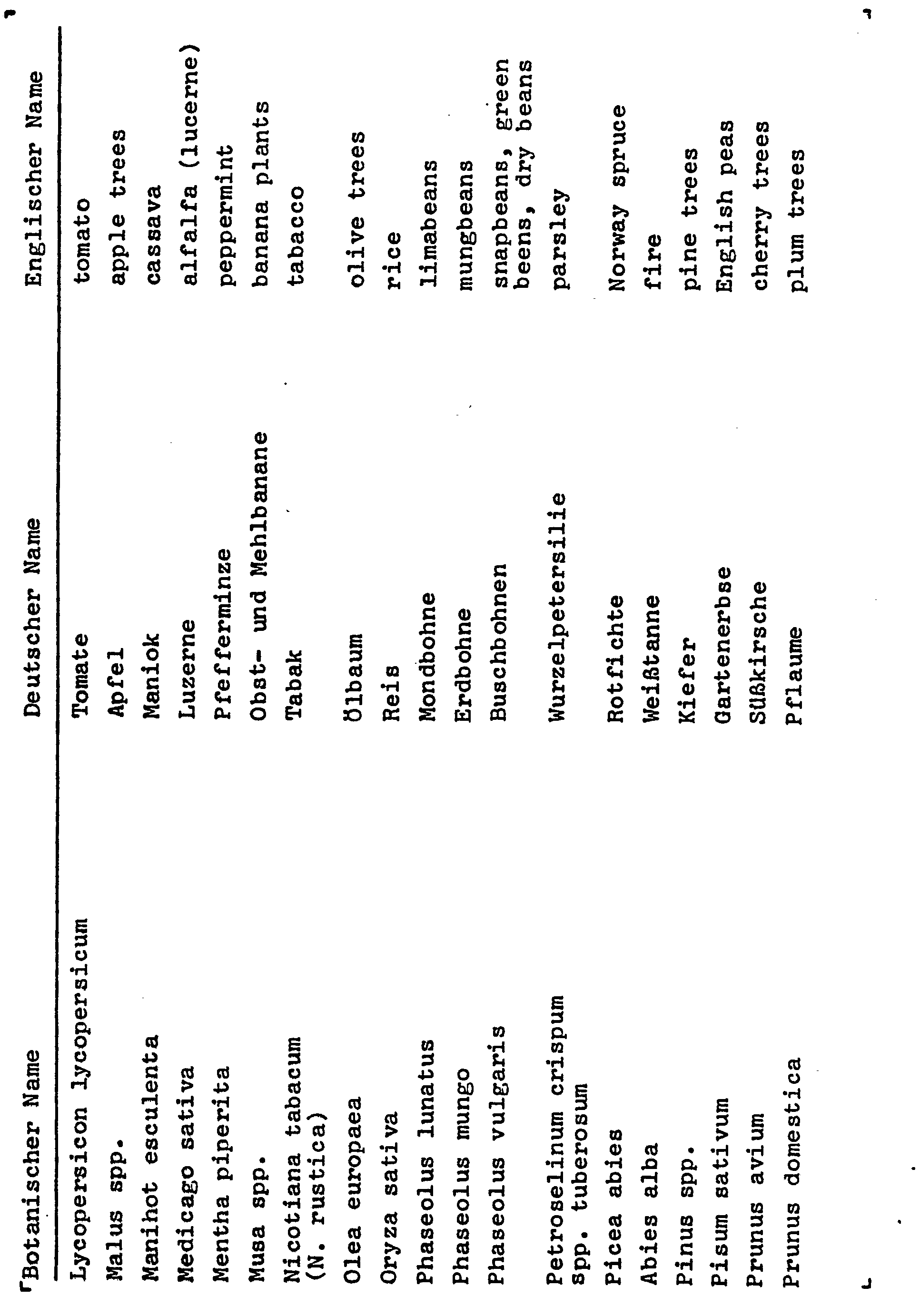
- In Betracht kommen beispielsweise folgende Kulturen:



- 5-Amino-4-chlor-2-phenyl-3(2H)-pyridazinon
- 5-Amino-4-brom-2-phenyl-3(2H)-pyridazinon
- 5-Amino-4-chlor-2-cyclohexyl-3(2H)-pyridazinon
- 5-Amino-4-brom-2-cyclohexyl-3(2H)-pyridazinon
- 5-Methylamino-4-chlor-2-(3-trifluormethylphenyl)-3(2H)--pyridazinon
- 5-Methylamino-4-chlor-2-(3-α,α,β,β-tetrafluorethoxyphenyl)--3(2H)-pyridazinon
- 5-Dimethylamino-4-chlor-2-phenyl-3(2H)-pyridazinon
- 4,5-Dimethoxy-2-phenyl-3(2H)-pyridazinon
- 4,5-Dimethoxy-2-cyclohexyl-3(2H)-pyridazinon
- 4,5-Dimethoxy-2-(3-trifluormethylphenyl)-3(2H)-pyridazinon
- 5-Methoxy-4-chlor-2-(3-trifluormethylphenyl)-3(2H)-pyrida- zinon
- 5-Amino-4-brom-2-(3-methylphenyl-3(2H)-pyridazinon
- 3-(1-Methylethyl)-1H-2,1,3-benzothiadiazin-4(3H)-on-2,2--dioxid und Salze
- 3-(1-Methylethyl)-8-chlor-1H-2,1,3-benzothiadiazin-4(3H)--on-2,2-dioxid und Salze
- 3-(1-Methylethyl)-8-fluor-1H-2,1,3-benzothiadiazin-4(3H)--on-2,2-dioxid und Salze
- 3-(1-Methylethyl)-8-methyl-1H-2,1,3-benzothiadiazin-4(3H)--on-2,2-dioxid und Salze
- 1-Methoxymethyl-3-(1-methylethyl)-2,1,3-benzothiadiazin--4(3H)-on-2,2-dioxid
- 1-Methoxymethyl-8-chlor-3-(1-methylethyl)-2,1,3-benzothia- diazin-4(3H)-on-2,2-dioxid
- 1-Methoxymethyl-8-fluor-3-(1-methylethyl)-2,1,3-benzothia- diazin-4(3H)-on-2,2-dioxid
- 1-Cyan-8-chlor-3-(1-methylethyl)-2,1,3-benzothiadiazin--4(3H)-on-2,2-dioxid
- 1-Cyan-8-fluor-3-(1-methylethyl)-2,1,3-benzothiadiazin--4(3H)-on-2,2-dioxid
- 1-Cyan-8-methyl-3-(1-methylethyl)-2,1,3-benzothiadiazin--4(3H)-on-2,2-dioxid
- 1-Cyan-3-(1-methylethyl)-2,1,3-benzothiadiazin-4(3H)-on--2,2-dioxid
- 1-Azidomethyl-3-(1-methylethyl)-2,2,3-benzothiadiazin--4(3H)-on-2,2-dioxid
- 3-(1-methylethyl)-1H-(pyridino-[3,2-e]2,1,3-thiadiazin--(4)-on-2,2-dioxid
- N-(1-Ethylpropyl)-2,6-dinitro-3,4-dimethylanilin
- N-(1-Methylethyl)-N-ethyl-2,6-dinitro-4-trifluormethyl--anilin
- N-n.Propyl-N-ß-ehlorethyl-2,6-dinitro-4-trifluormethyl--anilin
- N-n.Propyl-N-cyclopropylmethyl-2,6-dinitro-4-trifluor--methyl-anilin
- N-Bis-(n.propyl)-2,6-dinitro-3-amino-4-trifluormethylanilin
- N-Bis-(n.propyl)-2,6-dinitro-4-methyl-anilin
- N-Bis-(n.propyl)-2,6-dinitro-4-methylsulfonyl-anilin
- N-Bis(n.propyl)-2,6-dinitro-4-aminosulfonyl-anilin
- Bis-(ß-chlorethyl)-2,6-dinitro-4-methyl-anilin
- N-Ethyl-N-(2-methylallyl)-2,6-dinitro-4-trifluormethyl--anilin
- N-Methylcarbaminsäure-3,4-dichlorbenzylester
- N-Methylcarbaminsäure-2,6-di(tert.butyl)-4-methylphenyl--ester
- N-Phenylcarbaminsäure-isopropylester
- N-3-Fluorphenylcarbaminsäure-3-methoxypropyl-2-ester
- N-3-Chlorphenylcarbaminsäure-isopropylester
- N-3-Chlorphenylcarbaminsäure-butin-l-yl-3-ester
- N-3-Chlorphenylcarbaminsäure-4-chlor-butin-2-yl-1-ester
- N-3,4-Dichlorphenylcarbaminsäure-methylester
- N-(4-Amino-benzolsulfonyl)-carbaminsäure-methylester
- 0-(N-Phenylcarbamoyl)-propanonoxim
- N-Ethyl-2-(phenylcarbamoyl)-oxypropionsäureamid
- 3'-N-Isopropyl-carbamoyloxy-propionsäureanilid
- Ethyl-N-(3-(N'-phenylcarbamoyloxy)-phenyl)-carbamat
- Methyl-N-(3-(N'-methyl-N'-phenylcarbamoyloxy)-phenyl)--carbamat
- Isopropyl-N-(3-(N'-ethyl-N'-phenylcarbamoyloxy)-phenyl)--carbamat
- Methyl-N-(3-(N'-3-methylphenylcarbamoyloxy)-phenyl)--carbamat
- Methyl-N-(3-(N'-4-fluorphenylcarbamoyloxy)-phenyl)--carbamat
- Methyl-N-(3-(N'-3-chlor-4-fluorphenylcarbamoyloxy)--phenyl)-carbamat
- Ethyl-N-(3-N'-3-chlor-4-fluorphenylcarbamoyloxy)-phenyl)--carbamat
- Ethyl-N-(3-N'-3,4-difluorphenylcarbamoyloxy)-phenyl)--carbamat
- Methyl-N-(3-(N'-3,4-difluorphenylcarbamoyloxy)-phenyl)--carbamat
- N-3-(4-Fluorphenoxycarbonylamino)-phenylearbaminsäure--methylester
- N-3-(2-Methylphenoxycarbonylamino)-phenylcarbaminsäure--ethylester
- N-3-(4-Fluorphenoxycarbonylamino)-phenylthiolcarbaminsäure--methylester
- N-3-(2,4,5-Trimethylphenoxycarbonylamino)-phenylthiolcar- baminsäure-methylester
- N-3-(Phenoxycarbonylamino)-phenylthiolcarbaminsäure-methylester
- N,N-Diethyl-thiolcarbaminsäure-p-chlorbenzylester
- N,N-Di-n-propyl-thiolcarbaminsäure-ethylester
- N,N-Di-n-propyl-thiolcarbaminsäure-n-propylester
- N,N-Di-isopropyl-thiolcarbaminsäure-2,3-dichlorallylester
- N,N-Di-isopropyl-thiolcarbaminsäure-2,3,3-trichlorallyl- ester
- N,N-Di-isopropyl-thiolearbaminsäure-3-methyl-5-isoxazolyl--methylester
- N,N-Di-isopropyl-thiolcarbaminsäure-3-ethyl-5-isoxazolyl--methylester
- N,N-Di-sec.butyl-thiolcarbaminsäure-ethylester
- N,N-Di-sec.butyl-thiolcarbaminsäure-benzylester
- N-Ethyl-N-cyclohexyl-thiolcarbaminsäure-ethylester
- N-Ethyl-N-bicyclo-[2,2,1] -heptyl-thiolcarbaminsäure-ethylester
- S-(2,3-Dichlorallyl)-(2,2,4-trimethyl-azetidin)-l-carbo- thiolat
- S-(2,3,3-Trichlorallyl)-(2,2,4-trimethyl-azetidin)-1--carbothiolat
- S-Ethyl-hexahydro-1-H-azepin-1-carbothiolat
- S-Benzyl-3-methylhexahydro-l-H-azepin-l-carbothiolat
- S-Benzyl-2,3-dimethylhexahydro-1-H-azepin-1-carbothiolat
- S-Ethyl-3-methylhexahydro-l-H-azepin-l-carbothiolat
- N-Ethyl-N-n-butyl-thiolcarbamins.äure-n.propylester
- N,N-Dimethyl-dithiocarbaminsäure-2-chlorallylester
- N-Methyl-dithiocarbaminsäure-Natrium
- Trichloressigsäure-Natriumsalz
- α,α-Dichlorpropionsäure-Natriumsalz
- α,α-Dichlorbuttersäure-Natriumsalz
- α,α,β,β-Tetrafluorpropionsäure-Natriumsalz
- α-Methyl,α,β-dichlorpropionsäure-Natriumsalz
- α-Chlor-β-(4-chlorphenyl)-propionsäure-methylester
- α,β-Dichlor-β-phenylpropionsäure-methylester
- Benzamido-oxy-essigsäure
- 2,3,5-Triiodbenzoesäure (Salze, Ester, Amide)
- 2,3,6-Trichlorbenzoesäure (Salze, Ester, Amide)
- 2,3,5,6-Tetrachlorbenzoesäure (Salze, Ester, Amide)
- 2-Methoxy-3,6-dichlorbenzoesäure (Salze, Ester, Amide)
- 2-Methoxy-3,5,6-trichlorbenzoesäure (Salze, Ester, Amide)
- 3-Amino-2,5,6-trichlorbenzoesäure (Salze, Ester, Amide)
- O,S-Dimethyl-tetrachlor-thioterephthalat
- Dimethyl-2,3,5,6-tetrachlor-terephthalat
- Dinatrium-3,6-endoxohexahydro-phthalat
- 4-Amino-3,5,6-trichlor-picolinsäure (Salze)
- 2-Cyan-3-(N-methyl-N-phenyl)-amino-acrylsäureethylester
- 2-[4-(4'-Chlorphenoxy)-phenoxy]-propionsäureisobutylester
- 2-[4-(2',4'-Dichlorphenoxy)-phenoxy]-propionsäuremethyl- ester
- 2-[4-(4'-Trifluormethylphenoxy)-phenoxy]-propionsäure--methylester
- 2-[4-(2'-Chlor-4'-trifluorphenoxy)-phenoxy]-propionsäure-Natriumsalz
- 2-[4-(3',5'-Dichlorpyridyl-2-oxy)-phenoxy]-propionsäure-Natriumsalz
- 2-(N-Benzoyl-3,4-dichlorphenylamino)-propionsäureethyl- ester
- 2-(N-Benzoyl-3-chlor-4-fluorphenylamino)-propionsäure--methylester
- 2-(N-Benzoyl-3-chlor-4-fluorphenylamino)-propionsäure- isopropylester
- 2-Chlor-4-ethylamino-6-isopropylamino-1,3,5-triazin
- 2-Chlor-4-ethylamino-6-(amino-2'-propionitril)-1,3,5--triazin
- 2-Chlor-4-ethylamino-6-2-methoxypropyl-2-amino-1,3,5--triazin
- 2-Chlor-4-ethylamino-6-butin-1-yl-2-amino-1,3,5-triazin
- 2-Chlor-4,6-bisethylamino-1,3,5-triazin
- 2-Chlor-4,6-bisisopropylamino-1,3,5-triazin
- 2-Chlor-4-isopropylamino-6-cyclopropylamino-1,3,5-triazin
- 2-Azido-4-methylamino-6-isopropylamino-1,3,5-triazin
- 2-Methylthio-4-ethylamino-6-isopropylamino-1,3,5-triazin
- 2-Methylthio-4-ethylamino-6-tert.butylamino-1,3,5-triazin
- 2-Methylthio-4,6-bisethylamino-1,3,5-triazin
- 2-Methylthio-4,6-bisisopropylamino-1,3,5-triazin
- 2-Methoxy-4-ethylamino-6-isopropylamino-1,3,5-triazin
- 2-Methoxy-4,6-bisethylamino-1,3,5-triazin
- 2-Methoxy-4,6-bisisopropylamino-1,3,5-triazin
- 4-Amino-6-tert.butyl-3-methylthio-4,5-dihydro-l,2,4--triazin-5-on
- 4-Amino-6-phenyl-3-methyl-4,5-dihydro-2,2,4-triazin-5-on
- 4-Isobutylidenamino-6-tert.butyl-3-methylthio-4,5-dihydro--1,2,4-triazin-5-on
- 1-Methyl-3-cyclohexyl-6-dimethylamino-1,3,5-triazin-2,4--dion .
- 3-tert.Butyl-5-chlor-6-methyluracil
- 3-tert.Butyl-5-brom-6-methyluracil
- 3-Isopropyl-5-brom-6-methyluracil
- 3-sec.Butyl-5-brom-6-methyluracil
- 3-(2-Tetrahydropyranyl)-5-chlor-6-methyluracil
- 3-(2-Tetrahydropyranyl)-5,6-trimethylenuracil
- 3-Cyclohexyl-5,6-trimethylenuracil
- 2-Methyl-4-(3'-trifluormethylphenyl)-tetrahydro-l,2,4--oxadiazin-3,5-dion
- 2-Methyl-4-(4'-fluorphenyl)-tetrahydro-1,2,4-oxadiazin--3,5-dion
- 3-Amino-1,2,4-triazol
- 1-Allyloxy-1-(4-bromphenyl)-2-[1',2',4'-triazolyl-(1')]-ethan (Salze)
- 1-(4-Chlorphenoxy-3,3-dimethyl-1-(1H-1,2,4-triazol-1-yl)--2-butanon
- N,N-Diallylchloracetamid
- N-Isopropyl-2-chloracetanilid
- N-(1-Methyl-propin-2-yl)-2-chloracetamid
- 2-Methyl-6-ethyl-N-(propargyl)-2-chloracetanilid
- 2-Methyl-6-ethyl-N-(ethoxymethyl)-2-chloracetanilid
- 2-Methyl-6-ethyl-N-(2-methoxy-1-methylethyl)-2-chloracet- anilid
- 2-Methyl-6-ethyl-N-(isopropoxycarbonylethyl)-2-chloracet- anilid
- 2-Methyl-6-ethyl-N-(4-methoxypyrazol-1-yl-methyl)-2-chlor--acetanilid
- 2-Methyl-6-ethyl-N-(pyrazol-1-yl-methyl)-2-chloracetanilid
- 2,6-Dimethyl-N-(pyrazol-l-yl-methyl)-2-chloracetanilid
- 2,6-Dimethyl-N-(4-methylpyrazol-1-yl-methyl)-2-chlor- acetatanilid
- 2,6-Dimethyl-N-(1,2,4-triazol-1-yl-methyl)-2-chloracet- anilid
- 2,6-Dimethyl-N-(3,5-dimethylpyrazol-1-yl-methyl)-2-chlor- acetanilid
- 2,6-Dimethyl-N-(1,3'-dioxolan-2-yl-methyl)-2-chloracet- anilid
- 2,6-Dimethyl-N-(2-methoxyethyl)-2-chloracetanilid
- 2,6-Dimethyl-N-(isobutoxymethyl)-2-chloracetanilid
- 2,6-Diethyl-N-(methoxymethyl)-2-chloracetanilid
- 2,6-Diethyl-N-(n-butoxymethyl)-2-chloracetanilid
- 2,6-Diethyl-N-(ethoxycarbonylmethyl)-2-chloracetanilid
- 2,3,6-Trimethyl-N-(pyrazol-1-yl-methyl)-2-chloracetanilid
- 2,3-Dimethyl-N-(isopropyl)-2-chloracetanilid
- 2,6-Diethyl-N-(2-n-propoxyethyl)-2-chloracetanilid
- 2-(2-Methyl-4-chlorphenoxy-N-methoxy-acetamid
- 2-(α-Naphthoxy)-N,N-diethylpropionamid
- 2,2-Diphenyl-N,N-dimethylacetamid
- α-(3,4,5-Tribrompyrazol-1-yl)-N,N-dimethylpropionamid
- N-(1,1-Dimethylpropinyl)-3,5-dichlorbenzamid
- N-1-Naphthylphthalamidsäure
- Propionsäure-3,4-dichloranilid .
- Cyclopropancarbonsäure-3,4-dichloranilid
- Methacrylsäure-3,4-dichloranilid
- 2-Methylpentancarbonsäure-3,4-dichloranilid
- 5-Acetamido-2,4-dimethyltrifluormethan-sulfonanilid
- 5-Acetamido-4-methyl-trifluormethan-sulfonanilid
- 2-Propionyl-amino-4-methyl-5-chlor-thiazol
- O-(Methylsulfonyl)-glykolsäure-N-ethoxymethyl-2,6-dimethyl- anilid
- O-(Methylaminosulfonyl)-glykolsäure-N-isopropyl-anilid
- O-(i-Propylaminosulfonyl)-glykolsäure-N-butin-1-yl-3-anilid
- 0-(Methylaminosulfonyl)-glykolsäure-hexamethylenimid
- 2,6-Dichlor-thiobenzamid
- 2,6-Dichlorbenzonitril
- 3,5-Dibrom-4-hydroxy-benzonitril (Salze)
- 3,5-Diiod-4-hydroxy-benzonitril (Salze)
- 3,5-Dibrom-4-hydroxy-0-2,4-dinitrophenylbenzaldoxim (Salze)
- 3,5-Dibrom-4-hydroxy-0-2-Cyan-4-nitrophenylbenzaldoxim (Salze)
- Pentachlorphenyl-Natriumsalz
- 2,4-Dichlorphenyl-4'-nitrophenylether
- 2,4,6-Trichlorphenyl-4'-nitrophenylether
- 2-Fluor-4,6-dichlorphenyl-4'-nitrophenylether
- 2-Chlor-4-trifluormethylphenyl-4'-nitrophenylether
- 2,4'-Dinitro-4-trifluormethyl-diphenylether
- 2,4-Dichlorphenyl-3'-methoxy-4'-nitro-phenylether
- 2-Chlor-4-trifluormethylphenyl-3'-ethoxy-4'-nitro-phenyl- ether
- 2-Chlor-4-trifluormethylphenyl-3'-carboxy-4'-nitro-phenyl- ether (Salze)
- 2,4-Dichlorphenyl-3'-methoxycarbonyl-4'-nitro-phenylether
- 2-(3,4-Dichlorphenyl)-4-methyl-l,2,4-oxadiazolidin-3,5--dion
- 2-(3-tert.Butylcarbamoyl-oxyphenyl)-4-methyl-1,2,4-oxadia- zolidin-3,5-dion
- 2-(3-iso-Propylcarbamoyl-oxyphenyl)-4-methyl-1,2,4-oxadia- zolidin-3,5-dion
- 2-Phenyl-3,1-benzoxazinon-(4)
- (4-Bromphenyl)-3,4,5,9,10-pentaazatetracyclo-[5,4,1,02,6,0, 8,11]-dodeca-3,9-dien
- 2-ethoxy-2,3-dihydro-3,3-dimethyl-5-benzofuranyl-methan--sulfonat
- 2-ethoxy-2,3-dihydro-3,3-dinethyl-5-benzofuranyl-dimethyl--aminosulfonat
- 2-Ethoxy-2,3-dihydro-3,3-dimethyl-5-benzofuranyl-(N-methyl--N-acetyl)-aminosulfonat
- 3,4-Dichlor-1,2-benzisothiazol
- N-4-Chlorphenyl-allylbernsteinsäureimid
- 2-Methyl-4,6-dinitrophenol (Salze, Ester)
- 2-sec.Butyl-4,6-dinitrophenol (Salze, Ester)
- 2-sec.Butyl-4,6-dinitrophenol-acetat
- 2-tert.Butyl-4,6-dinitrophenol-acetat
- 2-tert.Butyl-4,6-dinitrophenol (Salze)
- 2-tert.Butyl-5-methyl-4,6-dinitrophenol (Salze) .
- 2-tert.Butyl-5-methyl-4,6-dinitrophenol-acetat
- 2-sec.Amyl-4,6-dinitrophenol (Salze, Ester)
- 1-(α,α-Dimethylbenzyl)-3-(4-methylphenyl)-harnstoff
- l-Phenyl-3-(2-methylcyclohexyl)-harnstoff
- 1-Phenyl-1-benzoyl-3,3-dimethyl-harnstoff
- 1-(4-chlorphenyl)-1-benzoyl-3,3-dimethyl-harnstoff
- 1-(4-chlorphenyl)-3,3-dimethyl-harnstoff
- 1-(4-Chlorphenyl)-3-methyl-3-butin-1-yl-3-harnstoff
- 1-(3,4-Dichlorphenyl)-3,3-dimethyl-harnstoff
- 1-(3,4-Dichlorphenyl)-1-benzoyl-3,3-dimethyl-harnstoff
- 1-(3,4-Dichlorphenyl)-3-methyl-3-n-butyl-harnstoff
- 1-(4-i-Propylphenyl)-3,3-dimethyl-harnstoff
- 1-(3-Trifluormethylphenyl)-3,3-dimethyl-harnstoff
- 1-(α,α,β,β-Tetrafluoräthoxyphenyl)-3,3-dimethyl-harnstoff
- 1-(3-tert.Butylcarbamoyloxy-phenyl)-3,3-dimethyl-harnstoff
- 1-(3-Chlor-4-methylphenyl)-3,3-dimethyl-harnstoff
- 1-(3-Chlor-4-methoxyphenyl)-3,3-dimethyl-harnstoff
- 1-(3,5-Dichlor-4-methoxyphenyl)-3,3-dimethyl-harnstoff
- 1-[4(4'-Chlorphenoxy)-phenyl]-3,3-dimethyl-harnstoff
- 1-[4(4'-methoxyphenoxy)-phenyl]-3,3-dimethyl-harnstoff
- 1-Cyclooctyl-3,3-dimethyl-harnstoff
- 1-(Hexahydro-4,7-methanindan-5-yl)-3,3-dimethyl-harnstoff
- 1-[1- oder 2-(3a,4,5,7,7a-Hexahydro)-4,7-methanoindanyl]--3,3-dimethyl-harnstoff
- 1-(4-Fluorphenyl)-3-carboxymethoxy-3-methyl-harnstoff
- 1-Phenyl-3-methyl-3-methoxy-harnstoff
- 1-(4-Chlorphenyl)-3-methyl-3-methoxy-harnstoff
- 1-(4-Bromphenyl)-3-methyl-3-methoxy-harnstoff
- 1-(3,4-Dichlorphenyl)-3-methyl-3-methoxy-harnstoff
- 1-(3-Chlor-4-bromphenyl)-3-methyl-3-methoxy-harnstoff
- 1-(3-Chlor-4-isopropylphenyl)-3-methyl-3-methoxy-harnstoff
- 1-(3-Chlor-4-methoxyphenyl)-3-methyl-3-methoxy-harnstoff
- 1-(3-tert.Butylphenyl)-3-methyl-3-methoxy-harnstoff
- 1-(2-Benzthiazolyl)-1,3-dimethyl-harnstoff
- 1-(2-Benzthiazolyl)-3-methyl-harnstoff
- 1-(5-Trifluormethyl-l,3,4-thiadiazolyl)-1,3-dimethyl--harnstoff
- Imidazolidin-2-on-1-carbonsäure-iso-butylamid
- 1,2-Dimethyl-3,5-diphenylpyrazolium-methylsulfat
- 1,2-4-Trimethyl-3,5-diphenylpyrazolium-methylsulfat
- 1,2-Dimethyl-4-brom-3,5-diphenylpyrazolium-methylsulfat
- 1,3-Dimethyl-4-(3,4-dichlorbenzoyl)-5-[(4-methylphenylsulfonyl)-oxy]-pyrazol
- 2,3,5-Trichlor-pyridinol-(4)
- 1-Methyl-3-phenyl-5-(3'-trifluormethylphenyl)-pyridon-(4)
- 1-Methyl-4-phenyl-pyridiniumchlorid
- 1,1-Dimethylpyridiniumchlorid
- 3-Phenyl-4-hydroxy-6-chlorpyridazin
- 1,1'-Dimethyl-4,4'-dipyridylium-di-(methylsulfat)
- 1,1'-Di(3,5-dimethylmorpholin-carbonylmethyl)-4,4'-di- pyridylium-dichlorid
- 1,1'-Ethylen-2,2'-dipyridylium-dibromid
- 3-[1(N-Ethoxyamino)-propyliden] -6-ethyl-3,4-dihydro-2-H--pyran-2,4-dion
- 3-[l-(N-Allyloxyamino)-propyliden]-6-ethyl-3,4-dihydro-2--H-pyran-2,4-dion
- 2-[1-(N-Allyloxyamino)-propyliden]-5,5-dimethyleyclohexan--1,3-dion (Salze)
- 2-[1-(N-Allyloxyamino-butyliden]-5,5-dimethylcyclohexan--1,3-dion (Salze)
- 2-[1-(N-Allyloxyamino-butyliden]-5,5-dimethyl-4-methoxycarbonyl-cyclohexan-2,3-dion (Salze)
- 2-Chlorphenoxyessigsäure (Salze, Ester, Amide)
- 4-Chlorphenoxyessigsäure (Salze, Ester, Amide)
- 2,4-Dichlorphenoxyessigsäure (Salze, Ester, Amide) .
- 2,4,5-Trichlorphenoxyessigsäure (Salze, Ester, Amide)
- 2-Methyl-4-chlorphenoxyessigsäure (Salze, Ester, Amide)
- 3,5,6-Trichlor-2-pyridinyl-oxyessigsäure (Salze, Ester, Amide)
- α-Naphthoxyessigsäuremethylester
- 2-(2-Methylphenoxy)-propionsäure (Salze, Ester, Amide)
- 2-(4-Chlorphenoxy)-propionsäure (Salze, Ester, Amide)
- 2-(2,4-Dichlorphenoxy)-propionsäure (Salze, Ester, Amide)
- 2-(2,4,5-Trichlorphenoxy)-propionsäure (Salze, Ester, Amide)
- 2-(2-Methyl-4-chlorphenoxy)-propionsäure (Salze, Ester, Amide)
- 4-(2,4-Dichlorphenoxy)-buttersäure (Salze, Ester, Amide)
- 4-(2-Methyl-4-chlorphenoxy)-buttersäure (Salze, Ester, Amide)
- Cyclohexyl-3-(2,4-dichlorphenoxy-acrylat
- 9-Hydroxyfluoren-carbonsäure-(9) (Salze, Ester)
- 2,3,6-Trichlorphenyl-essigsäure (Salze, Ester)
- 4-Chlor-2-oxo-benzothiazolin-3-yl-essigsäure (Salze, Ester)
- Gibellerinsäure (Salze)
- Dinatrium-methylarsonat
- Mononatriumsalz der Methylarsonsäure
- N-Phosphon-methyl-glycin (Salze)
- N,N-Bis-(phosphonmethyl)-glycin (Salze)
- 2-Chlorethanphosphonsäure-2-chlorethylester Ammonium-ethyl-carbamoyl-phosphonat
- Di-n-butyl-1-n.butylamino-cyclohexyl-phosphonat Trithiobutylphosphit
- 0,0-Diisopropyl-5-(2-benzosulfonylamino-ethyl)-phos- phordithionat
- 2,3-Dihydro-5,6-dimethyl-1,4-dithiin-1,1,4,4-tetraoxid
- 5-tert.Butyl-3-(2,4-dichlor-5-isopropoxyphenyl)-1,3,4--oxadiazolon-(2)
- 4,5-Dichlor-2-trifluormethyl-benzimidazol (Salze)
- 1,2,3,6-Tetrahydropyridazin-3,6-dion (Salze)
- Bernsteinsäure-mono-N-dimethylhydrazid (Salze)
- (2-Chlorethyl)-trimethyl-ammoniumchlorid
- (2-Methyl-4-phenylsulfonyl)-trifluormethansulfonanilid
- 1,1-Dimethyl-4,6-diisopropyl-5-indanylethylketon
- Natriumchlorat
- Calciumcyanamid
- 2-Chlor-4-trifluormethylphenyl-3'-ethoxycarbonyl-4'-nitro- phenylether
- 1-(4-Benzyloxyphenyl)-3-methyl-3-methoxyharnstoff
- 2-[1-(2,5-Dimethylphenyl)-ethylsulfonyl]-pyridin-N-oxid
- 1-Acetyl-3-anilino-4-methoxycarbonyl-5-methylpyrazol
- 3-Anilino-4-methoxycarbonyl-5-methylpyrazol
- 3-tert.Butylamino-4-methoxycarbonyl-5-methylpyrazol
- N-Benzyl-N-isopropyl-trimethylacetamid
- 2-[4-(4'-Chlorphenoxymethyl)-phenoxy]-propionsäuremethyl- ester
- 2-[4-(5'-Brompyridyl-2-oxy)-phenoxy]-propionsäureethyl- ester
- 2-[4-(5'-Iodpyridyl-2-oxy)-phenoxy]-propionsäure-n-butylester
- 2-Chlor-4-trifluormethylphenyl-3'-(2-fluorethoxy)-4'-nitro--phenylether
- 2-Chlor-4-trifluormethylphenyl-3-(ethoxycarbonyl)-methyl- thio-4-nitrophenylether
- 2,4,6-Trichlorphenyl-3-(ethoxycarbonyl)-methylthio-4-nitro- phenylether
- 2-[1-(N-ethoxamino)-butyliden]-5-(2-ethylthiopropyl)-3--hydroxy-cyclohexen-(2)-on-(l) (Salze)
- 2-[1-(N-ethoxamino)-butyliden]-5-(2-phenylthiopropyl)-3--hydroxy-cyclohexen-(2)-on-(1) (Salze)
- 4-[4-(4'-Trifluormethyl)-phenoxy]-penten-2-carbonsäureethyl- ester
- 2-Chlor-4-trifluormethyl-3'-methoxycarbonyl-4'-nitrophenyl- ether
- 2,4-Dichlorphenyl-3'-carboxy-4'-nitrophenylether (Salze) 4,5-Dimethoxy-2-(3- α, α,β-trifluor-β-bromoethoxyphenyl)--3-(2H)-pyridazinon
- 2,4-Dichlorphenyl-3'-ethoxy-ethoxy-ethoxy-4'-nitrophenyl--ether
- 2,3-Dihydro-3,3-dimethyl-5-benzofuranyl-ethansulfonat N-[4-Methoxy-6-methyl-1,3,5-triazin-2-yl-aminocarbonyl]-2--chlorbenzolsulfonamid
- 2-(3-Chlor-4-ethoxyphenyl)-3,3-dimethylharnstoff
- 2-Methyl-4-Chlorphenoxy-thioessigsäureethylester
- 2-Chlor-3,5-diiod-4-acetoxy-pyridin
- 1-(4-(2-(4-Methylphenyl)-ethoxy]-phenyl)-3-methyl-3--methoxyharnstoff
- 2,6-Dimethyl-N-(pyrazol-1-yl-methylenoxymethyl)-2-chlor- acetanilid
- 2-Methyl-6-ethyl-N-(pyrazol-1-yl-methylenoxymethyl)-2--chloracetanilid
- 1-(α-2,4-Dichlorphenoxypropionsäure)-3-(O-methylcarbamoyl)--anilid
- 1-(α -2-Brom-4-chlorphenoxypropionsäure)-3-(0-methylcarbamoyl)-anilid
- 2-Methyl-6-ethyl-N-(pyrazol-1-yl-ethylenoxymethyl)-2-chlor- acetanilid
- Methyl-N-dichlorfluormethylsulfenyl-(3-(N-dichlorfluor-
- methylsulfenyl-N'-phenylcarbamoyl-oxy)-phenyl)-carbamat
- Methyl-N-dichlorfluormethylsulfenyl-(3-(N'-dichlorfluor-
- methylsulfenyl-N'-3-methylphenylcarbamoyl-oxy)-phenyl)--carbamat
- N-(Pyrazol-1-yl-methyl)-pyrazol-1-yl-essigsäure-2,6-di- methylanilid
- N-(Pyrazol-1-yl-methyl)-1,2,4-triazol-2-yl-essigsäure-2,6--dimethylanilid
- 2-(3'-Trifluormethylphenyl)-4H-3,1-benzoxazin-4-on
- 2-(2-Thienyl)-4H-3,1-benzoxazin-4-on
- 2-(3-Pentafluorethoxyphenyl)-4H-3,1-benzoxazin-4-on
- 2-(3-Trifluormethylthio-phenyl)-4H-3,1-benzoxazin-4-on
- 2-(3-Difluor-chlormethoxyphenyl)-4H-3,1-benzoxazin-4-on
- 5-Nitro-2-(3-trifluormethyl-phenyl)-4H-3,1-benzoxazin-4-on
- 5-Chlor-2-(3=trifluormethoxyphenyl)-4H-3,1-benzoxazin-4-on
- 5-Chlor-2-(3-α,α,β,β)-tetrafluorethoxyphenyl)-4H-3,1-benz- oxazin-4-on
- 5-Fluor-2-(3-α,α,β,β-tetrafluorethoxyphenyl)-4H-3,1-benz- oxazin-4-on
- 5-Chlor-2-(4-Difluorchlormethoxyphenyl)-4H-3,1-benz- oxazin-4-on
- 5-Fluor-2-(4-Difluorchlormethoxyphenyl)-4H-3,1-benz- oxazin-4-on
- 5-Fluor-2-(phenyl)-4H-3,1-benzoxazin-4-on
- 5-Fluor-2-(3-Difluormethoxyphenyl)-4H-3,1-benzoxazin-4-on
- 5-Chlor-2-(phenyl)-4H-3,1-benzoxazin-4-on
- 3-(3,5-Dichlorphenyl)-4-methoxycarbonyl-5-methylpyrazol
- 3-(3-Chlorphenyl)-4-methoxycarbonyl-5-methylpyrazol
- 3-(3-Fluorphenyl)-4-methoxycarbonyl-5-methylpyrazol
- 1-Acetyl-3-(3-fluorphenyl)-4-methoxycarbonyl-5-methyl- pyrazol
- 1-Acetyl-3-(3-chlorphenyl)-4-methoxycarbonyl-5-methyl- pyrazol
- 1-Acetyl-3-(3-bromphenyl)-4-methoxycarbonyl-5-methyl- pyrazol
- lAcetyl-3-(3,5-dichlorphenyl-4-methoxycarbonyl-5-methyl- pyrazol
- 1-Acetyl-3-thienyl-4-methoxycarbonyl-5-methylpyrazol
- N-3-Chlor-4-isopropylphenyl-thiolcarbaminsäuremethylester
- N-3-Methyl-4-fluorphenyl-thiolcarbaminsäuremethylester
- N-3-Chlor-4-isopentylphenyl-thiolcarbaminsäuremethylester
- N-3-Chlor-4-difluormethoxyphenyl-thiolcarbaminsäure- methylester
- N-3-Chlor-4-(1-chlorisopropyl)-phenyl-thiolcarbaminsäure- methylester
- 1-(2-Fluorphenyl)-3-methyl-5-iminoimidazolidin-2-on
- 1-(3-Isopropylphenyl)-3-methyl-5-iminimidazolidin-2-on
- 1-(4-Isopropylphenyl)-3-methyl-5-iminoimidazolidin-2-on
- 1-[3-(1,1,2,2-Tetrafluorethoxy)-phenyl]-3-methyl-5-imino- imidazolidin-2-on
- 1-(3,4-Dichlorphenyl)-3-methyl-5-iminoimidazolidin-2-on
- 1-(3,4-Difluorphenyl)-3-methyl-5-iminoimidazolidin-2-on
- 6-Methyl-3-methoxy-5,6-dihydro-1,2,4,6-thiatriazin-5-on--1,1-dioxid
- 6-Methyl-3-methoxy-5,6-dihydro-1,2,4,6-thiatriazin-5-on--1,1-dioxid Na-Salz
- 6-n-Propyl-3-methoxy-5,6-dihydro-1,2,4,6-thiatriazin--5-on-1,1-dioxid
- 6-Methyl-3-ethoxy-5,6-dihydro-2,2,4,6-thiatriazin-5-on--1,1-dioxid
- 6-n-Propyl-3-ethoxy-5,6-dihydro-1,2,4,6-thiatriazin-5-on--1,1-dioxid Na-Salz
- 6-Methyl-3-iso-propoxy-5,6-dihydro-l,2,4,6-thiatriazin--5-on-1,1-dioxid
- 6-n-propyl-3-iso-propoxy-5,6-dihydro-1,2,4,6-thiatriazin--5-on-1,1,-dioxid
- 6-iso-Pronyl-3-sek.butoxy-5,6-dihydro-1,2,4,6-thiatriazin--5-on-1,1-dioxid Na-Salz
- N-3'-(2"-Chlor-4"-trifluormethyl-phenoxy)-6'-nitrobenzoyl- anthranilsäure
- N-3'-(2"-Chlor-4"-trifluormethyl-phenoxy)-6'-nitrobenzoyl- anthranilsäure-methylester
- N-3'-(2"-Chlor-4"-trifluormethyl-phenoxy)-6'-nitrobenzoyl- anthranilsäure Na-Salz
- N-3'-(2"-Chlor-4"-trifluormethyl-phenoxy)-6'-nitrobenzoyl--3-chloranthranilsäure
- N-3'-(2"-Chlor-4"-trifluormethyl-phenoxy)-benzoyl-3-chloranthranilsäure
- N-3'-(2"-Chlor-4"-trifluormethyl-phenoxy)-benzoyl-3-methylanthranilsäure
- N-3'-(2"-Chlor-4"-trifluormethyl-phenoxy)-benzoylanthranil- säure
- N-3'-(2",4"-Dichlorphenoxy)-6'-nitrobenzoylanthranilsäure 2-[3'-(2"-Chlor-4"-trifluormethyl-phenoxy)-6'-nitrophenyl]-4H-l,3-benzoxazin-4-on
- 2-[3'-(2"-Chlor-4"-trifluormethyl-phenoxy)-6'-nitrophenyl]-4H-1,3-8-methoxy-benzoxazin-4-on
- Außerdem ist es nützlich, die neuen Verbindungen allein oder in Kombination mit anderen Herbiziden auch noch mit weiteren Pflanzenschutzmitteln gemischt gemeinsam auszubringen, beispielsweise mit Mitteln zur Bekämpfung von Schädlingen oder phytopathogenen Pilzen bzw. Bakterien. Von Interesse ist ferner die Mischbarkeit mit Mineralsalzlösungen, welche zur Behebung von Ernährungs- oder Spurenelementmängeln eingesetzt werden. Es können auch nichtphytotoxische Öle und ölkonzentrate zugesetzt werden.
Claims (10)


Priority Applications (1)
| Application Number | Priority Date | Filing Date | Title |
|---|---|---|---|
| AT82104909T ATE16795T1 (de) | 1981-06-15 | 1982-06-04 | Chloressigsaeurecyclohexylamide, ihre herstellung, ihre verwendung zur bekaempfung von unkraeutern und mittel dafuer. |
Applications Claiming Priority (2)
| Application Number | Priority Date | Filing Date | Title |
|---|---|---|---|
| DE19813123731 DE3123731A1 (de) | 1981-06-15 | 1981-06-15 | Chloressigsaeurecyclohexylamide, ihre herstellung, ihre verwendung zur herbizidbekaempfung und mittel dafuer |
| DE3123731 | 1981-06-15 |
Publications (3)
| Publication Number | Publication Date |
|---|---|
| EP0067382A2 true EP0067382A2 (de) | 1982-12-22 |
| EP0067382A3 EP0067382A3 (en) | 1983-03-23 |
| EP0067382B1 EP0067382B1 (de) | 1985-12-04 |
Family
ID=6134769
Family Applications (1)
| Application Number | Title | Priority Date | Filing Date |
|---|---|---|---|
| EP82104909A Expired EP0067382B1 (de) | 1981-06-15 | 1982-06-04 | Chloressigsäurecyclohexylamide, ihre Herstellung, ihre Verwendung zur Bekämpfung von Unkräutern und Mittel dafür |
Country Status (10)
| Country | Link |
|---|---|
| US (1) | US4494983A (de) |
| EP (1) | EP0067382B1 (de) |
| JP (1) | JPS58946A (de) |
| AT (1) | ATE16795T1 (de) |
| BR (1) | BR8203379A (de) |
| CA (1) | CA1178281A (de) |
| DE (2) | DE3123731A1 (de) |
| HU (1) | HU190392B (de) |
| IL (1) | IL65936A (de) |
| ZA (1) | ZA824151B (de) |
Cited By (1)
| Publication number | Priority date | Publication date | Assignee | Title |
|---|---|---|---|---|
| EP0075821A3 (en) * | 1981-09-28 | 1983-08-03 | Basf Aktiengesellschaft | N-substituted carbon amides, process for their preparation and fungicides containing them |
Families Citing this family (6)
| Publication number | Priority date | Publication date | Assignee | Title |
|---|---|---|---|---|
| DE3336255A1 (de) * | 1983-10-05 | 1985-04-18 | Krupp Polysius Ag, 4720 Beckum | Vorrichtung zur abscheidung ferromagnetischer partikel aus einer truebe |
| HU193197B (en) * | 1984-02-03 | 1987-08-28 | Egyt Gyogyszervegyeszeti Gyar | Preparatives regulating the growth of plants containing as reagent derivatives of n-substituated amin-prophansulphonic acid and process for production of the reagent |
| JPS61191682A (ja) * | 1985-02-19 | 1986-08-26 | Mitsubishi Petrochem Co Ltd | 2‐クロロ‐n‐(4,6‐ジメトキシ‐5‐ピリミジニル)‐n‐{1‐(1‐ピラゾリル)エチル}アセトアミド及びこれを含有する除草剤 |
| US4664796A (en) * | 1985-09-16 | 1987-05-12 | Coulter Electronics, Inc. | Flux diverting flow chamber for high gradient magnetic separation of particles from a liquid medium |
| US4666595A (en) * | 1985-09-16 | 1987-05-19 | Coulter Electronics, Inc. | Apparatus for acoustically removing particles from a magnetic separation matrix |
| JP5659084B2 (ja) * | 2011-05-30 | 2015-01-28 | 株式会社東芝 | 酸性ガス吸収剤、酸性ガス除去方法および酸性ガス除去装置 |
Family Cites Families (10)
| Publication number | Priority date | Publication date | Assignee | Title |
|---|---|---|---|---|
| BE532981A (de) * | 1953-10-30 | |||
| US3007786A (en) * | 1960-02-25 | 1961-11-07 | Monsanto Chemicals | Use of cyclohexyl substituted alphachloroacetamides as herbicides |
| US3141758A (en) * | 1961-07-07 | 1964-07-21 | Monsanto Co | Method of inhibiting the germination of grass seeds |
| US3356724A (en) * | 1961-08-28 | 1967-12-05 | Monsanto Co | Herbicidal alpha-halo-nu-cyclohexyl-acetamides |
| FR1353476A (fr) * | 1961-08-28 | 1964-02-28 | Monsanto Chemicals | Compositions herbicides et applications de ces compositions |
| US4021224A (en) * | 1971-12-09 | 1977-05-03 | Stauffer Chemical Company | Herbicide compositions |
| US4155744A (en) * | 1977-06-17 | 1979-05-22 | Monsanto Company | Herbicidal α-haloacetamides |
| US4258196A (en) * | 1978-04-17 | 1981-03-24 | Monsanto Company | Process for the production of tertiary 2-haloacetamides |
| US4311858A (en) * | 1980-12-01 | 1982-01-19 | Monsanto Company | Process for producing N-(halomethyl) acyl-amides |
| US4322553A (en) * | 1981-02-02 | 1982-03-30 | Monsanto Company | Process for producing N-(halomethyl)acylamides |
-
1981
- 1981-06-15 DE DE19813123731 patent/DE3123731A1/de not_active Withdrawn
-
1982
- 1982-06-01 US US06/383,977 patent/US4494983A/en not_active Expired - Fee Related
- 1982-06-01 IL IL65936A patent/IL65936A/xx unknown
- 1982-06-04 DE DE8282104909T patent/DE3267766D1/de not_active Expired
- 1982-06-04 EP EP82104909A patent/EP0067382B1/de not_active Expired
- 1982-06-04 AT AT82104909T patent/ATE16795T1/de active
- 1982-06-07 CA CA000404614A patent/CA1178281A/en not_active Expired
- 1982-06-08 BR BR8203379A patent/BR8203379A/pt unknown
- 1982-06-11 JP JP57099461A patent/JPS58946A/ja active Pending
- 1982-06-14 HU HU821920A patent/HU190392B/hu unknown
- 1982-06-14 ZA ZA824151A patent/ZA824151B/xx unknown
Cited By (1)
| Publication number | Priority date | Publication date | Assignee | Title |
|---|---|---|---|---|
| EP0075821A3 (en) * | 1981-09-28 | 1983-08-03 | Basf Aktiengesellschaft | N-substituted carbon amides, process for their preparation and fungicides containing them |
Also Published As
| Publication number | Publication date |
|---|---|
| JPS58946A (ja) | 1983-01-06 |
| DE3267766D1 (en) | 1986-01-16 |
| IL65936A0 (en) | 1982-09-30 |
| IL65936A (en) | 1986-01-31 |
| EP0067382A3 (en) | 1983-03-23 |
| CA1178281A (en) | 1984-11-20 |
| ZA824151B (en) | 1983-04-27 |
| ATE16795T1 (de) | 1985-12-15 |
| BR8203379A (pt) | 1983-05-31 |
| DE3123731A1 (de) | 1982-12-30 |
| EP0067382B1 (de) | 1985-12-04 |
| US4494983A (en) | 1985-01-22 |
| HU190392B (en) | 1986-08-28 |
Similar Documents
| Publication | Publication Date | Title |
|---|---|---|
| EP0024669B1 (de) | Substituierte N-Benzoylanthranilsäurederivate und deren Anhydroverbindungen, Verfahren zu ihrer Herstellung und ihre Verwendung als Herbizide und Mittel dafür | |
| EP0027965B1 (de) | Substituierte Harnstoffe, ihre Herstellung und Verwendung als Herbizide und Mittel dafür | |
| EP0071707A1 (de) | Cyclohexandionderivate, Verfahren zu ihrer Herstellung und diese enthaltende Herbizide | |
| EP0056119B1 (de) | Substituierte Diphenylether, diese enthaltende Herbizide und ihre Anwendung als Herbizide | |
| EP0041145B1 (de) | Aralkylphenylharnstoffe und diese enthaltende Herbizide | |
| EP0032242B1 (de) | 4H-3,1-Benzoxazinderivate, Verfahren zu ihrer Herstellung und ihre Verwendung zur Bekämpfung unerwünschten Pflanzenwuchses | |
| EP0037925A1 (de) | Substituierte Pyridazone, Verfahren zu ihrer Herstellung, diese enthaltende Herbizide und ihre Anwendung als Herbizide | |
| EP0053678A1 (de) | 5-Amino-1-phenyl-4-cyanpyrazole, diese enthaltende herbizide Mittel, Verfahren zu ihrer Herstellung und ihre Anwendung als Herbizide | |
| EP0067382B1 (de) | Chloressigsäurecyclohexylamide, ihre Herstellung, ihre Verwendung zur Bekämpfung von Unkräutern und Mittel dafür | |
| EP0046860B1 (de) | Cyclohexan-1,3-dion-Derivate | |
| EP0053698B1 (de) | 5-Amino-1-phenylpyrazol-4-carbonsäureester, Verfahren zu ihrer Herstellung, diese enthaltende Herbizide und ihre Anwendung als Herbizide | |
| EP0049398B1 (de) | 4H-3,1-Benzoxazinderivate, Verfahren zu ihrer Herstellung und ihre Verwendung zur Bekämpfung unerwünschten Pflanzenwuchses | |
| EP0019760B1 (de) | 3-Aryl-5-methyl-pyrazol-4-carbonsäureester, diese enthaltende Herbizide, Verfahren zu ihrer Herstellung und ihrer Anwendung | |
| EP0035712B1 (de) | N-Aryl(thiol)carbamate, Verfahren zu ihrer Herstellung und ihre Verwendung zur Bekämpfung unerwünschten Pflanzenwuchses | |
| EP0019759B1 (de) | N-Arylthiolcarbamate, Herbizide, die diese Verbindungen enthalten, und Verfahren zur Bekämpfung unerwünschten Pflanzenwuchses mit diesen Verbindungen | |
| EP0019171B1 (de) | Herbizide Mittel auf der Basis von N-Azolylmethyl-halogen-acetaniliden und Cyclohexan-1,3-dionderivaten und ihre Verwendung zur Bekämpfung unerwünschten Pflanzenwuchses | |
| EP0041613B1 (de) | Aralkylanilinderivate und Herbizide, die diese Verbindungen enthalten | |
| EP0024570B1 (de) | 5-Imino-imidazolin-2-one, diese enthaltende Herbizide und Verfahren zur Bekämpfung unerwünschter Pflanzen mit diesen Verbindungen | |
| EP0021324B1 (de) | m-Anilidurethane und diese enthaltende Herbizide | |
| EP0192111B1 (de) | Isoharnstoffe, Verfahren zu ihrer Herstellung und ihre Verwendung zur Bekämpfung unerwünschten Pflanzenwuchses | |
| EP0025113A1 (de) | 5.6-Dihydro-1.2.4.6-thiatriazin(5)on-1.1-dioxide, Verfahren zu ihrer Herstellung und diese enthaltende Herbizide | |
| EP0028355B1 (de) | 1,2-Oxazolylalkylcarbamate, ihre Herstellung, ihre Verwendung als Herbizide und Herbizide | |
| EP0170203A2 (de) | 4H-Pyrido[2,3-d][1,3]oxazin-4-on-derivate, Verfahren zu ihrer Herstellung und ihre Verwendung zur Bekämpfung unerwünschten Pflanzenwuchses | |
| EP0042991B1 (de) | Carbonylaminourethane und diese enthaltende Herbizide und Fungizide | |
| DE3041702A1 (de) | Verfahren zur bekaempfung unerwuenschten pflanzenwuchses mit 2-aryloxy-2-azolylalkancarbonsaeureamiden, diese enthaltende herbizide und verfahren zu ihrer herstellung |
Legal Events
| Date | Code | Title | Description |
|---|---|---|---|
| PUAI | Public reference made under article 153(3) epc to a published international application that has entered the european phase |
Free format text: ORIGINAL CODE: 0009012 |
|
| AK | Designated contracting states |
Designated state(s): AT BE CH DE FR GB IT LI NL |
|
| PUAL | Search report despatched |
Free format text: ORIGINAL CODE: 0009013 |
|
| 17P | Request for examination filed |
Effective date: 19821210 |
|
| AK | Designated contracting states |
Designated state(s): AT BE CH DE FR GB IT LI NL |
|
| GRAA | (expected) grant |
Free format text: ORIGINAL CODE: 0009210 |
|
| AK | Designated contracting states |
Designated state(s): AT BE CH DE FR GB IT LI NL |
|
| REF | Corresponds to: |
Ref document number: 16795 Country of ref document: AT Date of ref document: 19851215 Kind code of ref document: T |
|
| ITF | It: translation for a ep patent filed | ||
| REF | Corresponds to: |
Ref document number: 3267766 Country of ref document: DE Date of ref document: 19860116 |
|
| ET | Fr: translation filed | ||
| PLBE | No opposition filed within time limit |
Free format text: ORIGINAL CODE: 0009261 |
|
| STAA | Information on the status of an ep patent application or granted ep patent |
Free format text: STATUS: NO OPPOSITION FILED WITHIN TIME LIMIT |
|
| 26N | No opposition filed | ||
| PG25 | Lapsed in a contracting state [announced via postgrant information from national office to epo] |
Ref country code: GB Effective date: 19880604 |
|
| PG25 | Lapsed in a contracting state [announced via postgrant information from national office to epo] |
Ref country code: DE Effective date: 19880624 |
|
| BERE | Be: lapsed |
Owner name: BASF A.G. Effective date: 19880630 |
|
| GBPC | Gb: european patent ceased through non-payment of renewal fee | ||
| PG25 | Lapsed in a contracting state [announced via postgrant information from national office to epo] |
Ref country code: FR Free format text: LAPSE BECAUSE OF NON-PAYMENT OF DUE FEES Effective date: 19890228 |
|
| REG | Reference to a national code |
Ref country code: FR Ref legal event code: ST |
|
| PGFP | Annual fee paid to national office [announced via postgrant information from national office to epo] |
Ref country code: CH Payment date: 19890529 Year of fee payment: 8 Ref country code: AT Payment date: 19890529 Year of fee payment: 8 |
|
| PG25 | Lapsed in a contracting state [announced via postgrant information from national office to epo] |
Ref country code: BE Effective date: 19890630 |
|
| PGFP | Annual fee paid to national office [announced via postgrant information from national office to epo] |
Ref country code: NL Payment date: 19890630 Year of fee payment: 8 |
|
| PG25 | Lapsed in a contracting state [announced via postgrant information from national office to epo] |
Ref country code: AT Effective date: 19900604 |
|
| PG25 | Lapsed in a contracting state [announced via postgrant information from national office to epo] |
Ref country code: LI Effective date: 19900630 Ref country code: CH Effective date: 19900630 |
|
| PG25 | Lapsed in a contracting state [announced via postgrant information from national office to epo] |
Ref country code: NL Effective date: 19910101 |
|
| NLV4 | Nl: lapsed or anulled due to non-payment of the annual fee | ||
| REG | Reference to a national code |
Ref country code: CH Ref legal event code: PL |