EP0067426A1 - Herstellung von Bauplatten unter Verwendung von Isocyanat/Aldehyd-Bindemitteln - Google Patents
Herstellung von Bauplatten unter Verwendung von Isocyanat/Aldehyd-Bindemitteln Download PDFInfo
- Publication number
- EP0067426A1 EP0067426A1 EP82105098A EP82105098A EP0067426A1 EP 0067426 A1 EP0067426 A1 EP 0067426A1 EP 82105098 A EP82105098 A EP 82105098A EP 82105098 A EP82105098 A EP 82105098A EP 0067426 A1 EP0067426 A1 EP 0067426A1
- Authority
- EP
- European Patent Office
- Prior art keywords
- isocyanate
- aldehyde
- polyisocyanate
- mixture
- weight
- Prior art date
- Legal status (The legal status is an assumption and is not a legal conclusion. Google has not performed a legal analysis and makes no representation as to the accuracy of the status listed.)
- Granted
Links
Classifications
-
- C—CHEMISTRY; METALLURGY
- C08—ORGANIC MACROMOLECULAR COMPOUNDS; THEIR PREPARATION OR CHEMICAL WORKING-UP; COMPOSITIONS BASED THEREON
- C08G—MACROMOLECULAR COMPOUNDS OBTAINED OTHERWISE THAN BY REACTIONS ONLY INVOLVING UNSATURATED CARBON-TO-CARBON BONDS
- C08G18/00—Polymeric products of isocyanates or isothiocyanates
- C08G18/04—Polymeric products of isocyanates or isothiocyanates with vinyl compounds
-
- C—CHEMISTRY; METALLURGY
- C08—ORGANIC MACROMOLECULAR COMPOUNDS; THEIR PREPARATION OR CHEMICAL WORKING-UP; COMPOSITIONS BASED THEREON
- C08G—MACROMOLECULAR COMPOUNDS OBTAINED OTHERWISE THAN BY REACTIONS ONLY INVOLVING UNSATURATED CARBON-TO-CARBON BONDS
- C08G18/00—Polymeric products of isocyanates or isothiocyanates
- C08G18/006—Polymeric products of isocyanates or isothiocyanates with aldehydes
-
- C—CHEMISTRY; METALLURGY
- C08—ORGANIC MACROMOLECULAR COMPOUNDS; THEIR PREPARATION OR CHEMICAL WORKING-UP; COMPOSITIONS BASED THEREON
- C08L—COMPOSITIONS OF MACROMOLECULAR COMPOUNDS
- C08L97/00—Compositions of lignin-containing materials
- C08L97/02—Lignocellulosic material, e.g. wood, straw or bagasse
Definitions
- binders used to make such products are thermosetting resins such as phenol formaldehyde; Resorcinol formaldehyde; Melamine formaldehyde; Urea formaldehyde; Urea furfural and condensed furfuryl alcohol resins.
- binders include organic polyisocyanates, which are used for gluing plywood and alone or together with urea or melamine-formaldehyde resins as an adhesive for chipboard.
- Typical binders of this type disclosed according to the prior art are polyisocyanate-formaldehyde mixtures (cf. US Pat. Nos. 3,919,017 and 3,930,110), polyisocyanates (cf. US Pat. No. 4,046,952 and GB-PS) 1 148 016) and polyisocyanates in combination with urea-formaldehyde resin and / or phenol-formaldehyde resins (see US Pat. No. 4,209,433 and GB Pat. No. 1 148 016).
- furfural as a smoke-suppressing agent in polyurethane foams
- isocyanate that is a phosgenation product of an aniline-formaldehyde condensate
- isocyanates have demonstrated their suitability as binders in the production of building boards from cellulose particles.
- Isocyanates especially polymethylene polyphenyl isocyanates, can provide products whose properties are generally the same or even superior to those of products made from phenol-formaldehyde resins.
- One of the main problems with the use of isocyanates is their relatively high cost compared to that of phenol-formaldehyde resins.
- an isocyanate binder offers many cost-reducing advantages (such as shorter pressing times, lower coating rates and lower plate densities), the actual use costs of the isocyanate prevent its use.
- the present invention is based on the finding that highly suitable binders for the production of boards, in particular building boards, from cellulose particles can be obtained by simply mixing polyisocyanates based on methylene di (phenyl isocyanate) with an aldehyde which are soluble in the polyisocyanate and capable of reacting therewith at temperatures above 121 ° C (250 ° F). Indeed, it has been found that the addition of such an aldehyde to the polyisocyanates not only considerably reduces the cost of the isocyanate binder, but also allows the production of building boards with improved physical properties compared to those made using the isocyanate alone were.
- the present invention accordingly relates to new binder compositions and their use in the production of building boards from cellulose particles.
- the present invention is also directed to mixtures of the binder according to the present invention with cellulose particles.
- the isocyanate component of the binder according to the present invention can be essentially any polyisocyanate based on methylene di (phenyl isocyanate).
- methylene di (phenyl isocyanate) -based polyisocyanate refers to polymethylene polyphenyl isocyanates, polyisocyanates with urethane groups, which have been obtained by reacting relatively small amounts of low molecular weight diols with methylene di (phenyl isocyanate) (cf. e.g. US Pat. Nos.
- polyisocyanates containing carbodiimide groups which are derived from methylene derive di (phenyl isocyanate) (see, for example, US Pat. Nos. 3,152,162, 3,384,653, 3,449,256, 4,014,935, 4,088,665 and 4,154,752), as well as mixtures thereof.
- phenyl isocyanate derived from methylene derive di
- polymethylene polyphenyl isocyanates for example, those obtained by phosgenation of an aniline-formaldehyde condensate
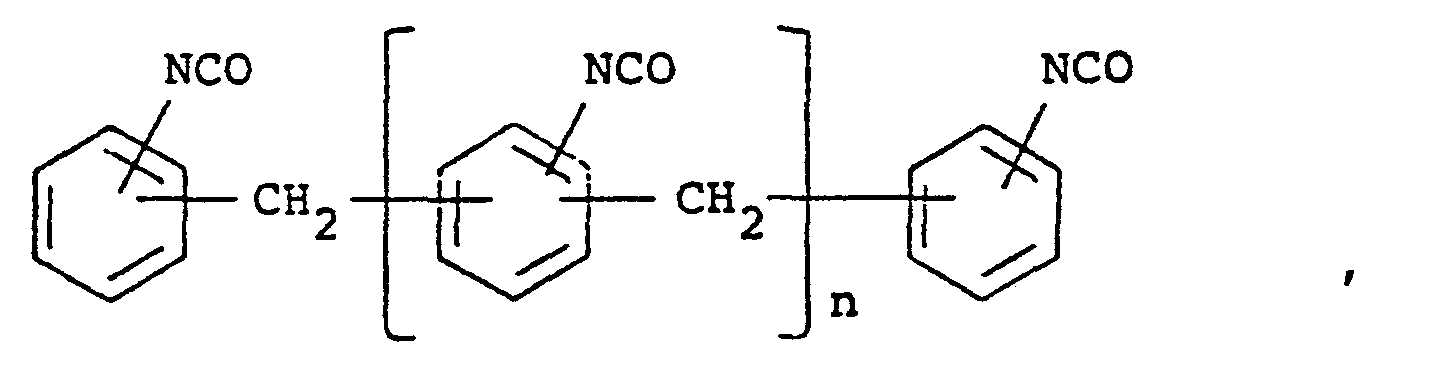
- a mixture of isocyanates having the following average structure is particularly preferred used, in which n has a value from 0.5 to 4, preferably from 0.5 to 3.
- Such isocyanate mixtures are known in the art and are commercially available.
- the aldehyde used in the present invention must be soluble in and capable of reacting with the isocyanate.
- Specific aldehydes that have been found to be suitable include furfural, benzaldehyde, pelargonaldehyde, cinnamaldehyde, nonylaldehyde, butyraldehyde, salicylaldehyde, chlorobenzaldehyde, o-tolylaldehyde, 2-naphthaldehyde, piperonal and vanillal.
- the currently preferred aldehyde is furfural.
- aldehydes used herein are said to be reactive to the isocyanate component, it is not known with absolute certainty that the aldehyde in question reacts with the isocyanate.
- the aldehydes used here are heated with the isocyanates, however, a characteristic aldehyde odor is not perceived, so that it is concluded that aldehyde and isocyanate actually react with one another.
- the aldehyde used in the present invention is used as such.
- the ratio of isocyanate to aldehyde is not critical, and the optimal ratio for a given application can be determined by routine experimentation.
- the amount of aldehyde can be 1 to 50 parts by weight per 100 parts by weight of the mixture of aldehyde and isocyanate.
- An amount of aldehyde in the range from 3 to 30 parts by weight is particularly preferred.
- An amount of aldehyde is preferably added such that the viscosity of the mixture is below 1,000 mPa.s, more advantageously below 500 mPa.s (Brookfield at 25 ° C.).
- a viscosity of the mixture between 25 and 300 mPa.s is particularly preferred. It is naturally also possible to use even higher proportions of aldehyde (e.g. up to 60% or even more) if inert fillers such as highly disperse silicon dioxide are added.
- the binder system can be added or applied in any suitable manner, such as by brushing, dipping, spraying, roller coating, etc.
- the polyisocyanate and the aldehyde added or applied together, because their nature is miscible with each other.
- the amount of the binder required for a special application can be determined by simple experiments. Amounts in the range of 2 to 5% by weight, based on the dry weight of the cellulose material, have been used with good results, although amounts up to 20% by weight can also be used advantageously.
- the new isocyanate-aldehyde binder system can be used for the production of a large variety of products from many different cellulose materials or mixtures of such materials.
- the invention is described below in particular with regard to the production of chipboard.
- Particle boards are produced according to the invention in such a way that particles of wood or other cellulose materials are bonded together using heat, pressure and a binder system containing a polyisocyanate and an aldehyde.
- the polyisocyanate component of the binder system can be essentially any polyisocyanate based on methylene di (phenyl isocyanate).
- the preferred polyisocyanates are polyphenyl isocyanates, and of these, the above average structures are particularly preferred.
- the starting material for the chipboard includes. Particles of cellulose material, preferably wood particles from lumber processing waste such as wood shavings, veneer chips and the like, and specially manufactured particles such as flakes, threads, flakes and the like.
- suitable particles are well known and common. Possibly mixtures of cellulose particles can be used.
- chipboard is successfully produced from wood particle mixtures that contain up to 30% bark.
- the particles must be dried to a moisture content between 4 and 10%, which causes significant drying costs.
- particles with a moisture content of up to 20% can be used.
- lumber waste particles contain about 10 to 20% moisture and can be used without further drying. Particles that contain smaller amounts of moisture can also be used, but this unnecessarily increases the drying costs.
- chipboard is produced by spraying the particles with binder while stirring or in rotating drums.
- the amount of binder used can generally be 1 to 20% by weight, depending on the desired properties of the end product.
- the components of the binder system are added as a previously prepared mixture, although if desired they can also be added separately at the same time.
- Other materials such as wax glue or flame retardants can also be added to the particles during the mixing process.
- the coated cellulose particles are in the form of a loose mat or one Nonwoven fabric made preferably containing about 6 to 20 G ew .-% moisture.
- the mat is then placed in a heated press between pressure equalization plates, which can be treated with a release agent if necessary, and then pressed together, compressing the particles into a plate. Press times, temperatures and pressures are subject to wide variations depending on the thickness of the plate being made, the desired density of the plate, the size of the particles used, and other factors well known in the art.
- pressures are about 24.1 to 48.3 bar (350-700 psi) and temperatures are about 132 to 218 ° C (270 ° F-425) ° F) typical values.
- the pressing times are typically 2 to 7 minutes for 12.7 mm (1/2 inch) thick chipboard. As is well known in the art, these parameters depend on the desired thickness of the finished product. Since part of the moisture present in the mat reacts with the polyisocyanate to form polyurea, it does not need to be evaporated during the pressing cycle.
- isocyanates used were all phosgenation products of aniline-formaldehyde condensates, which can be characterized as follows:
- Plates were prepared in such a manner that the designated binder was sprayed in a rotating drum mixer, which had previously been charged with ring-sectional flakes D ouglas spruce.
- the binder was used in a ratio of 3 parts by weight of binder to 97 parts by weight of wood flakes.
- the coated particles were removed from the mixer and made into a 61.0 cm x 71.1 cm x 1.27 plate in an electrically heated, hydraulically operated laboratory press cm (24 inch x 28 inch x 1/2 inch).
- the press was kept at a temperature of about 177 ° C (350 ° F) and a 5 minute press cycle was used. Pressure compensation plates held all sides of the plate during the pressing.
- the plates were then held at 22.2 ° C (72 ° F) and 65% relative humidity until no change in weight was observed (this generally took 3 to 10 days).
- the plates were then tested according to ASTM D-1037-72 to determine the modulus of rupture (MOR; flexural strength), the modulus of elasticity (MOE), the tensile strength perpendicular to the surface (IB), the 6-cycle MOR and the wet MOR (MOR after 2 h in boiling water and 1 h soaking in cold water). The results of these tests are shown in Table I.
- the binder in this example consisted of a mixture of 25 parts of polyisocyanate D and 6 parts of benzaldehyde. 3 parts of this mixture were mixed with 97 parts of wood chips as indicated in the previous example. A panel was made following the procedure of the previous example.
- the binder in these examples consisted of a mixture of 25 parts of polyisocyanate D and 6 parts of the aldehyde listed in Table II. 31 parts of the mixture were mixed with 1,036 parts of wood chips as indicated in Example 1. Following the procedure of Example 1, however. with the change that the ess cycle was 7 minutes instead of 5 minutes, plates were made. IB, MOR and wet MOR of the plates were determined. The results obtained for this are shown in Table II.
Landscapes
- Chemical & Material Sciences (AREA)
- Medicinal Chemistry (AREA)
- Organic Chemistry (AREA)
- Polymers & Plastics (AREA)
- Health & Medical Sciences (AREA)
- Chemical Kinetics & Catalysis (AREA)
- Engineering & Computer Science (AREA)
- Materials Engineering (AREA)
- Life Sciences & Earth Sciences (AREA)
- Wood Science & Technology (AREA)
- Dry Formation Of Fiberboard And The Like (AREA)
- Investigating Or Analyzing Non-Biological Materials By The Use Of Chemical Means (AREA)
- Catalysts (AREA)
- Organic Low-Molecular-Weight Compounds And Preparation Thereof (AREA)
- Laminated Bodies (AREA)
- Chemical And Physical Treatments For Wood And The Like (AREA)
- Polyurethanes Or Polyureas (AREA)
Abstract
Description
- Viele Produkte werden mit Hilfe des grundlegenden Verfahrens der Verdichtung oder Vereinigung von Körpern aus Cellulosematerialien unter Einsatz von Druck, Wärme und einem chemischen Bindemittel hergestellt. Zu diesen zählen Erzeugnisse auf Holz-Basis wie Sperrholz, Hartfaser-Preßplatten, Spanplatten und furnierte Spanplatten, sowie durch Pressen oder Formpressen hergestellte Erzeugnisse aus pflanzlichen Fasern wie Maisstengeln, Stroh oder Zuckerrohrbagasse, oder aus anderen Cellulosematerialien wie Pulpe, Papierschnitzeln oder dergleichen. Typischerweise sind die für die Herstellung solcher Produkte verwendeten Bindemittel warmhärtende Harze wie Phenol-Formaldehyd; Resorcin-Formaldehyd; Melamin-Formaldehyd; Harnstoff-Formaldehyd; Harnstoff-Furfural- und kondensierte Furfurylalkohol-Harze. Zu anderen bekannten Bindemitteln zählen organische Polyisocyanate, die zum Verkleben von Sperrholz sowie allein oder zusammen mit Harnstoff- oder Melamin-Formaldehyd-Harzen als Klebemittel für Spanplatten verwendet werden. Typische, gemäß dem Stand der Technik offenbarte Bindemittel dieser Art sind Polyisocyanat-Formaldehyd-Mischungen (vgl. die US-PSen 3 919 017 und 3 930 110), Polyisocyanate (vgl. die US-PS 4 046 952 und die GB-PS 1 148 016) und Polyisocyanate in Verbindung mit Harnstoff-Formaldehyd-Harz und/oder Phenol-Formaldehyd-Harzen (vgl. die US-PS 4 209 433 und die GB-PS 1 148 016).
- Ebenfalls bekannt ist die Verwendung von Furfural als rauchunterdrückendes Mittel in Polyurethan-Schaumstoffen (vgl. K. Ashida, "Novel Methods of Smoke Suppression in Isocyanurate Foams (1)", Advances in Urethane Science and Technology, Band 5, 1978). Schließlich wurde vorgeschlagen, Furfural und/oder Furfurylalkohol mit einem Isocyanat zu mischen, das ein Phosgenierungsprodukt eines Anilin-Formaldehyd-Kondensats ist, und danach gleichzeitig das Isocyanat zu trimerisieren und das Furfural und/oder den Furfurylalkohol zu polymerisieren, um dadurch einen Furan-modifizierten Isocyanurat-Schaumstoff herzustellen (vgl. die US-PS 4 232 127).
- Isocyanate haben, wie bereits vorher bemerkt, ihre Eignung als Bindemittel bei der Herstellung von Bauplatten aus Celluloseteilchen unter Beweis gestellt. Isocyanate, insbesondere Polymethylen-polyphenylisocyanate, können Produkte liefern, deren Eigenschaften im allgemeinen denjenigen von Erzeugnissen aus Phenol-Formaldehyd-Harzen gleich oder noch überlegen sind. Eines der Hauptprobleme hinsichtlich des Einsatzes von Isocyanaten sind deren relativ hohe Kosten im Vergleich zu denen von Phenol-Formaldehyd-Harzen. Obwohl der Einsatz eines Isocyanat-Bindemittels viele kostensenkende Vorteile bietet (wie kürzere Preßzeiten, niedrigere Bestreichungsraten und geringere Plattendichten), stehen die eigentlichen Einsatzkosten des Isocyanats dessen Verwendung hindernd entgegen.
- Die vorliegende Erfindung beruht auf dem Befund, daß in hohem Maße geeignete Bindemittel für die Herstellung von Platten, insbesondere von Bauplatten, aus Cellulose-Teilchen dadurch erhalten werden können, daß Polyisocyanate auf Methylen-di(phenylisocyanat)-Basis einfach mit einem Aldehyd vermischt werden, der in dem Polyisocyanat löslich und zu einer Reaktion mit diesem bei Temperaturen oberhalb von 121°C (250°F) befähigt sind. Es wurde nämlich gefunden, daß der Zusatz eines solchen Aldehyds zu den Polyisocyanaten nicht nur den Kostenaufwand für das Isocyanat-Bindemittel beträchtlich reduziert, sondern auch die Herstellung von Bauplatten mit verbesserten physikalischen Eigenschaften im Vergleich zu solchen Platten erlaubt, die unter Verwendung des Isocyanats allein hergestellt wurden.
- Die vorliegende Erfindung richtet sich demgemäß auf neue Bindemittel-Zusammensetzungen und deren Verwendung bei der Herstellung von Bauplatten aus Cellulose-Teilchen. Die vorliegende Erfindung richtet sich ebenfalls auf Mischungen des Bindemittels gemäß der vorliegenden Erfindung mit Cellulose-Teilchen.
- Der Isocyanat-Bestandteil des Bindemittels gemäß der vorliegenden Erfindung kann im wesentlichen jedes Polyisocyanat auf Methylen-di(phenylisocyanat)-Basis sein. Der Begriff "Polyisocyanat auf Methylen-di(phenylisocyanat)-Basis", wie er hierin verwendet wird, bezeichnet Polymethylen-polyphenylisocyanate, Polyisocyanate mit Urethangruppen, die durch Reaktion relativ kleiner Mengen niedermolekularer Diole mit Methylen-di(phenylisocyanat) erhalten wurden (vgl. z.B. die US-PSen 3 644 457, 3 394 164 und 4 115 429), Carbodiimid-Gruppen enthaltende Polyisocyanate, die sich von Methylen- di(phenylisocyanat) ableiten (vgl. z.B. die US-PSen 3 152 162, 3 384 653, 3 449 256, 4 014 935, 4 088 665 und 4 154 752), sowie Gemische aus diesen. Derartige Isocyanate sind in der Fachwelt wohlbekannt und im Handel erhältlich. Derzeit werden Polymethylen-polyphenylisocyanate (z.B. solche, wie sie durch Phosgenierung eines Anilin-Formaldehyd-Kondensats erhalten werden) bevorzugt verwendet, und besonders bevorzugt wird eine Mischung von Isocyanaten nachstehender mittlerer Struktur

- Wie bereits oben festgestellt wurde, muß der gemäß der vorliegenden Erfindung verwendete Aldehyd in dem Isocyanat löslich und zur Reaktion mit diesem befähigt sein. Spezielle Aldehyde, die als geeignet befunden wurden, sind unter anderen Furfural, Benzaldehyd, Pelargonaldehyd, Zimtaldehyd, Nonylaldehyd, Butyraldehyd, Salicylaldehyd, Chlorobenzaldehyd, o-Tolylaldehyd, 2-Naphthaldehyd, Piperonal und Vanillal. Der gegenwärtig bevorzugte Aldehyd ist Furfural. Wenngleich die hierin verwendeten Aldehyde als reaktionsfähig gegenüber dem Isocyanat-Bestandteil bezeichnet werden, so ist nicht mit letzter Sicherheit bekannt, daß der betreffende Aldehyd mit dem Isocyanat reagiert. Beim Erhitzen der hier verwendeten Aldehyde mit den Isocyanaten wird jedoch ein jeweils charakteristischer Aldehyd-Geruch nicht wahrgenommen, so daß daraus geschlossen wird, daß Aldehyd und Isocyanat tatsächlich miteinander reagieren.
- Der gemäß der vorliegenden Erfindung eingesetzte Aldehyd wird als solcher verwendet. Das Verhältnis Isocyanat zu Aldehyd ist nicht kritisch, und das optimale Verhältnis für eine vorgegebene Anwendungsmöglichkeit kann durch Routineversuche bestimmt werden. Im allgemeinen kann die Menge des Aldehyds 1 bis 50 Gew.-Teile auf 100 Gew.-Teile des Gemischs aus Aldehyd und Isocyanat betragen. Besonders bevorzugt wird eine Aldehyd-Menge im Bereich von 3 bis 30 Gew.-Teilen. Vorzugsweise wird eine solche Aldehyd-Menge zugesetzt, daß die Viskosität der Mischung unterhalb von 1 000mPa.s,günstiger noch unterhalb von 500mPa.s,liegt (Brookfield bei 25°C). Besonders bevorzugt wird eine Viskosität des Gemischs zwischen 25 und 300mPa.s.Naturgemäß ist es auch möglich, noch höhere Aldehyd-Anteile zu verwenden (z.B. bis zu 60 % oder noch mehr), wenn inerte Füllstoffe wie hochdisperses Siliciumdioxid zugesetzt werden.
- Das Bindemittel-System kann in jeder geeigneten Weise zugesetzt oder zur Anwendung gebracht werden, etwa durch Bestreichen mit Pinsel bzw. Bürste, Eintauchen, Spritzen, Walzenbeschichten etc.. Bei der bevorzugten Form der praktischen Ausführung der vorliegenden Erfindung werden-das Polyisocyanat und der Aldehyd gemeinsam zugesetzt oder aufgetragen, da sie ihrer Eigenart nach miteinander mischbar sind. Die Menge des für einen speziellen Anwendunsgzweck benötigten Bindemittels kann durch einfache Versuche ermittelt werden. Mengen im Bereich von 2 bis 5 Gew.-%, bezogen auf das Trockengewicht des Cellulose-Materials, sind mit guten Ergebnissen verwendet worden, wenngleich auch Mengen bis hinauf zu 20 Gew.-% vorteilhaft verwendet werden können.
- Es ist ausdrücklich festzustellen, daß das neue Isocyanat-Aldehyd-Bindemittelsystem für die Herstellung einer großen Mannigfaltigkeit von Produkten aus vielen verschiedenen Cellulose-Materialien oder Mischungen solcher Materialien verwendet werden kann. Zur Erläuterung wird jedoch die Erfindung im Folgenden insbesondere hinsichtlich der Herstellung von Spanplatten beschrieben.
- Spanplatten werden gemäß der Erfindung in der Weise hergestellt, daß Teilchen aus Holz oder anderen Cellulose-Materialien unter Einsatz von Wärme, Druck sowie einem ein Polyisocyanat und einen Aldehyd enthaltenden Bindemittelsystem miteinander verbunden werden. Die Polyisocyanat-Komponente des Bindemittelsystems kann, wie bereits im Vorstehenden erwähnt, im wesentlichen jedes Polyisocyanat auf Methylen-di(phenylisocyanat)-Basis sein. Die bevorzugten Polyisocyanate sind Polyphenylisocyanate, und von diesen werden die oben bezeichneten mittleren Strukturen besonders bevorzugt.
- Das Ausgangsmaterial für die Spanplatten umfaßt. Teilchen aus Cellulose-Material, vorzugsweise Holzteilchen aus Abfällen der Nutzholz-Bearbeitung wie Hobelspäne, Furnierschnitzel und dergleichen, sowie speziell gefertigte Teilchen wie Flocken, Fäden, Plättchen und dergleichen. Die Verfahren zur Erzeugung geeigneter Teilchen sind wohlbekannt und gebräuchlich. Gegebenenfalls können Gemische aus Cellulose-Teilchen verwendet werden. Beispielsweise werden Spanplatten mit Erfolg aus Holzteilchen-Gemischen hergestellt, die bis zu 30 % Borke enthalten. Typischerweise müssen die Teilchen auf einen Feuchtigkeitsgehalt zwischen 4 und 10 % getrocknet werden, wodurch erhebliche Trocknungskosten verursacht werden. Gemäß der vorliegenden Erfindung können Teilchen mit einem Feuchtigkeitsgehalt bis zu 20 % eingesetzt werden. Im allgemeinen enthalten Teilchen aus Nutzholz-Abfällen etwa 10 bis 20 % Feuchtigkeit und können ohne weitere Trocknung verwendet werden. Auch Teilchen, die geringere Mengen Feuchtigkeit enthalten, können verwendet werden, jedoch erhöhen sich hierdurch die Trocknungskosten in unnötiger Weise.
- Spanplatten werden gemäß bevorzugter Praxis durch Bespritzen der Teilchen mit Bindemittel unter Rühren oder in rotierenden Trommeln hergestellt. Die eingesetzte Bindemittel-Menge kann im allgemeinen 1 bis 20 Gew.-%, je nach den angestrebten Eigenschaften des Endprodukts, betragen. Vorzugsweise werden etwa 2 bis 5 Gew.-% des Bindemittelsystems, bezogen auf das Gewicht der ofengetrockneten Teilchen, zugesetzt. Die Komponenten des Bindemittelsystems werden als vorher hergestellte Mischung zugesetzt, obwohl sie gewünschtenfalls auch getrennt gleichzeitig zugegeben werden können. Andere Materialien wie Wachsleim oder Flammverzögerungsmittel können den Teilchen während des Mischungsvorgangs ebenfalls zugesetzt werden.
- Nach für die Herstellung einer einheitlichen Mischung ausreichendem Mischen werden die beschichteten Cellulose-Teilchen in die Form einer lockeren Matte oder eines Vlieses gebracht, die vorzugsweise etwa 6 bis 20 Gew.-% Feuchtigkeit enthalten. Die Matte wird dann in eine beheizte Presse zwischen Druckausgleichsplatten gebracht, die erforderlichenfalls mit einem Trennmittel behandelt werden können, und dann zusammengepreßt, wodurch die Teilchen zu einer Platte verdichtet werden. Preßzeiten, Temperaturen und Drücke unterliegen weiten Variationen, je nach der Dicke der hergestellten Platte, der gewünschten Dichte der Platte, der Größe der eingesetzten Teilchen und anderer, in der Fachwelt wohlbekannter Faktoren. Beispielsweise sind jedoch für 12,7 mm (1/2 inch) dicke Spanplatten mittlerer Dichte Drücke von etwa 24,1 bis 48,3 bar (350-700 psi) und Temperaturen von etwa 132 bis 218°C (270°F-425°F) typische Werte. Die Preßzeiten betragen für Spanplatten von 12,7 mm (1/2 inch) Dicke typischerweise 2 bis 7 min. Wie in der Fachwelt allgemein bekannt ist, hängen diese Parameter von der gewünschten Dicke des fertigen Produkts ab. Da ein Teil der in der Matte vorhandenen Feuchtigkeit mit dem Polyisocyanat unter Bildung von Polyharnstoff reagiert, braucht sie während des Preßcyclus nicht verdampft zu werden.
- Die vorliegende Erfindung wird durch die folgenden Beispiele näher erläutert, ist jedoch nicht auf diese beschränkt. In den Beispielen beziehen sich, sofern nicht anders bezeichnet, sämtliche Angaben von Teilen und Prozentsätzen auf das Gewicht.
- Beispiele
- In den nachstehenden Beispielen waren die verwendeten Isocyanate sämtlich Phosgenierungsprodukte von Anilin-Formaldehyd-Kondensaten, die sich wie folgt charakterisieren lassen:
- Ein Polymethylen-polyphenylisocyanat mit einem Gewichtsmittel des Molekulargewichts von 410, einer Brookfield-Viskosität bei 25°C von 225 mPa.s und einem NCO-Gehalt von 31,5 %.
- Ein Polymethylen-polyphenylisocyanat mit einem Gewichtsmittel des Molekulargewichts von 410, einer Brookfield-Viskosität bei 25°C von 291 mPa.s und einem NCO-Gehalt von 31,5 %.
- Ein Polymethylen-polyphenylisocyanat mit einem Gewichtsmittel des Molekulargewichts von 480, einer Brookfield-Viskosität bei 25°C von 558 mPa.s und einem NCO-Gehalt von 31,3 %.
- Ein Polymethylen-polyphenylisocyanat mit einem Gewichtsmittel des Molekulargewichts von 510, einer Brookfield-Viskosität bei 25°C von 2 180 mPa.s und einem NCO-Gehalt von 30,8 %.
- Ein Polymethylen-polyphenylisocyanat mit einem Ge-wichtsmittel des Molekulargewichts von 610, einer Brookfield-Viskosität bei 25°C von 4 525 mPa.s und einem NCO-Gehalt von 30,2 %.
- Ein Polymethylen-polyphenylisocyanat mit einem Gewichtsmittel des Molekulargewichts von 720, einer Brookfield-Viskosität bei 25°C von 11 350 mPa.s und einem NCO-Gehalt von 29,9 %.
- In den nachstehenden Beispielen wurden die vier in Tabelle I angegebenen Viskositäts-Werte ausgewählt, und die zur Erzielung jedes dieser Viskositätswerte bei jedem Isocyanat erforderlichen Mengen Furfural, die in der Tabelle I aufgeführt sind, wurden zugesetzt.
- Platten wurden in der Weise hergestellt, daß das bezeichnete Bindemittel in einen Drehtrommelmischer gespritzt wurde, der vorher mit Ringschnitt-Flocken aus Douglas-Fichte beschickt worden war. Das Bindemittel wurde in einem Mengenverhältnis von 3 Gew.-Teilen Bindemittel zu 97 Gew.-Teilen Holzflocken eingesetzt. Nach einer Betriebsdauer des Trommelmischers, die ausreichend war, um das Bindemittel gleichförmig zu verteilen, wurden die beschichteten Teilchen dem Mischer entnommen und in einer elektrisch beheizten, hydraulisch betriebenen Laboratoriumspresse zu einer Platte von 61,0 cm x 71,1 cm x 1,27 cm (24 inch x 28 inch x 1/2 inch) geformt. Die Presse wurde bei einer Temperatur von etwa 177°C (350°F) gehalten, und ein Preßcyclus von 5 min wurde angewandt. Druckausgleichsplatten halterten alle Seiten der Platte während des Pressens. Um das Kleben der Platte an den Druckausgleichsplatten zu verhindern, wurde auf jede der letzteren eine 10-proz. wäßrige Zinkstearat-Lösung aufgesprüht. Die erhaltenen Spanplatten hatten sämtlich eine Dichte von 0.673 g/cm3 (42 Ibs./cu.ft.).
- Die Platten wurden dann bei 22,2°C (72°F) und einer relativen Luftfeuchtigkeit von 65 % gehalten, bis keine Gewichtsänderung mehr festgestellt wurde (dieses dauerte im allgemeinen 3 bis 10 Tage). Die Platten wurden dann gemäß ASTM D-1037-72 zur Bestimmung des Bruchmoduls (MOR; Biegefestigkeit), des Elastizitätsmoduls (MOE), der Zugfestigkeit senkrecht zu der Oberfläche (IB), des 6-Cyclen-MOR und des Feucht-MOR (MOR nach 2 h in siedendem Wasser und 1 h Einweichen in kaltem Wasser) untersucht. Die Ergebnisse dieser Tests sind in Tabelle I aufgeführt.


- Das Bindemittel in diesem Beispiel bestand aus einem Gemisch aus 25 Teilen Polyisocyanat D und 6 Teilen Benzaldehyd. 3 Teile dieses Gemischs wurden mit 97 Teilen Holzschnitzeln wie in dem vorhergehenden Beispiel angegeben vermischt. Nach der Arbeitsweise des vorhergehenden Beispiels wurde eine Platte hergestellt. Die so erhaltene Platte hatte ein spezifisches Gewicht von D,67, sowie die Test-Werte IB = 0,765 N/mm2 (111 psi), MOR = 17,23 N/mm2 (2500 psi) und Feucht-MOR = 12,87 N/mm2 (1866 psi).
- pas Bindemittel in diesen Beispielen bestand aus einem Gemisch aus 25 Teilen Polyisocyanat D und 6 Teilen des in Tabelle II aufgeführten Aldehyds. 31 Teile des Gemischs wurden mit 1 036 Teilen Holzschnitzeln wie in Beispiel 1 angegeben vermischt. Nach der Arbeitsweise des Beispiels 1, jedoch. mit der Abänderung, daß der ?reßcyclus 7 min statt 5 min betrug, wurden Platten hergestellt. IB, MOR und Feucht-MOR der Platten wurden bestimmt. Die hierfür erhaltenen Ergebnisse sind in Tabelle II aufgeführt.
-

Claims (8)
Priority Applications (1)
| Application Number | Priority Date | Filing Date | Title |
|---|---|---|---|
| AT82105098T ATE18240T1 (de) | 1981-06-15 | 1982-06-11 | Herstellung von bauplatten unter verwendung von isocyanat/aldehyd-bindemitteln. |
Applications Claiming Priority (2)
| Application Number | Priority Date | Filing Date | Title |
|---|---|---|---|
| US27368081A | 1981-06-15 | 1981-06-15 | |
| US273680 | 1981-06-15 |
Publications (2)
| Publication Number | Publication Date |
|---|---|
| EP0067426A1 true EP0067426A1 (de) | 1982-12-22 |
| EP0067426B1 EP0067426B1 (de) | 1986-02-26 |
Family
ID=23044964
Family Applications (1)
| Application Number | Title | Priority Date | Filing Date |
|---|---|---|---|
| EP82105098A Expired EP0067426B1 (de) | 1981-06-15 | 1982-06-11 | Herstellung von Bauplatten unter Verwendung von Isocyanat/Aldehyd-Bindemitteln |
Country Status (6)
| Country | Link |
|---|---|
| EP (1) | EP0067426B1 (de) |
| JP (1) | JPS57210843A (de) |
| AT (1) | ATE18240T1 (de) |
| CA (1) | CA1170394A (de) |
| DE (1) | DE3269348D1 (de) |
| FI (1) | FI822100A7 (de) |
Cited By (1)
| Publication number | Priority date | Publication date | Assignee | Title |
|---|---|---|---|---|
| DE4436981A1 (de) * | 1994-10-06 | 1996-04-11 | Hartmut Faerber | Leichtbaukörper geringer Wärmeleitfähigkeit |
Families Citing this family (3)
| Publication number | Priority date | Publication date | Assignee | Title |
|---|---|---|---|---|
| US7071248B2 (en) | 2003-01-21 | 2006-07-04 | Ashland Licensing And Intellectual Property, Llc | Adhesive additives and adhesive compositions containing an adhesive additive |
| EP2805976A1 (de) * | 2013-05-24 | 2014-11-26 | Huntsman International Llc | Aldehyd enthaltende Zusammensetzungen, die zur Herstellung von härtbaren Polyisocyanatzusammensetzungen geeignet sind |
| CA3237889A1 (en) * | 2021-11-10 | 2023-05-19 | Daisu LEE | Eco-friendly polyurethane foam using aldehyde compound and diels-alder reaction products of aldehyde compound and method for forming same |
Citations (3)
| Publication number | Priority date | Publication date | Assignee | Title |
|---|---|---|---|---|
| GB1351555A (en) * | 1972-09-05 | 1974-05-01 | Dow Chemical Co | Polyurethane foams |
| US3930110A (en) * | 1974-02-11 | 1975-12-30 | Ellingson Timber Co | Manufacture of multilayer panels using polyisocyanate: formaldehyde binder system |
| DE2711958A1 (de) * | 1977-03-18 | 1978-09-21 | Bayer Ag | Verfahren zur bindung oder impraegnierung lignocellulosehaltiger rohstoffe |
-
1982
- 1982-03-30 CA CA000399801A patent/CA1170394A/en not_active Expired
- 1982-06-11 AT AT82105098T patent/ATE18240T1/de not_active IP Right Cessation
- 1982-06-11 EP EP82105098A patent/EP0067426B1/de not_active Expired
- 1982-06-11 DE DE8282105098T patent/DE3269348D1/de not_active Expired
- 1982-06-11 FI FI822100A patent/FI822100A7/fi not_active Application Discontinuation
- 1982-06-14 JP JP57100794A patent/JPS57210843A/ja active Pending
Patent Citations (3)
| Publication number | Priority date | Publication date | Assignee | Title |
|---|---|---|---|---|
| GB1351555A (en) * | 1972-09-05 | 1974-05-01 | Dow Chemical Co | Polyurethane foams |
| US3930110A (en) * | 1974-02-11 | 1975-12-30 | Ellingson Timber Co | Manufacture of multilayer panels using polyisocyanate: formaldehyde binder system |
| DE2711958A1 (de) * | 1977-03-18 | 1978-09-21 | Bayer Ag | Verfahren zur bindung oder impraegnierung lignocellulosehaltiger rohstoffe |
Cited By (1)
| Publication number | Priority date | Publication date | Assignee | Title |
|---|---|---|---|---|
| DE4436981A1 (de) * | 1994-10-06 | 1996-04-11 | Hartmut Faerber | Leichtbaukörper geringer Wärmeleitfähigkeit |
Also Published As
| Publication number | Publication date |
|---|---|
| FI822100A0 (fi) | 1982-06-11 |
| EP0067426B1 (de) | 1986-02-26 |
| ATE18240T1 (de) | 1986-03-15 |
| CA1170394A (en) | 1984-07-03 |
| JPS57210843A (en) | 1982-12-24 |
| FI822100A7 (fi) | 1982-12-16 |
| DE3269348D1 (en) | 1986-04-03 |
Similar Documents
| Publication | Publication Date | Title |
|---|---|---|
| DE69703552T2 (de) | Verfahren zur herstellung von verbundstoffen aus lignocellulosematerial | |
| DE69034003T2 (de) | Wärmehärtbares Harz und Verbundstoff aus Lignozellulosematerial | |
| DE69805410T2 (de) | Verfahren zur herstellung von lignocelluloseplatten | |
| EP3366713B1 (de) | Verfahren zur herstellung von holzverbundwerkstoffen | |
| DE3150626C2 (de) | ||
| DE10012427A1 (de) | Holzfaserplatte und Herstellungsverfahren dafür | |
| DE2026093B2 (de) | Verfahren zur Herstellung von Preßholzplatten | |
| EP0896008B1 (de) | Bindemittelzusammensetzung, ihre Verwendung sowie ein Verfahren zur Herstellung von Spanplatten | |
| EP3684573B1 (de) | Bindemittel für cellulosehaltige materialien | |
| DE2716971C2 (de) | Bindemittel für kochwasser- und witterungsbeständige Platten aus lignozellulosehaltigem Material | |
| EP0565109A1 (de) | Verfahren zum Verkleben von Holzfragmenten | |
| DE3933279C1 (de) | ||
| DE3128808A1 (de) | Klebstoffmasse und ihre verwendung | |
| DE69730412T2 (de) | Verfahren zur Herstellung von Celluloseverbundwerkstoffen | |
| DE4020969C1 (en) | Moulding with improved mechanical properties and density - comprises mixt. of wood or cellulose material shavings and potato pulp, waste paper and binder | |
| EP0067426B1 (de) | Herstellung von Bauplatten unter Verwendung von Isocyanat/Aldehyd-Bindemitteln | |
| EP0639608B1 (de) | Hitzehärtende Bindemittel | |
| EP2567798B1 (de) | Verwendung von Polyamin in Holzwerkstoffen zur Reduzierung der Emission von Aldehyden und/oder Säuren | |
| EP0700762B1 (de) | Verfahren zur Herstellung von Holzspan- und Faserplatten | |
| EP0613906B1 (de) | Förmkörper, insbesondere in Form einer Faserplatte | |
| EP3694641B1 (de) | Poröses trägersystem zur reduktion der formaldehydemission in einem holzwerkstoff | |
| DE102015103511B4 (de) | Verfahren zur Herstellung eines Holzspanwerkstoffs und darin verwendete Härter für Aminoplaste | |
| DE102005051716A1 (de) | Bindemittelzusammensetzung für Holzwerkstoffe | |
| DE2744425C2 (de) | Trockenverfahren zur Herstellung von Faserformkörpern aus gegenüber Stammholzmaterial unterschiedlichem pflanzlichem lignocellulosehaltigem Material, sowie Einrichtung zur Durchführung dieses Verfahren | |
| DE10124638A1 (de) | Verfahren zur Herstellung von mit Tanninformaldehydharzen gebundenen Holzspan-und Holzfaserplatten |
Legal Events
| Date | Code | Title | Description |
|---|---|---|---|
| PUAI | Public reference made under article 153(3) epc to a published international application that has entered the european phase |
Free format text: ORIGINAL CODE: 0009012 |
|
| 17P | Request for examination filed |
Effective date: 19820611 |
|
| AK | Designated contracting states |
Designated state(s): AT BE DE FR GB IT SE |
|
| GRAA | (expected) grant |
Free format text: ORIGINAL CODE: 0009210 |
|
| AK | Designated contracting states |
Designated state(s): AT BE DE FR GB IT SE |
|
| REF | Corresponds to: |
Ref document number: 18240 Country of ref document: AT Date of ref document: 19860315 Kind code of ref document: T |
|
| ITF | It: translation for a ep patent filed | ||
| ET | Fr: translation filed | ||
| REF | Corresponds to: |
Ref document number: 3269348 Country of ref document: DE Date of ref document: 19860403 |
|
| RAP2 | Party data changed (patent owner data changed or rights of a patent transferred) |
Owner name: MOBAY CORPORATION |
|
| PGFP | Annual fee paid to national office [announced via postgrant information from national office to epo] |
Ref country code: AT Payment date: 19860613 Year of fee payment: 5 |
|
| BECN | Be: change of holder's name |
Effective date: 19860226 |
|
| PLBE | No opposition filed within time limit |
Free format text: ORIGINAL CODE: 0009261 |
|
| STAA | Information on the status of an ep patent application or granted ep patent |
Free format text: STATUS: NO OPPOSITION FILED WITHIN TIME LIMIT |
|
| 26N | No opposition filed | ||
| PG25 | Lapsed in a contracting state [announced via postgrant information from national office to epo] |
Ref country code: AT Effective date: 19870611 |
|
| PG25 | Lapsed in a contracting state [announced via postgrant information from national office to epo] |
Ref country code: SE Effective date: 19870612 |
|
| BERE | Be: lapsed |
Owner name: MOBAY CORP. Effective date: 19870630 |
|
| PG25 | Lapsed in a contracting state [announced via postgrant information from national office to epo] |
Ref country code: FR Free format text: LAPSE BECAUSE OF NON-PAYMENT OF DUE FEES Effective date: 19880226 |
|
| PG25 | Lapsed in a contracting state [announced via postgrant information from national office to epo] |
Ref country code: DE Effective date: 19880301 |
|
| GBPC | Gb: european patent ceased through non-payment of renewal fee | ||
| REG | Reference to a national code |
Ref country code: FR Ref legal event code: ST |
|
| PG25 | Lapsed in a contracting state [announced via postgrant information from national office to epo] |
Ref country code: GB Effective date: 19881121 |
|
| PG25 | Lapsed in a contracting state [announced via postgrant information from national office to epo] |
Ref country code: BE Effective date: 19890630 |
|
| EUG | Se: european patent has lapsed |
Ref document number: 82105098.6 Effective date: 19880712 |