EP0068246A1 - Verfahren zur Herstellung von pulverförmigem Polyimid und seine Verwendung - Google Patents
Verfahren zur Herstellung von pulverförmigem Polyimid und seine Verwendung Download PDFInfo
- Publication number
- EP0068246A1 EP0068246A1 EP82105146A EP82105146A EP0068246A1 EP 0068246 A1 EP0068246 A1 EP 0068246A1 EP 82105146 A EP82105146 A EP 82105146A EP 82105146 A EP82105146 A EP 82105146A EP 0068246 A1 EP0068246 A1 EP 0068246A1
- Authority
- EP
- European Patent Office
- Prior art keywords
- aromatic
- entrainer
- polyimide
- polyamic acid
- dianhydride
- Prior art date
- Legal status (The legal status is an assumption and is not a legal conclusion. Google has not performed a legal analysis and makes no representation as to the accuracy of the status listed.)
- Granted
Links
- 239000004642 Polyimide Substances 0.000 title claims abstract description 21
- 229920001721 polyimide Polymers 0.000 title claims abstract description 21
- 238000000034 method Methods 0.000 title claims abstract description 18
- XLYOFNOQVPJJNP-UHFFFAOYSA-N water Substances O XLYOFNOQVPJJNP-UHFFFAOYSA-N 0.000 claims abstract description 18
- 229920005575 poly(amic acid) Polymers 0.000 claims abstract description 16
- 239000000843 powder Substances 0.000 claims abstract description 16
- 125000003118 aryl group Chemical group 0.000 claims abstract description 11
- 238000005245 sintering Methods 0.000 claims abstract description 11
- 239000000203 mixture Substances 0.000 claims abstract description 8
- 238000000465 moulding Methods 0.000 claims abstract description 6
- 238000004519 manufacturing process Methods 0.000 claims abstract description 5
- 239000003960 organic solvent Substances 0.000 claims abstract description 5
- 238000009835 boiling Methods 0.000 claims abstract description 4
- GTDPSWPPOUPBNX-UHFFFAOYSA-N ac1mqpva Chemical compound CC12C(=O)OC(=O)C1(C)C1(C)C2(C)C(=O)OC1=O GTDPSWPPOUPBNX-UHFFFAOYSA-N 0.000 claims description 16
- -1 aromatic tetracarboxylic acid Chemical class 0.000 claims description 5
- 150000004945 aromatic hydrocarbons Chemical class 0.000 claims description 2
- 238000002360 preparation method Methods 0.000 claims description 2
- 150000001412 amines Chemical class 0.000 claims 1
- 239000007795 chemical reaction product Substances 0.000 claims 1
- OKKJLVBELUTLKV-UHFFFAOYSA-N Methanol Chemical compound OC OKKJLVBELUTLKV-UHFFFAOYSA-N 0.000 description 9
- WFDIJRYMOXRFFG-UHFFFAOYSA-N Acetic anhydride Chemical compound CC(=O)OC(C)=O WFDIJRYMOXRFFG-UHFFFAOYSA-N 0.000 description 6
- SECXISVLQFMRJM-UHFFFAOYSA-N N-Methylpyrrolidone Chemical compound CN1CCCC1=O SECXISVLQFMRJM-UHFFFAOYSA-N 0.000 description 6
- YXFVVABEGXRONW-UHFFFAOYSA-N Toluene Chemical compound CC1=CC=CC=C1 YXFVVABEGXRONW-UHFFFAOYSA-N 0.000 description 6
- 238000006243 chemical reaction Methods 0.000 description 6
- 150000004985 diamines Chemical class 0.000 description 6
- 239000003795 chemical substances by application Substances 0.000 description 5
- JUJWROOIHBZHMG-UHFFFAOYSA-N Pyridine Chemical compound C1=CC=NC=C1 JUJWROOIHBZHMG-UHFFFAOYSA-N 0.000 description 4
- 239000002904 solvent Substances 0.000 description 4
- UHOVQNZJYSORNB-UHFFFAOYSA-N Benzene Chemical compound C1=CC=CC=C1 UHOVQNZJYSORNB-UHFFFAOYSA-N 0.000 description 3
- ZMXDDKWLCZADIW-UHFFFAOYSA-N N,N-Dimethylformamide Chemical compound CN(C)C=O ZMXDDKWLCZADIW-UHFFFAOYSA-N 0.000 description 3
- CTQNGGLPUBDAKN-UHFFFAOYSA-N O-Xylene Chemical compound CC1=CC=CC=C1C CTQNGGLPUBDAKN-UHFFFAOYSA-N 0.000 description 3
- 125000004432 carbon atom Chemical group C* 0.000 description 3
- 125000006159 dianhydride group Chemical group 0.000 description 3
- 238000010438 heat treatment Methods 0.000 description 3
- 239000008096 xylene Substances 0.000 description 3
- VLDPXPPHXDGHEW-UHFFFAOYSA-N 1-chloro-2-dichlorophosphoryloxybenzene Chemical compound ClC1=CC=CC=C1OP(Cl)(Cl)=O VLDPXPPHXDGHEW-UHFFFAOYSA-N 0.000 description 2
- 0 C*1cc(*)ccc1 Chemical compound C*1cc(*)ccc1 0.000 description 2
- IAZDPXIOMUYVGZ-UHFFFAOYSA-N Dimethylsulphoxide Chemical compound CS(C)=O IAZDPXIOMUYVGZ-UHFFFAOYSA-N 0.000 description 2
- ATUOYWHBWRKTHZ-UHFFFAOYSA-N Propane Chemical compound CCC ATUOYWHBWRKTHZ-UHFFFAOYSA-N 0.000 description 2
- 239000002253 acid Substances 0.000 description 2
- 125000002915 carbonyl group Chemical group [*:2]C([*:1])=O 0.000 description 2
- MVPPADPHJFYWMZ-UHFFFAOYSA-N chlorobenzene Chemical compound ClC1=CC=CC=C1 MVPPADPHJFYWMZ-UHFFFAOYSA-N 0.000 description 2
- 238000001035 drying Methods 0.000 description 2
- 239000002244 precipitate Substances 0.000 description 2
- UMJSCPRVCHMLSP-UHFFFAOYSA-N pyridine Natural products COC1=CC=CN=C1 UMJSCPRVCHMLSP-UHFFFAOYSA-N 0.000 description 2
- 239000011541 reaction mixture Substances 0.000 description 2
- JRBJSXQPQWSCCF-UHFFFAOYSA-N 3,3'-Dimethoxybenzidine Chemical compound C1=C(N)C(OC)=CC(C=2C=C(OC)C(N)=CC=2)=C1 JRBJSXQPQWSCCF-UHFFFAOYSA-N 0.000 description 1
- NUIURNJTPRWVAP-UHFFFAOYSA-N 3,3'-Dimethylbenzidine Chemical group C1=C(N)C(C)=CC(C=2C=C(C)C(N)=CC=2)=C1 NUIURNJTPRWVAP-UHFFFAOYSA-N 0.000 description 1
- LJGHYPLBDBRCRZ-UHFFFAOYSA-N 3-(3-aminophenyl)sulfonylaniline Chemical compound NC1=CC=CC(S(=O)(=O)C=2C=C(N)C=CC=2)=C1 LJGHYPLBDBRCRZ-UHFFFAOYSA-N 0.000 description 1
- TYKLCAKICHXQNE-UHFFFAOYSA-N 3-[(2,3-dicarboxyphenyl)methyl]phthalic acid Chemical compound OC(=O)C1=CC=CC(CC=2C(=C(C(O)=O)C=CC=2)C(O)=O)=C1C(O)=O TYKLCAKICHXQNE-UHFFFAOYSA-N 0.000 description 1
- UCFMKTNJZCYBBJ-UHFFFAOYSA-N 3-[1-(2,3-dicarboxyphenyl)ethyl]phthalic acid Chemical compound C=1C=CC(C(O)=O)=C(C(O)=O)C=1C(C)C1=CC=CC(C(O)=O)=C1C(O)=O UCFMKTNJZCYBBJ-UHFFFAOYSA-N 0.000 description 1
- PAHZZOIHRHCHTH-UHFFFAOYSA-N 3-[2-(2,3-dicarboxyphenyl)propan-2-yl]phthalic acid Chemical compound C=1C=CC(C(O)=O)=C(C(O)=O)C=1C(C)(C)C1=CC=CC(C(O)=O)=C1C(O)=O PAHZZOIHRHCHTH-UHFFFAOYSA-N 0.000 description 1
- ICNFHJVPAJKPHW-UHFFFAOYSA-N 4,4'-Thiodianiline Chemical compound C1=CC(N)=CC=C1SC1=CC=C(N)C=C1 ICNFHJVPAJKPHW-UHFFFAOYSA-N 0.000 description 1
- YBRVSVVVWCFQMG-UHFFFAOYSA-N 4,4'-diaminodiphenylmethane Chemical compound C1=CC(N)=CC=C1CC1=CC=C(N)C=C1 YBRVSVVVWCFQMG-UHFFFAOYSA-N 0.000 description 1
- UITKHKNFVCYWNG-UHFFFAOYSA-N 4-(3,4-dicarboxybenzoyl)phthalic acid Chemical compound C1=C(C(O)=O)C(C(=O)O)=CC=C1C(=O)C1=CC=C(C(O)=O)C(C(O)=O)=C1 UITKHKNFVCYWNG-UHFFFAOYSA-N 0.000 description 1
- AVCOFPOLGHKJQB-UHFFFAOYSA-N 4-(3,4-dicarboxyphenyl)sulfonylphthalic acid Chemical compound C1=C(C(O)=O)C(C(=O)O)=CC=C1S(=O)(=O)C1=CC=C(C(O)=O)C(C(O)=O)=C1 AVCOFPOLGHKJQB-UHFFFAOYSA-N 0.000 description 1
- IWXCYYWDGDDPAC-UHFFFAOYSA-N 4-[(3,4-dicarboxyphenyl)methyl]phthalic acid Chemical compound C1=C(C(O)=O)C(C(=O)O)=CC=C1CC1=CC=C(C(O)=O)C(C(O)=O)=C1 IWXCYYWDGDDPAC-UHFFFAOYSA-N 0.000 description 1
- OSGFBINRYVUILV-UHFFFAOYSA-N 4-[(4-aminophenyl)-diethylsilyl]aniline Chemical compound C=1C=C(N)C=CC=1[Si](CC)(CC)C1=CC=C(N)C=C1 OSGFBINRYVUILV-UHFFFAOYSA-N 0.000 description 1
- KTZLSMUPEJXXBO-UHFFFAOYSA-N 4-[(4-aminophenyl)-phenylphosphoryl]aniline Chemical compound C1=CC(N)=CC=C1P(=O)(C=1C=CC(N)=CC=1)C1=CC=CC=C1 KTZLSMUPEJXXBO-UHFFFAOYSA-N 0.000 description 1
- IJJNNSUCZDJDLP-UHFFFAOYSA-N 4-[1-(3,4-dicarboxyphenyl)ethyl]phthalic acid Chemical compound C=1C=C(C(O)=O)C(C(O)=O)=CC=1C(C)C1=CC=C(C(O)=O)C(C(O)=O)=C1 IJJNNSUCZDJDLP-UHFFFAOYSA-N 0.000 description 1
- WUPRYUDHUFLKFL-UHFFFAOYSA-N 4-[3-(4-aminophenoxy)phenoxy]aniline Chemical compound C1=CC(N)=CC=C1OC1=CC=CC(OC=2C=CC(N)=CC=2)=C1 WUPRYUDHUFLKFL-UHFFFAOYSA-N 0.000 description 1
- JCRRFJIVUPSNTA-UHFFFAOYSA-N 4-[4-(4-aminophenoxy)phenoxy]aniline Chemical compound C1=CC(N)=CC=C1OC(C=C1)=CC=C1OC1=CC=C(N)C=C1 JCRRFJIVUPSNTA-UHFFFAOYSA-N 0.000 description 1
- LBNFPUAJWZYIOQ-UHFFFAOYSA-N 4-n-(4-aminophenyl)-4-n-methylbenzene-1,4-diamine Chemical compound C=1C=C(N)C=CC=1N(C)C1=CC=C(N)C=C1 LBNFPUAJWZYIOQ-UHFFFAOYSA-N 0.000 description 1
- QZHXKQKKEBXYRG-UHFFFAOYSA-N 4-n-(4-aminophenyl)benzene-1,4-diamine Chemical compound C1=CC(N)=CC=C1NC1=CC=C(N)C=C1 QZHXKQKKEBXYRG-UHFFFAOYSA-N 0.000 description 1
- VQVIHDPBMFABCQ-UHFFFAOYSA-N 5-(1,3-dioxo-2-benzofuran-5-carbonyl)-2-benzofuran-1,3-dione Chemical compound C1=C2C(=O)OC(=O)C2=CC(C(C=2C=C3C(=O)OC(=O)C3=CC=2)=O)=C1 VQVIHDPBMFABCQ-UHFFFAOYSA-N 0.000 description 1
- QQGYZOYWNCKGEK-UHFFFAOYSA-N 5-[(1,3-dioxo-2-benzofuran-5-yl)oxy]-2-benzofuran-1,3-dione Chemical compound C1=C2C(=O)OC(=O)C2=CC(OC=2C=C3C(=O)OC(C3=CC=2)=O)=C1 QQGYZOYWNCKGEK-UHFFFAOYSA-N 0.000 description 1
- OKTJSMMVPCPJKN-UHFFFAOYSA-N Carbon Chemical compound [C] OKTJSMMVPCPJKN-UHFFFAOYSA-N 0.000 description 1
- MQJKPEGWNLWLTK-UHFFFAOYSA-N Dapsone Chemical compound C1=CC(N)=CC=C1S(=O)(=O)C1=CC=C(N)C=C1 MQJKPEGWNLWLTK-UHFFFAOYSA-N 0.000 description 1
- FXHOOIRPVKKKFG-UHFFFAOYSA-N N,N-Dimethylacetamide Chemical compound CN(C)C(C)=O FXHOOIRPVKKKFG-UHFFFAOYSA-N 0.000 description 1
- NINIDFKCEFEMDL-UHFFFAOYSA-N Sulfur Chemical compound [S] NINIDFKCEFEMDL-UHFFFAOYSA-N 0.000 description 1
- 125000002947 alkylene group Chemical group 0.000 description 1
- 239000000010 aprotic solvent Substances 0.000 description 1
- QVGXLLKOCUKJST-UHFFFAOYSA-N atomic oxygen Chemical compound [O] QVGXLLKOCUKJST-UHFFFAOYSA-N 0.000 description 1
- HFACYLZERDEVSX-UHFFFAOYSA-N benzidine Chemical compound C1=CC(N)=CC=C1C1=CC=C(N)C=C1 HFACYLZERDEVSX-UHFFFAOYSA-N 0.000 description 1
- 150000001721 carbon Chemical class 0.000 description 1
- 229910052799 carbon Inorganic materials 0.000 description 1
- 230000000052 comparative effect Effects 0.000 description 1
- 238000007796 conventional method Methods 0.000 description 1
- ZZTCPWRAHWXWCH-UHFFFAOYSA-N diphenylmethanediamine Chemical compound C=1C=CC=CC=1C(N)(N)C1=CC=CC=C1 ZZTCPWRAHWXWCH-UHFFFAOYSA-N 0.000 description 1
- 150000008282 halocarbons Chemical class 0.000 description 1
- 238000005259 measurement Methods 0.000 description 1
- OBKARQMATMRWQZ-UHFFFAOYSA-N naphthalene-1,2,5,6-tetracarboxylic acid Chemical compound OC(=O)C1=C(C(O)=O)C=CC2=C(C(O)=O)C(C(=O)O)=CC=C21 OBKARQMATMRWQZ-UHFFFAOYSA-N 0.000 description 1
- KQSABULTKYLFEV-UHFFFAOYSA-N naphthalene-1,5-diamine Chemical compound C1=CC=C2C(N)=CC=CC2=C1N KQSABULTKYLFEV-UHFFFAOYSA-N 0.000 description 1
- DOBFTMLCEYUAQC-UHFFFAOYSA-N naphthalene-2,3,6,7-tetracarboxylic acid Chemical compound OC(=O)C1=C(C(O)=O)C=C2C=C(C(O)=O)C(C(=O)O)=CC2=C1 DOBFTMLCEYUAQC-UHFFFAOYSA-N 0.000 description 1
- 229910052760 oxygen Inorganic materials 0.000 description 1
- 239000001301 oxygen Substances 0.000 description 1
- 238000001556 precipitation Methods 0.000 description 1
- 239000001294 propane Substances 0.000 description 1
- 238000010992 reflux Methods 0.000 description 1
- 238000007363 ring formation reaction Methods 0.000 description 1
- 229910052717 sulfur Inorganic materials 0.000 description 1
- 239000011593 sulfur Substances 0.000 description 1
- 150000000000 tetracarboxylic acids Chemical class 0.000 description 1
- 238000005406 washing Methods 0.000 description 1
Classifications
-
- C—CHEMISTRY; METALLURGY
- C08—ORGANIC MACROMOLECULAR COMPOUNDS; THEIR PREPARATION OR CHEMICAL WORKING-UP; COMPOSITIONS BASED THEREON
- C08J—WORKING-UP; GENERAL PROCESSES OF COMPOUNDING; AFTER-TREATMENT NOT COVERED BY SUBCLASSES C08B, C08C, C08F, C08G or C08H
- C08J3/00—Processes of treating or compounding macromolecular substances
- C08J3/12—Powdering or granulating
- C08J3/14—Powdering or granulating by precipitation from solutions
-
- C—CHEMISTRY; METALLURGY
- C08—ORGANIC MACROMOLECULAR COMPOUNDS; THEIR PREPARATION OR CHEMICAL WORKING-UP; COMPOSITIONS BASED THEREON
- C08G—MACROMOLECULAR COMPOUNDS OBTAINED OTHERWISE THAN BY REACTIONS ONLY INVOLVING UNSATURATED CARBON-TO-CARBON BONDS
- C08G73/00—Macromolecular compounds obtained by reactions forming a linkage containing nitrogen with or without oxygen or carbon in the main chain of the macromolecule, not provided for in groups C08G12/00 - C08G71/00
- C08G73/06—Polycondensates having nitrogen-containing heterocyclic rings in the main chain of the macromolecule
- C08G73/10—Polyimides; Polyester-imides; Polyamide-imides; Polyamide acids or similar polyimide precursors
- C08G73/1003—Preparatory processes
- C08G73/1007—Preparatory processes from tetracarboxylic acids or derivatives and diamines
-
- C—CHEMISTRY; METALLURGY
- C08—ORGANIC MACROMOLECULAR COMPOUNDS; THEIR PREPARATION OR CHEMICAL WORKING-UP; COMPOSITIONS BASED THEREON
- C08G—MACROMOLECULAR COMPOUNDS OBTAINED OTHERWISE THAN BY REACTIONS ONLY INVOLVING UNSATURATED CARBON-TO-CARBON BONDS
- C08G73/00—Macromolecular compounds obtained by reactions forming a linkage containing nitrogen with or without oxygen or carbon in the main chain of the macromolecule, not provided for in groups C08G12/00 - C08G71/00
- C08G73/06—Polycondensates having nitrogen-containing heterocyclic rings in the main chain of the macromolecule
- C08G73/10—Polyimides; Polyester-imides; Polyamide-imides; Polyamide acids or similar polyimide precursors
- C08G73/1003—Preparatory processes
- C08G73/1007—Preparatory processes from tetracarboxylic acids or derivatives and diamines
- C08G73/1028—Preparatory processes from tetracarboxylic acids or derivatives and diamines characterised by the process itself, e.g. steps, continuous
-
- C—CHEMISTRY; METALLURGY
- C08—ORGANIC MACROMOLECULAR COMPOUNDS; THEIR PREPARATION OR CHEMICAL WORKING-UP; COMPOSITIONS BASED THEREON
- C08G—MACROMOLECULAR COMPOUNDS OBTAINED OTHERWISE THAN BY REACTIONS ONLY INVOLVING UNSATURATED CARBON-TO-CARBON BONDS
- C08G73/00—Macromolecular compounds obtained by reactions forming a linkage containing nitrogen with or without oxygen or carbon in the main chain of the macromolecule, not provided for in groups C08G12/00 - C08G71/00
- C08G73/06—Polycondensates having nitrogen-containing heterocyclic rings in the main chain of the macromolecule
- C08G73/10—Polyimides; Polyester-imides; Polyamide-imides; Polyamide acids or similar polyimide precursors
- C08G73/1003—Preparatory processes
- C08G73/1007—Preparatory processes from tetracarboxylic acids or derivatives and diamines
- C08G73/1028—Preparatory processes from tetracarboxylic acids or derivatives and diamines characterised by the process itself, e.g. steps, continuous
- C08G73/1032—Preparatory processes from tetracarboxylic acids or derivatives and diamines characterised by the process itself, e.g. steps, continuous characterised by the solvent(s) used
-
- C—CHEMISTRY; METALLURGY
- C08—ORGANIC MACROMOLECULAR COMPOUNDS; THEIR PREPARATION OR CHEMICAL WORKING-UP; COMPOSITIONS BASED THEREON
- C08J—WORKING-UP; GENERAL PROCESSES OF COMPOUNDING; AFTER-TREATMENT NOT COVERED BY SUBCLASSES C08B, C08C, C08F, C08G or C08H
- C08J2379/00—Characterised by the use of macromolecular compounds obtained by reactions forming in the main chain of the macromolecule a linkage containing nitrogen with or without oxygen, or carbon only, not provided for in groups C08J2361/00 - C08J2377/00
- C08J2379/04—Polycondensates having nitrogen-containing heterocyclic rings in the main chain; Polyhydrazides; Polyamide acids or similar polyimide precursors
- C08J2379/08—Polyimides; Polyester-imides; Polyamide-imides; Polyamide acids or similar polyimide precursors
Definitions
- the invention relates to a method for producing powdered polyimide and its use.
- the object of the present invention is to demonstrate a process for the production of powdered polyimides which does not have these disadvantages.
- the present invention relates to a process for the preparation of powdered polyimide from a polyamic acid solution obtained by a conventional process, which is characterized in that aromatic polyamic acid having an inherent viscosity of 1.5 to 2.5 dl / dissolved in an aprotic dipolar organic solvent. g is mixed with an entrainer for water, the mixture is heated to the boiling point of the entrainer, the water formed is distilled off azeotropically and the precipitated polyimide powder is filtered off and optionally washed and dried.
- the present invention also relates to the use of these polyimide powders for the production of moldings by high-pressure sintering.
- the aromatic polyamic acid can be obtained by a conventional method from dianhydrides of aromatic tetracarboxylic acids and aromatic diprimeric diamines.
- the dianhydrides of aromatic tetracarboxylic acids are those of the general formula into which R is a tetravalent radical which contains at least one aromatically unsaturated carbon six-membered ring, the four carbonyl groups are bonded directly to different carbon atoms and each carbonyl group pair is bonded to adjacent carbon atoms in a six-membered aromatically unsaturated ring of the radicals R, for example pyromellitic dianhydride, 2, 3,6,7-naphthalenetetracarboxylic acid dianhydride, 3,3 ', 4,4'-diphenyltetracarboxylic acid dianhydride, 1,2,5,6-naphthalene tetracarboxylic acid dianhydride, 2,2', 3,3'-diphenyltetracarboxylic acid dianhydride, 2,2-bis- (3rd , 4-dicarboxyphenyl) propane dianhydride, bis (3,4-dicarboxyphenyl)
- Pyromellitic dianhydride and benzophenonetetracarboxylic dianhydride are preferred.
- Aromatic diprimary diamines are those of the general formula H 2 N-R'-NH 2 , in which R 'is a divalent polycyclic aromatic radical.
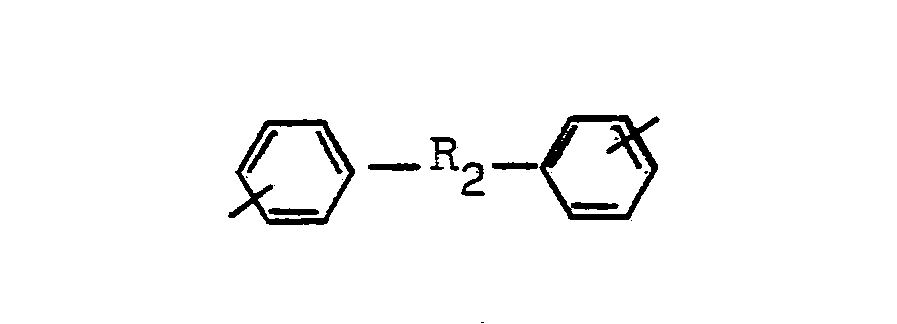
- R t are or wherein R 2 and R 3 are selected from the radicals consisting of carbon in alkylene chains with 1 to 3 carbon atoms, oxygen or sulfur alone or in -S0 2 -.
- Such diamines include, for example, pan 4,4 '-Diaminodiphenylpro-, 4,4'-diaminodiphenylmethane, 4,4'-diaminodiphenylamine, benzidine, 4,4'-diaminodiphenyl sulfide, 4,4'-diaminodiphenylsulfone, 3,3'-diaminodiphenylsulfone, 4.4 t- diaminodiphenyl ether, bis (4-aminophenyl) diethylsilane, bis (4-aminophenyl) phenylphosphine oxide, bis (4-aminophenyl) -N-methylamine, 1,5-diaminonaphthalene, 3,3'- Dimethyl-4,4'-diamino-biphenyl, 3,3'-dimethoxybenzidine, 1,4-bis (p-aminophenoxy) benzene, 1,3-
- Preferred diamines are diaminodiphenylmethane and diaminodiphenyloxide.
- Suitable aprotic dipolar organic solvents in which the polyamic acids are expediently prepared and dissolved are, for example, N, N-dimethylacetamide, and in particular N, N-dimethylformamide, N-methylpyrrolidone and dimethyl sulfoxide and mixtures thereof, which are generally present in amounts of 95 up to 75, preferably 90 to 80% by weight, based on the solution.
- the dianhydrides of the aromatic tetracarboxylic acids are generally reacted with the aromatic diprimeric diamines in equimolar amounts to give the polyamic acids.
- the polyamic acid solutions can be prepared particularly advantageously by first adding about 90 to 95 equivalent% of the dianhydride of the aromatic tetracarboxylic acid at temperatures of about 0 to 30 ° C. to a solution of the aromatic diprimeric diamine in a dipolar aprotic organic solvent and after the reaction has subsided at temperatures of about 0.degree. C. to 40.degree. C., dianhydride of the tetracarboxylic acid is added in portions (for example 2.5 equivalent% in each case) until an inherent viscosity of 1.5 to 2.5 dl / g is reached is.
- an entrainer for water is added to the polyamic acid solution, the mixture thus obtained is heated to the boiling point of the entrainer and the water formed during the conversion of the polyamic acid to polyimide which thereby precipitates is distilled off azeotropically.
- Suitable entraining agents are the usual entraining agents for water, in particular aromatic hydrocarbons, such as benzene, toluene, xylene, and halogenated hydrocarbons, such as chlorobenzene. Particularly preferred entraining agents are toluene and xylene.
- the entraining agents are generally used in amounts of 10 to 40, preferably 15 to 25,% by weight, based on the solution.
- the polyimide obtained by the process according to the invention precipitates out as a fine powder which is filtered off, washed with a methanol / water mixture if necessary and finally dried.
- Drying can be carried out in two stages: first a predrying at 100 to 150 ° C (12 hours), then 2 hours at 250 to 300 ° C, whereby it is also possible to work under reduced pressure.
- the polyimide powders have inherent viscosities (measured in 0.5% in conc. H 2 SO 4 ) between 0.6 and 1.2 and bulk densities of approximately 200 to 300 g / l.
- the polyimide powders obtained according to the invention are notable for the fact that they can be processed to shaped articles in an outstanding manner by sintering, particularly advantageously by high pressure sintering.
- the example of DE-OS 19 04 988 was reworked exactly.
- the powder obtained had an inherent viscosity of 0.357 dl / g (0.5% in conc. H 2 S0 4 ) and could not be processed into compact moldings by high pressure sintering (sintering pressure 6250 kg / cm 2 , sintering temperature 3800C).
Landscapes
- Chemical & Material Sciences (AREA)
- Health & Medical Sciences (AREA)
- Chemical Kinetics & Catalysis (AREA)
- Medicinal Chemistry (AREA)
- Polymers & Plastics (AREA)
- Organic Chemistry (AREA)
- Macromolecular Compounds Obtained By Forming Nitrogen-Containing Linkages In General (AREA)
- Polymers With Sulfur, Phosphorus Or Metals In The Main Chain (AREA)
Abstract
Description
- Die Erfindung betrifft ein Verfahren zur Herstellung von pulverförmigem Polyimid und dessen Verwendung.
- Es ist bekannt, daß man Lösungen von aromatischen Polyamidsäuren in dipolaren aprotischen Lösungsmitteln herstellen kann. Die Überführung der Polyamidsäure (=PAS) in das entsprechende Polyimid (=PI) kann durch Erhitzen auf>50°C (DE-OS 1 904 988) geschehen oder durch Erhitzen auf >50°C unter gleichzeitger Umsetzung mit Acetanhydrid/Pyridin (DE-AS 1 198 547, DE-AS 1 202 981). Bei einem anderen Verfahren wird die Polyamidsäurelösung mit Lösungsmittel verdünnt und in Methanol (oder Wasser) gefällt. Das gefällte Pulver wird beim Trocknen in das Polyimid überführt (US-PS 3 422 061). Alle diese Verfahren weisen jedoch beträchtliche Nachteile auf. So sind meistens, wie bei der Fällungsmethode, sehr große Lösungsmittelmengen notwendig. Das Herauswaschen von Lösungsmittelresten aus den gefällten Pulvern muß sehr sorgfältig ausgeführt werden und ist somit sehr aufwendig, da auch geringste Mengen, die im Pulver verbleiben, beim späteren Verarbeitungsprozeß stören. Beim Erhitzen der PAS im Lösungsmittel auf Temp. >50 erhält man Polyimidpulver mit nur ungenügendem Molekulargewicht. Die Verwendung von Acetanhydrid/Pyridin ist kostspielig und aufwendig.
- Aufgabe der vorliegenden Erfindung ist es, ein Verfahren zur Herstellung von pulverförmigen Polyimiden aufzuzeigen, das diese Nachteile nicht aufweist.
- Gegenstand der vorliegenden Erfindung ist ein Verfahren zur Herstellung von pulverförmigem Polyimid aus einer nach einem üblichen Verfahren erhaltenen Polyamidsäurelösung, das dadurch gekennzeichnet ist, daß man in einem aprotisehen dipolaren organischen Lösungsmittel gelöste aromatische Polyamidsäure einer inherenten Viskosität von 1,5 bis 2,5 dl/g mit einem Schleppmittel für Wasser vermischt, das Gemisch auf die Siedetemperatur des Schleppmittels erhitzt, das entstehende Wasser azeotrop abdestilliert und das ausgefallene Polyimidpulver abfiltriert sowie gegebenenfalls wäscht und trocknet.
- Gegenstand der vorliegenden Erfindung ist außerdem die Verwendung dieser Polyimidpulver zur Herstellung von Formkörpern durch Hochdrucksintern.
- Es war überraschend, daß sich durch den erfindungsgemäßen Einsatz von Schleppmittel für Wasser die Ringschlußreaktion der Polyamidsäure zu Polyimid in so vorteilhafter Weise durchführen läßt. Das entstehende Wasser wird azeotrop abdestilliert und man erhält ein feinteiliges Polyimidpulver, das sich seht gut weiterverarbeiten läßt.
- Zu den für das erfindungsgemäße Verfahren zu verwendenden Aufbaukomponenten ist im einzelnen folgendes auszuführen.
- Die aromatische Polyamidsäure kann nach einem üblichen Verfahren aus Dianhydriden aromatischer Tetracarbonsäuren und aromatischen diprimären Diaminen erhalten werden.
- "Als Dianhydride aromatischer Tetracarbonsäuren kommen solche der allgemeinen Formel

- Bevorzugt sind Pyromellitsäuredianhydrid und Benzophenontetracarbonsäuredianhydrid.
- Als aromatische diprimäre Diamine kommen solche der allgemeinen Formel H2N-R'-NH2 in Frage, worin R' für einen zweiwertigen polycyclischen aromatischen Rest steht. Beispiele für solche Reste Rt sind



- Bevorzugte Diamine sind Diaminodiphenylmethan und Diaminodiphenyloxid.
- Als aprotische dipolare organische Lösungsmittel, in denen die Polyamidsäuren zweckmäßigerweise hergestellt und gelöst sind, kommen beispielsweise N,N-Dimethylacetamid, sowie insbesondere N,N-Dimethylformamid, N-Methylpyrrolidon und Dimethylsulfoxid sowie deren Gemische in Betracht, die im allgemeinen in Mengen von 95 bis 75, vorzugsweise 90 bis 80 Gew.-%, bezogen auf die Lösung, eingesetzt werden. Die Dianhydride der aromatischen Tetracarbonsäuren werden mit den aromatischen diprimären Diaminen im allgemeinen in äquimolaren Mengen miteinander zu den Polyamidsäuren umgesetzt.
- Die Herstellung der Polyamidsäurelösungen kann besonders vorteilhaft in der Weise erfolgen, daß man bei Temperaturen von etwa 0 bis 30°C zu einer Lösung des aromatischen diprimären Diamins in einem dipolaren aprotischen organischen Lösungsmittel zunächst etwa 90 bis 95 Äquivalent-% des Dianhydrids der aromatischen Tetracarbonsäure zugibt und nach Abklingen der Reaktion bei Temperaturen von etwa 0°C bis 40°C so lange portionsweise (z.B. jeweils 2,5 Äquivalent- %) Dianhydrid der Tetracarbonsäure zudosiert, bis eine inherente Viskosität von 1,5 bis 2,5 dl/g erreicht ist.
- Erfindungsgemäß wird zur Polyamidsäurelösung ein Schleppmittel für Wasser zugegeben, das so erhaltene Gemisch auf die Siedetemperatur des Schleppmittels erhitzt und das bei der Umwandlung der Polyamidsäure in Polyimid, das dabei ausfällt, entstehende Wasser azeotrop abdestilliert.
- Es ist vorteilhaft, das abdestillierte Schleppmittel in einem üblichen Wasserabscheider vom Wasser abzutrennen und wieder dem Reaktionsgemisch zuzuführen, das Wasser also auszukreisen.
- Als Schleppmittel eignen sich die üblichen Schleppmittel für Wasser, insbesondere aromatische Kohlenwasserstoffe, wie Benzol, Toluol, Xylol sowie Halogenkohlenwasserstoffe, wie Chlorbenzol. Besonders bevorzugte Schleppmittel sind Toluol und Xylol. Die Schleppmittel werden im allgemeinen in Mengen von 10 bis 40, vorzugsweise 15 bis 25 Gew.-%, bezogen auf die Lösung, eingesetzt.
- Das nach dem erfindungsgemäßen Verfahren erhaltene Polyimid fällt als feines Pulver aus, das abfiltriert, gegebenenfalls mit Methanol/Wasser-Gemisch gewaschen und schließlich getrocknet wird.
- Die Trocknung kann in zwei Stufen erfolgen: Zunächst eine Vortrocknung bei 100 bis 150°C (12 Stunden), anschließend 2 Stunden bei 250 bis 300°C, wobei gegebenenfalls auch unter vermindertem Druck gearbeitet werden kann.
- Die Polyimidpulver weisen inherente Viskositäten ( gemessen in 0,5 %ig in Konz. H2S04) zwischen 0,6 und 1,2 und Schüttdichten von ca. 200 bis 300 g/1 auf.
- Die erfindungsgemäß erhaltenen Polyimidpulver zeichnen sich dadurch aus, daß sie sich hervorragend durch Sintern, besonders vorteilhaft durch Hochdrucksintern, zu Formkörpern verarbeiten lassen.
- Die Formkörper die aus Pulver mit hohen inherenten Viskositäten hergestellt werden - diese werden nach dem beanspruchten Verfahren besonders vorteilhaft erhalten - weisen in Bezug auf die Reißdehnung besonders guten Eigenschaften aus.
- Die im Beispiel genannten Teile und Prozente sind soweit nicht anders angegeben Gewichtsteile bzw. Gewichtsprozente.
- 80 Teile Diaminodiphenyloxid und 1000 Teile N-Methylpyrrolidon (=NMP) werden in ein heiz- und kühlbares Reaktionsgefäß, das mit einem Rührer, Wasserabscheider Rückflußkühler und N2-Einleitungsrohr versehen ist, eingefüllt. Dazu gibt man 122,4 Teile Benzophenontetracarbonsäuredianhydrid (=BTDA) gelöst in 183 Teilen NMP. Nach Beendigung der Reaktion gibt man 2 x 3,21 Teile BTDA (2,5 Mol-%) hinzu und verfolgt durch Messung den Viskositätsanstieg. Die Lösungsviskosität beträgt dann 34 655 mPa.s, was einer inherenten Viskosität ηinh.= 1,62 dl/g entspricht. Zu der hochviskosen Lösung gibt man anschließend 280 Teile Xylol und erhitzt 4 Stunden lang auf 170°C, wobei das entstehende Wasser aus der Reaktionsmischung azeotrop entfernt wird. Das ausgefallene Polyimid wird abfiltriert, einmal in Methanol/H20 (1:1) gewaschen, bei 150°C (12 Stunden) und bei 300°C (2 Stunden) getrocknet. Das Schüttgewicht beträgt 240 g/l. Die inherente Viskosität ηinh. = 1,15 dl/g. Das Pulver läßt sich durch Hochdrucksintern (Sinterdruck 6250 kg/cm2, Sintertemperatur 360°C) zu Formkörpern verarbeiten, die folgende Eigenschaften aufweisen:
- Reiß-Dehnung εB = εR= 2,6 %;
- Kerbschlagzähigkeit 2,64 Nmm/m2
- Härte H 30 = 294 N/nm2;
- E-Modul 4870 N/mm2;
- Das Beispiel der DE-OS 19 04 988 wurde genau nachgearbeitet. Das dabei erhaltene Pulver wies eine inherente Viskosität von 0,357 dl/g (0,5 %ig in Konz. H2S04) auf und ließ sich durch Hochdrucksintern (Sinterdruck 6250 kg/cm2, Sintertemperatur 3800C) nicht zu kompakten Formkörpern verarbeiten.
Claims (4)
Applications Claiming Priority (2)
| Application Number | Priority Date | Filing Date | Title |
|---|---|---|---|
| DE3124401 | 1981-06-22 | ||
| DE19813124401 DE3124401A1 (de) | 1981-06-22 | 1981-06-22 | Verfahren zur herstellung von pulverfoermigem polyimid und seine verwendung |
Publications (2)
| Publication Number | Publication Date |
|---|---|
| EP0068246A1 true EP0068246A1 (de) | 1983-01-05 |
| EP0068246B1 EP0068246B1 (de) | 1985-10-30 |
Family
ID=6135075
Family Applications (1)
| Application Number | Title | Priority Date | Filing Date |
|---|---|---|---|
| EP82105146A Expired EP0068246B1 (de) | 1981-06-22 | 1982-06-12 | Verfahren zur Herstellung von pulverförmigem Polyimid und seine Verwendung |
Country Status (4)
| Country | Link |
|---|---|
| US (1) | US4413117A (de) |
| EP (1) | EP0068246B1 (de) |
| JP (1) | JPS5849726A (de) |
| DE (2) | DE3124401A1 (de) |
Cited By (3)
| Publication number | Priority date | Publication date | Assignee | Title |
|---|---|---|---|---|
| FR2563226A1 (fr) * | 1984-04-18 | 1985-10-25 | Nitto Electric Ind Co | Poudre de polyimide spherique poreux |
| WO2007009652A1 (de) * | 2005-07-22 | 2007-01-25 | Evonik Fibres Gmbh | Verfahren zur herstellung eines blockcopolymeren aus polyimiden und verwendung des blockcopolymeren zur herstellung von pulvern und formteilen |
| EP4410868A4 (de) * | 2021-09-30 | 2025-10-08 | Pi Advanced Mat Co Ltd | Polyimidpulver und herstellungsverfahren dafür |
Families Citing this family (21)
| Publication number | Priority date | Publication date | Assignee | Title |
|---|---|---|---|---|
| US4681928A (en) * | 1984-06-01 | 1987-07-21 | M&T Chemicals Inc. | Poly(amide-amide acid), polyamide acid, poly(esteramide acid), poly(amide-imide), polyimide, poly(esterimide) from poly arylene diamine |
| JPS61241326A (ja) * | 1985-04-18 | 1986-10-27 | Nitto Electric Ind Co Ltd | ポリイミド粉末およびその製法 |
| US4755555A (en) * | 1985-04-26 | 1988-07-05 | E. I. Du Pont De Nemours And Company | Polyimide molding resins and molded articles |
| BR8601779A (pt) * | 1985-04-26 | 1986-12-23 | Du Pont | Poliimida solida em particulas,artigo moldado da poliimida e processo para a preparacao de uma poliimida solida em particulas |
| US4622384A (en) * | 1985-04-26 | 1986-11-11 | E. I. Du Pont De Nemours And Company | Polyimide molding resins and molded articles |
| US5288843A (en) * | 1987-05-20 | 1994-02-22 | Mitsui Toatsu Chemicals, Inc. | Polyimides, process for the preparation thereof and polyimide resin compositions |
| JPH02128665A (ja) * | 1988-11-07 | 1990-05-17 | Gentaro Inoue | 野菜を素材とした舞鶴形平型の形成方法 |
| US4943682A (en) * | 1988-12-15 | 1990-07-24 | Ethyl Corporation | Production of particulate polyimide polymers |
| US6346510B1 (en) | 1995-10-23 | 2002-02-12 | The Children's Medical Center Corporation | Therapeutic antiangiogenic endostatin compositions |
| US5898048A (en) * | 1996-04-05 | 1999-04-27 | Ube Industries, Ltd. | Polyimide powder and process for producing powder molded body |
| US6713597B2 (en) * | 2002-03-19 | 2004-03-30 | General Electric Company | Preparation of polyimide polymers |
| JP4686742B2 (ja) * | 2004-12-27 | 2011-05-25 | 大阪府 | ポリイミド湿潤ゲル及びその製造方法 |
| JP4740250B2 (ja) | 2005-09-22 | 2011-08-03 | 富士通株式会社 | 外力検知方法、外力検知器及び電子機器 |
| US20070154717A1 (en) * | 2005-12-30 | 2007-07-05 | Saint-Gobain Performance Plastics Corporation | Thermally stable composite material |
| US20070155949A1 (en) * | 2005-12-30 | 2007-07-05 | Saint-Gobain Performance Plastics Corporation | Thermally stable composite material |
| US20070152195A1 (en) * | 2005-12-30 | 2007-07-05 | Saint-Gobain Performance Plastics Corporation | Electrostatic dissipative composite material |
| US20070154716A1 (en) * | 2005-12-30 | 2007-07-05 | Saint-Gobain Performance Plastics Corporation | Composite material |
| US7476339B2 (en) * | 2006-08-18 | 2009-01-13 | Saint-Gobain Ceramics & Plastics, Inc. | Highly filled thermoplastic composites |
| CN103261277B (zh) * | 2010-12-17 | 2015-12-02 | 积水化学工业株式会社 | 聚酰胺酸粒子的制造方法、聚酰亚胺粒子的制造方法、聚酰亚胺粒子及电子部件用接合材料 |
| JP2020122121A (ja) * | 2019-01-31 | 2020-08-13 | 住友化学株式会社 | ポリイミド系樹脂粉体の製造方法 |
| CN113072703A (zh) * | 2021-04-19 | 2021-07-06 | 中国科学院化学研究所 | 一种综合性能优异的热塑性聚酰亚胺及其制备方法与应用 |
Citations (3)
| Publication number | Priority date | Publication date | Assignee | Title |
|---|---|---|---|---|
| BE715666A (de) * | 1967-05-26 | 1968-10-16 | ||
| DE2159935A1 (de) * | 1971-12-03 | 1973-06-14 | Basf Ag | Verfahren zur herstellung loeslicher polyimide |
| US4075171A (en) * | 1973-05-25 | 1978-02-21 | University Of Notre Dame Du Lac | Process for preparing aromatic polyimides and some polyimides prepared thereby |
Family Cites Families (7)
| Publication number | Priority date | Publication date | Assignee | Title |
|---|---|---|---|---|
| DE715666C (de) * | 1936-03-24 | 1942-01-05 | Dr Hans Hatzig | Verfahren zur Darstellung primaerer Alkohole der Cyclopentanophenanthrenreihe |
| NL288197A (de) * | 1962-01-26 | 1900-01-01 | ||
| US3422061A (en) * | 1963-10-18 | 1969-01-14 | Du Pont | Coalesceable polyimide powders from a polycarbocylic aromatic dianhydride and phenylene diamine |
| US3803081A (en) * | 1967-07-03 | 1974-04-09 | Trw Inc | Polyamide molding powder prepolymers and method of preparation |
| US3619329A (en) * | 1969-02-28 | 1971-11-09 | Dow Chemical Co | Extrusion apparatus for the preparation of walled structures |
| US3607838A (en) * | 1970-01-28 | 1971-09-21 | Jorg Strickrodt | Process for producing polyimides in glycol |
| US3708459A (en) * | 1970-06-24 | 1973-01-02 | Trw Inc | Molding power prepolymers |
-
1981
- 1981-06-22 DE DE19813124401 patent/DE3124401A1/de not_active Withdrawn
-
1982
- 1982-06-04 US US06/385,273 patent/US4413117A/en not_active Expired - Fee Related
- 1982-06-12 EP EP82105146A patent/EP0068246B1/de not_active Expired
- 1982-06-12 DE DE8282105146T patent/DE3267136D1/de not_active Expired
- 1982-06-16 JP JP57102353A patent/JPS5849726A/ja active Granted
Patent Citations (3)
| Publication number | Priority date | Publication date | Assignee | Title |
|---|---|---|---|---|
| BE715666A (de) * | 1967-05-26 | 1968-10-16 | ||
| DE2159935A1 (de) * | 1971-12-03 | 1973-06-14 | Basf Ag | Verfahren zur herstellung loeslicher polyimide |
| US4075171A (en) * | 1973-05-25 | 1978-02-21 | University Of Notre Dame Du Lac | Process for preparing aromatic polyimides and some polyimides prepared thereby |
Cited By (4)
| Publication number | Priority date | Publication date | Assignee | Title |
|---|---|---|---|---|
| FR2563226A1 (fr) * | 1984-04-18 | 1985-10-25 | Nitto Electric Ind Co | Poudre de polyimide spherique poreux |
| WO2007009652A1 (de) * | 2005-07-22 | 2007-01-25 | Evonik Fibres Gmbh | Verfahren zur herstellung eines blockcopolymeren aus polyimiden und verwendung des blockcopolymeren zur herstellung von pulvern und formteilen |
| CN101228208B (zh) * | 2005-07-22 | 2012-01-11 | 赢创纤维有限责任公司 | 由聚酰亚胺制备嵌段共聚物的方法以及嵌段共聚物用于生产粉末和模塑品的用途 |
| EP4410868A4 (de) * | 2021-09-30 | 2025-10-08 | Pi Advanced Mat Co Ltd | Polyimidpulver und herstellungsverfahren dafür |
Also Published As
| Publication number | Publication date |
|---|---|
| JPS5849726A (ja) | 1983-03-24 |
| EP0068246B1 (de) | 1985-10-30 |
| DE3267136D1 (en) | 1985-12-05 |
| JPH0320412B2 (de) | 1991-03-19 |
| US4413117A (en) | 1983-11-01 |
| DE3124401A1 (de) | 1983-01-27 |
Similar Documents
| Publication | Publication Date | Title |
|---|---|---|
| EP0068246B1 (de) | Verfahren zur Herstellung von pulverförmigem Polyimid und seine Verwendung | |
| DE69405646T2 (de) | Polyimidoligomere | |
| DE69121348T2 (de) | Polyimidcopolymervorläufer | |
| DE1770866C3 (de) | Verfahren zur Herstellung von Polyimiden und deren Verwendung | |
| DE2363784C2 (de) | Verfahren zum Herstellen von Polyätherimiden | |
| DE3587783T2 (de) | Polyamidsäuren, Polyimide, Poly(esterimide). | |
| DE2446383C2 (de) | Von Phenylindandiaminen und -dianhydriden abgeleitete lösliche Polyimide | |
| DE69123078T2 (de) | Polyimidsiloxanoligomer | |
| DE3855656T2 (de) | Schmelzformbares kristallines Polyimid | |
| DE68926551T2 (de) | Verfahren zur Herstellung von Polyimid mit ausgezeichneter Temperaturstabilität | |
| DE3486367T2 (de) | Verwendung fluorhaltiger Polyimide für Orientierungsschichten von Flüssigkristall-Anzeigevorrichtungen. | |
| DE3782140T2 (de) | Kumulierte phenylensulfid-einheiten enthaltende kristalline polyimide. | |
| DE2813425A1 (de) | Verfahren zur herstellung von polyaetheramid-saeuren | |
| DE2363785C2 (de) | Polyätherimide | |
| DE69324662T2 (de) | Polyamid-Lösungszusammensetzungen und Verfahren zur Herstellung | |
| DE3873844T2 (de) | Verfahren zur herstellung eines silicon enthaltenden polyimids sowie dessen vorstufe. | |
| EP0245815B1 (de) | Neue lösliche und/oder schmelzbare Polyimide und Polyamidimide | |
| DE69821664T2 (de) | Wärmehärtbare Harzzusammensetzung | |
| DE3131907A1 (de) | Polyimid-isoindrochinazolindion/silicon-copolymerharz | |
| DE3231149C2 (de) | Verfahren zur Herstellung einer oligomere Polyetherimide enthaltenden Überzugslösung | |
| DE3883234T2 (de) | Verbesserung der Molekulargewichtsverteilung durch Lösungsmittelextraktion. | |
| DE69116650T2 (de) | Polyimidharz und dessen Zubereitung | |
| DE69029413T2 (de) | Zusammensetzung aus Silicon-Polyimid-Vorläufern | |
| DE69132923T2 (de) | Härtbare Verbindung und Verfahren zu ihrer Herstellung | |
| DE69311050T2 (de) | Verfahren zur Herstellung von Polyimide |
Legal Events
| Date | Code | Title | Description |
|---|---|---|---|
| PUAI | Public reference made under article 153(3) epc to a published international application that has entered the european phase |
Free format text: ORIGINAL CODE: 0009012 |
|
| AK | Designated contracting states |
Designated state(s): BE DE FR GB IT NL |
|
| 17P | Request for examination filed |
Effective date: 19821210 |
|
| ITF | It: translation for a ep patent filed | ||
| GRAA | (expected) grant |
Free format text: ORIGINAL CODE: 0009210 |
|
| AK | Designated contracting states |
Designated state(s): BE DE FR GB IT NL |
|
| REF | Corresponds to: |
Ref document number: 3267136 Country of ref document: DE Date of ref document: 19851205 |
|
| ET | Fr: translation filed | ||
| PLBE | No opposition filed within time limit |
Free format text: ORIGINAL CODE: 0009261 |
|
| STAA | Information on the status of an ep patent application or granted ep patent |
Free format text: STATUS: NO OPPOSITION FILED WITHIN TIME LIMIT |
|
| 26N | No opposition filed | ||
| PGFP | Annual fee paid to national office [announced via postgrant information from national office to epo] |
Ref country code: FR Payment date: 19910515 Year of fee payment: 10 |
|
| PGFP | Annual fee paid to national office [announced via postgrant information from national office to epo] |
Ref country code: BE Payment date: 19910527 Year of fee payment: 10 |
|
| PGFP | Annual fee paid to national office [announced via postgrant information from national office to epo] |
Ref country code: GB Payment date: 19910603 Year of fee payment: 10 |
|
| PGFP | Annual fee paid to national office [announced via postgrant information from national office to epo] |
Ref country code: DE Payment date: 19910619 Year of fee payment: 10 |
|
| ITTA | It: last paid annual fee | ||
| PGFP | Annual fee paid to national office [announced via postgrant information from national office to epo] |
Ref country code: NL Payment date: 19910630 Year of fee payment: 10 |
|
| PG25 | Lapsed in a contracting state [announced via postgrant information from national office to epo] |
Ref country code: GB Effective date: 19920612 |
|
| PG25 | Lapsed in a contracting state [announced via postgrant information from national office to epo] |
Ref country code: DE Effective date: 19920623 |
|
| PG25 | Lapsed in a contracting state [announced via postgrant information from national office to epo] |
Ref country code: BE Effective date: 19920630 |
|
| BERE | Be: lapsed |
Owner name: BASF A.G. Effective date: 19920630 |
|
| PG25 | Lapsed in a contracting state [announced via postgrant information from national office to epo] |
Ref country code: NL Effective date: 19930101 |
|
| GBPC | Gb: european patent ceased through non-payment of renewal fee |
Effective date: 19920612 |
|
| NLV4 | Nl: lapsed or anulled due to non-payment of the annual fee | ||
| PG25 | Lapsed in a contracting state [announced via postgrant information from national office to epo] |
Ref country code: FR Effective date: 19930226 |
|
| REG | Reference to a national code |
Ref country code: FR Ref legal event code: ST |