EP0068332A1 - Appareil et procédé pour la fabrication d'objets en matière plastique mousseuse - Google Patents
Appareil et procédé pour la fabrication d'objets en matière plastique mousseuse Download PDFInfo
- Publication number
- EP0068332A1 EP0068332A1 EP82105319A EP82105319A EP0068332A1 EP 0068332 A1 EP0068332 A1 EP 0068332A1 EP 82105319 A EP82105319 A EP 82105319A EP 82105319 A EP82105319 A EP 82105319A EP 0068332 A1 EP0068332 A1 EP 0068332A1
- Authority
- EP
- European Patent Office
- Prior art keywords
- resin
- blowing agent
- disposed
- ports
- extruder
- Prior art date
- Legal status (The legal status is an assumption and is not a legal conclusion. Google has not performed a legal analysis and makes no representation as to the accuracy of the status listed.)
- Granted
Links
Images

Classifications
-
- B—PERFORMING OPERATIONS; TRANSPORTING
- B29—WORKING OF PLASTICS; WORKING OF SUBSTANCES IN A PLASTIC STATE IN GENERAL
- B29C—SHAPING OR JOINING OF PLASTICS; SHAPING OF MATERIAL IN A PLASTIC STATE, NOT OTHERWISE PROVIDED FOR; AFTER-TREATMENT OF THE SHAPED PRODUCTS, e.g. REPAIRING
- B29C44/00—Shaping by internal pressure generated in the material, e.g. swelling or foaming ; Producing porous or cellular expanded plastics articles
- B29C44/34—Auxiliary operations
- B29C44/3442—Mixing, kneading or conveying the foamable material
- B29C44/3446—Feeding the blowing agent
-
- B—PERFORMING OPERATIONS; TRANSPORTING
- B29—WORKING OF PLASTICS; WORKING OF SUBSTANCES IN A PLASTIC STATE IN GENERAL
- B29C—SHAPING OR JOINING OF PLASTICS; SHAPING OF MATERIAL IN A PLASTIC STATE, NOT OTHERWISE PROVIDED FOR; AFTER-TREATMENT OF THE SHAPED PRODUCTS, e.g. REPAIRING
- B29C48/00—Extrusion moulding, i.e. expressing the moulding material through a die or nozzle which imparts the desired form; Apparatus therefor
- B29C48/25—Component parts, details or accessories; Auxiliary operations
- B29C48/285—Feeding the extrusion material to the extruder
- B29C48/29—Feeding the extrusion material to the extruder in liquid form
-
- B—PERFORMING OPERATIONS; TRANSPORTING
- B29—WORKING OF PLASTICS; WORKING OF SUBSTANCES IN A PLASTIC STATE IN GENERAL
- B29C—SHAPING OR JOINING OF PLASTICS; SHAPING OF MATERIAL IN A PLASTIC STATE, NOT OTHERWISE PROVIDED FOR; AFTER-TREATMENT OF THE SHAPED PRODUCTS, e.g. REPAIRING
- B29C48/00—Extrusion moulding, i.e. expressing the moulding material through a die or nozzle which imparts the desired form; Apparatus therefor
- B29C48/25—Component parts, details or accessories; Auxiliary operations
- B29C48/36—Means for plasticising or homogenising the moulding material or forcing it through the nozzle or die
- B29C48/50—Details of extruders
- B29C48/505—Screws
- B29C48/53—Screws having a varying channel depth, e.g. varying the diameter of the longitudinal screw trunk
-
- B—PERFORMING OPERATIONS; TRANSPORTING
- B29—WORKING OF PLASTICS; WORKING OF SUBSTANCES IN A PLASTIC STATE IN GENERAL
- B29C—SHAPING OR JOINING OF PLASTICS; SHAPING OF MATERIAL IN A PLASTIC STATE, NOT OTHERWISE PROVIDED FOR; AFTER-TREATMENT OF THE SHAPED PRODUCTS, e.g. REPAIRING
- B29C48/00—Extrusion moulding, i.e. expressing the moulding material through a die or nozzle which imparts the desired form; Apparatus therefor
- B29C48/25—Component parts, details or accessories; Auxiliary operations
- B29C48/36—Means for plasticising or homogenising the moulding material or forcing it through the nozzle or die
- B29C48/50—Details of extruders
- B29C48/68—Barrels or cylinders
- B29C48/685—Barrels or cylinders characterised by their inner surfaces, e.g. having grooves, projections or threads
- B29C48/687—Barrels or cylinders characterised by their inner surfaces, e.g. having grooves, projections or threads having projections with a short length in the barrel direction, e.g. pins
-
- B—PERFORMING OPERATIONS; TRANSPORTING
- B29—WORKING OF PLASTICS; WORKING OF SUBSTANCES IN A PLASTIC STATE IN GENERAL
- B29C—SHAPING OR JOINING OF PLASTICS; SHAPING OF MATERIAL IN A PLASTIC STATE, NOT OTHERWISE PROVIDED FOR; AFTER-TREATMENT OF THE SHAPED PRODUCTS, e.g. REPAIRING
- B29C48/00—Extrusion moulding, i.e. expressing the moulding material through a die or nozzle which imparts the desired form; Apparatus therefor
- B29C48/03—Extrusion moulding, i.e. expressing the moulding material through a die or nozzle which imparts the desired form; Apparatus therefor characterised by the shape of the extruded material at extrusion
-
- B—PERFORMING OPERATIONS; TRANSPORTING
- B29—WORKING OF PLASTICS; WORKING OF SUBSTANCES IN A PLASTIC STATE IN GENERAL
- B29K—INDEXING SCHEME ASSOCIATED WITH SUBCLASSES B29B, B29C OR B29D, RELATING TO MOULDING MATERIALS OR TO MATERIALS FOR MOULDS, REINFORCEMENTS, FILLERS OR PREFORMED PARTS, e.g. INSERTS
- B29K2105/00—Condition, form or state of moulded material or of the material to be shaped
- B29K2105/0005—Condition, form or state of moulded material or of the material to be shaped containing compounding ingredients
-
- Y—GENERAL TAGGING OF NEW TECHNOLOGICAL DEVELOPMENTS; GENERAL TAGGING OF CROSS-SECTIONAL TECHNOLOGIES SPANNING OVER SEVERAL SECTIONS OF THE IPC; TECHNICAL SUBJECTS COVERED BY FORMER USPC CROSS-REFERENCE ART COLLECTIONS [XRACs] AND DIGESTS
- Y10—TECHNICAL SUBJECTS COVERED BY FORMER USPC
- Y10S—TECHNICAL SUBJECTS COVERED BY FORMER USPC CROSS-REFERENCE ART COLLECTIONS [XRACs] AND DIGESTS
- Y10S261/00—Gas and liquid contact apparatus
- Y10S261/39—Liquid feeding nozzles
-
- Y—GENERAL TAGGING OF NEW TECHNOLOGICAL DEVELOPMENTS; GENERAL TAGGING OF CROSS-SECTIONAL TECHNOLOGIES SPANNING OVER SEVERAL SECTIONS OF THE IPC; TECHNICAL SUBJECTS COVERED BY FORMER USPC CROSS-REFERENCE ART COLLECTIONS [XRACs] AND DIGESTS
- Y10—TECHNICAL SUBJECTS COVERED BY FORMER USPC
- Y10S—TECHNICAL SUBJECTS COVERED BY FORMER USPC CROSS-REFERENCE ART COLLECTIONS [XRACs] AND DIGESTS
- Y10S264/00—Plastic and nonmetallic article shaping or treating: processes
- Y10S264/05—Use of one or more blowing agents together
Definitions
- Extrusion of low density foams is well known in the art. These foams are prepared by advancing a particulate resin through an extruder where it is melted and then injected with a blowing agent. As the mixture of the molten resin and the blowing agent is further conveyed through the extruder, it is mixed, cooled to reduce vapor pressure of the blowing agent and to increase viscosity of the molten resin in order to promote formation of closed cells, and extruded through a die into a zone of lower pressure whereby the blowing agent expands to form a low density foam product.
- blowing agent is introduced into molten resin through a single port with the result that there is inadequate distribution of the blowing agent within the resin.
- a number of approaches have been tried to promote uniform distribution of the blowing agent within the resin, including the provision of a longer agitation zone, innovative designs of feed screws in the extruder, etc. It is believed that the invention disclosed herein facilitates distribution of the blowing agent in the resin in a novel way that does not require elongated agitation zone or a unique design of the feed screw although these features can be used in conjunction with the invention disclosed herein to further improve uniform distribution of the blowing agent within the resin.
- This invention pertains to making low density foam from a particulate polymeric resin that is converted from a solid to a molten state as it is conveyed through an extruder, the invention being characterized in that a blowing agent is introduced into the resin through a plurality of ports thus facilitating a more uniform distribution.
- This aspect is important in achieving a good quality cellular product that, in a preferred embodiment, contains a predominant proportion of closed cells.
- This invention is characterized by multiple injection ports for introducing a blowing agent into a polymeric resin.
- the ability to introduce a blowing agent at different levels in the resin is consonant with the desirable objective of uniformly distributing the blowing agent within the resin in order to obtain a low density foam with a uniformly distributed cellular structure preferably containing a predominant proportion of closed cells.
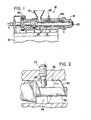
- the apparatus shown in Fig. 1, that can be used to make a foamed product includes a base 10 of an extruder designated generally by reference numeral 12.
- the extruder has a hopper 14, a heating means 16 and cooling means 16a for circulating oil, water or another medium, an extruder head 18, and a die 20.
- Injection device 22 is positioned downstream of the hopper, one end of which protrudes into the extruder to convey a blowing agent thereinto.
- a suitable motor not shown, drives transmission means 24 that, in turn, drives a feed screw, not shown, that is normally disposed within extruder cylinder 26.
- the extruder can also include a crammer, not shown, disposed in the hopper for forcing the resin into the channels of the extruder.
- the sketch shown in Fig. 2 shows arrangement of the injection device and the extruder in greater detail.
- the injection device 22 is securely disposed in extruder cylinder 26 with its lower extremity 28 projecting into extruder channel formed by a helical screw flight 30.
- screw flight 30 is disposed on core 32 of the feed screw.
- flight 30 is removed to provide a circumferential annular space 34 within which the injection device is allowed to operate. Since it is desirable to diffuse the blowing agent in the resin as uniformly as possible, injection device 22 is positioned within extruder with a minimal of clearance between it and core 32 of the feed screw.
- the injection device is positioned so that it introduces a blowing agent into the flowing stream of resin in the direction of resin flow, i.e., in the direction of the extrusion die.
- Figs. 3, 4 and 5 Additional details of the injection device are illustrated in Figs. 3, 4 and 5 where it is shown as comprising a cylindrical outer sleeve 36 and an inner shaft 38 disposed within the sleeve.
- Sleeve 36 has a diametrically reduced sleeve section 40 at the lower portion thereof that is complemented by a diametrically reduced shaft section 42 that snugly yet rotatably fits within the reduced section 40 of sleeve 38.
- Reduced section 40 of the sleeve is connected to the main sleeve by a seating surface 44 that is defined by a circumferential inclined surface that mates with a complementing inclined seating surface 46 on shaft 38.
- Inclined seating surface 46 connects the reduced section 42 to the main shaft 38 and in its operative condition is slidably disposed on seating surface 44.
- Shaft 38 is secured at its upper extremity within sleeve 36 so that it can be raised thus disengaging the seating surfaces 44, 46.
- Annular chamber 48 is formed by sleeve 36 and shaft 38 that is of a reduced diameter.
- Reduced shaft section 42 is snugly yet rotatably disposed within reduced sleeve section 40 and is provided with an open axial slot 50 that extends from the lower extremity of reduced shaft section 42 all the way up to the seating surface 46.
- Communicating with axial slot 50 in the operating condition of the injection device are a plurality of ports 52 that extend through the reduced sleeve section 40.
- ports 52 can vary widely, however, it is desired to have from 3 to 8 of such ports.
- ports 52 are shown disposed along a vertical line, it should be understood that the arrangement can be varied by providing the ports in a helical pattern or any other pattern around the reduced sleeve section 40.
- Seating surfaces 44, 46 are smooth, finely ground surfaces that are formed_at complementing angular disposition. When engaged, seating surfaces 44, 46 are so well ground that the seal formed thereby is substantially impervious to a fluid. Interior surface of reduced sleeve section 40 and exterior surface of reduced shaft section 42 can also be well ground cylindrical surfaces that mate to form a fluid impervious barrier.
- Operation of the apparatus for making a cellular product is commenced by charging a particulate polymer resin material, along with any suitable additives, into hopper 12 and then into the channels of the feed screw disposed in extruder cylinder 26.
- the feed screw conveys the resin through the extruder and during the course of its movement from the point of introduction at the hopper to the point of exit at the extrusion die, the resin is converted from a solid to a molten state.
- a blowing agent is injected into the resin and mixed therewith as it is conveyed thorugh the extruder.
- the characteristic feature of this invention resides in the injection of the blowing agent into the resin.
- the blowing agent is introduced into the annular chamber 48 of the stationary injection device 22.
- This device protrudes into extruder cylinder 26 and resides in the annular space 34 created by cutting out a circumferential portion of screw flight 30.
- the path of the injection device 22 is unobstructed as flight 30 on core 32 of the feed screw is rotated.
- the resin flows from right to left, as viewed in Fig. 2, occupying the annular space between extruder cylinder 26 and core 32 of the feed screw.
- the injection device is positioned within the extruder so as to allow for a small clearance between its lower extremity and core 32 of the feed screw. In this disposition, the lower portion of the reduced section is substantially completely immersed in the resin with the result that ports 52 are also submerged in the resin.
- ports 52 are positioned within the extruder so that they look downstream in the direction of the extruder exit.
- the blowing agent is introduced into the resin, its flow pattern coincides with that of the resin, i.e., it flows in the same direction as the resin.
- This positioning of the ports is more advantageous than other dispositions for the reason that the resin, whether in molten or solid state, presents a relatively large surface area for contacting with a blowing agent. This is made possible due to formation of a void or pocket on the downstream side of the injection device the depth of which is the thickness of the resin in the vicinity of the injection device.
- the void presents the surface area of the resin for contact with a blowing agent. Creation of such void would be difficult or impossible if the injection ports were disposed on the upstream side of the injection device.
- blowing agent Since the blowing agent is under pressure when it is injected into the resin and is therefore a liquid it is fairly uniformly mixed with the resin in the screw channel along the radial extent of the space between core 32 of the feed screw and extruder cylinder 26. Further mixing takes place as the resin and the blowing agent are conveyed by the feed screw through the extruder. A cellular product is produced when the mixture of resin and blowing agent is extruded through the die into a zone of lower pressure whereupon the blowing agent expands to form the cells within the resin structure.
- the method of extruding a cellular product includes the steps of charging a particulate resin into the extruder, conveying the resin through the extruder by means of a feed screw, melting the resin as it is conveyed through the extruder, introducing a blowing agent into the resin in a plurality of streams disposed in the space between core of the feed screw and extruder cylinder whereby the blowing agent is dispersed in the resin through a vertical section of the resin disposed in a screw channel, mixing the resin and the blowing agent, and extruding the mixture into a zone of reduced pressure whereby therblowing agent expands to form numerous cells in the resin.
- the characteristic feature of this extrusion method resides in the step of introducing the blowing agent in a plurality of streams in order to disperse same in the resin fairly uniformly as the resin is conveyed through the injection zone. Improved mixing of the resin and the blowing agent attained in this way results in numerous advantages such as reduction in sorption time for blowing agent, reduction in screw length, improved dispersion of the blowing agent in the resin, and reduction in the incidence of hard particles which.results in a product of lower density.
- thermoplastic resins that include cellulose ethers and esters
- the gorup of vinyl aromatic resins includes styrene homopolymers an styrene interpolymers containing at least 50% by weight styrene and up to 50% by weight of a vinylidene monomer interpolymerized therewith, such as butadiene, acrylonitrile, alpha-methylstyrene, and the like.
- the vinyl chloride resins can be homopolymers or copolymers containing at least 20 mole percent, preferably about 60 mole percent, of vinyl chloride.
- the preferred feed resin in powder or pellet form, is chlorinated polyvinyl chloride with a minimum chlorine content of at least 60% by weight while for practical purposes, the maximum chlorine content feasible is about 75% by weight.
- the chlorine content is about 64 to 73% by weight.
- ability of the resin to tolerate high temperatures is increased from about 80°C to abut 100°C, thus enabling the polymer to better withstand contact with hot . objects.
- increasing chlorine content of the resin from 60% to 64% also makes it easier to retain the blowing agents within the resin.
- the resin can be stabilized by admixing known antioxidants and other additives.
- chlorinated polyvinyl chloride In place of chlorinated polyvinyl chloride, there can be used a mixture-of chlorinated polyvinyl chloride with a minor amount of other polymer or copolymer of vinyl chloride with a minor amount of another monomer, as long as the properties of the starting material do not differ significantly from those of chlorinated polyvinyl chloride. It is intended that the term "chlorinated polyvinyl chloride", as used herein, include the obvious variations described above.
- the chlorinated polyvinyl chloride employed in the present invention can be readily prepared by the post-chlorination of commercially available polyvinyl chloride. Prior to post-chlorination, the polyvinyl chloride generally has a chlorine content of about 56.7% by.weight, a glass transition temperature from about 75° to 80°C, and a density of about 1.40 grams per cubic centimeter. Polyvinyl chloride can be post- chlorinated by a number of procedures including chlorination in a solution; chlorination in an aqueous suspension or in a suspension in a swelling agent; and by direct chlorination of dry polyvinyl chloride powder. In our work, it has been found particularly convenient to chlorinate the polyvinyl chloride in an aqueous suspension.
- Typical procedure for carrying out such chlorination comprises agitating an aqueous suspension of 15 parts by weight of water in a pressure vessel which has been purged with nitrogen, heating the suspension to 140°C, and introducing chlorine at a rate of about 2 parts by weight per hour until the polyvinyl chloride has been chlorinated to the desired extent.
- Suitable blowing agents are the halogenated hydrocarbons containing 1 to 3 carbon atoms such as methyl chloride, methylene chloride, ethyl chloride, ethylene dichloride, n-propyl chloride, and methyl bromide.
- a preferred group of halogenated hydrocarbon blowing agents are chlorofluoroalkanes of from 1 to 2 carbon atoms such as trichloromonofluoromethane, dichlorodifluoromethane, dichloromonofluoromethane, monochlorodifluoromethane, trichlorotrifluoroethane, dichlorotetrafluoroethane, and monochlorotrifluoro- ethane.
- blowing agent can be used in an amount of about 5% to 50%, it is preferred to have a quantity of blowing agent from about 10% to 40% by weight of the chlorinated polyvinyl chloride absorbed in the polymer at the commencement of the foaming procedure.
- Suitable stabilizers for chlorinated polyvinyl chloride include antioxidants such as 2,6-diter- butyl-4-methylphenol, thermal stabilizers such as alkyl tin and pentaerythritol, and hydrogen chloride acceptors such as epoxy stabilizers.
- nucleating agents can be added to the resin prior to extrusion.
- the nucleating agents can be added in an amount of 0.2 to 5 parts by weight per 100 parts by weight of the resin.
- Many of the known nucleating agents are suitable, including finely divided inorganic pigments such as silica and calcium carbonate; alkali metal and aluminum silicates; mixtures of carbon dioxide liberating agents such as alkali metal bicarbonate, and a solid organic acid such as citric acid; hydrated salts such as hydrated sodium citrate; stearates such as calcium or lead stearates; any finely ground material such as talc; and mixtures of such agents.
- the cellular product made by the apparatus and method described herein is foamed chlorinated polyvinyl chloride that has at least 60% of its cells closed, and a density of 1 to 20 pounds per cubic foot.
- Especially preferred product is rigid, nonflammable, thermoplastic chlorinated polyvinyl chloride that has at least 85% of its cells closed, a density of 1 to 10 pounds per cubic foot, and a thermal conductivity of less than 0.20 Btu/ (hour)(ft 2 )(°F/in).
- the experimental work described herein was carried out in a 3-1/2 NRM extruder provided with a set of mixing pins on the downstream side and upstream side of the injection device.
- The-type of extruder screw used is illustrated in Fig. 6.
- the resin formulation was composed of 100 parts by weight chlorinated polyvinyl chloride powder containing 67% chlorine, 3.0 parts butyl tin heat stabilizer, 2.4 parts lubricant composed of calcium stearate, ethylene bisstearamide and an ester of Montan wax, 3.0 parts of a low molecular weight chlorinated polyethylene, 10 parts styreneacrylonitrile rubber processing aid, 0.5 part titanium dioxide nucleating agent, 0.5 part of azobisdicarbon- amide, and 0.25 part of magnesium hydroxide hydrogen chloride acceptor.
- Zones #2 and #3 generally define mixing and melting of the resin whereas zones #4 and #5 define cooling and metering of the resin. There is a gap of about 2-3 L/D between zones #1 and #2 and between zones #3 and #4 that accounts for 32:1 L/D for the extruder.
- the temperature profile for the extruder used in making one run was as follows:
- the foamed product produced had a density of 2 to 3 r pounds per cubic foot.
Landscapes
- Engineering & Computer Science (AREA)
- Mechanical Engineering (AREA)
- Extrusion Moulding Of Plastics Or The Like (AREA)
- Molding Of Porous Articles (AREA)
- Casting Or Compression Moulding Of Plastics Or The Like (AREA)
- Processing And Handling Of Plastics And Other Materials For Molding In General (AREA)
Applications Claiming Priority (2)
| Application Number | Priority Date | Filing Date | Title |
|---|---|---|---|
| US274997 | 1981-06-18 | ||
| US06/274,997 US4393017A (en) | 1981-06-18 | 1981-06-18 | Apparatus and method for making foamed resin products |
Publications (3)
| Publication Number | Publication Date |
|---|---|
| EP0068332A1 true EP0068332A1 (fr) | 1983-01-05 |
| EP0068332B1 EP0068332B1 (fr) | 1986-01-15 |
| EP0068332B2 EP0068332B2 (fr) | 1989-10-04 |
Family
ID=23050474
Family Applications (1)
| Application Number | Title | Priority Date | Filing Date |
|---|---|---|---|
| EP82105319A Expired EP0068332B2 (fr) | 1981-06-18 | 1982-06-16 | Appareil et procédé pour la fabrication d'objets en matière plastique mousseuse |
Country Status (10)
| Country | Link |
|---|---|
| US (1) | US4393017A (fr) |
| EP (1) | EP0068332B2 (fr) |
| JP (1) | JPS57212036A (fr) |
| AU (1) | AU558618B2 (fr) |
| BR (1) | BR8203497A (fr) |
| CA (1) | CA1178758A (fr) |
| DE (1) | DE3268517D1 (fr) |
| IN (1) | IN156604B (fr) |
| NO (1) | NO160835C (fr) |
| ZA (1) | ZA823898B (fr) |
Cited By (2)
| Publication number | Priority date | Publication date | Assignee | Title |
|---|---|---|---|---|
| EP0166820A1 (fr) * | 1984-05-18 | 1986-01-08 | Firma Carl Freudenberg | Procédé de fabrication de matières plastiques expansées à haute stabilité dimensionnelle à chaud |
| US5324108A (en) * | 1990-04-02 | 1994-06-28 | Kleinewefers Kunststoffanlagen Gmbh | Arrangement for pin cylinder extruders |
Families Citing this family (32)
| Publication number | Priority date | Publication date | Assignee | Title |
|---|---|---|---|---|
| US4462423A (en) * | 1983-02-08 | 1984-07-31 | Franklin Jr Paul R | CO2 Snow forming header |
| DE3723301A1 (de) * | 1987-07-15 | 1989-01-26 | Basf Ag | Verfahren zur herstellung von geschlossenzelligen schaumstoffen mit hoher druckfestigkeit |
| DE3921108C1 (fr) * | 1989-06-28 | 1990-06-07 | Hermann Berstorff Maschinenbau Gmbh, 3000 Hannover, De | |
| US5034171A (en) * | 1989-11-30 | 1991-07-23 | Air Products And Chemicals, Inc. | Process for extruding thermoplastic materials using low pressure inert gases as foaming agents |
| US6348512B1 (en) | 1995-12-29 | 2002-02-19 | Pmd Holdings Corp. | Medium density chlorinated polyvinyl chloride foam and process for preparing |
| US6884377B1 (en) * | 1996-08-27 | 2005-04-26 | Trexel, Inc. | Method and apparatus for microcellular polymer extrusion |
| AU755441B2 (en) * | 1996-08-27 | 2002-12-12 | Trexel, Inc. | Method and apparatus for microcellular polymer extrusion |
| US5789453A (en) * | 1997-04-10 | 1998-08-04 | The B. F. Goodrich Company | Medium density chlorinated polyvinyl chloride foam and process for preparing |
| US6702949B2 (en) | 1997-10-24 | 2004-03-09 | Microdiffusion, Inc. | Diffuser/emulsifier for aquaculture applications |
| US6386751B1 (en) | 1997-10-24 | 2002-05-14 | Diffusion Dynamics, Inc. | Diffuser/emulsifier |
| US7654728B2 (en) | 1997-10-24 | 2010-02-02 | Revalesio Corporation | System and method for therapeutic application of dissolved oxygen |
| US7128278B2 (en) | 1997-10-24 | 2006-10-31 | Microdiffusion, Inc. | System and method for irritating with aerated water |
| US6926507B2 (en) * | 2000-03-07 | 2005-08-09 | Trexel, Inc. | Blowing agent delivery system |
| EP1166991B1 (fr) * | 2000-06-22 | 2006-02-22 | Mitsui Chemicals, Inc. | Procédé, appareil et composition d'injection de mousse |
| US8784898B2 (en) | 2006-10-25 | 2014-07-22 | Revalesio Corporation | Methods of wound care and treatment |
| CA2667791A1 (fr) * | 2006-10-25 | 2008-05-02 | Revalesio Corporation | Procedes de traitement therapeutique des yeux et d'autres tissus humains a l'aide d'une solution enrichie en oxygene |
| EP2083876A4 (fr) | 2006-10-25 | 2012-09-19 | Revalesio Corp | Méthodes de soins et de traitement de plaies |
| US8784897B2 (en) | 2006-10-25 | 2014-07-22 | Revalesio Corporation | Methods of therapeutic treatment of eyes |
| US8609148B2 (en) | 2006-10-25 | 2013-12-17 | Revalesio Corporation | Methods of therapeutic treatment of eyes |
| US8445546B2 (en) | 2006-10-25 | 2013-05-21 | Revalesio Corporation | Electrokinetically-altered fluids comprising charge-stabilized gas-containing nanostructures |
| JP5306214B2 (ja) | 2006-10-25 | 2013-10-02 | リバルシオ コーポレイション | 混合装置 |
| US10125359B2 (en) | 2007-10-25 | 2018-11-13 | Revalesio Corporation | Compositions and methods for treating inflammation |
| US9745567B2 (en) | 2008-04-28 | 2017-08-29 | Revalesio Corporation | Compositions and methods for treating multiple sclerosis |
| US20100310665A1 (en) * | 2007-10-25 | 2010-12-09 | Revalesio Corporation | Bacteriostatic or bacteriocidal compositions and methods |
| US20100004189A1 (en) * | 2007-10-25 | 2010-01-07 | Revalesio Corporation | Compositions and methods for treating cystic fibrosis |
| US9523090B2 (en) | 2007-10-25 | 2016-12-20 | Revalesio Corporation | Compositions and methods for treating inflammation |
| CA2723215A1 (fr) | 2008-05-01 | 2009-11-05 | Revalesio Corporation | Compositions et methodes de traitement de troubles digestifs |
| US8815292B2 (en) | 2009-04-27 | 2014-08-26 | Revalesio Corporation | Compositions and methods for treating insulin resistance and diabetes mellitus |
| CN104983740A (zh) | 2010-05-07 | 2015-10-21 | 利发利希奥公司 | 用于增强生理性能和恢复时间的组合物和方法 |
| JP2013533320A (ja) | 2010-08-12 | 2013-08-22 | レバレジオ コーポレイション | タウオパチーを治療するための組成物および方法 |
| US8714952B2 (en) * | 2011-06-13 | 2014-05-06 | Floracraft Corp. | System and method for manufacturing cylindrical foam articles |
| US9713893B2 (en) * | 2013-07-09 | 2017-07-25 | Wenger Manufacturing, Inc. | Method of preconditioning comestible materials using steam/water static mixer |
Citations (6)
| Publication number | Priority date | Publication date | Assignee | Title |
|---|---|---|---|---|
| US3440309A (en) * | 1964-03-31 | 1969-04-22 | Shell Oil Co | Production of expanded thermoplastic products |
| US3444283A (en) * | 1965-11-08 | 1969-05-13 | Mobil Oil Corp | Method for direct injection extrusion of polystyrene foam |
| DE1504840B1 (de) * | 1962-10-03 | 1970-08-20 | Shell Int Research | Verfahren und Vorrichtung zum Herstellen von Schlauchfolien aus geschaeumtem Polystyrol |
| DE1729005A1 (de) * | 1966-08-18 | 1971-06-03 | Shell Int Research | Verfahren zur Herstellung von Schaumstoffen aus Polymeren und/oder Copolymeren von Vinylchlorid |
| DE2217535B1 (de) * | 1972-04-12 | 1973-10-25 | Hermann Berstorff Maschinenbau Gmbh, 3000 Hannover | Verfahren zum herstellen von schlauchfolien aus geschaeumtem polystyrol |
| US4181647A (en) * | 1973-01-11 | 1980-01-01 | Phillips Cables Limited | Process for extrusion coating of a wire with a cellular thermoplastic resin material |
Family Cites Families (22)
| Publication number | Priority date | Publication date | Assignee | Title |
|---|---|---|---|---|
| US1833080A (en) * | 1931-01-14 | 1931-11-24 | Worthington Pump & Mach Corp | Fuel injection or spray valve |
| US2197231A (en) * | 1937-07-28 | 1940-04-16 | Walker Earl | Valve construction |
| US2153356A (en) * | 1937-11-19 | 1939-04-04 | Walker Earl | Circulating spray bar |
| US2483719A (en) * | 1945-07-13 | 1949-10-04 | Air Reduction | Gas torch |
| US2927737A (en) * | 1952-04-12 | 1960-03-08 | Bosch Gmbh Robert | Fuel injection valves |
| US3089857A (en) * | 1960-04-12 | 1963-05-14 | Koppers Co Inc | Storage stable expandable polymeric composition containing expandable polymeric particles and two different blowing agents and method of making same |
| US3160688A (en) * | 1961-06-02 | 1964-12-08 | Monsanto Co | Extrusion process |
| US3121132A (en) * | 1961-12-18 | 1964-02-11 | Koppers Co Inc | Stress relieving expandable plastic particles |
| US3366580A (en) * | 1964-09-30 | 1968-01-30 | Allied Chem | Chlorinated polyvinyl chloride foam |
| US3287477A (en) * | 1964-11-12 | 1966-11-22 | Koppers Co Inc | Process and apparatus for extruding a foamed plastic |
| US3461498A (en) * | 1966-11-30 | 1969-08-19 | Scott Paper Co | Pressure injection apparatus |
| US3832431A (en) * | 1969-11-10 | 1974-08-27 | Lever Brothers Ltd | Process for making marbleized soap or detergent |
| US3650510A (en) * | 1970-04-03 | 1972-03-21 | Denver Brick & Pipe Co | Mixing and aerating apparatus for plastics |
| US3890419A (en) * | 1971-02-01 | 1975-06-17 | Armour Dial Inc | Method and apparatus for producing striped soap bar |
| JPS5249504B2 (fr) * | 1973-01-17 | 1977-12-17 | ||
| AT327418B (de) * | 1974-01-17 | 1976-01-26 | Voest Ag | Strahlduse |
| JPS5621589B2 (fr) * | 1974-10-04 | 1981-05-20 | ||
| JPS5440468Y2 (fr) * | 1975-04-03 | 1979-11-28 | ||
| JPS5231323U (fr) * | 1975-08-26 | 1977-03-04 | ||
| JPS5351462U (fr) * | 1976-10-06 | 1978-05-01 | ||
| US4124336A (en) * | 1977-05-18 | 1978-11-07 | Mobil Oil Corporation | Poppet check valve for controlled feeding of blowing agent |
| FI792972A7 (fi) * | 1979-09-25 | 1981-01-01 | Nokia Oy Ab | Menetelmä nestemäisen lisäaineen ruiskuttamiseksi muovipuristimen sylinteriin. |
-
1981
- 1981-06-18 US US06/274,997 patent/US4393017A/en not_active Expired - Lifetime
-
1982
- 1982-05-27 CA CA000403873A patent/CA1178758A/fr not_active Expired
- 1982-06-02 AU AU84409/82A patent/AU558618B2/en not_active Ceased
- 1982-06-03 ZA ZA823898A patent/ZA823898B/xx unknown
- 1982-06-08 JP JP57097072A patent/JPS57212036A/ja active Granted
- 1982-06-15 BR BR8203497A patent/BR8203497A/pt unknown
- 1982-06-16 EP EP82105319A patent/EP0068332B2/fr not_active Expired
- 1982-06-16 DE DE8282105319T patent/DE3268517D1/de not_active Expired
- 1982-06-17 NO NO822022A patent/NO160835C/no unknown
- 1982-09-06 IN IN1034/CAL/82A patent/IN156604B/en unknown
Patent Citations (6)
| Publication number | Priority date | Publication date | Assignee | Title |
|---|---|---|---|---|
| DE1504840B1 (de) * | 1962-10-03 | 1970-08-20 | Shell Int Research | Verfahren und Vorrichtung zum Herstellen von Schlauchfolien aus geschaeumtem Polystyrol |
| US3440309A (en) * | 1964-03-31 | 1969-04-22 | Shell Oil Co | Production of expanded thermoplastic products |
| US3444283A (en) * | 1965-11-08 | 1969-05-13 | Mobil Oil Corp | Method for direct injection extrusion of polystyrene foam |
| DE1729005A1 (de) * | 1966-08-18 | 1971-06-03 | Shell Int Research | Verfahren zur Herstellung von Schaumstoffen aus Polymeren und/oder Copolymeren von Vinylchlorid |
| DE2217535B1 (de) * | 1972-04-12 | 1973-10-25 | Hermann Berstorff Maschinenbau Gmbh, 3000 Hannover | Verfahren zum herstellen von schlauchfolien aus geschaeumtem polystyrol |
| US4181647A (en) * | 1973-01-11 | 1980-01-01 | Phillips Cables Limited | Process for extrusion coating of a wire with a cellular thermoplastic resin material |
Cited By (2)
| Publication number | Priority date | Publication date | Assignee | Title |
|---|---|---|---|---|
| EP0166820A1 (fr) * | 1984-05-18 | 1986-01-08 | Firma Carl Freudenberg | Procédé de fabrication de matières plastiques expansées à haute stabilité dimensionnelle à chaud |
| US5324108A (en) * | 1990-04-02 | 1994-06-28 | Kleinewefers Kunststoffanlagen Gmbh | Arrangement for pin cylinder extruders |
Also Published As
| Publication number | Publication date |
|---|---|
| CA1178758A (fr) | 1984-12-04 |
| EP0068332B2 (fr) | 1989-10-04 |
| DE3268517D1 (en) | 1986-02-27 |
| JPS57212036A (en) | 1982-12-27 |
| BR8203497A (pt) | 1983-06-07 |
| NO160835B (no) | 1989-02-27 |
| NO822022L (no) | 1982-12-20 |
| NO160835C (no) | 1989-06-07 |
| EP0068332B1 (fr) | 1986-01-15 |
| US4393017A (en) | 1983-07-12 |
| AU8440982A (en) | 1982-12-23 |
| IN156604B (fr) | 1985-09-14 |
| ZA823898B (en) | 1983-04-27 |
| AU558618B2 (en) | 1987-02-05 |
| JPH0324325B2 (fr) | 1991-04-03 |
Similar Documents
| Publication | Publication Date | Title |
|---|---|---|
| US4393017A (en) | Apparatus and method for making foamed resin products | |
| US4409165A (en) | Method and apparatus for extruding a cellular product | |
| US5034171A (en) | Process for extruding thermoplastic materials using low pressure inert gases as foaming agents | |
| US3843757A (en) | Process for extruding foamed thermoplastics by utilizing an intermeshing co-rotating twin screw extruder | |
| US3440309A (en) | Production of expanded thermoplastic products | |
| US4877815A (en) | Nucleating agents for thermoplastic resins | |
| EP0067442B1 (fr) | Appareil et procédé pour l'extrusion de polymères expansés | |
| US3827841A (en) | Extrusion apparatus for use in the production of thermoplastic resin foams | |
| US5403865A (en) | Process for producing polystyrene foam | |
| US3026273A (en) | Process for making expandable vinyl aromatic resin compositions | |
| KR101578953B1 (ko) | 난연성 팽창성 스티렌 중합체 및 이의 제조 방법 | |
| US4394460A (en) | Ethylene-chlorotrifluoroethylene copolymer foam | |
| EP0054183B1 (fr) | Mousse de copolymère d'éthylène avec le chlortrifluoréthylène | |
| US5032621A (en) | Nucleating agents for thermoplastic resins | |
| US4370286A (en) | Chlorinated polyvinyl chloride composition | |
| US4071591A (en) | Method of manufacturing foamed thermoplastic resin profiles | |
| US3658973A (en) | Method for extruding a foamed thermoplastic polymer | |
| EP0785857B1 (fr) | Plastiques expanses obtenus par injection d'eau en aval | |
| CA2006361A1 (fr) | Methode et appareil pour la preparation de mousse thermoplastique | |
| US3821129A (en) | Method and apparatus for extrusion of thermoplastics | |
| JPS6217612B2 (fr) | ||
| JPH0220654B2 (fr) | ||
| SU413817A1 (ru) | Композици дл получени пенопластов | |
| JPS6041088B2 (ja) | エチレン−四弗化エチレン系共重合体の発泡体の製造法 |
Legal Events
| Date | Code | Title | Description |
|---|---|---|---|
| PUAI | Public reference made under article 153(3) epc to a published international application that has entered the european phase |
Free format text: ORIGINAL CODE: 0009012 |
|
| AK | Designated contracting states |
Designated state(s): BE CH DE FR GB IT LI NL SE |
|
| 17P | Request for examination filed |
Effective date: 19830616 |
|
| GRAA | (expected) grant |
Free format text: ORIGINAL CODE: 0009210 |
|
| AK | Designated contracting states |
Designated state(s): BE CH DE FR GB IT LI NL SE |
|
| ITF | It: translation for a ep patent filed | ||
| REF | Corresponds to: |
Ref document number: 3268517 Country of ref document: DE Date of ref document: 19860227 |
|
| ET | Fr: translation filed | ||
| PLBI | Opposition filed |
Free format text: ORIGINAL CODE: 0009260 |
|
| 26 | Opposition filed |
Opponent name: HERMANN BERSTORFF MASCHINENBAU GMBH Effective date: 19860924 |
|
| NLR1 | Nl: opposition has been filed with the epo |
Opponent name: HERMANN BERSTORFF MASCHINENBAU GMBH |
|
| PUAH | Patent maintained in amended form |
Free format text: ORIGINAL CODE: 0009272 |
|
| STAA | Information on the status of an ep patent application or granted ep patent |
Free format text: STATUS: PATENT MAINTAINED AS AMENDED |
|
| 27A | Patent maintained in amended form |
Effective date: 19891004 |
|
| AK | Designated contracting states |
Kind code of ref document: B2 Designated state(s): BE CH DE FR GB IT LI NL SE |
|
| ET3 | Fr: translation filed ** decision concerning opposition | ||
| ITF | It: translation for a ep patent filed | ||
| NLR2 | Nl: decision of opposition | ||
| NLR3 | Nl: receipt of modified translations in the netherlands language after an opposition procedure | ||
| ITTA | It: last paid annual fee | ||
| PGFP | Annual fee paid to national office [announced via postgrant information from national office to epo] |
Ref country code: FR Payment date: 19910318 Year of fee payment: 10 |
|
| PGFP | Annual fee paid to national office [announced via postgrant information from national office to epo] |
Ref country code: SE Payment date: 19910320 Year of fee payment: 10 |
|
| PGFP | Annual fee paid to national office [announced via postgrant information from national office to epo] |
Ref country code: GB Payment date: 19910321 Year of fee payment: 10 |
|
| PGFP | Annual fee paid to national office [announced via postgrant information from national office to epo] |
Ref country code: DE Payment date: 19910323 Year of fee payment: 10 |
|
| PGFP | Annual fee paid to national office [announced via postgrant information from national office to epo] |
Ref country code: CH Payment date: 19910326 Year of fee payment: 10 |
|
| PGFP | Annual fee paid to national office [announced via postgrant information from national office to epo] |
Ref country code: BE Payment date: 19910408 Year of fee payment: 10 |
|
| PGFP | Annual fee paid to national office [announced via postgrant information from national office to epo] |
Ref country code: NL Payment date: 19910630 Year of fee payment: 10 |
|
| PG25 | Lapsed in a contracting state [announced via postgrant information from national office to epo] |
Ref country code: GB Effective date: 19920616 |
|
| PG25 | Lapsed in a contracting state [announced via postgrant information from national office to epo] |
Ref country code: SE Effective date: 19920617 |
|
| PG25 | Lapsed in a contracting state [announced via postgrant information from national office to epo] |
Ref country code: LI Effective date: 19920630 Ref country code: CH Effective date: 19920630 Ref country code: BE Effective date: 19920630 |
|
| BERE | Be: lapsed |
Owner name: THE B.F. GOODRICH CY Effective date: 19920630 |
|
| PG25 | Lapsed in a contracting state [announced via postgrant information from national office to epo] |
Ref country code: NL Effective date: 19930101 |
|
| GBPC | Gb: european patent ceased through non-payment of renewal fee |
Effective date: 19920616 |
|
| NLV4 | Nl: lapsed or anulled due to non-payment of the annual fee | ||
| PG25 | Lapsed in a contracting state [announced via postgrant information from national office to epo] |
Ref country code: FR Effective date: 19930226 |
|
| REG | Reference to a national code |
Ref country code: CH Ref legal event code: PL |
|
| PG25 | Lapsed in a contracting state [announced via postgrant information from national office to epo] |
Ref country code: DE Effective date: 19930302 |
|
| REG | Reference to a national code |
Ref country code: FR Ref legal event code: ST |
|
| EUG | Se: european patent has lapsed |
Ref document number: 82105319.6 Effective date: 19930109 |