EP0068377B1 - Verfahren zur katalytischen Oxydation von Abgasen aus Formaldehydanlagen - Google Patents
Verfahren zur katalytischen Oxydation von Abgasen aus Formaldehydanlagen Download PDFInfo
- Publication number
- EP0068377B1 EP0068377B1 EP82105410A EP82105410A EP0068377B1 EP 0068377 B1 EP0068377 B1 EP 0068377B1 EP 82105410 A EP82105410 A EP 82105410A EP 82105410 A EP82105410 A EP 82105410A EP 0068377 B1 EP0068377 B1 EP 0068377B1
- Authority
- EP
- European Patent Office
- Prior art keywords
- heat
- preheater
- heat exchanger
- flue gas
- formaldehyde
- Prior art date
- Legal status (The legal status is an assumption and is not a legal conclusion. Google has not performed a legal analysis and makes no representation as to the accuracy of the status listed.)
- Expired
Links
- WSFSSNUMVMOOMR-UHFFFAOYSA-N Formaldehyde Chemical compound O=C WSFSSNUMVMOOMR-UHFFFAOYSA-N 0.000 title claims abstract description 44
- 239000007789 gas Substances 0.000 title claims abstract description 38
- 238000000034 method Methods 0.000 title claims abstract description 17
- 230000003647 oxidation Effects 0.000 title description 2
- 238000007254 oxidation reaction Methods 0.000 title description 2
- 230000003197 catalytic effect Effects 0.000 title 1
- BASFCYQUMIYNBI-UHFFFAOYSA-N platinum Chemical compound [Pt] BASFCYQUMIYNBI-UHFFFAOYSA-N 0.000 claims abstract description 16
- UGFAIRIUMAVXCW-UHFFFAOYSA-N Carbon monoxide Chemical compound [O+]#[C-] UGFAIRIUMAVXCW-UHFFFAOYSA-N 0.000 claims abstract description 15
- OKKJLVBELUTLKV-UHFFFAOYSA-N Methanol Chemical compound OC OKKJLVBELUTLKV-UHFFFAOYSA-N 0.000 claims abstract description 15
- CURLTUGMZLYLDI-UHFFFAOYSA-N Carbon dioxide Chemical compound O=C=O CURLTUGMZLYLDI-UHFFFAOYSA-N 0.000 claims abstract description 12
- 238000006243 chemical reaction Methods 0.000 claims abstract description 11
- LCGLNKUTAGEVQW-UHFFFAOYSA-N Dimethyl ether Chemical compound COC LCGLNKUTAGEVQW-UHFFFAOYSA-N 0.000 claims abstract description 8
- 239000003054 catalyst Substances 0.000 claims abstract description 8
- 229910052697 platinum Inorganic materials 0.000 claims abstract description 8
- 229910002092 carbon dioxide Inorganic materials 0.000 claims abstract description 6
- 239000001569 carbon dioxide Substances 0.000 claims abstract description 6
- 239000002826 coolant Substances 0.000 claims abstract description 6
- 239000001257 hydrogen Substances 0.000 claims abstract description 5
- 229910052739 hydrogen Inorganic materials 0.000 claims abstract description 5
- QVGXLLKOCUKJST-UHFFFAOYSA-N atomic oxygen Chemical compound [O] QVGXLLKOCUKJST-UHFFFAOYSA-N 0.000 claims abstract description 3
- 238000010438 heat treatment Methods 0.000 claims abstract description 3
- 239000001301 oxygen Substances 0.000 claims abstract description 3
- 229910052760 oxygen Inorganic materials 0.000 claims abstract description 3
- 239000003546 flue gas Substances 0.000 claims abstract 8
- IKIWQIUJLIJZJB-UHFFFAOYSA-N [N].O=[C] Chemical compound [N].O=[C] IKIWQIUJLIJZJB-UHFFFAOYSA-N 0.000 claims abstract 2
- 125000004435 hydrogen atom Chemical class [H]* 0.000 claims abstract 2
- 238000000746 purification Methods 0.000 claims abstract 2
- TZCXTZWJZNENPQ-UHFFFAOYSA-L barium sulfate Inorganic materials [Ba+2].[O-]S([O-])(=O)=O TZCXTZWJZNENPQ-UHFFFAOYSA-L 0.000 claims description 5
- 239000007787 solid Substances 0.000 claims 1
- 229910002091 carbon monoxide Inorganic materials 0.000 description 9
- 238000010521 absorption reaction Methods 0.000 description 4
- 239000006096 absorbing agent Substances 0.000 description 3
- QGZKDVFQNNGYKY-UHFFFAOYSA-N Ammonia Chemical compound N QGZKDVFQNNGYKY-UHFFFAOYSA-N 0.000 description 2
- IJGRMHOSHXDMSA-UHFFFAOYSA-N Atomic nitrogen Chemical compound N#N IJGRMHOSHXDMSA-UHFFFAOYSA-N 0.000 description 2
- 239000012876 carrier material Substances 0.000 description 2
- 239000008187 granular material Substances 0.000 description 2
- 150000002431 hydrogen Chemical class 0.000 description 2
- 239000007788 liquid Substances 0.000 description 2
- VNWKTOKETHGBQD-UHFFFAOYSA-N methane Chemical compound C VNWKTOKETHGBQD-UHFFFAOYSA-N 0.000 description 2
- WSFSSNUMVMOOMR-NJFSPNSNSA-N methanone Chemical compound O=[14CH2] WSFSSNUMVMOOMR-NJFSPNSNSA-N 0.000 description 2
- TWNQGVIAIRXVLR-UHFFFAOYSA-N oxo(oxoalumanyloxy)alumane Chemical compound O=[Al]O[Al]=O TWNQGVIAIRXVLR-UHFFFAOYSA-N 0.000 description 2
- 238000005406 washing Methods 0.000 description 2
- CSCPPACGZOOCGX-UHFFFAOYSA-N Acetone Natural products CC(C)=O CSCPPACGZOOCGX-UHFFFAOYSA-N 0.000 description 1
- UFHFLCQGNIYNRP-UHFFFAOYSA-N Hydrogen Chemical compound [H][H] UFHFLCQGNIYNRP-UHFFFAOYSA-N 0.000 description 1
- BQCADISMDOOEFD-UHFFFAOYSA-N Silver Chemical compound [Ag] BQCADISMDOOEFD-UHFFFAOYSA-N 0.000 description 1
- 229910021529 ammonia Inorganic materials 0.000 description 1
- 238000001311 chemical methods and process Methods 0.000 description 1
- 238000004140 cleaning Methods 0.000 description 1
- 239000000356 contaminant Substances 0.000 description 1
- 239000000446 fuel Substances 0.000 description 1
- 239000012535 impurity Substances 0.000 description 1
- 229910044991 metal oxide Inorganic materials 0.000 description 1
- 150000004706 metal oxides Chemical class 0.000 description 1
- VUZPPFZMUPKLLV-UHFFFAOYSA-N methane;hydrate Chemical compound C.O VUZPPFZMUPKLLV-UHFFFAOYSA-N 0.000 description 1
- 239000003345 natural gas Substances 0.000 description 1
- 229910052757 nitrogen Inorganic materials 0.000 description 1
- 150000002894 organic compounds Chemical class 0.000 description 1
- 230000036632 reaction speed Effects 0.000 description 1
- 238000011084 recovery Methods 0.000 description 1
- 150000003839 salts Chemical class 0.000 description 1
- 229920006395 saturated elastomer Polymers 0.000 description 1
- 229910052709 silver Inorganic materials 0.000 description 1
- 239000004332 silver Substances 0.000 description 1
- XLYOFNOQVPJJNP-UHFFFAOYSA-N water Substances O XLYOFNOQVPJJNP-UHFFFAOYSA-N 0.000 description 1
Images
Classifications
-
- B—PERFORMING OPERATIONS; TRANSPORTING
- B01—PHYSICAL OR CHEMICAL PROCESSES OR APPARATUS IN GENERAL
- B01D—SEPARATION
- B01D53/00—Separation of gases or vapours; Recovering vapours of volatile solvents from gases; Chemical or biological purification of waste gases, e.g. engine exhaust gases, smoke, fumes, flue gases, aerosols
- B01D53/34—Chemical or biological purification of waste gases
- B01D53/74—General processes for purification of waste gases; Apparatus or devices specially adapted therefor
- B01D53/86—Catalytic processes
-
- B—PERFORMING OPERATIONS; TRANSPORTING
- B01—PHYSICAL OR CHEMICAL PROCESSES OR APPARATUS IN GENERAL
- B01D—SEPARATION
- B01D53/00—Separation of gases or vapours; Recovering vapours of volatile solvents from gases; Chemical or biological purification of waste gases, e.g. engine exhaust gases, smoke, fumes, flue gases, aerosols
- B01D53/34—Chemical or biological purification of waste gases
- B01D53/74—General processes for purification of waste gases; Apparatus or devices specially adapted therefor
- B01D53/86—Catalytic processes
- B01D53/864—Removing carbon monoxide or hydrocarbons
-
- B—PERFORMING OPERATIONS; TRANSPORTING
- B01—PHYSICAL OR CHEMICAL PROCESSES OR APPARATUS IN GENERAL
- B01D—SEPARATION
- B01D53/00—Separation of gases or vapours; Recovering vapours of volatile solvents from gases; Chemical or biological purification of waste gases, e.g. engine exhaust gases, smoke, fumes, flue gases, aerosols
- B01D53/34—Chemical or biological purification of waste gases
- B01D53/74—General processes for purification of waste gases; Apparatus or devices specially adapted therefor
- B01D53/86—Catalytic processes
- B01D53/8668—Removing organic compounds not provided for in B01D53/8603 - B01D53/8665
-
- C—CHEMISTRY; METALLURGY
- C07—ORGANIC CHEMISTRY
- C07C—ACYCLIC OR CARBOCYCLIC COMPOUNDS
- C07C45/00—Preparation of compounds having >C = O groups bound only to carbon or hydrogen atoms; Preparation of chelates of such compounds
- C07C45/27—Preparation of compounds having >C = O groups bound only to carbon or hydrogen atoms; Preparation of chelates of such compounds by oxidation
- C07C45/32—Preparation of compounds having >C = O groups bound only to carbon or hydrogen atoms; Preparation of chelates of such compounds by oxidation with molecular oxygen
- C07C45/37—Preparation of compounds having >C = O groups bound only to carbon or hydrogen atoms; Preparation of chelates of such compounds by oxidation with molecular oxygen of >C—O—functional groups to >C=O groups
- C07C45/38—Preparation of compounds having >C = O groups bound only to carbon or hydrogen atoms; Preparation of chelates of such compounds by oxidation with molecular oxygen of >C—O—functional groups to >C=O groups being a primary hydroxyl group
-
- Y—GENERAL TAGGING OF NEW TECHNOLOGICAL DEVELOPMENTS; GENERAL TAGGING OF CROSS-SECTIONAL TECHNOLOGIES SPANNING OVER SEVERAL SECTIONS OF THE IPC; TECHNICAL SUBJECTS COVERED BY FORMER USPC CROSS-REFERENCE ART COLLECTIONS [XRACs] AND DIGESTS
- Y02—TECHNOLOGIES OR APPLICATIONS FOR MITIGATION OR ADAPTATION AGAINST CLIMATE CHANGE
- Y02P—CLIMATE CHANGE MITIGATION TECHNOLOGIES IN THE PRODUCTION OR PROCESSING OF GOODS
- Y02P20/00—Technologies relating to chemical industry
- Y02P20/10—Process efficiency
Definitions
- the invention relates to a method for purifying exhaust gases from formaldehyde plants which consist essentially of oxygen, nitrogen, carbon monoxide, carbon dioxide, hydrogen, methanol, dimethyl ether and formaldehyde.
- formaldehyde plants consist essentially of oxygen, nitrogen, carbon monoxide, carbon dioxide, hydrogen, methanol, dimethyl ether and formaldehyde.
- the exhaust gas after the formaldehyde absorber usually contains even larger amounts of impurities, in particular carbon monoxide and formaldehyde.
- exhaust gases contain up to 3,000 ppm formaldehyde and up to 2 vol.% Carbon monoxide, while the official value of a maximum of 20 ppm formaldehyde in the exhaust gas is usually only achieved by complex processes.
- these exhaust gases can be brought to greater purity by improvements in the absorption towers or by subsequent chemical processes.
- the improvement of the absorption towers is usually limited by the temperature of the washing liquids being too high and the enlargement of the columns brings additional pressure loss.
- the exhaust gases are burned with the addition of natural gas using the Formox process, which causes high fuel costs.
- the invention is therefore based on the object of finding an inexpensive process for cleaning these exhaust gases and reducing the concentration of formaldehyde in the exhaust gas as far as possible below 20 ppm.
- Another object of the invention was to also reduce the carbon monoxide content in the exhaust gas.
- the object is achieved in that the exhaust gas is heated in a preheater to 140 ° -200 ° C., the preheated exhaust gas is passed over a catalyst bed which consists of an inert, inorganic, highly porous carrier material, on the outer surface of which is 0, 1 to 0.5% by weight of platinum layer is applied, whereupon the exhaust gas heated to 250 ° -450 ° C by the catalyst is cooled in a heat exchanger with energy recovery in the form of steam or thermal oil to 150 ° -300 ° C and the remaining heat of the exhaust gas is fed either directly to the preheater or to a cooling medium in a heat exchanger which heats the incoming exhaust gas in the preheater. It is well known to catalytically oxidize organic compounds in exhaust gases. These processes are usually carried out at temperatures above 400 ° C and are very energy-intensive.
- the concentration of carbon monoxide in the exhaust gas is usually between 0.1 and 2 vol.%, It is essential to use the heat of reaction in the reaction of carbon monoxide to carbon dioxide and to heat both the catalyst bed and the exhaust gas from the absorber , whereby the reaction speed can be increased significantly.
- the exhaust gas is preferably heated by a separate circuit, the hot exhaust gas being cooled with a heat exchanger using a cooling medium and the warm cooling medium heating the cold exhaust gas. In this way, reaction temperatures up to 450 ° C can be achieved.
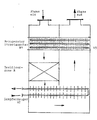
- the reaction zone R (see Figure 1) can be Gas stream are first cooled to about 200 ° C, the heat z. B. is used for steam generation, while the remaining heat, which is released when the gas is cooled, is used to preheat the exhaust gas entering the reaction zone to approximately 150 ° C.
- Thermal oil can be used as the cooling medium, or steam can also be generated after the catalyst bed if there is a large excess of heat.
- the exhaust gas emerging from the absorption column is passed through the preheater W1, in which the exhaust gas in counterflow z. B. is heated to 150 ° C with a thermal oil as a heat transfer medium.
- the preheater W1 can be a heat exchanger with heat pipes.
- the exhaust gas is heated to 450 ° C. by the heat of reaction.
- the concentration of formaldehyde is reduced to 10 ppm and that of carbon monoxide to 0.004 vol.%.
- the exhaust gas is cooled down to approx. 210 ° C, whereby the heat is obtained in the form of 20 bar saturated steam and can be released from the system.
- the amount of heat required for preheating the exhaust gas to 150 ° C is recovered when the exhaust gas is cooled from 210 ° C to 95 ° C in countercurrent, so that the preheating in W1 uses the thermal oil at a temperature of approx. 180 ° C Available.
Landscapes
- Chemical & Material Sciences (AREA)
- Engineering & Computer Science (AREA)
- Environmental & Geological Engineering (AREA)
- Analytical Chemistry (AREA)
- Health & Medical Sciences (AREA)
- Biomedical Technology (AREA)
- Organic Chemistry (AREA)
- General Chemical & Material Sciences (AREA)
- Oil, Petroleum & Natural Gas (AREA)
- Chemical Kinetics & Catalysis (AREA)
- Catalysts (AREA)
- Exhaust Gas After Treatment (AREA)
- Exhaust Gas Treatment By Means Of Catalyst (AREA)
Description
- Die Erfindung betrifft ein Verfahren zur Reinigung von Abgasen aus Formaldehydanlagen, die im wesentlichen aus Sauerstoff, Stickstoff, Kohlenmonoxyd, Kohlendioxyd, Wasserstoff, Methanol, Dimethyläther und Formaldehyd bestehen. Bei den Verfahren zur Oxydation von Methanol zu Formaldehyd enthält das Abgas nach dem Formaldehyd-Absorber meist noch größere Mengen von Veruneinigungen, insbesondere Kohlenmonoxyd und Formaldehyd.
- Während die Abgase aus Anlagen, die nach dem Silberkontaktverfahren arbeiten, durch den hohen Gehalt an Wasserstoff (bis zu 20 Vol.% Wasserstoff, Heizwert ca. 2 000 KJ/m3) in einer Fackel verbrannt werden können oder zur Erzeugung von Dampf Verwendung finden, sind die bisher vorgeschlagenen Lösungen für das Abgasproblem nach dem Formox-Verfahren mit metalloxydischen Kontakten noch nicht wirtschaftlich gelöst.
- Diese Abgase enthalten bis zu 3 000 ppm Formaldehyd und bis zu 2 Vol.% Kohlenmonoxyd, während der behördlich festgesetzte Wert von maximal 20 ppm Formaldehyd im Abgas meist nur durch aufwendige Verfahren erreicht wird. So können diese Abgase durch Verbesserungen der Absorptionstürme auf größere Reinheit gebracht werden oder aber durch nachgeschaltete chemische Verfahren. Die Verbesserung der Absorptionstürme ist meist durch zu hohe Temperatur der Waschflüssigkeiten begrenzt und die Vergrößerung der Kolonnen bringt zusätzlichen Druckverlust.
- Ferner werden die Abgase nach dem Formox-Verfahren auch unter Zusatz von Erdgas verbrannt, was hohe Brennstoffkosten verursacht.
- Es werden auch Naßabsorptionsverfahren zur Entfernung von Formaldehyd vorgeschlagen und gebaut, wobei der Waschflüssigkeit anorganische Salze oder Ammoniak zugegeben werden. Alle diese Verfahren sind teuer und verursachen zusätzliche Betriebskosten.
- Der Erfindung liegt daher die Aufgabe zugrunde, ein kostengünstiges Verfahren zur Reinigung dieser Abgase zu finden und die Konzentration von Formaldehyd im Abgas möglichst weit unter 20 ppm zu senken.
- Eine weitere Aufgabe der Erfindung war es, den Kohlenmonoxydgehalt im Abgas ebenfalls zu reduzieren.
- Die Aufgabe wird erfindungsgemäß dadurch gelöst, daß man das Abgas in einem Vorwärmer auf 140°-200 °C aufheizt, das vorgewärmte Abgas über ein Katalysatorbett leitet, das aus einem inerter, anorganischen, hochporösen Trägermaterial besteht, auf essen äußere Oberfläche eine aus 0,1 bis 0,5 Gewichts-% Platin bestehende Platinschicht aufgebracht ist, worauf das am Katalysator durch die freiwerdende Reaktionswärme auf 250°-450°C aufgewärmte Abgas in einem Wärmetauscher unter Energiegewinnung in Form von Wasserdampf oder Thermoöl auf 150°-300 °C abgekühlt wird und die restliche Wärme des Abgases entweder direkt dem Vorwärmer oder einem Kühlmedium in einem Wärmetauscher zugeführt wird, der das eintretende Abgas in Vorwärmer aufwärmt. Es ist hinreichend bekannt, organische Verbindungen in Abgasen katalytisch zu oxydieren. Diese Verfahren werden meist bei Temperaturen über 400 °C durchgeführt und sind sehr energieintensiv.
- Es ist daher überraschend, daß Formaldehyd schon bei den erfindungsgemäßen Temperaturen an Platinkatalysatoren zu Kohlendioxyd und Wasser oxydiert werden kann und zwar mit großer Geschwindigkeit und großem Umsatz. Dabei hat es sich gezeigt, daß es nicht erforderlich ist, reines Platin zu verwenden, sondern daß es wesentlich ist, für den Katalysator hochporöse Oberflächen zu schaffen, die mit 0,1 bis 0,5 Gewichts % Platin besetzt sind. Als Trägermaterial kann Aluminiumoxyd oder Bariumsulfat in Form von 2-10 mm großem Granulat oder anderen Fastkörpern eingesetzt werden. Größere PlatinGehalte verbessern die Reaktion im Verhältnis zum Preis nur unwesentlich.
- Gemäß der Erfindung zeigte es sich auch, daß es möglich ist, Kohlenmonoxyd schon bei Temperaturen ab 140 °C zu Kohlendioxyd zu oxydieren.
- Da die Konzentration von Kohlenmonoxyd im Abgas aber meist zwischen 0,1 und 2 Vol.% liegt, ist es von wesentlicher Bedeutung, die Reaktionswärme der Reaktion von Kohlenmonoxyd zu Kohlendioxyd zu nützen und sowohl das Katalysatorbett, als auch das Abgas aus dem Absorber damit aufzuheizen, wodurch die Reaktionsgeschwindigkeit wesentlich vergrößert werden kann.
- Die Aufheizung des Abgases erfolgt vorzugsweise durch einen eigenen Kreislauf, wobei mit einem Kühlmedium das heiße Abgas mit einem Wärmetauscher gekühlt wird und das warme Kühlmedium das kalte Abgas aufwärmt. Auf diese Weise können Reaktionstemperaturen bis 450 °C erreicht werden.
- Da bei den meisten Formaldehyd-Anlagen nach dem Formox-Verfahren die Konzentration der organischen Verunreinigungen im Abgas (Formaldehyd, Methanol, Kohlenmonoxyd und Dimethyläther u. a.) zwischen 1 und 2 Vol.% liegt, kann nach der Reaktionszone R (s. Abbildung 1) der Gasstrom zunächst auf ca. 200 °C abgekühlt werden, wobei die Wärme z. B. zur Dampferzeugung Verwendung findet, während die verbleibende Wärme, die bei der Abkühlung des Gases frei wird, zur Vorheizung des in die Reaktionszone eintretenden Abgases auf ca. 150 °C Verwendung findet.
- Als Kühlmedium kann dabei Thermoöl verwendet werden oder bei größeren Wärmeüberschüssen auch nach dem Katalysatorbett Dampf erzeugt werden.
- 40 000 M3/h Abgas mit 36 °C aus einem Formaldehyd-Absorber nach dem Formox-Verfahren enthalten :

- Das aus der Absorptionskolonne austrentende Abgas wird durch den Vorwärmer W1 geleitet, in dem das Abgas im Gegenstrom z. B. mit einem Thermoöl als Wärmeträger auf 150 °C erwärmt wird.
- Der Vorwärmer W1 kann erfindungsgemäß ein Wärmetauscher mit Wärmerohren sein.
- In der Reaktionszone R1 die aus einer 0,1 m hohen Schicht mit porösem Granulat mit einem Durchmesser von 8 mm besteht (0,2 Gew.% Platin auf Aluminiumoxyd oder Bariumsulfat), erhitzt sich das Abgas durch die Reaktionswärme auf 450 °C.
- Dabei reduziert sich die Konzentration von Formaldehyd auf 10 ppm und die von Kohlenmonoxyd auf 0,004 Vol.%. Im Wärmetauscher W2 wird das Abgas auf ca. 210 °C abgekühlt, wobei die Wärme in Form von 20 bar Sattdampf gewonnen wird und aus der Anlage abgegeben werden kann. Im Wärmetauscher W3 wird die zur Vorwärmung des Abgases auf 150 °C benötigte Wärmemenge bei der Abkühlung des Abgases von 210 °C auf 95 °C im Gegenstrom rückgewonnen, so daß zur Vorwärmung in W1 das Thermoöl mit einer Temperatur von ca. 180 °C zur Verfügung steht.
Claims (3)
Applications Claiming Priority (2)
| Application Number | Priority Date | Filing Date | Title |
|---|---|---|---|
| AT0291881A AT371372B (de) | 1981-07-01 | 1981-07-01 | Verfahren zur reinigung von abgasen aus formaldehydanlagen |
| AT2918/81 | 1981-07-01 |
Publications (2)
| Publication Number | Publication Date |
|---|---|
| EP0068377A1 EP0068377A1 (de) | 1983-01-05 |
| EP0068377B1 true EP0068377B1 (de) | 1985-08-28 |
Family
ID=3542357
Family Applications (1)
| Application Number | Title | Priority Date | Filing Date |
|---|---|---|---|
| EP82105410A Expired EP0068377B1 (de) | 1981-07-01 | 1982-06-21 | Verfahren zur katalytischen Oxydation von Abgasen aus Formaldehydanlagen |
Country Status (3)
| Country | Link |
|---|---|
| EP (1) | EP0068377B1 (de) |
| AT (2) | AT371372B (de) |
| DE (1) | DE3265837D1 (de) |
Families Citing this family (14)
| Publication number | Priority date | Publication date | Assignee | Title |
|---|---|---|---|---|
| US4673556A (en) * | 1985-11-08 | 1987-06-16 | General Motors Corporation | Method of simultaneous oxidation of carbon monoxide and unburned fuel in methanol vehicle exhaust |
| US4950476A (en) * | 1986-11-06 | 1990-08-21 | Ford Motor Company | Method of catalytically oxidizing alcohol vapor accompanied by varying amounts of excess oxygen |
| US4859435A (en) * | 1988-06-10 | 1989-08-22 | Air Products And Chemicals, Inc. | Deoxygenation of inert gas streams with methanol |
| US4859434A (en) * | 1988-06-10 | 1989-08-22 | Air Products And Chemicals, Inc. | Production of endothermic gases with methanol |
| DE3906430A1 (de) * | 1989-03-01 | 1990-09-06 | Bookmann Gmbh | Verfahren und vorrichtung zur katalytischen und/oder thermischen nachverbrennung von prozess-abluft |
| US5907066A (en) * | 1996-11-27 | 1999-05-25 | Lehigh University | Treating methanol-containing waste gas streams |
| US6084135A (en) * | 1997-12-31 | 2000-07-04 | Lehigh University | Production of formaldehyde using carbon oxides, hydrogen and H2 S |
| US6198005B1 (en) | 1998-04-23 | 2001-03-06 | Lehigh University | Treating methanol containing waste gas streams |
| WO2000047309A1 (en) * | 1999-02-10 | 2000-08-17 | General Electric Company | Method of removing methanol from off gases |
| RU2155093C1 (ru) * | 1999-02-10 | 2000-08-27 | Институт органической химии им. Н.Д. Зелинского РАН | Способ очистки отходящих газов от метанола |
| RU2332251C2 (ru) * | 2006-06-19 | 2008-08-27 | Институт Катализа Им. Г.К. Борескова Сибирского Отделения Российской Академии Наук | Способ каталитического окисления метанола |
| CN114832620B (zh) * | 2022-06-07 | 2023-04-11 | 威士迪(杭州)生物技术有限公司 | 一种除甲醛用室内空气净化装置 |
| CN115414780B (zh) * | 2022-09-05 | 2023-11-24 | 中国矿业大学 | 一种高浓度NOx烟气脱硝系统及控制方法 |
| CN116571066A (zh) * | 2023-05-19 | 2023-08-11 | 欧季亚新材料(南京)有限公司 | 一种尾气处理装置 |
Family Cites Families (2)
| Publication number | Priority date | Publication date | Assignee | Title |
|---|---|---|---|---|
| FR2063216A5 (de) * | 1969-09-03 | 1971-07-09 | Schwarzheide Synthesewerk Veb | |
| DE3042843A1 (de) * | 1979-12-21 | 1981-07-02 | USS Engineers and Consultants, Inc., 15230 Pittsburgh, Pa. | Verfahren und vorrichtung zur katalytischen oxidierung von verunreinigungssubstanzen in einem abgasstrom |
-
1981
- 1981-07-01 AT AT0291881A patent/AT371372B/de not_active IP Right Cessation
-
1982
- 1982-06-21 AT AT82105410T patent/ATE15150T1/de not_active IP Right Cessation
- 1982-06-21 EP EP82105410A patent/EP0068377B1/de not_active Expired
- 1982-06-21 DE DE8282105410T patent/DE3265837D1/de not_active Expired
Also Published As
| Publication number | Publication date |
|---|---|
| ATA291881A (de) | 1982-11-15 |
| DE3265837D1 (en) | 1985-10-03 |
| ATE15150T1 (de) | 1985-09-15 |
| AT371372B (de) | 1983-06-27 |
| EP0068377A1 (de) | 1983-01-05 |
Similar Documents
| Publication | Publication Date | Title |
|---|---|---|
| DE2648190C3 (de) | Verfahren zur Herstellung von Schwefel nach dem Claus-Verfahren | |
| EP0068377B1 (de) | Verfahren zur katalytischen Oxydation von Abgasen aus Formaldehydanlagen | |
| DE3586888T2 (de) | Rückgewinnung von Wärme aus konzentrierter Schwefelsäure. | |
| DE2459615C3 (de) | Verfahren zur gleichzeitigen Behandlung von Abwässern und Abgasen aus Ammoniak-Synthesegas herstellenden Anlagen | |
| EP0672618A1 (de) | Verfahren zur Gewinnung von elementarem Schwefel aus einem H2S enthaltenden Gasgemisch | |
| DE2915210A1 (de) | Verfahren zur erzeugung von wasserstoff und schwefel aus schwefelwasserstoff | |
| EP0137467A3 (de) | Verfahren und Vorrichtung zum Herstellen von Synthesegas | |
| DE2253806B2 (de) | Verfahren zur umsetzung des in gasgemischen enthaltenen schwefelwasserstoffs mit schwefeldioxid nach dem claus-prozess | |
| DD142203A5 (de) | Verfahren zur reinigung des prozesskondensates von den wasserstoff-und synthesegas-herstellungsanlagen | |
| DE3420579A1 (de) | Hochleistungs-methanierungsvorrichtung | |
| DE2709881A1 (de) | Verfahren zum aufarbeiten schwefelwasserstoff enthaltender gase | |
| DE2505828B2 (de) | Verfahren und vorrichtung zur erzeugung von konzentrierter schwefelsaeure und/oder oleum | |
| US4032618A (en) | Conversion of ammonia into hydrogen and nitrogen by reaction with a sulfided catalyst | |
| DE3690569C2 (de) | Verfahren zum Entfernen von schwefelhaltigen Verbindungen aus einem Restgas | |
| DE2615307A1 (de) | Verfahren zur reinigung von schwefeldioxidhaltigem gas | |
| DE2721462C2 (de) | Verwendung von Prozeßwasser aus der Ammoniak- und Harnstoffsynthese | |
| DE69331577T2 (de) | Verfahren und anwendung einer vorrichtung zur gewinnung von schwefel aus gasströmen enthaltend schwefelwasserstoffsäure | |
| DE2333708B2 (de) | Verfahren zum selektiven entfernen von schwefelwasserstoff aus kohlenwasserstoffhaltigen gasen | |
| DE2200004C2 (de) | Verfahren zur Erzeugung eines methanreichen mit Erdgas austauschbaren Gases | |
| DE2352425A1 (de) | Katalytische behandlung von schwefelerzeugungs-beschickungsgas zum entfernen von hcn und nh tief 3 | |
| DE1567613C3 (de) | Verfahren zur zweistufigen Konvertierung kohlenmonoxidhaltiger Gasgemische | |
| DD237152A5 (de) | Verfahren zur erzeugung von elementarem schwefel | |
| DE2113428A1 (de) | Verfahren zur Umwandlung von Schwefeldioxyd in Schwefelsaeure | |
| DE4023476C2 (de) | Verfahren zur Vermeidung von Abwasser bei der Hexaminherstellung | |
| DE2447221A1 (de) | Verfahren zur vernichtung von cyanwasserstoffgas |
Legal Events
| Date | Code | Title | Description |
|---|---|---|---|
| PUAI | Public reference made under article 153(3) epc to a published international application that has entered the european phase |
Free format text: ORIGINAL CODE: 0009012 |
|
| AK | Designated contracting states |
Designated state(s): AT BE CH DE FR GB IT LI NL SE |
|
| 17P | Request for examination filed |
Effective date: 19830528 |
|
| ITF | It: translation for a ep patent filed | ||
| GRAA | (expected) grant |
Free format text: ORIGINAL CODE: 0009210 |
|
| AK | Designated contracting states |
Designated state(s): AT BE CH DE FR GB IT LI NL SE |
|
| PG25 | Lapsed in a contracting state [announced via postgrant information from national office to epo] |
Ref country code: NL Effective date: 19850828 Ref country code: BE Effective date: 19850828 |
|
| REF | Corresponds to: |
Ref document number: 15150 Country of ref document: AT Date of ref document: 19850915 Kind code of ref document: T |
|
| REF | Corresponds to: |
Ref document number: 3265837 Country of ref document: DE Date of ref document: 19851003 |
|
| NLV1 | Nl: lapsed or annulled due to failure to fulfill the requirements of art. 29p and 29m of the patents act | ||
| PLBI | Opposition filed |
Free format text: ORIGINAL CODE: 0009260 |
|
| PG25 | Lapsed in a contracting state [announced via postgrant information from national office to epo] |
Ref country code: GB Effective date: 19860621 Ref country code: AT Effective date: 19860621 |
|
| 26 | Opposition filed |
Opponent name: JOHNSON MATTHEY PLC Effective date: 19860522 |
|
| ET | Fr: translation filed | ||
| PG25 | Lapsed in a contracting state [announced via postgrant information from national office to epo] |
Ref country code: FR Free format text: LAPSE BECAUSE OF NON-PAYMENT OF DUE FEES Effective date: 19870227 |
|
| GBPC | Gb: european patent ceased through non-payment of renewal fee | ||
| REG | Reference to a national code |
Ref country code: FR Ref legal event code: ST |
|
| PG25 | Lapsed in a contracting state [announced via postgrant information from national office to epo] |
Ref country code: SE Effective date: 19870622 |
|
| PGFP | Annual fee paid to national office [announced via postgrant information from national office to epo] |
Ref country code: DE Payment date: 19880219 Year of fee payment: 6 |
|
| REG | Reference to a national code |
Ref country code: CH Ref legal event code: PL |
|
| RDAG | Patent revoked |
Free format text: ORIGINAL CODE: 0009271 |
|
| STAA | Information on the status of an ep patent application or granted ep patent |
Free format text: STATUS: PATENT REVOKED |
|
| 27W | Patent revoked |
Effective date: 19880109 |
|
| GBPR | Gb: patent revoked under art. 102 of the ep convention designating the uk as contracting state | ||
| EUG | Se: european patent has lapsed |
Ref document number: 82105410.3 Effective date: 19880712 |