EP0068480A1 - Process for preparing rhodium (I) carbonyl complexes - Google Patents
Process for preparing rhodium (I) carbonyl complexes Download PDFInfo
- Publication number
- EP0068480A1 EP0068480A1 EP82105722A EP82105722A EP0068480A1 EP 0068480 A1 EP0068480 A1 EP 0068480A1 EP 82105722 A EP82105722 A EP 82105722A EP 82105722 A EP82105722 A EP 82105722A EP 0068480 A1 EP0068480 A1 EP 0068480A1
- Authority
- EP
- European Patent Office
- Prior art keywords
- rhodium
- complex
- triorganophosphorus
- ketoenolate
- halocarbonylbis
- Prior art date
- Legal status (The legal status is an assumption and is not a legal conclusion. Google has not performed a legal analysis and makes no representation as to the accuracy of the status listed.)
- Granted
Links
- 238000004519 manufacturing process Methods 0.000 title claims description 7
- MHOVAHRLVXNVSD-UHFFFAOYSA-N rhodium atom Chemical compound [Rh] MHOVAHRLVXNVSD-UHFFFAOYSA-N 0.000 claims abstract description 98
- 238000000034 method Methods 0.000 claims abstract description 60
- QVGXLLKOCUKJST-UHFFFAOYSA-N atomic oxygen Chemical compound [O] QVGXLLKOCUKJST-UHFFFAOYSA-N 0.000 claims abstract description 21
- 229910052760 oxygen Inorganic materials 0.000 claims abstract description 21
- 239000001301 oxygen Substances 0.000 claims abstract description 21
- 239000003795 chemical substances by application Substances 0.000 claims abstract description 19
- CIHOLLKRGTVIJN-UHFFFAOYSA-N tert‐butyl hydroperoxide Chemical compound CC(C)(C)OO CIHOLLKRGTVIJN-UHFFFAOYSA-N 0.000 claims description 25
- 238000006243 chemical reaction Methods 0.000 claims description 14
- YRKCREAYFQTBPV-UHFFFAOYSA-N acetylacetone Chemical compound CC(=O)CC(C)=O YRKCREAYFQTBPV-UHFFFAOYSA-N 0.000 claims description 10
- UYPYRKYUKCHHIB-UHFFFAOYSA-N trimethylamine N-oxide Chemical compound C[N+](C)(C)[O-] UYPYRKYUKCHHIB-UHFFFAOYSA-N 0.000 claims description 10
- GOOHAUXETOMSMM-UHFFFAOYSA-N Propylene oxide Chemical compound CC1CO1 GOOHAUXETOMSMM-UHFFFAOYSA-N 0.000 claims description 9
- 125000000217 alkyl group Chemical group 0.000 claims description 6
- 125000003118 aryl group Chemical group 0.000 claims description 6
- 239000001257 hydrogen Substances 0.000 claims description 6
- 229910052739 hydrogen Inorganic materials 0.000 claims description 6
- AWMVMTVKBNGEAK-UHFFFAOYSA-N Styrene oxide Chemical compound C1OC1C1=CC=CC=C1 AWMVMTVKBNGEAK-UHFFFAOYSA-N 0.000 claims description 5
- 239000002585 base Substances 0.000 claims description 4
- AIWZOHBYSFSQGV-LNKPDPKZSA-M sodium;(z)-4-oxopent-2-en-2-olate Chemical group [Na+].C\C([O-])=C\C(C)=O AIWZOHBYSFSQGV-LNKPDPKZSA-M 0.000 claims description 4
- 150000001340 alkali metals Chemical class 0.000 claims description 3
- 125000004435 hydrogen atom Chemical group [H]* 0.000 claims description 3
- QGZKDVFQNNGYKY-UHFFFAOYSA-O Ammonium Chemical compound [NH4+] QGZKDVFQNNGYKY-UHFFFAOYSA-O 0.000 claims description 2
- ZQRLHBAMCGVPRF-UHFFFAOYSA-N [Rh+].ClP(C(=O)P(C1=CC=CC=C1)(C1=CC=CC=C1)C1=CC=CC=C1)(C1=CC=CC=C1)(C1=CC=CC=C1)C1=CC=CC=C1 Chemical compound [Rh+].ClP(C(=O)P(C1=CC=CC=C1)(C1=CC=CC=C1)C1=CC=CC=C1)(C1=CC=CC=C1)(C1=CC=CC=C1)C1=CC=CC=C1 ZQRLHBAMCGVPRF-UHFFFAOYSA-N 0.000 claims description 2
- 229910052783 alkali metal Inorganic materials 0.000 claims description 2
- 229910052784 alkaline earth metal Inorganic materials 0.000 claims description 2
- 150000001342 alkaline earth metals Chemical class 0.000 claims description 2
- 125000003545 alkoxy group Chemical group 0.000 claims description 2
- 125000004104 aryloxy group Chemical group 0.000 claims description 2
- ZLUSCZLCHQSJRU-UHFFFAOYSA-N thallium(1+) Chemical compound [Tl+] ZLUSCZLCHQSJRU-UHFFFAOYSA-N 0.000 claims description 2
- POILWHVDKZOXJZ-ARJAWSKDSA-M (z)-4-oxopent-2-en-2-olate Chemical compound C\C([O-])=C\C(C)=O POILWHVDKZOXJZ-ARJAWSKDSA-M 0.000 claims 1
- DBKMQNOOKOXATA-UHFFFAOYSA-N [Rh+].C=1C=CC=CC=1P(C=1C=CC=CC=1)(=C=O)C1=CC=CC=C1 Chemical compound [Rh+].C=1C=CC=CC=1P(C=1C=CC=CC=1)(=C=O)C1=CC=CC=C1 DBKMQNOOKOXATA-UHFFFAOYSA-N 0.000 claims 1
- 238000007037 hydroformylation reaction Methods 0.000 abstract description 30
- 239000003054 catalyst Substances 0.000 abstract description 22
- 238000002360 preparation method Methods 0.000 abstract description 13
- 239000002243 precursor Substances 0.000 abstract description 3
- RIOQSEWOXXDEQQ-UHFFFAOYSA-N triphenylphosphine Chemical compound C1=CC=CC=C1P(C=1C=CC=CC=1)C1=CC=CC=C1 RIOQSEWOXXDEQQ-UHFFFAOYSA-N 0.000 description 66
- 239000010948 rhodium Substances 0.000 description 54
- 229910052703 rhodium Inorganic materials 0.000 description 51
- 238000004821 distillation Methods 0.000 description 27
- 239000003446 ligand Substances 0.000 description 25
- 239000012141 concentrate Substances 0.000 description 20
- -1 halide ion Chemical class 0.000 description 18
- UGFAIRIUMAVXCW-UHFFFAOYSA-N Carbon monoxide Chemical compound [O+]#[C-] UGFAIRIUMAVXCW-UHFFFAOYSA-N 0.000 description 15
- 229910002091 carbon monoxide Inorganic materials 0.000 description 15
- CSCPPACGZOOCGX-UHFFFAOYSA-N Acetone Chemical group CC(C)=O CSCPPACGZOOCGX-UHFFFAOYSA-N 0.000 description 14
- 239000000047 product Substances 0.000 description 14
- XYFCBTPGUUZFHI-UHFFFAOYSA-N Phosphine Chemical compound P XYFCBTPGUUZFHI-UHFFFAOYSA-N 0.000 description 12
- 239000000725 suspension Substances 0.000 description 12
- 239000012429 reaction media Substances 0.000 description 11
- 239000012018 catalyst precursor Substances 0.000 description 10
- 150000001299 aldehydes Chemical class 0.000 description 9
- 239000007787 solid Substances 0.000 description 9
- VEXZGXHMUGYJMC-UHFFFAOYSA-N Hydrochloric acid Chemical compound Cl VEXZGXHMUGYJMC-UHFFFAOYSA-N 0.000 description 8
- 238000009835 boiling Methods 0.000 description 8
- 229910052736 halogen Inorganic materials 0.000 description 8
- 229910052751 metal Inorganic materials 0.000 description 8
- 239000002184 metal Substances 0.000 description 8
- 101100030361 Neurospora crassa (strain ATCC 24698 / 74-OR23-1A / CBS 708.71 / DSM 1257 / FGSC 987) pph-3 gene Proteins 0.000 description 7
- 239000006227 byproduct Substances 0.000 description 7
- 230000001590 oxidative effect Effects 0.000 description 7
- 150000003283 rhodium Chemical class 0.000 description 7
- 238000006467 substitution reaction Methods 0.000 description 7
- 239000000706 filtrate Substances 0.000 description 6
- 150000003003 phosphines Chemical group 0.000 description 6
- 229910000073 phosphorus hydride Inorganic materials 0.000 description 6
- 239000002904 solvent Substances 0.000 description 6
- 239000002253 acid Substances 0.000 description 5
- 238000006073 displacement reaction Methods 0.000 description 5
- 150000002367 halogens Chemical class 0.000 description 5
- 239000000203 mixture Substances 0.000 description 5
- 239000007858 starting material Substances 0.000 description 5
- VEXZGXHMUGYJMC-UHFFFAOYSA-M Chloride anion Chemical compound [Cl-] VEXZGXHMUGYJMC-UHFFFAOYSA-M 0.000 description 4
- 238000004566 IR spectroscopy Methods 0.000 description 4
- 150000001875 compounds Chemical class 0.000 description 4
- 239000010408 film Substances 0.000 description 4
- JRZJOMJEPLMPRA-UHFFFAOYSA-N olefin Natural products CCCCCCCC=C JRZJOMJEPLMPRA-UHFFFAOYSA-N 0.000 description 4
- 239000000243 solution Substances 0.000 description 4
- OAICVXFJPJFONN-UHFFFAOYSA-N Phosphorus Chemical compound [P] OAICVXFJPJFONN-UHFFFAOYSA-N 0.000 description 3
- HEMHJVSKTPXQMS-UHFFFAOYSA-M Sodium hydroxide Chemical compound [OH-].[Na+] HEMHJVSKTPXQMS-UHFFFAOYSA-M 0.000 description 3
- 125000000129 anionic group Chemical group 0.000 description 3
- 238000009833 condensation Methods 0.000 description 3
- 230000005494 condensation Effects 0.000 description 3
- 230000000694 effects Effects 0.000 description 3
- 239000007789 gas Substances 0.000 description 3
- 150000004820 halides Chemical class 0.000 description 3
- 238000005984 hydrogenation reaction Methods 0.000 description 3
- 239000000463 material Substances 0.000 description 3
- MWUXSHHQAYIFBG-UHFFFAOYSA-N nitrogen oxide Inorganic materials O=[N] MWUXSHHQAYIFBG-UHFFFAOYSA-N 0.000 description 3
- 125000002524 organometallic group Chemical group 0.000 description 3
- 239000007800 oxidant agent Substances 0.000 description 3
- 230000003647 oxidation Effects 0.000 description 3
- 238000007254 oxidation reaction Methods 0.000 description 3
- 229910052698 phosphorus Inorganic materials 0.000 description 3
- 239000011574 phosphorus Substances 0.000 description 3
- 150000003839 salts Chemical class 0.000 description 3
- 241000894007 species Species 0.000 description 3
- XLYOFNOQVPJJNP-UHFFFAOYSA-N water Chemical compound O XLYOFNOQVPJJNP-UHFFFAOYSA-N 0.000 description 3
- POILWHVDKZOXJZ-ONEGZZNKSA-M (E)-4-oxopent-2-en-2-olate Chemical compound C\C([O-])=C/C(C)=O POILWHVDKZOXJZ-ONEGZZNKSA-M 0.000 description 2
- IJGRMHOSHXDMSA-UHFFFAOYSA-N Atomic nitrogen Chemical compound N#N IJGRMHOSHXDMSA-UHFFFAOYSA-N 0.000 description 2
- ZAMOUSCENKQFHK-UHFFFAOYSA-N Chlorine atom Chemical compound [Cl] ZAMOUSCENKQFHK-UHFFFAOYSA-N 0.000 description 2
- MHAJPDPJQMAIIY-UHFFFAOYSA-N Hydrogen peroxide Chemical compound OO MHAJPDPJQMAIIY-UHFFFAOYSA-N 0.000 description 2
- FAPWRFPIFSIZLT-UHFFFAOYSA-M Sodium chloride Chemical compound [Na+].[Cl-] FAPWRFPIFSIZLT-UHFFFAOYSA-M 0.000 description 2
- 150000007513 acids Chemical class 0.000 description 2
- 150000001336 alkenes Chemical class 0.000 description 2
- 150000001408 amides Chemical class 0.000 description 2
- 238000004458 analytical method Methods 0.000 description 2
- 125000002915 carbonyl group Chemical group [*:2]C([*:1])=O 0.000 description 2
- 239000000460 chlorine Substances 0.000 description 2
- 229910052801 chlorine Inorganic materials 0.000 description 2
- 150000005676 cyclic carbonates Chemical class 0.000 description 2
- 238000001914 filtration Methods 0.000 description 2
- 150000002432 hydroperoxides Chemical class 0.000 description 2
- 229910052500 inorganic mineral Inorganic materials 0.000 description 2
- 239000011707 mineral Substances 0.000 description 2
- 230000007935 neutral effect Effects 0.000 description 2
- 239000003960 organic solvent Substances 0.000 description 2
- MPQXHAGKBWFSNV-UHFFFAOYSA-N oxidophosphanium Chemical group [PH3]=O MPQXHAGKBWFSNV-UHFFFAOYSA-N 0.000 description 2
- 150000002978 peroxides Chemical class 0.000 description 2
- 239000000376 reactant Substances 0.000 description 2
- 239000012266 salt solution Substances 0.000 description 2
- JHJLBTNAGRQEKS-UHFFFAOYSA-M sodium bromide Chemical compound [Na+].[Br-] JHJLBTNAGRQEKS-UHFFFAOYSA-M 0.000 description 2
- 239000010409 thin film Substances 0.000 description 2
- 238000004809 thin layer chromatography Methods 0.000 description 2
- 238000005406 washing Methods 0.000 description 2
- 238000005303 weighing Methods 0.000 description 2
- QEEPPWQOVJWUBC-UHFFFAOYSA-N 1-hydroperoxycyclohexene Chemical compound OOC1=CCCCC1 QEEPPWQOVJWUBC-UHFFFAOYSA-N 0.000 description 1
- BMYNFMYTOJXKLE-UHFFFAOYSA-N 3-azaniumyl-2-hydroxypropanoate Chemical compound NCC(O)C(O)=O BMYNFMYTOJXKLE-UHFFFAOYSA-N 0.000 description 1
- ZCYVEMRRCGMTRW-UHFFFAOYSA-N 7553-56-2 Chemical compound [I] ZCYVEMRRCGMTRW-UHFFFAOYSA-N 0.000 description 1
- 241001660853 Ammodytidae Species 0.000 description 1
- WKBOTKDWSSQWDR-UHFFFAOYSA-N Bromine atom Chemical compound [Br] WKBOTKDWSSQWDR-UHFFFAOYSA-N 0.000 description 1
- MYMOFIZGZYHOMD-UHFFFAOYSA-N Dioxygen Chemical compound O=O MYMOFIZGZYHOMD-UHFFFAOYSA-N 0.000 description 1
- LFQSCWFLJHTTHZ-UHFFFAOYSA-N Ethanol Chemical compound CCO LFQSCWFLJHTTHZ-UHFFFAOYSA-N 0.000 description 1
- PXGOKWXKJXAPGV-UHFFFAOYSA-N Fluorine Chemical compound FF PXGOKWXKJXAPGV-UHFFFAOYSA-N 0.000 description 1
- UFHFLCQGNIYNRP-UHFFFAOYSA-N Hydrogen Chemical compound [H][H] UFHFLCQGNIYNRP-UHFFFAOYSA-N 0.000 description 1
- 229910021578 Iron(III) chloride Inorganic materials 0.000 description 1
- GRYLNZFGIOXLOG-UHFFFAOYSA-N Nitric acid Chemical compound O[N+]([O-])=O GRYLNZFGIOXLOG-UHFFFAOYSA-N 0.000 description 1
- 239000007983 Tris buffer Substances 0.000 description 1
- JAZCEXBNIYKZDI-UHFFFAOYSA-N [Ir+] Chemical compound [Ir+] JAZCEXBNIYKZDI-UHFFFAOYSA-N 0.000 description 1
- CUJRVFIICFDLGR-UHFFFAOYSA-N acetylacetonate Chemical compound CC(=O)[CH-]C(C)=O CUJRVFIICFDLGR-UHFFFAOYSA-N 0.000 description 1
- 125000005595 acetylacetonate group Chemical group 0.000 description 1
- 229910001508 alkali metal halide Inorganic materials 0.000 description 1
- 150000008045 alkali metal halides Chemical class 0.000 description 1
- 229910000272 alkali metal oxide Inorganic materials 0.000 description 1
- 229910001860 alkaline earth metal hydroxide Inorganic materials 0.000 description 1
- 150000001450 anions Chemical class 0.000 description 1
- 239000008346 aqueous phase Substances 0.000 description 1
- 239000007864 aqueous solution Substances 0.000 description 1
- 238000000998 batch distillation Methods 0.000 description 1
- GDTBXPJZTBHREO-UHFFFAOYSA-N bromine Substances BrBr GDTBXPJZTBHREO-UHFFFAOYSA-N 0.000 description 1
- 229910052794 bromium Inorganic materials 0.000 description 1
- 125000004432 carbon atom Chemical group C* 0.000 description 1
- GGRQQHADVSXBQN-FGSKAQBVSA-N carbon monoxide;(z)-4-hydroxypent-3-en-2-one;rhodium Chemical compound [Rh].[O+]#[C-].[O+]#[C-].C\C(O)=C\C(C)=O GGRQQHADVSXBQN-FGSKAQBVSA-N 0.000 description 1
- 150000001768 cations Chemical class 0.000 description 1
- 239000007795 chemical reaction product Substances 0.000 description 1
- 239000003638 chemical reducing agent Substances 0.000 description 1
- 150000001805 chlorine compounds Chemical group 0.000 description 1
- 229910001914 chlorine tetroxide Inorganic materials 0.000 description 1
- 238000007796 conventional method Methods 0.000 description 1
- 229910001882 dioxygen Inorganic materials 0.000 description 1
- 239000012153 distilled water Substances 0.000 description 1
- 150000002148 esters Chemical class 0.000 description 1
- XYIBRDXRRQCHLP-UHFFFAOYSA-N ethyl acetoacetate Chemical compound CCOC(=O)CC(C)=O XYIBRDXRRQCHLP-UHFFFAOYSA-N 0.000 description 1
- 229910052731 fluorine Inorganic materials 0.000 description 1
- 239000011737 fluorine Substances 0.000 description 1
- 125000001153 fluoro group Chemical group F* 0.000 description 1
- 125000004997 halocarbonyl group Chemical group 0.000 description 1
- 125000005843 halogen group Chemical group 0.000 description 1
- 150000004678 hydrides Chemical class 0.000 description 1
- 150000002431 hydrogen Chemical group 0.000 description 1
- XMBWDFGMSWQBCA-UHFFFAOYSA-N hydrogen iodide Chemical compound I XMBWDFGMSWQBCA-UHFFFAOYSA-N 0.000 description 1
- 229940071870 hydroiodic acid Drugs 0.000 description 1
- 239000012535 impurity Substances 0.000 description 1
- 238000011065 in-situ storage Methods 0.000 description 1
- 239000011261 inert gas Substances 0.000 description 1
- 239000011630 iodine Substances 0.000 description 1
- 229910052740 iodine Inorganic materials 0.000 description 1
- RBTARNINKXHZNM-UHFFFAOYSA-K iron trichloride Chemical compound Cl[Fe](Cl)Cl RBTARNINKXHZNM-UHFFFAOYSA-K 0.000 description 1
- 150000002576 ketones Chemical class 0.000 description 1
- 239000007788 liquid Substances 0.000 description 1
- 229910001507 metal halide Inorganic materials 0.000 description 1
- 150000005309 metal halides Chemical class 0.000 description 1
- 238000002156 mixing Methods 0.000 description 1
- 229910017604 nitric acid Inorganic materials 0.000 description 1
- 229910052757 nitrogen Inorganic materials 0.000 description 1
- 150000001451 organic peroxides Chemical class 0.000 description 1
- 238000006053 organic reaction Methods 0.000 description 1
- 150000002903 organophosphorus compounds Chemical class 0.000 description 1
- 238000013021 overheating Methods 0.000 description 1
- VLTRZXGMWDSKGL-UHFFFAOYSA-M perchlorate Chemical compound [O-]Cl(=O)(=O)=O VLTRZXGMWDSKGL-UHFFFAOYSA-M 0.000 description 1
- 125000000864 peroxy group Chemical group O(O*)* 0.000 description 1
- 239000012286 potassium permanganate Substances 0.000 description 1
- 230000002035 prolonged effect Effects 0.000 description 1
- 230000001737 promoting effect Effects 0.000 description 1
- 239000011541 reaction mixture Substances 0.000 description 1
- 230000009257 reactivity Effects 0.000 description 1
- 238000011084 recovery Methods 0.000 description 1
- 238000004064 recycling Methods 0.000 description 1
- 238000009877 rendering Methods 0.000 description 1
- PZSJYEAHAINDJI-UHFFFAOYSA-N rhodium(3+) Chemical compound [Rh+3] PZSJYEAHAINDJI-UHFFFAOYSA-N 0.000 description 1
- 238000000926 separation method Methods 0.000 description 1
- 239000011734 sodium Substances 0.000 description 1
- 229910052708 sodium Inorganic materials 0.000 description 1
- 239000011780 sodium chloride Substances 0.000 description 1
- 239000012265 solid product Substances 0.000 description 1
- 239000000126 substance Substances 0.000 description 1
- 239000000758 substrate Substances 0.000 description 1
- XTQHKBHJIVJGKJ-UHFFFAOYSA-N sulfur monoxide Chemical class S=O XTQHKBHJIVJGKJ-UHFFFAOYSA-N 0.000 description 1
- 229910052815 sulfur oxide Inorganic materials 0.000 description 1
- 238000003786 synthesis reaction Methods 0.000 description 1
- GETQZCLCWQTVFV-UHFFFAOYSA-N trimethylamine Chemical compound CN(C)C GETQZCLCWQTVFV-UHFFFAOYSA-N 0.000 description 1
- 239000003039 volatile agent Substances 0.000 description 1
Classifications
-
- C—CHEMISTRY; METALLURGY
- C07—ORGANIC CHEMISTRY
- C07F—ACYCLIC, CARBOCYCLIC OR HETEROCYCLIC COMPOUNDS CONTAINING ELEMENTS OTHER THAN CARBON, HYDROGEN, HALOGEN, OXYGEN, NITROGEN, SULFUR, SELENIUM OR TELLURIUM
- C07F15/00—Compounds containing elements of Groups 8, 9, 10 or 18 of the Periodic Table
-
- C—CHEMISTRY; METALLURGY
- C07—ORGANIC CHEMISTRY
- C07F—ACYCLIC, CARBOCYCLIC OR HETEROCYCLIC COMPOUNDS CONTAINING ELEMENTS OTHER THAN CARBON, HYDROGEN, HALOGEN, OXYGEN, NITROGEN, SULFUR, SELENIUM OR TELLURIUM
- C07F15/00—Compounds containing elements of Groups 8, 9, 10 or 18 of the Periodic Table
- C07F15/0006—Compounds containing elements of Groups 8, 9, 10 or 18 of the Periodic Table compounds of the platinum group
- C07F15/0073—Rhodium compounds
- C07F15/008—Rhodium compounds without a metal-carbon linkage
Definitions
- Another such catalyst precursor is acetylacetonatocarbonyl(triphenylphosphine) rhodium(I) complex (hereinafter referred to as "Complex I").
- the basic hydroformylation process of Pruett, et al. has been further improved since its invention. Such further improvements include removing product aldehyde by recycling gas (U.S. Pat. No. 4,247,486), providing an alkyldiaryl phosphine ligand in the reaction medium (U.S. Pat. No. 4,260,828) and using the rhodium catalyst in a condensate solvent (U.S. Patent No. 4,148,830).
- the spent hydroformylation reaction medium by means of distillation as taught in U.S. application Serial No. 120,101, filed February 28, 1980, (Bryant, et al.), the entire disclosure of which is incorporated herein by reference thereto.
- Such a procedure involves concentrating the spent hydroformylation reaction medium into at least two material streams by means of distillation at temperatures of about 20.to about 350°C. and at pressures of about 1330 1.3.10 -6 mbar 1000 to about 1x10 -6 mm. Hg., wherein one stream is said rhodium complex concentrate (i.e. the distillation residue) containing a major amount of the rhodium values of the partially deactivated rhodium hydroformylation catalyst present in said medium.
- each distillation stage in general, it is preferred to carry out both distillation stages in a thin-film evaporator, especially a wiped-film evaporator.
- evaporators are well known in the art and thus need not be further discussed herein.
- the procedure of each distillation stage can be carried out more than once, i.e., repeated until the desired amount of volatiles have been removed and/or the desired rhodium concentration obtained.
- the preferred phosphorus ligands are those which have been heretofore employed as rhodium ligands in the hydroformylation field, e.g., as seen by United States Patent No. 3,527,809.
- the amount of free triorganophosphorus ligand employed need only be at least that stoichiometric amount necessary to form the desired halocarbonylbis(triorganophosphorus) rhodium(I) product, i.e., at least two mole equivalents of free triorganophosphorus ligand per mole of rhodium calculated as free metal in the rhodium complex concentrate starting material.
- oxygen transfer agents which are effective in the process of this invention.
- Most preferred oxygen transfer agents are tert-butyl hydroperoxide, trimethylamin p oxide, propylene oxide and styrene oxide.
- oxygen and cyclic carbonates are also useful in this capacity.
- the oxygen transfer agent is preferably added in a quantity equal to or slightly'in excess of one mole equivalent per mole equivalent of the halocarbonylbis(triorganophosphorus) rhodium(I) complex.
- tert-butyl hydroperoxide is the oxyqen transfer agent, an amount only slightly exceeding one mole equivalent per equivalent of the complex is preferable so as to preserve the selectivity of the oxidation-substitution reaction.
Landscapes
- Chemical & Material Sciences (AREA)
- Organic Chemistry (AREA)
- Organic Low-Molecular-Weight Compounds And Preparation Thereof (AREA)
- Low-Molecular Organic Synthesis Reactions Using Catalysts (AREA)
- Catalysts (AREA)
- Inorganic Compounds Of Heavy Metals (AREA)
- Nitrogen And Oxygen Or Sulfur-Condensed Heterocyclic Ring Systems (AREA)
Abstract
Description
- This invention relates to a process for preparing rhodium(I) carbonyltriorganophosphorus mono-B-ketoenolate complexes from halocarbonylbis(triorganophosphorus) rhodium(I) complexes. Such complexes are useful as catalysts in hydroformylation processes. Hydroformylation is the generaT term applied to the reaction of an olefin with hydrogen and carbon monoxide to form an aldehyde.
- United States Patent No. 3,527,809 (Pruett, et al.) discloses an improved rhodium-catalyzed hydroformylation process which results in a high ratio of normal to branched-chain aldehydes. This process has proven very successful commercially. In this process certain rhodium complexes (i.e. catalyst precursors) are added to the reaction medium. For example, acetylacetonatodicarbonyl rhodium(I) (Rh(CO)2acac) can be added to the reaction medium where it forms active catalyst. Another such catalyst precursor is acetylacetonatocarbonyl(triphenylphosphine) rhodium(I) complex (hereinafter referred to as "Complex I"). The basic hydroformylation process of Pruett, et al. has been further improved since its invention. Such further improvements include removing product aldehyde by recycling gas (U.S. Pat. No. 4,247,486), providing an alkyldiaryl phosphine ligand in the reaction medium (U.S. Pat. No. 4,260,828) and using the rhodium catalyst in a condensate solvent (U.S. Patent No. 4,148,830).
- It is known that the rhodium complex catalyst loses activity (i.e., becomes partially deactivated) during prolonged use in such hydroformylation processes. Because of the high-cost of rhodium, several methods have been developed to maintain the level of activity of the catalyst and to reactivate deactivated catalyst.
- United States Patent Application Serial No. 120,101 filed February 28, 1980, discloses a method of concentrating the spent hydroformylation reaction medium using a distillation technique in a wiped film evaporator. The resulting rhodium complex concentrate, especially when supplemented with a treatment by air, is an active catalyst precursor.
- The rhodium complex concentrate may alternatively be treated according to the method disclosed in United States Patent Application Serial No. 221,502, filed December 30, 1980. This process entails treating the distilled rhodium complex concentrate with a halide ion source, a carbon monoxide source and free triorganophosphorus ligand, initially to prepare a halocarbonyl- bis(triorganophosphorus) rhodium(I) complex ("Complex II"). Serial No. 221,502 further discloses that if Complex II is reacted with a metal. hydride reducing agent and free triorganophosphorus ligand without isolating Complex II from its product mixture, the reaction process will form a hydridocarbonyltris(triorganophosphorus) rhodium(I) complex, which is useful as a hydroformylation catalyst precursor. Although Serial No. 221,502 broadly discloses that Complex II is useful as source material for catalyst - precursors, no process for producing a B-ketoenolate rhodium complex precursor is disclosed.
- United States Patent No. 4,021,463 discloses a process for preparing Complex II by treating the distillation residue of a hydroformylation mixture with an aqueous mineral acid and a peroxide to convert the rhodium into a water-soluble salt which passes into the aqueous phase, mixing the resulting aqueous salt solution with a solvent, tertiary phosphine and hydrohalic acid or metal halide and reacting the aqueous solution with carbon monoxide or a carbon monoxide donor. Said patent further discloses that the hydridocarbonyltris(triorganophosphine) rhodium(I) complex, an active catalyst precursor, can be produced by simultaneously subjecting the aqueous starting solution to hydrogenation conditions or by subjecting a solvent solution of the halo-containing compound together with additional phosphine to hydrogenation conditions.
- United States Patent No. 4,113,754 discloses a process for preparing chlorocarbonylbis(triorganophosphine) rhodium(I) complexes ("Complex IIA") by treating a distillation residue of a hydroformylation mixture with oxygen-containing mineral acids and peroxides to form an aqueous rhodium salt solution which is then treated with a cation exchanger. The complexed rhodium ions are then eluted with hydrochloric acid and the solution obtained is reacted in the presence of a water-soluble organic solvent, a tertiary phosphine and carbon monoxide to produce Complex IIA. The patent further discloses that if the latter reaction is carried out under hydrogenation conditions, hydridocarbonyl- tris(triorganophosphine) rhodium(I) is produced.
- Various processes are known for producing rhodium(I) carbonyltriorganophosphorus mono-β-ketoenolate complexes. By way of illustration, "Dicarbonyl-6-diketonato and Related Complexes of Rhodium(I)", Bonati and Wilkinson, J. Chem. Soc. 3156 (1964), discloses a process involving the following reactions:


- Thus the prior art does not disclose a process for producing any rhodium(I) carbonyltriorganophosphorus mono-B-ketoenolate complex (e.g., Complex I) directly from a halocarbonylbis(triorganophosphorus) rhodium(I) complex (Complex II). The preparation of Complex I from RhCOCl(PPh3)2 can be represented hypothetically by Reaction (5) (displacement of chloride and triphenylphosphine from RhCOCl(PPh3)2 by acetylacetonate anion):

- However, while displacement reactions of coordinated chloride for the preparation of certain metal acetylacetonato derivatives are well known and are described in the prior art (see "Metal B-Diketonates and Allied Derivatives," Mehrota, et a1., Academic Press, 1978, 18), it has now been found that Reaction (5) does not proceed or proceeds sluggishly to low conversions of Complex I (see Example 2 below). In fact, not only is RhCOCl(PPh3)2 a poor substrate for displacement of chloride by acetylacetonate anion, but it is well known that, with only a few exceptions, anionic displacement of chloride from RhCOCl(PPh3)2 proceeds poorly, if at all. Following known procedures for preparing anionic displacement products of RhCOCl(PPh3)2, the latter is first converted into RhCOF(PPh3)2 or RhCO(ClO4)(PPh3)2 [see "Fluoro Complexes of Rhodium(I) and Iridium(I)", Vaska and Peone, in Inorganic Syntheses, Parshall, editor, McGraw-Hill, 1974].
- Various methods are known for oxidizing tertiary phosphines.existing in free as well as coordinated states. However, there is no known method for preparing a rhodium(I) β-ketoenolate complex whereby the prior or simultaneous oxidation of a coordinated tertiary phosphine facilitates the substitution of a coordinated halide by β-ketoenolate to form said B-ketoenolate complex. The various known methods for oxidizing tertiary phosphines (free and coordinated) are illustrated by the following references.
- "Tertiary Phosphine Oxides" (Hays and Peterson), which appears as Chapter 6 in Organic Phosphorus Compounds, Vol. 3 (Kosolapoff and Maier) discloses a method of oxidizing free tertiary phosphines to make phosphine oxides using a variety of oxidizing agents, including oxygen, peroxy compounds, olefin epoxides, nitrogen oxides, sulfur oxides and standard inorganic oxidants. Hays et al. also specifically discloses the use of t-butyl hydroperoxide for oxidizing free tertiary phosphines.
- A literature and patent survey entitled "Tertiary Phosphines as Catalysts" (M. K. Moran, M & T Chemicals, Inc., 1975) discloses methods of oxidizing free trialkylphosphines using nitric acid, aqueous potassium permanganate, hydrogen peroxide, ferric chloride, olefin epoxides, and cyclic carbonates to produce trialkylphosphine oxides.
- "In situ High Pressure, High-temperature Spectrophotometric Studies of the Chlorocarbonylbis(triphenylphosphine)-rhodium(I) Hydroformylation Catalyst Activated by Hydroperoxides", Tinker and Morris, J. Organometallic Chem. 52, 1973, C55, teaches, among other things, that in the presence of one equivalent of an organic hydroperoxide (cyclohexenyl hydroperoxide) and under hydroformylation conditions, RhCOCl(PPh3)2 is converted into cis-Rh(CO)2C1PPh3:


- Trimethylamine N-oxide has been employed extensively and exclusively to promote the substitution of coordinated CO in metal carbonyls by other neutral ligands including tertiary phosphines via prior or simultaneous oxidation of the coordinated CO (Blumer, 5 Barnett, and Brown, J. Organometallic Chem., 173, (1979), 71-76, and references cited therein). However, none of these references discloses or suggests the use of trimethylamine N-oxide in the context of the present invention, namely, promoting substitution of a coordinated anion in a metal carbonyl by first or simultaneously oxidizing a coordinated tertiary phosphine ligand.
- Thus, it is an object of this invention to provide a process for preparing rhodium(I) carbonyltriorganophosphorus mono-B-ketoenolate complexes from halocarbonylbis(triorganophosphorus) rhodium(I) complexes.
- It is a further object of this invention to provide a process for preparing hydroformylation catalyst precursors.
- It is still a further object of this invention to convert halocarbonylbis(triorganophosphorus) rhodium(I) complexes directly to rhodium(I) carbonyltriorganophosphorus mono-B-ketoenolate complexes.
- It has now been discovered that rhodium(I) carbonyltriorganophosphorus mono-B-ketoenolate complexes which may be used as catalyst precursors for hydroformylation processes (particularly the Pruett, et al. process) can be prepared by reacting a halocarbonylbis(triorganophosphorus) rhodium(I) complex, a B-ketoenolate source and an oxygen transfer agent.
- The present invention comprises reacting a halocarbonyl- bis(triorganophosphorus) rhodium(I) complex, a B-ketoenolate source and an oxygen transfer agent to form a rhodium(I) carbonyltriorganophosphorus mono-B-ketoenolate complex.
- The starting material, a halocarbonylbis(triorganophosphorus) rhodium(I) complex, is conveniently derived from a rhodium complex concentrate generated from spent hydroformylation reaction medium. Such rhodium complex concentrates can be produred by any conventional method or combination of methods which result in a rhodium complex concentrate consisting essentially of from about 0.1 to about 30 percent by weight of a spent hydroformylation reaction medium having been produced by a process comprising concentrating a spent hydroformylation reaction medium so as to'.remove, while retaining a major amount of the rhodium values of the partially deactivated rhodium complex catalyst present in said medium, at least essentially all of the aldehyde products present in said medium, at least 50 percent by weight of the higher boiling aldehyde condensation by-products present in said medium having a boiling point below that of the free triorganophosphorus ligand present in said medium, and at least 50 percent by weight of the free triorganophosphorus ligand being present in said medium.
- For example, it is generally preferred to concentrate the spent hydroformylation reaction medium by means of distillation as taught in U.S. application Serial No. 120,101, filed February 28, 1980, (Bryant, et al.), the entire disclosure of which is incorporated herein by reference thereto. Such a procedure involves concentrating the spent hydroformylation reaction medium into at least two material streams by means of distillation at temperatures of about 20.to about 350°C. and at pressures of about 1330 1.3.10-6 mbar 1000 to about 1x10⁻⁶ mm. Hg., wherein one stream is said rhodium complex concentrate (i.e. the distillation residue) containing a major amount of the rhodium values of the partially deactivated rhodium hydroformylation catalyst present in said medium.
- The distillation procedure of Bryant et al. preferably takes place in two stages, the first stage being conducted at temperatures of about 20 to 250°C., preferably from 20 to 190°C., 1330 0,133 mbar and pressures of about 1000 to about 0.1 mm Hg., preferably about 200 0.665 mbar 150 to 0.5 mm Hg., which may effect up to about a three-fold concentration of the spent hydroformylation reaction medium; the second stage of the distillation being conducted at temperatures of about 25° to 350°C., preferably from about 150° to about 133 1.1g-6 mbar 300°C., and pressures of about 100 to 1x10⁻⁶ mm Hg., preferably 26.6 0.133 mbar about 20 to 0.1 mm Hg., so as to further concentrate the bottom or residue product of the first stage to the finally desired rhodium complex concentrate which may contain from about 1000 to about 70,000 ppm, more preferably from about 1500 to about 15,000 ppm, and most preferably from about 2,000 to 12,000 ppm, of rhodium calculated as free metal.
- The first distillation stage of Bryant et al. is employed to distill off and remove the most volatile components, e.g. the aldehyde products, that are present in the spent hydroformylation medium since such low boiling volatile components interfere with obtaining the desired low pressures employed in the second distillation stage and needed for the most effective removal of the less volatile (i.e. higher boiling) component and said free triorganophorphorus ligand present in said medium.
- The second distillation stage of Bryant et al. involves taking the liquid residue or bottoms of said first distillation stage containing the partially deactivated rhodium complex catalyst and less volatile components, such as said higher boiling aldehyde condensation by-products and the free triorganophosphorus ligands of the spent hydroformylation reaction medium, and - subjecting it to further distillation at the reduced pressures given above so as to distill off and remove free triorganophosphorus ligand and the higher'boiling aldehyde condensation by-products that have a boiling point above said aldehyde products but below that of the free triorganophosphorus ligand present in said residue. The desired rhodium complex concentrate employable in this invention is thus recovered as the distillation residue of said second stage distillation and contains a major amount of. the rhodium values of said partially deactivated catalyst (i.e., more than 50 percent by-weight, preferably more than 90 percent by weight, of the total amount of rhodium values of said catalyst). For obvious economic reasons it is most desirable that the rhodium complex concentrate contain essentially (i.e., greater than 97 percent by weight) of all of the rhodium values of said partially deactivated catalyst.
- The distillation of each separation stage of Bryant et al. can be carried out by using any suitable distillation system and can take place on a continuous and/or discontinuous (batch) basis. However, care should be taken to avoid overheating the rhodium complex. It is also important to maintain a high vacuum in the second distillation stage so that the temperature required for concentration can be minimized. Thus the distillation is preferably carried out at the lowest temperature and shortest residence time required to achieve the desired rhodium concentration. Accordingly it is preferred to employ a thin-film evaporator, such as a wiped-film evaporator, since in such systems residence times at elevated temperatures of less than 10 minutes should be suitable in most instances, and preferably such residence times will be less than about three minutes, whereas in a kettle-type batch distillation the residence time for the second stage of distillation can be hours. However, batch systems are readily suitable for the first stage of distillation, since such is concerned with only removing the most volatile (lower boiling) components of the spent medium and thus the distillation can be carried out at rather mild temperatures and at much higher pressures than those pressures employed in the second distillation stage. In general, it is preferred to carry out both distillation stages in a thin-film evaporator, especially a wiped-film evaporator. Such evaporators are well known in the art and thus need not be further discussed herein. Of course, it is also to be understood that the procedure of each distillation stage can be carried out more than once, i.e., repeated until the desired amount of volatiles have been removed and/or the desired rhodium concentration obtained.
- It should be noted that a fundamental change in the rhodium species present in the partially deactivated catalyst occurs during the distillation concentration procedure of Bryant et al. The rhodium species found in the rhodium complex concentrates produced by the distillation concentration procedure are different in that they are generally larger in size than those species found in partially deactivated rhodium complex catalysts. Said rhodium complex concentrates so obtained have a dark brownish color and are highly viscous rhodium complex mediums.
- The halocarbonylbis(triorganophosphorus) rhodium(I) complexes which serve as starting materials for the process of this invention can be formed from rhodium complex concentrates obtained by any convenient means. A preferred method by which these materials may be obtained is that of United States Patent Application Serial No. 221,502, filed December 30, 1980, (Biilig, et al.), the entire disclosure of which is hereby incorporated by reference thereto; According to the procedure disclosed therein, rhodium complex concentrate is reacted, in an essentially non-aqueous homogeneous organic reaction solution, with a halide ion source, a carbon monoxide source, and free triorganophosphorus ligand. The rhodium complex concentrate is first exposed to an oxidant such as oxygen and/or an organic peroxide, preferably in the form of an admixture of oxygen gas with an inert gas in a convenient manner. Any suitable halide ion source may be employed which will furnish the halogen radical of the desired halocarbonyl- bis(triorganophosphorus) rhodium(I) product. Such halogen radicals include, of course, chlorine, bromine, iodine and fluorine with chlorine being preferred. Illustrative sources of such halide ions include halogens, hydrohalic acids, halide salts e.g., alkali metal halides and the like; for instance, hydrochloric acid, hydrobromic acid, hydroiodic acid, sodium chloride, sodium bromide, and the like. The preferred source of halide ion is a hydrohalic acid especially hydrochloric acid. The source of halide ion need only be employed in an amount sufficient to provide at least that stoichiometric amount of halogen ion necessary to form the desired halocarbonylbis(triorganophosphorus) rhodium(I) product, i.e., at least one mole equivalent of halogen per mole of rhodium calculated as free metal in the rhodium complex concentrate starting material. Any suitable carbon monoxide source, as an alternative to carbon monoxide gas per se, may be employed in the method of Billig et al. which will furnish the carbonyl radical of the desired halocarbonylbis(triorganophosphorus) rhodium(I) product. In general, it is preferred to employ a source of carbon monoxide rather than carbon monoxide gas per se. The preferred source of carbon monoxide are high bailing amides, especially N,N-dimethylfonnamide, since such has been found to not only serve as a source of carbon monoxide, but also as an excellent solvent and/or compatibilizing agent for rendering the prefer-red hydrochloric acid and triphenylphosphine components of the Billig et al. process completely homogeneous with the rhodium complex concentrate employed in that process. The source of carbon monoxide need only be employed in an amount sufficient to provide at least that stoichiometric amount of carbon monoxide necessary to form the desired halocarbonylbis(triorganophosphorus) rhodium(I) product, i.e., at least one mole equivalent of carbon monoxide per mole of rhodium calculated as free metal in the rhodium complex starting material.
- A free triorganophosphorus ligand (i.e., ligand that is not complexed with or tied to the rhodium of the partially deactivated rhodium cdmplex catalyst) is also used in the method of Billig et al. Any suitable free triorganophosphorus ligand may be employed to furnish the triorganophosphorus radicals of the desired halocarbonylbis(triorganophosphorus) rhodium(I) complex. Obviously the choice of such phosphorus ligands will merely depend upon the nature of the rhodium complex product desired. Such phosphorus ligands are well known and include those already discussed above. For example in general, the preferred phosphorus ligands are those which have been heretofore employed as rhodium ligands in the hydroformylation field, e.g., as seen by United States Patent No. 3,527,809. The amount of free triorganophosphorus ligand employed need only be at least that stoichiometric amount necessary to form the desired halocarbonylbis(triorganophosphorus) rhodium(I) product, i.e., at least two mole equivalents of free triorganophosphorus ligand per mole of rhodium calculated as free metal in the rhodium complex concentrate starting material.
- There are several β-ketoenolate sources that may be used in accordance with the present invention. Typical of such sources are those represented by the formula:

- There are several oxygen transfer agents which are effective in the process of this invention. Most preferred oxygen transfer agents are tert-butyl hydroperoxide, trimethylaminp oxide, propylene oxide and styrene oxide. Also useful in this capacity are oxygen and cyclic carbonates. The oxygen transfer agent is preferably added in a quantity equal to or slightly'in excess of one mole equivalent per mole equivalent of the halocarbonylbis(triorganophosphorus) rhodium(I) complex. When tert-butyl hydroperoxide is the oxyqen transfer agent, an amount only slightly exceeding one mole equivalent per equivalent of the complex is preferable so as to preserve the selectivity of the oxidation-substitution reaction. If a larger amount is used, it is possible that more than one organophosphorus ligand may be oxidized or the rhodium(I) may be oxidized to yield a less desirable rhodium(III) complex. When propylene oxide or styrene oxide is employed as oxygen transfer agent, the excess amount is less critical, and an amount much greater than one mole equivalent per mole of the rhodium(I) complex reactant may be added to the reaction because these compounds are milder oxygen transfer agents than tert-butyl hydroperoxide and trimethylamine oxide. Trimethylamine oxide, as oxygen transfer agent, is preferably added in amounts in excess of one mole equivalent, more preferably at least 1.5 mole equivalents, per mo·1e of halocarbonylbis(triorganophosphorus) rhodium(I) complex.
- The reaction involved in the process of this invention is preferably conducted in an organic solvent such as an alcohol, amide, ester or ketone. More preferably, the solvent is acetone. There are no narrowly critical temperature or pressure limitations which bear on the practice of this invention, however, the desired selectivity tends to decrease at higher temperatures. A preferred temperature range for conducting the process of this invention is between 50 and 100°C.
- By-products formed by the process of this invention include triorganophosphorus oxides and halogen-containing compounds. The particular by-products depend upon the reactants used. For example, when sodium acetylacetonate is used, the halogen-containing by-product is a sodium halide. When acetylacetone is used, an olefin oxide such as free propylene oxide can be used as both an oxygen transfer agent and a base (halide acceptor). This obviates the need for extensive water-washing to remove inorganic impurities. The by-products are readily separated from the desired reaction products by washing with suitable solvents.
- The process of this invention provides a high-yield method of producing hydroformylation catalyst precursors in the form of B-ketoenolate rhodium(I) complexes. Yields of at least 34% and as high as 99% of rhodium recovered as B-ketoenolate rhodium(I) complexes from halocarbonylbis(triorganophosphorus) rhodium(I) complexes have been obtained using the process of this invention. When Complex I produced according to the process of this invention was used as catalyst precursor in a hydroformylation process, a reaction rate was achieved equal to that using conventionally prepared Complex I.
- The following Examples are illustrative of the practice of this invention. However, they do not serve to limit the invention to the embodiments in the Examples.
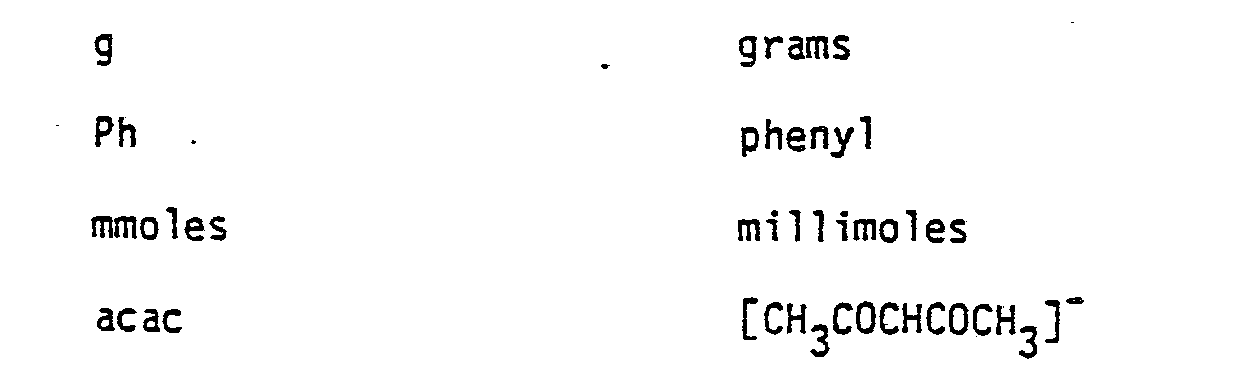
- As used in the Examples appearing below the following abbreviations and symbols have the indicated meanings:
- To a stirred suspension of 2.0 g (2.9 mmoles) of RhClCO(PPh3)2 and 2.8 g (17.7 mmoles) of sodium acetylacetonate dihydrate, 0.35 g (2.7mmoles) of 70% aqueous TBHP was added. 'The suspension was refluxed for 18 hours, then poured onto ice. A crude solid product weighing 1.4 g was isolated by filtration. The product was identified as Complex I by thin layer chromatography and infrared spectroscopy (νco=1980cm-1). The rhodium content of the filtrate was evaluated and found to be 0.0128 g, or 4.3% of the rhodium originally charged. Thus, 95.7% of the RhClCO(PPh3)2 originally charged was converted to Complex I.
- The procedure of Example 1 was followed except that no TBHP was added to the suspension of RhClCO(PPh3)2 and sod.ium acetylacetonate dihydrate in acetone. The crude yellow solids weighing 1.98 g recovered by filtration were identified by infrared spectroscopy (νco=1960cm-1) and thin layer chromatography as unchanged RhClCO(PPh3)2.
- Using the procedure of Bryant, et al., a sample of spent hydroformylation catalyst was converted to a WFE residue which was used to prepare 67.0 g of RhClCO(PPh3)2 containing 9.98 g (97 mmoles) of rhodium. The RhClCO(PPh3)2 and 91 g (580 mmoles) of sodium acetylacetonate dihydrate were suspended in acetone. 12.8 g (100 mmoles) of 70% aqueous TBHP was added, and the suspension was refluxed for 6.5 hours. The suspension was then poured onto ice, filtered and washed with distilled water. The recovered solids were then dried. The solids were identified by infrared spectroscopy as Complex I (vco = 1980 cm 1). The filtrate was analyzed for rhodium and found to contain 15% of that initially present corresponding to an 85% recovery in the form of Complex I.
- To a suspension of 2.0 g (2.9 mmoles) of RhClCO(PPh3)2 and 2.8 g (17.7 mmoles) of sodium acetylacetonate dihydrate in 100 ml of acetone was added 3.4 g (58 mmoles) of propylene oxide. The suspension was placed in a pressure bottle under 30 psi of nitrogen, heated to 65°C and stirred for 19 hours. The suspension was filtered and 3 g of crude yellow solids were recovered. The filtrate was analyzed to determine rhodium content, and the solids were analyzed by infrared spectroscopy to determine their composition. It was found that the solids contained Complex I in an amount corresponding to 54% of the RhClCO(PPh3)2 originally charged.
- The procedure described in Example 4 was used, but 7.0 g (59.8 mmoles) of styrene oxide was used in place of propylene oxide as the oxygen-transfer agent. 55% of the rhodium in the original sample was recovered as Complex I as determined by filtrate analysis and infrared spectrosopic examination of-the isolated solids.
- To a suspension of 2.0 g (2.9 mmoles) of RhClCO(PPh3)2 in acetone was added 1.74 g (17.4 mmoles) of acetylacetone and 3.4 g (58 mmoles) of propylene oxide. The reaction mixture was heated for 67 hours. Complex I was isolated as in Example 1. 34% of the original RhClCO(PPh3)2 was recovered as Complex I.
- To a. suspension of 2.0 g (2.9 mmoles) of RhClCO(PPh3)2 and 2.8 g (17.7 mmoles) of sodium acetylacetonate dihydrate in acetone was added 0.52 g (4.64 mmoles) of TMAO. The suspension was refluxed for 15.5 hours and then filtered. The isolated crude solids were analyzed as in Example 1 to determine composition and the filtrate analyzed for rhodium concentration. 99% of the original RhClCO(PPh3)2 was converted to Complex I.
- Using the procedure of Bryant, et al., a sample of spent hydroformylation catalyst was converted to a WFE residue which was used to prepare a 50.2 g (72.7 mmoles) sample of crude RhClCO(PPh3)2. The crude RhClCO(PPh3)2 was suspended in one liter of acetone along with 69 g (436 mmoles) of sodium acetylacetonate and 13.3 g (119 mmoles) of TMAO. This suspension was refluxed for 19 hours. Analysis of the filtrate and crude solids showed that 72% of the original RhClCO(PPh3)2 was converted to Complex I.
Claims (7)

Priority Applications (1)
| Application Number | Priority Date | Filing Date | Title |
|---|---|---|---|
| AT82105722T ATE9702T1 (en) | 1981-06-29 | 1982-06-28 | PROCESS FOR PREPARING RHODIUM (I) CARBONYL COMPLEXES. |
Applications Claiming Priority (2)
| Application Number | Priority Date | Filing Date | Title |
|---|---|---|---|
| US06/278,897 US4409149A (en) | 1981-06-29 | 1981-06-29 | Process for producing catalyst precursors |
| US278897 | 2002-10-24 |
Publications (2)
| Publication Number | Publication Date |
|---|---|
| EP0068480A1 true EP0068480A1 (en) | 1983-01-05 |
| EP0068480B1 EP0068480B1 (en) | 1984-10-03 |
Family
ID=23066848
Family Applications (1)
| Application Number | Title | Priority Date | Filing Date |
|---|---|---|---|
| EP82105722A Expired EP0068480B1 (en) | 1981-06-29 | 1982-06-28 | Process for preparing rhodium (i) carbonyl complexes |
Country Status (11)
| Country | Link |
|---|---|
| US (1) | US4409149A (en) |
| EP (1) | EP0068480B1 (en) |
| JP (1) | JPS588088A (en) |
| KR (1) | KR870000644B1 (en) |
| AT (1) | ATE9702T1 (en) |
| BR (1) | BR8203680A (en) |
| CA (1) | CA1182833A (en) |
| DE (1) | DE3260891D1 (en) |
| ES (1) | ES8303439A1 (en) |
| MX (1) | MX164152B (en) |
| ZA (1) | ZA823912B (en) |
Cited By (1)
| Publication number | Priority date | Publication date | Assignee | Title |
|---|---|---|---|---|
| US9163045B2 (en) | 2012-04-25 | 2015-10-20 | Umicore Ag & Co. Kg | Process for preparing diketonato-rhodium(I)-carbonyl complexes |
Families Citing this family (3)
| Publication number | Priority date | Publication date | Assignee | Title |
|---|---|---|---|---|
| CN102372745A (en) * | 2010-08-27 | 2012-03-14 | 中国石油化工股份有限公司 | Preparation method of hydroformylation catalyst precursor |
| CN102976913B (en) * | 2012-11-05 | 2014-12-03 | 中国海洋石油总公司 | Method for preparing high-purity acetylacetonatodicarbonyl rhodium through using rhodium trichloride |
| CN105503959B (en) * | 2014-09-26 | 2018-11-30 | 中国石油化工股份有限公司 | A method of preparing acetylacetonatodicarrhodium rhodium |
Family Cites Families (7)
| Publication number | Priority date | Publication date | Assignee | Title |
|---|---|---|---|---|
| US3636034A (en) | 1964-10-02 | 1972-01-18 | Mitsubishi Chem Ind | Surfactant production via rhodium-catalyzed oxo process |
| US3511880A (en) * | 1966-09-16 | 1970-05-12 | Union Oil Co | Hydrocarbonylation process |
| US3527809A (en) * | 1967-08-03 | 1970-09-08 | Union Carbide Corp | Hydroformylation process |
| GB1249303A (en) * | 1968-02-07 | 1971-10-13 | British Petroleum Co | Preparation of rhodium complexes |
| US3547964A (en) * | 1968-07-24 | 1970-12-15 | Union Oil Co | Group viii noble metal catalyst recovery |
| DE2448005C2 (en) * | 1974-10-09 | 1983-10-20 | Basf Ag, 6700 Ludwigshafen | Process for the regeneration of catalysts containing rhodium or iridium from distillation residues of hydroformylation mixtures |
| DE2614799C2 (en) * | 1976-04-06 | 1986-02-27 | Basf Ag, 6700 Ludwigshafen | Process for the regeneration of rhodium-containing catalysts by treating rhodium-containing distillation residues from hydroformylation mixtures |
-
1981
- 1981-06-29 US US06/278,897 patent/US4409149A/en not_active Expired - Lifetime
-
1982
- 1982-06-03 ZA ZA823912A patent/ZA823912B/en unknown
- 1982-06-03 CA CA000404445A patent/CA1182833A/en not_active Expired
- 1982-06-24 BR BR8203680A patent/BR8203680A/en not_active IP Right Cessation
- 1982-06-28 KR KR8202882A patent/KR870000644B1/en not_active Expired
- 1982-06-28 JP JP57110070A patent/JPS588088A/en active Granted
- 1982-06-28 DE DE8282105722T patent/DE3260891D1/en not_active Expired
- 1982-06-28 EP EP82105722A patent/EP0068480B1/en not_active Expired
- 1982-06-28 AT AT82105722T patent/ATE9702T1/en not_active IP Right Cessation
- 1982-06-28 MX MX193336A patent/MX164152B/en unknown
- 1982-06-28 ES ES513551A patent/ES8303439A1/en not_active Expired
Non-Patent Citations (2)
| Title |
|---|
| JOURNAL OF ORGANOMETALLIC CHEMISTRY, vol. 77, 1974, pages 107-115 * |
| JOURNAL OF THE CHEMICAL SOCIETY, September 1964, pages 3156-60; * |
Cited By (1)
| Publication number | Priority date | Publication date | Assignee | Title |
|---|---|---|---|---|
| US9163045B2 (en) | 2012-04-25 | 2015-10-20 | Umicore Ag & Co. Kg | Process for preparing diketonato-rhodium(I)-carbonyl complexes |
Also Published As
| Publication number | Publication date |
|---|---|
| JPS6411032B2 (en) | 1989-02-23 |
| DE3260891D1 (en) | 1984-11-08 |
| EP0068480B1 (en) | 1984-10-03 |
| BR8203680A (en) | 1983-06-21 |
| ES513551A0 (en) | 1983-03-01 |
| KR840000579A (en) | 1984-02-25 |
| CA1182833A (en) | 1985-02-19 |
| ATE9702T1 (en) | 1984-10-15 |
| JPS588088A (en) | 1983-01-18 |
| US4409149A (en) | 1983-10-11 |
| KR870000644B1 (en) | 1987-04-03 |
| MX164152B (en) | 1992-07-20 |
| ES8303439A1 (en) | 1983-03-01 |
| ZA823912B (en) | 1983-04-27 |
Similar Documents
| Publication | Publication Date | Title |
|---|---|---|
| EP0024091B1 (en) | Hydroformylation process and novel transition metal catalysts | |
| CA1152105B (en) | Hydroformylation process of olefins | |
| US4473655A (en) | Method for the recovery of rhodium complexes | |
| Bartik et al. | Synthesis, reactions, and catalytic chemistry of the water-soluble chelating phosphine 1, 2-bis [bis (m-sodiosulfonatophenyl) phosphino] ethane (DPPETS). Complexes with nickel, palladium, platinum, and rhodium | |
| EP0055487B1 (en) | Preparation of rhodium complex compounds | |
| DE3141456C2 (en) | ||
| JP2669423B2 (en) | Method for producing fluorinated hydrocarbon | |
| FR2511613A1 (en) | ORGANOMETALLIC COMPLEXES AND THEIR USE AS HOMOGENEOUS CATALYSTS | |
| EP0068480B1 (en) | Process for preparing rhodium (i) carbonyl complexes | |
| KR890003750B1 (en) | Process for the preparation of aldehydes | |
| JPWO1997011931A1 (en) | Hydroformylation Process | |
| EP0017183B1 (en) | Hydroformylation medium, process of production thereof and process for producing aldehydes using the hydroformylation medium | |
| Hirai et al. | Reactions of carbonyl compounds with phosphorus ylide generated from tribromofluoromethane and tris (dimethylamino) phosphine | |
| US5905175A (en) | Synthesis and purification of 3,3-dimethylbutyraldehyde via oxidation of 1-chloro-3,3-dimethylbutane with dimethyl sulfoxide | |
| Keiter et al. | Controlling the number of metal sites to which Ph2PCH2CH2PPhCH2CH2PPh2 coordinates in tungsten carbonyls | |
| US7160835B2 (en) | Bisphosphine process for producing the same and use thereof | |
| EP0150982B1 (en) | Process for producing acetone | |
| JP2775855B2 (en) | Method for producing aldehyde | |
| JP3794202B2 (en) | Recovery method of rhodium | |
| JP4145548B2 (en) | Sulfonated bisphosphine, its production method and its use | |
| PL137016B1 (en) | Process for preparing complex mono- -ketoenolates of carbonyltriorganophosphorhodium /i/ | |
| JPH0994461A (en) | Catalyst for synthesis of aldehyde or alcohol and production of aldehyde or alcohol using the same | |
| US20040249195A1 (en) | Lithium rho-diarylphosphinobenzenesulfonates, process for preparation of the same and use thereof | |
| JP4122534B2 (en) | Method for recovering Group VIII metal from carbonylation reaction solution | |
| JPS621960B2 (en) |
Legal Events
| Date | Code | Title | Description |
|---|---|---|---|
| PUAI | Public reference made under article 153(3) epc to a published international application that has entered the european phase |
Free format text: ORIGINAL CODE: 0009012 |
|
| AK | Designated contracting states |
Designated state(s): AT BE CH DE FR GB IT LI NL SE |
|
| 17P | Request for examination filed |
Effective date: 19830128 |
|
| ITF | It: translation for a ep patent filed | ||
| GRAA | (expected) grant |
Free format text: ORIGINAL CODE: 0009210 |
|
| AK | Designated contracting states |
Designated state(s): AT BE CH DE FR GB IT LI NL SE |
|
| REF | Corresponds to: |
Ref document number: 9702 Country of ref document: AT Date of ref document: 19841015 Kind code of ref document: T |
|
| REF | Corresponds to: |
Ref document number: 3260891 Country of ref document: DE Date of ref document: 19841108 |
|
| ET | Fr: translation filed | ||
| PG25 | Lapsed in a contracting state [announced via postgrant information from national office to epo] |
Ref country code: LI Effective date: 19850630 Ref country code: CH Effective date: 19850630 |
|
| PLBE | No opposition filed within time limit |
Free format text: ORIGINAL CODE: 0009261 |
|
| STAA | Information on the status of an ep patent application or granted ep patent |
Free format text: STATUS: NO OPPOSITION FILED WITHIN TIME LIMIT |
|
| 26N | No opposition filed | ||
| REG | Reference to a national code |
Ref country code: CH Ref legal event code: PL |
|
| PGFP | Annual fee paid to national office [announced via postgrant information from national office to epo] |
Ref country code: AT Payment date: 19860422 Year of fee payment: 5 |
|
| PG25 | Lapsed in a contracting state [announced via postgrant information from national office to epo] |
Ref country code: AT Effective date: 19890628 |
|
| ITTA | It: last paid annual fee | ||
| PGFP | Annual fee paid to national office [announced via postgrant information from national office to epo] |
Ref country code: NL Payment date: 19930630 Year of fee payment: 12 |
|
| PGFP | Annual fee paid to national office [announced via postgrant information from national office to epo] |
Ref country code: DE Payment date: 19940328 Year of fee payment: 13 |
|
| PGFP | Annual fee paid to national office [announced via postgrant information from national office to epo] |
Ref country code: SE Payment date: 19940329 Year of fee payment: 13 |
|
| PGFP | Annual fee paid to national office [announced via postgrant information from national office to epo] |
Ref country code: GB Payment date: 19940331 Year of fee payment: 13 |
|
| PGFP | Annual fee paid to national office [announced via postgrant information from national office to epo] |
Ref country code: FR Payment date: 19940405 Year of fee payment: 13 |
|
| PGFP | Annual fee paid to national office [announced via postgrant information from national office to epo] |
Ref country code: BE Payment date: 19940427 Year of fee payment: 13 |
|
| PG25 | Lapsed in a contracting state [announced via postgrant information from national office to epo] |
Ref country code: NL Effective date: 19950101 |
|
| EAL | Se: european patent in force in sweden |
Ref document number: 82105722.1 |
|
| NLV4 | Nl: lapsed or anulled due to non-payment of the annual fee | ||
| PG25 | Lapsed in a contracting state [announced via postgrant information from national office to epo] |
Ref country code: GB Effective date: 19950628 |
|
| PG25 | Lapsed in a contracting state [announced via postgrant information from national office to epo] |
Ref country code: SE Effective date: 19950629 |
|
| PG25 | Lapsed in a contracting state [announced via postgrant information from national office to epo] |
Ref country code: BE Effective date: 19950630 |
|
| BERE | Be: lapsed |
Owner name: UNION CARBIDE CORP. Effective date: 19950630 |
|
| GBPC | Gb: european patent ceased through non-payment of renewal fee |
Effective date: 19950628 |
|
| PG25 | Lapsed in a contracting state [announced via postgrant information from national office to epo] |
Ref country code: FR Effective date: 19960229 |
|
| PG25 | Lapsed in a contracting state [announced via postgrant information from national office to epo] |
Ref country code: DE Effective date: 19960301 |
|
| EUG | Se: european patent has lapsed |
Ref document number: 82105722.1 |
|
| REG | Reference to a national code |
Ref country code: FR Ref legal event code: ST |