EP0068701A2 - Proinsulin genes with modified C-chain - Google Patents
Proinsulin genes with modified C-chain Download PDFInfo
- Publication number
- EP0068701A2 EP0068701A2 EP82303071A EP82303071A EP0068701A2 EP 0068701 A2 EP0068701 A2 EP 0068701A2 EP 82303071 A EP82303071 A EP 82303071A EP 82303071 A EP82303071 A EP 82303071A EP 0068701 A2 EP0068701 A2 EP 0068701A2
- Authority
- EP
- European Patent Office
- Prior art keywords
- gene
- chain
- insulin
- dna
- chain gene
- Prior art date
- Legal status (The legal status is an assumption and is not a legal conclusion. Google has not performed a legal analysis and makes no representation as to the accuracy of the status listed.)
- Withdrawn
Links
Classifications
-
- C—CHEMISTRY; METALLURGY
- C12—BIOCHEMISTRY; BEER; SPIRITS; WINE; VINEGAR; MICROBIOLOGY; ENZYMOLOGY; MUTATION OR GENETIC ENGINEERING
- C12N—MICROORGANISMS OR ENZYMES; COMPOSITIONS THEREOF; PROPAGATING, PRESERVING, OR MAINTAINING MICROORGANISMS; MUTATION OR GENETIC ENGINEERING; CULTURE MEDIA
- C12N15/00—Mutation or genetic engineering; DNA or RNA concerning genetic engineering, vectors, e.g. plasmids, or their isolation, preparation or purification; Use of hosts therefor
- C12N15/09—Recombinant DNA-technology
- C12N15/63—Introduction of foreign genetic material using vectors; Vectors; Use of hosts therefor; Regulation of expression
- C12N15/66—General methods for inserting a gene into a vector to form a recombinant vector using cleavage and ligation; Use of non-functional linkers or adaptors, e.g. linkers containing the sequence for a restriction endonuclease
-
- C—CHEMISTRY; METALLURGY
- C07—ORGANIC CHEMISTRY
- C07K—PEPTIDES
- C07K14/00—Peptides having more than 20 amino acids; Gastrins; Somatostatins; Melanotropins; Derivatives thereof
- C07K14/435—Peptides having more than 20 amino acids; Gastrins; Somatostatins; Melanotropins; Derivatives thereof from animals; from humans
- C07K14/575—Hormones
- C07K14/62—Insulins
Definitions
- This invention is concerned with the synthesis of exact DNA genetic sequences and the joining of the synthetic gene to replicable cloning vehicles.
- Of particular concern is the total synthesis of the human-like proinsulin gene analogs, the insertion of the gene analogs into cloning vehicles, and the transferring of the hybrid DNA molecules into host cells, the transformed cells thus having the ability to produce the specified human-like proinsulin protein.
- the use of several adaptors for trimming DNA has been described, in particular trimming C-chain DNA down to a desired length.
- preproinsulin (S.J. Chan and D.F. Steiner, Proc. Nat. Acad. Sci. 73, 1964, 1976) is synthesized as the precursor of insulin.
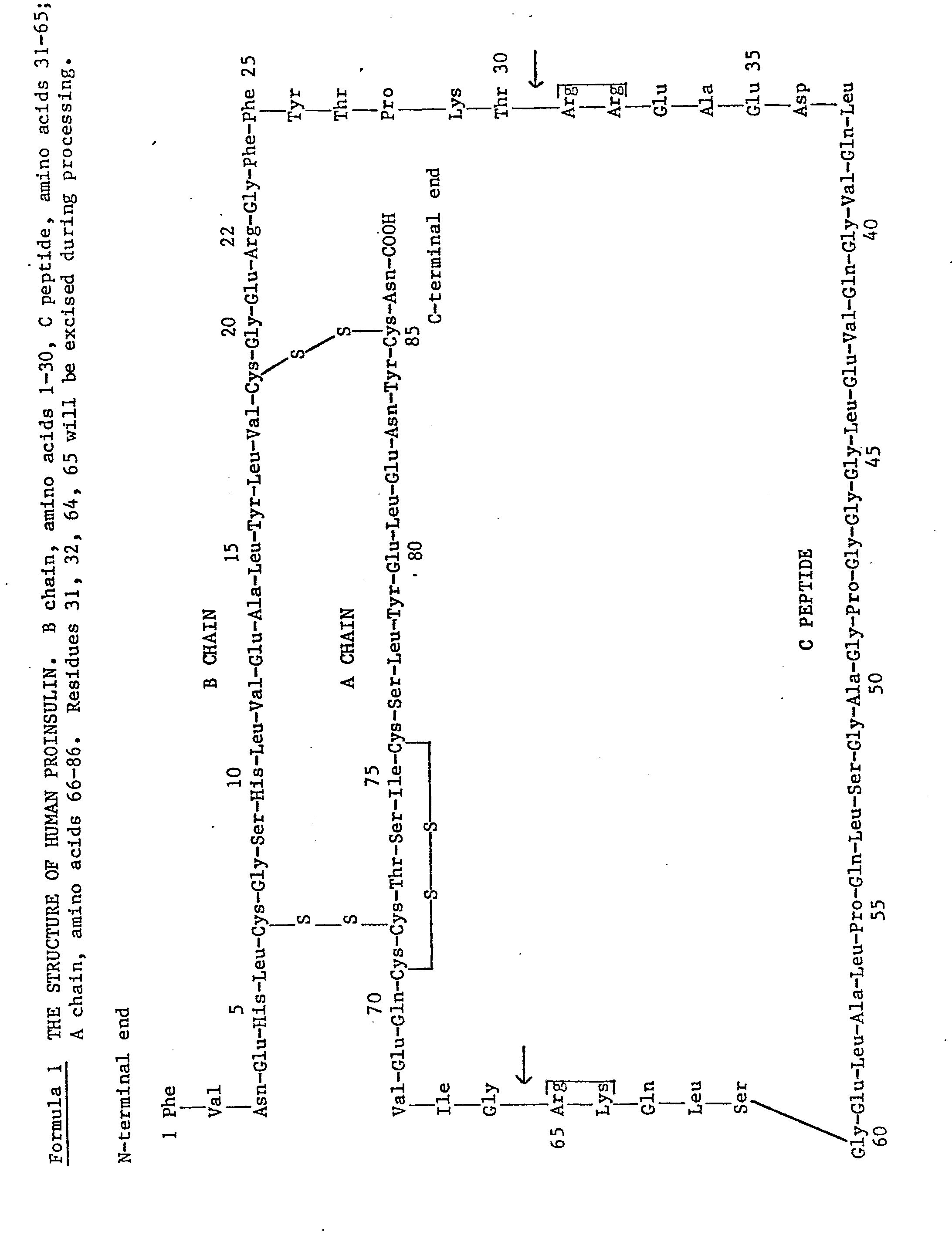
- the general structure of proinsulin is NH 2 -B chain-(C chain)-A chain-COOH; it is converted to insulin by the action of peptidases in the pancreatic islet tissue which remove the C-chain by cleavage at the positions of the two arrows shown in Formula 1 for the human proinsulin (Oyer et al, J. Biol. Chem., 246, 1375, 1971).
- the B-chain and A-chain of insulin are held together by two disulfide cross-linkages which are formed at the correct location at the stage of the proinsulin.
- Novel codon sequences for insulin C-chain gene have been provided. Shorter or mini-C-chains have been developed and used to form analogs of proinsulin. A restriction enzyme recognition site was incorporated in these C-chains by selection of appropriate codons at a selected location to facilitate opening and insertion of a DNA information sequence.
- the invention includes combining selected A-, B- and C-chains into novel proinsulin genes, ligating these genes to replicable cloning vehicles and transferring the resulting hybrid into host cells.
- a synthetic human-like proinsulin gene (formula 2) has been synthesized by a combination of chemical and enzymatic methods.
- a start signal (ATG) and an EcoRI cohesive end (5' AATT) was placed at the 5' end (left-hand end) of the gene, and a stop signal (TGA) and a BamHI cohesive end (5' GATC) was placed at the 3' end of the gene.
- This adapted proinsulin gene was joined to a replicable cloning vehicle that can enter a cell and replicate itself together with the cloning vehicle.
- the transformed host cell progeny was shown by DNA sequence analysis to contain the exact input proinsulin gene.
- a plasmid cloning vehicle has been constructed which includes a lactose promoter and produces several hundred copies of the proinsulin gene per cell
- This type of adaptor for trimming DNA can be blunt-end ligated to any DNA from which 8 nucleotides at the end can be removed.
- MboII adaptor is used as an example to remove eight nucleotides N N N N N N N N from the end of a cloned insulin A-chain gene.
- the dXTP is chosen so that it is identical to the one adjacent to 'N' at the 3' end of the cloned A-chain gene, e.g. if the nucleotide "X" is C then dCTP is used.
- adaptors for trimming DNA of this type containing 1 to 7 additional nucleotides beyond the MboII or HphI recognition sites can be used to trim off 7 to 1 base pairs from the ends of any DNA duplex (Narang et al, Nucleic Acids Res. Symposium Series No. 7, 377, 1980). This technique was used in modifying the insulin C-chain.
- the human-like proinsulin gene which we prepared is given in formula 2.
- This codon sequence (base pairs 1 through 258) was selected by us and codes for the human-like proinsulin, the structure of which is shown in formula 1.
- the coding sequence (gene sequence) was based on that of the rat proinsulin gene (Ullrich et al, Science 196, 1313, 1977) wherever the amino acids are in common.
- the amino acids in positions 3, 9, 30, 34, 37, 40, 42, 49, 52, 55, 60, 61, 62 and 69 for the human proinsulin are different than those in rat, thus in these positions a coding sequence for the human proinsulin was selected.
- the nucleotides 1-90, 91-195 and 196-258 code for human-like insulin chain B, chain C and chain A, respectively.
- the codons we selected form a unique combination.
- the human-like proinsulin gene was assembled in the following way.
- the gene coding for the B-chain and a major portion of the C-chain was constructed as one unit which included the start signal (on fragments B-18 and B-19) and the coding sequence (nucleotides 1-178 of the upper strand and 1-182 of the lower strand of formula 2).
- This synthetic DNA was constructed from 32 synthetic fragments of 10 to 13 nucleotides in length. Four to six fragments were first joined together by cohesive-end ligation using DNA ligase to give six groups of fragments (a-f in formula 6). The sequence of each fragment was shown in formula 2.
- a similar scheme can be used for other proinsulin analogs.
- Formula 6 A scheme for the construction of B+C chain of a human-like proinsulin gene.
- each group of fragments about 800 pmoles of each synthetic fragment (4 to 6 fragments) was phosphorylated at its 5'-end with 32 p using polynucleotide kinase.
- the phosphorylated fragment was purified on a 20% p p lyacrylamide gel.
- About 500 pmoles of each purified fragment was annealed in 30 ⁇ l volume at 65°C and slowly cooled to 0°C.
- Concentrated DNA ligase buffer was added to give the following final concentrations: 50 mM Tris-HCl (pH 7.6), 10 mM MgCl 2 , 10 mM dithiothreitol, 100 ⁇ M ATP.
- T 4 polynucleotide ligase (0.4 unit) was added and the mixture incubated at 12°C for 24-36 hours.
- the ligation product was purified on a 15% polyacrylamide gel (denaturing condition).
- the yield of fragments incorporated into each group (a through f) varied between 120 and 250 pmoles.
- one group was joined to the adjacent group (e.g. group a to b) by cohesive-end ligation until all six groups were connected to give structure I of formula 6.
- the ligation conditions are the same as given in the paragraph above.
- the yield of structure I was about 20 pmoles.
- the cloned human-like insulin A-chain gene has been reported in a pending U.S. patent application No. 129,880, filed March 27, 1980, by S.A. Narang and R.J. Wu, which is hereby incorporated by reference.
- the insulin A-chain gene has been retrieved (recovered) from the clone by digestion with EcoRI restriction enzyme, which exposed the EcoRI site eight nucleotides away from the A-chain gene as shown in formula 7.
- the 3' end (right-hand end) of the cloned A-chain gene at this stage is still joined to the stop adaptor and pBR322 plasmid cloning vehicle.
- the eight extra nucleotides at the 5' end (lefthand side) of the insulin A-chain gene (which includes the start signal) has been removed by using a MboII trimming adaptor.
- the DNA in formula 7 was first repaired by using dATP and dTTP in the presence of AMV reverse transcriptase.
- a decanucleotide MboII adaptor for trimming DNA was next blunt-end ligated to the repaired end to give:
- human-like proinsulin gene can - also be constructed by joining the same 32 fragments of the B+C chain and the retrieved A-chain gene in several different ways.
- the natural human proinsulin contains a C-chain consisting of 35 amino acids.
- the efficiency of removing the C-chain by peptidases to produce biologically active insulin (B+A chains) may be influenced by the length of the C-chain.
- One or several of the proinsulin analogs may prove to be superior than the natural proinsulin in giving a higher yield of the biologically active insulin, and possibly the modified C-chains will have less physiological side effects.
- This can be accomplished by constructing the B+C chain in a similar way as that in formula 6 except that groups d, e, f have been redesigned (see formula 11) by eliminating fragments C-5 and C-13 to give a C-chain shorter by 12 base pairs (see formula 11).
- the C-chain gene can be shortened to only 18 base pairs by ligating the following synthetic fragments between the right-hand end of the B-chain gene and the left-hand end of the A-chain gene as follows:
- the human-like proinsulin gene (chain B-C-A), or its analogs, which carries a start signal at the 5' end (left-end) and the stop signal at the 3' end (right-end) was jointed to EcoRI- and BamHI-digested pBR322 plasmid and the resulting hybrid DNA used to transform E. coli (strain 5346). This strain and the containment facilities used conformed to current recombinant DNA regulations.
- the exact sequence of several cloned proinsulin genes was determined by DNA sequence analysis.
- the C-chain gene in the cloned human-like proinsulin gene also can be shortened after digesting the latter with Sau3A restriction enzyme to give a DNA structure in which the right-hand end is similar to that shown in Structure I above, and the left-hand end includes all of the B-chain gene and an additional 325 base pairs of the DNA from the cloning vehicle pBR322.
- This molecule can be shortened from the right-hand end in two ways:
- the C-chain gene of the proinsulin can be shortened by a total of 12, 18, 24 or 30 base pairs leftward from the nucleotide #182 of Formula 2 above.
- the C-chain gene can be lengthened by digesting the cloned human-like proinsulin gene with Sau3A restriction enzyme as described above and inserting DNA fragments of different lengths.
- the 5' protruding end (5' GCTA) can be joined by cohesive-end ligation to another molecule of synthetic fragment C-16 followed by C-7. After repair synthesis with 4 dNTP and the AMV reverse transcriptase, the blunt- ended DNA is now 13 base pairs longer.
- the C-chain gene which is still attached to the B-chain gene and some pBR322 DNA, it can be blunt-end ligated to the retrieved and modified insulin A-chain gene (Structure II, above) after cleaving off the 4 protruding nucleotides (5' GATC at the Sau3A site) at the left-hand end by Sl nuclease (as mentioned in the previous paragraph).
- the product is then digested by EcoRI and BamHI restriction enzymes to release the shortened proinsulin gene (corresponding to the parent structure shown at the bottom of Formula 10, above), and ligated by cohesive-end ligation to EcoRI- and BamHI-digested pBR322 plasmid and cloned as described previously.
- the resulting adapted proinsulin gene carrying an EcoRI site at each end can be ligated to a plasmid such as pBGP 120 (Polisky et al, Proc. Nat. Acad. Sci. 73, 3900, 1976) or pLL70 (Lau and Wu, unpublished result), adjacent to a strong lactose promoter for expression.
- a plasmid such as pBGP 120 (Polisky et al, Proc. Nat. Acad. Sci. 73, 3900, 1976) or pLL70 (Lau and Wu, unpublished result).
- This reconstructed hybrid plasmid DNA carrying the proinsulin gene can be used to transform E. coli cells and to direct the synthesis of large amounts of the human proinsulin, which is a natural precursor of biologically active insulin.
- the E. coli proinsulin clone is being maintained in the Dept. of Biochemistry at Cornell University, Ithaca, N.Y. and will be made available as required.
Landscapes
- Health & Medical Sciences (AREA)
- Life Sciences & Earth Sciences (AREA)
- Genetics & Genomics (AREA)
- Chemical & Material Sciences (AREA)
- Organic Chemistry (AREA)
- Engineering & Computer Science (AREA)
- Molecular Biology (AREA)
- Zoology (AREA)
- Biochemistry (AREA)
- Biophysics (AREA)
- General Health & Medical Sciences (AREA)
- Biotechnology (AREA)
- Biomedical Technology (AREA)
- General Engineering & Computer Science (AREA)
- Bioinformatics & Cheminformatics (AREA)
- Wood Science & Technology (AREA)
- Proteomics, Peptides & Aminoacids (AREA)
- Physics & Mathematics (AREA)
- Medicinal Chemistry (AREA)
- Gastroenterology & Hepatology (AREA)
- Toxicology (AREA)
- Plant Pathology (AREA)
- Endocrinology (AREA)
- Microbiology (AREA)
- Diabetes (AREA)
- Preparation Of Compounds By Using Micro-Organisms (AREA)
- Peptides Or Proteins (AREA)
- Medicines That Contain Protein Lipid Enzymes And Other Medicines (AREA)
Abstract
Human-like proinsulin gene analogs have been synthesized by a combination of chemical and enzymatic methods. A number of different human-like proinsulin gene analogs with altered C-chains have been designed and can be readily constructed as described. As a part of the strategy, an adaptor for trimming DNA has been used to recover the A-chain insulin gene with the desired sequence from a hybrid plasmid; a related adaptor for trimming DNA has been used to shorten the C-chain gene. The synthetic proinsulin gene has been joined to a replicable cloning vehicle and the hybrid DNA transferred to a host cell. The transformed host cells can be grown under selected conditions to yield the proinsulin analogs.
Description
- This invention is concerned with the synthesis of exact DNA genetic sequences and the joining of the synthetic gene to replicable cloning vehicles. Of particular concern is the total synthesis of the human-like proinsulin gene analogs, the insertion of the gene analogs into cloning vehicles, and the transferring of the hybrid DNA molecules into host cells, the transformed cells thus having the ability to produce the specified human-like proinsulin protein. The use of several adaptors for trimming DNA has been described, in particular trimming C-chain DNA down to a desired length.
- In recent years, methods have been developed (see "Molecular Cloning of Recombinant DNA", eds., W.A. Scott and R. Werner, Academic Press Inc., 1977), (1) for the in vitro joining by DNA ligase of a DNA segment to be cloned to a cloning vehicle (DNA capable of independent replication),
- (2) for introducing the hybrid DNA molecule (recombinant DNA) into a suitable host.cell,
- (3) for selecting and identifying the transformed cells carrying the desired hybrid DNA (cloned DNA as a hybrid DNA),
- (4) for amplifying the desired cloned DNA in the transformed cells, and
- (5) for expressing the cloned DNA as a protein product. In most reported cases, DNA molecules isolated from cells or viruses have been fragmented by restriction enzyme digestion or by physical shearing or by reverse transcription copy of messenger to cDNA before cloning.
- Protein synthesis in bacteria using a segment of transferred DNA derived from mouse as the blue print was shown by Chang et al. (Cell '6, 231-244, 1975). Still other examples of the cloning of natural foreign DNA have been described recently (Goeddel et al, Nature 281, 544-548, 1979; etc.).
- Methods for the total chemical synthesis of oligodeoxynucleotides of up to 20-nucleotides-long have been well established by using either the phosphodiester method (H.G. Khorana, J. Mol. Biol. 72, 209, 1972) or the improved phosphotriester method (H.M. Hsiung and S.A. Narang, Nucleic Acids Res. 6, 1371, 1979; S.A. Narang et al, Methods in Enzymology, Vol. 65, 610, 1980, and Vol. 68, 90, 1979). The latter method is now the preferred method because of its higher speed, better yield and purity of products, and has been used to prepare defined DNA sequences of longer length.
- A few chemically-synthesized DNA sequences, such as the lactose operator (Marians, Wu, et al, Nature 263, 744, 1976) and the tyrosine tRNA gene (Khorana, Science 203, 614, 1979), have been successfully cloned in E. coli and the expression of the cloned DNA detected in subsequent cultures. Recent reports have indicated that human brain hormone somatostatin (Itakura et al, Science 198, 1056, 1977) and human growth hormone (Goeddel et al, Nature 281, 544, 1979) have been produced in a transformed bacterial host which had the transferred synthesized gene.
- In the pancreas of animals, preproinsulin (S.J. Chan and D.F. Steiner, Proc. Nat. Acad. Sci. 73, 1964, 1976) is synthesized as the precursor of insulin. The general structure of proinsulin is NH2-B chain-(C chain)-A chain-COOH; it is converted to insulin by the action of peptidases in the pancreatic islet tissue which remove the C-chain by cleavage at the positions of the two arrows shown in Formula 1 for the human proinsulin (Oyer et al, J. Biol. Chem., 246, 1375, 1971). The B-chain and A-chain of insulin are held together by two disulfide cross-linkages which are formed at the correct location at the stage of the proinsulin.
- Using a biological method, Ullrich et al, (Science 196, 1313, 1977) and Villa-Komoroff et al, (Proc. Nat.'Acad. Sci. 75, 3727, 1978) succeeded in cloning the coding region of rat proinsulin I. Using a chemical method, Crea et al, (Proc. Nat. Acad. Sci. 75, 5765, 1978), synthesized, and Goeddel et al (Proc. Nat. Acad. Sci. 76, 106, 1979), cloned, an insulin A-chain gene and a B-chain gene, separately. The codons selected for these synthetic genes were arbitrary and quite different from the natural human DNA sequence. On culturing, the bacteria produced an insulin A-chain protein and B-chain protein which were separately treated to remove the extraneous g-galactosidase and methionine.
- In U.S. Patent Application Serial No. 843,422, filed Oct. 19, 1977, by R. Wu et al, and U.S. Patent Application Serial No. 129,880,
- Novel codon sequences for insulin C-chain gene (DNA) have been provided. Shorter or mini-C-chains have been developed and used to form analogs of proinsulin. A restriction enzyme recognition site was incorporated in these C-chains by selection of appropriate codons at a selected location to facilitate opening and insertion of a DNA information sequence.
- The invention includes combining selected A-, B- and C-chains into novel proinsulin genes, ligating these genes to replicable cloning vehicles and transferring the resulting hybrid into host cells. In particular, for example, a synthetic human-like proinsulin gene (formula 2) has been synthesized by a combination of chemical and enzymatic methods. A start signal (ATG) and an EcoRI cohesive end (5' AATT) was placed at the 5' end (left-hand end) of the gene, and a stop signal (TGA) and a BamHI cohesive end (5' GATC) was placed at the 3' end of the gene. This adapted proinsulin gene was joined to a replicable cloning vehicle that can enter a cell and replicate itself together with the cloning vehicle. The transformed host cell progeny was shown by DNA sequence analysis to contain the exact input proinsulin gene. A plasmid cloning vehicle has been constructed which includes a lactose promoter and produces several hundred copies of the proinsulin gene per cell.
- Formula 2. DNA SEQUENCE OF HUMAN-LIKE PROINSULIN GENE. The duplex structure represented by base pairs 1 through 258 constitutes the proinsulin gene. The B-chain, C-chain and A-chain start from base pairs 1, 91 and 196, respectively.
-

- The principle behind this type of retrieving (trimming) adaptor is based on the knowledge that certain restriction endonucleases such as HphI and MboII cleave DNA eight nucleotides away from their recognition sequence (R.J. Roberts, Methods in Enzymol. 68, 27, 1980). In formula 3, the five nucleotides with a line drawn above constitute the recognition sequence, where N stands for any nucleotide.
-

- We 'have designed and synthesized adaptors for trimming DNA as symmetric adaptors (non-symmetric adaptors based on formula 3 can also be used):
-

- This type of adaptor for trimming DNA can be blunt-end ligated to any DNA from which 8 nucleotides at the end can be removed. MboII adaptor is used as an example to remove eight nucleotides N N N N N N N N from the end of a cloned insulin A-chain gene.
- The dXTP is chosen so that it is identical to the one adjacent to 'N' at the 3' end of the cloned A-chain gene, e.g. if the nucleotide "X" is C then dCTP is used.

- In principle, adaptors for trimming DNA of this type containing 1 to 7 additional nucleotides beyond the MboII or HphI recognition sites can be used to trim off 7 to 1 base pairs from the ends of any DNA duplex (Narang et al, Nucleic Acids Res. Symposium Series No. 7, 377, 1980). This technique was used in modifying the insulin C-chain.
- The chemical synthesis of all the deoxyribooligonucleotides constituting the sequence of human proinsulin DNA as in formula 2 and various adaptors were achieved by the modified phosphotriester approach developed in one of our labs in 1973 (Can. J. Chem. 51, 3649, 1973; S. Narang et al, Methods of Enzymology 65, 610, 1980; and S. Narang et al, Methods in Enzymology 68, 90, 1979). The main features of our approach are:
- (i) use of 5'-dimethoxytrityl-deoxyribomononucleoside 3'-phosphotriester (monomer) as a starting material;
- (ii) condensation between 5'-dimethoxytrityl-deoxyribomononucleoside 3'-phosphodiester with a 5'-hydroxy containing component to yield a di- nucleotide containing an internucleotidic phosphotriester linkage as a neutral species which is amenable to all the conventional techniques of organic chemistry for their isolation; and
- (iii) formation of the desired product in a higher yield because of the absence of side products.
- The synthesis of all the deoxyribooligomers (10-20 units length) were constructed from the sixteen possible dimer blocks. Each coupling reaction was performed using almost stoichiometric amounts of each component in the presence of mesitylenesulfonyl tetrazole, as coupling reagent (S. Narang et al, U.S. Patent No. 4,059,592, 22 November 1977), for 30-45 min. at room temperature. After work-up, the desired product was isolated by the reversed-phased chromatographic technique developed by H. M. Hsiung et al, Nucleic Acid Res. 6, 1371, 1979. After the completion of synthesis, the 5'-dimethoxytrityl group was removed using 2% benzenesulfonic solution in chloroform-methanol (J. Stawinski et al, Nucleic Acid Res. 4, 353, 1977). All the other protecting groups were removed by two-step concentrated ammonia treatments (H.M. Hsiung et al, Nucleic Acid Res. 8, 5753, 1980). Each of the unprotected oligomers was purified on P.EI-tlc plate and sequenced by the mobility-shift method (C.D. Tu et al, Anal. Biochem. 74, 73, 1976). Each fragment sequence was confirmed and their autoradiographs have been published (Nucleic Acid Res. 6, 1371, 1979; 7, 2199, 1979; 8, 5753, 1980).
- The human-like proinsulin gene which we prepared is given in formula 2. This codon sequence (base pairs 1 through 258) was selected by us and codes for the human-like proinsulin, the structure of which is shown in formula 1. The coding sequence (gene sequence) was based on that of the rat proinsulin gene (Ullrich et al, Science 196, 1313, 1977) wherever the amino acids are in common. The amino acids in positions 3, 9, 30, 34, 37, 40, 42, 49, 52, 55, 60, 61, 62 and 69 for the human proinsulin are different than those in rat, thus in these positions a coding sequence for the human proinsulin was selected. In formula 2 the nucleotides 1-90, 91-195 and 196-258 code for human-like insulin chain B, chain C and chain A, respectively. The codons we selected form a unique combination.
- The human-like proinsulin gene was assembled in the following way. The gene coding for the B-chain and a major portion of the C-chain was constructed as one unit which included the start signal (on fragments B-18 and B-19) and the coding sequence (nucleotides 1-178 of the upper strand and 1-182 of the lower strand of formula 2). This synthetic DNA was constructed from 32 synthetic fragments of 10 to 13 nucleotides in length. Four to six fragments were first joined together by cohesive-end ligation using DNA ligase to give six groups of fragments (a-f in formula 6). The sequence of each fragment was shown in formula 2. A similar scheme can be used for other proinsulin analogs.
-

- Formula 6(cont.)Structure I

- In constructing each group of fragments, about 800 pmoles of each synthetic fragment (4 to 6 fragments) was phosphorylated at its 5'-end with 32p using polynucleotide kinase. The phosphorylated fragment was purified on a 20% pplyacrylamide gel. About 500 pmoles of each purified fragment was annealed in 30 µl volume at 65°C and slowly cooled to 0°C. Concentrated DNA ligase buffer was added to give the following final concentrations: 50 mM Tris-HCl (pH 7.6), 10 mM MgCl2, 10 mM dithiothreitol, 100 µM ATP. T4 polynucleotide ligase (0.4 unit) was added and the mixture incubated at 12°C for 24-36 hours. The ligation product was purified on a 15% polyacrylamide gel (denaturing condition). The yield of fragments incorporated into each group (a through f) varied between 120 and 250 pmoles.
- In the next step, one group was joined to the adjacent group (e.g. group a to b) by cohesive-end ligation until all six groups were connected to give structure I of formula 6. The ligation conditions are the same as given in the paragraph above. The yield of structure I was about 20 pmoles.
- The cloned human-like insulin A-chain gene has been reported in a pending U.S. patent application No. 129,880, filed March 27, 1980, by S.A. Narang and R.J. Wu, which is hereby incorporated by reference. The insulin A-chain gene has been retrieved (recovered) from the clone by digestion with EcoRI restriction enzyme, which exposed the EcoRI site eight nucleotides away from the A-chain gene as shown in formula 7.
- Formula 7 The Cloned Insulin A-chain Gene.

- Note that the 3' end (right-hand end) of the cloned A-chain gene at this stage is still joined to the stop adaptor and pBR322 plasmid cloning vehicle. The eight extra nucleotides at the 5' end (lefthand side) of the insulin A-chain gene (which includes the start signal) has been removed by using a MboII trimming adaptor. The DNA in formula 7 was first repaired by using dATP and dTTP in the presence of AMV reverse transcriptase. A decanucleotide MboII adaptor for trimming DNA was next blunt-end ligated to the repaired end to give:
- The blunt-end ligation was carried out in 15 µl of a reaction mixture containing 50 mM Tris-HC1 (pH 7.6), 10 mM MgCl2, 10 mM dithiothreitol 100 µM ATP, 100 pmoles of the self-complementary MboII adaptor, 30 pmoles of cloned A-chain gene, and 0.3 units of T4 polynucleotide kinase. Incubation was at 12°C for 40 hours.

- Cleavage of DNA shown in formula 8 with MboII restriction enzyme (which cleaves DNA at the arrows, eight nucleotides away from recognition sequence GAAGA),. followed by E. coli polymerase I (in the presence of 32p dCTP or cold dCTP to insure that the end of DNA is flushed), results in the removal of the eight extra base pairs from the A-chain gene. The retrieved A-chain gene was next cleaved with BamHI restriction enzyme, which gave the following structure:
-

- The retrieved insulin A-chain gene was blunt-end ligated to segments C-8 and C-17 to give structure II.Structure II was then joined to structure I at their Sau3A sites by cohesive-end ligation under the same conditions as given above for each group of fragments, to give the proinsulin (B+C+A chain) gene as shown in formula 10, lower part. This same synthesis strategy can be adapted to prepare other proinsulin gene analogs.

-

- It must be pointed out that the human-like proinsulin gene can - also be constructed by joining the same 32 fragments of the B+C chain and the retrieved A-chain gene in several different ways.
- The natural human proinsulin contains a C-chain consisting of 35 amino acids. The efficiency of removing the C-chain by peptidases to produce biologically active insulin (B+A chains) may be influenced by the length of the C-chain. Thus, we designed several methods to produce proinsulin analogs by changing the length of the C-chain gene, which would lead to proinsulin analogs with different lengths of the C-chain. One or several of the proinsulin analogs may prove to be superior than the natural proinsulin in giving a higher yield of the biologically active insulin, and possibly the modified C-chains will have less physiological side effects. (a) In one method, the length of the C-chain gene (normally 35 amino acids X3 = 105 base pairs) can be assembled by omitting two or more fragments to give only 93, 84 or 72 base pairs, respectively. This can be accomplished by constructing the B+C chain in a similar way as that in formula 6 except that groups d, e, f have been redesigned (see formula 11) by eliminating fragments C-5 and C-13 to give a C-chain shorter by 12 base pairs (see formula 11). In a similar manner, the elimination of fragments C-3, C-4, C-11, and C-12, gave a C-chain shorter by 21 base pairs, or the elimination of fragments C-3, C-4, C-5, C-11, C-12, and C-13, gave aC-chain shorter by 33 base pairs.
- Scheme for the construction of a shorter B+C chain of a human-like proinsulin gene. Groups a), b) and c) are the same as in formula 6 and are not shown.
-

- These constructions are possible since the nucleotide sequence at the junctions of the eliminated fragments (C-2, C-4, and C-5) are identical and they all contain a 3' protruding sequence d(G-G-G-T) in the upper strand (see formula 2, underlined nucleotides, and formula 11). Thus, we can eliminate one or two or three segments from the upper strand and still allow annealing with the d(C-C-C-A) sequence in the lower strand to give C-chains of different length. Once the different shortened C-chains are assembled, each will be joined to groups a), b), and c) of formula 6 to give shortened B+C chain gene similar to structure I of formula 10. Finally, shortened structure I is jointed to structure II of formula 10 to give shortened proinsulin genes as analogs of the normal gene.
- (b) The C-chain gene can be shortened to only 18 base pairs by ligating the following synthetic fragments between the right-hand end of the B-chain gene and the left-hand end of the A-chain gene as follows:
-

- The human-like proinsulin gene (chain B-C-A), or its analogs, which carries a start signal at the 5' end (left-end) and the stop signal at the 3' end (right-end) was jointed to EcoRI- and BamHI-digested pBR322 plasmid and the resulting hybrid DNA used to transform E. coli (strain 5346). This strain and the containment facilities used conformed to current recombinant DNA regulations. The desired clones were identified by colony hybridization (Grunstein and Hogness, Proc. Nat. Acad. Sci. 72, 3961, 1975) with 32p-labelled C-chain fragment (17-32 nucleotides long), and 32P=labelled cloned A-chain fragment. Among the positive clones, the exact sequence of several cloned proinsulin genes was determined by DNA sequence analysis.
- The C-chain gene in the cloned human-like proinsulin gene also can be shortened after digesting the latter with Sau3A restriction enzyme to give a DNA structure in which the right-hand end is similar to that shown in Structure I above, and the left-hand end includes all of the B-chain gene and an additional 325 base pairs of the DNA from the cloning vehicle pBR322. This molecule can be shortened from the right-hand end in two ways:
- (i) by removing the 4 protruding nucleotides (5' GATC) by S1 nuclease digestion (Vogt et al, Europ. J. Biochem. 33, 192, 1973) and joining a Mbo II retrieving adaptor by blunt-end ligation. After carrying out the steps shown in Formula 5 above, 8 base pairs can be removed from the right-hand end to shorten this part of the C-chain by 12 base pairs (4+8). By repeating the Mbo II retrieving adaptor procedure (Formula 5) one or more cycles, but using the following adaptor (Formula 13), 6 base pairs can be removed in each cycle from the right-hand end of the already shortened C-chain gene.
-

- By using the above methods, the C-chain gene of the proinsulin can be shortened by a total of 12, 18, 24 or 30 base pairs leftward from the nucleotide #182 of Formula 2 above.
- (ii) by digesting the DNA with a combination of exonuclease III and Sl nuclease (Wu et al, Biochem. 15, 734, 1976; Roberts et al, Proc. Natl. Acad. Sci. 76, 760, 1978) or with BAL31 (Legerski et al, Nucleic Acids Res. 5; 1445, 1978; Talmadge et al, Proc. Natl. Acad. Sci. 77, 3369 and 3988, 1980). In this method from about 6 to 81 base pairs can be removed and those DNA molecules with a multiple of 3 base pairs removed (e.g. 6, 9, 12, 15, .... 81) can be selected after cloning and DNA sequence analysis.
- The C-chain gene can be lengthened by digesting the cloned human-like proinsulin gene with Sau3A restriction enzyme as described above and inserting DNA fragments of different lengths. For example, the 5' protruding end (5' GCTA) can be joined by cohesive-end ligation to another molecule of synthetic fragment C-16 followed by C-7. After repair synthesis with 4 dNTP and the AMV reverse transcriptase, the blunt- ended DNA is now 13 base pairs longer. When this molecule is blunt-end ligated to the Sl nuclease digested structure II above, which digestion removed 4 base pairs from the retrieved and modified insulin A-chain gene, the net result is an addition of 9 base pairs to the C-chain of the proinsulin gene (codes for three additional amino acids). Using the same procedure but adding C-16, C-7, C-15 and C-6 fragments, the end result is the addition of 21 base pairs (seven additional amino acids). Similarly, other multiples of three base pairs can be added.
- After the modification of the C-chain gene, which is still attached to the B-chain gene and some pBR322 DNA, it can be blunt-end ligated to the retrieved and modified insulin A-chain gene (Structure II, above) after cleaving off the 4 protruding nucleotides (5' GATC at the Sau3A site) at the left-hand end by Sl nuclease (as mentioned in the previous paragraph). The product is then digested by EcoRI and BamHI restriction enzymes to release the shortened proinsulin gene (corresponding to the parent structure shown at the bottom of Formula 10, above), and ligated by cohesive-end ligation to EcoRI- and BamHI-digested pBR322 plasmid and cloned as described previously.
- For maximum expression, the cloned proinsulin gene can be excised by digestion of the cloned hybrid plasmid DNA with EcoRI and BamHI endonucleases. The BamHI end can be converted to an EcoRI end by using an EcoRI-BamHI conversion adaptor of the type reported in U.S. Patent Application No. 129,880, filed March 27, 1980 by S.A. Narang and R.J. Wu. The conversion adaptor has the structure:
- Formula 14 EcoRI-BamHI Conversion Adaptor

- The resulting adapted proinsulin gene carrying an EcoRI site at each end can be ligated to a plasmid such as pBGP 120 (Polisky et al, Proc. Nat. Acad. Sci. 73, 3900, 1976) or pLL70 (Lau and Wu, unpublished result), adjacent to a strong lactose promoter for expression. This reconstructed hybrid plasmid DNA carrying the proinsulin gene can be used to transform E. coli cells and to direct the synthesis of large amounts of the human proinsulin, which is a natural precursor of biologically active insulin. Alternatively, the cloned proinsulin gene can be joined to the lactose promoter and then to plasmid pKN402 (Uhlin et al, Gene 6, 91, 1979), or a derivative of it, which can produce over 200 copies of the plasmid per E. coli cell. The copy number of this plasmid is at least seven times more than that of pBGP120 or pBR322. Thus, over 200 copies of the proinsulin gene can be synthesized per E. coli cell to yield up to 500,000 copies of the proinsulin protein per cell.
- The E. coli proinsulin clone is being maintained in the Dept. of Biochemistry at Cornell University, Ithaca, N.Y. and will be made available as required.
Claims (15)
1. An insulin C-chain gene analog shortened or lengthened from the normal gene length by the deletion or addition of nucleotides, respectively.
2. The insulin C-chain gene analog of claim 1 shortened or lengthened by the deletion or addition of nucleotides in multiples of three.
3. The insulin C-chain gene of claim I wherein the normal gene length is the duplex DNA nucleotides 91-195 of formula 2 herein.
4. An insulin C-chain partial gene as in claim 3 having the duplex DNA sequence C-1 to C-7 plus C-9 to C-16 of formula 2, suitable for ligation to appropriately adapted insulin A-chain and B-chain genes.
5. The insulin C-chain gene of claim 3 shortened 12 base pairs by deletion of fragments C-5 and C-13.
6. The insulin C-chain gene of claim 3 shortened 21 base pairs by deletion of fragments C-3, C-4, C-11 and C-12.
7. The insulin C-chain gene of claim 3 shortened 33 base pairs by deletion of fragments C-3, C-4, C-5, C-11, C-12 and C-13.
8. The insulin C-chain gene of claim 3 shortened by one of 12, 18, 24, 30, or more base pairs leftward from nucleotide 182 of Formula 2.
9. The insulin C-chain gene of claim 3 shortened by one of 6, 9, 12, 15, .... up to 81 base pairs, in multiples of 3, leftward from nucleotide 182 of Formula 2.
10. The insulin C-chain gene of claim 3 lengthened by multiples of three base pairs by ligating DNA fragments of selected lengths at the Sau3A site (5' GATC) of the C-chain gene.
11. The insulin C-chain gene analog having the formula:
CGT CGT AAG CfT AAG CGT
GCA GCA TTG GAA TTC GCA
12. An insulin C-chain gene including inserted nucleotides selected to form at least one restriction enzyme recognition site.
13. Proinsulin gene analogs in which the normal C-chain DNA has been shortened by deletion of nucleotides or lengthened by addition of nucleotides in multiples of three.
14. The proinsulin gene analogs of claim 13 ligated to a replicable cloning vehicle.
15. A method of assembling a modified proinsulin gene comprising:
(a) providing a combined insulin B + partial C chain gene analog having the enzyme recognition site for.Sau3A (3' CTAG 5') in the lower DNA strand at the free partial C-chain end,
(b) providing an insulin A-chain gene carrying the other part of the C-chain gene analog and having the complementary recognition site for said enzyme 5' GATC 3' at the upstream end in the upper DNA strand of the remainder of the C-chain gene analog, and
(c) ligating the two genes (a) and (b) at their Sau3A sites to form the complete proinsulin gene.
Applications Claiming Priority (2)
| Application Number | Priority Date | Filing Date | Title |
|---|---|---|---|
| US27516181A | 1981-06-19 | 1981-06-19 | |
| US275161 | 1988-11-22 |
Publications (2)
| Publication Number | Publication Date |
|---|---|
| EP0068701A2 true EP0068701A2 (en) | 1983-01-05 |
| EP0068701A3 EP0068701A3 (en) | 1983-06-29 |
Family
ID=23051120
Family Applications (1)
| Application Number | Title | Priority Date | Filing Date |
|---|---|---|---|
| EP82303071A Withdrawn EP0068701A3 (en) | 1981-06-19 | 1982-06-14 | Proinsulin genes with modified c-chain |
Country Status (3)
| Country | Link |
|---|---|
| EP (1) | EP0068701A3 (en) |
| JP (1) | JPS584800A (en) |
| CA (1) | CA1204682A (en) |
Cited By (11)
| Publication number | Priority date | Publication date | Assignee | Title |
|---|---|---|---|---|
| EP0090433A1 (en) * | 1982-03-31 | 1983-10-05 | Genetics Institute, Inc. | Creation of DNA sequences encoding modified proinsulin precursors |
| EP0163529A1 (en) * | 1984-05-30 | 1985-12-04 | Novo Nordisk A/S | Insulin precursors, process for their preparation and process for preparing human insulin from such insulin precursors |
| EP0245130A1 (en) * | 1986-04-04 | 1987-11-11 | Innogenetics N.V. | Vectors comprising appropriate means for an enzymatical synthesis of nucleotide sequences, particularly dna fragments |
| WO1988002005A1 (en) * | 1986-09-12 | 1988-03-24 | Nordisk Gentofte A/S | Insulin precursors |
| EP0192743A4 (en) * | 1984-08-31 | 1988-05-10 | Genetics Inst | Modified insulin precursors products and processes. |
| FR2730495A1 (en) * | 1995-02-15 | 1996-08-14 | Hanil Synthetic Fiber Co Ltd | PROINSULIN DERIVATIVE AND PROCESS FOR THE PRODUCTION OF HUMAN INSULIN |
| EP0741188A3 (en) * | 1995-05-05 | 1999-07-14 | Eli Lilly And Company | Single chain insulin with high bioactivity |
| US7056701B2 (en) | 1992-01-31 | 2006-06-06 | Aventis Behring L.L.C. | Hormone and albumin fusion protein |
| US7141547B2 (en) | 2001-12-21 | 2006-11-28 | Human Genome Sciences, Inc. | Albumin fusion proteins comprising GLP-1 polypeptides |
| US7507414B2 (en) | 2000-04-12 | 2009-03-24 | Human Genome Sciences, Inc. | Albumin fusion proteins |
| US7521424B2 (en) | 2003-01-22 | 2009-04-21 | Human Genome Sciences, Inc. | Albumin fusion proteins |
Family Cites Families (2)
| Publication number | Priority date | Publication date | Assignee | Title |
|---|---|---|---|---|
| CA1202581A (en) * | 1980-03-27 | 1986-04-01 | Saran A. Narang | Adaptor molecules for dna and their application to synthesis of gene-derived products |
| NZ199391A (en) * | 1981-01-02 | 1985-12-13 | Genentech Inc | Chimeric polypeptides comprising a proinsulin sequence,and preparation by recombinant dna technique;production of human insulin |
-
1982
- 1982-06-08 CA CA000404721A patent/CA1204682A/en not_active Expired
- 1982-06-14 EP EP82303071A patent/EP0068701A3/en not_active Withdrawn
- 1982-06-18 JP JP57105259A patent/JPS584800A/en active Pending
Cited By (27)
| Publication number | Priority date | Publication date | Assignee | Title |
|---|---|---|---|---|
| EP0090433A1 (en) * | 1982-03-31 | 1983-10-05 | Genetics Institute, Inc. | Creation of DNA sequences encoding modified proinsulin precursors |
| WO1983003413A1 (en) * | 1982-03-31 | 1983-10-13 | Genetics Inst | Creation of dna sequences encoding modified proinsulin precursors |
| EP0163529A1 (en) * | 1984-05-30 | 1985-12-04 | Novo Nordisk A/S | Insulin precursors, process for their preparation and process for preparing human insulin from such insulin precursors |
| US4916212A (en) * | 1984-05-30 | 1990-04-10 | Novo Industri A/S | DNA-sequence encoding biosynthetic insulin precursors and process for preparing the insulin precursors and human insulin |
| EP0427296A1 (en) * | 1984-05-30 | 1991-05-15 | Novo Nordisk A/S | Insulin precursors |
| EP0192743A4 (en) * | 1984-08-31 | 1988-05-10 | Genetics Inst | Modified insulin precursors products and processes. |
| EP0245130A1 (en) * | 1986-04-04 | 1987-11-11 | Innogenetics N.V. | Vectors comprising appropriate means for an enzymatical synthesis of nucleotide sequences, particularly dna fragments |
| WO1988002005A1 (en) * | 1986-09-12 | 1988-03-24 | Nordisk Gentofte A/S | Insulin precursors |
| US7056701B2 (en) | 1992-01-31 | 2006-06-06 | Aventis Behring L.L.C. | Hormone and albumin fusion protein |
| US7410779B2 (en) | 1992-01-31 | 2008-08-12 | Novozymes Biopharma Uk Limited | Fusion polypeptides of human serum albumin and a therapeutically active polypeptide |
| US7094577B2 (en) | 1992-01-31 | 2006-08-22 | Aventis Behring L.L.C. | Insulin and albumin fusion protein |
| GB2298206B (en) * | 1995-02-15 | 1998-12-09 | Hanil Synthetic Fiber Co Ltd | Proinsulin derivative and process for producing human insulin |
| FR2730495A1 (en) * | 1995-02-15 | 1996-08-14 | Hanil Synthetic Fiber Co Ltd | PROINSULIN DERIVATIVE AND PROCESS FOR THE PRODUCTION OF HUMAN INSULIN |
| GB2298206A (en) * | 1995-02-15 | 1996-08-28 | Hanil Synthetic Fiber Co Ltd | Human proinsulin derivative and the preparation of human insulin therefrom |
| EP0741188A3 (en) * | 1995-05-05 | 1999-07-14 | Eli Lilly And Company | Single chain insulin with high bioactivity |
| US7507414B2 (en) | 2000-04-12 | 2009-03-24 | Human Genome Sciences, Inc. | Albumin fusion proteins |
| US7238667B2 (en) | 2001-12-21 | 2007-07-03 | Human Genome Sciences, Inc. | Albumin fusion proteins |
| US7141547B2 (en) | 2001-12-21 | 2006-11-28 | Human Genome Sciences, Inc. | Albumin fusion proteins comprising GLP-1 polypeptides |
| US7592010B2 (en) | 2001-12-21 | 2009-09-22 | Human Genome Sciences, Inc. | Albumin fusion proteins |
| US7847079B2 (en) | 2001-12-21 | 2010-12-07 | Human Genome Sciences, Inc. | Albumin fusion proteins |
| US8071539B2 (en) | 2001-12-21 | 2011-12-06 | Human Genome Sciences, Inc. | Albumin fusion proteins |
| US8252739B2 (en) | 2001-12-21 | 2012-08-28 | Human Genome Sciences, Inc. | Albumin fusion proteins |
| US8513189B2 (en) | 2001-12-21 | 2013-08-20 | Human Genome Sciences, Inc. | Albumin fusion proteins |
| US8993517B2 (en) | 2001-12-21 | 2015-03-31 | Human Genome Sciences, Inc. | Albumin fusion proteins |
| US9221896B2 (en) | 2001-12-21 | 2015-12-29 | Human Genome Sciences, Inc. | Albumin fusion proteins |
| US9296809B2 (en) | 2001-12-21 | 2016-03-29 | Human Genome Sciences, Inc. | Albumin fusion proteins |
| US7521424B2 (en) | 2003-01-22 | 2009-04-21 | Human Genome Sciences, Inc. | Albumin fusion proteins |
Also Published As
| Publication number | Publication date |
|---|---|
| JPS584800A (en) | 1983-01-11 |
| CA1204682A (en) | 1986-05-20 |
| EP0068701A3 (en) | 1983-06-29 |
Similar Documents
| Publication | Publication Date | Title |
|---|---|---|
| Scott et al. | Isolation and nucleotide sequence of a cDNA encoding the precursor of mouse nerve growth factor | |
| EP0086548B1 (en) | A method of cleaving double stranded dna | |
| EP0080848B1 (en) | Stabilizing & selecting cells | |
| US4431740A (en) | DNA Transfer vector and transformed microorganism containing human proinsulin and pre-proinsulin genes | |
| US4351901A (en) | Method for single nucleotide alteration | |
| EP0020147B1 (en) | A dna transfer vector for human pre-growth hormone, a microorganism transformed thereby, and a method of cloning therefor | |
| FI64640B (en) | FOERFARANDE FOER FRAMSTAELLNING AV EN KOMBINATIONS-DNA-MOLEKYLSOM INNEHAOLLER EN FOER INSULIN KODANDE NUCLEOTIDSEKVENS HOCSOM KAN ANVAENDAS VID FRAMSTAELLNING AV EN INSULIN PRODU RCENDE MICROORGANISM | |
| EP0104920B1 (en) | Dna sequences, recombinant dna molecules and processes for producing swing growth hormone-like polypeptides | |
| IE66387B1 (en) | Insulin precursors process for their preparation and process for preparing human insulin from such insulin precursors | |
| Brousseau et al. | Synthesis of a human insulin gene V. Enzymatic assembly, cloning and characterization of the human proinsulin DNA | |
| US4792602A (en) | Adaptors, and synthesis and cloning of proinsulin genes | |
| FI86993C (en) | A method for protecting a bacterium from a bacteriophage found in nature | |
| CA1204682A (en) | Adaptors, and synthesis and cloning of proinsulin genes | |
| CA1180289A (en) | Human proinsulin and preproinsulin genes | |
| US5087564A (en) | Release of recombinant peptides from polypeptides using V8 endopeptidase | |
| EP0068375A2 (en) | Recombinant DNA techniques for the production of relaxin | |
| EP0040466B1 (en) | Adaptor molecules for dna and their application to synthesis of gene-derived products | |
| JPH0690759A (en) | New peptide | |
| US4716217A (en) | Hybrid lymphoblastoid-leukocyte human interferons | |
| DK175511B1 (en) | DNA sequence, method of transport expression of proteins using the DNA sequence, hybrid vector and hybrid plasmid containing the DNA sequence, and host organism containing the hybrid vector or hybrid plasmid | |
| EP0119247A1 (en) | Production of mature proteins in transformed yeast | |
| PT80052B (en) | Process for preparing vectors for expressing bovine growth hormone derivatives | |
| US4617384A (en) | Adaptor molecules for DNA and their application to synthesis of gene-derived products | |
| Katsuya et al. | Construction of a new plasmid vector that can express cloned cDNA in all translational reading frames | |
| Wengenmayer | Synthesis of peptide hormones using recombinant DNA techniques |
Legal Events
| Date | Code | Title | Description |
|---|---|---|---|
| PUAI | Public reference made under article 153(3) epc to a published international application that has entered the european phase |
Free format text: ORIGINAL CODE: 0009012 |
|
| AK | Designated contracting states |
Designated state(s): BE CH DE FR GB IT LI NL SE |
|
| PUAL | Search report despatched |
Free format text: ORIGINAL CODE: 0009013 |
|
| AK | Designated contracting states |
Designated state(s): BE CH DE FR GB IT LI NL SE |
|
| 17P | Request for examination filed |
Effective date: 19831001 |
|
| STAA | Information on the status of an ep patent application or granted ep patent |
Free format text: STATUS: THE APPLICATION IS DEEMED TO BE WITHDRAWN |
|
| 18D | Application deemed to be withdrawn |
Effective date: 19860415 |
|
| RIN1 | Information on inventor provided before grant (corrected) |
Inventor name: NARANG, SARAN A. Inventor name: WU, RAY J. |