EP0068784A2 - Verfahren zur Herstellung von Bauteilen die beim Bau benützt werden - Google Patents
Verfahren zur Herstellung von Bauteilen die beim Bau benützt werden Download PDFInfo
- Publication number
- EP0068784A2 EP0068784A2 EP82303229A EP82303229A EP0068784A2 EP 0068784 A2 EP0068784 A2 EP 0068784A2 EP 82303229 A EP82303229 A EP 82303229A EP 82303229 A EP82303229 A EP 82303229A EP 0068784 A2 EP0068784 A2 EP 0068784A2
- Authority
- EP
- European Patent Office
- Prior art keywords
- resin
- matrix
- panel
- parts
- filler
- Prior art date
- Legal status (The legal status is an assumption and is not a legal conclusion. Google has not performed a legal analysis and makes no representation as to the accuracy of the status listed.)
- Withdrawn
Links
- 238000000034 method Methods 0.000 title claims description 25
- 239000011159 matrix material Substances 0.000 claims abstract description 40
- 229920005989 resin Polymers 0.000 claims abstract description 28
- 239000011347 resin Substances 0.000 claims abstract description 28
- 239000003795 chemical substances by application Substances 0.000 claims abstract description 11
- 239000010425 asbestos Substances 0.000 claims abstract description 5
- 229910052895 riebeckite Inorganic materials 0.000 claims abstract description 5
- 229910052602 gypsum Inorganic materials 0.000 claims abstract description 4
- 239000010440 gypsum Substances 0.000 claims abstract description 4
- 239000000945 filler Substances 0.000 claims description 11
- VYPSYNLAJGMNEJ-UHFFFAOYSA-N Silicium dioxide Chemical compound O=[Si]=O VYPSYNLAJGMNEJ-UHFFFAOYSA-N 0.000 claims description 9
- WFUGQJXVXHBTEM-UHFFFAOYSA-N 2-hydroperoxy-2-(2-hydroperoxybutan-2-ylperoxy)butane Chemical group CCC(C)(OO)OOC(C)(CC)OO WFUGQJXVXHBTEM-UHFFFAOYSA-N 0.000 claims description 7
- 239000003999 initiator Substances 0.000 claims description 7
- 210000002105 tongue Anatomy 0.000 claims description 7
- 239000003085 diluting agent Substances 0.000 claims description 5
- 239000011152 fibreglass Substances 0.000 claims description 5
- 230000009257 reactivity Effects 0.000 claims description 5
- 239000000178 monomer Substances 0.000 claims description 4
- PPBRXRYQALVLMV-UHFFFAOYSA-N Styrene Chemical group C=CC1=CC=CC=C1 PPBRXRYQALVLMV-UHFFFAOYSA-N 0.000 claims description 3
- 239000000470 constituent Substances 0.000 claims description 3
- 229920001225 polyester resin Polymers 0.000 claims description 3
- 239000004645 polyester resin Substances 0.000 claims description 3
- 239000004576 sand Substances 0.000 claims description 3
- 239000000377 silicon dioxide Substances 0.000 claims description 3
- 239000004575 stone Substances 0.000 claims description 3
- MMEDJBFVJUFIDD-UHFFFAOYSA-N 2-[2-(carboxymethyl)phenyl]acetic acid Chemical compound OC(=O)CC1=CC=CC=C1CC(O)=O MMEDJBFVJUFIDD-UHFFFAOYSA-N 0.000 claims description 2
- JLTDJTHDQAWBAV-UHFFFAOYSA-N N,N-dimethylaniline Chemical compound CN(C)C1=CC=CC=C1 JLTDJTHDQAWBAV-UHFFFAOYSA-N 0.000 claims description 2
- 238000005266 casting Methods 0.000 claims description 2
- 239000011256 inorganic filler Substances 0.000 claims description 2
- 229910003475 inorganic filler Inorganic materials 0.000 claims description 2
- GEMHFKXPOCTAIP-UHFFFAOYSA-N n,n-dimethyl-n'-phenylcarbamimidoyl chloride Chemical compound CN(C)C(Cl)=NC1=CC=CC=C1 GEMHFKXPOCTAIP-UHFFFAOYSA-N 0.000 claims description 2
- 239000012766 organic filler Substances 0.000 claims description 2
- 239000000454 talc Substances 0.000 claims description 2
- 229910052623 talc Inorganic materials 0.000 claims description 2
- 238000009435 building construction Methods 0.000 claims 2
- 239000011248 coating agent Substances 0.000 claims 1
- 238000000576 coating method Methods 0.000 claims 1
- 238000010422 painting Methods 0.000 claims 1
- 239000003365 glass fiber Substances 0.000 abstract description 8
- 239000000853 adhesive Substances 0.000 abstract description 5
- 230000001070 adhesive effect Effects 0.000 abstract description 5
- 238000004519 manufacturing process Methods 0.000 abstract description 2
- 238000010276 construction Methods 0.000 abstract 2
- 239000011810 insulating material Substances 0.000 abstract 1
- 238000009413 insulation Methods 0.000 abstract 1
- 239000000463 material Substances 0.000 abstract 1
- 239000004033 plastic Substances 0.000 abstract 1
- 229920003023 plastic Polymers 0.000 abstract 1
- 239000010410 layer Substances 0.000 description 11
- 239000011449 brick Substances 0.000 description 5
- 239000000203 mixture Substances 0.000 description 5
- 239000004372 Polyvinyl alcohol Substances 0.000 description 3
- 229920002451 polyvinyl alcohol Polymers 0.000 description 3
- 239000001993 wax Substances 0.000 description 3
- VTYYLEPIZMXCLO-UHFFFAOYSA-L Calcium carbonate Chemical compound [Ca+2].[O-]C([O-])=O VTYYLEPIZMXCLO-UHFFFAOYSA-L 0.000 description 2
- 241000276489 Merlangius merlangus Species 0.000 description 2
- 229920005830 Polyurethane Foam Polymers 0.000 description 2
- 239000004115 Sodium Silicate Substances 0.000 description 2
- ADCOVFLJGNWWNZ-UHFFFAOYSA-N antimony trioxide Chemical compound O=[Sb]O[Sb]=O ADCOVFLJGNWWNZ-UHFFFAOYSA-N 0.000 description 2
- 239000006260 foam Substances 0.000 description 2
- 239000004814 polyurethane Substances 0.000 description 2
- 229920002635 polyurethane Polymers 0.000 description 2
- 239000011496 polyurethane foam Substances 0.000 description 2
- NTHWMYGWWRZVTN-UHFFFAOYSA-N sodium silicate Chemical compound [Na+].[Na+].[O-][Si]([O-])=O NTHWMYGWWRZVTN-UHFFFAOYSA-N 0.000 description 2
- 229910052911 sodium silicate Inorganic materials 0.000 description 2
- 239000000126 substance Substances 0.000 description 2
- 239000010455 vermiculite Substances 0.000 description 2
- 229910052902 vermiculite Inorganic materials 0.000 description 2
- 235000019354 vermiculite Nutrition 0.000 description 2
- KXGFMDJXCMQABM-UHFFFAOYSA-N 2-methoxy-6-methylphenol Chemical compound [CH]OC1=CC=CC([CH])=C1O KXGFMDJXCMQABM-UHFFFAOYSA-N 0.000 description 1
- CPELXLSAUQHCOX-UHFFFAOYSA-M Bromide Chemical compound [Br-] CPELXLSAUQHCOX-UHFFFAOYSA-M 0.000 description 1
- VEXZGXHMUGYJMC-UHFFFAOYSA-M Chloride anion Chemical compound [Cl-] VEXZGXHMUGYJMC-UHFFFAOYSA-M 0.000 description 1
- 239000012790 adhesive layer Substances 0.000 description 1
- 230000000903 blocking effect Effects 0.000 description 1
- 229910000019 calcium carbonate Inorganic materials 0.000 description 1
- 238000001035 drying Methods 0.000 description 1
- 230000000694 effects Effects 0.000 description 1
- 230000009970 fire resistant effect Effects 0.000 description 1
- 229910052736 halogen Inorganic materials 0.000 description 1
- 150000002367 halogens Chemical class 0.000 description 1
- 229910052751 metal Inorganic materials 0.000 description 1
- 239000002184 metal Substances 0.000 description 1
- 238000000465 moulding Methods 0.000 description 1
- 239000010451 perlite Substances 0.000 description 1
- 235000019362 perlite Nutrition 0.000 description 1
- 229920001296 polysiloxane Polymers 0.000 description 1
- 230000000979 retarding effect Effects 0.000 description 1
- 238000005096 rolling process Methods 0.000 description 1
- 239000004590 silicone sealant Substances 0.000 description 1
Images
Classifications
-
- B—PERFORMING OPERATIONS; TRANSPORTING
- B29—WORKING OF PLASTICS; WORKING OF SUBSTANCES IN A PLASTIC STATE IN GENERAL
- B29C—SHAPING OR JOINING OF PLASTICS; SHAPING OF MATERIAL IN A PLASTIC STATE, NOT OTHERWISE PROVIDED FOR; AFTER-TREATMENT OF THE SHAPED PRODUCTS, e.g. REPAIRING
- B29C67/00—Shaping techniques not covered by groups B29C39/00 - B29C65/00, B29C70/00 or B29C73/00
- B29C67/24—Shaping techniques not covered by groups B29C39/00 - B29C65/00, B29C70/00 or B29C73/00 characterised by the choice of material
- B29C67/242—Moulding mineral aggregates bonded with resin, e.g. resin concrete
- B29C67/243—Moulding mineral aggregates bonded with resin, e.g. resin concrete for making articles of definite length
-
- B—PERFORMING OPERATIONS; TRANSPORTING
- B29—WORKING OF PLASTICS; WORKING OF SUBSTANCES IN A PLASTIC STATE IN GENERAL
- B29C—SHAPING OR JOINING OF PLASTICS; SHAPING OF MATERIAL IN A PLASTIC STATE, NOT OTHERWISE PROVIDED FOR; AFTER-TREATMENT OF THE SHAPED PRODUCTS, e.g. REPAIRING
- B29C70/00—Shaping composites, i.e. plastics material comprising reinforcements, fillers or preformed parts, e.g. inserts
- B29C70/003—Shaping composites, i.e. plastics material comprising reinforcements, fillers or preformed parts, e.g. inserts characterised by the matrix material, e.g. material composition or physical properties
-
- B—PERFORMING OPERATIONS; TRANSPORTING
- B29—WORKING OF PLASTICS; WORKING OF SUBSTANCES IN A PLASTIC STATE IN GENERAL
- B29C—SHAPING OR JOINING OF PLASTICS; SHAPING OF MATERIAL IN A PLASTIC STATE, NOT OTHERWISE PROVIDED FOR; AFTER-TREATMENT OF THE SHAPED PRODUCTS, e.g. REPAIRING
- B29C70/00—Shaping composites, i.e. plastics material comprising reinforcements, fillers or preformed parts, e.g. inserts
- B29C70/04—Shaping composites, i.e. plastics material comprising reinforcements, fillers or preformed parts, e.g. inserts comprising reinforcements only, e.g. self-reinforcing plastics
- B29C70/28—Shaping operations therefor
- B29C70/30—Shaping by lay-up, i.e. applying fibres, tape or broadsheet on a mould, former or core; Shaping by spray-up, i.e. spraying of fibres on a mould, former or core
- B29C70/302—Details of the edges of fibre composites, e.g. edge finishing or means to avoid delamination
-
- E—FIXED CONSTRUCTIONS
- E04—BUILDING
- E04C—STRUCTURAL ELEMENTS; BUILDING MATERIALS
- E04C2/00—Building elements of relatively thin form for the construction of parts of buildings, e.g. sheet materials, slabs, or panels
- E04C2/02—Building elements of relatively thin form for the construction of parts of buildings, e.g. sheet materials, slabs, or panels characterised by specified materials
- E04C2/10—Building elements of relatively thin form for the construction of parts of buildings, e.g. sheet materials, slabs, or panels characterised by specified materials of wood, fibres, chips, vegetable stems, or the like; of plastics; of foamed products
- E04C2/24—Building elements of relatively thin form for the construction of parts of buildings, e.g. sheet materials, slabs, or panels characterised by specified materials of wood, fibres, chips, vegetable stems, or the like; of plastics; of foamed products laminated and composed of materials covered by two or more of groups E04C2/12, E04C2/16, E04C2/20
- E04C2/243—Building elements of relatively thin form for the construction of parts of buildings, e.g. sheet materials, slabs, or panels characterised by specified materials of wood, fibres, chips, vegetable stems, or the like; of plastics; of foamed products laminated and composed of materials covered by two or more of groups E04C2/12, E04C2/16, E04C2/20 one at least of the material being insulating
-
- E—FIXED CONSTRUCTIONS
- E04—BUILDING
- E04C—STRUCTURAL ELEMENTS; BUILDING MATERIALS
- E04C2/00—Building elements of relatively thin form for the construction of parts of buildings, e.g. sheet materials, slabs, or panels
- E04C2/02—Building elements of relatively thin form for the construction of parts of buildings, e.g. sheet materials, slabs, or panels characterised by specified materials
- E04C2/26—Building elements of relatively thin form for the construction of parts of buildings, e.g. sheet materials, slabs, or panels characterised by specified materials composed of materials covered by two or more of groups E04C2/04, E04C2/08, E04C2/10 or of materials covered by one of these groups with a material not specified in one of the groups
- E04C2/284—Building elements of relatively thin form for the construction of parts of buildings, e.g. sheet materials, slabs, or panels characterised by specified materials composed of materials covered by two or more of groups E04C2/04, E04C2/08, E04C2/10 or of materials covered by one of these groups with a material not specified in one of the groups at least one of the materials being insulating
-
- B—PERFORMING OPERATIONS; TRANSPORTING
- B29—WORKING OF PLASTICS; WORKING OF SUBSTANCES IN A PLASTIC STATE IN GENERAL
- B29K—INDEXING SCHEME ASSOCIATED WITH SUBCLASSES B29B, B29C OR B29D, RELATING TO MOULDING MATERIALS OR TO MATERIALS FOR MOULDS, REINFORCEMENTS, FILLERS OR PREFORMED PARTS, e.g. INSERTS
- B29K2067/00—Use of polyesters or derivatives thereof, as moulding material
- B29K2067/06—Unsaturated polyesters
-
- B—PERFORMING OPERATIONS; TRANSPORTING
- B29—WORKING OF PLASTICS; WORKING OF SUBSTANCES IN A PLASTIC STATE IN GENERAL
- B29L—INDEXING SCHEME ASSOCIATED WITH SUBCLASS B29C, RELATING TO PARTICULAR ARTICLES
- B29L2031/00—Other particular articles
- B29L2031/10—Building elements, e.g. bricks, blocks, tiles, panels, posts, beams
Definitions
- THIS INVENTION relates to a method of producing components for use in building.
- a method of producing a component for use in building which method comprises casting a matrix comprising a filled, low reactivity resin in a mould.
- the resin is preferably an orthophthalic resin or an isophthalic polyester resin.
- the mould can be gellcoated over a release agent before the resin is poured.
- the matrix can include an organic or inorganic filler such as washed and dried silica sand.
- the filler can have a coarseness of up to 140 mesh (British Standard), and preferably a coarseness of between 60 and 90 mesh.
- the matrix can have the following constituents by weight;
- the initiator is preferably methyl ethyl ketone peroxide.
- the matrix can also include; up to 0,25 parts by weight dimethylaniline; up to 30 parts by weight of a powdered filler such as industrial talc with a fineness of approximately 200 mesh, this fine filler being in addition to the 100 - 600 parts of coarser filler.
- a powdered filler such as industrial talc with a fineness of approximately 200 mesh, this fine filler being in addition to the 100 - 600 parts of coarser filler.
- the monomer is preferably styrene monomer.
- the resin is preferably preaccelerated with up to 6% by weight cobalt naphthenate or cobalt octoate.
- the building panel is produced in a mould of suitable area and depth.
- a release agent is applied thereby to enable the panel readily to be removed after fabrication.
- the release agent can be a paraffinic based wax that is silicone free or can be based on polyvinyl alcohol. Alternatively, a mixture of polyvinyl alcohol and paraffinic based waxes may be used as a release agent.
- a gellcoat is catalysed with 1 to 2% methyl ethyl ketone peroxide initiator and painted, using a brush, over the release agent on the vertical and horizontal mould surfaces.
- the gellcoat which will normally be pigmented white, cures to a tacky surface within about twenty minutes.
- a glass fibre mat is then placed into the mould to cover the gellcoat on the horizontal mould surface.
- the mat is then 'wet-out' with a general purpose resin which has been catalyzed'with 1 to 2 percent methyl ethyl ketone peroxide just prior to application.
- 'Wetting-out' means the application of the resin to the fibre glass and then, by using a metal or sheepskin roller, rolling the resin so as completely to impregnate or wet the glass fibre mat and remove all entrapped air.
- the mat is of the chopped strand type and will normally be of 300 or 450 gram weight per square metre.
- a mat of 600 gram weight per square metre mat can be used.
- the glass fibre mat with the resin thereon is allowed to cure until it ceases to be tacky. This takes about twenty minutes, the exact time depending on temperature conditions.
- a matrix is then made up using a low reactivity preaccelerated orthophthalic resin or a low reactivity preaccelerated isophthalic polyester resin.
- a suitable matrix has the following constituents by weight;
- the matrix is poured onto the resin impregnated glass fibre mat which is in the mould to a depth of 2 mm to 15 mm. The preferred depth is 5 mm. Subsequently the matrix is screeded to give an even thickness throughout. The diluent facilitates screeding as it makes the matrix less viscous. The matrix is then allowed to cure, curing taking thirty to forty minutes depending on prevailing temperature conditions.
- Dividing ribs of polyurethane or phenolformal- dhyde foam are then adhered to the matrix layer using a general purpose filled or unfilled resin catalyzed with 1 to 2 percent methyl ethyl ketone peroxide.
- the gaps or voids between the polyurethane ribs are between 2 mm and 100 mm wide and the number depends on the width of the panel that is being produced. Normally,the ribs will be parallel to one another but it is possible for the ribs to be in an intersecting pattern.
- the polyurethane foam is of the 'hard' type which does not compress readily under pressure.
- the gaps between the parallel ribs, or the spaces between the intersecting ribs, are filled with the matrix described above to a level co-planar with upper faces of the ribs.
- the matrix is allowed to cure, this normally taking about thirty minutes.
- a further amount of the matrix is then poured onto the partially completed panel to a thickness of between 2 mm and 15 mm (preferably 10 mm) thus totally embedding the ribs, screeded and allowed to cure. Curing time is again between thirty and forty minutes.
- the next step is to place a glass fibre mat of, for example, 300 gram per square metre weight onto the cured matrix and wet this out with a general purpose resin which is subsequently allowed to cure.
- a further layer of matrix, then another mat then another layer of matrix etc can be provided.
- the complete moulding is removed from the mould and allowed to cure for one to two days on a flat drying rack. Again, the time allowed for curing depends on prevailing temperature conditions.
- the final stage of the procedure is the addition of a decorative finish to the non-gellcoated surface of the moulded panel.
- This is achieved by preparing a mixture of general purpose resin and filler (usually calcium carbonate whiting) mixed in the ratio of one part by weight resin to two parts by weight whiting and catalyzed with 1% methyl ethyl ketone peroxide initiator.
- This mixture is painted thickly onto the non-gellcoated surface of the panel and stone chippings are immediately dropped on. The chippings adhere,to the tacky surface becoming partly embedded therein and adhering thereto. As soon as curing is complete, all loose chippings are brushed off the panel which is now ready for erection.
- the matrix can include substances which impart fire retarding or self- extinguishing properties thereto.
- it can include a halogen such as a bromide or a chloride or can include antimony trioxide.
- a substance having ultra violet blocking properties can be included.
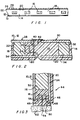
- reference numeral 10 designates the gellcoat adjacent which is the first glass fibre mat 12 placed in the mould. It should be noted that the layers are not drawn to scale. Above the mat 12 is the first layer of matrix, designated 14, and the vertical ribs of polyurethane foam designated 16. The matrix fill between the ribs 16 is referenced 18. The second major layer of matrix is shown at 20 and this is surmounted by the glass fibre mat 22, the general purpose adhesive layer 24 and the stone chippings 26.
- each panel 28, 30 illustrated is similar to that illustrated in Figure 1 except in that two asbestos boards 32, 34 are incorporated into each panel.
- Each panel 28, 30 is produced by the following method steps :
- the panel 28 in Figure 2 has a groove 36 along that vertical edge thereof which is illustrated.
- the panel 30 has a corresponding tongue 38 which fits into the groove 36.
- Screws 40 are driven through the tongue 38 and those parts of the grooved panel which lie on each side of the tongue 38.
- a cover strip 42 of T-section covers the heads of the screws 40 and the joint between the panels. The 'upright' limb of the T-section cover strip 42 is pushed into the gap between the panels 28 and 30.
- FIG 3 the lower part of a panel 44 is shown. Where the parts shown correspond to those of Figures 1 and 2, like reference numerals have been used.
- the lower end of the panel 44 includes a downwardly open groove 46 flanked by tongues 48.
- a rail 50 is secured to a foundation 52 by means of a series of screws one of which is shown at 54.
- the rail 50 is cast using the matrix described herein and its profile is such that it fits the groove 46.
- Embedded in all faces of the rail 50 except the lower face is a chopstrand fibreglass mat. Screws 56 pass through the tongues 48 and rail 50 to secure the panel to the rail. Silicone sealant can be provided between the rail 50 and foundation 52, and between the rail 50 and the panel 44.
- the matrix described can also be used to produce a simulated brick veneer.
- a mould which has a series of rectangular depressions therein.
- the depressions are arranged in parallel rows, and the depressions in adjacent rows are staggered with respect to one another to simulate the pattern in which house bricks are laid.
- the base of each depression is roughened, and the depressions are separated from one another by raised ribs of rectangular cross-section.
- the matrix is poured into the depressions.
- the matrix is appropriately coloured to simulate brick and is poured in to a depth such that it almost completely fills the depressions.
- another matrix which can be white or off-white, is poured in so that it extends across the ribs and joins the previously separate areas of brick-coloured matrix which were in the depressions.
- the resultant veneer is removed from the mould. It will be understood that, from the front of the veneer, horizontal and vertical strips of the off-white or white matrix can be seen between the coloured rectangular areas, these strips simulating the motar normally found between bricks in a conventionally built brick wall.
- Suitable resins, release agents etc are commercially available from N.C.P. Resins Division of Cape Town under the following designations:-
Landscapes
- Engineering & Computer Science (AREA)
- Mechanical Engineering (AREA)
- Structural Engineering (AREA)
- Architecture (AREA)
- Chemical & Material Sciences (AREA)
- Composite Materials (AREA)
- Ceramic Engineering (AREA)
- Physics & Mathematics (AREA)
- Mathematical Physics (AREA)
- Civil Engineering (AREA)
- Life Sciences & Earth Sciences (AREA)
- Wood Science & Technology (AREA)
- Laminated Bodies (AREA)
- Finishing Walls (AREA)
Applications Claiming Priority (2)
| Application Number | Priority Date | Filing Date | Title |
|---|---|---|---|
| ZA814159 | 1981-06-19 | ||
| ZA814159 | 1981-06-19 |
Publications (1)
| Publication Number | Publication Date |
|---|---|
| EP0068784A2 true EP0068784A2 (de) | 1983-01-05 |
Family
ID=25575480
Family Applications (1)
| Application Number | Title | Priority Date | Filing Date |
|---|---|---|---|
| EP82303229A Withdrawn EP0068784A2 (de) | 1981-06-19 | 1982-06-21 | Verfahren zur Herstellung von Bauteilen die beim Bau benützt werden |
Country Status (2)
| Country | Link |
|---|---|
| EP (1) | EP0068784A2 (de) |
| AU (1) | AU8500682A (de) |
Cited By (3)
| Publication number | Priority date | Publication date | Assignee | Title |
|---|---|---|---|---|
| EP0328921A1 (de) * | 1988-02-17 | 1989-08-23 | INNOVA GMBH Mobile Systeme | Plattenförmiges Bauelement in Sandwichbauweise |
| EP0824062A3 (de) * | 1996-08-13 | 1999-01-13 | Siebolt Hettinga | Mehrschichtiger Gegenstand mit einer wirksam verbundenen Oberflächenschicht und Verfahren zu seiner Herstellung |
| WO2013110139A1 (en) * | 2012-01-26 | 2013-08-01 | Weir Minerals Australia Ltd | Polymer composite articles |
-
1982
- 1982-06-18 AU AU85006/82A patent/AU8500682A/en not_active Abandoned
- 1982-06-21 EP EP82303229A patent/EP0068784A2/de not_active Withdrawn
Cited By (4)
| Publication number | Priority date | Publication date | Assignee | Title |
|---|---|---|---|---|
| EP0328921A1 (de) * | 1988-02-17 | 1989-08-23 | INNOVA GMBH Mobile Systeme | Plattenförmiges Bauelement in Sandwichbauweise |
| EP0824062A3 (de) * | 1996-08-13 | 1999-01-13 | Siebolt Hettinga | Mehrschichtiger Gegenstand mit einer wirksam verbundenen Oberflächenschicht und Verfahren zu seiner Herstellung |
| US6071461A (en) * | 1996-08-13 | 2000-06-06 | Hettinga; Siebolt | Method of making a multiple-layer article having a plastic member with a surface application material effectively bonded thereto |
| WO2013110139A1 (en) * | 2012-01-26 | 2013-08-01 | Weir Minerals Australia Ltd | Polymer composite articles |
Also Published As
| Publication number | Publication date |
|---|---|
| AU8500682A (en) | 1982-12-23 |
Similar Documents
| Publication | Publication Date | Title |
|---|---|---|
| US12158009B2 (en) | Cladding panel | |
| US3885008A (en) | Method for producing prefabricated wall section with molded panels | |
| US12312815B2 (en) | Wall panel | |
| US6237294B1 (en) | Decorative three dimensional panels and method of producing the same | |
| US3177279A (en) | Method of molding a decorative building panel | |
| US5927034A (en) | Flexible cement textured building tile and tile manufacturing process | |
| US20070209308A1 (en) | Faux-stone architectural panel system | |
| US3679529A (en) | Panel construction | |
| US20100088989A1 (en) | Concrete veneer panel with air entrained concrete core | |
| US4076875A (en) | Ornamental design | |
| CA3010868C (en) | Wall panel | |
| US20020100241A1 (en) | Sheet of articulated masonry-like units and method for producing the same | |
| US3649424A (en) | Panels | |
| GB2224969A (en) | Improvements in and relating to the manufacture of laminates | |
| CS243451B2 (en) | Method of insulation plaster-faced facade's production | |
| US3419454A (en) | Method of making and reinforcing decorative polyester resin products | |
| US3401069A (en) | Method for installing resinous floor coverings | |
| EP1308253B1 (de) | Verfahren zur Herstellung von Betonplatten | |
| GB2145651A (en) | Concrete structures | |
| JPS5945495B2 (ja) | 建築用パネルの製造方法 | |
| JPH03287901A (ja) | エクステリア材及びその製造法 | |
| WO1998055712A1 (en) | Finishing methods for construction elements and mesh for finishing of constructional elements | |
| EP0016541A1 (de) | Verfahren zur Herstellung einer Gebäudeaussenwand und Bauelement dafür | |
| CA2359639A1 (en) | A sheet of articulated masonry-like units and method for producing the same | |
| KR960004104B1 (ko) | 페녹시수지를 이용한 건축용 성형물 및 그 제조방법 |
Legal Events
| Date | Code | Title | Description |
|---|---|---|---|
| PUAI | Public reference made under article 153(3) epc to a published international application that has entered the european phase |
Free format text: ORIGINAL CODE: 0009012 |
|
| AK | Designated contracting states |
Designated state(s): AT CH DE FR GB IT LI SE |
|
| STAA | Information on the status of an ep patent application or granted ep patent |
Free format text: STATUS: THE APPLICATION IS DEEMED TO BE WITHDRAWN |
|
| 18D | Application deemed to be withdrawn |
Effective date: 19850104 |
|
| RIN1 | Information on inventor provided before grant (corrected) |
Inventor name: COURTNEY, WYNDHAM JAMES |