EP0069700A2 - Transparent polyamides, process for their preparation and their use in the manufacture of mouldings - Google Patents
Transparent polyamides, process for their preparation and their use in the manufacture of mouldings Download PDFInfo
- Publication number
- EP0069700A2 EP0069700A2 EP82810257A EP82810257A EP0069700A2 EP 0069700 A2 EP0069700 A2 EP 0069700A2 EP 82810257 A EP82810257 A EP 82810257A EP 82810257 A EP82810257 A EP 82810257A EP 0069700 A2 EP0069700 A2 EP 0069700A2
- Authority
- EP
- European Patent Office
- Prior art keywords
- formula
- polyamides
- methyl
- alkyl
- structural elements
- Prior art date
- Legal status (The legal status is an assumption and is not a legal conclusion. Google has not performed a legal analysis and makes no representation as to the accuracy of the status listed.)
- Granted
Links
Classifications
-
- C—CHEMISTRY; METALLURGY
- C08—ORGANIC MACROMOLECULAR COMPOUNDS; THEIR PREPARATION OR CHEMICAL WORKING-UP; COMPOSITIONS BASED THEREON
- C08G—MACROMOLECULAR COMPOUNDS OBTAINED OTHERWISE THAN BY REACTIONS ONLY INVOLVING UNSATURATED CARBON-TO-CARBON BONDS
- C08G69/00—Macromolecular compounds obtained by reactions forming a carboxylic amide link in the main chain of the macromolecule
- C08G69/02—Polyamides derived from amino-carboxylic acids or from polyamines and polycarboxylic acids
- C08G69/26—Polyamides derived from amino-carboxylic acids or from polyamines and polycarboxylic acids derived from polyamines and polycarboxylic acids
Definitions
- the invention relates to new transparent polyamides, processes for their preparation and their use for the production of moldings.
- polyamides are made from 2- (4-aminocyclohexyl) -1,1-dimethylethylamine or 2- (4-aminophenyl) -1,1-dimethylethylamine and aliphatic, aromatic or aliphatic-aromatic dicarboxylic acids or amide-forming derivatives thereof.
- Some of these polyamides are crystalline. They absorb significant amounts of water and are not fully satisfactory in terms of hydrolysis resistance and / or dimensional stability under the influence of moisture, which also affects their mechanical and electrical properties.
- the present invention relates to new transparent polyamides which are distinguished by improved thermoplastic processability, good resistance to boiling water and low water absorption, high resistance to hydrolysis, good dimensional stability under the influence of moisture and correspondingly improved mechanical and electrical properties.
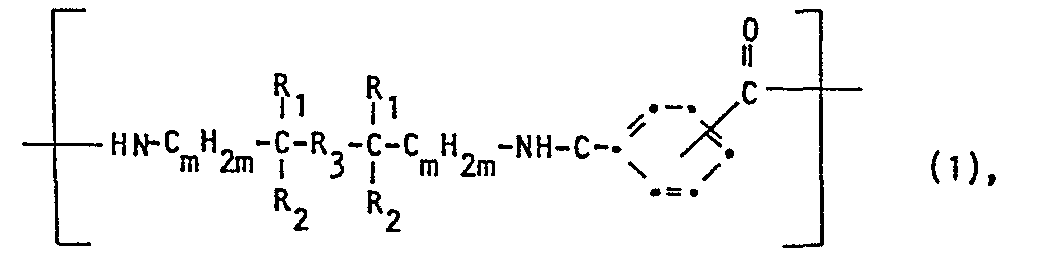
- the new polyamides according to the invention have a reduced specific viscosity (hereinafter also called reduced solution viscosity) of at least 0.3 dl / g, preferably about 0.5 to about 2.0 dl / g and in particular about 0.7 to about 1.8 dl / g, measured on a 0.5% solution in m-cresol at 25 ° C and consist of recurring structural elements of the formula I.
- reduced solution viscosity hereinafter also called reduced solution viscosity
- the two m are independently an integer from 4 to 16
- the two R are independently C 1-3 alkyl
- the two R 2 are independently C 1-6 alkyl
- R 3 is 1,4-phenylene or mean in which X is the direct bond, -CH 2 -, -0-, -S- or -NH- and wherein the carbonyl groups are bonded to the benzene ring in the 1,3- and / or 1,4-position.
- the two m preferably have the same meaning, the two R 1 represent identical alkyl groups and the two R 2 are identical alkyl groups.
- Alkyl groups R 1 and R 2 can be straight-chain or branched. Examples of such alkyl groups are the methyl, ethyl, n-propyl, isopropyl, n-butyl, sec-butyl, n-pentyl and n-hexyl groups.
- R 1 preferably represents methyl or ethyl.
- Preferred groups R 2 are alkyl groups with 1-4 C atoms, especially methyl, ethyl and isopropyl.
- the groups -C m H 2m - can likewise be straight-chain or branched, the branching preferably not being vicinal to the group C (R 1 ) (R 2 ) -.
- Examples of such groups -C m H 2m - are the tetramethylene, 4-methyltetramethylene, pentamethylene, 2,2-dimethylpentamethylene, hexamethylene, heptamethylene, octamethylene, nonamethylene, 9-methylnonamethylene, 9-ethylnonamethylene, 9-isopropylnonamethylene, decamethylene, 10-methyldecamethylene, 10-ethyldecamethylene, 10-isopropyldecamethylene, undecamethylene, dodecamethylene, tridecamethylene, tetradecamethylene and pentadecamethylene.
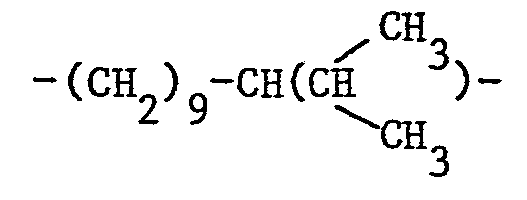
- Preferred groups -C m H 2m - are those of the formulas - (CH 2 ) 3 -CH (CH 3 ) -, - (CH 2 ) 8 -CH (R 4 ) - or - (CH 2 ) 9 -CH (R 4 ) -, in which the -CH group is bonded to the nitrogen atom and R 4 denotes straight-chain or branched alkyl having 1-6 C atoms.
- Preferred polyamides consist of recurring structural elements of the formula I, in which the R is methyl or ethyl, the R 2 is C 1-4 alkyl, especially methyl, ethyl or isopropyl, the -C m H 2m - each (CH 2 ) 3 - CH (CH 3 ) -, - (CH 2 ) 8 -CH (R 4 ) - or - (CH 2 ) 9 -CH (R 4 ) - with -CH group attached to the nitrogen atom and R 4 C 1-4 -Alkyl, in particular isopropyl, R 3 1,4-phenylene or a group means where X is the direct bond, -CH 2 -, -0- or -NH-.
- Polyamides of recurring structural elements of the formula I are particularly preferred, in which the R is methyl, the R 2 is methyl or ethyl, the -CH - each - (CH 2 ) 3 -CH (CH 3 ) -, represent and R 3 has the preferred meaning mentioned above.
- the carbonyl groups are attached to the benzene ring in either the 1,3 or 1,4 position.
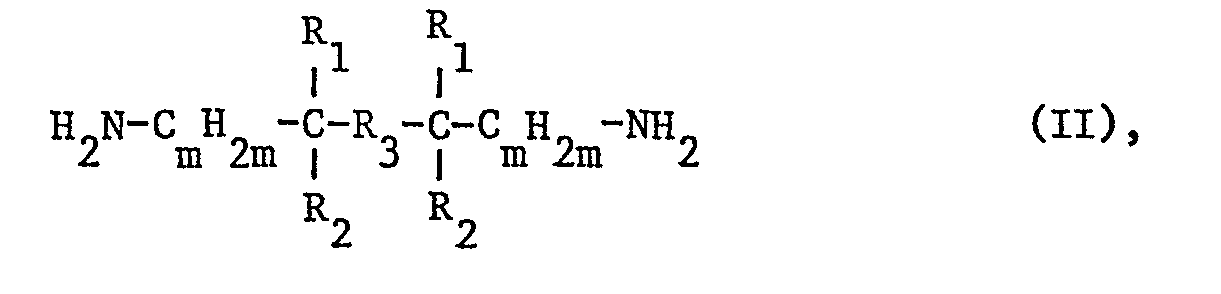
- the polyamides according to the invention can be obtained by reacting a diamine of the formula II wherein m, R, R 2 and R 3 have the meaning given under formula I, with isophthalic acid and / or terephthalic acid or amide-forming derivatives thereof.
- Suitable amide-forming derivatives of isophthalic acid or terephthalic acid are, for example, the corresponding dinitriles or dialkyl esters, each with 1-4 C atoms in the alkyl groups.
- the use of the free acids is preferred.
- the production is preferably carried out by melt polycondensation in several stages.
- the diamines are precondensed with essentially stoichiometric amounts of iso- and / or terephthalic acid in a closed vessel, optionally with the addition of water, under an inert gas and at temperatures between approximately 240 and 290 ° C. It may be advantageous to use the diamines and the dicarboxylic acids in the form of salts; It is particularly advantageous to use terephthalic acid in the form of a salt.
- the salts to be used for the precondensation are prepared from essentially stoichiometric amounts of terephthalic acid or isophthalic acid and a diamine of the formula II in a suitable inert organic solvent.
- suitable inert organic solvents are, for example: cycloaliphatic alcohols, such as cyclopentanol and cyclohexanol, and especially aliphatic alcohols with up to 6 C atoms, such as methanol, ethanol, n-propanol, butanols, pentanols and hexanols, and also mixtures of these solvents Water.
- the precondensate can then be further condensed at a temperature between about 260 and 300 ° C. under normal pressure and in an inert gas atmosphere until the polyamides according to the invention are formed. Under certain circumstances, it may be advantageous to apply a vacuum to degas the polyamide after the polycondensation has ended.
- the polyamides according to the invention can also be obtained by melt polycondensation of the diamines of the formula II with essentially stoichiometric amounts of an active ester of isophthalic acid or terephthalate acid or mixtures thereof.
- Suitable activated esters are, in particular, the corresponding diphenyl esters.
- the reaction temperatures are generally between about 230 and 300 ° C.
- polyamides according to the invention can also be obtained in a manner known per se by interfacial polycondensation of diamines of the formula II with isophthalic and / or terephthalic acid dihalides, especially the corresponding dichlorides.
- Customary additives such as heat and light stabilizers, antioxidants, dyes, flame retardants and the like can be added to the polyamides according to the invention during production or during processing.
- Formula II diamines are new. They can be obtained by using a compound of formula III in the presence of a Friedel-Krafts catalyst wherein Z represents a replaceable hydrogen atom and R 3 has the meaning given above, with at least two moles of an amino alcohol serving as alkylating agent or aminoolefin or salt thereof with an organic or inorganic acid which are capable of reacting two hydrogen atoms in the compound of the formula III one group each of formula IV to replace.
- the alkylating agent used is preferably amino alcohols or salts thereof with an organic or inorganic acid which are capable of introducing a radical of the formula IV or of converting to a radical of the formula V.
- Broensted or Lewis acids can be used as catalysts.
- Broensted acids suitable for this purpose are sulfuric acid, phosphoric acid or hydrochloric acid; metal halide, for example ZnCl 2 , SnC1 4 or FeC1 3 and especially A1C1 3, are preferred as Lewis acid.
- metal halide for example ZnCl 2 , SnC1 4 or FeC1 3 and especially A1C1 3, are preferred as Lewis acid.
- the polyamides according to the invention can be processed to moldings of the most varied types by processes known per se, e.g. by means of injection molding or extrusion processes. They are particularly suitable for the production of transparent apparatus or apparatus parts from the melt.
- Example I To a solution of 256 parts of 98% sulfuric acid, 48 parts of methanol and 7.8 parts of benzene are added 36.0 parts of 6-hydroxy-6-methyl-2- with stirring at room temperature (20-25 ° C). heptylamine hydrochloride (heptaminol hydrochloride) in batches of 3.0 parts every 6 hours. After the last addition after 66 hours, the reaction mixture is stirred for a further 18 hours at room temperature and then diluted with water. The aqueous solution is then neutralized with sodium hydroxide solution, and the organic phase is extracted with diethyl ether, washed with water and distilled after evaporation of the solvent. 18.7 parts of 1,4-bis- (6-amino-2-methylhept-2-yl) -benzene are obtained, b.p. 180-190 ° at 0.8 mbar.
- Example II 15.4 parts of diphenyl are reacted with 42.0 parts of heptaminol hydrochloride according to the procedure described in Example I. Distillation gives 29.0 parts of 4,4'-bis (6-amino-2-methylhept-2-yl) diphenyl; Bp. 220-235 ° at 0.3 mbar.
- EXAMPLE III 18.2 parts of heptamino hydrochloride are added in portions to 8.5 parts of diphenyl ether and 26.7 parts of aluminum chloride in 50 parts of nitromethane. After the addition, the reaction mixture is stored for 3 days at room temperature, then poured onto water and washed with sodium hydroxide solution until the aqueous phase is alkaline. The organic phase is extracted with diethyl ether, washed with water, evaporated and distilled.
- Example IV 16.8 parts of diphenylmethane are reacted with 36.4 parts of heptaminol hydrochloride in the manner described in Example III. After distillation, 22.4 parts of bis (6-amino-2-methylhept-2-yl) diphenylmethane are obtained; Bp 230-244 ° at 0.4 mbar. According to analysis, this fraction contains 73% of the 4,4'-isomer with the following composition in%:
- Example V 16.9 parts of diphenylamine, 20.4 parts of 36% aqueous hydrochloric acid, 6.8 parts of anhydrous zinc chloride, 36.4 parts of heptaminol hydrochloride and 20 parts of water are stirred under reflux for 4 days. After cooling, the reaction mixture is treated with 50 parts of water and the organic phase is extracted with diethyl ether, washed with water, evaporated and distilled. After removing 8.0 parts of a first fraction, bp 146-238 ° at 0.33 mbar, 29.6 parts of 4,4'-bis (6-amino-2-methylhept-2-yl) diphenylamine are obtained, b.p. 254-258 ° at 0.3 mbar (70% of theory) .Th.)
- Example 1 In a flask equipped with a stirrer, reflux condenser and dropping funnel, 2.556 g (0.0154 mol) of terephthalic acid are slurried in 100 ml of 50% ethanol and heated to reflux temperature. 5.137 g (0.0154 mol) of 1,4-bis (6-amino-2-methylhept-2-yl) benzene are added dropwise from the dropping funnel to the boiling mixture. The result is a clear solution, from which the salt formed precipitates after a few minutes. The salt is filtered off and dried at 80 ° in vacuo. Yield: 6.5 g (85% of theory). The salt is then placed in a bomb tube, which is equipped with a screw cap and a built-in pressure relief valve.
- Examples 6 to 10 6.137 g (0.0184 mol) of 1,4-bis (6-amino-2-methylhept-2-yl) benzene and 3.056 g (0.0184 mol) of isophthalic acid are placed in a bomb tube , which is provided with screw cap and built-in pressure relief valve, weighed. After the air in the bomb tube has been completely displaced with nitrogen, the bomb tube is closed. This is then immersed in a 270 ° warm salt bath. After a short time, a clear melt forms. After 2 hours the reaction is stopped by removing the tube from the salt bath and releasing the excess pressure by opening the valve. The solidified pre-condensate is removed from the tube and transferred to a condensation vessel. The further polycondensation is then carried out at 280 °, as described in Example 1.
Landscapes
- Chemical & Material Sciences (AREA)
- Health & Medical Sciences (AREA)
- Chemical Kinetics & Catalysis (AREA)
- Medicinal Chemistry (AREA)
- Polymers & Plastics (AREA)
- Organic Chemistry (AREA)
- Polyamides (AREA)
Abstract
Es werden neue transparente Polyamide aus wiederkehrenden Strukturelementen der Formel I
Description
Die Erfindung betrifft neue transparente Polyamide, Verfahren zu deren Herstellung sowie deren Verwendung zur Herstellung von Formkörpern.The invention relates to new transparent polyamides, processes for their preparation and their use for the production of moldings.
In den US-PS 3 776 890 und 4 024 185 sind Polyamide aus 2-(4-Aminocyclohexyl)-1,1-dimethyl-äthylamin oder 2-(4-Aminophenyl)-1,1-dimethyl- äthylamin und aliphatischen, aromatischen oder aliphatisch-aromatischen Dicarbonsäuren oder amidbildenden Derivaten davon beschrieben. Diese Polyamide sind zum Teil kristallin. Sie absorbieren beträchtliche Mengen Wasser und sind in Bezug auf Hydrolysebeständigkeit und/ oder Dimensionsstabilität unter dem Einfluss von Feuchtigkeit nicht voll zufriedenstellend, wodurch auch deren mechanische und elektrische Eigenschaften beeinträchtigt werden. Zudem sind die Glasumwandlungstemperaturen dieser Polyamide stark feuchtigkeitsabhängig, und Polyamide aus den oben genannten Diaminen und aromatischen Dicarbonsäuren oder amidbildenden Derivaten davon lassen sich nicht aus der Schmelze verarbeiten [vgl. auch Journal of Polymer Science: Polymer Chemistry Edition, Bd. 16, 2025-2038 (1978)].In U.S. Patents 3,776,890 and 4,024,185, polyamides are made from 2- (4-aminocyclohexyl) -1,1-dimethylethylamine or 2- (4-aminophenyl) -1,1-dimethylethylamine and aliphatic, aromatic or aliphatic-aromatic dicarboxylic acids or amide-forming derivatives thereof. Some of these polyamides are crystalline. They absorb significant amounts of water and are not fully satisfactory in terms of hydrolysis resistance and / or dimensional stability under the influence of moisture, which also affects their mechanical and electrical properties. In addition, the glass transition temperatures of these polyamides are highly moisture-dependent, and polyamides from the above-mentioned diamines and aromatic dicarboxylic acids or amide-forming derivatives thereof cannot be processed from the melt [cf. also Journal of Polymer Science: Polymer Chemistry Edition, vol. 16, 2025-2038 (1978)].
Die vorliegende Erfindung betrifft neue transparente Polyamide, die sich durch verbesserte thermoplastische Verarbeitbarkeit, gute Kochwasserbeständigkeit sowie niedrige Wasseraufnahme, hohe Hydrolysebeständigkeit, gute Dimensionsstabilität unter dem Einfluss von Feuchtigkeit und entsprechend verbesserte mechanische und elektrische Eigenschaften auszeichnen.The present invention relates to new transparent polyamides which are distinguished by improved thermoplastic processability, good resistance to boiling water and low water absorption, high resistance to hydrolysis, good dimensional stability under the influence of moisture and correspondingly improved mechanical and electrical properties.
Die neuen erfindungsgemässen Polyamide haben eine reduzierte spezifische Viskosität (im folgenden auch reduzierte Lösungsviskosität genannt) von mindestens 0,3 dl/g, vorzugsweise etwa 0,5 bis etwa 2,0 dl/g und insbesondere etwa 0,7 bis etwa 1,8 dl/g, gemessen an einer 0,5%igen Lösung in m-Kresol bei 25°C und bestehen aus wiederkehrenden Strukturelementen der Formel I


Vorzugsweise haben die beiden m dieselbe Bedeutung, stellen die beiden R1 identische Alkylgruppen dar und sind die beiden R2 gleiche Alkylgruppen.The two m preferably have the same meaning, the two R 1 represent identical alkyl groups and the two R 2 are identical alkyl groups.
Alkylgruppen R1 und R2 können geradkettig oder verzweigt sein. Beispiele solcher Alkylgruppen sind die Methyl-, Aethyl-, n-Propyl-, Isopropyl-, n-Butyl-, sek-Butyl-, n-Pentyl- und n-Hexylgruppe. R1 stellt bevorzugt Methyl oder Aethyl dar. Bevorzugte Gruppen R2 sind Alkylgruppen mit 1-4 C-Atomen, besonders Methyl, Aethyl und Isopropyl. Die Gruppen -CmH2m- können ebenfalls geradkettig oder verzweigt sein, wobei die Verzweigung vorzugsweise nicht vicinal zur Gruppe C(R1)(R2)- ist. Beispiele solcher Gruppen -CmH2m- sind die Tetra- methylen-, 4-Methyltetramethylen-, Pentamethylen-, 2,2-Dimethylpentamethylen-, Hexamethylen-, Heptamethylen-, Octamethylen-, Nonamethylen-, 9-Methylnonamethylen-, 9-Aethylnonamethylen-, 9-Isopropylnonamethylen-, Decamethylen-, 10-Methyldecamethylen-, 10-Ethyldecamethylen-, 10-Isopropyldecamethylen-, Undecamethylen-, Dodecamethylen-, Tridecamethylen-, Tetradecamethylen-, Pentadecamethylen- und Hexadecamethylengruppe. Bevorzugte Gruppen -CmH2m- sind solche der Formeln -(CH2)3-CH(CH3)-, -(CH2)8-CH(R4)- oder -(CH2)9-CH(R4)-, worin die -CH-Gruppe an das Stickstoffatome gebunden ist und R4 geradkettiges oder verzweigtes Alkyl mit 1-6 C-Atomen bedeutet.Alkyl groups R 1 and R 2 can be straight-chain or branched. Examples of such alkyl groups are the methyl, ethyl, n-propyl, isopropyl, n-butyl, sec-butyl, n-pentyl and n-hexyl groups. R 1 preferably represents methyl or ethyl. Preferred groups R 2 are alkyl groups with 1-4 C atoms, especially methyl, ethyl and isopropyl. The groups -C m H 2m - can likewise be straight-chain or branched, the branching preferably not being vicinal to the group C (R 1 ) (R 2 ) -. Examples of such groups -C m H 2m - are the tetramethylene, 4-methyltetramethylene, pentamethylene, 2,2-dimethylpentamethylene, hexamethylene, heptamethylene, octamethylene, nonamethylene, 9-methylnonamethylene, 9-ethylnonamethylene, 9-isopropylnonamethylene, decamethylene, 10-methyldecamethylene, 10-ethyldecamethylene, 10-isopropyldecamethylene, undecamethylene, dodecamethylene, tridecamethylene, tetradecamethylene and pentadecamethylene. Preferred groups -C m H 2m - are those of the formulas - (CH 2 ) 3 -CH (CH 3 ) -, - (CH 2 ) 8 -CH (R 4 ) - or - (CH 2 ) 9 -CH (R 4 ) -, in which the -CH group is bonded to the nitrogen atom and R 4 denotes straight-chain or branched alkyl having 1-6 C atoms.
Bevorzugte Polyamide bestehen aus wiederkehrenden Strukturelementen der Formel I, worin die R je Methyl oder Aethyl, die R2 je C1-4-Alkyl, besonders Methyl, Aethyl oder Isopropyl, die -CmH2m- je (CH2)3-CH(CH3)-, -(CH2)8-CH(R4)- oder -(CH2)9-CH(R4)- mit an das Stickstoffatom gebundener -CH-Gruppe und R4 C1-4-Alkyl, insbesonders Isopropyl darstellen, R3 1,4-Phenylen oder eine Gruppe


Bei diesen bevorzugten Ausführungsformen sind die Carbonylgruppen entweder in 1,3- oder in 1,4-Stellung an den Benzolring gebunden.In these preferred embodiments, the carbonyl groups are attached to the benzene ring in either the 1,3 or 1,4 position.
Die erfindungsgemässen Polyamide können durch die Umsetzung eines Diamins der Formel II
Vorzugsweise erfolgt die Herstellung durch Schmelzpolykondensation in mehreren Stufen. In diesem Falle werden die Diamine mit im wesentlichen stöchiometrischen Mengen Iso- und/oder Terephthalsäure in einem geschlossenen Gefäss, gegebenenfalls unter Zusatz von Wasser, unter einem Inertgas und bei Temperaturen zwischen etwa 240 und 290°C vorkondensiert. Unter Umständen kann es von Vorteil sein, die Diamine und die Dicarbonsäuren in Form von Salzen einzusetzen; besonders vorteilhaft ist es, die Terephthalsäure in Form eines Salzes zu verwenden.The production is preferably carried out by melt polycondensation in several stages. In this case, the diamines are precondensed with essentially stoichiometric amounts of iso- and / or terephthalic acid in a closed vessel, optionally with the addition of water, under an inert gas and at temperatures between approximately 240 and 290 ° C. It may be advantageous to use the diamines and the dicarboxylic acids in the form of salts; It is particularly advantageous to use terephthalic acid in the form of a salt.
Die für die Vorkondensation zu verwendenden Salze werden aus im wesentlichen stöchiometrischen Mengen Terephthalsäure oder Isophthalsäure und einem Diamin der Formel II in einem geeigneten inerten organischen Lösungsmittel hergestellt. Geeignete inerte organische Lösungsmittel sind zum Beispiel: cycloaliphatische Alkohole, wie Cyclopentanol und Cyclohexanol, und vor allem aliphatische Alkohole mit bis zu 6 C-Atomen, wie Methanol, Aethanol, n-Propanol, Butanole, Pentanole und Hexanole, und auch Gemische dieser Lösungsmittel mit Wasser. Das Vorkondensat kann anschliessend bei einer Temperatur zwischen etwa 260 und 300°C unter Normaldruck und in einer Inertgasatmosphäre bis zur Bildung der erfindungsgemässen Polyamide weiterkondensiert werden. Unter Umständen kann es vorteilhaft sein, nach Beendigung der Polykondensation zum Entgasen des Polyamids Vakuum anzulegen.The salts to be used for the precondensation are prepared from essentially stoichiometric amounts of terephthalic acid or isophthalic acid and a diamine of the formula II in a suitable inert organic solvent. Suitable inert organic solvents are, for example: cycloaliphatic alcohols, such as cyclopentanol and cyclohexanol, and especially aliphatic alcohols with up to 6 C atoms, such as methanol, ethanol, n-propanol, butanols, pentanols and hexanols, and also mixtures of these solvents Water. The precondensate can then be further condensed at a temperature between about 260 and 300 ° C. under normal pressure and in an inert gas atmosphere until the polyamides according to the invention are formed. Under certain circumstances, it may be advantageous to apply a vacuum to degas the polyamide after the polycondensation has ended.
Die erfindungsgemässen Polyamide können auch durch Schmelzpolykondensation der Diamine der Formel II mit im wesentlichen stöchiometrischen Mengen eines aktiven Esters der Isophthalsäure oder der Terephthalsäure oder Gemischen davon hergestellt werden. Geeignete aktivierte Ester sind insbesondere die entsprechenden Diphenylester. Die Reaktionstemperaturen liegen im allgemeinen zwischen etwa 230 und 300°C.The polyamides according to the invention can also be obtained by melt polycondensation of the diamines of the formula II with essentially stoichiometric amounts of an active ester of isophthalic acid or terephthalate acid or mixtures thereof. Suitable activated esters are, in particular, the corresponding diphenyl esters. The reaction temperatures are generally between about 230 and 300 ° C.
Die erfindungsgemässen Polyamide können ferner in an sich bekannter Weise durch Grenzflächenpolykondensation von Diaminen der Formel II mit Isophthalsäure- und/oder Terephthalsäuredihalogeniden, besonders den entsprechenden Dichloriden, erhalten werden.The polyamides according to the invention can also be obtained in a manner known per se by interfacial polycondensation of diamines of the formula II with isophthalic and / or terephthalic acid dihalides, especially the corresponding dichlorides.
Den erfindungsgemässen Polyamiden können bei der Herstellung oder während der Verarbeitung übliche Zusätze zugegeben werden, wie Hitze-und Lichtstabilisatoren, Antioxidantien, Farbstoffe, Flammschutzmittel und dergleichen.Customary additives such as heat and light stabilizers, antioxidants, dyes, flame retardants and the like can be added to the polyamides according to the invention during production or during processing.
Die Diamine der Formel II sind neu. Sie können dadurch erhalten werden, dass man in Gegenwart eines Friedel-Krafts-Katalysators eine Verbindung der Formel III


Als Alkylierungsmittel verwendet man bevorzugt Aminoalkohole oder Salze davon mit einer organischen oder anorganischen Säure, die zur Einführung eines Rests der Formel IV oder zur Umwandlung in einen Rest der Formel V befähigt sind.The alkylating agent used is preferably amino alcohols or salts thereof with an organic or inorganic acid which are capable of introducing a radical of the formula IV or of converting to a radical of the formula V.
Als Katalysatoren können Broensted- oder Lewis-Säuren verwendet werden. Für diesen Zweck geeignete Broensted-Säuren sind Schwefelsäure, Phosphorsäure oder Chlorwasserstoffsäure; als Lewis-Säure werden Metallhalogenid, z.B. ZnCl2, SnC14 oder FeC13 und vor allem A1C13 bevorzugt. Nach Beendigung der Alkylierung können die Diamine der Formel II in üblicher Weise gereinigt und isoliert werden.Broensted or Lewis acids can be used as catalysts. Broensted acids suitable for this purpose are sulfuric acid, phosphoric acid or hydrochloric acid; metal halide, for example ZnCl 2 , SnC1 4 or FeC1 3 and especially A1C1 3, are preferred as Lewis acid. After the alkylation has ended, the diamines of the formula II can be purified and isolated in the customary manner.
Die erfindungsgemässen Polyamide können nach an sich bekannten Verfahren zu Formkörpern der verschiedensten Art verarbeitet werden, z.B. mittels Spritzguss- oder Extrusionsverfahren. Sie eignen sich besonders zur Herstellung von transparenten Apparaturen oder Apparateteilen aus der Schmelze.The polyamides according to the invention can be processed to moldings of the most varied types by processes known per se, e.g. by means of injection molding or extrusion processes. They are particularly suitable for the production of transparent apparatus or apparatus parts from the melt.
In den folgenden Beispielen bedeuten Teile Gewichtsteile und Prozente Gewichtsprozente; die Temperaturen sind in °C angegeben.In the following examples, parts are parts by weight and percentages are percentages by weight; the temperatures are given in ° C.
Beispiel I: Zu einer Lösung von 256 Teilen 98%iger Schwefelsäure, 48 Teilen Methanol und 7,8 Teilen Benzol gibt man unter Rühren bei Raumtemperatur (20-25°C) 36,0 Teile 6-Hydroxy-6-methyl-2-heptylamin-Hydrochlorid (Heptaminol-Hydrochlorid) und zwar in Chargen von je 3,0 Teilen alle 6 Stunden. Nach der letzten Zugabe nach 66 Stunden wird das Reaktionsgemisch während weiterer 18 Stunden bei Raumtemperatur gerührt und dann mit Wasser verdünnt. Die wässrige Lösung wird dann mit Natriumhydroxidlösung neutralisiert, und die organische Phase wird mit Diäthyläther extrahiert, mit Wasser gewaschen und nach dem Verdampfen des Lösungsmittels destilliert. Man erhält 18,7 Teile 1,4-Bis-(6-amino-2-methylhept-2-yl)-benzol, Sdp. 180-190° bei 0,8 mbar.Example I: To a solution of 256 parts of 98% sulfuric acid, 48 parts of methanol and 7.8 parts of benzene are added 36.0 parts of 6-hydroxy-6-methyl-2- with stirring at room temperature (20-25 ° C). heptylamine hydrochloride (heptaminol hydrochloride) in batches of 3.0 parts every 6 hours. After the last addition after 66 hours, the reaction mixture is stirred for a further 18 hours at room temperature and then diluted with water. The aqueous solution is then neutralized with sodium hydroxide solution, and the organic phase is extracted with diethyl ether, washed with water and distilled after evaporation of the solvent. 18.7 parts of 1,4-bis- (6-amino-2-methylhept-2-yl) -benzene are obtained, b.p. 180-190 ° at 0.8 mbar.
Beispiel II: 15,4 Teile Diphenyl werden nach der in Beispiel I beschriebenen Arbeitsweise mit 42,0 Teilen Heptaminol-Hydrochlorid umgesetzt. Die Destillation ergibt 29,0 Teile 4,4'-Bis-(6-amino-2-methylhept-2-yl)-diphenyl; Sdp. 220-235° bei 0,3 mbar.Example II: 15.4 parts of diphenyl are reacted with 42.0 parts of heptaminol hydrochloride according to the procedure described in Example I. Distillation gives 29.0 parts of 4,4'-bis (6-amino-2-methylhept-2-yl) diphenyl; Bp. 220-235 ° at 0.3 mbar.
Beispiel III: Zu 8,5 Teilen Diphenyläther und 26,7 Teilen Aluminiumchlorid in 50 Teilen Nitromethan gibt man portionenweise 18,2 Teile Heptamino-Hydrochlorid. Nach der Zugabe wird das Reaktionsgemisch 3 Tage bei Raumtemperatur gelagert, dann auf Wasser gegossen und mit Natriumhydroxidlösung gewaschen, bis die wässrige Phase alkalisch ist. Die organische Phase wird mit Diäthyläther extrahiert, mit Wasser gewaschen, verdampft und destilliert. Man erhält 2,1 Teile 4-(6-Amino-2-methylhept-2-yl)-diphenyläther; Sdp. 170-180° bei 0,4 mbar, gefolgt von 14,2 Teilen Bis-(2-Amino-2-methylhept-2-yl)-diphenyläther; Sdp. 240-270° bei 0,7 mbar. Gemäss Analyse enthält diese zweite Fraktion 70% des 4,4'-Isomeren.EXAMPLE III 18.2 parts of heptamino hydrochloride are added in portions to 8.5 parts of diphenyl ether and 26.7 parts of aluminum chloride in 50 parts of nitromethane. After the addition, the reaction mixture is stored for 3 days at room temperature, then poured onto water and washed with sodium hydroxide solution until the aqueous phase is alkaline. The organic phase is extracted with diethyl ether, washed with water, evaporated and distilled. 2.1 parts of 4- (6-amino-2-methylhept-2-yl) diphenyl ether are obtained; Bp 170-180 ° at 0.4 mbar followed by 14.2 parts of bis (2-amino-2-methylhept-2-yl) diphenyl ether; Bp 240-270 ° at 0.7 mbar. According to analysis, this second fraction contains 70% of the 4,4'-isomer.
Beispiel IV: 16,8 Teile Diphenylmethan werden auf die in Beispiel III beschriebene Weise mit 36,4 Teilen Heptaminol-Hydrochlorid umgesetzt. Nach der Destillation erhält man 22,4 Teile Bis-(6-Amino-2-methylhept-2-yl)-diphenylmethan; Sdp. 230-244° bei 0,4 mbar. Gemäss Analyse enthält diese Fraktion 73% des 4,4'-Isomeren mit der folgenden Zusammensetzung in %:

Beispiel V: 16,9 Teile Diphenylamin, 20,4 Teile 36%ige wässrige Chlorwasserstoffsäure, 6,8 Teile wasserfreies Zinkchlorid, 36,4 Teile Heptaminol-Hydrochlorid und 20 Teile Wasser werden 4 Tage unter Rückfluss gerührt. Nach dem Abkühlen wird das Reaktionsgemisch mit 50 Teilen Wasser behandelt, und die organische Phase wird mit Diäthyläther extrahiert, mit Wasser gewaschen, verdampft und destilliert. Nach dem Entfernen von 8,0 Teilen einer ersten Fraktion, Sdp. 146-238° bei 0,33 mbar, erhält man 29,6 Teile 4,4'-Bis-(6-amino-2-methylhept-2-yl)-diphenylamin, Sdp. 254-258° bei 0,3 mbar (70% d.Th.)Example V: 16.9 parts of diphenylamine, 20.4 parts of 36% aqueous hydrochloric acid, 6.8 parts of anhydrous zinc chloride, 36.4 parts of heptaminol hydrochloride and 20 parts of water are stirred under reflux for 4 days. After cooling, the reaction mixture is treated with 50 parts of water and the organic phase is extracted with diethyl ether, washed with water, evaporated and distilled. After removing 8.0 parts of a first fraction, bp 146-238 ° at 0.33 mbar, 29.6 parts of 4,4'-bis (6-amino-2-methylhept-2-yl) diphenylamine are obtained, b.p. 254-258 ° at 0.3 mbar (70% of theory) .Th.)
Beispiel 1: In einem mit Rührwerk, Rückflusskühler und Tropftrichter versehenen Kolben werden 2,556 g (0,0154 Mol) Terephthalsäure in 100 ml 50%igem Aethanol aufgeschlämmt und auf Rückflusstemperatur erhitzt. In die siedende Mischung werden aus dem Tropftrichter 5,137 g (0,0154 Mol) 1,4-Bis-(6-amino-2-methylhept-2-yl)-benzol eingetropft. Es entsteht eine klare Lösung, aus welcher sich nach wenigen Minuten das gebildete Salz ausscheidet. Das Salz wird abfiltriert und bei 80° im Vakuum getrocknet. Ausbeute: 6,5 g (85% d.Th.). Das Salz wird dann in ein Bombenrohr, das mit Schraubdeckel und eingebautem Ueberdruckventil versehen ist, gegeben. Nachdem man die Luft im Bombenrohr vollständig durch Stickstoff verdrängt hat, verschliesst man das Bombenrohr und taucht es in ein Salzbad von 270° ein. Nach kurzer Zeit ist eine klare Schmelze entstanden. Nach zwei Stunden wird die Reaktion abgebrochen, indem man das Rohr aus dem Salzbad entfernt und den Ueberdruck durch Oeffnen des Ventils ablässt. Das erstarrte Vorkondensat wird aus dem Bombenrohr entfernt und in ein Kondensationsgefäss übergeführt. Unter strengem Ausschluss von Luft und dauerndem Durchleiten von Stickstoff bei einer Temperatur von 280° wird die gebildete Schmelze polykondensiert, wobei das entstandene Wasser durch den Stickstoffstrom laufend entfernt wird. Nach 5 Stunden wird die Polykondensation abgebrochen. Beim Abkühlen erstarrt die Schmelze zu einer glasklaren farblosen Masse.Example 1: In a flask equipped with a stirrer, reflux condenser and dropping funnel, 2.556 g (0.0154 mol) of terephthalic acid are slurried in 100 ml of 50% ethanol and heated to reflux temperature. 5.137 g (0.0154 mol) of 1,4-bis (6-amino-2-methylhept-2-yl) benzene are added dropwise from the dropping funnel to the boiling mixture. The result is a clear solution, from which the salt formed precipitates after a few minutes. The salt is filtered off and dried at 80 ° in vacuo. Yield: 6.5 g (85% of theory). The salt is then placed in a bomb tube, which is equipped with a screw cap and a built-in pressure relief valve. After the air in the bomb tube has been completely replaced by nitrogen, close the bomb tube and immerse it in a salt bath of 270 °. After a short time, a clear melt developed. After two hours the reaction is stopped by removing the tube from the salt bath and releasing the excess pressure by opening the valve. The solidified precondensate is removed from the bomb tube and transferred to a condensation vessel. With strict exclusion of air and continuous passage of nitrogen at a temperature of 280 °, the melt formed is polycondensed, the water formed being continuously removed by the stream of nitrogen. The polycondensation is stopped after 5 hours. When it cools, the melt solidifies to a crystal-clear, colorless mass.
2-3 g des so erhaltenen Polyamids werden mittels einer beheizbaren hydraulischen Presse zu einer Folie von etwa 0,3 bis 0,5 mm Dicke verpresst. Zur Bestimmung der Wasseraufnahme wird die Folie bei Raumtemperatur einer relativen Luftfeuchtigkeit von 65% ausgesetzt, bis keine Gewichtszunahme mehr festgestellt werden kann. Die reduzierte Lösungsviskosität des erhaltenen Polyamids wird an einer 0,5Xigen Lösung in m-Kresol bei 25° gemessen. Die Glasumwandlungstemperatur Tg wird im Differentialkalorimeter (DSC) bestimmt. Die Resultate sind in Tabelle 1 zusammengefasst.2-3 g of the polyamide obtained in this way are pressed by means of a heatable hydraulic press into a film approximately 0.3 to 0.5 mm thick. To determine the water absorption, the film is exposed to a relative air humidity of 65% at room temperature until no further weight gain can be determined. The reduced solution viscosity of the polyamide obtained is at one 0.5Xigen solution in m-cresol measured at 25 °. The glass transition temperature Tg is determined in the differential calorimeter (DSC). The results are summarized in Table 1.
Beispiele 2-5: Auf analoge Weise wie in Beispiel 1 beschrieben, werden äquimolare Mengen weiterer Diamine und Terephthalsäure zu den entsprechenden Salzen umgesetzt, die dann wie in Beispiel 1 beschrieben polykondensiert werden. Es werden die folgenden Reaktanden verwendet:
- Beispiel 2: 4,4'-Bis-(6-amino-2-methyl-hept-2-yl)-diphenyl und Terephthalsäure;
- Beispiel 3: Bis-(6-amino-2-methyl-hept-2-yl)-diphenyläther (Isomerengemisch) und Terephthalsäure;
- Beispiel 4: Bis-(6-amino-2-methyl-hept-2-yl)-diphenylmethan (Isomerengemisch) und Terephthalsäure;
- Beispiel 5: 4,4'-Bis-(6-amino-2-methyl-hept-2-yl)-diphenylamin und Terephthalsäure.
- Example 2: 4,4'-bis (6-amino-2-methyl-hept-2-yl) diphenyl and terephthalic acid;
- Example 3: bis (6-amino-2-methyl-hept-2-yl) diphenyl ether (mixture of isomers) and terephthalic acid;
- Example 4: Bis- (6-amino-2-methyl-hept-2-yl) diphenylmethane (mixture of isomers) and terephthalic acid;
- Example 5: 4,4'-bis (6-amino-2-methyl-hept-2-yl) diphenylamine and terephthalic acid.
Die Eigenschaften der erhaltenen Polyamide werden wie in Beispiel 1 beschrieben bestimmt. Die Resultate sind in Tabelle 1 zusammengefasst.The properties of the polyamides obtained are determined as described in Example 1. The results are summarized in Table 1.
Beispiele 6 bis 10: 6,137 g (0,0184 Mol) 1,4-Bis-(6-amino-2-methyl- hept-2-yl)-benzol und 3,056 g (0,0184 Mol) Isophthalsäure werden in ein Bombenrohr, das mit Schraubdeckel und eingebautem Ueberdruckventil versehen ist, eingewogen. Nachdem man die Luft im Bombenrohr vollständig mit Stickstoff verdrängt hat, verschliesst man das Bombenrohr. Dieses wird dann in ein 270° warmes Salzbad eingetaucht. Nach kurzer Zeit bildet sich eine klare Schmelze. Nach 2 Stunden wird die Reaktion unterbrochen, indem man das Rohr aus dem Salzbad entfernt und den Ueberdruck durch Oeffnen des Ventils ablässt. Das erstarrte Vorkondensat wird aus dem Rohr entfernt und in ein Kondensationsgefäss übergeführt. Die weitere Polykondensation wird dann bei 280° durchgeführt, wie in Beispiel 1 beschrieben.Examples 6 to 10: 6.137 g (0.0184 mol) of 1,4-bis (6-amino-2-methylhept-2-yl) benzene and 3.056 g (0.0184 mol) of isophthalic acid are placed in a bomb tube , which is provided with screw cap and built-in pressure relief valve, weighed. After the air in the bomb tube has been completely displaced with nitrogen, the bomb tube is closed. This is then immersed in a 270 ° warm salt bath. After a short time, a clear melt forms. After 2 hours the reaction is stopped by removing the tube from the salt bath and releasing the excess pressure by opening the valve. The solidified pre-condensate is removed from the tube and transferred to a condensation vessel. The further polycondensation is then carried out at 280 °, as described in Example 1.
Auf analoge Weise werden die folgenden Reaktanden polykondensiert:
- Beispiel 7: 4,4'-Bis-(6-amino-2-methyl-hept-2-yl)-diphenyl und Isophthalsäure;
- Beispiel 8: Bis-(6-amino-2-methyl-hept-2-yl)-diphenyläther (Isomerengemisch) und Isophthalsäure;
- Beispiel 9: Bis-(6-amino-2-methyl-hept-2-yl)-diphenylmethan (Isomerengemisch) und Isophthalsäure;
- Beispiel 10: 4,4'-Bis-(6-amino-2-methyl-hept-2-yl)-diphenylamin und Isophthalsäure.
- Example 7: 4,4'-bis (6-amino-2-methyl-hept-2-yl) diphenyl and isophthalic acid;
- Example 8: bis (6-amino-2-methyl-hept-2-yl) diphenyl ether (mixture of isomers) and isophthalic acid;
- Example 9: Bis- (6-amino-2-methyl-hept-2-yl) diphenylmethane (mixture of isomers) and isophthalic acid;
- Example 10: 4,4'-bis (6-amino-2-methyl-hept-2-yl) diphenylamine and isophthalic acid.
Die Eigenschaften der erhaltenen Polyamide werden wie in Beispiel 1 beschrieben bestimmt. Die Resultate sind in Tabelle 1 zusammengefasst.

Claims (6)




Applications Claiming Priority (2)
| Application Number | Priority Date | Filing Date | Title |
|---|---|---|---|
| GB8119013 | 1981-06-19 | ||
| GB8119013 | 1981-06-19 |
Publications (3)
| Publication Number | Publication Date |
|---|---|
| EP0069700A2 true EP0069700A2 (en) | 1983-01-12 |
| EP0069700A3 EP0069700A3 (en) | 1983-03-16 |
| EP0069700B1 EP0069700B1 (en) | 1984-12-19 |
Family
ID=10522668
Family Applications (1)
| Application Number | Title | Priority Date | Filing Date |
|---|---|---|---|
| EP82810257A Expired EP0069700B1 (en) | 1981-06-19 | 1982-06-14 | Transparent polyamides, process for their preparation and their use in the manufacture of mouldings |
Country Status (5)
| Country | Link |
|---|---|
| US (1) | US4433137A (en) |
| EP (1) | EP0069700B1 (en) |
| JP (1) | JPS582329A (en) |
| CA (1) | CA1186845A (en) |
| DE (1) | DE3261608D1 (en) |
Cited By (6)
| Publication number | Priority date | Publication date | Assignee | Title |
|---|---|---|---|---|
| EP0725101A1 (en) | 1995-02-01 | 1996-08-07 | Ems-Inventa Ag | Transparent colourless amorphous polyamides and moulded articles |
| US5696202A (en) * | 1995-02-01 | 1997-12-09 | Ems-Inventa Ag | Transparent, colorless, amorphous polyamides and molded articles |
| US5773558A (en) * | 1995-02-01 | 1998-06-30 | Ems-Inventa Ag | Transparent, colorless, amorphous polyamides and molded articles |
| US5886087A (en) * | 1995-02-01 | 1999-03-23 | Ems-Inventa Ag | Transparent, colorless, amorphous polyamides and molded articles |
| US6008288A (en) * | 1995-02-01 | 1999-12-28 | Ems-Inventa Ag | Transparent, colorless, amorphous polyamides and molded articles |
| US6277911B1 (en) | 1995-02-01 | 2001-08-21 | Ems Inventa Ag | Transparent, colorless, amorphous copolyamides and molded articles made therefrom |
Families Citing this family (3)
| Publication number | Priority date | Publication date | Assignee | Title |
|---|---|---|---|---|
| DE3934926A1 (en) * | 1989-10-20 | 1991-04-25 | Huels Chemische Werke Ag | SHAPE-RESISTANT DIMENSIONS TO ALCOHOLS AND BOILING WATER |
| DE3934927A1 (en) * | 1989-10-20 | 1991-04-25 | Huels Chemische Werke Ag | SHAPE-RESISTANT DIMENSIONS TO ALCOHOLS AND BOILING WATER |
| JPH04121831U (en) * | 1991-04-16 | 1992-10-30 | 山下 広次 | Pot with boil-over prevention function |
Family Cites Families (4)
| Publication number | Priority date | Publication date | Assignee | Title |
|---|---|---|---|---|
| US2497673A (en) * | 1946-04-16 | 1950-02-14 | Du Pont | Reaction of alpha-beta unsaturated compounds with aromatic hydrocarbons and products obtained |
| US3776890A (en) * | 1971-05-13 | 1973-12-04 | Allied Chem | Polyamides from 2-(4-aminocyclohexyl)-1,1-dimethylethylamine or 2-(4-amino-phenyl)-1,1-dimethylethylamine |
| US4024185A (en) * | 1973-09-05 | 1977-05-17 | Allied Chemical Corporation | Cycloaliphatic unsymmetrical diamines |
| US4130579A (en) * | 1977-06-08 | 1978-12-19 | E. I. Du Pont De Nemours And Company | Bis(2-methyl-2-cyanopropyl) aromatics |
-
1982
- 1982-06-10 US US06/387,118 patent/US4433137A/en not_active Expired - Fee Related
- 1982-06-14 EP EP82810257A patent/EP0069700B1/en not_active Expired
- 1982-06-14 DE DE8282810257T patent/DE3261608D1/en not_active Expired
- 1982-06-17 CA CA000405357A patent/CA1186845A/en not_active Expired
- 1982-06-19 JP JP57106071A patent/JPS582329A/en active Granted
Cited By (6)
| Publication number | Priority date | Publication date | Assignee | Title |
|---|---|---|---|---|
| EP0725101A1 (en) | 1995-02-01 | 1996-08-07 | Ems-Inventa Ag | Transparent colourless amorphous polyamides and moulded articles |
| US5696202A (en) * | 1995-02-01 | 1997-12-09 | Ems-Inventa Ag | Transparent, colorless, amorphous polyamides and molded articles |
| US5773558A (en) * | 1995-02-01 | 1998-06-30 | Ems-Inventa Ag | Transparent, colorless, amorphous polyamides and molded articles |
| US5886087A (en) * | 1995-02-01 | 1999-03-23 | Ems-Inventa Ag | Transparent, colorless, amorphous polyamides and molded articles |
| US6008288A (en) * | 1995-02-01 | 1999-12-28 | Ems-Inventa Ag | Transparent, colorless, amorphous polyamides and molded articles |
| US6277911B1 (en) | 1995-02-01 | 2001-08-21 | Ems Inventa Ag | Transparent, colorless, amorphous copolyamides and molded articles made therefrom |
Also Published As
| Publication number | Publication date |
|---|---|
| EP0069700B1 (en) | 1984-12-19 |
| EP0069700A3 (en) | 1983-03-16 |
| CA1186845A (en) | 1985-05-07 |
| US4433137A (en) | 1984-02-21 |
| DE3261608D1 (en) | 1985-01-31 |
| JPS582329A (en) | 1983-01-07 |
| JPH0158211B2 (en) | 1989-12-11 |
Similar Documents
| Publication | Publication Date | Title |
|---|---|---|
| EP0069700B1 (en) | Transparent polyamides, process for their preparation and their use in the manufacture of mouldings | |
| EP0069067B1 (en) | Transparent polyamides, process for their preparation and their use in the manufacture of mouldings | |
| EP0042820B1 (en) | Transparent copolyamides and their use in producing shaped articles | |
| EP0001968B1 (en) | Process for the production of polyamides from isophthalic acid and hexamethylene diamine | |
| DE2846514C2 (en) | ||
| DE2846501C2 (en) | ||
| DE2846459C2 (en) | ||
| EP0011600B1 (en) | Transparent copolyamides and their use in producing moulded objects | |
| EP0001786B1 (en) | Crystalline polyamide, its application and diamines | |
| EP0010522B1 (en) | Transparent copolyamides, process for their production and their use in the manufacture of moulded articles | |
| EP0010521B1 (en) | Transparent copolyamide and its use in the manufacture of moulded articles | |
| DE69409789T2 (en) | METHOD FOR PRODUCING ALPHA-AMINO OMEGA-ESTER-MONOAMIDE | |
| EP0069063B1 (en) | Aminoalkyl-substituted aromatic or heterocyclic compounds and process for their preparation | |
| EP0069064B1 (en) | Diamines and their preparation | |
| EP0012712B1 (en) | Transparent polyamides, process for their production and their use in producing moulded objects | |
| DE2846481C2 (en) | ||
| EP0041130B1 (en) | Transparent polyamide | |
| EP0085653B1 (en) | 1,10-substituted 1,11-diamino-undeca-3,7 dienes and process for their preparation | |
| DE2045770A1 (en) | New polyamides and methods of making them | |
| DE2124885A1 (en) | ||
| CA1120192A (en) | Aliphatic polyamides | |
| CH498893A (en) | Transparent polyamides with high resistance to boiling water are prepd. by reacting aromatic dicarboxylic acids, or their amide-forming derivatives, with diamin | |
| DE2743483A1 (en) | Transparent polyamide with improved mechanical properties - obtd. by polycondensation of hexa:methylene di:amine and alkyl isophthalate(s) |
Legal Events
| Date | Code | Title | Description |
|---|---|---|---|
| PUAI | Public reference made under article 153(3) epc to a published international application that has entered the european phase |
Free format text: ORIGINAL CODE: 0009012 |
|
| PUAL | Search report despatched |
Free format text: ORIGINAL CODE: 0009013 |
|
| 17P | Request for examination filed |
Effective date: 19820616 |
|
| AK | Designated contracting states |
Designated state(s): CH DE FR GB IT LI NL |
|
| AK | Designated contracting states |
Designated state(s): CH DE FR GB IT LI NL |
|
| ITF | It: translation for a ep patent filed | ||
| GRAA | (expected) grant |
Free format text: ORIGINAL CODE: 0009210 |
|
| AK | Designated contracting states |
Designated state(s): CH DE FR GB IT LI NL |
|
| REF | Corresponds to: |
Ref document number: 3261608 Country of ref document: DE Date of ref document: 19850131 |
|
| ET | Fr: translation filed | ||
| PLBE | No opposition filed within time limit |
Free format text: ORIGINAL CODE: 0009261 |
|
| STAA | Information on the status of an ep patent application or granted ep patent |
Free format text: STATUS: NO OPPOSITION FILED WITHIN TIME LIMIT |
|
| 26N | No opposition filed | ||
| ITTA | It: last paid annual fee | ||
| PGFP | Annual fee paid to national office [announced via postgrant information from national office to epo] |
Ref country code: FR Payment date: 19920415 Year of fee payment: 11 |
|
| PGFP | Annual fee paid to national office [announced via postgrant information from national office to epo] |
Ref country code: GB Payment date: 19920430 Year of fee payment: 11 |
|
| PGFP | Annual fee paid to national office [announced via postgrant information from national office to epo] |
Ref country code: DE Payment date: 19920504 Year of fee payment: 11 |
|
| PGFP | Annual fee paid to national office [announced via postgrant information from national office to epo] |
Ref country code: NL Payment date: 19920630 Year of fee payment: 11 |
|
| PGFP | Annual fee paid to national office [announced via postgrant information from national office to epo] |
Ref country code: CH Payment date: 19920922 Year of fee payment: 11 |
|
| PG25 | Lapsed in a contracting state [announced via postgrant information from national office to epo] |
Ref country code: GB Effective date: 19930614 |
|
| PG25 | Lapsed in a contracting state [announced via postgrant information from national office to epo] |
Ref country code: LI Effective date: 19930630 Ref country code: CH Effective date: 19930630 |
|
| PG25 | Lapsed in a contracting state [announced via postgrant information from national office to epo] |
Ref country code: NL Effective date: 19940101 |
|
| GBPC | Gb: european patent ceased through non-payment of renewal fee |
Effective date: 19930614 |
|
| NLV4 | Nl: lapsed or anulled due to non-payment of the annual fee | ||
| PG25 | Lapsed in a contracting state [announced via postgrant information from national office to epo] |
Ref country code: FR Effective date: 19940228 |
|
| REG | Reference to a national code |
Ref country code: CH Ref legal event code: PL |
|
| PG25 | Lapsed in a contracting state [announced via postgrant information from national office to epo] |
Ref country code: DE Effective date: 19940301 |
|
| REG | Reference to a national code |
Ref country code: FR Ref legal event code: ST |