EP0069843B2 - NF-Verstärker für ein Fernsehgerät - Google Patents
NF-Verstärker für ein Fernsehgerät Download PDFInfo
- Publication number
- EP0069843B2 EP0069843B2 EP82104105A EP82104105A EP0069843B2 EP 0069843 B2 EP0069843 B2 EP 0069843B2 EP 82104105 A EP82104105 A EP 82104105A EP 82104105 A EP82104105 A EP 82104105A EP 0069843 B2 EP0069843 B2 EP 0069843B2
- Authority
- EP
- European Patent Office
- Prior art keywords
- voltage
- pin
- terminal
- capacitor
- switching
- Prior art date
- Legal status (The legal status is an assumption and is not a legal conclusion. Google has not performed a legal analysis and makes no representation as to the accuracy of the status listed.)
- Expired - Lifetime
Links
Images
Classifications
-
- H—ELECTRICITY
- H04—ELECTRIC COMMUNICATION TECHNIQUE
- H04N—PICTORIAL COMMUNICATION, e.g. TELEVISION
- H04N5/00—Details of television systems
- H04N5/44—Receiver circuitry for the reception of television signals according to analogue transmission standards
- H04N5/50—Tuning indicators; Automatic tuning control
- H04N5/505—Invisible or silent tuning
-
- H—ELECTRICITY
- H03—ELECTRONIC CIRCUITRY
- H03G—CONTROL OF AMPLIFICATION
- H03G11/00—Limiting amplitude; Limiting rate of change of amplitude
- H03G11/08—Limiting rate of change of amplitude
-
- H—ELECTRICITY
- H03—ELECTRONIC CIRCUITRY
- H03G—CONTROL OF AMPLIFICATION
- H03G3/00—Gain control in amplifiers or frequency changers
- H03G3/20—Automatic control
- H03G3/30—Automatic control in amplifiers having semiconductor devices
- H03G3/34—Muting amplifier when no signal is present
Definitions
- the switching on and off crack is perceived as disruptive by NF amplifiers. At higher volume levels, this noise can damage the loudspeaker.
- One possible solution is to use switches that respond quickly, such as relays, which are connected upstream of the loudspeaker. The loudspeaker was only switched on when a stable state was reached after switching on. The switch-off crack was also prevented. Disadvantages are the relatively high circuit complexity and the relatively expensive components, eg. B. a relay.
- Mute control circuits are known, for example, from US Pat. No. 4,238,771 and DE-OS 2,832,269 and relate to signal receivers for amplitude modulation, television sets or radio broadcast receivers.
- the disturbing clock signal in the sound reproduction is to be prevented or suppressed by a muting which occurs in such devices when they use a synchronous detector.
- the task is to suppress this clock signal as well as "white noise”, but not the noise between stations or the annoying crackling when switching on and off.
- the solution provides a so-called “cold volume control", that is, direct current.
- DE-OS 2 832 269 relates to a monolithically integrated circuit for the horizontal deflection of television sets, which according to this invention contains a mute function to completely suppress noisy TV input signals or signals that are not TV signals. With this RF differential amplifier circuit there is no possibility of suppressing on and off cracking in the audio channel.
- DE-OS 2 542 502 addition to DE-OS 2 413 839.4, shows the use of a special 6-pin IC for a television with picture-in-picture reproduction, the tuner and for the duration of lines the IF amplifier is switched between two received signals.
- the audible LF switching cracking is to be suppressed by this invention. It is a special task. The aim here is not to mute or switch off noisy TV signals or non-TV signals.
- the solutions described can also offer no measure against cracking on and off.
- mute control signal mute control signal
- the present invention was therefore based on the object of realizing both noise suppression and mute control of the AF amplifier of a signal receiver, in particular a television, with the least possible effort in such a way that disturbing crackling noises when switching on and off are suppressed and that by operation the power consumption of the device is very low.
- the NF amplifier for the electro-acoustic converter of a television set is designed with a differential amplifier IC.
- Such integrated circuits have an inverting input, which is often used to connect a negative feedback.
- this voltage can, according to the invention, serve as a control signal for a semiconductor switch which in a simple manner derives a voltage from the operating voltage for the NF amplifier via a divided series resistor Voltage switches. If there is no detector signal, this voltage is at the inverting input of the differential amplifier and controls it mute.
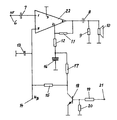
- the circuit according to the invention is based on the drawing, which is only a figure has been described.
- the NF amplifier is designed in a known manner with a differential amplifier IC 22.
- the audio frequency to be amplified is fed to the input pin 1 via a coupling capacitor 7.
- Pin 3 is grounded.
- a negative feedback resistor 11 to which an RC element consisting of the resistor 12 and the capacitor 16 is connected.
- the amplified audio frequency passes from the output pin 4 via the coupling capacitor 8 and the filter resistor 9 to the electroacoustic transducer, the loudspeaker 10.
- the operating voltage U B is fed in at the front of the connector 14 via the filter capacitor 13 at the pin 5.
- a series resistor consisting of two resistors 15 and 17 is connected.
- a semiconductor switch here the NPN transistor 18, lies with its collector at the connection point of the divided series resistor 15, 17. Its emitter is connected to ground. Its base is via the resistor combination 19 and 20 at connection 21, to which the mute control signal is supplied by the detector of the television, not shown.
- the mode of operation is now as follows: In stand-by mode, the full operating voltage U B is at terminal 14 and thus also at pin 5 of differential amplifier 22. Transistor 18 is blocked because there is no signal from the detector at terminal 21. The reverse voltage across the resistor 12 is thus at pin 2, the inverting input of the differential amplifier 22. The differential amplifier 22 remains muted, its quiescent current consumption is practically zero. The television set consumes practically no current for the LF amplifier.
- the signal from the detector is initially omitted as long as noise or a non-TV transmitter is received.
- the transistor 18 blocks and the blocking voltage is again at the inverting input until a television transmitter is tuned again, as a result of which the detector again supplies a signal to the terminal 21. Then the transistor 18 is turned on again, the reverse voltage at the inverting input is eliminated and the LF amplifier operates again and feeds the loudspeaker 10.
- the switch-off crack suppression takes place with a suitable choice of the time constants of the RC element and the values of the connected determining resistors by ensuring that the blocking voltage at the inverting input (pin 2) becomes effective after the device is switched off before the crack can be heard.
Landscapes
- Engineering & Computer Science (AREA)
- Multimedia (AREA)
- Signal Processing (AREA)
- Amplifiers (AREA)
Description
- Der Ein- und Ausschaltknacks wird bei NF-Verstärkern als störend empfunden. Bei größerer Lautstärke kann dieses Störgeräusch den Lautsprecher beschädigen. Eine mögliche Lösung sind schnell ansprechende Schalter, beispielsweise Relais, die man dem Lautsprecher vorschaltet. Der Lautsprecher wurde erst dann eingeschaltet, wenn sich ein stabiler Zustand nach dem Einschalten eingestellt hat. Desgleichen wurde auch der Ausschaltknacks verhindert. Nachteilig ist dabei der relativ hohe Schaltungsaufwand und die relativ teueren Bauteile, z. B. ein Relais.
- Stummsteuerschaltungen (Mute-Schaltungen) sind beispielsweise aus der US-PS 4 238 771 und der DE-OS 2 832 269 bekannt und betreffen Signalempfänger für Amplitudenmodulation, Fernsehgeräte oder Hörrundfunkempfänger. Im Falle der US-PS soll das störende Taktsignal in der Tonwiedergabe durch eine Stummschaltung verhindert oder unterdrückt werden, das bei solchen Geräten auftritt, wenn sie einen Synchron- Detektor verwenden. Es liegt die Aufgabe zugrunde, dieses Taktsignal sowie »Weißes Rauschen« zu unterdrücken, aber nicht das Rauschen zwischen Stationen bzw. das störende Knacken beim Ein- und Ausschalten. Die Lösung sieht eine sogenannte »kalte Lautstärkeregelung« vor, also gleichstrommäßig.
- Die DE-OS 2 832 269 betrifft eine monolithisch integrierte Schaltung für die Horizontalablenkung von Fernsehgeräten, die nach dieser Erfindung eine Stummschaltung enthält, um verrauschte TV-Eingangssignale oder Signale, die keine TV-Signale sind, ganz zu unterdrücken. Es besteht mit dieser HF- Differenz-Verstärkerschaltung keine Möglichkeit im Tonkanal Ein- und Ausschaltknacken zu unterdrücken.
- Aus der DE-OS 2 542 502, Zusatz zu DE-OS 2 413 839.4, ist die Anwendung eines speziellen 6 Pin-IC für ein Fernsehgerät mit Bild-im-Bild-Wiedergabe zu entnehmen, wobei für die Dauer von Zeilen der Tuner und der ZF-Verstärker zwischen zwei Empfangssignalen umgeschaltet wird. Das hierbei hörbare NF-Schaltknacken soll durch diese Erfindung unterdrückt werden. Das ist eine besondere Aufgabe. Es wird hier nicht eine Stummschaltung bzw. Abschaltung verrauschter TV-Signale oder Nicht-TV-Signale angestrebt. Auch können die beschriebenen Lösungswege keine Maßnahme gegen Ein- und Ausschaltknacken bieten.
- Aus der US-PS 3 867 709 ist eine Stummsteuerung zur Knack- und Störgeräuschunterdrückung bekannt. Die beschriebene Lösung sollte die Aufgabe lösen, Störgeräusche zu unterdrücken, die speziell bei schnellem Vor- und Rücklauf von Bandgeräten auftreten, und dies mit einer elektronischen Schaltung im Tonverstärker erreichen, nachdem zuvor mechanische und elektromechanische Lösungen desselben Problems nicht zufriedenstellend arbeiteten. Die Schaltung gemäß dieser US-PS sieht vor, daß beim Schließen des Schalters SW der Ausgang (Pin 4) ohne, jede Verzögerung »hart« stummgeschaltet wird, so daß ein Knackgeräüsch übertragen werden kann.
- Die von R7, R8 und C₄ gebildete Zeitkonstante am Differenzverstärkereingang (Pin 5) ist dabei ohne Bedeutung.
- Neuerdings wird von der Post eine Stummsteuerung der NF in Fernsehempfängern gefordert, wenn das empfangene Signal sehr schwach oder kein Fernsehsignal ist. Eine bekannte Lösung ist die Stummsteuerung mit Hilfe eines sogenannten Mute-Signals (Stummsteuersignal), das bei fehlenden Synchronimpulsen erzeugt wird und auf den Ton-ZF-Verstärker bzw. über die Lautstärkeeinstellung wirksam wird.
- Der vorliegenden Erfindung lag somit die Aufgabe zugrunde, sowohl eine Störgeräuschunterdrükkung wie auch eine Stummsteuerung des NF-Verstärkers eines Signalempfängers, insbesondere Fernsehgerätes, mit geringstmöglichem Aufwand so zu realisieren, daß auch störende Knackgeräusche beim Ein- und beim Ausschalten unterdrückt werden und daß bei Stand-by-Betrieb die Stromentnahme des Gerätes sehr gering ist.
- Diese Aufgabe wird für einen NF-Verstärker gemäß dem Oberbegriff des Anspruchs erfindungsgemäß nach dessen Kennzeichen gelöst.
- Weitere Einzelheiten sind der Beschreibung eines Ausführungsbeispiels zu entnehmen.
- Der NF-Verstärker für den elektroakustischen Wandler eines Fernsehgerätes ist mit einem Differenz-Verstärker-IC ausgeführt. Derartige integrierte Schaltungen besitzen einen invertierenden Eingang, der zum Anschluß einer Gegenkopplung gern verwendet wird. Wenn das Fernsehgerät mit einer Detektorschaltung ausgestattet ist, die eine Spannung bei Empfang eines Fernsehsenders abgibt, dann kann diese Spannung nach der Erfindung als Steuersignal für einen Halbleiterschalter dienen, der auf einfache Weise eine über einen unterteilten Vorwiderstand aus der Betriebsspannung für den NF-Verstärker abgeleitete Spannung schaltet. Wenn kein Detektorsignal vorhanden ist, liegt diese Spannung am invertierenden Eingang des Differenz-Verstärkers und steuert diesen stumm. Dadurch wird vorteilhafterweise im sogenannten Stand-By-Betrieb, der gegenwärtig gern angewendet wird, die Ruhestromaufnahme des NF-Verstärkers fast Null und so die Stromaufnahme des Gerätes bei dieser Betriebsart sehr gering, obwohl die Betriebsspannung, die direkt aus dem Netz stammt, während dieser Betriebsart ständig am Differenzverstärker anliegt. Außerdem wird die Forderung nach Unterdrückung der Störgeräusche und die Postforderung nach Stummsteuerung gemäß der gestellten Aufgabe auf ideale Weise erfüllt
- Die erfindungsgemäße Schaltung wird nachfolgend anhand der Zeichnung, die nur eine Figur aufweist, beschrieben.
- Der NF-Verstärker ist auf bekannte Weise mit einem Differenz-Verstärker-IC 22 ausgeführt. Am Anschluß 6 wird die zu verstärkende Tonfrequenz über einen Koppelkondensator 7 dem Eingangs-Pin 1 zugeführt. Der Pin 3 liegt an Masse. Zwischen dem Ausgangs-Pin 4 und dem invertierenden Eingang (Pin 2) liegt ein Gegenkopplungswiderstand 11, an welchem ein RC-Glied bestehend aus dem Widerstand 12 und dem Kondensator 16 angeschlossen ist. Die verstärkte Tonfrequenz gelangt vom Ausgangs-Pin 4 über den Koppelkondensator 8 und den Siebwiderstand 9 an den elektroakustischen Wandler, den Lautsprecher 10. Am Pin 5 wird die Betriebsspanung UB vorn Anschluß 14 über den Siebkondensator 13 zugeführt. Zwischen dem Anschluß 14 und dem Verbindungspunkt des RC-Gliedes 12, 16 ist ein aus zwei Widerständen 15 und 17 bestehender Vorwiderstand angeschlossen. Ein Halbleiterschalter, hier der NPN-Transistor 18, liegt mit seinem Collektor an dem Verbindungspunkt des aufgeteilten Vorwiderstandes 15, 17. Sein Emitter ist mit Masse verbunden. Seine Basis liegt über die Widerstandskombination 19 und 20 am Anschluß 21, dem das Stummsteuersignal vom nicht dargestellten Detektor des Fernsehgerätes zugeführt wird. Die Funktionsweise ist nun folgende: Im Stand-By-Betrieb liegt die volle Betriebsspannung UB am Anschluß 14 und damit auch am Pin 5 des Differenz-Verstärkers 22. Der Transistor 18 ist gesperrt, weil kein Signal vom Detektor am Anschluß 21 anliegt. Damit liegt am Pin 2, dem invertierenden Eingang des Differenzverstärkers 22, die Sperrspannung über den Widerstand 12. Der Differenzverstärker 22 bleibt stumm gesteuert, seine Ruhestromaufnahme ist praktisch Null Das Fernsehgerät verbraucht für den NF-Vestärker praktisch keinen Strom.
- Beim Einschalten des Fernsehgerätes gelangt ein Signal eines Fernsehsenders an den Detektor, der dem Anschluß 21 ein entsprechendes Signal zuleitet (damit fehlt quasi das sogenannte Stummsteuer-(Muting) Signal, das den Transistor 18 durchschaltet, die Collektor-Emitter-Strecke wird leitend. Dadurch entlädt sich der Kondensator 16 und die sperrende Spannung am invertierenden Eingang (Pin 2) reduziert sich auf die Arbeitsspannung, als Folge davon verstärkt der Differenzverstärker 22 erst mit einer gewünschten Zeitverzögerung, wodurch der Einschaltknacks wirkungsvoll unterdrückt wird.
- Wenn auf einen anderen Sender abgestimmt wird, entfällt zunächst das Signal vom Detektor solange Rauschen oder ein Nicht-Fernsehsender empfangen wird. Dabei sperrt der Transistor 18 und die Sperrspannung liegt wieder am invertierenden Eingang bis erneut auf einen Fernsehsender abgestimmt ist, wodurch der Detektor wieder ein Signal an den Anschluß 21 liefert. Dann wird der Transistor 18 wieder durchgeschaltet, die Sperrspannung am invertierenden Eingang entfällt und der NF-Verstärker arbeitet wieder und speist den Lautsprecher 10.
- Die Abschaltknacksunterdrückung geschieht bei geeigneter Wahl der Zeitkonstanten des RC-Gliedes und der Werte der angeschlossenen mitbestimmenden Widerstände, indem man dafür sorgt, daß die Sperrspannung am invertierenden Eingang (Pin 2) nach dem Abschalten des Gerätes bereits wirksam wird bevor der Knacks hörbar werden kann.

Claims (1)
Priority Applications (1)
| Application Number | Priority Date | Filing Date | Title |
|---|---|---|---|
| AT82104105T ATE16547T1 (de) | 1981-07-10 | 1982-05-12 | Nf-verstaerker fuer ein fernsehgeraet. |
Applications Claiming Priority (2)
| Application Number | Priority Date | Filing Date | Title |
|---|---|---|---|
| DE3127278 | 1981-07-10 | ||
| DE3127278A DE3127278C1 (de) | 1981-07-10 | 1981-07-10 | NF-Verstaerker fuer ein Fernsehgeraet |
Publications (3)
| Publication Number | Publication Date |
|---|---|
| EP0069843A1 EP0069843A1 (de) | 1983-01-19 |
| EP0069843B1 EP0069843B1 (de) | 1985-11-13 |
| EP0069843B2 true EP0069843B2 (de) | 1991-04-03 |
Family
ID=6136596
Family Applications (1)
| Application Number | Title | Priority Date | Filing Date |
|---|---|---|---|
| EP82104105A Expired - Lifetime EP0069843B2 (de) | 1981-07-10 | 1982-05-12 | NF-Verstärker für ein Fernsehgerät |
Country Status (3)
| Country | Link |
|---|---|
| EP (1) | EP0069843B2 (de) |
| AT (1) | ATE16547T1 (de) |
| DE (1) | DE3127278C1 (de) |
Families Citing this family (6)
| Publication number | Priority date | Publication date | Assignee | Title |
|---|---|---|---|---|
| DE3729656A1 (de) * | 1987-09-04 | 1989-03-23 | Thomson Brandt Gmbh | Schaltungsanordnung zur unterdrueckung von stoergeraeuschen |
| US5426394A (en) * | 1993-03-12 | 1995-06-20 | Thomson Consumer Electronics S.A. | Sound intermediate frequency amplifier for a broadcast receiver |
| EP0562414B1 (de) * | 1992-03-25 | 1998-03-04 | THOMSON multimedia | Ton-Zwischenfrequenz-Verstärker für einen Empfänger |
| EP0576770B1 (de) * | 1992-05-22 | 1999-12-22 | STMicroelectronics S.r.l. | Abschaltsteuerschaltung für einen Audioverstärker |
| DE102009041999A1 (de) | 2008-09-22 | 2010-03-25 | Sennheiser Electronic Gmbh & Co. Kg | Headset und Kopfhörer |
| CN103248985B (zh) * | 2012-02-03 | 2015-12-09 | 安凯(广州)微电子技术有限公司 | 一种带隔离直电容的音频功放杂音抑制电路 |
Family Cites Families (7)
| Publication number | Priority date | Publication date | Assignee | Title |
|---|---|---|---|---|
| FR2183569B3 (de) * | 1972-05-10 | 1975-08-01 | Thomson Csf | |
| JPS5524284B2 (de) * | 1972-10-04 | 1980-06-27 | ||
| DE2328673A1 (de) * | 1973-06-06 | 1975-01-02 | Bosch Elektronik Gmbh | Hochfrequenzempfaenger zum empfangen von in bestimmten zeitlichen abstaenden uebertragenen informationen |
| DE2542502A1 (de) * | 1975-09-24 | 1977-04-07 | Itt Ind Gmbh Deutsche | Fernsehempfaenger mit einer einrichtung zur gleichzeitigen wiedergabe mehrerer programme |
| JPS6041493B2 (ja) * | 1977-03-16 | 1985-09-17 | ソニー株式会社 | 受信機 |
| DE2832269C2 (de) * | 1978-07-22 | 1980-08-14 | Deutsche Itt Industries Gmbh, 7800 Freiburg | Monolithisch integrierte Schaltung für die Horizontalablenkung von Fernsehgeräten und deren Betriebsschaltung |
| DE2854196A1 (de) * | 1978-12-15 | 1980-06-26 | Bosch Gmbh Robert | Schaltungsanordnung zur einschaltverzoegerung bei einer verstaerkerschaltung |
-
1981
- 1981-07-10 DE DE3127278A patent/DE3127278C1/de not_active Expired
-
1982
- 1982-05-12 EP EP82104105A patent/EP0069843B2/de not_active Expired - Lifetime
- 1982-05-12 AT AT82104105T patent/ATE16547T1/de not_active IP Right Cessation
Also Published As
| Publication number | Publication date |
|---|---|
| EP0069843B1 (de) | 1985-11-13 |
| EP0069843A1 (de) | 1983-01-19 |
| ATE16547T1 (de) | 1985-11-15 |
| DE3127278C1 (de) | 1982-12-16 |
Similar Documents
| Publication | Publication Date | Title |
|---|---|---|
| DE4132957B4 (de) | Stummschaltung | |
| US3919482A (en) | FM receiver noise suppression circuit | |
| EP0069843B1 (de) | NF-Verstärker für ein Fernsehgerät | |
| DE3788571T2 (de) | Adaptiver entzerrer für gleichstrom-einschwingungsfehler. | |
| DE2902398C2 (de) | ||
| EP0641070A1 (de) | Verfahren und Einrichtung zum Anpassen der Lautstärke eines mobilen Wiedergabegerätes an das Umgebungsgeräusch | |
| DE68925252T2 (de) | Schnurloses Fernsprechkommunikationssystem | |
| EP0446195B1 (de) | Einkanal-Schaltung für ein Hörgerät | |
| DE2009930B2 (de) | Verstaerker- und demodulatorschaltung fuer fernsehempfaenger | |
| DE4233475C2 (de) | Schaltungsanordnung zum Stummschalten von Tonteilen | |
| US4203073A (en) | Radio receiver blanker gate | |
| DE3418037A1 (de) | Schaltung zur daempfung der stoerungen in einem funkempfaenger durch verwendung eines tiefpassfilters mit einstellbarem durchlassbereich | |
| DE2811542C2 (de) | ||
| DE2461134A1 (de) | Stereophonie-empfaenger | |
| DE3217231A1 (de) | Anordnung zur angepassten steuerung der lautstaerke zweier tonkanaele | |
| DE2725068A1 (de) | Schaltungsanordnung fuer einen rundfunkempfaenger | |
| DE3537837C1 (de) | Schaltungsanordnung zur Stoergeraeuschunterdrueckung bei auf Minimum eingestellter Lautstaerke eines Niederfrequenzverstaerkers | |
| JPS5832361Y2 (ja) | Fmステレオ受信回路 | |
| DE4326097C2 (de) | Schaltungsanordnung zum kurzzeitigen Stummschalten der Wiedergabe in einem Rundfunkempfänger | |
| DE2057531C3 (de) | Schaltungsanordnung zur Störaustastung bei einem Informationssignal | |
| DE1919972A1 (de) | Vorrichtung zur Fernsteuerung eines Geraets | |
| JP2519320Y2 (ja) | チューナのagc回路 | |
| JPS6345081Y2 (de) | ||
| JPH0453065Y2 (de) | ||
| JPH0510419Y2 (de) |
Legal Events
| Date | Code | Title | Description |
|---|---|---|---|
| PUAI | Public reference made under article 153(3) epc to a published international application that has entered the european phase |
Free format text: ORIGINAL CODE: 0009012 |
|
| AK | Designated contracting states |
Designated state(s): AT CH FR GB IT LI |
|
| 17P | Request for examination filed |
Effective date: 19821203 |
|
| ITF | It: translation for a ep patent filed | ||
| GRAA | (expected) grant |
Free format text: ORIGINAL CODE: 0009210 |
|
| AK | Designated contracting states |
Designated state(s): AT CH FR GB IT LI |
|
| REF | Corresponds to: |
Ref document number: 16547 Country of ref document: AT Date of ref document: 19851115 Kind code of ref document: T |
|
| ET | Fr: translation filed | ||
| PLBI | Opposition filed |
Free format text: ORIGINAL CODE: 0009260 |
|
| 26 | Opposition filed |
Opponent name: INTERESSENGEMEINSCHAFT FUER RUNDFUNKSCHUTZRECHTE E Effective date: 19860730 |
|
| PLAB | Opposition data, opponent's data or that of the opponent's representative modified |
Free format text: ORIGINAL CODE: 0009299OPPO |
|
| R26 | Opposition filed (corrected) |
Opponent name: INTERESSENGEMEINSCHAFT FUER RUNDFUNKSCHUTZRECHTE E Effective date: 19860730 |
|
| PLAB | Opposition data, opponent's data or that of the opponent's representative modified |
Free format text: ORIGINAL CODE: 0009299OPPO |
|
| R26 | Opposition filed (corrected) |
Opponent name: INTERESSENGEMEINSCHAFT FUER RUNDFUNKSCHUTZRECHTE E Effective date: 19860730 |
|
| PLAB | Opposition data, opponent's data or that of the opponent's representative modified |
Free format text: ORIGINAL CODE: 0009299OPPO |
|
| R26 | Opposition filed (corrected) |
Opponent name: INTERESSENGEMEINSCHAFT FUER RUNDFUNKSCHUTZRECHTE E Effective date: 19860730 |
|
| ITF | It: translation for a ep patent filed | ||
| PUAH | Patent maintained in amended form |
Free format text: ORIGINAL CODE: 0009272 |
|
| STAA | Information on the status of an ep patent application or granted ep patent |
Free format text: STATUS: PATENT MAINTAINED AS AMENDED |
|
| 27A | Patent maintained in amended form |
Effective date: 19910403 |
|
| AK | Designated contracting states |
Kind code of ref document: B2 Designated state(s): AT CH FR GB IT LI |
|
| ET3 | Fr: translation filed ** decision concerning opposition | ||
| REG | Reference to a national code |
Ref country code: CH Ref legal event code: AEN |
|
| ITTA | It: last paid annual fee | ||
| PGFP | Annual fee paid to national office [announced via postgrant information from national office to epo] |
Ref country code: AT Payment date: 19920515 Year of fee payment: 11 |
|
| PGFP | Annual fee paid to national office [announced via postgrant information from national office to epo] |
Ref country code: CH Payment date: 19920526 Year of fee payment: 11 |
|
| PGFP | Annual fee paid to national office [announced via postgrant information from national office to epo] |
Ref country code: FR Payment date: 19920820 Year of fee payment: 11 |
|
| PG25 | Lapsed in a contracting state [announced via postgrant information from national office to epo] |
Ref country code: AT Effective date: 19930512 |
|
| PG25 | Lapsed in a contracting state [announced via postgrant information from national office to epo] |
Ref country code: LI Effective date: 19930531 Ref country code: CH Effective date: 19930531 |
|
| PG25 | Lapsed in a contracting state [announced via postgrant information from national office to epo] |
Ref country code: FR Effective date: 19940131 |
|
| REG | Reference to a national code |
Ref country code: CH Ref legal event code: PL |
|
| REG | Reference to a national code |
Ref country code: FR Ref legal event code: ST |
|
| PGFP | Annual fee paid to national office [announced via postgrant information from national office to epo] |
Ref country code: GB Payment date: 19950418 Year of fee payment: 14 |
|
| PG25 | Lapsed in a contracting state [announced via postgrant information from national office to epo] |
Ref country code: GB Effective date: 19960512 |
|
| GBPC | Gb: european patent ceased through non-payment of renewal fee |
Effective date: 19960512 |
|
| REG | Reference to a national code |
Ref country code: CH Ref legal event code: AEN Free format text: AUFRECHTERHALTUNG DES PATENTES IN GEAENDERTER FORM |
|
| APAH | Appeal reference modified |
Free format text: ORIGINAL CODE: EPIDOSCREFNO |