EP0069924A2 - Computed tomography system cable retractor - Google Patents
Computed tomography system cable retractor Download PDFInfo
- Publication number
- EP0069924A2 EP0069924A2 EP82105860A EP82105860A EP0069924A2 EP 0069924 A2 EP0069924 A2 EP 0069924A2 EP 82105860 A EP82105860 A EP 82105860A EP 82105860 A EP82105860 A EP 82105860A EP 0069924 A2 EP0069924 A2 EP 0069924A2
- Authority
- EP
- European Patent Office
- Prior art keywords
- disk
- inner drum
- base
- drum
- cable
- Prior art date
- Legal status (The legal status is an assumption and is not a legal conclusion. Google has not performed a legal analysis and makes no representation as to the accuracy of the status listed.)
- Granted
Links
Images


Classifications
-
- A—HUMAN NECESSITIES
- A61—MEDICAL OR VETERINARY SCIENCE; HYGIENE
- A61B—DIAGNOSIS; SURGERY; IDENTIFICATION
- A61B6/00—Apparatus or devices for radiation diagnosis; Apparatus or devices for radiation diagnosis combined with radiation therapy equipment
- A61B6/44—Constructional features of apparatus for radiation diagnosis
- A61B6/4429—Constructional features of apparatus for radiation diagnosis related to the mounting of source units and detector units
- A61B6/4435—Constructional features of apparatus for radiation diagnosis related to the mounting of source units and detector units the source unit and the detector unit being coupled by a rigid structure
- A61B6/4447—Tiltable gantries
-
- A—HUMAN NECESSITIES
- A61—MEDICAL OR VETERINARY SCIENCE; HYGIENE
- A61B—DIAGNOSIS; SURGERY; IDENTIFICATION
- A61B6/00—Apparatus or devices for radiation diagnosis; Apparatus or devices for radiation diagnosis combined with radiation therapy equipment
- A61B6/56—Details of data transmission or power supply, e.g. use of slip rings
-
- H—ELECTRICITY
- H02—GENERATION; CONVERSION OR DISTRIBUTION OF ELECTRIC POWER
- H02G—INSTALLATION OF ELECTRIC CABLES OR LINES, OR OF COMBINED OPTICAL AND ELECTRIC CABLES OR LINES
- H02G11/00—Arrangements of electric cables or lines between relatively-movable parts
Definitions
- the invention disclosed herein pertains to computed x-ray tomography equipment.
- the invention comprises apparatus for controlling and protecting the cables that communicate between rotating and stationary parts such as between a panrry structure and the x-ray tube, x-ray detector and other components on the rotating x-ray scanner.
- Typical conputed tonography apparatus comprises a scanner base, basically a ring having a central opening, counted for rotation about a renerally horizontal axis on an upright member.
- the body being examined extends axially through the cenrral opening and is supported on a cantilevered x-ray transmissive table top coincident with the axis of rotation.
- An x-ray source and its associated beam collinstor are nounted on the scanner base on one side of the rotational axis and a sulticell x-ray detector and its associated data acquisition device are mounted on the base on the other side of the axis.
- the x-ray beam is collimated into a thin fan-shaped configuration for scanning a thin layer of the body.
- the x-ray source is usually energizea for about 360° of scanner rotation in either direction.
- the x-ray detector yields signals representative of x-ray attenuation along discrete bundles of rays in the beam. The signals are ultimately converted to digital data which is used by a computer to reconstruct an image of the cross-section or layer of the body that has been scanned as is well known.
- a large number of electrical connections must be side between stationary parts of the tomography apparatus and the rotatable scanner base!
- high voltage cables run to the anode and cathode of the rotating anode x-ray tube.
- a cable runs to the anode rotating motor.
- Another cable supplies the servo notors that operate the x-ray beam collimator blades.
- Various cables run to position sensors. There are cables for conducting the multiplexed data from the x-ray detector and its data acquisition system to the computer.
- the scanner base nust rotate from a rest position through about 180° to allow acceleration up to a uniform speed before the x-ray beam is turned on for 360° of rotation. Then the scanner base must decelerate and come to a smooth stop so considerable angular overtravel must be permitted up to a limit. Excessive overtravel must also be avoided and measures must be taken to assure that the scanner base is positively stopped when the permissible rotational limit, that is determined by the length of the cables, is reached.
- slip rings and brushes are used to provide electrically conductive paths between the totating scanner electrical components and stationary corponents. This obviates soae of the problems that arise with cables but it creates other problems such as the need for insulation for withstanding the high x-ray tube voltages, introduction of noise in the data channels and distortion and wear of the slip rings and their cooperating contacts.
- Objects of the present inventon are to provide a cable handling device or retractor that: reduces cable wear; minimises load imposed by the cables on the scanner; reduces the power required to drive the cables and the scanner base; minimizes bending stresses in the cables; avoids developing any significant noise as a result of cable movement; and, keeps the cables arranged in an orderly and determinable fashion.
- the open-centered scanner base which carries the x-ray source and detector, is .journaled in an upright member for rotation about a nomially horizontal axis.
- a motor and belt drives the scrnner base at the rotational speed desired for x-ray beam scanning.
- a cable supporting inner drua on which the cable group assembly is reeled and unreeled, is mounted to the scanner base concentrically with the axis of rotation and, hence, the inner drum rotates at the speed of the scanner base.
- One end of the cable assembly is attached to the inner drum.
- An outer drum or shroud that remains stationary is fixed to the upright member concentrically with the inner drum. Another end of the cable is fastened to the outer drum.
- the outside periphery of the rotatable inner drum and the inside of the stationary outer shroud define a circular channel. The action of unreeling and reeling the cable assembly by rotation of the inner drum causes a loop of cable to be formed in the channel.
- An open-centered disk is disposed over the channel.
- the disk is aounted for rotation on the inner drum.
- the disk is driven with the same motor that drives the base and inner drum but at an angular rate or rotational speed which is a fixed fraction of the rotational speed of the inner drum.
- the disk carries several circunferentially spaced apart stud shafts that project into the channel along its center.
- the shafts each have a cable supporting pulley rotatable on then.
- the pulleys have diameters roughly equal to the radial width of the channel minus the thickness of two cable runs.
- the loop of the cable has an angular motion with respect to the inner drum which is a fraction of the inner drum rotational speed.
- the disk and, hence, the pulleys are orbited around the channel at an appropriate speed for one pulley to fit into the loop or reentrant bend in the cable for transferring cable fron the inner drum to the outer stationary shroud or drua while portions of the cable extending away from the bend of the loop are supported on the other pulleys.
- the z-ray-scanaer apparatus comprises a base 10 that is anchored to the floor and two upstanding laterally spaced apart plate members 11 and 12.
- Typical plate member 12 has V-shaped rollers mounted to it such as those narked 13 and 14.
- a rocker segment 15 rests on the rollers for rocking thereon.
- Rocker segment 15 has a V-shaped lower edge that complements the grooves in rollers 13 and 14.
- Typical rocker 15 is fastened to one of two laterally spaced apart upright members 16.
- the visible one in FIGURE 2 has a curved lower portion 16' that is concentric to the curve of the rocker 15.
- the rocker is driven by a chain 17 that is fastened at both of its ends to curved portion 16' and loops around a driving sprocket 20.
- Sprocket 20 is driven by a reversible motor 21 which appears in FIGURE. 1.
- the upright mexbers can be tilted from the vertical position in which they are shown.
- a nominally vertical plate 25 is mounted to laterally spaced apart upright members 16. This plate has a large central opening concentric to the large central opening 26, see FIGURE 1, in a generally cone-shaped scanner base 27. As can be seen in FIGURES 2 and 10, scanner base 27 has a radially extending annular ris 28. An annular member 29 which serves as a pulley is fastened to scanner base ris 28 at circunferentially spaced apart locations by cap screws such as the one marked 30. Pulley 29 has the inner race 31 or a ball bearing 32 pressed on it. As can be seen best in FIGURE 10, the outer race 33 of bearing 32 is fitted into nonrotating vertical plate 25.
- the annular or ring-type pulley 29 has axially extending teeth 37 on its outer periphery.
- the toothed pulley has a toothed belt 38 running on it.
- belt 38 is driven by a toothed pulley 39 that is fastened to the shaft 40 of a reversible electric motor 41. When the motor is energized, it drives the scanner base 27 rotationally by aeans of belt 38.
- an x-ray tube casing 45 is mounted on scanner bass 27 on one side of nominally horizontal axis 43.
- a multiple cell x-ray detector 46 is mounted to scanner base 27 on the other side of horizontal axis 43.
- the x-ray beam emerging from x-ray tube casing 45 passes through a beam collimator 47 which results in the beam emerging from the collinator being thin in the axial direction and having a fan-shape in a plane to which axis 43 is perpendicular.
- the path of the thin bean is indicated by the arrows 48 in FIGURE 2.
- the body which is to be scanned with the x-ray bean is supported colinear with axis 43.
- x-ray detector 46 produces electric signals indicative of x-ray attenuation of the ray bundles after they have emerged from the body and, as is well known, these signals are variously processed and ultimately used by a computer to reconstruct an image of a layer of the body through which the thin x-ray mecanic passes.
- Valid x-ray attenuation data is obtained during the time that the x-ray tube 45 is eneryized and making a 360° orbit jointly with the detector 46 around the body.
- the x-ray tube and, hence, the scanner base must be orbiting or rotating at a constant angular rate during 360° of rotation during which the x-ray tube is energized.
- the first 180 degrees of rotation are used for accelerating the scanner base up to constant speed.
- the x-ray tube is energized and attenuation data is collected.
- another 180° is allowed for decelerating and stopping rotation of the scanner base 27.
- the scanner base will make two revolutions in one direction.
- the body being examined is indexed longitudinally by an amount equal to the thickness of the x-ray beam and another scan is made in the opposite direction and another two revolutions of the scanner bass occur.
- the cables which communicate between the stationary parts of the scanner apparatus and rotating parts such as the x-ray tube and the x-ray detector must be long enough to allow for two revolutions of the scanner base.
- the retractor in the illustrative embodiment is located rearwardly of scanner base 27 and noninally vertical plate 25.
- the retractor comprises an outer nonrotatable drum or axially extending, cylinder 55 which is provided with a flange 56 for facilitating fastening it to vertical plate 25 by means of angularly spaced apart nechine screws such as the one marked 57.
- an inner drum 58 is provided with a plurality of angularly apaced apart pads 59 through which cap screws 34 pass to fasten inner drum 58 to the driven scanner base pulley 29 which turns with scanner base 27.
- the pads 59 pass through the cutaways 36 in bearing retainer ring 35. It will be evident that when scanner base 27 is rotated under the influence of driving belt 38, inner drum 58 will rotate with the scanner base.
- the concentrically arranged outer stationary drum 55 and inner rotatable drum 58 define an axially extending channel 60.
- one end of the cable group is fastened at a point marked 62 to inner rotatable drum 58 and the other end of the cable group is fastened at 63 near an inlet to outer stationary drum 55.
- the cable forms a loop in channel 60 which is defined between concentric rotating drum 58 and fixed outer drum 55.
- the loop is identified by the numeral 64.
- the cable loop moves circularly in the channel 60.
- the angular motion of the loop is less than the angular motion of the scanner base and, hence, is less than the angular notion of the inner drum 58.
- Means are provided for maintaining control over the cable bundle 61 and its loop within chanael 60. Objectives are to keep the heavy cables in the group organized in a predetermined fashion and to minimize the noise that might result from the cable bundle slapping against the outer drum as the cable is unreeled from the inner drum.
- channel 60 is closed at its end with a disk 65.
- the disk has a central opening 66 for permitting it to be disposed circusjacrat inner drum 58 with the axis of the disk coincident with the horizontal rotational axis 42 of the scanner base.
- a large ring-type pulley 67 is fastened concentrically to disk 65. Pulley 67 is jourailed for rotation on inner drum 58 so the pulley 67 can rotate at a different angular rate than that of the inner drum and scanner base.
- pulley 67 has a smooth internal periphery 68 that runs on a plurality of rollers 69 which are journaled on stud shafts 70 that are, in turn, anchored in angularly spaced apart radially extending pads 71 which are integral with inner drum 58.
- a typical roller 69 and several others marked 72, 73 are also shown in FIGURE 3.
- the outer periphery of pulley 67 is smooth but is engaged to be driven by a toothed belt 74.
- the belt 74 wraps around opposite sides of pulley 67 to a place where the ends of the belt are gripped by a clamp 83 that is coupled to an adjustable belt tightener 84 which is fastened to disk 65.
- FIGURE 3 shows how the disk driving belt loops around driving pulley 79 and diverges in opposite directions around idler pulleys 81 and 82 which are mounted on a bracket 82.
- the radially extending rin 75 of pulley 67 is actually a cam whose purpose will be described later.
- the radius of rin 75 is reduced over a region marked 76 to thereby create two approximately 180° spaced apart cam risers 77 and 78.
- FIGURE 2 shows how belt 74, which drives pulley 67 and, hence disk 65 rotationally, runs around a small peripherally toothed driving pulley 79 which is fastened to the shaft 40 that extends out of motor 41.
- Disk 65 is driven so that its angular motion is a constant fraction of the angular motion of the scanner base and, hence, of inner drun 58.
- the minner in which the ratio between the angular motion of disk 65 and inner drum 58 are determined will be discussed in detail later.
- ring pulley 67 which carries disk 65 is retained against shifting arially by means of another set of rollers such as the one karked 86 in FIGURE 4. Rollers 86 turn on stud shafts 87 that are anchored on blocks 88 which are in turn fastened to inner drum 58.
- shutter elements 89 and 80 are carried on block 88 and pulley 67, respectively. These shutter elements alternately block and unblock light beams in photosensitive devices 91 and 92 which provide electric signal information indicative of the angular positon of some of the relatively movable parts which signals are used for purposes that do not have to be described to understand how the new cable retractor is constructed and functions.
- Axial motion constraining roller 86 is concealed under shutter bar 89 in FIGURE 3. As can be seen by inspection of FIGURE 3, there are eight rollers equivalent to roller 86 under shutter bars in FIGURE 3 and they are equiangularly spaced. There are also additional rollers comparable to roller 86 and one of them is marked 93 in FIGURE 3.
- the cable group 61 which is shown in detail in FIGURE 11 is shown in dashed lines in FIGURE 3.
- the cables are disposed in annular channel 60 which is defined by concentric outer stationary drum 55 and inner rotating drum 58.
- the cables are fastened at one end to outer drum SS with a clamp 63 and to inner drun 58 with a clamp 62 as was previously mentoned in connection with the diagrams in FIGURES 7-9.
- the cables 61 are shown to lay along the inner surface of outer drum 55 and make a substantially semicicu- lar loop in a portion of the cable marked 64.
- This same reference numeral 64 is used to indicate the loop for other rotational positions of the scanner and inner drum relative to the outer drum as, for instance, in FIGURES 7-9.
- FIGURE 3 one may see that since the cable group 61 is clamped at its inner end to the inner drum 58 with clamp 62 it is effectively clamped to scanner base 27.
- the cables run through an opening 101 with an inner drum 58 to connect with various electrical components on scanner base 27.
- two of the cables marked 102 and 103 in FIGURE 10 run through an opening 104 in the scanner base to connectors 105 and 106 on the x-ray tube casing 45.
- the retractor is rotated to the midway or rotational position it has in the FIGURE 8 diagram so none of the pulleys 110-115 (to be described later) appear in channel 60 in FIGURE 10.
- the cable group 61 when reeled on inner drum 58 has an effective radius of r i .
- the cable when constrained to lie along the inside of the outer drum 55, has an effective radius of to.
- the action of unreeling the cable by rotation of the inner drum causes the loop of cable 64 to be formed.
- the radius of this loop is equal to (r o -r i )/2.
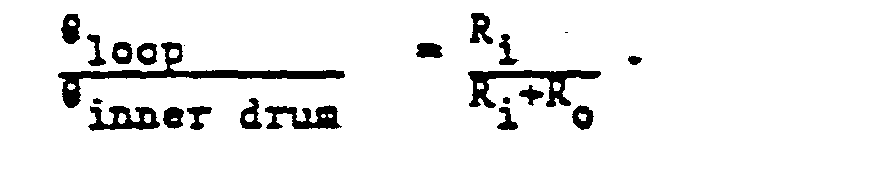
- This loop of cable has an angular action (0) with respect to the inner drum 58 of:
- FIGURE 7-9 diagrams, one may see that in the ideal case where gravity would not be a factor, action of the cable would be to unreel from the inner drum 58 and reel onto the inside of outer drum 55.
- the pulleys just referred to are shown is dashed line circles in FIGURE 3 where they are given the reference numerals 110-115. In the illustrative embodiment there are six such pulleys.
- a typical pulley 112 is shown in the FIGURE 6 sectional view.
- the typical pulley comprises a hub 115 in which there is a bushing 116 made of a material such as nylon which requires no lubrication.
- the typical pulley comprises a metal cylindrical shell 117 that is covered with a layer of pliable cushioning material 118 to suppress noise and reduce cable wear.
- clockwise and counterclockwise as used herein refer to rotational directions of scanner base 27 as viewed from the front of the apparatus as it is viewed in FIGURE 1.
- FIGURE 7 shows the disposition of the cable group 61 when the inner drum 58 (and the scanner base 27 to which it is fastened) is rotated to its counterclockwise limit after having made two revolutions in the counterclockwise direction.
- cable loop 64 travels at a fraction of the angular motion of the inner drum. That fraction is represented by r i /r i +r o .
- the ratio of the diameter of the driven pulley 29 on scanner base 27 to the driving pulley 39 on the motor shaft is chosen so that fixed speed reversible motor 41 will drive the scanner base rotationally at a speed that is appropriate for gathering the x-ray attenn- ation data.
- a 360° scan of the body is made in two seconds. A little more time is added for acceleration and deceration of the scanner base.
- the ratio of the diameter of ring-like pulley 67 on disk 65 to the diameter of its driving pulley 79 on the aotor shaft 41 is substantially greater than the previously mentioned ratio in which case the angular motion of disk 65 will be a fraction of the angular motion of the scanner base.
- the disk 65 is rotated at a rate which results in the loading pulley 11S carried thereon resaining coincident with the loop 64 that is formed in the cable.
- the pulleys 110-115 move in a circle at the angular rate at which the cable loop would move by itself.
- the ratio of the diameter of scanner base pulley 29 to its driving pulley 39 is 12:1 to use a nuaerical example.
- the ratio of the diameter of pulley 67 on disk 65 to its driving pulley 79 is 30:1.
- annular disk 65 will move four-tenths of the angular movement of scanner base 27 and the cable supporting pulleys would orbit at a corresponding angular rate.
- the pulley 67 and its cam and disk 65 rotate four-tenths as much or 288°.
- 360° of inner drum rotation the disk would rotate 144 0 .
- FIGURE 8 shows the disposition of cable group 61 when one full 360° rotation of the scanner base and inner drum 62 has been completed.
- the scanner base and drum 62 have reached their clockwise rotational limit where they have rotated about 720° or two revolutions from the position in which they are depicted in FIGURE 7.
- FIGURE 9 one may see that a substantial portion of the cable 61 is now reeled on inner drum 58.
- pulley 115 on disk 65 is always kept within the cable loop 64.
- the other pulleys 110-114 always support the cable against falling off of inner drum 58 and onto the outer drun 55 or from the outer drum 55 onto the inner drum 58, depending on the rotational position of the inner drum and the scanner base to which it is attached.
- Means are provided for assuring that the scanner base will not rotate beyond predsterained limits at which a tensile stress might be imposed on the cables. Means are also provided for assuring that the scanner bass rotation will be positively stopped before the cables are subjected to tensile stress.
- FIGJRE 1 is a view of the front of the scanner base 27. Adjacent this base and substantially diametrically opposite of each other are a pair of plates 120 and 121 which are mounted for yielding slightly upwardly.
- Typical plate 120 has a solenoid coil 122 mounted to it.
- the magnetic plunger within the solenoid is biased to the right by means of a coil spring 123.
- a solenoid plunger 124 is pivotally connected to a pivotally mounted and swingable latch lever 125 that has a recessed end 126.
- the solenoid assembly on the other plate 121 is similar to that just described. It comprises a solenoid 122' and latching lever 127.
- brackets 128 and 129 fastened to scanner base 27.
- the brackets have pins 130 and 131, respectively, extending from them in the axial directibn.
- solenoids 122 and 122' are maintained in a deenergized state during the first 120° of rotation of the scanner base from either its counterclockwise or clockwise limit.
- both latch levers 127 and 12S will be retracted out of the orbital path of pins 130 and 131.
- scanner base 27 is rotating clockwise so that typical stop pin 130 orbits clockwise.
- stop pin 130 would now be orbiting clockwise and would pass latching lever 127 in the course of the scanner base making its second revolution.
- the solenoids become deenergized and, under the influence of biasing spring 123, the latching levers go into the orbital paths of the stop pins. This would occur when stop pin 130 is moving between latching lever 127 toward latching lever 125.
- latching lever 125 With latching lever 125 in the path of pin 130, the pin would strike the recess 26 in the end of latching lever 12S for the latching lever to perform its scanner base stopping function.
- latching lever 127 would perform the stopping function.
- Typical solenoid supporting plate 120 is coupled by means of a bracket 132 to plunger rods 133 and 133' which extend out of cylinders 134 and 135.
- the cylinders and rods comprise what is known as a gas spring.
- a gas spring has the properties of bringing about constant deceleration of 2 moving object.
- the Gas Spring Corporation is one source of such devices. Gas springs are malagous to counterbalancing systems which maintain a constant force regardless of their position.
- typical plunger rods 133 and 133' yield and impose a constant resisting force on the plate 120 which carries the solenoid operated latching lever 125, for example. Smooth stopping of scanner base rotation results. Stopping motion in the counterclockwise direction is achieved with a similar constant force-applying device which is generally designated by the reference numeral 136.
- the means for controlling energization and deenergization of latching lever solenoids 122 and 121' comprise the previously mentioned cam 75 which forms part of the ring-type pulley 7S that drives disk 65.
- the cam has two risers 77 and 78.
- a switch 129 is disposed adjacent the orbital path of the cam risers and in this particular embodiment, switch 129 is located between idler pulleys 80 and 81 over which the belt that drives the disk supporting pulley 67 runs.
- Switch 129 has a rockable operating lever on whose end there is a roller 12S. When the roller goes on or off of the cam risers, the lever is pivoted and the switch is actuated.
- scanner base 27 along with its driving pulley 29 rotates through a total anglo of 720°. While executing this amount of angular motion, the rear disk-carrying pulley 67 would have four-tenths as much motion or a total of 288°. After the first 120° of rotation of the scanner base from either limit, the rear pulley 67 would turn only 48° so that the cam risers would just reach the switch lever. When the cam risers reach the lever 128 of switch 129 the switch is transferred to its closed circuit state and the solenoids become energized. This retracts the latching levers 12S and 127 from the orbital path of the stop pins 130 and 131 to allow 48° of scanner base rotational motion as previously described.
- the cable group 61 is shown in detail in FIGURES 11 and 12.
- Various cables are clamped and held in substantially the seme plane by clamps such as the ones marked 140 and 141 in FIGURE 11.
- the clamps are spanned by a pair of spring steel members or bands 142 and 143 which are held in place by bolts such as the one marked 144 which hold the two halves of the clamps together.
- Spring steel bands 142 and 143 provide a spring force which tends to force the cable group into good contact with the inner and outer drums of the cable retractor.
Landscapes
- Life Sciences & Earth Sciences (AREA)
- Health & Medical Sciences (AREA)
- Engineering & Computer Science (AREA)
- Medical Informatics (AREA)
- Pathology (AREA)
- Heart & Thoracic Surgery (AREA)
- High Energy & Nuclear Physics (AREA)
- Physics & Mathematics (AREA)
- Nuclear Medicine, Radiotherapy & Molecular Imaging (AREA)
- Optics & Photonics (AREA)
- Veterinary Medicine (AREA)
- Radiology & Medical Imaging (AREA)
- Biomedical Technology (AREA)
- Biophysics (AREA)
- Molecular Biology (AREA)
- Surgery (AREA)
- Animal Behavior & Ethology (AREA)
- General Health & Medical Sciences (AREA)
- Public Health (AREA)
- Computer Networks & Wireless Communication (AREA)
- Apparatus For Radiation Diagnosis (AREA)
- Analysing Materials By The Use Of Radiation (AREA)
Abstract
Description
- The invention disclosed herein pertains to computed x-ray tomography equipment. In particular, the invention comprises apparatus for controlling and protecting the cables that communicate between rotating and stationary parts such as between a panrry structure and the x-ray tube, x-ray detector and other components on the rotating x-ray scanner.
- Typical conputed tonography apparatus comprises a scanner base, basically a ring having a central opening, counted for rotation about a renerally horizontal axis on an upright member. The body being examined extends axially through the cenrral opening and is supported on a cantilevered x-ray transmissive table top coincident with the axis of rotation. An x-ray source and its associated beam collinstor are nounted on the scanner base on one side of the rotational axis and a sulticell x-ray detector and its associated data acquisition device are mounted on the base on the other side of the axis. The x-ray beam is collimated into a thin fan-shaped configuration for scanning a thin layer of the body. The x-ray source is usually energizea for about 360° of scanner rotation in either direction. The x-ray detector yields signals representative of x-ray attenuation along discrete bundles of rays in the beam. The signals are ultimately converted to digital data which is used by a computer to reconstruct an image of the cross-section or layer of the body that has been scanned as is well known.
- A large number of electrical connections must be side between stationary parts of the tomography apparatus and the rotatable scanner base! For exmple, high voltage cables run to the anode and cathode of the rotating anode x-ray tube. A cable runs to the anode rotating motor. Another cable supplies the servo notors that operate the x-ray beam collimator blades. Various cables run to position sensors. There are cables for conducting the multiplexed data from the x-ray detector and its data acquisition system to the computer.
- It is desirable to avoid having the cables become tangled, or bent too sharply or overstressed in tension as they go around with the scanner base which may rotate nearly two full revolutions or 720° in each direction to execute a 360° scan of successive layers of the body. Cable tangling or disordsrliness could result in the cables being effectively shortened in which case they right break when the power-driven scanner base approaches its rotational limits. Kecping the cibles organized in a deterninable way and free of undue stresses can be as- pecially problematical where, as in the tomography apparatus to be described later, the scinner base nakes about two revolutions for each body layer scanned. Even though the x-ray source is energized for only 360° or, by way of example, two seconds of rotation, the scanner base nust rotate from a rest position through about 180° to allow acceleration up to a uniform speed before the x-ray beam is turned on for 360° of rotation. Then the scanner base must decelerate and come to a smooth stop so considerable angular overtravel must be permitted up to a limit. Excessive overtravel must also be avoided and measures must be taken to assure that the scanner base is positively stopped when the permissible rotational limit, that is determined by the length of the cables, is reached.
- In some computed tomography equipment slip rings and brushes are used to provide electrically conductive paths between the totating scanner electrical components and stationary corponents. This obviates soae of the problems that arise with cables but it creates other problems such as the need for insulation for withstanding the high x-ray tube voltages, introduction of noise in the data channels and distortion and wear of the slip rings and their cooperating contacts.
- Objects of the present inventon are to provide a cable handling device or retractor that: reduces cable wear; minimises load imposed by the cables on the scanner; reduces the power required to drive the cables and the scanner base; minimizes bending stresses in the cables; avoids developing any significant noise as a result of cable movement; and, keeps the cables arranged in an orderly and determinable fashion.
- In accordance with the invention, the open-centered scanner base, which carries the x-ray source and detector, is .journaled in an upright member for rotation about a nomially horizontal axis. A motor and belt drives the scrnner base at the rotational speed desired for x-ray beam scanning. A cable supporting inner drua, on which the cable group assembly is reeled and unreeled, is mounted to the scanner base concentrically with the axis of rotation and, hence, the inner drum rotates at the speed of the scanner base. One end of the cable assembly is attached to the inner drum. An outer drum or shroud that remains stationary is fixed to the upright member concentrically with the inner drum. Another end of the cable is fastened to the outer drum. The outside periphery of the rotatable inner drum and the inside of the stationary outer shroud define a circular channel. The action of unreeling and reeling the cable assembly by rotation of the inner drum causes a loop of cable to be formed in the channel.
- An open-centered disk is disposed over the channel. The disk is aounted for rotation on the inner drum. The disk is driven with the same motor that drives the base and inner drum but at an angular rate or rotational speed which is a fixed fraction of the rotational speed of the inner drum. The disk carries several circunferentially spaced apart stud shafts that project into the channel along its center. The shafts each have a cable supporting pulley rotatable on then. The pulleys have diameters roughly equal to the radial width of the channel minus the thickness of two cable runs. As indicated, the loop of the cable has an angular motion with respect to the inner drum which is a fraction of the inner drum rotational speed. Thus, the disk and, hence, the pulleys are orbited around the channel at an appropriate speed for one pulley to fit into the loop or reentrant bend in the cable for transferring cable fron the inner drum to the outer stationary shroud or drua while portions of the cable extending away from the bend of the loop are supported on the other pulleys.
- The manner in which the objects mentioned above and other objects of the invention are achieved will be evident in the sore detailed description of a preferred erbodinent of the invention which will now be set forth in reference to the drawings.
-
- FIGURE 1 is a front elevation view of computed tomography scanning apparatus which incorporates the new cable retractor, the decorative shrouds of said apparatus being omitted to perait depicting the operative apparatus more clearly;
- FIGURE 2 is a right side elevation, partially in section, of the apparatus shown in FIGURE 1, the position of the retractor in FIGURE 2 corresponding to the counterclockwise limit of rotation of the scanner when viewed from the front as in FIGURE 1 whereas the FIGURE 7 diagram shows the retractor from the rear of the scanner when the scanner is at its counterclockwise limit;
- FIGURE 3 is a rear elevation view of the scanning apparatus in FIGURE 1 looking directly at the cable retractor;
- FIGURE 4 is a partial section taken on a line corresponding to 4-4 in FIGURE 3;
- FIGURE 5 is a partial section taken on a line corresponding to 5-5 in FIGURE 3;
- FIGURE 6 is a section taken through one of the cable supporting pulleys on a line corresponding with 6-6 in FIGURE 3 with parts other than the pulley and the disk on which it is mounted being omitted for the sake of clarity;
- FIGURES 7, 8 and 9 are diagrams of the cable retractor in different operational stages;
- FIGURE 10 is an enlargement of the upper portion of FIGURE 2 but with the cable retractor rotated to a position midway between its clockwise and counterclockwise limits to correspond with the FIGURE 8 diagram;
- FIGURE 11 is a plan view of a typical cable group that might be handled and controlled by the retractor; and
- FIGURE 12 is a section taken an a line corresponding with 12-12 in FIGURE 11.
- Referring to FIGURES 1 and 2, the z-ray-scanaer apparatus comprises a
base 10 that is anchored to the floor and two upstanding laterally spaced apartplate members Typical plate member 12 has V-shaped rollers mounted to it such as those narked 13 and 14. As shown best in FIGURE 2, arocker segment 15 rests on the rollers for rocking thereon. Rockersegment 15 has a V-shaped lower edge that complements the grooves inrollers Typical rocker 15 is fastened to one of two laterally spaced apartupright members 16. The visible one in FIGURE 2 has a curved lower portion 16' that is concentric to the curve of therocker 15. The rocker is driven by achain 17 that is fastened at both of its ends to curved portion 16' and loops around a drivingsprocket 20. Sprocket 20 is driven by areversible motor 21 which appears in FIGURE. 1. Thus, the upright mexbers can be tilted from the vertical position in which they are shown. - A nominally
vertical plate 25 is mounted to laterally spaced apartupright members 16. This plate has a large central opening concentric to the largecentral opening 26, see FIGURE 1, in a generally cone-shapedscanner base 27. As can be seen in FIGURES 2 and 10,scanner base 27 has a radially extendingannular ris 28. Anannular member 29 which serves as a pulley is fastened to scanner base ris 28 at circunferentially spaced apart locations by cap screws such as the one marked 30.Pulley 29 has theinner race 31 or aball bearing 32 pressed on it. As can be seen best in FIGURE 10, theouter race 33 of bearing 32 is fitted into nonrotatingvertical plate 25. The bearing is retained with a retainingring 35 that has some circuaferentially spaced apart cytaxays such as the one marked 36 in FIGURE 10. Machine screws, not shown, pass throughring 35 between cutaways and screw intopulley 29 to secureretainer ring 35 against the inner race of the bearing. It will be evident from the description thus far thatscanner base 27 is journaled for rotation about a nominally horizontal axis relative to nonrotatingvertical plate 25 which is supported on the uprights. This axis is marked 42 in FIGURE 1. Whenplate 25 is tilted from vertical on its rockers,axis 42 will be inclined to horizontal so the x-ray bean can pass through the body at an angle with respect to vertical to the option of the radiologist. - The annular or ring-
type pulley 29 has axially extendingteeth 37 on its outer periphery. The toothed pulley has atoothed belt 38 running on it. As shown in FIGURES 1 and 2,belt 38 is driven by atoothed pulley 39 that is fastened to the shaft 40 of a reversibleelectric motor 41. When the motor is energized, it drives thescanner base 27 rotationally by aeans ofbelt 38. - As shown in FIGURES 1, 2 and 10, an
x-ray tube casing 45 is mounted onscanner bass 27 on one side of nominally horizontal axis 43. A multiplecell x-ray detector 46 is mounted toscanner base 27 on the other side of horizontal axis 43. The x-ray beam emerging from x-ray tube casing 45 passes through abeam collimator 47 which results in the beam emerging from the collinator being thin in the axial direction and having a fan-shape in a plane to which axis 43 is perpendicular. The path of the thin bean is indicated by thearrows 48 in FIGURE 2. As is well mown, the body which is to be scanned with the x-ray bean is supported colinear with axis 43. During a rotational scan,x-ray detector 46 produces electric signals indicative of x-ray attenuation of the ray bundles after they have emerged from the body and, as is well known, these signals are variously processed and ultimately used by a computer to reconstruct an image of a layer of the body through which the thin x-ray beim passes. - Valid x-ray attenuation data is obtained during the time that the
x-ray tube 45 is eneryized and making a 360° orbit jointly with thedetector 46 around the body. However, the x-ray tube and, hence, the scanner base must be orbiting or rotating at a constant angular rate during 360° of rotation during which the x-ray tube is energized. Thus, in the illustrative embodiment, the first 180 degrees of rotation are used for accelerating the scanner base up to constant speed. During the next 360° of rotation at a constant speed the x-ray tube is energized and attenuation data is collected. At the end of the scan, another 180° is allowed for decelerating and stopping rotation of thescanner base 27. Thus, it will be evident that for every body layer that is scanned the scanner base will make two revolutions in one direction. Usually, after a scan in one direction is made, the body being examined is indexed longitudinally by an amount equal to the thickness of the x-ray beam and another scan is made in the opposite direction and another two revolutions of the scanner bass occur. It will be evident then that the cables which communicate between the stationary parts of the scanner apparatus and rotating parts such as the x-ray tube and the x-ray detector must be long enough to allow for two revolutions of the scanner base. - The new cable handling and control device will now be discussed. For convenience, the device will be called a cable retractor. Referring to FIGURES 2 and 3, the retractor in the illustrative embodiment is located rearwardly of
scanner base 27 and noninallyvertical plate 25. As can be seen particularly well in FIGURE 2, the retractor comprises an outer nonrotatable drum or axially extending,cylinder 55 which is provided with aflange 56 for facilitating fastening it tovertical plate 25 by means of angularly spaced apart nechine screws such as the one marked 57. As shown in FIGURES 2, 3, 5 and 10, aninner drum 58 is provided with a plurality of angularly apacedapart pads 59 through which cap screws 34 pass to fasteninner drum 58 to the drivenscanner base pulley 29 which turns withscanner base 27. Thepads 59 pass through thecutaways 36 in bearingretainer ring 35. It will be evident that whenscanner base 27 is rotated under the influence of drivingbelt 38,inner drum 58 will rotate with the scanner base. The concentrically arranged outerstationary drum 55 and innerrotatable drum 58 define anaxially extending channel 60. The group of electric cables, which is generally designated by thereference numeral 61, resides inchannel 60. - As shown in the FIGURE 7-9 diagrans, one end of the cable group is fastened at a point marked 62 to inner
rotatable drum 58 and the other end of the cable group is fastened at 63 near an inlet to outerstationary drum 55. One may see in the diagrams that the cable reels and unreels from the inner drum and is correspondingly picked up from and laid down on the outer drum. The cable forms a loop inchannel 60 which is defined between concentricrotating drum 58 and fixedouter drum 55. The loop is identified by the numeral 64. During rotation of thescanner base 27, the cable loop moves circularly in thechannel 60. The angular motion of the loop is less than the angular motion of the scanner base and, hence, is less than the angular notion of theinner drum 58. - Means are provided for maintaining control over the
cable bundle 61 and its loop withinchanael 60. Objectives are to keep the heavy cables in the group organized in a predetermined fashion and to minimize the noise that might result from the cable bundle slapping against the outer drum as the cable is unreeled from the inner drum. - As can be seen particularly well in FIGURES 2, 3 and 10, in accordance with the invention,
channel 60 is closed at its end with adisk 65. The disk has acentral opening 66 for permitting it to be disposed circusjacratinner drum 58 with the axis of the disk coincident with the horizontalrotational axis 42 of the scanner base. A large ring-type pulley 67 is fastened concentrically todisk 65.Pulley 67 is jourailed for rotation oninner drum 58 so thepulley 67 can rotate at a different angular rate than that of the inner drum and scanner base. As can be seen particularly well in FIGURES S and 10,pulley 67 has a smoothinternal periphery 68 that runs on a plurality ofrollers 69 which are journaled onstud shafts 70 that are, in turn, anchored in angularly spaced apart radially extendingpads 71 which are integral withinner drum 58. Atypical roller 69 and several others marked 72, 73 are also shown in FIGURE 3. The outer periphery ofpulley 67 is smooth but is engaged to be driven by atoothed belt 74. Thebelt 74 wraps around opposite sides ofpulley 67 to a place where the ends of the belt are gripped by aclamp 83 that is coupled to anadjustable belt tightener 84 which is fastened todisk 65. FIGURE 3 shows how the disk driving belt loops around drivingpulley 79 and diverges in opposite directions around idler pulleys 81 and 82 which are mounted on a bracket 82. Theradially extending rin 75 ofpulley 67 is actually a cam whose purpose will be described later. As can be seen in FIGURE 3, the radius ofrin 75 is reduced over a region marked 76 to thereby create two approximately 180° spaced apartcam risers belt 74, which drivespulley 67 and, hencedisk 65 rotationally, runs around a small peripherally toothed drivingpulley 79 which is fastened to the shaft 40 that extends out ofmotor 41. It will be evident that whenmotor 41 turns the scanner baseby means ofbelt driving pulley 39, theother pulley 79 on the same motor shaft will drivedisk 65.Disk 65 is driven so that its angular motion is a constant fraction of the angular motion of the scanner base and, hence, ofinner drun 58. The minner in which the ratio between the angular motion ofdisk 65 andinner drum 58 are determined will be discussed in detail later. - As shown in FIGURE 4,
ring pulley 67 which carriesdisk 65 is retained against shifting arially by means of another set of rollers such as the one karked 86 in FIGURE 4.Rollers 86 turn onstud shafts 87 that are anchored onblocks 88 which are in turn fastened toinner drum 58. As shown in FIGURE 4, shutterelements block 88 andpulley 67, respectively. These shutter elements alternately block and unblock light beams inphotosensitive devices motion constraining roller 86 is concealed undershutter bar 89 in FIGURE 3. As can be seen by inspection of FIGURE 3, there are eight rollers equivalent toroller 86 under shutter bars in FIGURE 3 and they are equiangularly spaced. There are also additional rollers comparable toroller 86 and one of them is marked 93 in FIGURE 3. - The
cable group 61 which is shown in detail in FIGURE 11 is shown in dashed lines in FIGURE 3. The cables are disposed inannular channel 60 which is defined by concentric outerstationary drum 55 and innerrotating drum 58. The cables are fastened at one end to outer drum SS with aclamp 63 and toinner drun 58 with aclamp 62 as was previously mentoned in connection with the diagrams in FIGURES 7-9. Referring to FIGURE 3, for that particular rotational position of thescanner base 27, thecables 61 are shown to lay along the inner surface ofouter drum 55 and make a substantially semicicu- lar loop in a portion of the cable marked 64. Thissame reference numeral 64 is used to indicate the loop for other rotational positions of the scanner and inner drum relative to the outer drum as, for instance, in FIGURES 7-9. In FIGURE 3, one may see that since thecable group 61 is clamped at its inner end to theinner drum 58 withclamp 62 it is effectively clamped toscanner base 27. As shown in FIGURE 10, where the retractor is in a rotational position that differs from its position in FIGURE 3, the cables run through anopening 101 with aninner drum 58 to connect with various electrical components onscanner base 27. To illustrate, two of the cables marked 102 and 103 in FIGURE 10, run through anopening 104 in the scanner base toconnectors x-ray tube casing 45. Note that in FIGURE 10, the retractor is rotated to the midway or rotational position it has in the FIGURE 8 diagram so none of the pulleys 110-115 (to be described later) appear inchannel 60 in FIGURE 10. - The
cable group 61, when reeled oninner drum 58 has an effective radius of ri. The cable when constrained to lie along the inside of theouter drum 55, has an effective radius of to. The action of unreeling the cable by rotation of the inner drum (which is fastened to thescanning base 27 and rotates with it) causes the loop ofcable 64 to be formed. The radius of this loop is equal to (ro-ri)/2. This loop of cable has an angular action (0) with respect to theinner drum 58 of:
- Referring to the FIGURE 7-9 diagrams, one may see that in the ideal case where gravity would not be a factor, action of the cable would be to unreel from the
inner drum 58 and reel onto the inside ofouter drum 55. Because the cables operate in a vertical plane, several pulleys are used to maintain the cable loop progression defined in Equation 1 when the cable is acted upon by the force of gravity and also by the inner drum or scanning base acceleration forces. The pulleys just referred to are shown is dashed line circles in FIGURE 3 where they are given the reference numerals 110-115. In the illustrative embodiment there are six such pulleys. Atypical pulley 112 is shown in the FIGURE 6 sectional view. It is journaled for rotation on astud shaft 113 which is welded into abase plate 114. Thebase plates 114 are anchored todisk 65 which is juxtaposed to the channel defined by the concentrically related outer and inner drums. The typical pulley comprises ahub 115 in which there is abushing 116 made of a material such as nylon which requires no lubrication. The typical pulley comprises a metalcylindrical shell 117 that is covered with a layer ofpliable cushioning material 118 to suppress noise and reduce cable wear. - The terms clockwise and counterclockwise as used herein refer to rotational directions of
scanner base 27 as viewed from the front of the apparatus as it is viewed in FIGURE 1. - FIGURE 7 shows the disposition of the
cable group 61 when the inner drum 58 (and thescanner base 27 to which it is fastened) is rotated to its counterclockwise limit after having made two revolutions in the counterclockwise direction. In accordance with Equation 1,cable loop 64 travels at a fraction of the angular motion of the inner drum. That fraction is represented by ri/ri+ro. Referring to FIGURE 2, the ratio of the diameter of the drivenpulley 29 onscanner base 27 to the drivingpulley 39 on the motor shaft is chosen so that fixed speedreversible motor 41 will drive the scanner base rotationally at a speed that is appropriate for gathering the x-ray attenn- ation data. Typically, as in the illustrated embodiment, a 360° scan of the body is made in two seconds. A little more time is added for acceleration and deceration of the scanner base. The ratio of the diameter of ring-like pulley 67 ondisk 65 to the diameter of its drivingpulley 79 on theaotor shaft 41 is substantially greater than the previously mentioned ratio in which case the angular motion ofdisk 65 will be a fraction of the angular motion of the scanner base. In fact, thedisk 65 is rotated at a rate which results in the loading pulley 11S carried thereon resaining coincident with theloop 64 that is formed in the cable. In other words, all of the pulleys 110-115 move in a circle at the angular rate at which the cable loop would move by itself. By way of example and not limitation, in a commercial embodiment, the ratio of the diameter ofscanner base pulley 29 to its drivingpulley 39 is 12:1 to use a nuaerical example. The ratio of the diameter ofpulley 67 ondisk 65 to its drivingpulley 79 is 30:1. It will be evident that in this exampleannular disk 65 will move four-tenths of the angular movement ofscanner base 27 and the cable supporting pulleys would orbit at a corresponding angular rate. Thus, using the numerical example, for 720° of inner drum rotation thepulley 67 and its cam anddisk 65 rotate four-tenths as much or 288°. For 360° of inner drum rotation the disk would rotate 1440. - when the scanner base and
inner drum 58 begin to rotate in the clockwise direction from the counterclockwise limit depicted in FIGURE 7, the cable group portion leading back fromclamp 62 on the inner drum begins to reel onto the outer periphery of theinner drum 58 and off of the inner periphery ofouter drum 55. FIGURE 8 shows the disposition ofcable group 61 when one full 360° rotation of the scanner base andinner drum 62 has been completed. In FIGURE 9, the scanner base and drum 62 have reached their clockwise rotational limit where they have rotated about 720° or two revolutions from the position in which they are depicted in FIGURE 7. In FIGURE 9, one may see that a substantial portion of thecable 61 is now reeled oninner drum 58. For any angular position of the inner drum,pulley 115 ondisk 65 is always kept within thecable loop 64. The other pulleys 110-114 always support the cable against falling off ofinner drum 58 and onto theouter drun 55 or from theouter drum 55 onto theinner drum 58, depending on the rotational position of the inner drum and the scanner base to which it is attached. - Means are provided for assuring that the scanner base will not rotate beyond predsterained limits at which a tensile stress might be imposed on the cables. Means are also provided for assuring that the scanner bass rotation will be positively stopped before the cables are subjected to tensile stress. These means will now be discussed.
- Refer again to FIGJRE 1 which is a view of the front of the
scanner base 27. Adjacent this base and substantially diametrically opposite of each other are a pair ofplates Typical plate 120 has asolenoid coil 122 mounted to it. The magnetic plunger within the solenoid is biased to the right by means of acoil spring 123. A solenoid plunger 124 is pivotally connected to a pivotally mounted andswingable latch lever 125 that has a recessedend 126. The solenoid assembly on theother plate 121 is similar to that just described. It comprises a solenoid 122' and latchinglever 127. - As shown in FIGURE I, there are an angularly spaced- apart pair of
brackets scanner base 27. The brackets havepins solenoids 122 and 122' are maintained in a deenergized state during the first 120° of rotation of the scanner base from either its counterclockwise or clockwise limit. When the solenoids are energized, both latchlevers 127 and 12S will be retracted out of the orbital path ofpins scanner base 27 is rotating clockwise so thattypical stop pin 130 orbits clockwise. During the x-ray scanning revolution it will clear past both latchinglevers 127 and 12S since the solenoids are energized. As a result of a cam operating a switch, as will be described, sometime before the scanner base reaches its rotational limit in one direction, that is, before the base has completed its second revolution,solenoids 122 and 122' become deenergized so that the latch levers 125 and 127 are disposed in the orbital path of stop pins 130 and 131. For the sake of illustration, assume that the scanner base and theinner drum 58 thereon is to rotate clockwise as viewed from the front of the machine in FIGURE 1 and counterclockwise as viewed from the rear of the machine and looking at the cable retractor as in FIGURE 8. Referring to FIGURE 1, stoppin 130 would now be orbiting clockwise and would pass latchinglever 127 in the course of the scanner base making its second revolution. After passing latchinglever 127, the solenoids become deenergized and, under the influence of biasingspring 123, the latching levers go into the orbital paths of the stop pins. This would occur whenstop pin 130 is moving between latchinglever 127 toward latchinglever 125. With latchinglever 125 in the path ofpin 130, the pin would strike therecess 26 in the end of latching lever 12S for the latching lever to perform its scanner base stopping function. For rotation of the scanner base in the opposite direction in FIGURE 1, latchinglever 127 would perform the stopping function. - Typical
solenoid supporting plate 120 is coupled by means of abracket 132 toplunger rods 133 and 133' which extend out ofcylinders typical plunger rods 133 and 133' yield and impose a constant resisting force on theplate 120 which carries the solenoid operated latchinglever 125, for example. Smooth stopping of scanner base rotation results. Stopping motion in the counterclockwise direction is achieved with a similar constant force-applying device which is generally designated by thereference numeral 136. - The means for controlling energization and deenergization of latching
lever solenoids 122 and 121' comprise the previously mentionedcam 75 which forms part of the ring-type pulley 7S that drivesdisk 65. As shown in FIGURE 3, the cam has tworisers switch 129 is disposed adjacent the orbital path of the cam risers and in this particular embodiment,switch 129 is located betweenidler pulleys 80 and 81 over which the belt that drives thedisk supporting pulley 67 runs.Switch 129 has a rockable operating lever on whose end there is a roller 12S. When the roller goes on or off of the cam risers, the lever is pivoted and the switch is actuated. Whenever the switch is actuated, it closes a circuit, not shown, in whichsolenoids 122 and 122' are connected so that the solenoids are energized. As explained earlier,pulley 67 which carriesdisk 65 moves through an angle that is a fraction of the angle through which thescanner base 27 for drivingpulley 29 moves whenmotor 41 drives both pulleys together. Thus the rear disk-carryingpulley 67 rotates less than one revolution when thefront scanner 27 rotatingpulley 29 rotates a full revolution. Thus, the can risers do not reach the operatinglever 128 ofswitch 129 for the first 120° of rotation of thefront pulley 29 and, hence,scanner base 27. Using the nuaerical example which was used for illustrative purposes and not limitation earlier,scanner base 27 along with its drivingpulley 29 rotates through a total anglo of 720°. While executing this amount of angular motion, the rear disk-carryingpulley 67 would have four-tenths as much motion or a total of 288°. After the first 120° of rotation of the scanner base from either limit, therear pulley 67 would turn only 48° so that the cam risers would just reach the switch lever. When the cam risers reach thelever 128 ofswitch 129 the switch is transferred to its closed circuit state and the solenoids become energized. This retracts the latchinglevers 12S and 127 from the orbital path of the stop pins 130 and 131 to allow 48° of scanner base rotational motion as previously described. - The
cable group 61 is shown in detail in FIGURES 11 and 12. Various cables are clamped and held in substantially the seme plane by clamps such as the ones marked 140 and 141 in FIGURE 11. The clamps are spanned by a pair of spring steel members orbands Spring steel bands - Although a preferred embodiment of the new invention has been described in substantial detail, such description is intended to be illustrative rather than limiting, for the invention may be variously embodied and is to be limited only by interpretation of the claims which follow.
Claims (7)
means coupled to the bracket members for decelerating said base with a constant force when said stop elements are butted by said abutment elements.
Applications Claiming Priority (2)
| Application Number | Priority Date | Filing Date | Title |
|---|---|---|---|
| US06/282,897 US4366577A (en) | 1981-07-13 | 1981-07-13 | Computed tomography system cable retractor |
| US282897 | 1981-07-13 |
Publications (3)
| Publication Number | Publication Date |
|---|---|
| EP0069924A2 true EP0069924A2 (en) | 1983-01-19 |
| EP0069924A3 EP0069924A3 (en) | 1985-12-04 |
| EP0069924B1 EP0069924B1 (en) | 1992-05-27 |
Family
ID=23083593
Family Applications (1)
| Application Number | Title | Priority Date | Filing Date |
|---|---|---|---|
| EP82105860A Expired EP0069924B1 (en) | 1981-07-13 | 1982-07-01 | Computed tomography system cable retractor |
Country Status (5)
| Country | Link |
|---|---|
| US (1) | US4366577A (en) |
| EP (1) | EP0069924B1 (en) |
| JP (1) | JPS5825149A (en) |
| DE (1) | DE3280402D1 (en) |
| IL (1) | IL66158A0 (en) |
Cited By (2)
| Publication number | Priority date | Publication date | Assignee | Title |
|---|---|---|---|---|
| EP0133972B1 (en) * | 1983-07-29 | 1990-12-27 | Kabushiki Kaisha Toshiba | Ct scanner |
| CN103776850A (en) * | 2014-01-17 | 2014-05-07 | 国家电网公司 | Nondestructive detecting device for carbon fiber composite core lead |
Families Citing this family (20)
| Publication number | Priority date | Publication date | Assignee | Title |
|---|---|---|---|---|
| US4799245A (en) * | 1983-05-12 | 1989-01-17 | Tokyo Shibaura Denki Kabushiki Kaisha | Integrated CT scanner gantry |
| JPS6041953A (en) * | 1983-08-16 | 1985-03-05 | 株式会社東芝 | Multi-rotary cable treating apparatus |
| JPS6198240A (en) * | 1984-10-18 | 1986-05-16 | 横河メディカルシステム株式会社 | Mechanical stopper apparatus |
| US4658408A (en) * | 1985-03-04 | 1987-04-14 | Picker International Inc. | Computed tomography brake method and apparatus |
| JP2000116644A (en) * | 1998-10-16 | 2000-04-25 | Toshiba Corp | X-ray CT system |
| US7039154B1 (en) | 2003-10-02 | 2006-05-02 | Reveal Imaging Technologies, Inc. | Folded array CT baggage scanner |
| US7465928B2 (en) * | 2005-09-29 | 2008-12-16 | Siemens Medical Solutions Usa, Inc. | Apparatus and methods for guiding cables around a rotating gantry of a nuclear medicine camera |
| US8447560B2 (en) * | 2008-11-13 | 2013-05-21 | General Electric Company | Apparatus and method for identifying the absolute rotation of a rotating imaging system |
| US8237123B2 (en) * | 2008-11-13 | 2012-08-07 | General Electric Company | Apparatus for preventing damage to retractor in rotating imaging system |
| US8469303B2 (en) | 2011-01-07 | 2013-06-25 | Crestron Electronics Inc. | Cable cord retractor |
| US9056744B2 (en) | 2011-01-07 | 2015-06-16 | Crestron Electronics Inc. | Cable cord retractor |
| US9475673B2 (en) | 2011-01-07 | 2016-10-25 | Crestron Electronics, Inc. | Cable retractor |
| US8469304B2 (en) | 2011-01-07 | 2013-06-25 | Crestron Electronics Inc. | System for storing multiple cable retractors |
| US8469305B2 (en) | 2011-01-07 | 2013-06-25 | Crestron Electronics Inc. | Cable cord retractor |
| US9363876B2 (en) | 2013-04-09 | 2016-06-07 | Neurologica Corp. | Computerized tomography (CT) imaging system with improved X-ray tube mount |
| CN104490414B (en) * | 2014-12-11 | 2017-08-25 | 同方威视技术股份有限公司 | A kind of slip ring driving structure for CT |
| CN108352697B (en) * | 2015-11-24 | 2020-12-11 | 卡尔斯特里姆保健公司 | Cable system and method |
| US10549946B2 (en) | 2017-12-28 | 2020-02-04 | Crestron Electronics, Inc. | Cable retractor |
| DE102019210995A1 (en) * | 2019-07-24 | 2020-10-08 | Siemens Healthcare Gmbh | Cable routing element for arranging cables in a CT scanner |
| FI130676B1 (en) * | 2021-05-06 | 2024-01-11 | Planmeca Oy | CT Imaging apparatus and a cabling arrangement |
Family Cites Families (9)
| Publication number | Priority date | Publication date | Assignee | Title |
|---|---|---|---|---|
| FR1394274A (en) * | 1964-02-21 | 1965-04-02 | Connection without a collector of an electrical circuit rotating to a fixed electrical circuit | |
| SE335192B (en) * | 1967-07-10 | 1971-05-17 | Saab Scania Ab | |
| DE2621308C3 (en) * | 1976-05-13 | 1982-03-04 | Siemens AG, 1000 Berlin und 8000 München | X-ray layer device for the production of transverse layer images |
| NL7709166A (en) * | 1976-08-21 | 1978-02-23 | Emi Ltd | CABLE REEL FOR A RANGER DEVICE. |
| JPS5392481A (en) * | 1977-01-24 | 1978-08-14 | Toshiba Corp | Cable handling meachanism |
| FR2385632A1 (en) * | 1977-03-31 | 1978-10-27 | Radiologia Sp Comp Gen | Electric cable winding gear - has outer drum to take cable and transfer it to coaxial inner drum rotating in same direction |
| NL7707541A (en) * | 1977-07-07 | 1979-01-09 | Philips Nv | CABLE GUIDE, AS WELL AS A MEDICAL DEVICE EQUIPPED WITH SUCH CABLE GUIDE. |
| JPS577196Y2 (en) * | 1978-05-26 | 1982-02-10 | ||
| US4246482A (en) * | 1978-06-19 | 1981-01-20 | Picker Corporation | Computed tomography method and apparatus |
-
1981
- 1981-07-13 US US06/282,897 patent/US4366577A/en not_active Expired - Fee Related
-
1982
- 1982-06-29 IL IL66158A patent/IL66158A0/en not_active IP Right Cessation
- 1982-07-01 DE DE8282105860T patent/DE3280402D1/en not_active Expired - Lifetime
- 1982-07-01 EP EP82105860A patent/EP0069924B1/en not_active Expired
- 1982-07-09 JP JP57118737A patent/JPS5825149A/en active Granted
Cited By (2)
| Publication number | Priority date | Publication date | Assignee | Title |
|---|---|---|---|---|
| EP0133972B1 (en) * | 1983-07-29 | 1990-12-27 | Kabushiki Kaisha Toshiba | Ct scanner |
| CN103776850A (en) * | 2014-01-17 | 2014-05-07 | 国家电网公司 | Nondestructive detecting device for carbon fiber composite core lead |
Also Published As
| Publication number | Publication date |
|---|---|
| JPH0260331B2 (en) | 1990-12-17 |
| EP0069924A3 (en) | 1985-12-04 |
| DE3280402D1 (en) | 1992-07-02 |
| IL66158A0 (en) | 1982-09-30 |
| JPS5825149A (en) | 1983-02-15 |
| US4366577A (en) | 1982-12-28 |
| EP0069924B1 (en) | 1992-05-27 |
Similar Documents
| Publication | Publication Date | Title |
|---|---|---|
| EP0069924B1 (en) | Computed tomography system cable retractor | |
| EP0579033B2 (en) | X-ray tomography apparatus | |
| EP0116174B1 (en) | Wire-like structure twisting machine | |
| EP0822916B1 (en) | Apparatus for and method of continuously spooling a continuous filament on reels with accessible long inside ends | |
| US4397032A (en) | Cable guide, as well as medical apparatus provided with such a cable guide | |
| US3945580A (en) | Wire-winding machine | |
| CN113327723B (en) | Frame winch with wire coil position calibration function and calibration method thereof | |
| US3812666A (en) | Double-twist stranding or cabling machine | |
| US6361237B1 (en) | Coupling device | |
| EP4160276B9 (en) | Ct scanning device | |
| EP0179300B1 (en) | Machine for winding at least one metallic wire on a cable at a very slow pace | |
| US4082023A (en) | Cable cutter | |
| US6220752B1 (en) | X-ray examination apparatus | |
| GB1603346A (en) | Scanning apparatus for cross-sectional inspection equipment | |
| CA1088907A (en) | Winding machine | |
| US3389868A (en) | Device for coiled stowage of cables | |
| US2698146A (en) | Ratchet structure for cord reels | |
| EP3394944B1 (en) | Cable system and method | |
| WO2023247917A1 (en) | Reeling device | |
| JP4350939B2 (en) | X-ray CT system | |
| CN210727762U (en) | Imaging medical device | |
| US2849194A (en) | Apparatus for coiling filamentary material | |
| JPS6214836A (en) | Processor of cables of ct scanner | |
| CN223254638U (en) | Spliced winding and unwinding wire | |
| JP2603825B2 (en) | Coil winding device |
Legal Events
| Date | Code | Title | Description |
|---|---|---|---|
| PUAI | Public reference made under article 153(3) epc to a published international application that has entered the european phase |
Free format text: ORIGINAL CODE: 0009012 |
|
| AK | Designated contracting states |
Designated state(s): DE GB NL |
|
| PUAL | Search report despatched |
Free format text: ORIGINAL CODE: 0009013 |
|
| AK | Designated contracting states |
Designated state(s): DE GB NL |
|
| 17P | Request for examination filed |
Effective date: 19860526 |
|
| 17Q | First examination report despatched |
Effective date: 19880223 |
|
| GRAA | (expected) grant |
Free format text: ORIGINAL CODE: 0009210 |
|
| AK | Designated contracting states |
Kind code of ref document: B1 Designated state(s): DE GB NL |
|
| PGFP | Annual fee paid to national office [announced via postgrant information from national office to epo] |
Ref country code: DE Payment date: 19920611 Year of fee payment: 11 |
|
| PGFP | Annual fee paid to national office [announced via postgrant information from national office to epo] |
Ref country code: GB Payment date: 19920622 Year of fee payment: 11 |
|
| REF | Corresponds to: |
Ref document number: 3280402 Country of ref document: DE Date of ref document: 19920702 |
|
| PGFP | Annual fee paid to national office [announced via postgrant information from national office to epo] |
Ref country code: NL Payment date: 19920731 Year of fee payment: 11 |
|
| REG | Reference to a national code |
Ref country code: GB Ref legal event code: 746 |
|
| PLBE | No opposition filed within time limit |
Free format text: ORIGINAL CODE: 0009261 |
|
| STAA | Information on the status of an ep patent application or granted ep patent |
Free format text: STATUS: NO OPPOSITION FILED WITHIN TIME LIMIT |
|
| 26N | No opposition filed | ||
| PG25 | Lapsed in a contracting state [announced via postgrant information from national office to epo] |
Ref country code: GB Effective date: 19930701 |
|
| PG25 | Lapsed in a contracting state [announced via postgrant information from national office to epo] |
Ref country code: NL Effective date: 19940201 |
|
| GBPC | Gb: european patent ceased through non-payment of renewal fee |
Effective date: 19930701 |
|
| NLV4 | Nl: lapsed or anulled due to non-payment of the annual fee | ||
| PG25 | Lapsed in a contracting state [announced via postgrant information from national office to epo] |
Ref country code: DE Effective date: 19940401 |