EP0069943A1 - Verfahren zur Hydrierung von Kohlenwasserstoffen - Google Patents
Verfahren zur Hydrierung von Kohlenwasserstoffen Download PDFInfo
- Publication number
- EP0069943A1 EP0069943A1 EP82105941A EP82105941A EP0069943A1 EP 0069943 A1 EP0069943 A1 EP 0069943A1 EP 82105941 A EP82105941 A EP 82105941A EP 82105941 A EP82105941 A EP 82105941A EP 0069943 A1 EP0069943 A1 EP 0069943A1
- Authority
- EP
- European Patent Office
- Prior art keywords
- hydrogenation
- hydrocarbons
- anion exchangers
- catalyst
- anion
- Prior art date
- Legal status (The legal status is an assumption and is not a legal conclusion. Google has not performed a legal analysis and makes no representation as to the accuracy of the status listed.)
- Granted
Links
- 238000005984 hydrogenation reaction Methods 0.000 title claims abstract description 47
- 150000001450 anions Chemical class 0.000 claims abstract description 36
- 238000000034 method Methods 0.000 claims abstract description 28
- 239000000203 mixture Substances 0.000 claims abstract description 23
- 230000008569 process Effects 0.000 claims abstract description 18
- 229930195733 hydrocarbon Natural products 0.000 claims abstract description 17
- 150000002430 hydrocarbons Chemical class 0.000 claims abstract description 17
- 229930195735 unsaturated hydrocarbon Natural products 0.000 claims abstract description 14
- 238000005336 cracking Methods 0.000 claims description 8
- 238000006384 oligomerization reaction Methods 0.000 claims description 6
- CHRJZRDFSQHIFI-UHFFFAOYSA-N 1,2-bis(ethenyl)benzene;styrene Chemical compound C=CC1=CC=CC=C1.C=CC1=CC=CC=C1C=C CHRJZRDFSQHIFI-UHFFFAOYSA-N 0.000 claims description 3
- 230000003197 catalytic effect Effects 0.000 claims description 3
- 239000011159 matrix material Substances 0.000 claims description 2
- 239000003054 catalyst Substances 0.000 abstract description 35
- 238000009903 catalytic hydrogenation reaction Methods 0.000 abstract description 3
- 238000004821 distillation Methods 0.000 abstract description 3
- 238000005406 washing Methods 0.000 abstract description 2
- 238000002203 pretreatment Methods 0.000 abstract 1
- GDTBXPJZTBHREO-UHFFFAOYSA-N bromine Substances BrBr GDTBXPJZTBHREO-UHFFFAOYSA-N 0.000 description 13
- WKBOTKDWSSQWDR-UHFFFAOYSA-N Bromine atom Chemical compound [Br] WKBOTKDWSSQWDR-UHFFFAOYSA-N 0.000 description 12
- 229910052794 bromium Inorganic materials 0.000 description 12
- 239000007789 gas Substances 0.000 description 9
- 150000002500 ions Chemical class 0.000 description 8
- 239000011347 resin Substances 0.000 description 8
- 229920005989 resin Polymers 0.000 description 8
- 229910018072 Al 2 O 3 Inorganic materials 0.000 description 7
- -1 C 4 olefin Chemical class 0.000 description 7
- 229910052739 hydrogen Inorganic materials 0.000 description 7
- 239000001257 hydrogen Substances 0.000 description 7
- UFHFLCQGNIYNRP-UHFFFAOYSA-N Hydrogen Chemical compound [H][H] UFHFLCQGNIYNRP-UHFFFAOYSA-N 0.000 description 6
- 239000002245 particle Substances 0.000 description 6
- KDLHZDBZIXYQEI-UHFFFAOYSA-N Palladium Chemical compound [Pd] KDLHZDBZIXYQEI-UHFFFAOYSA-N 0.000 description 5
- 229920000642 polymer Polymers 0.000 description 5
- 238000000197 pyrolysis Methods 0.000 description 5
- 239000004215 Carbon black (E152) Substances 0.000 description 4
- 239000004793 Polystyrene Substances 0.000 description 4
- 238000005349 anion exchange Methods 0.000 description 4
- 150000002891 organic anions Chemical class 0.000 description 4
- 239000012071 phase Substances 0.000 description 4
- 229920002223 polystyrene Polymers 0.000 description 4
- 239000000126 substance Substances 0.000 description 4
- AQLBDEAOQUJAIE-UHFFFAOYSA-N 10-methylundec-1-ene Chemical compound CC(C)CCCCCCCC=C AQLBDEAOQUJAIE-UHFFFAOYSA-N 0.000 description 3
- 239000007868 Raney catalyst Substances 0.000 description 3
- 125000000524 functional group Chemical group 0.000 description 3
- 239000007788 liquid Substances 0.000 description 3
- 239000007791 liquid phase Substances 0.000 description 3
- MYRTYDVEIRVNKP-UHFFFAOYSA-N 1,2-Divinylbenzene Chemical compound C=CC1=CC=CC=C1C=C MYRTYDVEIRVNKP-UHFFFAOYSA-N 0.000 description 2
- QGZKDVFQNNGYKY-UHFFFAOYSA-O Ammonium Chemical compound [NH4+] QGZKDVFQNNGYKY-UHFFFAOYSA-O 0.000 description 2
- IJGRMHOSHXDMSA-UHFFFAOYSA-N Atomic nitrogen Chemical compound N#N IJGRMHOSHXDMSA-UHFFFAOYSA-N 0.000 description 2
- OKTJSMMVPCPJKN-UHFFFAOYSA-N Carbon Chemical compound [C] OKTJSMMVPCPJKN-UHFFFAOYSA-N 0.000 description 2
- CURLTUGMZLYLDI-UHFFFAOYSA-N Carbon dioxide Chemical compound O=C=O CURLTUGMZLYLDI-UHFFFAOYSA-N 0.000 description 2
- UQSXHKLRYXJYBZ-UHFFFAOYSA-N Iron oxide Chemical compound [Fe]=O UQSXHKLRYXJYBZ-UHFFFAOYSA-N 0.000 description 2
- 208000005374 Poisoning Diseases 0.000 description 2
- 150000001336 alkenes Chemical class 0.000 description 2
- HSFWRNGVRCDJHI-UHFFFAOYSA-N alpha-acetylene Natural products C#C HSFWRNGVRCDJHI-UHFFFAOYSA-N 0.000 description 2
- 150000001449 anionic compounds Chemical class 0.000 description 2
- 230000015572 biosynthetic process Effects 0.000 description 2
- 230000009849 deactivation Effects 0.000 description 2
- 150000001993 dienes Chemical class 0.000 description 2
- 125000005677 ethinylene group Chemical group [*:2]C#C[*:1] 0.000 description 2
- 238000002474 experimental method Methods 0.000 description 2
- 239000000499 gel Substances 0.000 description 2
- 239000011521 glass Substances 0.000 description 2
- 230000006872 improvement Effects 0.000 description 2
- 239000012535 impurity Substances 0.000 description 2
- 230000000977 initiatory effect Effects 0.000 description 2
- 238000005342 ion exchange Methods 0.000 description 2
- 238000004519 manufacturing process Methods 0.000 description 2
- VNWKTOKETHGBQD-UHFFFAOYSA-N methane Chemical compound C VNWKTOKETHGBQD-UHFFFAOYSA-N 0.000 description 2
- 229910000510 noble metal Inorganic materials 0.000 description 2
- JRZJOMJEPLMPRA-UHFFFAOYSA-N olefin Natural products CCCCCCCC=C JRZJOMJEPLMPRA-UHFFFAOYSA-N 0.000 description 2
- 239000003208 petroleum Substances 0.000 description 2
- BASFCYQUMIYNBI-UHFFFAOYSA-N platinum Chemical compound [Pt] BASFCYQUMIYNBI-UHFFFAOYSA-N 0.000 description 2
- 231100000572 poisoning Toxicity 0.000 description 2
- 230000000607 poisoning effect Effects 0.000 description 2
- 150000003839 salts Chemical class 0.000 description 2
- 229930195734 saturated hydrocarbon Natural products 0.000 description 2
- NWRZGFYWENINNX-UHFFFAOYSA-N 1,1,2-tris(ethenyl)cyclohexane Chemical compound C=CC1CCCCC1(C=C)C=C NWRZGFYWENINNX-UHFFFAOYSA-N 0.000 description 1
- WVAFEFUPWRPQSY-UHFFFAOYSA-N 1,2,3-tris(ethenyl)benzene Chemical compound C=CC1=CC=CC(C=C)=C1C=C WVAFEFUPWRPQSY-UHFFFAOYSA-N 0.000 description 1
- QTBSBXVTEAMEQO-UHFFFAOYSA-M Acetate Chemical compound CC([O-])=O QTBSBXVTEAMEQO-UHFFFAOYSA-M 0.000 description 1
- 239000004925 Acrylic resin Substances 0.000 description 1
- 229920000178 Acrylic resin Polymers 0.000 description 1
- CPELXLSAUQHCOX-UHFFFAOYSA-M Bromide Chemical compound [Br-] CPELXLSAUQHCOX-UHFFFAOYSA-M 0.000 description 1
- UGFAIRIUMAVXCW-UHFFFAOYSA-N Carbon monoxide Chemical compound [O+]#[C-] UGFAIRIUMAVXCW-UHFFFAOYSA-N 0.000 description 1
- VEXZGXHMUGYJMC-UHFFFAOYSA-M Chloride anion Chemical compound [Cl-] VEXZGXHMUGYJMC-UHFFFAOYSA-M 0.000 description 1
- 239000004971 Cross linker Substances 0.000 description 1
- BRLQWZUYTZBJKN-UHFFFAOYSA-N Epichlorohydrin Chemical compound ClCC1CO1 BRLQWZUYTZBJKN-UHFFFAOYSA-N 0.000 description 1
- VGGSQFUCUMXWEO-UHFFFAOYSA-N Ethene Chemical compound C=C VGGSQFUCUMXWEO-UHFFFAOYSA-N 0.000 description 1
- 239000005977 Ethylene Substances 0.000 description 1
- XEEYBQQBJWHFJM-UHFFFAOYSA-N Iron Chemical compound [Fe] XEEYBQQBJWHFJM-UHFFFAOYSA-N 0.000 description 1
- 125000003580 L-valyl group Chemical group [H]N([H])[C@]([H])(C(=O)[*])C(C([H])([H])[H])(C([H])([H])[H])[H] 0.000 description 1
- 229910019142 PO4 Inorganic materials 0.000 description 1
- NPXOKRUENSOPAO-UHFFFAOYSA-N Raney nickel Chemical compound [Al].[Ni] NPXOKRUENSOPAO-UHFFFAOYSA-N 0.000 description 1
- 229910000564 Raney nickel Inorganic materials 0.000 description 1
- QAOWNCQODCNURD-UHFFFAOYSA-L Sulfate Chemical compound [O-]S([O-])(=O)=O QAOWNCQODCNURD-UHFFFAOYSA-L 0.000 description 1
- 230000002378 acidificating effect Effects 0.000 description 1
- 230000009471 action Effects 0.000 description 1
- 125000003277 amino group Chemical group 0.000 description 1
- 239000007864 aqueous solution Substances 0.000 description 1
- 230000008901 benefit Effects 0.000 description 1
- 229910052799 carbon Inorganic materials 0.000 description 1
- 125000004432 carbon atom Chemical group C* 0.000 description 1
- 229910002092 carbon dioxide Inorganic materials 0.000 description 1
- 239000001569 carbon dioxide Substances 0.000 description 1
- 229910002091 carbon monoxide Inorganic materials 0.000 description 1
- 150000004649 carbonic acid derivatives Chemical class 0.000 description 1
- 239000000969 carrier Substances 0.000 description 1
- 229920002678 cellulose Polymers 0.000 description 1
- 239000001913 cellulose Substances 0.000 description 1
- 239000002734 clay mineral Substances 0.000 description 1
- 238000004140 cleaning Methods 0.000 description 1
- 239000011248 coating agent Substances 0.000 description 1
- 238000000576 coating method Methods 0.000 description 1
- 229910017052 cobalt Inorganic materials 0.000 description 1
- 239000010941 cobalt Substances 0.000 description 1
- GUTLYIVDDKVIGB-UHFFFAOYSA-N cobalt atom Chemical compound [Co] GUTLYIVDDKVIGB-UHFFFAOYSA-N 0.000 description 1
- 230000000052 comparative effect Effects 0.000 description 1
- 238000009833 condensation Methods 0.000 description 1
- 230000005494 condensation Effects 0.000 description 1
- 239000003431 cross linking reagent Substances 0.000 description 1
- 230000008021 deposition Effects 0.000 description 1
- 239000000539 dimer Substances 0.000 description 1
- 238000007700 distillative separation Methods 0.000 description 1
- 230000000694 effects Effects 0.000 description 1
- 238000005485 electric heating Methods 0.000 description 1
- 230000008030 elimination Effects 0.000 description 1
- 238000003379 elimination reaction Methods 0.000 description 1
- 238000000605 extraction Methods 0.000 description 1
- 150000002431 hydrogen Chemical class 0.000 description 1
- 125000002887 hydroxy group Chemical group [H]O* 0.000 description 1
- 125000001841 imino group Chemical group [H]N=* 0.000 description 1
- 229910001412 inorganic anion Inorganic materials 0.000 description 1
- 238000011068 loading method Methods 0.000 description 1
- 238000005259 measurement Methods 0.000 description 1
- WSFSSNUMVMOOMR-NJFSPNSNSA-N methanone Chemical compound O=[14CH2] WSFSSNUMVMOOMR-NJFSPNSNSA-N 0.000 description 1
- 238000002156 mixing Methods 0.000 description 1
- 229910052757 nitrogen Inorganic materials 0.000 description 1
- 229910052756 noble gas Inorganic materials 0.000 description 1
- 150000002835 noble gases Chemical class 0.000 description 1
- 239000003921 oil Substances 0.000 description 1
- TWNQGVIAIRXVLR-UHFFFAOYSA-N oxo(oxoalumanyloxy)alumane Chemical compound O=[Al]O[Al]=O TWNQGVIAIRXVLR-UHFFFAOYSA-N 0.000 description 1
- GGROONUBGIWGGS-UHFFFAOYSA-N oxygen(2-);zirconium(4+);hydrate Chemical class O.[O-2].[O-2].[Zr+4] GGROONUBGIWGGS-UHFFFAOYSA-N 0.000 description 1
- 229910052763 palladium Inorganic materials 0.000 description 1
- 150000002989 phenols Chemical class 0.000 description 1
- 235000021317 phosphate Nutrition 0.000 description 1
- 150000003013 phosphoric acid derivatives Chemical class 0.000 description 1
- 229910052697 platinum Inorganic materials 0.000 description 1
- 229920000768 polyamine Polymers 0.000 description 1
- 230000000750 progressive effect Effects 0.000 description 1
- 238000000926 separation method Methods 0.000 description 1
- 239000007787 solid Substances 0.000 description 1
- VRRFSFYSLSPWQY-UHFFFAOYSA-N sulfanylidenecobalt Chemical class [Co]=S VRRFSFYSLSPWQY-UHFFFAOYSA-N 0.000 description 1
- PTISTKLWEJDJID-UHFFFAOYSA-N sulfanylidenemolybdenum Chemical class [Mo]=S PTISTKLWEJDJID-UHFFFAOYSA-N 0.000 description 1
- WWNBZGLDODTKEM-UHFFFAOYSA-N sulfanylidenenickel Chemical class [Ni]=S WWNBZGLDODTKEM-UHFFFAOYSA-N 0.000 description 1
- 150000003467 sulfuric acid derivatives Chemical class 0.000 description 1
- 125000001302 tertiary amino group Chemical group 0.000 description 1
- 238000009997 thermal pre-treatment Methods 0.000 description 1
- 239000013638 trimer Substances 0.000 description 1
- 238000009736 wetting Methods 0.000 description 1
Classifications
-
- C—CHEMISTRY; METALLURGY
- C10—PETROLEUM, GAS OR COKE INDUSTRIES; TECHNICAL GASES CONTAINING CARBON MONOXIDE; FUELS; LUBRICANTS; PEAT
- C10G—CRACKING HYDROCARBON OILS; PRODUCTION OF LIQUID HYDROCARBON MIXTURES, e.g. BY DESTRUCTIVE HYDROGENATION, OLIGOMERISATION, POLYMERISATION; RECOVERY OF HYDROCARBON OILS FROM OIL-SHALE, OIL-SAND, OR GASES; REFINING MIXTURES MAINLY CONSISTING OF HYDROCARBONS; REFORMING OF NAPHTHA; MINERAL WAXES
- C10G67/00—Treatment of hydrocarbon oils by at least one hydrotreatment process and at least one process for refining in the absence of hydrogen only
- C10G67/02—Treatment of hydrocarbon oils by at least one hydrotreatment process and at least one process for refining in the absence of hydrogen only plural serial stages only
- C10G67/06—Treatment of hydrocarbon oils by at least one hydrotreatment process and at least one process for refining in the absence of hydrogen only plural serial stages only including a sorption process as the refining step in the absence of hydrogen
-
- C—CHEMISTRY; METALLURGY
- C10—PETROLEUM, GAS OR COKE INDUSTRIES; TECHNICAL GASES CONTAINING CARBON MONOXIDE; FUELS; LUBRICANTS; PEAT
- C10G—CRACKING HYDROCARBON OILS; PRODUCTION OF LIQUID HYDROCARBON MIXTURES, e.g. BY DESTRUCTIVE HYDROGENATION, OLIGOMERISATION, POLYMERISATION; RECOVERY OF HYDROCARBON OILS FROM OIL-SHALE, OIL-SAND, OR GASES; REFINING MIXTURES MAINLY CONSISTING OF HYDROCARBONS; REFORMING OF NAPHTHA; MINERAL WAXES
- C10G25/00—Refining of hydrocarbon oils in the absence of hydrogen, with solid sorbents
- C10G25/02—Refining of hydrocarbon oils in the absence of hydrogen, with solid sorbents with ion-exchange material
-
- C—CHEMISTRY; METALLURGY
- C10—PETROLEUM, GAS OR COKE INDUSTRIES; TECHNICAL GASES CONTAINING CARBON MONOXIDE; FUELS; LUBRICANTS; PEAT
- C10G—CRACKING HYDROCARBON OILS; PRODUCTION OF LIQUID HYDROCARBON MIXTURES, e.g. BY DESTRUCTIVE HYDROGENATION, OLIGOMERISATION, POLYMERISATION; RECOVERY OF HYDROCARBON OILS FROM OIL-SHALE, OIL-SAND, OR GASES; REFINING MIXTURES MAINLY CONSISTING OF HYDROCARBONS; REFORMING OF NAPHTHA; MINERAL WAXES
- C10G45/00—Refining of hydrocarbon oils using hydrogen or hydrogen-generating compounds
-
- C—CHEMISTRY; METALLURGY
- C10—PETROLEUM, GAS OR COKE INDUSTRIES; TECHNICAL GASES CONTAINING CARBON MONOXIDE; FUELS; LUBRICANTS; PEAT
- C10G—CRACKING HYDROCARBON OILS; PRODUCTION OF LIQUID HYDROCARBON MIXTURES, e.g. BY DESTRUCTIVE HYDROGENATION, OLIGOMERISATION, POLYMERISATION; RECOVERY OF HYDROCARBON OILS FROM OIL-SHALE, OIL-SAND, OR GASES; REFINING MIXTURES MAINLY CONSISTING OF HYDROCARBONS; REFORMING OF NAPHTHA; MINERAL WAXES
- C10G2400/00—Products obtained by processes covered by groups C10G9/00 - C10G69/14
- C10G2400/02—Gasoline
Definitions
- the invention relates to a process for the hydrogenation of unsaturated hydrocarbons, in which these unsaturated hydrocarbons are treated with anion exchangers before a catalytic hydrogenation known per se.
- the anion exchangers which can be used according to the invention can be natural or synthetic, inorganic or organic anion exchangers.
- natural or artificial inorganic anion exchangers are: natural or artificial scapolites or hydroxylapatites, iron oxide gels, carbon anion exchangers such as ammonium carbons, clay minerals, insoluble salts, such as phosphates, zirconium oxide hydrates, aluminum oxide and others.
- organic anion exchangers examples include gel or macroporous styrene / divinylbenzene resins, condensation resins made from phenols and formaldehyde, cellulose anion exchangers with the functional group -OC 2 H 4 N (C 2 B 5 ) 2 or -OCH 2 C 6 H 4 NH 2 or one other strongly basic functional group, called (meth) acrylic resins or epichlorohydrin / polyamine condensates.
- the crosslinking agent is generally present in an amount of about 0.3 to 80% by weight, preferably 1 to 65% by weight, particularly preferably 2 to 50% by weight, based on the total amount of the comonomers.
- Anion exchangers with one of the matrices mentioned contain, for example, functional ammonium groups -NR 3 + , such as -N (CH 3 ) 3 + or -N (CH 3 ) 2 CH 2 CH 2 OH + , or tertiary amino groups -NR 2 , as functional groups -N (CH 3 ) 2 .
- the matrices can carry alkylene amine or imino groups or unsubstituted amino groups.
- Anion exchangers of the types described have, for example, total capacities for ion exchange of approximately 0.5 to 6 val / 1 resin. Such described anion exchangers and their. Extraction or production processes have long been known (Houben-Weyl, Methods of Organic Chemistry, Volume 1, page 526; F. Helferich, Ion Exchange, Mc-Graw-Hill, Book Company, New York 1962).
- Anion exchangers in particular synthetic organic anion exchangers, are available in many variations and in a large number of types as commercial products from many manufacturers. Such anion exchangers can be used individually or as a mixture of several.
- synthetic organic anion exchangers are preferably used.
- Anion exchangers which have a matrix of styrene / divinylbenzene and have a gel-like or macroporous structure are used in a particularly preferred manner.
- the anion exchangers mentioned can be loaded with various ions, for example with hydroxyl, chloride, bromide, sulfate, acetate or formate ions. Mixtures of different ion exchangers which are loaded with various of the anions mentioned by way of example can also be used. Mixtures of the same anion exchanger can also be used, in which the resin particles present in the mixture are loaded with various of the anions mentioned by way of example. Finally, it is also possible to use anion exchangers which, as a result of partial loading with salts of the various anions mentioned by way of example, contain different anions in a resin particle.
- anion or mixtures are used of anion exchangers in which, at various resin particles or resin particles on the same hydroxyl ions, g are present as the anion of all or part of e-optionally together with one or more other anion (s).
- a proportion of at least 10%, preferably at least 50%, particularly preferably 100% hydroxyl ions, based on the total number of anions may be mentioned.
- Unsaturated hydrocarbons which are treated according to the invention are olefinic, diolefinic or acetylenic hydrocarbons, or hydrocarbons which contain one or more acetylenic bonds in addition to one or more olefinic bonds. Such unsaturated bonds can be either terminal or non-terminal. Such hydrocarbons can also be used as a pure substance fraction, as a mixture with one another or as a mixture with other substances. Such other substances can be, for example, saturated hydrocarbons, hydrogen, carbon monoxide, carbon dioxide, nitrogen or noble gases. Unsaturated or saturated hydrocarbons that can be treated according to the invention can be either branched or straight-chain. Their chain length is not critical for the implementation of the method according to the invention.
- a chain length of 2 to 30, preferably 2 to 24, carbon atoms may be mentioned by way of example.
- hydrocarbons and hydrocarbon mixtures mentioned are fractions such as those formed during the cracking of various cracking feedstocks or are produced from them, further fractions such as those obtained in the selective hydrogenation of cracking gasoline and cracking gasoline fractions, and further fractions such as those used in the oligomerization of C 3 - and / or C 4 -olefins or olefin fractions with the aid of acidic catalysts.
- the process according to the invention is preferably carried out by using such cracking fractions and oligomerization products with unsaturated bonds, which may also contain paraffins, naphthenes and / or aromatics as mixture components.
- the process according to the invention is carried out at a temperature of, for example, 0 to 120 ° C., preferably 10 to 50 ° C., particularly preferably 20 to 30 ° C. and at a pressure of 1 to 100 bar, preferably 1 to 15 bar, particularly preferably 1 to 5 executed in cash.
- the hydrocarbons to be treated are at least partially in the liquid phase, for example at least 30%, preferably at least 80%, particularly preferably completely, based on the total amount of the hydrocarbons or the mixture proportions.
- the hydrocarbons can be passed from top to bottom or from bottom to top through a bed of the anion exchanger particles.
- the anion exchange particles can be arranged in a fixed bed, floating bed or in a fluidized bed.
- the apparatus to be used to carry out the process according to the invention can be very simple, such as a cylindrical reactor without internals.
- the anion exchanger can also be used in different beds, which are arranged, for example, on different bottoms of a cylindrical reactor.
- distributor plates can each be arranged between two such beds to ensure uniform wetting of the different beds of the anion exchangers.
- the method according to the invention can be used in the same way and are applied with equal advantage to unsaturated hydrocarbons or the mixtures mentioned above, which are then to be subjected to selective hydrogenation or full hydrogenation.
- the bed of anion exchangers is made from the unsaturated hydrocarbon to be treated or one of the mixtures mentioned with a space velocity LHSV (Liquid Hourly Space Velocity) of 0.1-10, preferably 0.5-5, particularly preferably 1-221 hydrocarbons per 1 exchanger loaded per hour.
- LHSV Liquid Hourly Space Velocity
- the unsaturated hydrocarbons or the above-named e g mixtures are subjected after treatment with an anion exchanger in known manner to a catalytic selective hydrogenation or full hydrogenation of a catalytic.
- the conditions for such a hydrogenation are known to the person skilled in the art.
- 1 to 10 moles of hydrogen are used per mole of the double or triple bond to be hydrogenated.
- it is carried out at 10 to 350 ° C and 1 to 200 bar.
- hydrogenation catalysts are noble metal catalysts such as palladium or platinum, Raney catalysts such as Raney nickel, Raney cobalt, Raney iron or mixtures of such Raney catalysts, optionally with the addition of promoters, or sulfidic hydrogenation catalysts such as cobalt sulfides, nickel sulfides, molybdenum sulfides or mixtures thereof.
- Suitable inert carriers are Si0 2 , Al 2 O 3 , burnt MgO, carbonates, such as CaCO 3 or BaCO 3 , sulfates, such as BaSO 4 or activated carbon.
- Such a catalytic hydrogenation can be carried out, for example, in the gas phase, the trickle phase or the liquid phase with a solid or suspended catalyst.
- the process according to the invention is energetic and therefore financially more economical.
- the elimination of the energy-consuming and thus expensive distillation of the hydrogenation product should be mentioned.
- the inventive method can be carried out in a simple and inexpensive apparatus and requires in contrast to many previous pretreatment processes, only low investment costs.
- the hydrogenation equipment consisted of: insert piston pump, preheater, hydrogenation reactor, cooler and separator.
- VA reactors inner diameter 15 mm, length 700 mm with electric heating or with double jacket were used as hydrogenation reactors.
- the lower half of the reactor (about 340 mm in length, corresponding to 60 ml of catalyst) was filled with a Pd catalyst on Al 2 O 3.
- the reactor room above was filled with Al 2 O 3 balls and served as an additional preheater.
- the hydrogenation was carried out in the trickle phase with a hydrogen obtained in cracking plants with approx. 15% CH 4 at 26 bar and an LHSV (Liquid Hourly Space Velocity) of 5.
- the criterion for the hydrogenation performance the bromine number (GBR 2/100 g) serving of the hydrogenated product.
- the product used was pyrolysis gasoline, which was to be selectively hydrogenated to a diene number of at most 1. This ent speaks based on comparative measurements of a decrease in the bromine number to 40-45 g Br2 / 100 g.
- the inlet temperature was raised from 30-60 ° C, depending on the hydrogenation activity, to 110-160 ° C, the catalyst being considered deactivated if the temperature exceeded 100 ° C.
- untreated pyrolysis gasoline was used for the selective hydrogenation of the diolefins.
- the catalyst contained 5 g Pd / l on Al 2 O 3 , impregnated only on the surface. Fresh hydrogen was added to the reactor to the extent that exhaust gas was withdrawn. The amount of exhaust gas was 200 l / h.
- the hydrogenation was started at an inlet temperature of 60 ° C.
- the bromine number increased after 5 days of running time to over 50 GBR 2/100 g to had to be raised and then the inlet temperature several times to 10-15 ° C. After a running time of 6 weeks, the inlet temperature of 110 ° C was exceeded. During the entire period were almost without exception only bromine numbers> 50 g Br 2 / g reaches 100th
- Example 1 noble metal catalyst, 5 gPd / 1 on Al 2 O 3 , but soaked.
- the inlet temperature had to be raised several times by 10-15 ° C. after a week of running. After a running time of approx. 4 weeks, the inlet temperature of 110 ° C was exceeded.
- Example 3 but non-distilled pyrolysis gasoline was used, which had previously been pretreated using an ion exchanger.
- This anion exchanger pretreatment takes place in a fixed bed reactor at 20 ° C practically without pressure using an ion exchanger mixture consisting of a part of weakly basic, macroporous ion exchanger based on polystyrene in the OH form (Bayer Lewatit MP 62) and a part of strongly basic gel-like ion exchanger Polystyrene base in the Cl'-orm (Bayer Lewatit M 500).
- the pretreatment reactor consisted of a glass tube 350 mm long and 35 mm wide and was completely filled with the anion exchange mixture.
- the amount of exhaust gas had to be reduced to approx. 40 l / h and the inlet temperature to 30 ° C. After about 4 weeks, the inlet temperature was raised to 40 ° C. The amount of exhaust gas la g after 20 Mcnaten runtime still at 120 l / h instead of the "Normal amount" apparatus-related rate of 200 l / h. After 20 weeks running, the inlet temperature was still 40 ° C, the bromine numbers varied between 38 to 45 g of Br 2 / 100g, but were nl usually at about 40 g of Br 2/100.
- the hydrogenation equipment consisted of: insert piston pump, preheater, hydrogenation reactor, cooler and separator.
- VA reactors 25 mm inside diameter, 700 mm length, with double jacket were used as hydrogenation reactors.
- the reactors were filled with 400 ml of catalyst.
- the free space above was filled up with Al 2 O 3 balls. These served simultaneously as a liquid distributor and as an additional preheating zone.
- the hydrogenation was carried out in the trickle phase with a trimer from a C 4 oligomerization (isododecene) as the starting product and with a hydrogen obtained in crackers with approx. 15% methane at 26 bar and an LHSV of 1.5.
- the feed was preheated to 180 ° C and hydrogenated at a reactor temperature of 220 ° C.
- the criterion for the hydrogenation performance served the bromine number (g Er 2/100 g) of the hydrogenated product.
- a bromine number of 0.1 Br z / 100 g was the limit of the product specification, and exceeding this limit was considered to be deactivation of the catalyst.
- Isododecene not pretreated was prepared as described previously, to V of the olefins ollhydrtechnik into the hydrogenator set.
- the catalyst contained 18 g Pd / l on Al 2 O 3 , impregnated only on the surface. Fresh hydrogen was added to the reactor to the extent that exhaust gas was withdrawn. The amount of exhaust gas was 200 l / h.
- Example 5 the isododecene feed was treated with an anion exchanger before entering the hydrogenation.
- This anion pre-cleaning was carried out in a fixed bed reactor at 20 ° C practically without pressure using an anion exchange mixture consisting of a part of weakly basic, macroporous ion exchanger based on polystyrene in the OH form (Bayer Lewatit MP 62) and a part of strongly basic, gel-like ion exchanger Polystyrene base in the Cl 'form (Bayer Lewatit M500).
- the reactor consisted of a glass tube 350 mm long and 35 mm wide and was completely filled with the anion exchange mixture.
- Example 5 Compared to Example 5, a considerable increase in the catalyst runtime has been achieved by treating the feed product with anion exchangers.
Landscapes
- Chemical & Material Sciences (AREA)
- Oil, Petroleum & Natural Gas (AREA)
- Engineering & Computer Science (AREA)
- Chemical Kinetics & Catalysis (AREA)
- General Chemical & Material Sciences (AREA)
- Organic Chemistry (AREA)
- Production Of Liquid Hydrocarbon Mixture For Refining Petroleum (AREA)
- Organic Low-Molecular-Weight Compounds And Preparation Thereof (AREA)
- Catalysts (AREA)
Abstract
Description
- Die Erfindung betrifft ein Verfahren zur Hydrierung ungesättigter Kohlenwasserstoffe, bei dem diese ungesättigten Kohlenwasserstoffe vor einer an sich bekannten katalytischen Hydrierung mit Anionenaustauschern behandelt werden.
- Bei der Hydrierung von olefinischen, diolefinischen oder Acetylene enthaltenden Kohlenwasserstoff-Fraktionen tritt durch Ablagerung von Verunreinigungen oder Bildung von Polymeren auf dem Katalysator eine fortschreitende Vergiftung und Desaktivierung dieses Katalysators auf, was zu relativ kurzen Katalysatorstandzeiten führt. Dies trifft besonders für die selektive Hydrierung von diolefinischen Krackbenzinfraktionen zu, die beispielsweise bei der Ethylengewinnung durch Kracken von Naphtha, Gasölen usw. anfallen.
- Es sind verschiedene Verfahren zur Selektivhydrierung dieser Krackbenzinfraktionen sowie deren Vorbehandlung vor dem Einsatz in diese Teilhydrierung bekannt (Asinger, Die Petrolchemische Industrie, Akademie-Verlag Berlin; S. 618 ff). Hierzu zählen thermische Vorbehandlungen, destillative Abtrennung von Polymeren, Abwaschen von Polymeren vom Hydrierkatalysator durch Anwendung von Rieselphasen bzw. Flüssigphasenhydrierungen, wobei teilweise hydrierte Kohlenwasserstoffströme zurückgeführt werden sowie die allgemeine Verbesserung der Hydrierkatalysatoren. Bei diesen Verfahren werden Katalysatorstandzeiten von einigen Monaten bis zu einem Jahr und nur gelegentlich auch darüber erreicht. Hierfür ist jedoch ein relativ hoher Aufwand bei der Vorbehandlung erforderlich, beispielsweise ein hoher energetischer Aufwand bei der destillativen Abtrennung von Polymeren und ein hoher Investitionsaufwand, bei der Rückführung von hydrierten Produktströmen.
- Die Hydrierung von acetylenhaltigen oder auch olefinischen Kohlenwasserstoffen führt ebenfalls durch die Bildung von Polymeren sowie durch enthaltene Verunreinigungen zur Belegung der Katalysatoroberfläche oder zur Vergiftung des Katalysators und damit zu unbefriedigenden Katalysatorstandzeiten. So werden beispielsweise bei der Hydrierung der Dimeren und Oligomeren der C3- und C4-Olefinoligomerisation nur Katalysatorstandzeiten von wenigen Monaten erzielt.
- Eigene Versuche, mit innigem Vermischen der zu hydrierenden Kohlenwasserstoff-Fraktion mit einer alkalisch reagierenden wäßrigen Lösung als Vorbehandlung vor der eigentlichen Hydrierung führten zu keiner wesentlichen Verbesserung der Katalysatorstandzeiten.
- Es ist daher völlig überraschend, daß eine Behandlung der zur Hydrierung vorgesehenen ungesättigten Kohlenwasserstoffe, mit einem Anionenaustauscher eine beträchtliche Erhöhung der Katalysatorstandzeiten ergibt.
- Es wurde demnach ein Verfahren zur Hydrierung von Kohlenwasserstoffen gefunden, das dadurch gekennzeichnet ist, daß man ungesättigte Kohlenwasserstoffe bei 0 bis 120°C mit Anionenaustauschern behandelt und dann in bekannter Weise katalytisch hydriert.
- Die erfindungsgemäß-einsetzbaren Anionenaustauscher können natürliche oder synthetische, anorganische oder organische Anionenaustauscher sein. Als natürliche oder künstliche anorganische Anionenaustauscher seien beispielsweise genannt: natürliche oder künstliche Skapolite oder Hydroxylapatite, Eisenoxidgel, Kohle-Anionenaustauscher, wie die Ammonkohlen,Tonmineralien, unlösliche Salze, wie Phosphate, Zirkonoxidhydrate, Aluminiumoxid und andere.
- Als organische Anionenaustauscher seien beispielsweise gelförmige oder makroporöse Styrol/Divinylbenzol-Harze, Kondensationsharze aus Phenolen und Formaldehyd, Cellulose-Anionenaustauscher mit der funktionellen Gruppe -OC2H4N(C2B5)2 oder-OCH2C6H4NH2 oder einer anderen stark basischen funktionellen Gruppe, (Meth)-Acrylharze oder Epichlorhydrin/Polyamin-Kondensate genannt.
- Alle diese Harze sind vernetzt und damit unlöslich gemacht. Anstelle des genannten Vernetzers Divinylbenzol können beispielsweise auch Trivinylbenzol oder Trivinylcyclohexan eingesetzt werden. Der Vernetzer liegt im allgemeinen in einer Menge von etwa 0,3 bis 80 Gew.-%, bevorzugt 1 bis 65 Gew.-%, besonders bevorzugt 2 bis 50 Gew.-%, bezogen auf die Gesamtmenge der Comonomeren, vor. Anionenaustauscher mit einer der genannten Matrices enthalten als funktionelle Gruppen beispielsweise auartäre Ammoniumgruppen -NR3 + , wie -N(CH3)3 + oder -N(CH3)2CH2CH2OH+, oder tertiäre Aminogruppen -NR2, wie -N(CH3)2. Ferner können die Matrices Alkylenamin bzw. Iminogruppen oder nicht substituierte Aminogruppen tragen. Anionenaustauscher der beschriebenen Arten haben beispielsweise Totalkapazitäten für den Ionenaustausch von etwa 0,5 bis 6 val/1 Harz. Solche beschriebenen Anionenaustauscher und ihre. Gewinnungs- bzw. Herstellungsverfahren sind seit langem bekannt (Houben-Weyl, Methoden der organischen Chemie, Band 1, Seite 526; F.Helfferich, Ion Exchange, Mc-Graw-Hill, Book-Company, New York 1962).
- Anionenaustauscher, insbesondere synthetische organische Anionenaustauscher, sind in vielfältiger Abwandlung und in großer Typenzahl als Handelsprodukte vieler Hersteller erhältlich. Solche Anionenaustauscher können einzeln oder als Gemisch mehrerer eingesetzt werden.
- In bevorzugter Weise werden erfindungsgemäß synthetische organische Anionenaustauscher eingesetzt. In besonders bevorzugter Weise werden solche Anionenaustauscher eingesetzt, die eine Matrix aus Styrol/Divinylbenzol haben und eine gelförmige oder makroporöse Struktur aufweisen.
- Die genannten Anionenaustauscher können mit verschiedenen Ionen beladen sein, beispielsweise mit Hydroxyl-, Chlorid-, Bromid-, Sulfat-, Acetat- oder Formiationen. Es können auch Gemische verschiedener Ionenaustauscher eingesetzt werden, die mit verschiedenen der beispielhaft genannten Anionen beladen sind. Es können auch Gemische desselben Anionenaustauschers eingesetzt werden, bei denen die im Gemisch vorhandenen Harzteilchen mit verschiedenen der beispielhaft genannten Anionen beladen sind. Schließlich können auch Anionenaustauscher eingesetzt werden, die in Folge einer partiellen Beladung mit Salzen der verschiedenen, beispielhaft genannten Anionen in einem Harzteilchen verschiedene Anionen enthalten. In bevorzugter Weise werden Anionenaustauscher oder Gemische von Anionenaustauschern eingesetzt, in denen als Anion ganz oder teilweise, auf verschiedenen Harzteilchen oder auf dem gleichen Harzteilchen Hydroxylionen, ge-gebenenfalls neben einem oder mehreren anderen Anion(en) vorhanden sind. Beispielsweise sei hierzu ein Anteil von mindestens 10 %, bevorzugt mindestens.50 %, besonders bevorzugt 100 % Hydroxylionen, bezogen auf die Gesamtzahl der Anionen, genannt.
- Als ungesättigte Kohlenwasserstoffe, die erfindungsgemäß behandelt werden, seien olefinische, diolefinische oder acetylenische Kohlenwasserstoffe, oder Kohlenwasserstoffe, die eine oder mehrere acetylenische Bindungen neben einer oder mehreren olefinischen Bindungen enthalten, genannt. Solche ungesättigten Bindungen können sowohl endständig wie nicht-endständig sein. Solche Kohlenwasserstoffe können weiterhin als Reinstoff-Fraktion, als Gemisch untereinander oder als Gemisch mit anderen Stoffen eingesetzt werden. Solche anderen Stoffe können beispielsweise gesättigte Kohlenwasserstoffe, Wasserstoff, Kohlenmonoxid, Kohlendioxid, Stickstoff oder Edelgase sein. Ungesättigte oder gesättigte Kohlenwasserstoffe, die erfindungsgemäß behandelt werden können, können sowohl verzweigt als auch geradkettig sein. Ihre Kettenlänge ist für die Durchführung des erfindungsgemäßen Verfahrens unkritisch. Beispielhaft sei eine Kettenlänge von 2 bis 30, bevorzugt 2 bis 24 Kohlenstoffatome genannt. Beispiele für solche genannten Kohlenwasserstoffe und Kohlenwasserstoff-Mischungen sind Fraktionen, wie sie beim Kracken verschiedener Krackeinsatzstoffe entstehen oder aus diesen hergestellt werden, weiterhin Fraktionen, wie sie bei der selektiven Hydrierung von Krackbenzinen und Krackbenzinfraktionen anfallen, weiterhin Fraktionen wie sie bei der Oligcmerisierung von C3- und/oder C4-Olefinen oder Olefinfraktionen mit Hilfe saurer Katalysatoren anfallen. In bevorzugter Weise wird das erfindungsgemäße Verfahren durch Einsatz solcher Krackfraktionen und Oligomerisierungsprodukten mit ungesättigten Bindungen ausgeführt, die gegebenenfalls noch Paraffine, Naphthene und/oder Aromaten als Gemischbestandteile enthalten.
- Das erfindungsgemäße Verfahren wird bei einer Temperatur von beispielsweise 0 bis 120°C, bevorzugt 10 bis 50°C, besonders bevorzugt 20 bis 30°C und bei einem Druck von 1 bis 100 bar, bevorzugt 1 bis 15 bar, besonders bevorzugt 1 bis 5 bar ausgeführt. Bei der Ausführung des erfindungsgemäßen Verfahrens befinden sich die zu behandelnden Kohlenwasserstoffe wenigstens teilweise in flüssiger Phase, beispielsweise mindestens 30 %, bevorzugt mindestens 80 %, besonders bevorzugt vollständig, bezogen auf die Gesamtmenge der Kohlenwasserstoffe bzw. der Gemischanteile.
- Zur Durchführung des erfindungsgemäßen Verfahrens können die Kohlenwasserstoffe von oben nach unten oder von unten nach oben durch eine Schüttung der Anionenaustauscher-Teilchen gefahren werden. Hierbei können die Anionenaustauscher-Teilchen im Festbett, Schwebebett oder im Wirbelbett angeordnet sein. Die zur Durchführung des erfindungsgemäßen Verfahrens zu verwendenden Apparate können sehr einfach sein, wie beispielsweise ein zylinderförmiger Reaktor ohne Einbauten. Selbstverständlich kann der Anionenaustauscher auch in verschiedenen Schüttungen angewandt werden, die beispielsweise auf verschiedenen Böden eines zylinderförmigen Reaktors angeordnet sind. Weiterhin können zwischen zwei solcher Schüttungen jeweils Verteilerböden zur Sicherstellung einer gleichförmigen Benetzung der verschiedenen Schüttungen der Anionenaustauscher angeordnet sein.
- Das erfindungsgemäße Verfahren kann in gleicher Weise und mit gleichem Vorteil auf ungesättigte Kohlenwasserstoffe oder die obengenannten Mischungen angewendet werden, die anschließend einer selektiven Hydrierung oder einer Vollhydrierung unterworfen werden sollen.
- Die Anionenaustauscher-Schüttung wird von dem zu behandelnden ungesättigten Kohlenwasserstoff oder einer der genannten Mischungen mit einer Raumgeschwindigkeit LHSV (Liquid Hourly Space Velocity) von 0,1 - 10, bevorzugt 0,5 - 5, besonders bevorzugt 1 - 2 1 Kohlenwasserstoffe pro 1 Austauscher pro Stunde beschickt.
- Die ungesättigten Kohlenwasserstoffe bzw. die oben ge-nannten Gemische werden nach der Behandlung mit einem Anionenaustauscher in bekannter Weise einer katalytischen selektiven Hydrierung oder einer katalytischen Vollhydrierung unterworfen. Die Bedingungen für eine solche Hydrierung sind dem Fachmann bekannt. Beispielsweise werden 1 bis 10 Mol Wasserstoff pro Mol der zu hydrierenden Doppel- oder Dreifachbindung eingesetzt. Es wird beispielsweise bei 10 bis 350°C und 1 bis 200 bar gearbeitet. Als Hydrierkatalysatoren seien beispielsweise Edelmetallkatalysatoren, wie Palladium oder Platin, Raney-Katalysatoren, wie Raney-Nickel, Raney-Kobalt, Raney-Eisen oder Gemische solcher Raney-Katalysatoren, gegebenenfalls unter Zusatz von Promotoren, oder sulfidische Hydrierkatalysatoren, wie Kobaltsulfide, Nickelsulfide, Molybdänsulfide oder Gemische hiervon, genannt. In bekannter Weise können solche Hydrierkatalysatoren als solche oder in Verbindung mit einem inerten Träger eingesetzt werden. Als inerte Träger kommen Si02, Al2O3, totgebranntes MgO, Carbonate, wie CaCO3 oder BaCO3, Sulfate, wie BaSO4 oder Aktivkohle in Betracht. Eine solche katalytische Hydrierung kann beispielsweise in der Gasphase, der Rieselphase oder der Flüssigphase bei festem oder suspendiertem Katalysator durchgeführt werden.
- Bei Anwendung des erfindungsgemäßen Verfahrens können alle bisher bekannten Verfahren zur Vorbehandlung des Hydriergutes mit dem Ziele der Erhöhung der Katalysatorstandzeiten entfallen. Im Vergleich zu den bisherigen Vorbehandlungsverfahren wird erfindungsgemäß eine deutliche Erhöhung der Katalysatorstandzeiten erzielt. So wird beispielsweise bei der selektiven Hydrierung von Pyrolysebenzin unter Anwendung des erfindungsgemäßen Verfahrens die Katalysatorstandzeit zumindest verdoppelt. Ebenso führt die Behandlung von Oligomeren der C3- und C4-Oligomerisationen vor der Vollhydrierung zu einer beträchtlichen, beispielsweise 2 - 5 fachen Erhöhung der Katalysatorstandzeiten.
- Das erfindungsgemäße Verfahren ist im Vergleich zu bisher bekannten Vorbehandlungsverfahren energetisch und damit finanziell günstiger. Hierzu sei beispielsweise der Fortfall der energieaufwendigen und damit teuren Destillation des Hydriergutes erwähnt.
- Das erfindungsgemäße Verfahren kann in einer einfachen und billigen Apparatur durchgeführt werden und erfordert damit im Gegensatz zu vielen bisher üblichen Vorbehandlungsverfahren nur geringe Investitionsaufwändungen.
- Schließlich können infolge der längeren Katalysatorstandzeiten viele der bislang notwendigen Betriebsstillstände entfallen.
- Die erfindungsgemäße Behandlung wird im Zusammenhang mit den nachfolgend beschriebenen Hydrierungen erläutert.
- Die Hydrierapparaturen bestanden aus: Einsatzkolbenpumpe, Vorwärmer, Hydrierreaktor, Kühler und Abscheider. Als Hydrierreaktoren wurden VA-Reaktoren, Innendurchmesser 15 mm, Länge 700 mm mit elektrischer Beheizung oder mit Doppelmantel eingesetzt. Der Reaktor war in der unteren Hälfte (etwa 340 mm Länge, entspricht 60 ml Katalysator) mit einem Pd-Katalysator auf Al203 gefüllt. Der darüber befindliche Reaktorraum war mit Al2O3-Kugeln gefüllt und diente als zusätzlicher Vorwärmer.
- Die Hydrierung wurde in der Rieselphase mit einem bei Krackanlagen anfallenden Wasserstoff mit ca. 15 % CH4 bei 26 bar und einer LHSV (Liquid Hourly Space Velocity) von 5 betrieben. Als Kriterium für die Hydrierleistung diente die Bromzahl (gBr2/100 g) des hydrierten Produktes. Einsatzprodukt war Pyrolysebenzin, das selektiv bis zu einer Dienzahl von höchstens 1 hydriert werden sollte. Dies entspricht aufgrund von Vergleichsmessungen einer Absenkung der Bromzahl auf 40-45 g Br2/100 g. Bei der Bestimmung der Katalysatorstandzeiten wurde die Eintrittstemperatur von 30-60°C je nach Hydrieraktivität bis auf 110-160°C angehoben, wobei bei überschreitung von ca. 100°C der Katalysator als desaktiviert angesehen werden kann.
- Unvorbehandeltes Pyrolysebenzin wurde, wie vorab beschrieben, zur selektiven Hydrierung der Diolefine eingesetzt. Der Katalysator enthielt 5 g Pd/l auf Al2O3, nur oberflächlich getränkt. Frischwasserstoff wurde in dem Maße in den Reaktor gegeben, wie Abgas entnommen wurde. Die Abgasmenge betrug 200 l/h. Die Hydrierung wurde mit einer Eintrittstemperatur von 60°C angefahren. Die Bromzahl stieg nach 5 Tagen Laufzeit auf über 50 gBr2/100 g an, worauf die Eintrittstemperatur mehrmals um 10-15°C angehoben werden mußte. Nach 6 Wochen Laufzeit wurde die Eintrittstemperatur von 110°C überschritten. Während der gesamten Laufzeit konnten fast ausnahmslos nur Bromzahlen > 50 g Br2/100 g erreicht werden.
- Die Bromzahlen und Eintrittstemperaturen über die Laufzeit sind in Tabelle I zusammengestellt:
- Wie Beispiel 1, Edelmetallkatalysator, 5 gPd/1 auf Al2O3, jedoch durchgetränkt. Die Eintrittstemperatur mußte wie im Beispiel 1 nach einer Woche Laufzeit mehrmals um 10-15°C angehoben werden. Nach einer Laufzeit von ca. 4 Wochen wurde die Eintrittstemperatur von 110°C überschritten.
- Die Bromzahlen und Eintrittstemperaturen über die Laufzeit sind in Tabelle II zusammengestellt:
- Wie Beispiel 1, jedoch wurde destilliertes Pyrolysebenzin in die Hydrierung eingesetzt. Die Eintrittstemperatur betrug anfangs 60°C, jedoch mußte die Abgasmenge und damit die Frischwasserstoffmenge aufgrund der hohen Anfangsaktivität bis auf 30 l/h gedrosselt werden. Sie hatte erst nach ca. 6 Wochen die apparativ bedingte "Normalmenge" von 200 l/h erreicht. Analog den Beispielen 1 und 2 mußte auch hier die Eintrittstemperatur schrittweise um 10-15°C erhöht werden, jedoch waren die zeitlichen Abstände erheblich länger. Der Versuch wurde nach 15 Wochen bei einer Eintrittstemperatur von 100°C und einer Bromzahl von 47 gBr2/100 g abgebrochen.
- Die Bromzahlen und Eintrittstemperaturen über die Laufzeit sind in Tabelle III zusammengestellt:


- Wie Beispiel 3, jedoch wurde nicht destilliertes Pyrolysebenzin eingesetzt, das zuvor mittels Änionenaustauscher vorbehandelt wurde. Diese Anionenaustauscher-Vorbehandlung erfolgt in einem Festbettreaktor bei 20°C praktisch drucklos unter Verwendung eines Ionentauschergemisches, bestehend aus einem Teil schwach basischen, makroporösen Ionenaustauschers auf Polystyrolbasis in der OH-Form (Bayer Lewatit MP 62) und aus einem Teil stark basischen gelförmigen Ionenaustauschers auf Polystyrolbasis in der Cl'-orm (Bayer Lewatit M 500). Der Vorbehandlungsreaktor bestand aus einem Glasrohr von 350 mm Länge und einer Weite von 35 mm und war ganz mit dem Anionenaustauschergemisch gefüllt.
- Aufgrund der hohen Anfangsaktivität mußten die Abgasmenge auf ca. 40 l/h und die Eintrittstemperatur bis auf 30°C reduziert werden. Nach ca. 4 Wochen wurde die Eintrittstempratur auf 40°C angehoben. Die Abgasmenge lag nach 20 Mcnaten Laufzeit noch bei 120 l/h statt der Apparatur-bedingten "Normalmenge" von 200 l/h. Nach 20 Wochen Laufzeit betrug die Eintrittstemperatur immer noch 40°C, die Bromzahlen schwankten zwischen 38-45 g Br2/100 g, lagen jedoch in der Regel bei ca. 40 g Br2/100 nl.
- Die Hydrierapparaturen bestanden aus: Einsatzkolbenpumpe, Vorwärmer, Hydrierreaktor, Kühler und Abscheider. Als Hydrierreaktoren wurden VA-Reaktoren, 25 mm Innendurchmesser, 700 mm Länge, mit Doppelmantel eingesetzt. Die Reaktoren waren mit 400 ml Katalysator gefüllt. Der darüber befindliche freie Raum wurde mit Al2O3-Kugeln aufgefüllt. Diese dienten gleichzeitig als Flüssigkeitsverteiler und als zusätzliche Vorheizzone.
- Die Hydrierung wurde in der Rieselphase mit einem Trimeren aus einer C4-Oligomerisation (Isododecen) als Einsatzprodukt und mit einem bei Krackanlagen anfallenden Wasserstoff mit ca. 15 % Methan bei 26 bar und einer LHSV von 1,5 betrieben. Das Einsatzprodukt wurde auf 180°C vorgewärmt und bei einer Reaktortemperatur von 220°C hydriert. Als Kriterium für die Hydrierleistung diente die Bromzahl (g Er2/100 g) des hydrierten Produktes. Eine Bromzahl von 0,1 Brz/100 g galt als Grenz- .wert der Produktspezifikation, und eine überschreitung dieses Grenzwertes wurde als Desaktivierung des Katalysators angesehen.
- Unvorbehandeltes Isododecen wurde, wie vorab beschrieben, zur Vollhydrierung der Olefine in die Hydrierapparatur eingesetzt. Der Katalysator enthielt 18 g Pd/l auf Al2O3, nur oberflächlich getränkt. Frischwasserstoff wurde in dem Maße in den Reaktor gegeben, wie Abgas entnommen wurde. Die Abgasmenge betrug 200 l/h.
- Der Verlauf der Bromzahl über die Katalysatorlaufzeit ist in folgender Tabelle zusammengestellt:

- Wie Beispiel 5, jedoch wurde das Einsatzprodukt Isododecen vor dem Eintritt in die Hydrierung mit einem Aniohentauscher behandelt. Diese Anionenvorreinigung erfolgte in einem Festbettreaktor bei 20°C praktisch drucklos unter Verwendung eines Aniontauschergemisches, bestehend aus einem Teil schwach basischen, makroporösen Ionenaustauscher auf Basis Polystyrol in der OH-Form (Bayer Lewatit MP 62) und aus einem Teil stark basischen, gelförmigen Ionentauscher auf Polystyrolbasis in der Cl'-Form (Bayer Lewatit M500).
- Der Reaktor bestand aus einem Glasrohr von 350 mm Länge und einer Weite von 35 mm und war ganz mit dem Anionenaustauschergemisch gefüllt.
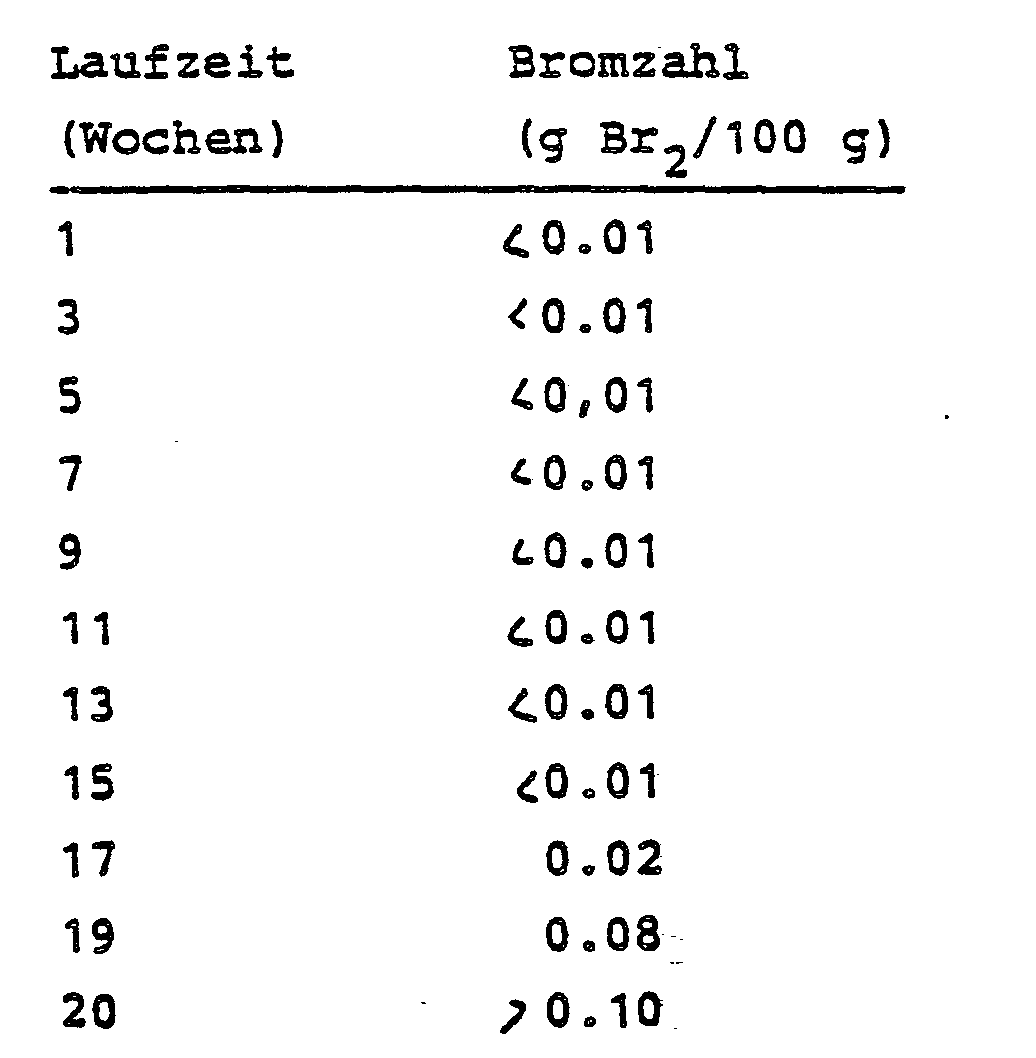
- Gegenüber Beispiel 5 ist eine erhebliche Verlängerung der Katalysatorlaufzeit durch die Behandlung des Einsatzproduktes mit Anionentauschern erreicht worden.
Claims (7)
Priority Applications (1)
| Application Number | Priority Date | Filing Date | Title |
|---|---|---|---|
| AT82105941T ATE13070T1 (de) | 1981-07-14 | 1982-07-03 | Verfahren zur hydrierung von kohlenwasserstoffen. |
Applications Claiming Priority (2)
| Application Number | Priority Date | Filing Date | Title |
|---|---|---|---|
| DE19813127751 DE3127751A1 (de) | 1981-07-14 | 1981-07-14 | Verfahren zur hydrierung von kohlenwasserstoffen |
| DE3127751 | 1981-07-14 |
Publications (2)
| Publication Number | Publication Date |
|---|---|
| EP0069943A1 true EP0069943A1 (de) | 1983-01-19 |
| EP0069943B1 EP0069943B1 (de) | 1985-05-02 |
Family
ID=6136871
Family Applications (1)
| Application Number | Title | Priority Date | Filing Date |
|---|---|---|---|
| EP82105941A Expired EP0069943B1 (de) | 1981-07-14 | 1982-07-03 | Verfahren zur Hydrierung von Kohlenwasserstoffen |
Country Status (6)
| Country | Link |
|---|---|
| US (1) | US4431528A (de) |
| EP (1) | EP0069943B1 (de) |
| JP (1) | JPS5819388A (de) |
| AT (1) | ATE13070T1 (de) |
| CA (1) | CA1185272A (de) |
| DE (2) | DE3127751A1 (de) |
Families Citing this family (7)
| Publication number | Priority date | Publication date | Assignee | Title |
|---|---|---|---|---|
| DE3338269A1 (de) * | 1983-10-21 | 1985-05-02 | Basf Ag, 6700 Ludwigshafen | Verfahren zur gewinnung von isopren aus einem c(pfeil abwaerts)5(pfeil abwaerts)-kohlenwasserstoffgemisch |
| US6248230B1 (en) * | 1998-06-25 | 2001-06-19 | Sk Corporation | Method for manufacturing cleaner fuels |
| SE9904197D0 (sv) | 1999-11-22 | 1999-11-22 | Amersham Pharm Biotech Ab | A method for anion exchange adsorption on matrices carrying mixed mode ligands |
| CN100444918C (zh) * | 2004-10-22 | 2008-12-24 | 中国石化上海石油化工股份有限公司 | 甲基四氢苯酐生产废液的分离方法 |
| CN100444919C (zh) * | 2004-10-22 | 2008-12-24 | 中国石化上海石油化工股份有限公司 | 一种分离利用甲基四氢苯酐生产废液的方法 |
| CN100448501C (zh) * | 2004-11-11 | 2009-01-07 | 中国石化上海石油化工股份有限公司 | 甲基四氢苯酐生产过程中产生的废液的分离方法 |
| US20070137097A1 (en) * | 2005-12-16 | 2007-06-21 | Michio Ikura | Production of biodiesel from triglycerides via a thermal route |
Citations (6)
| Publication number | Priority date | Publication date | Assignee | Title |
|---|---|---|---|---|
| FR991042A (fr) * | 1948-08-04 | 1951-09-28 | Cie Francaise Procedes Houdry | Perfectionnements à la purification des huiles |
| US3019199A (en) * | 1957-08-29 | 1962-01-30 | Shell Oil Co | Regeneration of a nitrogen base containing ion exchanger |
| DE1183491B (de) * | 1961-07-20 | 1964-12-17 | Basf Ag | Verfahren zum Reinigen von Olefinen |
| GB1055233A (en) * | 1963-02-04 | 1967-01-18 | Bayer Ag | Hydrogenation of oligomers |
| DE1568408A1 (de) * | 1966-08-23 | 1970-03-05 | Dow Chemical Co | Verfahren zur Reinigung von Kohlenwasserstoffen |
| US3668271A (en) * | 1967-10-02 | 1972-06-06 | Mobil Oil Corp | Hydrogenation of unsaturated hydrocarbons using ion exchange resin containing zero-valent metal as catalyst |
Family Cites Families (5)
| Publication number | Priority date | Publication date | Assignee | Title |
|---|---|---|---|---|
| US2780582A (en) * | 1954-07-29 | 1957-02-05 | Standard Oil Co | Chemical refining and catalytic conversion of hydrocarbon oils |
| AR206714A1 (es) * | 1974-05-21 | 1976-08-13 | Snam Progetti | Procedimiento para eliminar compuestos acetilenicos de hidrocarburos saturados olefinicos y dienicos o mezcla de los mismos |
| US3953323A (en) * | 1974-12-23 | 1976-04-27 | Texaco Inc. | Process for reduction of olefinic unsaturation of pyrolysis naphtha (dripolene) |
| IT1039740B (it) * | 1975-07-08 | 1979-12-10 | Snam Progetti | Procedimento per l addizione di acidi organici a composti acetile nici contenuti in correnet i idrocar buriche inorganiche do organiche |
| FR2410038A1 (fr) * | 1977-11-29 | 1979-06-22 | Inst Francais Du Petrole | Procede d'hydrogenation selective d'essences contenant a la fois des composes generateurs de gommes et des composes indesirables du soufre |
-
1981
- 1981-07-14 DE DE19813127751 patent/DE3127751A1/de not_active Withdrawn
-
1982
- 1982-06-25 US US06/392,035 patent/US4431528A/en not_active Expired - Lifetime
- 1982-07-03 AT AT82105941T patent/ATE13070T1/de not_active IP Right Cessation
- 1982-07-03 DE DE8282105941T patent/DE3263386D1/de not_active Expired
- 1982-07-03 EP EP82105941A patent/EP0069943B1/de not_active Expired
- 1982-07-12 JP JP57120002A patent/JPS5819388A/ja active Pending
- 1982-07-12 CA CA000407115A patent/CA1185272A/en not_active Expired
Patent Citations (6)
| Publication number | Priority date | Publication date | Assignee | Title |
|---|---|---|---|---|
| FR991042A (fr) * | 1948-08-04 | 1951-09-28 | Cie Francaise Procedes Houdry | Perfectionnements à la purification des huiles |
| US3019199A (en) * | 1957-08-29 | 1962-01-30 | Shell Oil Co | Regeneration of a nitrogen base containing ion exchanger |
| DE1183491B (de) * | 1961-07-20 | 1964-12-17 | Basf Ag | Verfahren zum Reinigen von Olefinen |
| GB1055233A (en) * | 1963-02-04 | 1967-01-18 | Bayer Ag | Hydrogenation of oligomers |
| DE1568408A1 (de) * | 1966-08-23 | 1970-03-05 | Dow Chemical Co | Verfahren zur Reinigung von Kohlenwasserstoffen |
| US3668271A (en) * | 1967-10-02 | 1972-06-06 | Mobil Oil Corp | Hydrogenation of unsaturated hydrocarbons using ion exchange resin containing zero-valent metal as catalyst |
Also Published As
| Publication number | Publication date |
|---|---|
| CA1185272A (en) | 1985-04-09 |
| ATE13070T1 (de) | 1985-05-15 |
| DE3263386D1 (en) | 1985-06-05 |
| JPS5819388A (ja) | 1983-02-04 |
| EP0069943B1 (de) | 1985-05-02 |
| US4431528A (en) | 1984-02-14 |
| DE3127751A1 (de) | 1983-02-03 |
Similar Documents
| Publication | Publication Date | Title |
|---|---|---|
| DE2836645C2 (de) | ||
| DE2526887C2 (de) | Verfahren zur Herstellung von aromatischen Kohlenwasserstoffen | |
| DE2640471C3 (de) | Verfahren zum dehydrierenden Cyclisieren von aliphatischen Kohlenwasserstoffen | |
| DE60119206T2 (de) | Benzin Entschwefelungsverfahren mit Entschwefelung von Schwer- und Mittelfraktionen von einen Fraktionierung in mindestens drei Schnitten | |
| DE69003634T2 (de) | Verfahren zur Herstellung eines aromatischen Naphthas mit niedrigem Benzolgehalt. | |
| DE19705034B4 (de) | Prozeß zur Herstellung einer entbenzenten und isomerisierten Benzinmischkomponente unter Verwendung eines Doppelfunktions-Katalysators | |
| EP0028377B1 (de) | Verfahren zur Herstellung eines Gemisches, bestehend im wesentlichen aus iso-Buten-Oligomeren und Methyl-tert.-butyl-ether, seine Verwendung und Treibstoffe, enthaltend ein solches Gemisch | |
| DE69405654T2 (de) | Verfahren zur Wiedergewinnung von verbrauchten, sauren Katalysatoren in Alkylierungsverfahren | |
| DE2162442A1 (de) | Katalytisches Reformierverfahren | |
| DE1542309A1 (de) | Verfahren zur Herstellung eines edelmetallhaltigen Katalysators | |
| DE2517231C2 (de) | ||
| EP0069943B1 (de) | Verfahren zur Hydrierung von Kohlenwasserstoffen | |
| DE69023863T2 (de) | Verfahren zur Herstellung von aromatischen Kohlenwasserstoffen. | |
| DE4013711A1 (de) | Verfahren zur herstellung von hochoktanigen, olefinarmen kraftstoffen und kraftstoffkomponenten | |
| DE1543195A1 (de) | Verfahren zur Herstellung von Benzol hoher Reinheit | |
| DE2118155C3 (de) | Katalysator, der Al2 0 3, Rhenium sowie Molybdän oder Wolfram enthält, sowie dessen Verwendung zur Dehydrierung von gesättigten Kohlenwasserstoffen | |
| DE2557913C2 (de) | ||
| EP0042537B1 (de) | Verfahren zur Stellungsisomerisierung von endständigen Doppelbindungen in Olefinen | |
| EP0659723B1 (de) | Verfahren zur Herstellung von Alkyl-tert.-alkyl-ether enthaltenden Kohlenwasserstoffgemischen | |
| DE1618982B2 (de) | Verfahren zum dehydrocyclisieren von paraffinen mit 6 bis 20 kohlenstoffatomen zu aromaten | |
| DE1645741A1 (de) | Verfahren zur aromatischen Reformierung mit schwefelhaltigen Katalysatoren | |
| DE19530409C2 (de) | Katalysator und dessen Verwendung | |
| DE965734C (de) | Verfahren zur Herstellung von Platin- oder Palladiumkatalysatoren fuer die Reformierung von Kohlenwasserstoffen | |
| DE1470632C (de) | Verfahren zur selektiven Hydrierung leichter, dienhaltiger Kohlenwasser stoftble | |
| DE2145639C3 (de) | Kontinuierliches Verfahren zur Reinigung einer leichten Paraffinfraktion durch Hydrierung |
Legal Events
| Date | Code | Title | Description |
|---|---|---|---|
| PUAI | Public reference made under article 153(3) epc to a published international application that has entered the european phase |
Free format text: ORIGINAL CODE: 0009012 |
|
| 17P | Request for examination filed |
Effective date: 19820703 |
|
| AK | Designated contracting states |
Designated state(s): AT BE DE FR GB IT NL |
|
| ITF | It: translation for a ep patent filed | ||
| GRAA | (expected) grant |
Free format text: ORIGINAL CODE: 0009210 |
|
| AK | Designated contracting states |
Designated state(s): AT BE DE FR GB IT NL |
|
| REF | Corresponds to: |
Ref document number: 13070 Country of ref document: AT Date of ref document: 19850515 Kind code of ref document: T |
|
| REF | Corresponds to: |
Ref document number: 3263386 Country of ref document: DE Date of ref document: 19850605 |
|
| ET | Fr: translation filed | ||
| PLBE | No opposition filed within time limit |
Free format text: ORIGINAL CODE: 0009261 |
|
| STAA | Information on the status of an ep patent application or granted ep patent |
Free format text: STATUS: NO OPPOSITION FILED WITHIN TIME LIMIT |
|
| 26N | No opposition filed | ||
| PGFP | Annual fee paid to national office [announced via postgrant information from national office to epo] |
Ref country code: NL Payment date: 19870731 Year of fee payment: 6 |
|
| PG25 | Lapsed in a contracting state [announced via postgrant information from national office to epo] |
Ref country code: BE Effective date: 19890731 |
|
| BERE | Be: lapsed |
Owner name: EC ERDOLCHEMIE G.M.B.H. Effective date: 19890731 |
|
| PG25 | Lapsed in a contracting state [announced via postgrant information from national office to epo] |
Ref country code: NL Effective date: 19900201 |
|
| NLV4 | Nl: lapsed or anulled due to non-payment of the annual fee | ||
| PGFP | Annual fee paid to national office [announced via postgrant information from national office to epo] |
Ref country code: DE Payment date: 19950619 Year of fee payment: 14 |
|
| PGFP | Annual fee paid to national office [announced via postgrant information from national office to epo] |
Ref country code: GB Payment date: 19950622 Year of fee payment: 14 |
|
| PGFP | Annual fee paid to national office [announced via postgrant information from national office to epo] |
Ref country code: FR Payment date: 19950719 Year of fee payment: 14 |
|
| PGFP | Annual fee paid to national office [announced via postgrant information from national office to epo] |
Ref country code: AT Payment date: 19950721 Year of fee payment: 14 |
|
| PG25 | Lapsed in a contracting state [announced via postgrant information from national office to epo] |
Ref country code: GB Effective date: 19960703 Ref country code: AT Effective date: 19960703 |
|
| GBPC | Gb: european patent ceased through non-payment of renewal fee |
Effective date: 19960703 |
|
| PG25 | Lapsed in a contracting state [announced via postgrant information from national office to epo] |
Ref country code: FR Effective date: 19970328 |
|
| PG25 | Lapsed in a contracting state [announced via postgrant information from national office to epo] |
Ref country code: DE Effective date: 19970402 |
|
| REG | Reference to a national code |
Ref country code: FR Ref legal event code: ST |