EP0069952A2 - Hair-treatment compositions with quaternary isostearyl ammonium compounds - Google Patents
Hair-treatment compositions with quaternary isostearyl ammonium compounds Download PDFInfo
- Publication number
- EP0069952A2 EP0069952A2 EP82105963A EP82105963A EP0069952A2 EP 0069952 A2 EP0069952 A2 EP 0069952A2 EP 82105963 A EP82105963 A EP 82105963A EP 82105963 A EP82105963 A EP 82105963A EP 0069952 A2 EP0069952 A2 EP 0069952A2
- Authority
- EP
- European Patent Office
- Prior art keywords
- hair
- isostearyl
- chloride
- quaternary
- ammonium compounds
- Prior art date
- Legal status (The legal status is an assumption and is not a legal conclusion. Google has not performed a legal analysis and makes no representation as to the accuracy of the status listed.)
- Withdrawn
Links
Classifications
-
- A—HUMAN NECESSITIES
- A61—MEDICAL OR VETERINARY SCIENCE; HYGIENE
- A61K—PREPARATIONS FOR MEDICAL, DENTAL OR TOILETRY PURPOSES
- A61K8/00—Cosmetics or similar toiletry preparations
- A61K8/18—Cosmetics or similar toiletry preparations characterised by the composition
- A61K8/30—Cosmetics or similar toiletry preparations characterised by the composition containing organic compounds
- A61K8/40—Cosmetics or similar toiletry preparations characterised by the composition containing organic compounds containing nitrogen
- A61K8/41—Amines
- A61K8/416—Quaternary ammonium compounds
-
- A—HUMAN NECESSITIES
- A61—MEDICAL OR VETERINARY SCIENCE; HYGIENE
- A61Q—SPECIFIC USE OF COSMETICS OR SIMILAR TOILETRY PREPARATIONS
- A61Q5/00—Preparations for care of the hair
-
- C—CHEMISTRY; METALLURGY
- C07—ORGANIC CHEMISTRY
- C07C—ACYCLIC OR CARBOCYCLIC COMPOUNDS
- C07C255/00—Carboxylic acid nitriles
Definitions
- the invention thus relates to hair treatment compositions, characterized in that they contain a quaternary isostearylammonium compound of the formula where R 1 is isearearyl, R 2 isostearyl, C 1 -C 4 alkyl, preferably methyl or benzyl, R 3 and R 4 C 1 -C 4 alkyl, preferably methyl or hydroxiethyl and A is a halide, methosulfate, * methophosphate - or ethophosphate means. * E thosulfate,
- the quaternary ammonium compounds of the above formula are obtained by known methods starting from isostearic acid.
- the isostearyl nitrile is produced from this acid with ammonia and is converted into the isostearylamine by hydrogenation.
- This isostearylamine is then alkylated or quaternized using known processes.
- the isostearyl group is a mixture of methyl-branched C 17 alkyl groups.
- the quaternary ammonium compounds of the above formula have technically interesting surface-active properties and are particularly suitable for use in hair care products.
- Liquid or pasty hair care products with very good storage stability can be produced by simply mixing with water.
- These hair care products can also contain all those compounds that are usually used in these products, such as perfume oil, thickeners, hair fixers, alcohols, antistatic compounds and other surface-active compounds.
- the content of the quaternary isostearylammonium compounds in the hair care products is the same as when using quaternary ammonium compounds which have been used hitherto and is about 0.1-20, preferably 0.1-10,% by weight. Disturbing excesses of the quaternary ammonium compound can be washed out of the hair without any problems and the good distribution also enables very good wet combability. Dry combability is also good.
- the liquid settings of the quaternary ether amines also show only a very weak foaming effect. This is of particular advantage when filling the finished hair care products with automatic dosing systems, where a much larger amount of liquid hair care products can be filled in the same time unit compared to a foaming, aqueous cetyltrimethylammonium bromide solution.
- the foaming which occurs when using, for example, aqueous cetyltrimethylammonium chloride and which impair the ability to style the hair is also not present when using aqueous quaternary etheramine solutions according to the present invention.
- a mixture of 300 g of isostearylamine, 90 g of 50% NaOH and 200 g of isopropanol is placed in a 1 liter glass autoclave, flushed twice with nitrogen and checked for leaks. The mixture is then heated to approximately 80 ° C. and reacted with 170 g of liquid methyl chloride. After 2 hours of reaction at 30 ° C., a further 110 g of 50% NaOH are added. After a total reaction time of 6.5 hours, another 10 g of 50% NaOH are added and the reaction is continued at 80 ° C. for a further 2 hours.
- the hair was washed with a 1% lauryl diglycol ether sulfate sodium salt solution in water and then rinsed with water at 35 ° C.
- 10 ml of a 2% aqueous solution or dispersion of the quaternary ammonium compound were distributed over the still damp hair and after 5 minutes of exposure, the excess amount of the quaternary ammonium compound was rinsed out with 2 l of water at 35 ° C.
- the foaming power was assessed subjectively during application and rinsing, and in general a behavior with as little foam as possible is desired.
- the test is carried out by combing wet hair, the frictional resistance between hair and comb should be as low as possible.
- the gloss of the hair was assessed visually using a constant light source.
- the spreadability of the hair treatment agents on damp or dry hair is of great importance for the effectiveness of the products.
- the assessment was made visually during use and at the same time by applying the hair treatment liquid to filter paper.
Landscapes
- Life Sciences & Earth Sciences (AREA)
- Health & Medical Sciences (AREA)
- Chemical & Material Sciences (AREA)
- Organic Chemistry (AREA)
- Animal Behavior & Ethology (AREA)
- General Health & Medical Sciences (AREA)
- Public Health (AREA)
- Veterinary Medicine (AREA)
- Birds (AREA)
- Epidemiology (AREA)
- Cosmetics (AREA)
Abstract
Haarbehandlungsmittel mit einem Gehalt einer quartären Isostearyl-ammonium-Verbindung der Formel <IMAGE> wobei R1 Isostearyl, R2 Isostearyl, C1-C4-Alkyl oder Benzyl, R3 und R4 C1-C4-Alkyl oder Hydroxiethyl und A ein Anion bedeutet.Hair treatment composition containing a quaternary isostearylammonium compound of the formula <IMAGE> where R1 isostearyl, R2 isostearyl, C1-C4-alkyl or benzyl, R3 and R4 C1-C4-alkyl or hydroxiethyl and A is an anion.
Description
Humanhaare können durch physikalische, chemische und mikrobiologische exogene Einflüsse geschädigt werden; vor allem durch Kämmen und Bürsten wird das Haar irreparabel mechanisch angegriffen. Zur Prophylaxe und zur kosmetischen Nachbehandlung werden deshalb Haarspülmittel, die kationische Tenside (Quats) enthalten, verwendet. Diese Quats werden meist in Kombination mit nichtionischen Emulgatoren bzw. konsistenzgebenden Fettalkoholen in wäßriger Lösung bzw. Suspension angewandt und verbessern nach dem Aufbringen auf die Haare sowohl die Naßkämmerbarkeit durch Herabsetzung der Reibung zwischen Haar/Haar bzw. Haar/Kamm bzw. Bürste und bewirken außerdem eine Reihe von speziellen Eigenschaften wie Glanz, Antistatik und Trockenkämmbarkeit. Häufig verwendete quartäre Ammoniumverbindungen für diesen Zweck sind Cetyltrimethylammoniumchlorid oder -bromid, Stearyldimethylbenzylammoniumchlorid und Distearyldimethylammoniumchlorid .Human hair can be damaged by physical, chemical and microbiological exogenous influences; Combing and brushing, in particular, mechanically attacks the hair irreparably. For the prophylaxis and for cosmetic after-treatment, hair rinsing agents that contain cationic surfactants (quats) are therefore used. These quats are mostly used in combination with nonionic emulsifiers or consistency-giving fatty alcohols in aqueous solution or suspension and, after being applied to the hair, both improve wet combability by reducing the friction between hair / hair or hair / comb or brush and also have an effect a number of special properties such as gloss, antistatic and dry combability. Quaternary ammonium compounds commonly used for this purpose are cetyltrimethylammonium chloride or bromide, stearyldimethylbenzylammonium chloride and distearyldimethylammonium chloride.
Es wurde nun gefunden, daß quartäre Ammoniumverbindungen mit einer oder mehreren Isostearyl-Gruppen besondere Vorteile im Hinblick auf Emulgierverhalten, Verteilbarkeit auf den Humanhaaren und auch bezüglich der Haarnaßkämmbarkeit und Schaumarmut bieten.It has now been found that quaternary ammonium compounds with one or more groups isostearyl special advantages in terms of emulsification, spreadability on the human h Aaren and also have regard to the Haarnaßkämmbarkeit and low foaming.
Gegenstand der Erfindung sind somit Haarbehandlungsmittel, gekennzeichnet durch einen Gehalt einer quartären Isostearyl-ammoniumverbindung der Formel

Die quartären Ammoniumverbindungen der obigen Formel werden erhalten nach bekannten Verfahren ausgehend von Isostearinsäure. Aus dieser Säure stellt man mit Ammoniak das Isostearylnitril her, das durch Hydrieren in das Isostearylamin überführt wird. Dieses Isostearylamin wird dann nach bekannten Verfahren alkyliert bzw. quaterniert. Bei der Isostearylgruppe handelt es sich um ein Gemisch von methyl-verzweigten C17-Alkylgruppen.The quaternary ammonium compounds of the above formula are obtained by known methods starting from isostearic acid. The isostearyl nitrile is produced from this acid with ammonia and is converted into the isostearylamine by hydrogenation. This isostearylamine is then alkylated or quaternized using known processes. The isostearyl group is a mixture of methyl-branched C 17 alkyl groups.
Die quartären Ammoniumverbindungen der obigen Formel weisen technisch interessante oberflächenaktive Eigenschaften auf und eignen sich besonders zur Verwendung in Haarpflegemitteln. So lassen sich durch einfaches Mischen mit Wasser flüssige oder pastöse Haarpflegemittel mit sehr guter Lagerstabilität herstellen. Diese Haarpflegemittel können weiterhin alle solche Verbindungen enthalten, die üblicherweise in diesen Produkten eingesetzt werden, wie etwa Parfümöl, Verdicker, Haarfestiger, Alkohole,antistatisch wirkende Verbindungen und weitere oberflächenaktive Verbindungen. Der Gehalt der quartären Isostearyl-ammonium-Verbindungen in den Haarpflegemittelm ist gleich groß wie bei der Verwendung bisher gebräuchlicher quartärer Ammoniumverbindungen und beträgt ca. 0,1 - 20,vorzugsweise 0,1 - 10 Gem %. Störende Überschüsse der quartären Ammoniumverbindung lassen sich ohne Probleme aus dem Haar auswaschen und durch die gute Verteilung wird auch eine sehr gute Naßkämmbarkeit erreicht. Auch die Trockenkämmbarkeit ist gut.The quaternary ammonium compounds of the above formula have technically interesting surface-active properties and are particularly suitable for use in hair care products. Liquid or pasty hair care products with very good storage stability can be produced by simply mixing with water. These hair care products can also contain all those compounds that are usually used in these products, such as perfume oil, thickeners, hair fixers, alcohols, antistatic compounds and other surface-active compounds. The content of the quaternary isostearylammonium compounds in the hair care products is the same as when using quaternary ammonium compounds which have been used hitherto and is about 0.1-20, preferably 0.1-10,% by weight. Disturbing excesses of the quaternary ammonium compound can be washed out of the hair without any problems and the good distribution also enables very good wet combability. Dry combability is also good.
Die Flüssigeinstellungen der quartären Ätheramine zeigen außerdem nur eine sehr schwache Schaumwirkung. Dies ist von besonderem Vorteil beim Abfüllen der fertigen Haarpflegemittel mit automatischen Dosieranlagen, wo in der gleichen Zeiteinheit eine wesentlich größere Menge an flüssigen Haarpflegemitteln abgefüllt werden kann im Vergleich zu einer schäumenden, wäßrigen Cetyltrimethylammoniumbromid-Lösung. Auch die bei der Anwendung beispielsweise von wäßrigen Cetyltrimethylammoniumchlorid auftretenden Schaumbildungen, die die Frisierbarkeit des Haares beeinträchtigen, sind bei der Verwendung wäßriger quartärer Ätheramin-Lösungen gemäß der vorliegenden Erfindung nicht vorhanden.The liquid settings of the quaternary ether amines also show only a very weak foaming effect. This is of particular advantage when filling the finished hair care products with automatic dosing systems, where a much larger amount of liquid hair care products can be filled in the same time unit compared to a foaming, aqueous cetyltrimethylammonium bromide solution. The foaming which occurs when using, for example, aqueous cetyltrimethylammonium chloride and which impair the ability to style the hair is also not present when using aqueous quaternary etheramine solutions according to the present invention.
Die Herstellung der quartären Ammoniumverbindungen wird in den folgenden Beispielen weiter erläutert. Sofern nicht anders angegeben, beziehen sich alle Mengenangaben auf das Gewicht.The preparation of the quaternary ammonium compounds is further explained in the following examples. Unless otherwise stated, all quantities are based on weight.
In einem Vierhalskolben mit Rührer, Thermometer, Wasserabscheider und Gaseinleitungsrohr werden 2000 g Isostearinsäure und 20 g Zink-dodecylbenzolsulfonat vorgelegt und unter schwachem Stickstoffstrom auf 150°C erhitzt. Nun beginnt man mit dem Einleiten von 40 Liter NH3/Std. und Aufheizen auf 290°C. Nach 12 Stunden Reaktion bei 290°C wird unter Stickstoff abgekühlt und im Vakuum bei 1 - 0,3 mbar destilliert. Man erhält ca. 85 % Isostearylnitril vom Kp 155 - 190°C/ 1 - 0,3 mbar.2000 g of isostearic acid and 20 g of zinc dodecylbenzenesulfonate are placed in a four-necked flask with stirrer, thermometer, water separator and gas inlet tube and heated to 150 ° C. under a weak stream of nitrogen. Now you start with the introduction of 40 liters of NH 3 / hour and heating to 290 ° C. After 12 hours of reaction at 290 ° C., the mixture is cooled under nitrogen and distilled in vacuo at 1 to 0.3 mbar. Approx. 85% isostearyl nitrile with a boiling point of 155-190 ° C / 1-0.3 mbar is obtained.
- 1300 g Isostearylnitril werden zusammen mit 70 g wasserfreiem Raney-Nickel in einen 5 1 Schüttelautoklaven gefüllt, 2 x mit Stickstoff gespült und mit 180 bar Wasserstoff auf Dichtigkeit geprüft. Nach Entspannen werden 400 mlflüssiges Ammoniak zugefahren und 80 bar Wasserstoff aufgepreßt. Die Reaktionstemperatur wird auf 80 - 120°C gebracht und der Wasserstoffdruck durch Nachpressen bei 150 - 180 bar gehalten. Nach Erreichen von 180 bar Wasserstoffdruck wird 2 Stunden nachreagiert, auf 50°C abgekühlt und über ein Druckfilter filtriert.1300 g of isostearyl nitrile are filled together with 70 g of anhydrous Raney nickel into a 5 l shaking autoclave, flushed twice with nitrogen and checked for leaks with 180 bar of hydrogen. After relaxation, 400 ml of liquid ammonia are added and 80 bar of hydrogen are injected. The reaction temperature is brought to 80-120 ° C and the hydrogen pressure is kept at 150-180 bar by pressing. After the hydrogen pressure has reached 180 bar, the mixture is after-reacted for 2 hours, cooled to 50 ° C. and filtered through a pressure filter.
Nach Destillation im Hochvakuum erhält man1189 g (91,5 %) des bei 142 - 60°C/0,3 mbar siedenden Isostearylamins, das 99,9 % Primäramin-Anteile aufweist.After distillation in a high vacuum, 1189 g (91.5%) of the isostearylamine boiling at 142-60 ° C / 0.3 mbar and containing 99.9% of primary amine are obtained.
Eine Mischung von 300 g Isostearylamin, 90 g 50 %iger NaOH und 200 g Isopropanol wird in einem 1 1 Glasautoklaven vorgelegt, 2 x mit Stickstoff gespült und auf Dichtigkeit geprüft. Anschließend wird auf ca. 80°C aufgeheizt und mit 170 g flüssigem Methylchlorid umgesetzt. Nach 2 Stunden Reaktion bei 30°C werden weitere 110 g 50 %iger NaOH zugegeben. Nach insgesamt 6,5 Stunden Reaktionszeit werden nochmals 10 g 50 %ige NaOH nachgegeben und weitere 2 Stunden bei 80°C umgesetzt.A mixture of 300 g of isostearylamine, 90 g of 50% NaOH and 200 g of isopropanol is placed in a 1 liter glass autoclave, flushed twice with nitrogen and checked for leaks. The mixture is then heated to approximately 80 ° C. and reacted with 170 g of liquid methyl chloride. After 2 hours of reaction at 30 ° C., a further 110 g of 50% NaOH are added. After a total reaction time of 6.5 hours, another 10 g of 50% NaOH are added and the reaction is continued at 80 ° C. for a further 2 hours.
Nach Entspannen des überschüssigen Methylchlorids wird der pH-Wert der Reaktionsmischung auf 6 - 7 eingestellt und der Rest Methylchlorid am Rotationsverdampfer entfernt. Nach Absaugen des ausgefällten NaCl und Zugabe von 8 g Wasser und 15 g Isopropanol werden 505 g Isostearyltrimethylammoniumchlorid 75 %ig in Isopropanol erhalten.After releasing the excess methyl chloride, the pH of the reaction mixture is adjusted to 6-7 and the rest of the methyl chloride is removed on a rotary evaporator. After vacuuming the precipitated NaCl and addition of 8 g of water and 15 g of isopropanol give 505 g of 75% strength isostearyltrimethylammonium chloride in isopropanol.
400 g Isostearylamin werden in einem Rührkolben mit Thermometer und Gaseinleitungsrohr mit 20 g Raney-Nickel versetzt und 100 1 Wasserstoff/Stunde eingegast. Die Reaktionstemperatur wird in ca. 30 Minuten auf 160°C gebracht und 1,5 Stunden gehalten. Nach Abkühlen auf ca. 50°C wird der Katalysator abfiltriert und dabei Diisostearylamin in praktisch quantitativer Ausbeute erhalten. Das'Reaktionsprodukt enthält neben 92,3 % Sekundär-Anteilen 4,7 % bzw. 4,3 % Primär-und Tertiär-Aminanteile.400 g of isostearylamine are mixed in a stirred flask with a thermometer and gas inlet tube with 20 g of Raney nickel and 100 1 hydrogen / hour are gassed. The reaction temperature is brought to 160 ° C. in about 30 minutes and held for 1.5 hours. After cooling to about 50 ° C., the catalyst is filtered off and diisostearylamine is obtained in practically quantitative yield. The reaction product contains 92.3% secondary components, 4.7% and 4.3% primary and tertiary amine components.
126 g Diisostearylamin und 25 g 50 %ige NaOH werden zusammen mit 100 g Isopropanol in einem 1 1-Glasautoklaven mit 28 g flüssigem Methylchlorid analog 1 c umgesetzt. Dabei entsteht ein Methylchlorid-Druck .von ca. 5 bar. Nach ca. 2 Stunden Reaktionszeit wird 1 g 50 %ige NaOH nachgegeben und weitere 1,5 Stunden bei 80°C umgesetzt.126 g of diisostearylamine and 25 g of 50% NaOH are reacted together with 100 g of isopropanol in a 1 liter glass autoclave with 28 g of liquid methyl chloride analogously to 1 c. This creates a methyl chloride pressure of approx. 5 bar. After a reaction time of about 2 hours, 1 g of 50% NaOH is added and the reaction is continued at 80 ° C. for a further 1.5 hours.
Nach Entspannen des überschüssigen-Methylchlorids wird der pH-Wert der Reaktionsmischung auf 6 - 7 eingestelltundder Restanethylchlorid am Rotationsverdampfer entfernt. Nach Absaugen des ausgefällten NaCl und Zugabe von 8 g Wasser und 15 g Isopropanol werden ca. 150 g Diisostearyldimethylammoniumchlorid 75 %ig in Isopropanol-Wasser (1:2) erhalten.After the excess methyl chloride has been let down, the pH of the reaction mixture is adjusted to 6-7 and the residual anethyl chloride is removed on a rotary evaporator. After the NaCl had been filtered off with suction and 8 g of water and 15 g of isopropanol had been added, about 150 g of 75% strength diisostearyldimethylammonium chloride in isopropanol / water (1: 2) were obtained.
Die anwendungstechnischen Eigenschaften der quartären Ammoniumverbindungen mit Isoalkyl-Gruppen im Molekül wurden sowohl in-vivo am Haar von jeweils vier Versuchspersonen als auch in-vitro an Strähnen von mitteleuropäischem Haar beurteilt.The application properties of the quaternary ammonium compounds with isoalkyl groups in the molecule were assessed both in vivo on the hair of four test subjects and in vitro on strands of Central European hair.
Zunächst wurden jeweils die Haare mit einer 1 %igen Lauryl-diglykolethersulfat-Natriumsalzlösung in Wasser gewaschen und anschließend mit Wasser von 35°C ausgespült. Beim in-vivo-Test wurden 10 ml einer 2 %igen wäßrigen Lösung bzw. Dispersion der quartären Ammoniumverbindung auf das noch feuchte Kopfhaar verteilt und nach 5minütiger Einwirkungszeit wurde mit 2 1 Wasser von 35°C die überschüssige Menge der quartären Ammoniumverbindung ausgespült.First, the hair was washed with a 1% lauryl diglycol ether sulfate sodium salt solution in water and then rinsed with water at 35 ° C. In the in vivo test, 10 ml of a 2% aqueous solution or dispersion of the quaternary ammonium compound were distributed over the still damp hair and after 5 minutes of exposure, the excess amount of the quaternary ammonium compound was rinsed out with 2 l of water at 35 ° C.
Beim in-vitro-Test wurde eine Haarsträhne mit einer Länge von 15 cm und einem Durchmesser von 1,5 cm 3 Minuten in t00 ml einer 2 %igen wäßrigen Lösung bzw. Dispersion der quartären Ammoniumverbindung getaucht. Anschließend wurde die Haarsträhne mit 300 ml Wasser von 35°C ausgespült.In the in vitro test, a strand of hair with a length of 15 cm and a diameter of 1.5 cm was immersed in t00 ml of a 2% aqueous solution or dispersion of the quaternary ammonium compound for 3 minutes. The lock of hair was then rinsed with 300 ml of water at 35 ° C.
Sowohl am Lebendhaar als auch an den Haarsträhnen wurden eine Reihe von Prüfungen durchgeführt, die nachstehend kurz erläutert sind.A series of tests were carried out on both the living hair and the strands of hair, which are briefly explained below.
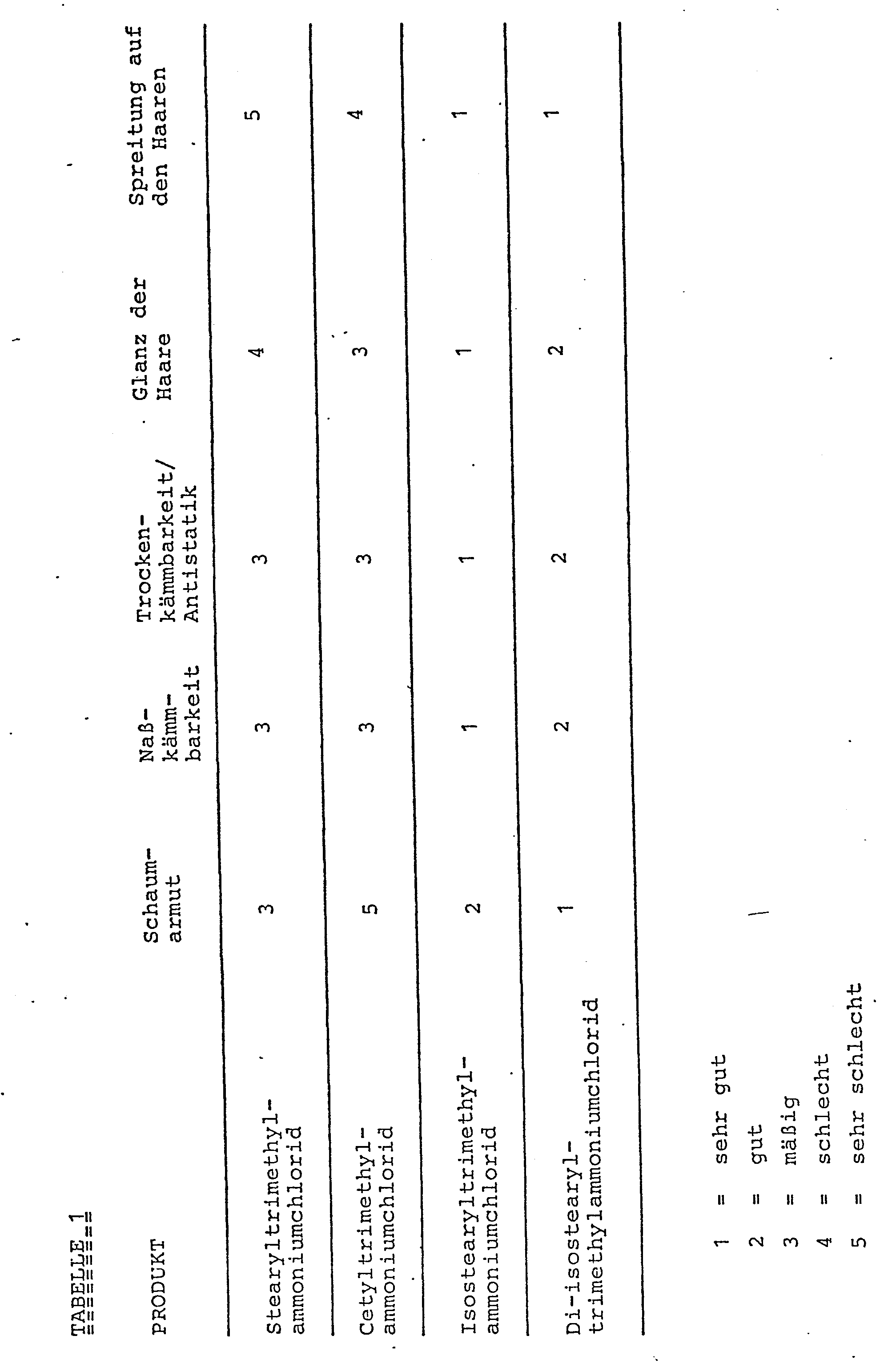
Das Schaumvermögen wurde während des Auftragens und Ausspülens subjektiv beurteilt und im allgemeinen wird ein möglichst schaumarmes Verhalten gewünscht.The foaming power was assessed subjectively during application and rinsing, and in general a behavior with as little foam as possible is desired.
Die Prüfung erfolgt durch Kämmen des nassen Haares, wobei der Reibungswiderstand, zwischen Haar und Kamm möglichst gering sein sollte.The test is carried out by combing wet hair, the frictional resistance between hair and comb should be as low as possible.
Nach dem Trocknen der behandelten Haare wurden diese bei 25°C und 65 % Luftfeuchte mit einem Haar-Hartgummikamm gekämmt und gleichzeitig auch die antistatische Wirkung beurteilt.After the treated hair had dried, it was combed with a hard rubber comb at 25 ° C. and 65% air humidity and the antistatic effect was also assessed at the same time.
Der Glanz der Haare wurde bei Verwendung einer konstanten Lichtquelle visuell beurteilt.The gloss of the hair was assessed visually using a constant light source.
Die Verteilbarkeit der Haarbehandlungsmittel auf dem feuchten bzw. trockenen Haar ist von großer Bedeutung für die Effektivität der Produkte. Die Beurteilung erfolgte visuell während der Anwendung und gleichzeitig durch Aufbringen der Haarbehandlungsflüssigkeit auf Filterpapier.The spreadability of the hair treatment agents on damp or dry hair is of great importance for the effectiveness of the products. The assessment was made visually during use and at the same time by applying the hair treatment liquid to filter paper.
In der Tabelle 1 sind die ermittelten Ergebnisse dargestellt und es zeigt sich, daß die quartären Ammonium- verbindungen mit Isostearylgruppen gegenüber den Vergleichssubstanzen vor allem Vorteile im Hinblick auf die relevanten haarkosmetischen Eigenschaften bieten.The results obtained are shown in Table 1 and it can be seen that the quaternary ammonium compounds with isostearyl groups offer advantages over the comparison substances above all with regard to the relevant hair cosmetic properties.
Die folgenden Anwendungsbeispiele veranschaulichen die Einsatzmöglichkeiten der quartären Ammoniumverbindungen mit Isostearylalkylresten zur Herstellung von Haarbehandlungsmitteln.The following application examples illustrate the possible uses of the quaternary ammonium compounds with isostearylalkyl radicals for the preparation of hair treatment compositions.
Die Mengen- und Prozentangaben in den Beispielen beziehen sich auf das Gewicht.The amounts and percentages in the examples relate to the weight.
- 2,0 % Isostearyltrimethylammoniumchlorid
ad 100,0 % Wasser.
- 2.0% isostearyltrimethylammonium chloride
ad 100.0% water.
- 1,5 % Isostearyltrimethylammoniumchlorid
- 1,2 % Hydroxyethylcellulose
- 0,2 % Parfümöl
ad 100,0 % Wasser.
- 1.5% isostearyltrimethylammonium chloride
- 1.2% hydroxyethyl cellulose
- 0.2% perfume oil
ad 100.0% water.
- 2,0 % Isostearyldimethylbenzylammoniumchlorid2.0% isostearyldimethylbenzylammonium chloride
- 3,0 % Stearylalkohol + 3 Mol Ethylenoxid3.0% stearyl alcohol + 3 moles of ethylene oxide
- 1,0 % Cetylalkohol1.0% cetyl alcohol
- 0,2 % Parfümöl0.2% perfume oil
- ad 100,0 % Wasser.ad 100.0% water.
- 2,0 % Diisostearyltrimethylammoniumchlorid
- 3,0 % Cetylalkohol
- 2,0 % Triethylenglykoldistearat
- 1,0 % Stearylalkohol
- 0,1 % Parfümöl
ad 100,0% Wasser.
- 2.0% diisostearyltrimethylammonium chloride
- 3.0% cetyl alcohol
- 2.0% triethylene glycol distearate
- 1.0% stearyl alcohol
- 0.1% perfume oil
ad 100.0% water.
- 1,0 % Cetyltrimethylammoniumchlorid
- 2,0 % Diisostearyltrimethylammoniumchlorid
- 1,0 % Diglycerinisostearat
- 3,0 % Cetylalkohol
ad 100,0 % Wasser.
- 1.0% cetyltrimethylammonium chloride
- 2.0% diisostearyltrimethylammonium chloride
- 1.0% diglycerin isostearate
- 3.0% cetyl alcohol
ad 100.0% water.
- 2,0 % Isostearyltrimethylammoniumchlorid
- 2,0 % Behenyltrimethylammoniumchlorid
- 3,0 % Cetylalkohol
- 0,2 % Parfümöl
ad 100,0 % Wasser.
- 2.0% isostearyltrimethylammonium chloride
- 2.0% behenyltrimethylammonium chloride
- 3.0% cetyl alcohol
- 0.2% perfume oil
ad 100.0% water.
- 3,0 % Isostearyltrimethylammoniumchlorid
- 1,0 % Lauryl-tetraglykol-orthophosphorsäureester
- 3,0 % Cetylalkohol
- 2,0 % Paraffinöl
- 1,0 % Lanolin
- 0,2 % Parfümöl
ad 100,0 % Wasser.
- 3.0% isostearyltrimethylammonium chloride
- 1.0% lauryl tetraglycol orthophosphoric acid ester
- 3.0% cetyl alcohol
- 2.0% paraffin oil
- 1.0% lanolin
- 0.2% perfume oil
ad 100.0% water.
- 1,0 % Diisostearyltrimethylammoniumchlorid
- 5,0 % Diglycerinsesquioleat
- 15,0 % Paraffinwachs
- 15,0 % Vaseline
- 0,1 % Parfümöl
ad 100,0 % Wasser.
- 1.0% diisostearyltrimethylammonium chloride
- 5.0% diglycerol sesquioleate
- 15.0% paraffin wax
- 15.0% petroleum jelly
- 0.1% perfume oil
ad 100.0% water.
- 0,2 % Isostearyltrimethylammoniumchlorid
- 1,5 % Polyvinylpyrrolidon/Vinylacetat Mischpolymerisat, Verhältnis 70:30
- 0,1 % Parfümöl
- 28,0 % Ethylalkohol
ad 100,0 % fluorierte Kohlenwasserstoffe als Treibgas
- 0.2% isostearyltrimethylammonium chloride
- 1.5% polyvinylpyrrolidone / vinyl acetate copolymer, ratio 70:30
- 0.1% perfume oil
- 28.0% ethyl alcohol
ad 100.0% fluorinated hydrocarbons as propellant
- 2,0 % Isostearyltrimethylammoniumchlorid
- 15,0 % Lauryldiglykolethersulfat-Natriumsalz
- 3,0 % Cocosfettsäurediethanolamid
- 1,3 % Natriumchlorid
- 0,05 % Formaldehyd
- 0,2 % Parfümöl
ad 100,0 % Wasser.
- 2.0% isostearyltrimethylammonium chloride
- 15.0% lauryl diglycol ether sulfate sodium salt
- 3.0% coconut fatty acid diethanolamide
- 1.3% sodium chloride
- 0.05% formaldehyde
- 0.2% perfume oil
ad 100.0% water.
- 3,0 % Vinylpyrrolidon/Vinylacetat Mischpolymerisat, Verhältnis 60:40
- 0,15 % Isostearyltrimethylammoniumchlorid
- 45,0 % Isopropylalkohol
ad 100,0 % Wasser.
- 3.0% vinyl pyrrolidone / vinyl acetate copolymer, ratio 60:40
- 0.15% isostearyltrimethylammonium chloride
- 45.0% isopropyl alcohol
ad 100.0% water.
Claims (2)


Applications Claiming Priority (2)
| Application Number | Priority Date | Filing Date | Title |
|---|---|---|---|
| DE19813127128 DE3127128A1 (en) | 1981-07-09 | 1981-07-09 | "HAIR TREATMENT AGENT WITH QUARTAINE ISOTEARYLAMMONIUM COMPOUNDS" |
| DE3127128 | 1981-07-09 |
Publications (2)
| Publication Number | Publication Date |
|---|---|
| EP0069952A2 true EP0069952A2 (en) | 1983-01-19 |
| EP0069952A3 EP0069952A3 (en) | 1983-04-27 |
Family
ID=6136512
Family Applications (1)
| Application Number | Title | Priority Date | Filing Date |
|---|---|---|---|
| EP82105963A Withdrawn EP0069952A3 (en) | 1981-07-09 | 1982-07-03 | Hair-treatment compositions with quaternary isostearyl ammonium compounds |
Country Status (5)
| Country | Link |
|---|---|
| EP (1) | EP0069952A3 (en) |
| JP (1) | JPS5815908A (en) |
| AR (1) | AR227110A1 (en) |
| BR (1) | BR8203986A (en) |
| DE (1) | DE3127128A1 (en) |
Cited By (2)
| Publication number | Priority date | Publication date | Assignee | Title |
|---|---|---|---|---|
| EP0168741A1 (en) * | 1984-07-16 | 1986-01-22 | Henkel Kommanditgesellschaft auf Aktien | Applicator for treating hair |
| EP0181547A3 (en) * | 1984-11-06 | 1986-11-12 | Kao Corporation | Hair cosmetic composition |
Families Citing this family (1)
| Publication number | Priority date | Publication date | Assignee | Title |
|---|---|---|---|---|
| JPS62138414A (en) * | 1985-12-10 | 1987-06-22 | Lion Corp | hair cosmetics |
Family Cites Families (2)
| Publication number | Priority date | Publication date | Assignee | Title |
|---|---|---|---|---|
| GB1085984A (en) * | 1963-10-16 | 1967-10-04 | Miles Lab | Hair conditioner comprising quaternary ammonium compounds |
| US3395100A (en) * | 1964-12-11 | 1968-07-30 | Foremost Mckesson | Fabric softener and method of using |
-
1981
- 1981-07-09 DE DE19813127128 patent/DE3127128A1/en not_active Withdrawn
-
1982
- 1982-07-03 EP EP82105963A patent/EP0069952A3/en not_active Withdrawn
- 1982-07-07 AR AR28992482A patent/AR227110A1/en active
- 1982-07-08 BR BR8203986A patent/BR8203986A/en unknown
- 1982-07-08 JP JP11787682A patent/JPS5815908A/en active Pending
Cited By (2)
| Publication number | Priority date | Publication date | Assignee | Title |
|---|---|---|---|---|
| EP0168741A1 (en) * | 1984-07-16 | 1986-01-22 | Henkel Kommanditgesellschaft auf Aktien | Applicator for treating hair |
| EP0181547A3 (en) * | 1984-11-06 | 1986-11-12 | Kao Corporation | Hair cosmetic composition |
Also Published As
| Publication number | Publication date |
|---|---|
| DE3127128A1 (en) | 1983-01-27 |
| EP0069952A3 (en) | 1983-04-27 |
| AR227110A1 (en) | 1982-09-15 |
| JPS5815908A (en) | 1983-01-29 |
| BR8203986A (en) | 1983-07-05 |
Similar Documents
| Publication | Publication Date | Title |
|---|---|---|
| EP0017121B1 (en) | Quaternary polysiloxane derivatives, their use in hair cosmetics, and hair washing and hair treatment compositions containing them | |
| DE2521960C3 (en) | Use of quaternized polymers for the cosmetic treatment of hair | |
| DE3719293C2 (en) | Conditioning hair conditioner | |
| DE69205737T2 (en) | Ampholytic terpolymers with improved conditioning properties in shampoo compositions and hair care products. | |
| DE2629922C2 (en) | ||
| DE2808830C2 (en) | ||
| DE69205561T2 (en) | CATIONIC DISPERSIONS CONTAINING CERAMIDES AND / OR GLYCOCERAMIDES. | |
| EP0714654A1 (en) | Composition and process for permanent waving of hair | |
| DE69004016T2 (en) | Cosmetic hair preparation. | |
| EP0648103B1 (en) | Hair conditioner | |
| EP0662815B1 (en) | Hair-care agent | |
| EP0648104B1 (en) | Hair-treatment agents | |
| AT392414B (en) | HAIR CARE PRODUCTS | |
| EP0925775B1 (en) | Hair treatment agent | |
| DE3024578C2 (en) | Composition for conditioning hair that has been treated with an alkaline agent | |
| DE3127128A1 (en) | "HAIR TREATMENT AGENT WITH QUARTAINE ISOTEARYLAMMONIUM COMPOUNDS" | |
| DE69115602T3 (en) | Hair treatment composition | |
| EP0605503B1 (en) | Hair-treatment preparations | |
| DE2657613A1 (en) | USE OF CARBONIC ACID ALCOXYMETHYLESTERS TO IMPROVE THE STRUCTURE OF DAMAGED HAIR | |
| DE19902528A1 (en) | Aqueous hair treating agent containing esterquat and urea and useful as a conditioner giving improvements in compatibility and volume as well as good gloss | |
| EP0662814B1 (en) | Hair treatment agent | |
| DE3622066A1 (en) | COSMETIC PREPARATION CONTAINING A CONDENSATE OF THE TYPE AMID-AMINE AND METHOD FOR COSMETIC TREATMENT WITH SUCH A CONDENSATE | |
| US4781918A (en) | Cosmetic agents for hair and skin treatment | |
| DE1792155C3 (en) | Hair treatment preparations and hair treatment methods | |
| EP0255604A1 (en) | Antistatic hair care composition |
Legal Events
| Date | Code | Title | Description |
|---|---|---|---|
| PUAI | Public reference made under article 153(3) epc to a published international application that has entered the european phase |
Free format text: ORIGINAL CODE: 0009012 |
|
| AK | Designated contracting states |
Designated state(s): CH DE FR GB IT LI NL SE |
|
| PUAL | Search report despatched |
Free format text: ORIGINAL CODE: 0009013 |
|
| AK | Designated contracting states |
Designated state(s): CH DE FR GB IT LI NL SE |
|
| STAA | Information on the status of an ep patent application or granted ep patent |
Free format text: STATUS: THE APPLICATION HAS BEEN WITHDRAWN |
|
| 18W | Application withdrawn |
Withdrawal date: 19830513 |
|
| RIN1 | Information on inventor provided before grant (corrected) |
Inventor name: QUACK, JOCHEN MEINHARD, DR. Inventor name: RENG, ALWIN Inventor name: HARTUNG, HERBERT, DR. |