EP0070018B1 - Eléments photographiques utilisant des composés 2-(2-pyridylazo)-4,5-bis (amino tertiaire) phénol non-diffusibles, libérateurs de colorants noirs ou leurs précurseurs - Google Patents
Eléments photographiques utilisant des composés 2-(2-pyridylazo)-4,5-bis (amino tertiaire) phénol non-diffusibles, libérateurs de colorants noirs ou leurs précurseurs Download PDFInfo
- Publication number
- EP0070018B1 EP0070018B1 EP82106191A EP82106191A EP0070018B1 EP 0070018 B1 EP0070018 B1 EP 0070018B1 EP 82106191 A EP82106191 A EP 82106191A EP 82106191 A EP82106191 A EP 82106191A EP 0070018 B1 EP0070018 B1 EP 0070018B1
- Authority
- EP
- European Patent Office
- Prior art keywords
- dye
- photographic element
- element according
- complete
- car
- Prior art date
- Legal status (The legal status is an assumption and is not a legal conclusion. Google has not performed a legal analysis and makes no representation as to the accuracy of the status listed.)
- Expired
Links
- 150000001875 compounds Chemical class 0.000 title claims description 18
- 239000002243 precursor Substances 0.000 title claims description 9
- ISWSIDIOOBJBQZ-UHFFFAOYSA-N Phenol Chemical compound OC1=CC=CC=C1 ISWSIDIOOBJBQZ-UHFFFAOYSA-N 0.000 title claims description 6
- -1 silver halide Chemical class 0.000 claims description 32
- 229910052709 silver Inorganic materials 0.000 claims description 27
- 239000004332 silver Substances 0.000 claims description 27
- 239000000463 material Substances 0.000 claims description 16
- 239000000839 emulsion Substances 0.000 claims description 14
- 125000004070 6 membered heterocyclic group Chemical group 0.000 claims description 11
- 229910021645 metal ion Inorganic materials 0.000 claims description 11
- 238000011161 development Methods 0.000 claims description 10
- JUJWROOIHBZHMG-UHFFFAOYSA-N Pyridine Chemical group C1=CC=NC=C1 JUJWROOIHBZHMG-UHFFFAOYSA-N 0.000 claims description 8
- 125000000217 alkyl group Chemical group 0.000 claims description 8
- 125000002373 5 membered heterocyclic group Chemical group 0.000 claims description 7
- 125000004432 carbon atom Chemical group C* 0.000 claims description 7
- 125000000547 substituted alkyl group Chemical group 0.000 claims description 7
- 229910052739 hydrogen Inorganic materials 0.000 claims description 6
- 239000001257 hydrogen Substances 0.000 claims description 6
- 125000004435 hydrogen atom Chemical group [H]* 0.000 claims description 6
- 229910052757 nitrogen Inorganic materials 0.000 claims description 6
- 125000002496 methyl group Chemical group [H]C([H])([H])* 0.000 claims description 4
- 125000004573 morpholin-4-yl group Chemical group N1(CCOCC1)* 0.000 claims description 4
- IJGRMHOSHXDMSA-UHFFFAOYSA-N nitrogen Substances N#N IJGRMHOSHXDMSA-UHFFFAOYSA-N 0.000 claims description 3
- 125000004433 nitrogen atom Chemical group N* 0.000 claims description 3
- QJGQUHMNIGDVPM-UHFFFAOYSA-N nitrogen group Chemical group [N] QJGQUHMNIGDVPM-UHFFFAOYSA-N 0.000 claims description 3
- 125000000565 sulfonamide group Chemical group 0.000 claims description 2
- 239000000975 dye Substances 0.000 description 55
- 239000000987 azo dye Substances 0.000 description 14
- 238000012545 processing Methods 0.000 description 10
- 238000012546 transfer Methods 0.000 description 9
- 238000000034 method Methods 0.000 description 8
- 239000000203 mixture Substances 0.000 description 8
- 238000009792 diffusion process Methods 0.000 description 7
- 239000003446 ligand Substances 0.000 description 7
- BQCADISMDOOEFD-UHFFFAOYSA-N Silver Chemical compound [Ag] BQCADISMDOOEFD-UHFFFAOYSA-N 0.000 description 6
- XLYOFNOQVPJJNP-UHFFFAOYSA-N water Substances O XLYOFNOQVPJJNP-UHFFFAOYSA-N 0.000 description 6
- 239000000243 solution Substances 0.000 description 5
- YNAVUWVOSKDBBP-UHFFFAOYSA-N Morpholine Chemical compound C1COCCN1 YNAVUWVOSKDBBP-UHFFFAOYSA-N 0.000 description 4
- 229920000159 gelatin Polymers 0.000 description 4
- 239000008273 gelatin Substances 0.000 description 4
- QTBSBXVTEAMEQO-UHFFFAOYSA-N Acetic acid Chemical compound CC(O)=O QTBSBXVTEAMEQO-UHFFFAOYSA-N 0.000 description 3
- WEVYAHXRMPXWCK-UHFFFAOYSA-N Acetonitrile Chemical compound CC#N WEVYAHXRMPXWCK-UHFFFAOYSA-N 0.000 description 3
- ZMANZCXQSJIPKH-UHFFFAOYSA-N Triethylamine Chemical compound CCN(CC)CC ZMANZCXQSJIPKH-UHFFFAOYSA-N 0.000 description 3
- 230000015572 biosynthetic process Effects 0.000 description 3
- 239000003153 chemical reaction reagent Substances 0.000 description 3
- 230000000694 effects Effects 0.000 description 3
- 229910052751 metal Inorganic materials 0.000 description 3
- 239000002184 metal Substances 0.000 description 3
- 238000007254 oxidation reaction Methods 0.000 description 3
- UMJSCPRVCHMLSP-UHFFFAOYSA-N pyridine Natural products COC1=CC=CN=C1 UMJSCPRVCHMLSP-UHFFFAOYSA-N 0.000 description 3
- FVOXYYKMFUAVHX-UHFFFAOYSA-N 4,5-dimorpholin-4-yl-2-(pyridin-2-yldiazenyl)phenol Chemical compound C1COCCN1C=1C=C(N=NC=2N=CC=CC=2)C(O)=CC=1N1CCOCC1 FVOXYYKMFUAVHX-UHFFFAOYSA-N 0.000 description 2
- QTBSBXVTEAMEQO-UHFFFAOYSA-M Acetate Chemical compound CC([O-])=O QTBSBXVTEAMEQO-UHFFFAOYSA-M 0.000 description 2
- QGZKDVFQNNGYKY-UHFFFAOYSA-N Ammonia Chemical compound N QGZKDVFQNNGYKY-UHFFFAOYSA-N 0.000 description 2
- LFQSCWFLJHTTHZ-UHFFFAOYSA-N Ethanol Chemical compound CCO LFQSCWFLJHTTHZ-UHFFFAOYSA-N 0.000 description 2
- 108010010803 Gelatin Proteins 0.000 description 2
- VEXZGXHMUGYJMC-UHFFFAOYSA-N Hydrochloric acid Chemical compound Cl VEXZGXHMUGYJMC-UHFFFAOYSA-N 0.000 description 2
- QIGBRXMKCJKVMJ-UHFFFAOYSA-N Hydroquinone Chemical class OC1=CC=C(O)C=C1 QIGBRXMKCJKVMJ-UHFFFAOYSA-N 0.000 description 2
- NQRYJNQNLNOLGT-UHFFFAOYSA-N Piperidine Chemical compound C1CCNCC1 NQRYJNQNLNOLGT-UHFFFAOYSA-N 0.000 description 2
- 239000007844 bleaching agent Substances 0.000 description 2
- 239000006229 carbon black Substances 0.000 description 2
- YCIMNLLNPGFGHC-UHFFFAOYSA-N catechol Chemical compound OC1=CC=CC=C1O YCIMNLLNPGFGHC-UHFFFAOYSA-N 0.000 description 2
- 239000000084 colloidal system Substances 0.000 description 2
- 150000004696 coordination complex Chemical class 0.000 description 2
- 239000012992 electron transfer agent Substances 0.000 description 2
- 235000019322 gelatine Nutrition 0.000 description 2
- 235000011852 gelatine desserts Nutrition 0.000 description 2
- 125000005647 linker group Chemical group 0.000 description 2
- 230000003647 oxidation Effects 0.000 description 2
- 230000005855 radiation Effects 0.000 description 2
- GGCZERPQGJTIQP-UHFFFAOYSA-N sodium;9,10-dioxoanthracene-2-sulfonic acid Chemical compound [Na+].C1=CC=C2C(=O)C3=CC(S(=O)(=O)O)=CC=C3C(=O)C2=C1 GGCZERPQGJTIQP-UHFFFAOYSA-N 0.000 description 2
- 239000007787 solid Substances 0.000 description 2
- 230000003381 solubilizing effect Effects 0.000 description 2
- 239000002904 solvent Substances 0.000 description 2
- 238000012360 testing method Methods 0.000 description 2
- 125000001731 2-cyanoethyl group Chemical group [H]C([H])(*)C([H])([H])C#N 0.000 description 1
- RSEBUVRVKCANEP-UHFFFAOYSA-N 2-pyrroline Chemical compound C1CC=CN1 RSEBUVRVKCANEP-UHFFFAOYSA-N 0.000 description 1
- CBOGDPVZDITNCU-UHFFFAOYSA-N 4,5-dimorpholin-4-ylcyclohexa-3,5-diene-1,2-dione Chemical compound C1COCCN1C1=CC(=O)C(=O)C=C1N1CCOCC1 CBOGDPVZDITNCU-UHFFFAOYSA-N 0.000 description 1
- WKBOTKDWSSQWDR-UHFFFAOYSA-N Bromine atom Chemical compound [Br] WKBOTKDWSSQWDR-UHFFFAOYSA-N 0.000 description 1
- VEXZGXHMUGYJMC-UHFFFAOYSA-M Chloride anion Chemical compound [Cl-] VEXZGXHMUGYJMC-UHFFFAOYSA-M 0.000 description 1
- ZAMOUSCENKQFHK-UHFFFAOYSA-N Chlorine atom Chemical compound [Cl] ZAMOUSCENKQFHK-UHFFFAOYSA-N 0.000 description 1
- 229940126062 Compound A Drugs 0.000 description 1
- JPVYNHNXODAKFH-UHFFFAOYSA-N Cu2+ Chemical compound [Cu+2] JPVYNHNXODAKFH-UHFFFAOYSA-N 0.000 description 1
- NLDMNSXOCDLTTB-UHFFFAOYSA-N Heterophylliin A Natural products O1C2COC(=O)C3=CC(O)=C(O)C(O)=C3C3=C(O)C(O)=C(O)C=C3C(=O)OC2C(OC(=O)C=2C=C(O)C(O)=C(O)C=2)C(O)C1OC(=O)C1=CC(O)=C(O)C(O)=C1 NLDMNSXOCDLTTB-UHFFFAOYSA-N 0.000 description 1
- VEQPNABPJHWNSG-UHFFFAOYSA-N Nickel(2+) Chemical compound [Ni+2] VEQPNABPJHWNSG-UHFFFAOYSA-N 0.000 description 1
- 239000004372 Polyvinyl alcohol Substances 0.000 description 1
- FOIXSVOLVBLSDH-UHFFFAOYSA-N Silver ion Chemical compound [Ag+] FOIXSVOLVBLSDH-UHFFFAOYSA-N 0.000 description 1
- PTFCDOFLOPIGGS-UHFFFAOYSA-N Zinc dication Chemical compound [Zn+2] PTFCDOFLOPIGGS-UHFFFAOYSA-N 0.000 description 1
- 238000010521 absorption reaction Methods 0.000 description 1
- 238000000862 absorption spectrum Methods 0.000 description 1
- 238000005904 alkaline hydrolysis reaction Methods 0.000 description 1
- 239000012670 alkaline solution Substances 0.000 description 1
- 125000003545 alkoxy group Chemical group 0.000 description 1
- 125000004397 aminosulfonyl group Chemical group NS(=O)(=O)* 0.000 description 1
- 229910021529 ammonia Inorganic materials 0.000 description 1
- WPYMKLBDIGXBTP-UHFFFAOYSA-N benzoic acid Chemical compound OC(=O)C1=CC=CC=C1 WPYMKLBDIGXBTP-UHFFFAOYSA-N 0.000 description 1
- 239000011230 binding agent Substances 0.000 description 1
- 230000000903 blocking effect Effects 0.000 description 1
- GDTBXPJZTBHREO-UHFFFAOYSA-N bromine Substances BrBr GDTBXPJZTBHREO-UHFFFAOYSA-N 0.000 description 1
- 229910052794 bromium Inorganic materials 0.000 description 1
- 239000007853 buffer solution Substances 0.000 description 1
- 150000004657 carbamic acid derivatives Chemical class 0.000 description 1
- 239000003795 chemical substances by application Substances 0.000 description 1
- 229910052801 chlorine Inorganic materials 0.000 description 1
- 239000000460 chlorine Substances 0.000 description 1
- 238000003776 cleavage reaction Methods 0.000 description 1
- 239000011248 coating agent Substances 0.000 description 1
- 238000000576 coating method Methods 0.000 description 1
- XLJKHNWPARRRJB-UHFFFAOYSA-N cobalt(2+) Chemical compound [Co+2] XLJKHNWPARRRJB-UHFFFAOYSA-N 0.000 description 1
- 230000000536 complexating effect Effects 0.000 description 1
- 229940125898 compound 5 Drugs 0.000 description 1
- 238000001816 cooling Methods 0.000 description 1
- 230000008878 coupling Effects 0.000 description 1
- 238000010168 coupling process Methods 0.000 description 1
- 238000005859 coupling reaction Methods 0.000 description 1
- 230000006240 deamidation Effects 0.000 description 1
- 125000004663 dialkyl amino group Chemical group 0.000 description 1
- 238000010790 dilution Methods 0.000 description 1
- 239000012895 dilution Substances 0.000 description 1
- 239000006185 dispersion Substances 0.000 description 1
- 238000006073 displacement reaction Methods 0.000 description 1
- 239000012153 distilled water Substances 0.000 description 1
- 150000002148 esters Chemical class 0.000 description 1
- 125000001495 ethyl group Chemical group [H]C([H])([H])C([H])([H])* 0.000 description 1
- 238000005562 fading Methods 0.000 description 1
- 229910052736 halogen Inorganic materials 0.000 description 1
- 150000002367 halogens Chemical class 0.000 description 1
- 238000003402 intramolecular cyclocondensation reaction Methods 0.000 description 1
- 125000001449 isopropyl group Chemical group [H]C([H])([H])C([H])(*)C([H])([H])[H] 0.000 description 1
- RVQGDRNAFUEPOC-UHFFFAOYSA-N n-[[4-[[carbonochloridoyl(propyl)amino]methyl]-2,5-di(dodecan-2-yl)-3,6-dioxocyclohexa-1,4-dien-1-yl]methyl]-n-propylcarbamoyl chloride Chemical compound CCCCCCCCCCC(C)C1=C(CN(CCC)C(Cl)=O)C(=O)C(C(C)CCCCCCCCCC)=C(CN(CCC)C(Cl)=O)C1=O RVQGDRNAFUEPOC-UHFFFAOYSA-N 0.000 description 1
- 239000005445 natural material Substances 0.000 description 1
- RRIWRJBSCGCBID-UHFFFAOYSA-L nickel sulfate hexahydrate Chemical compound O.O.O.O.O.O.[Ni+2].[O-]S([O-])(=O)=O RRIWRJBSCGCBID-UHFFFAOYSA-L 0.000 description 1
- 229940116202 nickel sulfate hexahydrate Drugs 0.000 description 1
- 239000012038 nucleophile Substances 0.000 description 1
- MUJIDPITZJWBSW-UHFFFAOYSA-N palladium(2+) Chemical compound [Pd+2] MUJIDPITZJWBSW-UHFFFAOYSA-N 0.000 description 1
- 229950010765 pivalate Drugs 0.000 description 1
- IUGYQRQAERSCNH-UHFFFAOYSA-N pivalic acid Chemical compound CC(C)(C)C(O)=O IUGYQRQAERSCNH-UHFFFAOYSA-N 0.000 description 1
- HRGDZIGMBDGFTC-UHFFFAOYSA-N platinum(2+) Chemical compound [Pt+2] HRGDZIGMBDGFTC-UHFFFAOYSA-N 0.000 description 1
- 229920000139 polyethylene terephthalate Polymers 0.000 description 1
- 239000005020 polyethylene terephthalate Substances 0.000 description 1
- 229920002451 polyvinyl alcohol Polymers 0.000 description 1
- 238000002360 preparation method Methods 0.000 description 1
- 125000001436 propyl group Chemical group [H]C([*])([H])C([H])([H])C([H])([H])[H] 0.000 description 1
- NWELCUKYUCBVKK-UHFFFAOYSA-N pyridin-2-ylhydrazine Chemical compound NNC1=CC=CC=N1 NWELCUKYUCBVKK-UHFFFAOYSA-N 0.000 description 1
- ZVJHJDDKYZXRJI-UHFFFAOYSA-N pyrroline Natural products C1CC=NC1 ZVJHJDDKYZXRJI-UHFFFAOYSA-N 0.000 description 1
- 230000009257 reactivity Effects 0.000 description 1
- 238000001953 recrystallisation Methods 0.000 description 1
- 238000011160 research Methods 0.000 description 1
- 230000000717 retained effect Effects 0.000 description 1
- 150000003839 salts Chemical group 0.000 description 1
- 230000007017 scission Effects 0.000 description 1
- 239000002002 slurry Substances 0.000 description 1
- 230000003595 spectral effect Effects 0.000 description 1
- 125000001424 substituent group Chemical group 0.000 description 1
- 125000005420 sulfonamido group Chemical group S(=O)(=O)(N*)* 0.000 description 1
- 229920001059 synthetic polymer Polymers 0.000 description 1
- 238000000411 transmission spectrum Methods 0.000 description 1
- 229910052724 xenon Inorganic materials 0.000 description 1
- FHNFHKCVQCLJFQ-UHFFFAOYSA-N xenon atom Chemical compound [Xe] FHNFHKCVQCLJFQ-UHFFFAOYSA-N 0.000 description 1
Classifications
-
- G—PHYSICS
- G03—PHOTOGRAPHY; CINEMATOGRAPHY; ANALOGOUS TECHNIQUES USING WAVES OTHER THAN OPTICAL WAVES; ELECTROGRAPHY; HOLOGRAPHY
- G03C—PHOTOSENSITIVE MATERIALS FOR PHOTOGRAPHIC PURPOSES; PHOTOGRAPHIC PROCESSES, e.g. CINE, X-RAY, COLOUR, STEREO-PHOTOGRAPHIC PROCESSES; AUXILIARY PROCESSES IN PHOTOGRAPHY
- G03C8/00—Diffusion transfer processes or agents therefor; Photosensitive materials for such processes
- G03C8/02—Photosensitive materials characterised by the image-forming section
- G03C8/08—Photosensitive materials characterised by the image-forming section the substances transferred by diffusion consisting of organic compounds
- G03C8/10—Photosensitive materials characterised by the image-forming section the substances transferred by diffusion consisting of organic compounds of dyes or their precursors
-
- C—CHEMISTRY; METALLURGY
- C09—DYES; PAINTS; POLISHES; NATURAL RESINS; ADHESIVES; COMPOSITIONS NOT OTHERWISE PROVIDED FOR; APPLICATIONS OF MATERIALS NOT OTHERWISE PROVIDED FOR
- C09B—ORGANIC DYES OR CLOSELY-RELATED COMPOUNDS FOR PRODUCING DYES, e.g. PIGMENTS; MORDANTS; LAKES
- C09B29/00—Monoazo dyes prepared by diazotising and coupling
- C09B29/0025—Monoazo dyes prepared by diazotising and coupling from diazotized amino heterocyclic compounds
- C09B29/0029—Monoazo dyes prepared by diazotising and coupling from diazotized amino heterocyclic compounds the heterocyclic ring containing only nitrogen as heteroatom
- C09B29/0048—Monoazo dyes prepared by diazotising and coupling from diazotized amino heterocyclic compounds the heterocyclic ring containing only nitrogen as heteroatom containing a six-membered heterocyclic ring with one nitrogen atom
-
- C—CHEMISTRY; METALLURGY
- C09—DYES; PAINTS; POLISHES; NATURAL RESINS; ADHESIVES; COMPOSITIONS NOT OTHERWISE PROVIDED FOR; APPLICATIONS OF MATERIALS NOT OTHERWISE PROVIDED FOR
- C09B—ORGANIC DYES OR CLOSELY-RELATED COMPOUNDS FOR PRODUCING DYES, e.g. PIGMENTS; MORDANTS; LAKES
- C09B29/00—Monoazo dyes prepared by diazotising and coupling
- C09B29/24—Monoazo dyes prepared by diazotising and coupling from coupling components containing both hydroxyl and amino directing groups
- C09B29/26—Amino phenols
Definitions
- This invention relates to photography and more particularly to diffusion transfer photography employing nondiffusible azo dye-releasing compounds which, as a function of development of a silver halide emulsion layer, release a diffusible, metallizable, 2-(2-pyradylazo)-4,5-bis(tertiary amino)phenol black dye, or precursor thereof. Highly stable metal complexes of this dye are formed during processing.
- U.S. Patent 4,142,891 relates to nondiffusible azo dye releasing compounds while U.S. Patent 3,118,871 relates to 4-azoaniline dyes. Neither of these patents relates to a 4,5-bis(dialkylamino)-phenol dye moiety or to release of a moiety which would form a black dye.
- black layers is desirable in color diffusion transfer processes where an opaque layer is needed in order to protect a photosensitive layer, or layers, from unwanted exposure to actinic radiation. Where such layers are desired they are formed from a dispersion of carbon black in a suitable binder. However, such layers have proven to be a problem in that they adsorb essential reagents, or retard the diffusion of such reagents, in color photographic elements.
- the object of this invention is to provide a black dye for use in diffusion transfer photography which has good spectral absorption, excellent light stability, provides sharp images and is free from the disadvantages of carbon black when used in formation of an opaque layer.
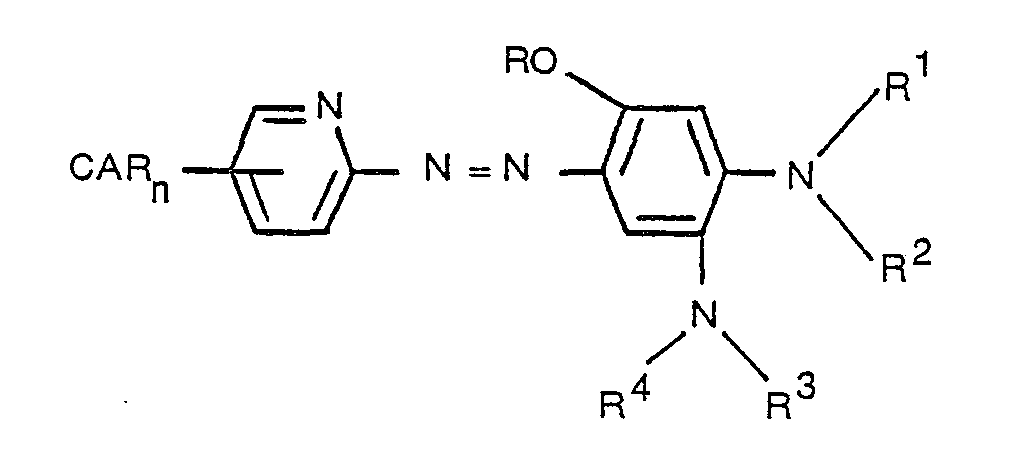
- the present invention provides a photographic element comprising a support having thereon a dye image-providing material comprising a nondiffusible 2-(2-pyridylazo)-4,5-bis(tertiary amino)phenol black dye moiety, or precursor thereof, containing a ballasted carrier moiety capable of releasing the diffusible 2-(2-pyridylazo)-4,5-bis-(tertiary amino)phenol black dye moiety, or precursor thereof, as a function of development of the silver halide emulsion layer under alkaline conditions.
- the dye image-providing material has the following formula: wherein
- the alkyl or substituted alkyl groups which R 1 , R 2 , R 3 , and R 4 represent can be, for example, methyl, ethyl, propyl, isopropyl, cyanoethyl, sulfamoylpropyl or ethoxycarbonylmethyl.
- R 1 and R 2- and/or R 3 and R can represent a 5- or 6-membered heterocyclic ring, such as, for example, morpholine, piperidine, or pyrroline.
- Preferred image-providing compounds are those wherein n is 1; R represents hydrogen, R 1 and R 2 are each methyl or together complete a 6-membered heterocyclic ring such as morpholino; R 3 and R 4 are each methyl or together complete a 6-membered heterocyclic ring; and the pyridine ring is substituted in the 5- position with a sulfonamide group.
- substituents may also be present in the two rings illustrated above, such as alkyl or alkoxy of 1 to 6 carbon atoms, halogen such as chlorine or bromine and solubilizing groups such as sulfonamido, sulfamoyl, phenylsulfamoyl, carboxy, sulfo or hydrolyzable precursors thereof.
- CAR may have two azo dye moieties attached thereto in which case two dye moieties can be released from one CAR moiety.
- Hydrolyzable moieties which can be represented by R include esters such as acetate, benzoate, pivalate or carbamates or imidomethyl groups, or blocking groups which can be cleaved by an intramolecular nucleophile displacement reaction such as those disclosed in U.S. Patent 4,310,612.
- CAR moieties useful in the invention are described in U.S. Patents 3,227,550; 3,628,952; 3,227,552 and 3,844,785 (dye released by chromogenic coupling); U.S. Patents 3,443,939 and 3,443,940 (dye released by intramolecular ring closure); U.S. Patents 3,698,897 and 3,725,062 (dye released from hydroquinone derivatives); U.S.
- Patent 3,728,113 (dye released from a hydroquinonyl- methyl quaternary salt); U.S Patents 3,719,489 and 3,443,941 (silver ion induced dye release); British Patent Publication 2,017,950A (dye released by a dye bleach process); U.S. Patents 4,053,312; 4,198,235; 4,179,231; 4,055,428 and 4,149,892 (dye released by oxidation and deamidation); and U.S. Patents 3,245,789 and 3,980,497; Canadian Patent 602,607; British Patent 1,464,104; Research Disclosure 14447, April 1976; and U.S. Patent 4,139,379.
- Representative compounds which can be used in this invention include the following:
- nondiffusible compounds of the invention which have a releasable, 2-(2-pyridylazo)-4,5- bis(tertiary amino)phenol black dye moiety, or precursor thereof, are preferably employed in a photographic element which also comprises at least one photosensitive silver halide emulsion layer with which the nondiffusible compounds are associated.
- a process for producing a photographic transfer image utilizing such a photographic element comprises:
- the black azo dye moiety which is released from the dye-releasing compounds described above is a tridentate ligand and will form a coordination complex in the image-receiving layer with polyvalent metal ions.
- the metal ions can be present in the image-receiving layer or in a layer adjacent thereto.
- the dye thus becomes immobilized in the dye image-receiving layer and metallized at the same time.
- the image-receiving layer can be contacted with metal ions in a bath after diffusion of the dye has taken place.
- Metal ions most useful are those which are essentially colorless when incorporated into the image-receiving element, are inert with respect to the silver halide layers, react readily with the released dye to form a complex, are tightly coordinated to the dye in the complex, have a stable oxidation state, and form a dye complex which is stable to heat, light and chemical reagents. Good results are obtained with divalent metal ions such as copper (II), zinc (II), nickel (II), platinum (II), palladium (II) and cobalt (II) ions.
- Lig is one or more ligand groups, depending upon the coordination number of the metal ion, such as H Z O, CI or pyridine, or a second dye moiety.
- a divalent metal ion in solution has a number of ligand groups attached to it depending upon its coordination number and the relative reactivity of various ligand groups such as water, ammonia, chloride, pyridine or acetate, which may be in the solution environment of the metal ion. These ligands can be displaced by a tridentate azo dye ligand which would form a more stable complex).
- an imagewise distribution of azo dye in addition to developed silver After processing the photographic element described above, there remains in it after transfer has taken place an imagewise distribution of azo dye in addition to developed silver.
- An image comprising residual nondiffusible compound is obtained in this element if the residual silver and silver halide are removed by any conventional manner well known to those skilled in the photographic art, such as a bleach bath, followed by a fix bath, a bleach-fix bath, etc.
- a retained dye image should normally be treated with metal ions to metallize the dye to increase its light fastness.
- the imagewise distribution of azo dye may also diffuse out of the element into these baths, if desired, rather than to an image-receiving element.
- a negative-working silver halide emulsion is employed a positive image, such as a reflection print, transparency or a motion picture film, is produced in this manner. If a direct-positive silver halide emulsion is employed, a negative image is produced.
- the photographic element in the above-described process can be treated in any manner with an alkaline processing composition to effect or initiate development.
- a photographic film unit or assemblage utilizing the dye-releasing compounds described above is adapted to be processed by an alkaline processing composition, and comprises:
- the assemblage contains the alkaline processing composition and means containing same for discharge within the film unit.
- a rupturable container which is adapted to be positioned during processing of the film unit so that a compressive force applied to the container by pressure-applying members, such as would be found in a camera designed for in- camera processing, will effect a discharge of the container's contents within the film unit.
- the dye image-providing material associated with the silver halide emulsion layer in this invention is contained either in the silver halide emulsion layer or in a layer contiguous to the silver halide emulsion layer.
- the concentration of the dye image-providing materials that are employed in the present invention may be varied over a wide range, depending upon the particular material employed and the results which are desired.
- the dye image-providing materials of the present invention may be coated in layers at a concentration of 0.1 to 3 g/m 2 by using coating solutions containing between 0.5 and 8 percent by weight of the dye image-providing material distributed in a hydrophilic film- forming natural material or synthetic polymer, such as gelatin, polyvinyl alcohol, etc, which is adapted to be permeated by aqueous alkaline processing composition.
- the silver halide developer or electron transfer agent (ETA) employed in the process becomes oxidized upon development and reduces silver halide to silver metal.
- the oxidized developer then cross-oxidizes the dye image-providing material.
- the product of cross-oxidation then undergoes alkaline hydrolysis, thus releasing an imagewise distribution of diffusible azo dye which then diffuses to the receiving layer to provide the dye image.
- the diffusible moiety is transferable in alkaline processing composition either by virtue of its self-diffusivity or by its having attached to it one or more solubilizing groups, for example, a carboxy, sulpho, sulphonamido, hydroxy or morpholino group.
- nondiffusing used herein has the meaning commonly applied to the term in photography and denotes materials that, for all practical purposes, do not migrate or wander through organic colloid layers, such as gelatin, in the photographic elements of the invention in an alkaline medium and preferably when processed in a medium having a pH of 11 or greater. The same meaning is to be attached to the term “immobile”.
- diffusible as applied to the materials of this invention has the converse meaning and denotes materials having the property of diffusing effectively through the colloid layers of the photographic elements in an alkaline medium.
- Mobile has the same meaning as "diffusible”.
- a receiving element was prepared comprising a poly(ethylene terephthalate) film support having thereon a nickel sulfate hexahydrate (0.58 g/m 2 )-gelatin (1.08 g/m 2 ) metal complexing layer and a poly(4-vinylpyridine)-gelatin mordant layer (each at 2.15 g/m 2 ).
- the receiving element was immersed in an alkaline solution of the azo dyes listed in the Table below.
- the receiving element was removed from the dye solution, washed in distilled water, placed in a pH 7.0 buffer solution and dried. Transmission spectra obtained on each sample were normalized to a density of 1.0.
- the ⁇ max at maximum density, along with the "half band width" (1/2 BW), the wavelength range of the curve at half the maximum density, and the A 1/2 (the center of the wavelength range at half the maximum density) are recorded in the Table below.
- a broad 1/2 BW would be desirable for a neutral-absorbing dye. With respect to those dyes which have two distinct maxima, the highest density ⁇ max is given first.
- a fading test was also run wherein the samples were mounted on aperture cards and subjected to 5000-foot-cable Xenon arc radiation (High Intensity Daylight or HID) for 10 and 21 days using a Wratten 2B filter. The curves were compared with an undyed receiving element as a reference. The percentage of dye remaining at each time interval was measured and recorded in the Table below.
- HID High Intensity Daylight
- a general procedure for preparing compounds suitable for an element according to the invention comprises the following sequence:
- 4,5-Dimorpholino-2-(2-pyridylazo)phenol was partially dissolved in 38 ml pyridine containing 3.8 ml triethylamine.
- To the warmed solution was added 3,6-bis(N-chloroformyl-N-propylaminomethyl)-2,5-bis(I-methylundecyl)benzoquinone (1.43 g, 2.0 mmol) (U.S. Patent 4,207,104, Col. 33).
- the mixture was stirred at room temperature overnight (no residue), poured into an ice/water slurry containing 48 ml conc. hydrochloric acid. An orange solid was filtered off and dried.
Landscapes
- Chemical & Material Sciences (AREA)
- Organic Chemistry (AREA)
- Physics & Mathematics (AREA)
- General Physics & Mathematics (AREA)
- Plural Heterocyclic Compounds (AREA)
- Acyclic And Carbocyclic Compounds In Medicinal Compositions (AREA)
- Nitrogen Condensed Heterocyclic Rings (AREA)
- Silver Salt Photography Or Processing Solution Therefor (AREA)
Claims (8)
Applications Claiming Priority (2)
| Application Number | Priority Date | Filing Date | Title |
|---|---|---|---|
| US06/282,612 US4357411A (en) | 1981-07-13 | 1981-07-13 | Photographic products and processes employing novel nondiffusible 2-(2-pyridylazo)-4,5-bis(tertiary amino)phenol black dye-releasing compounds and precursors thereof |
| US282612 | 1981-07-13 |
Publications (2)
| Publication Number | Publication Date |
|---|---|
| EP0070018A1 EP0070018A1 (fr) | 1983-01-19 |
| EP0070018B1 true EP0070018B1 (fr) | 1984-10-10 |
Family
ID=23082289
Family Applications (1)
| Application Number | Title | Priority Date | Filing Date |
|---|---|---|---|
| EP82106191A Expired EP0070018B1 (fr) | 1981-07-13 | 1982-07-12 | Eléments photographiques utilisant des composés 2-(2-pyridylazo)-4,5-bis (amino tertiaire) phénol non-diffusibles, libérateurs de colorants noirs ou leurs précurseurs |
Country Status (5)
| Country | Link |
|---|---|
| US (1) | US4357411A (fr) |
| EP (1) | EP0070018B1 (fr) |
| JP (1) | JPS5817437A (fr) |
| CA (1) | CA1178580A (fr) |
| DE (1) | DE3260955D1 (fr) |
Families Citing this family (3)
| Publication number | Priority date | Publication date | Assignee | Title |
|---|---|---|---|---|
| US4892584A (en) * | 1988-12-05 | 1990-01-09 | Eastman Kodak Company | Water soluble infrared absorbing dyes and ink-jet inks containing them |
| US6644800B2 (en) | 2002-01-30 | 2003-11-11 | Hewlett-Packard Development Company, L.P. | Inkjet images having improved visual properties and methods of making same |
| CN115925619B (zh) * | 2022-11-23 | 2025-05-27 | 上海阿拉丁生化科技股份有限公司 | 一种4-(2-吡啶偶氮)间苯二酚的制备方法 |
Family Cites Families (7)
| Publication number | Priority date | Publication date | Assignee | Title |
|---|---|---|---|---|
| CA569011A (fr) * | 1955-01-28 | 1959-01-13 | Bossard Werner | Sels de couleurs solubles dans l'eau de matieres colorantes monoazoiques |
| US3051697A (en) * | 1958-10-06 | 1962-08-28 | American Cyanamid Co | Azomonazone n-oxides, production and deoxygenation |
| US3118871A (en) * | 1960-12-12 | 1964-01-21 | American Cyanamid Co | Monazinium azo compounds |
| GB1585178A (en) * | 1976-09-10 | 1981-02-25 | Kodak Ltd | Photographic materials |
| DE2733112A1 (de) * | 1977-07-22 | 1979-02-08 | Agfa Gevaert Ag | Fotografisches farbdiffusionsuebertragungsverfahren |
| US4195994A (en) * | 1977-08-05 | 1980-04-01 | Eastman Kodak Company | Photographic products and processes employing nondiffusible 6-arylazo-2-amino-3-pyridinol dye-releasing compounds and precursors thereof |
| US4204993A (en) * | 1978-07-24 | 1980-05-27 | Eastman Kodak Company | Nondiffusible 6-arylazo-2-amino-3-pyridinol dye-releasing compounds |
-
1981
- 1981-07-13 US US06/282,612 patent/US4357411A/en not_active Expired - Lifetime
-
1982
- 1982-03-16 CA CA000398497A patent/CA1178580A/fr not_active Expired
- 1982-07-12 EP EP82106191A patent/EP0070018B1/fr not_active Expired
- 1982-07-12 DE DE8282106191T patent/DE3260955D1/de not_active Expired
- 1982-07-13 JP JP57120721A patent/JPS5817437A/ja active Pending
Also Published As
| Publication number | Publication date |
|---|---|
| EP0070018A1 (fr) | 1983-01-19 |
| CA1178580A (fr) | 1984-11-27 |
| DE3260955D1 (en) | 1984-11-15 |
| JPS5817437A (ja) | 1983-02-01 |
| US4357411A (en) | 1982-11-02 |
Similar Documents
| Publication | Publication Date | Title |
|---|---|---|
| EP0187340B1 (fr) | Produits photographiques utilisant des complexes métalliques de colorants azo non-diffusibles | |
| EP0045633B1 (fr) | Eléments photographiques utilisant des composés 6-arylazo-3-pyridinol non-diffusibles, libérateurs de colorants magenta ainsi que leurs précurseurs | |
| JPS6131861B2 (fr) | ||
| EP0292618B1 (fr) | Elément photographique contenant des composés utilisables dans un procédé de diffusion et de transfert de colorants | |
| GB2136980A (en) | Sensitive silver halide photothermographic materials for producing dye images | |
| CA1144921A (fr) | Produits et procedes pour la photographie, utilisant de nouveaux composes non diffusibles, qui liberent des colorants azoiques | |
| EP0097849B1 (fr) | Matériel d'enregistrement photographique utilisant un composé libérant un colorant jaune | |
| EP0070019B1 (fr) | Eléments photographiques utilisant des composés azoaminophénol non-diffusibles, libérateurs de colorants magenta ou leurs précurseurs | |
| EP0070018A1 (fr) | Eléments photographiques utilisant des composés 2-(2-pyridylazo)-4,5-bis (amino tertiaire) phénol non-diffusibles, libérateurs de colorants noirs ou leurs précurseurs | |
| US4368260A (en) | Photographic light sensitive element | |
| EP0095324B1 (fr) | Matériau d'enregistrement photographique utilisant un composé non diffusible libérateur d'un colorant magenta ou son précurseur | |
| EP0070481B1 (fr) | Eléments photographiques utilisant des composés pyridylazo(dialkylamino)phénol non diffusibles, libérateurs de colorants magenta ou leurs précurseurs | |
| JP3150346B2 (ja) | 画像記録材料 | |
| EP0147105B1 (fr) | Produits photographiques utilisant un composé non diffusible libérateur d'un colorant hydrazonique | |
| US4416979A (en) | Photographic light-sensitive element with nitrophyenylazo metal complexable dye | |
| EP0095127B1 (fr) | Matériau d'enregistrement photographique utilisant un composé non diffusible libérateur d'un colorant cyan ou son précurseur | |
| US4436799A (en) | Photographic products and processes employing novel nondiffusible magenta dye-releasing compounds and precursors thereof | |
| US5037731A (en) | Organic compounds for use in a dye diffusion transfer process and photographic elements incorporating them | |
| EP0149158B1 (fr) | Composés complexes de chrome et système photographique | |
| US4598030A (en) | Photographic products employing novel nondiffusible metal complexes of azo dyes | |
| US4368248A (en) | Photographic products and processes employing novel nondiffusible 2-(2-pyridylazo)-4,5-bis(tertiary amino)phenol black dye-releasing compounds and precursors thereof | |
| US4368153A (en) | Photographic products and processes employing novel nondiffusible 2-(2-pyridylazo)-4,5-bis(tertiary amino)phenol black dye-releasing compounds and precursors thereof | |
| EP0284130A1 (fr) | Composés organiques pour utilisation dans un procédé de diffusion-transfert de colorant et éléments photographiques les contenant | |
| JPS58126529A (ja) | 写真要素 | |
| JPS6318179B2 (fr) |
Legal Events
| Date | Code | Title | Description |
|---|---|---|---|
| PUAI | Public reference made under article 153(3) epc to a published international application that has entered the european phase |
Free format text: ORIGINAL CODE: 0009012 |
|
| AK | Designated contracting states |
Designated state(s): DE FR GB |
|
| 17P | Request for examination filed |
Effective date: 19830208 |
|
| GRAA | (expected) grant |
Free format text: ORIGINAL CODE: 0009210 |
|
| AK | Designated contracting states |
Designated state(s): DE FR GB |
|
| REF | Corresponds to: |
Ref document number: 3260955 Country of ref document: DE Date of ref document: 19841115 |
|
| ET | Fr: translation filed | ||
| PLBE | No opposition filed within time limit |
Free format text: ORIGINAL CODE: 0009261 |
|
| STAA | Information on the status of an ep patent application or granted ep patent |
Free format text: STATUS: NO OPPOSITION FILED WITHIN TIME LIMIT |
|
| 26N | No opposition filed | ||
| PGFP | Annual fee paid to national office [announced via postgrant information from national office to epo] |
Ref country code: DE Payment date: 19890706 Year of fee payment: 8 |
|
| PGFP | Annual fee paid to national office [announced via postgrant information from national office to epo] |
Ref country code: FR Payment date: 19890713 Year of fee payment: 8 |
|
| PGFP | Annual fee paid to national office [announced via postgrant information from national office to epo] |
Ref country code: GB Payment date: 19900627 Year of fee payment: 9 |
|
| PG25 | Lapsed in a contracting state [announced via postgrant information from national office to epo] |
Ref country code: FR Effective date: 19910329 |
|
| PG25 | Lapsed in a contracting state [announced via postgrant information from national office to epo] |
Ref country code: DE Effective date: 19910403 |
|
| REG | Reference to a national code |
Ref country code: FR Ref legal event code: ST |
|
| PG25 | Lapsed in a contracting state [announced via postgrant information from national office to epo] |
Ref country code: GB Effective date: 19910712 |
|
| GBPC | Gb: european patent ceased through non-payment of renewal fee |