EP0071202A1 - Méthode et appareil pour contrôler optiquement une feuille de verre en mouvement - Google Patents
Méthode et appareil pour contrôler optiquement une feuille de verre en mouvement Download PDFInfo
- Publication number
- EP0071202A1 EP0071202A1 EP82106642A EP82106642A EP0071202A1 EP 0071202 A1 EP0071202 A1 EP 0071202A1 EP 82106642 A EP82106642 A EP 82106642A EP 82106642 A EP82106642 A EP 82106642A EP 0071202 A1 EP0071202 A1 EP 0071202A1
- Authority
- EP
- European Patent Office
- Prior art keywords
- glass
- web
- light
- edges
- defects
- Prior art date
- Legal status (The legal status is an assumption and is not a legal conclusion. Google has not performed a legal analysis and makes no representation as to the accuracy of the status listed.)
- Withdrawn
Links
- 239000011521 glass Substances 0.000 title claims abstract description 82
- 238000000034 method Methods 0.000 title claims abstract description 15
- 230000007547 defect Effects 0.000 claims abstract description 19
- 238000007689 inspection Methods 0.000 claims abstract description 12
- 230000033001 locomotion Effects 0.000 claims abstract description 11
- 230000003287 optical effect Effects 0.000 claims abstract description 6
- 230000005855 radiation Effects 0.000 claims abstract description 3
- 238000001816 cooling Methods 0.000 claims description 3
- 239000012080 ambient air Substances 0.000 claims description 2
- 230000000903 blocking effect Effects 0.000 claims 1
- 238000010276 construction Methods 0.000 abstract description 3
- 239000005329 float glass Substances 0.000 description 7
- 238000012545 processing Methods 0.000 description 7
- 230000006870 function Effects 0.000 description 4
- 238000004519 manufacturing process Methods 0.000 description 4
- 239000003570 air Substances 0.000 description 3
- 238000001514 detection method Methods 0.000 description 3
- 239000000463 material Substances 0.000 description 3
- XKRFYHLGVUSROY-UHFFFAOYSA-N Argon Chemical compound [Ar] XKRFYHLGVUSROY-UHFFFAOYSA-N 0.000 description 2
- 238000013459 approach Methods 0.000 description 2
- 239000000428 dust Substances 0.000 description 2
- 238000010438 heat treatment Methods 0.000 description 2
- 238000012986 modification Methods 0.000 description 2
- 230000004048 modification Effects 0.000 description 2
- 238000006748 scratching Methods 0.000 description 2
- 230000002393 scratching effect Effects 0.000 description 2
- 230000003595 spectral effect Effects 0.000 description 2
- 238000002834 transmittance Methods 0.000 description 2
- OKTJSMMVPCPJKN-UHFFFAOYSA-N Carbon Chemical compound [C] OKTJSMMVPCPJKN-UHFFFAOYSA-N 0.000 description 1
- 101000916532 Rattus norvegicus Zinc finger and BTB domain-containing protein 38 Proteins 0.000 description 1
- 230000005856 abnormality Effects 0.000 description 1
- 230000009102 absorption Effects 0.000 description 1
- 238000010521 absorption reaction Methods 0.000 description 1
- 229910052786 argon Inorganic materials 0.000 description 1
- 230000005540 biological transmission Effects 0.000 description 1
- 238000007664 blowing Methods 0.000 description 1
- UIZLQMLDSWKZGC-UHFFFAOYSA-N cadmium helium Chemical compound [He].[Cd] UIZLQMLDSWKZGC-UHFFFAOYSA-N 0.000 description 1
- 229910052799 carbon Inorganic materials 0.000 description 1
- 230000006735 deficit Effects 0.000 description 1
- 238000003708 edge detection Methods 0.000 description 1
- 238000001914 filtration Methods 0.000 description 1
- 239000005357 flat glass Substances 0.000 description 1
- 239000007789 gas Substances 0.000 description 1
- 239000001307 helium Substances 0.000 description 1
- 229910052734 helium Inorganic materials 0.000 description 1
- SWQJXJOGLNCZEY-UHFFFAOYSA-N helium atom Chemical compound [He] SWQJXJOGLNCZEY-UHFFFAOYSA-N 0.000 description 1
- 238000005286 illumination Methods 0.000 description 1
- 238000012544 monitoring process Methods 0.000 description 1
- 230000008447 perception Effects 0.000 description 1
- 230000004044 response Effects 0.000 description 1
- 150000003839 salts Chemical class 0.000 description 1
- 238000012549 training Methods 0.000 description 1
- 230000001960 triggered effect Effects 0.000 description 1
- 230000000007 visual effect Effects 0.000 description 1
- 238000011179 visual inspection Methods 0.000 description 1
- XLYOFNOQVPJJNP-UHFFFAOYSA-N water Substances O XLYOFNOQVPJJNP-UHFFFAOYSA-N 0.000 description 1
Images
Classifications
-
- G—PHYSICS
- G01—MEASURING; TESTING
- G01N—INVESTIGATING OR ANALYSING MATERIALS BY DETERMINING THEIR CHEMICAL OR PHYSICAL PROPERTIES
- G01N21/00—Investigating or analysing materials by the use of optical means, i.e. using sub-millimetre waves, infrared, visible or ultraviolet light
- G01N21/84—Systems specially adapted for particular applications
- G01N21/88—Investigating the presence of flaws or contamination
- G01N21/89—Investigating the presence of flaws or contamination in moving material, e.g. running paper or textiles
- G01N21/892—Investigating the presence of flaws or contamination in moving material, e.g. running paper or textiles characterised by the flaw, defect or object feature examined
- G01N21/896—Optical defects in or on transparent materials, e.g. distortion, surface flaws in conveyed flat sheet or rod
Definitions
- This invention relates to a method and apparatus for automatically optically inspecting a glass web, and more particularly to such a method and apparatus which utilizes internal reflection moving from defects in the web toward the edges and edge detecting the totally internally reflected light at the edges thereof.
- the many problems are the detection of bubbles in the glass which are caused by gases captured by the molten elements during the heating process. Such bubbles do not have time to emerge before the glass leaves the heating process.
- the bubbles vary in size from microns to several centimeters and their size and number vary with the thickness of the glass.
- Bubbles may be classified as filled bubbles or salt cakes which look like stones and occur infrequently; body bubbles which are small in diameter, relative to the thickness of the glass, which do not distort the glass and appear as small, spherical or eliptical lines and block transmitted light in the glass; or surface bubbles which tend to appear just below the surface of the glass, mostly on the lower surface in float glass and cause distortion in the glass and as an extreme case provide an open bubble when the bubble breaks on the surface.
- Bubbles vary greatly in shape from spherical to ellipsoidal with the larger bubbles tending to be more elongated as well as those which are generated in higher speed glass lines. The most important factors in determining the bubble shape are the operating characteristics of a particular float line fur manufacturing the glass.
- bubble detection is done visibly by inspectors with the glass being lit or illuminated from the top such that the defect casts a characteristic shadow on a white board under the glass web.
- glass inspectors can learn to identify certain kinds of flaws.
- the location must be marked with a colored crayon attached to the end of a long pointer.
- the accuracy depends on the experience of the inspector, the speed of the line and of course, the foibles of human perceptions and response.
- a further object of this invention is to provide a new and improved apparatus and method of optically inspecting a moving web of glass which eliminates the subjective nature of visual inspection.
- a further object of this invention is to provide a new and improved method and apparatus for optically inspecting a moving web of glass for defects which is fast, efficient, more accurate and less time-consuming than previously used visual methods.
- a method of automatically optically inspecting a moving web of glass in which the moving web of glass is scanned orthogonally with respect to the direction of movement with a light source. As the light source strikes a defect within the web, it is internally reflected in the glass and travels towards the edges where it is captured on the opposite ends of the glass web. The captured light emanating from the edges of the web caused by internal reflection due to defects in the glass, is detected for converting the light to electrical signals and the defects are determined in accordance with the characteristics of the electrical signals so generated.
- Apparatus for carrying out the aforesaid method including edge detection means which surround opposite sides of the web and prevent ambient light from entering the edge detectors.
- the edge detectors are also cooled and follow the vertical and horizontal motions of the web so as not to disturb the manufacture of the web.
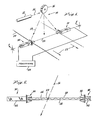
- a light inspection system referred to generally with the reference numeral 10, has a suitable light source such as a laser beam, zenon lamp, etc. generating a beam 14 which is scanned by a scanner 16 over a moving web of glass 20 which is being examined thereby.
- the scanner 16 may be a conventional, multiple faceted, mirrored surface polygon of a suitable number of facets.
- the scanner 16 may comprise any means which functions to rapidly scan a light source across the surface of the glass web 20, such as an oscillating mirror, rotating mirror or prism, or any other suitable deflection apparatus.
- the scanner 16 performs the function of scanning the light source repeatedly across the moving web of glass 20 which is moving in the direction shown by the arrows 22 which may be referred to as the machine direction or axis of web movement. As illustrated in Figure 1, the scanning light beam 14 traces a line 24 across the moving web of glass 20. Scanning in the orthogonal direction is automatically formed by the movement of the glass web 20.
- the scanning of the glass web 20 by the light beam 14 causes the beam 14 to be partially reflected from the top surface of the glass web 20 with a portion of the beam being refracted by the glass web 20 as well as being absorbed thereby.
- the light will impinge on the abnormality and be deflected thereby producing an angle of reflection which satisfies the critical angle and causes total internal reflection within the glass which travels towards the edges of the glass web 20.
- some of the totally internal reflected light is absorbed as it moves towards the edges.
- Figure 2 illustrates this phenomena with the scanning light beam 14 striking a bubble 25 totally internally reflecting the resulting beam 26 which by total internal reflection is trapped in the glass web.
- the beam 26 moves to the edges where it may be captured and detected.
- the intensity of the total reflected beam 26 appearing at the edge of the glass plate 20 is a function of the illumination wavelength, the distance between the edge and the bubble, and the initial intensity of the scanner beam 14.
- edge detectors In order to capture and detect the internally reflected beam 26, edge detectors, referred to generally with the reference numeral 30, are provided by flanking both edges of the moving glass web 20.
- the function of the edge detector is to capture the reflected light 26 that emerges from the edges of the glass web 20 on a float line without being disturbed by ambient or stray light due to dust or foreign matter on the glass surface, and further to convert such light into an electrical signal which may be utilized to identify and characterize the flaw which is present.
- a suitable light detector such as a photomultiplier tube 32 is utilized for converting the internally reflected light appearing at the edges of the web 20 into an electrical signal.
- Edge detector 30 includes a number of features due to the conditions which it must operate under including a warm glass web which may be dusty, wet and moving in all directions, as well as having varying amounts of ambient light which must be excluded and not measured.
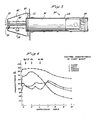
- the construction of the edge detector 30, as best seen in Figure 3, includes a mouth 34 that fits over the glass edge such that only the edges of the glass are seen by the detector or photomultiplier tube 32.
- the mouth has upper and lower jaws 36 and 38 with the jaws being movable in order to follow the glass web.
- the jaws are held by springs 40 mounted on a vertical rail 42.
- the detectors 30 may be moved manually in the horizontal direction because the horizontal movements are very slow. However, the horizontal movement may also be done mechanically.
- a preferable way of moving the edge detectors 30 along the web would be by providing glass edge sensors which operate pneumatic cylinders to follow the horizontal and vertical movements of the web.
- the mouth 34 is equipped with upper and lower brushes 46 and 48, respectively, which completely seal the mouth in a light tight condition without scratching or altering the glass product.
- the brushes 46 and 48 may be carbon filter or other resistant material mounted in a light labyrinth construction.
- the photomultiplier tube 32 has a noise characteristic proportional to temperature, and since the float glass and the ambient air are warm at the inspection site, typically between 40° and 60°, cooling of the tube becomes necessary. Accordingly, a fan 50 is provided for blowing air in the detector housing 52. By filtering the air inside, the detector housing can be kept dust free by creating an overpresssure in the air stream which also prevents water which is normally present on the web edges from condensing on the photomultiplier tube window.
- the source 10 which generates the beam 14 is scanned by the scanner 16 orthogonally across the glass web being inspected.
- the edge detectors 30 fit over the glass edge and capture the light which is internally reflected toward the edges of the glass web 20 due to defects occurring in the glass web which have been struck by the scanning light beam 14 and have been caused to be totally internally reflected to the edges of the glass web.
- the brushes 46 and 48 on the jaws 36 and 38 of the mouth 34 mechanically follow the movements or the motions of the web and follow the web without admitting ambient light thereto and without scratching or altering the product.
- the electrical signals which are generated by the detector 32 are applied to a processing circuit 55 from which flaws or defects may be characterized depending on their. location, size and type.
- the signals generated must exceed a predetermined amplitude which takes care of system anomalies and noise and indicates that a flaw exists and that a flaw signal rather than noise has triggered the output of the processing circuit 55.
- the signal processing techniques per se are considered conventional and accordingly are not discussed in detail. Reference may be made to U.S. 3,781,531; 3,900,265; 3,920,970; 3,898,469 and 3,980,891 which are assigned to the assignee of the present invention for information with respect to signal processing. The exact nature and type of processing used will depend on the characteristics of the material being inspected and the particular application to which the processing is employed.
- Figure 4 is a graph illustrating the spectral transmittance of float glass verses wavelength indicating the wavelength of a helium cadmium laser, an argon laser or a helium laser. Due to its properties, clear glass has a slightly green appearance which is readily visible in thick glass plates. Accordingly, clear glass transmits visible light almost independently of color with the best transmission for green being about 500 nanometers. When light hits a flat glass surface, about 8 percent of the light is reflected and about 2 percent is absorbed per centimeter. Accordingly, Figure 4 provides a relation between the absorptions for different wavelengths in clear and various colored glasses.- The type of source which is utilized will therefore depend to some extent on the type of float glass which is being examined.
- the edge detector system may be used by itself or it may be used in conjunction with a receiver which detects the reflected light off of the top surface of the glass and/or the light which is transmitted through the glass by placing the receiver on the underside and processing the radiation therefrom.
- a more fully automatic and reliable automatic optical inspection system provides a complete diagnostic tool for the examination of float glass.
- this method and approach to the inspection of glass provides a way of distinguishing between surface dirt and actual defects in surface and in the glass.
Landscapes
- Engineering & Computer Science (AREA)
- Textile Engineering (AREA)
- Physics & Mathematics (AREA)
- Health & Medical Sciences (AREA)
- Life Sciences & Earth Sciences (AREA)
- Chemical & Material Sciences (AREA)
- Analytical Chemistry (AREA)
- Biochemistry (AREA)
- General Health & Medical Sciences (AREA)
- General Physics & Mathematics (AREA)
- Immunology (AREA)
- Pathology (AREA)
- Investigating Materials By The Use Of Optical Means Adapted For Particular Applications (AREA)
Applications Claiming Priority (2)
| Application Number | Priority Date | Filing Date | Title |
|---|---|---|---|
| US288010 | 1981-07-29 | ||
| US06/288,010 US4401893A (en) | 1981-07-29 | 1981-07-29 | Method and apparatus for optically inspecting a moving web of glass |
Publications (1)
| Publication Number | Publication Date |
|---|---|
| EP0071202A1 true EP0071202A1 (fr) | 1983-02-09 |
Family
ID=23105374
Family Applications (1)
| Application Number | Title | Priority Date | Filing Date |
|---|---|---|---|
| EP82106642A Withdrawn EP0071202A1 (fr) | 1981-07-29 | 1982-07-23 | Méthode et appareil pour contrôler optiquement une feuille de verre en mouvement |
Country Status (2)
| Country | Link |
|---|---|
| US (1) | US4401893A (fr) |
| EP (1) | EP0071202A1 (fr) |
Cited By (4)
| Publication number | Priority date | Publication date | Assignee | Title |
|---|---|---|---|---|
| GB2158940A (en) * | 1984-05-17 | 1985-11-20 | Zeiss Stiftung | Detecting defects in transparent materials |
| EP0336350A3 (fr) * | 1988-04-06 | 1991-02-06 | Fraunhofer-Gesellschaft Zur Förderung Der Angewandten Forschung E.V. | Dispositif d'inspection optique de surfaces mouvantes de matériaux |
| WO2001018532A1 (fr) * | 1999-09-02 | 2001-03-15 | Resolve Engineering Pty Ltd | Detection d'inclusions dans le verre |
| DE102005022271B3 (de) * | 2005-05-10 | 2006-08-17 | Schott Ag | Verfahren und Vorrichtung zum Detektieren von Blasen in einem Glaskörper sowie zur Herstellung von Glaskörpern |
Families Citing this family (21)
| Publication number | Priority date | Publication date | Assignee | Title |
|---|---|---|---|---|
| DE3334357C2 (de) * | 1983-09-22 | 1986-04-10 | Erwin Sick Gmbh Optik-Elektronik, 7808 Waldkirch | Optisches Fehlersuchgerät für Bahnen |
| FR2563337B1 (fr) * | 1984-04-19 | 1986-06-27 | Saint Gobain Rech | Mesure des contraintes dans le verre flotte |
| US4719061A (en) * | 1985-08-12 | 1988-01-12 | Essex Group, Inc. | System and method for in-process detection of contamination in electrical conductor insulation |
| IL85851A0 (en) * | 1988-03-24 | 1988-09-30 | Israel Atomic Energy Comm | Method and apparatus for detecting flaws in transparent bodies |
| FI81453C (fi) * | 1988-06-22 | 1990-10-10 | Outokumpu Oy | Analysatortaetning. |
| US5517301A (en) * | 1993-07-27 | 1996-05-14 | Hughes Aircraft Company | Apparatus for characterizing an optic |
| JPH10221268A (ja) * | 1997-02-05 | 1998-08-21 | Advantest Corp | ウェーハの表面状態検出方法および装置 |
| US6392683B1 (en) * | 1997-09-26 | 2002-05-21 | Sumitomo Heavy Industries, Ltd. | Method for making marks in a transparent material by using a laser |
| JP4018347B2 (ja) * | 2001-04-13 | 2007-12-05 | 富士フイルム株式会社 | 表面検査装置及び表面検査方法 |
| DE10221945C1 (de) | 2002-05-13 | 2003-07-31 | Schott Glas | Verfahren und Vorrichtung zur Ermittlung von Fehlstellen in einem kontinuierlich fortbewegten Band aus transparentem Material |
| DE10316707B4 (de) * | 2003-04-04 | 2006-04-27 | Schott Ag | Verfahren und Vorrichtung zur Erkennung von Fehlern in transparentem Material |
| DE10351254A1 (de) * | 2003-11-03 | 2005-06-02 | Adc Automotive Distance Control Systems Gmbh | Vorrichtung zur Erfassung von Verschmutzungen auf einer lichtdurchlässigen Abdeckscheibe vor einem optischen Einheit |
| US7511807B2 (en) * | 2003-12-30 | 2009-03-31 | Agency For Science, Technology And Research | Method and apparatus for detection of inclusion in glass |
| KR101442290B1 (ko) * | 2007-01-11 | 2014-09-19 | 쓰리엠 이노베이티브 프로퍼티즈 컴파니 | 웨브 종방향 위치 센서 |
| US7800749B2 (en) * | 2007-05-31 | 2010-09-21 | Corning Incorporated | Inspection technique for transparent substrates |
| KR101493115B1 (ko) * | 2007-06-19 | 2015-02-12 | 쓰리엠 이노베이티브 프로퍼티즈 컴파니 | 웨브의 위치를 나타내는 시스템 및 방법 |
| BRPI0811664A2 (pt) * | 2007-06-19 | 2015-02-10 | 3M Innovative Properties Co | "escala de deslocamento por reflexão interna total" |
| EP2162705A4 (fr) * | 2007-06-19 | 2014-02-19 | 3M Innovative Properties Co | Systèmes et procédés pour fabriquer des échelles de déplacement |
| SG172349A1 (en) | 2008-12-29 | 2011-07-28 | 3M Innovative Properties Co | Phase-locked web position signal using web fiducials |
| WO2010077719A2 (fr) | 2008-12-30 | 2010-07-08 | 3M Innovative Properties Company | Appareil et procédé de réalisation de repères sur un substrat |
| CN109297975A (zh) * | 2018-08-16 | 2019-02-01 | 奇酷互联网络科技(深圳)有限公司 | 移动终端及检测方法、存储装置 |
Citations (3)
| Publication number | Priority date | Publication date | Assignee | Title |
|---|---|---|---|---|
| GB898828A (en) * | 1959-06-26 | 1962-06-14 | Gen Electric Co Ltd | Improvements in or relating to the examination of transparent sheet material |
| DE2327381A1 (de) * | 1972-05-30 | 1973-12-13 | Saint Gobain | Verfahren zum feststellen von fehlern in flachglas |
| DE2527403A1 (de) * | 1975-06-19 | 1977-02-24 | Sick Optik Elektronik Erwin | Verfahren und vorrichtung zur pruefung von durchscheinenden kunststoffrohren |
Family Cites Families (2)
| Publication number | Priority date | Publication date | Assignee | Title |
|---|---|---|---|---|
| GB1315654A (en) * | 1969-05-21 | 1973-05-02 | Pilkington Brothers Ltd | Detection of faults in transparent material using lasers |
| US3859537A (en) * | 1973-10-15 | 1975-01-07 | Du Pont | Inspection system for web materials |
-
1981
- 1981-07-29 US US06/288,010 patent/US4401893A/en not_active Expired - Fee Related
-
1982
- 1982-07-23 EP EP82106642A patent/EP0071202A1/fr not_active Withdrawn
Patent Citations (3)
| Publication number | Priority date | Publication date | Assignee | Title |
|---|---|---|---|---|
| GB898828A (en) * | 1959-06-26 | 1962-06-14 | Gen Electric Co Ltd | Improvements in or relating to the examination of transparent sheet material |
| DE2327381A1 (de) * | 1972-05-30 | 1973-12-13 | Saint Gobain | Verfahren zum feststellen von fehlern in flachglas |
| DE2527403A1 (de) * | 1975-06-19 | 1977-02-24 | Sick Optik Elektronik Erwin | Verfahren und vorrichtung zur pruefung von durchscheinenden kunststoffrohren |
Cited By (5)
| Publication number | Priority date | Publication date | Assignee | Title |
|---|---|---|---|---|
| GB2158940A (en) * | 1984-05-17 | 1985-11-20 | Zeiss Stiftung | Detecting defects in transparent materials |
| EP0336350A3 (fr) * | 1988-04-06 | 1991-02-06 | Fraunhofer-Gesellschaft Zur Förderung Der Angewandten Forschung E.V. | Dispositif d'inspection optique de surfaces mouvantes de matériaux |
| WO2001018532A1 (fr) * | 1999-09-02 | 2001-03-15 | Resolve Engineering Pty Ltd | Detection d'inclusions dans le verre |
| DE102005022271B3 (de) * | 2005-05-10 | 2006-08-17 | Schott Ag | Verfahren und Vorrichtung zum Detektieren von Blasen in einem Glaskörper sowie zur Herstellung von Glaskörpern |
| EP1722215A1 (fr) | 2005-05-10 | 2006-11-15 | Schott AG | Procédé et dispositif pour la détection de bulles dans un object en verre et pour la fabrication des objects en verre |
Also Published As
| Publication number | Publication date |
|---|---|
| US4401893A (en) | 1983-08-30 |
Similar Documents
| Publication | Publication Date | Title |
|---|---|---|
| US4401893A (en) | Method and apparatus for optically inspecting a moving web of glass | |
| KR100756254B1 (ko) | 투명 매체의 다크뷰 검사 시스템 | |
| US3988068A (en) | Method and apparatus for detecting cosmetic defects in opthalmic lenses | |
| US5355213A (en) | Inspection system for detecting surface flaws | |
| US4223346A (en) | Automatic defect detecting inspection apparatus | |
| US5389794A (en) | Surface pit and mound detection and discrimination system and method | |
| CA2252308C (fr) | Systeme d'inspection de vitrage | |
| EP0174939B1 (fr) | Detection de defauts a la surface de panneaux | |
| KR850000308B1 (ko) | 물질표면의 입자를 검출하는 방법 | |
| US4681442A (en) | Method for surface testing | |
| US3761186A (en) | Apparatus for optically inspecting the condition of a surface having known variations in the condition | |
| CN100371677C (zh) | 衬底表面检测方法与设备 | |
| US4483615A (en) | Method and apparatus for detecting checks in glass tubes | |
| PL172759B1 (en) | Method of and apparatus for inspecting transparent materials | |
| JP4177556B2 (ja) | 板ガラス及び他の透光性材料の光学的品質を測定し、欠陥を検出するための方法並びに装置 | |
| WO1999051971A1 (fr) | Procede et dispositif d'inspection automatique d'objets plans presentant une caracteristique de transmission optique | |
| JPH08278257A (ja) | 移動体検査方法 | |
| US5122672A (en) | Surface quality analyzer apparatus and method | |
| US5086232A (en) | Methods of and apparatus for inspecting surfaces for defects | |
| US4570074A (en) | Flying spot scanner system | |
| KR101039686B1 (ko) | 연속적으로 제조되어 이동하는 대상투명판의 결점들을검출하기 위한 방법과 장치 | |
| JPH06294749A (ja) | 板ガラスの欠点検査方法 | |
| US3361025A (en) | Method and apparatus of detecting flaws in transparent bodies | |
| US20070008522A1 (en) | Glazing inspection | |
| GB2195178A (en) | Glass object inspection |
Legal Events
| Date | Code | Title | Description |
|---|---|---|---|
| PUAI | Public reference made under article 153(3) epc to a published international application that has entered the european phase |
Free format text: ORIGINAL CODE: 0009012 |
|
| AK | Designated contracting states |
Designated state(s): BE DE FR GB IT |
|
| 17P | Request for examination filed |
Effective date: 19830808 |
|
| STAA | Information on the status of an ep patent application or granted ep patent |
Free format text: STATUS: THE APPLICATION IS DEEMED TO BE WITHDRAWN |
|
| 18D | Application deemed to be withdrawn |
Effective date: 19850608 |
|
| RIN1 | Information on inventor provided before grant (corrected) |
Inventor name: DEHUYSSER, ANDRE |