EP0071824A1 - Structure de préforme - Google Patents
Structure de préforme Download PDFInfo
- Publication number
- EP0071824A1 EP0071824A1 EP82106581A EP82106581A EP0071824A1 EP 0071824 A1 EP0071824 A1 EP 0071824A1 EP 82106581 A EP82106581 A EP 82106581A EP 82106581 A EP82106581 A EP 82106581A EP 0071824 A1 EP0071824 A1 EP 0071824A1
- Authority
- EP
- European Patent Office
- Prior art keywords
- preform
- container
- forming portion
- flange
- forming
- Prior art date
- Legal status (The legal status is an assumption and is not a legal conclusion. Google has not performed a legal analysis and makes no representation as to the accuracy of the status listed.)
- Withdrawn
Links
Images



Classifications
-
- B—PERFORMING OPERATIONS; TRANSPORTING
- B29—WORKING OF PLASTICS; WORKING OF SUBSTANCES IN A PLASTIC STATE IN GENERAL
- B29C—SHAPING OR JOINING OF PLASTICS; SHAPING OF MATERIAL IN A PLASTIC STATE, NOT OTHERWISE PROVIDED FOR; AFTER-TREATMENT OF THE SHAPED PRODUCTS, e.g. REPAIRING
- B29C51/00—Shaping by thermoforming, i.e. shaping sheets or sheet like preforms after heating, e.g. shaping sheets in matched moulds or by deep-drawing; Apparatus therefor
- B29C51/02—Combined thermoforming and manufacture of the preform
-
- B—PERFORMING OPERATIONS; TRANSPORTING
- B29—WORKING OF PLASTICS; WORKING OF SUBSTANCES IN A PLASTIC STATE IN GENERAL
- B29C—SHAPING OR JOINING OF PLASTICS; SHAPING OF MATERIAL IN A PLASTIC STATE, NOT OTHERWISE PROVIDED FOR; AFTER-TREATMENT OF THE SHAPED PRODUCTS, e.g. REPAIRING
- B29C51/00—Shaping by thermoforming, i.e. shaping sheets or sheet like preforms after heating, e.g. shaping sheets in matched moulds or by deep-drawing; Apparatus therefor
- B29C51/14—Shaping by thermoforming, i.e. shaping sheets or sheet like preforms after heating, e.g. shaping sheets in matched moulds or by deep-drawing; Apparatus therefor using multilayered preforms or sheets
-
- Y—GENERAL TAGGING OF NEW TECHNOLOGICAL DEVELOPMENTS; GENERAL TAGGING OF CROSS-SECTIONAL TECHNOLOGIES SPANNING OVER SEVERAL SECTIONS OF THE IPC; TECHNICAL SUBJECTS COVERED BY FORMER USPC CROSS-REFERENCE ART COLLECTIONS [XRACs] AND DIGESTS
- Y10—TECHNICAL SUBJECTS COVERED BY FORMER USPC
- Y10S—TECHNICAL SUBJECTS COVERED BY FORMER USPC CROSS-REFERENCE ART COLLECTIONS [XRACs] AND DIGESTS
- Y10S264/00—Plastic and nonmetallic article shaping or treating: processes
- Y10S264/64—Processes of using preform in molding
Definitions
- This invention relates to a preform of novel configuration and relates, more particularly, to a preform having an improved structure that is readily adaptable for forming a container made by'solid state pressure techniques.
- the preform is further characterized by being so contoured to present a predetermined volume of polymeric material so that there is maintained not only a uniform distribution of polymeric material during container formation but that there is sufficient polymeric material to meet the dimensional requirements of the desired container.
- the subject invention is an improvement over prior art preform configurations. It is well known that preforms can be injection molded from a molten polymeric material and later thermoformed into thermoplastic containers. Moreover, the forming of oriented or multilayered preforms is not readily and easily done via injection molding processes, and relatively expensive equipment may be required. Solid state forming has recently been introduced to overcome a number of these limitations.
- Solid state pressure forming is a special process used to form oriented, high strength plastic containers, especially multilayered thermoplastic containers whereby barrier or gas impermeable layers may be incorporated.
- a container is produced by forming a circular preform from a plastic chip or blank by forging the blank and immediately thereafter thermoforming the circular preform into - the finished container.
- the rim area of the final container is established and held by a gripping fixture that acts to clamp the preform in place along the rim area while the central area or ungripped area of the preform is maintained at a predetermined temperature for the subsequent molding or thermoforming operation.
- thermoforming it is important that a predetermined volume of polymeric material be utilized since insufficient or excessive polymeric material would not form a properly dimensioned container. While the preform is maintained at a fixed temperature it is deformed by forcing a plunger through the unclamped portion resulting in the drawing of the polymeric material of a strictly defined volume so that the plunger forms the sidewalls and bottom wall of the container as the plunger travels therethrough of precise dimensions.
- Plastic containers may be fabricated from a preform structure of the present invention by molding process such as solid state pressure technique.
- a preform is forged with a finished rim and immediately thermoformed into a container.
- a determined amount of thermoplastic material such as relatively thin thermoplastic blank, is formed by cutting a sheet of plastic into a plurality of polygonal blanks having a fixed size and shape. The blank is thereafter lubricated or the molds are lubricated in which the blank is to be forged.
- the blank is preheated to a temperature ranging from just below the softening point to about the melting point of the plastic resin and immediately forged in a heated mold into a circular shaped preform in which the center portion thereof is maintained at its forming temperature while the peripheral rim portion is quickly brought below the softening point of the plastic.
- the circular preform is thereafter thermoformed into a container having a desired shape.
- the circular preform must be thoroughly secured so that no edge portion slips or leaves the gripping fixtures, resulting in defects or blemishes in the finished container.
- containers are made from preforms of the subject invention, they are of improved quality and have excellent rim or flange structures that are very suitable for seaming to closures and the like.
- the subject invention relates to a preform configuration for making an open mouth container, said preform being substantially circular and having a central area for forming the bottom of the container, said preform having an annular sidewall forming portion for the container surrounding and integral with the outer periphery of the central area, a flange connected radially outwardly of said annular sidewall forming portion, said flange having the contour of essentially the rim portion of said container, and a retaining member integral with said flange and extending radially outwardly therefrom, said retaining member having an enlarged cross-sectional configuration as compared to the flange.
- the subject invention further relates to the field in solid state pressure forming to a method of gauging a predetermined amount of polymeric material for a preform, the method which comprises providing a polymeric tabular form having a slightly larger volume than a predetermined preform configuration, forging said tabular form into a preform having the predetermined configuration whereby the preform has the necessary polymeric material within its container-forming area to meet the dimensional requirements of the container and allowing the excess polymeric material to be forced outwardly into a peripheral zone to provide an enlarged portion, said zone providing a retaining surface for said preform during the pressure forming of said container.
- the present invention was developed to provide an improved preform configuration that presents to the molding surfaces a precise and predetermined volume of polymeric material to achieve dimensional requirements for a given container. Moreover, the subject preform provides an improved configuration that is readily held and secured during the molding step of the solid state forming process for fabricating plastic containers.
- a primary object of the subject invention therefore, is to provide a simple and practical means by which a preform may be secured while being thermoformed into a container, the container meeting predetermined dimensional requirements.
- Another object of this invention is to provide the in art with a preform characterized by being so contoured to present a predetermined volume of polymeric material in a solid state forming process.
- a forging press 10 having an upper ram 11 and a lower stationary ram 12.
- the press 10 depicts one of the apparatus that can be used to make a plastic preform in accordance with the dimensions and design of the subject invention.
- the upper ram 11 may be guided by any conventional means (not shown) for reciprocation. It will be noted that the upper ram 11 is provided with an upper platen 13 integrally affixed to the ram 11 and, in a like manner, the lower stationary ram 12 is provided with a lower platen 14. Affixed to the lower platen 14 is a forming fixture 15.
- the upper and lower platens 13 and 14, respectively, are provided with conventional heating means such as steam or hot fluid-carrying channels therein.
- the forming fixture 15 is provided with a cooling means (not shown) such as a separate conduit and circumferential channels within the fixture 15 to transport a cooling liquid therethrough.
- the forming fixture 15 comprises a first clamping ring 16 and a second clamping ring 17.
- first clamping ring 16 it is contoured at 18 to match an upper chamfered surface 18 of upper platen 13 and, in a like manner, the second clamping ring 17 is chamfered to match a lower chamfered surface 19 of the lower platen 14.
- Both the first and second clamping rings 16 and 17, respectively, are provided with conventional circumferential cooling channels (not shown) as previously mentioned.
- the first clamping ring 16 is provided with a first shoulder 21; the second clamping ring 17 is likewise provided with a second shoulder 22, said shoulders providing a rim forming portion 31 for a preform 20.
- Radially outward from the rim forming portion is a retaining area 26, an enlarged portion communicating with the rim portion.
- Figure 2 illustrates the forging operation whereby a plastic blank 25 is formed into the preform 20.
- the plastic blank 25 is converted into preform 20 within the cavity 30 defined between platens 13 and 14, the flow of the plastic material after filling the cavity 30 being outwardly towards a retaining area 26.
- plastic material is forced into the area 26 whereby a specific volume is retained and established for the central portion A of the preform, said portion A being substantially the container-forming portion.
- retaining area 26 acts to collect a certain amount of residual plastic material upon forging of the preform to thereby insure that a precise volume is retained in the central, container-forming portion A of the preform.
- the plastic material forces outwardly and into the retaining area excess polymeric material that accumulates and thereby is secured to the outer area of the forming fixture 15. In this way the preform is secured to the fixture and cannot be readily pulled away from forming fixture 15 until released by the same by opening the clamping rings 16 and 17.
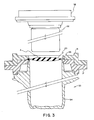
- FIGS 3, 4 and 5 illustrate the preform 20 being positioned into alignment with die members comprising upper plunger 32 and mold cavity 34.
- the upper plunger 32 is provided with a sealing member 35 which seals itself into clamping ring 16.
- Figure 4 shows the member 35 advancing into the mold cavity 34 and the clamping ring 16 engaging the sealing member 35 whereby the preform 20 is stretched over the molding surface B of plunger 32 and air and vacuum means bring the preform into engagement with the base C of the mold cavity 34.
- the particular configuration of the subject invention allows a multilayered profile having a precise volume to be thermoformed into a given container design. This follows from the novel structure of the preform itself in that all of the layers transverse the preform so formed and extend outermost to the extremes of the retaining section of the preform. This is of particular importance in mul 7 tilayered structures wherein one layer may have a relatively slower flow rate in advancing outwardly during the forging operation.
- certain polymers such as polyvinylidene chloride during the forging step have a somewhat slower flow rate as compared to polyolefins like polypropylene and as a result the polyolefin advances ahead to fill the outer confines of the preform cavity thereby blocking or interfering with the advance of the slower moving polyvinylidene chloride. It is of particular importance that such blockage not occur, especially in the rim forming portion of the preform.
- the subject invention therefore provides a means to allow such slower moving polymers to extend outwardly beyond the rim forming portion of the preform.
- the forging temperature is a relative term it cannot be specifically defined without considering the properties of each polymer.
- optimum forging temperature can be determined in accordance with this invention.
- the pressure ranges used in the forging step are quite variable according to the plastic which is to be forged and to the temperature to which it is heated and to the dimensions of the cavity of the mold.
- the blank 25 is generally lubricated and preheated to a temperature ranging just above the softening point to below the melting point of the material, and then placed on the lower platen 14.
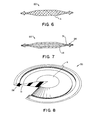
- the upper ram 11 then is allowed to descend under pressure to forge the heated blank 25 into the cavity between the platens 13 and 14 in a cavity configuration to form preforms as shown in Figures 6, 7 and 8.
- the upper and lower platens 13 and 14 are heated to a forging temperature, generally above the softening point of the material being forged.
- the temperature of the platens and the blank can be the same or different but it is preferred to have the platens at a slightly higher temperature than the blank.
- a preform made in accordance with this invention can be most readily thermoformed into an open-mouth container having uniform sidewalls and structural integrity.
- the invention may be constructed of various materials.
- the invention is applicable to the use of a single plastic such as polyolefin, including polyethylene, polypropylene, etc., and polyvinyl aromatics such as polyesters, polystyrenes as well as polyvinyl halides such as polyvinyl chlorides.
- an essential aspect of the subject invention is the structural features of the preform itself, in that it readily is formable into multilayered articles, including open-mouth containers.
- a multilayer material may-consist of polyvinyl aromatics such as styrene, polyvinyl toluene, or rubber modified blends thereof with a core 36 of polyvinylidene chloride.
- a further useful layer may consist of polyethylene or polypropylene with a core of polyvinylidene chloride.
- Containers formed with a_polyvinylidene chloride layer are excellent barriers to gases such as oxygen and carbon dioxide.
Landscapes
- Engineering & Computer Science (AREA)
- Mechanical Engineering (AREA)
- Manufacturing & Machinery (AREA)
- Blow-Moulding Or Thermoforming Of Plastics Or The Like (AREA)
- Processing And Handling Of Plastics And Other Materials For Molding In General (AREA)
- Shaping Of Tube Ends By Bending Or Straightening (AREA)
Applications Claiming Priority (2)
| Application Number | Priority Date | Filing Date | Title |
|---|---|---|---|
| US291540 | 1981-08-10 | ||
| US06/291,540 US4419319A (en) | 1981-08-10 | 1981-08-10 | Preform structure |
Publications (1)
| Publication Number | Publication Date |
|---|---|
| EP0071824A1 true EP0071824A1 (fr) | 1983-02-16 |
Family
ID=23120719
Family Applications (1)
| Application Number | Title | Priority Date | Filing Date |
|---|---|---|---|
| EP82106581A Withdrawn EP0071824A1 (fr) | 1981-08-10 | 1982-07-21 | Structure de préforme |
Country Status (3)
| Country | Link |
|---|---|
| US (1) | US4419319A (fr) |
| EP (1) | EP0071824A1 (fr) |
| JP (1) | JPS5838120A (fr) |
Cited By (3)
| Publication number | Priority date | Publication date | Assignee | Title |
|---|---|---|---|---|
| EP0256953A1 (fr) * | 1986-08-19 | 1988-02-24 | Joel Queirel | Procédé de fabrication d'objets thermoformés plaque intermédiaire pour la mise en oeuvre de ce procédé et objet obtenu |
| FR2652032A1 (fr) * | 1989-09-20 | 1991-03-22 | Gaillon J Sa | Procede de fabrication par thermoformage d'une feuille en matiere synthetique et moyens pour sa mise en óoeuvre. |
| CN110545984A (zh) * | 2017-02-28 | 2019-12-06 | 转化器生产有限责任公司 | 形成的具有平滑边缘及可选地可剥离表面的热塑性制品 |
Families Citing this family (11)
| Publication number | Priority date | Publication date | Assignee | Title |
|---|---|---|---|---|
| US4921646A (en) * | 1988-08-31 | 1990-05-01 | Shell Oil Company | Forming laminated billets from individual billets |
| US5358583A (en) * | 1988-10-19 | 1994-10-25 | E. I. Du Pont De Nemours And Company | Apparatus and method for shaping fiber reinforced resin matrix materials and product thereof |
| US5206036A (en) * | 1988-10-19 | 1993-04-27 | E. I. Du Pont De Nemours And Company | Apparatus for shaping fiber reinforced resin matrix materials |
| US5213821A (en) * | 1988-11-05 | 1993-05-25 | Werzalit Ag & Co. | Apparatus for manufacturing an elongate cover profile |
| WO1990009267A1 (fr) * | 1989-02-13 | 1990-08-23 | Adolph Coors Company | Procede et appareil de formation d'article en plastique façonne |
| US5540352A (en) * | 1991-07-24 | 1996-07-30 | American National Can Company | Method and apparatus for reforming can bottom to provide improved strength |
| US5222385A (en) * | 1991-07-24 | 1993-06-29 | American National Can Company | Method and apparatus for reforming can bottom to provide improved strength |
| US6616393B1 (en) | 2000-02-07 | 2003-09-09 | Ball Corporation | Link coupling apparatus and method for container bottom reformer |
| FR2870775B1 (fr) * | 2004-05-28 | 2006-09-01 | Gaillon Soc Par Actions Simpli | Procede de fabrication d'une plaque destinee a etre thermoformee et plaque obtenue par ce procede |
| FR2881675B1 (fr) * | 2004-11-05 | 2009-04-24 | Erca Formseal Sa | Procede de fabrication de jetons thermoplastiques par usinage d'une feuille extrudee |
| FR2878181B1 (fr) * | 2004-11-19 | 2008-10-24 | Erca Formseal Sa | Jeton en materiau thermoplastique pour le thermoformage d'au moins un recipient |
Citations (6)
| Publication number | Priority date | Publication date | Assignee | Title |
|---|---|---|---|---|
| FR1252029A (fr) * | 1959-01-26 | 1961-01-27 | Gerhardi & Cie | Procédé et dispositif pour la fabrication de corps du type boîtier en matière synthétique |
| DE1924744A1 (de) * | 1968-05-17 | 1969-11-27 | Shell Int Research | Verfahren zur Herstellung von Kunststoffbehaeltern |
| FR2225268A2 (fr) * | 1973-04-10 | 1974-11-08 | Daniels Hamilton Ltd | |
| US4005967A (en) * | 1974-01-14 | 1977-02-01 | The Dow Chemical Company | Scrapless forming of plastic articles |
| US4122147A (en) * | 1978-03-23 | 1978-10-24 | The Continental Group, Inc. | Method of making multilayer containers |
| EP0027914A1 (fr) * | 1979-10-25 | 1981-05-06 | Ball Corporation | Préforme en matière plastique orientée pour la fabrication d'un récipient ayant une large ouverture |
Family Cites Families (2)
| Publication number | Priority date | Publication date | Assignee | Title |
|---|---|---|---|---|
| US3739052A (en) * | 1970-08-11 | 1973-06-12 | Dow Chemical Co | Scrapless forming of plastic articles |
| US4014970A (en) * | 1974-04-25 | 1977-03-29 | The Budd Company | Solid state forming of thermoplastic material |
-
1981
- 1981-08-10 US US06/291,540 patent/US4419319A/en not_active Expired - Fee Related
-
1982
- 1982-07-21 EP EP82106581A patent/EP0071824A1/fr not_active Withdrawn
- 1982-08-10 JP JP57138052A patent/JPS5838120A/ja active Pending
Patent Citations (6)
| Publication number | Priority date | Publication date | Assignee | Title |
|---|---|---|---|---|
| FR1252029A (fr) * | 1959-01-26 | 1961-01-27 | Gerhardi & Cie | Procédé et dispositif pour la fabrication de corps du type boîtier en matière synthétique |
| DE1924744A1 (de) * | 1968-05-17 | 1969-11-27 | Shell Int Research | Verfahren zur Herstellung von Kunststoffbehaeltern |
| FR2225268A2 (fr) * | 1973-04-10 | 1974-11-08 | Daniels Hamilton Ltd | |
| US4005967A (en) * | 1974-01-14 | 1977-02-01 | The Dow Chemical Company | Scrapless forming of plastic articles |
| US4122147A (en) * | 1978-03-23 | 1978-10-24 | The Continental Group, Inc. | Method of making multilayer containers |
| EP0027914A1 (fr) * | 1979-10-25 | 1981-05-06 | Ball Corporation | Préforme en matière plastique orientée pour la fabrication d'un récipient ayant une large ouverture |
Cited By (4)
| Publication number | Priority date | Publication date | Assignee | Title |
|---|---|---|---|---|
| EP0256953A1 (fr) * | 1986-08-19 | 1988-02-24 | Joel Queirel | Procédé de fabrication d'objets thermoformés plaque intermédiaire pour la mise en oeuvre de ce procédé et objet obtenu |
| FR2602995A1 (fr) * | 1986-08-19 | 1988-02-26 | Queirel Joel | Procede de fabrication d'objets thermoformes, plaque intermediaire pour la mise en oeuvre de ce procede et objet obtenu |
| FR2652032A1 (fr) * | 1989-09-20 | 1991-03-22 | Gaillon J Sa | Procede de fabrication par thermoformage d'une feuille en matiere synthetique et moyens pour sa mise en óoeuvre. |
| CN110545984A (zh) * | 2017-02-28 | 2019-12-06 | 转化器生产有限责任公司 | 形成的具有平滑边缘及可选地可剥离表面的热塑性制品 |
Also Published As
| Publication number | Publication date |
|---|---|
| US4419319A (en) | 1983-12-06 |
| JPS5838120A (ja) | 1983-03-05 |
Similar Documents
| Publication | Publication Date | Title |
|---|---|---|
| US4419319A (en) | Preform structure | |
| US3947204A (en) | Scrapless forming of plastic articles | |
| US4005967A (en) | Scrapless forming of plastic articles | |
| US3532786A (en) | Solid state forming of plastics | |
| US4420454A (en) | Method of making a plastic hollow article | |
| CA1140715A (fr) | Methode et appareil pour le formage a la chaleur d'articles en mousse thermoplastique | |
| US4404162A (en) | Process for producing a thin-wall deep drawn container of thermoplastic resin | |
| US4340557A (en) | Method of making unfestooned plastic containers from polygonal blanks | |
| US6203870B1 (en) | Liner and preform | |
| EP0004722B1 (fr) | Procédé pour la fabrication de récipients à paroi multicouche | |
| JPS5829202B2 (ja) | 熱可塑性物品の製造方法及び装置 | |
| US4265852A (en) | Process for forming a plastic article | |
| EP0579737B1 (fr) | Production de profiles en polymere a orientation biaxiale | |
| US4361457A (en) | Method for making a container closure with liner | |
| US4842742A (en) | Method for forming large objects such as refrigerator liners from crystalline synthetic resins | |
| WO1983001412A1 (fr) | Ameliorations relatives a des recipients | |
| WO1988000128A1 (fr) | Conteneur et son procede de formation | |
| CA1099883A (fr) | Appareil pour l'emboutissage a chaud de feuille de plastique thermoplastique | |
| EP0027914B1 (fr) | Préforme en matière plastique orientée pour la fabrication d'un récipient ayant une large ouverture | |
| US4112042A (en) | Moulding of synthetic plastics sheet material | |
| US5013517A (en) | Method of blow molding integral press-lock container | |
| US5135381A (en) | Cutting and trimming plastic pot | |
| US4419412A (en) | Plastic blank structure | |
| EP0529367A1 (fr) | Procédé et dispositif de formage en phase visqueuse et de découpage en place | |
| JPH05253965A (ja) | 多層薄肉容器及びその容器の製造方法 |
Legal Events
| Date | Code | Title | Description |
|---|---|---|---|
| PUAI | Public reference made under article 153(3) epc to a published international application that has entered the european phase |
Free format text: ORIGINAL CODE: 0009012 |
|
| AK | Designated contracting states |
Designated state(s): AT BE CH DE FR GB IT LI LU NL SE |
|
| 17P | Request for examination filed |
Effective date: 19830621 |
|
| STAA | Information on the status of an ep patent application or granted ep patent |
Free format text: STATUS: THE APPLICATION IS DEEMED TO BE WITHDRAWN |
|
| 18D | Application deemed to be withdrawn |
Effective date: 19860725 |
|
| RIN1 | Information on inventor provided before grant (corrected) |
Inventor name: CERNY, DARYL DEAN Inventor name: REYNOLDS, VIRGIL CLIFFORD, JR. |