EP0071880A2 - Lackhilfsmittel - Google Patents
Lackhilfsmittel Download PDFInfo
- Publication number
- EP0071880A2 EP0071880A2 EP82106813A EP82106813A EP0071880A2 EP 0071880 A2 EP0071880 A2 EP 0071880A2 EP 82106813 A EP82106813 A EP 82106813A EP 82106813 A EP82106813 A EP 82106813A EP 0071880 A2 EP0071880 A2 EP 0071880A2
- Authority
- EP
- European Patent Office
- Prior art keywords
- contain
- paint
- long
- paint auxiliaries
- auxiliaries according
- Prior art date
- Legal status (The legal status is an assumption and is not a legal conclusion. Google has not performed a legal analysis and makes no representation as to the accuracy of the status listed.)
- Granted
Links
Classifications
-
- C—CHEMISTRY; METALLURGY
- C09—DYES; PAINTS; POLISHES; NATURAL RESINS; ADHESIVES; COMPOSITIONS NOT OTHERWISE PROVIDED FOR; APPLICATIONS OF MATERIALS NOT OTHERWISE PROVIDED FOR
- C09D—COATING COMPOSITIONS, e.g. PAINTS, VARNISHES OR LACQUERS; FILLING PASTES; CHEMICAL PAINT OR INK REMOVERS; INKS; CORRECTING FLUIDS; WOODSTAINS; PASTES OR SOLIDS FOR COLOURING OR PRINTING; USE OF MATERIALS THEREFOR
- C09D5/00—Coating compositions, e.g. paints, varnishes or lacquers, characterised by their physical nature or the effects produced; Filling pastes
- C09D5/04—Thixotropic paints
-
- C—CHEMISTRY; METALLURGY
- C09—DYES; PAINTS; POLISHES; NATURAL RESINS; ADHESIVES; COMPOSITIONS NOT OTHERWISE PROVIDED FOR; APPLICATIONS OF MATERIALS NOT OTHERWISE PROVIDED FOR
- C09D—COATING COMPOSITIONS, e.g. PAINTS, VARNISHES OR LACQUERS; FILLING PASTES; CHEMICAL PAINT OR INK REMOVERS; INKS; CORRECTING FLUIDS; WOODSTAINS; PASTES OR SOLIDS FOR COLOURING OR PRINTING; USE OF MATERIALS THEREFOR
- C09D7/00—Features of coating compositions, not provided for in group C09D5/00; Processes for incorporating ingredients in coating compositions
- C09D7/40—Additives
- C09D7/43—Thickening agents
-
- C—CHEMISTRY; METALLURGY
- C08—ORGANIC MACROMOLECULAR COMPOUNDS; THEIR PREPARATION OR CHEMICAL WORKING-UP; COMPOSITIONS BASED THEREON
- C08K—Use of inorganic or non-macromolecular organic substances as compounding ingredients
- C08K3/00—Use of inorganic substances as compounding ingredients
- C08K3/34—Silicon-containing compounds
Definitions
- thickeners and thixotropic agents on an inorganic basis are widely used. These are certain layered silicates, in particular those of the montmorillonite type, which have been organophilized by suitable pretreatment. Known commercial products of this type are bentonites or hectorites, which have been given organophilic properties by treatment with quaternary ammonium salts. The incorporation of such oleophilic clays in paint systems leads to thickening, optionally for thixotropy and can take place both in the area of baking finishes and u b-Licher paint, in particular based on organic solvents.
- Organophilized silicate materials of the type mentioned often swell in an uncontrolled manner when systems containing organic solvents are incorporated.
- the paint technology has therefore gotten used to first processing these inorganic thickeners into so-called stock pastes, which contain limited amounts of the organophilized silicate material - for example amounts in the range of about 10 percent by weight - in organic solvent systems.
- stock pastes which contain limited amounts of the organophilized silicate material - for example amounts in the range of about 10 percent by weight - in organic solvent systems.
- dispersing or emulsifying agents are also used to produce these master pastes.
- the choice of a suitable dispersing or emulsifying agent is of crucial importance for the quality and shelf life of the master paste, for its further processing when incorporating the
- amine salts of fatty acids have been used as dispersants or emulsifiers of the parent pastes described organophilized montmorillonites in organic solvent systems.
- amine salts of fatty acids with a higher carbon number have so far proven themselves in practice.
- tallow fatty amines or corresponding amines with a higher carbon number have been used as salt-forming amines.
- the invention is based on the object of providing effective dispersing or emulsifying aids which not only lead to good digestion of the organophilized silicate materials with formation of satisfactory quality of pastes in master pastes of the type described, but also additionally when these master pastes are used Ensure satisfactory properties in paint systems and last the desired high quality coats.
- the teaching of the invention is based on the finding that certain alkoxylated derivatives of H-active ver. are suitable dispersants or emulsifiers for stock pastes of the type described and that good work results are obtained in particular when these alkoxylated derivatives are used together with certain fatty acid alkanolamides.
- the invention relates in a first embodiment to paint auxiliaries in the form of a pasty dispersion of an inorganic gelling agent based on organophilized phyllosilicates in organic solvents containing dissolved dispersing or emulsifying agents.
- the characteristic of these new coating auxiliaries is that they contain, as dispersants or emulsifiers, alkoxylated derivatives of long-chain alcohols, long-chain fatty acids or fatty acid amides and / or of phenols or alkylphenols.
- the dispersants or emulsifiers are mixtures of the alkoxylated derivatives mentioned - also referred to below as component A - together with alkanolamides of long-chain fatty acids - also referred to below as component B.
- the alkoxylated component A can be derived from one or more of the following basic compounds: mono- or polyhydric alcohols, in particular mono- or dihydric alcohols with at least 10 carbon atoms in the basic structure. Preferably the alcohols contain no more than about 40 carbon atoms, with be preferably the range is from about 10 to 24 carbon atoms.
- the alcohols can be straight-chain or branched. Monofunctional alcohols of the type indicated are preferred, but polyhydric alcohols are not excluded.
- Fatty alcohols of the type mentioned can be a particularly suitable base body for the dispersing or emulsifying components according to A. It is essential for this base body and for the other base body of component A below that there is a sufficiently large oleophilic residue.
- fatty acid amides are of particular importance as the oleophilic base, which, like the alcohols, are alkoxylated.
- the information provided in connection with the definition of alcohol applies analogously to the definition of the fatty acids on which this is based.
- Monocarboxylic acids with at least 10 C atoms, in particular not more than about 40 C atoms and in particular carboxylic acids with about 10 to 24 C atoms, are particularly suitable oleophilic radicals for the components A discussed here.
- fatty acid amides not only encompasses conventional alkoxylated or alkoxylated fatty acid amides, in particular fatty acid amides with amino alcohols which are alkoxylated in the sense of component A can be considered here, while in the highly alkoxylated state they fall under the definition of component B, as indicated above.
- fatty acids themselves are also H-active basic components for a subsequent one Alkoxylation is suitable, although less preferred within the scope of the invention.
- the statements made in connection with the long-chain alcohols or the long-chain fatty acid amides apply mutatis mutandis to the more detailed definition of these fatty acids.
- a suitable oleophilic base body for the alkoxylated derivatives of component A are phenols or alkylphenols.
- Mononuclear phenolic compounds are particularly suitable as the phenolic base, namely the phenol itself or alkylphenols.
- corresponding compounds having a maximum of up to 12 carbon atoms in the alkyl radical (s) are preferred.
- 1 to 2 alkyl radicals can preferably be present.
- the phenolic base body preferably contains 1 or 2 hydroxyl groups.
- the alkoxylated components A contain at least one alkoxy radical, but preferably a plurality of alkoxy radicals which are linked to one another in a polyether bond and are ultimately linked via the active hydrogen atom to the oleophilic base of the type described above.
- alkoxy groups containing polyether radicals can be incorporated as a hydrophilic component in component A.
- corresponding polyalkoxy ether radicals having 2 to 25, in particular 2 to 15, alkoxy groups will often be present. Care is preferably taken to ensure that a balanced ratio between oleophilic and hydrophilic constituent in component A is ensured.
- components A are organic Solvents are no longer well tolerated and can cause difficulties in the coating system. In this sense, it may be preferred to use components A with HLB values in the range from 6 to 18, a range from 6 to 16, in particular 9 to 15, in particular being preferred.
- alkanolamides of long-chain fatty acids are used as component B in the dispersants or emulsifiers.
- the term long-chain fatty acids is defined here in a manner comparable to the definition of the corresponding term for components A.
- the fatty acids contain about 10 carbon atoms, at least, wherein the preferred range of about 10 - apply to 24 carbon atoms.
- the fatty acids are amidated here with amino alcohols, both monoalkanolamines and dialkanolamines being suitable.
- Alkanolamines are preferably corresponding compounds with lower alkanol radicals, which can preferably each contain up to 5 carbon atoms.
- the corresponding amides of monoethanolamine or diethanolamine are particularly important in this context.
- Polydiethanolamides are also preferred components B for the purposes of the invention.
- the fatty acids of this component B are preferably corresponding acids or acid mixtures of the naturally occurring C number range, for example coconut fatty acid diethanolamide, coconut fatty acid monoethanolamide, coconut fatty acid polydiethanolamide or the corresponding oleic acid amide compounds.
- suitable components A are, for example, coconut fatty acid monoethanolamide. 4 EO, C 12/14 fatty alcohol. 5 EO, oleyl cetyl alcohol. 5 EO, nonylphenol. 4 E O , nonylphenol. 10 EO, octylphenol. 40 EO, C 12/14 fatty acid. 4 EO and similar components.
- the alkoxy or polyalkoxy ether residues of component A are preferably derived from ethylene oxide, although other alkylene oxides, for example 1,2-propylene oxide, are not excluded.
- the mixing ratios of component A: B are expediently in the range from 5: 1 to 1: 5, preferably in the range from approximately 3: 1 to 1: 3, each calculated in parts by weight. Particularly good results have been obtained with approximately equal amounts by weight of A: B.
- organophilized phyllosilicates in particular the corresponding organophilic bentonites or hectorites, are the relevant commercial products, see, for example, Römpp's Chemistry Lexicon 7th Edition, 328 and 2217.
- the stock pastes according to the invention can also be added subsequently, i.e. the already dispersed phase z. B. added for the purpose of viscosity correction.
- the master pastes according to the invention are distinguished by the fact that they show no or no significant syneresis even when stored for a long time.
- the effects of a plurality of emulsifying or dispersing aids in the sense of the invention are determined by determining test results.
- a first test group the thickening effect and paste properties of stock solutions are determined, which, in addition to an aromatic (xylene) or aliphatic (white spirit) solvent, contain changing types and changing amounts of an organophilized bentonite, which is sold under the trade name.
- the brand name "Bentone” is sold in different qualities.
- the three types “Bentone 27", “Bentone 34" and “Bentone 38" are used.
- the HLB values of the fatty acid diethanolamides used in auxiliaries 8 and 9 are as follows: coconut fatty acid diethanolamide 8.2; Oleic acid diethanolamide 6.6.
- the HLB values are calculated using the formula
- the dispersing or emulsifying auxiliary mixture 8 according to the invention is used in an alkyd resin topcoat.
- the composition of the lacquer - without the additive according to the invention - is chosen as follows.
- This test varnish is obtained by mixing the 2-component dispersion batch (Table IV) and varnish solution (Table V).
- the level and run-off test doctor blade type 419 from Erichsen GmbH & Co. (Hemer-Sundwig, FRG) is used.
- the doctor blade which contains 10 columns, each 6.4 mm wide and the height of 75-100-125 etc. up to 300 ⁇ m, 10 adjacent films are placed on a glass plate strips drawn and the plates then immediately set up vertically.
- the columns or the drawn film strips are numbered from 1 to 10 in the order of their height or thickness, the lowest gap being designated 1 and the highest being 10.
- the number of the film strip is used as the run-off index, in which there is just no blending with the subsequent strip. The smaller this index is, the worse the resistance to drainage of the tested material.
Landscapes
- Chemical & Material Sciences (AREA)
- Life Sciences & Earth Sciences (AREA)
- Engineering & Computer Science (AREA)
- Materials Engineering (AREA)
- Wood Science & Technology (AREA)
- Organic Chemistry (AREA)
- Paints Or Removers (AREA)
- Organic Low-Molecular-Weight Compounds And Preparation Thereof (AREA)
- Emulsifying, Dispersing, Foam-Producing Or Wetting Agents (AREA)
- Toys (AREA)
- Pens And Brushes (AREA)
Abstract
Description
- In Anstrichmitteln bzw. Lackiersystemen werden im weiten Umfange_Verdickungsmittel bzw. Thixotropiermittel auf anorganischer Basis eingesetzt. Hierbei handelt es sich um bestimmte Schichtsilikate, insbesondere solche des Montmorillonittyps, die durch geeignete Vorbehandlung organophiliert worden sind. Bekannte Handelsprodukte dieser Art sind Bentonite oder Hectorite, denen durch Behandlung mit quartären Ammoniumsalzen organophile Eigenschaften verliehen worden sind. Die Einarbeitung solcher oleophilen Tone in Lackierungssysteme führt zur Eindickung, gegebenenfalls zur Thixotropierung und kann sowohl im Bereich der Einbrennlackierungen als auch üb-licher Anstrichmittel, insbesondere auf Basis organischer Lösungsmittel erfolgen.
- Organophilierte Silikatmaterialien der genannten Art quellen-bei der Einarbeitung in organische Lösungsmittel enthaltende Systeme häufig in unkontrollierter Weise.
- Die Anstrichmitteltechnik hat sich daher daran gewöhnt, diese anorganischen Dickungsmittel zunächst zu sogenannten Stammpasten aufzuarbeiten, die beschränkte Mengen des organophilierten Silikatmaterials - beispielsweise Mengen im Bereich von etwa 10 Gewichtsprozent - in organischen Lösungsmittelsystemen enthalten. üblicherweise werden zur Herstellung dieser Stammpasten Dispergier- bzw. Emulgiermittel mitverwendet. Die Wahl des geeigneten Dispergier- bzw. Emulgiermittels hat entscheidende Bedeutung für die Beschaffenheit und Lagerbeständigkeit der Stammpaste, für ihre Weiterverarbeitbarkeit bei der Einarbeitung der
- Stammpasten in Anstrichmittelsysteme und schließlich wirken sich diese Dispergier- bzw. Emulgierhilfsmittel der Stammpaste substantiell auch in der Beschaffenheit des Anstrichmittels bzw. den mit dem Anstrichmittel letztlich erhaltenen Lackschichten aus. In der Auswahl des richtigen Dispergier- bzw. Emulgierhilfsmittels bei der Zubereitung der Stammpaste liegt also ein entscheidender Verfahrensschritt der nicht nur wesentlichen Einfluß auf die Beschaffenheit der Stammpaste hat, sondern sich letztlich auch entscheidungserheblich im fertigen Anstrichmittel und in den damit erhaltenen Überzügen verkörpert.
- Im Stand der Technik sind als Dispergier- bzw. Emulgiermittel der geschilderten Stammpasten organophilierter Montmorillonite in organischen Lösungsmittelsystemen beispielsweise Aminsalze von Fettsäuren zur Verwendung gekommen. So haben sich insbesondere Aminsalze von Fettsäuren höherer Kohlenstoffzahl bisher in der Praxis bewährt. Als salzbildende Amine sind dabei beispielsweise Talgfettamine oder entsprechende Amine höherer Kohlenstoffzahl zur Verwendung gekommen. Die hier erforderlichen Ausgangsmaterialien unterliegen teils gewissen Beschränkungen in der Zugänglichkeit - insbesondere gilt das für höhere Rübölfettsäuren - teilweise besteht aus Kostengesichtspunkten der Wunsch ihres Ersatzes.
- Die Erfindung geht von der Aufgabe aus, wirkungsvolle Dispergier- bzw. Emulgierhilfsmittel zur Verfügung zu stellen, die in Stammpasten der geschilderten Art nicht nur zu einem guten Aufschluß der organophilierten Silikatmaterialien unter Ausbildung von Stammpasten befriedigender Beschaffenheit führen, sondern zusätzlich auch bei dem Einsatz dieser Stammpasten in Anstrichmittelsystemen befriedigende Eigenschaften sicherstellen und letztlich die gewünschten Anstriche hoher Qualität mitbedingen.
- Der erfindungsgemäßen Lehre liegt die Feststellung zugrunde, daß bestimmte alkoxylierte Derivate H-aktiver Ver-. bindungen geeignete Dispergier- bzw. Emulgiermittel für Stammpasten der geschilderten Art sind und daß insbesondere dann gute Arbeitsergebnisse erhalten werden, wenn diese alkoxylierten Derivate zusammen mit gewissen Fettsäurealkanolamiden eingesetzt werden.
- Gegenstand der Erfindung sind dementsprechend in einer ersten Ausführungsform Lackhilfsmittel in Form einer pastösen Dispersion eines anorganischen Gelbildners auf Basis organophilierter Schichtsilikate in organischen Lösungsmitteln mit einem Gehalt gelöster Dispergier- bzw. Emulgiermittel. Das Kennzeichen dieser neuen Lackhilfsmittel besteht darin, daß diese als Dispergier- bzw. Emulgiermittel alkoxylierte Derivate von langkettigen Alkoholen, langkettigen Fettsäuren bzw. Fettsäureamiden und/oder von Phenolen bzw. Alkylphenolen enthalten. In einer bevorzugten Ausführungsform der Erfindung liegen als Dispergier- bzw. Emulgiermittel Mischungen-der genannten alkoxylierten Derivate - im folgenden auch als Komponente A bezeichnet - zusammen mit Alkanolamiden langkettiger Fettsäuren - im folgenden auch als Komponente B bezeichnet - vor.
- Die alkoxylierte Komponente A kann sich von einer oder mehreren der folgender Grundverbindungen ableiten: Ein-oder mehrwertige Alkohole, insbesondere ein- oder zweiwertige Alkohole mit wenigstens 10 Kohlenstoffatomen im Grundgerüst. Bevorzugt enthalten die Alkohole nicht mehr als etwa 40 Kohlenstoffatome, wobei besonders bevorzugt der Bereich von etwa 10 bis 24 C-Atomen ist. Die Alkohole können geradkettig oder verzweigt sein. Monofunktionelle Alkohole der angegebenen Art sind bevorzugt, mehrwertige Alkohole sind aber nicht ausgeschlossen. Geeignet können insbesondere entsprechende Diole sein, bei denen gegebenenfalls die Hydroxylgruppen in Vicinal=Stellung stehen. Die Hydroxylgruppen können - müssen aber nicht - endständig sein. Fettalkohole der genannten Art können ein besonders geeigneter Grundkörper für die Dispergier- bzw. Emulgierkomponenten gemäß A sein. Wesentlich ist für diesen Grundkörper und für die im folgenden anderen Grundkörper der Komponente A, daß ein hinreichend großer oleophiler Rest vorliegt.
- Neben den Alkoholen kommt als oleophiler Grundkörper Fettsäureamiden besondere Bedeutung zu, die ebenso wie die Alkohole alkoxyliert sind. Zur Definition der hier zugrunde liegenden Fettsäuren gelten die im Zusammenhang mit der Alkoholdefinition gemachten Angaben sinngemäß. Monocarbonsäuren mit wenigstens 10 C-Atomen, insbesondere nicht mehr als etwa 40 C-Atomen und insbesondere Carbonsäuren mit etwa 10 bis 24 C-Atomen sind besonders geeignete oleophile Reste für die hier besprochenen Komponenten A. Der Begriff der Fettsäureamide erfaßt nicht nur übliche alkyoxylierbare bzw. alkoxylierte Fettsäureamide, insbesondere können hier Fettsäureamide mit Aminoalkoholen in Betracht kommen, die im Sinne der Komponente A alkoxyliert sind, während sie im hichtalkoxylierten Zustand unter die Definition der Komponte B fallen, wie zuvor angegeben.
- Neben diesen Fettsäureamiden sind auch Fettsäuren selber als H-aktive Grundkomponenten für eine anschließenede Alkoxylierung geeignet, wenn auch im Rahmen der Erfindung weniger bevorzugt. Für die nähere Definition dieser Fettsäuren gelten die im Zusammenhang mit den langkettigen Alkoholen bzw. den langkettigen Fettsäureamiden gemachten Angaben sinngemäß.
- Schließlich sind ein geeigneter öleophiler Grundkörper für die alkoxylierten Derivate der Komponente A Phenole bzw. Alkylphenole. Als phenolische Grundkörper eignen sich insbesondere einkernige phenolische Verbindungen, und zwar das Phenol selber bzw. Alkylphenole. Im Falle der Alkylphenole sind entsprechende Verbindungen mit maximal bis zu 12 Kohlenstoffatomen in dem bzw. den Alkylrest-(en) bevorzugt. Im Falle der Alkylphenole können bevorzugt 1 bis 2 Alkylreste vorliegen. Der phenolische Grundkörper enthält bevorzugt 1 oder auch 2 Hydroxylgruppen.
- Die alkoxylierten Komponenten A enthalten wenigstens einen Alkoxyrest, vorzugsweise jedoch eine Mehrzahl von in Polyetherbindung aneinander geknüpfte Alkoxyreste, die letztlich über das aktive Wasserstoffatom an den oleophilen Grundkörper der zuvor geschilderten.Art angebunden sind. Bei hinreichend großem oleophilen Grundkörper können beispielsweise bis zu 50, vorzugsweise nicht mehr als etwa 40 Alkoxygruppen enthaltende Polyetherreste als hydrophiler Bestandteil in die Komponente A eingebunden sein. In der Praxis werden häufig entsprechende Polyalkoxyetherreste mit 2 bis 25, insbesondere 2 bis 15 Alkoxygruppen vorliegen. Bevorzugt wird dabei darauf geachtet, daß ein ausgewogenes Verhältnis zwischen oleophilem und hydrophilem Bestandteil in der Komponente A gewährleistet ist. Überwiegt der hydrophile Polyalkoxybestandteil, dann sind die Komponenten A in organischen Lösungsmitteln nicht mehr gut verträglich und können Schwierigkeiten im Lacksystem bereiten. Bevorzugt kann es in diesem Sinne sein, Komponenten A mit HLB-Werten im Bereich von 6 bis 18 einzusetzen, wobei insbesondere ein Bereich von 6 bis 16, vor allem 9 bis 15 bevorzugt sein kann.
- Als Komponente B werden erfindungsgemäß in den Dispergier- bzw. Emulgiermitteln Alkanolamide langkettiger Fettsäuren eingesetzt. Der Begriff der langkettigen Fettsäuren ist hier sinngemäß vergleichbar mit der Definition des entsprechenden Begriffs bei den Komponenten A definiert. Auch hier gilt also, daß die Fettsäuren mindestens etwa 10 C-Atome enthalten, wobei als bevorzugter Bereich etwa 10-bis 24 C-Atome gelten. Die Fettsäuren sind hier mit Aminoalkoholen amidiert, wobei sowohl Monoalkanolamine als auch Dialkanolamine in Betracht kommen. Alkanolamine sind bevorzugt entsprechende Verbindungen mit niederen Alkanolresten, die bevorzugt jeweils bis zu 5 Kohlenstoffatome enthalten können. Besonders wichtig sind in diesem Zusammenhang die entsprechenden Amide des Monoethanolamins oder Diethanolamins. Auch Polydiethanolamide sind bevorzugte Komponenten B im Sinne der Erfindung. Die Fettsäuren dieser Komponente B sind bevorzugt entsprechende Säuren bzw. Säuregemische des natürlich vorkommenden C-Zahlbereichs, beispielsweise Cocosfettsäurediethanolamid, Cocosfettsäuremonoethanolamid, Cocosfettsäurepolydiethanolamid bzw. die entsprechenden Ölsäureamid-Verbindungen.
- Spezielle Beispiele für geeignete Komponenten A sind etwa Cocosfettsäuremonoethanolamid . 4 EO, C12/14-Fettalkohol . 5 EO, Oleylcetylalkohol . 5 EO, Nonylphenol . 4 EO, Nonylphenol . 10 EO, Octylphenol . 40 EO, C 12/14-Fettsäure . 4 EO und ähnliche Komponenten. Ganz allgemein gilt, daß die Alkoxy- bzw. Polyalkoxyetherreste der Komponenten A sich bevorzugt von Ethylenoxyd ableiten, wenn auch andere Alkylenoxide, beispielsweise 1,2-Propylenoxid nicht ausgeschlossen sind.
- Die Mischungsverhältnisse von Komponente A : B liegen zweckmäßigerweise im Bereich von 5 : 1 bis 1 : 5, bevorzugt im Bereich von etwa 3 : 1 bis 1 : 3 - jeweils in Gewichtsteilen berechnet. Besonders gute Ergebnisse haben sich mit etwa gleichen Gewichtsmengen von A : B ergeben.
- Die organophilierten Schichtsilikate, insbesondere die entsprechenden organophilen Bentonite bzw. Hectorite sind die einschlägigen Handelsprodukte, vergleiche hierzu beispielsweise Römpp's Chemielexikon 7. Auflage, 328 und 2217.
- In den Stammpasten können als organische Flüssigphase rein aromatische Komponenten, beispielsweise Xylol, Toluol und dergleichen, rein aliphatische Flüssigphasen wie Testbenzin oder deren Gemische vorliegen. Stammpasten der geschilderten Art, die neben ca. 10 Gewichtsprozent anorganischem Verdickungsmittel etwa 3 bis 10 'Gewichtsprozent der erfindungsgemäßen Dispergier- bzw. Emulgierhilfsmittel und zum Rest organische Flüssigphasen enthalten, bilden weiche, pump- oder sogar fließfähige Pasten aus, die nicht zur Krustenbildung neigen, lange lagerfähig und leicht in Lacksysteme einarbeitbar sind. Trotz vergleichsweise niedrigviskosen Pasten entsteht im fertigen Lack kein Thixotropieverlust, der Dispergieraufwand ist gering. Die erfindungsgemäßen Stammpasten können auch nachträglich,d.h. der bereits dispergierten Phase z. B. zum Zwecke der Viskositätskorrektur zugefügt werden. Die erfindungsgemäßen Stammpasten zeichnen sich dadurch aus, daß sie auch bei längerer Lagerung keine oder keine wesentliche Synärese zeigen.
- In den nachfolgenden Untersuchungen werden die Wirkungen einer Mehrzahl von Emulgier- bzw. Dispergierhilfsmitteln im Sinne der Erfindung durch Bestimmung von Testergebnissen ermittelt. In einer ersten Versuchsgruppe werden dabei insbesondere die Verdickungswirkung und die Pastenbeschaffenheit von Stammlösungen bestimmt, die neben einem aromatischen (Xylol) bzw. aliphatischen (Testbenzin) Lösungsmittel wechselnde Typen und wechselnde Mengen eines organophilierten Bentonits enthalten, der unter dem Han-. delsnamen "Bentone" in unterschiedlichen Qualitäten vertrieben wird. Es werden dabei die drei Typen "Bentone 27", "Bentone 34" und "Bentone 38" eingesetzt.
- In einer ersten Versuchsserie werden Stammpasten aus 80 Gewichtsteilen (GT) des organischen Lösungsmittels, 10 GT des jeweiligen organophilierten Bentonits und 10 GT des erfindungsgemäßen Hilfsmittels zur Dispergierung bzw. Emulgierung hergestellt. In einer zweiten Versuchsserie wird mit den gleichen Komponenten, jedoch in den folgenden unterschiedlichen Gewichtsverhältnissen gearbeitet: 87 GT organisches Lösungsmittel, 10 GT des jeweiligen organophilierten.Bentonits und 3 GT erfindungsgemäßes Hilfsmittel.
- Zur Herstellung dieser Stammpasten werden in einer 250 ml-Einheitsweithalsflasche 80 bzw. 87 g des Lösungsmittels und 10 bzw. 3 g des erfindungsgemäßen Dispergier- bzw. Emulgierhilfsmittels vorgelegt und dann jeweils 10 g des organophilierten Bentonits unter Verwendung eines Hochleistungsrührscheibengerätes (Dissolvertyp, Durchmesser der Mahlscheibe 4 cm) während 10 Minuten bei ca. 4000 UpM ( = ca. 8 m/sec.) eindispergiert.
- Die Beurteilung der entstandenen Gele bzw. Stammpasten erfolgte nach einer Ruhezeit von mindestens 24 Stunden gemäß dem folgenden Schlüssel:

- Als Dispergier- bzw. Emulgierhilfsmittel wurden dabei die folgenden Komponenten bzw. Komponentengemische 1 bis 10 geprüft.

- Die HLB-Werte der in den Hilfsmitteln 8 und 9 mitverwendeten Fettsäurediethanolamide sind die folgenden: Kokosfettsäurediethanolamid 8,2; Ölsäurediethanolamid 6,6.
- Die Errechnung der HLB-Werte erfolgt dabei gemäß der Formel
-

- Vergleiche hierzu N. Schönfeldt " Grenzflächenaktive Ethylenoxidaddukte", Wissenschaftliche Verlagsgemeinschaft mbH Stuttgart 1976, Seite 209.
- Die Zusammensetzung und Beurteilung der jeweiligen Produkte geht aus der folgenden Tabelle I hervor.


- In einem nachfolgenden Versuchsansatz wird die erfindungsgemäße Dispergier- bzw. Emulgierhilfsmittelmischung 8 in. einem Alkydharzdecklack eingesetzt. Die Zusammensetzung des Lackes - ohne den erfindungsgemäßen Zusatz - ist wie folgt gewählt.

- Dieser Prüflack wird durch Vermischen der 2 Komponenten Dispergieransatz (Tabelle IV) und Auflacklösung (Tabelle V) erhalten.


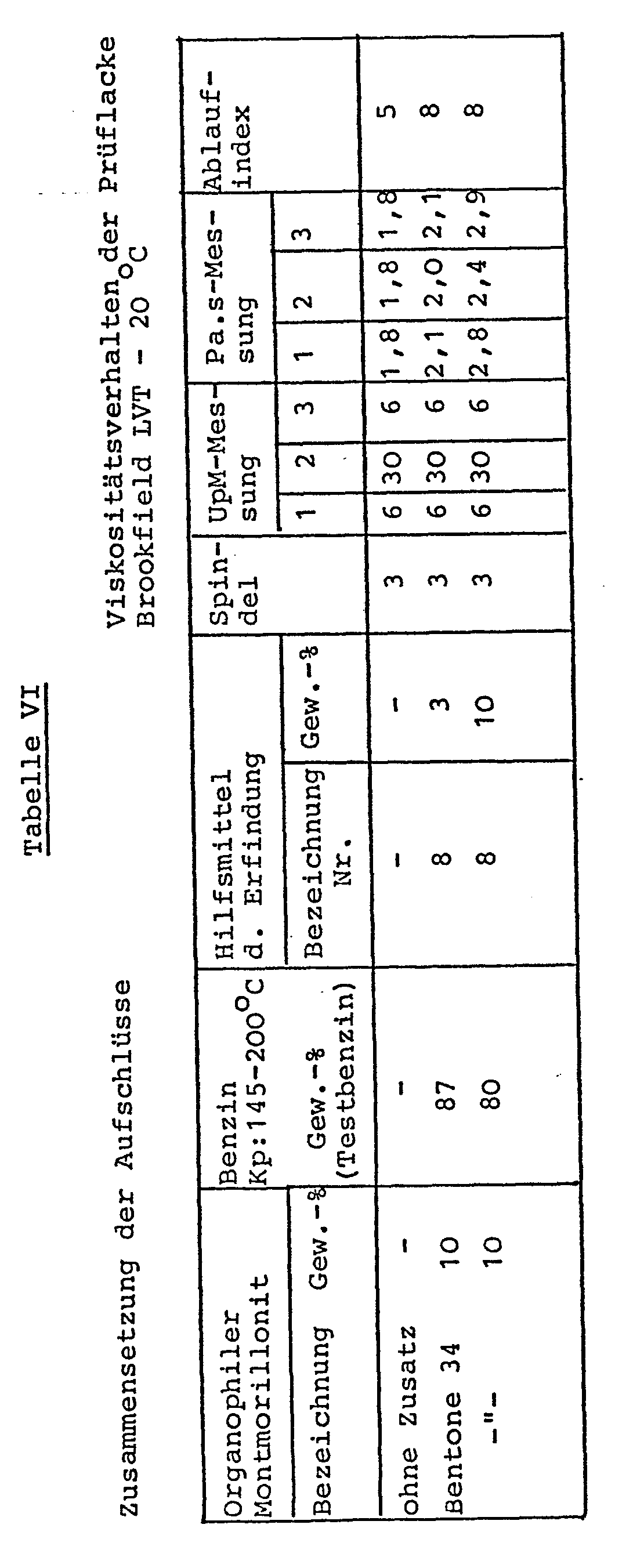
- Zur Beurteilung des erfindungsgemäßen Aufschlußmittels 8 werden in 521 GT aispergierter Mahlpaste (Kornfeinheit ca. 5 µm) 52 GT der ausgewählten Bentonepaste während 10 Minuten mit dem Dissolver eingearbeitet. Anschließend wird unter Berücksichtigung der mit der Betonepaste eingebrachten Lösemittelmenge aufgelackt. Die Beur- ßend wird mit 479 GT Auflacklösung versetzt. Die Beurteilung der so erhaltenen Lacksysteme erfolgt nach Lagerung über Nacht. Bestimmt werden dabei das Viskositätsverhalten (Brookfield-Viskosimeter, Typ LVT, Spindel 3). Es wird zunächst auf die möglichst kleinste Geschwindigkeit eingestellt. Der nach einer Minute abgelesene Wert wird als Viskositäterhöhung angenommen. Nun wird eine Minute bei der höchstmöglichen Geschwindigkeit geschert. Der nun erhaltene Wert- kann als Maß für den Thixotropieabbau gewertet werden. Unmittelbar darauf wird wieder auf die ursprünglich niedrige Geschwindigkeit eingestellt. Der nach einer Minute ablesbare Wert dient als Maß für den Viskositätsaufbau.
- Zur Bestimmung der Ablaufneigung des Anstrichmittels wird der Verlauf- und Ablaufprüfrakeltyp 419 der Fa. Erichsen GmbH & Co. (Hemer-Sundwig, BRD) eingesetzt. Mit der Ablaufrakel, die 10 Spalten von je 6,4 mm Breite und der Höhe von 75-100-125 usw. bis 300 µm enthält, werden auf einer Glasplatte 10 nebeneinander liegende Filmstreifen gezogen und die Platten daraufhin sofort senkrecht aufgestellt. Die Spalten oder auch die gezogenen Filmstreifen werden in der Reihenfolge der Höhe bzw. der Dicke numeriert von 1 bis 10, wobei der niedrigste Spalt mit 1 und der höchste mit 10 bezeichnet wird. Als Ablaufindex benutzt man die Nummern des Filmstreifens, bei dem gerade noch kein Verlaufen mit dem nachfolgenden Streifen erfolgt. Je kleiner dieser Index ist, desto schlechter ist der Ablaufwiderstand des geprüften Materials.
- Die ohne Zusatz und mit dem erfindungsgemäßen Zusatz gemäß Ziffer 8 erhaltenen Ergebnisse sind in der folgenden Tabelle VI zusammengefaßt.
Claims (8)
Priority Applications (1)
| Application Number | Priority Date | Filing Date | Title |
|---|---|---|---|
| AT82106813T ATE15383T1 (de) | 1981-08-05 | 1982-07-28 | Lackhilfsmittel. |
Applications Claiming Priority (2)
| Application Number | Priority Date | Filing Date | Title |
|---|---|---|---|
| DE19813131007 DE3131007A1 (de) | 1981-08-05 | 1981-08-05 | Lackhilfsmittel |
| DE3131007 | 1981-08-05 |
Publications (3)
| Publication Number | Publication Date |
|---|---|
| EP0071880A2 true EP0071880A2 (de) | 1983-02-16 |
| EP0071880A3 EP0071880A3 (en) | 1983-09-07 |
| EP0071880B1 EP0071880B1 (de) | 1985-09-04 |
Family
ID=6138657
Family Applications (1)
| Application Number | Title | Priority Date | Filing Date |
|---|---|---|---|
| EP82106813A Expired EP0071880B1 (de) | 1981-08-05 | 1982-07-28 | Lackhilfsmittel |
Country Status (5)
| Country | Link |
|---|---|
| EP (1) | EP0071880B1 (de) |
| JP (1) | JPS5837068A (de) |
| AT (1) | ATE15383T1 (de) |
| BR (1) | BR8204573A (de) |
| DE (2) | DE3131007A1 (de) |
Cited By (1)
| Publication number | Priority date | Publication date | Assignee | Title |
|---|---|---|---|---|
| US7139630B1 (en) | 2005-04-28 | 2006-11-21 | International Business Machines Corporation | Allocating manufactured devices according to customer specifications |
Family Cites Families (3)
| Publication number | Priority date | Publication date | Assignee | Title |
|---|---|---|---|---|
| US3687885A (en) * | 1970-04-15 | 1972-08-29 | Du Pont | Water base paints having an improved balance of anti-drip and leveling qualities |
| US4097437A (en) * | 1977-05-27 | 1978-06-27 | M & T Chemicals Inc. | Thixotropic aqueous coating composition of solubilized polymer with dispersion of quaternary ammonium clay in aliphatic hydrocarbon |
| GB1602187A (en) * | 1977-11-30 | 1981-11-11 | Nl Industries Inc | Method of increasing the viscosity of liquid organic systems and organophilic clay having enhanced dispersibility therein |
-
1981
- 1981-08-05 DE DE19813131007 patent/DE3131007A1/de not_active Withdrawn
-
1982
- 1982-07-28 DE DE8282106813T patent/DE3266037D1/de not_active Expired
- 1982-07-28 EP EP82106813A patent/EP0071880B1/de not_active Expired
- 1982-07-28 AT AT82106813T patent/ATE15383T1/de active
- 1982-08-04 BR BR8204573A patent/BR8204573A/pt unknown
- 1982-08-05 JP JP57137145A patent/JPS5837068A/ja active Granted
Cited By (2)
| Publication number | Priority date | Publication date | Assignee | Title |
|---|---|---|---|---|
| US7139630B1 (en) | 2005-04-28 | 2006-11-21 | International Business Machines Corporation | Allocating manufactured devices according to customer specifications |
| US7715937B2 (en) | 2005-04-28 | 2010-05-11 | International Business Machines Corporation | Allocating manufactured devices according to customer specifications |
Also Published As
| Publication number | Publication date |
|---|---|
| JPS5837068A (ja) | 1983-03-04 |
| JPH039152B2 (de) | 1991-02-07 |
| DE3131007A1 (de) | 1983-02-24 |
| EP0071880A3 (en) | 1983-09-07 |
| EP0071880B1 (de) | 1985-09-04 |
| BR8204573A (pt) | 1983-07-26 |
| ATE15383T1 (de) | 1985-09-15 |
| DE3266037D1 (en) | 1985-10-10 |
Similar Documents
| Publication | Publication Date | Title |
|---|---|---|
| EP0281124B1 (de) | Thixotrope Zubereitungen, Verwendung von Polycarbonsäureamiden zu ihrer Herstellung und mit Polycarbonsäureamiden beschichtetes Siliciumdioxid | |
| DE69208210T2 (de) | Organotonzusammensetzungen, hergestellt aus einer Mischung von zwei organischen Kationen sowie ihre Verwendung in nichtwässrigen Systemen | |
| DE3005057C2 (de) | ||
| AT395857B (de) | Mineraloelfreie zusammensetzungen zur befreiung festgesetzter bohrgestaenge | |
| WO1990009417A1 (de) | Oleophile basische aminverbindungen als additiv in invert-bohrspülschlämmen | |
| DE10039837A1 (de) | Verfahren zur Herstellung einer lagerstabilen, rheologisch wirksamen Harnstoffurethan-Lösung mit breiter Verträglichkeit | |
| DE2726036C3 (de) | Wäßrige Aluminiumpaste und ihre Verwendung zur Herstellung von leichtem Schaumbeton | |
| DE2746903A1 (de) | Oxalkylierte polyglycerine und daraus hergestellte schmiermittel auf wasserbasis | |
| DE60127209T2 (de) | Quaternäre fettsäure auf basis von anti-iso verbindungen | |
| DE69819283T2 (de) | Reduzierung der Oberflächenenergie mit alkylierten Polyaminen | |
| EP0718275B1 (de) | Quaternierte Triethanolaminfettsäureester | |
| DE69821084T2 (de) | Reduzierung der Oberflächenenergie mit hohen alkylierten Polyaminen | |
| EP0071880B1 (de) | Lackhilfsmittel | |
| DE10321536A1 (de) | Aminoalkohol-basierte Tenside mit geringer Oberflächenspannung und deren Verwendung | |
| DE3829840A1 (de) | Verdickungsmittel | |
| DE878833C (de) | Verfahren zur Herstellung von Schmierfetten | |
| EP1705172B1 (de) | Hydroxylgruppen enthaltende Tenside mit geringer Oberflächenspannung und deren Verwendung | |
| DE19615400C2 (de) | Schlicker und seine Verwendung zur Herstellung keramischer Grünkörper und keramischer Gegenstände | |
| EP0149139B1 (de) | Entschäumer für wässrige Dispersionen und Lösungen von Kunstharzen | |
| DE4008699C3 (de) | Tiefenwirksame Grundierung | |
| DE3242503C2 (de) | Mittel zur Abtrennung einer auf Wasser aufschwimmenden Ölschicht | |
| DE2248719A1 (de) | Poliermittel fuer oberflaechen von festen koerpern | |
| DE1100216B (de) | Schmierfett | |
| DE3100957C2 (de) | ||
| DE3208748A1 (de) | Epoxid-phosphorsaeure-addukte und verfahren zu deren herstellung |
Legal Events
| Date | Code | Title | Description |
|---|---|---|---|
| PUAI | Public reference made under article 153(3) epc to a published international application that has entered the european phase |
Free format text: ORIGINAL CODE: 0009012 |
|
| AK | Designated contracting states |
Designated state(s): AT BE CH DE FR GB IT LI LU NL SE |
|
| PUAL | Search report despatched |
Free format text: ORIGINAL CODE: 0009013 |
|
| AK | Designated contracting states |
Designated state(s): AT BE CH DE FR GB IT LI LU NL SE |
|
| 17P | Request for examination filed |
Effective date: 19830707 |
|
| ITF | It: translation for a ep patent filed | ||
| RBV | Designated contracting states (corrected) |
Designated state(s): AT BE CH DE FR GB IT LI NL |
|
| GRAA | (expected) grant |
Free format text: ORIGINAL CODE: 0009210 |
|
| AK | Designated contracting states |
Designated state(s): AT BE CH DE FR GB IT LI NL |
|
| REF | Corresponds to: |
Ref document number: 15383 Country of ref document: AT Date of ref document: 19850915 Kind code of ref document: T |
|
| REF | Corresponds to: |
Ref document number: 3266037 Country of ref document: DE Date of ref document: 19851010 |
|
| ET | Fr: translation filed | ||
| PLBE | No opposition filed within time limit |
Free format text: ORIGINAL CODE: 0009261 |
|
| STAA | Information on the status of an ep patent application or granted ep patent |
Free format text: STATUS: NO OPPOSITION FILED WITHIN TIME LIMIT |
|
| 26N | No opposition filed | ||
| ITTA | It: last paid annual fee | ||
| PGFP | Annual fee paid to national office [announced via postgrant information from national office to epo] |
Ref country code: CH Payment date: 19930609 Year of fee payment: 12 |
|
| PGFP | Annual fee paid to national office [announced via postgrant information from national office to epo] |
Ref country code: AT Payment date: 19930629 Year of fee payment: 12 |
|
| PG25 | Lapsed in a contracting state [announced via postgrant information from national office to epo] |
Ref country code: AT Effective date: 19940728 |
|
| PG25 | Lapsed in a contracting state [announced via postgrant information from national office to epo] |
Ref country code: LI Effective date: 19940731 Ref country code: CH Effective date: 19940731 |
|
| REG | Reference to a national code |
Ref country code: CH Ref legal event code: PL |
|
| PGFP | Annual fee paid to national office [announced via postgrant information from national office to epo] |
Ref country code: FR Payment date: 19960709 Year of fee payment: 15 |
|
| PGFP | Annual fee paid to national office [announced via postgrant information from national office to epo] |
Ref country code: GB Payment date: 19960719 Year of fee payment: 15 |
|
| PGFP | Annual fee paid to national office [announced via postgrant information from national office to epo] |
Ref country code: BE Payment date: 19960911 Year of fee payment: 15 |
|
| PG25 | Lapsed in a contracting state [announced via postgrant information from national office to epo] |
Ref country code: GB Free format text: LAPSE BECAUSE OF NON-PAYMENT OF DUE FEES Effective date: 19970728 |
|
| PG25 | Lapsed in a contracting state [announced via postgrant information from national office to epo] |
Ref country code: BE Free format text: LAPSE BECAUSE OF NON-PAYMENT OF DUE FEES Effective date: 19970731 |
|
| PGFP | Annual fee paid to national office [announced via postgrant information from national office to epo] |
Ref country code: NL Payment date: 19970731 Year of fee payment: 16 |
|
| PGFP | Annual fee paid to national office [announced via postgrant information from national office to epo] |
Ref country code: DE Payment date: 19970801 Year of fee payment: 16 |
|
| BERE | Be: lapsed |
Owner name: HENKEL K.G.A.A. Effective date: 19970731 |
|
| GBPC | Gb: european patent ceased through non-payment of renewal fee |
Effective date: 19970728 |
|
| PG25 | Lapsed in a contracting state [announced via postgrant information from national office to epo] |
Ref country code: FR Free format text: LAPSE BECAUSE OF NON-PAYMENT OF DUE FEES Effective date: 19980331 |
|
| REG | Reference to a national code |
Ref country code: FR Ref legal event code: ST |
|
| PG25 | Lapsed in a contracting state [announced via postgrant information from national office to epo] |
Ref country code: NL Free format text: LAPSE BECAUSE OF NON-PAYMENT OF DUE FEES Effective date: 19990201 |
|
| NLV4 | Nl: lapsed or anulled due to non-payment of the annual fee |
Effective date: 19990201 |
|
| PG25 | Lapsed in a contracting state [announced via postgrant information from national office to epo] |
Ref country code: DE Free format text: LAPSE BECAUSE OF NON-PAYMENT OF DUE FEES Effective date: 19990601 |