EP0071950A1 - Neue Heteroaryloxypropanolamine, Verfahren zu ihrer Herstellung und diese Verbindungen enthaltende Arzneimittel - Google Patents
Neue Heteroaryloxypropanolamine, Verfahren zu ihrer Herstellung und diese Verbindungen enthaltende Arzneimittel Download PDFInfo
- Publication number
- EP0071950A1 EP0071950A1 EP82106984A EP82106984A EP0071950A1 EP 0071950 A1 EP0071950 A1 EP 0071950A1 EP 82106984 A EP82106984 A EP 82106984A EP 82106984 A EP82106984 A EP 82106984A EP 0071950 A1 EP0071950 A1 EP 0071950A1
- Authority
- EP
- European Patent Office
- Prior art keywords
- general formula
- hydrogen
- lower alkyl
- compounds
- group
- Prior art date
- Legal status (The legal status is an assumption and is not a legal conclusion. Google has not performed a legal analysis and makes no representation as to the accuracy of the status listed.)
- Granted
Links
Classifications
-
- C—CHEMISTRY; METALLURGY
- C07—ORGANIC CHEMISTRY
- C07D—HETEROCYCLIC COMPOUNDS
- C07D285/00—Heterocyclic compounds containing rings having nitrogen and sulfur atoms as the only ring hetero atoms, not provided for by groups C07D275/00 - C07D283/00
- C07D285/01—Five-membered rings
- C07D285/02—Thiadiazoles; Hydrogenated thiadiazoles
- C07D285/14—Thiadiazoles; Hydrogenated thiadiazoles condensed with carbocyclic rings or ring systems
-
- A—HUMAN NECESSITIES
- A61—MEDICAL OR VETERINARY SCIENCE; HYGIENE
- A61P—SPECIFIC THERAPEUTIC ACTIVITY OF CHEMICAL COMPOUNDS OR MEDICINAL PREPARATIONS
- A61P9/00—Drugs for disorders of the cardiovascular system
- A61P9/04—Inotropic agents, i.e. stimulants of cardiac contraction; Drugs for heart failure
-
- C—CHEMISTRY; METALLURGY
- C07—ORGANIC CHEMISTRY
- C07D—HETEROCYCLIC COMPOUNDS
- C07D209/00—Heterocyclic compounds containing five-membered rings, condensed with other rings, with one nitrogen atom as the only ring hetero atom
- C07D209/02—Heterocyclic compounds containing five-membered rings, condensed with other rings, with one nitrogen atom as the only ring hetero atom condensed with one carbocyclic ring
- C07D209/04—Indoles; Hydrogenated indoles
- C07D209/08—Indoles; Hydrogenated indoles with only hydrogen atoms or radicals containing only hydrogen and carbon atoms, directly attached to carbon atoms of the hetero ring
-
- C—CHEMISTRY; METALLURGY
- C07—ORGANIC CHEMISTRY
- C07D—HETEROCYCLIC COMPOUNDS
- C07D209/00—Heterocyclic compounds containing five-membered rings, condensed with other rings, with one nitrogen atom as the only ring hetero atom
- C07D209/56—Ring systems containing three or more rings
- C07D209/80—[b, c]- or [b, d]-condensed
- C07D209/82—Carbazoles; Hydrogenated carbazoles
- C07D209/88—Carbazoles; Hydrogenated carbazoles with hetero atoms or with carbon atoms having three bonds to hetero atoms with at the most one bond to halogen, e.g. ester or nitrile radicals, directly attached to carbon atoms of the ring system
-
- C—CHEMISTRY; METALLURGY
- C07—ORGANIC CHEMISTRY
- C07D—HETEROCYCLIC COMPOUNDS
- C07D231/00—Heterocyclic compounds containing 1,2-diazole or hydrogenated 1,2-diazole rings
- C07D231/54—Heterocyclic compounds containing 1,2-diazole or hydrogenated 1,2-diazole rings condensed with carbocyclic rings or ring systems
- C07D231/56—Benzopyrazoles; Hydrogenated benzopyrazoles
-
- C—CHEMISTRY; METALLURGY
- C07—ORGANIC CHEMISTRY
- C07D—HETEROCYCLIC COMPOUNDS
- C07D235/00—Heterocyclic compounds containing 1,3-diazole or hydrogenated 1,3-diazole rings, condensed with other rings
- C07D235/02—Heterocyclic compounds containing 1,3-diazole or hydrogenated 1,3-diazole rings, condensed with other rings condensed with carbocyclic rings or ring systems
- C07D235/04—Benzimidazoles; Hydrogenated benzimidazoles
- C07D235/06—Benzimidazoles; Hydrogenated benzimidazoles with only hydrogen atoms, hydrocarbon or substituted hydrocarbon radicals, directly attached in position 2
-
- C—CHEMISTRY; METALLURGY
- C07—ORGANIC CHEMISTRY
- C07D—HETEROCYCLIC COMPOUNDS
- C07D235/00—Heterocyclic compounds containing 1,3-diazole or hydrogenated 1,3-diazole rings, condensed with other rings
- C07D235/02—Heterocyclic compounds containing 1,3-diazole or hydrogenated 1,3-diazole rings, condensed with other rings condensed with carbocyclic rings or ring systems
- C07D235/04—Benzimidazoles; Hydrogenated benzimidazoles
- C07D235/06—Benzimidazoles; Hydrogenated benzimidazoles with only hydrogen atoms, hydrocarbon or substituted hydrocarbon radicals, directly attached in position 2
- C07D235/08—Radicals containing only hydrogen and carbon atoms
-
- C—CHEMISTRY; METALLURGY
- C07—ORGANIC CHEMISTRY
- C07D—HETEROCYCLIC COMPOUNDS
- C07D235/00—Heterocyclic compounds containing 1,3-diazole or hydrogenated 1,3-diazole rings, condensed with other rings
- C07D235/02—Heterocyclic compounds containing 1,3-diazole or hydrogenated 1,3-diazole rings, condensed with other rings condensed with carbocyclic rings or ring systems
- C07D235/04—Benzimidazoles; Hydrogenated benzimidazoles
- C07D235/24—Benzimidazoles; Hydrogenated benzimidazoles with hetero atoms or with carbon atoms having three bonds to hetero atoms with at the most one bond to halogen, e.g. ester or nitrile radicals, directly attached in position 2
- C07D235/26—Oxygen atoms
-
- C—CHEMISTRY; METALLURGY
- C07—ORGANIC CHEMISTRY
- C07D—HETEROCYCLIC COMPOUNDS
- C07D241/00—Heterocyclic compounds containing 1,4-diazine or hydrogenated 1,4-diazine rings
- C07D241/36—Heterocyclic compounds containing 1,4-diazine or hydrogenated 1,4-diazine rings condensed with carbocyclic rings or ring systems
- C07D241/38—Heterocyclic compounds containing 1,4-diazine or hydrogenated 1,4-diazine rings condensed with carbocyclic rings or ring systems with only hydrogen or carbon atoms directly attached to the ring nitrogen atoms
- C07D241/40—Benzopyrazines
- C07D241/42—Benzopyrazines with only hydrogen atoms, hydrocarbon or substituted hydrocarbon radicals, directly attached to carbon atoms of the hetero ring
-
- C—CHEMISTRY; METALLURGY
- C07—ORGANIC CHEMISTRY
- C07D—HETEROCYCLIC COMPOUNDS
- C07D249/00—Heterocyclic compounds containing five-membered rings having three nitrogen atoms as the only ring hetero atoms
- C07D249/16—Heterocyclic compounds containing five-membered rings having three nitrogen atoms as the only ring hetero atoms condensed with carbocyclic rings or ring systems
- C07D249/18—Benzotriazoles
Definitions
- the present invention relates to heteroaryloxypropanolamines of the general formula I, processes for their preparation and medicaments for combating and prophylaxis of cardiovascular diseases which contain these compounds.
- the invention furthermore relates to the optically active forms and racemic mixtures of these compounds.
- the general formula I applies to bi- and tricyclic heteroaromatic radicals A, for example indole, indolizine, isoindole, benzotriazole, indazole, purine, quinolizine, isoquinoline, quinoline, quinoxaline, quinazoline, cinnoline, carboline, carbazole, acridine, benzothiadiazole , Phenazine, benzimidazole, preferably indole, benzimidazole, indazole, benzotriazole, carbazole, as a partially hydrogenated heteroaromatic radical, for example indoline, isoindoline, pyrroline, imidazoline, preferably indoline.
- A for example indole, indolizine, isoindole, benzotriazole, indazole, purine, quinolizine, isoquinoline, quinoline, quinoxaline, quinazoline,
- a lower alkyl group of the radicals R 1 , R 2 , R 3 , R 4 , R 5 , R 6 , R 7 or R 8 or the lower alkyl part of lower alkanoyl, lower alkoxycarbonyl, lower alkoxy and lower alkyl mercapto includes straight-chain or branched groups from 1 to 6, preferably 1 to 4 carbon atoms to understand, such as methyl, ethyl, propyl, isopropyl, butyl, isobutyl, sec. Butyl, tert. Butyl, n-pentyl or n-hexyl. Methyl and ethyl are particularly preferred.
- alkylene chain of the radical X is to be understood as straight-chain or branched chains with 2 to 6, preferably 2 to 4, carbon atoms.
- the ethylene and trimethylene groups are particularly preferred.
- Halogen in the context of the invention means fluorine, chlorine, bromine and iodine, in particular fluorine, chlorine and bromine.
- Reactions according to process a) are generally carried out without solvent by melting the reactants and subsequent reaction at room temperature.
- solvents such as dimethylformamide, alcohols, e.g. Ethanol or glycol ethers work.
- the reaction temperatures are then between 20 and 80 ° C.
- the reactions according to process b) are carried out under generally customary alkylation conditions.
- the reactive group in compounds of the general formula IV preferably denotes a halogen radical or a sulfonic acid ester.
- the alkylations are usually carried out in polar solvents such as e.g. Dimethylformamid or Dimethylsulfoxyd carried out.
- the reaction of an amine of the general formula VI with an aldehyde of the general formula VII with elimination of water is usually carried out in toluene as a solvent with acid catalysis, p-toluenesulfonic acid being used in particular.
- the water formed in the reaction is distilled off azeotropically.
- the reduction of the Schiff base to compounds of the general formula I is generally carried out by catalytic hydrogenation in the presence of noble metal catalysts such as palladium or platinum.
- noble metal catalysts such as palladium or platinum.
- the reduction can also be carried out with complex hydrides such as lithium aluminum hydride.
- the compounds of general formula VIII used in process d) are prepared under the same reaction conditions as in process a).
- the intermediates thus obtained are then reduced by catalytic hydrogenation.
- Precious metal catalysts such as palladium or platinum, are used here in particular.
- the compound of the general formula I is a quinoxalinone derivative
- the corresponding phenylenediamine is reacted with acetylenedicarboxylic acid in water at a temperature of 40-100 ° C.
- the resulting isomers are separated by fractional crystallization or column chromatography on silica gel.
- the compound of the general formula I is a benzotriazole derivative
- the corresponding phenylenediamine derivative is reacted with sodium nitrite in aqueous acetic acid at 0-30 ° C.
- the reaction can, however, also be carried out using a lower alkyl salt nitrate in an organic solvent.
- the compound of general formula I is a benzimidazole derivative
- the corresponding phenylenediamine is allowed to react with formic acid or acetic acid.
- the reaction is usually carried out under reflux conditions.
- the compound of the general formula I is a benzimidazolinone derivative
- the corresponding phenylenediamine derivative is reacted with a carbonic acid derivative, such as, for example, diethyl carbonate, diphenyl carbonate, urea or phosgene.
- the solvent used can be, for example, dimethylformamide, toluene or water at temperatures of 20-110 ° C.
- the hydrogenation of the corresponding compound of the general formula VIII is carried out under acidic conditions, for example in the presence of acetic acid made, at the same time a ring closure occurs to the desired indole derivative.
- the splitting off of protective groups takes place according to methods which are in themselves conventional.
- the benzyl protecting group is used in the presence of noble metal catalysts, e.g. Palladium or platinum hydrogenated.
- the tetrahydropyranyl or acyl protecting group is split off under acidic conditions.
- Mineral acids such as e.g. Hydrochloric acid or sulfuric acid, but also Lewis acids, e.g. Boron trifluoride.
- a subsequent conversion of a compound of the general formula I into other compounds of the general formula I is, for example, the reduction of a nitroin, the amino group or a carboxylic acid ester residue into the hydroxymethyl residue.
- the reduction can be carried out according to generally known methods, e.g. by catalytic hydrogenation in the presence of noble metal catalysts such as palladium or platinum or with complex metal hydrides such as lithium aluminum hydride in an aprotic solvent such as e.g. Diethyl ether or tetrahydrofuran.
- the compounds of formula I according to the invention can be obtained in the form of a racemic mixture.
- the racemate is separated into the optically active forms by methods known per se via the diastereomeric salts of active acids, e.g. Tartaric acid, malic acid or camphor sulfonic acid.
- the new compounds of general formula I are obtained under the reaction conditions of the processes described predominantly as acid addition salts, e.g. as hydrochlorides, and can be easily converted into the free bases according to the methods described.
- the compounds of the general formula I are added, preferably in an organic solvent, with the equivalent amount of an inorganic or organic acid, e.g. Hydrochloric acid, hydrobromic acid, phosphoric acid, sulfuric acid, acetic acid, citric acid, maleic acid.
- an inorganic or organic acid e.g. Hydrochloric acid, hydrobromic acid, phosphoric acid, sulfuric acid, acetic acid, citric acid, maleic acid.
- the substances I are mixed in a manner known per se with suitable pharmaceutical carrier substances, flavorings, flavors and colors and shaped, for example, as tablets or dragées or with the addition of appropriate auxiliaries in water or oil, such as e.g. Olive oil, suspended or dissolved.
- novel substances I and their salts according to the invention can be administered enterally or parenterally in liquid or solid form.
- Water is preferably used as the injection medium, which contains the additives which are customary in injection solutions, such as stabilizing agents, solubilizers or buffers.
- additives are, for example, tartrate and citrate buffers, ethanol, complexing agents (such as ethylenediaminetetraacetic acid and its non-toxic salts), high molecular weight polymers (such as liquid polyethylene oxide) for viscosity regulation.
- Solid carrier substances are, for example, starch, lactose, mannitol, methyl cellulose, talc, highly disperse silica, high molecular weight fatty acids (such as stearic acid), gelatin, agar agar, Calcium phosphate, magnesium stearate, animal and vegetable fats and solid high-molecular polymers (such as polyethylene glycols).
- Preparations suitable for oral administration can optionally contain flavorings and sweeteners.
- the dose to be used in humans depends on the age, weight and general condition of the patient, the severity of the disease, the nature of other treatments at the same time, the frequency of ingestion and the nature of the intended effect.
- the daily dose of the active substance is usually 0.1 to 50 mg per / kg body weight. Normally 0.5 to 40 mg, preferably 10 to 20 mg / kg / day in one or more single doses should be sufficient to achieve the desired improvement.
- the starting compound used is made from 2-benzyl-4- (2,3-epoxypropoxy) -indazole by reaction with N-methyl-2- (2,6-dimethylphenylamino) ethylamine (b.p. 0th 05 93-95 ° C, benzoate mp. 145-146 ° C), 22 hours 70 ° C with 76% of theory Th. Obtained as a brownish oil.
- Th. Benzoate: colorless crystals, mp 162-163 ° C (ethyl acetate), by reacting 4- (2,3-epoxypropoxy) carbazole with 2- (2,6-dimethylphenylamino) ethylamine.
- Tablets with 10 mg each of 1- (indazol-4-yloxy) -3- [2- (2,6-dimethyl-phenylamino) ethylamino] propan-2-ol were prepared according to the following recipe: The above compound was finely pulverized and mixed with lactose and starch. The mixture was granulated in a conventional manner. Magnesium stearate was added to the granules and the mixture was compressed into 1000 tablets with an individual weight of o.12 g.
Landscapes
- Chemical & Material Sciences (AREA)
- Organic Chemistry (AREA)
- Health & Medical Sciences (AREA)
- Engineering & Computer Science (AREA)
- Bioinformatics & Cheminformatics (AREA)
- Cardiology (AREA)
- Pharmacology & Pharmacy (AREA)
- General Health & Medical Sciences (AREA)
- General Chemical & Material Sciences (AREA)
- Medicinal Chemistry (AREA)
- Nuclear Medicine, Radiotherapy & Molecular Imaging (AREA)
- Heart & Thoracic Surgery (AREA)
- Hospice & Palliative Care (AREA)
- Life Sciences & Earth Sciences (AREA)
- Animal Behavior & Ethology (AREA)
- Chemical Kinetics & Catalysis (AREA)
- Public Health (AREA)
- Veterinary Medicine (AREA)
- Pharmaceuticals Containing Other Organic And Inorganic Compounds (AREA)
- Plural Heterocyclic Compounds (AREA)
- Indole Compounds (AREA)
- Nitrogen- Or Sulfur-Containing Heterocyclic Ring Compounds With Rings Of Six Or More Members (AREA)
- Saccharide Compounds (AREA)
- Nitrogen And Oxygen Or Sulfur-Condensed Heterocyclic Ring Systems (AREA)
- Organic Low-Molecular-Weight Compounds And Preparation Thereof (AREA)
- Acyclic And Carbocyclic Compounds In Medicinal Compositions (AREA)
Abstract
Description
- Die vorliegende Erfindung betrifft Heteroaryloxypropanolamine der allgemeinen Formel I, Verfahren zu ihrer Herstellung sowie Arzneimittel zur Bekaempfung und Prophylaxe von Herz- und Kreislauferkrankungen, die diese Verbindungen enthalten.
- Gegenueber aehnlichen Verbindungen, wie sie in den deutschen Offenlegungsschriften 2 819 629 und 2 844 497 beansprucht sind, kann mit den Verbindungen der Formel I eine ueberraschende Wirkungsverbesserung erzielt werden.
- Gegenstand der Erfindung sind daher neue Heteroaryloxypropanolamine der allgemeinen Formel I

- A einen bi- oder tricyclischen heteroaromatischen Rest, der gegebenenfalls teilweise hydriert ist,
- X eine geradkettige oder verzweigte Alkylenkette mit 2 bis 6 Kohlenstoffatomen,
- R1, R2 gleich oder verschieden sein koennen und Wasserstoff, Niederalkyl oder Benzyl, R3, R4, R5 gleich oder verschieden sein können und Wasserstoff, Niederalkyl, Benzyl, Formyl, Niederalkanoyl, Cyan, Hydroxymethyl, Niederalkoxycarbonyl, Carbamoyl und die zweibindigen Substituenten Sauerstoff oder Schwefel,
- R61 R7, R8 gleich oder verschieden sein können und Wasserstoff, Halogen, Niederalkyl, Nitro, Amino, Niederalkylmercapto, Niederalkoxy, oder R6 und R7 gemeinsam eine gegebenenfalls ungesättigte Trimethylenkette
- Da diese Verbindungen der Formel I asymmetrische Kohlenstoffatome besitzen, sind ferner Gegenstand der Erfindung die optisch aktiven Formen und racemischen Gemische dieser Verbindungen.
- Im Sinne der Anmeldung gelten in der allgemeinen Formel I als bi- und tricyclische heteroaromatische Reste A beispielsweise Indol, Indolizin, Isoindol, Benztriazol, Indazol, Purin, Chinolizin, Isochinolin, Chinolin, Chinoxalin, Chinazolin, Cinnolin, Carbolin, Carbazol, Acridin,Benzthiadiazol, Phenazin, Benzimidazol, vorzugsweise Indol, Benzimidazol, Indazol, Benztriazol, Carbazol, als teilweise hydrierter heteroaromatischer Rest beispielsweise Indolin, Isoindolin, Pyrrolin, Imidazolin, vorzugsweise Indolin.
- Die unterbrochenen Linien zwischen den Resten R3, R4, und R5 einerseits und dem Ring A der allgemeinen Formeln, I, II, IV und VI andererseits bedeuten jeweils die zweite Bindung, wenn R3, R4 oder R5 einen der zweibindigen Substituenten Sauerstoff oder Schwefel darstellen.
- Unter einer Niederalkylgruppe der Reste R1, R2, R3, R4, R5, R6, R7, oder R8 oder dem Niederalkylteil von Niederalkanoyl, Niederalkoxycarbonyl, Niederalkoxy und Niederalkylmercapto sind geradkettige oder verzweigte Gruppen von 1 bis 6, vorzugsweise 1 bis 4 Kohlenstoffatomen zu verstehen, wie zum Beispiel Methyl, Ethyl, Propyl, Isopropyl, Butyl, Isobutyl, sek. Butyl, tert. Butyl, n-Pentyl oder n-Hexyl. Besonders bevorzugt sind Methyl und Ethyl.
- Unter einer Alkylenkette des Restes X sind geradkettige oder verzweigte Ketten mit 2 bis 6, vorzugsweise 2 bis 4 Kohlenstoffatomen zu verstehen. Besonders bevorzugt sind die Ethylen- und die Trimethylengruppe.
- Unter Halogen wird im Sinne der Erfindung Fluor, Chlor, Brom und Jod verstanden, insbesondere Fluor, Chlor und Brom.
- Ein weiterer Gegenstand der Erfindung sind Verfahren zur Herstellung von Verbindungen der allgemeinen Formel I. Die Verbindungen werden erhalten, indem man in an sich bekannter Weise entweder
- a) eine Verbindung der allgemeinen Formel II


- b) eine Verbindung der allgemeinen Formel IV


- c) im Falle dass in der allgemeinen Formel I R1 ein Wasserstoffatom und X eine Ethylen- oder Propylengruppe bedeutet, eine Verbindung der allgemeinen Formel VI


- d) eine Verbindung der allgemeinen Formel VIII

- Reaktionen nach Verfahren a) werden in der Regel ohne Loesungsmittel durch Schmelzen der Reaktionspartner und anschließende Umsetzung bei Zimmertemperatur durchgefuehrt. Man kann jedoch auch in Loesungsmitteln wie Dimethylformamid, Alkoholen, wie z.B. Ethanol oder Glykolethern arbeiten. Die Reaktionstemperaturen liegen dann bei 20 - 80°C.
- Die Umsetzungen nach Verfahren b) werden unter allgemein ueblichen Bedingungen einer Alkylierung durchgefuehrt. Die reaktive Gruppe bei Verbindungen der allgemeinen Formel IV bedeutet bevorzugt einen Halogenrest oder einen Sulfonsaeureester. Die Alkylierungen werden in der Regel in polaren Loesungsmitteln wie z.B. Dimethylformamid oder Dimethylsulfoxyd durchgefuehrt.
- Die Reaktion eines Amins der allgemeinen Formel VI mit einem Aldehyd der allgemeinen Formel VII unter Wasserabspaltung wird ueblicherwiese in Toluol als Loesungsmittel unter Saeurekatalyse durchgefuehrt, wobei insbesondere p-Toluolsulfonsaeure Verwendung findet. Das bei der Reaktion entstehende Wasser wird azeotrop abdestilliert. Die Reduktion der Schiffschen Base zu Verbindungen der allgemeinen Formel I fuehrt man in der Regel durch katalytische Hydrierung in Gegenwart von Edelmetallkatalysatoren wie Palladium oder Platin durch. Man kann. die Reduktion jedoch auch mit komplexen Hydriden wie Lithiumaluminiumhydrid ausfuehren.
- Die bei Verfahren d) verwendeten Verbindungen der allgemeinen Formel VIII werden unter denselben Reaktionsbedingungen wie bei Verfahren a) hergestellt. Die so erhaltenen Zwischenprodukte werden dann durch katalytische Hydrierung reduziert. Hierbei finden vorallem Edelmetallkatalysatoren, wie z.B. Palladium oder Platin Verwendung. Fuer den Fall, daß es sich bei der Verbindung der allgemeinen Formel I um ein Chinoxalinonderivat handelt, wird das entsprechende Phenylendiamin mit Acetylendicarbonsaeure in Wasser bei einer Temperatur von 40-100°C zur Reaktion gebracht. Die entstandenen Isomeren werden durch fraktionierte Kristallisation oder saeulenchromatographisch an Kieselgel getrennt. Fuer den Fall, daß es sich bei der Verbindung der allgemeinen Formel I um ein Benzotriazolderivat handelt, setzt man das entsprechende Phenylendiaminderivat mit Natriumnitrit in waessriger Essigsaeure bei 0-30°C um. Die Reaktion kann jedoch auch mit einem Niederalkylsalpetrigsaeureester in einem organischen Loesungsmittel durchgefuehrt werden. Fuer den Fall, daß es sich bei der Verbindung der allgemeinen Formel I um ein Benzimidazolderivat handelt, laeßt man das entsprechende Phenylendiamin mit Ameisensaeure oder Essigsaeure reagieren. Die Umsetzung wird in der Regel unter Rueckflußbedingungen durchgefuehrt. Fuer den Fall, daß es sich bei der Verbindung der allgemeinen Formel I um ein Benzimidazolinonderivat handelt, wird das entsprechende Phenylendiaminderivat mit einem Kohlesaeurederivat, wie z.B. Diethylcarbonat, Diphenylcarbonat, Harnstoff oder Phosgen umgesetzt. Als Loesungsmittel kann man z.B. Dimethylformamid, Toluol oder auch Wasser bei Temperaturen von 20-110°C verwenden. Fuer den Fall, daß es sich bei der Verbindung der allgemeinen Formel I um ein Indolderivat handelt, wird die Hydrierung der entsprechenden Verbindung der allgemeinen Formel VIII unter sauren Bedingungen, z.B. in Gegenwart von Essigsaeure vorgenommen, wobei gleichzeitig ein Ringschluß zum gewuenschten Indolderivat eintritt.
- Die gegebenenfalls erforderliche Abspaltung von Schutzgruppen geschieht nach an sich ueblichen Methoden. Die Benzylschutzgruppe wird in Gegenwart von Edelmetallkatalysatoren, wie z.B. Palladium oder Platin abhydriert. Die Tetrahydropyranyl- bzw. Acylschutzgruppe wird unter sauren Bedingungen abgespalten. Hierzu eignen sich Mineralsaeuren wie z.B. Salzsaeure oder Schwefelsaeure,aber auch Lewis-Saeuren, wie z.B. Bortrifluorid.
- Als nachtraegliche Umwandlung einer Verbindung der allgemeinen Formel I in andere Verbindungen der allgemeinen Formel I kommt beispielsweise die Reduktion einer Nitroin die Aminogruppe oder eines Carbonsaeureesterrestes in den Hydroxymethylrest infrage. Die Reduktion kann nach allgemein bekannten Methoden durchgefuehrt werden, z.B. durch katalytische Hydrierung in Gegenwart von Edelmetallkatalysatoren wie Palladium oder Platin oder mit komplexen Metallhydriden wie Lithiumaluminiumhydrid in einem aprotischen Loesungsmittel wie z.B. Diethylether oder Tetrahydrofuran.
- Die erfindungsgemaessen Verbindungen der Formel I koennen in Form eines racemischen Gemisches anfallen. Die Trennung des Racemats in die optisch aktiven Formen geschieht nach an sich bekannten Methoden ueber die diastereomeren Salze aktiver Saeuren, wie z.B. Weinsaeure, Aepfelsaeure oder Camphersulfonsaeure.
- Die neuen Verbindungen der allgemeinen Formel I fallen unter den Reaktionsbedingungen der beschriebenen Verfahren vorwiegend als Saeureadditionssalze an, z.B. als Hydrochloride, und koennen nach beschriebenen Methoden ohne weiteres in die freien Basen uebergefuehrt werden.
- Zur Uberfuehrung der Verbindungen der allgemeinen Formel I in ihre pharmakologisch unbedenklichen Salze setzt man diese, vorzugsweise in einem organischen Loesungsmittel, mit der aequivalenten Menge einer anorganischen oder organischen Saeure, z.B. Salzsaeure, Bromwasserstoffsaeure, Phosphorsaeure, Schwefelsaeure, Essigsaeure, Citronensaeure, Maleinsaeure um.
- Zur Herstellung von Arzneimitteln werden die Substanzen I in an sich bekannter Weise mit geeigneten pharmazeutischen Traegersubstanzen, Aroma-, Geschmacks- und Farbstoffen gemischt und beispielsweise als Tabletten oder Dragees ausgeformt oder unter Zugabe entsprechender Hilfsstoffe in Wasser oder Oel, wie z.B. Olivenoel, suspendiert oder geloest.
- Die erfindungsgemaessen neuen Substanzen I und ihre Salze koennen in fluessiger oder fester Form enteral oder parenteral appliziert werden. Als Injektionsmedium kommt vorzugsweise Wasser zur Anwendung, welches die bei Injektionsloesungen ueblichen Zusaetze wie Stabilisierungsmittel, Loesungsvermittler oder Puffer enthaelt. Derartige Zusaetze sind z.B. Tartrat- und Citratpuffer, Ethanol,Komplexbildner (wie Ethylendiamintetraessigsaeure und deren nichttoxische Salze), hochmolekulare Polymere (wie fluessiges Polyethylenoxyd) zur Viskositaetsregulierung. Feste Traegerstoffe .sind z.B. Staerke, Lactose, Mannit, Methylcellulose, Talkum, hochdisperse Kieselsaeuren, hochmolekulare Fettsaeuren (wie Stearinsaeure), Gelatine, Agar-Agar, Calciumphosphat, Magnesiumstearat, tierische und pflanzliche Fette und feste hochmolekulare Polymere (wie Polyethylenglykole). Fuer orale Applikation geeignete Zubereitungen koennen gewuenschtenfalls Geschmacks-und Sueßstoffe enthalten.
- Die beim Menschen anzuwendende Dosis hängt ab von Alter, Gewicht und Allgemeinbefinden des Patienten, der Schwere der Erkrankung, der Natur gleichzeitiger sonstiger Behandlungen, der Einnahme-Häufigkeit und der Natur der beabsichtigten Wirkung. Gewöhnlich beträgt die Tagesdosis der aktiven Substanz o.1 bis 5o mg pro /kg Körpergewicht. Normalerweise sollten 0.5 bis 4o mg, vorzugsweise 1.o bis 2o mg/kg/Tag in einer oder mehreren Einzeldosen ausreichen, um die gewünschte Besserung zu erreichen.
- Bevorzugt im Sinne der vorliegenden Anmeldung sind außer den in den Beispielen genannten Verbindungen die folgenden:
- 1-(6-Hydroxymethylindol-4-yloxy)-3-[2-(2.6-dimethyl- phenylamino)-ethylamino]-propan-2-ol
- 1-(6-Methoxycarbonylindol-4-yloxy)-3-[2-(2.6-dimethyl- phenylamino)-ethylamino]-propan-2-ol
- 1-(2-Cyanindol-4-yloxy)-3-[2-(2.6-dimethylphenylamino)-ethylamino]-propan-2-ol
- 1-(Indazol-4-yloxy)-3-[2-(2.6-dichlorphenylamino)-ethyl- amino-]propan-2-ol
- 1-(Indazol-7-yloxy)-3-[2-(2.6-dimethylphenylamino)-ethylamino]-propan-2-ol
- 1-(6-Methylindazol-4-yloxy)-3-[2-(2.6-dimethylphenyl- amino)-ethylamino]-propan-2-ol
- 1-(2-Methylbenzimidazol-4-yloxy)-3-[2-(2.6-dimethyl- phenylamino)-ethylamino]-propan-2-ol
- 1-(7-Methylbenzimidazol-4-yloxy)-3-[2-(2.6-dimethyl- phenylamino)-ethylamino]-propan-2-ol
- 1-(1.3-Dimethyl-benzimidazolin-2-on-4-yloxy)-3-[2-(2.6-dimethylphenylamino)-ethylamino]-propan-2-ol
- 1-(7-Methylbenzotriazol-4-yloxy)-3-[2-(2.6-dimethyl- phenylamino)-ethylamino]-propan-2-ol
- Die Erfindung wird durch die folgenden Beispiele naeher erlaeutert.
- 6.8 g 1-(2-Benzylindazol-4-yloxy)-3-[2-(2.6-dimethylphenyl- amino)ethylamino]propan-2-ol werden in 100 ml Methanol und 10 ml conc. Salzsaeure ueber 0.9 g 10proz. Palladium-Kohle hydriert. Nach Absaugen wird eingeengt, in Wasser geloest, mit Natronlauge alkalisch gestellt und mit Methylenchlorid extrahiert. Die organische Phase wird eingeengt, mit Ether verrieben und abgesaugt. Nach Umkristallisieren aus Essigester erhaelt man 3.9 g der Titelverbindung vom Schmp. 127-128°C (72 % d.Th.).
- Das 1-(2-Benzylindazol-4-yloxy)-3-[2-(2.6-dimethylphenylamino)-ethylamino]propan-2-ol wird auf folgende Weise hergestellt:
- 6.2 g 2-Benzyl-4-(2.3-epoxypropoxy)indazol und 7.2 g 2-(2.6-Dimethylphenylamino)ethylamin werden 20 Stunden bei 70°C geruehrt. Man loest in Methylenchlorid und reinigt chromatographisch ueber eine Kieselgelsaeule mit dem Laufmittel Methylenchlorid/Methanol (ammoniakgesättigt) 20:1. Nach dem Eindampfen werden 6.8 g als viskoses Oel erhalten (69 % d.Th.).
- In analoger Weise wie fuer Beispiel 1 angegeben erhaelt man 1-(Indazol-4-yloxy)-3-[N-methyl-2-(2.6-dimethyl-phenylamino)-ethylamino]-propan-2-ol
- 39 % d. Th. farblose Kristalle, Fp. 120-121°C (Propanol-2) aus 1-(2-Benzylindazol-4-yloxy)-3-[N-methyl-2-(2.6-dimethyl- phenylamino)-ethylamino]propan-2-ol durch Hydrogenolyse der Benzylgruppe.
- Die verwendete Ausgangsverbindung wird aus 2-Benzyl-4-(2.3-epoxypropoxy)-indazol durch Umsetzung mit N-Methyl-2-(2.6-dimethylphenylamino)-ethylamin (Kp 0.05 93-95°C, Benzoat Fp. 145-146°C), 22 Stunden 70°C mit 76 % d. Th. als braeunliches Oel erhalten.
- 52 % d. Th., Benzoat: farblose Kristalle, Fp. 162-163°C (Essigester), durch Umsetzung von 4-(2.3-Epoxypropoxy)-carbazol mit 2-(2.6-Dimethylphenylamino)-ethylamin.
- 4,7 g 1-(Indol-4-yloxy)-2.3-epoxypropan werden in 100 ml Methanol und 8.2 g 2-(2.6-Dimethylphenylamino)ethylamin geloest und 4 d bei Raumtemperatur stehen lassen. Nach Entfernen des Loesungsmittels nimmt man in Wasser und Essigester auf, versetzt mit C02 und saugt die Kristalle ab. Es verbleiben nach Trocknen 5,0 g der Titelverbindung vom Schmp. 99-110°C (50 % d.Th.).
- In analoger Weise, wie in Beispiel 2 beschrieben, erhaelt man:


- Zu einer Suspension von 1,2 g Lithiumaluminiumhydrid in 50 ml abs. Tetrahydrofuran tropft man eine Loesung von 2,7 g 1-(2-Ethoxycarbonylindol-4-yloxy)-3-[2-(2.6-dimethylphenylamino)-ethylamino]propan-2-ol (s. Beisp. 2 c) in 25 ml abs. Tetrahydrofuran, ruehrt 3 h bei Raumtemperatur nach, zersetzt unter Kuehlung mit Natriumchlorid-Loesung, filtriert und engt im Vaccum ein. Die Rohbase wird in Propanol-2 gelöst, mit der berechneten Menge N-Cyclohexylsulfaminsäure versetzt und vom ausgefallenen Salz abgesaugt. Nach Umkristallisieren aus Methanol/Essigester erhält man 1,5 g der Titelverbindung vom Schmp. 98°C (42% d.Th.).
- o 11,3 g [2-(2.3-Epoxypropxy)-6-nitrophenyl]essigsaeure- ethylester (P 29058762) und 13,1 g 2-(2.6-Dimethylphenylamino)ethylamin (0,08 mol)werden in 100 ml Methanol 2 d bei Raumtemperatur stehen gelassen. Dann gibt man 100 ml Essigsaeure und 1 g 10proz. Palladiumkohle zu und hydriert bei 1 bar Wasserstoffdruck. Nach Absaugen des Katalysators wird im Vakuum abdestilliert und der verbleibende Rueckstand in Wasser geloest. Durch Zugabe von Kaliumcarbonatloesung wird die Base ausgefaellt und mit Essigester extrahiert. Nach Trocknen ueber Natriumsulfat und Einengen der organischen Phase verbleiben 7,2 g Rohprodukt. Durch Loesen in Propanol-2 und Zugabe der berechneten Menge Benzoesaeure erhaelt man 4,3 g der Titelverbindung vom Schmp.191°C, (21 % d.Th.).
- Eine Loesung von 21,5 g 2,3-Diamino-1-<2-hydroxy-3-[2-(2.6-dimethylphenylamino]ethylamino]propoxy>benzol-trihydrochlorid in 150 ml Ameisensaeure wird 6 Stunden unter Rueckfluss gekocht. Nach Einengen in vacuo wird der Rueckstand in 200 ml 2 N Salzsaeure aufgenommen, 4 Stunden unter Rueckfluss gekocht, mit Aktivkohle versetzt und heiss filtriert. Das Filtrat wird zur Trockene eingeengt und der Rueckstand aus umkristallisiert. Ausbeute: 3,5 g (17,4% d.Th.), Fp. 128-131°C
- Analog zum vorangehenden Beispiel erhaelt man durch Reaktion von 3-Amino-2-methylamino-1-(2-hydroxy-3-[2-(2.6-dimethyl- phenylamino)-ethylamino]propoxy)benzol -trihydrochlorid mit Ameisensaeure die Titelverbindung. Ausbeute: 2,1 g ( 14 % d.Th)., Fp.94-96°C. (Ethanol/Ether)
- In eine Loesung von 21,5 g 2,3-Diamino-1-<2-hydroxy-3-[2(2.6-dimethylphenylamino)ethylamino]propoxy>benzol-trihydrochlorid in 400 ml Wasser wird waehrend 45 min unter Kuehlung (Innentemperatur 20-25°) Phosgen eingeleitet. Nach Spuelen mit Stickstoff wird der waessrige Ueberstand abdekantiert und der Niederschlag aus Ethanol/Methanol (1 :1) unter Zusatz von Aktivkohle umkristallisiert. Ausbeute: 6,6 g (35 % d.Th.), Fp. 248-250 °C.
- In analoger Weise erhaelt man aus den entsprechend substituierten Phenylendiaminen und Phosgen

- Zu einer gekuehlten (O°) Loesung von 9,1 g 2.3-Diamino-1- 〈2-hydroxy-3-[2-(2.6-dimethylphenylamino)ethylamino]prop- oxy〉benzol-trihydrochlorid in 1-2 ml Wasser und 4,6 ml Eisessig werden 1,38 g Natriumnitrit, geloest in 2,2 ml Wasser, gegeben. Nach 2-stuendigem Ruehren bei Raumtemperatur wird zur Trockene eingeengt, der Rueckstand in Chloroform aufgenommen und die Loesung mit 1 M Salzsaeure und Wasser gewaschen, getrocknet und eingedampft. Der Rueckstand wird aus Ethanol-Essigester unter Zusatz von Aktivkohle umkristallisiert. Ausbeute: 2,2 g (26 % d.Th.), Fp. 230-232°C.
- Zu einer heissen Loesung von 45,4 g 2.3-Diamino-1-(2-hydroxy-3-[2-(2.6-dimethylphenylamino)ethylamino]propoxy)benzol-trihydrochlorid in 150 ml Wasser wird eine Loesung von 11,4 g Acetylendicarbonsaeure in 125 ml Wasser gegeben. Nach Stehen ueber Nacht bei Raumtemperatur wird der Niederschlag abgesaugt und die Isomeren durch fraktionierte Kristallisation aus Ethanol getrennt. Ausbeute des 5-substituierten Chinoxalinons 1,6 g (6,8 d.Th.) , Fp. 145-148°C. Ausbeute an 8-substituiertem Chinoxalinon 1 ,08g (4,6 % d.Th.) Fp. 180-183°C.
- Die als Ausgangsmaterial zur Herstellung der vorstehenden Verbindungen eingesetzten Diamine werden folgendermassen erhalten:
- 25,4 g N-Benzyl-2-(2.6-dimethylphenylamino)ethylamin und 24,2 g 2,3-Dinitro-1-(2.3-epoxypropoxy)benzol werden in 300 ml Ethanol 4 Stunden unter Rueckfluss gekocht. Die Reaktionsloesung wird mit 300 ml Ethanol verduennt und bei 50°C und 30 bar Wasserstoff-Druck ueber 7 g 10proz. Palladium/Aktivkohle hydriert. Man filtriert vom Katalysator ab, saeuert mit 2 N Salzsaeure an und erhaelt nach Einengen das amorphe 2,3-Diamino-1- <2-hydroxy-3-[2-(2.6-dimethylphenylamino)ethylamino]propoxy>- benzol-trihydrochlorid, das als Vorstufe fuer die Beispiele Nr. 5, 7, 8 und 9 dient.
- In analoger Weise erhaelt man 3-Amino-2-methylamino-1-<2-hydroxy-3-[2-(2.6-dimethylphenylamino)ethylamino]propoxy>- benzol-trihydrochlorid als Ausgangssubstanz für die Beispiele Nr. 6 und 7 a, jedoch wird vor der katalytischen Hydrierung in vorstehendem Beispiel die ortho-staendige Nitrogruppe durch Methylamin (40proz. waessr. Methylamin-Loesung, 2 Stunden bei 60°C) ausgetauscht, sowie
- 2,3-Diamino-1-(2-hydroxy-3-[2-(2.6-dimethylphenylamino)ethyl- amino]propoxy)-4-methylbenzol-tetrahydrochlorid als Vorstufe fuer Beispiel Nr. 7 b aus 2,3-Dinitro-1-(2,3-epoxypropoxy)-4-methylbenzol und N-Benzyl-2-(2,6-dimethylphenyl- amino)ethylamin.
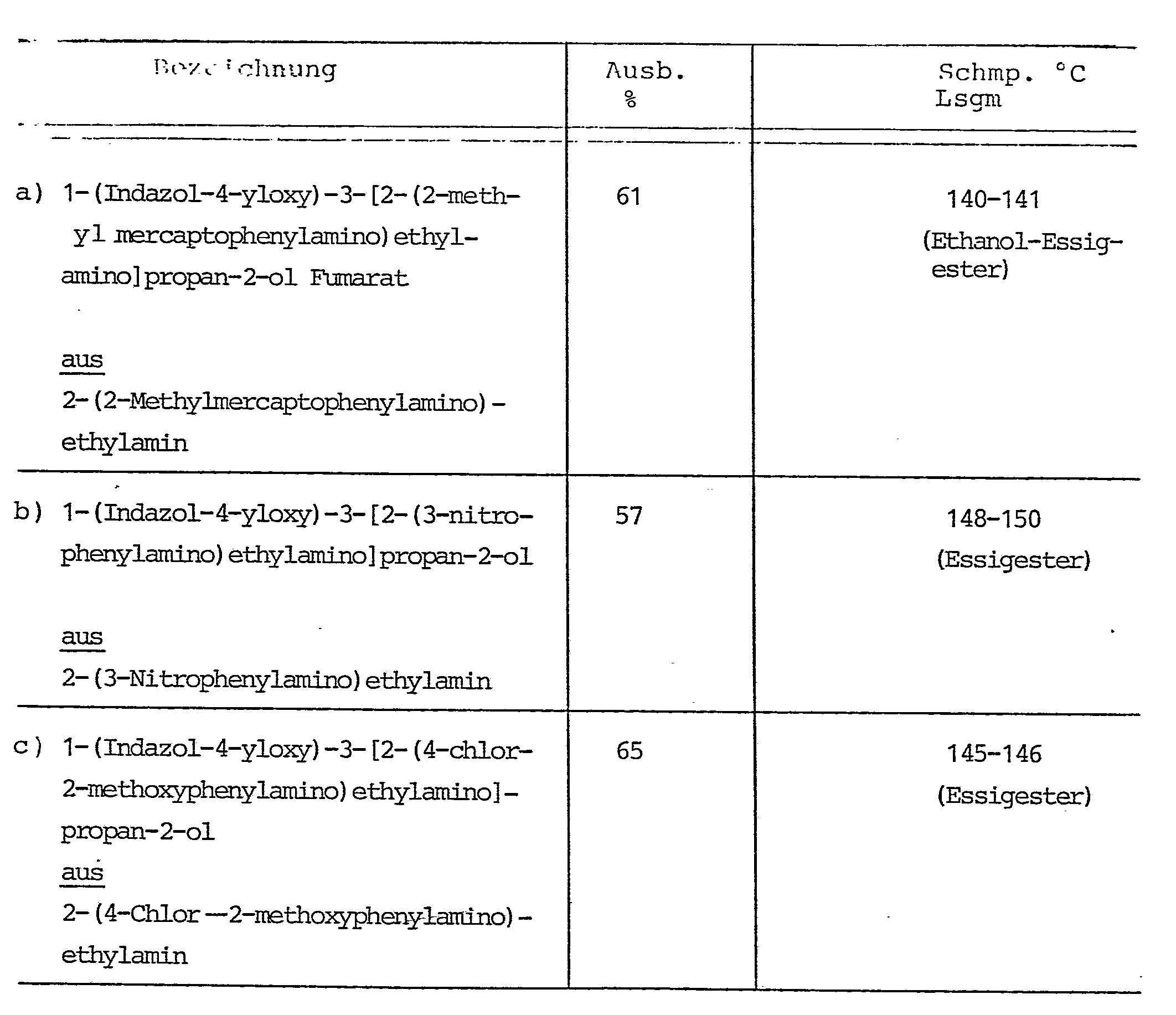
- In analoger Weise wie im Beispiel 1 beschrieben erhält man aus 2-Benzyl-4-(2,3-epoxypropoxy)indazol und dem angegebenen, entsprechend substituierten 2-(phenylamino)ethylamin und anschließender hydrogenolytischer Abspaltung der Benzyl-Schutzgruppe die folgenden Verbindungen:


- In analoger Weise wie für Beispiel 1 angegeben erhält man:

- 7.8 g (175 mmol) 1-[1-(Tetrahydropyran-2-yl)indazol-4-yloxy]-3-[2-(2-chlorphenylamino)ethylamino]propan-2-ol in 250 ml Ethanol werden mit Ionenaustauscher Amberlite CG 120 II (H+-Form) versetzt und 24 Stunden bei 25° geruehrt. Der Ionenaustauscher wird abgetrennt und gruendlich mit 2proz. Ammoniak in Methanol gewaschen. Die vereinigten Loesungen werden eingeengt und der Rueckstand aus Essigester umkristallisiert. Ausbeute: 3.6 g (57 % d.Th.), Fp. 129 - 130°C.
- Die als Ausgangsmaterial fuer vorstehendes Beispiel eingesetzte Verbindung wird folgendermaßen erhalten:
- 5.5 g (20 mmol) 4-(2,3-Epoxypropoxy)-1-(2-tetrahydropyranyl) indazol und 6.8 g (40 mmol) 2-(2-Chlorphenylamino)ethylamin werden unter gelindem Erwaermen innig vermischt und 24 Stunden bei 250C belassen.Nach Chromatographie an Kieselgel mit Essigester-Methanol-Triethylamin (100:10:1) ergibt Einengen der entsprechenden Fraktionen das gewuenschte Additionsprodukt als farbloses, zaehes Oel; Ausbeute 7.8 g (88 % d.Th.).
- In analoger Weise erhaelt man aus 4-(2,3-Epoxypropoxy)-1-(2-tetrahydropyranyl)indazol und dem entsprechend substituierten Phenylendiamin und Abspaltung der Schutzgruppe:
- Es wurden Tabletten mit jeweils 1o mg 1-(Indazol-4-yloxy)-3-[2-(2,6-dimethyl-phenyl- amino)ethylamino]propan- 2-ol gemäß folgender Rezeptur hergestellt:

bedeuten, sowie deren pharmakologisch verträgliche Salze.
Claims (6)

bedeuten, sowie deren pharmakologisch verträgliche. Salze.

bedeuten, sowie deren pharmakologisch verträglichen Salzen, dadurch gekennzeichnet, daß man in an sich bekannter Weise

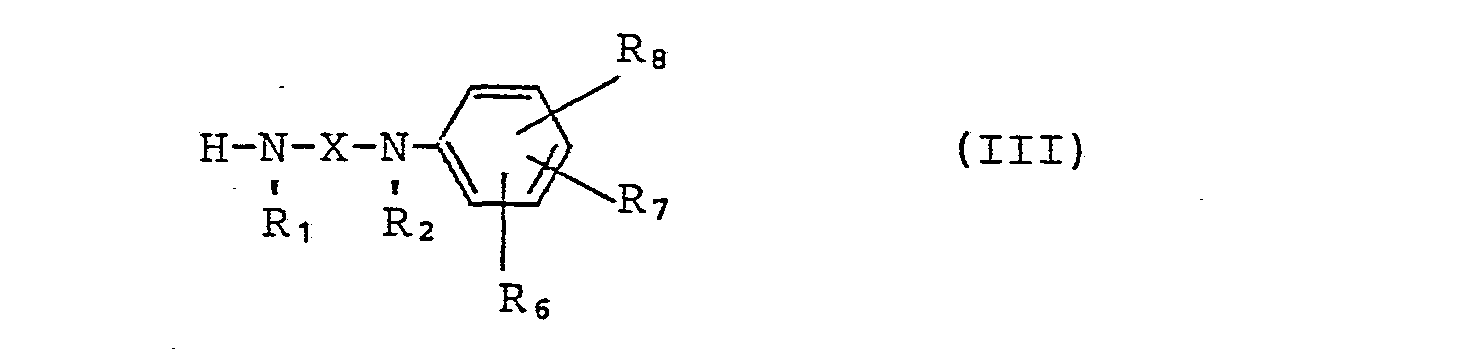
umsetzt und ggf. eine Schutzgruppe R' durch Hydrolyse oder Hydrogenolyse abspaltet, oder


umsetzt und ggf. eine Schutzgruppe R' abspaltet, oder
eine Verbindung der allgemeinen Formel VI


reagieren laesst und anschliessend die dabei gebildete Schiffsche Base reduziert und eine Schutzgruppe R' abspaltet, oder

Priority Applications (1)
| Application Number | Priority Date | Filing Date | Title |
|---|---|---|---|
| AT82106984T ATE16383T1 (de) | 1981-08-06 | 1982-08-03 | Neue heteroaryloxypropanolamine, verfahren zu ihrer herstellung und diese verbindungen enthaltende arzneimittel. |
Applications Claiming Priority (2)
| Application Number | Priority Date | Filing Date | Title |
|---|---|---|---|
| DE19813131146 DE3131146A1 (de) | 1981-08-06 | 1981-08-06 | Neue heteroaryloxypropanolamine, verfahren zu ihrer herstellung und diese verbindungen enthaltende arzneimittel |
| DE3131146 | 1981-08-06 |
Publications (2)
| Publication Number | Publication Date |
|---|---|
| EP0071950A1 true EP0071950A1 (de) | 1983-02-16 |
| EP0071950B1 EP0071950B1 (de) | 1985-11-06 |
Family
ID=6138726
Family Applications (1)
| Application Number | Title | Priority Date | Filing Date |
|---|---|---|---|
| EP82106984A Expired EP0071950B1 (de) | 1981-08-06 | 1982-08-03 | Neue Heteroaryloxypropanolamine, Verfahren zu ihrer Herstellung und diese Verbindungen enthaltende Arzneimittel |
Country Status (13)
| Country | Link |
|---|---|
| US (1) | US4479962A (de) |
| EP (1) | EP0071950B1 (de) |
| JP (1) | JPS5826871A (de) |
| AT (1) | ATE16383T1 (de) |
| AU (1) | AU583247B2 (de) |
| CA (1) | CA1203236A (de) |
| DD (1) | DD202548A5 (de) |
| DE (2) | DE3131146A1 (de) |
| ES (1) | ES514628A0 (de) |
| FI (1) | FI80024C (de) |
| HU (1) | HU189607B (de) |
| IL (1) | IL66439A0 (de) |
| ZA (1) | ZA825653B (de) |
Cited By (3)
| Publication number | Priority date | Publication date | Assignee | Title |
|---|---|---|---|---|
| EP0121176A1 (de) * | 1983-03-25 | 1984-10-10 | Roche Diagnostics GmbH | Indolinon-(2)-Derivate, Verfahren zu ihrer Herstellung, diese Verbindungen enthaltende Arzneimittel und Zwischenprodukte |
| FR2567885A1 (fr) * | 1984-07-19 | 1986-01-24 | Sandoz Sa | Derives 3-aminopropoxyaryliques, leur preparation, leur application comme medicaments et compositions pharmaceutiques les contenant |
| US4780474A (en) * | 1984-08-02 | 1988-10-25 | Boehringer Mannheim Gmbh | Use of alkylenediamine derivatives for the treatment of blood flow disturbances and pharmaceutical compositions containing them |
Families Citing this family (2)
| Publication number | Priority date | Publication date | Assignee | Title |
|---|---|---|---|---|
| DE3434271A1 (de) * | 1984-09-19 | 1986-03-20 | Beiersdorf Ag, 2000 Hamburg | Substituierte 3,4-dihydro-chinolin-2(1h)-one verfahren zu ihrer herstellung und ihre verwendung sowie diese verbindungen enthaltende zubereitungen |
| DE3531658A1 (de) * | 1985-09-05 | 1987-03-12 | Boehringer Mannheim Gmbh | Heterocyclisch substituierte indole, zwischenprodukte, verfahren zu ihrer herstellung und arzneimittel |
Citations (6)
| Publication number | Priority date | Publication date | Assignee | Title |
|---|---|---|---|---|
| DE2830211A1 (de) * | 1977-07-21 | 1979-02-01 | Sandoz Ag | Substituierte indol-derivate, ihre herstellung und verwendung |
| DE2844497A1 (de) * | 1977-12-01 | 1979-06-07 | Dresden Arzneimittel | Verfahren zur herstellung von phenoxyalkanolamin-derivaten |
| EP0004920A1 (de) * | 1978-04-13 | 1979-10-31 | Roche Diagnostics GmbH | Carbazolyl-(4)-oxy-propanolamin-Derivate, Verfahren zu ihrer Herstellung und diese Verbindungen enthaltende Arzneimittel |
| EP0014951A2 (de) * | 1979-02-16 | 1980-09-03 | Roche Diagnostics GmbH | Heterocyclische Oxypropanolamin-Derivate, Verfahren zu ihrer Herstellung und diese Verbindungen enthaltende Arzneimittel |
| EP0025111A1 (de) * | 1979-08-10 | 1981-03-18 | Sandoz Ag | 3-Aminopropoxyaryl-Derivate, ihre Herstellung und diese enthaltende pharmazeutische Zusammensetzungen |
| EP0042592A1 (de) * | 1980-06-23 | 1981-12-30 | Roche Diagnostics GmbH | N-Heteroaryl-alkylendiamine, Verfahren zu ihrer Herstellung sowie ihre Verwendung |
Family Cites Families (4)
| Publication number | Priority date | Publication date | Assignee | Title |
|---|---|---|---|---|
| IE41248B1 (en) * | 1974-06-05 | 1979-11-21 | Ici Ltd | 1-(aryl-or hetero-aryl)oxy-3-(substituded-amino)propan-i-ol derivatives process for their manufacture and pharmaceutical compositions containing them |
| DE2619164C2 (de) * | 1976-04-30 | 1985-07-11 | Boehringer Mannheim Gmbh, 6800 Mannheim | Indazolyl-(4)-oxy-propanolamine, Verfahren zu ihrer Herstellung und deren Verwendung |
| LU77339A1 (de) * | 1977-05-16 | 1979-01-19 | ||
| ZA804848B (en) * | 1979-08-10 | 1982-03-31 | Sandoz Ltd | 3-aminopropoxy deri-vatives, their preparation and pharmaceutical compositions containing them |
-
1981
- 1981-08-06 DE DE19813131146 patent/DE3131146A1/de not_active Withdrawn
-
1982
- 1982-07-27 CA CA000408114A patent/CA1203236A/en not_active Expired
- 1982-08-02 US US06/403,968 patent/US4479962A/en not_active Expired - Fee Related
- 1982-08-02 ES ES514628A patent/ES514628A0/es active Granted
- 1982-08-02 IL IL66439A patent/IL66439A0/xx not_active IP Right Cessation
- 1982-08-02 AU AU86681/82A patent/AU583247B2/en not_active Ceased
- 1982-08-03 AT AT82106984T patent/ATE16383T1/de active
- 1982-08-03 EP EP82106984A patent/EP0071950B1/de not_active Expired
- 1982-08-03 DD DD82242220A patent/DD202548A5/de unknown
- 1982-08-03 FI FI822706A patent/FI80024C/fi not_active IP Right Cessation
- 1982-08-03 DE DE8282106984T patent/DE3267291D1/de not_active Expired
- 1982-08-04 JP JP57135256A patent/JPS5826871A/ja active Granted
- 1982-08-05 HU HU822524A patent/HU189607B/hu not_active IP Right Cessation
- 1982-08-05 ZA ZA825653A patent/ZA825653B/xx unknown
Patent Citations (7)
| Publication number | Priority date | Publication date | Assignee | Title |
|---|---|---|---|---|
| DE2830211A1 (de) * | 1977-07-21 | 1979-02-01 | Sandoz Ag | Substituierte indol-derivate, ihre herstellung und verwendung |
| DE2844497A1 (de) * | 1977-12-01 | 1979-06-07 | Dresden Arzneimittel | Verfahren zur herstellung von phenoxyalkanolamin-derivaten |
| EP0004920A1 (de) * | 1978-04-13 | 1979-10-31 | Roche Diagnostics GmbH | Carbazolyl-(4)-oxy-propanolamin-Derivate, Verfahren zu ihrer Herstellung und diese Verbindungen enthaltende Arzneimittel |
| EP0014951A2 (de) * | 1979-02-16 | 1980-09-03 | Roche Diagnostics GmbH | Heterocyclische Oxypropanolamin-Derivate, Verfahren zu ihrer Herstellung und diese Verbindungen enthaltende Arzneimittel |
| EP0025111A1 (de) * | 1979-08-10 | 1981-03-18 | Sandoz Ag | 3-Aminopropoxyaryl-Derivate, ihre Herstellung und diese enthaltende pharmazeutische Zusammensetzungen |
| EP0042592A1 (de) * | 1980-06-23 | 1981-12-30 | Roche Diagnostics GmbH | N-Heteroaryl-alkylendiamine, Verfahren zu ihrer Herstellung sowie ihre Verwendung |
| EP0042593A1 (de) * | 1980-06-23 | 1981-12-30 | Roche Diagnostics GmbH | Aryloxypropanolamine, Verfahren zu ihrer Herstellung und diese Verbindungen enthaltende Arzneimittel |
Cited By (4)
| Publication number | Priority date | Publication date | Assignee | Title |
|---|---|---|---|---|
| EP0121176A1 (de) * | 1983-03-25 | 1984-10-10 | Roche Diagnostics GmbH | Indolinon-(2)-Derivate, Verfahren zu ihrer Herstellung, diese Verbindungen enthaltende Arzneimittel und Zwischenprodukte |
| FR2567885A1 (fr) * | 1984-07-19 | 1986-01-24 | Sandoz Sa | Derives 3-aminopropoxyaryliques, leur preparation, leur application comme medicaments et compositions pharmaceutiques les contenant |
| US4780474A (en) * | 1984-08-02 | 1988-10-25 | Boehringer Mannheim Gmbh | Use of alkylenediamine derivatives for the treatment of blood flow disturbances and pharmaceutical compositions containing them |
| EP0172446A3 (de) * | 1984-08-02 | 1989-07-26 | Roche Diagnostics GmbH | Verwendung von Alkylendiamin-Derivaten zur Behandlung von Durchblutungsstörungen sowie Arzneimittel, die diese Verbindungen enthalten |
Also Published As
| Publication number | Publication date |
|---|---|
| ES8304940A1 (es) | 1983-04-16 |
| HU189607B (en) | 1986-07-28 |
| DD202548A5 (de) | 1983-09-21 |
| AU8668182A (en) | 1983-02-10 |
| DE3267291D1 (en) | 1985-12-12 |
| ATE16383T1 (de) | 1985-11-15 |
| ES514628A0 (es) | 1983-04-16 |
| DE3131146A1 (de) | 1983-02-24 |
| IL66439A0 (en) | 1982-12-31 |
| EP0071950B1 (de) | 1985-11-06 |
| FI822706L (fi) | 1983-02-07 |
| US4479962A (en) | 1984-10-30 |
| AU583247B2 (en) | 1989-04-27 |
| ZA825653B (en) | 1983-07-27 |
| FI80024B (fi) | 1989-12-29 |
| CA1203236A (en) | 1986-04-15 |
| FI80024C (fi) | 1990-04-10 |
| JPS5826871A (ja) | 1983-02-17 |
| JPS6345667B2 (de) | 1988-09-12 |
| FI822706A0 (fi) | 1982-08-03 |
Similar Documents
| Publication | Publication Date | Title |
|---|---|---|
| EP0121176B1 (de) | Indolinon-(2)-Derivate, Verfahren zu ihrer Herstellung, diese Verbindungen enthaltende Arzneimittel und Zwischenprodukte | |
| EP0008653B1 (de) | N-Substituierte Benzimidazole, Verfahren zu ihrer Herstellung, und sie enthaltende Arzneimittel | |
| EP0014951B1 (de) | Heterocyclische Oxypropanolamin-Derivate, Verfahren zu ihrer Herstellung und diese Verbindungen enthaltende Arzneimittel | |
| EP0700905B1 (de) | Tricyclische Pyrazol-Derivate | |
| DE3119874A1 (de) | "benzazepinderivate, ihre herstellung und ihre verwendung als arzneimittel" | |
| DE1695556B2 (de) | 3Alkyl-l,2,3,4,4a,9-hexahydropyrazino [1,2-f] morphanthridinderivate | |
| DE2143204C3 (de) | N-Fluoralkyl-phenylisopropylamin-Derivate und deren Salze, Verfahren zu deren Herstellung und Arzneimittel auf deren Basis | |
| DE3131728A1 (de) | Indolverbindungen, verfahren zu ihrer herstellung und diese verbindungen enthaltende arzneimittel | |
| DE2226703A1 (de) | Neue tetrahydrocarbazolderivate und verfahren zu ihrer herstellung | |
| DE2164058A1 (de) | Neue basisch substituierte Benzylphthalazon-Derivate, ihre Salze, Verfahren zu ihrer Herstellung und diese Produkte enthaltende pharmazeutische Präparate | |
| EP0014928A1 (de) | Neue Piperidinopropylderivate, Verfahren zu ihrer Herstellung und diese Verbindungen enthaltende Arzneimittel | |
| EP0000784B1 (de) | 4-Hydroxy-2-Benzimidazolinon-derivate, Verfahren zu deren Herstellung sowie diese Verbindungen enthaltende Arzneimittel | |
| EP0071950B1 (de) | Neue Heteroaryloxypropanolamine, Verfahren zu ihrer Herstellung und diese Verbindungen enthaltende Arzneimittel | |
| EP0525584B1 (de) | 6-Oxo-azepinoindol-Verbindungen sowie Verfahren und Zwischenprodukte zu ihrer Herstellung und diese Verbindungen enthaltende Arzneimittel | |
| DD151408A5 (de) | Verfahren zur herstellung neuer pharmazeutisch aktiver phenylpiperazinderivate | |
| DE2153801A1 (de) | Phenathylaminderivate | |
| EP0065295A1 (de) | Substituierte Tryptaminderivate von Thienyloxypropanolaminen, Verfahren zu ihrer Herstellung, pharmazeutische Präparate auf Basis dieser Verbindungen sowie ihre Verwendung | |
| DE2619164A1 (de) | Indazolyl-(4)-oxy-propanolamine und verfahren zu ihrer herstellung | |
| DE2817083A1 (de) | Benzylisochinolin-derivate, verfahren zu ihrer herstellung und diese verbindungen enthaltende arzneipraeparate | |
| EP0003298B1 (de) | 4-Hydroxy-2-benzimidazolin-thion-Derivate, Verfahren zu deren Herstellung sowie diese Verbindungen enthaltende Arzneimittel | |
| EP0029992B1 (de) | Neue Aminopropanolderivate, Verfahren zu ihrer Herstellung und diese Verbindungen enthaltende Arzneimittel | |
| DE2609862C2 (de) | ||
| EP0138034A1 (de) | Substituierte Pyrido(1,2-c)imidazo((1,2-a)benzimidazole, Verfahren zu ihrer Herstellung, ihre Verwendung sowie pharmazeutische Präparate auf Basis dieser Verbindungen | |
| DD215540A5 (de) | Verfahren zur herstellung von benzazepinderivaten | |
| AT300763B (de) | Verfahren zur Herstellung von neuen 5-(1'-Hydroxy-2'-arylalkyl-oder -aryloxyalkylaminoäthyl)-salicylamiden und deren Säureadditionssalzen |
Legal Events
| Date | Code | Title | Description |
|---|---|---|---|
| PUAI | Public reference made under article 153(3) epc to a published international application that has entered the european phase |
Free format text: ORIGINAL CODE: 0009012 |
|
| 17P | Request for examination filed |
Effective date: 19820803 |
|
| AK | Designated contracting states |
Designated state(s): AT BE CH DE FR GB IT LI LU NL SE |
|
| ITF | It: translation for a ep patent filed | ||
| GRAA | (expected) grant |
Free format text: ORIGINAL CODE: 0009210 |
|
| AK | Designated contracting states |
Designated state(s): AT BE CH DE FR GB IT LI LU NL SE |
|
| REF | Corresponds to: |
Ref document number: 16383 Country of ref document: AT Date of ref document: 19851115 Kind code of ref document: T |
|
| REF | Corresponds to: |
Ref document number: 3267291 Country of ref document: DE Date of ref document: 19851212 |
|
| ET | Fr: translation filed | ||
| PLBE | No opposition filed within time limit |
Free format text: ORIGINAL CODE: 0009261 |
|
| STAA | Information on the status of an ep patent application or granted ep patent |
Free format text: STATUS: NO OPPOSITION FILED WITHIN TIME LIMIT |
|
| 26N | No opposition filed | ||
| ITTA | It: last paid annual fee | ||
| PGFP | Annual fee paid to national office [announced via postgrant information from national office to epo] |
Ref country code: GB Payment date: 19920724 Year of fee payment: 11 |
|
| PGFP | Annual fee paid to national office [announced via postgrant information from national office to epo] |
Ref country code: FR Payment date: 19920807 Year of fee payment: 11 |
|
| PGFP | Annual fee paid to national office [announced via postgrant information from national office to epo] |
Ref country code: AT Payment date: 19920813 Year of fee payment: 11 |
|
| PGFP | Annual fee paid to national office [announced via postgrant information from national office to epo] |
Ref country code: CH Payment date: 19920814 Year of fee payment: 11 |
|
| PGFP | Annual fee paid to national office [announced via postgrant information from national office to epo] |
Ref country code: SE Payment date: 19920817 Year of fee payment: 11 |
|
| PGFP | Annual fee paid to national office [announced via postgrant information from national office to epo] |
Ref country code: DE Payment date: 19920826 Year of fee payment: 11 |
|
| PGFP | Annual fee paid to national office [announced via postgrant information from national office to epo] |
Ref country code: NL Payment date: 19920831 Year of fee payment: 11 |
|
| PGFP | Annual fee paid to national office [announced via postgrant information from national office to epo] |
Ref country code: LU Payment date: 19920903 Year of fee payment: 11 |
|
| PGFP | Annual fee paid to national office [announced via postgrant information from national office to epo] |
Ref country code: BE Payment date: 19920918 Year of fee payment: 11 |
|
| EPTA | Lu: last paid annual fee | ||
| PG25 | Lapsed in a contracting state [announced via postgrant information from national office to epo] |
Ref country code: LU Free format text: LAPSE BECAUSE OF NON-PAYMENT OF DUE FEES Effective date: 19930803 Ref country code: GB Effective date: 19930803 Ref country code: AT Effective date: 19930803 |
|
| PG25 | Lapsed in a contracting state [announced via postgrant information from national office to epo] |
Ref country code: SE Effective date: 19930804 |
|
| PG25 | Lapsed in a contracting state [announced via postgrant information from national office to epo] |
Ref country code: LI Effective date: 19930831 Ref country code: CH Effective date: 19930831 Ref country code: BE Effective date: 19930831 |
|
| BERE | Be: lapsed |
Owner name: BOEHRINGER MANNHEIM G.M.B.H. Effective date: 19930831 |
|
| PG25 | Lapsed in a contracting state [announced via postgrant information from national office to epo] |
Ref country code: NL Effective date: 19940301 |
|
| GBPC | Gb: european patent ceased through non-payment of renewal fee |
Effective date: 19930803 |
|
| NLV4 | Nl: lapsed or anulled due to non-payment of the annual fee | ||
| PG25 | Lapsed in a contracting state [announced via postgrant information from national office to epo] |
Ref country code: FR Effective date: 19940429 |
|
| REG | Reference to a national code |
Ref country code: CH Ref legal event code: PL |
|
| PG25 | Lapsed in a contracting state [announced via postgrant information from national office to epo] |
Ref country code: DE Effective date: 19940503 |
|
| REG | Reference to a national code |
Ref country code: FR Ref legal event code: ST |
|
| EUG | Se: european patent has lapsed |
Ref document number: 82106984.6 Effective date: 19940310 |