EP0072364B1 - Procédé pour préparer une masse de support, en particulier pour supporter une partie du corps humain et masse ainsi obtenue - Google Patents
Procédé pour préparer une masse de support, en particulier pour supporter une partie du corps humain et masse ainsi obtenue Download PDFInfo
- Publication number
- EP0072364B1 EP0072364B1 EP19820890108 EP82890108A EP0072364B1 EP 0072364 B1 EP0072364 B1 EP 0072364B1 EP 19820890108 EP19820890108 EP 19820890108 EP 82890108 A EP82890108 A EP 82890108A EP 0072364 B1 EP0072364 B1 EP 0072364B1
- Authority
- EP
- European Patent Office
- Prior art keywords
- mixture
- mass
- hollow microspheres
- composition
- mould
- Prior art date
- Legal status (The legal status is an assumption and is not a legal conclusion. Google has not performed a legal analysis and makes no representation as to the accuracy of the status listed.)
- Expired
Links
Images
Classifications
-
- A—HUMAN NECESSITIES
- A47—FURNITURE; DOMESTIC ARTICLES OR APPLIANCES; COFFEE MILLS; SPICE MILLS; SUCTION CLEANERS IN GENERAL
- A47C—CHAIRS; SOFAS; BEDS
- A47C27/00—Spring, stuffed or fluid mattresses or cushions specially adapted for chairs, beds or sofas
- A47C27/14—Spring, stuffed or fluid mattresses or cushions specially adapted for chairs, beds or sofas with foamed material inlays
- A47C27/15—Spring, stuffed or fluid mattresses or cushions specially adapted for chairs, beds or sofas with foamed material inlays consisting of two or more layers
-
- B—PERFORMING OPERATIONS; TRANSPORTING
- B29—WORKING OF PLASTICS; WORKING OF SUBSTANCES IN A PLASTIC STATE IN GENERAL
- B29C—SHAPING OR JOINING OF PLASTICS; SHAPING OF MATERIAL IN A PLASTIC STATE, NOT OTHERWISE PROVIDED FOR; AFTER-TREATMENT OF THE SHAPED PRODUCTS, e.g. REPAIRING
- B29C70/00—Shaping composites, i.e. plastics material comprising reinforcements, fillers or preformed parts, e.g. inserts
- B29C70/58—Shaping composites, i.e. plastics material comprising reinforcements, fillers or preformed parts, e.g. inserts comprising fillers only, e.g. particles, powder, beads, flakes, spheres
- B29C70/66—Shaping composites, i.e. plastics material comprising reinforcements, fillers or preformed parts, e.g. inserts comprising fillers only, e.g. particles, powder, beads, flakes, spheres the filler comprising hollow constituents, e.g. syntactic foam
-
- C—CHEMISTRY; METALLURGY
- C08—ORGANIC MACROMOLECULAR COMPOUNDS; THEIR PREPARATION OR CHEMICAL WORKING-UP; COMPOSITIONS BASED THEREON
- C08G—MACROMOLECULAR COMPOUNDS OBTAINED OTHERWISE THAN BY REACTIONS ONLY INVOLVING UNSATURATED CARBON-TO-CARBON BONDS
- C08G18/00—Polymeric products of isocyanates or isothiocyanates
- C08G18/06—Polymeric products of isocyanates or isothiocyanates with compounds having active hydrogen
- C08G18/28—Polymeric products of isocyanates or isothiocyanates with compounds having active hydrogen characterised by the compounds used containing active hydrogen
- C08G18/67—Unsaturated compounds having active hydrogen
- C08G18/69—Polymers of conjugated dienes
-
- C—CHEMISTRY; METALLURGY
- C08—ORGANIC MACROMOLECULAR COMPOUNDS; THEIR PREPARATION OR CHEMICAL WORKING-UP; COMPOSITIONS BASED THEREON
- C08J—WORKING-UP; GENERAL PROCESSES OF COMPOUNDING; AFTER-TREATMENT NOT COVERED BY SUBCLASSES C08B, C08C, C08F, C08G or C08H
- C08J9/00—Working-up of macromolecular substances to porous or cellular articles or materials; After-treatment thereof
- C08J9/32—Working-up of macromolecular substances to porous or cellular articles or materials; After-treatment thereof from compositions containing microballoons, e.g. syntactic foams
-
- B—PERFORMING OPERATIONS; TRANSPORTING
- B29—WORKING OF PLASTICS; WORKING OF SUBSTANCES IN A PLASTIC STATE IN GENERAL
- B29K—INDEXING SCHEME ASSOCIATED WITH SUBCLASSES B29B, B29C OR B29D, RELATING TO MOULDING MATERIALS OR TO MATERIALS FOR MOULDS, REINFORCEMENTS, FILLERS OR PREFORMED PARTS, e.g. INSERTS
- B29K2105/00—Condition, form or state of moulded material or of the material to be shaped
- B29K2105/06—Condition, form or state of moulded material or of the material to be shaped containing reinforcements, fillers or inserts
- B29K2105/16—Fillers
- B29K2105/165—Hollow fillers, e.g. microballoons or expanded particles
-
- Y—GENERAL TAGGING OF NEW TECHNOLOGICAL DEVELOPMENTS; GENERAL TAGGING OF CROSS-SECTIONAL TECHNOLOGIES SPANNING OVER SEVERAL SECTIONS OF THE IPC; TECHNICAL SUBJECTS COVERED BY FORMER USPC CROSS-REFERENCE ART COLLECTIONS [XRACs] AND DIGESTS
- Y10—TECHNICAL SUBJECTS COVERED BY FORMER USPC
- Y10S—TECHNICAL SUBJECTS COVERED BY FORMER USPC CROSS-REFERENCE ART COLLECTIONS [XRACs] AND DIGESTS
- Y10S428/00—Stock material or miscellaneous articles
- Y10S428/905—Odor releasing material
-
- Y—GENERAL TAGGING OF NEW TECHNOLOGICAL DEVELOPMENTS; GENERAL TAGGING OF CROSS-SECTIONAL TECHNOLOGIES SPANNING OVER SEVERAL SECTIONS OF THE IPC; TECHNICAL SUBJECTS COVERED BY FORMER USPC CROSS-REFERENCE ART COLLECTIONS [XRACs] AND DIGESTS
- Y10—TECHNICAL SUBJECTS COVERED BY FORMER USPC
- Y10S—TECHNICAL SUBJECTS COVERED BY FORMER USPC CROSS-REFERENCE ART COLLECTIONS [XRACs] AND DIGESTS
- Y10S5/00—Beds
- Y10S5/909—Flowable viscous, e.g. gel material containing
-
- Y—GENERAL TAGGING OF NEW TECHNOLOGICAL DEVELOPMENTS; GENERAL TAGGING OF CROSS-SECTIONAL TECHNOLOGIES SPANNING OVER SEVERAL SECTIONS OF THE IPC; TECHNICAL SUBJECTS COVERED BY FORMER USPC CROSS-REFERENCE ART COLLECTIONS [XRACs] AND DIGESTS
- Y10—TECHNICAL SUBJECTS COVERED BY FORMER USPC
- Y10T—TECHNICAL SUBJECTS COVERED BY FORMER US CLASSIFICATION
- Y10T428/00—Stock material or miscellaneous articles
- Y10T428/24—Structurally defined web or sheet [e.g., overall dimension, etc.]
- Y10T428/24479—Structurally defined web or sheet [e.g., overall dimension, etc.] including variation in thickness
- Y10T428/24496—Foamed or cellular component
- Y10T428/24504—Component comprises a polymer [e.g., rubber, etc.]
-
- Y—GENERAL TAGGING OF NEW TECHNOLOGICAL DEVELOPMENTS; GENERAL TAGGING OF CROSS-SECTIONAL TECHNOLOGIES SPANNING OVER SEVERAL SECTIONS OF THE IPC; TECHNICAL SUBJECTS COVERED BY FORMER USPC CROSS-REFERENCE ART COLLECTIONS [XRACs] AND DIGESTS
- Y10—TECHNICAL SUBJECTS COVERED BY FORMER USPC
- Y10T—TECHNICAL SUBJECTS COVERED BY FORMER US CLASSIFICATION
- Y10T428/00—Stock material or miscellaneous articles
- Y10T428/24—Structurally defined web or sheet [e.g., overall dimension, etc.]
- Y10T428/24479—Structurally defined web or sheet [e.g., overall dimension, etc.] including variation in thickness
- Y10T428/24496—Foamed or cellular component
- Y10T428/24504—Component comprises a polymer [e.g., rubber, etc.]
- Y10T428/24512—Polyurethane
-
- Y—GENERAL TAGGING OF NEW TECHNOLOGICAL DEVELOPMENTS; GENERAL TAGGING OF CROSS-SECTIONAL TECHNOLOGIES SPANNING OVER SEVERAL SECTIONS OF THE IPC; TECHNICAL SUBJECTS COVERED BY FORMER USPC CROSS-REFERENCE ART COLLECTIONS [XRACs] AND DIGESTS
- Y10—TECHNICAL SUBJECTS COVERED BY FORMER USPC
- Y10T—TECHNICAL SUBJECTS COVERED BY FORMER US CLASSIFICATION
- Y10T428/00—Stock material or miscellaneous articles
- Y10T428/249921—Web or sheet containing structurally defined element or component
- Y10T428/249953—Composite having voids in a component [e.g., porous, cellular, etc.]
- Y10T428/249971—Preformed hollow element-containing
- Y10T428/249972—Resin or rubber element
-
- Y—GENERAL TAGGING OF NEW TECHNOLOGICAL DEVELOPMENTS; GENERAL TAGGING OF CROSS-SECTIONAL TECHNOLOGIES SPANNING OVER SEVERAL SECTIONS OF THE IPC; TECHNICAL SUBJECTS COVERED BY FORMER USPC CROSS-REFERENCE ART COLLECTIONS [XRACs] AND DIGESTS
- Y10—TECHNICAL SUBJECTS COVERED BY FORMER USPC
- Y10T—TECHNICAL SUBJECTS COVERED BY FORMER US CLASSIFICATION
- Y10T428/00—Stock material or miscellaneous articles
- Y10T428/249921—Web or sheet containing structurally defined element or component
- Y10T428/249953—Composite having voids in a component [e.g., porous, cellular, etc.]
- Y10T428/249981—Plural void-containing components
Definitions
- the invention relates to a method for producing a mass for supporting parts, in particular parts of the human body, based on a plastic containing hollow microspheres with a polyurethane linkage.
- the invention further relates to such a mass for supporting parts, in particular parts of the human body.
- Cushions which have a filling made of a foam-like plastic mass which, under pressure, adapts to the shape of parts to be supported, in particular the human body.
- the filling compound which is arranged in a thin shell made of flat material, for example a fabric, consists of hollow thermoplastic microspheres which are separably connected to one another by means of a small amount of a liquid or pasty substance at body temperature.
- the filling compound has a very low density of 0.02 to 0.3.
- Such known pads are particularly suitable for areas of application where the shape adapted to the body parts will be retained in the future, for example in ski boots that are always worn by the same person.
- the cushions already having a certain shape are to be adapted to another part of the body, then these cushions, since they have no elastic properties at all, must first be brought into their original shape before being adapted to the other part of the body.
- the known upholstery for certain areas of application for example as a seat upholstery for office chairs, vehicle seats, hospital chairs, or for mattresses, for example for bedridden patients to avoid pressure ulcers, is not suitable, or at least only poorly, because an adaptation following a movement is not carried out immediately , but only via an intermediate stage, at which the upholstery must be brought into its original shape.
- Pads for shoes are also known in which a tixotropic or highly viscous mass, such as, for example, an oil filled with silicates or a liquid plastic, is filled in a cover, for example made of a polyvinyl chloride film (US Pat. No. 3,237,319, 3402411, 3 635,849, 3,882,561).
- a cover for example made of a polyvinyl chloride film
- these cushions have plastic properties and adapt well to the parts to be supported under pressure, they are heavy and have no compressive and elastic properties, so that the desired comfort is lacking.
- the deformed cushions no longer reset without the application of external force; rather, the action of an external force is required for any change in their shape.
- the filling consists of thermoplastic hollow microspheres which are inseparably and elastically connected to one another by means of a polysulfide or polysiloxane (DE-PS2519910).
- a polysulfide or polysiloxane DE-PS2519910
- These cushions only adapt to a certain body shape under high dynamic pressure and can therefore only be used optimally where such high pressure acts on a small area, such as with orthopedic insoles or crutches, because they remain elastic after adjustment .
- These known cushions are unsuitable for seat cushions and mattresses to avoid decubitus, because the pressure that arises is not sufficient for a complete adjustment.
- the molded parts known from EP-A 0029 021 consist of a polyurethane modified by the inclusion of hollow microspheres, which is produced in the usual way from polyols and isocyanate.
- the hollow microspheres can thus be added to the mixture in a prefabricated manner or can be formed in situ in the mixture in that corresponding compact particles containing a blowing agent are inflated by the application of heat. Temperatures higher than 165 ° C should be avoided in situ during the production of the hollow microspheres because this could damage the thin shells of the hollow microspheres.
- the mass according to the invention adapts completely to a given body shape even at a low pressure, acts on the part in question after its adaptation with a very low, non-disturbing relaxation pressure, and turns itself on after the pressure exerted by this part has ceased, that is to say after this part has been removed back again and does not have to be brought back into its original form manually.
- the mass has a low weight and is easy to manufacture.
- the mass has both plastic and elastic properties, these properties each having the desired effect without the disadvantages of the known plastic masses and the known elastic masses being effective.
- this composition behaves similarly to very soft rubber when pressure is exerted, thus ensuring good elastic support for the parts in question.
- the composition according to the invention also adapts well to the shape of the respective parts, and after it has undergone deformation it behaves sluggishly in terms of tension and compression, so that no noticeable restoring force acts on the parts to be supported, which is perceived as unpleasant.
- the hollow microspheres embedded in the mass give the mass a foam-like consistency and reduce the weight of the mass in the desired manner.
- the hollow microspheres are pressure-elastic due to their filling with a gas, as a result of which the support properties of the composition according to the invention are further improved.
- the hollow microspheres prevent the cells formed by the isocyanate reaction from sticking together.
- the mass produced by the method according to the invention can be used particularly advantageously for supporting parts of the human body, since it adapts rapidly to the shape of these body parts even at a low pressure which is exerted on the mass by the body parts after adjustment has been carried out, only exerts a small and therefore not disturbing restoring pressure on these parts of the body, but resets itself automatically when the pressure is released.
- the composition according to the invention can be used particularly advantageously as a filling compound for anti-decubitus underlays, but also as a filling compound for cushions, for example for crash helmets, shoes, in particular ski boots, mattresses of any kind, seat cushions for office chairs, vehicle seats and hospital chairs, but can also be used for backing of dentures are used.
- polyisobutylene namely low molecular weight polyisobutylene with a molecular weight between 500 and 15,000
- polyisobutylene is composed of the essentially unsaturated ones, preferably polybutadiene.
- the resulting liquid hydrocarbons are readily miscible, do not separate upon completion of the mixing or stirring process and hardly react with the NCO groups of the polyisocyanate forming the reactant.
- These essentially saturated liquid hydrocarbons contribute to a wide-meshed crosslinking of the polybutadiene without sweating out or emigrating from the finished mass. This gives the mass the favorable properties mentioned, ie it behaves both plastically and elastically.
- the proportion of mineral oils or of polyisobutylene in relation to the proportion of unsaturated liquid hydrocarbons can vary within certain limits. The larger this ratio, the better the plastic properties of the mass and the slower the mass becomes in relation to its tensile and compressive elastic properties.
- the ratio between the proportion of mineral oils or polyisobutylene and the proportion of unsaturated hydrocarbons is expediently between 2.5: 1 and 1: 3, preferably 1: 1.
- a lower proportion of mineral oil or polyisobutylene is not recommended, since otherwise mass according to the invention no longer has sufficient plastic properties.
- the hollow microspheres forming part of the mass advantageously have a diameter between 0.01 and 0.1 mm.
- These hollow microspheres, the thin shell of which consists of vinylidene chloride copolymer and the inside of which contains a gas, are inert towards the polyisocyanate that forms the reactant and towards the unsaturated liquid hydrocarbons and significantly improve the inert tensile and compressive properties of the mass.
- the reactant which preferably consists of polyisocyanate and a crosslinking agent, for example of ethylhexanediol
- the substantially saturated hydrocarbons and the hollow microspheres are thus inactive with regard to the molecular function, but their effect on the properties of the composition according to the invention is essential and, despite being virtually unbound in the composition, they are a firmly integrated component of this composition which cannot escape.
- the mass produced by the process according to the invention has only closed cells and behaves more thermoelastically than thermoplastic, i.e. that is, the properties of the mass are almost the same in a wide temperature range. Among other things, this enables sterilization by means of heat of pads filled with the mass, which is necessary, for example, in the case of anti-decubitus pads.
- the density of the mass is also significantly reduced by the hollow microspheres. This density is between 0.20 and 0.85, preferably between 0.35 and 0.55.
- the pressure-elastic hollow microspheres also prevent the cells from sticking together when compressed.
- compositions can be improved further by adding fillers, for example fragrances, pigments and / or stabilizers, to the mixture from which the composition is formed.
- fillers for example fragrances, pigments and / or stabilizers
- the mixture from which the mass is formed is advantageously mixed with substances which give the mass a sticky property.
- the mass then has a certain self-adhesive effect, which can be used to fix the mass or a cushion formed by this mass, which is uncovered on at least one side, with this side at a certain point without additional measures. This creates a self-adhesive bond, which is usually sufficient to connect the inner padding of a helmet or a ski boot to the fixed shell, for example.
- the mass is not necessary for the mass to be enclosed in a coating.
- the mass when used as a backing for dentures, the mass is used without a cover.
- a layer preferably made of air-permeable material, or a film, for example made of polyethylene, can be inserted into a mold in this mold, so that after removal from the mold, the mass is at least partially covered by this layer or film is.
- the mass produced by the process according to the invention can be kneaded under low pressure, this mass has such an internal connection that a textile material and / or a natural or artificial fur can be used as a layer without the risk that the Mass migrates through the layer.
- a textile material or a skin as a cover has a significant advantage over plastic films, since such plastic films have poor hygienic properties.
- the recess used in a shaped body preferably made of an elastomeric foam, for example made of PUR foam or polyethylene foam
- the mass is directly connected to the molded body, which as a whole, that is together with the mass, is used to support parts, in particular parts of the human body.
- the properties of the elastomer foam or of the PUR foam or of the polyethylene foam which are decisive for the support can be combined with the properties of the composition according to the invention, the overall properties of the cushion thus formed being dependent on the ratio of the volume of the elastomer foam to the volume of the composition.
- Reset pressure and reset time can be further adapted to the respective requirements. Such an adjustment is useful because, for example, when using the mass for patients who move little, it is more important to avoid pressure ulcers that a low reset pressure occurs after the adjustment than that a quick reset takes place after the pressure has been released. When used, for example, for seat cushions of office chairs, it is in turn advantageous that the quickest possible reset after the adjustment has priority over a low reset pressure during the load.
- the molded body can have at least one recess which is open on one side and into which the mixture is poured, this recess being covered by a film or layer after the mixture has been poured in.
- the recesses can be arranged at those points where support with the mass according to the invention is desired.
- a shoe sole in particular an insole or a midsole, can be used as the molded body, the recesses being provided in the region of the ball and the heel.
- the mixture is preferably filled into the recesses in such an amount that the mass protrudes a little from the recess.
- composition according to the invention prevents joint damage due to the damping and inert properties of the composition according to the invention. If polyethylene foam is used as the sole material, it becomes very together at the particularly high pressure points pressed and thereby loses its good support properties. However, if these points are deposited with the composition according to the invention, this causes the desired damping support and also prevents the polyethylene foam from collapsing, since the pressure is largely absorbed by the composition according to the invention.
- the mass according to the invention protrudes somewhat from the recess, it is ensured that pressure is exerted on the mass by the foot such that the mass deforms accordingly, that is to say the shape of the foot adapts to the relevant positions. This provides optimal foot support.
- a further possibility of producing the mass and at the same time connecting it to a shaped body is that the mass is preformed in a mold, that the preformed mass is then inserted into a further mold corresponding to the dimensions of a shaped body to be produced, and then the remaining one Space of this further shape is filled with a material that forms the shaped body, preferably polyurethane-forming material.
- the mass is firmly connected to the molded body without additional measures and assumes the desired position in relation to the molded body.
- the mixture which is required to form the hollow microspheres in situ from the compact particles of vinylidene chloride copolymer, can be heated by supplying heat from the outside.
- the mixture is heated as a result of the reaction temperature occurring in the presence of the catalyst. In this case, it is not only unnecessary to supply heat from the outside, but also a uniform heating of the entire mixture is ensured, so that the hollow microspheres in the mixture are also formed uniformly. If heat is supplied from the outside, however, even heating is not ensured even when stirring or mixing.
- the chain is lengthened with simultaneous crosslinking by mixing the substantially saturated liquid hydrocarbons such as polyisobutylene with the unsaturated liquid hydrocarbons, preferably polybutadiene, which contains OH groups, by adding the reaction agent consisting of polyisocyanate of the crosslinker, whereby the presence of the hollow microspheres, the thin shell of which consists of a vinylidene chloride copolymer, creates a quasi-foam structure without changing the molecular function of the mass.
- substantially saturated liquid hydrocarbons such as polyisobutylene
- unsaturated liquid hydrocarbons preferably polybutadiene, which contains OH groups
- the composition of the invention has a density of about 0.20 to 0.85, an elongation at break of more than 420% and a Shore A hardness of 1 to 25. Even at a pressure of less than 1 N / cm 2 within a minute, the mass deforms substantially as a result of lateral drainage and adapts to the parts to be supported. After the deformation pressure has ceased, a very small, barely measurable pressure is sufficient to keep the mass in the adapted shape. After relieving the pressure completely, the mass gradually returns completely or almost completely to the starting position. The rate of return is essentially dependent on the proportion of the substantially saturated hydrocarbons. The greater this proportion, the better the plastic properties of the mass and the slower the resetting takes place or the greater the remainder of the deformation, which does not reset after complete pressure relief. For this reason, a proportion of less than 50% of essentially saturated hydrocarbons is not recommended.
- Polybutadiene of the type «Poly bd R45HT is available from Metallgesellschaft AG in Frankfurt am Main.
- the catalyst «Dabco ® DC2 is available from Hommes-Chemische Fabriken in Marl (FRG).
- the compact particles from which the hollow microspheres are formed are available under the name “Expacel” from Kema-Nord in Sundvall (Sweden).
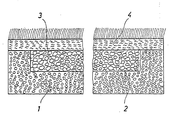
- the drawing shows in cross section a pad filled with a mass according to the invention.
- a molded body 1 made of PUR foam there is a recess 2 which is open on one side and in which the composition 3 according to the invention is embedded.
- the molded body 1 expediently forms the shape during the production of the mass 3.
- the recess 2 is covered by a layer 4, which in the exemplary embodiment shown consists of a fur imitation, but can also be formed from a textile material.
Landscapes
- Chemical & Material Sciences (AREA)
- Organic Chemistry (AREA)
- Polymers & Plastics (AREA)
- Engineering & Computer Science (AREA)
- Medicinal Chemistry (AREA)
- Health & Medical Sciences (AREA)
- Chemical Kinetics & Catalysis (AREA)
- Materials Engineering (AREA)
- Composite Materials (AREA)
- Mechanical Engineering (AREA)
- Polyurethanes Or Polyureas (AREA)
- Manufacture Of Porous Articles, And Recovery And Treatment Of Waste Products (AREA)
- Compositions Of Macromolecular Compounds (AREA)
- Manufacturing Of Micro-Capsules (AREA)
- Footwear And Its Accessory, Manufacturing Method And Apparatuses (AREA)
Claims (15)
Priority Applications (1)
| Application Number | Priority Date | Filing Date | Title |
|---|---|---|---|
| AT82890108T ATE23052T1 (de) | 1981-07-29 | 1982-07-29 | Verfahren zur herstellung einer masse fuer die abstuetzung von teilen, insbesondere von teilen des menschlichen koerpers und eine solche masse. |
Applications Claiming Priority (2)
| Application Number | Priority Date | Filing Date | Title |
|---|---|---|---|
| DE3129888A DE3129888C2 (de) | 1981-07-29 | 1981-07-29 | Verfahren zur Herstellung einer Masse für die Abstützung von Teilen des menschlichen Körpers |
| DE3129888 | 1981-07-29 |
Publications (2)
| Publication Number | Publication Date |
|---|---|
| EP0072364A1 EP0072364A1 (fr) | 1983-02-16 |
| EP0072364B1 true EP0072364B1 (fr) | 1986-10-22 |
Family
ID=6137986
Family Applications (1)
| Application Number | Title | Priority Date | Filing Date |
|---|---|---|---|
| EP19820890108 Expired EP0072364B1 (fr) | 1981-07-29 | 1982-07-29 | Procédé pour préparer une masse de support, en particulier pour supporter une partie du corps humain et masse ainsi obtenue |
Country Status (4)
| Country | Link |
|---|---|
| US (1) | US4502234A (fr) |
| EP (1) | EP0072364B1 (fr) |
| AT (1) | ATE23052T1 (fr) |
| DE (1) | DE3129888C2 (fr) |
Families Citing this family (49)
| Publication number | Priority date | Publication date | Assignee | Title |
|---|---|---|---|---|
| DE3216966C2 (de) * | 1982-05-06 | 1986-04-10 | Secans AG, Zug | Verfahren zur Herstellung einer elastischen Formsohle |
| KR930004059B1 (ko) * | 1984-12-28 | 1993-05-19 | 가부시끼가이샤 큐우빅 엔지니어링 | 완충재용 복합형 실리콘겔재 |
| US4658515A (en) * | 1985-02-05 | 1987-04-21 | Oatman Donald S | Heat insulating insert for footwear |
| DE3545521A1 (de) * | 1985-12-20 | 1987-07-02 | Ipa Bauchemie Gmbh | Verformbarer formkoerper sowie verwendung desselben und verfahren zu dessen herstellung |
| US4843735A (en) * | 1987-06-12 | 1989-07-04 | Kabushiki Kaisha Cubic Engineering | Shock absorbing type footwear |
| DE3802035A1 (de) * | 1988-01-25 | 1989-08-10 | Reichenecker Hans Storopack | Daempfungs- oder polsterkoerper zum einsatz in schuhen |
| IT1232798B (it) * | 1989-02-17 | 1992-03-05 | Pol Scarpe Sportive Srl | Struttura di suola traspirante/impermeabile per calzature. |
| US5273154A (en) * | 1989-06-15 | 1993-12-28 | Reiner Braun | Display cushion, process for its manufacture and display |
| US5096760A (en) * | 1989-07-20 | 1992-03-17 | Creme Art Corporation | Covered soft foam article |
| US5554694A (en) * | 1990-12-21 | 1996-09-10 | Crow; William R. | Performance enhancing athletic shoe components and methods |
| WO1992020249A1 (fr) * | 1991-05-17 | 1992-11-26 | Phurness Pty. Ltd. | Semelle de chaussure antistatique |
| EP0555476B1 (fr) * | 1991-08-27 | 1996-11-06 | Namba Press Works Co., Ltd. | Materiau cro te double d'un mince film de mousse latex et produit mousse integre utilisant ce materiau cro te |
| US5139864A (en) * | 1991-11-11 | 1992-08-18 | International Flavors & Fragrances Inc. | Multi-layer, multi-functional volatilizable substance delivery articles |
| GB9200495D0 (en) * | 1992-01-10 | 1992-02-26 | Cavalier Bemis Limited | Improvements in or relating to foam-filled articles having composite-material filled voids |
| GB9203186D0 (en) * | 1992-02-14 | 1992-04-01 | Balmoral Group | Process for producing microsphere containing thermosetting resin compositions |
| DK0630195T3 (da) * | 1992-02-18 | 2000-03-27 | Delta Thermal Systems Inc | Formbart skum med reversible forøgede varmelagringsegenskaber |
| US5695850A (en) * | 1993-01-29 | 1997-12-09 | Crow; William R. | Performance enhancing athletic shoe components and methods |
| US6343426B1 (en) * | 1994-12-29 | 2002-02-05 | Steven E. Robbins | Resilient sole for use in articles of footwear to enhance balance and stability |
| WO1996028057A1 (fr) * | 1995-03-15 | 1996-09-19 | Gel Sciences, Inc. | Construction de chaussure adaptable a base de gels et procede de fabrication de cette chaussure |
| US5830237A (en) * | 1996-03-05 | 1998-11-03 | Ohio Willow Wood Company | Gel and cushioning devices |
| CA2190764C (fr) * | 1995-03-20 | 2007-11-20 | Robert E. Arbogast | Gel et dispositifs de matelassage |
| US5603122A (en) * | 1995-03-20 | 1997-02-18 | Kania; Bruce | Form-fit sock |
| US6589630B1 (en) | 1995-03-23 | 2003-07-08 | William R. Crow | Performance enhancing shoe components and methods |
| US6120880A (en) * | 1995-03-23 | 2000-09-19 | Crow; William R. | Performance enhancing athletic shoe components and methods |
| EP0955964B1 (fr) * | 1996-07-31 | 2006-10-11 | Ohio Willow Wood Company | Gel et dispositifs d'amortissement |
| US6964688B1 (en) | 1996-07-31 | 2005-11-15 | Ohio Willow Wood Company | Tube sock-shaped covering |
| US6012726A (en) * | 1997-02-13 | 2000-01-11 | K-2 Corporation | In-line skate with temperature dependent support |
| DE69803794T2 (de) * | 1997-10-31 | 2002-10-31 | Kraton Polymers Research B.V., Amsterdam | Schaumzusammensetzung enthaltend öl, thermoplastisches elastomer und expandierbare polymerteilchen |
| US6564476B1 (en) | 1999-07-02 | 2003-05-20 | Bbc International, Ltd. | Flex sole |
| US6408544B1 (en) * | 1999-07-02 | 2002-06-25 | Bbc International Ltd. | Flex sole |
| US6367172B2 (en) * | 1999-07-02 | 2002-04-09 | Bbc International Ltd. | Flex sole |
| BR0110032A (pt) * | 2000-05-29 | 2003-05-27 | Rieter Automotive Int Ag | Estrutura para piso de veìculo leve |
| US6923834B2 (en) | 2000-10-04 | 2005-08-02 | Ossur Hf | Artificial limb socket containing volume control pad |
| US6589289B2 (en) | 2000-10-04 | 2003-07-08 | Ossur Hf | Prosthetic socket and socket component assembly |
| DE10138132B4 (de) * | 2001-08-09 | 2011-08-11 | Basf Se, 67063 | Polyurethane mit einer Shore A-Härte von 1 bis 20 |
| US20030198822A1 (en) * | 2002-04-19 | 2003-10-23 | Phillipp Schaefer | Leather assembly and method of fabricating a leather assembly |
| US7152342B2 (en) * | 2003-02-14 | 2006-12-26 | Roland Wilfried Sommer | Reversed kinetic system for shoe sole |
| US20060265907A1 (en) * | 2003-02-14 | 2006-11-30 | Sommer Roland W | Reversed kinetic system for shoe sole |
| US20050101693A1 (en) * | 2003-11-06 | 2005-05-12 | Ohio Willow Wood Company | Gel and cushioning devices |
| DE102007016791A1 (de) * | 2007-04-05 | 2008-10-09 | Heraeus Kulzer Gmbh | Schaumbildende, sich verfestigende Zusammensetzungen zur Abformung von Oberflächen und dafür geeignete Abformlöffel |
| US20090076625A1 (en) * | 2007-09-14 | 2009-03-19 | The Ohio Willow Wood Company | Reinforced prosthetic suspension sleeve |
| US7926204B2 (en) * | 2007-10-11 | 2011-04-19 | Nike, Inc. | Article of footwear with tubular sole assembly and method of manufacture |
| US20090240344A1 (en) * | 2008-03-19 | 2009-09-24 | The Ohio Willow Wood Company | Multi-layer polymeric prosthetic liner |
| US8317873B2 (en) * | 2010-02-23 | 2012-11-27 | The Ohio Willow Wood Company | Polymeric prosthetic liner with controlled stretch characteristics |
| EP2640760B1 (fr) | 2010-11-16 | 2015-07-08 | Basf Se | Nouvel élément amortisseur dans les semelles de chaussures |
| US9265629B2 (en) | 2011-04-01 | 2016-02-23 | The Ohio Willow Wood Company | Fabric covered polymeric prosthetic liner |
| US9282785B2 (en) | 2013-03-15 | 2016-03-15 | New Balance Athletic Shoe, Inc. | Multi-density sole elements, and systems and methods for manufacturing same |
| EP3226710B1 (fr) * | 2014-12-02 | 2022-04-27 | NIKE Innovate C.V. | Structure de semelle dotée d'éléments polymères creuses pour un article chaussant et son procédé de fabrication |
| US10130197B2 (en) * | 2016-03-07 | 2018-11-20 | Tansel Erten | Support material having an hourglass shape |
Family Cites Families (9)
| Publication number | Priority date | Publication date | Assignee | Title |
|---|---|---|---|---|
| US3355535A (en) * | 1963-12-13 | 1967-11-28 | Union Carbide Corp | Process for producing a shoe-upper |
| NL6606553A (fr) * | 1965-06-18 | 1967-11-13 | ||
| GB1195568A (en) * | 1966-08-23 | 1970-06-17 | Trw Inc | Foam Resins |
| DE2336136C2 (de) * | 1973-07-16 | 1975-05-28 | Philipp 3000 Hannover Schaefer | Polster mit Füllung sowie Verfahren zu seiner Herstellung |
| US4108928A (en) * | 1976-03-02 | 1978-08-22 | Hanson Industries Inc. | Method of producing a viscous flowable pressure-compensating fitting composition from hollow thermoplastic microblends with the use of high frequency heating and dispensing the composition into a sealable, flexible, protective enclosure means |
| US4128950A (en) * | 1977-02-07 | 1978-12-12 | Brs, Inc. | Multilayered sole athletic shoe with improved foam mid-sole |
| DE7807113U1 (de) * | 1978-03-09 | 1978-06-22 | Fa. Carl Freudenberg, 6940 Weinheim | Schuhunterteil |
| AT366565B (de) * | 1979-11-08 | 1982-04-26 | Schaefer Philipp | Formteil aus polyurethan und verfahren zur herstellung desselben |
| DE3123062A1 (de) * | 1981-06-11 | 1983-02-10 | Carsten 3000 Hannover Picker | "geschaeumter, elastischer formkoerper, sowie ein verfahren zu seiner herstellung" |
-
1981
- 1981-07-29 DE DE3129888A patent/DE3129888C2/de not_active Expired
-
1982
- 1982-07-28 US US06/402,597 patent/US4502234A/en not_active Expired - Fee Related
- 1982-07-29 AT AT82890108T patent/ATE23052T1/de not_active IP Right Cessation
- 1982-07-29 EP EP19820890108 patent/EP0072364B1/fr not_active Expired
Also Published As
| Publication number | Publication date |
|---|---|
| EP0072364A1 (fr) | 1983-02-16 |
| ATE23052T1 (de) | 1986-11-15 |
| DE3129888C2 (de) | 1985-01-03 |
| DE3129888A1 (de) | 1983-02-10 |
| US4502234A (en) | 1985-03-05 |
Similar Documents
| Publication | Publication Date | Title |
|---|---|---|
| EP0072364B1 (fr) | Procédé pour préparer une masse de support, en particulier pour supporter une partie du corps humain et masse ainsi obtenue | |
| DE69503139T2 (de) | Schuhwerk und dessen herstellung | |
| DE69820094T2 (de) | Gelenkpfannen-Auskleidung | |
| DE10254678B4 (de) | Formkörper, insbesondere für ein Sitzpolster | |
| EP1103371B1 (fr) | Corps moulés cellulaires en polyuréthane et procédé pour leur préparation | |
| DE69923813T2 (de) | Vorrichtung zum Halten der physikalischen Position von Personen | |
| WO1989006501A1 (fr) | Insertion elastique ou de rembourrage pour chaussures et son procede de fabrication | |
| DE2403652B2 (de) | Desodorierende schaumstoffolie und verfahren zu ihrer herstellung | |
| DE1544731A1 (de) | Verfahren zur Herstellung eines elastischen,zellhaltigen Materials | |
| DE1504919A1 (de) | Verfahren zur Herstellung von geformten Gegenstaenden aus Schaumkunststoffen und auf diese Weise hergestellte Gegenstaende bzw. Artikel | |
| DE10218533A1 (de) | Äußeres Fixierungsmittel für eine orthopädische Behandlung | |
| DE69508966T2 (de) | Verfahren zur herstellung eines thermoplastischen kunststoffes und damit versehenes immobilisationselement | |
| EP2840923A1 (fr) | Semelle intérieure | |
| DE102010015145B4 (de) | Thermoplastisch verformbare Schuheinlegesohle | |
| DE2336136C2 (de) | Polster mit Füllung sowie Verfahren zu seiner Herstellung | |
| DE102009060933B4 (de) | Integrales Dämpf- und Stützelement | |
| EP2636327B1 (fr) | Plastique pour semelle de chaussure | |
| DE3903743A1 (de) | Fussbettung fuer schuhe | |
| DE69615029T2 (de) | Massgeformtes kissen und verfahren dafür | |
| DE102015012660A1 (de) | Weicher isocyanatvernetzter Polymerwerkstoff und zugehörige Erzeugnisse | |
| DE1719266B2 (de) | Verfahren zur herstellung von polyurethan-polyharnstoff-schaumstoffen und -formteilen | |
| DE102014008513B4 (de) | Kontakteinlage für Fußsohlen | |
| DE2318013A1 (de) | Verfahren zur herstellung einer polstersohle und eines schuhes mit einer solchen sohle | |
| EP4353115B1 (fr) | Ébauche orthopédique de semelle intérieure de chaussure en mousse pur | |
| DE29614131U1 (de) | Preßkork-Formteil |
Legal Events
| Date | Code | Title | Description |
|---|---|---|---|
| PUAI | Public reference made under article 153(3) epc to a published international application that has entered the european phase |
Free format text: ORIGINAL CODE: 0009012 |
|
| AK | Designated contracting states |
Designated state(s): AT BE CH FR GB IT LI NL SE |
|
| 17P | Request for examination filed |
Effective date: 19830802 |
|
| RAP1 | Party data changed (applicant data changed or rights of an application transferred) |
Owner name: SECANS AG |
|
| GRAA | (expected) grant |
Free format text: ORIGINAL CODE: 0009210 |
|
| AK | Designated contracting states |
Kind code of ref document: B1 Designated state(s): AT BE CH FR GB IT LI NL SE |
|
| PG25 | Lapsed in a contracting state [announced via postgrant information from national office to epo] |
Ref country code: NL Effective date: 19861022 Ref country code: BE Effective date: 19861022 |
|
| REF | Corresponds to: |
Ref document number: 23052 Country of ref document: AT Date of ref document: 19861115 Kind code of ref document: T |
|
| ET | Fr: translation filed | ||
| ITF | It: translation for a ep patent filed | ||
| NLV1 | Nl: lapsed or annulled due to failure to fulfill the requirements of art. 29p and 29m of the patents act | ||
| PG25 | Lapsed in a contracting state [announced via postgrant information from national office to epo] |
Ref country code: LI Effective date: 19870731 Ref country code: CH Effective date: 19870731 |
|
| PLBE | No opposition filed within time limit |
Free format text: ORIGINAL CODE: 0009261 |
|
| STAA | Information on the status of an ep patent application or granted ep patent |
Free format text: STATUS: NO OPPOSITION FILED WITHIN TIME LIMIT |
|
| 26N | No opposition filed | ||
| REG | Reference to a national code |
Ref country code: CH Ref legal event code: PL |
|
| PG25 | Lapsed in a contracting state [announced via postgrant information from national office to epo] |
Ref country code: SE Effective date: 19890730 |
|
| PGFP | Annual fee paid to national office [announced via postgrant information from national office to epo] |
Ref country code: AT Payment date: 19891228 Year of fee payment: 8 |
|
| PGFP | Annual fee paid to national office [announced via postgrant information from national office to epo] |
Ref country code: GB Payment date: 19891231 Year of fee payment: 8 |
|
| PG25 | Lapsed in a contracting state [announced via postgrant information from national office to epo] |
Ref country code: FR Free format text: LAPSE BECAUSE OF NON-PAYMENT OF DUE FEES Effective date: 19900330 |
|
| REG | Reference to a national code |
Ref country code: FR Ref legal event code: ST |
|
| PG25 | Lapsed in a contracting state [announced via postgrant information from national office to epo] |
Ref country code: GB Effective date: 19900729 Ref country code: AT Effective date: 19900729 |
|
| GBPC | Gb: european patent ceased through non-payment of renewal fee | ||
| EUG | Se: european patent has lapsed |
Ref document number: 82890108.2 Effective date: 19900418 |