EP0072412A2 - Cellule de mémoire semi-conductrice dynamique - Google Patents
Cellule de mémoire semi-conductrice dynamique Download PDFInfo
- Publication number
- EP0072412A2 EP0072412A2 EP82105757A EP82105757A EP0072412A2 EP 0072412 A2 EP0072412 A2 EP 0072412A2 EP 82105757 A EP82105757 A EP 82105757A EP 82105757 A EP82105757 A EP 82105757A EP 0072412 A2 EP0072412 A2 EP 0072412A2
- Authority
- EP
- European Patent Office
- Prior art keywords
- layer
- region
- memory cell
- source
- conductivity type
- Prior art date
- Legal status (The legal status is an assumption and is not a legal conclusion. Google has not performed a legal analysis and makes no representation as to the accuracy of the status listed.)
- Granted
Links
Images
Classifications
-
- G—PHYSICS
- G11—INFORMATION STORAGE
- G11C—STATIC STORES
- G11C11/00—Digital stores characterised by the use of particular electric or magnetic storage elements; Storage elements therefor
- G11C11/21—Digital stores characterised by the use of particular electric or magnetic storage elements; Storage elements therefor using electric elements
- G11C11/34—Digital stores characterised by the use of particular electric or magnetic storage elements; Storage elements therefor using electric elements using semiconductor devices
-
- H—ELECTRICITY
- H10—SEMICONDUCTOR DEVICES; ELECTRIC SOLID-STATE DEVICES NOT OTHERWISE PROVIDED FOR
- H10B—ELECTRONIC MEMORY DEVICES
- H10B12/00—Dynamic random access memory [DRAM] devices
- H10B12/10—DRAM devices comprising bipolar components
-
- H—ELECTRICITY
- H10—SEMICONDUCTOR DEVICES; ELECTRIC SOLID-STATE DEVICES NOT OTHERWISE PROVIDED FOR
- H10B—ELECTRONIC MEMORY DEVICES
- H10B69/00—Erasable-and-programmable ROM [EPROM] devices not provided for in groups H10B41/00 - H10B63/00, e.g. ultraviolet erasable-and-programmable ROM [UVEPROM] devices
Definitions
- This invention relates to a high density, high performance memory cell.
- it relates to a dynamic storage device achieving high packing density that can be fabricated utilizing simple processing steps.
- a second requirement, mitigating against high packing density, is that each cell have a charge capacity per unit area which is at an acceptable level so that the charge stored therein is distinguishable from noise in the memory.
- packing density increases, the number of cells per chip increases and therefore the size of each cell for a given chip area decreases. Accordingly, the amount of charge that can be stored in an individual cell decreases, reaching a point where the amount of stored charged is unacceptably low.
- a balancing packing density vs. signal strength is therefore a serious consideration.
- U.S. Patent 3 852 800 describes a memory storage cell utilizing the inherent metal-insulator-semiconductor capacitance and the P-N junction capacitance at the source node of a field effect transistor. In order to enhance charge storage, an extended portion of the source diffusion in combination with overlying thin oxide and metal layers forms a capacitor. Accordingly, the 1 800 patent'utilizes a single IGFET with the binary data represented in the form of a stored charge arranged in a matrix of memory cells to define a random access memory.
- U.S. Patent 4 122 543 shows a variation of the MIS structure shown in the '800 patent by utilizing a second storage state having an MIIS element whose electric charge is controlled by the width of the channel formed between two depletion zones in a substrate which forms a first storage state.
- the MIIS structure is formed by a layer of metal covered by two layers of an insulator, the second being very thin and finally by semiconductor layer.
- the MIIS structure in the '543 patent acts when a positive voltage is applied to the metal layer with respect to the semiconductor layer. Electrons from the semiconductor pass through the thinnest insulating layer by tunnel effect and are trapped at the interface between the two interface layers. Alternatively, the electrons can be trapped in an ion implant area with the charge therein retained for a long period of time, in the order of one year. Erasure of the charge is obtained by applying a voltage in the opposite direction.
- U .S. Patent 4 164 751 also relates to a memory system integrated in a semiconductor substrate having an N+ region on a first surface of a semiconductor substrate forming a bit line and transistor source.
- a storage region is defined in the same surface spaced from the N+ region and comprises an N- type implant in the substrate near the first surface together with a P type implant in the substrate beneath the N type implant.
- An insulating layer is formed with a storage gate region and a transfer gate region formed overlying the insulating layer.
- each memory cell the charge is stored in both an oxide capacitor and in a depletion capacitor.
- the oxide capacitor is defined by the storage gate and an N type implant separated by an insulating layer.
- the depletion capacitor is formed by a storage region defined by two ion implants near the surface of the memory cell.
- the invention as claimed is intended to remedy these drawbacks. It solves the problem of how to design a memory cell having current flows smaller than in IGFET devices and one eliminating the requirement for thin film dielectrics, having low power dissipation and capable of being manufactured utilizing simple manufacturing techniques, and achieving high packing density while having low power dissipation.
- the storage device in accordance with the present invention utilizes a P+ injector region surrounded by a N+ region in a N- layer on a N+ region.
- the P+ injector region is positioned between a N+ source region and a N+ drain region. Holes injected into the N- layer are stored by the high-low-high junctions formed below the injector region and are detected by sensing of the source-drain current flow.
- the fabrication of the memory cell requires the use of only four masks in a self-aligned process once the pattern for isolation in the substrate has been defined.
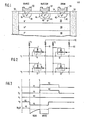
- a semiconductor substrate of e.g. silicon is generally shown as element 10.
- the substrate may be either N-type or P-type depending on design considerations. For purposes of explaining this embodiment it will be assumed that layer 10 is a P-type substrate, of resistivity 10-20 ⁇ -cm.
- a blanket subcollector N+ region 20 is formed upon which a N- epitaxial region 30 is grown. Isolation is achieved between memory cell units by deep dielectric isolation regions 32 formed on each side of the cell.
- a SiO 2 layer 34 covers the surface having subsequently etched open areas for source, drain and injector regions.
- an N+ implanted layer 38 is positioned.
- Below the drain opening 40 a second N+ implant 42 is positioned.
- a third N+ region 44 is implanted beneath the injector opening 46.
- a P+ region 48 is implanted above the N+ region 44.
- Metal lines 50, 52, and 54 are evaporated over the respective openings to define couplings to the source, injector and drain regions respectively.
- Metallization is known in the art to achieve separation between orthogonal (source-X and. drain, injector-Y) lines.
- the amount of holes stored depends on N- region doping, source and drain spacing, epi thickness and the forward bias on the P+ injector region. Storage, therefore, can easily be controlled by adjusting these parameters.
- the P+ injector region is held at ground potential and the drain region 42 is biased with respect to the source, which is also held at ground potential.
- a large current will initially flow between the source region 38 and the drain region 42 due to holes stored in the N- region 30. After all the stored holes are depleted from the N- region, only a small current will flow due to the high resistance of the N- region. This increase in current can be sensed so that the presence or absence of stored holes in the N- region can be used to define binary one or binary zero values for the memory cell.
- the increase in current between source and drain due to holes stored in the N-region is also controllable. It is apparent, then, that the holes injected into the N- layer 30 are initially trapped by the high-low-high junctions existing below the injector region. Accordingly, the system operates with high efficiency yet with low power dissipation. Moreover, as shown in Figure 1, utilizing deep dielectric isolation techniques, (DDI) high packing densities are achieved.
- DPI deep dielectric isolation techniques
- Figure 2 shows a circuit diagram representation of an array of memory cells forming a portion of a composite memory in accordance with this invention. It is understood that while only four cells in the array are shown, thousands are used to form a composite high density memory array.
- Figure 2 shows four cells denoted in conventional row number as 11 and 12 in the first row and cells 21 and 22 in the second row. The column structure of cells 11 and 21 forming one column to define the numbering sequence for the array.
- Each memory cell shown schematically has a source (S) injector (I) and drain (D) terminals.
- Forward biasing of the injector with respect to the source is accomplished by the voltage applied on lines y 1 , y 2 with respect to that imposed on lines x 1 and x 2 .
- Lines y 1 and y 2 form the write lines in the array while lines x 1 and x 2 form the read lines with outputs 0 1 and 0 2 , that is to determine the current flow from source S to drain D.
- the forward biasing reference voltage V2 is imposed on the drain line D via an external diode.
- the cycle begins with a read operation shown as point 2 in Figure 3.
- the operation will be discussed for devices 21 and 22 since simultaneous read out occurs.
- Line x 2 falls to a low potential (vl) and current flows into devices 21 and 22 but not into devices 11 and 12 since X1 is at the high level V2.
- the magnitude of the current is determined by the charge stored in devices 21 and 22 in the previous cycle. If no charge has been stored in device 21, the current has a low value and the output 01 falls by a small amount as indicated by the dotted line in Figure 3. Also, 02 falls by a small amount if no charge had been stored in device 22.
- line yl is raised to the high level (v2) as shown as point 3 in Figure 3.
- This high level V2 is shown as the solid line for y, in Figure 3. This is accomplished if charge has been sensed in the subsequent read operation and if it is desired to restore the old data. Accordingly, if restoration is desired, and if the old data was not a stored charge, then, line y 1 is held at the low level (vl). If new data is to be written, independent of any old data, yl is raised to the level v2 to store charge or held at level vl for no stored charge to take place. Device 22 is written simultaneously with device 21 but independently under the control of line y 2 .
- Cells 11 and 12 are not disturbed during the read or write operations on devices 21 and 22 because the diodes for those cells have not been forward biased.
- X 1 was held at the high level V2 during the read and write operations described above.
- Devices 11 and 12 are selected for read and write operations by lowering the voltage of line x 1 while holding line x 2 at a high value.
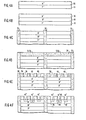
- the substrate 10 is P type of resistivity in the range of 10-20 n-cm.
- a lightly doped epitaxial region 30 of the same conductivity type as the subcollector region 20 is grown, typically with impurity doping in the range of 1.0 x 10 14 - 1 . 0 x 10 15 cm -3 . Region 3 0 is more lightly doped than region 20. Reoxidation of the epi layer 30 then takes place followed by the application of a resist material to define the memory cell pattern. Dielectric isolation techniques for complete isolation are preferable. These techniques are known in the technology, for example, as described in Bean and Ruyan, "Dielectric Isolation; Comprehensive, Current and Future", J. Electrochem. Soc., 124, 5 (1977).
- the oxide layer 34 is grown on the surface of the lightly doped layer 30, typically to a depth of 3000 A. This is shown in Fig. 4D. Applying photoresist and using a first mask, areas are opened for the source, drain and injector regions in the oxide layer 34. The opening for the source is shown as element 36, for the injector as opening 46, and for the drain as opening 40.
- implantation of the N+ regions 38 and 42 for source and drain takes place by ion implantation of arsenic. This is followed by the use of a third mask to implant the N+ region 44 at the injector utilizing phosphorous implantation.
- implantation of the P+ injector region 48 takes place by boron implantation. Following implantation of the three regions annealing of the implanted impurities takes place followed by evaporation of the metal lines to define the complete memory cell pattern.
- the substrate is shown as a P- type with the epitaxial region shown as the N type silicon, it is apparent that opposite conductivity types can be used. That is, the substrate can be formed of an N type silicon with the epitaxial layers formed of P type material. Similar reversal of the source, injector and drain regions will be necessary. Additionally, implantation impurities are not restricted to those defined with respect to Figure 4. It is apparent that other suitable materials may be implanted or diffused to form the source, injector and drain regions.
Landscapes
- Engineering & Computer Science (AREA)
- Computer Hardware Design (AREA)
- Semiconductor Memories (AREA)
- Static Random-Access Memory (AREA)
Applications Claiming Priority (2)
| Application Number | Priority Date | Filing Date | Title |
|---|---|---|---|
| US06/293,546 US4427989A (en) | 1981-08-14 | 1981-08-14 | High density memory cell |
| US293546 | 1981-08-14 |
Publications (3)
| Publication Number | Publication Date |
|---|---|
| EP0072412A2 true EP0072412A2 (fr) | 1983-02-23 |
| EP0072412A3 EP0072412A3 (en) | 1984-04-25 |
| EP0072412B1 EP0072412B1 (fr) | 1986-10-22 |
Family
ID=23129520
Family Applications (1)
| Application Number | Title | Priority Date | Filing Date |
|---|---|---|---|
| EP82105757A Expired EP0072412B1 (fr) | 1981-08-14 | 1982-06-29 | Cellule de mémoire semi-conductrice dynamique |
Country Status (4)
| Country | Link |
|---|---|
| US (1) | US4427989A (fr) |
| EP (1) | EP0072412B1 (fr) |
| JP (1) | JPS5846866B2 (fr) |
| DE (1) | DE3273921D1 (fr) |
Cited By (1)
| Publication number | Priority date | Publication date | Assignee | Title |
|---|---|---|---|---|
| WO2008137441A3 (fr) * | 2007-05-01 | 2008-12-31 | Dsm Solutions Inc | Cellule de mémoire vive dynamique à effet de champ à jonction et applications pour celle-ci |
Families Citing this family (13)
| Publication number | Priority date | Publication date | Assignee | Title |
|---|---|---|---|---|
| JPS62166134U (fr) * | 1986-04-11 | 1987-10-22 | ||
| US5266821A (en) * | 1988-05-31 | 1993-11-30 | Micron Technology, Inc. | Chip decoupling capacitor |
| US5687109A (en) * | 1988-05-31 | 1997-11-11 | Micron Technology, Inc. | Integrated circuit module having on-chip surge capacitors |
| US5032892A (en) * | 1988-05-31 | 1991-07-16 | Micron Technology, Inc. | Depletion mode chip decoupling capacitor |
| US5307309A (en) * | 1988-05-31 | 1994-04-26 | Micron Technology, Inc. | Memory module having on-chip surge capacitors |
| US6124625A (en) * | 1988-05-31 | 2000-09-26 | Micron Technology, Inc. | Chip decoupling capacitor |
| DE59105063D1 (de) * | 1991-01-09 | 1995-05-04 | Siemens Ag | Speicherzellenanordnung und verfahren zu deren betrieb. |
| US6114756A (en) | 1998-04-01 | 2000-09-05 | Micron Technology, Inc. | Interdigitated capacitor design for integrated circuit leadframes |
| US6414391B1 (en) | 1998-06-30 | 2002-07-02 | Micron Technology, Inc. | Module assembly for stacked BGA packages with a common bus bar in the assembly |
| JP3678212B2 (ja) * | 2002-05-20 | 2005-08-03 | ウシオ電機株式会社 | 超高圧水銀ランプ |
| US6755700B2 (en) * | 2002-11-12 | 2004-06-29 | Modevation Enterprises Inc. | Reset speed control for watercraft |
| DE202006007122U1 (de) * | 2006-05-03 | 2006-09-07 | Retzlaff, Udo, Dr. | Mobiler, transportabler, elektrostatischer Substrathalter aus Halbleitermaterial |
| US20240049476A1 (en) * | 2022-08-06 | 2024-02-08 | Euipil Kwon | Semiconducor device and method of fabricating the same |
Family Cites Families (3)
| Publication number | Priority date | Publication date | Assignee | Title |
|---|---|---|---|---|
| US3868718A (en) | 1972-06-30 | 1975-02-25 | Sony Corp | Field effect transistor having a pair of gate regions |
| US4328511A (en) | 1979-12-10 | 1982-05-04 | Texas Instruments Incorporated | Taper isolated ram cell without gate oxide |
| EP0030856B1 (fr) * | 1979-12-13 | 1984-03-21 | Fujitsu Limited | Cellule à mémoire semiconductrice à pompage de charges comprenant une région de stockage de charge et dispositif à mémoire utilisant ces cellules |
-
1981
- 1981-08-14 US US06/293,546 patent/US4427989A/en not_active Expired - Lifetime
-
1982
- 1982-06-10 JP JP57098631A patent/JPS5846866B2/ja not_active Expired
- 1982-06-29 DE DE8282105757T patent/DE3273921D1/de not_active Expired
- 1982-06-29 EP EP82105757A patent/EP0072412B1/fr not_active Expired
Cited By (1)
| Publication number | Priority date | Publication date | Assignee | Title |
|---|---|---|---|---|
| WO2008137441A3 (fr) * | 2007-05-01 | 2008-12-31 | Dsm Solutions Inc | Cellule de mémoire vive dynamique à effet de champ à jonction et applications pour celle-ci |
Also Published As
| Publication number | Publication date |
|---|---|
| JPS5833867A (ja) | 1983-02-28 |
| EP0072412A3 (en) | 1984-04-25 |
| US4427989A (en) | 1984-01-24 |
| DE3273921D1 (en) | 1986-11-27 |
| EP0072412B1 (fr) | 1986-10-22 |
| JPS5846866B2 (ja) | 1983-10-19 |
Similar Documents
| Publication | Publication Date | Title |
|---|---|---|
| US4298962A (en) | Memory | |
| KR100338462B1 (ko) | 자기증폭다이나믹mos트랜지스터메모리셀을포함하는장치제조방법 | |
| EP0399191B1 (fr) | Méthode de fabrication d'un transistor auto-aligné avec source et drain légèrement dopé formés dans une tranchée | |
| US3996657A (en) | Double polycrystalline silicon gate memory device | |
| US4427989A (en) | High density memory cell | |
| EP0169346B1 (fr) | Cellule de mémoire dynamique et son procédé de fabrication | |
| EP0145606A2 (fr) | Dispositif de mémoire semi-conducteur | |
| EP0272476B1 (fr) | Matrice de RAM dynamique de type VMOS à haute densité | |
| KR100317741B1 (ko) | 반도체장치 | |
| US6380598B1 (en) | Radiation hardened semiconductor memory | |
| US20240324196A1 (en) | Bit-erasable embedded select in trench memory (estm) | |
| US4833647A (en) | Semiconductor memory device having high capacitance and improved radiation immunity | |
| US7894255B1 (en) | Thyristor based memory cell | |
| US5149664A (en) | Self-aligning ion-implantation method for semiconductor device having multi-gate type MOS transistor structure | |
| US4353082A (en) | Buried sense line V-groove MOS random access memory | |
| US4471368A (en) | Dynamic RAM memory and vertical charge coupled dynamic storage cell therefor | |
| US7894256B1 (en) | Thyristor based memory cell | |
| US5502318A (en) | Bipolar gate charge coupled device with clocked virtual phase | |
| JPS61229353A (ja) | 集積回路型ダイナミツクメモリ | |
| EP0782186B1 (fr) | Procédé pour la formation d'un DRAM ayant une lamelle implantée enterrée pour des condensateurs des stockage en sillon | |
| EP0072414B1 (fr) | Cellule de mémoire semi-conductrice dynamique | |
| EP0225757B1 (fr) | Mémoire à semi-conducteur et son procédé de fabrication | |
| US4706107A (en) | IC memory cells with reduced alpha particle influence | |
| JPS61229352A (ja) | 集積回路型ダイナミツクメモリ及びその製造方法 | |
| CA1228425A (fr) | Cellule de memoire vive dynamique avec condensateur dans un sillon mos en technologie cmos |
Legal Events
| Date | Code | Title | Description |
|---|---|---|---|
| PUAI | Public reference made under article 153(3) epc to a published international application that has entered the european phase |
Free format text: ORIGINAL CODE: 0009012 |
|
| AK | Designated contracting states |
Designated state(s): DE FR GB |
|
| 17P | Request for examination filed |
Effective date: 19830621 |
|
| PUAL | Search report despatched |
Free format text: ORIGINAL CODE: 0009013 |
|
| AK | Designated contracting states |
Designated state(s): DE FR GB |
|
| GRAA | (expected) grant |
Free format text: ORIGINAL CODE: 0009210 |
|
| AK | Designated contracting states |
Kind code of ref document: B1 Designated state(s): DE FR GB |
|
| REF | Corresponds to: |
Ref document number: 3273921 Country of ref document: DE Date of ref document: 19861127 |
|
| ET | Fr: translation filed | ||
| PLBE | No opposition filed within time limit |
Free format text: ORIGINAL CODE: 0009261 |
|
| STAA | Information on the status of an ep patent application or granted ep patent |
Free format text: STATUS: NO OPPOSITION FILED WITHIN TIME LIMIT |
|
| 26N | No opposition filed | ||
| PGFP | Annual fee paid to national office [announced via postgrant information from national office to epo] |
Ref country code: GB Payment date: 19920506 Year of fee payment: 11 |
|
| PGFP | Annual fee paid to national office [announced via postgrant information from national office to epo] |
Ref country code: FR Payment date: 19920601 Year of fee payment: 11 |
|
| PGFP | Annual fee paid to national office [announced via postgrant information from national office to epo] |
Ref country code: DE Payment date: 19920619 Year of fee payment: 11 |
|
| PG25 | Lapsed in a contracting state [announced via postgrant information from national office to epo] |
Ref country code: GB Effective date: 19930629 |
|
| GBPC | Gb: european patent ceased through non-payment of renewal fee |
Effective date: 19930629 |
|
| PG25 | Lapsed in a contracting state [announced via postgrant information from national office to epo] |
Ref country code: FR Effective date: 19940228 |
|
| PG25 | Lapsed in a contracting state [announced via postgrant information from national office to epo] |
Ref country code: DE Effective date: 19940301 |
|
| REG | Reference to a national code |
Ref country code: FR Ref legal event code: ST |