EP0072672A2 - Dispositif de filtration et le procédé de filtration d'une suspension solide-liquide - Google Patents
Dispositif de filtration et le procédé de filtration d'une suspension solide-liquide Download PDFInfo
- Publication number
- EP0072672A2 EP0072672A2 EP82304269A EP82304269A EP0072672A2 EP 0072672 A2 EP0072672 A2 EP 0072672A2 EP 82304269 A EP82304269 A EP 82304269A EP 82304269 A EP82304269 A EP 82304269A EP 0072672 A2 EP0072672 A2 EP 0072672A2
- Authority
- EP
- European Patent Office
- Prior art keywords
- filter
- suspension
- filtrate
- filter cloth
- compartment
- Prior art date
- Legal status (The legal status is an assumption and is not a legal conclusion. Google has not performed a legal analysis and makes no representation as to the accuracy of the status listed.)
- Granted
Links
Images
Classifications
-
- B—PERFORMING OPERATIONS; TRANSPORTING
- B01—PHYSICAL OR CHEMICAL PROCESSES OR APPARATUS IN GENERAL
- B01D—SEPARATION
- B01D29/00—Filters with filtering elements stationary during filtration, e.g. pressure or suction filters, not covered by groups B01D24/00 - B01D27/00; Filtering elements therefor
- B01D29/50—Filters with filtering elements stationary during filtration, e.g. pressure or suction filters, not covered by groups B01D24/00 - B01D27/00; Filtering elements therefor with multiple filtering elements, characterised by their mutual disposition
- B01D29/52—Filters with filtering elements stationary during filtration, e.g. pressure or suction filters, not covered by groups B01D24/00 - B01D27/00; Filtering elements therefor with multiple filtering elements, characterised by their mutual disposition in parallel connection
-
- B—PERFORMING OPERATIONS; TRANSPORTING
- B01—PHYSICAL OR CHEMICAL PROCESSES OR APPARATUS IN GENERAL
- B01D—SEPARATION
- B01D29/00—Filters with filtering elements stationary during filtration, e.g. pressure or suction filters, not covered by groups B01D24/00 - B01D27/00; Filtering elements therefor
- B01D29/11—Filters with filtering elements stationary during filtration, e.g. pressure or suction filters, not covered by groups B01D24/00 - B01D27/00; Filtering elements therefor with bag, cage, hose, tube, sleeve or like filtering elements
- B01D29/31—Self-supporting filtering elements
- B01D29/35—Self-supporting filtering elements arranged for outward flow filtration
-
- B—PERFORMING OPERATIONS; TRANSPORTING
- B01—PHYSICAL OR CHEMICAL PROCESSES OR APPARATUS IN GENERAL
- B01D—SEPARATION
- B01D29/00—Filters with filtering elements stationary during filtration, e.g. pressure or suction filters, not covered by groups B01D24/00 - B01D27/00; Filtering elements therefor
- B01D29/44—Edge filtering elements, i.e. using contiguous impervious surfaces
-
- B—PERFORMING OPERATIONS; TRANSPORTING
- B01—PHYSICAL OR CHEMICAL PROCESSES OR APPARATUS IN GENERAL
- B01D—SEPARATION
- B01D29/00—Filters with filtering elements stationary during filtration, e.g. pressure or suction filters, not covered by groups B01D24/00 - B01D27/00; Filtering elements therefor
- B01D29/62—Regenerating the filter material in the filter
- B01D29/66—Regenerating the filter material in the filter by flushing, e.g. counter-current air-bumps
- B01D29/661—Regenerating the filter material in the filter by flushing, e.g. counter-current air-bumps by using gas-bumps
-
- B—PERFORMING OPERATIONS; TRANSPORTING
- B01—PHYSICAL OR CHEMICAL PROCESSES OR APPARATUS IN GENERAL
- B01D—SEPARATION
- B01D2201/00—Details relating to filtering apparatus
- B01D2201/04—Supports for the filtering elements
- B01D2201/0407—Perforated supports on both sides of the filtering element
Definitions
- the invention relates to filtering apparatus and methods of filtering a liquid-solids suspension, and more particularly, to filtration thickening methods and apparatus which can be used, for example, in ore processing and tailing thickening operations in the mining industry.
- mine tailing In mining operations, water, with and without chemical additives, is commonly used to separate the ore from the finely crushed rock and earth particles. All matter that is not ore is known as mine tailing and it is by far the largest portion of material involved in the operations. Mine tailing has no commercial value and is disposed of with a considerable amount of process water in large man-built tailing ponds provided for this purpose. In order to reduce the cost of recycling the process water and also to reduce the size and hence the cost of the tailing ponds and tailing conveyance equipment it is common practice to remove as much process water as possible before conveying the waste solids to the disposal pond. A method currently in use for this purpose is to pass the tailing through settlement basins known as thickeners which may be as large as 137 m in diameter.
- the suspension of solids that is to be thickened is introduced to one side of a filter cloth.
- the perforations of the filter cloth are sized to allow the passage of the liquid component of the suspension, but to prevent the passage of the solids component.
- Most filter-cloths consist of a woven fabric, commonly made of synthetic fibers, either loosely or tightly woven, as determined by the grain size of the suspended solids and by the desired clarity of the resulting filtrate.
- a known way of forcing liquid through the filter-cloth is to raise the pressure of the suspension to a higher value than the pressure of the filtrate on the opposite side of the filter cloth.
- Another known way of forcing liquid through the filter cloth is by applying a suction or vacuum on the filtrate side of the filter cloth.
- the suspended solids impinge on it, developing thereon a layer of solids known as filter cake.
- the filter cake thickness grows, the passage of liquid through the filter-cloth is impeded.
- the pressure differential on the two sides of the filter cloth is reversed.
- the filter cloth is not normally strong enough to withstand the desirable filtration pressure, nor in some cases the desired backwash pressure, it is common practice to provide supports means on either one or both sides of the filter cloth.
- These support means generally consist of rigid cages, screens, or perforated plates. The supports allow the passage of liquid but prevent the filter cloth from bursting.
- Suspensions from different industrial processes vary chemically, and in both size and shape of the particles that form their solids component. It can therefore be reasonably expected that various filter cakes will differ in their thicknesses, weights, toughnesses and the facility with which they disengage from the filter cloth.
- a particular filter cake may be very soft and light, such as results from filter thickening of natural clay slimes, a waste product from the processing of phosphate ore.
- the filter cake may be relatively dry, heavy and tough such as the product of filter thickening of tailing waste from base metal mining operations. It has been found that the gradation and specific gravity of the solids play a primary role in the ease or difficulty with which filter cake can be disengaged from the filter cloth.
- the filter or thickener apparatus must be capable of operating effectively and efficiently with a soft and light filter cake, or with a coarse filter cake, the apparatus being designed as required to suit one or several of the various industrial processes.
- filtering apparatus comprising tank means including a receiver for filter cake, filter means in said tank means including a filter cloth, supply means for supplying a liquid-solids suspension to said tank means on one side of said filter means and a filtrate compartment for receiving filtrate passing through to the other side of said filter means, whereby during the filtering process the liquid of the liquid-solids suspension flows from the supply means through the filter means and provides a reverse flow to backwash the filter means and dislodge filter cake.
- the invention also comprehends a method of filtering a liquid-solids suspension comprising pumping the suspension into a suspension compartment,forcing a liquid portion of the suspension through a filter cloth by pressurizing the suspension in said suspension compartment such that the liquid portion of the suspension flows through said filter cloth to become filtrate and a solids portion of the suspension collects on said filter cloth as filter cake, intermittently backwashing the liquid portion in a reverse direction through said filter cloth to force the solids portion to intrude into and adhere to a first side of an accumulator grating, and intermittently extruding the solids portion accumulated in said grating through a second side of said accumulator grating by the pressure of the solids portion deposited during subsequent cycles.
- Filtration thickening apparatus includes a thickener tank to which the tailing or other liquid-solid suspension is supplied.
- the tank has a receiver portion at the bottom for the accumulation of filter cake and a filtrate compartment at the top for collection of filtrate.
- Individual tubular filter units are suspended in the tank below the filtrate compartment and above the filter cake receiver portion.
- An overflow pipe is spaced above the filter units in the filtrate compartment for draining the filtrate liquid from the tank.
- the filter units preferably include either an accumulator grating or a filter cloth which is sealed along narrow bands to form a pattern of filtering areas or both.
- a centrifugal pump supplies the tailing from a holding tank to the thickener tank and a valve controls the discharge of filter cake from the receiver portion of the thickener tank.
- the process of filtration thickening a liquid-solids suspension in accordance with a preferred embodiment of the present invention includes pumping the suspension into a thickener tank.
- the liquid portion of the suspension is forced to flow through the filter cloth as filtrate and the solids portion collects on the filter cloth as filter cake.
- the filter cloth preferably is separated into filtering areas by liquid impermeable strips to improve the sloughing off of the filter cake during backwashing.
- a portion of the filtrate is intermittently backwashed to slough off the solids portion from the filter cloth.
- a centrifugal pump supplies the tailing to the thickener tank, forcing the liquid through the filter units and upwardly to a filtrate compartment from which the clarified liquid is discharged by gravity.
- Backwashing is accomplished by stopping the pump and simultaneously opening the underflow valve to discharge a portion of the filter cake underflow which has accumulated in the receiver portion of the tank.
- the hydrostatic head of the suspension in the thickener tank causes part of the suspension to drain back through the pump and into a holding tank which is disposed at a lower elevation. This action, together with the discharge of some filter cake underflow, creates a lower head in the thickener tank suspension than in the clarified liquid filtrate compartment, thus filtrate flow is reversed.
- Reversed flow from the filtrate compartment causes the clarified liquid to flow through the filter units in the reverse direction, thereby dislodging the filter cake and causing it to fall into the receiver at the bottom of the tank from whence it will be removed by the opening of the underflow valve in subsequent backwash cycles.
- the process can be repeated at time intervals as selected according to the rate at which the filter cake builds up on the filter units.
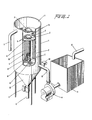
- a preferred embodiment of a filtering apparatus includes a thickener tank 1 having a suspension compartment 2 and a filtrate compartment 3.
- a separation plate 4 separates the suspension compartment 2 from the filtrate compartment 3.
- the separation plate 4 contains a plurality of approximately equally spaced holes or sockets 31 into each of which is placed a filter unit 5.
- Each filter unit 5 is suspended by a collar 6 in the hole 31 of the separation plate 4.
- Each collar 6 has a gasket 7 and is attached by bolts 8 to the separation plate 4 to ensure that there is no leakage of liquid between the filtrate compartment 3 and the suspension compartment 2 around the collars 6.
- the filtrate compartment 3 is provided with a filtrate overflow pipe 9 which is spaced a predetermined distance above the separation plate 4 in order to provide adequate backwash fluid and backwash pressure for the system.
- the vertical distance between the separation plate 4 and the lower end of the suspension compartment 2 is substantially greater than the length of each of the filter units 5, to provide a space in the lower portion of the suspension compartment 2 as a receiver portion for the accumulation of filter cake.
- the bottom of the receiver portion in the suspension compartment 2 is in the shape of a funnel 32 which is connected to an underflow pipe 10.
- a mechanized valve 11 controls the outflow of consolidated filter cake material through the underflow pipe 10.
- a supply pipe 12 supplies the liquid-solids suspension that is to be thickened into a holding tank 13.
- the suspension is pumped from the holding tank 13 by a first centrifugal pump 14 through a centrifugal pump outlet pipe 15 and into the suspension compartment 2.
- a second valve 80 may be provided in the centrifugal pump outlet pipe 15.
- the second valve 80 may be used to block the flow of suspension through the centrifugal pump outlet pipe 15 during the time that the valve 11 at the bottom of the thickener tank 1 is opened.
- the centrifugal pump 14 may be deactivated until the second valve 80 opens again.
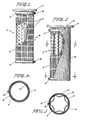
- Each filter unit 5 has a rigid pipe 16 which is closed at the bottom and open at the top and connected to the collars 6 by which it is suspended on the separation plate 4.
- the rigid pipe 16 has a plurality of perforations 17.
- Each perforated pipe 16 is surrounded by a filter cloth sleeve 18 which may be held in place by two strips 19 positioned at the bottom and the top edge of the rigid pipe 16.
- Each of the strips 19 may be tightened by the use of a strip fastener 68, Figure 2.
- the filter cloth 18 rests on or is stretched against the rigid pipe 16 which acts to support and prevent bursting of the filter cloth 18 under filtration pressure.
- a loose-fitting accumulator grating 20, Figure 1 surrounds the filter cloth 18 over the full length of the perforated pipe 16.
- the accumulator grating 20 may be fastened on the filter unit 5 by fasteners 67, Figure 3, or other suitable means.
- the accumulator grating 20 acts to accumulate and grip the filter cake during the backwash phase of the process and to prevent bursting of the filter cloth under backwash pressure.
- the distance between the perforated pipes 16 and the accumulator grating 20 is approximately the thickness of the filter cloth 18 and the anticipated filter cake to avoid tensioning the filter cloth.
- the pressure created in the suspension compartment 2 by the first centrifugal pump 14 is higher than the pressure within the filter units 5.
- This pressure difference forces the filter cloth 18 against the rigid pipe or support pipe 16 and causes the liquid portion of the suspension to flow from the outside to the inside of each filter unit. Filtrate passes through the filter cloth and through the perforations in the support pipe 16 and flows upwardly into the filtrate compartment. The solids from the suspension adhere to the filter cloth 18 to form the filter cake.
- a sufficient depth of filter cake has accumulated on the suspension side of the filter cloth 18, a rapid reversal of pressures on the suspension and filtrate side causes the filter cloth to flop across the space provided between the support pipe 16 and the accumulator grating 20.
- the filter cloth 18 is pressed against the accumulator grating 20 and the filter cake which is formed on the filter cloth is thus squeezed into the spaces on the accumulator grating and held therein.
- the pressure on the suspension side may now be raised to cause a return flop of the filter cloth 18. It has been found that the filter cake remains impinged on the accumulator grating 20 and the filter cloth 18 flops back in a clean condition.
- the gripping action of the accumulator grating 20 reduces the backwash requirement to a minute film of water while allowing complete disengagement of the filter cake from the filter cloth 18. With this system, no waiting period is required for the filter cake to fall away from the filter cloth.
- the return flop is unimpeded by the presence of filter cake impinged on the accumulator grating 20 because as soon as the pressure in the suspension compartment 2 is raised, the filter cake in a few of the openings in the accumulator grating which were clogged with filter cake is ejected through or washed through the accumulator grating.
- the pressurized suspension immediately finds its way through these few openings and pushes back the filter cloth 18 against the support pipe 16, and the cycle is repeated.
- the filter units 5 of Figure 1 would be most useful in cases where the filter cake.is thin, lightweight, soft and cohesive and therefore tends to adhere to the filter cloth.
- the rigid pipe or support screen 16 and the accumulator grating 20 are spaced apart at least a distance approximating the thickness of the anticipated filter cake.
- the support screen 16 may consist of punched metal, or rigid bars of woven mesh or any other support system which is used in the industry
- the accumulator grating 20 should preferably be of a rigid, deeper construction to enmesh and retain the filter cake. Expanded sheet metal has been used very successfully for the purpose.
- the openings in the accumulator grating 20 may be 100mm 2 to 500mm 2 , for example.
- the twisted components of this mesh act as excellent gripping surfaces for the filter cake.
- several contiguous layers of woven mesh could also be used.
- the centrifugal pump 14 pumps the liquid-solids suspension from the tank 13 into the suspension compartment 2, creating a high pressure therein, since the compartment 2 is closed and fluid can flow out of the compartment only through the filter units 5.
- the liquid is forced through the filter cloth to the interior of the perforated pipe 16, and the solids accumulate on an outer surface of the filter cloth 18 as filter cake.
- the size of the filter cloth openings would determine the clarity of the liquid which becomes filtrate when it passes through the filter cloth 18.
- the filtrate then flows up into the filtrate compartment 3 and accumulates in that compartment until its level reaches the overflow pipe 9 which then removes the filtrate for further use in the mining operation, or for other purposes.
- the high pressure of the suspension keeps the filter cloth 18 pressed against the perforated support pipe 16.
- valve 11 at the bottom of the thickener tank 1 may be opened to remove some of the filter cake which has accumulated in the receiver portion at the bottom of the suspension compartment 2 during previous cycles. Opening this valve 11 will accelerate the downward flow of the filtrate which accelerates, in turn, the commencement of the backwash cycle.
- the filtrate retained in the filtrate compartment 3 flows back down the perforated pipes 16 to initiate the backwash cycle forcing the filter cloth away from the perforated pipes 16 and expanding the filter cloth 18 outwardly against the accumulator grating 20.
- the filter cake on the filter cloth 18 is thus squeezed into the spaces of, and is gripped by, the accumulator grating 20.
- the centrifugal pump 14 is again started and the pressure in the suspension compartment rises again.
- the filter cloth 18 flops back against the perforated pipe 16 leaving the filter cake on the accumulator grating 20.
- a second valve 80 may shut off flow to and from the centrifugal pump outlet pipe 15. With the valve 11 open and the second valve 80 closed, the suspension will flow towards the bottom of the thickener tank 1 instead of back through the centrifugal pump 14. The flow of suspension towards the bottom of the thickener tank 1 will also cause a downward flow of the filtrate from the filtrate compartment 3 to initiate the backwash cycle. After the backwash cycle is completed, as explained in the preceding paragraphs, the second valve 80 is opened and the valve 11 is closed. After restart of the first centrifugal pump 14, the pressure in the suspension compartment 2 will again rise and the filtration process will resume.
- the accumulator grating fills to capacity with filter cake and the excess filter cake which has been squeezed all the way through the accumulator grating 20 falls down to the bottom of the suspension compartment 2.
- the filter cake is allowed to accumulate at the bottom of the suspension compartment 2 and thus to consolidate over a substantial depth in the lower portion of the suspension compartment before a quantity is extruded periodically through the underflow pipe 10 when the valve 11 is open.
- the valve 11 is preferably either completely open or completely closed and is not kept in a partially open position.
- the thickener tank 1 is preferably of substantial height and because it preferably has a relatively small diameter the lumps of filter cake which have fallen to the bottom of the suspension compartment 2 are easily extruded by the substantial hydrostatic head at the bottom of the thickener tank 1.
- This arrangement avoids the necessity of having to rake or mechanically remove the filter cake as is required in the conventional thickening systems.
- the rate of removal of the lumps of filter cake together with some of the suspension which is inevitably trapped between the lumps of filter cake will determine the thickening which can be achieved.
- the lumps of filter cake may be allowed to accumulate at the bottom of the suspension compartment 2 so that they will be compressed by their own weight into a more dense mass. This will expel upwards some of the suspension fluid trapped between the filter cake lumps thus achieving a higher effective thickening.
- a modified form of the filter unit 5' has the rigid perforated pipe 16 with the plurality of perforations or holes 17 therein.
- the filter cloth sleeve 18 is disposed over the perforated pipe 16 and the filter cloth is secured by a pair of support straps 19 to the perforated pipe 16.
- the filter cloth 18 has been separated into a plurality of filtering areas 26 by a plurality of fluid impermeable bands or strips 27.
- the filter cloth is sealed along these bands or strips 27 to provide a pattern of filtering areas which could be square, rectangular, triangular or any other two-dimensional area.
- the filter cake will then form only on the filtering areas 26 because the bands 27 are fluid impermeable.
- the bands 27 facilitate filter cake disengagement from the filter cloth 18 during backwash.
- the filter cloth 18 may be surrounded by an accumulator grating 20 (not illustrated).
- Filter cake is prevented from forming on top of the sealed strips 27 and therefore the cake can only form over the filtering areas on the surface of the cloth 18. Disengagement is thereby facilitated because the cake pieces are small and can immediately start sliding down the filter cloth 18 as the backwash cycle commences. There is no impediment to the initial sliding of the cakes because each filter cake piece is surrounded by a clear and narrow margin without'filter cake. The filter cake does not have to be broken up and pushed outwardly by the backwash as would happen if the filter cloth 18 were covered by one large surface of continuous filter cake.
- This version of the filter cloth operates very effectively with a tailing suspension comprised of a coarse gradation of solids which forms a tough, thick and heavy filter cake. The filter cake pieces, being heavier than the suspension, once disengaged from the filter cloth 18, will fall through the suspension to the bottom of the suspension compartment 2 from where they can be withdrawn.
- the filter cloth 18 can be sealed, for example, by the application of a somewhat flexible paint which can be coated along narrow 13mm to 16mm bands to form, for example, square grids of 152mm by 152mm.
- a somewhat flexible paint which can be coated along narrow 13mm to 16mm bands to form, for example, square grids of 152mm by 152mm.
- other ways of creating the sealed narrow bands such as impervious tape and other widths and other pattern shapes and sizes could naturally be used for the same purpose.
- An accumulator grating 20 may be also used with the filter unit 5'. Because the strips 27 are impermeable and will prevent any filter cake from accumulating over themselves, the accumulator grating 20 will always be free of filter cake opposite these treated strips or areas. The suspension can thus readily flow through the accumulator grating 20 at these locations to begin the next filtration cycle.
- a second modified form of the filter unit 5 11 has a corrugated perforated pipe 33 which is surrounded by a filter cloth sleeve 18.
- the perforated pipe 33 is corrugated in order to avoid stretching the filter cloth 18 during its flopping action. Thus the filter cloth 18 is prevented from being expanded against the larger diameter accumulator grating 20.
- the perforated pipe 33 which serves as the support screen is preferably shaped to be vertically corrugated over a central portion of its length as shown in Figure 5.
- the end portions of the perforated pipe 33 are not corrugated, see Figure 4. It has been found that horizontal corrugations will not perform adequately, rather, the corrugations should be substantially vertical or at least spiral. In other words, the corrugations must have a vertical component.
- FIG 5 are designed so that the perimeter distance along the surface of the perforated pipe 33 is substantially the same as the inside perimeter distance of the accumulator grating 20.
- the perforated pipe 33 is preferably made of a perforated metal which is rolled and then spot-welded.
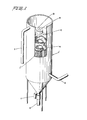
- a modified form of thickener tank 1 1 includes a suspension compartment 2', a first filtrate compartment 41 and a second filtrate compartment 42.
- a second centrifugal pump 43 is located between the two filtrate compartments 41, 42.
- the second centrifugal pump 43 is mounted on a second separating plate 70 which is secured to the thickener tank 1 1 .
- the second centrifugal pump 43 pumps filtrate, preferably a non-abrasive clear liquid, from the second filtrate compartment 42 down into the first filtrate compartment 41.
- the backwash pressure in the first filtrate compartment 41 exceeds the pressure normally developed by the first centrifugal pump 14 through the centrifugal pump outlet pipe 15 in the suspension compartment 2'.
- the second centrifugal pump 43 is stopped and the line pressure through the first centrifugal pump outlet pipe 15 again raises the pressure in the suspension compartment 2 to commence filtrate production.
- the filtrate flows from the inside of each filter unit 5 into the first filtrate compartment 41 and hence through the non-operating second centrifugal pump 43 and into the second filtrate compartment 42.
- the filtrate accumulates until it reaches the overflow pipe 9 which removes the filtrate from the thickener tank 1'.
- the filter cloth sleeve 18 for any of the above- described embodiments may be obtained from the Barrday division of Wheelabrator Corporation of Canada Limited located in Cambridge, Ontario and in Montreal, Quebec.
- a typical filter cloth material is style number fn2080 which is a 2/2 weave nylon fabric weighing 495 g/m 2 .
- Another typical filtration cloth is style number f3030 which is a plain weave terylene fabric weighing 136 g/m 2 .
- a United States company which manufactures filter cloth is Albany International Technical Fabrics Division 1400 Clinton Street Buffalo New York 14206.
- the preferred embodiment of the filter unit 5 may be 203mm to 305mm in diameter and is 3.66m to 6.1m long although lengths over 6.1m may be used.
- the perforations in the perforated pipes 16, 33 may be located 6.4mm away from each other and may be 3.2mm in diameter.
- a preferred thickener tank 1 may be 3.66m in diameter and 9.14m to 12.2m high.
- the filtrate overflow pipe 9 is disposed at least 0.6m above the separation plate 4 which separates the filtrate compartment 3 from the suspension compartment 2 although, as much as 2.4m or more of filtrate could be disposed in the filtrate compartment to provide the hydrostatic head used during the backwash cycle. That is, the filtrate overflow pipe 9 could be located 2.44m above the separation plate 4. The system does not need a rake at the bottom because of the pressure exerted by the hydrostatic head on the filter cake disposed in the funnel 32.
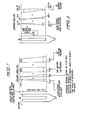
- a pressure cycle for a 6.1m long filter unit 5 in a thickener tank 1 having a 0.6m overflow can be calculated.
- the filtrate is water.
- the suspension pressure outside the filter unit 5 is calculated on the basis of a 50% solids by weight mixture having a specific gravity of the solids of 3. Therefore, the unit weight of the suspension is 1498 kg/m 3 .
- the pump or line pressure is assumed to be 172.4 kPa.
- the pressure of the clear filtrate or water inside the filter tube varies from zero at the point of overflow 0.6m above the filter unit 5, to -65.7 kPa at the bottom of the filter unit (the negative sign is used for those pressures that oppose filtrate and filter cake production but aid the backwash cycle).
- the pressure of the filtrate is -6 kPa.
- the suspension pressure at the top of the filter unit is zero, and increases linearly so that at the bottom it is 89.6 kPa.
- the net filtration pressure at the top of the filter unit is 166.4 kPa whereas the pressure at the bottom is 196.3 kPa during the pressure cycle.
- a backwash cycle for 6.1 m long filter unit 5 having a 0.6 m overflow and a suspension level in holding tank 13 located 3.66m from the top of the 6.1m long filter unit may be calculated.
- the clear filtrate water pressure inside the filter unit during the backwash cycle would drop at the top of the filter unit from -6 kPa at the start of the backwash cycle to zero at the end of the cycle, whereas at the bottom the corresponding water pressure would drop from -65.7 kPa to -59.7 kPa.
- the suspension pressure is -53.8 kPa at the top of the filter unit and 35.8 kPa at the bottom of the filter unit.
- the net backwash pressure thus ranges from -59.8 kPa to -53.8 kPa at the top of the filter unit 5 and is in the range of -29.9 kPa to -23.9 kPa at the bottom of the filter unit.
- the backwash pressure is not uniform over the height of the filter unit 5, this differential is not of much concern because both pressures are negative. All that is required to commence the backwash cycle is that a negative pressure be exerted at all points from inside the filter unit 5 to outside the filter unit to push the filter cloth 18 outwardly.
Landscapes
- Chemical & Material Sciences (AREA)
- Chemical Kinetics & Catalysis (AREA)
- Filtration Of Liquid (AREA)
- Electrical Discharge Machining, Electrochemical Machining, And Combined Machining (AREA)
- Soy Sauces And Products Related Thereto (AREA)
Applications Claiming Priority (2)
| Application Number | Priority Date | Filing Date | Title |
|---|---|---|---|
| US292737 | 1981-08-14 | ||
| US06/292,737 US4436633A (en) | 1981-08-14 | 1981-08-14 | Filtration thickening method and apparatus |
Publications (3)
| Publication Number | Publication Date |
|---|---|
| EP0072672A2 true EP0072672A2 (fr) | 1983-02-23 |
| EP0072672A3 EP0072672A3 (en) | 1984-08-01 |
| EP0072672B1 EP0072672B1 (fr) | 1987-04-01 |
Family
ID=23125982
Family Applications (1)
| Application Number | Title | Priority Date | Filing Date |
|---|---|---|---|
| EP82304269A Expired EP0072672B1 (fr) | 1981-08-14 | 1982-08-12 | Dispositif de filtration et le procédé de filtration d'une suspension solide-liquide |
Country Status (17)
| Country | Link |
|---|---|
| US (1) | US4436633A (fr) |
| EP (1) | EP0072672B1 (fr) |
| JP (1) | JPS5840118A (fr) |
| AU (1) | AU558554B2 (fr) |
| BR (1) | BR8204760A (fr) |
| CA (1) | CA1188626A (fr) |
| DE (1) | DE3275911D1 (fr) |
| ES (1) | ES514971A0 (fr) |
| FI (1) | FI72048C (fr) |
| GB (1) | GB2103952B (fr) |
| IN (1) | IN158521B (fr) |
| NO (1) | NO822753L (fr) |
| NZ (1) | NZ201576A (fr) |
| PT (1) | PT75426B (fr) |
| ZA (1) | ZA825598B (fr) |
| ZM (1) | ZM6482A1 (fr) |
| ZW (1) | ZW16482A1 (fr) |
Cited By (3)
| Publication number | Priority date | Publication date | Assignee | Title |
|---|---|---|---|---|
| EP0547512A1 (fr) * | 1991-12-13 | 1993-06-23 | Eltech Systems Corporation | Filtre de cristallisateur |
| WO1993020921A1 (fr) * | 1992-04-14 | 1993-10-28 | Caustec Aktiebolag | Dispositif de nettoyage de melanges de liqueurs caustiques |
| CN113171657A (zh) * | 2021-03-11 | 2021-07-27 | 邵福生 | 一种避免形成二次污染的道路施工除尘装置 |
Families Citing this family (26)
| Publication number | Priority date | Publication date | Assignee | Title |
|---|---|---|---|---|
| US4528103A (en) * | 1984-04-06 | 1985-07-09 | Dorr-Oliver Incorporated | Pressure filter |
| US4590994A (en) * | 1984-08-17 | 1986-05-27 | Champion Elmer L | Heat exchanger tube strainer |
| US5167814A (en) * | 1989-06-15 | 1992-12-01 | Cuno, Incorporated | Filter apparatus snap lock cartridge retainer |
| US5069786A (en) * | 1989-06-15 | 1991-12-03 | Cuno, Incorporated | Filter apparatus snap lock cartridge retainer |
| US4994332A (en) * | 1989-07-11 | 1991-02-19 | Eltech Systems Corporation | Metal hydroxide crystallizer and filter |
| US5509467A (en) * | 1994-06-28 | 1996-04-23 | Champion Clam Traps, Inc. | Heat exchanger tube strainer |
| JP2615528B2 (ja) * | 1995-02-13 | 1997-05-28 | 松下電器産業株式会社 | 抵抗溶接機用制御装置 |
| US7799235B2 (en) * | 2004-07-23 | 2010-09-21 | Contech Stormwater Solutions, Inc. | Fluid filter system and related method |
| US20070080118A1 (en) * | 2005-08-25 | 2007-04-12 | Municipal Filtration Company, Llc | Filter assembly |
| US8287726B2 (en) | 2007-08-15 | 2012-10-16 | Monteco Ltd | Filter for removing sediment from water |
| DE102008012521A1 (de) * | 2008-03-04 | 2009-09-17 | Rt-Filtertechnik Gmbh | Filtervorrichtung sowie Filterelement für eine dahingehende Filtervorrichtung |
| US8574431B2 (en) * | 2008-03-18 | 2013-11-05 | Municipal Filtration Company, Llc | Filter system with gas agitation |
| US8309711B2 (en) * | 2009-08-07 | 2012-11-13 | Corn Products Development Inc. | Filtration of corn starch followed by washing and collection of the resultant corn starch cake |
| DE102010055522B3 (de) * | 2010-12-22 | 2012-06-06 | Khs Gmbh | Vorrichtung und Verfahren zur Filtration von Fluiden |
| JP5709677B2 (ja) * | 2011-07-14 | 2015-04-30 | 東京特殊電線株式会社 | 巻き線型ろ材、巻き線型ろ材の製造方法、巻き線型ろ過エレメントおよび巻き線型ろ過エレメントの製造方法 |
| WO2013116895A1 (fr) * | 2012-02-08 | 2013-08-15 | Advanced Metallurgical Solutions Pty Ltd | Système de soutien de membrane tubulaire |
| CA2906036A1 (fr) * | 2013-03-15 | 2014-09-25 | Hayward Industries, Inc. | Support de filtration et son filtre |
| US9914076B2 (en) * | 2013-07-15 | 2018-03-13 | Clarus Fluid Intelligence, Llc | Convertible filtration system |
| CN104492141A (zh) * | 2014-12-11 | 2015-04-08 | 西南铝业(集团)有限责任公司 | 铝合金熔体管式过滤装置 |
| AU2016320582A1 (en) * | 2015-09-10 | 2018-04-26 | 1934612 Ontario Inc. | Methods and systems for dewatering solid particles in a contaminated liquid mixture |
| ITUA20161501A1 (it) * | 2016-03-09 | 2017-09-09 | Della Toffola Spa | Metodo e dispositivo perfezionato di prefiltrazione |
| EP3806975B1 (fr) * | 2018-06-13 | 2024-12-04 | Cargill, Incorporated | Procédé de filtration |
| CA3044946C (fr) * | 2018-09-17 | 2025-10-07 | McFarlen Engineering Ltd. | Element de soutien du filtre et methode d`utilisation |
| MX2021012000A (es) | 2019-04-03 | 2022-01-18 | Gregg Williams | Aparato, método y sistema de filtración de presión negativa. |
| KR20230039690A (ko) * | 2020-07-13 | 2023-03-21 | 에보쿠아 워터 테크놀로지스 엘엘씨 | 흐름 확산기를 구비한 재생 매체 필터 |
| US12215555B2 (en) * | 2023-03-21 | 2025-02-04 | Saudi Arabian Oil Company | Systems and methods for operating candle filters to recover glycols from drilling operations |
Family Cites Families (40)
| Publication number | Priority date | Publication date | Assignee | Title |
|---|---|---|---|---|
| US231066A (en) | 1880-08-10 | Filter | ||
| CA447057A (fr) | 1948-03-02 | Tecalemit Limited | Filtration de liquides | |
| CA790398A (en) | 1968-07-23 | Bowser | Filter | |
| US1194646A (en) | 1916-08-15 | linden | ||
| US1585817A (en) | 1925-07-01 | 1926-05-25 | Bailey Frank | Apparatus for straining fluids |
| US1716040A (en) | 1925-10-16 | 1929-06-04 | Genter Thickener Company | Continuous-filter thickening apparatus |
| US1945839A (en) | 1932-04-25 | 1934-02-06 | Maltitz Edmund Von | Filtering apparatus |
| GB404309A (en) | 1932-05-12 | 1934-01-12 | Leslie Donald Stuart | Improvements relating to filters |
| US2338549A (en) | 1941-08-01 | 1944-01-04 | Us Rubber Co | Filter bag |
| US2322586A (en) * | 1942-02-24 | 1943-06-22 | Oliver United Filters Inc | Filter |
| US2341097A (en) | 1942-12-14 | 1944-02-08 | Res Prod Corp | Filter |
| US2423172A (en) | 1944-04-19 | 1947-07-01 | Wallace & Tiernan Co Inc | Backwashing means for filtering apparatus by reverse flow of filtrate |
| US2568085A (en) | 1947-10-10 | 1951-09-18 | John J Naugle | Filtering device |
| US2668624A (en) * | 1949-07-14 | 1954-02-09 | Spraying Systems Co | Strainer attachment |
| US3019184A (en) | 1954-07-27 | 1962-01-30 | Judson G Brown | Filtering processes and apparatus for use in connection therewith |
| FR1133609A (fr) | 1955-10-11 | 1957-03-29 | Appareil pour le décolmatage automatique de filtres en usage | |
| US2940517A (en) | 1955-11-15 | 1960-06-14 | Napier & Son Ltd | Fluid filtering apparatus |
| US3019903A (en) | 1959-04-13 | 1962-02-06 | Beloit Iron Works | Fluid filter mechanism |
| US3155613A (en) | 1960-06-29 | 1964-11-03 | Laval Turbine | Filtering apparatus |
| US3233739A (en) | 1962-08-16 | 1966-02-08 | Industrial Filter Pump Mfg Co | Perforated tube |
| DE1891440U (de) * | 1964-02-18 | 1964-04-23 | Ferch & Nabben | Korbfilter. |
| US3374889A (en) | 1964-07-14 | 1968-03-26 | Simonacco Ltd | Filtration |
| FR1425297A (fr) * | 1964-08-28 | 1966-01-24 | Perfectionnements aux filtres à toile filtrante | |
| US3356215A (en) | 1965-04-22 | 1967-12-05 | Dorr Oliver Inc | Apparatus and method for the filtration-thickening of suspensions of solids |
| CH444820A (fr) * | 1965-09-16 | 1967-10-15 | Brasco Sa | Dispositif de raclage de l'élément filtrant d'une cellule de filtrage à nettoyage à contre-courant |
| GB1262874A (en) | 1968-05-23 | 1972-02-09 | Plessey Co Ltd | Improvements in or relating to self cleaning filter systems |
| GB1279606A (en) | 1968-09-27 | 1972-06-28 | English Clays Lovering Pochin | Improvements in or relating to filter thickeners |
| DE1807230A1 (de) | 1968-11-06 | 1970-05-27 | Boehringer Mannheim Gmbh | Verfahren und Vorrichtung zur kontinuierlichen Entnahme von klaren Fluessigkeitsproben |
| US3598238A (en) | 1969-07-30 | 1971-08-10 | Henry R Collins Jr | Apparatus for cleaning analyzer and other filters |
| US3645400A (en) | 1970-08-28 | 1972-02-29 | Terence John Floyd | Self-cleaning filter apparatus |
| GB1357643A (en) | 1971-08-26 | 1974-06-26 | Jessel Co Ltd | Filter candles |
| US3926804A (en) | 1972-06-13 | 1975-12-16 | Pro Tech Inc | Fluid filtration and sampling |
| SU538727A1 (ru) | 1974-01-16 | 1976-12-15 | Предприятие П/Я Р-6273 | Фильтр |
| US3935105A (en) * | 1974-11-12 | 1976-01-27 | Henry Manufacturing Co., Inc. | Tubular filter in settler |
| US4051033A (en) | 1975-12-22 | 1977-09-27 | Blace Filtronics, Inc. | Filter device |
| DE2645948C2 (de) | 1976-10-12 | 1987-01-08 | Honeywell-Braukmann GmbH, 6950 Mosbach | Rückspülbare Filtereinrichtung |
| GB1591631A (en) | 1977-01-27 | 1981-06-24 | Lucas Industries Ltd | Coanda-type filters |
| FI55937C (fi) | 1978-03-13 | 1979-11-12 | Enso Gutzeit Oy | Tryckfilter |
| FI62772C (fi) | 1978-11-28 | 1983-03-10 | Enso Gutzeit Oy | Tryckfilter |
| GB2074886B (en) * | 1980-04-22 | 1983-09-28 | British Sidac Ltd | Backwashable filter |
-
1981
- 1981-08-14 US US06/292,737 patent/US4436633A/en not_active Expired - Fee Related
-
1982
- 1982-08-03 ZA ZA825598A patent/ZA825598B/xx unknown
- 1982-08-05 AU AU86780/82A patent/AU558554B2/en not_active Ceased
- 1982-08-05 ZW ZW164/82A patent/ZW16482A1/xx unknown
- 1982-08-06 ZM ZM64/82A patent/ZM6482A1/xx unknown
- 1982-08-09 FI FI822772A patent/FI72048C/fi not_active IP Right Cessation
- 1982-08-10 CA CA000409141A patent/CA1188626A/fr not_active Expired
- 1982-08-11 IN IN615/DEL/82A patent/IN158521B/en unknown
- 1982-08-12 NO NO822753A patent/NO822753L/no unknown
- 1982-08-12 DE DE8282304269T patent/DE3275911D1/de not_active Expired
- 1982-08-12 GB GB08223271A patent/GB2103952B/en not_active Expired
- 1982-08-12 EP EP82304269A patent/EP0072672B1/fr not_active Expired
- 1982-08-13 BR BR8204760A patent/BR8204760A/pt unknown
- 1982-08-13 ES ES514971A patent/ES514971A0/es active Granted
- 1982-08-13 JP JP57139957A patent/JPS5840118A/ja active Granted
- 1982-08-13 PT PT75426A patent/PT75426B/pt unknown
- 1982-08-13 NZ NZ201576A patent/NZ201576A/en unknown
Cited By (4)
| Publication number | Priority date | Publication date | Assignee | Title |
|---|---|---|---|---|
| EP0547512A1 (fr) * | 1991-12-13 | 1993-06-23 | Eltech Systems Corporation | Filtre de cristallisateur |
| WO1993020921A1 (fr) * | 1992-04-14 | 1993-10-28 | Caustec Aktiebolag | Dispositif de nettoyage de melanges de liqueurs caustiques |
| US5518609A (en) * | 1992-04-14 | 1996-05-21 | Caustec | Device for cleaning of caustic liquid mixtures |
| CN113171657A (zh) * | 2021-03-11 | 2021-07-27 | 邵福生 | 一种避免形成二次污染的道路施工除尘装置 |
Also Published As
| Publication number | Publication date |
|---|---|
| ZA825598B (en) | 1983-07-27 |
| PT75426A (en) | 1982-09-01 |
| PT75426B (en) | 1984-11-12 |
| JPS6331247B2 (fr) | 1988-06-23 |
| FI822772A0 (fi) | 1982-08-09 |
| AU8678082A (en) | 1983-02-17 |
| ZM6482A1 (en) | 1984-04-23 |
| CA1188626A (fr) | 1985-06-11 |
| FI72048B (fi) | 1986-12-31 |
| EP0072672A3 (en) | 1984-08-01 |
| JPS5840118A (ja) | 1983-03-09 |
| ZW16482A1 (en) | 1983-05-18 |
| IN158521B (fr) | 1986-12-06 |
| GB2103952A (en) | 1983-03-02 |
| ES8402166A1 (es) | 1984-01-16 |
| FI72048C (fi) | 1987-04-13 |
| NO822753L (no) | 1983-02-15 |
| US4436633A (en) | 1984-03-13 |
| BR8204760A (pt) | 1983-08-02 |
| NZ201576A (en) | 1986-03-14 |
| FI822772L (fi) | 1983-02-15 |
| AU558554B2 (en) | 1987-02-05 |
| GB2103952B (en) | 1985-10-30 |
| EP0072672B1 (fr) | 1987-04-01 |
| DE3275911D1 (en) | 1987-05-07 |
| ES514971A0 (es) | 1984-01-16 |
Similar Documents
| Publication | Publication Date | Title |
|---|---|---|
| EP0072672B1 (fr) | Dispositif de filtration et le procédé de filtration d'une suspension solide-liquide | |
| JP3734227B2 (ja) | 上向流式高速濾過装置 | |
| US4196079A (en) | Pleated filter underdrain, method and apparatus | |
| US4116838A (en) | Sludge filter | |
| US3659718A (en) | Filter elements | |
| WO1989002776A1 (fr) | Milieu filtrant pour systemes de filtre | |
| US4515691A (en) | Filtration apparatus | |
| US4285816A (en) | Dewatering system | |
| EP0183767B1 (fr) | Filet tubulaire pour le traitement des eaux d'egout | |
| US4964987A (en) | Cross flow filter apparatus | |
| US3762560A (en) | Tube pressure filters | |
| US3735872A (en) | Filter system | |
| US4212737A (en) | Processes and apparatus for removing suspended matter from suspensions by filtration through foams | |
| RU2212125C2 (ru) | Отстойник-накопитель навоза крупного рогатого скота | |
| US5925258A (en) | Upright tubular filter unit and method of separation using the filter unit | |
| US3216569A (en) | Method of dewatering sewage sludge | |
| CN119367825A (zh) | 污水处理压滤设备 | |
| US4424125A (en) | Separator apparatus | |
| CN120305723B (zh) | 一种基于步进电机驱动滤布行走的智能固液分离装置 | |
| JPS6153093B2 (fr) | ||
| RU2033971C1 (ru) | Нефтеловушка-фильтр | |
| SU1754676A1 (ru) | Дренажна система иловой площадки | |
| SU1480850A1 (ru) | Устройство дл осветлени жидкости | |
| Pierson et al. | Tools for the job. | |
| JP2003199554A (ja) | 酒粕の固液分離装置 |
Legal Events
| Date | Code | Title | Description |
|---|---|---|---|
| PUAI | Public reference made under article 153(3) epc to a published international application that has entered the european phase |
Free format text: ORIGINAL CODE: 0009012 |
|
| AK | Designated contracting states |
Designated state(s): DE FR GB SE |
|
| PUAL | Search report despatched |
Free format text: ORIGINAL CODE: 0009013 |
|
| AK | Designated contracting states |
Designated state(s): DE FR GB SE |
|
| 17P | Request for examination filed |
Effective date: 19841211 |
|
| RBV | Designated contracting states (corrected) |
Designated state(s): DE FR SE |
|
| RAP1 | Party data changed (applicant data changed or rights of an application transferred) |
Owner name: LAING, DAVID HARKNESS Owner name: ROBINSKY, ELI IVAN |
|
| GRAA | (expected) grant |
Free format text: ORIGINAL CODE: 0009210 |
|
| AK | Designated contracting states |
Kind code of ref document: B1 Designated state(s): DE FR SE |
|
| PG25 | Lapsed in a contracting state [announced via postgrant information from national office to epo] |
Ref country code: FR Free format text: THE PATENT HAS BEEN ANNULLED BY A DECISION OF A NATIONAL AUTHORITY Effective date: 19870401 |
|
| REF | Corresponds to: |
Ref document number: 3275911 Country of ref document: DE Date of ref document: 19870507 |
|
| PG25 | Lapsed in a contracting state [announced via postgrant information from national office to epo] |
Ref country code: SE Effective date: 19870813 |
|
| EN | Fr: translation not filed | ||
| PLBE | No opposition filed within time limit |
Free format text: ORIGINAL CODE: 0009261 |
|
| STAA | Information on the status of an ep patent application or granted ep patent |
Free format text: STATUS: NO OPPOSITION FILED WITHIN TIME LIMIT |
|
| 26N | No opposition filed | ||
| PG25 | Lapsed in a contracting state [announced via postgrant information from national office to epo] |
Ref country code: DE Effective date: 19880503 |
|
| EUG | Se: european patent has lapsed |
Ref document number: 82304269.2 Effective date: 19880711 |