EP0072987A1 - Neue cytostatisch wirksame Epoxidgruppen tragende 1,3,2-Oxazaphosphorin-Verbindungen, Verfahren zu ihrer Herstellung sowie ihre Verwendung in pharmazeutischen Zubereitungen - Google Patents
Neue cytostatisch wirksame Epoxidgruppen tragende 1,3,2-Oxazaphosphorin-Verbindungen, Verfahren zu ihrer Herstellung sowie ihre Verwendung in pharmazeutischen Zubereitungen Download PDFInfo
- Publication number
- EP0072987A1 EP0072987A1 EP82107361A EP82107361A EP0072987A1 EP 0072987 A1 EP0072987 A1 EP 0072987A1 EP 82107361 A EP82107361 A EP 82107361A EP 82107361 A EP82107361 A EP 82107361A EP 0072987 A1 EP0072987 A1 EP 0072987A1
- Authority
- EP
- European Patent Office
- Prior art keywords
- radical
- compounds
- glycidyl
- general formula
- hydroxy
- Prior art date
- Legal status (The legal status is an assumption and is not a legal conclusion. Google has not performed a legal analysis and makes no representation as to the accuracy of the status listed.)
- Withdrawn
Links
- 238000002360 preparation method Methods 0.000 title claims abstract description 11
- 238000000034 method Methods 0.000 title claims abstract description 9
- 230000008569 process Effects 0.000 title claims abstract description 8
- MIQVAKCNWBAWPC-UHFFFAOYSA-N 2h-1,3,2-oxazaphosphinine Chemical group O1PN=CC=C1 MIQVAKCNWBAWPC-UHFFFAOYSA-N 0.000 title claims description 13
- 125000003700 epoxy group Chemical group 0.000 title description 5
- 239000008194 pharmaceutical composition Substances 0.000 title 1
- 150000001875 compounds Chemical class 0.000 claims abstract description 22
- 239000004215 Carbon black (E152) Substances 0.000 claims abstract description 9
- 229930195733 hydrocarbon Natural products 0.000 claims abstract description 9
- 229910052739 hydrogen Inorganic materials 0.000 claims abstract description 7
- 239000001257 hydrogen Substances 0.000 claims abstract description 6
- 239000000825 pharmaceutical preparation Substances 0.000 claims abstract description 5
- -1 glycidyl radical Chemical class 0.000 claims description 30
- 150000003254 radicals Chemical class 0.000 claims description 17
- 230000001085 cytostatic effect Effects 0.000 claims description 8
- 125000004432 carbon atom Chemical group C* 0.000 claims description 7
- 229910052801 chlorine Inorganic materials 0.000 claims description 5
- 239000000460 chlorine Substances 0.000 claims description 5
- 229910052736 halogen Inorganic materials 0.000 claims description 5
- ZAMOUSCENKQFHK-UHFFFAOYSA-N Chlorine atom Chemical compound [Cl] ZAMOUSCENKQFHK-UHFFFAOYSA-N 0.000 claims description 4
- 150000002367 halogens Chemical class 0.000 claims description 4
- WKBOTKDWSSQWDR-UHFFFAOYSA-N Bromine atom Chemical compound [Br] WKBOTKDWSSQWDR-UHFFFAOYSA-N 0.000 claims description 3
- GDTBXPJZTBHREO-UHFFFAOYSA-N bromine Substances BrBr GDTBXPJZTBHREO-UHFFFAOYSA-N 0.000 claims description 3
- 229910052794 bromium Inorganic materials 0.000 claims description 3
- UFHFLCQGNIYNRP-UHFFFAOYSA-N Hydrogen Chemical compound [H][H] UFHFLCQGNIYNRP-UHFFFAOYSA-N 0.000 claims description 2
- 150000002431 hydrogen Chemical class 0.000 claims description 2
- 229910052740 iodine Inorganic materials 0.000 claims description 2
- 239000000969 carrier Substances 0.000 claims 1
- 125000004435 hydrogen atom Chemical class [H]* 0.000 abstract 2
- CSCPPACGZOOCGX-UHFFFAOYSA-N Acetone Chemical compound CC(C)=O CSCPPACGZOOCGX-UHFFFAOYSA-N 0.000 description 12
- 238000004440 column chromatography Methods 0.000 description 6
- 241001465754 Metazoa Species 0.000 description 5
- 239000000047 product Substances 0.000 description 5
- 206010028980 Neoplasm Diseases 0.000 description 4
- 239000004480 active ingredient Substances 0.000 description 4
- 238000006243 chemical reaction Methods 0.000 description 4
- 239000000203 mixture Substances 0.000 description 4
- YMWUJEATGCHHMB-UHFFFAOYSA-N Dichloromethane Chemical compound ClCCl YMWUJEATGCHHMB-UHFFFAOYSA-N 0.000 description 3
- BRLQWZUYTZBJKN-UHFFFAOYSA-N Epichlorohydrin Chemical compound ClCC1CO1 BRLQWZUYTZBJKN-UHFFFAOYSA-N 0.000 description 3
- 239000004593 Epoxy Substances 0.000 description 3
- HEMHJVSKTPXQMS-UHFFFAOYSA-M Sodium hydroxide Chemical compound [OH-].[Na+] HEMHJVSKTPXQMS-UHFFFAOYSA-M 0.000 description 3
- ZMANZCXQSJIPKH-UHFFFAOYSA-N Triethylamine Chemical compound CCN(CC)CC ZMANZCXQSJIPKH-UHFFFAOYSA-N 0.000 description 3
- QVGXLLKOCUKJST-UHFFFAOYSA-N atomic oxygen Chemical compound [O] QVGXLLKOCUKJST-UHFFFAOYSA-N 0.000 description 3
- 201000011510 cancer Diseases 0.000 description 3
- 239000012043 crude product Substances 0.000 description 3
- 125000004122 cyclic group Chemical group 0.000 description 3
- 125000003055 glycidyl group Chemical group C(C1CO1)* 0.000 description 3
- 125000005842 heteroatom Chemical group 0.000 description 3
- 238000001819 mass spectrum Methods 0.000 description 3
- 239000001301 oxygen Substances 0.000 description 3
- 229910052760 oxygen Inorganic materials 0.000 description 3
- 239000002904 solvent Substances 0.000 description 3
- 239000000126 substance Substances 0.000 description 3
- 125000001424 substituent group Chemical group 0.000 description 3
- OUPZKGBUJRBPGC-UHFFFAOYSA-N 1,3,5-tris(oxiran-2-ylmethyl)-1,3,5-triazinane-2,4,6-trione Chemical compound O=C1N(CC2OC2)C(=O)N(CC2OC2)C(=O)N1CC1CO1 OUPZKGBUJRBPGC-UHFFFAOYSA-N 0.000 description 2
- 238000005160 1H NMR spectroscopy Methods 0.000 description 2
- 125000001340 2-chloroethyl group Chemical group [H]C([H])(Cl)C([H])([H])* 0.000 description 2
- IJGRMHOSHXDMSA-UHFFFAOYSA-N Atomic nitrogen Chemical compound N#N IJGRMHOSHXDMSA-UHFFFAOYSA-N 0.000 description 2
- RTZKZFJDLAIYFH-UHFFFAOYSA-N Diethyl ether Chemical compound CCOCC RTZKZFJDLAIYFH-UHFFFAOYSA-N 0.000 description 2
- 239000013543 active substance Substances 0.000 description 2
- IJKVHSBPTUYDLN-UHFFFAOYSA-N dihydroxy(oxo)silane Chemical compound O[Si](O)=O IJKVHSBPTUYDLN-UHFFFAOYSA-N 0.000 description 2
- 238000002474 experimental method Methods 0.000 description 2
- 238000002347 injection Methods 0.000 description 2
- 239000007924 injection Substances 0.000 description 2
- 229910052757 nitrogen Inorganic materials 0.000 description 2
- 125000004433 nitrogen atom Chemical group N* 0.000 description 2
- 239000000546 pharmaceutical excipient Substances 0.000 description 2
- 230000000144 pharmacologic effect Effects 0.000 description 2
- 239000000376 reactant Substances 0.000 description 2
- 239000007790 solid phase Substances 0.000 description 2
- 230000004083 survival effect Effects 0.000 description 2
- ZZVDXRCAGGQFAK-UHFFFAOYSA-N 2h-oxazaphosphinine Chemical class N1OC=CC=P1 ZZVDXRCAGGQFAK-UHFFFAOYSA-N 0.000 description 1
- ZCYVEMRRCGMTRW-UHFFFAOYSA-N 7553-56-2 Chemical compound [I] ZCYVEMRRCGMTRW-UHFFFAOYSA-N 0.000 description 1
- 206010009944 Colon cancer Diseases 0.000 description 1
- 201000008228 Ependymoblastoma Diseases 0.000 description 1
- 206010014968 Ependymoma malignant Diseases 0.000 description 1
- GHASVSINZRGABV-UHFFFAOYSA-N Fluorouracil Chemical compound FC1=CNC(=O)NC1=O GHASVSINZRGABV-UHFFFAOYSA-N 0.000 description 1
- 206010058467 Lung neoplasm malignant Diseases 0.000 description 1
- 241000699666 Mus <mouse, genus> Species 0.000 description 1
- 241000699670 Mus sp. Species 0.000 description 1
- 239000003513 alkali Substances 0.000 description 1
- 230000002152 alkylating effect Effects 0.000 description 1
- 150000001408 amides Chemical class 0.000 description 1
- 239000000010 aprotic solvent Substances 0.000 description 1
- 125000003710 aryl alkyl group Chemical group 0.000 description 1
- 125000003118 aryl group Chemical group 0.000 description 1
- 239000002585 base Substances 0.000 description 1
- 125000001797 benzyl group Chemical group [H]C1=C([H])C([H])=C(C([H])=C1[H])C([H])([H])* 0.000 description 1
- 239000003054 catalyst Substances 0.000 description 1
- 238000002512 chemotherapy Methods 0.000 description 1
- 150000003945 chlorohydrins Chemical class 0.000 description 1
- 238000013375 chromatographic separation Methods 0.000 description 1
- 238000002648 combination therapy Methods 0.000 description 1
- 125000000113 cyclohexyl group Chemical group [H]C1([H])C([H])([H])C([H])([H])C([H])(*)C([H])([H])C1([H])[H] 0.000 description 1
- 125000001511 cyclopentyl group Chemical group [H]C1([H])C([H])([H])C([H])([H])C([H])(*)C1([H])[H] 0.000 description 1
- 239000000824 cytostatic agent Substances 0.000 description 1
- 239000003814 drug Substances 0.000 description 1
- 230000008030 elimination Effects 0.000 description 1
- 238000003379 elimination reaction Methods 0.000 description 1
- 229960002949 fluorouracil Drugs 0.000 description 1
- 239000012433 hydrogen halide Substances 0.000 description 1
- 229910000039 hydrogen halide Inorganic materials 0.000 description 1
- 150000003949 imides Chemical group 0.000 description 1
- 239000011630 iodine Substances 0.000 description 1
- ZFSLODLOARCGLH-UHFFFAOYSA-N isocyanuric acid Chemical group OC1=NC(O)=NC(O)=N1 ZFSLODLOARCGLH-UHFFFAOYSA-N 0.000 description 1
- 208000032839 leukemia Diseases 0.000 description 1
- 201000005296 lung carcinoma Diseases 0.000 description 1
- 230000010534 mechanism of action Effects 0.000 description 1
- HAWPXGHAZFHHAD-UHFFFAOYSA-N mechlorethamine Chemical class ClCCN(C)CCCl HAWPXGHAZFHHAD-UHFFFAOYSA-N 0.000 description 1
- 201000001441 melanoma Diseases 0.000 description 1
- 239000002808 molecular sieve Substances 0.000 description 1
- 238000000655 nuclear magnetic resonance spectrum Methods 0.000 description 1
- 239000003208 petroleum Substances 0.000 description 1
- 239000012071 phase Substances 0.000 description 1
- 125000001997 phenyl group Chemical group [H]C1=C([H])C([H])=C(*)C([H])=C1[H] 0.000 description 1
- 208000029340 primitive neuroectodermal tumor Diseases 0.000 description 1
- 238000000746 purification Methods 0.000 description 1
- 150000003856 quaternary ammonium compounds Chemical class 0.000 description 1
- 239000011541 reaction mixture Substances 0.000 description 1
- 230000035484 reaction time Effects 0.000 description 1
- 230000009257 reactivity Effects 0.000 description 1
- 229920006395 saturated elastomer Polymers 0.000 description 1
- URGAHOPLAPQHLN-UHFFFAOYSA-N sodium aluminosilicate Chemical compound [Na+].[Al+3].[O-][Si]([O-])=O.[O-][Si]([O-])=O URGAHOPLAPQHLN-UHFFFAOYSA-N 0.000 description 1
- 239000000243 solution Substances 0.000 description 1
- 239000007858 starting material Substances 0.000 description 1
- 150000003512 tertiary amines Chemical class 0.000 description 1
- 238000002560 therapeutic procedure Methods 0.000 description 1
- 238000004809 thin layer chromatography Methods 0.000 description 1
- 125000003944 tolyl group Chemical group 0.000 description 1
- 238000007740 vapor deposition Methods 0.000 description 1
- 125000005023 xylyl group Chemical group 0.000 description 1
Classifications
-
- C—CHEMISTRY; METALLURGY
- C07—ORGANIC CHEMISTRY
- C07F—ACYCLIC, CARBOCYCLIC OR HETEROCYCLIC COMPOUNDS CONTAINING ELEMENTS OTHER THAN CARBON, HYDROGEN, HALOGEN, OXYGEN, NITROGEN, SULFUR, SELENIUM OR TELLURIUM
- C07F9/00—Compounds containing elements of Groups 5 or 15 of the Periodic Table
- C07F9/02—Phosphorus compounds
- C07F9/547—Heterocyclic compounds, e.g. containing phosphorus as a ring hetero atom
- C07F9/6564—Heterocyclic compounds, e.g. containing phosphorus as a ring hetero atom having phosphorus atoms, with or without nitrogen, oxygen, sulfur, selenium or tellurium atoms, as ring hetero atoms
- C07F9/6581—Heterocyclic compounds, e.g. containing phosphorus as a ring hetero atom having phosphorus atoms, with or without nitrogen, oxygen, sulfur, selenium or tellurium atoms, as ring hetero atoms having phosphorus and nitrogen atoms with or without oxygen or sulfur atoms, as ring hetero atoms
- C07F9/6584—Heterocyclic compounds, e.g. containing phosphorus as a ring hetero atom having phosphorus atoms, with or without nitrogen, oxygen, sulfur, selenium or tellurium atoms, as ring hetero atoms having phosphorus and nitrogen atoms with or without oxygen or sulfur atoms, as ring hetero atoms having one phosphorus atom as ring hetero atom
- C07F9/65842—Cyclic amide derivatives of acids of phosphorus, in which one nitrogen atom belongs to the ring
- C07F9/65846—Cyclic amide derivatives of acids of phosphorus, in which one nitrogen atom belongs to the ring the phosphorus atom being part of a six-membered ring which may be condensed with another ring system
-
- A—HUMAN NECESSITIES
- A61—MEDICAL OR VETERINARY SCIENCE; HYGIENE
- A61P—SPECIFIC THERAPEUTIC ACTIVITY OF CHEMICAL COMPOUNDS OR MEDICINAL PREPARATIONS
- A61P35/00—Antineoplastic agents
Definitions
- DE-OS 29 07 349 relates to pharmaceutical preparations with cytostatic activity which contain triglycidyl isocyanurate (TGI) as the active ingredient.
- TGI triglycidyl isocyanurate
- the three N atoms of the isocyanuric acid ring are occupied by epoxy groups.
- the alkylating effect of these epoxy groups is presumably responsible for the cytostatic activity of the T G I derivative.
- European patent application 81 100 544.6 describes pharmaceutical preparations with cytostatic activity which are characterized by a content of N-heterocycles which contain at least two glycidyl-substituted N atoms in amide and / or imide form in the ring system. involved, included. Numerous specific examples of such N-glycidyl substituted heterocyclic compounds are given.
- GB-PS 812 651 describes 2 H-1,3,2-0xazaphosphorin-2-amine-N, N-bis- (2-chloroethyl-) tetrahydro-2-oxide, while in FR-PS 1 530 962 the 2 H-1,3,2-0xaza- phosphorin-3 (2-chloroethyl) -2- [(2-chloroethylamino] - tetrahydro-2-oxide is described.
- the corresponding derivative with three 2-chloroethyl groups is also known,
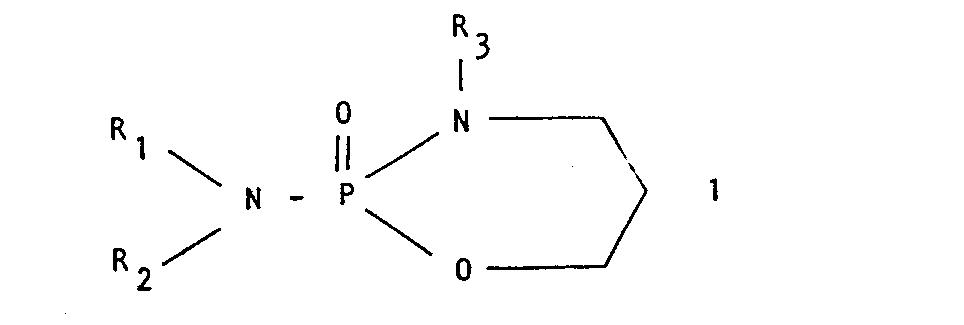
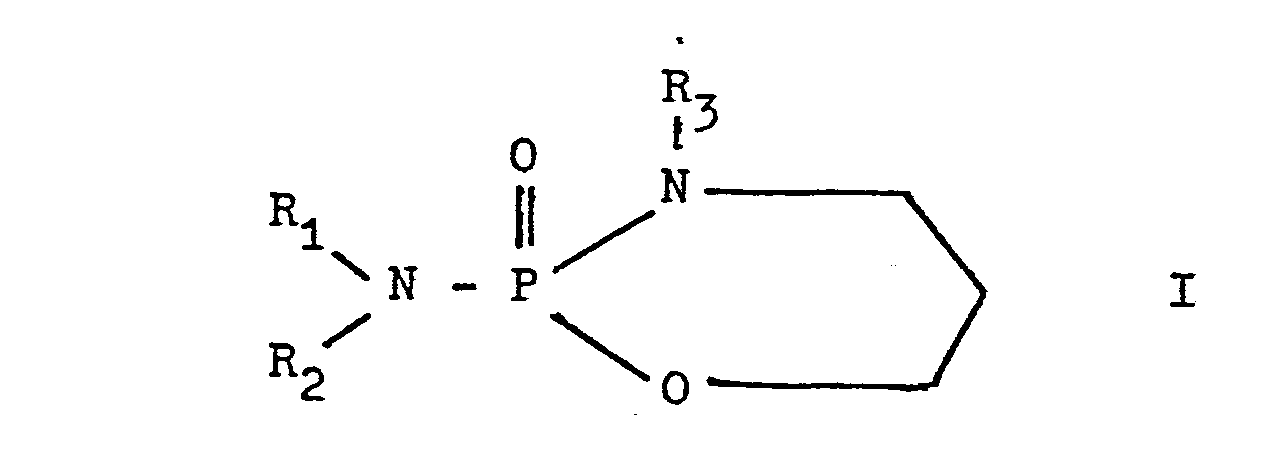
- the invention relates in a first embodiment to new glycidyl-substituted 1,3,2-oxazaphosphorin compounds of the general formula I; in which R 1 , R 2 and R 3 are hydrogen, the glycidyl radical and / or a 3-hydroxy-2-halopropyl radical with the proviso that at least 2 glycidyl radicals or at least 1 glycidyl radical together with at least one 3-hydroxy-2- Halogen-propyl radical are present, where R 1 can also mean a hydrocarbon radical,
- the invention relates to pharmaceutical preparations which are characterized by a content of the new glycidyl-substituted 1,3,2-oxazaphosphorin compounds of the general formula I and which contain these in particular in a mixture with customary auxiliaries or excipients for pharmacological preparations.
- the invention relates to the process for the preparation of the new cytostatically active compounds of the general formula I.
- one of these active radicals on the ring nitrogen is present as the radical R 3 .
- the two remaining radicals R 1 and R 2 or at least one of these two radicals are also a glycidyl radical or the 3-hydroxy-2-halopropyl radical mentioned.
- radical R 1 here can be a hydrocarbon radical which can also contain heteroatoms. N, 0, S and / or P are particularly suitable as heteroatoms.
- This radical preferably contains a total of no more than 12 carbon atoms and expediently no more than 8 carbon atoms.
- radicals can be of interest which contain up to 6 or preferably even only up to 4 carbon atoms, the numerical values being to be understood independently of the particular structure and relating only to the sum of all carbon atoms in the radical concerned.
- R is an aryl, aralkyl or alkaryl radical
- 1-ring substituents are particularly preferred here. Typical representatives are phenyl, benzyl, tolyl, xylyl and related compounds.
- R 1 mononuclear ring systems based on cyclopentyl, cyclohexyl and their descendants are also preferred Scope of the invention.
- the ring systems can preferably contain 1, 2 or 3 such heteroatoms. These heterocyclic radicals preferably contain 5 or 6 ring members.
- R 1 hydrocarbon radical
- this radical denotes an alkyl radical, which can also be substituted.
- This alkyl radical can be straight-chain or branched and saturated or unsaturated and preferably contains not more than 8, in particular not more than 6, carbon atoms. Unsubstituted alkyl radicals having up to 4 carbon atoms are particularly preferred in this embodiment.
- substituents on the radical R 1 the rule here applies to the compounds of the general formula I which are preferably used in the context of the invention that, at least under normal conditions, such substituting groups show no or no substantial reactivity with the epoxy group of the glycidyl substituent. In this way it is ensured that the compounds according to the invention are sufficiently stable in storage and that no undesired reaction takes place while the epoxy groups are destroyed.
- the preferred halogen in the 3-hydroxy-2-halogen-propyl radical for R 1 , R 2 and / or R 3 is chlorine, although the other halogens, in particular bromine, are not excluded.
- the invention relates to the process for the preparation of the new 1,3,2-oxazaphosphorin compounds of the general formula I.
- the process is characterized in that the 1,3,2-oxazaphosphorin compounds of the general formula II Introduces glycidyl radical and / or the 3-hydroxy-2-halopropyl radical in a manner known per se.
- R 1 is hydrogen or a hydrocarbon radical of the constitution given above.
- Suitable for the preparation of the new compounds of the general formula I is in particular the reaction of corresponding phosphoric acid ester diamides with epihalohydrins and subsequent complete or at least partial elimination of hydrogen halide with alkali.
- These starting compounds of the general formula II are reacted with epihalohydrins in a manner known per se. It can be carried out in the presence of small amounts of bases, for example tertiary amines or quaternary ammonium compounds as a catalyst.
- the reaction is expediently carried out in temperature range up to about 150 ° C.
- the preferred epihalohydrins contain chlorine or optionally bromine as halogen.
- the reaction can be carried out in suitable solvents, in particular aprotic solvents, which dissolve at least one of the reactants and are not reactive towards the reactants.
- the preferred reaction time is 1 to 10 hours, especially 2 to 5 hours.
- the compounds of the general formula I according to the invention can be separated from the crude reaction mixtures in a conventional manner, for example by chromatographic separation processes, and can be obtained in pure form. These new compounds of the general formula I are preferably obtained in such a form, in particular in such purity that they can be used as medicaments.
- the pharmaceutical mixtures according to the invention which are characterized by a content of compounds of the general formula I, contain these active substances in suitable vehicles.
- the usual auxiliaries or excipients for pharmacological preparations are suitable here.
- the invention finally relates to the use of these compounds or mixtures of substances for the therapy of malignant neoplasms.
- the compounds used according to the invention are active against various forms of leukemia such as malignant neoplasms such as lung carcinoma, colon carcinoma, melanoma, ependymoblastoma and sarcome. Combination therapy in combination with other cytostatics, such as derivatives of nitrogen mustard or fluorouracil, is possible.
- mice In mice, the tumor type PS 2684 ip with 10 6 cells / mouse was set according to protocol 1200 (page 91 c). The mean survival of the untreated animals is determined.
- the active ingredient is applied to the treated animals.
- injections are administered as single doses on 9 days in varying individual amounts as specified below.
- a significant increase in the lifespan of the treated test animals compared to the mean survival of the animals not treated with the active ingredient is achieved.
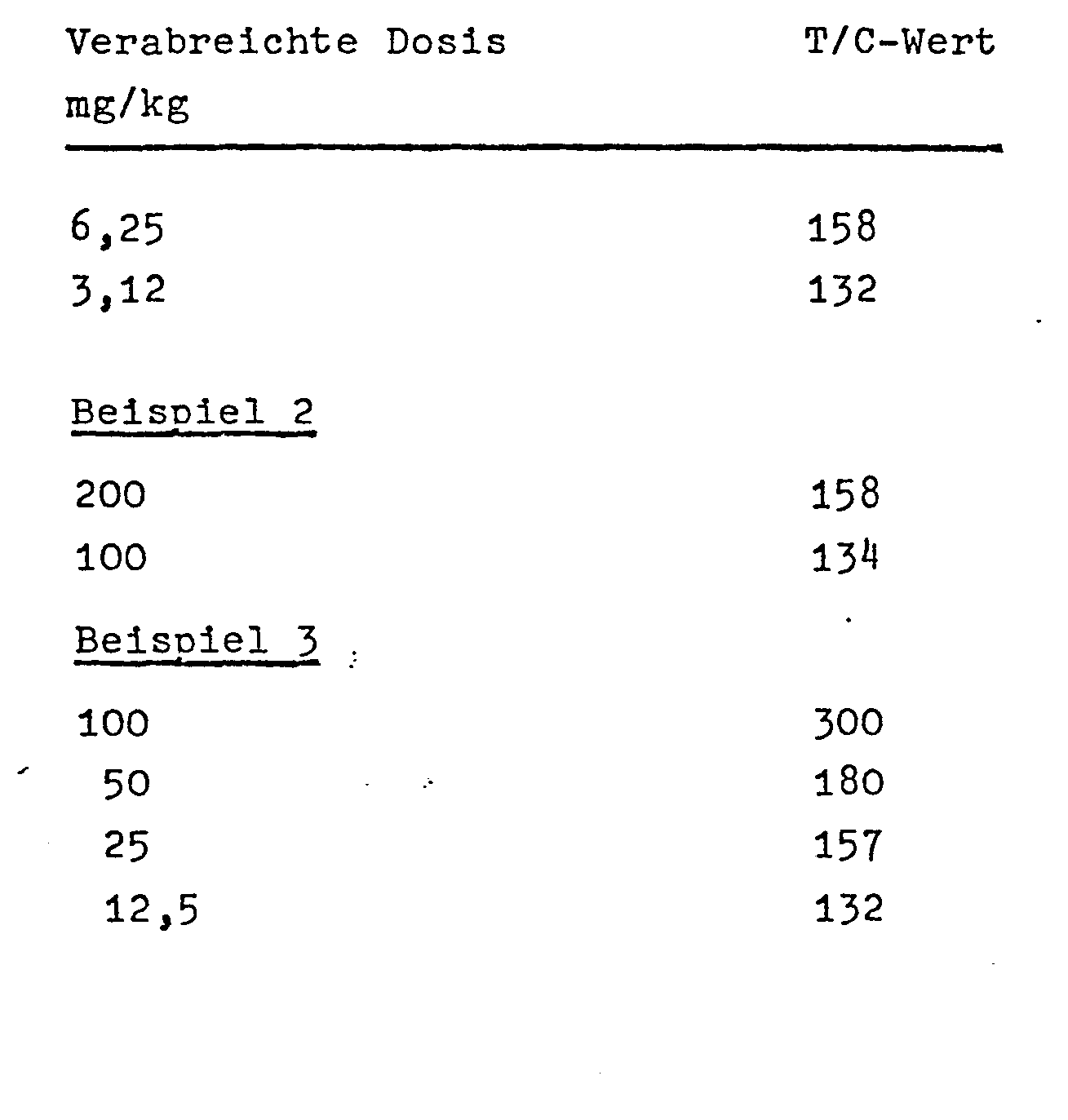
- the extension rate T / C depending on the dosage of the active ingredient is as follows:
Landscapes
- Chemical & Material Sciences (AREA)
- Organic Chemistry (AREA)
- Health & Medical Sciences (AREA)
- Life Sciences & Earth Sciences (AREA)
- General Health & Medical Sciences (AREA)
- General Chemical & Material Sciences (AREA)
- Molecular Biology (AREA)
- Chemical Kinetics & Catalysis (AREA)
- Biochemistry (AREA)
- Medicinal Chemistry (AREA)
- Nuclear Medicine, Radiotherapy & Molecular Imaging (AREA)
- Pharmacology & Pharmacy (AREA)
- Animal Behavior & Ethology (AREA)
- Public Health (AREA)
- Veterinary Medicine (AREA)
- Pharmaceuticals Containing Other Organic And Inorganic Compounds (AREA)
Abstract

Description
- Gegenstand der DE-OS 29 07 349 sind Arzneimittelzubereitungen mit cytostatischer Wirksamkeit, die als Wirkstoff Triglycidylisocyanurat (TGI) enthalten. Die drei N-Atome des Isocyanursäureringes sind hier mit Epoxidgruppen besetzt. Vermutlich ist die alkylierende Wirkung dieser Epoxidgruppen für die cytostatische Wirksamkeit des TGI-Derivats verantwortlich zu machen.
- Die Europäische Patentanmeldung 81 100 544.6 schildert Arzneimittelzubereitungen mit cytostatischer Wirksamkeit, die durch einen Gehalt an N-Heterocyclen gekennzeichnet sind, welche wenigstens zwei Glycidyl-substituierte N-Atome in Amid-und/oder Imidform in das Ringsystem. eingebunden, enthalten. Es werden zahlreiche spezielle Beispiele für solche N-Glycidyl-substituierte heterocyclische Verbindungen angegeben.
- Bekannt ist weiterhin, daß eine ganz andere Stoffklasse ausgeprägte cytostatische Wirksamkeit aufweist. Es handelt sich hier um Verbindungen aus der Klasse der substituierten 1,3,2-Oxazaphosphorin-Verbindungen. So beschreibt die GB-PS 812 651 das 2 H-1,3,2-0xazaphosphorin-2-amin-N,N-bis-(2-chloroethyl-) tetrahydro-2-oxid, während in der FR-PS 1 530 962 das 2 H-1,3,2-0xaza- phosphorin-3(2-chlorethyl)-2- [(2-chlorethylamino]-tetrahydro-2-oxid beschrieben ist. Bekannt ist auch das entsprechende Derivat mit drei 2-Chlorethylgruppen,
- Es wurde jetzt im Tierversuch festgestellt, daß neue Glycidyl-substituierte 1,3,2-0xazaphosphorin-Verbindungen der im folgenden angegebenen Struktur ausgesprochene cytostatische Aktivität aufweisen.
- Gegenstand der Erfindung sind dementsprechend in einer ersten Ausführungsform neue Glycidyl-substituierte 1,3,2-Oxazaphosphorin-Verbindungen der allgemeinen Formel I ;
- Die Erfindung betrifft in einer weiteren Ausführungsform Arzneimittelzubereitungen, die durch einen Gehalt an den neuen Glycidyl-substituierten 1,3,2-Oxazaphosphorin-Verbindungen der allgemeinen Formel I gekennzeichnet sind und diese insbesondere in Abmischung mit üblichen Hilfs- beziehungsweise Trägerstoffen für pharmakologische Zubereitungen enthalten. Schließlich betrifft die Erfindung in einer weiteren Ausführungsform das Verfahren zur Herstellung der neuen cytostatisch aktiven Verbindungen der allgemeinen Formel I.
- Der Wirkungsmechanismus der im Rahmen der Erfindung eingesetzten Verbindungen ist im einzelnen nicht geklärt. Vermutlich sind jedoch auch hier - wie bei den Glycidyl-substituierten Verbindungen der DE-OS 29 07 349 beziehungsweise der Europäischen Patentanmeldung 81 100 544.6 die Glycidylreste für die cytostatische Wirkung mitverantwortlich. Neben der erfindungsgemäß wenigstens einfach vorliegenden Glycidylgruppe dürfte auch dem 3-Hydroxy-2-chloro-propyl-Rest Bedeutung zukommen.
- In einer bevorzugten Ausführungsform der Erfindung liegt einer dieser aktiven Reste am Ringstickstoff als Rest R3 vor. Die beiden verbleibenden Reste R1 und R2 oder wenigstens einer dieser beiden Reste sind gleichfalls ein Glycidyl-Rest oder der genannte 3-Hydroxy-2-Halogenpropyl-Rest.
- In den Rahmen der Erfindung fallen allerdings auch solche Oxazaphosphorin-Verbindungen, in denen insgesamt nur 2 der genannten aktiven Substituenten in N-Stellung vorliegen. Insbesondere kann hier der Rest R1 ein Kohlenwasserstoffrest sein, der auch Heteroatome enthalten kann. Als Heteroatome kommen insbesondere N, 0, S und/oder P in Betracht. Bevorzugt enthält dieser Rest insgesamt nicht mehr als 12 Kohlenstoffatome und dabei zweckmäßig nicht mehr als 8 Kohlenstoffatome. Interessant können insbesondere Reste sein, die bis zu 6 oder vorzugsweise sogar nur bis zu 4 Kohlenstoffatome enthalten, wobei die Zahlenwerte unabhängig von der jeweiligen Struktur zu verstehen sind und sich lediglich auf die Summe aller Kohlenstoffatome im betroffenen Rest beziehen.
- Bedeutet R einen Aryl-, Aralkyl- oder Alkarylrest, so sind hier insbesondere 1-kernige Substituenten bevorzugt. Typische Vertreter sind Phenyl, Benzyl, Tolyl, Xylyl und verwandte Verbindungen. Auch bei den cycloaliphatischen Ringen für den Rest R1 sind 1-kernige Ringsysteme auf der Basis von Cyclopentyl, Cyclohexyl und ihren Abkömmlingen bevorzugt, Entsprechende heterocyclische Reste, insbesondere also 1-kernige Ringverbindungen mit 0, N und/oder S im System fallen in den Rahmen der Erfindung. Die Ringsysteme können dabei bevorzugt 1,2 oder 3 solcher Heteroatome enthalten. Diese heterocyclischen Reste enthalten vorzugsweise 5 oder 6 Ringglieder.
- In einer bevorzugten Ausführungsform der Erfindung bedeutet im Falle R1 = Kohlenwasserstoffrest dieser Rest einen Alkylrest, der auch substituiert sein kann. Dieser Alkylrest kann geradkettig oder verzweigt und gesättigt oder ungesättigt sein und enthält vorzugsweise nicht mehr als 8 insbesondere nicht mehr als 6 Kohlenstoffatome. Besonders bevorzugt sind in dieser Ausführungsform unsubstituierte Alkylreste mit bis zu 4 C-Atome.
- Liegen an dem Rest R1 Substituenten vor, so gilt hier für die im Rahmen der Erfindung bevorzugt eingesetzten Verbindungen der allgemeinen Formel I die Regel, daß solche substituierenden Gruppen wenigstens unter Normalbedingungen keine oder keine wesentliche Reaktivität mit der Epoxidgruppe des Glycidylsubstituenten zeigen. Auf diese Weise ist sichergestellt, daß die erfindungsgemäßen Verbindungen hinreichend lagerbeständig sind und keine unerwünschte Umsetzung unter Vernichtung der Epoxidgruppierungen stattfindet.
- Das bevorzugte Halogen im 3-Hydroxy-2-Halogen-Propylrest für R1, R2 und/oder R3 ist Chlor, wenn auch die anderen Halogene insbesondere Brom nicht ausgeschlossen sind.
- In einer weiteren Ausführungsform betrifft die Erfindung das Verfahren zur Herstellung der neuen 1,3,2-Oxazaphosphorin-Verbindungen der allgemeinen Formel I. Das Verfahren ist dadurch gekennzeichnet, daß man in 1,3,2-Oxazaphosphorin-Verbindungen der allgemeinen Formel II den Glycidylrest und/oder den 3-Hydroxy-2-Halogen-propylrest in an sich bekannter Weise einführt. In dieser allgemeinen Formel II bedeutet R1 Wasserstoff oder einen Kohlenwasserstoffrest der zuvor angegebenen Konstitution. Geeignet ist zur Herstellung der neuen Verbindungen der allgemeinen Formel I insbesondere die Umsetzung entsprechender Phosphorsäureesterdiamide mit Epihalohydrinen und anschließender vollständiger oder wenigstens teilweise Abspaltung von Halogenwasserstoff mit Alkali.
- Die Herstellung der 1,3,2-Oxazaphosphorin-Verbindungen der allgemeinen Formel II kann nach literaturbekannten Verfahren erfolgen. Zur einschlägigen Literatur wird beispielsweise verwiesen auf:
- K. Sasse in Houben Weyl: "Methoden der Organischen Chemie" Band 12/2, S. 407 (Verlag Thome 1964).
- Die Umsetzung dieser Ausgangsverbindungen der allgemeinen Formel II mit Epihalogenhydrinen erfolgt in an sich bekannter Weise. Sie kann in Gegenwart geringer Mengen an Basen,beispielsweise tertiärer Amine oder auch quartärer Ammoniumverbindungen als Katalysator erfolgen. Die Umsetzung erfolgt zweckmäßigerweise im Temperaturbereich bis etwa 150 °C. Die bevorzugten Epihalohydrine enthalten Chlor oder gegebenenfalls Brom als Halogen. Die Reaktion kann gewünschtenfalls in geeigneten Lösungsmitteln insbesondere aprotischen Lösungsmitteln vorgenommen werden, die wenigstens einen der Reaktionspartner lösen und den Reaktanten gegenüber nicht reaktiv sind. Die bevorzugte Reaktionszeit beträgt 1 bis 10 Stunden, insbesondere 2 bis 5 Stunden. Die erfindungsgemäßen Verbindungen der allgemeinen Formel I können aus den Reaktionsrohgemischen in konventioneller Weise, zum Beispiel durch chromatographische Trennverfahren,abgetrennt und in reiner Form gewonnen werden. Bevorzugt werden diese neuen Verbindungen der allgemeinen Formel I in einer solchen Form, insbesondere in solcher Reinheit gewonnen, die ihre Verwendung als Arzneimittel zuläßt.
- Die erfindungsgemäßen Arzneimittelmischungen, die sich durch einen Gehalt an Verbindungen der allgemeinen Formel I kennzeichnen, enthalten diese Wirksubstanzen in geeigneten Vehikeln. Hier eignen sich die üblichen Hilfs- beziehungsweise Trägerstoffe für pharmakologische Zubereitungen. Gegenstand der Erfindung ist schließlich die Verwendung dieser Verbindungen beziehungsweise Stoffgemische zur Therapie maligner Neoplasien. Die erfindungsgemäß eingesetzten Verbindungen sind wirksam gegen verschiedene Leukämieformen wie maligne Neoplasmen, wie Lungenkarzinom, Colonkarzinom, Melanome, Ependymoblastom und Sarcome. Eine Kombinationstherapie in Verbindung mit anderen Cytostatika, wie Derivaten des Stickstofflosts oder auch Fluoruracil ist möglich.
- 10 g 2H-1,3,2-Oxazaphosphorin, 2-aminotetrahydro-2-oxid (0,073 mol) werden mit 275 ml Epichlorhydrin und 1 ml Triethylamin 4 h unter Rückfluß zum Sieden erhitzt. Man kühlt auf 40 °C, fügt 18 g 50 %ige NaOH und 50 g trockenes Molekularsieb 4zu, rührt 1 h bei dieser Temperatur, filtriert ab und engt ein. Das Rohprodukt (ca. 20 g) wird durch Säulenchromatographie vorgereinigt: feste Phase Kieselgel 60 (Merck) Laufmittel Aceton, Laufmittelmenge dreifaches Volumen der 25 cm langen Säule. Nach Einengen i. Vac. wird das so vorgereinigte Produkt durch fraktionierte Säulenchromatographie in Aceton/Methylenchlorid (1:1) von den Chlorhydrinen, die einen höheren RF-Wert haben, abgetrennt. Ausbeute 2,63 g (12 %) Epoxidsauerstoff: 16,4 % (theor.: 15,9 %). Das Produkt kristallisierte innerhalb von 3 Tagen bei 4 °C. Massenspektrum IR und 'H-NMR stützen die Struktur.

- 10 g 2H-1,3,2-0xazaphosphorin, 2-methylaminotetra- hydro-2-oxid (0,067 mol) wurden wie vorstehend beschrieben mit Epichlorhydrin umgesetzt und durch Säulenchromatographie (Aceton) vorgereinigt (zweimal), Die Rohausbeute betrug 9,4 g, Die Dünnschichtchromatographie des Rohproduktes (feste Phase Kieselgel 60 (Merck) Laufmittel Aceton) zeigte drei Produkte mit Rf-Werten zwischen 0,66 und 0.78. (Sichtbar gemacht durch Bedampfen mit Jod). Durch Säulenchromatographie wird das Produkt mit Rf-Wert 0,66 (Aceton) isoliert. Ausbeute: 2,7 g (14 % d.Th.), 6,1 % Epoxidsauerstoff (theor. 5,5), 11,4 % Cl (theor. 12,3). IR- und H-NMR- und Massenspektrum stützen die Struktur.
- 10 g 2H-1,3,2-Oxazaphosphorin-2-amino-3-methyl- tetrahydro-2-oxid (0,067 mol) wurden in der beschriebenen Weise mit Epichlorhydrin umbesetzt. Nach zweimaligem Vorreinigen durch Säulenchromatographie wurden 18 g Rohprodukt erhalten. Es wurden die in Petrolether unlösliche Bestandteile abgetrennt und durch Säulenchromatographie (Aceton) ein Produkt mit Rf = 0,62 (Hauptbestandteil) isoliert. Ausbeute 3,4 g (18 % d. Th.), 4,7 % Epoxidsauerstoff (theor. 5,5), 11,9 % Chlor (theor. 12,3). IR,- H-NMR- und Massenspektrum stützen die Struktur.
- Bei Mäusen wurde gemäß Protokoll 1200 (Seite 91 c) die Tumorart PS 2684 i.p. mit 106 Zellen/Maus gesetzt. Die mittlere überlebensdauer der unbehandelten Tiere wird bestimmt.
- In weiteren Versuchsgruppen wird den behandelten Tieren der Wirkstoff appliziert. In unterschiedlichen Versuchsreihen werden dabei als Einzelgaben an 9 Tagen Injektionen in wechselnden im folgenden angegebenen Einzelmengen verabreicht. In allen Fällen wird eine signifikante Verlängerung der Lebensdauer der behandelten Testtiere gegenüber der mittleren überlebensdauer der nicht mit dem Wirkstoff behandelten Tiere erzielt. Die Verlängerungsrate T/C in Abhängigkeit von der Dosierung des Wirkstoffs ist wie folgt:
Claims (6)


Applications Claiming Priority (2)
| Application Number | Priority Date | Filing Date | Title |
|---|---|---|---|
| DE3133077 | 1981-08-21 | ||
| DE19813133077 DE3133077A1 (de) | 1981-08-21 | 1981-08-21 | Neue cytostatisch wirksame epoxidgruppen tragende 1,3,2-oxazaphosphorin-verbindungen, verfahren zu ihrer herstellung sowie ihre verwendung in pharmazeutischen zubereitungen |
Publications (1)
| Publication Number | Publication Date |
|---|---|
| EP0072987A1 true EP0072987A1 (de) | 1983-03-02 |
Family
ID=6139783
Family Applications (1)
| Application Number | Title | Priority Date | Filing Date |
|---|---|---|---|
| EP82107361A Withdrawn EP0072987A1 (de) | 1981-08-21 | 1982-08-13 | Neue cytostatisch wirksame Epoxidgruppen tragende 1,3,2-Oxazaphosphorin-Verbindungen, Verfahren zu ihrer Herstellung sowie ihre Verwendung in pharmazeutischen Zubereitungen |
Country Status (3)
| Country | Link |
|---|---|
| EP (1) | EP0072987A1 (de) |
| JP (1) | JPS5839691A (de) |
| DE (1) | DE3133077A1 (de) |
Cited By (6)
| Publication number | Priority date | Publication date | Assignee | Title |
|---|---|---|---|---|
| EP0137439A3 (de) * | 1983-10-08 | 1985-05-15 | Henkel Kommanditgesellschaft auf Aktien | Antitumormittel |
| US7205404B1 (en) | 1999-03-05 | 2007-04-17 | Metabasis Therapeutics, Inc. | Phosphorus-containing prodrugs |
| CN1321999C (zh) * | 1999-03-05 | 2007-06-20 | 症变治疗公司 | 新的含磷前药 |
| US9994600B2 (en) | 2014-07-02 | 2018-06-12 | Ligand Pharmaceuticals, Inc. | Prodrug compounds and uses therof |
| US10449210B2 (en) | 2014-02-13 | 2019-10-22 | Ligand Pharmaceuticals Inc. | Prodrug compounds and their uses |
| US11970482B2 (en) | 2018-01-09 | 2024-04-30 | Ligand Pharmaceuticals Inc. | Acetal compounds and therapeutic uses thereof |
Families Citing this family (3)
| Publication number | Priority date | Publication date | Assignee | Title |
|---|---|---|---|---|
| ZA851062B (en) * | 1984-03-01 | 1985-11-27 | Asta Werke Ag Chem Fab | Salts of oxazaphosphorine derivatives and process for their production |
| JPH052401Y2 (de) * | 1985-03-15 | 1993-01-21 | ||
| JP7184840B2 (ja) | 2020-03-19 | 2022-12-06 | Ckd株式会社 | ブリスタ包装機及びブリスタパックの製造方法 |
Citations (4)
| Publication number | Priority date | Publication date | Assignee | Title |
|---|---|---|---|---|
| GB812651A (en) * | 1956-12-20 | 1959-04-29 | Asta Werke Ag Chem Fab | Novel cyclic phosphoric acid ester amides and the production thereof |
| FR6695M (de) * | 1966-07-11 | 1969-02-10 | ||
| DE2907349A1 (de) * | 1979-02-24 | 1980-08-28 | Henkel Kgaa | Cytostatisch wirkende arzneimittel bzw. pharmazeutische zubereitungen |
| EP0033503A2 (de) * | 1980-01-31 | 1981-08-12 | Henkel Kommanditgesellschaft auf Aktien | Arzneimittel mit cytostatischer Wirkung sowie Verwendung von mehrfach mit Glycidylgruppen substituierten N-heterocyclischen Ringverbindungen in pharmazeutischen Zubereitungen |
-
1981
- 1981-08-21 DE DE19813133077 patent/DE3133077A1/de not_active Withdrawn
-
1982
- 1982-08-13 EP EP82107361A patent/EP0072987A1/de not_active Withdrawn
- 1982-08-20 JP JP57143476A patent/JPS5839691A/ja active Pending
Patent Citations (4)
| Publication number | Priority date | Publication date | Assignee | Title |
|---|---|---|---|---|
| GB812651A (en) * | 1956-12-20 | 1959-04-29 | Asta Werke Ag Chem Fab | Novel cyclic phosphoric acid ester amides and the production thereof |
| FR6695M (de) * | 1966-07-11 | 1969-02-10 | ||
| DE2907349A1 (de) * | 1979-02-24 | 1980-08-28 | Henkel Kgaa | Cytostatisch wirkende arzneimittel bzw. pharmazeutische zubereitungen |
| EP0033503A2 (de) * | 1980-01-31 | 1981-08-12 | Henkel Kommanditgesellschaft auf Aktien | Arzneimittel mit cytostatischer Wirkung sowie Verwendung von mehrfach mit Glycidylgruppen substituierten N-heterocyclischen Ringverbindungen in pharmazeutischen Zubereitungen |
Cited By (11)
| Publication number | Priority date | Publication date | Assignee | Title |
|---|---|---|---|---|
| EP0137439A3 (de) * | 1983-10-08 | 1985-05-15 | Henkel Kommanditgesellschaft auf Aktien | Antitumormittel |
| US7205404B1 (en) | 1999-03-05 | 2007-04-17 | Metabasis Therapeutics, Inc. | Phosphorus-containing prodrugs |
| CN1321999C (zh) * | 1999-03-05 | 2007-06-20 | 症变治疗公司 | 新的含磷前药 |
| US7816345B2 (en) | 1999-03-05 | 2010-10-19 | Metabasis Therapeutics, Inc. | Phosphorus-containing prodrugs |
| US8080536B2 (en) | 1999-03-05 | 2011-12-20 | Metabasis Therapeutics, Inc. | Phosphorus-containing prodrugs |
| US8664195B2 (en) | 1999-03-05 | 2014-03-04 | Metabasis Therapeutics, Inc. | Phosphorus-containing prodrugs |
| US10449210B2 (en) | 2014-02-13 | 2019-10-22 | Ligand Pharmaceuticals Inc. | Prodrug compounds and their uses |
| US11278559B2 (en) | 2014-02-13 | 2022-03-22 | Ligand Pharmaceuticals Incorporated | Prodrug compounds and their uses |
| US9994600B2 (en) | 2014-07-02 | 2018-06-12 | Ligand Pharmaceuticals, Inc. | Prodrug compounds and uses therof |
| US10150788B2 (en) | 2014-07-02 | 2018-12-11 | Ligand Pharmaceuticals, Inc. | Prodrug compounds and uses thereof |
| US11970482B2 (en) | 2018-01-09 | 2024-04-30 | Ligand Pharmaceuticals Inc. | Acetal compounds and therapeutic uses thereof |
Also Published As
| Publication number | Publication date |
|---|---|
| JPS5839691A (ja) | 1983-03-08 |
| DE3133077A1 (de) | 1983-03-10 |
Similar Documents
| Publication | Publication Date | Title |
|---|---|---|
| EP0071904A1 (de) | Neue Diglycidyl-substituierte heterocyclische Verbindungen, Verfahren zu ihrer Herstellung und ihre Verwendung in Arzneimittelzubereitungen mit cytostatischer Wirksamkeit | |
| AT394853B (de) | Verfahren zur herstellung von neuen mitosanderivaten | |
| DD153370A5 (de) | Verfahren zur herstellung neuer isocyanursaeureverbindungen | |
| EP0046243B1 (de) | Cytostatisch wirkende Arzneimittel, neue Isocyanursäurederivate und Verfahren zu ihrer Herstellung | |
| EP0003029A2 (de) | Neue 2-Oxo-1-pyrrolidinessigsäurederivate, Verfahren zu ihrer Herstellung, diese enthaltende Arzneimittel und deren Herstellung | |
| DE3133077A1 (de) | Neue cytostatisch wirksame epoxidgruppen tragende 1,3,2-oxazaphosphorin-verbindungen, verfahren zu ihrer herstellung sowie ihre verwendung in pharmazeutischen zubereitungen | |
| EP0217207B1 (de) | In 6- und 9-Stellung substituierte 2-Aminopurine, ihre Verwendung, diese Purine enthaltende Arzneimittel und Verfahren zur Herstellung der Purine | |
| EP0416401A2 (de) | Verwendung von Phospholipid-Derivaten als antivirale Arzneimittel und neue Phospholipide | |
| DE2166752A1 (de) | Pyridazinderivate | |
| EP0072531A1 (de) | Neue Cyclophosphamid-Derivate, Verfahren zu ihrer Herstellung und ihre Verwendung | |
| DE3447003A1 (de) | 7-acylamino-9a-methoxymitosane, verfahren zu deren herstellung und diese verbindungen enthaltende pharmazeutische mittel | |
| EP0056962B1 (de) | Neue N-substitierte Polyglycidyl-urazolverbindungen, Verfahren zu ihrer Herstellung sowie pharmazeutische Zubereitungen | |
| EP0104654B1 (de) | Anthracyclinglykoside, deren Herstellung und Arzneimittel damit | |
| DE2907349C2 (de) | Arzneimittel mit cytostatischer Wirksamkeit | |
| EP0521353B1 (de) | Arzneimittel mit antineoplastischer Wirkung enthaltend als Wirkstoff Octadecyl-[2-(N-methylpiperidino)-ethyl]-phosphat und Verfahren zu dessen Herstellung | |
| EP0033503A2 (de) | Arzneimittel mit cytostatischer Wirkung sowie Verwendung von mehrfach mit Glycidylgruppen substituierten N-heterocyclischen Ringverbindungen in pharmazeutischen Zubereitungen | |
| EP0071903B1 (de) | Neue Diglycidyl-pteridin-Verbindungen, Verfahren zu ihrer Herstellung und ihre Anwendung in Arzneimitteln mit cytostatischer Wirkung | |
| EP0594999A1 (de) | Phospholipidderivate, die höhere Elemente der V. Hauptgruppe enthalten | |
| DE1292664B (de) | 1, 2, 3, 5, 6-Pentathiacycloheptan, Verfahren zu dessen Herstellung und Verwendung | |
| AT393505B (de) | Arzneimittel, welche alkylphosphoamine in kombination mit einem alkylglycerin enthalten | |
| DE3024304C2 (de) | ||
| EP0107120A1 (de) | Substituierte Aminoalkanolphospholipide und Verfahren zu ihrer Herstellung | |
| DE19516631A1 (de) | Ungesättigte Taxan-Verbindungen | |
| AT397091B (de) | Verfahren zur herstellung von neuen mitosan-derivaten | |
| AT370729B (de) | Verfahren zur herstellung von neuen diglycidyltriazinverbindungen |
Legal Events
| Date | Code | Title | Description |
|---|---|---|---|
| PUAI | Public reference made under article 153(3) epc to a published international application that has entered the european phase |
Free format text: ORIGINAL CODE: 0009012 |
|
| AK | Designated contracting states |
Designated state(s): AT BE CH DE FR GB IT LI LU NL SE |
|
| 17P | Request for examination filed |
Effective date: 19830707 |
|
| STAA | Information on the status of an ep patent application or granted ep patent |
Free format text: STATUS: THE APPLICATION HAS BEEN WITHDRAWN |
|
| 18W | Application withdrawn |
Withdrawal date: 19840818 |
|
| RIN1 | Information on inventor provided before grant (corrected) |
Inventor name: HASE, GEB. KORNRUMPF, BRIGITTE, DR. Inventor name: ZEIDLER, ULRICH, DR. Inventor name: FISCHER, HERBERT, DR. Inventor name: WILK, HANS-CHRISTOPH, DR. Inventor name: MOELLER, HINRICH, DR. |