EP0073348B1 - Steckverbindungsanordnung zur Zu- und Herausführung vieladriger Kabel zur Verbindung elektrischer Baueinheiten untereinander - Google Patents
Steckverbindungsanordnung zur Zu- und Herausführung vieladriger Kabel zur Verbindung elektrischer Baueinheiten untereinander Download PDFInfo
- Publication number
- EP0073348B1 EP0073348B1 EP82106886A EP82106886A EP0073348B1 EP 0073348 B1 EP0073348 B1 EP 0073348B1 EP 82106886 A EP82106886 A EP 82106886A EP 82106886 A EP82106886 A EP 82106886A EP 0073348 B1 EP0073348 B1 EP 0073348B1
- Authority
- EP
- European Patent Office
- Prior art keywords
- plug
- plug housing
- socket
- housing
- arrangement according
- Prior art date
- Legal status (The legal status is an assumption and is not a legal conclusion. Google has not performed a legal analysis and makes no representation as to the accuracy of the status listed.)
- Expired
Links
- 230000002093 peripheral effect Effects 0.000 claims abstract description 6
- 238000003825 pressing Methods 0.000 claims abstract description 3
- 230000001629 suppression Effects 0.000 claims description 4
- 239000011159 matrix material Substances 0.000 claims description 2
- 238000006073 displacement reaction Methods 0.000 description 3
- 238000003780 insertion Methods 0.000 description 2
- 230000037431 insertion Effects 0.000 description 2
- 230000013011 mating Effects 0.000 description 2
- 230000006978 adaptation Effects 0.000 description 1
- 230000000712 assembly Effects 0.000 description 1
- 238000000429 assembly Methods 0.000 description 1
- 239000004020 conductor Substances 0.000 description 1
- 230000000694 effects Effects 0.000 description 1
- 230000006870 function Effects 0.000 description 1
- 230000000717 retained effect Effects 0.000 description 1
Images


Classifications
-
- H—ELECTRICITY
- H01—ELECTRIC ELEMENTS
- H01R—ELECTRICALLY-CONDUCTIVE CONNECTIONS; STRUCTURAL ASSOCIATIONS OF A PLURALITY OF MUTUALLY-INSULATED ELECTRICAL CONNECTING ELEMENTS; COUPLING DEVICES; CURRENT COLLECTORS
- H01R13/00—Details of coupling devices of the kinds covered by groups H01R12/70 or H01R24/00 - H01R33/00
- H01R13/62—Means for facilitating engagement or disengagement of coupling parts or for holding them in engagement
- H01R13/627—Snap or like fastening
- H01R13/6271—Latching means integral with the housing
-
- H—ELECTRICITY
- H01—ELECTRIC ELEMENTS
- H01R—ELECTRICALLY-CONDUCTIVE CONNECTIONS; STRUCTURAL ASSOCIATIONS OF A PLURALITY OF MUTUALLY-INSULATED ELECTRICAL CONNECTING ELEMENTS; COUPLING DEVICES; CURRENT COLLECTORS
- H01R13/00—Details of coupling devices of the kinds covered by groups H01R12/70 or H01R24/00 - H01R33/00
- H01R13/62—Means for facilitating engagement or disengagement of coupling parts or for holding them in engagement
- H01R13/629—Additional means for facilitating engagement or disengagement of coupling parts, e.g. aligning or guiding means, levers, gas pressure electrical locking indicators, manufacturing tolerances
- H01R13/633—Additional means for facilitating engagement or disengagement of coupling parts, e.g. aligning or guiding means, levers, gas pressure electrical locking indicators, manufacturing tolerances for disengagement only
Definitions
- the invention relates to a connector assembly for feeding and removing multi-core cables for connecting electrical units to one another, in particular for connecting the central unit of a data processing system with its peripheral devices, with a socket part and a plug with a plug housing.
- the central unit of a data processing system can in many cases be connected to a large number of peripheral devices, for example a keyboard, a printer, a magnetic disk memory and the like. Like., Or a central unit must be connected to a large variety of data terminals, which consist for example of a keyboard and a monitor.
- the invention aims to provide a plug-in connection arrangement that is as practical as possible for the connection of such units to one another, in such a way that the plug-in contact connections can be attached as close as possible to one another on the central unit. So that they take up as little space as possible, it is necessary to design them in such a way that they can be installed as closely as possible in a matrix. Furthermore, it is desirable not to carry out both the decoupling of the lines of the central unit from the lines of the peripheral devices and the radio interference suppression within the device housing, but rather to connect them to the plug-in connection arrangement as possible, so that the decoupling also occurs when the plug-in connection arrangement is inserted and removed and the radio interference suppression are carried out. This design assumes that a number of electrical components must be present in the connector arrangement, which of course are arranged on a circuit board. Another application of the connector arrangement is given when connecting peripheral devices to adapt the physical interface.
- connector assemblies which are only held in their sockets by a clamping action, has not proven particularly useful in this context, because the large number of conductors to be connected results in relatively large plugs and then a relatively large amount of force is required to pull the plugs to pull out of their clamping sockets.
- the plug-in connection arrangements which only work with a clamping effect, can only be arranged at a relatively large distance from one another in the mounting plates, because it is necessary to grip with the whole hand in order to pull out the plug.
- the connector arrangement according to the invention is intended to create a connection means which can be pulled out of the socket relatively easily and also inserted again.
- the inventive. Plug connection arrangement is characterized in that in the plug housing a circuit board carrying the electrical components and the plug contacts is connected to a holding part, that the plug housing is movable relative to the holding part against the force of a spring, that the plug housing is partly by means of this, partly on the holding part Arranged locking projections with corresponding recesses can be locked in the fixed socket part, that the mating contacts in the socket part. are arranged so that they penetrate the connector housing with play, and that a spring arranged in the socket part presses the connector housing into the removal position when the locking by pressure is loosened on the connector housing.
- the connector housing With such a design of the connector housing, it is possible to first release it from its latching by simply pressing the connector housing with one finger, so that it is then pressed into the removal position and can be pulled out without requiring any special effort.
- the relative displaceability of the circuit board with the contacts and the plug housing relative to one another ensures that, despite displacement of the switch housing in order to release the latching, the contacts easily engage with one another and can also be pulled out again.
- Another advantage of the plug connection arrangement is that there is sufficient space in the plug housing provided as a rectangular component for accommodating additional components for decoupling, radio interference suppression or interface adaptation, etc., the rectangular design also having the advantage of being as closely aligned as possible to enable the connector arrangements in a device wall.
- the connector housing consists of a bottom part for the mounting of the holding plate and the circuit board and a cover, it is possible to provide not only one circuit board but even several and then close the connector housing with a higher cover close. This makes it possible to accommodate additional electrical components and even possibly to implement further functions without the dimensions of the plug connection arrangement changing significantly.
- the attachment of the electrical line to the holding part ensures that a pull on the line does not lead to an unwanted unlocking.
- a holding rail 1 or a frame On the rear wall or a side wall of an electrical device which is to be connected to various other electrical devices, for example, a holding rail 1 or a frame is provided, which is provided with openings 2, in which the individual plug connection arrangements are mounted.
- a socket part 3 is assigned to each plug connection arrangement.
- the plug housing 6 is locked in the socket part 3.
- the socket part 3 rests with its edges 4 on the holding rail 1 and is screwed to it.
- the electrical connection cables 5 are led out downwards.
- Fig. 1 now shows an exploded view of a connector assembly according to the invention, which consists of a socket part 3 and a connector housing 6.
- the plug housing 6 comprises a bottom part 7 on the one hand and a cover 8 on the other hand.
- the bottom part 7 has a latching lug 9 at its upper end, which latches into a recess 10 in the socket part 3 when the plug housing is inserted.
- a leg spring 11 is also fastened in the socket part 3 and projects into the rectangularly recessed interior 13 of the socket part 3 with the aid of two bent ends 12 of its legs.
- a plug contact arrangement 14 is provided, to which the electrical lines are led, which are to be led out of the device or which have to be inserted into the device.
- a further recess 15 is provided, which cooperates with a locking projection 16 on a holding part 17.
- the holding part 17 is guided in the bottom part 7 of the connector housing 6 on the one hand through a recess in the bottom, on the other hand through a tab 18 which is fastened to the bottom part 7.
- a pin / slot connection 19 secures the lateral position of the holding part 17, but allows a relative movement between the bottom part 7 and the holding part 17.
- a spring 20 is fastened at 21 and presses on the holding part 17 via a projection 22, so that the pin / slot connection 19 is in the position shown (FIG. 3). If one presses on the plug housing 6 from above, the housing can move relative to the holding part 17.
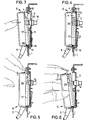
- the displacement path results from the difference between the dimension a according to FIGS. 4 and 7 and b according to FIGS. 5 and 6.
- both the base part 7 and the holding part 1.7 are provided with a corresponding opening 23, 24, so that the contacts 25 on the circuit board 26 can be inserted into the mating contacts 14, through the cutouts 23 and 24 .
- the holding part 17 and the circuit board 26 can be screwed together by means of screws 27 and holes 28, so that these two parts can then be moved together relative to the plug housing 6.
- the connector housing 6 can be closed with the aid of a cover 8. If a circuit board 26 is not sufficient to accommodate all the components required, a second circuit board 29 can be used, and in this case a higher cover 8 'is used, as indicated by dash-dotted lines in FIG. 1.
- Fig. 4 shows the connector housing 6 in its locked position in the socket part 3.
- the contacts 14 and 25 are in engagement with each other, the leg spring 11 is tensioned by the bottom part 7 of the connector housing 6.
- the nose 9 on the bottom part 7 has penetrated into the recess 10 of the socket part 3.
- the locking projection 16 on the holding part 17 is engaged in the recess 15 of the socket part 3.
- the holding part 17 is also provided with a stop 30 which is supported in the socket part 3.
- FIG. 7 The insertion of the plug is shown in FIG. 7.
- the locking projection 16 is inserted into the recess 15 in the socket part and then pressed lightly on the plug housing 6, again displacing the housing relative to the contact arrangement 14, 25, so that the engagement, which presents no difficulties for either contact arrangement.
- the arrangement can be put back into the ready-for-operation state, which results from FIG. 4, only by light pressure with a finger on the plug housing 6.
- the nose 9 on the connector housing 6 is rounded, which makes it easier to engage the connector housing 6 with the socket 3.
Landscapes
- Details Of Connecting Devices For Male And Female Coupling (AREA)
- Coupling Device And Connection With Printed Circuit (AREA)
- Cable Accessories (AREA)
Description
- Die Erfindung bezieht sich auf eine Steckverbindungsanordnung zur Zu- und Herausführung vieladriger Kabel zur Verbindung elektrischer Baueinheiten untereinander, insbesondere zur Verbindung der Zentraleinheit einer Datenverarbeitungsanlage mit ihren peripheren Geräten, mit einem Steckbuchsenteil und einem Stecker mit einem Steckergehäuse.
- Die Zentraleinheit einer Datenverarbeitungsanlage ist in vielen Fällen mit einer grossen Vielzahl von peripheren Geräten zu verbinden, beispielsweise mit einer Tastatur, mit einem Drucker, mit einem Magnetplattenspeicher u. dgl., oder aber eine Zentraleinheit muss mit einer grossen Vielzahl von Datenendstationen verbunden sein, die beispielsweise aus einer Tastatur und einem Bildschirmgerät bestehen.
- Die Erfindung zielt darauf ab, eine möglichst praktisch zu handhabende Steckverbindungsanordnung für die Verbindung derartiger Baueinheiten untereinander zu schaffen, derart, dass die Steckkontaktverbindungen möglichst dicht beieinander an der Zenraleinheit angebracht werden können. Damit sie möglichst wenig Platz beanspruchen, ist es notwendig, sie so auszubilden, dass sie in Matrixform möglichst eng beieinander liegend montiert werden können. Ferner ist es wünschenswert, sowohl die Entkopplung der Leitungen der Zentraleinheit von den Leitungen der peripheren Geräte als auch die Funkentstörung nicht innerhalb der Gerätegehäuse durchzuführen, sondern sie möglichst mit der Steckverbindungsanordnung zu verbinden, so dass gleichzeitig mit dem Einstecken und Herausziehen der Steckverbindungsanordnung auch die Entkopplung und die Funkentstörung durchgeführt werden. Diese Bauweise setzt es voraus, dass in der Steckverbindungsanordnung eine Anzahl von elektrischen Bauteilen vorhanden sein muss, die selbstverständlich auf einer Schaltungsplatte angeordnet werden. Eine weitere Anwendung der Steckverbindungsanordnung ist gegeben beim Anschluss von Peripheriegeräten zum Anpassen der physikalischen Schnittstelle.
- Die Verwendung von Steckverbindungsanordnungen, die lediglich durch Klemmwirkung in ihren Steckbuchsen gehalten werden, hat sich in diesem Zusammenhang nicht besonders bewährt, weil bei der Vielzahl der miteinander zu verbindenden Leiter relativ grosse Stecker entstehen und weil es dann eines relativ grossen Kraftaufwandes bedarf, um die Stecker aus ihren klemmenden Steckbuchsen herauszuziehen. Aus diesem Grunde können auch die lediglich mit Klemmwirkung arbeitenden Steckverbindungsanordnungen nur mit relativ grossem Abstand zueinander in den Montageplatten angeordnet werden, weil es notwendig ist, mit der ganzen Hand zuzufassen, um den Stecker herauszuziehen. Demgegenüber soll durch die erfindungsgemässe Steckverbindungsanordnung ein Verbindungsmittel geschaffen werden, welches sich relativ leicht aus der Steckbuchse herausziehen und auch wieder hereinstekken lässt.
- Die erfindungsgemässe. Steckverbindungsanordnung ist dadurch gekennzeichnet, dass in dem Steckergehäuse eine die elektrischen Bauteile und die Steckkontakte tragende Schaltungsplatte mit einem Halteteil verbunden ist, dass das Stekkergehäuse entgegen der Kraft einer Feder relativ zum Halteteil beweglich ist, dass das Steckergehäuse mittels teils an diesem, teils an dem Halteteil angeordneten Rastvorsprüngen mit entsprechenden Ausnehmungen in dem fest angeordneten Steckbuchsenteil verrastbar ist, dass die Gegenkontakte im Steckbuchsenteil.so angeordnet sind, dass sie das Steckergehäuse mit Spiel durchdringen, und dass eine im Steckbuchsenteil angeordnete Feder das Steckergehäuse in die Entnahmestellung drückt, wenn die Verrastung durch Druck auf das Steckergehäuse gelöst ist.
- Bei einer derartigen Ausbildung des Steckergehäuses ist es möglich, durch einfachen Druck auf das Steckergehäuse mit einem Finger dieses zunächst aus seiner Verrastung zu lösen, so dass es dann in die Entnahmestellung gedrückt wird und herausgezogen werden kann, ohne dass hierfür ein besonderer Kraftaufwand erforderlich wäre.
- In diesem Zusammenhang ist es aus der US-A Nr. 2710384 bereits bekannt, einen Stecker und ein Steckbuchsenteil so zueinander anzuordnen, dass die beiden Teile durch Federwirkung auseinandergedrückt werden. Bei der bekannten Anordnung wird aber das herausziehbare Steckerteil vollkommen weggedrückt, ohne dass eine Verbindung mit dem Steckbuchsenteil erhalten bleibt, d.h. das Steckerteil kann herabfallen. Bei der Erfindung dagegen ist durch die Anordnung der Rastvorsprünge und der entsprechenden Ausnehmungen in dem fest angeordneten Steckbuchsenteil dafür Sorge getragen, dass zwar die Federn das Steckerteil in eine Entnahmestellung drücken, dass aber trotzdem noch ein körperlicher Zusammenhang erhalten bleibt, bis die manuelle Entnahme erfolgt ist.
- Durch die relative Verschiebbarkeit der Schaltungsplatte mit den Kontakten und des Steckergehäuses zueinander wird sichergestellt, dass trotz Verschiebung des Schaltergehäuses zum Lösen der Verrastung die Kontakte problemlos miteinander in Eingriff kommen und auch wieder herausgezogen werden können. Ein weiterer Vorteil der Steckverbindungsanordnung ist es, dass in dem als rechteckiges Bauteil vorgesehenen Steckergehäuse ausreichend Platz vorhanden ist für die Unterbringung zusätzlicher Bauteile für die Entkopplung, die Funkentstörung bzw. Schnittstellenanpassung usw., wobei die rechteckige Bauform gleichzeitig den Vorteil hat, eine möglichst enge Aneinanderreihung der Steckeranordnungen in einer Gerätewand zu ermöglichen.
- Dadurch, dass das Steckergehäuse aus einem Bodenteil für die Lagerung der Halteplatte und der Schaltungsplatte und aus einem Deckel besteht, ist es möglich, nicht nur eine Schaltungsplatte, sondern sogar mehrere vorzusehen und das Stekkergehäuse dann mit einem höheren Deckel zu verschliessen. Hierdurch wird es möglich, zusätzliche elektrische Bauteile unterzubringen und sogar evtl. weitere Funktionen zu verwirklichen, ohne dass sich die Dimensionen der Steckverbindungsanordnung wesentlich ändern. Durch die Befestigung der elektrischen Leitung mit dem Halteteil ist sichergestellt, dass ein Zug auf die Leitung nichtzu einer ungewollten Entriegelung führt.
- In den beiliegenden Zeichnungen ist ein Ausführungsbeispiel der Erfindung gezeigt.
- Fig. 1 ist eine Explosivdarstellung der erfindungsgemässen Steckverbindungsanordnung,
- Fig. 2 zeigt eine Vorderansicht des Steckbuchsenteiles,
- Fig. 3 ist eine Ansicht des Bodenteiles des Stekkergehäuses mit Halteteil,
- Fig. 4 zeigt die Steckverbindungsanordnung in fertig montiertem Zustande,
- Fig. 5 u. 6 zeigen das Herausnehmen des Stekkers,
- Fig. 7 zeigt das Einführen des Steckers, und
- Fig. 8 zeigt die matrixförmige Anordnung der Stecker in einer entsprechenden Halteschiene, die beispielsweise an der Rückseite des mit verschiedenen anderen Geräten zu verbindenden elektrischen Gerätes vorgesehen ist.
- An der Rückwand oder einer Seitenwand eines elektrischen Gerätes, welches mit verschiedenen anderen elektrischen Geräten verbunden werden soll, sei beispielsweise eine Halteschiene 1 bzw. ein Rahmen angeordnet, der mit Durchbrüchen 2 versehen ist, in denen die einzelnen Steckverbindungsanordnungen montiert werden. Jeder Steckverbindungsanordnung ist ein Buchsenteil 3 zugeordnet. In dem Steckbuchsenteil 3 ist das Steckergehäuse 6 verrastet. Das Steckbuchsenteil 3 liegt mit seinen Rändern 4 auf der Halteschiene 1 auf und ist damit verschraubt. Die elektrischen Verbindungskabel 5 sind nach unten herausgeführt.
- Fig. 1 zeigt nun in Explosivdarstellung eine erfindungsgemässe Steckverbindungsanordnung, die aus einem Steckbuchsenteil 3 und aus einem Steckergehäuse 6 besteht. Das Steckergehäuse 6 umfasst einerseits ein Bodenteil 7 und andererseits einen Deckel 8. Das Bodenteil 7 hat an seinem oberen Ende eine Rastnase 9, die in eine Ausnehmung 10 im Buchsenteil 3 einrastet, wenn das Steckergehäuse eingesetzt ist. In dem Steckbuchsenteil 3 ist auch eine Schenkelfeder 11 befestigt, die mit Hilfe von zwei abgebogenen Enden 12 ihrer Schenkel in den rechteckig ausgenommenen Innenraum 13 des Steckbuchsenteiles 3 hineinragt. In der Wandung des Steckbuchsenteiles 3 ist eine Steckkontaktanordnung 14 vorgesehen, an die die elektrischen Leitungen herangeführt sind, die aus dem Gerät herauszuführen sind bzw. die in das Gerät eingeführt werden müssen. Am Boden der rechteckigen Ausnehmung 13 des Steckbuchsenteiles 3 ist eine weitere Ausnehmung 15 vorgesehen, die mit einem Rastvorsprung 16 an einem Halteteil 17 zusammenwirkt. Das Halteteil 17 ist in dem Bodenteil 7 des Steckergehäuses 6 einerseits durch eine Ausnehmung im Boden geführt, andererseits durch eine Lasche 18, die am Bodenteil 7 befestigt ist. Eine Stift/Schlitz-Verbindung 19 sichert die seitliche Lage des Halteteiles 17, lässt aber eine relative Bewegung zwischen dem Bodenteil 7 und dem Halteteil 17 zu. Eine Feder 20 ist bei 21 befestigt und drückt über einen Vorsprung 22 auf das Halteteil 17, so dass die Stift/ Schlitz-Verbindung 19 sich in der gezeichneten Lage (Fig. 3) befindet. Wenn man von oben auf das Steckergehäuse 6 drückt, kann sich das Gehäuse relativ zu dem Halteteil 17 verschieben. Der Verschiebeweg ergibt sich aus der Differenz zwischen dem Mass a gemäss den Fig. 4 und 7 und b gemäss den Fig. 5 und 6.
- Zur Durchführung der Kontakte 1,4 ist sowohl das Bodenteil 7 als auch das Halteteil 1.7 mit einer entsprechenden Öffnung 23, 24 versehen, so dass die Kontakte 25 an der Schaltungsplatte 26 in die Gegenkontakte 14 eingesteckt werden können, durch die Ausschnitte 23 und 24 hindurch. Mittels Schrauben 27 und Löchern 28 können das Halteteil 17 und die Schaltungsplatte 26 miteinander verschraubt werden, so dass diese beiden Teile dann zusammen relativ zu dem Steckergehäuse 6 beweglich sind.
- Das Steckergehäuse 6 kann mit Hilfe eines Dekkels 8 verschlossen werden. Falls eine Schaltungsplatte 26 für die Aufnahme aller benötigten Bauteile nicht ausreicht, kann eine zweite Schaltungsplatte 29 Verwendung finden, und in diesem Falle wird auch ein höherer Deckel 8', wie dies in strichpunktierten Linien in Fig. 1 angedeutet ist, verwendet.
- Fig. 4 zeigt das Steckergehäuse 6 in seiner in das Steckbuchsenteil 3 eingerasteten Position. Die Kontakte 14 und 25 befinden sich im Eingriff miteinander, die Schenkelfeder 11 ist durch das Bodenteil 7 des Steckergehäuses 6 gespannt. Die Nase 9 am Bodenteil 7 ist in die Ausnehmung 10 des Steckbuchsenteiles 3 eingedrungen. Gleichfalls ist der Rastvorsprung 16 an dem Halteteil 17 in die Ausnehmung 15 des Steckbuchsenteiles 3 eingerastet. Das Halteteil 17 ist noch mit einem Anschlag 30versehen, der sich in dem Steckbuchsenteil 3 abstützt.
- Drückt man nun, wie die Fig. 5 zeigt, auf die obere Kante des Steckergehäuses 6, dann verschiebt sich das Gehäuse relativ zu dem Halteteil 17 und der Schaltungsplatte 26 um die Differenz zwischen dem Mass a und dem Mass b, die Nase an dem Steckergehäuse 6 kommt ausser Eingriff mit der Ausnehmung 10, was durch die abgebogenen Enden 12 der Schenkelfeder 11 noch unterstützt wird, so dass das Steckerteil 6 zunächst die Stellung gemäss Fig. 5 und dann die Stellung gemäss Fig. 6 einnimmt, in der nun das Steckergehäuse 6 leicht entnommen werden kann, indem man es etwas anhebt, so dass der Rastvorsprung 16 und die Ausnehmung 15 ausser Eingriff miteinander kommen. Wie Fig. 5 erkennen lässt, bleibt während des Verschiebens des Steckergehäuses 6 aus der Stellung gemäss Fig. 4 in die Stellung gemäss Fig. 5 die Kontaktanordnung 14, 25 noch völlig miteinander im Eingriff. Lediglich, wenn dann das Steckerteil 6 nach vorne herauskippt, wird die elektrische Verbindung unterbrochen.
- Das Einsetzen des Steckers ergibt sich aus Fig. 7. Man führt zunächst den Rastvorsprung 16 in die Ausnehmung 15 im Buchsenteil ein und drückt dann leicht auf das Steckergehäuse 6, wobei wiederum eine Verschiebung des Gehäuses relativ zu der Kontaktanordnung 14, 25 erfolgt, so dass das Ineingriffgehen, der beiden Kontaktanordnungen keinerlei Schwierigkeiten bereitet. Lediglich durch leichten Druck mit einem Finger auf das Steckergehäuse 6 kann die Anordnung wieder in den betriebsbereiten Zustand versetzt werden, der sich aus Fig. 4 ergibt.
- Es sei noch darauf hingewiesen, dass die Nase 9 am Steckergehäuse 6 abgerundet ist, wodurch das Ineingriffbringen des Steckergehäuses 6 mit der Steckbuchse 3 erleichtert wird.
Claims (8)
Priority Applications (1)
| Application Number | Priority Date | Filing Date | Title |
|---|---|---|---|
| AT82106886T ATE13473T1 (de) | 1981-08-22 | 1982-07-30 | Steckverbindungsanordnung zur zu- und herausfuehrung vieladriger kabel zur verbindung elektrischer baueinheiten untereinander. |
Applications Claiming Priority (2)
| Application Number | Priority Date | Filing Date | Title |
|---|---|---|---|
| DE3133281A DE3133281C2 (de) | 1981-08-22 | 1981-08-22 | Steckeranordnung zur Zu- und Herausführung vieladriger Kabel zur Verbindung elektrischer Baueinheiten untereinander |
| DE3133281 | 1981-08-22 |
Publications (2)
| Publication Number | Publication Date |
|---|---|
| EP0073348A1 EP0073348A1 (de) | 1983-03-09 |
| EP0073348B1 true EP0073348B1 (de) | 1985-05-22 |
Family
ID=6139899
Family Applications (1)
| Application Number | Title | Priority Date | Filing Date |
|---|---|---|---|
| EP82106886A Expired EP0073348B1 (de) | 1981-08-22 | 1982-07-30 | Steckverbindungsanordnung zur Zu- und Herausführung vieladriger Kabel zur Verbindung elektrischer Baueinheiten untereinander |
Country Status (3)
| Country | Link |
|---|---|
| EP (1) | EP0073348B1 (de) |
| AT (1) | ATE13473T1 (de) |
| DE (2) | DE3133281C2 (de) |
Families Citing this family (4)
| Publication number | Priority date | Publication date | Assignee | Title |
|---|---|---|---|---|
| DE3407725A1 (de) * | 1984-03-02 | 1985-09-05 | Robert Bosch Gmbh, 7000 Stuttgart | Vielpolige steckvorrichtung |
| DE3436968C2 (de) * | 1984-10-09 | 1986-12-04 | Leopold Kostal GmbH & Co KG, 5880 Lüdenscheid | Elektrische Kupplung |
| FR2698492A1 (fr) * | 1992-11-20 | 1994-05-27 | Itw Fastex Italia Spa | Bloc intégré à câble et plaque à bornes. |
| DE19729410C1 (de) * | 1997-07-09 | 1998-12-03 | Siemens Ag | Elektrische Steckvorrichtung |
Family Cites Families (10)
| Publication number | Priority date | Publication date | Assignee | Title |
|---|---|---|---|---|
| US2899669A (en) * | 1959-08-11 | Electrical connector | ||
| GB185090A (en) * | 1921-08-22 | 1923-08-16 | Benjamin Electric Ltd | Improvements in connecting and supporting devices for electric fixtures |
| GB474735A (en) * | 1937-05-27 | 1937-11-05 | Carr Fastener Co Ltd | Improvements in and relating to electrical connectors for use in plug and socket couplings |
| US2710384A (en) * | 1949-07-08 | 1955-06-07 | Burndy Engineering Co Inc | Spring loaded disconnecting panel |
| US2626974A (en) * | 1949-09-16 | 1953-01-27 | Pyle National Co | Explosion proof plug and socket |
| DE1850455U (de) * | 1959-10-22 | 1962-04-26 | Hirschmann Radiotechnik | Konzentrische steckverbindung fuer gemeinschaftsantennenanlagen. |
| US3683314A (en) * | 1971-01-21 | 1972-08-08 | Bunker Ramo | Cable junction box |
| US3865454A (en) * | 1973-07-18 | 1975-02-11 | Loral Corp | Adapter for high density connectors |
| DE7601457U1 (de) * | 1976-01-21 | 1976-06-16 | Priesemuth, Wolfgang, 2210 Itzehoe | Steckverteiler |
| DE2640233C3 (de) * | 1976-09-07 | 1980-10-23 | Siemens Ag, 1000 Berlin Und 8000 Muenchen | Kabelstecker für eine Vielzahl von Schaltdrähten |
-
1981
- 1981-08-22 DE DE3133281A patent/DE3133281C2/de not_active Expired
-
1982
- 1982-07-30 AT AT82106886T patent/ATE13473T1/de not_active IP Right Cessation
- 1982-07-30 DE DE8282106886T patent/DE3263751D1/de not_active Expired
- 1982-07-30 EP EP82106886A patent/EP0073348B1/de not_active Expired
Also Published As
| Publication number | Publication date |
|---|---|
| DE3263751D1 (en) | 1985-06-27 |
| DE3133281A1 (de) | 1983-04-07 |
| DE3133281C2 (de) | 1983-07-28 |
| EP0073348A1 (de) | 1983-03-09 |
| ATE13473T1 (de) | 1985-06-15 |
Similar Documents
| Publication | Publication Date | Title |
|---|---|---|
| EP3044837B1 (de) | Direktsteckvorrichtung mit vorjustiereinrichtung und relativ zu dieser verschiebbarer verriegelungseinrichtung | |
| DE3876604T2 (de) | Steckbare baugruppe fuer gedruckte schaltungen. | |
| DE69031574T2 (de) | Fussbodenanschlusseinheit | |
| DE3537400A1 (de) | Gehaeuse fuer eine erweiterbare periphere interface-einheit | |
| EP0709917A2 (de) | Anschlussklemmenblock mit Elektronikmodul | |
| DE68914855T2 (de) | Steckervorrichtung für Koaxialkabel hoher Dichte. | |
| DE102013223961A1 (de) | Eine elektromagnetische Interferenz (EMI) Abschirmungsvorrichtung und Verfahren zum Verwenden in einem optischen Kommunikationssystem | |
| DE60001549T2 (de) | Elektrischer verbinder für ein ein/ausgabemodul | |
| EP0397057B1 (de) | Anordnung zur mechanischen und elektrischen Verbindung einer Ergänzungsleiterplatte an einer Grundleiterplatte | |
| EP3493333A1 (de) | Elektrische steckverbindung zur datenübertragung | |
| WO1991015102A1 (de) | Halteeinrichtung für steckkarten | |
| DE102012100058B3 (de) | Gehäuse für ein Computersystem sowie Computersystem mit einem derartigen Gehäuse | |
| DE4433735A1 (de) | Verschwenkbarer Verbinder für planare elektronische Vorrichtungen | |
| EP1520330B1 (de) | Träger für modulgehäuse | |
| EP0073348B1 (de) | Steckverbindungsanordnung zur Zu- und Herausführung vieladriger Kabel zur Verbindung elektrischer Baueinheiten untereinander | |
| DE3942289C1 (de) | ||
| DE102005028512A1 (de) | Stecker | |
| DE2851749C2 (de) | ||
| EP1420330A2 (de) | Stromversorgung für ein elektrisches Gerät | |
| DE1811873U (de) | Elektrische steckfassung. | |
| DE4428687C1 (de) | Baugruppe eines elektrischen Geräts | |
| DE3789427T2 (de) | Elektronische Steck-Kassette mit Herauszieher. | |
| DE4111956A1 (de) | Mehrpolige elektrische anschlussvorrichtung | |
| DE29602268U1 (de) | Geschirmte Leiterplattensteckbuchse | |
| DE69715707T2 (de) | Sockel für Stromsteckdose |
Legal Events
| Date | Code | Title | Description |
|---|---|---|---|
| PUAI | Public reference made under article 153(3) epc to a published international application that has entered the european phase |
Free format text: ORIGINAL CODE: 0009012 |
|
| AK | Designated contracting states |
Designated state(s): AT CH DE FR GB IT LI SE |
|
| 17P | Request for examination filed |
Effective date: 19830318 |
|
| ITF | It: translation for a ep patent filed | ||
| GRAA | (expected) grant |
Free format text: ORIGINAL CODE: 0009210 |
|
| AK | Designated contracting states |
Designated state(s): AT CH DE FR GB IT LI SE |
|
| REF | Corresponds to: |
Ref document number: 13473 Country of ref document: AT Date of ref document: 19850615 Kind code of ref document: T |
|
| REF | Corresponds to: |
Ref document number: 3263751 Country of ref document: DE Date of ref document: 19850627 |
|
| ET | Fr: translation filed | ||
| RAP2 | Party data changed (patent owner data changed or rights of a patent transferred) |
Owner name: MANNESMANN KIENZLE GMBH |
|
| PLBE | No opposition filed within time limit |
Free format text: ORIGINAL CODE: 0009261 |
|
| STAA | Information on the status of an ep patent application or granted ep patent |
Free format text: STATUS: NO OPPOSITION FILED WITHIN TIME LIMIT |
|
| 26N | No opposition filed | ||
| ITTA | It: last paid annual fee | ||
| PGFP | Annual fee paid to national office [announced via postgrant information from national office to epo] |
Ref country code: GB Payment date: 19940510 Year of fee payment: 13 |
|
| PGFP | Annual fee paid to national office [announced via postgrant information from national office to epo] |
Ref country code: SE Payment date: 19940518 Year of fee payment: 13 |
|
| PGFP | Annual fee paid to national office [announced via postgrant information from national office to epo] |
Ref country code: FR Payment date: 19940519 Year of fee payment: 13 |
|
| PGFP | Annual fee paid to national office [announced via postgrant information from national office to epo] |
Ref country code: DE Payment date: 19940615 Year of fee payment: 13 |
|
| PGFP | Annual fee paid to national office [announced via postgrant information from national office to epo] |
Ref country code: AT Payment date: 19940616 Year of fee payment: 13 |
|
| PGFP | Annual fee paid to national office [announced via postgrant information from national office to epo] |
Ref country code: CH Payment date: 19940623 Year of fee payment: 13 |
|
| EAL | Se: european patent in force in sweden |
Ref document number: 82106886.3 |
|
| PG25 | Lapsed in a contracting state [announced via postgrant information from national office to epo] |
Ref country code: GB Effective date: 19950730 Ref country code: AT Effective date: 19950730 |
|
| PG25 | Lapsed in a contracting state [announced via postgrant information from national office to epo] |
Ref country code: SE Effective date: 19950731 Ref country code: LI Effective date: 19950731 Ref country code: CH Effective date: 19950731 |
|
| REG | Reference to a national code |
Ref country code: CH Ref legal event code: PL |
|
| GBPC | Gb: european patent ceased through non-payment of renewal fee |
Effective date: 19950730 |
|
| PG25 | Lapsed in a contracting state [announced via postgrant information from national office to epo] |
Ref country code: DE Effective date: 19960402 |
|
| EUG | Se: european patent has lapsed |
Ref document number: 82106886.3 |
|
| PG25 | Lapsed in a contracting state [announced via postgrant information from national office to epo] |
Ref country code: FR Effective date: 19960430 |
|
| REG | Reference to a national code |
Ref country code: FR Ref legal event code: ST |
|
| REG | Reference to a national code |
Ref country code: FR Ref legal event code: ST |
|
| REG | Reference to a national code |
Ref country code: FR Ref legal event code: ST |