EP0073555A2 - Metallisierter Kondensator mit verbesserten Doppelschichtelektroden - Google Patents
Metallisierter Kondensator mit verbesserten Doppelschichtelektroden Download PDFInfo
- Publication number
- EP0073555A2 EP0073555A2 EP82302685A EP82302685A EP0073555A2 EP 0073555 A2 EP0073555 A2 EP 0073555A2 EP 82302685 A EP82302685 A EP 82302685A EP 82302685 A EP82302685 A EP 82302685A EP 0073555 A2 EP0073555 A2 EP 0073555A2
- Authority
- EP
- European Patent Office
- Prior art keywords
- metal
- recited
- layer
- strip
- dielectric
- Prior art date
- Legal status (The legal status is an assumption and is not a legal conclusion. Google has not performed a legal analysis and makes no representation as to the accuracy of the status listed.)
- Granted
Links
Images

Classifications
-
- H—ELECTRICITY
- H01—ELECTRIC ELEMENTS
- H01G—CAPACITORS; CAPACITORS, RECTIFIERS, DETECTORS, SWITCHING DEVICES, LIGHT-SENSITIVE OR TEMPERATURE-SENSITIVE DEVICES OF THE ELECTROLYTIC TYPE
- H01G4/00—Fixed capacitors; Processes of their manufacture
- H01G4/002—Details
- H01G4/005—Electrodes
- H01G4/008—Selection of materials
Definitions
- This invention relates to metallized alternating current (AC) capacitors and more particularly to a high stress metallized capacitor with electrodes which comprise multiple thin metal layers of dissimilar metals laid down on a dielectric strip.
- AC alternating current
- a metallized capacitor is one in which one or both electrodes are provided by means of a very thin, metallic layer on a solid dielectric strip, a common example being a vapor deposited aluminum layer on a polypropylene resin strip. These strips may be wound together in roll form to provide an electrical capaci- tor with metallized electrodes and polypropylene dielectrics.
- the roll may be placed in a container and suitably impregnated with a dielectric liquid. It may also be suitably encapsulated and used in the dry state, or, placed in a container wherein only the roll ends are exposed to a dielectric liquid.
- This latter capacitor may be referred to as a semi or incompletely impregnated capacitor and it is the semi-impregnated or dry type of capacitor to which this invention is primarily directed.
- a capacitor which utilizes a small amount of fluid, is disclosed and claimed in U.S. Patent 3,987,348-Flanagan et al, assigned to the same assignee as the present invention.
- Corrosion is the second factor occurring in the normal operation of metallized capacitors. This phenomenon is noted where certain areas of the thin metallized layer are converted to an oxide, e.g., aluminum oxide which is not a good electrical conductor and therefore some effective electrode area is lost. The reasons for this corrosion phenomena are unclear, but with high electrical-stress and thin electrodes of aluminum,corrosion is a rapidly spreading and wasting operation. This is particularly found in AC capacitors when the voltage stress on a polypropylene dielectric film is on the order of above about 1000 volts per mil (8'1) thickness of the film.
- metallized capacitors may lose as much as 10% of their capacity over a relatively short period of time because of these factors, they become unacceptable for some applications, and they may require a considerable uneconomic design for compensatory purposes. Also the loss of capacitance of a capacitor may pose as a possible source of host equipment failure because of capacitance loss in the capacitor.
- the loss of capacitance due to the two deficiencies of clearings and corrosion is at present the most serious disadvantage in high stress AC metallized capacitors and a limiting factor on their useful life.
- the more important one of the above two deficiencies is the control of corrosion, quite apart from clearings, because corrosion is the largest contributor to loss of capacitance, and is quite independent from clearings.
- whatever is done to control corrosion should not deleteriously affect clearings, i.e., make them more violent with greater energy release.
- the corrosion problem is not overcome merely by the use-of a thicker metal electrode.
- a thicker metal electrode means an electrode which displays most disadvantageous delayed and violent clearing effects, a result that is counter to the primary purpose of a metallized capacitor.
- Thinner electrodes are more desirable, because of their favorable economics. However, the corrosion problem is not counteracted by thinner electrodes as they merely exacerbate the problem by supporting a multiplicity of unnecessary clearings. While different metals do have different corrosion rates, it is by far desirable to continue to use such proven metals as aluminum and zinc for the layer electrode and these metals are most prone to corrosion.
- FIG. 1 there is shown the kind of capacitor in which optimum benefits of this invention may be obtained.
- This capacitor utilizes structure similar to-that in the noted Flanagan patent for voltages above about 370 volts and particularly above about 440 volts.
- Roll section 10 comprises a pair of dielectric material strips 11 and 12 of polypropylene which have been metallized as illustrated by metallizing surfaces or coatings 13 and 14. As is the usual practice, the strips 11 and 12 are metallized in a manner which leaves metal free margins 15 and 16 along opposite edges of roll 10.
- the roll 10 is wound on a core member 17, and the strips 11 and 12 are laterally offset with respect to each other in order that each roll edge or end will display an offset with its metallized coatings exposed at the edge of the strip.
- suitable electrical leads 18 and 19 may be attached to the exposed metal coating through utilization of the well-known schooping process to provide a metal layer 20, and the roll is then placed in a can or casing as illustrated in FIG. 2.
- the capacitor 21 includes a casing or can 22 which contains a single roll.10, and the leads 18 and 19 from the roll connect to the terminals 23 and 24.
- Casing 22 may be a sealed can type which is filled with a dielectric fluid 25 and then sealed, or it may be a protective kind of casing without any liquid impregnant, In any event it is the metallized coatings 13 and 14 of FIG. 1 to which this invention is primarily directed, and which are described with respect to FIG. 3.
- the dielectric strip 11 is illustrated in sectional form as a dielectric synthetic resin, for example, polypropylene film, with a composite metal layer or coating 13 which is vacuum deposited or otherwise laid down on or attached to the strip 11.
- the composite layer 13 comprises a bilayer or a dual layer of metals 26 and 27. These metals generally cover the dielectric strip, or more specifically, they are continuous and coextensive with the effective capacitor electrode area of the capacitor.
- the first metal layer. 26 is the primary electrode layer of the capacitor.
- a typical metal for this layer is high purity aluminum of 99.99 aluminum. Ordinarily, such a layer may have a thickness in the range of 175A° to 250A° and corresponding resistivities of from 5 to 8 ⁇ / ⁇ for this invention. Ohms/square is an acceptable measurement for evaporated metal layers of extreme thinness. This layer covers all of the strip 11 except those areas used to offset margins. The reason for this total kind of coverage arises from the .fact that studies and examination of metallized capacitors indicate that corrosion is found throughout the capacitor roll, and that it may be insufficient or uneconomical to provide corrosion protection on less than all available capacitor effective electrode area surfaces.
- the second layer 27 is a specific metal or a specific alloy, different from the first metal, which must have clearly defined electro chemical properties to control two functions (a) permitting the layer. 26 to be made unusually and extremely thin for improved clear- ability and (b) controlling corrosion by its less oxidizing characteristics and its ability to remain in a substantially continuous metallic state during the operation of the capacitor.
- the right metal also provides a layer 27 which, when combined in thickness with the thickness of the base layer 26, will show a combined thickness less than the design thickness of a single prior art aluminum layer.
- Preferring metals for the layer 27 include such metals as iron-, chromium, nickel and their alloys such as NiCr.
- the resistivities of these metals lie in the range of about 10 4 to 10 10 ohms per square.
- These metals are members of a broader class of metals defined as those having a higher melting point than the metals of the first layer and a significantly lesser high field electrochemical corrosion rate than the metals of the first layer in the same operative environment. They also display a higher resistivity than the metal of the first layer - taking its thinness into consideration, and may be deposited on the first layer in a continuous metallic state in extremely thin layers.
- the second metal layer tends to remain mostly in its metallic form in the capacitor, i.e., that it does not readily convert to its oxide from exposure to air, etc.
- Metallic conductance is- preferable although some oxide semi-conducting properties are not detrimental.
- Potential corrosion sites should have an overlap or roofing metal with metallic and semi-conducting conductivity.
- Such metals.as zinc, copper, etc. are not desirable because of their rapid and highly corrosive nature in,very thin layers. Change or loss of capacitance is greatly minimized by the metallic conductive coating which preserves the total conducting electrode structure and concept.
- the metals of layer 27 of the present invention have a higher resistivity than that of the pure aluminum and a higher melting point. Their conductivities lie generally in the range of about 10 4 to 10 10 ohms per square.. During a clearing process the second layer need not melt. Their higher melting point and thinness will cause them to quickly evaporate during clearing without contributing any adverse clearing effects.
- Preferable ratios of the thicknesses of the individual layers are that the second layer is from 1/6 to 1/12 preferably from 1/8 to 1/12 the thickness of the first layer, with a first layer thickness of less than about 250A°. It is important to the present invention that the second layer be substantially-continuous in two forms - first, it must be substantially continuous over the effective electrode area and second it must be deposited as an unbroken layer in the sense that some metals when deposited in extremely thin layers, e.g. less than about 50A° form individual islands which may not be connected physically or electrically. The reasons for the expressed thickness relationships are that it is desirable for essentially all of the current flow to be carried by the first layer and for the second layer to have a higher'resistance and higher melting point.
- Metallized polypropylene film with bilayers of aluminum and, nickel and/or iron have demonstrated superior performance when compared to prior art capacitors. For example, loss of capacitance can be reduced by as much as 90% or more over the life of the capacitor, and by reason thereof the electrical stress level on.the film of these capacitors can be increased above about 1200 per mil (46 volts/M) for example, in the range of 1500 to 2000 volts per mil (82 volts/M) and higher. At the same time, the material economics are improved by having two layers in which the combined thickness is less than the thickness of the.prior single layers. Representative examples of the practices of this invention are illustrated as follows. In all examples the metal layers were deposited by means of the well known vacuum deposition process.
- the important features of this construction is the thinness of the polypropylene film, i.e., 8 MM and the thinness of the bi-layer coating.
- the bi-layer used in this example comprised a base layer of aluminum and a second layer of a nickel-chromium alloy, e..g. 80% Ni. and 20% Cr, over the aluminum layer.
- the aluminum laver was between about 175A° and 250A° thickness.
- the NiCr layer was between about 20A° to 30A°.
- the control is generally a prior art capacitor following the same general construction of other capacitors in the example but having a single aluminum layer of a thickness of about 500A°.
- Example I What is evident from Example I is that the capacitance loss with time is between about 5% to 8% for the prior art control unit and as low as 0.3 for the aluminum base layer and a nickel chrome coating. This is surprising in view of the fact that the units were tested at 470 to 660 volts and at 80°C,a most stringent set of test conditions for such a thin film dielectric system.
- the total thickness of the bimetal layer is markedly less than prior art thicknesses of single layers.
- the ordinary life of capacitors of this kind, including control capacitors, is usually more than 20,000 hours.
- Al-Fe or Fe-Al bi-layer Another bi-layer electrode that has eliminated the high field electrochemical corrosion process in SMPP capacitors is the Al-Fe or Fe-Al bi-layer.
- Iron is one of the most desirable bi-layer materials because it re- maines physically and electrically continuous at thicknesses lower than 20A° and in addition,it is relatively inexpensive.
- Al-Fe bi-layer electrode capacitors have been tested successfully at stress levels substantially higher than the control units (refer to example 1). In this example II the aluminum layer was from 200A° to 250A° thickness and the iron layer was from 20A o to 30A o thickness.
- the dielectric was polypropylene film of 8 M thickness.
- Example II As can be seen from this Example II, the excellent low capacitance loss results of Example I are confirmed, and the capacitance loss improvement illustrated in excess of 1200 hours of life at extreme stresses and temperatures is exceptional.
- Margin 28 exposes the underlay metal of aluminum to the usual schooping process with excellent results and removes an otherwise hidden problem with the.se capacitors with various coating metals.
- the exposed . aluminum layer at 28 may be made thicker for better joining characteristics.
- the aluminum margin is made about two times the aluminum layer thickness.
- capacitors were made up as described in Example I, but with graded electrodes where the aluminum was between 200A° to 250A° thickness.
- the iron was 20A° to 30A° thickness and the iron layer terminated about 2 to 3 mm from the edge of the strip. At this edge the thickened or graded aluminum was 400A° to 500A° thick.
- Poly- propylene film was 8 thickness.
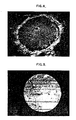
- FIG. 4 photomicrograph A clearance occurrence is illustrated in the FIG. 4 photomicrograph.
- the clearance is defined by central aperture or puncture and an annular clear area.
- the clear area is the polypropylene film from which an aluminum area has been vaporized.
- the outer metal layer of higher resistivity serves-to implement the integrity of the outer metal layer.
- FIG. 5 there is illustrated a a photomicrograph showing the effects of corresion on an. aluminum electrode surface.
- the lighter area is a spot of aluminum oxide.
- the darker area is aluminum metal.
- This oxide spot starts at the interface of the aluminum metal layer and the polypropylene film and projects completely through the metal. Consequently the metal converged is metal electrode removed from the active electrode surface.
- corrosion is a growth process, and elevated temperatures, voltages, and frequencies accelerate the growth conditions.
- the dual layers of this invention may be'generated by well known plating, deposition, and coating processes. Vapor deposition in vacuum is a preferred process. It can provide for deposition of an alloy such as nickel chrome for simultaneous or serial deposition of different metals in the same chamber. This reduces the chances of contamination of the surfaces and limits oxidation of the-metal layers during the process. Some of the second metal may be found diffused into the first metal layer.
- the bi-layers of this invention may be aluminum as the outer layer of metal and the layers may comprise one layer of aluminum for example on one side of a film strip and a thinner layer of iron for example on the opposite side.
- This invention does not merely make a given capacitor operate more effectively by limiting corrosion, but in effect provides a unique, higher stressed capacitor, which also has minimal corrosion.
Landscapes
- Engineering & Computer Science (AREA)
- Power Engineering (AREA)
- Chemical & Material Sciences (AREA)
- Materials Engineering (AREA)
- Manufacturing & Machinery (AREA)
- Microelectronics & Electronic Packaging (AREA)
- Fixed Capacitors And Capacitor Manufacturing Machines (AREA)
Applications Claiming Priority (2)
| Application Number | Priority Date | Filing Date | Title |
|---|---|---|---|
| US29592881A | 1981-08-24 | 1981-08-24 | |
| US295928 | 1981-08-24 |
Publications (3)
| Publication Number | Publication Date |
|---|---|
| EP0073555A2 true EP0073555A2 (de) | 1983-03-09 |
| EP0073555A3 EP0073555A3 (en) | 1984-10-17 |
| EP0073555B1 EP0073555B1 (de) | 1989-03-01 |
Family
ID=23139824
Family Applications (1)
| Application Number | Title | Priority Date | Filing Date |
|---|---|---|---|
| EP19820302685 Expired EP0073555B1 (de) | 1981-08-24 | 1982-05-25 | Metallisierter Kondensator mit verbesserten Doppelschichtelektroden |
Country Status (9)
| Country | Link |
|---|---|
| EP (1) | EP0073555B1 (de) |
| JP (1) | JPS5866319A (de) |
| BR (1) | BR8203858A (de) |
| CA (1) | CA1194948A (de) |
| DE (1) | DE3279490D1 (de) |
| ES (1) | ES514958A0 (de) |
| FI (1) | FI82785C (de) |
| IN (1) | IN158264B (de) |
| MX (1) | MX158775A (de) |
Cited By (4)
| Publication number | Priority date | Publication date | Assignee | Title |
|---|---|---|---|---|
| GB2172432A (en) * | 1985-03-12 | 1986-09-17 | Sprague Electric Co | Self-healing metallized film capacitor |
| US5415954A (en) * | 1992-05-08 | 1995-05-16 | Hydro-Quebec | Electrical contact outlet for anodes |
| US5423110A (en) * | 1991-09-17 | 1995-06-13 | Hydro-Quebec | Process for the preparation of collectors-electrodes for the thin film cell, collectors-electrodes assemblies and cells obtained |
| US5953202A (en) * | 1997-02-06 | 1999-09-14 | Advanced Deposition Technologies, Inc. | High energy density capacitor films and capacitors made therefrom |
Families Citing this family (3)
| Publication number | Priority date | Publication date | Assignee | Title |
|---|---|---|---|---|
| JPS6064420A (ja) * | 1983-09-19 | 1985-04-13 | 松下電器産業株式会社 | 金属化誘電体コンデンサ |
| JPH05129154A (ja) * | 1991-10-31 | 1993-05-25 | Reiko Co Ltd | コンデンサ用Al蒸着フイルム及びその製造法 |
| JP4468729B2 (ja) | 2003-10-16 | 2010-05-26 | 株式会社湯山製作所 | 薬剤払出装置 |
Family Cites Families (7)
| Publication number | Priority date | Publication date | Assignee | Title |
|---|---|---|---|---|
| DE708421C (de) * | 1937-11-07 | 1941-07-21 | Siemens & Halske Akt Ges | Verfahren zum Metallisieren von elektrisch beanspruchten Isolierstoffen |
| JPS48104064A (de) * | 1972-04-17 | 1973-12-26 | ||
| DE2359432C3 (de) * | 1973-11-29 | 1984-08-09 | Licentia Patent-Verwaltungs-Gmbh, 6000 Frankfurt | Verfahren zur Herstellung von mit Aluminium beschichteten Folien für Kondensatoren und Vorrichtung zur Durchführung des Verfahrens |
| DE2623474C2 (de) * | 1976-05-25 | 1983-05-05 | Siemens AG, 1000 Berlin und 8000 München | Regenerierfähiger elektrischer Kondensator |
| JPS52147767A (en) * | 1976-06-04 | 1977-12-08 | Matsushita Electric Industrial Co Ltd | Electric film |
| DE2700013C2 (de) * | 1977-01-03 | 1983-05-05 | Siemens AG, 1000 Berlin und 8000 München | Regenerierfähiger elektrischer Kondensator |
| JPS5824005B2 (ja) * | 1978-03-28 | 1983-05-18 | 本州製紙株式会社 | 金属化誘電体コンデンサ |
-
1982
- 1982-05-25 DE DE8282302685T patent/DE3279490D1/de not_active Expired
- 1982-05-25 EP EP19820302685 patent/EP0073555B1/de not_active Expired
- 1982-05-26 IN IN606/CAL/82A patent/IN158264B/en unknown
- 1982-06-30 BR BR8203858A patent/BR8203858A/pt not_active IP Right Cessation
- 1982-07-08 FI FI822445A patent/FI82785C/fi not_active IP Right Cessation
- 1982-08-06 CA CA000408964A patent/CA1194948A/en not_active Expired
- 1982-08-12 ES ES514958A patent/ES514958A0/es active Granted
- 1982-08-24 JP JP14558682A patent/JPS5866319A/ja active Granted
- 1982-08-24 MX MX19412182A patent/MX158775A/es unknown
Cited By (5)
| Publication number | Priority date | Publication date | Assignee | Title |
|---|---|---|---|---|
| GB2172432A (en) * | 1985-03-12 | 1986-09-17 | Sprague Electric Co | Self-healing metallized film capacitor |
| US5423110A (en) * | 1991-09-17 | 1995-06-13 | Hydro-Quebec | Process for the preparation of collectors-electrodes for the thin film cell, collectors-electrodes assemblies and cells obtained |
| US5521028A (en) * | 1991-09-17 | 1996-05-28 | Hydro-Quebec | Collector-electrodes assemblies for thin film generators |
| US5415954A (en) * | 1992-05-08 | 1995-05-16 | Hydro-Quebec | Electrical contact outlet for anodes |
| US5953202A (en) * | 1997-02-06 | 1999-09-14 | Advanced Deposition Technologies, Inc. | High energy density capacitor films and capacitors made therefrom |
Also Published As
| Publication number | Publication date |
|---|---|
| DE3279490D1 (en) | 1989-04-06 |
| BR8203858A (pt) | 1983-06-28 |
| ES8305526A1 (es) | 1983-04-16 |
| EP0073555A3 (en) | 1984-10-17 |
| IN158264B (de) | 1986-10-11 |
| MX158775A (es) | 1989-03-10 |
| FI82785B (fi) | 1990-12-31 |
| JPH0258763B2 (de) | 1990-12-10 |
| FI82785C (fi) | 1991-04-10 |
| EP0073555B1 (de) | 1989-03-01 |
| ES514958A0 (es) | 1983-04-16 |
| FI822445A0 (fi) | 1982-07-08 |
| JPS5866319A (ja) | 1983-04-20 |
| FI822445L (fi) | 1983-02-25 |
| CA1194948A (en) | 1985-10-08 |
Similar Documents
| Publication | Publication Date | Title |
|---|---|---|
| US4482931A (en) | Metallized capacitor with improved bilayer electrodes | |
| US5615078A (en) | Metallized film for electrical capacitors having a semiconductive layer extending entirely across the unmetallized margin | |
| US6043973A (en) | Ceramic capacitor | |
| US4459637A (en) | Dielectric fluid for a capacitor | |
| EP0789371B1 (de) | Kondensator mit metallisierter dielektrischer Folie mit variablem Widerstand | |
| EP2023356B1 (de) | Filmkondensator | |
| EP0001351A1 (de) | Verbesserungen an Natrium-Schwefel Zellen | |
| US4831432A (en) | Positive ceramic semiconductor device | |
| US5844770A (en) | Capacitor structures with dielectric coated conductive substrates | |
| EP0073555B1 (de) | Metallisierter Kondensator mit verbesserten Doppelschichtelektroden | |
| US6757151B2 (en) | Capacitor element for a power capacitor, a power capacitor comprising such element and a metallized film for a power capacitor | |
| US5019418A (en) | Metallized film capacitor process | |
| US4615908A (en) | Method for the manufacture of plasma-polymer multilayer capacitors | |
| US3952116A (en) | Process for forming electrical resistance heaters | |
| US20020127460A1 (en) | Protective coatings for fuel cell interconnect | |
| US2463765A (en) | Manufacture of electrical condensers | |
| CA1042996A (en) | Windable series-parallel resistance-capacitance network | |
| JP3935561B2 (ja) | 金属化フィルムコンデンサ | |
| US3225276A (en) | Electrical capacitor with thermal fuse | |
| JPH02285618A (ja) | 金属化プラスチックフィルムコンデンサ | |
| JPH0232769B2 (de) | ||
| US4922375A (en) | Electrical capacitor | |
| CA1266518A (en) | Self-healing metallized film capacitor | |
| KR100302106B1 (ko) | 두개의강화층을갖는콘덴서용금속증착필름및그제조방법 | |
| JPS6215716A (ja) | 真空遮断器電極用接点 |
Legal Events
| Date | Code | Title | Description |
|---|---|---|---|
| PUAI | Public reference made under article 153(3) epc to a published international application that has entered the european phase |
Free format text: ORIGINAL CODE: 0009012 |
|
| AK | Designated contracting states |
Designated state(s): CH DE FR GB IT LI SE |
|
| PUAL | Search report despatched |
Free format text: ORIGINAL CODE: 0009013 |
|
| AK | Designated contracting states |
Designated state(s): CH DE FR GB IT LI SE |
|
| 17P | Request for examination filed |
Effective date: 19850404 |
|
| 17Q | First examination report despatched |
Effective date: 19860912 |
|
| RAP1 | Party data changed (applicant data changed or rights of an application transferred) |
Owner name: BOLMET INCORPORATED |
|
| GRAA | (expected) grant |
Free format text: ORIGINAL CODE: 0009210 |
|
| AK | Designated contracting states |
Kind code of ref document: B1 Designated state(s): CH DE FR GB IT LI SE |
|
| ITF | It: translation for a ep patent filed | ||
| REF | Corresponds to: |
Ref document number: 3279490 Country of ref document: DE Date of ref document: 19890406 |
|
| ET | Fr: translation filed | ||
| PLBE | No opposition filed within time limit |
Free format text: ORIGINAL CODE: 0009261 |
|
| STAA | Information on the status of an ep patent application or granted ep patent |
Free format text: STATUS: NO OPPOSITION FILED WITHIN TIME LIMIT |
|
| 26N | No opposition filed | ||
| ITTA | It: last paid annual fee | ||
| EAL | Se: european patent in force in sweden |
Ref document number: 82302685.1 |
|
| PGFP | Annual fee paid to national office [announced via postgrant information from national office to epo] |
Ref country code: CH Payment date: 19950517 Year of fee payment: 14 |
|
| PGFP | Annual fee paid to national office [announced via postgrant information from national office to epo] |
Ref country code: GB Payment date: 19950519 Year of fee payment: 14 |
|
| PGFP | Annual fee paid to national office [announced via postgrant information from national office to epo] |
Ref country code: SE Payment date: 19950524 Year of fee payment: 14 Ref country code: FR Payment date: 19950524 Year of fee payment: 14 Ref country code: DE Payment date: 19950524 Year of fee payment: 14 |
|
| PG25 | Lapsed in a contracting state [announced via postgrant information from national office to epo] |
Ref country code: GB Effective date: 19960525 |
|
| PG25 | Lapsed in a contracting state [announced via postgrant information from national office to epo] |
Ref country code: SE Effective date: 19960526 |
|
| PG25 | Lapsed in a contracting state [announced via postgrant information from national office to epo] |
Ref country code: LI Effective date: 19960531 Ref country code: CH Effective date: 19960531 |
|
| GBPC | Gb: european patent ceased through non-payment of renewal fee |
Effective date: 19960525 |
|
| REG | Reference to a national code |
Ref country code: CH Ref legal event code: PL |
|
| PG25 | Lapsed in a contracting state [announced via postgrant information from national office to epo] |
Ref country code: FR Effective date: 19970131 |
|
| PG25 | Lapsed in a contracting state [announced via postgrant information from national office to epo] |
Ref country code: DE Effective date: 19970201 |
|
| EUG | Se: european patent has lapsed |
Ref document number: 82302685.1 |
|
| REG | Reference to a national code |
Ref country code: FR Ref legal event code: ST |