EP0073747A2 - Procédé et installation de production de composés liquides ou gazeux dans un réacteur microbiel - Google Patents
Procédé et installation de production de composés liquides ou gazeux dans un réacteur microbiel Download PDFInfo
- Publication number
- EP0073747A2 EP0073747A2 EP82870046A EP82870046A EP0073747A2 EP 0073747 A2 EP0073747 A2 EP 0073747A2 EP 82870046 A EP82870046 A EP 82870046A EP 82870046 A EP82870046 A EP 82870046A EP 0073747 A2 EP0073747 A2 EP 0073747A2
- Authority
- EP
- European Patent Office
- Prior art keywords
- fraction
- liquid
- reactor
- temperature
- thick
- Prior art date
- Legal status (The legal status is an assumption and is not a legal conclusion. Google has not performed a legal analysis and makes no representation as to the accuracy of the status listed.)
- Withdrawn
Links
- 239000007788 liquid Substances 0.000 title claims abstract description 23
- 150000001875 compounds Chemical class 0.000 title claims abstract description 8
- 238000004519 manufacturing process Methods 0.000 title claims abstract description 6
- 230000000813 microbial effect Effects 0.000 title claims abstract description 5
- 238000000034 method Methods 0.000 title claims description 9
- 238000009434 installation Methods 0.000 title claims description 6
- 239000007787 solid Substances 0.000 claims abstract description 12
- 230000007928 solubilization Effects 0.000 claims abstract description 4
- 238000005063 solubilization Methods 0.000 claims abstract description 4
- 238000010438 heat treatment Methods 0.000 claims description 14
- 239000010802 sludge Substances 0.000 claims description 14
- 239000000203 mixture Substances 0.000 claims description 5
- 230000000696 methanogenic effect Effects 0.000 claims description 4
- 238000006065 biodegradation reaction Methods 0.000 claims description 2
- 238000011081 inoculation Methods 0.000 claims description 2
- 239000010815 organic waste Substances 0.000 claims description 2
- 230000003247 decreasing effect Effects 0.000 claims 1
- 238000007599 discharging Methods 0.000 claims 1
- 238000001125 extrusion Methods 0.000 claims 1
- VNWKTOKETHGBQD-UHFFFAOYSA-N methane Chemical compound C VNWKTOKETHGBQD-UHFFFAOYSA-N 0.000 description 6
- 238000002485 combustion reaction Methods 0.000 description 3
- 230000000694 effects Effects 0.000 description 3
- LFQSCWFLJHTTHZ-UHFFFAOYSA-N Ethanol Chemical compound CCO LFQSCWFLJHTTHZ-UHFFFAOYSA-N 0.000 description 2
- 239000007789 gas Substances 0.000 description 2
- 239000002245 particle Substances 0.000 description 2
- 238000006116 polymerization reaction Methods 0.000 description 2
- 238000000926 separation method Methods 0.000 description 2
- 239000002002 slurry Substances 0.000 description 2
- 239000000126 substance Substances 0.000 description 2
- 230000001133 acceleration Effects 0.000 description 1
- 238000000354 decomposition reaction Methods 0.000 description 1
- 238000010586 diagram Methods 0.000 description 1
- 230000029087 digestion Effects 0.000 description 1
- 235000013399 edible fruits Nutrition 0.000 description 1
- 239000010794 food waste Substances 0.000 description 1
- 230000002211 methanization Effects 0.000 description 1
- 239000005416 organic matter Substances 0.000 description 1
- 230000001590 oxidative effect Effects 0.000 description 1
- 230000001105 regulatory effect Effects 0.000 description 1
- 239000010865 sewage Substances 0.000 description 1
- 241001148471 unidentified anaerobic bacterium Species 0.000 description 1
- 235000013311 vegetables Nutrition 0.000 description 1
Images
Classifications
-
- C—CHEMISTRY; METALLURGY
- C12—BIOCHEMISTRY; BEER; SPIRITS; WINE; VINEGAR; MICROBIOLOGY; ENZYMOLOGY; MUTATION OR GENETIC ENGINEERING
- C12P—FERMENTATION OR ENZYME-USING PROCESSES TO SYNTHESISE A DESIRED CHEMICAL COMPOUND OR COMPOSITION OR TO SEPARATE OPTICAL ISOMERS FROM A RACEMIC MIXTURE
- C12P7/00—Preparation of oxygen-containing organic compounds
- C12P7/02—Preparation of oxygen-containing organic compounds containing a hydroxy group
- C12P7/04—Preparation of oxygen-containing organic compounds containing a hydroxy group acyclic
- C12P7/06—Ethanol, i.e. non-beverage
-
- C—CHEMISTRY; METALLURGY
- C12—BIOCHEMISTRY; BEER; SPIRITS; WINE; VINEGAR; MICROBIOLOGY; ENZYMOLOGY; MUTATION OR GENETIC ENGINEERING
- C12M—APPARATUS FOR ENZYMOLOGY OR MICROBIOLOGY; APPARATUS FOR CULTURING MICROORGANISMS FOR PRODUCING BIOMASS, FOR GROWING CELLS OR FOR OBTAINING FERMENTATION OR METABOLIC PRODUCTS, i.e. BIOREACTORS OR FERMENTERS
- C12M23/00—Constructional details, e.g. recesses, hinges
- C12M23/02—Form or structure of the vessel
- C12M23/16—Microfluidic devices; Capillary tubes
-
- C—CHEMISTRY; METALLURGY
- C12—BIOCHEMISTRY; BEER; SPIRITS; WINE; VINEGAR; MICROBIOLOGY; ENZYMOLOGY; MUTATION OR GENETIC ENGINEERING
- C12M—APPARATUS FOR ENZYMOLOGY OR MICROBIOLOGY; APPARATUS FOR CULTURING MICROORGANISMS FOR PRODUCING BIOMASS, FOR GROWING CELLS OR FOR OBTAINING FERMENTATION OR METABOLIC PRODUCTS, i.e. BIOREACTORS OR FERMENTERS
- C12M23/00—Constructional details, e.g. recesses, hinges
- C12M23/24—Gas permeable parts
-
- C—CHEMISTRY; METALLURGY
- C12—BIOCHEMISTRY; BEER; SPIRITS; WINE; VINEGAR; MICROBIOLOGY; ENZYMOLOGY; MUTATION OR GENETIC ENGINEERING
- C12M—APPARATUS FOR ENZYMOLOGY OR MICROBIOLOGY; APPARATUS FOR CULTURING MICROORGANISMS FOR PRODUCING BIOMASS, FOR GROWING CELLS OR FOR OBTAINING FERMENTATION OR METABOLIC PRODUCTS, i.e. BIOREACTORS OR FERMENTERS
- C12M27/00—Means for mixing, agitating or circulating fluids in the vessel
- C12M27/16—Vibrating; Shaking; Tilting
-
- C—CHEMISTRY; METALLURGY
- C12—BIOCHEMISTRY; BEER; SPIRITS; WINE; VINEGAR; MICROBIOLOGY; ENZYMOLOGY; MUTATION OR GENETIC ENGINEERING
- C12M—APPARATUS FOR ENZYMOLOGY OR MICROBIOLOGY; APPARATUS FOR CULTURING MICROORGANISMS FOR PRODUCING BIOMASS, FOR GROWING CELLS OR FOR OBTAINING FERMENTATION OR METABOLIC PRODUCTS, i.e. BIOREACTORS OR FERMENTERS
- C12M41/00—Means for regulation, monitoring, measurement or control, e.g. flow regulation
- C12M41/12—Means for regulation, monitoring, measurement or control, e.g. flow regulation of temperature
-
- C—CHEMISTRY; METALLURGY
- C12—BIOCHEMISTRY; BEER; SPIRITS; WINE; VINEGAR; MICROBIOLOGY; ENZYMOLOGY; MUTATION OR GENETIC ENGINEERING
- C12P—FERMENTATION OR ENZYME-USING PROCESSES TO SYNTHESISE A DESIRED CHEMICAL COMPOUND OR COMPOSITION OR TO SEPARATE OPTICAL ISOMERS FROM A RACEMIC MIXTURE
- C12P1/00—Preparation of compounds or compositions, not provided for in groups C12P3/00 - C12P39/00, by using microorganisms or enzymes
-
- Y—GENERAL TAGGING OF NEW TECHNOLOGICAL DEVELOPMENTS; GENERAL TAGGING OF CROSS-SECTIONAL TECHNOLOGIES SPANNING OVER SEVERAL SECTIONS OF THE IPC; TECHNICAL SUBJECTS COVERED BY FORMER USPC CROSS-REFERENCE ART COLLECTIONS [XRACs] AND DIGESTS
- Y02—TECHNOLOGIES OR APPLICATIONS FOR MITIGATION OR ADAPTATION AGAINST CLIMATE CHANGE
- Y02E—REDUCTION OF GREENHOUSE GAS [GHG] EMISSIONS, RELATED TO ENERGY GENERATION, TRANSMISSION OR DISTRIBUTION
- Y02E50/00—Technologies for the production of fuel of non-fossil origin
- Y02E50/10—Biofuels, e.g. bio-diesel
Definitions
- the subject of the present invention is a method and an installation for producing liquid or gaseous compounds in a microbial reactor, in particular a mesophilic or thermophilic reactor, operating at temperatures around 35 ° C or 55 ° C respectively.
- the invention is applicable not only to the production of gaseous compounds, for example to the methanization of sludge, but also to other microbial production processes which operate at temperatures between 30 and 75 ° C, such as the production of liquid compounds , for example ethanol, from influents loaded with solids.
- the object of the invention is to use in a particularly efficient manner the heat necessary to bring an influent charged with solid matter to an optimum temperature with a view to producing maximum liquid or gaseous components.
- Another object is to increase the methanogenic activity in an anaerobic digestion process charged with very poorly soluble sludge, that is to say to reduce the residence time of the liquids in the reactor in order to reduce the size and cost of an installation.
- the process for the decomposition of sludge in a reactor according to the invention is characterized in that a liquid charged with solids is brought into a device separating a clear fraction from a thick fraction of the liquids, in that the thick fraction is heated at a high temperature ensuring the solubilization of at least part of the solid components of this fraction and. that the fraction thus treated is remixed with the clear fraction and brought into the reactor.
- the proportion of the thick fraction and the temperature to which this thick fraction is brought to the treatment thermal are chosen so that after mixing this fraction with the cold liquid fraction, the temperature of the mixture is the optimum temperature for a maximum flow of liquid or gaseous compounds formed in the reactor.
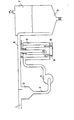
- Slurry is brought by a pipe 1 into a separation device which can be a filter, a centrifuge or in particular a settling tank 2.
- a separation device which can be a filter, a centrifuge or in particular a settling tank 2.
- the pump 4 can be equipped with a disintegration device for sludge, for example a screen or knives arranged on the input periphery of the pump.
- the thick fraction is sent to a continuous heat treatment device 5 or an autoclave with discontinuous operation in which it is heated to a high temperature, for example between 80 and 250 ° C in order to make a significant proportion soluble. of this mud.
- the proportion of sludge sent through the heat treatment device relative to the proportion of the liquid fraction is regulated by the speed of rotation of the pump 4.
- the choice of temperature depends on the composition of the sludge. In the case of easily solubilizable sludge a temperature between 80 and 120 ° C may already be sufficient. On the other hand, a temperature between 130 and 150 ° C is suitable for a mud composed of single-cell particles and a temperature of 180 to 200 ° C makes it possible to dissolve substances with cellulosic walls.
- a temperature of 200 to 220 P C in an oxidizing medium makes it possible to dissolve almost all the sludges in organic matter, but beyond these temperatures, polymerization effects are to be feared so that above 250 ° C the effect solubilization is generally destroyed by polymerization effects.
- the fraction leaving the heat treatment device 5, determined by the speed of the pump 4, is injected into a line 6 conveying the clear, unheated fraction coming from the settling tank 2. If a clear fraction of a quarter is subjected to a treatment of I40 ° C in device 5, this proportion is mixed with three quarters of the limpid fraction for rent downstream of the device 5, which brings the temperature of the mixture to approximately 41 ° C. which for certain layers of anaerobic bacteria constitutes an optimum temperature to ensure a maximum methane flow in the reactor 7 receiving this mixture.
- the heat treatment device 5 is preferably arranged in such a way that any heat leakage is recovered for heating the fraction which passes through the device 5.
- the pump 4 can be driven for example by an electric motor or by an internal combustion engine powered by the methane produced in the methanizer reactor.
- the heating in the heat treatment device 5 can be achieved either by the combustion of the methane produced directly heating the device 5 or first generating steam in a boiler not shown. This vapor is then injected through nozzles 8 into the heat treatment device 5.
- the engine of the pump 4 is an internal combustion engine, it is also possible to directly inject the exhaust gases from this engine through the nozzles 8.
- the steam or the gases injected through the nozzles 8 into the heat treatment device 5 make it possible to reach a temperature there between 80 ° C and 250 ° C.
- the methanogenic reactor 7 can be an infinitely mixed reactor followed by a decator or, as shown in the drawing, an upward flow reactor.
- the infinitely mixed reactor effluent or the muddy effluent collected in the bottom of the decanter 9 of the reactor 7 can be used, at least in part, as methanogenic inoculation sludge in other biodegradation processes of putrescible sludge or organic waste solids and thus allow a significant acceleration of these.
- the influent sent into the separation device 2 can also be rejects from auctions, fruits or vegetables, or other agro-food residues or activated sludge from a system of treatment of sewage, the non-pumpable substances of which have been eliminated beforehand.
Landscapes
- Chemical & Material Sciences (AREA)
- Organic Chemistry (AREA)
- Life Sciences & Earth Sciences (AREA)
- Wood Science & Technology (AREA)
- Engineering & Computer Science (AREA)
- Health & Medical Sciences (AREA)
- Zoology (AREA)
- Bioinformatics & Cheminformatics (AREA)
- Microbiology (AREA)
- Biochemistry (AREA)
- Biotechnology (AREA)
- General Engineering & Computer Science (AREA)
- General Health & Medical Sciences (AREA)
- Genetics & Genomics (AREA)
- Biomedical Technology (AREA)
- Sustainable Development (AREA)
- Chemical Kinetics & Catalysis (AREA)
- Clinical Laboratory Science (AREA)
- General Chemical & Material Sciences (AREA)
- Thermal Sciences (AREA)
- Analytical Chemistry (AREA)
- Mycology (AREA)
- Dispersion Chemistry (AREA)
- Physics & Mathematics (AREA)
- Preparation Of Compounds By Using Micro-Organisms (AREA)
- Treatment Of Sludge (AREA)
Abstract
Description
- La présente invention a pour objet un procédé et une installation de production de composés liquides ou gazeux dans un réacteur microbiel notamment mésophile, ou thermophile, fonctionnant à des températures aux environs de respectivement 35°C ou 55°C.
- L'invention est applicable non seulement à la production de composés gazeux, par exemple à la méthanisation de boues, mais aussi à d'autres procédés de production microbielle qui fonctionnement à des températures entre 30 et 75°C, telle la production de composés liquides, par exemple d'éthanol , à partir d'influents chargés de solides .
- Il est déjà connu de traiter des liquides chargés de solides dans un réacteur méthaniseur dans lequel on maintient une température d'environ 40°C et dans lequel les liquides usés séjournent en moyenne un ou deux jours. Un temps de séjour moyen d'un jour est suffisant si les liquides ne véhiculent pas de boues. Par contre, un séjour d'une ou plusieurs semaines dans le réacteur est nécessaire si les liquides véhiculent une proportion très importante de boues.
- L'invention a pour but d'utiliser d'une manière particulièrement efficace la chaleur nécessaire pour porter un influent chargé de matières solides à une température optimum en vue d'nne production de composants liquides ou gazeux maximum.
- Un autre but est d'augmenter l'activité méthanogène dans un processus de méthanisation d'un influent chargé de boues très peu solubles, c'est-à-dire de réduire le temps de séjour des liquides dans le réacteur afin de réduire l'encombrement et le coût d'une installation.
- Le procédé pour la décomposition de boues dans un réacteur suivant l'invention est caractérisé en ce qu'un liquide chargé de solides est amené dans un dispositif séparant une fraction limpide d'une fraction épaisse des liquides, en ce que la fraction épaisse est chauffée à une température élevée assurant la solubilisation d'au moins une partie des composants solides de cette fraction et en. ce que la fraction ainsi traitée est remélangée avec la fraction limpide et amenée dans le réacteur. De préférence, la proportion de la fraction épaisse et la température à laquelle est portée cette fraction épaisse pour le traitement thermique sont choisies de telle manière qu'après mélange de cette fractions avec la fraction liquide froide, la température du mélange est la température optimum pour un débit maximum de composés liquides ou gazeux formés dans le réacteur.
- L'invention est décrite ci-dessous par rapport à un exemple d'une installation dont le schéma figure au dessin annexé.
- Du lisier est amené par une conduite 1 dans u n dispositif de séparation qui peut être un filtre, une centrifuge ou notamment un bassin décanteur 2. Dans ce bassin, les particules solides, lourdes s'accumulent dans le fond et constituent une fraction épaisse. Cette dernière est évacuée par une conduite 3 à l'aide d'une pompe 4. La pompe 4 peut être équipée d'un dispositif de désintégration pour les boues, par exemple un grillage ou des couteaux disposés sur la périphérie d'entrée de la pompe. De la pompe 4, la fraction épaisse est envoyée dans un dispositif de traitement thermique en continu 5 ou un autoclave à fonctionnement discontinu dans lequel elle est chauffée à une température élevée, par exemple entre 80 et 250°C afin de rendre soluble une proportion importante de cette boue. La proportion de boue envoyée à travers le dispositif de traitement thermique par rapport à la proportion de la fraction liquide est réglée par la vitesse de rotation de la pompe 4. Le choix de la température dépend de la composition des boues. S'il s'agit de boues facilement solubilisables une température entre 80 et 120°C peut déjà suffire. Par contre, une température entre 130 et 150°C convient pour une boue composée de particules monocellulaires et une température de 180 à 200°C permet de solubiliser des substances à parois cellulosiques. Une température de 200 à 220P C en milieu oxydant permet de solubiliser preque toutes les boues en matière organique, mais-au delà de ces températures, des effets de polymerisation sont à craindre de sorte qu'au delà de 250°C l'effet de solubilisation est en général anéanti par des effets de polymérisation.
- La fraction quittant le dispositif de traitement thermique 5, déterminée par la vitesse de la pompe 4 est injectée dans une conduite 6 véhiculant la fraction limpide non chauffée provenant du décanteur 2. Si une proportion de fraction limpide d'un quart est soumis à un traitement de I40°C dans le dispositif 5, cette proportion est mélangée avec trois quarts de la fraction limpide à loue en aval du dispositif 5, ce qui amène la température du mélange à environ 41°C qui pour certaines couches de bactéries anaérobies constitue une température optimum pour assurer un débit de méthane maximum dans le réacteur 7 recevant ce mélange. Le dispositif de traitement thermique 5 est de préférence agencé de telle manière que toute fuite de chaleur est récupérée pour le chauffage de la fraction qui traverse le dispositif 5.
- La pompe 4 peut être entraînée par exemple par un moteur électrique ou par un moteur à explosion alimenté par le méthane produit dans le réacteur méthaniseur. Le chauffage dans le dispositif de traitement thermique 5 peut être réalisé soit par la combustion du méthane produit chauffant directement le dispositif 5 ou engendrant d'abord de la vapeur dans une chaudière non représentée. Cette vapeur est ensuite injectée à travers des tuyères 8 dans le dispositif de traitement thermique 5. Si le moteur de la pompe 4 est un moteur à explosion, il est possible aussi d'injecter directement les gaz d'échappement de ce moteur à travers les tuyères 8. La vapeur d'eau ou les gaz injectés à travers les tuyères 8 dans le dispositif de traitement thermique 5 permettent d'y atteindre une température entre 80°C et 250°C.
- Le réacteur méthanigène 7 peut être un réacteur infiniment mélangé suivi d'un décateur ou comme cela est montré sur le dessin un réacteur à flux ascendant. L'effluent du réacteur infiniment mélangé ou l'effluent boueux récolté dans le fond du décanteur 9 du réacteur 7 peuvent être utilisés, au moins en partie comme boue d'inoculation méthanigène dans d'autres procédés de biodégradation de boues ou de déchets organiques putrescibles solides et permettre ainsi une accélération notable de ceux-ci.
- En lieu et place de lisier, l'influent envoyé dans le dispositif de séparation 2, peut être aussi des rejets de criées, de fruits ou légumes, ou d'autres résidus agro-alimentaires ou encore des boues activées provenant d'un système d'épuration d'eaux d'égouts dont les substances non pompables ont été éliminées au préalable.
Claims (5)
caractérisé en ce qu'un liquide chargé de solides est amené dans un dispositif (2) séparant une fraction limpide d'une fraction épaisse du liquide, en ce que la fraction épaisse du liquide est chauffée à une température élevée assurant la solubilisation d'au moins une partie des composants solides de cette fraction et en ce que la fraction ainsi traitée est remélangée avec la fraction limpide et amenée dans le réacteur (7).
Applications Claiming Priority (2)
| Application Number | Priority Date | Filing Date | Title |
|---|---|---|---|
| BE205764 | 1981-08-26 | ||
| BE0/205764A BE890086A (fr) | 1981-08-26 | 1981-08-26 | Procede et installation de production de composes liquides ou gazeux dans un reacteur microbiel |
Publications (2)
| Publication Number | Publication Date |
|---|---|
| EP0073747A2 true EP0073747A2 (fr) | 1983-03-09 |
| EP0073747A3 EP0073747A3 (fr) | 1986-01-02 |
Family
ID=3843451
Family Applications (1)
| Application Number | Title | Priority Date | Filing Date |
|---|---|---|---|
| EP82870046A Withdrawn EP0073747A3 (fr) | 1981-08-26 | 1982-08-26 | Procédé et installation de production de composés liquides ou gazeux dans un réacteur microbiel |
Country Status (2)
| Country | Link |
|---|---|
| EP (1) | EP0073747A3 (fr) |
| BE (1) | BE890086A (fr) |
Cited By (1)
| Publication number | Priority date | Publication date | Assignee | Title |
|---|---|---|---|---|
| EP1008558A1 (fr) * | 1997-06-05 | 2000-06-14 | Shinko Pantec Co., Ltd. | Méthode pour le traitement des eaux usées organiques |
Family Cites Families (7)
| Publication number | Priority date | Publication date | Assignee | Title |
|---|---|---|---|---|
| US2689818A (en) * | 1951-06-23 | 1954-09-21 | Metal Glass Products Co | Pure culture method and apparatus |
| DE1246611B (de) * | 1961-09-19 | 1967-08-03 | Karl F Staab | Verfahren und Einrichtung zum Ausfaulen von Klaerschlamm |
| US3886046A (en) * | 1973-06-28 | 1975-05-27 | Squibb & Sons Inc | Recycle fermentation process |
| US3994780A (en) * | 1975-10-17 | 1976-11-30 | Institute Of Gas Technology | Anaerobic digestion with liberated enzyme biomass fractions |
| US4082611A (en) * | 1976-11-30 | 1978-04-04 | Imperial Chemical Industries Limited | Continuous fermentation process |
| IN153549B (fr) * | 1979-01-30 | 1984-07-28 | Univ Waterloo | |
| US4289625A (en) * | 1980-01-18 | 1981-09-15 | Institute Of Gas Technology | Hybrid bio-thermal gasification |
-
1981
- 1981-08-26 BE BE0/205764A patent/BE890086A/fr not_active IP Right Cessation
-
1982
- 1982-08-26 EP EP82870046A patent/EP0073747A3/fr not_active Withdrawn
Cited By (2)
| Publication number | Priority date | Publication date | Assignee | Title |
|---|---|---|---|---|
| EP1008558A1 (fr) * | 1997-06-05 | 2000-06-14 | Shinko Pantec Co., Ltd. | Méthode pour le traitement des eaux usées organiques |
| US6083395A (en) * | 1997-06-05 | 2000-07-04 | Shinko Pantec Co., Ltd. | Method of treating a waste water containing organic solids |
Also Published As
| Publication number | Publication date |
|---|---|
| EP0073747A3 (fr) | 1986-01-02 |
| BE890086A (fr) | 1982-02-26 |
Similar Documents
| Publication | Publication Date | Title |
|---|---|---|
| US9272935B2 (en) | Treatment of waste products with anaerobic digestion | |
| CA2299519C (fr) | Procede et dispositif d'epuration d'eaux usees comprenant un traitement additionnel des boues par ozonation | |
| FR2630344A1 (fr) | Procede d'extraction de l'eau melangee a un fluide liquide | |
| JP4590613B2 (ja) | メタンガスの製造方法 | |
| CN105792856A (zh) | 用于有效处理有机材料的热处理系统和方法 | |
| WO2009044076A2 (fr) | Procede de traitement en continu de produits organiques solides et installation pour le traitement en continu de produits organiques solides | |
| CA2277785C (fr) | Procede et dispositif de recuperation du gaz d'event provenant d'un reacteur d'ozonation | |
| EP2109487A1 (fr) | Procède et installation pour le traitement de déchets gras | |
| WO2012104330A1 (fr) | Installation et procede de traitement d'un effluent liquide comprenant une methanisation, un traitement biologique, une digestion de boues methanisees et de boues biologiques, et une methanisation de boues digerees | |
| FR2720014A1 (fr) | Procédé et installation de traitement et de valorisation de déchets graisseux. | |
| US5681483A (en) | Process for the treatment of oily suspensions | |
| EP3625350B1 (fr) | Dispositif et procédé de transformation de matières organiques en mélanges de méthane (ch4) et/ou d'hydrogèn (h2) et/ou de dixoyde de carbone (co2), par couplage de procédés thermochimiques et biologiques | |
| US7638068B1 (en) | Cogeneration system for grease separation and power production | |
| EP0011573A1 (fr) | Procédé de traitement des boues de fosses septiques | |
| EP0819156A1 (fr) | Procede et dispositif de production de combustible par pyrolyse en continu de dechets broyes ou pateux | |
| FR2690458A1 (fr) | Produit de valorisation de déchets organiques graisseux, son procédé d'obtention et installation pour la mise en Óoeuvre de ce procédé. | |
| WO2025087925A1 (fr) | Dispositif et procédé de traitement pyrolytique d'une biomasse ou autre produit carboné | |
| WO2025252641A1 (fr) | Procédé et installation de traitement d'un effluent organique pour la production de biogaz | |
| WO2025083367A1 (fr) | Procédé de traitement des coproduits issus de la production de carburants de synthèse et unité de production pour sa mise en oeuvre | |
| WO2003044157A2 (fr) | Dispositif et procede de destruction de valeurs mobilieres | |
| WO2023006754A1 (fr) | Dispositif de traitement d'intrants bi-étagé et procédé de traitement d'intrants mis en œuvre dans un tel dispositif | |
| EP2799534A1 (fr) | Procédé et appareil de digestion de matière organique | |
| WO2024068895A1 (fr) | Procede de traitement de dechets organiques | |
| BE1022055B1 (fr) | Procede et appareil de digestion de matiere organique. | |
| BE532872A (fr) |
Legal Events
| Date | Code | Title | Description |
|---|---|---|---|
| PUAI | Public reference made under article 153(3) epc to a published international application that has entered the european phase |
Free format text: ORIGINAL CODE: 0009012 |
|
| AK | Designated contracting states |
Designated state(s): AT BE CH DE FR GB IT LI LU NL SE |
|
| RAP1 | Party data changed (applicant data changed or rights of an application transferred) |
Owner name: ATELIERS DE CONSTRUCTIONS ELECTRIQUES DE CHARLEROI |
|
| RAP1 | Party data changed (applicant data changed or rights of an application transferred) |
Owner name: ATELIERS DE CONSTRUCTIONS ELECTRIQUES DE CHARLEROI |
|
| PUAL | Search report despatched |
Free format text: ORIGINAL CODE: 0009013 |
|
| AK | Designated contracting states |
Designated state(s): AT BE CH DE FR GB IT LI LU NL SE |
|
| STAA | Information on the status of an ep patent application or granted ep patent |
Free format text: STATUS: THE APPLICATION IS DEEMED TO BE WITHDRAWN |
|
| 18D | Application deemed to be withdrawn |
Effective date: 19860903 |
|
| RIN1 | Information on inventor provided before grant (corrected) |
Inventor name: DE BAERE, LUC |