EP0073871A1 - Verfahren zur Herstellung von N-substituierten N-Acetyl-2,6-dialkylanilinen - Google Patents
Verfahren zur Herstellung von N-substituierten N-Acetyl-2,6-dialkylanilinen Download PDFInfo
- Publication number
- EP0073871A1 EP0073871A1 EP19810810368 EP81810368A EP0073871A1 EP 0073871 A1 EP0073871 A1 EP 0073871A1 EP 19810810368 EP19810810368 EP 19810810368 EP 81810368 A EP81810368 A EP 81810368A EP 0073871 A1 EP0073871 A1 EP 0073871A1
- Authority
- EP
- European Patent Office
- Prior art keywords
- formula
- substituted
- dialkylaniline
- acetyl chloride
- formula iii
- Prior art date
- Legal status (The legal status is an assumption and is not a legal conclusion. Google has not performed a legal analysis and makes no representation as to the accuracy of the status listed.)
- Granted
Links
- 238000000034 method Methods 0.000 title claims abstract description 24
- 238000002360 preparation method Methods 0.000 title claims abstract description 7
- WETWJCDKMRHUPV-UHFFFAOYSA-N acetyl chloride Chemical compound CC(Cl)=O WETWJCDKMRHUPV-UHFFFAOYSA-N 0.000 claims abstract description 34
- 239000012346 acetyl chloride Substances 0.000 claims abstract description 32
- 238000006243 chemical reaction Methods 0.000 claims abstract description 18
- XLYOFNOQVPJJNP-UHFFFAOYSA-N water Substances O XLYOFNOQVPJJNP-UHFFFAOYSA-N 0.000 claims abstract description 18
- -1 1,2-ethylene group Chemical group 0.000 claims abstract description 13
- 125000002496 methyl group Chemical group [H]C([H])([H])* 0.000 claims abstract description 7
- 125000004432 carbon atom Chemical group C* 0.000 claims abstract description 6
- 239000002904 solvent Substances 0.000 claims abstract description 6
- 238000005406 washing Methods 0.000 claims abstract description 5
- 239000000460 chlorine Substances 0.000 claims abstract description 4
- 229910052801 chlorine Inorganic materials 0.000 claims abstract description 4
- 125000001309 chloro group Chemical group Cl* 0.000 claims abstract description 4
- 125000003545 alkoxy group Chemical group 0.000 claims abstract description 3
- 125000000217 alkyl group Chemical group 0.000 claims abstract description 3
- 125000001495 ethyl group Chemical group [H]C([H])([H])C([H])([H])* 0.000 claims abstract description 3
- 230000007935 neutral effect Effects 0.000 claims abstract description 3
- 239000011541 reaction mixture Substances 0.000 claims description 5
- 238000010992 reflux Methods 0.000 claims description 4
- 239000003513 alkali Substances 0.000 claims description 3
- 238000004821 distillation Methods 0.000 claims description 2
- 238000001035 drying Methods 0.000 abstract 1
- HEMHJVSKTPXQMS-UHFFFAOYSA-M Sodium hydroxide Chemical compound [OH-].[Na+] HEMHJVSKTPXQMS-UHFFFAOYSA-M 0.000 description 12
- NEOYGRJJOGVQPO-UHFFFAOYSA-N methyl 2-(2,6-dimethylanilino)propanoate Chemical compound COC(=O)C(C)NC1=C(C)C=CC=C1C NEOYGRJJOGVQPO-UHFFFAOYSA-N 0.000 description 6
- VEXZGXHMUGYJMC-UHFFFAOYSA-N Hydrochloric acid Chemical compound Cl VEXZGXHMUGYJMC-UHFFFAOYSA-N 0.000 description 5
- 239000000047 product Substances 0.000 description 5
- VGCXGMAHQTYDJK-UHFFFAOYSA-N Chloroacetyl chloride Chemical compound ClCC(Cl)=O VGCXGMAHQTYDJK-UHFFFAOYSA-N 0.000 description 4
- 238000009835 boiling Methods 0.000 description 4
- 239000007795 chemical reaction product Substances 0.000 description 4
- JJKWHOSQTYYFAE-UHFFFAOYSA-N 2-methoxyacetyl chloride Chemical compound COCC(Cl)=O JJKWHOSQTYYFAE-UHFFFAOYSA-N 0.000 description 3
- KWYUFKZDYYNOTN-UHFFFAOYSA-M Potassium hydroxide Chemical compound [OH-].[K+] KWYUFKZDYYNOTN-UHFFFAOYSA-M 0.000 description 3
- ZMANZCXQSJIPKH-UHFFFAOYSA-N Triethylamine Chemical compound CCN(CC)CC ZMANZCXQSJIPKH-UHFFFAOYSA-N 0.000 description 3
- IXCSERBJSXMMFS-UHFFFAOYSA-N hydrogen chloride Substances Cl.Cl IXCSERBJSXMMFS-UHFFFAOYSA-N 0.000 description 3
- 229910000041 hydrogen chloride Inorganic materials 0.000 description 3
- JLTDJTHDQAWBAV-UHFFFAOYSA-N N,N-dimethylaniline Chemical compound CN(C)C1=CC=CC=C1 JLTDJTHDQAWBAV-UHFFFAOYSA-N 0.000 description 2
- CDBYLPFSWZWCQE-UHFFFAOYSA-L Sodium Carbonate Chemical compound [Na+].[Na+].[O-]C([O-])=O CDBYLPFSWZWCQE-UHFFFAOYSA-L 0.000 description 2
- 239000008346 aqueous phase Substances 0.000 description 2
- 239000002585 base Substances 0.000 description 2
- 239000012043 crude product Substances 0.000 description 2
- 239000007789 gas Substances 0.000 description 2
- 230000007062 hydrolysis Effects 0.000 description 2
- 238000006460 hydrolysis reaction Methods 0.000 description 2
- 239000012442 inert solvent Substances 0.000 description 2
- 150000007529 inorganic bases Chemical class 0.000 description 2
- ZQEIXNIJLIKNTD-UHFFFAOYSA-N methyl N-(2,6-dimethylphenyl)-N-(methoxyacetyl)alaninate Chemical compound COCC(=O)N(C(C)C(=O)OC)C1=C(C)C=CC=C1C ZQEIXNIJLIKNTD-UHFFFAOYSA-N 0.000 description 2
- 244000005700 microbiome Species 0.000 description 2
- 150000007530 organic bases Chemical class 0.000 description 2
- 230000003032 phytopathogenic effect Effects 0.000 description 2
- 238000000926 separation method Methods 0.000 description 2
- 238000007086 side reaction Methods 0.000 description 2
- 239000007858 starting material Substances 0.000 description 2
- WVQBLGZPHOPPFO-UHFFFAOYSA-N 2-chloro-N-(2-ethyl-6-methylphenyl)-N-(1-methoxypropan-2-yl)acetamide Chemical compound CCC1=CC=CC(C)=C1N(C(C)COC)C(=O)CCl WVQBLGZPHOPPFO-UHFFFAOYSA-N 0.000 description 1
- YXWIRQHVEQIJOV-UHFFFAOYSA-N 2-ethyl-n-(1-methoxypropan-2-yl)-6-methylaniline Chemical compound CCC1=CC=CC(C)=C1NC(C)COC YXWIRQHVEQIJOV-UHFFFAOYSA-N 0.000 description 1
- 0 CN(O*)OO* Chemical compound CN(O*)OO* 0.000 description 1
- ZAMOUSCENKQFHK-UHFFFAOYSA-N Chlorine atom Chemical compound [Cl] ZAMOUSCENKQFHK-UHFFFAOYSA-N 0.000 description 1
- 206010061217 Infestation Diseases 0.000 description 1
- 229910000831 Steel Inorganic materials 0.000 description 1
- 230000021736 acetylation Effects 0.000 description 1
- 238000006640 acetylation reaction Methods 0.000 description 1
- 239000002253 acid Substances 0.000 description 1
- 239000013543 active substance Substances 0.000 description 1
- 238000005917 acylation reaction Methods 0.000 description 1
- 230000002411 adverse Effects 0.000 description 1
- 150000001412 amines Chemical class 0.000 description 1
- 230000015572 biosynthetic process Effects 0.000 description 1
- 239000006227 byproduct Substances 0.000 description 1
- 230000000694 effects Effects 0.000 description 1
- 239000003344 environmental pollutant Substances 0.000 description 1
- 239000011552 falling film Substances 0.000 description 1
- 238000010438 heat treatment Methods 0.000 description 1
- 239000000203 mixture Substances 0.000 description 1
- 230000003647 oxidation Effects 0.000 description 1
- 238000007254 oxidation reaction Methods 0.000 description 1
- 231100000719 pollutant Toxicity 0.000 description 1
- 239000000376 reactant Substances 0.000 description 1
- 230000035484 reaction time Effects 0.000 description 1
- 229910000029 sodium carbonate Inorganic materials 0.000 description 1
- 239000010959 steel Substances 0.000 description 1
- 239000000126 substance Substances 0.000 description 1
Classifications
-
- C—CHEMISTRY; METALLURGY
- C07—ORGANIC CHEMISTRY
- C07C—ACYCLIC OR CARBOCYCLIC COMPOUNDS
- C07C233/00—Carboxylic acid amides
- C07C233/01—Carboxylic acid amides having carbon atoms of carboxamide groups bound to hydrogen atoms or to acyclic carbon atoms
- C07C233/16—Carboxylic acid amides having carbon atoms of carboxamide groups bound to hydrogen atoms or to acyclic carbon atoms having the nitrogen atom of at least one of the carboxamide groups bound to a carbon atom of a hydrocarbon radical substituted by singly-bound oxygen atoms
-
- C—CHEMISTRY; METALLURGY
- C07—ORGANIC CHEMISTRY
- C07C—ACYCLIC OR CARBOCYCLIC COMPOUNDS
- C07C233/00—Carboxylic acid amides
- C07C233/01—Carboxylic acid amides having carbon atoms of carboxamide groups bound to hydrogen atoms or to acyclic carbon atoms
- C07C233/45—Carboxylic acid amides having carbon atoms of carboxamide groups bound to hydrogen atoms or to acyclic carbon atoms having the nitrogen atom of at least one of the carboxamide groups bound to a carbon atom of a hydrocarbon radical substituted by carboxyl groups
- C07C233/46—Carboxylic acid amides having carbon atoms of carboxamide groups bound to hydrogen atoms or to acyclic carbon atoms having the nitrogen atom of at least one of the carboxamide groups bound to a carbon atom of a hydrocarbon radical substituted by carboxyl groups with the substituted hydrocarbon radical bound to the nitrogen atom of the carboxamide group by an acyclic carbon atom
Definitions
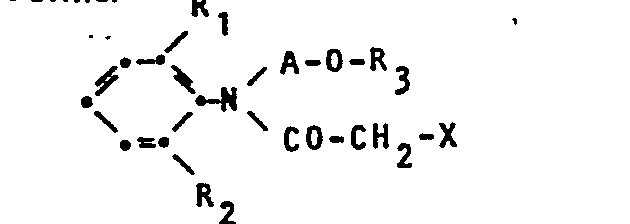
- the present invention relates to a process for the preparation of N-substituted N-acetyl-2,6-dialkylanilines of the formula I.
- R 1 and R 2 independently of one another are methyl or ethyl
- A is a 1,2-ethylene group which can be substituted by one or two methyl groups, a 2-oxo-1,2-ethylene group or a 1-methyl-2- represents oxo-1,2-ethylene group
- R 3 represents an alkyl group with 1-3 carbon atoms
- X represents chlorine or an alkoxy group with 1-3 carbon atoms
- N-substituted N-acetyl-2,6-dialkylanilines of formula I have a pronounced effect against phytopathogenic microorganisms and are therefore used to protect crops against infestation by phytopathogenic microorganisms.
- N-substituted N-acetyl-2,6-dialkylanilines of the formula I and their use are described, for example, in US Pat. Nos. 3,952,056, 3,937,730, 4,206,228 and 4,200,451.
- N-substituted N-acetyl-2,6-dialkylanilines of the formula I by reacting the corresponding N-substituted 2,6-dialkylanilines of the formula II with an acetyl chloride of the formula III.
- the reaction can be carried out either in the absence or in the presence of an inorganic or organic base, such as sodium hydroxide, sodium carbonate, N, N-dimethylaniline or triethylamine.
- an inorganic or organic base such as sodium hydroxide, sodium carbonate, N, N-dimethylaniline or triethylamine.
- the aforementioned methods are uneconomical because of the disadvantages inherent in them.
- the present invention is therefore based on the object of providing a process by which the N-substituted N-acetyl-2,6-dialkylanilines of the formula I can be prepared in a simple and economical manner in good yields on an industrial scale.
- N-substituted N-acetyl-2,6-dialkylanilines of the formula I can be prepared in excellent yield and purity by reacting the N-substituted 2,6-dialkylaniline of the formula II with the acetyl chloride of formula III in excess acetyl chloride of formula III as a solvent.
- the inventive method for the preparation of N-substituted N-acetyl-2,6-dialkylanilines of the formula I is therefore characterized in that the N-substituted 2,6-dialkylaniline Formula II with the acetyl chloride of the formula III in the presence of excess acetyl chloride of the formula III as a solvent, the excess acetyl chloride of the formula III is removed by distillation, the N-substituted N-acetyl-2,6-dialkylaniline of the formula I formed is neutral with water washes and then dries.
- the acetyl chloride of formula III is usually used in an amount of 2-20 moles per mole of N-substituted 2,6-dialkylaniline of formula II.
- the acetyl chloride of the formula III is preferably used in an amount of 4-8 moles per mole of N-substituted 2,6-dialkylaniline of the formula II.
- the reaction is advantageously carried out in the temperature range from 70 ° to the reflux temperature of the reaction mixture.
- the reaction is preferably carried out at the reflux temperature of the reaction mixture.
- the washing of the after removal of the excess acetyl chloride of the formula III with water can be carried out at 50-110 ° C. It is advantageous to repeat the washing process a few times. It is also advantageous to add an amount of alkali to the wash water which is sufficient to adjust the pH of the water to 4-10. Sodium hydroxide or potassium hydroxide is particularly suitable as the alkali which can be added to the wash water.
- the product is then optionally dried after further washing with pure water by heating to 100-120 ° C. in vacuo.
- the process according to the invention can be carried out batchwise or continuously.
- the procedure is advantageously such that the N-substituted 2,6-dialkylaniline of the formula II is introduced into boiling acetyl chloride of the formula III and the excess acetyl chloride is distilled off in vacuo after the reaction has ended.
- the process is carried out continuously, it is expedient to simultaneously introduce the acetyl chloride of the formula III and the N-substituted 2,6-dialkylaniline of the formula II into the reactor at the reaction temperature and to evaporate the mixture immediately subsequently in vacuo.
- the continuous implementation of the process can advantageously be carried out in a cascade reactor of 2 to 4 stages or in a falling film reactor.
- the hydrogen chloride formed in the reaction is separated off in gaseous form and can either be compressed and filled into steel bottles or dissolved in water to form concentrated hydrochloric acid or processed to chlorine by oxidation.
- N-substituted 2,6-dialkylanilines of the formula II used as starting materials preference is given to those in which A is a 1,2-ethylene group, an 1-methyl-1, 2-ethylene group or an 1-methoxy-2-oxo 1, 2-ethylene group and R 3 is methyl.
- Particularly preferred starting materials of the formula III are N- (1'-methyl-2'-methoxyethyl) -Z-ethyl-6-methylaniline and N- (1'-methoxycarbonylethyl) -2,6-dimethylaniline.
- acetyl chlorides of formula III chloroacetyl chloride and methoxyacetyl chloride are preferred.
- the crude product thus obtained is washed in a separating funnel with 200 ml of water, the pH of the wash water being adjusted to 8 by adding 30% sodium hydroxide solution. After the aqueous phase has been separated off, the product is first washed twice with pure water and then dried at 110 ° C. and 15 torr for 30 min. This gives 273.8 g (96.6% of theory) of N- (2'-methoxy-l'-methylethyl) -N-chloroacetyl-2-ethyl-6-methylaniline.
- the crude product thus obtained is washed at 80 ° C. with 100 ml of water, the pH of the wash water being adjusted to 4 by adding 1N sodium hydroxide solution. After the aqueous phase has been separated off, the product is washed twice more with warm water and then dried at 110 ° C. and 15 torr for 1 hour. This gives 217.3 g (97.2% of theory) of N- (1'-methoxycarbonylethyl) -N-methoxyacetyl-2,6-dimethylaniline.
Landscapes
- Chemical & Material Sciences (AREA)
- Organic Chemistry (AREA)
- Organic Low-Molecular-Weight Compounds And Preparation Thereof (AREA)
Abstract


Description
- Die vorliegende Erfindung betrifft ein Verfahren zur Herstellung von N-substituierten N-Acetyl-2,6-dialkylanilinen der Formel I


- Die N-substituierten N-Acetyl-2,6-dialkylaniline der Formel I haben eine ausgeprägte Wirkung gegen phytopathogene Mikroorganismen und werden daher zum Schutz von Kulturpflanzen gegen den Befall durch phytopathogene Mikroorganismen verwendet. N-substituierte N-Acetyl-2,6-dialkylaniline der Formel I und ihre Verwendung sind beispielsweise in den US-Patentschriften 3,952,056, 3,937,730, 4,206,228 und 4,200,451 beschrieben.
- Es ist bekannt, N-substituierte N-Acetyl-2,6-dialkylaniline der Formel I durch Umsetzung der entsprechenden N-substituierten 2,6-Dialkylaniline der Formel II mit einem Acetylchlorid der Formel III herzustellen. Die Umsetzung kann sowohl in Abwesenheit als auch in Anwesenheit einer anorganischen oder organischen Base, wie Natriumhydroxid, Natriumcarbonat, N,N-Dimethylanilin oder Triäthylamin durchgeführt werden. Bei der Durchführung der Acetylierung in Gegenwart von wässrigen anorganischen Basen wird jedoch ein grosser Ueberschuss an Acetylchlorid benötigt, da ein wesentlicher Teil des Acetylchlorids durch Hydrolyse verloren geht. Dies ist einerseits unwirtschaftlich und verursacht andererseits ökologische Probleme, da die durch Hydrolyse entstandene Säure aus dem Wasser entfernt werden muss. Dieser Nachteil der Verwendung eines grossen Ueberschusses an Chloracetylchlorid kann zwar durch Verwendung von organischen Basen vermieden werden, doch muss in diesem Fall das jeweils gebildete Aminhydrochlorid abgetrennt und das entsprechende Amin regeneriert werden, was einen zusätzlichen Aufwand bedeutet.
- Obwohl in einzelnen Fällen Acylierungsreaktionen in Abwesenheit einer Base und in Abwesenheit eines Lösungsmittels durchgeführt werden können, ist für die Umsetzung eines N-substituierten 2,6-Dialkylanilins der Formel II mit einem Acetylchlorid der Formel III in Abwesenheit einer Base zur Erreichung einer guten Ausbeute stets die Anwesenheit eines inerten Lösungsmittels notwendig. Wird die Umsetzung in Abwesenheit eines Lösungsmittels durchgeführt, so erhält man ein dunkelgefärbtes hochviskoses Reaktionsprodukt, welches sehr schwierig zu handhaben ist und aus welchem das gewünschte Reaktionsprodukt nur in sehr mässigen Ausbeuten gewonnen werden kann.
- Die Durchführung der Umsetzung eines N-substituierten 2,6-Diälkylanilins der Formel II mit einem Acetylchlorid der Formel III in einem inerten Lösungsmittel in Abwesenheit hat den Vorteil, dass der während der Umsetzung gebildete Chlorwasserstoff unmittelbar gasförmig abgetrennt werden kann. Da jedoch das Acetylchlorid aus wirtschaftlichen Gründen im wesentlichen in äquimolarer Menge verwendet wird, sind für die vollständige Umsetzung und für die vollständige Abtrennung des Chlorwasserstoffs lange Reaktionszeiten notwendig. In der Regel ist es notwendig, das Reaktionsgemisch einige Stunden auf Temperaturen von 90-110°C zu erhitzen, wodurch Nebenreaktionen, die zur Bildung harziger Nebenprodukte führen, begünstigt werden. Durch diese Nebenreaktionen wird die Ausbeute an Aktivsubstanz vermindert.
- Die vorgenannten Verfahren sind aufgrund der ihnen anhaftenden Nachteile unwirtschaftlich. Der vorliegenden Erfindung liegt daher die Aufgabe zugrunde, ein Verfahren bereitzustellen, nach dem die N-substituierten N-Acetyl-2,6-dialkylaniline der Formel I auf einfache und wirtschaftliche Weise in guten Ausbeuten in technischem Masstab hergestellt werden können.
- Es wurde nun gefunden, dass man N-substituierte N-Acetyl-2,6-dialkylaniline der Formel I in ausgezeichneter Ausbeute und ausgezeichneter Reinheit herstellen kann, wenn man die Umsetzung des N-substituierten 2,6-Dialkylanilins der Formel II mit dem Acetylchlorid der Formel III in überschüssigem Acetylchlorid der Formel III als Lösungsmittel durchführt. Das erfindungsgemässe Verfahren zur Herstellung von N-substituierten N-Acetyl-2,6-dialkylanilinen der Formel I ist daher dadurch gekennzeichnet, dass man das N-substituierte 2,6-Dialkylanilin der Formel II mit dem Acetylchlorid der Formel III in Gegenwart von überschüssigem Acetylchlorid der Formel III als Lösungsmittel durchführt, das überschüssige Acetylchlorid der Formel III durch Destillation abtrennt, das gebildete N-substituierte N-Acetyl-2,6-dialkylanilin der Formel I mit Wasser neutral wäscht und anschliessend trocknet.
- Das Acetylchlorid der Formel III wird in der Regel in einer Menge von 2-20 Mol pro Mol N-substituiertes 2,6-Dialkylanilin der Formel II verwendet. Vorzugsweise verwendet man das Acetylchlorid der Formel III in einer Menge von 4-8 Mol pro Mol N-substituiertes 2,6-Dialkylanilin der Formel II. Die Umsetzung wird vorteilhaft im Temperaturbereich von 70° bis Rückflusstemperatur des Reaktionsgemisches durchgeführt. Vorzugsweise führt man die Umsetzung bei Rückflusstemperatur des Reaktionsgemisches durch.
- Das Waschen des nach der Abtrennung des überschüssigen Acetylchlorids der Formel III mit Wasser kann bei 50-l10°C durchgeführt werden. Es ist vorteilhaft, den Waschvorgang einige Male zu wiederholen. Weiterhin ist es vorteilhaft, dem Waschwasser eine Menge Alkali zuzusetzen, die ausreicht, um den pH-Wert des Wassers auf 4-10 zu stellen. Als Alkali, das dem Waschwasser ztgesetzt werden kann, ist insbesondere Natriumhydroxid oder Kaliumhydroxid geeignet. Anschliessend wird das Produkt gegebenenfalls nach einer weiteren Wäsche mit reinem Wasser durch-Erhitzen auf 100-120 °C im Vakuum getrocknet.
- Das erfindungsgemässe Verfahren kann diskontinuierlich oder kontinuierlich durchgeführt werden.
- Bei der diskontinuierlichen Durchführung des Verfahrens geht man vorteilhaft so vor, dass man das N-substituierte 2,6-Dialkylanilin der Formel II in siedendes Acetylchlorid der Formel III einträgt und das überschüssige Acetylchlorid nach beendigter Umsetzung im Vakuum abdestilliert.
- Bei der kontinuierlichen Durchführung des Verfahrens ist es zweckmässig, das Acetylchlorid der Formel III und das N-substituierte 2,6-Dialkylanilin der Formel II bei Reaktionstempertur gleichzeitig in den Reaktor einzuführen und das Gemisch unmittelbar anschliessend im Vakuum einzudampfen. Die kontinuierliche Durchführung des Verfahrens kann vorteilhaft in einem Kaskadenreaktor von 2 bis 4 Stufen oder in einem Fallfilmreaktor vorgenommen werden.
- Der bei der Reaktion gebildete Chlorwasserstoff wird gasförmig abgetrennt und kann entweder komprimiert und in Stahlflaschen abgefüllt oder in Wasser zu konzentrierter Salzsäure gelöst oder durch Oxydation zu Chlor verarbeitet werden.
- Unter den als Ausgangsmaterialien verwendeten N-substituierten 2,6-Dialkylanilinen der Formel II sind diejenigen bevorzugt, in welchen A eine 1,2-Aethylengruppe, eine l-Methyl-l,2-Aethylengruppe oder eine l-Methoxy-2-oxo-l,2-äthylengruppe und R3 Methyl bedeutet. Besonders bevorzugte Ausgangsmaterialien der Formel III sind N-(1'-Methyl-2'-methoxyäthyl)-Z-äthyl-6-methylanilin und N-(1'-Methoxycarbonyläthyl)-2,6-dimethylanilin. Von den Acetylchloriden der Formel III sind Chloracetylchlorid und Methoxyacetylchlorid bevorzugt.
- Es ist ein besonderer Vorteil des erfindungsgemässen Verfahrens, dass die Belastung der Umwelt mit Schadstoffen auf ein Minimum reduziert ist. Die bei Durchführung des erfindungsgemässen Verfahrens erhaltenen Produkte sind sehr rein und die Ausbeute ist hervorragend. Da die Umsetzung der N-substituierten 2,6-Dialkylaniline der Formel II mit den Acetylchloriden der Formel III sehr rasch vonstatten geht, können die Verweilzeiten von Ausgangs- und Endprodukten unter Reaktionsbedingungen sehr kurz gehalten werden. Als Folge davon kann die Grösse des Reaktors für eine vorgegebene Menge an Produkt relativ klein gehalten werden. Da das überschüssige Acetylchlorid der Formel III nach seiner Abtrennung erneut in die Reaktion eingesetzt werden kann, werden Substanzverluste weitgehend vermieden. Ein weiterer Vorteil des erfindungsgemässen-Verfahrens besteht schliesslich darin, dass das Mengenverhältnis der Reaktanden in sehr weiten Grenzen variiert werden kann, ohne dass die Qualität des Endproduktes nachteilig beeinflusst wird.
- Mit dem erfindungsgemässen Verfahren wird. es daher möglich, die N-substituierten N-Acetyl-2,6-dialkylaniline der Formel I auf einfache Weise in ausgezeichnet Ausbeute und Reinheit herzustellen.
- Das erfindungsgemässe Verfahren wird durch die nachfolgenden Beispiele näher erläutert.
- In einem mit Rührer, Tropftrichter und Kühler versehenen Dreiliterdreihalskolben werden 1356 g (12 Mol) Chloracetylchlorid vorgelegt und zum Sieden erhitzt. Dann werden 207 g (1 Mol) N-(2'-Methoxy-1'-methyläthyl)-2-äthyl-6-methylanilin mit einer solchen Geschwindigkeit zugetropft, dass die Lösung immer gleichmässig am Sieden bleibt und Gas entwickelt. Nach Zugabe des N-(2'-Methoxy-l'-methyläthyl)-2- äthyl-6-methylanilins wird der Ueberschuss an Chloracetylchlorid in einem Rotationsverdampfer bei einem Druck von 15 Torr abdestilliert. Das so erhaltene Rohprodukt wird in einem Scheidetrichter mit 200 ml Wasser gewaschen, wobei der pH-Wert des Waschwassers durch Zugabe von 30%iger Natronlauge auf 8 eingestellt wird. Nach Abtrennung der wässrigen Phase wird das Produkt zunächst noch zweimal mit reinem Wasser gewaschen und dann 30 min bei 110°C und 15 Torr getrocknet. Es werden so 273,8 g (96,6% d.Th.) N-(2'-Methoxy-l'-methyläthyl)-N-chloracetyl-2-äthyl-6-methylanilin erhalten.
- In einem mit Rührer, Abtropftrichter und Kühler versehenen Zweiliterdreihalskolben werden 868 g (8 Mol) Methoxyacetylchlorid vorgelegt und zum Sieden erhitzt. Dann werden 165,6 g (0,8 Mol) N-(1'-Methoxycarbo- nyläthyl)-2,6-dimethylanilin mit solcher Geschwindigkeit zugetropft, dass die Lösung immer gleichmässig am Sieden bleibt und Gas entwickelt. Nach Zugabe des N-(1'-Methoxycarbonyläthyl)-2,6-Dimethyl- anilins wird das überschüssige Methoxyacetylchlorid in einem Rotationsverdampfer bei einem Druck von 15 Torr abdestilliert. Da so erhaltene Rohprodukt wird bei 80°C mit 100 ml Wasser gewaschen, wobei der pH-Wert des Waschwassers durch Zugabe von 1N-Natronlauge auf 4 eingestellt wird. Nach Abtrennung der wässrigen Phase wird das Produkt noch zweimal mit warmem Wasser gewaschen und dann 1 Stunde bei 110°C und 15 Torr getrocknet. Es werden so 217,3 g (97,2% d.Th.) N-(1'-Methoxy- carbonyläthyl)-N-methoxyacetyl-2,6-dimethylanilin erhalten.
Claims (7)


Priority Applications (3)
| Application Number | Priority Date | Filing Date | Title |
|---|---|---|---|
| EP19810810368 EP0073871B1 (de) | 1981-09-07 | 1981-09-07 | Verfahren zur Herstellung von N-substituierten N-Acetyl-2,6-dialkylanilinen |
| AT81810368T ATE14013T1 (de) | 1979-04-16 | 1981-09-07 | Verfahren zur herstellung von n-substituierten n- acetyl-2,6-dialkylanilinen. |
| DE8181810368T DE3171128D1 (en) | 1979-04-16 | 1981-09-07 | Process for the preparation of n-substituted-n-acylated 2,6-dialkylanilines |
Applications Claiming Priority (1)
| Application Number | Priority Date | Filing Date | Title |
|---|---|---|---|
| EP19810810368 EP0073871B1 (de) | 1981-09-07 | 1981-09-07 | Verfahren zur Herstellung von N-substituierten N-Acetyl-2,6-dialkylanilinen |
Publications (2)
| Publication Number | Publication Date |
|---|---|
| EP0073871A1 true EP0073871A1 (de) | 1983-03-16 |
| EP0073871B1 EP0073871B1 (de) | 1985-06-26 |
Family
ID=8188674
Family Applications (1)
| Application Number | Title | Priority Date | Filing Date |
|---|---|---|---|
| EP19810810368 Expired EP0073871B1 (de) | 1979-04-16 | 1981-09-07 | Verfahren zur Herstellung von N-substituierten N-Acetyl-2,6-dialkylanilinen |
Country Status (1)
| Country | Link |
|---|---|
| EP (1) | EP0073871B1 (de) |
Cited By (1)
| Publication number | Priority date | Publication date | Assignee | Title |
|---|---|---|---|---|
| DE3515094A1 (de) * | 1985-04-26 | 1986-10-30 | Hoechst Ag, 6230 Frankfurt | Verfahren zur herstellung von n-(2,6-dialkylphenyl)-n-formyl-glycinderivaten |
Citations (2)
| Publication number | Priority date | Publication date | Assignee | Title |
|---|---|---|---|---|
| EP0017850A1 (de) * | 1979-04-12 | 1980-10-29 | Bayer Ag | N,N-Disubstituierte Ethylglycinester, ihre Herstellung und Verwendung, sie enthaltende Fungizide und deren Herstellung |
| GB2073173A (en) * | 1980-04-03 | 1981-10-14 | Ciba Geigy Ag | Producing N-alkoxyalkyl-N- chloroacetyl-2,6-dialkylanilines |
-
1981
- 1981-09-07 EP EP19810810368 patent/EP0073871B1/de not_active Expired
Patent Citations (2)
| Publication number | Priority date | Publication date | Assignee | Title |
|---|---|---|---|---|
| EP0017850A1 (de) * | 1979-04-12 | 1980-10-29 | Bayer Ag | N,N-Disubstituierte Ethylglycinester, ihre Herstellung und Verwendung, sie enthaltende Fungizide und deren Herstellung |
| GB2073173A (en) * | 1980-04-03 | 1981-10-14 | Ciba Geigy Ag | Producing N-alkoxyalkyl-N- chloroacetyl-2,6-dialkylanilines |
Cited By (1)
| Publication number | Priority date | Publication date | Assignee | Title |
|---|---|---|---|---|
| DE3515094A1 (de) * | 1985-04-26 | 1986-10-30 | Hoechst Ag, 6230 Frankfurt | Verfahren zur herstellung von n-(2,6-dialkylphenyl)-n-formyl-glycinderivaten |
Also Published As
| Publication number | Publication date |
|---|---|
| EP0073871B1 (de) | 1985-06-26 |
Similar Documents
| Publication | Publication Date | Title |
|---|---|---|
| EP0253214B1 (de) | Verfahren zur Herstellung von Chlorcarbonsäurechloriden | |
| EP0370391A2 (de) | Verfahren zur Herstellung von 4,5-Dichlor-6-ethylpyrimidin | |
| DE19743901C1 (de) | Verfahren zur Herstellung von Methansulfonsäure | |
| EP0086324A2 (de) | Verfahren zur Herstellung von Ascorbinsäure | |
| EP0217018A1 (de) | Verfahren zur Herstellung von 3-Aminoacrylsäureestern | |
| DD150741A5 (de) | Verfahren zur herstellung von 2',6'-dialkyl-n-(alkoxymethyl)-2-chloracetaniliden | |
| EP0073871B1 (de) | Verfahren zur Herstellung von N-substituierten N-Acetyl-2,6-dialkylanilinen | |
| EP0569947A1 (de) | Verfahren zur Herstellung von 2-Chlor-5-chlormethyl-pyridin | |
| EP0004623A1 (de) | Verfahren zur Herstellung von aromatischen Aminen | |
| DE2065698C3 (de) | Verfahren zur Herstellung von 2-Isopropyl-6-methyl-4(3H)-pyrimidon | |
| DE2719020A1 (de) | Verfahren zur herstellung von anthranilamiden | |
| EP0171046B1 (de) | Verfahren zur Herstellung von Pantolacton | |
| EP0041923B1 (de) | Verfahren zur Herstellung von N-(1'-Alkoxycarbonyläthyl)-2,6-dialkylanilinen | |
| EP0025935B1 (de) | Verfahren zur Herstellung von 5-(2,2,2-Trihalogenethyl)-dialkyl-tetrahydrofuran-2-onen | |
| DE69511827T2 (de) | Verfahren zur Herstellung von Aminoacetamid Derivaten | |
| DE2558399A1 (de) | Herstellung von 3,6-dichlorpicolinsaeure | |
| DE1046063B (de) | Verfahren zur Herstellung neuer, amoebicid wirkender Acetanilide | |
| DE2256253C3 (de) | Verfahren zur Herstellung von Phthalimide- oder Cyclohexen-1,2-dicarboximidothionophosphaten | |
| AT234698B (de) | Verfahren zur Herstellung von 4-Sulfanilamido-2,6-di-nieder-alkoxy-pyrimidinen | |
| AT323123B (de) | Verfahren zur herstellung von n,n-disubstituierten charbonsäureamiden | |
| DE2944953C2 (de) | Verfahren zur Herstellung von N,N'-1,1-Dimethyltrimethylen-bis-benzamid | |
| DE2621833A1 (de) | Herstellung organischer saeuren | |
| DE69310136T2 (de) | Aliphatische Omega-hydroxy-3-ketonitrile und Verfahren zur Herstellung von aliphatischen Omega-hydroxycarbonsäuren | |
| AT372940B (de) | Verfahren zur herstellung von (d)-(-)-phydroxyphenylglycylchlorid-hydrochlorid | |
| CH660360A5 (de) | Verfahren zur herstellung von substituierten chloracetaniliden. |
Legal Events
| Date | Code | Title | Description |
|---|---|---|---|
| PUAI | Public reference made under article 153(3) epc to a published international application that has entered the european phase |
Free format text: ORIGINAL CODE: 0009012 |
|
| 17P | Request for examination filed |
Effective date: 19810909 |
|
| AK | Designated contracting states |
Kind code of ref document: A1 Designated state(s): AT BE CH DE FR GB IT LI LU NL SE |
|
| ITF | It: translation for a ep patent filed | ||
| GRAA | (expected) grant |
Free format text: ORIGINAL CODE: 0009210 |
|
| AK | Designated contracting states |
Kind code of ref document: B1 Designated state(s): AT BE CH DE FR GB IT LI LU NL SE |
|
| REF | Corresponds to: |
Ref document number: 14013 Country of ref document: AT Date of ref document: 19850715 Kind code of ref document: T |
|
| REF | Corresponds to: |
Ref document number: 3171128 Country of ref document: DE Date of ref document: 19850801 |
|
| ET | Fr: translation filed | ||
| PLBE | No opposition filed within time limit |
Free format text: ORIGINAL CODE: 0009261 |
|
| STAA | Information on the status of an ep patent application or granted ep patent |
Free format text: STATUS: NO OPPOSITION FILED WITHIN TIME LIMIT |
|
| 26N | No opposition filed | ||
| ITTA | It: last paid annual fee | ||
| EPTA | Lu: last paid annual fee | ||
| EAL | Se: european patent in force in sweden |
Ref document number: 81810368.1 |
|
| REG | Reference to a national code |
Ref country code: CH Ref legal event code: PFA Free format text: CIBA-GEIGY AG TRANSFER- NOVARTIS AG |
|
| REG | Reference to a national code |
Ref country code: GB Ref legal event code: 732E |
|
| NLS | Nl: assignments of ep-patents |
Owner name: NOVARTIS AG |
|
| REG | Reference to a national code |
Ref country code: FR Ref legal event code: TP |
|
| PGFP | Annual fee paid to national office [announced via postgrant information from national office to epo] |
Ref country code: FR Payment date: 20000726 Year of fee payment: 20 |
|
| PGFP | Annual fee paid to national office [announced via postgrant information from national office to epo] |
Ref country code: BE Payment date: 20000727 Year of fee payment: 20 |
|
| PGFP | Annual fee paid to national office [announced via postgrant information from national office to epo] |
Ref country code: NL Payment date: 20000728 Year of fee payment: 20 Ref country code: CH Payment date: 20000728 Year of fee payment: 20 |
|
| PGFP | Annual fee paid to national office [announced via postgrant information from national office to epo] |
Ref country code: SE Payment date: 20000731 Year of fee payment: 20 Ref country code: DE Payment date: 20000731 Year of fee payment: 20 |
|
| PGFP | Annual fee paid to national office [announced via postgrant information from national office to epo] |
Ref country code: LU Payment date: 20000802 Year of fee payment: 20 |
|
| PGFP | Annual fee paid to national office [announced via postgrant information from national office to epo] |
Ref country code: AT Payment date: 20000811 Year of fee payment: 20 |
|
| PGFP | Annual fee paid to national office [announced via postgrant information from national office to epo] |
Ref country code: GB Payment date: 20000815 Year of fee payment: 20 |
|
| BE20 | Be: patent expired |
Free format text: 20010907 *NOVARTIS A.G. |
|
| PG25 | Lapsed in a contracting state [announced via postgrant information from national office to epo] |
Ref country code: LI Free format text: LAPSE BECAUSE OF EXPIRATION OF PROTECTION Effective date: 20010906 Ref country code: GB Free format text: LAPSE BECAUSE OF EXPIRATION OF PROTECTION Effective date: 20010906 Ref country code: CH Free format text: LAPSE BECAUSE OF EXPIRATION OF PROTECTION Effective date: 20010906 |
|
| PG25 | Lapsed in a contracting state [announced via postgrant information from national office to epo] |
Ref country code: NL Free format text: LAPSE BECAUSE OF EXPIRATION OF PROTECTION Effective date: 20010907 Ref country code: LU Free format text: LAPSE BECAUSE OF EXPIRATION OF PROTECTION Effective date: 20010907 Ref country code: AT Free format text: LAPSE BECAUSE OF EXPIRATION OF PROTECTION Effective date: 20010907 |
|
| REG | Reference to a national code |
Ref country code: GB Ref legal event code: PE20 Effective date: 20010906 |
|
| REG | Reference to a national code |
Ref country code: CH Ref legal event code: PL |
|
| PG25 | Lapsed in a contracting state [announced via postgrant information from national office to epo] |
Ref country code: SE Free format text: THE PATENT HAS BEEN ANNULLED BY A DECISION OF A NATIONAL AUTHORITY Effective date: 20010929 |
|
| NLV7 | Nl: ceased due to reaching the maximum lifetime of a patent |
Effective date: 20010907 |
|
| EUG | Se: european patent has lapsed |
Ref document number: 81810368.1 |