EP0073881A2 - Kabelzuleitung für Herzschrittmacher-Elektroden - Google Patents
Kabelzuleitung für Herzschrittmacher-Elektroden Download PDFInfo
- Publication number
- EP0073881A2 EP0073881A2 EP82104847A EP82104847A EP0073881A2 EP 0073881 A2 EP0073881 A2 EP 0073881A2 EP 82104847 A EP82104847 A EP 82104847A EP 82104847 A EP82104847 A EP 82104847A EP 0073881 A2 EP0073881 A2 EP 0073881A2
- Authority
- EP
- European Patent Office
- Prior art keywords
- alloy
- platinum
- titanium
- core
- cable
- Prior art date
- Legal status (The legal status is an assumption and is not a legal conclusion. Google has not performed a legal analysis and makes no representation as to the accuracy of the status listed.)
- Granted
Links
Images
Classifications
-
- A—HUMAN NECESSITIES
- A61—MEDICAL OR VETERINARY SCIENCE; HYGIENE
- A61N—ELECTROTHERAPY; MAGNETOTHERAPY; RADIATION THERAPY; ULTRASOUND THERAPY
- A61N1/00—Electrotherapy; Circuits therefor
- A61N1/02—Details
- A61N1/04—Electrodes
- A61N1/05—Electrodes for implantation or insertion into the body, e.g. heart electrode
- A61N1/056—Transvascular endocardial electrode systems
Definitions
- the invention relates to a cable lead for a pacemaker electrode, with a cladding tube made of electrically insulating, elastic material and at least one conductor arranged therein for electrical stimulation current pulses, the conductor comprising a core made of a metal of high electrical conductivity and a jacket made of a has corrosion-resistant, non-toxic metal.
- a cable lead for a pacemaker electrode is known from US Pat. No. 3,749,101. Silicone rubber is used as the material for the cladding tube.
- the wire-shaped conductor arranged in the elastic cladding tube consists of a corrosion-resistant alloy of 20 to 50% Co, 15 to 30% Cr, 5 to 10% Ni, up to 18% Fe, 1 to 10% Mo, up to 3% Mn, up to 0.3% C and 0.01 to 0.09% Be.
- a cable feed line for a pacemaker electrode is also known from US Pat. No. 4,273,137.
- an electrical conductor is arranged, which consists of a plurality of electrically conductive fibers, these fibers having a jacket made of a corrosion-resistant, non-toxic metal alloy, such as stainless steel or a cobalt-based alloy, which has a core made of a Encased metal with high electrical conductivity.
- a corrosion-resistant, non-toxic metal alloy such as stainless steel or a cobalt-based alloy
- Silver, copper, silver-based alloys or copper-based alloys are used as core materials.
- the large number of electrically conductive fibers is arranged in a shell, which in turn consists of the same corrosion-resistant, non-toxic metal as the sheath material of the individual fibers.
- the single fiber consists of a tube serving as a jacket, which is filled with the metal with high electrical conductivity.
- the object of the invention is to provide a cable feed line in which electrical power losses are reduced to a minimum and which ensures good biocompatibility.
- the conductor is a sheathed wire produced by pulling, the sheath of which is made of a metal from the group of tantalum, titanium, zirconium, niobium, titanium-based alloy, platinum, platinum Iridium alloy, platinum-palladium alloy and platinum-rhodium alloy, wherein the shell wall thickness is in the range of 0.0025 to 0.035 mm and the core diameter is 0.04 to 0.3 mm.
- copper and copper alloys have proven to be suitable as materials for the core.
- Zr, Ti, Be, Fe, P, Zn or 'Sn are particularly important alloying elements.
- Examples of such alloys are CuZr0.15, CuTi4, CuBe2, CuBel, 7, CuBe0.7, CuZn28, CuZn37, CuSn6, CuSn8 or CuFe2.
- a cable has proven itself as a cable feeder in which the core of the sheathed wire consists of CuZr0.15 or CuBe2 and the sheath made of tantalum, the outer surface of which is anodized.
- Pt-Ir alloys with up to 40% Ir the rest of Pt, Pt-Pd alloys with up to 50% Pd, the rest of Pt and Pt-Rh alloys with up to 40% Rh, the rest of Pt have proven to be suitable as sheath materials, advantageously alloys made of PtIrlO, PtPdl0 and PtRh10.
- a preferred example of sheath materials made of titanium-based alloys are the alloys TiA16V4 and TiA15Fe2.5.
- the elastic cladding tube in which the sheathed wire is arranged, is made of plastic, such as, for example, silicone rubber or polyurethane. It is so elastic and flexible that it can only be introduced into the heart chamber by being carried along by the blood stream.
- cable feed lines designed according to the invention are distinguished by long service lives.
- the batteries required for the electrical stimulation current pulses have a very long service life.
- the biocompatibility of the wire-shaped conductor is ensured by using the sheath materials mentioned in claim 1.
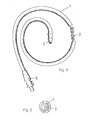
- Fig. 1 an embodiment of a cable feed line according to the invention is shown.
- Fig. 2 shows a cross section through the sheathed wire.
- Fig. 1 is made of plastic, for. B. silicone rubber, existing cladding tube, in which the conductor 2 is arranged for electrical stimulation current pulses.
- the conductor 2 is formed from four coiled sheathed wires, the thickness of the individual sheathed wires being 0.11 mm.
- the core of a sheathed wire consists of CuZr0.15, the sheath made of Ta, the outer surface of which is anodized.
- An electrical resistance of 1.75 ⁇ was measured for such a 60 cm long cable feed line - this length corresponds to the cable feed lines normally used. A value that is about an order of magnitude smaller than cable feeds on the market.
- the pacemaker electrode is designated, with 6 the connector, which is connected to the pacemaker control unit.
- the core is denoted by 3 and the sheath by 4.
- the wall thickness of the jacket is 0.012 mm
- the diameter of the core is 0.086 mm.
- Usual wall thicknesses for the jacket are in the range of 0.0025 to 0.035 mm
- core diameters are in the range of 0.04 to 0.3 mm.
Landscapes
- Health & Medical Sciences (AREA)
- Heart & Thoracic Surgery (AREA)
- Vascular Medicine (AREA)
- Cardiology (AREA)
- Engineering & Computer Science (AREA)
- Biomedical Technology (AREA)
- Nuclear Medicine, Radiotherapy & Molecular Imaging (AREA)
- Radiology & Medical Imaging (AREA)
- Life Sciences & Earth Sciences (AREA)
- Animal Behavior & Ethology (AREA)
- General Health & Medical Sciences (AREA)
- Public Health (AREA)
- Veterinary Medicine (AREA)
- Electrotherapy Devices (AREA)
Abstract
Description
- Die Erfindung bezieht sich auf eine Kabelzuleitung für eine Herzschrittmacher-Elektrode, mit einem Hüllrohr aus elektrisch isolierendem, elastischem Werkstoff und wenigstens einem darin angeordneten Leiter für elektrische Reizstrom-Impulse, wobei der Leiter einen Kern aus einem Metall hoher elektrischer Leitfähigkeit und einen Mantel aus einem korrosionsfesten, nicht-toxischen Metall aufweist.
- Eine Kabelzuleitung für eine Herzschrittmacher-Elektrode ist aus der US-PS 3 749 101 bekannt. Als Werkstoff für das Hüllrohr wird Siliconkautschuk verwandt. Der in dem elastischen Hüllrohr angeordnete drahtförmige Leiter besteht aus einer korrosionsfesten Legierung aus 20 bis 50 % Co, 15 bis 30 % Cr, 5 bis 10 % Ni, bis zu 18 % Fe, 1 bis 10 % Mo, bis zu 3 % Mn, bis zu 0,3 % C und 0,01 bis 0,09 % Be.
- Aus der US-PS 4 273 137 ist ferner eine Kabelzuleitung für eine Herzschrittmacher-Elektrode bekannt. In einem Hüllrohr aus Silicongummi ist ein elektrischer Leiter angeordnet, der aus einer Vielzahl von elektrisch leitfähigen Fasern besteht, wobei diese Fasern einen Mantel aus einer korrosionsfesten, nicht-toxischen Metall-Legierung, wie rostfreier Stahl oder eine Kobaltbasis-Legierung, aufweisen, der einen Kern aus einem Metall hoher elektrischer Leitfähigkeit umhüllt. Als Kernwerkstoffe werden Silber, Kupfer, Silberbasis-Legierungen oder Kupferbasis-Legierungen verwendet. Die Vielzahl der elektrisch leitfähigen Fasern ist in einer Hülle angeordnet, die wiederum aus dem gleichen korrosionsfesten, nicht-toxischen Metall besteht wie der Mantelwerkstoff der einzelnen Faser. Die einzelne Faser besteht aus einem als Mantel dienenden Röhrchen, das mit dem Metall hoher elektrischer Leitfähigkeit gefüllt ist.
- Aufgabe der Erfindung ist es, eine Kabelzuleitung zu schaffen, bei der elektrische Verlustleistungen auf ein Minimum reduziert sind, und die eine gute Biokompatibilität sicherstellt.
- Gelöst wird diese Aufgabe für eine Kabelzuleitung der eingangs charakterisierten Art erfindungsgemäß dadurch, daß der Leiter ein durch Ziehen hergestellter Manteldraht ist, dessen Mantel aus einem Metall aus der Gruppe Tantal, Titan, Zirkonium, Niob, Titan-Basis-Legierung, Platin, Platin-Iridium-Legierung, Platin-Palladium-Legierung und Platin-Rhodium-Legierung besteht, wobei die Mantelwandstärke im Bereich von 0,0025 bis 0,035 mm liegt und der Kerndurchmesser 0,04 bis 0,3 mm beträgt.
- Es hat sich besonders bewährt, den Mantal aus Tantal, Titan, Zirkonium, Niob oder einer Titan-Basis-Legierung herzustellen, dessen Außenoberfläche elektrisch isolierend ausgebildet ist, vorzugsweise anodisiert ist.
- Als Werkstoffe für den Kern haben sich insbesondere Kupfer and Kupfer-Legierungen als geeignet erwiesen. Als wesentliche Legierungselemente neben Kupfer kommen insbesondere Zr, Ti, Be, Fe, P, Zn oder 'Sn in Frage. Beispiele für derartige Legierungen sind CuZr0,15, CuTi4, CuBe2, CuBel,7, CuBe0,7, CuZn28, CuZn37, CuSn6, CuSn8 oder CuFe2.
- Als Kabelzuleitung hat sich insbesondere eine solche bewährt, bei der der Kern des Manteldrahtes aus CuZr0,15 oder CuBe2 und der Mantel aus Tantal bestehen, dessen Außenoberfläche anodi- siert ist.
- Als Mantelwerkstoffe haben sich Pt-Ir-Legierungen mit bis zu 40 % Ir, Rest Pt, Pt-Pd-Legierungen mit bis zu 50 % Pd, Rest Pt sowie Pt-Rh-Legierungen mit bis zu 40 % Rh, Rest Pt bewährt, vorteilhafterweise Legierungen aus PtIrlO, PtPdl0 und PtRh10. Ein bevorzugtes Beispiel für Mantelwerkstoffe aus Titan-Basis-Legierungen sind die Legierungen TiA16V4 und TiA15Fe2,5.
- Das elastische Hüllrohr, in dem der Manteldraht angeordnet ist, besteht aus Kunststoff, wie beispielsweise aus Siliconkautschuk oder Polyurethan. Es ist so elastisch und flexibel, daß seine Einführung in die Herzkammer allein durch die Mitnahme durch den Blutstrom möglich ist.
- Erfindungsgemäß ausgebildete Kabelzuleitungen zeichnen sich, wie Ermüdungstests ergeben haben, durch hohe Standzeiten aus. Außerdem ergibt sich eine sehr lange Lebensdauer der für die elektrischen Reizstrom-Impulse erforderlichen Batterien. Die Biokompatibilität des drahtförmigen Leiters wird durch die Verwendung der in Anspruch 1 genannten Mantelwerkstoffe sichergestellt. Durch die Nichtleitendmachung der Außenoberfläche der in Anspruch 2 genannten Mantelwerkstoffe, vorzugsweise durch Anodisieren, ist sichergestellt, daß bei Beschädigung oder durch andere Ursachen eintretendes Undichtwerden des Kunststoffhüllrohres Fehlstimulation des Herzens vermieden werden kann.
- Eine Interdiffusion des Kernwerkstoffes an die äußere Oberfläche des Mantels konnte bei dem erfindungsgemäß durch Ziehen hergestellten Leiter nicht festgestellt werden.
- In Fig. 1 ist ein Ausführungsbeispiel einer erfindungsgemäßen Kabelzuleitung dargestellt.
- Fig. 2 zeigt einen Querschnitt durch den Manteldraht.
- Mit der Bezugsziffer 1 ist in Fig. 1 das aus Kunststoff, z. B. Siliconkautschuk, bestehende Hüllrohr bezeichnet, in dem der Leiter 2 für elektrische Reizstrom-Impulse angeordnet ist. In diesem Ausführungsbeispiel ist der Leiter 2 aus vier gewendelten Manteldrähten gebildet, wobei die Stärke der einzelnen Manteldrähte 0,11 mm beträgt. Der Kern eines Manteldrahts besteht aus CuZr0,15, der Mantel aus Ta, dessen Außenoberfläche anodisiert ist. Für eine derartige 60 cm lange Kabelzuleitung - diese Länge entspricht den üblicherweise zum Einsatz gelangenden Kabelzuleitungen - wurde ein elektrischer Widerstand von 1,75Ω gemessen. Ein Wert, der um etwa eine Größenordnung kleiner ist als auf dem Markt befindliche Kabelzuleitungen. Mit 5 ist die Herzschrittmacher-Elektrode bezeichnet, mit 6 die Anschlußsteckvorrichtung, die an das Herzschrittmacher-Steuergerät angeschlossen wird.
- Bei dem in Fig. 2 dargestellten Manteldraht-Querschnitt ist mit 3 der Kern bezeichnet und mit 4 der Mantel. Die Wandstärke des Mantels beträgt im Ausführungsbeispiel 0,012 mm, der Durchmesser des Kerns 0,086 mm. Übliche Wandstärken für den Mantel liegen im Bereich von 0,0025 bis 0,035 mm, Kerndurchmesser liegen im Bereich von 0,04 bis 0,3 mm.
Claims (8)
Applications Claiming Priority (2)
| Application Number | Priority Date | Filing Date | Title |
|---|---|---|---|
| DE3134896 | 1981-09-03 | ||
| DE3134896A DE3134896C2 (de) | 1981-09-03 | 1981-09-03 | Kabelzuleitung für Herzschrittmacher-Elektroden |
Publications (3)
| Publication Number | Publication Date |
|---|---|
| EP0073881A2 true EP0073881A2 (de) | 1983-03-16 |
| EP0073881A3 EP0073881A3 (en) | 1984-05-16 |
| EP0073881B1 EP0073881B1 (de) | 1986-09-17 |
Family
ID=6140780
Family Applications (1)
| Application Number | Title | Priority Date | Filing Date |
|---|---|---|---|
| EP82104847A Expired EP0073881B1 (de) | 1981-09-03 | 1982-06-03 | Kabelzuleitung für Herzschrittmacher-Elektroden |
Country Status (3)
| Country | Link |
|---|---|
| US (1) | US4514589A (de) |
| EP (1) | EP0073881B1 (de) |
| DE (2) | DE3134896C2 (de) |
Cited By (4)
| Publication number | Priority date | Publication date | Assignee | Title |
|---|---|---|---|---|
| US4860446A (en) * | 1988-02-16 | 1989-08-29 | Medtronic, Inc. | Medical electrical lead and method of manufacture |
| EP0396835A1 (de) * | 1989-05-08 | 1990-11-14 | Intermedics Inc. | Intervenöse Leitung zur Reizung und Defibrillation |
| EP0617916A1 (de) * | 1993-04-01 | 1994-10-05 | Terumo Kabushiki Kaisha | Sonde mit mehreren Elektroden und Herstellungsverfahren |
| WO1995013111A1 (en) * | 1993-11-10 | 1995-05-18 | Medtronic Cadiorhythm | Electrode array catheter |
Families Citing this family (29)
| Publication number | Priority date | Publication date | Assignee | Title |
|---|---|---|---|---|
| US4760365A (en) * | 1986-12-29 | 1988-07-26 | General Dynamics Corp./Space Systems Division | Metallic insulation for superconducting coils |
| WO1989000870A1 (en) * | 1987-07-24 | 1989-02-09 | Cochlear Pty. Ltd. | Apparatus and method for insertion of cochlear electrode assembly |
| US4898183A (en) * | 1987-07-24 | 1990-02-06 | Cochlear Pty. Limited | Apparatus and method for insertion of cochlear electrode assembly |
| EP0312495A3 (de) * | 1987-10-16 | 1989-08-30 | Institut Straumann Ag | Elektrisches Kabel für die Durchführung mindestens einer Stimulation und/oder Messung in einem menschlichen oder tierischen Körper |
| US4926879A (en) * | 1988-06-13 | 1990-05-22 | Sevrain-Tech, Inc. | Electro-tactile stimulator |
| US5496359A (en) * | 1989-07-25 | 1996-03-05 | Smith & Nephew Richards, Inc. | Zirconium oxide and zirconium nitride coated biocompatible leads |
| JP2683446B2 (ja) * | 1990-09-28 | 1997-11-26 | 住友電気工業株式会社 | ハーネス用電線導体 |
| DE4125980A1 (de) * | 1991-08-06 | 1993-02-11 | Heraeus Sensor Gmbh | Halbzeug fuer einen elektrischen leiterdraht, anschlussleiter und verfahren zur herstellung des leiterdrahtes sowie dessen verwendung |
| GB2274736A (en) * | 1993-01-28 | 1994-08-03 | Intravascular Res Ltd | A micro-coaxial cable |
| US5483022A (en) * | 1994-04-12 | 1996-01-09 | Ventritex, Inc. | Implantable conductor coil formed from cabled composite wire |
| US5765418A (en) * | 1994-05-16 | 1998-06-16 | Medtronic, Inc. | Method for making an implantable medical device from a refractory metal |
| SE9500618D0 (sv) * | 1995-02-20 | 1995-02-20 | Pacesetter Ab | Elektrodkontaktdon, speciellt elektrodkontakthuvud respektive elektrodanslutningsdon till elektrodkabel för hjärtstimulator, samt förfarande för framställning av ett elektrodkontaktdon |
| US5824026A (en) * | 1996-06-12 | 1998-10-20 | The Spectranetics Corporation | Catheter for delivery of electric energy and a process for manufacturing same |
| US5800496A (en) * | 1996-06-24 | 1998-09-01 | Medtronic, Inc. | Medical electrical lead having a crush resistant lead body |
| US5935465A (en) | 1996-11-05 | 1999-08-10 | Intermedics Inc. | Method of making implantable lead including laser wire stripping |
| US6399886B1 (en) * | 1997-05-02 | 2002-06-04 | General Science & Technology Corp. | Multifilament drawn radiopaque high elastic cables and methods of making the same |
| US6610930B1 (en) | 1998-09-16 | 2003-08-26 | Kulicke & Soffa Investments, Inc. | Composite noble metal wire |
| US6216045B1 (en) * | 1999-04-26 | 2001-04-10 | Advanced Neuromodulation Systems, Inc. | Implantable lead and method of manufacture |
| AU5048400A (en) * | 1999-05-27 | 2000-12-18 | Monsanto Company | Biomaterials modified with superoxide dismutase mimics |
| US20040110722A1 (en) * | 1999-05-27 | 2004-06-10 | Ornberg Richard L. | Modified hyaluronic acid polymers |
| US20040064175A1 (en) * | 2002-09-30 | 2004-04-01 | Lessar Joseph F. | Implantable medical device lead conductor having integral biostable in-situ grown oxide insulation and process for forming |
| US20070260282A1 (en) * | 2003-09-12 | 2007-11-08 | Taylor William J | Feedthrough apparatus with noble metal-coated leads |
| US7966070B2 (en) * | 2003-09-12 | 2011-06-21 | Medtronic, Inc. | Feedthrough apparatus with noble metal-coated leads |
| US20060247714A1 (en) * | 2005-04-28 | 2006-11-02 | Taylor William J | Glass-to-metal feedthrough seals having improved durability particularly under AC or DC bias |
| US7340305B2 (en) * | 2005-06-09 | 2008-03-04 | Cardiac Pacemakers, Inc. | Implantable medical device feedthrough assembly having a coated conductor |
| DE102009009557A1 (de) * | 2009-02-19 | 2010-09-02 | W.C. Heraeus Gmbh | Elektrisch leitende Materialien, Zuleitungen und Kabel für Stimulationselektroden |
| DE102009009558B4 (de) * | 2009-02-19 | 2013-08-29 | Heraeus Precious Metals Gmbh & Co. Kg | Gewickeltes Band als elektrischer Leiter für Stimulationselektroden |
| US8862245B2 (en) * | 2012-10-31 | 2014-10-14 | Medtronic, Inc. | Electrode construction for implantable medical electrical leads |
| DE102019130522A1 (de) * | 2019-11-12 | 2021-05-12 | Heraeus Deutschland GmbH & Co. KG | Verfahren zur Herstellung von Verbunddrähten |
Family Cites Families (18)
| Publication number | Priority date | Publication date | Assignee | Title |
|---|---|---|---|---|
| US3333045A (en) * | 1965-07-20 | 1967-07-25 | Gen Electric | Body implantable electrical conductor |
| DE1690282C3 (de) * | 1967-07-06 | 1974-07-04 | Telefunken Patentverwertungsgesellschaft Mbh, 7900 Ulm | Elektrische Leitung für einen Herzschrittmacher |
| US3590822A (en) * | 1968-04-03 | 1971-07-06 | Electro Catheter Corp | Catheters |
| ZA717095B (en) * | 1970-10-29 | 1972-07-26 | Pirelli | Electric conductor |
| DE2056493A1 (en) * | 1970-11-06 | 1972-05-10 | Schaldach M | Pacemaker electrode assembly - using capacitative stimulus pulse coupling via dielectric film coated metal electrode head |
| US3769984A (en) * | 1971-03-11 | 1973-11-06 | Sherwood Medical Ind Inc | Pacing catheter with frictional fit lead attachment |
| GB1387621A (en) * | 1971-04-15 | 1975-03-19 | Imp Metal Ind Kynoch Ltd | Composite materials and a method of manufacture thereof |
| US3749101A (en) * | 1972-02-09 | 1973-07-31 | Cordis Corp | Nonpolarizable muscle stimulating electrode |
| US3837347A (en) * | 1972-04-20 | 1974-09-24 | Electro Catheter Corp | Inflatable balloon-type pacing probe |
| US4042753A (en) * | 1972-09-22 | 1977-08-16 | Imperial Chemical Industries Limited | Composite conductor |
| GB1457511A (en) * | 1973-02-08 | 1976-12-01 | Imp Metal Ind Kynoch Ltd | Composite body electrodes for electrolytic processes |
| US4142531A (en) * | 1977-01-04 | 1979-03-06 | Coratomic, Inc. | Catheter |
| US4156429A (en) * | 1977-10-11 | 1979-05-29 | Cardiac Pacemakers, Inc. | Implantable electrode |
| US4287896A (en) * | 1979-08-22 | 1981-09-08 | Grigorov Sergei S | Electrode for connecting to an internal organ of human body |
| FR2463625A1 (fr) * | 1979-08-23 | 1981-02-27 | Medtronic Inc | Conducteur multipolaire pour stimulateur cardiaque |
| DE2950022C2 (de) * | 1979-12-17 | 1984-01-12 | Vsesojuznyj kardiologičeskij naučnyj centr Akademii medicinskich Nauk SSSR,, Moskva | Elektrischer Leiter zur Implantation in den menschlichen Körper |
| DE3166638D1 (en) * | 1980-12-23 | 1984-11-15 | Kontron Ag | Implantable electrode |
| JPS57193852U (de) * | 1981-05-04 | 1982-12-08 |
-
1981
- 1981-09-03 DE DE3134896A patent/DE3134896C2/de not_active Expired
-
1982
- 1982-06-03 DE DE8282104847T patent/DE3273305D1/de not_active Expired
- 1982-06-03 EP EP82104847A patent/EP0073881B1/de not_active Expired
- 1982-08-27 US US06/412,292 patent/US4514589A/en not_active Expired - Fee Related
Cited By (7)
| Publication number | Priority date | Publication date | Assignee | Title |
|---|---|---|---|---|
| US4860446A (en) * | 1988-02-16 | 1989-08-29 | Medtronic, Inc. | Medical electrical lead and method of manufacture |
| EP0396835A1 (de) * | 1989-05-08 | 1990-11-14 | Intermedics Inc. | Intervenöse Leitung zur Reizung und Defibrillation |
| EP0617916A1 (de) * | 1993-04-01 | 1994-10-05 | Terumo Kabushiki Kaisha | Sonde mit mehreren Elektroden und Herstellungsverfahren |
| US5524619A (en) * | 1993-04-01 | 1996-06-11 | Terumo Kabushiki Kaisha | Multielectrode probe |
| WO1995013111A1 (en) * | 1993-11-10 | 1995-05-18 | Medtronic Cadiorhythm | Electrode array catheter |
| EP0861676A3 (de) * | 1993-11-10 | 1999-06-30 | Medtronic Cardiorhythm | Elektrodenanordnung für katheter |
| US5938694A (en) * | 1993-11-10 | 1999-08-17 | Medtronic Cardiorhythm | Electrode array catheter |
Also Published As
| Publication number | Publication date |
|---|---|
| DE3134896A1 (de) | 1983-03-10 |
| EP0073881B1 (de) | 1986-09-17 |
| DE3273305D1 (en) | 1986-10-23 |
| DE3134896C2 (de) | 1985-03-28 |
| EP0073881A3 (en) | 1984-05-16 |
| US4514589A (en) | 1985-04-30 |
Similar Documents
| Publication | Publication Date | Title |
|---|---|---|
| EP0073881B1 (de) | Kabelzuleitung für Herzschrittmacher-Elektroden | |
| DE69820418T2 (de) | Spulendrahtisolierung für biomedizinische leiter | |
| US6026567A (en) | Medical lead with stranded conductors | |
| DE2306266A1 (de) | Unpolarisierbare muskelstimulierelektrode | |
| US5330521A (en) | Low resistance implantable electrical leads | |
| EP0162178B1 (de) | Leitvorrichtung, insbesondere zum mindestens teilweisen Einsetzen in einen menschlichen oder tierischen Körper, mit einer zumindest aus einem Leiter gebildeten Wendel | |
| DE102004010886A1 (de) | Elektrokabel für ein Kraftfahrzeug | |
| EP0312495A2 (de) | Elektrisches Kabel für die Durchführung mindestens einer Stimulation und/oder Messung in einem menschlichen oder tierischen Körper | |
| DE1955516B2 (de) | Implantable elektrodenanordnung | |
| DE3832342C1 (en) | Platinum-jacketed wire, method for production of a platinum-jacketed wire and use of a platinum-jacketed wire | |
| DE10206336A1 (de) | Elektrisches Heizelement für Sitzheizungen und Lenkradheizungen | |
| EP0443291A2 (de) | Elektrisches Steckverbinderpaar | |
| DE3211510A1 (de) | Implantierbare leitung | |
| DE69704625T2 (de) | Elektrodenkabel zur elektrischen stimulation | |
| DE3031752A1 (de) | Mehrpolige schrittmacherleistung | |
| DE2950022C2 (de) | Elektrischer Leiter zur Implantation in den menschlichen Körper | |
| DE102009009558B4 (de) | Gewickeltes Band als elektrischer Leiter für Stimulationselektroden | |
| DE69801001T2 (de) | Medizinische elektrische leitung | |
| DE202004003677U1 (de) | Elektrischer Leiter sowie elektrisches Leiterelement | |
| DE10153217B4 (de) | Manteldraht, insbesondere Anschlussdraht für elektrische Temperatursensoren | |
| DE4125980A1 (de) | Halbzeug fuer einen elektrischen leiterdraht, anschlussleiter und verfahren zur herstellung des leiterdrahtes sowie dessen verwendung | |
| DE102004011514B4 (de) | Elektrisches Heizelement | |
| DE68927122T2 (de) | Verfahren zur Herstellung eines elektrischen Leiters , geeignet als unlösbare Anode in Elektrogewinnungsverfahren und in elektrochemischen Verfahren im allgemeinen und Zwischenprodukt davon. | |
| DE3136193C2 (de) | Einmalelektrode für elektromedizinische Zwecke und Verfahren zu ihrer Herstellung | |
| DE2418397A1 (de) | Elektrode fuer polarographische messungen in physiologischen medien |
Legal Events
| Date | Code | Title | Description |
|---|---|---|---|
| PUAI | Public reference made under article 153(3) epc to a published international application that has entered the european phase |
Free format text: ORIGINAL CODE: 0009012 |
|
| 17P | Request for examination filed |
Effective date: 19820614 |
|
| AK | Designated contracting states |
Designated state(s): CH DE FR GB LI NL |
|
| EL | Fr: translation of claims filed | ||
| TCNL | Nl: translation of patent claims filed | ||
| PUAL | Search report despatched |
Free format text: ORIGINAL CODE: 0009013 |
|
| AK | Designated contracting states |
Designated state(s): CH DE FR GB LI NL |
|
| GRAA | (expected) grant |
Free format text: ORIGINAL CODE: 0009210 |
|
| AK | Designated contracting states |
Kind code of ref document: B1 Designated state(s): CH DE FR GB LI NL |
|
| ET | Fr: translation filed | ||
| REF | Corresponds to: |
Ref document number: 3273305 Country of ref document: DE Date of ref document: 19861023 |
|
| PLBE | No opposition filed within time limit |
Free format text: ORIGINAL CODE: 0009261 |
|
| STAA | Information on the status of an ep patent application or granted ep patent |
Free format text: STATUS: NO OPPOSITION FILED WITHIN TIME LIMIT |
|
| 26N | No opposition filed | ||
| PGFP | Annual fee paid to national office [announced via postgrant information from national office to epo] |
Ref country code: GB Payment date: 19890531 Year of fee payment: 8 |
|
| PGFP | Annual fee paid to national office [announced via postgrant information from national office to epo] |
Ref country code: CH Payment date: 19890616 Year of fee payment: 8 |
|
| PGFP | Annual fee paid to national office [announced via postgrant information from national office to epo] |
Ref country code: FR Payment date: 19890629 Year of fee payment: 8 |
|
| PGFP | Annual fee paid to national office [announced via postgrant information from national office to epo] |
Ref country code: NL Payment date: 19890630 Year of fee payment: 8 |
|
| PGFP | Annual fee paid to national office [announced via postgrant information from national office to epo] |
Ref country code: DE Payment date: 19890717 Year of fee payment: 8 |
|
| PG25 | Lapsed in a contracting state [announced via postgrant information from national office to epo] |
Ref country code: GB Effective date: 19900603 |
|
| PG25 | Lapsed in a contracting state [announced via postgrant information from national office to epo] |
Ref country code: LI Effective date: 19900630 Ref country code: CH Effective date: 19900630 |
|
| PG25 | Lapsed in a contracting state [announced via postgrant information from national office to epo] |
Ref country code: NL Effective date: 19910101 |
|
| GBPC | Gb: european patent ceased through non-payment of renewal fee | ||
| NLV4 | Nl: lapsed or anulled due to non-payment of the annual fee | ||
| PG25 | Lapsed in a contracting state [announced via postgrant information from national office to epo] |
Ref country code: FR Effective date: 19910228 |
|
| REG | Reference to a national code |
Ref country code: CH Ref legal event code: PL |
|
| PG25 | Lapsed in a contracting state [announced via postgrant information from national office to epo] |
Ref country code: DE Effective date: 19910301 |
|
| REG | Reference to a national code |
Ref country code: FR Ref legal event code: ST |