EP0074036A1 - Procédé de production d'acier pour tôles électriques - Google Patents
Procédé de production d'acier pour tôles électriques Download PDFInfo
- Publication number
- EP0074036A1 EP0074036A1 EP82107902A EP82107902A EP0074036A1 EP 0074036 A1 EP0074036 A1 EP 0074036A1 EP 82107902 A EP82107902 A EP 82107902A EP 82107902 A EP82107902 A EP 82107902A EP 0074036 A1 EP0074036 A1 EP 0074036A1
- Authority
- EP
- European Patent Office
- Prior art keywords
- molten steel
- steel
- degassing
- vacuum
- less
- Prior art date
- Legal status (The legal status is an assumption and is not a legal conclusion. Google has not performed a legal analysis and makes no representation as to the accuracy of the status listed.)
- Withdrawn
Links
Images

Classifications
-
- B—PERFORMING OPERATIONS; TRANSPORTING
- B22—CASTING; POWDER METALLURGY
- B22D—CASTING OF METALS; CASTING OF OTHER SUBSTANCES BY THE SAME PROCESSES OR DEVICES
- B22D11/00—Continuous casting of metals, i.e. casting in indefinite lengths
- B22D11/10—Supplying or treating molten metal
- B22D11/11—Treating the molten metal
-
- C—CHEMISTRY; METALLURGY
- C21—METALLURGY OF IRON
- C21C—PROCESSING OF PIG-IRON, e.g. REFINING, MANUFACTURE OF WROUGHT-IRON OR STEEL; TREATMENT IN MOLTEN STATE OF FERROUS ALLOYS
- C21C7/00—Treating molten ferrous alloys, e.g. steel, not covered by groups C21C1/00 - C21C5/00
- C21C7/10—Handling in a vacuum
Definitions
- the present invention relates to a process for producing steel for the production of an electrical steel sheet.
- electrical steel sheet is meant oriented and non-oriented silicon-steel sheets. More particularly, the present invention relates to a process for producing steel for an electrical steel sheet, the process comprising subjecting molten iron to refining, vacuum-degassing, and continuous-casting procedures so as to obtain a slab.
- the term "aging deterioration” signifies a phenomenon in which the watt loss of an electrical steel sheet gradually deteriorates when the sheet is used for an extended period of time.
- One of the main causes of such deterioration is considered to be the residual carbon in the sheet.
- the starting material from which a non-oriented silicon-steel sheet is produced preferably has a carbon content of 0.0030% or less, as is disclosed in Japanese Patent Application No.4755/1979 previously filed by the applicant and entitled "Process for Producing a Non--oriented Silicon-Steel Sheet Exhibiting a Low Aging Deterioration and an Excellent Surface Property".
- the continuous-cast slab does not produce the great segregation of carbon involved in the steel ingot-casting process, it entails the problem that the [C] content of the steel in the starting material, i.e., the slab stage, exceeds the desired value, e.g., 0.0030%, regardless of the fact that the desired [C] content was ensured in the degassing procedure.
- An object of the present invention is to eliminate the above-mentioned difficulties in the production of steel for an electrical steel sheet in accordance with a process comprising a continuous-casting procedure.
- the gist of the present invention resides in a process for producing steel for an electrical steel sheet, the process comprising subjecting molten iron to refining, vacuum-degassing, and continuous-casting procedures to obtain a slab, characterized in that molten steel tapped from a steelmaking furnace is placed in a vacuum-degassing apparatus equipped with a means for blowing a gas into the molten steel; the molten steel is subjected to a degassing treatment to reduce the ultimate degree of vacuum in the degassing apparatus to 1.0 mm Hg or less while blowing an inert gas into the molten steel at a rate of from 30 to 150 Nt/min per gas-blowing orifice so as to reduce the [C] content of the molten steel to 0.0030% or less; adjustment of the steel chemistry is carried out by adding silicon or a silicon-containing alloy or any other alloying component to the decarburized molten steel in such an amount that the silicon content of the molten steel is in the range
- the present invention provides a process for producing steel for an electrical steel sheet which is capable not only of reducing the [C] content of molten steel to a desired value within an extremely short period of degassing, as compared with the conventional method, but also of suppressing an increase in the [C] content of molten steel during continuous casting so as to maintain the carbon content of a strand at the desired value.
- the inventors of the present invention made various studies and analyses regarding the vacuum-degassing procedure and the continuous-casting procedure prior to the completion of this invention. As a result, the inventors of the present invention made the following findings:
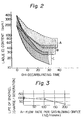
- an optimal decarburization rate to attain a desired [C] value can be maintained when the rate of argon gas blown is 700 Ni/min, preferably from 200 to 700 Ni/min.
- the symbol A represents a case where no argon. gas is blown
- the symbols B and C represent cases where argon gas is blown at a rate of from 100 to 200 Ni/min and from 500 to 700 Nl/min, respectively.
- the rate of argon gas blown per gas-blowing orifice is preferably 100 Ni/minute or more.
- a ferroalloy such as ferrosilicon, which is added to the degassed molten steel, may be a reason why carbon is picked up.
- an alloying component in the form of an element, such as metallic silicon, or to add extremely low-carbon alloys, such as high purity Fe-Si, such addition resulting in an increase in the production cost of a slab.
- the prevention of carbon pick up due to the above-mentioned factors A through D was investigated.
- the vacuum-degassing procedure is carried out under such operating conditions that the ultimate degree of vacuum in the vacuum-degassing apparatus is 1.0 mm Hg or less and the rate of inert gas, such as argon gas, blown through a gas-blowing orifice (generally, a gas-blowing pipe) provided in a snorkel (suction pipe) of the vacuum-degassing apparatus, e.g., a DH vacuum-degassing apparatus, is in a range of from 30 to 150 Ni/min, preferably from 30 to 100 Ni/min, per gas-blowing orifice,whereby the [C] content of the molten steel is reduced to 0.0030% or less at the completion of the degassing procedure.
- a gas-blowing orifice generally, a gas-blowing pipe
- a snorkel suction pipe
- the pattern in which an inert gas is blown may be suitably selected from the following two methods: a method in which the rate of inert gas blown is increased and decreased in accordance with the ascent and descent of the vacuum vessel and a method in which the rate of inert gas blown is constant (unchanged).
- the materials of alumina-graphite refractories and fused silica refractories are used as shaped refractories, such as a long nozzle or an immersion nozzle. From the viewpoint of the suppression of carbon pick-up, it is advantageous to use a nozzle made from a fused silica refractory whose carbon content is so very low that it is substantially negligible.
- the board is a well-known shaped refractory product in the form of a plate which is conventionally used as a lining material for a tundish.
- coating signifies anMgO coating applied on the surface of a refractory-lining material.
- the term "carbon-free product” signifies a heat-insulating material having a carbon content of 0.2 wt% or less and containing substantially no carbonaceous material, for example, a commercially available L.C.P. (Low Carbon Powdery.
- low carbon product signifies a so-called low carbon powder having a carbon content of 3 wt% or less, for example a powder product commercially available under the trade name CNS-15SP.
- carbon-free product signifies a carbon-free powder having a carbon content of 0.2 wt% or less and which can be considered to be substantially free of carbon, e.g., a powder product commercially available under the name DIACON-S6®.
- the amount of carbon picked up by the molten steel can be controlled so that it does not exceed 10 ppm, preferably 5 ppm, by weight of the molten steel by selecting an appropriate combination of the lining refractory for a tundish, the heat-insulating material for the melt in the tundish, and the additive powder for the mold.
- the results of Table 2 indicate that the entire amount of carbon picked up after the vacuum-degassing procedure can be controlled so that it does not exceed 10 ppm, sometimes 5 ppm or less, depending on the above-mentioned combination.
- the ultimate degree of vacuum.in the degassing vessel of the vacuum-degassing apparatus is limited to 1.0 mmHg or less. If the ultimate degree of vacuum exceeds 1.0 mmHg, the [C] content at the completion of degassing tends to be more than 0.0030%. Also, the rate of inert gas blown per gas-blowing orifice is limited to a range of from 30 to 150 Ni/min. If the rate of inert gas blown per gas-blowing orifice is less than 30 Nl/min, the molten steel enters the gas-blowing orifice, causing clogging of the blowing nozzle.
- a gas rate of at least 30 Nl/min is necessary for preventing the molten steel from entering the orifice.
- the blowing of an inert gas at a rate exceeding 150 Nl/min causes the lining refractory of the snorkel (suction pipe) to erode considerably due to the action of groups of bubbles generated by the blown gas, thereby shortening the life of the snorkel.
- the shaped material (agent) in contact with the molten steel should, respectively, have a carbon content of 3% or less.
- the carbon content exceeds 3%, even if the [C] content of the molten steel can be reduced to 0.0030% or less at the completion of degassing, the [C]content of the degassing molten steel tends to exceed the desired maximum value of 0.0030% during the continuous-casting procedure. Therefore, the chances are great that decarburization-annealing will be necessary at a stage subsequent to hot-rolling, as is the case with the conventional method.
- the practice of the present invention having the construction described above makes it possible not only to allow the [C] content of molten steel to reach a desired value within an extremely short degassing treatment time, as compared with the conventional art, but also to suppress an increase in the [C] content of the degassed molten steel during the continuous-casting procedure, thereby keeping the carbon content of the resultant slab at the desired value. Accordingly, the present invention is greatly advantageous in that decarburization-annealing subsequent to hot-rolling or cold-rolling can be omitted.
- the pressure in the degassing vessel of the degassing apparatus is reduced so that the ultimate degree of vacuum at a level of 1.0 mmHg or less is attained.
- the blowing of the inert gas is carried out in such a pattern that the entire rate of the inert gas blown is blown at four levels, 200 Nl/min, 300 Nl/min, 500 Nl/min, and 700 N t/ min; the rate of argon gas blown per gas-blowing orifice is in a range of from 30 to 150 Nl/min; a maximum rate, e.g., 150 Nt/min, per gas-blowing orifice of argon gas is blown into the molten steel when the vacuum-degassing apparatus sucks the molten steel from the ladle; and a minimum rate of 30 Nl/min per gas-blowing orifice of argon gas is blown into the molten steel when the molten steel is returned from the vacuum-degassing apparatus to the la
- the preferable maximum and minimum flow rates are 100 Nl/min and 30 Nt/min, respectively.
- Combinations of the refractory for the tundish, the heat-insulating material for the molten steel in the tundish, and the additive powder for the mold, selected in accordance with the entire rate of argon gas blown, the final chemical composition of the molten steel, and the DH degassing time, are collectively shown in Table 3.
- the nozzle is made of a fused silica-type material. **. Molten steel having a silicon content of from 1.0 % to 2.50% is not described in the Examples because the influence of the carbon value of the ferroalloy added to the molten steel in the DH vacuum-degassing apparatus is less than that in the above-mentioned Examples.
- the entire rate of argon gas blown is of the order in Example 12 of Table 3 in the present invention, most preferable results are obtained as in Table 2.
- the degassing time of Example 12 is from 7 to 8 minutes shorter than that of the Comparative Examples, in which argon-gas blowing was not carried out, indicating that the degassing of the present invention was completed within an extremely short period of time.
- the process of the present invention is utilized in an iron mill provided with a degassing apparatus and a continuous-casting apparatus for the purpose of producing an electrical steel sheet.
Landscapes
- Engineering & Computer Science (AREA)
- Chemical & Material Sciences (AREA)
- Mechanical Engineering (AREA)
- Materials Engineering (AREA)
- Metallurgy (AREA)
- Organic Chemistry (AREA)
- Treatment Of Steel In Its Molten State (AREA)
Applications Claiming Priority (2)
| Application Number | Priority Date | Filing Date | Title |
|---|---|---|---|
| PCT/JP1981/000203 WO1983000878A1 (fr) | 1981-08-28 | 1981-08-28 | Procede de production d'acier pour plaque d'acier au silicium isotropique |
| WOPCT/JP81/00203 | 1981-08-28 |
Publications (1)
| Publication Number | Publication Date |
|---|---|
| EP0074036A1 true EP0074036A1 (fr) | 1983-03-16 |
Family
ID=13734290
Family Applications (1)
| Application Number | Title | Priority Date | Filing Date |
|---|---|---|---|
| EP82107902A Withdrawn EP0074036A1 (fr) | 1981-08-28 | 1982-08-27 | Procédé de production d'acier pour tôles électriques |
Country Status (5)
| Country | Link |
|---|---|
| US (1) | US4555264A (fr) |
| EP (1) | EP0074036A1 (fr) |
| BE (1) | BE894231A (fr) |
| IT (1) | IT1205268B (fr) |
| WO (1) | WO1983000878A1 (fr) |
Cited By (1)
| Publication number | Priority date | Publication date | Assignee | Title |
|---|---|---|---|---|
| WO2003033746A1 (fr) * | 2001-10-12 | 2003-04-24 | Thyssenkrupp Stahl Ag | Procede pour produire des toles magnetiques a grains non orientes |
Families Citing this family (1)
| Publication number | Priority date | Publication date | Assignee | Title |
|---|---|---|---|---|
| US5482107A (en) * | 1994-02-04 | 1996-01-09 | Inland Steel Company | Continuously cast electrical steel strip |
Citations (11)
| Publication number | Priority date | Publication date | Assignee | Title |
|---|---|---|---|---|
| GB1123275A (en) * | 1965-05-19 | 1968-08-14 | Maximilianshuette Eisenwerk | Method of producing soft steel with a silicon content of 0.5 to 4.5% for the manufacture of sheets or strips for electromagnetic applications |
| GB1134110A (en) * | 1964-12-24 | 1968-11-20 | Loire Atel Forges | Methods of manufacturing very low-carbon steels, and products thus obtained |
| DE1533911B1 (de) * | 1967-02-14 | 1969-10-16 | Maximilianshuette Eisenwerk | Verfahren zur treffsicheren Herstellung von Staehlen mit gleichmaessig niedrigem Kohlenstoffgehalt durch Behandeln der Stahlschmelzen im Vakuum |
| DE1937475A1 (de) * | 1968-07-23 | 1970-03-26 | Nippon Kokan Kk | Verfahren zur Vakuumbehandlung von fluessigem Metall |
| DE1583626A1 (de) * | 1967-12-05 | 1970-09-24 | Maximilianshuette Eisenwerk | Verfahren zum Stranggiessen von Staehlen mit niedrigem Kohlenstoffgehalt |
| DE1458811B1 (de) * | 1965-01-09 | 1970-11-12 | Krupp Ag Huettenwerke | Verfahren zur Herstellung von kohlenstoffarmen Staehlen |
| JPS525614A (en) * | 1975-07-02 | 1977-01-17 | Kawasaki Steel Corp | Production process of steel of extremely low carbocontent |
| DE2026483B2 (de) * | 1969-07-08 | 1977-12-08 | Vereinigte Österreichische Eisen- und Stahlwerke - Alpine Montan AG, Wien | Verfahren zur herstellung niedrig gekohlter staehle |
| US4168158A (en) * | 1977-12-08 | 1979-09-18 | Kawasaki Steel Corporation | Method for producing alloy steels having a high chromium content and an extremely low carbon content |
| JPS55100927A (en) * | 1979-01-22 | 1980-08-01 | Nippon Steel Corp | Production of non-directional silicon steel sheet having less aging deterioration and good surface property |
| JPS5662662A (en) * | 1979-10-25 | 1981-05-28 | Nippon Steel Corp | Molten steel heat insulating method of less carburization |
Family Cites Families (3)
| Publication number | Priority date | Publication date | Assignee | Title |
|---|---|---|---|---|
| US3761242A (en) * | 1958-12-02 | 1973-09-25 | Finkl & Sons Co | Method of treating molten metal by gas purging rhtough a porous plug |
| US3467167A (en) * | 1966-09-19 | 1969-09-16 | Kaiser Ind Corp | Process for continuously casting oxidizable metals |
| US3702243A (en) * | 1969-04-15 | 1972-11-07 | Nat Steel Corp | Method of preparing deoxidized steel |
-
1981
- 1981-08-28 WO PCT/JP1981/000203 patent/WO1983000878A1/fr not_active Ceased
-
1982
- 1982-08-25 US US06/411,552 patent/US4555264A/en not_active Expired - Lifetime
- 1982-08-27 BE BE0/208900A patent/BE894231A/fr unknown
- 1982-08-27 EP EP82107902A patent/EP0074036A1/fr not_active Withdrawn
- 1982-08-30 IT IT23056/82A patent/IT1205268B/it active
Patent Citations (11)
| Publication number | Priority date | Publication date | Assignee | Title |
|---|---|---|---|---|
| GB1134110A (en) * | 1964-12-24 | 1968-11-20 | Loire Atel Forges | Methods of manufacturing very low-carbon steels, and products thus obtained |
| DE1458811B1 (de) * | 1965-01-09 | 1970-11-12 | Krupp Ag Huettenwerke | Verfahren zur Herstellung von kohlenstoffarmen Staehlen |
| GB1123275A (en) * | 1965-05-19 | 1968-08-14 | Maximilianshuette Eisenwerk | Method of producing soft steel with a silicon content of 0.5 to 4.5% for the manufacture of sheets or strips for electromagnetic applications |
| DE1533911B1 (de) * | 1967-02-14 | 1969-10-16 | Maximilianshuette Eisenwerk | Verfahren zur treffsicheren Herstellung von Staehlen mit gleichmaessig niedrigem Kohlenstoffgehalt durch Behandeln der Stahlschmelzen im Vakuum |
| DE1583626A1 (de) * | 1967-12-05 | 1970-09-24 | Maximilianshuette Eisenwerk | Verfahren zum Stranggiessen von Staehlen mit niedrigem Kohlenstoffgehalt |
| DE1937475A1 (de) * | 1968-07-23 | 1970-03-26 | Nippon Kokan Kk | Verfahren zur Vakuumbehandlung von fluessigem Metall |
| DE2026483B2 (de) * | 1969-07-08 | 1977-12-08 | Vereinigte Österreichische Eisen- und Stahlwerke - Alpine Montan AG, Wien | Verfahren zur herstellung niedrig gekohlter staehle |
| JPS525614A (en) * | 1975-07-02 | 1977-01-17 | Kawasaki Steel Corp | Production process of steel of extremely low carbocontent |
| US4168158A (en) * | 1977-12-08 | 1979-09-18 | Kawasaki Steel Corporation | Method for producing alloy steels having a high chromium content and an extremely low carbon content |
| JPS55100927A (en) * | 1979-01-22 | 1980-08-01 | Nippon Steel Corp | Production of non-directional silicon steel sheet having less aging deterioration and good surface property |
| JPS5662662A (en) * | 1979-10-25 | 1981-05-28 | Nippon Steel Corp | Molten steel heat insulating method of less carburization |
Non-Patent Citations (3)
| Title |
|---|
| Patent Abstracts of Japan, Vol. 1, No. 48, 11 May 1977, page 43C77; & JP-A-52 005 614 * |
| Patent Abstracts of Japan, Vol. 4, No. 155, 29 October 1980, page 83C29; & JP-A-55 100 927 * |
| Patent Abstracts of Japan, Vol. 5, No. 123, 8 August 1981; & JP-A-56 062 662 * |
Cited By (1)
| Publication number | Priority date | Publication date | Assignee | Title |
|---|---|---|---|---|
| WO2003033746A1 (fr) * | 2001-10-12 | 2003-04-24 | Thyssenkrupp Stahl Ag | Procede pour produire des toles magnetiques a grains non orientes |
Also Published As
| Publication number | Publication date |
|---|---|
| IT8223056A0 (it) | 1982-08-30 |
| IT1205268B (it) | 1989-03-15 |
| BE894231A (fr) | 1982-12-16 |
| WO1983000878A1 (fr) | 1983-03-17 |
| US4555264A (en) | 1985-11-26 |
Similar Documents
| Publication | Publication Date | Title |
|---|---|---|
| US3459537A (en) | Continuously cast steel slabs and method of making same | |
| GB1599176A (en) | Killed steels for continuous casting | |
| KR100233690B1 (ko) | 극저탄소 냉간압연강판 제조 방법 | |
| US7374623B2 (en) | Metallurgical product of carbon steel, intended especially for galvanization, and processes for its production | |
| JP3896650B2 (ja) | 含Ti極低炭素鋼の製造方法 | |
| EP0074036A1 (fr) | Procédé de production d'acier pour tôles électriques | |
| US3392009A (en) | Method of producing low carbon, non-aging, deep drawing steel | |
| JP2000001718A (ja) | 低炭素鋼の製造方法 | |
| US3986902A (en) | Silicon steel suitable for production of oriented silicon steel using low slab reheat temperature | |
| KR100916486B1 (ko) | 티타늄 첨가 미탈산 강의 용강 정련방법 | |
| JP3870627B2 (ja) | 高燐極低炭素鋼の製造方法 | |
| JP2991796B2 (ja) | マグネシウム脱酸による薄鋼板の溶製方法 | |
| JP3680470B2 (ja) | 電磁特性に優れた無方向性けい素鋼用溶鋼の溶製方法 | |
| JPH07103416B2 (ja) | 高炭素鋼線材の製造方法 | |
| US4014683A (en) | Method of making Drawing Quality steel | |
| JPH11323426A (ja) | 高清浄鋼の製造方法 | |
| JP3021736B2 (ja) | 電磁材料及びその製造方法 | |
| EP0163784B1 (fr) | Procédé de désoxydation d'acier en deux étapes | |
| CN117512272B (zh) | 一种基于转炉直上和预熔渣洗的H08Mn焊条钢生产方法 | |
| KR950012405B1 (ko) | 연질연강의 제조방법 | |
| JP3474451B2 (ja) | 極軟鋼連続鋳造ビレットの製造方法 | |
| JP7468567B2 (ja) | 溶鋼の脱窒処理方法 | |
| JPWO1983000878A1 (ja) | 無方向性珪素鋼板用鋼の製造方法 | |
| JPH07224317A (ja) | 高清浄度鋼の製造方法 | |
| JP3510088B2 (ja) | ビレット連続鋳造材の製造方法 |
Legal Events
| Date | Code | Title | Description |
|---|---|---|---|
| PUAI | Public reference made under article 153(3) epc to a published international application that has entered the european phase |
Free format text: ORIGINAL CODE: 0009012 |
|
| 17P | Request for examination filed |
Effective date: 19820827 |
|
| AK | Designated contracting states |
Designated state(s): DE FR GB SE |
|
| RBV | Designated contracting states (corrected) |
Designated state(s): DE FR GB SE |
|
| STAA | Information on the status of an ep patent application or granted ep patent |
Free format text: STATUS: THE APPLICATION IS DEEMED TO BE WITHDRAWN |
|
| 18D | Application deemed to be withdrawn |
Effective date: 19841204 |
|
| RIN1 | Information on inventor provided before grant (corrected) |
Inventor name: OBA, KATSUYUKINIPPON STEEL CORPORATION Inventor name: MASUDA, TAKASHINIPPON STEEL CORPORATION Inventor name: TAKESHITA, TAKEAKINIPPON STEEL CORPORATION Inventor name: SHIMOYAMA, YOSHIAKINIPPON STEEL CORPORATION |