EP0074059A2 - Verfahren zur Verbesserung der Füllfähigkeit von Tabakmaterial - Google Patents
Verfahren zur Verbesserung der Füllfähigkeit von Tabakmaterial Download PDFInfo
- Publication number
- EP0074059A2 EP0074059A2 EP82107992A EP82107992A EP0074059A2 EP 0074059 A2 EP0074059 A2 EP 0074059A2 EP 82107992 A EP82107992 A EP 82107992A EP 82107992 A EP82107992 A EP 82107992A EP 0074059 A2 EP0074059 A2 EP 0074059A2
- Authority
- EP
- European Patent Office
- Prior art keywords
- tobacco material
- gaseous medium
- speed
- tobacco
- expansion
- Prior art date
- Legal status (The legal status is an assumption and is not a legal conclusion. Google has not performed a legal analysis and makes no representation as to the accuracy of the status listed.)
- Granted
Links
- 241000208125 Nicotiana Species 0.000 title claims abstract description 71
- 235000002637 Nicotiana tabacum Nutrition 0.000 title claims abstract description 71
- 239000000463 material Substances 0.000 title claims abstract description 52
- 238000000034 method Methods 0.000 title claims description 40
- XLYOFNOQVPJJNP-UHFFFAOYSA-N water Chemical compound O XLYOFNOQVPJJNP-UHFFFAOYSA-N 0.000 claims description 12
- 238000001035 drying Methods 0.000 claims description 10
- 230000001133 acceleration Effects 0.000 claims description 8
- 238000012545 processing Methods 0.000 claims description 6
- 239000000203 mixture Substances 0.000 claims description 3
- 229930195733 hydrocarbon Natural products 0.000 claims description 2
- 150000002430 hydrocarbons Chemical class 0.000 claims description 2
- 239000011261 inert gas Substances 0.000 claims description 2
- 230000003111 delayed effect Effects 0.000 abstract 1
- 239000007789 gas Substances 0.000 description 19
- 230000008569 process Effects 0.000 description 6
- 238000001704 evaporation Methods 0.000 description 5
- 230000008020 evaporation Effects 0.000 description 5
- 238000002474 experimental method Methods 0.000 description 4
- 239000000835 fiber Substances 0.000 description 4
- 238000000691 measurement method Methods 0.000 description 4
- 239000003380 propellant Substances 0.000 description 3
- CURLTUGMZLYLDI-UHFFFAOYSA-N Carbon dioxide Chemical compound O=C=O CURLTUGMZLYLDI-UHFFFAOYSA-N 0.000 description 2
- 230000001143 conditioned effect Effects 0.000 description 2
- 230000003750 conditioning effect Effects 0.000 description 2
- 238000010586 diagram Methods 0.000 description 2
- 230000008570 general process Effects 0.000 description 2
- 239000007788 liquid Substances 0.000 description 2
- 238000005259 measurement Methods 0.000 description 2
- 239000003960 organic solvent Substances 0.000 description 2
- 230000009467 reduction Effects 0.000 description 2
- 229920006395 saturated elastomer Polymers 0.000 description 2
- 238000012360 testing method Methods 0.000 description 2
- 101100008046 Caenorhabditis elegans cut-2 gene Proteins 0.000 description 1
- 239000004215 Carbon black (E152) Substances 0.000 description 1
- 241000589614 Pseudomonas stutzeri Species 0.000 description 1
- 230000008901 benefit Effects 0.000 description 1
- 229910052799 carbon Inorganic materials 0.000 description 1
- 229910002092 carbon dioxide Inorganic materials 0.000 description 1
- 239000001569 carbon dioxide Substances 0.000 description 1
- 230000001413 cellular effect Effects 0.000 description 1
- 230000008859 change Effects 0.000 description 1
- 238000010276 construction Methods 0.000 description 1
- 230000007423 decrease Effects 0.000 description 1
- 238000013461 design Methods 0.000 description 1
- 230000000694 effects Effects 0.000 description 1
- 238000010438 heat treatment Methods 0.000 description 1
- 230000006872 improvement Effects 0.000 description 1
- 238000013021 overheating Methods 0.000 description 1
- 238000004886 process control Methods 0.000 description 1
- 238000007789 sealing Methods 0.000 description 1
Images


Classifications
-
- A—HUMAN NECESSITIES
- A24—TOBACCO; CIGARS; CIGARETTES; SIMULATED SMOKING DEVICES; SMOKERS' REQUISITES
- A24B—MANUFACTURE OR PREPARATION OF TOBACCO FOR SMOKING OR CHEWING; TOBACCO; SNUFF
- A24B3/00—Preparing tobacco in the factory
- A24B3/18—Other treatment of leaves, e.g. puffing, crimpling, cleaning
- A24B3/182—Puffing
Definitions
- the invention relates to a method for improving the fillability of tobacco material by expanding the moist tobacco material by reducing the pressure and then drying to processing moisture.
- the invention is directed to a method of the type mentioned in the introduction, in which tobacco material in the moist state is subjected to a pressure reduction with a simultaneous strong temperature increase within an extremely short period of time.
- the sudden evaporation of the liquid contained, in particular water and / or other easily evaporable harmless organic solvents leads to an improvement in the filling capacity of the tobacco material by 30 to 100%, without the tobacco cell structure being appreciably destroyed. The structure remains intact even after further processing of the tobacco material despite the high expansion result.
- Tobacco material in the sense of the invention is to be understood in particular as cut rib and / or leaf material, and also reconstituted tobacco.
- the above object is achieved in that the tobacco material with a moisture content of 18 to 80, in particular 30 to 80% (wet basis) and a temperature of -80 to 100 ° C by means of a gaseous medium to a speed of at least 20 m / s accelerated, then slowed down and dried in the usual way.
- the method of the invention has the particular advantage that the expansion system can have a simple construction. In view of the low mass ratio of transport gas / tobacco material, the energy requirement is low. Furthermore, the tobacco expansion can be carried out in a continuous procedure with the method of the invention.
- the tobacco material is dried to processing moisture in the usual way. Drying is normally carried out to a moisture content of 10 to 16% (wet basis). However, it is also possible to dry the tobacco material to a considerably lower moisture content, for example up to 2% (wet basis). A particularly permanent fixation of the ex panded structure achieved. However, it is necessary to moisten the strongly dried tobacco material thus obtained to a moisture content of 10 to 16% (wet basis) before further processing.
- inert gases e.g. B. nitrogen or carbon dioxide, hydrocarbon or mixtures; the same are used.
- Water vapor is preferred, which, depending on the process control, can also be overheated.
- the tobacco material is brought into a free jet formed by the gaseous medium and having a flow velocity of at least 20 m / s, the tobacco material either being sucked in by the free jet itself or at the essentially narrowest point of a suitable nozzle, e.g. of a jet pump or similar type.
- the free jet can also be limited by a fixed wall. Due to the suction effect of the generally turbulent free jet or nozzle, the tobacco material is in the core of the free jet or
- Pulled nozzle and accelerated to the flow rate of the gaseous medium Pulled nozzle and accelerated to the flow rate of the gaseous medium.
- The. in the core of the free jet or the lower pressure prevailing at the same time causes the tobacco material to expand while exchanging heat and material.
- the flow velocity of the gaseous medium decreases and, correspondingly, the velocity. of the tobacco material, whereby it is e.g. with horizontal arrangement of the free jet or the nozzle comes to separate gaseous medium and tobacco material.
- the tobacco material is then dried in the usual way.
- the expansion device can also be combined into a unit with a dryer.
- the specified flow velocity of the gaseous medium of at least 20 m / s essentially relates to the jet base; it is preferably at least 80 m / s.
- the tobacco material is introduced into the gaseous medium which already has a flow velocity of at least 20 m / s and is thus accelerated to the flow velocity of the medium, it is also possible to accelerate the tobacco material, in particular tobacco rib cut, together with the gaseous medium.
- the tobacco material is first brought to a speed of 6 to 50 m / s together with the gaseous medium, accelerated to a speed of at least 50 m / s within a maximum of 1/10 s in an acceleration zone of an expansion reactor, through a zone of constant speed transported and then braked in a deceleration zone of the expansion reactor, the dwell time of the tobacco material in the zone of constant speed being between 1/100 and 1/1000 s.
- the ratio of the speed of the gaseous medium or the tobacco material in front of the acceleration zone to the maximum speed in the same is at least 1: 3, preferably at least 1: 6.
- the acceleration of the gaseous medium or the tobacco material is preferably carried out in a venturi-type nozzle arranged in the expansion reactor or in another suitable nozzle arrangement.
- the gaseous medium has a temperature of 50 to 1000 ° C, in particular at least 100 ° C.
- the temperature of the gaseous medium is above that of the tobacco material, a certain heat exchange takes place, which, however, due to the relative short period in which the tobacco material and the transport gas in - can be neglected come contact with respect to the drying.
- an apparatus for carrying out the method of the invention comprises a conveyor 1 for introducing tobacco rib cut 2 into the feed part of an (horizontally or vertically arranged) expansion reactor 3.
- the expansion reactor comprises a venturi-type nozzle or another suitable nozzle arrangement with an acceleration zone 4, a zone 5 of constant speed and a deceleration zone 6.
- a conventional current dryer 7 with a connected separator 8 is connected to the expansion reactor.
- the system can be self-contained; the seal to the environment is carried out on the feed side by a rotary valve (not shown) and on the take-off side by a rotary valve 9 through which the expan dated tobacco is removed from the system.
- the transport gas is supplied via valves or flaps 10 and 11, e.g. Saturated steam at 10 and fresh air at 11; the exhaust gas is removed via a flap 12.
- the apparatus for carrying out the method of the invention according to FIG. 3 comprises, in addition to the conveying device 1 for the tobacco material 2, a feed part 13 which is horizontal arranged expansion section 14, which consists of a tube 15 and longitudinal slots 16 in the manner shown in FIG. 4.
- the longitudinal slots form the base points for a free jet 17.
- the expansion device 15 is integrated in the inlet of a conventional current dryer 18, so that the free jet 17 conveys the tobacco material 2 directly into the current dryer 18. Baffles provided to improve the flow guidance are not shown.
- the tobacco material is withdrawn from the current dryer via the separator 8 and the rotary valve 9.
- the system can be self-contained, the sealing to the environment takes place on the feed side by a rotary valve (not shown) and on the take-off side by rotary valve 9, through which the expanded material is removed from the system.
- the gaseous medium is supplied via a valve 19; the valve 10 and the flaps 11 and 12 are used to adjust the dryer.
- FIG. 5 shows an expansion device decoupled from drying.
- the tobacco material entering the system via a cellular wheel sluice 20 hits the jet 17 essentially perpendicularly, is accelerated and expanded by the jet 17, and is guided away essentially horizontally to a dryer device (not shown) of any configuration.
- a dryer device not shown
- pilot plant on a pilot plant scale was used to investigate the method of the invention according to FIG. 1.
- the dimensions of the pilot plant are as follows:
- the pilot plant was set up in such a way that the rib cut could be entered without a lock.
- the rib cut to be treated was moistened with cold water to approx. 45% (wet basis) and conveyed into the entry at ambient temperature (25 ° C.).
- the mass flow of the rib cut was 25 kg / h
- the transport gas mass flow was 300 kg / h.
- the ratio of transport gas to rib cut mass flow is thus 12: 1.
- the temperature of the transport gas flow at the rib cut entry was 340 ° C.
- a transport gas mass flow with a steam content of 85 mass percent was set.
- a speed of 22 m / s was measured in the cross section immediately behind the tobacco inlet and a speed of 137.5 m / s in the narrowest cross section of the expansion nozzle.
- Behind the relaxation nozzle the rib cut was practiced in the rest drying section to 13%.
- the discharge was done by a cyclone.
- the expanded ribs section and a treated for comparison purposes only in a flow drier ribs sectional were conditioned for 72 hours at 60% relative humidity and 22 0 C (according to DIN 10244)
- the Gearkraftflop made in Borgwaldt Densimeter initial weight 10 g, diameter mm of the measuring cup 60, load 3000 g and 30 s).
- the remaining height of the rib cut treated according to the prior art was 14.8 mm; that of the one obtained by the process of the invention was 23.7 mm, in each case at a humidity of 12.6%; determined according to the oven method: 3 h, 80 ° C.
- the increase in the filling capacity of the tobacco rib cut treated according to the method of the invention is approximately 60% compared to the comparison product according to this measurement method.
- Example 2 The experiment according to Example 1 was repeated with a leaf cut (20% moisture; wet basis). Because of the lower initial moisture, the tobacco mass flow was increased to 80 kg / h and the dryer temperature was reduced to 250 ° C. A filling capacity increase of 30% was obtained.
- Example 2 The experiment according to Example 1 was repeated in the pilot plant described there, the steam content of the transport gas mass flow being reduced to 4% by mass.
- the rib cut to be treated was approx. 45% with cold water (Wet basis) moistened and conveyed at ambient temperature (25 0 C) in the entry.
- the mass flow of the rib cut was 25 kg / h; that of the transport gas 300 kg / h. This results in a ratio of transport gas to rib cut mass flow of 12: 1.
- the temperature of the transport gas mass flow at the rib cut entry was 340 ° C.
- a semi-technical system was used to examine the method of the invention according to FIG. 3.
- the dimensions of the system are as follows:
- the experiments given here were carried out with a rib cut.
- the pilot plant was set up in such a way that the rib cut could be entered without a lock.
- the rib section to be treated was moistened with cold water to approx. 45% (wet basis) and at ambient temperature (20 ° C) promoted in the entry.
- the mass flow of the rib cut was 100 kg / h.
- the motive steam flow was 300 kg / h.
- the ratio of the rib cut to the motive steam mass flow is thus 1: 3.
- the rib cut was dried in the usual drying section with air at a temperature of 340 ° C. to 15%.
- the discharge was carried out by a cyclone.
- the expanded rib cut and a rib cut treated for comparison purposes in a current dryer (without free jet) were conditioned for 72 hours at 60% relative air humidity and 22 ° C (according to DIN 10244).
- the filling force was measured in the Borgwaldt densimeter (sample weight 10 g, diameter of the measuring cup 60 mm, load 3000 g and 30 s).
- the residual height of the rib cut treated according to the prior art was 14.8 mm, that of the one obtained by the method of the invention was 18.59 mm, in each case at a humidity of 12.6%, determined by the oven method: 3 h, 80 ° C.
- the increase in the filling capacity of the tobacco rib cut treated according to the method of the invention is approximately 25 compared to the comparison product according to this measurement method
- the experiment according to Example 4 was repeated in the pilot plant described there, the motive steam mass flow being reduced to 80 kg / h and overheating to 300 ° G (a larger motive steam mass flow could not be run because of the steam superheater available).
- the rib cut to be treated was moistened with cold water to approx. 45% (wet basis) and conveyed to the base point of the free jet at ambient temperature (25 ° C.). The mass flow of the rib cut
- the ratio of the rib cut to the motive steam mass flow is therefore 1: 0.8.
- the rib cut was dried behind the free jet in the drying section at a temperature of 340 ° C. to 15%.
- the discharge was carried out by a cyclone.
- the conditioning and measurement was carried out analogously to Example 3. According to the measurement method used, the increase in the filling capacity for the tobacco rib cut treated according to the invention is 30%.
Landscapes
- Manufacture Of Tobacco Products (AREA)
Abstract
Description
- Die Erfindung betrifft ein Verfahren zur Verbesserung der Füllfähigkeit von Tabakmaterial durch Expansion des feuchten Tabakmaterials durch Druckreduktion und anschließende Trocknung auf Verarbeitungsfeuchte.
- Es sind zahlreiche Verfahren der vorgenannten Art bekannt geworden, bei denen man Tabakrippenschnitt bzw.
- Tabakblattmaterial in feuchtem Zustand einer mehr oder weniger heftigen Temperaturerhöhung oder Druckreduktion unterwirft. Die rasche Verdampfung der in dem Tabak enthaltenen Flüssigkeit, z.B. Wasser oder organische Lösungsmittel, führt dabei zu einer mehr oder weniger starken Expansion der Tabakzellstruktur. Der Nachteil der vorgenannten Verfahren ist, daß das Expansionsverhältnis zum Teil unbefriedigend ist und die expandierte Struktur bei der nachfolgenden Verarbeitung mindestens teilweise wieder verloren geht.
- Die Erfindung ist auf ein Verfahren der eingangs genannten Art gerichtet, bei dem Tabakmaterial in feuchtem Zustand innerhalb einer extrem kurzen Zeitspanne einer Druckreduktion bei gleichzeitiger starker Temperaturerhöhung unterworfen wird. Die dabei auftretende schlagartige Verdampfung der enthaltenen Flüssigkeit, insbesondere Wasser und/oder andere leicht verdampfbare unbedenkliche organische Lösungsmittel, führt zu einer Füllfähigkeitsverbesserung des Tabakmaterials um 30 bis 100 %, ohne daß die Tabakzellstruktur nennenswert zerstört wird. Die Struktur bleibt trotz des hohen Expansionsergebnisses auch bei der weiteren Verarbeitung des Tabakmaterials erhalten.
- Unter Tabakmaterial im Sinne der Erfindung ist insbesondere geschnittenes Rippen-und/oder Blattmaterial zu verstehen, weiterhin rekonstituierter Tabak.
- Die vorgenannte Aufgabe wird erfindungsgemäß dadurch gelöst, daß das Tabakmaterial mit einem Feuchtegehalt von 18 bis 80, insbesondere 30 bis 80 % (Naßbasis) und einer Temperatur von -80 bis 100° C mittels eines gasförmigen Mediums auf eine Geschwindigkeit von mindestens 20 m/s beschleunigt, anschließend verlangsamt sowie in üblicher Weise getrocknet wird.
- Das Verfahren der Erfindung bietet insbesondere den Vorteil, daß die Expansionsanlage einen einfachen apparativen Aufbau aufweisen kann. Der Energiebedarf ist in Anbetracht des niedrigen Massesverhältnisses Transportgas/Tabakmaterial gering. Weiterhin kann mit dem Verfahren der Erfindung die Tabakexpansion in kontinuierlicher Verfahrensweise erfolgen.
- Im Anschluß an die Expansion wird das Tabakmaterial in üblicher Weise auf Verarbeitungsfeuchte getrocknet. Normalerweise erfolgt die Trocknung bis auf einen Feuchtegehalt von 10 bis 16 % (Naßbasis). Es ist jedoch auch möglich, das Tabakmaterial auf einen erheblich niedrigeren Feuchtegehalt zu trocknen, z.B. bis auf 2 % (Naßbasis). Dadurch wird eine besonders beständige Fixierung der expandierten Struktur erzielt. Dabei ist es allerdings erforderlich, das so erhaltene stark getrocknete Tabakmaterial vor der Weiterverarbeitung auf einen Feuchtegehalt von 10 bis 16 % (Naßbasis) aufzufeuchten.
- Als gasförmiges Medium können Luft, Wasserdampf, Luft/ Wasserdampfgemische mit einem Wasserdampfgehalt von 2 bis 80 Gew.-% Inertgase, z. B. Stickstoff oder Kohlendioxid, Kohlenwasserstoff oder Gemische;derselben eingesetzt werden. Bevorzugt ist Wasserdampf, der je nach Prozeßführung auch überhitzt werden kann.
- Gemäß einer bevorzugten Ausführungsform der Erfindung bringt man das Tabakmaterial in einen durch das gasförmige Medium gebildeten, eine Strömungsgeschwindigkeit von mindestens 20 m/s aufweisenden Freistrahl, wobei das Tabakmaterial entweder durch den Freistrahl selbst angesaugt oder an der im wesentlichen engsten Stelle einer geeigneten Düse, z.B. von einem Strahlpumpen- oder ähnlichen Typ, eingebracht wird. Die Begrenzung des Freistrahls kann auch durch eine feste Wand erfolgen. Durch die Saugwirkung des im allgemeinen turbulenten Freistrahls bzw. der Düse wird das Tabakmaterial in den Kern des Freistrahls bzw. der
- Düse gezogen und auf die Strömungsgeschwindigkeit des gasförmigen Mediums beschleunigt. Der. im Kern des Freistrahls bzw, der Düse herrschende geringere Druck bewirkt bei gleichzeitigem Wärme- und Stoffaustausch die Expansion des Tabakmaterials. Mit zunehmendem Durchmesser des Freistrahls bzw. der Düse verringert sich die Strömungsgeschwindigkeit des gasförmigen Mediums und dazu korrespondierend die Geschwindigkeit. des Tabakmaterials, wobei es z.B.bei waagerechter Anordnung des Freistrahls bzw. der Düse zur Separation von gasförmigem Medium und Tabakmaterial kommt. Das Tabakmaterial wird anschließend in üblicher Weise getrocknet. Die Expansionsvorriehtung kann jedoch auch mit einem Trockner zu einer Einheit verbunden werden.
- Die angegebene Strömungsgeschwindigkeit des gasförmigen Mediums von mindestens 20 m/s bezieht sich im wesentlichen auf den Strahlfuß; sie beträgt vorzugsweise mindestens 80-m/s.
- Während bisher solche Verfahrensvarianten der Erfindung angesprochen wurden, bei der. das Tabakmaterial in das bereits die Strömungsgeschwindigkeit von mindestens 20 m/s aufweisende gasförmige Medium eingebracht und somit auf die Strömungsgeschwindigkeit des Mediums beschleunigt wird, ist es auch möglich, das Tabakmaterial, insbesondere Tabakrippenschnitt, zusammen mit dem gasförmigen Medium zu beschleunigen. Vorzugsweise wird das Tabakmaterial zusammen mit dem gasförmigen Medium zunächst auf eine Geschwindigkeit von 6 bis 50 m/s gebracht, in einer Beschleunigungszone eines Expansionsre&ktors innerhalb von höchstens 1/10 s auf eine Geschwindigkeit von mindestens 50 m/s beschleunigt, durch eine Zone konstanter Geschwindigkeit transportiert und anschließend in einer Verzögerungszone des Expansionsreaktors abgebremst, wobei die Verweildauer des Tabakmaterials in der Zone konstanter Geschwindigkeit zwischen 1/100 und 1/1000 s beträgt. Dabei beträgt das Verhältnis der Geschwindigkeit des gasförmigen Mediums bzw. des Tabakmaterials vor der Beschleunigszone zur maximalen Geschwindigkeit in derselben mindestens 1 : 3, vorzugsweise mindestens 1 : 6. Die Beschleunigung des gasförmigen Mediums bzw. des Tabakmaterials erfolgt vorzugsweise in einer in dem Expansionsreaktor angeordneten Düse vom Venturi-Typ oder einer anderen geeigneten Düsenanordnung.
- Allgemein gilt für sämtliche Verfahrensvarianten, daß das erreichte Expansionsergebnis umso besser ist, je größer die Geschwindigkeit und die Temperatur des gasförmigen Mediums ist.
- Gemäß einer weiteren vorteilhaften Ausführungsform der Erfindung weist das gasförmige Medium eine Temperatur von 50 bis 1000°C, insbesondere mindestens 100°C auf. Da im allgemeinen die Temperatur des gasförmigen Mediums über derjenigen des Tabakmaterials liegt, findet ein gewisser Wärmeaustausch statt, der jedoch wegen der relativen kurzen Zeit, in der das Tabakmaterial und das Transportgas in-Berührung kommen, in Bezug auf die Trocknung vernachlässigt werden kann.
- Zwar ist aus der DE-OS 26 37 124, insbesondere Fig. 3, die Anordnung einer Venturi-Düse am Ende einer Trocknungs-strecke für Tabakmaterial bekannt, eine Tabakexpansion kann hier jedoch auch nicht auftreten, da die genannte Venturi-Düse an einer stelle der Vorrichtung angeordnet ist, wo bereits getrockneter Tabak vorliegt; der so getrocknete Tabak weist nicht mehr die für eine Expansion erforderliche Elastizität auf. Demgegenüber durchquert bei dem Verfahren der Erfindung der Tabak die Expansionsstrecke in feuchtem Zustand und wird erst anschließend getrocknet.
- Das Verfahren der Erfindung wird-im folgenden anhand der Zeichnungen sowie an Ausführungsbeispielen näher erläutert. Es zeigen:
- Fig. 1 ein Fließschema für eine bevorzugte Verfahrensform;
- Fig. 2 eine Düsenanordnung in schematischer Darstellung zur Verwendung in dem Verfahren gemäß Fig. 1;
- Fig. 3 ein Fließschema für eine andere Ausführungsform des Verfahrens der Erfindung;
- Fig. 4 eine Expansionssektion zur Verwendung in dem Verfahren gemäß Fig. 3;
- Fig. 5 eine unabhängig vom Trockner arbeitende Expansionssektion.
- Gemäß Fig. 1 umfaßt eine Vorrichtung zur Durchführung des Verfahrens der Erfindung eine Fördereinrichtung 1 für die Einführung von Tabakrippenschnitt 2 in den Aufgabeteil eines (horizontal oder vertikal angeordneten) Expansionsreaktors 3. Der Expansionsreaktor umfaßt eine eingesetzte Düse vom Venturi-Typ oder eine andere geeignete Düsenanordnung mit einer Beschleunigungszone 4, einer Zone 5 konstanter Geschwindigkeit sowie eine Verzögerungszone 6. An den Expansionsreaktor schließt sich ein üblicher Stromtrockner 7 mit angeschlossenem Separator 8 an. Das System kann in sich geschlossen sein; die Abdichtung zur-Umgebung erfolgt aufgabeseitig durch eine nicht gezeigte Zellradschleuse und abnahmeseitig durch eine Zellradschleuse 9, durch die der expandierte Tabak aus dem System entfernt wird.
- Die Zufuhr des Transportgases erfolgt über Ventile bzw. Klappen 10 und 11, z.B. Sattdampf bei 10 und Frischluft bei 11; das Abgas wird über eine.Klappe 12 entfernt.
- Die Düsenanordnung (4, 5, 6) ist in vergrößerter Darstellung auch aus Fig. 2 ersichtlich. Für das Verfahren der Erfindung gelten die folgenden allgemeinen Verfahrensparameter:
- Tabakmaterial mit einem Feuchtegehalt von 18 bis 80,insbesondere 30 bis 80, vorzugsweise 40 bis 80% (Naßbasis)wird bei Temperaturen zwischen -800C und +100°C zusammen mit einem Heißgasstrom durch die Expansionsdüse gefördert. Der Heißgasstrom weist Temperaturen zwischen 50 und 1000 C auf; sein Dampfgehalt kann zwischen 0 und 100 Gew.% betragen. Die Heißgasstromgeschwindigkeit vor der Beschleunigungszone liegt zwischen 6 und 50 m/s: sie steigt im engsten Düsenquerschnitt auf mindestens 50 m/s. Der Heißgasmassenstrom ist 5 bis 36mal größer als der Tabakmassenstrom. Die plötzliche Druckabsenkung in der Düse führt zur sogenannten Flashverdampfung aus der Einzelfaser heraus. Der extrem schnell entstehende Dampf bläht die Fasern auf. Die Energie zur Verdampfung des Wassers wird im wesentlichen aus der Tabakfaser selbst bezogen, d.h. die Temperatur des Tabakmaterials sinkt in der Expansionsdüse nur geringfügig. Der Expansionsvorgang dauert weniger als 0, s, insbesondere 1/100 bis 1/1000 s.
- Die Vorrichtung zur Durchführung des Verfahrens der Erfindung gemäß Fig. 3 umfaßt neben der Fördereinrichtung 1 für das Tabakmaterial 2 einen Aufgabeteil 13 einer horizontal angeordneten Expansionssektion 14, die in der aus Fig. 4 ersichtlichen Weise aus einem Rohr 15 und Längsschlitzen 16 besteht. Die Längsschlitze bilden die Fußpunkte für einen Freistrahl 17. In der hier gezeigten Ausführungsform ist die Expansionsvorrichtung 15 im Einlaß eines üblichen Stromtrockners 18 integriert, so daß der Freistrahl 17 das Tabakmaterial 2 direkt in den Stromtrockner 18 fördert. Zur Verbesserungs der Strömungsführung vorgesehene Leitbleche sind nicht dargestellt. Das Tabakmaterial wird über den Seperator 8 und die Zellradschleuse 9 aus dem Stromtrockner abgezogen.
- Das System kann in sich geschlossen sein, die Abdichtung zur Umgebung erfolgt aufgabeseitig durch eine nicht gezeigte Zellradschleuse und abnahmeseitig durch die Zellradschleuse 9, durch die das expandierte Material aus dem System entfernt wird.
- Die Zufuhr des gasförmigen Mediums erfolgt über ein Ventil 19; das Ventil 10 und die Klappen 11 und 12 dienen zur Einstellung des Trockners.
- In Fig. 5 ist eine von der Trocknung entkoppelte Expansionsvorrichtung dargestellt. Das über eine Zellradschleuse 20 in das System eintretende Tabakmaterial trifft im wesentlichen senkrecht auf den Strahl 17, wird von diesem beschleunigt und expandiert sowie im wesentlichen horizontal zu einer nicht gezeigten, beliebig ausgestalteten Trocknereinrichtung weggeführt. Je nach Auslegung der Expansionsvorrichtung kann im System-Überdruck oder Unterdruck herrschen.
- Für das Verfahren der Erfindung gemäß Figur 3 gelten die folgenden allgemeinen Verfahrensparameter:
- Tabakmaterial mit einem Feuchtegehalt von 18 bis 80, insbesondere 30 bis 80 % (Naßbasis) wird bei Temperaturen zwischen -80° und 100 C in den Fußpunkt des Freistrahls bzw. einer Düse gefördert, vom gasförmigen Medium beschleunigt und anschließend abgebremst sowie in einen Trockner geleitet. Das Treibgas weist Temperaturen zwischen 50 und 1000°C auf; sein Dampfgehalt kann zwischen 0 und 100 Gew.-% betragen. Die Treibgasgeschwindigkeit im engsten Querschnitt der Düse bzw. am Fußpunkt des Freistrahls beträgt mindestns 20 m/s. Eine Obergrenze der Strömungsgeschwindigkeit ergibt sich allein aus praktischen Gesichtspunkten, sie kann z.B. bis zu 900 m/s betragen. Die plötzliche Druckabsenkung im Freistrahl bzw. in der Düse mit überlagerter Wärmezufuhr führt zur sogenannten Flashverdampfung aus der Einzelfaser heraus. Der Expansionsvorgang dauert weniger als 0,5 s, insbesondere 1/10 bis 1/1000 s.
- Die Erfindung wird im folgenden anhand von Ausführungsbeispielen näher erläutert.
- Für die Untersuchung des Verfahrens der Erfindung gemäß Fig. 1 wurde eine Pilotanlage im Technikumsmaßstab verwendet. Die Abmessungen der Pilotanlage ergeben sich wie folgt:


- Für die Versuchsdurchführung wurde die genannte Pilotanlage so eingestellt, daß der Rippenschnitt ohne Schleuse eingetragen werden konnte. Der zu behandelnde Rippenschnitt wurde mit kaltem Wasser auf ca. 45 % (Naßbasis) angefeuchtet und bei Umgebungstemperatur (25°C) in den Eintrag gefördert. Der Massenstrom des Rippenschnitts betrug 25 kg/h, der Transportgasmassenstrom 300 kg/h. Das Verhältnis von Transportgas- zu Rippenschnittmassenstrom beträgt somit 12 : 1. Die Temperatur des Transportgasstroms am Rippenschnitteintrag betrug 340°C.
- Es wurde ein Transportgasmassenstrom mit einem Dampfgehalt von 85 Massenprozent eingestellt. Im Querschnitt unmittelbar hinter dem Tabakeintritt wurde eine Geschwindigkeit von 22 m/s und im engsten Querschnitt der Entspannungsdüse eine Geschwindigkeit von 137,5 m/s gemessen. Hinter der Entspannungsdüse wurde der Rippenschnitt in der im übrigen üblichen Trocknungsstrecke auf 13 % abgetrocknet. Die Ausschleusung erfolgte durch einen Zyklon. Der expandierte Rippenschnitt und ein zu Vergleichszwecken nur in einem Stromstrockner behandelter Rippenschnitt wurden 72 Stunden bei 60 % relativer Luftfeuchtigkeit und 220C konditioniert (nach DIN 10244) Die Füllkraftmessung erfolgte im Borgwaldt-Densimeter (Einwage 10 g, Durchmesser des Meßbechers 60 mm, Belastung 3000 g und 30 s).
- Die Resthöhe des nach dem Stand der Technik behandelten Rippenschnitts betrug 14,8 mm; diejenige des nach dem Verfahren der Erfindung erhaltene betrug 23,7 mm, jeweils bei einer Feuchte von 12,6 %; bestimmt nach der Ofenmethode: 3 h, 80° C.
- Die Zunahme der Füllfähigkeit des nach dem Verfahren der Erfindung behandelten Tabakrippenschnitts beträgt gegenüber dem Vergleichsprodukt nach dieser Meßmethode ca. 60 %.
- Der Versuch nach Beispiel 1 wurde mit Blattschnitt (20 % Feuchte; Naßbasis) wiederholt. Wegen der geringeren Ausgangsfeuchte wurde der Tabakmassenstrom auf 80 kg/h erhöht und die Trocknertemperatur auf 250° C abgesenkt. Es wurde eine Füllfähigkeitszunahme von 30 % erhalten.
- Der Versuch nach Beispiel 1 wurde in der dort beschriebenen Pilotanlage wiederholt, wobei der Dampfgehalt des Transportgasmassenstroms auf 4 Massen-% reduziert wurde. Der zu behandelnde Rippenschnitt wurde mit kaltem Wasser auf ca. 45 % (Naßbasis) angefeuchtet und bei Umgebungstemperatur (250 C) in den Eintrag gefördert. Der Massenstrom des Rippenschnitts betrug 25 kg/h; derjenige des Transportgäses 300 kg/h. Daraus ergibt sich ein Verhältnis von Transportgaszu Rippenschnittmassenstrom von 12 : 1. Die Temperatur des Transportgasmassenstroms am Rippenschnitteintrag betrug 340° C.
- Aufgrund der Dichteänderung ergibt sich unmittelbar hinter dem Tabakeintritt eine Geschwindigkeit von 15 m/s und im engsten Querschnitt der Entspannungsdüse eine Geschwindigkeit von 93,8 m/s. Hinter der Entspannungsdüse wurde der Rippenschnitt in einer normalen Trocknungsstrecke auf 13 % abgetrocknet. Die Ausschleusung erfolgt durch einen Zyklon. Die Konditionierung und Messung erfolgte analog Beispiel 1. Nach der benutzten Meßmethode beträgt die Zunahme in der Füllfähigkeit für den erfindungsgemäß behandelten Tabakrippenschnitt 30
- Für die Untersuchung des Verfahrens der Erfindung gemäß Fig. 3 wurde eine halbtechnische Anlage verwendet. Die Abmessungen der Anlage ergeben sich wie folgt:
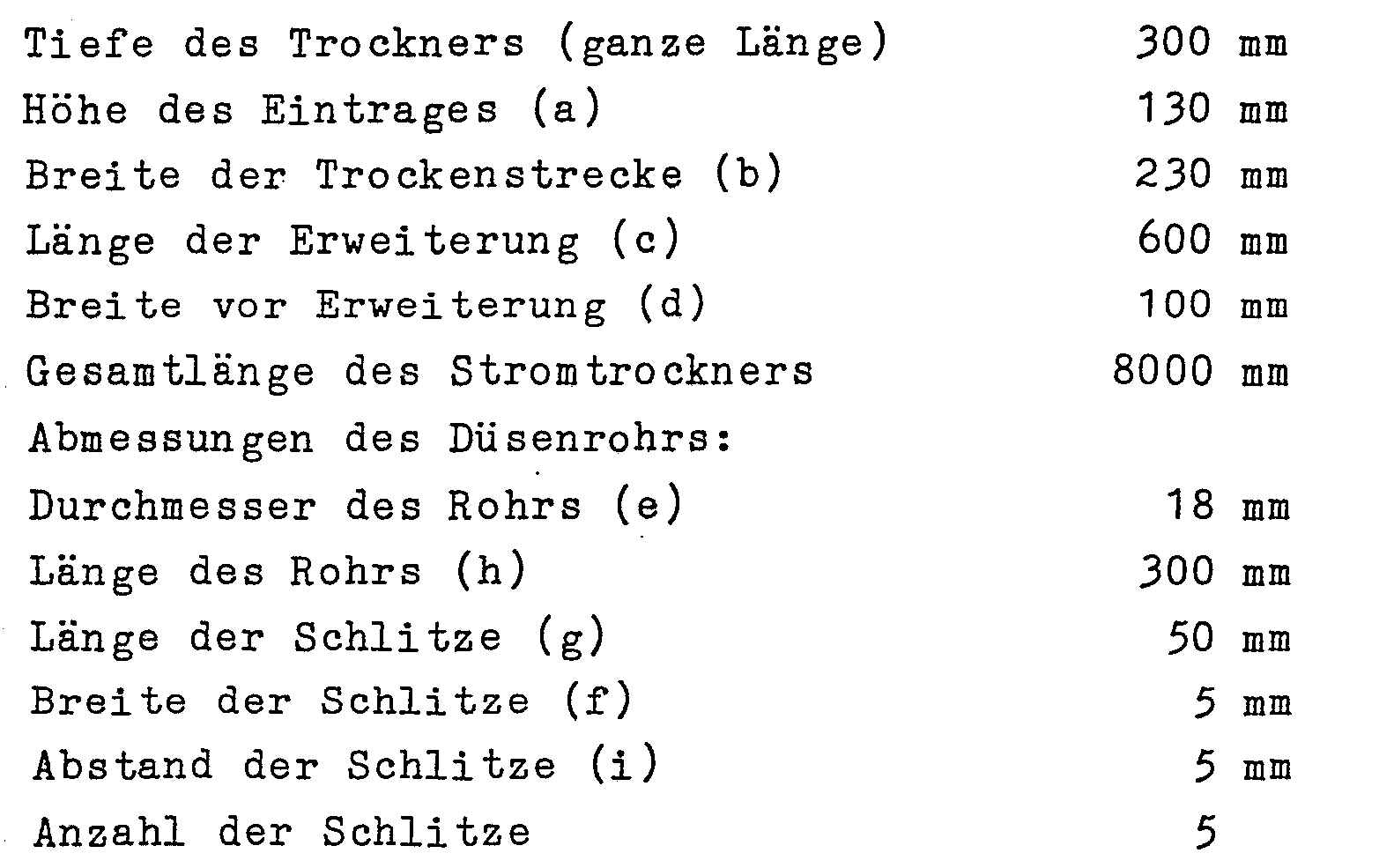
- Die hier angegebenen Versuche wurden mit Rippenschnitt durchgeführt. Für die Versuchsdurchführung wurde die genannte Pilotanlage so eingestellt, daß der Rippenschnitt ohne Schleuse eingetragen werden konnte. Der zu behandelnde Rippenschnitt wurde mit kaltem Wasser auf ca. 45 % (Naßbasis) angefeuchtet und bei Umgebungstemperatur (20°C) in den Eintrag gefördert. Der Massenstrom des Rippenschnitts betrug 100 kg/h. Als Treibgas wurde Sattdampf von 8 bar (t = 170,410 C) verwendet. Der Treibdampfstrom betrug 300 kg/h. Das Verhältnis von Rippenschnitt- zu Treibdampfmassenstrom beträgt somit 1 : 3. Hinter dem Freistrahl wurde der Rippenschnitt in der im übrigen üblichen Trocknungsstrecke mit Luft bei einer Temperatur von 340° C auf 15 % abgetrocknet. Die Ausschleusung erfolgte durch einen Zyklon. Der expandierte Rippenschnitt und ein zu Vergleichszwecken im Stromtrockner (ohne Freistrahl) behandelter Rippenschnitt wurde 72 Stunden bei 60 % relativer Luftfeuchtigkeit und'22° C konditioniert (nach DIN 10244). Die Füllkraftmessung erfolgte im Borgwaldt-Densimeter (Einwaage 10 g, Durchmesser des Meßbechers 60 mm, Belastung 3000 g und 30 s).
- Die Resthöhe des nach dem Stand der Technik behandelten Rippenschnitts betrug 14,8 mm, diejenige des nach dem Verfahren der Erfindung erhaltene betrug 18,59 mm, jeweils bei einer Feuchte von 12,6 %, bestimmt nach der Ofenmethode: 3 h, 80° C. Die Zunahme der Füllfähigkeit des nach dem Verfahren der Erfindung behandelten Tabakrippenschnitts beträgt gegenüber dem Vergleichsprodukt nach dieser Meßmethode ca. 25
- Der Versuch nach Beispiel 4 wurde in der dort beschriebenen Pilotanlage wiederholt, wobei der Treibdampfmassenstrom auf 80 kg/h reduziert und auf 300° G überhitzt wurde (ein grösserer Treibdampfmassenstrom konnte wegen des zur Verfügung stehenden Dampfüberhitzers nicht gefahren werden). Der zu behandelnde Rippenschnitt wurde mit kaltem Wasser auf ca. 45 % (Naßbasis) angefeuchtet und bei Umgebungstemperatur (25° C) in den Fußpunkt des Freistrahls gefördert. Der Massenstrom des Rippenschnitts
- betrug 100 kg/h. Das Verhältnis von Rippenschnitt zu Treibdampfmassenstrom beträgt somit 1 : 0,8. Hinter dem Freistrahl wurde der Rippenschnitt in der Trocknungsstrecke bei einer Temperatur von 340°C auf 15 % abgetrocknet.
- Die Ausschleusung erfolgte durch einen Zyklon. Die Konditionierung und Messung erfolgte analog Beispiel 3. Nach der benutzten Meßmethode beträgt die Zunahme in der Füllfähigkeit für den erfindungsgemäß behandelten Tabakrippenschnitt 30 %.
Claims (10)
Applications Claiming Priority (4)
| Application Number | Priority Date | Filing Date | Title |
|---|---|---|---|
| DE3135283 | 1981-09-05 | ||
| DE3135283 | 1981-09-05 | ||
| DE3147846A DE3147846C2 (de) | 1981-09-05 | 1981-12-03 | Verfahren zur Verbesserung der Füllfähigkeit von Tabakmaterial |
| DE3147846 | 1981-12-03 |
Publications (3)
| Publication Number | Publication Date |
|---|---|
| EP0074059A2 true EP0074059A2 (de) | 1983-03-16 |
| EP0074059A3 EP0074059A3 (en) | 1985-12-04 |
| EP0074059B1 EP0074059B1 (de) | 1988-10-26 |
Family
ID=25795826
Family Applications (1)
| Application Number | Title | Priority Date | Filing Date |
|---|---|---|---|
| EP82107992A Expired EP0074059B1 (de) | 1981-09-05 | 1982-08-31 | Verfahren zur Verbesserung der Füllfähigkeit von Tabakmaterial |
Country Status (3)
| Country | Link |
|---|---|
| US (1) | US4523598A (de) |
| EP (1) | EP0074059B1 (de) |
| DE (1) | DE3147846C2 (de) |
Cited By (7)
| Publication number | Priority date | Publication date | Assignee | Title |
|---|---|---|---|---|
| GB2155302A (en) * | 1984-03-13 | 1985-09-25 | Korea Ginseng & Tobacco Res | Process for expanding tobacco leaves and apparatus therefor |
| DE3619816A1 (de) * | 1985-06-15 | 1986-12-18 | British-American Tobacco Co. Ltd., London | Verfahren und vorrichtung zum expandieren von tabak |
| WO1989000014A1 (en) * | 1987-07-02 | 1989-01-12 | Gbe International Plc | Apparatus for expanding and/or drying particulate material |
| EP0484899A1 (de) * | 1990-11-07 | 1992-05-13 | Japan Tobacco Inc. | Verfahren und Vorrichtung zur Expansion von Tabak |
| EP0515877A3 (en) * | 1991-05-27 | 1993-02-03 | B.A.T. Cigarettenfabriken Gmbh | Drying process for improving the filling capacity of tobacco material and apparatus for carrying out this process |
| EP0546986A1 (de) * | 1991-12-09 | 1993-06-16 | EGRI, Laszlo, Dr. | Expandieren und Trocknen von Tabak |
| WO1998043501A1 (en) * | 1997-03-27 | 1998-10-08 | British American Tobacco (Investments) Limited | Tobacco dryers |
Families Citing this family (26)
| Publication number | Priority date | Publication date | Assignee | Title |
|---|---|---|---|---|
| US4407306A (en) * | 1981-12-17 | 1983-10-04 | American Brands, Inc. | Method for expanding tobacco with steam at high temperature and velocity |
| DE3315274A1 (de) | 1982-05-11 | 1983-11-17 | Hauni-Werke Körber & Co KG, 2050 Hamburg | Verfahren und vorrichtung zum volumenvergroessern von tabak |
| DE3240176A1 (de) * | 1982-10-29 | 1984-05-03 | Tamag Basel AG, 4127 Birsfelden | Verfahren zur volumenvergroesserung von tabakmaterial |
| MA20475A1 (fr) * | 1984-07-26 | 1986-04-01 | Bown & Williamson Tobacco Corp | Procede ameliore de gonflement de tabac |
| US4760854A (en) * | 1985-12-02 | 1988-08-02 | Brown & Williamson Tobacco Corporation | Tobacco expansion process |
| GB8530019D0 (en) * | 1985-12-05 | 1986-01-15 | British American Tobacco Co | Expansion of vegetable material |
| FR2608019B1 (fr) * | 1986-12-11 | 1991-01-25 | Decoufle Sarl | Systeme de guidage d'air pour une machine a confectionner des articles en forme de boudin de l'industrie de transformation du tabac |
| DE3710677A1 (de) * | 1987-03-31 | 1988-10-13 | Bat Cigarettenfab Gmbh | Vorrichtung zum expandieren von zerkleinertem tabakmaterial |
| US4895174A (en) * | 1988-05-19 | 1990-01-23 | R. J. Reynolds Tobacco Company | Tobacco particle separator |
| DE3839529C1 (de) * | 1988-11-23 | 1990-04-12 | Comas S.P.A., Silea, Treviso, It | |
| DE4005656C2 (de) * | 1990-02-22 | 1994-05-26 | Bat Cigarettenfab Gmbh | Verfahren und Vorrichtung zur Herstellung einer Tabak-Folie |
| US5251649A (en) * | 1991-06-18 | 1993-10-12 | Philip Morris Incorporated | Process for impregnation and expansion of tobacco |
| SK139993A3 (en) * | 1992-12-17 | 1994-09-07 | Philip Morris Prod | Method of impregnation and expanding of tobacco and device for its performing |
| GB9322967D0 (en) * | 1993-11-08 | 1994-01-05 | Gbe International Plc | A process and apparatus for treating a hygroscopic material |
| US5908032A (en) * | 1996-08-09 | 1999-06-01 | R.J. Reynolds Tobacco Company | Method of and apparatus for expanding tobacco |
| US6637438B1 (en) | 1997-04-21 | 2003-10-28 | Kerry Scott Lane | Method for assay and removal of harmful toxins during processing of tobacco products |
| US6058940A (en) * | 1997-04-21 | 2000-05-09 | Lane; Kerry Scott | Method and system for assay and removal of harmful toxins during processing of tobacco products |
| DE19909318C2 (de) | 1999-03-03 | 2001-06-28 | Bat Cigarettenfab Gmbh | Verfahren und Vorrichtung zur Expansion von Tabakmaterial |
| DE10135483A1 (de) * | 2001-07-20 | 2003-01-30 | Philip Morris Prod | Verfahren und Einrichtung zur Beseitigung von Tabak-Brandstrukturen aus expandiertem Tabak |
| US7556047B2 (en) * | 2003-03-20 | 2009-07-07 | R.J. Reynolds Tobacco Company | Method of expanding tobacco using steam |
| US8197231B2 (en) | 2005-07-13 | 2012-06-12 | Purity Solutions Llc | Diaphragm pump and related methods |
| IT1400927B1 (it) * | 2010-07-05 | 2013-07-02 | Magg Consulting S R L | Metodo di espansione del tabacco ed impianto per attuare il metodo. |
| US9610392B2 (en) | 2012-06-08 | 2017-04-04 | Fresenius Medical Care Holdings, Inc. | Medical fluid cassettes and related systems and methods |
| EP3771349B1 (de) | 2019-07-30 | 2024-04-17 | Muzer Makina Sanayi Ve Ticaret Ltd. Sti. | Tabakexpansionssystem (tes) |
| IT202000004129A1 (it) * | 2020-02-27 | 2021-08-27 | Magg Consulting S R L | Metodo perfezionato per il trattamento del tabacco. |
| CN116546891B (zh) * | 2020-12-09 | 2025-11-28 | 菲利普莫里斯生产公司 | 产生液体烟草提取物的改进方法 |
Family Cites Families (7)
| Publication number | Priority date | Publication date | Assignee | Title |
|---|---|---|---|---|
| US3357436A (en) * | 1964-08-26 | 1967-12-12 | Brown & Williamson Tobacco Corp | Apparatus for drying tobacco |
| US3678939A (en) * | 1970-11-13 | 1972-07-25 | Liggett & Myers Inc | Method of treating tobacco with flavorants in a pneumatic system |
| BE790758A (fr) * | 1971-11-04 | 1973-02-15 | Philip Morris Inc | Procede pour augmenter le volume des tiges de tabac |
| NL7216813A (de) * | 1971-12-17 | 1973-06-19 | ||
| CA1047352A (en) * | 1975-09-05 | 1979-01-30 | Eugene Glock | Method and apparatus for increasing the filling capacity of shredded tobacco tissue |
| US4044780A (en) * | 1975-09-05 | 1977-08-30 | American Brands, Inc. | Apparatus for total blend expansion |
| US4040431A (en) * | 1975-09-05 | 1977-08-09 | American Brands, Inc. | Method of increasing the filling capacity of shredded tobacco tissue |
-
1981
- 1981-12-03 DE DE3147846A patent/DE3147846C2/de not_active Expired
-
1982
- 1982-08-31 EP EP82107992A patent/EP0074059B1/de not_active Expired
- 1982-09-01 US US06/413,753 patent/US4523598A/en not_active Expired - Lifetime
Cited By (12)
| Publication number | Priority date | Publication date | Assignee | Title |
|---|---|---|---|---|
| GB2155302A (en) * | 1984-03-13 | 1985-09-25 | Korea Ginseng & Tobacco Res | Process for expanding tobacco leaves and apparatus therefor |
| DE3619816A1 (de) * | 1985-06-15 | 1986-12-18 | British-American Tobacco Co. Ltd., London | Verfahren und vorrichtung zum expandieren von tabak |
| DE3619816C2 (de) * | 1985-06-15 | 1998-01-29 | British American Tobacco Co | Verfahren und Vorrichtung zum Expandieren von Tabak |
| WO1989000014A1 (en) * | 1987-07-02 | 1989-01-12 | Gbe International Plc | Apparatus for expanding and/or drying particulate material |
| EP0484899A1 (de) * | 1990-11-07 | 1992-05-13 | Japan Tobacco Inc. | Verfahren und Vorrichtung zur Expansion von Tabak |
| US5379780A (en) * | 1990-11-07 | 1995-01-10 | Japan Tobacco Inc. | Method and system for expanding tobacco |
| EP0515877A3 (en) * | 1991-05-27 | 1993-02-03 | B.A.T. Cigarettenfabriken Gmbh | Drying process for improving the filling capacity of tobacco material and apparatus for carrying out this process |
| EP0546986A1 (de) * | 1991-12-09 | 1993-06-16 | EGRI, Laszlo, Dr. | Expandieren und Trocknen von Tabak |
| DE4227008A1 (de) * | 1991-12-09 | 1993-07-01 | Egri Laszlo Dr Chem | Expandieren und trocknen von tabak |
| US5307822A (en) * | 1991-12-09 | 1994-05-03 | Laszlo Egri | Expanding and drying tobacco |
| WO1998043501A1 (en) * | 1997-03-27 | 1998-10-08 | British American Tobacco (Investments) Limited | Tobacco dryers |
| CN1102356C (zh) * | 1997-03-27 | 2003-03-05 | 英美烟草(投资)有限公司 | 烟草干燥器 |
Also Published As
| Publication number | Publication date |
|---|---|
| EP0074059B1 (de) | 1988-10-26 |
| DE3147846C2 (de) | 1984-07-19 |
| DE3147846A1 (de) | 1983-06-16 |
| US4523598A (en) | 1985-06-18 |
| EP0074059A3 (en) | 1985-12-04 |
Similar Documents
| Publication | Publication Date | Title |
|---|---|---|
| EP0074059B1 (de) | Verfahren zur Verbesserung der Füllfähigkeit von Tabakmaterial | |
| DE3246513C2 (de) | Verfahren zum Auflockern von Tabak | |
| DE3619816C2 (de) | Verfahren und Vorrichtung zum Expandieren von Tabak | |
| DE69118653T2 (de) | Verfahren und Vorrichtung zur Expansion von Tabak | |
| DE602004006096T2 (de) | Dampfexpansionsverfahren für tabak | |
| EP0242873B1 (de) | Verfahren zur Behandlung von Tabak und ähnlichen organischen Materialien | |
| DE2615828A1 (de) | Verfahren und vorrichtung zur gasreinigung | |
| DE3114712C2 (de) | ||
| EP0515877A2 (de) | Trocknungsverfahren zur Füllfähigkeitssteigerung von Tabakmaterial | |
| DE19909318C2 (de) | Verfahren und Vorrichtung zur Expansion von Tabakmaterial | |
| DE102017206842A1 (de) | Verfahren zur pneumatischen Förderung von Kunststoffgranulat | |
| DE3037885C2 (de) | Verfahren zur Volumenvergrößerung von zerkleinerten Tabakrippen und Vorrichtung zur Durchführung des Verfahrens | |
| WO2007104389A1 (de) | Trocknungsvorrichtung für tabak | |
| DE1908704B2 (de) | Trockenverfahren und Vorrichtung zum kontinuierlichen Formen eines Vlieses aus pflanzlichem Fasermatenal | |
| DE3705879C2 (de) | ||
| DE3301872A1 (de) | Zerstaeubungstrockner und verfahren zum betrieb des trockners | |
| EP0370489B1 (de) | Verfahren und Vorrichtung zum Blähen von geschnittenem, befeuchtetem Tabakmaterial | |
| EP0546986B1 (de) | Expandieren und Trocknen von Tabak | |
| DE2555553A1 (de) | Verfahren zum trocknen nasser partikel und zentrifugentrocknungsanlage | |
| EP0141073A2 (de) | Verfahren zur Erhöhung des Abscheidungsgrades eines Zyklons und Zyklonenabscheider zur Durchführung des Verfahrens | |
| DE102006024936B3 (de) | Stromtrockner zum Trocknen eines faserförmigen Tabakprodukts | |
| DE102016104563B3 (de) | Verfahren und Strahlpumpe zum Auflockern und Vereinzeln von Holzfasern mit zeitgleicher Benetzung der Holzfasern mit Bindemittelfluid, sowie Anlage zur Benetzung und/oder Vorbenetzung von Holzfasern mit einem Bindemittelfluid | |
| EP0528227A1 (de) | Vorrichtung zum Überführen von Tabakteilen in einen Stromtrockner | |
| EP0054739B1 (de) | Verfahren und Einrichtung zum Nasslöschen von insbesondere Steinkohlenkoks | |
| DE202016101394U1 (de) | Strahlpumpe zum Auflockern und Vereinzeln von Holzfasern mit zeitgleicher Benetzung der Holzfasern mit Bindemittelfluid, sowie Anlage zur Benetzung und/oder Vorbenetzung von Holzfasern mit einem Bindemittelfluid |
Legal Events
| Date | Code | Title | Description |
|---|---|---|---|
| PUAI | Public reference made under article 153(3) epc to a published international application that has entered the european phase |
Free format text: ORIGINAL CODE: 0009012 |
|
| AK | Designated contracting states |
Designated state(s): BE CH FR GB IT LI NL |
|
| PUAL | Search report despatched |
Free format text: ORIGINAL CODE: 0009013 |
|
| AK | Designated contracting states |
Designated state(s): BE CH FR GB IT LI NL |
|
| 17P | Request for examination filed |
Effective date: 19851017 |
|
| 17Q | First examination report despatched |
Effective date: 19861126 |
|
| GRAA | (expected) grant |
Free format text: ORIGINAL CODE: 0009210 |
|
| AK | Designated contracting states |
Kind code of ref document: B1 Designated state(s): BE CH FR GB IT LI NL |
|
| ITF | It: translation for a ep patent filed | ||
| GBT | Gb: translation of ep patent filed (gb section 77(6)(a)/1977) | ||
| ET | Fr: translation filed | ||
| PLBE | No opposition filed within time limit |
Free format text: ORIGINAL CODE: 0009261 |
|
| STAA | Information on the status of an ep patent application or granted ep patent |
Free format text: STATUS: NO OPPOSITION FILED WITHIN TIME LIMIT |
|
| 26N | No opposition filed | ||
| ITTA | It: last paid annual fee | ||
| REG | Reference to a national code |
Ref country code: CH Ref legal event code: PFA Free format text: B.A.T. CIGARETTEN-FABRIKEN GMBH TRANSFER- BRITISH-AMERICAN TOBACCO (GERMANY) GMBH |
|
| REG | Reference to a national code |
Ref country code: FR Ref legal event code: CD |
|
| NLT1 | Nl: modifications of names registered in virtue of documents presented to the patent office pursuant to art. 16 a, paragraph 1 |
Owner name: BRITISH-AMERICAN TOBACCO (GERMANY) GMBH;B.A.T. CIG |
|
| PGFP | Annual fee paid to national office [announced via postgrant information from national office to epo] |
Ref country code: GB Payment date: 20010807 Year of fee payment: 20 |
|
| PGFP | Annual fee paid to national office [announced via postgrant information from national office to epo] |
Ref country code: FR Payment date: 20010822 Year of fee payment: 20 |
|
| PGFP | Annual fee paid to national office [announced via postgrant information from national office to epo] |
Ref country code: CH Payment date: 20010824 Year of fee payment: 20 Ref country code: BE Payment date: 20010824 Year of fee payment: 20 |
|
| PGFP | Annual fee paid to national office [announced via postgrant information from national office to epo] |
Ref country code: NL Payment date: 20010827 Year of fee payment: 20 |
|
| BE20 | Be: patent expired |
Free format text: 20020831 *BRITISH-AMERICAN TOBACCO (GERMANY) G.M.B.H. |
|
| REG | Reference to a national code |
Ref country code: GB Ref legal event code: IF02 |
|
| PG25 | Lapsed in a contracting state [announced via postgrant information from national office to epo] |
Ref country code: LI Free format text: LAPSE BECAUSE OF EXPIRATION OF PROTECTION Effective date: 20020830 Ref country code: CH Free format text: LAPSE BECAUSE OF EXPIRATION OF PROTECTION Effective date: 20020830 Ref country code: GB Free format text: LAPSE BECAUSE OF EXPIRATION OF PROTECTION Effective date: 20020830 |
|
| PG25 | Lapsed in a contracting state [announced via postgrant information from national office to epo] |
Ref country code: NL Free format text: LAPSE BECAUSE OF EXPIRATION OF PROTECTION Effective date: 20020831 |
|
| REG | Reference to a national code |
Ref country code: GB Ref legal event code: PE20 Effective date: 20020830 |
|
| REG | Reference to a national code |
Ref country code: CH Ref legal event code: PL |
|
| NLV7 | Nl: ceased due to reaching the maximum lifetime of a patent |
Effective date: 20020831 |