EP0074073A1 - Härtbare Epoxidharze - Google Patents
Härtbare Epoxidharze Download PDFInfo
- Publication number
- EP0074073A1 EP0074073A1 EP82108025A EP82108025A EP0074073A1 EP 0074073 A1 EP0074073 A1 EP 0074073A1 EP 82108025 A EP82108025 A EP 82108025A EP 82108025 A EP82108025 A EP 82108025A EP 0074073 A1 EP0074073 A1 EP 0074073A1
- Authority
- EP
- European Patent Office
- Prior art keywords
- resin composition
- composition according
- curable resin
- carbon atoms
- alkyl
- Prior art date
- Legal status (The legal status is an assumption and is not a legal conclusion. Google has not performed a legal analysis and makes no representation as to the accuracy of the status listed.)
- Withdrawn
Links
- 239000003822 epoxy resin Substances 0.000 title claims abstract description 12
- 229920000647 polyepoxide Polymers 0.000 title claims abstract description 12
- LNEPOXFFQSENCJ-UHFFFAOYSA-N haloperidol Chemical compound C1CC(O)(C=2C=CC(Cl)=CC=2)CCN1CCCC(=O)C1=CC=C(F)C=C1 LNEPOXFFQSENCJ-UHFFFAOYSA-N 0.000 title description 6
- 239000002184 metal Substances 0.000 claims abstract description 18
- 229910052751 metal Inorganic materials 0.000 claims abstract description 18
- 239000011342 resin composition Substances 0.000 claims abstract description 12
- 150000003839 salts Chemical class 0.000 claims abstract description 10
- 239000003054 catalyst Substances 0.000 claims abstract description 9
- WVIICGIFSIBFOG-UHFFFAOYSA-N pyrylium Chemical class C1=CC=[O+]C=C1 WVIICGIFSIBFOG-UHFFFAOYSA-N 0.000 claims abstract description 7
- 239000013522 chelant Substances 0.000 claims abstract description 5
- 125000005609 naphthenate group Chemical group 0.000 claims abstract description 3
- 125000005474 octanoate group Chemical group 0.000 claims abstract description 3
- 125000004432 carbon atom Chemical group C* 0.000 claims description 10
- 125000002877 alkyl aryl group Chemical group 0.000 claims description 8
- 125000000217 alkyl group Chemical group 0.000 claims description 8
- 239000000203 mixture Substances 0.000 claims description 8
- 125000003118 aryl group Chemical group 0.000 claims description 6
- 125000000753 cycloalkyl group Chemical group 0.000 claims description 6
- 229910052739 hydrogen Inorganic materials 0.000 claims description 5
- 239000001257 hydrogen Substances 0.000 claims description 5
- 238000000465 moulding Methods 0.000 claims description 5
- -1 Co ++ Inorganic materials 0.000 claims description 3
- 125000004435 hydrogen atom Chemical class [H]* 0.000 claims description 3
- 238000004519 manufacturing process Methods 0.000 claims description 3
- 238000000034 method Methods 0.000 claims description 3
- 125000001624 naphthyl group Chemical class 0.000 claims description 3
- 125000001997 phenyl group Chemical class [H]C1=C([H])C([H])=C(*)C([H])=C1[H] 0.000 claims description 3
- 230000008569 process Effects 0.000 claims description 3
- YBYIRNPNPLQARY-UHFFFAOYSA-N 1H-indene Chemical class C1=CC=C2CC=CC2=C1 YBYIRNPNPLQARY-UHFFFAOYSA-N 0.000 claims description 2
- 229910017008 AsF 6 Inorganic materials 0.000 claims description 2
- UFHFLCQGNIYNRP-UHFFFAOYSA-N Hydrogen Chemical compound [H][H] UFHFLCQGNIYNRP-UHFFFAOYSA-N 0.000 claims description 2
- 229910018286 SbF 6 Inorganic materials 0.000 claims description 2
- 239000002253 acid Substances 0.000 claims description 2
- 125000001931 aliphatic group Chemical group 0.000 claims description 2
- 150000001450 anions Chemical class 0.000 claims description 2
- 125000003710 aryl alkyl group Chemical group 0.000 claims description 2
- 125000003983 fluorenyl group Chemical class C1(=CC=CC=2C3=CC=CC=C3CC12)* 0.000 claims description 2
- 125000005842 heteroatom Chemical group 0.000 claims description 2
- 125000003392 indanyl group Chemical class C1(CCC2=CC=CC=C12)* 0.000 claims description 2
- 125000003454 indenyl group Chemical class C1(C=CC2=CC=CC=C12)* 0.000 claims description 2
- 230000000269 nucleophilic effect Effects 0.000 claims description 2
- POILWHVDKZOXJZ-ARJAWSKDSA-M (z)-4-oxopent-2-en-2-olate Chemical compound C\C([O-])=C\C(C)=O POILWHVDKZOXJZ-ARJAWSKDSA-M 0.000 claims 1
- 229910020598 Co Fe Inorganic materials 0.000 claims 1
- WPYMKLBDIGXBTP-UHFFFAOYSA-N benzoic acid Chemical compound OC(=O)C1=CC=CC=C1 WPYMKLBDIGXBTP-UHFFFAOYSA-N 0.000 claims 1
- 229910052802 copper Inorganic materials 0.000 claims 1
- QIQXTHQIDYTFRH-UHFFFAOYSA-N octadecanoic acid Chemical group CCCCCCCCCCCCCCCCCC(O)=O QIQXTHQIDYTFRH-UHFFFAOYSA-N 0.000 claims 1
- XNGIFLGASWRNHJ-UHFFFAOYSA-L phthalate(2-) Chemical compound [O-]C(=O)C1=CC=CC=C1C([O-])=O XNGIFLGASWRNHJ-UHFFFAOYSA-L 0.000 claims 1
- 150000001558 benzoic acid derivatives Chemical class 0.000 abstract description 2
- 238000000576 coating method Methods 0.000 abstract description 2
- 125000005498 phthalate group Chemical class 0.000 abstract description 2
- XOOUIPVCVHRTMJ-UHFFFAOYSA-L zinc stearate Chemical class [Zn+2].CCCCCCCCCCCCCCCCCC([O-])=O.CCCCCCCCCCCCCCCCCC([O-])=O XOOUIPVCVHRTMJ-UHFFFAOYSA-L 0.000 abstract description 2
- 125000005595 acetylacetonate group Chemical group 0.000 abstract 1
- YMWUJEATGCHHMB-UHFFFAOYSA-N Dichloromethane Chemical compound ClCCl YMWUJEATGCHHMB-UHFFFAOYSA-N 0.000 description 11
- 229920005989 resin Polymers 0.000 description 8
- 239000011347 resin Substances 0.000 description 8
- 238000004132 cross linking Methods 0.000 description 4
- 125000004122 cyclic group Chemical group 0.000 description 3
- 150000002739 metals Chemical class 0.000 description 3
- 230000005855 radiation Effects 0.000 description 3
- PLIKAWJENQZMHA-UHFFFAOYSA-N 4-aminophenol Chemical compound NC1=CC=C(O)C=C1 PLIKAWJENQZMHA-UHFFFAOYSA-N 0.000 description 2
- RWSOTUBLDIXVET-UHFFFAOYSA-N Dihydrogen sulfide Chemical class S RWSOTUBLDIXVET-UHFFFAOYSA-N 0.000 description 2
- 150000008064 anhydrides Chemical class 0.000 description 2
- IISBACLAFKSPIT-UHFFFAOYSA-N bisphenol A Chemical compound C=1C=C(O)C=CC=1C(C)(C)C1=CC=C(O)C=C1 IISBACLAFKSPIT-UHFFFAOYSA-N 0.000 description 2
- 238000006243 chemical reaction Methods 0.000 description 2
- 239000003085 diluting agent Substances 0.000 description 2
- 125000003700 epoxy group Chemical group 0.000 description 2
- 238000005259 measurement Methods 0.000 description 2
- 231100000252 nontoxic Toxicity 0.000 description 2
- 230000003000 nontoxic effect Effects 0.000 description 2
- 230000004044 response Effects 0.000 description 2
- 239000002904 solvent Substances 0.000 description 2
- 230000008961 swelling Effects 0.000 description 2
- STMDPCBYJCIZOD-UHFFFAOYSA-N 2-(2,4-dinitroanilino)-4-methylpentanoic acid Chemical compound CC(C)CC(C(O)=O)NC1=CC=C([N+]([O-])=O)C=C1[N+]([O-])=O STMDPCBYJCIZOD-UHFFFAOYSA-N 0.000 description 1
- KUBDPQJOLOUJRM-UHFFFAOYSA-N 2-(chloromethyl)oxirane;4-[2-(4-hydroxyphenyl)propan-2-yl]phenol Chemical compound ClCC1CO1.C=1C=C(O)C=CC=1C(C)(C)C1=CC=C(O)C=C1 KUBDPQJOLOUJRM-UHFFFAOYSA-N 0.000 description 1
- LCFVJGUPQDGYKZ-UHFFFAOYSA-N Bisphenol A diglycidyl ether Chemical compound C=1C=C(OCC2OC2)C=CC=1C(C)(C)C(C=C1)=CC=C1OCC1CO1 LCFVJGUPQDGYKZ-UHFFFAOYSA-N 0.000 description 1
- BRLQWZUYTZBJKN-UHFFFAOYSA-N Epichlorohydrin Chemical compound ClCC1CO1 BRLQWZUYTZBJKN-UHFFFAOYSA-N 0.000 description 1
- 238000005684 Liebig rearrangement reaction Methods 0.000 description 1
- CERQOIWHTDAKMF-UHFFFAOYSA-M Methacrylate Chemical compound CC(=C)C([O-])=O CERQOIWHTDAKMF-UHFFFAOYSA-M 0.000 description 1
- 239000006057 Non-nutritive feed additive Substances 0.000 description 1
- FQYUMYWMJTYZTK-UHFFFAOYSA-N Phenyl glycidyl ether Chemical compound C1OC1COC1=CC=CC=C1 FQYUMYWMJTYZTK-UHFFFAOYSA-N 0.000 description 1
- AWMVMTVKBNGEAK-UHFFFAOYSA-N Styrene oxide Chemical compound C1OC1C1=CC=CC=C1 AWMVMTVKBNGEAK-UHFFFAOYSA-N 0.000 description 1
- 125000000218 acetic acid group Chemical group C(C)(=O)* 0.000 description 1
- 150000007513 acids Chemical class 0.000 description 1
- 239000000654 additive Substances 0.000 description 1
- 150000001412 amines Chemical class 0.000 description 1
- 238000009835 boiling Methods 0.000 description 1
- 125000003178 carboxy group Chemical group [H]OC(*)=O 0.000 description 1
- 150000001735 carboxylic acids Chemical class 0.000 description 1
- 239000007795 chemical reaction product Substances 0.000 description 1
- 125000000113 cyclohexyl group Chemical group [H]C1([H])C([H])([H])C([H])([H])C([H])(*)C([H])([H])C1([H])[H] 0.000 description 1
- ZZTCPWRAHWXWCH-UHFFFAOYSA-N diphenylmethanediamine Chemical compound C=1C=CC=CC=1C(N)(N)C1=CC=CC=C1 ZZTCPWRAHWXWCH-UHFFFAOYSA-N 0.000 description 1
- KPUWHANPEXNPJT-UHFFFAOYSA-N disiloxane Chemical group [SiH3]O[SiH3] KPUWHANPEXNPJT-UHFFFAOYSA-N 0.000 description 1
- 239000000975 dye Substances 0.000 description 1
- 150000002118 epoxides Chemical class 0.000 description 1
- 150000002148 esters Chemical group 0.000 description 1
- 239000000945 filler Substances 0.000 description 1
- 230000004992 fission Effects 0.000 description 1
- 125000000524 functional group Chemical group 0.000 description 1
- 239000011521 glass Substances 0.000 description 1
- 230000009477 glass transition Effects 0.000 description 1
- WJRBRSLFGCUECM-UHFFFAOYSA-N hydantoin Chemical compound O=C1CNC(=O)N1 WJRBRSLFGCUECM-UHFFFAOYSA-N 0.000 description 1
- 229940091173 hydantoin Drugs 0.000 description 1
- 229930195733 hydrocarbon Natural products 0.000 description 1
- 150000002430 hydrocarbons Chemical class 0.000 description 1
- XMBWDFGMSWQBCA-UHFFFAOYSA-N hydrogen iodide Chemical class I XMBWDFGMSWQBCA-UHFFFAOYSA-N 0.000 description 1
- 125000002887 hydroxy group Chemical group [H]O* 0.000 description 1
- IQPQWNKOIGAROB-UHFFFAOYSA-N isocyanate group Chemical group [N-]=C=O IQPQWNKOIGAROB-UHFFFAOYSA-N 0.000 description 1
- ZFSLODLOARCGLH-UHFFFAOYSA-N isocyanuric acid Chemical compound OC1=NC(O)=NC(O)=N1 ZFSLODLOARCGLH-UHFFFAOYSA-N 0.000 description 1
- 239000000463 material Substances 0.000 description 1
- 239000011159 matrix material Substances 0.000 description 1
- 229910021645 metal ion Inorganic materials 0.000 description 1
- 125000002496 methyl group Chemical group [H]C([H])([H])* 0.000 description 1
- 229920003986 novolac Polymers 0.000 description 1
- RPQRDASANLAFCM-UHFFFAOYSA-N oxiran-2-ylmethyl prop-2-enoate Chemical compound C=CC(=O)OCC1CO1 RPQRDASANLAFCM-UHFFFAOYSA-N 0.000 description 1
- 230000000737 periodic effect Effects 0.000 description 1
- 150000002989 phenols Chemical class 0.000 description 1
- 239000000049 pigment Substances 0.000 description 1
- 229920000642 polymer Polymers 0.000 description 1
- 238000011417 postcuring Methods 0.000 description 1
- 239000000047 product Substances 0.000 description 1
- 230000001681 protective effect Effects 0.000 description 1
- 230000009257 reactivity Effects 0.000 description 1
- 239000012779 reinforcing material Substances 0.000 description 1
- 238000003860 storage Methods 0.000 description 1
- 239000000126 substance Substances 0.000 description 1
- 125000001424 substituent group Chemical group 0.000 description 1
- 239000010409 thin film Substances 0.000 description 1
- 231100000331 toxic Toxicity 0.000 description 1
- 230000002588 toxic effect Effects 0.000 description 1
- 230000001960 triggered effect Effects 0.000 description 1
Classifications
-
- C—CHEMISTRY; METALLURGY
- C08—ORGANIC MACROMOLECULAR COMPOUNDS; THEIR PREPARATION OR CHEMICAL WORKING-UP; COMPOSITIONS BASED THEREON
- C08G—MACROMOLECULAR COMPOUNDS OBTAINED OTHERWISE THAN BY REACTIONS ONLY INVOLVING UNSATURATED CARBON-TO-CARBON BONDS
- C08G59/00—Polycondensates containing more than one epoxy group per molecule; Macromolecules obtained by polymerising compounds containing more than one epoxy group per molecule using curing agents or catalysts which react with the epoxy groups
- C08G59/18—Macromolecules obtained by polymerising compounds containing more than one epoxy group per molecule using curing agents or catalysts which react with the epoxy groups ; e.g. general methods of curing
- C08G59/68—Macromolecules obtained by polymerising compounds containing more than one epoxy group per molecule using curing agents or catalysts which react with the epoxy groups ; e.g. general methods of curing characterised by the catalysts used
- C08G59/70—Chelates
-
- C—CHEMISTRY; METALLURGY
- C08—ORGANIC MACROMOLECULAR COMPOUNDS; THEIR PREPARATION OR CHEMICAL WORKING-UP; COMPOSITIONS BASED THEREON
- C08G—MACROMOLECULAR COMPOUNDS OBTAINED OTHERWISE THAN BY REACTIONS ONLY INVOLVING UNSATURATED CARBON-TO-CARBON BONDS
- C08G59/00—Polycondensates containing more than one epoxy group per molecule; Macromolecules obtained by polymerising compounds containing more than one epoxy group per molecule using curing agents or catalysts which react with the epoxy groups
- C08G59/18—Macromolecules obtained by polymerising compounds containing more than one epoxy group per molecule using curing agents or catalysts which react with the epoxy groups ; e.g. general methods of curing
- C08G59/68—Macromolecules obtained by polymerising compounds containing more than one epoxy group per molecule using curing agents or catalysts which react with the epoxy groups ; e.g. general methods of curing characterised by the catalysts used
Definitions
- Epoxy resins are usually cured with amines, phenols, carboxylic acids or their anhydrides. Because of the high reactivity, the two components must be handled separately and processed quickly after mixing.
- One-component systems have also been developed in which a radiation-sensitive onium salt is added to the epoxy resin and the curing of the storable and easy-to-handle and processable resin is triggered by radiation.
- iodonium salts have been used, but they are highly toxic.
- DE-A-25 18 652 describes curable compositions of an epoxy resin and a radiation-sensitive onium salt of an element of the 6th main group of the periodic table. If the preferred sulfonium salts are used, however, shaped articles with a rough or matt surface and a low resistance to methylene chloride are obtained after curing. In addition, the unpleasant smell of the sulfonium salts bothers when mixing and processing the resins.
- the invention was therefore based on the object of developing curable epoxy resins which contain an effective curing catalyst, can be stored well, are easy to handle and process and are non-toxic, and which, after curing, result in moldings having a good surface and solvent resistance.
- a pyrylium salt has the formula Dd / P
- R 1 R 5 and denotes an alkyl or alkaryl group with 1 to 8 carbon atoms;
- R 2 , R 3 and R 4 are the same or different and represent hydrogen, an alkyl, alkaryl or cycloalkyl group having up to 8 carbon atoms, an optionally alkyl-substituted phenyl, naphthyl, indenyl, indanyl or fluorenyl group or a heterocyclic substituent with one or two heteroatoms.
- the substituents R 1 to R 5 are isolated and are not connected to one another via ring systems.
- R 1 and R 5 are preferably methyl groups,
- R 2 and R 4 are hydrogen and R 3 is phenyl, naphthyl and cyclohexyl.
- X ⁇ is a non-nucleophilic, slightly basic anion, preferably AsF 6 ⁇ , SbF 6 ⁇ , BF 4 9 , PF 6 e , CF 3 SO 3 ⁇ or C10 4 ⁇ .
- the preferred pyrylium hexafluoroarsenates are non-toxic. When they decay, they do not emit any odor-causing fission products.
- the pyrylium salts are known; their manufacture is described, for example, in AV Baeyer, Liebigs Annalen 384 (1911), p. 208.
- epoxy resins is to be understood as meaning monomeric, dimeric, oligomeric and polymeric compounds with terminal or pendant epoxy groups and also built into cyclic systems, it being possible for one or more epoxy groups to be present in the molecule.
- the resins can too contain other functional groups such as hydroxyl, carboxyl, anhydride, ester, siloxane or isocyanate groups.
- Preferred epoxy resins are reaction products of bisphenol A, novolak resins, diaminodiphenylmethane, p-aminophenol, isocyanurate or hydantoin with epichlorohydrin, as well as cycloaliphatic epoxides and cycloaliphatic epoxide esters.
- the epoxy resins can contain the usual diluents, such as phenyl glycidyl ether, glycidyl acrylate or methacrylate, styrene oxide or allyl glycidyl ether as viscosity regulators.
- the resin composition according to the invention preferably additionally contains 0.01 to 10% by weight, preferably 0.1 to 5% by weight, of a metal chelate C 1 or a metal salt C 2 as cocatalyst.
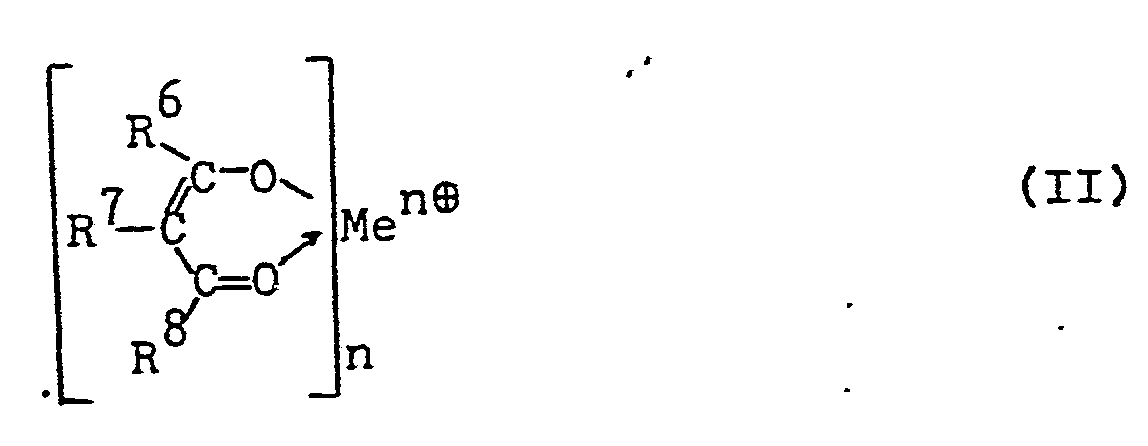
- the metal chelate C 1 has the formula where Me is a mono- to tetravalent metal, R 7 is hydrogen, an alkyl, cycloalkyl, aryl or alkaryl group of up to 8 carbon atoms, R 6 and R 8 are identical or different and an alkyl, cycloalkyl, Aryl, aralkyl or alkaryl group having up to 8 carbon atoms, where R 6 and R 8 can also be connected to one another by a ring system, and n is an integer between 1 and 4.
- metal ions are Ti 4+ , Zn 2+ , Zr 4+ , Ba 2+ , Ca 2+ , Ce 4+ , Cr 3+ , Pb 2+ , Mg 2+ , Sn 4+ , Nn 2+ , Ni 2 + , V 3+ and V 4+ in question; Al 3+ , Cu 2+ , Fe 3+ , Co 2+ and Co 3+ are preferred.
- Preferred metal chelates are the acetyl acetorate.
- the metal salts C 2 are salts of mono- to tetravalent metals with aliphatic or aromatic mono- or polycarboxylic acids with 6 to 20 carbon atoms.
- the above-mentioned metals are suitable as metals; stearates, benzoates, naphthenates, octoates or phthalates of Cu 2+ , Co 2+ , Co 3+ , Fe 3+ and Al 3+ are preferred.
- the cocatalysts can be used as a substance or in the form of solutions, for example in hydrocarbons. Mixtures of metal chelates C1 and metal salts C 2 can also be used. By adding the cocatalysts, the temperature at which curing begins (response temperature) and the curing time can be reduced. In many cases, the storage stability of the resins is increased.
- the curable resin compositions are prepared by mixing the epoxy resin A with the catalyst B and optionally a cocatalyst C 1 or C 2 .
- the mixture can be modified with diluents and mixed with reinforcing materials, fillers, dyes, pigments, processing aids or other conventional additives.
- the mixture is brought into a suitable shape, for example poured out as a thin film.
- the resin is heated to temperatures between 80 ° and 160 ° C., preferably between 300 ° and 150 ° C.
- the curing process is generally complete after 0.5 to 20 minutes.
- the shaped bodies formed during curing have a smooth, shiny surface.
- Your glass temperature is - after post-curing at 200 ° C for one hour - between 170 ° and 190 ° C. They have a high crosslink density, their shear modulus G 'in the rubber-elastic range reaches values between 40 and 50 N.mm 2 .
- the moldings have good resistance to solvents, they are not attacked when stored in methylene chloride.
- the curable compositions of the invention can e.g. for the production of protective and insulating coatings, investment materials or as a matrix for reinforced moldings.
- Resin mixtures were produced from a bisphenol A diglycidyl ether (®Epon 828 from SHELL), 2.4% by weight of catalyst and optionally 1% by weight of cocatalyst. Each equal amounts by weight resin mixture was poured into cylindrical molds which were immersed in a preheated to 120 ° C, 130 ° C and 140 0 C oil bath. The samples were provided with a thermocouple for temperature control. A temperature / time curve was recorded. This shows the start of the exothermic crosslinking reaction (adjustment of the sample temperature to the bath temperature), the associated response temperature and the maximum temperature. The time between the start of the crosslinking reaction and reaching the maximum temperature represents the curing time.
Landscapes
- Chemical & Material Sciences (AREA)
- Health & Medical Sciences (AREA)
- Chemical Kinetics & Catalysis (AREA)
- Medicinal Chemistry (AREA)
- Polymers & Plastics (AREA)
- Organic Chemistry (AREA)
- Epoxy Resins (AREA)
- Compositions Of Macromolecular Compounds (AREA)
Abstract
Die Erfindung betrifft eine härtbare Harzzusammensetzung aus A. einem Epoxidharz, B. einem Pyryliumsalz als Katalysator, sowie gegebenenfalls C. einem Metallchelat oder Metallsalz als Cokatalysator. Bevorzugte Pyryliumsalze sind solche der Formel <IMAGE> Bevorzugte Cokatalysatoren sind Acetylacetonate, Stearate, Benzoate, Naphthenate, Octoate oder Phthalate von Cu<+><+>, Co<+><+>, Co<+><+><+>, Fe<+><+><+>, oder Al<+><+><+>. Die Harzzusammensetzungen können zur Herstellung von Überzügen und Formkörpern verwendet werden.
Description
- Epoxidharze werden üblicherweise mit Aminen, Phenolen, Carbonsäuren oder deren Anhydriden gehärtet. Wegen der hohen Reaktivität müssen die beiden Komponenten getrennt gehandhabt und nach dem Vermischen rasch verarbeitet werden.
- Man hat auch schon Einkomponentensysteme entwickelt, bei denen dem Epoxidharz ein strahlungsempfindliches Oniumsalz zugesetzt und die Härtung des lagerfähigen und gut handhabbaren und verarbeitbaren Harzes durch Bestrahlung ausgelöst wird. In der Praxis wurden Jodoniumsalze eingesetzt, die aber stark toxisch sind. In der DE-A- 25 18 652 sind härtbare Zusammensetzungen aus einem Epoxidharz und einem strahlungsempfindlichen Oniumsalz eines Elements der 6. Hauptgruppe des Periodensystems beschrieben. Bei Verwendung der bevorzugten Sulfoniumsalze erhält man aber nach der Härtung Formkörper mit rauher oder matter Oberfläche und einer geringen Beständigkeit gegen Methylenchlorid. Außerdem stört bei der Abmischung und Verarbeitung der Harze der unangenehme Geruch der Sulfoniumsalze.
- Der Erfindung lag daher die Aufgabe zugrunde, härtbare Epoxidharze zu entwickeln, die einen wirksamen Härtungs--Katalysator enthalten, gut lagerfähig, leicht handhabbar und verarbeitungsfähig und nicht toxisch sind, und die nach der Härtung Formkörper mit guter Oberfläche und Lösungsmittelbeständigkeit ergeben.
- Diese Aufgabe wird gelöst, wenn man als Katalysatoren 0,5 bis 10, vorzugsweise 1 bis 8 Gew.-%, bezogen auf die Harzzusammensetzung, eines Pyryliumsalzes verwendet. Das Pyryliumsalz hat die Formel Dd/P

- Dabei ist R1 = R5 und bedeutet eine Alkyl- oder Alkaryl- gruppe mit 1 bis 8 Kohlenstoffatomen; R2, R3 und R4 sind gleich oder verschieden und bedeuten Wasserstoff, eine Alkyl-, Alkaryl- oder Cycloalkylgruppe mit bis zu 8 Kohlenstoffatomen, eine gegebenenfalls alkyl-substituierte Phenyl-, Naphthyl-, Indenyl-, Indanyl- oder Fluorenyl-Gruppe oder einen heterocyclischen Substituenten mit einem oder zwei Heteroatomen. Die Substituenten R1 bis R5 stehen isoliert und sind nicht über Ringsysteme miteinander verbunden. Bevorzugt sind R1 und R5 Methylgruppen, R2 und R4 Wasserstoff und R3 ist Phenyl, Naphthyl und Cyclohexyl.
- Xθ ist ein nicht nucleophiles, wenig basisches Anion, bevorzugt AsF6 θ, SbF6θ, BF4 9, PF6 e, CF3SO3 θ oder C104 θ. Die bevorzugten Pyrylium-hexafluoroarsenate sind nicht toxisch. Sie emittieren bei ihrem Zerfall keine geruchsbelästigenden Spaltprodukte. Die Pyryliumsalze sind bekannt; ihre Herstellung ist z.B. beschrieben in A.V. Baeyer, Liebigs Annalen 384 (1911), S. 208.
- Unter dem Begriff "Epoxidharze" sind monomere, dimere, oligomere und polymere Verbindungen mit end- oder seitenständigen sowie in cyclischen Systemen eingebauten Epoxidgruppen zu verstehen, wobei eine oder mehrere Epoxidgruppen im Molekül vorhanden sein können. Die Harze können auch andere funktionelle Gruppen, wie Hydroxyl-, Carboxyl-, Anhydrid-, Ester-, Siloxan- oder Isocyanatgruppen enthalten. Bevorzugte Epoxidharze sind Umsetzungsprodukte von Bisphenol A, Novolak-Harzen, Diaminodiphenylmethan, p-Aminophenol, Isocyanurat oder Hydantoin mit Epichlorhydrin, sowie cycloaliphatische Epoxide und cycloaliphatische Epoxidester. Die Epoxidharze können die üblichen Verdünnungsmittel, wie z.B. Phenylglycidyläther, Glycidylacrylat oder -methacrylat, Styroloxid oder Allylglycidyl- äther als Viskositätsregler enthalten.
- Bevorzugt enthält die erfindungsgemäße Harzzusammensetzung zusätzlich als Cokatalysator 0,01 bis 10 Gew.-%, vorzugsweise 0,1 bis 5 Gew.-% eines Metallchelats C1 oder eines Metallsalzes C2. Das Metallchelat C1 hat die Formel

- Die Metallsalze C2 sind Salze ein- bis vierwertiger Metalle mit aliphatischen oder aromatischen Mono- oder Polycarbonsäure mit 6 bis 20 Kohlenstoffatomen. Als Metalle kommen die oben genannten in Frage; bevorzugt sind Stearate, Benzoate, Näphthenate, Octoate oder Phthalate von Cu2+, Co2+, Co3+, Fe3+ und Al3+.
- Die Cokatalysatoren können als Substanz oder in Form von Lösungen, z.B. in Kohlenwasserstoffen eingesetzt werden. Man kann auch Mischungen von Metallchelaten C1 und Metallsalzen C2 verwenden. Durch Zusatz der Cokatalysatoren kann die Temperatur, bei der die Härtung einsetzt (Ansprechtemperatur) und die Härtungszeit herabgesetzt werden. In vielen Fällen wird auch die Lagerstabilität der Harze erhöht.
- Die härtbaren Harzzusammensetzungen werden durch Vermischen des Epoxidharzes A mit dem Katalysator B und gegebenenfalls einem Cokatalysator C1 oder C2 hergestellt. Die Mischung kann mit Verdünnungsmitteln modifiziert sowie mit Verstärkungsmaterialien, Füllstoffe, Farbstoffen, Pigmenten, Verarbeitungshilfsmitteln oder anderen üblichen Zusatzstoffen vermischt werden. Die Mischung wird in eine geeignete Form gebracht, z.B. als dünner Film ausgegossen. Zur Härtung wird das Harz auf Temperaturen zwischen 80° und 160°C, vorzugsweise zwischen 300° und 150°C erhitzt.
- Nach 0,5 bis 20 Minuten ist der Härtungsprozeß im allgemeinen beendet. Die bei der Härtung entstehenden Formkörper weisen eine glatte, glänzende Oberfläche auf. Ihre Glastemperatur liegt - nach einstündiger Nachhärtung bei 200°C - zwischen 170° und 190°C. Sie haben eine hohe Vernetzungsdichte, ihr Schubmodul G' im kautschukelastischen Bereich erreicht Werte zwischen 40 und 50 N.mm 2. Die Formkörper haben eine gute Lösungsmittelbeständigkeit, bei der Lage- rung in Methylenchlorid werden sie nicht angegriffen.
- Die erfindungsgemäßen härtbaren Zusammensetzungen können z.B. zur Herstellung von schützenden und isolierenden Überzügen, Einbettmassen oder als Matrix für verstärkte Formkörper verwendet werden.
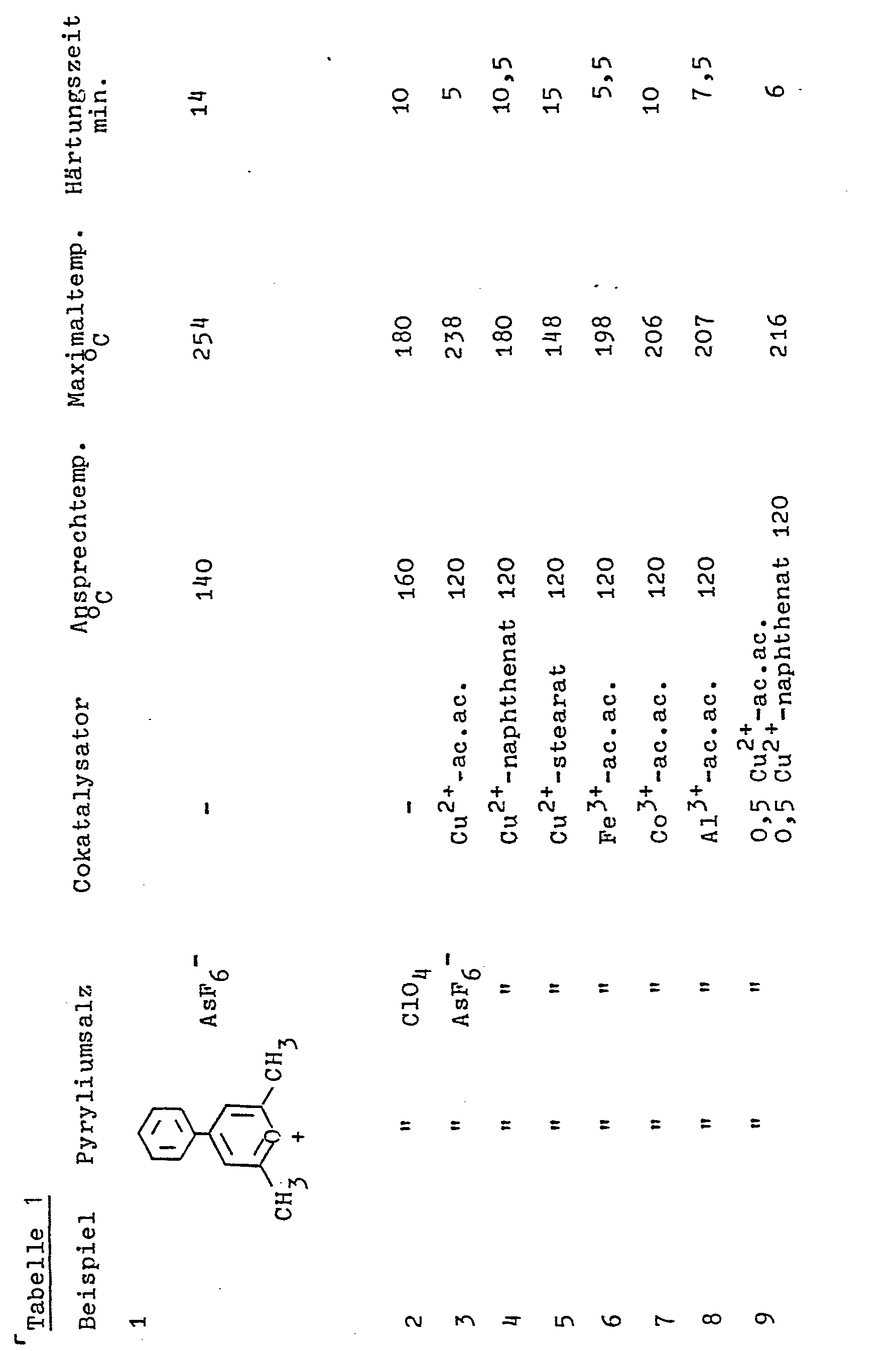
- Es wurden Harzmischungen hergestellt aus einem Bisphenol-A--diglycidyläther (®Epon 828 der SHELL), 2,4 Gew.-% Katalysator und gegebenenfalls 1 Gew.-% Cokatalysator. Jeweils gleiche Gewichtsmengen Harzmischung wurden in zylindrische Formen gegossen, welche in ein auf 120°C, 130°C bzw. 1400C vorgeheiztes ölbad getaucht wurden. Zur Temperaturkontrolle wurden die Proben mit einem Thermoelement versehen. Es wurde eine Temperatur/Zeit-Kurve aufgezeichnet. Aus dieser ist der Beginn der exothermen Vernetzungsreaktion (Angleichung der Probentemperatur an die Badtemperatur), die zugehörige Ansprechtemperatur und die Maximaltemperatur ersichtlich. Die Zeit zwischen dem Beginn der Vernetzungsreaktion und dem Erreichen der Maximaltemperatur stellt die Härtungszeit dar.
- Die Ergebnisse sind in der Tabelle 1 aufgezeichnet.


- Bei einigen Beispielen wurde an den Formkörpern folgende Eigenschaften gemessen:
- Die Glastemperatur und die Vernetzungsdichte wurden durch Torsionsschwingungsversuche nach DIN 53 445 an Probekörpern bestimmt, die aus gegossenen Platten herausgefräst wurden, die nach der Vernetzung eine Stunde bei 200°C nachgehärtet worden waren. Als Maß für die Vernetzungsdichte dient die Höhe der Schubmodulkurve im kautschukelastischen Bereich. Für Quellungsmessungen wurden Würfel der Kantenlänge 1 cm aus nachgehärteten Formkörpern herausgeschnitten und 120 Stunden bei 20°C sowie 3 h in siedendem Methylenchlorid gelagert. Die Quellung wurde als Mittelwert aus fünf Messungen ermittelt.

Claims (7)
1. Härtbare Harzzusammensetzung, enthaltend
dadurch gekennzeichnet, daß der Katalysator ein Pyryliumsalz der Formel 
wobei R1 = R 5 ist und eine Alkyl- oder Alkarylgruppe mit 1 bis 8 Kohlenstoffatomen bedeutet; R2, R3 und R4 gleich oder verschieden sind und Wasserstoff eine Alkyl-, Alkaryl- oder Cycloalkyl-Gruppe mit jeweils bis zu 8 Kohlenstoffatomen, eine gegebenenfalls alkylsubstituierte Phenyl-, Naphthyl-, Indenyl-, Indanyl- oder Fluorenyl-Gruppe oder ein heterocyclischer Substituent mit ein oder zwei Heteroatomen bedeutet; und Xθ ein nicht nucleophiles Anion ist.
A. ein kationisch polymerisierbares Epoxidharz, und
B. 0,5 bis 10 Gew.% eines Oniumsalzes als Härtungskatalysator,
dadurch gekennzeichnet, daß der Katalysator ein Pyryliumsalz der Formel
2. Härtbare Harzzusammensetzung nach Anspruch 1, dadurch gekennzeichnet, daß sie zusätzlich C1. 0,01 bis 10 Gew.% eines Metallchelats der Formel
enthält,
wobei Me ein ein- bis vierwertiges Metall ist, R7 Wasserstoff, eine Alkyl-, Cycloalkyl-, Aryl- oder Alkaryl-Gruppe mit bis zu 8 Kohlen- stoffatomen bedeutet, Rund R gleich oder verschieden sind und eine Alkyl-, Cycloalkyl-, Aryl-, Aralkyl- oder Alkaryl-Gruppe mit jeweils bis zu 8 Kohlenstoffatomen bedeuten, wobei R6 und R8 auch durch ein Ringsyster miteinander verbunden sein können, und n eine ganze Zahl zwischen 1 und 4 ist.
wobei Me ein ein- bis vierwertiges Metall ist, R7 Wasserstoff, eine Alkyl-, Cycloalkyl-, Aryl- oder Alkaryl-Gruppe mit bis zu 8 Kohlen- stoffatomen bedeutet, Rund R gleich oder verschieden sind und eine Alkyl-, Cycloalkyl-, Aryl-, Aralkyl- oder Alkaryl-Gruppe mit jeweils bis zu 8 Kohlenstoffatomen bedeuten, wobei R6 und R8 auch durch ein Ringsyster miteinander verbunden sein können, und n eine ganze Zahl zwischen 1 und 4 ist.
3. Härtbare Harzzusammensetzung nach Anspruch 1, dadurch gekennzeichnet, daß sie zusätzlich
C2. 0,01 bis 10 Gew.% eines Metallsalzes einer aliphatischen oder aromatischen Mono- oder Polycarbonsäure mit 6 bis 20 Kohlenstoffatomen enthält.
C2. 0,01 bis 10 Gew.% eines Metallsalzes einer aliphatischen oder aromatischen Mono- oder Polycarbonsäure mit 6 bis 20 Kohlenstoffatomen enthält.
4. Härtbare Harzzusammensetzung nach Anspruch 1, dadurch gekennzeichnet, daß der Katalysator ein Pyryliumsalz der Formel

wobei R3 die in Anspruch 1 angegebene Bedeutung hat, und Xθ = AsF6 θ, BF4 θ, SbF6 θ, PF6 θ, CF3SO3 θ oder C104 θ ist.
5. Härtbare Harzzusammensetzung nach Anspruch 2, dadurch gekennzeichnet, daß das Metallchelat ein Acetylacetonat von Cu++, Co++, Co+++, Fe+++ oder A1+++ ist.
6. Härtbare Harzzusammensetzung nach Anspruch 3, dadurch gekennzeichnet, daß das Metallsalz ein Stearat, Benzoat, Naphthenat, Octoat oder Phthalat von Cu , Co++, Co Fe+++ oder Al+++ ist.
7. Verfahren zur Herstellung von Formkörpern aus der Harzzusammensetzung nach Anspruch 1, dadurch gekennzeichnet, daß man ein Epoxidharz A mit dem Katalysator B und gegebenenfalls einem Cokatalysator C1 oder C2 innig vermischt und die Mischung auf Temperaturen von 80°C bis 160°C erwärmt.
Applications Claiming Priority (2)
| Application Number | Priority Date | Filing Date | Title |
|---|---|---|---|
| DE19813135636 DE3135636A1 (de) | 1981-09-09 | 1981-09-09 | Haertbare epoxidharze |
| DE3135636 | 1981-09-09 |
Publications (1)
| Publication Number | Publication Date |
|---|---|
| EP0074073A1 true EP0074073A1 (de) | 1983-03-16 |
Family
ID=6141177
Family Applications (1)
| Application Number | Title | Priority Date | Filing Date |
|---|---|---|---|
| EP82108025A Withdrawn EP0074073A1 (de) | 1981-09-09 | 1982-09-01 | Härtbare Epoxidharze |
Country Status (4)
| Country | Link |
|---|---|
| US (1) | US4405765A (de) |
| EP (1) | EP0074073A1 (de) |
| JP (1) | JPS5853917A (de) |
| DE (1) | DE3135636A1 (de) |
Cited By (4)
| Publication number | Priority date | Publication date | Assignee | Title |
|---|---|---|---|---|
| EP0132710A1 (de) * | 1983-07-20 | 1985-02-13 | BASF Aktiengesellschaft | Zur Herstellung von Reliefbildern oder Resistmustern geeignetes lichtempfindliches Aufzeichnungsmaterial |
| EP0145165A1 (de) * | 1983-11-03 | 1985-06-19 | National Aeronautics And Space Administration | Verfahren zum Verbessern der mechanischen Eigenschaften der Epoxyharze durch Hinzufügung von Kobaltionen |
| EP0169804A3 (en) * | 1984-06-27 | 1987-05-06 | Ciba-Geigy Ag | Method for coating metal surfaces |
| EP0775715A3 (de) * | 1995-11-22 | 1998-05-20 | LINTEC Corporation | Klebstoffzusammensetzung und Klebeschicht |
Families Citing this family (5)
| Publication number | Priority date | Publication date | Assignee | Title |
|---|---|---|---|---|
| DE3218287A1 (de) * | 1982-05-13 | 1983-11-17 | Siemens AG, 1000 Berlin und 8000 München | Isolierband zur herstellung einer mit einer heisshaertenden epoxidharz-saeureanhydrid-mischung impraegnierten isolierhuelse fuer elektrische leiter |
| DE3604580A1 (de) * | 1986-02-14 | 1987-08-20 | Basf Ag | Haertbare mischungen, enthaltend n-sulfonylaminosulfoniumsalze als kationisch wirksame katalysatoren |
| GB8914161D0 (en) * | 1989-06-20 | 1989-08-09 | Shell Int Research | Monoepoxide-polyol adducts,and process for preparing the same |
| EP1262506B1 (de) * | 2001-05-28 | 2006-10-25 | Dainippon Ink And Chemicals, Inc. | Photopolymerisierbare Initiatorkombination |
| WO2016081546A1 (en) * | 2014-11-20 | 2016-05-26 | Dow Global Technologies Llc | Accelerator composition |
Citations (3)
| Publication number | Priority date | Publication date | Assignee | Title |
|---|---|---|---|---|
| CH430201A (de) * | 1959-03-09 | 1967-02-15 | Argus Chem | Verfahren zum Herstellen von Kunstharzerzeugnissen und Mittel zur Ausführung desselben |
| DE2019816A1 (de) * | 1969-04-24 | 1970-10-29 | Morton Internat Inc | Formmassen aus Epoxyharzen |
| US4238587A (en) * | 1979-11-28 | 1980-12-09 | General Electric Company | Heat curable compositions |
Family Cites Families (4)
| Publication number | Priority date | Publication date | Assignee | Title |
|---|---|---|---|---|
| SU372237A1 (ru) | 1970-09-07 | 1973-03-01 | Эпоксидная композиция | |
| US3720634A (en) * | 1971-01-19 | 1973-03-13 | Atlantic Richfield Co | Organic hexafluorophosphates,arsenates or antimonates as accelerators for curing epoxy resins |
| GB1516511A (en) | 1974-05-02 | 1978-07-05 | Gen Electric | Curable epoxide compositions |
| SU637409A1 (ru) | 1975-12-08 | 1978-12-15 | Донецкое Отделение Физико-Органической Химии Института Физической Химии Ан Украинской Сср | Соли 5,6,7,8-тетрагидроизохромили , в качестве соотвердител эпоксидных смол |
-
1981
- 1981-09-09 DE DE19813135636 patent/DE3135636A1/de not_active Withdrawn
-
1982
- 1982-08-30 US US06/413,084 patent/US4405765A/en not_active Expired - Fee Related
- 1982-09-01 EP EP82108025A patent/EP0074073A1/de not_active Withdrawn
- 1982-09-08 JP JP57155319A patent/JPS5853917A/ja active Pending
Patent Citations (3)
| Publication number | Priority date | Publication date | Assignee | Title |
|---|---|---|---|---|
| CH430201A (de) * | 1959-03-09 | 1967-02-15 | Argus Chem | Verfahren zum Herstellen von Kunstharzerzeugnissen und Mittel zur Ausführung desselben |
| DE2019816A1 (de) * | 1969-04-24 | 1970-10-29 | Morton Internat Inc | Formmassen aus Epoxyharzen |
| US4238587A (en) * | 1979-11-28 | 1980-12-09 | General Electric Company | Heat curable compositions |
Non-Patent Citations (2)
| Title |
|---|
| Chemical Abstracts, Band 87, Nr. 10, 5 September 1977, Columbus, Ohio, USA. T. YAMAOKA et al.: "A study on phenoxy-resin esters of cinnamylideneacetic acid and its derivatives" Seite 13, Spalte 1, Abstract Nr. 68833a & Polymer, Band 18, Nr. 1, 1977, Seiten 81 bis 86 * |
| RESEARCH DISCLOSURE, Nr. 211, November 1981, Seiten 398 bis 399 * Artikel Nr. 21114, "Photoinitiation of cationic polymerisation by triaryl pyrylium salts and triaryl thiopyrylium salts" * * |
Cited By (4)
| Publication number | Priority date | Publication date | Assignee | Title |
|---|---|---|---|---|
| EP0132710A1 (de) * | 1983-07-20 | 1985-02-13 | BASF Aktiengesellschaft | Zur Herstellung von Reliefbildern oder Resistmustern geeignetes lichtempfindliches Aufzeichnungsmaterial |
| EP0145165A1 (de) * | 1983-11-03 | 1985-06-19 | National Aeronautics And Space Administration | Verfahren zum Verbessern der mechanischen Eigenschaften der Epoxyharze durch Hinzufügung von Kobaltionen |
| EP0169804A3 (en) * | 1984-06-27 | 1987-05-06 | Ciba-Geigy Ag | Method for coating metal surfaces |
| EP0775715A3 (de) * | 1995-11-22 | 1998-05-20 | LINTEC Corporation | Klebstoffzusammensetzung und Klebeschicht |
Also Published As
| Publication number | Publication date |
|---|---|
| JPS5853917A (ja) | 1983-03-30 |
| US4405765A (en) | 1983-09-20 |
| DE3135636A1 (de) | 1983-03-17 |
Similar Documents
| Publication | Publication Date | Title |
|---|---|---|
| DE1569172C3 (de) | Verfahren zur Herstellung von härtbaren Polyester-Epoxidmassen | |
| EP0200674B1 (de) | (Acylthiopropyl)-Polyphenole | |
| DE2012012C3 (de) | Verfahren zur kationischen Polymerisation von polymerisierbaren Monomeren mit Hilfe von Bis-(perfluoralkylsulfonyl)-Verbindungen | |
| DE2812847C2 (de) | ||
| DE2019816A1 (de) | Formmassen aus Epoxyharzen | |
| DE3049574A1 (de) | "latent waermehaertbare, jodonium/kupfersalzkatalysierte epoxidharzmassen" | |
| DE2139290C2 (de) | In der Wärme härtbare Epoxidharzzusammensetzungen und deren Verwendung | |
| DE3135636A1 (de) | Haertbare epoxidharze | |
| DE1096037B (de) | Verfahren zur Herstellung von Formkoerpern und UEberzuegen aus Diepoxydverbindungen | |
| DE1808671A1 (de) | Haertbare Mischungen aus Epoxidharzen,Polycarbonsaeureanhydriden und Aminbeschleunigern | |
| DE2716593C2 (de) | Verfahren zur Härtung von Epoxyharzsystemen | |
| DE1570382B2 (de) | Verwendung eines mercaptocarbonsaeureesters in massen auf basis von epoxidharz als flexibilisierungsmittel | |
| DE3327823A1 (de) | Haertbare epoxidharze | |
| DE69608054T2 (de) | 1-Imidazolylmethyl-2-naphthole als Katalysatoren für die Härtung von Epoxidharzen | |
| EP0383089B1 (de) | Kalthärtende Reaktionsharzmischung und deren Verwendung | |
| DE2922377C2 (de) | Pulverförmige Überzugsmittel und Anstrichmittel | |
| DE2254487C2 (de) | Heisshärtbare Mischungen auf Epoxidharzbasis | |
| EP0018949A1 (de) | Härtbare Epoxidharzgemische und Härtungsbeschleuniger dafür | |
| DE1645190B2 (de) | Verwendung von amino-s-triazinderivaten als haertungsmittel fuer epoxydverbindungen | |
| EP0429894A2 (de) | Einkomponentige Epoxidharzmassen | |
| DE1570416C3 (de) | Flüssiges Epoxidgießharz | |
| DE69211290T2 (de) | Addukte von Diaminodiphenylsulfonderivaten für Epoxyharzhärter | |
| DE2357121B2 (de) | Epoxyharzmassen mit überlegener Härtbarkeit | |
| DE2750123C2 (de) | Härtungskatalysatoren für wärmehärtbare, epoxidgruppenhaltige Einkomponentensysteme | |
| EP0022059B1 (de) | N-substituierte Asparaginsäureester, ihre Herstellung und Verwendung |
Legal Events
| Date | Code | Title | Description |
|---|---|---|---|
| PUAI | Public reference made under article 153(3) epc to a published international application that has entered the european phase |
Free format text: ORIGINAL CODE: 0009012 |
|
| 17P | Request for examination filed |
Effective date: 19821211 |
|
| AK | Designated contracting states |
Designated state(s): BE CH DE FR GB IT LI NL |
|
| STAA | Information on the status of an ep patent application or granted ep patent |
Free format text: STATUS: THE APPLICATION HAS BEEN WITHDRAWN |
|
| 18W | Application withdrawn |
Withdrawal date: 19830917 |
|
| RIN1 | Information on inventor provided before grant (corrected) |
Inventor name: DEMMLER, KURT, DR. Inventor name: OCHS, WOLFRAM, DR. |