EP0074621A2 - Kationische Ethylenoxid-Propylenoxid- bzw. Ethylenoxid-Butylenoxid-Polymere, Verfahren zu deren Herstellung und deren Verwendung - Google Patents
Kationische Ethylenoxid-Propylenoxid- bzw. Ethylenoxid-Butylenoxid-Polymere, Verfahren zu deren Herstellung und deren Verwendung Download PDFInfo
- Publication number
- EP0074621A2 EP0074621A2 EP82108307A EP82108307A EP0074621A2 EP 0074621 A2 EP0074621 A2 EP 0074621A2 EP 82108307 A EP82108307 A EP 82108307A EP 82108307 A EP82108307 A EP 82108307A EP 0074621 A2 EP0074621 A2 EP 0074621A2
- Authority
- EP
- European Patent Office
- Prior art keywords
- ethyleneoxide
- poly
- formula
- crude oil
- preparation
- Prior art date
- Legal status (The legal status is an assumption and is not a legal conclusion. Google has not performed a legal analysis and makes no representation as to the accuracy of the status listed.)
- Withdrawn
Links
- 238000002360 preparation method Methods 0.000 title claims abstract description 4
- 125000002091 cationic group Chemical group 0.000 title description 2
- -1 poly(ethyleneoxide-propyleneoxide) Polymers 0.000 title 3
- 239000010779 crude oil Substances 0.000 claims abstract description 15
- 239000000839 emulsion Substances 0.000 claims abstract description 15
- 150000001875 compounds Chemical class 0.000 claims abstract description 12
- 125000003118 aryl group Chemical group 0.000 claims abstract description 8
- 230000007797 corrosion Effects 0.000 claims abstract description 7
- 238000005260 corrosion Methods 0.000 claims abstract description 7
- VNWKTOKETHGBQD-UHFFFAOYSA-N methane Chemical compound C VNWKTOKETHGBQD-UHFFFAOYSA-N 0.000 claims abstract description 6
- 239000003112 inhibitor Substances 0.000 claims abstract description 4
- 238000004519 manufacturing process Methods 0.000 claims abstract description 4
- CPELXLSAUQHCOX-UHFFFAOYSA-M Bromide Chemical compound [Br-] CPELXLSAUQHCOX-UHFFFAOYSA-M 0.000 claims abstract description 3
- VEXZGXHMUGYJMC-UHFFFAOYSA-M Chloride anion Chemical compound [Cl-] VEXZGXHMUGYJMC-UHFFFAOYSA-M 0.000 claims abstract description 3
- 150000001450 anions Chemical class 0.000 claims abstract description 3
- 125000001495 ethyl group Chemical group [H]C([H])([H])C([H])([H])* 0.000 claims abstract description 3
- 238000000034 method Methods 0.000 claims abstract description 3
- 125000002496 methyl group Chemical group [H]C([H])([H])* 0.000 claims abstract description 3
- 239000003345 natural gas Substances 0.000 claims abstract description 3
- 125000000843 phenylene group Chemical group C1(=C(C=CC=C1)*)* 0.000 claims abstract description 3
- 125000000217 alkyl group Chemical group 0.000 claims description 2
- LMBFAGIMSUYTBN-MPZNNTNKSA-N teixobactin Chemical compound C([C@H](C(=O)N[C@@H]([C@@H](C)CC)C(=O)N[C@@H](CO)C(=O)N[C@H](CCC(N)=O)C(=O)N[C@H]([C@@H](C)CC)C(=O)N[C@@H]([C@@H](C)CC)C(=O)N[C@@H](CO)C(=O)N[C@H]1C(N[C@@H](C)C(=O)N[C@@H](C[C@@H]2NC(=N)NC2)C(=O)N[C@H](C(=O)O[C@H]1C)[C@@H](C)CC)=O)NC)C1=CC=CC=C1 LMBFAGIMSUYTBN-MPZNNTNKSA-N 0.000 claims description 2
- 125000004178 (C1-C4) alkyl group Chemical group 0.000 abstract 1
- XLYOFNOQVPJJNP-UHFFFAOYSA-N water Substances O XLYOFNOQVPJJNP-UHFFFAOYSA-N 0.000 description 13
- 239000000243 solution Substances 0.000 description 7
- KFZMGEQAYNKOFK-UHFFFAOYSA-N Isopropanol Chemical compound CC(C)O KFZMGEQAYNKOFK-UHFFFAOYSA-N 0.000 description 6
- 229920000642 polymer Polymers 0.000 description 6
- LFQSCWFLJHTTHZ-UHFFFAOYSA-N Ethanol Chemical compound CCO LFQSCWFLJHTTHZ-UHFFFAOYSA-N 0.000 description 5
- RVGRUAULSDPKGF-UHFFFAOYSA-N Poloxamer Chemical compound C1CO1.CC1CO1 RVGRUAULSDPKGF-UHFFFAOYSA-N 0.000 description 5
- FAPWRFPIFSIZLT-UHFFFAOYSA-M Sodium chloride Chemical compound [Na+].[Cl-] FAPWRFPIFSIZLT-UHFFFAOYSA-M 0.000 description 4
- 239000003921 oil Substances 0.000 description 4
- FYSNRJHAOHDILO-UHFFFAOYSA-N thionyl chloride Chemical compound ClS(Cl)=O FYSNRJHAOHDILO-UHFFFAOYSA-N 0.000 description 4
- CURLTUGMZLYLDI-UHFFFAOYSA-N Carbon dioxide Chemical compound O=C=O CURLTUGMZLYLDI-UHFFFAOYSA-N 0.000 description 3
- 150000001412 amines Chemical class 0.000 description 3
- 150000004985 diamines Chemical class 0.000 description 3
- 239000000203 mixture Substances 0.000 description 3
- 239000000047 product Substances 0.000 description 3
- 150000003839 salts Chemical class 0.000 description 3
- 238000000926 separation method Methods 0.000 description 3
- ROSDSFDQCJNGOL-UHFFFAOYSA-N Dimethylamine Chemical compound CNC ROSDSFDQCJNGOL-UHFFFAOYSA-N 0.000 description 2
- TWRXJAOTZQYOKJ-UHFFFAOYSA-L Magnesium chloride Chemical compound [Mg+2].[Cl-].[Cl-] TWRXJAOTZQYOKJ-UHFFFAOYSA-L 0.000 description 2
- 230000001476 alcoholic effect Effects 0.000 description 2
- 150000003868 ammonium compounds Chemical group 0.000 description 2
- 238000009835 boiling Methods 0.000 description 2
- 125000004970 halomethyl group Chemical group 0.000 description 2
- 238000010438 heat treatment Methods 0.000 description 2
- 230000005764 inhibitory process Effects 0.000 description 2
- ZXEKIIBDNHEJCQ-UHFFFAOYSA-N isobutanol Chemical compound CC(C)CO ZXEKIIBDNHEJCQ-UHFFFAOYSA-N 0.000 description 2
- GAGSAAHZRBTRGD-UHFFFAOYSA-N oxirane;oxolane Chemical compound C1CO1.C1CCOC1 GAGSAAHZRBTRGD-UHFFFAOYSA-N 0.000 description 2
- 239000000376 reactant Substances 0.000 description 2
- 239000011780 sodium chloride Substances 0.000 description 2
- 239000000126 substance Substances 0.000 description 2
- ZZHIDJWUJRKHGX-UHFFFAOYSA-N 1,4-bis(chloromethyl)benzene Chemical compound ClCC1=CC=C(CCl)C=C1 ZZHIDJWUJRKHGX-UHFFFAOYSA-N 0.000 description 1
- UXVMQQNJUSDDNG-UHFFFAOYSA-L Calcium chloride Chemical compound [Cl-].[Cl-].[Ca+2] UXVMQQNJUSDDNG-UHFFFAOYSA-L 0.000 description 1
- 229910000975 Carbon steel Inorganic materials 0.000 description 1
- RWSOTUBLDIXVET-UHFFFAOYSA-N Dihydrogen sulfide Chemical compound S RWSOTUBLDIXVET-UHFFFAOYSA-N 0.000 description 1
- 239000002253 acid Substances 0.000 description 1
- 239000001110 calcium chloride Substances 0.000 description 1
- 229910001628 calcium chloride Inorganic materials 0.000 description 1
- 229910002092 carbon dioxide Inorganic materials 0.000 description 1
- 239000001569 carbon dioxide Substances 0.000 description 1
- 239000010962 carbon steel Substances 0.000 description 1
- 239000007795 chemical reaction product Substances 0.000 description 1
- MMIVZWZHLDUCKH-UHFFFAOYSA-N chloromethane;chloromethylbenzene Chemical compound ClC.ClCC1=CC=CC=C1 MMIVZWZHLDUCKH-UHFFFAOYSA-N 0.000 description 1
- 238000011033 desalting Methods 0.000 description 1
- 150000002009 diols Chemical class 0.000 description 1
- 238000004821 distillation Methods 0.000 description 1
- 230000000694 effects Effects 0.000 description 1
- 239000003995 emulsifying agent Substances 0.000 description 1
- 239000007789 gas Substances 0.000 description 1
- 239000011521 glass Substances 0.000 description 1
- 229910000037 hydrogen sulfide Inorganic materials 0.000 description 1
- 239000012442 inert solvent Substances 0.000 description 1
- 229910001629 magnesium chloride Inorganic materials 0.000 description 1
- 239000003960 organic solvent Substances 0.000 description 1
- 239000003208 petroleum Substances 0.000 description 1
- 238000010992 reflux Methods 0.000 description 1
- 239000007787 solid Substances 0.000 description 1
- 239000003381 stabilizer Substances 0.000 description 1
- 238000003756 stirring Methods 0.000 description 1
- 239000012085 test solution Substances 0.000 description 1
- 230000000699 topical effect Effects 0.000 description 1
- 239000007762 w/o emulsion Substances 0.000 description 1
Classifications
-
- B—PERFORMING OPERATIONS; TRANSPORTING
- B01—PHYSICAL OR CHEMICAL PROCESSES OR APPARATUS IN GENERAL
- B01D—SEPARATION
- B01D17/00—Separation of liquids, not provided for elsewhere, e.g. by thermal diffusion
- B01D17/02—Separation of non-miscible liquids
- B01D17/04—Breaking emulsions
- B01D17/047—Breaking emulsions with separation aids
-
- C—CHEMISTRY; METALLURGY
- C08—ORGANIC MACROMOLECULAR COMPOUNDS; THEIR PREPARATION OR CHEMICAL WORKING-UP; COMPOSITIONS BASED THEREON
- C08G—MACROMOLECULAR COMPOUNDS OBTAINED OTHERWISE THAN BY REACTIONS ONLY INVOLVING UNSATURATED CARBON-TO-CARBON BONDS
- C08G73/00—Macromolecular compounds obtained by reactions forming a linkage containing nitrogen with or without oxygen or carbon in the main chain of the macromolecule, not provided for in groups C08G12/00 - C08G71/00
- C08G73/02—Polyamines
- C08G73/024—Polyamines containing oxygen in the form of ether bonds in the main chain
-
- C—CHEMISTRY; METALLURGY
- C09—DYES; PAINTS; POLISHES; NATURAL RESINS; ADHESIVES; COMPOSITIONS NOT OTHERWISE PROVIDED FOR; APPLICATIONS OF MATERIALS NOT OTHERWISE PROVIDED FOR
- C09K—MATERIALS FOR MISCELLANEOUS APPLICATIONS, NOT PROVIDED FOR ELSEWHERE
- C09K8/00—Compositions for drilling of boreholes or wells; Compositions for treating boreholes or wells, e.g. for completion or for remedial operations
- C09K8/02—Well-drilling compositions
- C09K8/03—Specific additives for general use in well-drilling compositions
- C09K8/035—Organic additives
-
- C—CHEMISTRY; METALLURGY
- C10—PETROLEUM, GAS OR COKE INDUSTRIES; TECHNICAL GASES CONTAINING CARBON MONOXIDE; FUELS; LUBRICANTS; PEAT
- C10G—CRACKING HYDROCARBON OILS; PRODUCTION OF LIQUID HYDROCARBON MIXTURES, e.g. BY DESTRUCTIVE HYDROGENATION, OLIGOMERISATION, POLYMERISATION; RECOVERY OF HYDROCARBON OILS FROM OIL-SHALE, OIL-SAND, OR GASES; REFINING MIXTURES MAINLY CONSISTING OF HYDROCARBONS; REFORMING OF NAPHTHA; MINERAL WAXES
- C10G33/00—Dewatering or demulsification of hydrocarbon oils
- C10G33/04—Dewatering or demulsification of hydrocarbon oils with chemical means
-
- Y—GENERAL TAGGING OF NEW TECHNOLOGICAL DEVELOPMENTS; GENERAL TAGGING OF CROSS-SECTIONAL TECHNOLOGIES SPANNING OVER SEVERAL SECTIONS OF THE IPC; TECHNICAL SUBJECTS COVERED BY FORMER USPC CROSS-REFERENCE ART COLLECTIONS [XRACs] AND DIGESTS
- Y10—TECHNICAL SUBJECTS COVERED BY FORMER USPC
- Y10S—TECHNICAL SUBJECTS COVERED BY FORMER USPC CROSS-REFERENCE ART COLLECTIONS [XRACs] AND DIGESTS
- Y10S516/00—Colloid systems and wetting agents; subcombinations thereof; processes of
- Y10S516/01—Wetting, emulsifying, dispersing, or stabilizing agents
- Y10S516/07—Organic amine, amide, or n-base containing
Definitions
- the task of a demulsifier is to break the emulsion at the lowest possible application concentration and, in this separation process, to achieve complete water separation without expenditure or with minimal additional heat, and to reduce the salt content to a minimum.
- the quality criteria for delivered crude oil are the residual salt content and the water content.
- the crude oils have different compositions depending on their provinces and the natural emulsion stabilizers present in the oil have a complicated and differentiated chemical structure, so that splitters have to be developed specifically for each oil. Due to different funding and processing conditions, the demands placed on a demulsifier are even more diverse. By constantly opening up new and changing the production conditions of older oil fields, the development of optimal demulsifiers for the respective purpose remains a topical task.
- R is an aromatic, preferably phenylene
- R and R 2 are C 1 -C 4 alkyl, preferably C 1 -C 2 alkyl
- R 3 is methyl or ethyl
- x and z together are a number from 2 to 360, preferably from 2 to 140
- y is a number from 15 to 70, preferably 25 to 60
- n is a number from 1 to 10
- A is an anion, preferably chloride or bromide.
- the groups R 1 , R 2 and R 3 can be the same or different, preferably R 1 , R 2 and R 3 are the same.
- the values for x and z can also be the same or different.
- the compounds of formula I above are prepared by using a compound of formula II with a bis (halogenomethyl) aromatic, preferably bis (chloromethyl) benzene.
- the starting diamines of the formula II are obtained by first using an ethylene oxide-propylene oxide or ethylene oxide-butylene oxide block polymer of the formula III by known processes chlorinated, for example with thionyl chloride in bulk or in an inert solvent at temperatures of about 80 to 120 ° C, preferably at 90 ° C.
- the resulting 1, ⁇ -dichloro compound of formula IV is then reacted with an amine of the formula HNR 1 R 2 to give the compounds of the formula II.
- This reaction is carried out by heating the reactants for several hours in aqueous alcoholic solution at temperatures of approximately 80 to 200 ° C., preferably in isopropanolic solution in a stirred autoclave at 130 to 170 ° C.
- the reaction of the diamines of the formula II with the bis (halomethyl) aromatic takes place by heating the reactants for several hours in a low-boiling alcohol at its boiling point, for example in ethanol, isopropanol or isobutanol.
- the molar ratio of diamine II to bis (halomethyl) aromatic is 1: 1.
- the end products obtained are polymers whose chain length can be given approximately by the numbers 1 to 10 for the index n in the formula I.
- the compounds according to the invention are yellow to brown, highly viscous products which can be diluted with water or water / alcohol mixtures in any ratio.
- the emulsifiers were used in 50% isobutanolic solutions that are injected into microdosing devices.
- the emulsified water is separated in conical, calibrated, stopper-closable glasses and the amount of the emulsion is 100 cm 3 each.
- the tables show the amounts of emulsion water separated in certain times in%.
- the absolute water content of the emulsions was determined according to Dean-Stark by means of preliminary tests.
- the dosing quantity of the demulsifiers, the absolute water content of the emulsion, the separation temperature and the origin of the emulsion are listed in the individual tables.
- test strips made of carbon steel with a surface area of 20 cm 2 at 60 ° C. were immersed for 6 hours in 20% sodium chloride solutions containing an addition of 10 mg / l, 20 mg / l or 30 mg / l des contained product to be tested.
Landscapes
- Chemical & Material Sciences (AREA)
- Organic Chemistry (AREA)
- Chemical Kinetics & Catalysis (AREA)
- Engineering & Computer Science (AREA)
- Oil, Petroleum & Natural Gas (AREA)
- Polymers & Plastics (AREA)
- Health & Medical Sciences (AREA)
- Medicinal Chemistry (AREA)
- General Chemical & Material Sciences (AREA)
- Life Sciences & Earth Sciences (AREA)
- General Life Sciences & Earth Sciences (AREA)
- Materials Engineering (AREA)
- Physics & Mathematics (AREA)
- Thermal Sciences (AREA)
- Production Of Liquid Hydrocarbon Mixture For Refining Petroleum (AREA)
- Organic Low-Molecular-Weight Compounds And Preparation Thereof (AREA)
Abstract
Gegenstand der Erfindung sind somit Verbindungen der Formel I <IMAGE> worin R einen Aromaten, vorzugsweise Phenylen, R1 und R2 C1-C4-Alkyl, vorzugsweise C1-C2-Alkyl, R3 Methyl oder Ethyl, x und z zusammen eine Zahl von 2 bis 360, vorzugsweise von 2 bis 140, y eine Zahl von 15 bis 70, vorzugsweise 25 bis 60, n eine Zahl von 1 bis 10 und A<-> ein Anion, vorzugsweise Chlorid oder Bromid bedeuten, Verfahren zu deren Herstellung und deren Verwendung als Demulgatoren für die Spaltung von Rohölemulsionen und als Korrosionsinhibitoren in Anlagen für die Erdgas- und Rohölförderung und -aufbereitung.
Description
- Bei der Förderung von Rohölemulsionen erfolgt bekanntlich mit der Zeit eine zunehmende Verwässerung der geförderten Rohöle. Dieses mitgeförderte Wasser bildet mit dem Rohöl eine Wasser-in-öl-Emulsion, wobei in dem einemulgierten Wasser Salze wie Natriumchlorid, Calziumchlorid und Magnesiumchlorid gelöst sein können. Außerdem sind in den Rohölemulsionen häufig Kohlensäure und Schwefelwasserstoff enthalten. All diese Substanzen bewirken Korrosionsschäden in den Fördereinrichtungen und in der Raffinerie, so daß allein schon aus diesem Grund das salzhaltige Wasser aus der Rohölemulsion mit Hilfe von Demulgatoren abgetrennt werden muß.
- Ein Demulgator hat die Aufgabe, bei einer möglichst geringen Anwendungskonzentration die Emulsion zu brechen und bei diesem Separaticnsprozeß möglichst ohne Aufwendung oder mit minimaler zusätzlicher Wärme eine vollständige Wasserabscheidung zu bewirken und den Salzgehalt auf ein Minimum zu reduzieren. Die Qualitätskriterien für geliefertes Rohöl sind der Restgehalt an Salz und der Wassergehalt.
- Die Rohöle sind je nach ihrer Provinienz unterschiedlich zusammengesetzt und die im öl vorhandenen natürlichen Emulsionsstabilisatoren besitzen einen komplizierten und differenzierten chemischen Aufbau, so daß für jedes öl gezielt Spalter entwickelt werden müssen. Bedingt durch unterschiedliche Förderungs- und Aufbereitungsbedingungen werden die Anforderungen, die an einen Demulgator gestellt werden, noch vielfältiger. Durch das ständige Erschließen neuer und Änderung der Förderbedingungen älterer ölfelder bleibt daher die Entwicklung optimaler Demulgatoren für den jeweiligen Zweck eine aktuelle Aufgabe.
- Es wurde nun gefunden, daß neue kationische Ethylenoxid-Propylenoxid- bzw. Ethylenoxid-Butylenoxid-Polymere gute Demulgier- und Entsalzungseigenschaften bei Rohölen aufweisen sowie die Korrosion wirkungsvoll inhibieren.
- Gegenstand der Erfindung sind somit Verbindungen der Formel I

- Die Verbindungen der obigen Formel I werden hergestellt, indem man eine Verbindung der Formel II

- Die als Ausgangsverbindungen dienenden Diamine der Formel II werden erhalten, indem man nach bekannten Verfahren zunächst ein Ethylenoxid-Propylenoxid- bzw. Ethylenoxid-Butylenoxid-Blockpolymer der Formel III


- Die Reaktion der Diamine der Formel II mit dem Bis-(halomethyl)aromaten erfolgt durch mehrstündiges Erhitzen der Reaktionspartner in einem niedrig siedenden Alkohol bei dessen Siedetemperatur, beispielsweise in Ethanol, Isopropanol oder Isobutanol. Das Molverhältnis von Diamin II zum Bis(halomethyl)aromaten beträgt 1:1. Als Endprodukte erhält man Polymere, deren Kettenlänge ungefähr durch die Zahlen 1 bis 10 für den Index n in der Formel I angegeben werden können.
- Die erfindungsgemäßen Verbindungen sind gelbe bis braune, hochviskose Produkte, die in jedem Verhältnis mit Wasser bzw. Wasser/Alkohol-Gemischen verdünnbar sind.
- Sie eignen sich sehr gut zum Spalten von Emulsionen aus Wasser und Erdöl. Man setzt diese Produkte den Rohölemulsionen in Konzentrationen von 2 bis 400, vorzugsweise 5 bis 80 ppm zu entweder in unverdünnter Form oder als Lösung, die im Verhältnis 1 : 200 mit einem organischen Lösungsmittel verdünnt werden. Darüberhinaus inhibieren diese Verbindungen die Korrosion in den Anlagen für die Erdgas- und Rohölförderung und -aufbereitung.
- Zu 1 Mol eines Diols der allgemeinen Formel III läßt man bei 50°C 2,4 Mol Thionylchlorid unter Rühren so schnell zulaufen, daß-die Innentemperatur nicht über 90°C ansteigt. Man hält 3 h bei dieser Temperatur, entfernt die sauren Gase durch Einleiten eines kräftigen N2-Stromes und erhält die Dichloride IV in nahezu quantitativer Ausbeute.
- 1 Mol eines Dichlorids der Formel IV wird zusammen .mit 10 Mol eines Amins der Formel HNR1R2 in wäßrigisopropanolischer Lösung 5 Stunden bei 160°C in einem Autoklaven gerührt. Man setzt 2 Mol festes KOH zu, dekantiert oder filtriert vom ausgefallenen KCl ab, entfernt überschüssiges Amin, Isopropanol und Wasser durch Destillation und erhält die 1,ω-Diamine II in guten Ausbeuten.
- 1 Mol eines 1,W-Diamins der Formel (II) wird zusammen mit 1 Mol eines Bis(halogenmethyl)aromaten in alkoholischer Lösung 6 Stunden lang unter Rückfluß erhitzt. Nach Abdestillieren des Alkohols erhält man die polyquaternären Ammoniumverbindungen I in nahezu quantitativer Ausbeute.
- 387 g (0,2 Mol) eines Ethylenoxid-Propylenoxid-Blockpolymers mit einem PyO-Block von 1750 plus ca. 10 % EO, Mol = 1935 aus OH-Zahl, werden nach den oben beschriebenen allgemeinen Darstellungsmethoden schrittweise mit SOCl2, Dimethylamin und 1,4-Bis(chlormethyl)benzol zu 410 g (95 % d.Th.) der polyquaternären Verbindungen Ia umgesetzt.


- Ausgehend von einem Ethylenoxid-Propylenoxid-Blockpolymer mit einem PyO-Block von 1750 plus ca. 20 % EO, Mol 2550 aus OH-Zahl, erhält man mit einer Ausbeute von 92 % d.Th. auf die gleiche Weise die Verbindung Ib


- Ausgehend von einem Ethylenoxid-Propylenoxid-Blockpolymer mit einem Pyo-Block von 1750 plus ca. 40 % EO, Mol 2700 aus OH-Zahl,erhält man mit einer Ausbeute von 93 % d.Th. auf die gleiche Weise die Verbindung Ic


- In den folgenden Tabellen wird die demulgierende Wirkung der erfindungsgemäßen VerbindungenIan Rohölemulsionen bei den in den ölfeldern üblichen Bedingungen und Einsatzmengen aufgezeigt.
- Die Emulgatoren wurden dabei in 50%igen isobutanolischen Lösungen angewendet, die bei Mikrodosiereinrichtungen injiziert werden. Die Abscheidung des emulgierten Wassers erfolgt in konischen, kalibrierten, mit Stopfen verschließbaren Gläsern und die Menge der Emulsion beträgt jeweils 100 cm3. In den Tabellen werden die in bestimmten Zeiten abgeschiedenen Mengen Emulsionswasser in % angegeben. Durch Vorversuche wurde der absolute Wassergehalt der Emulsionen jeweils nach Dean-Stark bestimmt. Die Dosiermenge der Demulgatoren, der absolute Wassergehalt der Emulsion, die Separiertemperatur und der Emulsionsursprung sind in den einzelnen Tabellen aufgeführt.


- Zur Ermittlung der Korrosionsinhibitorwirkung wurden Teststreifen aus Kohlenstoffstahl mit einer Oberfläche von 20 cm2 bei 60°C jeweils 6 Stunden lang in 20%ige Natriumchloridlösungen getaucht, die einen Zusatz von 10 mg/l, 20 mg/l bzw. 30 mg/l des zu prüfenden Produktes enthielten. Durch die Testlösungen perlte während der Prüfung ein ständiger Strom von Kohlendioxid. Die Inhibierung wird in % angegeben, wobei der Blindwert ohne Inhibitor als Bezugsgröße 0 % ist.
- Die erhaltenen Ergebnisse sind in Tabelle 4 zusammengestellt.

Claims (3)
1. Verbindungen der Formel
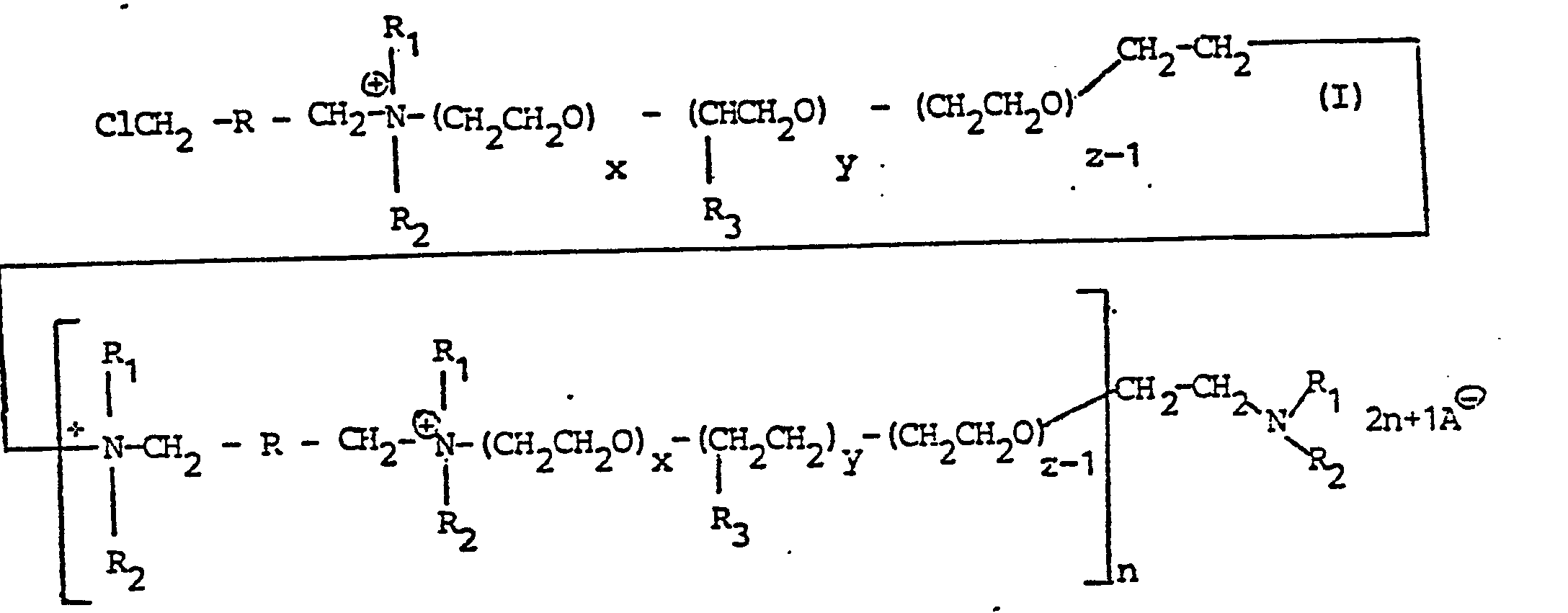
worin R einen Aromaten, vorzugsweise Phenylen, R1 und R2 C1-C4-Alkyl, vorzugsweise C1-C2-Alkyl, R3 Methyl oder Ethyl, x und z zusammen eine Zahl von 2 bis 360, vorzugsweise von 2 bis 140, y eine Zahl von 15 bis 70, vorzugsweise 25 bis 60, n eine Zahl von 1 bis 10 und A ein Anion, vorzugsweise Chlorid oder Bromid bedeuten.
2. Verfahren zur Herstellung der Verbindungen nach Anspruch 1, dadurch gekennzeichnet, daß man eine Verbindung der Formel II

mit einem Bis(halogenmethyl)aromaten umsetzt.
3. Verwendung der Verbindungen nach Anspruch 1 als Demulgatoren für die Spaltung von Rohölemulsionen und als Korrosionsinhibitoren in Anlagen für die Erdgas-und Rohölförderung und -aufbereitung.
Applications Claiming Priority (2)
| Application Number | Priority Date | Filing Date | Title |
|---|---|---|---|
| DE3136212 | 1981-09-12 | ||
| DE3136212A DE3136212A1 (de) | 1981-09-12 | 1981-09-12 | Kationische ethylenoxid-propylenoxid- bzw. ethylenoxid-butylenoxid-polymere, verfahren zu deren herstellung und deren verwendung |
Publications (1)
| Publication Number | Publication Date |
|---|---|
| EP0074621A2 true EP0074621A2 (de) | 1983-03-23 |
Family
ID=6141480
Family Applications (1)
| Application Number | Title | Priority Date | Filing Date |
|---|---|---|---|
| EP82108307A Withdrawn EP0074621A2 (de) | 1981-09-12 | 1982-09-09 | Kationische Ethylenoxid-Propylenoxid- bzw. Ethylenoxid-Butylenoxid-Polymere, Verfahren zu deren Herstellung und deren Verwendung |
Country Status (5)
| Country | Link |
|---|---|
| US (1) | US4451671A (de) |
| EP (1) | EP0074621A2 (de) |
| BR (1) | BR8205295A (de) |
| DE (1) | DE3136212A1 (de) |
| NO (1) | NO823086L (de) |
Cited By (2)
| Publication number | Priority date | Publication date | Assignee | Title |
|---|---|---|---|---|
| US4664848A (en) * | 1982-12-23 | 1987-05-12 | The Procter & Gamble Company | Detergent compositions containing cationic compounds having clay soil removal/anti-redeposition properties |
| EP0228803A3 (en) * | 1985-11-25 | 1988-10-12 | Minnesota Mining And Manufacturing Company | Ionene elastomers |
Families Citing this family (8)
| Publication number | Priority date | Publication date | Assignee | Title |
|---|---|---|---|---|
| DE4007596A1 (de) * | 1990-03-09 | 1991-09-12 | Henkel Kgaa | Alkylenoxideinheiten und quaternaere ammoniumgruppen enthaltende verbindungen |
| EP0931122A4 (de) * | 1996-10-04 | 2000-04-26 | Exxon Research Engineering Co | Co2-behandlung zur entfernung von kalzium aus rohöl |
| DE69739659D1 (de) * | 1996-10-04 | 2009-12-31 | Exxonmobil Res & Eng Co | Entfernung von calcium aus rohölen |
| US20040120847A1 (en) * | 2002-12-24 | 2004-06-24 | Willem Dijkhuizen | Reducing the corrosivity of water-containing oil-mixtures |
| US7745501B2 (en) * | 2006-06-22 | 2010-06-29 | Momentive Performance Materials Inc. | Method for demulsifying |
| US8030363B2 (en) | 2008-01-25 | 2011-10-04 | Momentive Performance Materials Inc. | Polyorganosiloxane demulsifier compositions and methods of making the same |
| CN113003633B (zh) * | 2021-04-30 | 2022-06-17 | 西南石油大学 | 一种含聚含油污水处理用树枝状清水剂及制备方法 |
| WO2024137277A1 (en) * | 2022-12-21 | 2024-06-27 | Dow Global Technologies Llc | Demulsifying block copolymer, method for forming such copolymer, and method of demulsifying an emulsion of petroleum and water |
Family Cites Families (5)
| Publication number | Priority date | Publication date | Assignee | Title |
|---|---|---|---|---|
| US2560280A (en) * | 1950-06-23 | 1951-07-10 | Rohm & Haas | Bis-quaternary ammonium compounds |
| US2668855A (en) * | 1952-12-20 | 1954-02-09 | Hoffmann La Roche | Alkylene-bis(oxyalkylene-ammonium) compounds |
| US3899534A (en) * | 1971-10-12 | 1975-08-12 | California Inst Of Techn | Cross-linked polyelectrolytes |
| GB1430608A (en) * | 1972-08-08 | 1976-03-31 | Hoechst Ag | Polyquaternary ammonium compounds and their use as petroleum demulsifiers |
| US4197865A (en) * | 1975-07-04 | 1980-04-15 | L'oreal | Treating hair with quaternized polymers |
-
1981
- 1981-09-12 DE DE3136212A patent/DE3136212A1/de not_active Withdrawn
-
1982
- 1982-08-30 US US06/412,527 patent/US4451671A/en not_active Expired - Fee Related
- 1982-09-09 EP EP82108307A patent/EP0074621A2/de not_active Withdrawn
- 1982-09-10 NO NO823086A patent/NO823086L/no unknown
- 1982-09-10 BR BR8205295A patent/BR8205295A/pt unknown
Cited By (3)
| Publication number | Priority date | Publication date | Assignee | Title |
|---|---|---|---|---|
| US4664848A (en) * | 1982-12-23 | 1987-05-12 | The Procter & Gamble Company | Detergent compositions containing cationic compounds having clay soil removal/anti-redeposition properties |
| EP0228803A3 (en) * | 1985-11-25 | 1988-10-12 | Minnesota Mining And Manufacturing Company | Ionene elastomers |
| AU602130B2 (en) * | 1985-11-25 | 1990-10-04 | Minnesota Mining And Manufacturing Company | Ionene elastomers |
Also Published As
| Publication number | Publication date |
|---|---|
| DE3136212A1 (de) | 1983-03-31 |
| BR8205295A (pt) | 1983-08-16 |
| US4451671A (en) | 1984-05-29 |
| NO823086L (no) | 1983-03-14 |
Similar Documents
| Publication | Publication Date | Title |
|---|---|---|
| EP0441198B1 (de) | Verwendung von Trialkanolaminpolyethern als Demulgatoren von Öl-in-Wasser-Emulsionen | |
| EP0074592A2 (de) | Bisamide, Verfahren zu deren Herstellung und deren Verwendung | |
| DE2736408C3 (de) | Verfahren zur Herstellung von N-acylierten Aminosulfobetainen, abgeleitet von Naphthensäuren | |
| DE69227730T2 (de) | Korrosionsinhibierung in stark säuren Medien mittels Pyridinsalzen zusammen mit bestimmten kationischen Tensiden | |
| EP0584708A1 (de) | Polyfunktionelle Demulgatoren für Rohöle | |
| DE3638743A1 (de) | Verzweigte polyoxalkylenmischpolyester, verfahren zu ihrer herstellung und ihre verwendung | |
| DE3136212A1 (de) | Kationische ethylenoxid-propylenoxid- bzw. ethylenoxid-butylenoxid-polymere, verfahren zu deren herstellung und deren verwendung | |
| EP0087147B1 (de) | Quaternäre Vernetzungsprodukte von Xylylendichloriden mit Triäthanolaminkondensaten und deren Verwendung | |
| DE2840112C2 (de) | Wassermischbare Korrosionsschutzmittel und Verfahren zur Verhinderung der Korrosion von Eisenmetallen | |
| EP0572881B1 (de) | Verfahren zum Trennen von Erdölemulsionen vom Wasser-in-Öl-Typ | |
| EP0065191A1 (de) | Inhibitoren gegen die Korrosion von H2S und CO2 in Wasser-in-Öl-Emulsionen | |
| DE69812472T2 (de) | Herstellung von aromatischen Aminen und ihr Gebrauch als Metallkorrosionsverhinderer | |
| EP0074622A2 (de) | Quaternierte polymere Polyoxyalkyl-alkylenpolyamine, Verfahren zu deren Herstellung und deren Verwendung | |
| EP0333135B1 (de) | Veresterte Glycidylether-Additionsprodukte und deren Verwendung | |
| EP0074077B1 (de) | Bisimidazoline, Verfahren zu deren Herstellung und deren Verwendung | |
| DE69208288T2 (de) | Korrosioninhibierung in stark sauren Umgebungen | |
| DE69310682T2 (de) | Neutralisierung von Aminen mit niedrigen Salzausfällungspotential | |
| DE68915357T2 (de) | Korrosionsinhibitoren für hochfesten und mittelfesten Stahl. | |
| DE2238995C3 (de) | N,N'-Bis-(alkyl)-N,N,N\N'-tetra (polyoxyalkyl)-l,4-arylen-bis-<ammoniumhalogenide) und deren Verwendung als korrosionsinhibierende Erdöl-Emulsionsspalter | |
| DE1290280B (de) | Korrosionsinhibitor fuer Raffinationsverfahren von Erdoelkohlenwasserstoffzwischenprodukten | |
| DE69117442T2 (de) | Verfahren zur Herstellung von Reinigungszusatz für Kraftstoffe | |
| DE2751636C2 (de) | Verfahren zur Einschränkung der Korrosion in Trennanlagen für Erdöl- und petrochemische Kohlenwasserstoffverarbeitssysteme mit maximal 1Gew.-% Wasser im Obendestillat | |
| DE944623C (de) | Zusatzmittel fuer technische OEle und Fette auf Minerlaoelbasis | |
| DE652551C (de) | Verfahren zur Herstellung von Alkylresorcinen | |
| DE19510517A1 (de) | Verfahren zur Inhibierung der Oxidation und Polymerisation von Furfural und seinen Derivaten |
Legal Events
| Date | Code | Title | Description |
|---|---|---|---|
| PUAI | Public reference made under article 153(3) epc to a published international application that has entered the european phase |
Free format text: ORIGINAL CODE: 0009012 |
|
| AK | Designated contracting states |
Designated state(s): DE FR GB NL |
|
| 18W | Application withdrawn |
Withdrawal date: 19840525 |
|
| STAA | Information on the status of an ep patent application or granted ep patent |
Free format text: STATUS: THE APPLICATION HAS BEEN WITHDRAWN |
|
| R18W | Application withdrawn (corrected) |
Effective date: 19840525 |
|
| RIN1 | Information on inventor provided before grant (corrected) |
Inventor name: WESTER, NORBERT, DR. Inventor name: HILLE, MARTIN, DR. Inventor name: DIERY, HELMUT, DR. |