EP0074779A2 - Geschützte Pigmente - Google Patents
Geschützte Pigmente Download PDFInfo
- Publication number
- EP0074779A2 EP0074779A2 EP82304680A EP82304680A EP0074779A2 EP 0074779 A2 EP0074779 A2 EP 0074779A2 EP 82304680 A EP82304680 A EP 82304680A EP 82304680 A EP82304680 A EP 82304680A EP 0074779 A2 EP0074779 A2 EP 0074779A2
- Authority
- EP
- European Patent Office
- Prior art keywords
- pigment
- protected
- zirconium
- making
- silicate
- Prior art date
- Legal status (The legal status is an assumption and is not a legal conclusion. Google has not performed a legal analysis and makes no representation as to the accuracy of the status listed.)
- Granted
Links
- 239000000049 pigment Substances 0.000 title claims abstract description 99
- GFQYVLUOOAAOGM-UHFFFAOYSA-N zirconium(iv) silicate Chemical compound [Zr+4].[O-][Si]([O-])([O-])[O-] GFQYVLUOOAAOGM-UHFFFAOYSA-N 0.000 claims abstract description 16
- 239000013078 crystal Substances 0.000 claims abstract description 11
- 229910052793 cadmium Inorganic materials 0.000 claims abstract description 7
- BDOSMKKIYDKNTQ-UHFFFAOYSA-N cadmium atom Chemical compound [Cd] BDOSMKKIYDKNTQ-UHFFFAOYSA-N 0.000 claims abstract description 7
- 239000000470 constituent Substances 0.000 claims abstract description 7
- 239000007864 aqueous solution Substances 0.000 claims abstract description 5
- 230000001376 precipitating effect Effects 0.000 claims abstract description 5
- 238000000034 method Methods 0.000 claims description 16
- 238000004519 manufacturing process Methods 0.000 claims description 15
- MCMNRKCIXSYSNV-UHFFFAOYSA-N Zirconium dioxide Chemical compound O=[Zr]=O MCMNRKCIXSYSNV-UHFFFAOYSA-N 0.000 claims description 13
- 239000003086 colorant Substances 0.000 claims description 11
- 239000000203 mixture Substances 0.000 claims description 11
- 229960004029 silicic acid Drugs 0.000 claims description 9
- KRHYYFGTRYWZRS-UHFFFAOYSA-M Fluoride anion Chemical compound [F-] KRHYYFGTRYWZRS-UHFFFAOYSA-M 0.000 claims description 7
- 239000011133 lead Substances 0.000 claims description 7
- RVTZCBVAJQQJTK-UHFFFAOYSA-N oxygen(2-);zirconium(4+) Chemical compound [O-2].[O-2].[Zr+4] RVTZCBVAJQQJTK-UHFFFAOYSA-N 0.000 claims description 7
- 239000002244 precipitate Substances 0.000 claims description 7
- 150000003839 salts Chemical class 0.000 claims description 6
- 235000012239 silicon dioxide Nutrition 0.000 claims description 6
- 239000004115 Sodium Silicate Substances 0.000 claims description 5
- 239000002243 precursor Substances 0.000 claims description 5
- RMAQACBXLXPBSY-UHFFFAOYSA-N silicic acid Chemical compound O[Si](O)(O)O RMAQACBXLXPBSY-UHFFFAOYSA-N 0.000 claims description 5
- NTHWMYGWWRZVTN-UHFFFAOYSA-N sodium silicate Chemical compound [Na+].[Na+].[O-][Si]([O-])=O NTHWMYGWWRZVTN-UHFFFAOYSA-N 0.000 claims description 5
- 229910052911 sodium silicate Inorganic materials 0.000 claims description 5
- IVORCBKUUYGUOL-UHFFFAOYSA-N 1-ethynyl-2,4-dimethoxybenzene Chemical compound COC1=CC=C(C#C)C(OC)=C1 IVORCBKUUYGUOL-UHFFFAOYSA-N 0.000 claims description 4
- LRCFXGAMWKDGLA-UHFFFAOYSA-N dioxosilane;hydrate Chemical compound O.O=[Si]=O LRCFXGAMWKDGLA-UHFFFAOYSA-N 0.000 claims description 4
- 239000012457 nonaqueous media Substances 0.000 claims description 4
- OERNJTNJEZOPIA-UHFFFAOYSA-N zirconium nitrate Chemical compound [Zr+4].[O-][N+]([O-])=O.[O-][N+]([O-])=O.[O-][N+]([O-])=O.[O-][N+]([O-])=O OERNJTNJEZOPIA-UHFFFAOYSA-N 0.000 claims description 4
- IPCAPQRVQMIMAN-UHFFFAOYSA-L zirconyl chloride Chemical compound Cl[Zr](Cl)=O IPCAPQRVQMIMAN-UHFFFAOYSA-L 0.000 claims description 4
- DUFCMRCMPHIFTR-UHFFFAOYSA-N 5-(dimethylsulfamoyl)-2-methylfuran-3-carboxylic acid Chemical compound CN(C)S(=O)(=O)C1=CC(C(O)=O)=C(C)O1 DUFCMRCMPHIFTR-UHFFFAOYSA-N 0.000 claims description 3
- 241000219321 Caryophyllaceae Species 0.000 claims description 3
- 235000002845 Dianthus plumarius Nutrition 0.000 claims description 3
- BPQQTUXANYXVAA-UHFFFAOYSA-N Orthosilicate Chemical compound [O-][Si]([O-])([O-])[O-] BPQQTUXANYXVAA-UHFFFAOYSA-N 0.000 claims description 3
- QCWXUUIWCKQGHC-UHFFFAOYSA-N Zirconium Chemical compound [Zr] QCWXUUIWCKQGHC-UHFFFAOYSA-N 0.000 claims description 3
- 238000004140 cleaning Methods 0.000 claims description 3
- 239000010987 cubic zirconia Substances 0.000 claims description 3
- 229910052726 zirconium Inorganic materials 0.000 claims description 3
- VYZAMTAEIAYCRO-UHFFFAOYSA-N Chromium Chemical compound [Cr] VYZAMTAEIAYCRO-UHFFFAOYSA-N 0.000 claims description 2
- RYGMFSIKBFXOCR-UHFFFAOYSA-N Copper Chemical compound [Cu] RYGMFSIKBFXOCR-UHFFFAOYSA-N 0.000 claims description 2
- DGAQECJNVWCQMB-PUAWFVPOSA-M Ilexoside XXIX Chemical compound C[C@@H]1CC[C@@]2(CC[C@@]3(C(=CC[C@H]4[C@]3(CC[C@@H]5[C@@]4(CC[C@@H](C5(C)C)OS(=O)(=O)[O-])C)C)[C@@H]2[C@]1(C)O)C)C(=O)O[C@H]6[C@@H]([C@H]([C@@H]([C@H](O6)CO)O)O)O.[Na+] DGAQECJNVWCQMB-PUAWFVPOSA-M 0.000 claims description 2
- 239000004111 Potassium silicate Substances 0.000 claims description 2
- BOTDANWDWHJENH-UHFFFAOYSA-N Tetraethyl orthosilicate Chemical compound CCO[Si](OCC)(OCC)OCC BOTDANWDWHJENH-UHFFFAOYSA-N 0.000 claims description 2
- HCHKCACWOHOZIP-UHFFFAOYSA-N Zinc Chemical compound [Zn] HCHKCACWOHOZIP-UHFFFAOYSA-N 0.000 claims description 2
- HSSJULAPNNGXFW-UHFFFAOYSA-N [Co].[Zn] Chemical compound [Co].[Zn] HSSJULAPNNGXFW-UHFFFAOYSA-N 0.000 claims description 2
- 229910052802 copper Inorganic materials 0.000 claims description 2
- 239000010949 copper Substances 0.000 claims description 2
- JVPLOXQKFGYFMN-UHFFFAOYSA-N gold tin Chemical compound [Sn].[Au] JVPLOXQKFGYFMN-UHFFFAOYSA-N 0.000 claims description 2
- 238000010438 heat treatment Methods 0.000 claims description 2
- PAZHGORSDKKUPI-UHFFFAOYSA-N lithium metasilicate Chemical compound [Li+].[Li+].[O-][Si]([O-])=O PAZHGORSDKKUPI-UHFFFAOYSA-N 0.000 claims description 2
- 229910052912 lithium silicate Inorganic materials 0.000 claims description 2
- NNHHDJVEYQHLHG-UHFFFAOYSA-N potassium silicate Chemical compound [K+].[K+].[O-][Si]([O-])=O NNHHDJVEYQHLHG-UHFFFAOYSA-N 0.000 claims description 2
- 229910052913 potassium silicate Inorganic materials 0.000 claims description 2
- 235000019353 potassium silicate Nutrition 0.000 claims description 2
- 229910052708 sodium Inorganic materials 0.000 claims description 2
- 239000011734 sodium Substances 0.000 claims description 2
- 229910052725 zinc Inorganic materials 0.000 claims description 2
- 239000011701 zinc Substances 0.000 claims description 2
- ZXAUZSQITFJWPS-UHFFFAOYSA-J zirconium(4+);disulfate Chemical compound [Zr+4].[O-]S([O-])(=O)=O.[O-]S([O-])(=O)=O ZXAUZSQITFJWPS-UHFFFAOYSA-J 0.000 claims description 2
- 150000002222 fluorine compounds Chemical class 0.000 claims 2
- OYPRJOBELJOOCE-UHFFFAOYSA-N Calcium Chemical compound [Ca] OYPRJOBELJOOCE-UHFFFAOYSA-N 0.000 claims 1
- WHXSMMKQMYFTQS-UHFFFAOYSA-N Lithium Chemical compound [Li] WHXSMMKQMYFTQS-UHFFFAOYSA-N 0.000 claims 1
- ZLMJMSJWJFRBEC-UHFFFAOYSA-N Potassium Chemical compound [K] ZLMJMSJWJFRBEC-UHFFFAOYSA-N 0.000 claims 1
- XUIMIQQOPSSXEZ-UHFFFAOYSA-N Silicon Chemical compound [Si] XUIMIQQOPSSXEZ-UHFFFAOYSA-N 0.000 claims 1
- UCKMPCXJQFINFW-UHFFFAOYSA-N Sulphide Chemical compound [S-2] UCKMPCXJQFINFW-UHFFFAOYSA-N 0.000 claims 1
- 239000004411 aluminium Substances 0.000 claims 1
- XAGFODPZIPBFFR-UHFFFAOYSA-N aluminium Chemical compound [Al] XAGFODPZIPBFFR-UHFFFAOYSA-N 0.000 claims 1
- 229910052782 aluminium Inorganic materials 0.000 claims 1
- 239000011575 calcium Substances 0.000 claims 1
- 229910052791 calcium Inorganic materials 0.000 claims 1
- YPANPSDPZOVDOM-UHFFFAOYSA-N gold zirconium Chemical compound [Zr].[Au] YPANPSDPZOVDOM-UHFFFAOYSA-N 0.000 claims 1
- 229910052744 lithium Inorganic materials 0.000 claims 1
- QSHDDOUJBYECFT-UHFFFAOYSA-N mercury Chemical compound [Hg] QSHDDOUJBYECFT-UHFFFAOYSA-N 0.000 claims 1
- 229910052753 mercury Inorganic materials 0.000 claims 1
- 229910052700 potassium Inorganic materials 0.000 claims 1
- 239000011591 potassium Substances 0.000 claims 1
- 150000003346 selenoethers Chemical class 0.000 claims 1
- 229910052710 silicon Inorganic materials 0.000 claims 1
- 239000010703 silicon Substances 0.000 claims 1
- XSOKHXFFCGXDJZ-UHFFFAOYSA-N telluride(2-) Chemical compound [Te-2] XSOKHXFFCGXDJZ-UHFFFAOYSA-N 0.000 claims 1
- 239000000919 ceramic Substances 0.000 abstract description 14
- 239000004033 plastic Substances 0.000 abstract description 10
- 229920003023 plastic Polymers 0.000 abstract description 10
- 238000011109 contamination Methods 0.000 abstract description 2
- 239000000243 solution Substances 0.000 description 12
- XLYOFNOQVPJJNP-UHFFFAOYSA-N water Substances O XLYOFNOQVPJJNP-UHFFFAOYSA-N 0.000 description 11
- 238000005034 decoration Methods 0.000 description 8
- PQXKHYXIUOZZFA-UHFFFAOYSA-M lithium fluoride Chemical compound [Li+].[F-] PQXKHYXIUOZZFA-UHFFFAOYSA-M 0.000 description 8
- 239000002253 acid Substances 0.000 description 7
- 229920006395 saturated elastomer Polymers 0.000 description 7
- 239000000843 powder Substances 0.000 description 6
- 150000007513 acids Chemical class 0.000 description 5
- JLATXDOZXBEBJX-UHFFFAOYSA-N cadmium(2+);selenium(2-);sulfide Chemical compound [S-2].[Se-2].[Cd+2].[Cd+2] JLATXDOZXBEBJX-UHFFFAOYSA-N 0.000 description 5
- 239000002245 particle Substances 0.000 description 5
- 229910052845 zircon Inorganic materials 0.000 description 5
- 238000010304 firing Methods 0.000 description 4
- 239000004793 Polystyrene Substances 0.000 description 3
- VYPSYNLAJGMNEJ-UHFFFAOYSA-N Silicium dioxide Chemical compound O=[Si]=O VYPSYNLAJGMNEJ-UHFFFAOYSA-N 0.000 description 3
- HEMHJVSKTPXQMS-UHFFFAOYSA-M Sodium hydroxide Chemical compound [OH-].[Na+] HEMHJVSKTPXQMS-UHFFFAOYSA-M 0.000 description 3
- 239000007795 chemical reaction product Substances 0.000 description 3
- 230000004907 flux Effects 0.000 description 3
- 239000000463 material Substances 0.000 description 3
- 229920002223 polystyrene Polymers 0.000 description 3
- 239000001054 red pigment Substances 0.000 description 3
- 238000012546 transfer Methods 0.000 description 3
- KLZUFWVZNOTSEM-UHFFFAOYSA-K Aluminium flouride Chemical compound F[Al](F)F KLZUFWVZNOTSEM-UHFFFAOYSA-K 0.000 description 2
- VHUUQVKOLVNVRT-UHFFFAOYSA-N Ammonium hydroxide Chemical compound [NH4+].[OH-] VHUUQVKOLVNVRT-UHFFFAOYSA-N 0.000 description 2
- IJGRMHOSHXDMSA-UHFFFAOYSA-N Atomic nitrogen Chemical compound N#N IJGRMHOSHXDMSA-UHFFFAOYSA-N 0.000 description 2
- 238000002441 X-ray diffraction Methods 0.000 description 2
- 239000000908 ammonium hydroxide Substances 0.000 description 2
- 230000008901 benefit Effects 0.000 description 2
- QCUOBSQYDGUHHT-UHFFFAOYSA-L cadmium sulfate Chemical compound [Cd+2].[O-]S([O-])(=O)=O QCUOBSQYDGUHHT-UHFFFAOYSA-L 0.000 description 2
- PGWFQHBXMJMAPN-UHFFFAOYSA-N ctk4b5078 Chemical class [Cd].OS(=O)(=O)[Se]S(O)(=O)=O PGWFQHBXMJMAPN-UHFFFAOYSA-N 0.000 description 2
- 239000004615 ingredient Substances 0.000 description 2
- 238000005259 measurement Methods 0.000 description 2
- 229910052751 metal Inorganic materials 0.000 description 2
- 239000002184 metal Substances 0.000 description 2
- NROKBHXJSPEDAR-UHFFFAOYSA-M potassium fluoride Chemical compound [F-].[K+] NROKBHXJSPEDAR-UHFFFAOYSA-M 0.000 description 2
- 230000008569 process Effects 0.000 description 2
- 239000000047 product Substances 0.000 description 2
- 230000005855 radiation Effects 0.000 description 2
- 238000000985 reflectance spectrum Methods 0.000 description 2
- PUZPDOWCWNUUKD-UHFFFAOYSA-M sodium fluoride Chemical compound [F-].[Na+] PUZPDOWCWNUUKD-UHFFFAOYSA-M 0.000 description 2
- GRVFOGOEDUUMBP-UHFFFAOYSA-N sodium sulfide (anhydrous) Chemical compound [Na+].[Na+].[S-2] GRVFOGOEDUUMBP-UHFFFAOYSA-N 0.000 description 2
- 150000004763 sulfides Chemical class 0.000 description 2
- 231100000331 toxic Toxicity 0.000 description 2
- 230000002588 toxic effect Effects 0.000 description 2
- GRYLNZFGIOXLOG-UHFFFAOYSA-N Nitric acid Chemical compound O[N+]([O-])=O GRYLNZFGIOXLOG-UHFFFAOYSA-N 0.000 description 1
- BUGBHKTXTAQXES-UHFFFAOYSA-N Selenium Chemical compound [Se] BUGBHKTXTAQXES-UHFFFAOYSA-N 0.000 description 1
- QAOWNCQODCNURD-UHFFFAOYSA-N Sulfuric acid Chemical compound OS(O)(=O)=O QAOWNCQODCNURD-UHFFFAOYSA-N 0.000 description 1
- 239000003513 alkali Substances 0.000 description 1
- 238000013459 approach Methods 0.000 description 1
- 238000000498 ball milling Methods 0.000 description 1
- 210000000988 bone and bone Anatomy 0.000 description 1
- 239000001030 cadmium pigment Substances 0.000 description 1
- WUKWITHWXAAZEY-UHFFFAOYSA-L calcium difluoride Chemical compound [F-].[F-].[Ca+2] WUKWITHWXAAZEY-UHFFFAOYSA-L 0.000 description 1
- 229910001634 calcium fluoride Inorganic materials 0.000 description 1
- 230000008859 change Effects 0.000 description 1
- 150000001875 compounds Chemical class 0.000 description 1
- 238000001514 detection method Methods 0.000 description 1
- 230000000694 effects Effects 0.000 description 1
- 230000005670 electromagnetic radiation Effects 0.000 description 1
- 235000013305 food Nutrition 0.000 description 1
- 238000009472 formulation Methods 0.000 description 1
- PCHJSUWPFVWCPO-UHFFFAOYSA-N gold Chemical compound [Au] PCHJSUWPFVWCPO-UHFFFAOYSA-N 0.000 description 1
- 238000000227 grinding Methods 0.000 description 1
- 239000012535 impurity Substances 0.000 description 1
- 238000011065 in-situ storage Methods 0.000 description 1
- YAFKGUAJYKXPDI-UHFFFAOYSA-J lead tetrafluoride Chemical compound F[Pb](F)(F)F YAFKGUAJYKXPDI-UHFFFAOYSA-J 0.000 description 1
- 150000002739 metals Chemical class 0.000 description 1
- 229910017604 nitric acid Inorganic materials 0.000 description 1
- 229910052757 nitrogen Inorganic materials 0.000 description 1
- 230000019612 pigmentation Effects 0.000 description 1
- 239000011698 potassium fluoride Substances 0.000 description 1
- 235000003270 potassium fluoride Nutrition 0.000 description 1
- 238000012545 processing Methods 0.000 description 1
- 230000009467 reduction Effects 0.000 description 1
- 239000000377 silicon dioxide Substances 0.000 description 1
- 229960001866 silicon dioxide Drugs 0.000 description 1
- 239000011775 sodium fluoride Substances 0.000 description 1
- 235000013024 sodium fluoride Nutrition 0.000 description 1
- 239000006104 solid solution Substances 0.000 description 1
- 238000001179 sorption measurement Methods 0.000 description 1
- 238000001228 spectrum Methods 0.000 description 1
- 239000000126 substance Substances 0.000 description 1
- 239000001117 sulphuric acid Substances 0.000 description 1
- 235000011149 sulphuric acid Nutrition 0.000 description 1
- 229910052714 tellurium Inorganic materials 0.000 description 1
- PORWMNRCUJJQNO-UHFFFAOYSA-N tellurium atom Chemical compound [Te] PORWMNRCUJJQNO-UHFFFAOYSA-N 0.000 description 1
- 229920001169 thermoplastic Polymers 0.000 description 1
- 239000004416 thermosoftening plastic Substances 0.000 description 1
- 238000005406 washing Methods 0.000 description 1
- 239000001052 yellow pigment Substances 0.000 description 1
- 150000003754 zirconium Chemical class 0.000 description 1
- 229910001928 zirconium oxide Inorganic materials 0.000 description 1
Images

Classifications
-
- C—CHEMISTRY; METALLURGY
- C09—DYES; PAINTS; POLISHES; NATURAL RESINS; ADHESIVES; COMPOSITIONS NOT OTHERWISE PROVIDED FOR; APPLICATIONS OF MATERIALS NOT OTHERWISE PROVIDED FOR
- C09C—TREATMENT OF INORGANIC MATERIALS, OTHER THAN FIBROUS FILLERS, TO ENHANCE THEIR PIGMENTING OR FILLING PROPERTIES ; PREPARATION OF CARBON BLACK ; PREPARATION OF INORGANIC MATERIALS WHICH ARE NO SINGLE CHEMICAL COMPOUNDS AND WHICH ARE MAINLY USED AS PIGMENTS OR FILLERS
- C09C1/00—Treatment of specific inorganic materials other than fibrous fillers; Preparation of carbon black
- C09C1/0009—Pigments for ceramics
- C09C1/0012—Pigments for ceramics containing zirconium and silicon
-
- C—CHEMISTRY; METALLURGY
- C09—DYES; PAINTS; POLISHES; NATURAL RESINS; ADHESIVES; COMPOSITIONS NOT OTHERWISE PROVIDED FOR; APPLICATIONS OF MATERIALS NOT OTHERWISE PROVIDED FOR
- C09C—TREATMENT OF INORGANIC MATERIALS, OTHER THAN FIBROUS FILLERS, TO ENHANCE THEIR PIGMENTING OR FILLING PROPERTIES ; PREPARATION OF CARBON BLACK ; PREPARATION OF INORGANIC MATERIALS WHICH ARE NO SINGLE CHEMICAL COMPOUNDS AND WHICH ARE MAINLY USED AS PIGMENTS OR FILLERS
- C09C1/00—Treatment of specific inorganic materials other than fibrous fillers; Preparation of carbon black
- C09C1/0081—Composite particulate pigments or fillers, i.e. containing at least two solid phases, except those consisting of coated particles of one compound
-
- C—CHEMISTRY; METALLURGY
- C01—INORGANIC CHEMISTRY
- C01P—INDEXING SCHEME RELATING TO STRUCTURAL AND PHYSICAL ASPECTS OF SOLID INORGANIC COMPOUNDS
- C01P2002/00—Crystal-structural characteristics
- C01P2002/70—Crystal-structural characteristics defined by measured X-ray, neutron or electron diffraction data
- C01P2002/72—Crystal-structural characteristics defined by measured X-ray, neutron or electron diffraction data by d-values or two theta-values, e.g. as X-ray diagram
-
- C—CHEMISTRY; METALLURGY
- C01—INORGANIC CHEMISTRY
- C01P—INDEXING SCHEME RELATING TO STRUCTURAL AND PHYSICAL ASPECTS OF SOLID INORGANIC COMPOUNDS
- C01P2002/00—Crystal-structural characteristics
- C01P2002/80—Crystal-structural characteristics defined by measured data other than those specified in group C01P2002/70
- C01P2002/84—Crystal-structural characteristics defined by measured data other than those specified in group C01P2002/70 by UV- or VIS- data
-
- C—CHEMISTRY; METALLURGY
- C01—INORGANIC CHEMISTRY
- C01P—INDEXING SCHEME RELATING TO STRUCTURAL AND PHYSICAL ASPECTS OF SOLID INORGANIC COMPOUNDS
- C01P2006/00—Physical properties of inorganic compounds
- C01P2006/12—Surface area
-
- C—CHEMISTRY; METALLURGY
- C01—INORGANIC CHEMISTRY
- C01P—INDEXING SCHEME RELATING TO STRUCTURAL AND PHYSICAL ASPECTS OF SOLID INORGANIC COMPOUNDS
- C01P2006/00—Physical properties of inorganic compounds
- C01P2006/32—Thermal properties
- C01P2006/37—Stability against thermal decomposition
-
- C—CHEMISTRY; METALLURGY
- C01—INORGANIC CHEMISTRY
- C01P—INDEXING SCHEME RELATING TO STRUCTURAL AND PHYSICAL ASPECTS OF SOLID INORGANIC COMPOUNDS
- C01P2006/00—Physical properties of inorganic compounds
- C01P2006/60—Optical properties, e.g. expressed in CIELAB-values
-
- C—CHEMISTRY; METALLURGY
- C01—INORGANIC CHEMISTRY
- C01P—INDEXING SCHEME RELATING TO STRUCTURAL AND PHYSICAL ASPECTS OF SOLID INORGANIC COMPOUNDS
- C01P2006/00—Physical properties of inorganic compounds
- C01P2006/60—Optical properties, e.g. expressed in CIELAB-values
- C01P2006/62—L* (lightness axis)
-
- C—CHEMISTRY; METALLURGY
- C01—INORGANIC CHEMISTRY
- C01P—INDEXING SCHEME RELATING TO STRUCTURAL AND PHYSICAL ASPECTS OF SOLID INORGANIC COMPOUNDS
- C01P2006/00—Physical properties of inorganic compounds
- C01P2006/60—Optical properties, e.g. expressed in CIELAB-values
- C01P2006/63—Optical properties, e.g. expressed in CIELAB-values a* (red-green axis)
-
- C—CHEMISTRY; METALLURGY
- C01—INORGANIC CHEMISTRY
- C01P—INDEXING SCHEME RELATING TO STRUCTURAL AND PHYSICAL ASPECTS OF SOLID INORGANIC COMPOUNDS
- C01P2006/00—Physical properties of inorganic compounds
- C01P2006/60—Optical properties, e.g. expressed in CIELAB-values
- C01P2006/64—Optical properties, e.g. expressed in CIELAB-values b* (yellow-blue axis)
-
- C—CHEMISTRY; METALLURGY
- C01—INORGANIC CHEMISTRY
- C01P—INDEXING SCHEME RELATING TO STRUCTURAL AND PHYSICAL ASPECTS OF SOLID INORGANIC COMPOUNDS
- C01P2006/00—Physical properties of inorganic compounds
- C01P2006/80—Compositional purity
Definitions
- the invention relates to a method of making a protected pigment especially suitable for firing on ceramics and for use in plastics, and a pigment made according to the method.
- Such protected pigments are sometimes referred to as encapsulated pigments.
- pigment ingredients, zirconium oxide powder and silicon dioxide powder are mixed with water to a dough and the resulting mixture heated to high temperature followed by grinding and removal of unwanted reaction products.
- Pigments made according to this method suffer from the disadvantage that it is not possible to obtain fully saturated colours when such pigments are fired on ceramic ware.
- the present invention seeks to obviate or mitigate these disadvantages of the prior pigment.
- the invention provides, in a method of making a protected pigment by inclusion of a pigment in transparent zirconium silicate crystals, the step of precipitating simultaneously or sequentially the constituents of the protected pigment from aqueous or non-aqueous solutions of their salts.
- the invention also provides a method of making a protected pigment by inclusion of a pigment in transparent zirconium silicate crystals comprising the steps of precipitating simultaneously or sequentially the constitutents of the protected pigment from aqueous or non-aqueous solutions of their salts to form a precipitate, mixing the precipitate with a fluoride, heating the mixture to a high temperature and cleaning the protected pigment so produced.
- the said constituents are preferably :
- the protected pigment made according to the method hereinbefore described contains about 8-10% cadmium sulphoselenide pigment included in the zirconium silicate crystal, and has no poorly pigmented or unpigmented zirconium silicate.
- the X-ray diffraction spectrum shows a peak at a d spacing of 2.96 A, which can be assigned to a small percentage of cubic zirconium dioxide. This X-ray diffraction peak at 2.96 A has not been detected in commercially available protected pigments. Thase latter contain peaks at d spacings of 2.83 ⁇ and 3.16 ⁇ Which are barely detectable in the protected pigment.made by this process, and which can be assigned to monoclinic zirconium dioxide.
- the cubic zirconium dioxide is apparently present in the protected pigment in a percentage, according to preliminary studies, of 3-6% by weight. It is thought that this may be caused by the presence of the finely divided pigment, particularly cadmium, and that its presence may be a contributing factor to the density of colour exhibited by the protected pigments.
- These bright red, orange and yellow cadmium sulphoselenide inclusion pigments can be applied to ceramic tableware in on-glaze transfer decorations fired at 800°C - 850°C.
- the pigments are fully compatible with the lead fluxes commonly used in on-glaze decoration. These pigments also have sufficient thermal stability to permit their use in the under-glaze decoration of tableware (firing temperature 1050°C), and as glaze stains in tile and sanitaryuare glazes (firing temperatures up to 1200 0 C).
- the brightness of the colour depends upon the refractive index of the glaze.
- the most saturated colours are obtained in high refractive index lead glazes. These glazes approach the refractive index of the zircon surrounding the pigment, and minimise the opacifying effect of the zircon.
- Less saturated colours are obtained in lead free glazes of lower refractive index such as are used on sanitary- warse.
- the red protected pigment made according to the invention provides a much more saturated red colour in lead-free glazes than has been available hitherto.
- the method of preparing protected pigments according to the invention is suitable for pigments of limited stability and particularly for cadmium sulphoselenides, cadmium-mercuric sulphides and similar sulphides containing zinc and/or tellurium, gold-tin and gold-zirconia pinks, chrome yellows, cobalt zinc blues and copper colours.
- the method may be used as a "post-treatment" method on existing (unprotected) pigments and is thus desirable for use by pigment-users who desire complets freedom of formulation of their pigment.
- the method is applicable to the production of protected pigments in situ.
- the constituents of the protected pigment according to the invention are a pigment or its precursor, zirconium hydroxide or hydrated zirconia, and silicic acid or hydrated silica.
- Any soluble zirconium salt can be used to provide the zirconium component, for example zirconyl chloride, zirconium nitrate, zirconium sulphate, zirconium acetate,and similar salts.
- a soluble silicate for example sodium silicate, potassium silicate, lithium silicate or ethyl silicate may be used to provide the silicate component.
- the fluoride preferably a metallic fluoride, for example sodium fluoride, lithium fluoride, lead fluoride, potassium fluoride, calcium fluoride or sodium aluminium fluoride, is added in amounts between 0.1 and 15% by weight, preferably betueen 1 and 3%,
- the mixture is preferably fired between 800°C and 1300°C desirably greater than 1000°C for at least one minute and preferably ten to fifteen minutes.
- the fired product is then crushed, ground, treated with acids, alkalis and water, to remove undesired reaction products and unprotected pigment and finally dried.
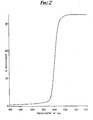
- FIG. 1 shows graphs of percentage reflectance of electromagnetic radiation for sample glazes (y-axis) against wavelength of the radiation (x-axis), Fig. 1 displaying data for a known protected ceramic pigment and Fig. 2 displaying data for a pigment made in accordance with the invention, as follous:
- 29g of cadmium sulphate were dissolved in 200 cm 3 of water and then this solution was mixed with 140g of a solution containing approximately 35% by. weight of zirconium acetate.
- the two solutions were mixed together and the precipitate obtained was uashed, filtered and dried.
- the dry powder was then mixed with 35 cm 3 of sodium silicate solution diluted to 200 cm 3 with water and neutralised with acid to produce a gel.
- the gel was washed with water, filtered and dried at 130°C to give a fine powder.
- This powder was dry-mixed with 3% by ut. of lithium fluoride and fired in a closed crucible at 1050°C for 30 minutes.
- the resulting red pigment composition was ground in a ball mill, and then washed with a mixture of concentrated sulphuric acid and concentrated nitric acid. This was followed by washing with Water, then with 5 M sodium hydroxide and finally with water.
- the resulting red protected pigment contained 5.9% by wt. of cadmium.
- This red protected pigment was completely stable to acids and alkalis and to temperatures of 1200°C. It produced bright red colours in on-glaze decoration on tableware.
- the on-glaze decoration was applied to a bone china plate as a block of colour 1 dm 2 in the form of a silk screen water-slide transfer. The on-glaze transfer was made up from 1 part of the red pigment to 2 parts of lead flux. After application to the plate and firing at 800°C a bright red block of colour was obtained.
- the cadmium release from this decoration was below the limits of detection of the procsdure in 85. 4860 : Part 1 : 1972. Measurements of the colours produced in the on-glaze decoration and in glaze stain applications are given below.
- the high purity of the red pigment is revealed by the reflectance spectrum for the on-glaze decoration shown in Figure 2.
- Example 1 The resultant precipitate was decanted, filtered and dried at 130°C, then added to 60 cm 3 of sodium silicate solution (S.G. 1.42) diluted to approximately 250 cm 3 with water. The solution was gelled as described in Example 1. The fine powder thus obtained was dry mixed with 1% by ut. of lithium fluoride and fired in a crucible at 1050°C for 15 minutes. The resulting yellow pigment composition was ball milled and washed with acids and alkali by the procedure given in Example 1.
- the resulting bright yellow protected pigment gave the following colour co-ordinates in ceramic applications when measured under the same conditions as in Example 1.
- a red/purple gold colloid uas prepared in the normal manner on hydrated zirconia, from a solution of zirconyl chloride and chloroauric acid.
- the precipitate was filtered and mixed damp with sodium silicate solution which was neutralised to precipitate silicic acid.
- the mixture was filtered, washed and dried to a powder which was then mixed with 3% by wsight LiF and fired in a closed crucible for ten minutes at 1000°C.
- the red and yellow protected pigments made by the process described in Examples 1 and 2 were ball milled for 24 hours to give finely divided protected pigments suitable for plastics applications. After ball milling the protected pigments had specific surface areas by nitrogen adsorption of approximately 10 m 2 /g. These two protected pigments were added to polystyrene at the 3.3% level. The polystyrene was melted and moulded into plaques and gave the following colour co-ordinates measured under the conditions given in Example 1.
- the zircon protected pigments prepared according to this invention provide the following benefits compared with the pigments of this type currently available.
- inclusion pigments produced according to the invention are especially suitable for ceramic applications and this is indeed their principal application. However such pigments are also suitable for use in other applications for example plastics. Although the temperature stability of the pigments is well within the range of temperatures used in plastics manufacture, the principal advantage in using pigments according to the invention in plastics is that there is no release of toxic materials from the pigment when the plastics are incinerated or are exposed to materials such as food and other products which would otherwise attack unprotected pigments.
Landscapes
- Chemical & Material Sciences (AREA)
- Organic Chemistry (AREA)
- Engineering & Computer Science (AREA)
- Ceramic Engineering (AREA)
- Composite Materials (AREA)
- Compositions Of Macromolecular Compounds (AREA)
- Glass Compositions (AREA)
- Organic Low-Molecular-Weight Compounds And Preparation Thereof (AREA)
- Pigments, Carbon Blacks, Or Wood Stains (AREA)
- Coloring Foods And Improving Nutritive Qualities (AREA)
- Food Preservation Except Freezing, Refrigeration, And Drying (AREA)
- Cosmetics (AREA)
Priority Applications (1)
| Application Number | Priority Date | Filing Date | Title |
|---|---|---|---|
| AT82304680T ATE18065T1 (de) | 1981-09-12 | 1982-09-07 | Geschuetzte pigmente. |
Applications Claiming Priority (2)
| Application Number | Priority Date | Filing Date | Title |
|---|---|---|---|
| GB8127615 | 1981-09-12 | ||
| GB8127615 | 1981-09-12 |
Publications (3)
| Publication Number | Publication Date |
|---|---|
| EP0074779A2 true EP0074779A2 (de) | 1983-03-23 |
| EP0074779A3 EP0074779A3 (en) | 1983-09-07 |
| EP0074779B1 EP0074779B1 (de) | 1986-02-19 |
Family
ID=10524477
Family Applications (1)
| Application Number | Title | Priority Date | Filing Date |
|---|---|---|---|
| EP82304680A Expired EP0074779B1 (de) | 1981-09-12 | 1982-09-07 | Geschützte Pigmente |
Country Status (7)
| Country | Link |
|---|---|
| US (1) | US4482390A (de) |
| EP (1) | EP0074779B1 (de) |
| AT (1) | ATE18065T1 (de) |
| CA (1) | CA1187252A (de) |
| DE (1) | DE3269192D1 (de) |
| ES (1) | ES515641A0 (de) |
| GB (1) | GB2106530B (de) |
Cited By (6)
| Publication number | Priority date | Publication date | Assignee | Title |
|---|---|---|---|---|
| GB2161494A (en) * | 1984-07-13 | 1986-01-15 | British Ceramic Res Ass | Precipitation process |
| EP0294664A1 (de) * | 1987-06-06 | 1988-12-14 | Degussa Aktiengesellschaft | Verfahren zur Herstellung von Einschlusspigmenten |
| EP0418669A3 (en) * | 1989-09-18 | 1992-01-08 | Degussa Aktiengesellschaft | Greyish-black occlusion pigments |
| EP0504599A3 (en) * | 1991-03-16 | 1993-03-24 | Degussa Aktiengesellschaft | Zirconium silicate occlusion pigments with spinel occlusions, their preparation and their use |
| US5205866A (en) * | 1989-09-18 | 1993-04-27 | Degussa Aktiengesellschaft | Method for making grey-black inclusion pigments |
| US5393714A (en) * | 1992-12-30 | 1995-02-28 | Ferro Italia S.R.L. | Free-flowing, chemically resistant color granulates, their preparation and use |
Families Citing this family (9)
| Publication number | Priority date | Publication date | Assignee | Title |
|---|---|---|---|---|
| EP0260951A3 (de) * | 1986-09-19 | 1988-06-22 | COOKSON GROUP plc | Verfahren zur Verhütung von Glasurfehlern |
| DE3906818C2 (de) * | 1989-03-03 | 1994-01-13 | Degussa | Grau-schwarze Einschlußpigmente und Verfahren zu ihrer Herstellung |
| DE3906819A1 (de) * | 1989-03-03 | 1990-09-13 | Degussa | Grauschwarze einschlusspigmente und verfahren zu ihrer herstellung |
| DE3906821A1 (de) * | 1989-03-03 | 1990-09-13 | Degussa | Beigebraune einschlusspigmente und verfahren zu ihrer herstellung |
| US5589427A (en) * | 1992-03-24 | 1996-12-31 | Schott Glaswerke | Substantially spherical particles of lithium silicates with improved mechanical properties and impaired surface quality |
| IN181745B (de) * | 1993-06-30 | 1998-09-12 | Tech Resources Pty Ltd | |
| US5783507A (en) * | 1997-01-16 | 1998-07-21 | Cerdec Corporation | Partially crystallizing lead-free enamel composition for automobile glass |
| FR2837206B1 (fr) * | 2002-03-12 | 2004-07-09 | Rhodia Chimie Sa | Utilisation de silice precipitee dispersee pour l'obtention d'un colorant par melange avec un pigment inorganique, colorant ainsi obtenu et application a la coloration de materiaux ceramiques |
| FR2837207B1 (fr) * | 2002-03-12 | 2004-07-09 | Rhodia Chimie Sa | Utilisation de silice precipitee sous forme de billes sensiblement spheriques pour l'obtention d'un colorant, colorant ainsi obtenu et application a la coloration de materiaux ceramiques |
Family Cites Families (9)
| Publication number | Priority date | Publication date | Assignee | Title |
|---|---|---|---|---|
| DE1467302A1 (de) * | 1962-09-12 | 1969-05-14 | Vittoriano Bitossi | Verfahren zur Herstellung von Zirkoniumsilicat hohen Reinheitsgrades,insbesondere als Truebungsmittel fuer die Emaillierung von Eisen,Glas und Keramik |
| BE794682A (fr) * | 1972-01-29 | 1973-07-30 | Hoechst Ag | Compositions pigmentaires |
| AT316407B (de) * | 1972-05-05 | 1974-07-10 | Degussa | Keramische Farbkörper |
| DE2323481C3 (de) * | 1973-05-10 | 1981-07-02 | Degussa Ag, 6000 Frankfurt | Anorganische Farbpigmente und Verfahren zu ihrer Herstellung |
| DE2323770C3 (de) * | 1973-05-11 | 1978-06-29 | Deutsche Gold- Und Silber-Scheideanstalt Vormals Roessler, 6000 Frankfurt | Keramische Farbkörper und Verfahren zu ihrer Herstellung |
| DE2341829A1 (de) * | 1973-08-18 | 1975-02-27 | Bayer Ag | Stabilisierte cadmiumpigmente |
| DE2511934A1 (de) * | 1975-03-19 | 1976-10-07 | Degussa | Verfahren zur herstellung von brennstabilen gelben bis roten glasurmischungen |
| GB2011366B (en) * | 1977-11-01 | 1982-06-30 | Atomic Energy Authority Uk | Materials |
| GB2052462B (en) * | 1979-06-13 | 1983-04-20 | Atomic Energy Authority Uk | Preparation of ion conductors |
-
1982
- 1982-09-07 AT AT82304680T patent/ATE18065T1/de not_active IP Right Cessation
- 1982-09-07 DE DE8282304680T patent/DE3269192D1/de not_active Expired
- 1982-09-07 EP EP82304680A patent/EP0074779B1/de not_active Expired
- 1982-09-07 GB GB08225482A patent/GB2106530B/en not_active Expired
- 1982-09-08 US US06/415,813 patent/US4482390A/en not_active Expired - Fee Related
- 1982-09-10 CA CA000411242A patent/CA1187252A/en not_active Expired
- 1982-09-10 ES ES515641A patent/ES515641A0/es active Granted
Cited By (7)
| Publication number | Priority date | Publication date | Assignee | Title |
|---|---|---|---|---|
| GB2161494A (en) * | 1984-07-13 | 1986-01-15 | British Ceramic Res Ass | Precipitation process |
| EP0294664A1 (de) * | 1987-06-06 | 1988-12-14 | Degussa Aktiengesellschaft | Verfahren zur Herstellung von Einschlusspigmenten |
| EP0418669A3 (en) * | 1989-09-18 | 1992-01-08 | Degussa Aktiengesellschaft | Greyish-black occlusion pigments |
| US5205866A (en) * | 1989-09-18 | 1993-04-27 | Degussa Aktiengesellschaft | Method for making grey-black inclusion pigments |
| EP0504599A3 (en) * | 1991-03-16 | 1993-03-24 | Degussa Aktiengesellschaft | Zirconium silicate occlusion pigments with spinel occlusions, their preparation and their use |
| US5252125A (en) * | 1991-03-16 | 1993-10-12 | Degussa Aktiengesellschaft | Inclusion pigments of zirconium silicate formed with spinel inclusions, a process for the preparation and use thereof |
| US5393714A (en) * | 1992-12-30 | 1995-02-28 | Ferro Italia S.R.L. | Free-flowing, chemically resistant color granulates, their preparation and use |
Also Published As
| Publication number | Publication date |
|---|---|
| ATE18065T1 (de) | 1986-03-15 |
| GB2106530B (en) | 1985-06-19 |
| US4482390A (en) | 1984-11-13 |
| EP0074779B1 (de) | 1986-02-19 |
| GB2106530A (en) | 1983-04-13 |
| ES8403152A1 (es) | 1984-03-01 |
| CA1187252A (en) | 1985-05-21 |
| ES515641A0 (es) | 1984-03-01 |
| DE3269192D1 (en) | 1986-03-27 |
| EP0074779A3 (en) | 1983-09-07 |
Similar Documents
| Publication | Publication Date | Title |
|---|---|---|
| EP0074779B1 (de) | Geschützte Pigmente | |
| Del Nero et al. | Yellow Pr-zircon pigments: The role of praseodymium and of the mineralizer | |
| DE69115359T2 (de) | Glaszusammensetzung | |
| JP2848905B2 (ja) | 灰黒色の封入顔料およびその製造方法 | |
| García et al. | Low-toxicity red ceramic pigments for porcelainised stoneware from lanthanide–cerianite solid solutions | |
| Acharjee et al. | A review of various ceramic pigment preparation and characterization methodologies for applications | |
| JPH03257005A (ja) | 無機顔料 | |
| US4252570A (en) | Bismuth oxyhalide solid solution | |
| JPH0931354A (ja) | 顔料物質 | |
| CA1055204A (en) | Antimony-free yellow pigments and their preparation | |
| AU2009343120B2 (en) | A novel yellow inorganic pigment from samarium and molybdenum compounds and a process for preparing the same | |
| US6004391A (en) | Pigments for the production of purple ceramic decoration, process for the production thereof and use thereof | |
| Earl et al. | Effects of glass frit oxides on crystallization and zircon pigment dissolution in whiteware coatings | |
| US3012898A (en) | Yellow pigments | |
| JP2002519445A (ja) | アルカリ元素のリン酸塩又はホウ酸塩からのアルカリ元素を含む希土類硫化物の製法、得られる組成物、及びそれの着色顔料としての用途 | |
| Hosseini-Zori | Substitution of a fraction of zircon by cristobalite in nano hematite encapsulated pigment and examination of glaze application | |
| KR910001938B1 (ko) | 보호 안료의 제조방법 | |
| US3888688A (en) | Inorganic pigments and process for their production | |
| US5779784A (en) | Pigmentary material | |
| Singh et al. | Spectrochemical studies on charge transfer bands due to d0, d5 and d10 ions in a sodium silicate glass | |
| JP2019077799A (ja) | フォトクロミック物質およびその製造方法 | |
| US6136084A (en) | Sulphur compounds coated with a zinc compound for use as pigments | |
| CZ266094A3 (en) | Pigment material | |
| DE19739124A1 (de) | Pigmente zur Erzeugung purpurfarbener keramischer Dekore, Verfahren zu ihrer Herstellung und deren Verwendung | |
| RU2096357C1 (ru) | Состав эмалевого покрытия, преимущественно для защиты надглазурного рисунка |
Legal Events
| Date | Code | Title | Description |
|---|---|---|---|
| PUAI | Public reference made under article 153(3) epc to a published international application that has entered the european phase |
Free format text: ORIGINAL CODE: 0009012 |
|
| AK | Designated contracting states |
Designated state(s): AT BE CH DE FR IT LI LU NL SE |
|
| PUAL | Search report despatched |
Free format text: ORIGINAL CODE: 0009013 |
|
| AK | Designated contracting states |
Designated state(s): AT BE CH DE FR IT LI LU NL SE |
|
| 17P | Request for examination filed |
Effective date: 19840215 |
|
| ITF | It: translation for a ep patent filed | ||
| GRAA | (expected) grant |
Free format text: ORIGINAL CODE: 0009210 |
|
| AK | Designated contracting states |
Designated state(s): AT BE CH DE FR IT LI LU NL SE |
|
| PG25 | Lapsed in a contracting state [announced via postgrant information from national office to epo] |
Ref country code: LI Effective date: 19860219 Ref country code: CH Effective date: 19860219 |
|
| REF | Corresponds to: |
Ref document number: 18065 Country of ref document: AT Date of ref document: 19860315 Kind code of ref document: T |
|
| PG25 | Lapsed in a contracting state [announced via postgrant information from national office to epo] |
Ref country code: SE Effective date: 19860228 |
|
| REF | Corresponds to: |
Ref document number: 3269192 Country of ref document: DE Date of ref document: 19860327 |
|
| ET | Fr: translation filed | ||
| REG | Reference to a national code |
Ref country code: CH Ref legal event code: PL |
|
| PLBI | Opposition filed |
Free format text: ORIGINAL CODE: 0009260 |
|
| 26 | Opposition filed |
Opponent name: DEGUSSA AG, FRANKFURT - ZWEIGNIEDERLASSUNG WOLFGAN Effective date: 19861115 |
|
| NLR1 | Nl: opposition has been filed with the epo |
Opponent name: DEGUSSA AG |
|
| PLBN | Opposition rejected |
Free format text: ORIGINAL CODE: 0009273 |
|
| STAA | Information on the status of an ep patent application or granted ep patent |
Free format text: STATUS: OPPOSITION REJECTED |
|
| 27O | Opposition rejected |
Effective date: 19880822 |
|
| NLR2 | Nl: decision of opposition | ||
| PGFP | Annual fee paid to national office [announced via postgrant information from national office to epo] |
Ref country code: FR Payment date: 19910712 Year of fee payment: 10 |
|
| PGFP | Annual fee paid to national office [announced via postgrant information from national office to epo] |
Ref country code: BE Payment date: 19910731 Year of fee payment: 10 |
|
| PGFP | Annual fee paid to national office [announced via postgrant information from national office to epo] |
Ref country code: AT Payment date: 19910801 Year of fee payment: 10 |
|
| PGFP | Annual fee paid to national office [announced via postgrant information from national office to epo] |
Ref country code: LU Payment date: 19910829 Year of fee payment: 10 |
|
| PGFP | Annual fee paid to national office [announced via postgrant information from national office to epo] |
Ref country code: DE Payment date: 19910918 Year of fee payment: 10 |
|
| ITTA | It: last paid annual fee | ||
| PGFP | Annual fee paid to national office [announced via postgrant information from national office to epo] |
Ref country code: NL Payment date: 19910930 Year of fee payment: 10 |
|
| EPTA | Lu: last paid annual fee | ||
| PG25 | Lapsed in a contracting state [announced via postgrant information from national office to epo] |
Ref country code: LU Free format text: LAPSE BECAUSE OF NON-PAYMENT OF DUE FEES Effective date: 19920907 Ref country code: AT Effective date: 19920907 |
|
| PG25 | Lapsed in a contracting state [announced via postgrant information from national office to epo] |
Ref country code: BE Effective date: 19920930 |
|
| BERE | Be: lapsed |
Owner name: THE BRITISH CERAMIC RESEARCH ASSOCIATION LTD Effective date: 19920930 |
|
| PG25 | Lapsed in a contracting state [announced via postgrant information from national office to epo] |
Ref country code: NL Effective date: 19930401 |
|
| NLV4 | Nl: lapsed or anulled due to non-payment of the annual fee | ||
| PG25 | Lapsed in a contracting state [announced via postgrant information from national office to epo] |
Ref country code: FR Effective date: 19930528 |
|
| PG25 | Lapsed in a contracting state [announced via postgrant information from national office to epo] |
Ref country code: DE Effective date: 19930602 |
|
| REG | Reference to a national code |
Ref country code: FR Ref legal event code: ST |