EP0074812A2 - Procédé et dispositif pour la fabrication de produits multi-couches en matière synthétique - Google Patents
Procédé et dispositif pour la fabrication de produits multi-couches en matière synthétique Download PDFInfo
- Publication number
- EP0074812A2 EP0074812A2 EP82304760A EP82304760A EP0074812A2 EP 0074812 A2 EP0074812 A2 EP 0074812A2 EP 82304760 A EP82304760 A EP 82304760A EP 82304760 A EP82304760 A EP 82304760A EP 0074812 A2 EP0074812 A2 EP 0074812A2
- Authority
- EP
- European Patent Office
- Prior art keywords
- passage
- head
- mandrel
- extrusion
- plastics
- Prior art date
- Legal status (The legal status is an assumption and is not a legal conclusion. Google has not performed a legal analysis and makes no representation as to the accuracy of the status listed.)
- Withdrawn
Links
- 239000004033 plastic Substances 0.000 title claims abstract description 82
- 229920003023 plastic Polymers 0.000 title claims abstract description 82
- 238000000034 method Methods 0.000 title claims description 8
- 238000001125 extrusion Methods 0.000 claims abstract description 76
- 239000000463 material Substances 0.000 claims abstract description 57
- 230000000295 complement effect Effects 0.000 claims abstract description 11
- 239000011347 resin Substances 0.000 claims description 20
- 229920005989 resin Polymers 0.000 claims description 20
- 238000002347 injection Methods 0.000 claims description 7
- 239000007924 injection Substances 0.000 claims description 7
- 239000007787 solid Substances 0.000 claims description 7
- 238000011144 upstream manufacturing Methods 0.000 claims description 6
- 239000011248 coating agent Substances 0.000 claims description 5
- 238000000576 coating method Methods 0.000 claims description 5
- 238000007789 sealing Methods 0.000 claims description 5
- 239000004088 foaming agent Substances 0.000 claims description 3
- 230000000694 effects Effects 0.000 claims description 2
- 239000010410 layer Substances 0.000 description 42
- 239000000047 product Substances 0.000 description 15
- 230000013011 mating Effects 0.000 description 7
- 239000002131 composite material Substances 0.000 description 4
- 239000002184 metal Substances 0.000 description 3
- 230000004048 modification Effects 0.000 description 3
- 238000012986 modification Methods 0.000 description 3
- 239000003000 extruded plastic Substances 0.000 description 2
- 239000000203 mixture Substances 0.000 description 2
- 238000000465 moulding Methods 0.000 description 2
- 230000000717 retained effect Effects 0.000 description 2
- 230000007704 transition Effects 0.000 description 2
- 244000007853 Sarothamnus scoparius Species 0.000 description 1
- 239000011247 coating layer Substances 0.000 description 1
- 230000006835 compression Effects 0.000 description 1
- 238000007906 compression Methods 0.000 description 1
- 238000010276 construction Methods 0.000 description 1
- 235000012438 extruded product Nutrition 0.000 description 1
- 239000012530 fluid Substances 0.000 description 1
- 238000005187 foaming Methods 0.000 description 1
- 238000001746 injection moulding Methods 0.000 description 1
- 238000004519 manufacturing process Methods 0.000 description 1
- 238000004806 packaging method and process Methods 0.000 description 1
- 230000002093 peripheral effect Effects 0.000 description 1
- 239000002356 single layer Substances 0.000 description 1
- 239000012265 solid product Substances 0.000 description 1
- 239000002983 wood substitute Substances 0.000 description 1
Images




Classifications
-
- B—PERFORMING OPERATIONS; TRANSPORTING
- B29—WORKING OF PLASTICS; WORKING OF SUBSTANCES IN A PLASTIC STATE IN GENERAL
- B29C—SHAPING OR JOINING OF PLASTICS; SHAPING OF MATERIAL IN A PLASTIC STATE, NOT OTHERWISE PROVIDED FOR; AFTER-TREATMENT OF THE SHAPED PRODUCTS, e.g. REPAIRING
- B29C45/00—Injection moulding, i.e. forcing the required volume of moulding material through a nozzle into a closed mould; Apparatus therefor
- B29C45/16—Making multilayered or multicoloured articles
-
- B—PERFORMING OPERATIONS; TRANSPORTING
- B29—WORKING OF PLASTICS; WORKING OF SUBSTANCES IN A PLASTIC STATE IN GENERAL
- B29C—SHAPING OR JOINING OF PLASTICS; SHAPING OF MATERIAL IN A PLASTIC STATE, NOT OTHERWISE PROVIDED FOR; AFTER-TREATMENT OF THE SHAPED PRODUCTS, e.g. REPAIRING
- B29C48/00—Extrusion moulding, i.e. expressing the moulding material through a die or nozzle which imparts the desired form; Apparatus therefor
- B29C48/03—Extrusion moulding, i.e. expressing the moulding material through a die or nozzle which imparts the desired form; Apparatus therefor characterised by the shape of the extruded material at extrusion
- B29C48/06—Rod-shaped
-
- B—PERFORMING OPERATIONS; TRANSPORTING
- B29—WORKING OF PLASTICS; WORKING OF SUBSTANCES IN A PLASTIC STATE IN GENERAL
- B29C—SHAPING OR JOINING OF PLASTICS; SHAPING OF MATERIAL IN A PLASTIC STATE, NOT OTHERWISE PROVIDED FOR; AFTER-TREATMENT OF THE SHAPED PRODUCTS, e.g. REPAIRING
- B29C48/00—Extrusion moulding, i.e. expressing the moulding material through a die or nozzle which imparts the desired form; Apparatus therefor
- B29C48/03—Extrusion moulding, i.e. expressing the moulding material through a die or nozzle which imparts the desired form; Apparatus therefor characterised by the shape of the extruded material at extrusion
- B29C48/09—Articles with cross-sections having partially or fully enclosed cavities, e.g. pipes or channels
-
- B—PERFORMING OPERATIONS; TRANSPORTING
- B29—WORKING OF PLASTICS; WORKING OF SUBSTANCES IN A PLASTIC STATE IN GENERAL
- B29C—SHAPING OR JOINING OF PLASTICS; SHAPING OF MATERIAL IN A PLASTIC STATE, NOT OTHERWISE PROVIDED FOR; AFTER-TREATMENT OF THE SHAPED PRODUCTS, e.g. REPAIRING
- B29C48/00—Extrusion moulding, i.e. expressing the moulding material through a die or nozzle which imparts the desired form; Apparatus therefor
- B29C48/03—Extrusion moulding, i.e. expressing the moulding material through a die or nozzle which imparts the desired form; Apparatus therefor characterised by the shape of the extruded material at extrusion
- B29C48/12—Articles with an irregular circumference when viewed in cross-section, e.g. window profiles
-
- B—PERFORMING OPERATIONS; TRANSPORTING
- B29—WORKING OF PLASTICS; WORKING OF SUBSTANCES IN A PLASTIC STATE IN GENERAL
- B29C—SHAPING OR JOINING OF PLASTICS; SHAPING OF MATERIAL IN A PLASTIC STATE, NOT OTHERWISE PROVIDED FOR; AFTER-TREATMENT OF THE SHAPED PRODUCTS, e.g. REPAIRING
- B29C48/00—Extrusion moulding, i.e. expressing the moulding material through a die or nozzle which imparts the desired form; Apparatus therefor
- B29C48/16—Articles comprising two or more components, e.g. co-extruded layers
- B29C48/18—Articles comprising two or more components, e.g. co-extruded layers the components being layers
- B29C48/21—Articles comprising two or more components, e.g. co-extruded layers the components being layers the layers being joined at their surfaces
-
- B—PERFORMING OPERATIONS; TRANSPORTING
- B29—WORKING OF PLASTICS; WORKING OF SUBSTANCES IN A PLASTIC STATE IN GENERAL
- B29C—SHAPING OR JOINING OF PLASTICS; SHAPING OF MATERIAL IN A PLASTIC STATE, NOT OTHERWISE PROVIDED FOR; AFTER-TREATMENT OF THE SHAPED PRODUCTS, e.g. REPAIRING
- B29C48/00—Extrusion moulding, i.e. expressing the moulding material through a die or nozzle which imparts the desired form; Apparatus therefor
- B29C48/25—Component parts, details or accessories; Auxiliary operations
- B29C48/30—Extrusion nozzles or dies
- B29C48/32—Extrusion nozzles or dies with annular openings, e.g. for forming tubular articles
- B29C48/335—Multiple annular extrusion nozzles in coaxial arrangement, e.g. for making multi-layered tubular articles
-
- B—PERFORMING OPERATIONS; TRANSPORTING
- B29—WORKING OF PLASTICS; WORKING OF SUBSTANCES IN A PLASTIC STATE IN GENERAL
- B29C—SHAPING OR JOINING OF PLASTICS; SHAPING OF MATERIAL IN A PLASTIC STATE, NOT OTHERWISE PROVIDED FOR; AFTER-TREATMENT OF THE SHAPED PRODUCTS, e.g. REPAIRING
- B29C48/00—Extrusion moulding, i.e. expressing the moulding material through a die or nozzle which imparts the desired form; Apparatus therefor
- B29C48/25—Component parts, details or accessories; Auxiliary operations
- B29C48/30—Extrusion nozzles or dies
- B29C48/32—Extrusion nozzles or dies with annular openings, e.g. for forming tubular articles
- B29C48/335—Multiple annular extrusion nozzles in coaxial arrangement, e.g. for making multi-layered tubular articles
- B29C48/336—Multiple annular extrusion nozzles in coaxial arrangement, e.g. for making multi-layered tubular articles the components merging one by one down streams in the die
- B29C48/3366—Multiple annular extrusion nozzles in coaxial arrangement, e.g. for making multi-layered tubular articles the components merging one by one down streams in the die using a die with concentric parts, e.g. rings, cylinders
Definitions
- THIS INVENTION relates to a method of and apparatus for producing multi- layered plastics products and to plastics products produced by the method of using the apparatus.
- a first annular plenum chamber is provided at the end of the annular-section extrusion passage furthest from the extrusion outlet, said first annular plenum chamber being defined between the mandrel and the outer head structure, and second and third annular plenum chambers defined within the outer structure are connected, via respective frusto-conically tapering annular-section supply passages, coaxial with the mandrel, to said annular-section extrusion passage at respective axial positions spaced downstream of the first annular plenum chamber.
- frusto-conically tapering annular-section supply passages are each partially defined by a respective annular adjustment ring bounding the outer side of the respective supply passage and adjustable transversely relative to the outer structure and the mandrel by respective adjustment screws extending radially from the outer structure.
- molten or plasticised plastics material is fed to each of the plenum chambers and proceeds therefrom to the extrusion passage so that there is passed to the extrusion outlet a multi-layered plastics flow comprising a plurality of concentric annular-section layers, each said layer being provided by the plastics material supplied from a respective said plenum chamber, with the innermost layer corresponding to the first plenum chamber and the middle and outermost layer corresponding to the two further plenum chambers.
- the supply passage for the material of the inner layer as an annular supply passage in the outer structure, in the same way as for the supply passages for the other two layers, and to utilise a similar annular adjustment ring disposed on the radially outer side of the respective passage and adjustable by respective adjustment screws extending radially from the outer structure.
- such an arrangement would necessitate a longer head structure which, apart from the physical inconvenience of the increased size and cost would have the further disadvantage of being less rigid making accurate control of the thickness distribution of the product issuing from the extrusion outlet difficult if not impossible.
- an extrusion head for use in producing multi-layered plastics products, the head comprising a central mandrel and an outer structure encircling the mandrel and defining, with the mandrel, a passage extending to an extrusion outlet, means for supplying plastics material to said passage at a position remote from the extrusion outlet, said passage including, at a position therealong which is downstream of the first-mentioned position, a portion of limited axial extent defined between the outer structure and an equalisation element accommodated within a complementary groove formed around the mandrel and projecting radially therefrom, said ring being adjustable transversely of the longitudinal axis of the head by adjustment means extending, for access, to the exterior of the head, without passing through said annular-section passage, the head including at least one further supply passage which is of annular cross-section and communicates with the extrusion passage defined between the mandrel and the outer head structure at a position downstream of said ring.
- a method of producing an extruded multi-layered plastics product using the apparatus according to the first mentioned aspect of the invention comprising supplying plasticised plastics material to said resin flow passages to pass, in the form of respective streams to the extrusion passage, to proceed along the extrusion passage as a plurality of concentric layers to the extrusion outlet, and adjusting the thickness of the or each of said layers which is formed of material which has passed through the or a respective said passage portion defined between the outer structure and said, or a said equalisation element, by operation of the adjustment means associated with the or the respective equalisation element accommodated within the or the respective complementary groove formed around the mandrel.
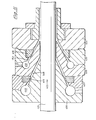
- the extrusion head comprises a base member 9 in the form of a thick metal disc and, mounted in a stack on the base member 9, a plurality of annular plates, referenced, in order of increasing distance from the base member, 8, 7, 6, 5 and 4.
- the plates 4 to 8 and the base member 9 are held together by various bolts holding individual parts to , adjoining parts, and by tie bolts 10 extending longitudinally, i.e. parallel with the head axis, through member 9 and all of the plates 8, 7, 6, 5 and 4.
- the face of the member 9 adjoining the plate 8 is formed with a tapering hollow in which is received a mating complementary insert member 9b affording an end face, adjoining plate 8, which is co-planar with the corresponding end face of the member 9.
- an annular inner member 8a Fitted within the plate 8 is an annular inner member 8a, and fitted within the central aperture in member 8a is a root portion 15a of a mandrel 15 extending axially within the die away from base 9.
- the portion of the radially outer surface of the insert member 9b which lies closer to the end face of base 9, which engages plate 8 is formed as a respective part of a conical surface co-axial with the head, and increasing in radius towards the front end of the head, i.e. in the direction towards plate 4 and the mating portion of the surface of the hollow in base 9 which engages this conical surface is correspondingly conical.
- the radially outer surface of the part of annular inner member 8a nearer the base 9 is formed as an extension of the frusto-conical outer surface of the insert 9b, and mates with a correspondingly conical surface of the aperture through plate 8.
- the root portion 15a of the mandrel is externally cylindrical and is received as a close fit in a correspondingly cylindrical axial bore in the member 8a.
- the root portion 15a has, at its rear end, i.e. its end nearer member 9, a radially outwardly extending flange 15b received closely in a correspondingly dimensioned counter-bore at the rear end of the axial bore through member 8a.
- the rear faces of the flange 15b, member 15a, member 8a and member 8 are co-planar for snug engagement with the respective parts of the composite co-planar face presented by base 9 and insert member 9b.
- the flange 15b is secured in its counterbore by bolts 15c passed through apertures in the flange into the member 8b, and the member 8b is in turn secured to the base 9, with the insert 9b, flange 15b and the inner . portion of plate 8 clamped therebetween, by bolts, not shown, extending parallel with the axis of the head.
- a front die part 2 has a root portion retained in a recess in the plate 4 by means of a retaining plate 3.
- the front die part 2 has a central passage therethrough, the portion 16 of said passage which is within the forward portion of the front die part 2 being cylindrical and coaxial with the outer surface of said forward part, whereas the part 18 of said central passage which extends through said root portion of the front die part is frusto-conical in form converging in the forward direction and being coaxial with said cylindrical bore.
- a planar annular shoulder 20 extends across the root of the front die part and cooperates with the opposing surface of plate 3
- Figure 1 there is shown, above the longitudinal axis of the head, one form of mandrel tip with cooperating front die part, and, below the longitudinal axis, an alternative form of mandrel tip with cooperating front die part.
- the recess in the plate 4 in which the front die part is accommodated is in the form of a cylindrical bore 22 extending axially into the plate 4 from the front face thereof, the diameter of the bore 22 being substantially greater than the external diameter of the root portion of the front die part 2 accommodated therein.
- the front retaining plate 3 is in the form of an annular disc with planar end faces, the forward portion of the front die part 2 extending through the central aperture in the retaining plate 3 with substantial diametrical clearance.
- the front retaining plate 3 is clamped to the plate 4 by means of a plurality of clamping bolts.
- Adjustment bolts (not shown) are provided for centering the die part 2 with respect to the annular plates, or varying the eccentricity of the die part 2 with respect to these plates.
- the plate 8 has the general form of a flat disc, the rear face of which engages the front end face of the base member 9, and the part 8a has the form of a tubular spigot extending forwardly from the plate 8, the exterior of said spigot tapering frusto-conically in the forward direction.
- the rearward part of the axial bore 36 extending through the member 8a is a close sealing fit around the root portion 15a of the mandrel 15.
- an annular groove 38 is formed internally in the member 8a, defining, with the opposing external wall of the mandrel 15 an annular plenum chamber 40.
- the mandrel 15 comprises, in axial succession from root portion 15a to the mandrel tip: portion 15a, portion 15d bolted to portion 15a, portion 15e bolted to portion 15d, and tip portion 15f.
- the part of the mandrel formed by portions 15a, 15d and 15e is of substantially constant external diameter.
- the mandrel 15 is reduced slightly in diameter in the region of the groove 38 and downstream thereof, and the downstream part of mandrel portion 15a and portions 15d and 15e are all of substantially the same diameter.
- the axial bore through the spigot part of member 8a is enlarged in diameter from the forwardmost edge of the groove 38 to the front end of the spigot member to define, extending from the plenum chamber 40 towards the extrusion outlet 16, a rearwardmost part 41 of the extrusion passage.
- the plenum chamber 40 is connected via inclined bores in the mandrel with an axial bore 43 extending rearwardly in the portion 15a, the bore 43 being'connected in turn with a radial bore 43a formed partly in part 15a and partly in insert 9b.
- mandrel portion 15d is formed as a conical tip co-axial with the head, and the mating front end of portion 15a is formed as a correspondingly frusto conical recess ending in the bore 43.
- the inclined bores referred to are each formed by a respective groove formed on the conical surface of portion 15d and a registering groove formed in the mating surface of part 15a.
- the bore 43a is formed by two registering half circular section grooves formed respectively on the face formed by members 8, 8a, and 15a, on the one hand and by members 9 and 9a on the other hand, the bore 43a ending in an inlet orifice on the periphery of the head.
- the plasticised plastics material may be supplied to the plenum chamber 40 via said inclined bores and the bores 43 and 43a which constitute plastics supply passages, to pass from the chamber 40 to the extrusion passage.
- a second plenum chamber 46 is defined partly by an annular groove formed around the spigot portion of the member 8a, partly by an annular groove formed around said spigot portion in the front end face of the plate 8, partly by an annular groove formed in the plate 7 and forming the transition between the rear end face of the plate 7 and the axial passage through the plate 7, and partly by a ring 8b pinned onto the member 8a.
- the plenum chamber 46 is connected with the extrusion passage proper via a passage 48 which is annular in cross section and is of generally frusto-conical form, sloping, in the forward direction from the plenum chamber 46, towards the central axis of the head.
- the passage 48 is defined between, on the one hand, the outer surface of the spigot part of the member 8a, and, on the other hand, a part of the passage through the plate 7, the internal passage through the equalisation ring 11, and the rearward portion of the internal axial passage through the plate 6, the plate 6 having a rear face engaging the front face of the plate 7.
- Plasticised plastics material is supplied, in use, to the plenum chamber 46, via passages each defined by a groove formed on the rearwardly and outwardly facing surface of the insert 9b and a registering groove formed on the forwardly and inwardly facing surface of the base 9.
- the rearwardly facing surface of insert 9b (and thus the mating surface of base 9) comprises a rearwardmost, less acutely tapering conical part and a forwardmost, more acutely tapering frusto-conical part, and a tapering bore 142 is formed axially through the base, the plastics supply passages for the plenum chamber 46 comprising primary large diameter passages, radiating from bore 142, over the less acutely tapering parts of the mating surfaces of insert 9b and base 9, and minor passages branching from each said primary passage and extending over the more acutely tapering parts of said mating surfaces to the plenum chamber 46.
- the bore 43a does not, of course, intersect any of these passages.
- the bore 142 communicates with an axially extending plastics supply duct, shown only partially.
- the plate 6, like the plate 8, comprises a rear portion 6a in the . general form of a flat disc and a spigot portion 6b extending axially forwards from the spigot portion 6a.
- the outer surface of the spigot portion 6b is substantially frusto-conical, tapering forwardly from the portion 6a, and in this case the axial bore through the plate 6 tapers frusto-conically from the rear face of the part 6a to a position somewhat downstream of the position of the front end of the spigot portion 8b, (this tapering portion of the passage through plate 6a partly defining the radially outer wall of the frusto-conically tapering passage 48), whilst the remainder of the bore through the plate 6 is substantially cylindrical.
- a third annular plenum chamber 50 is defined partly by an annular groove formed in the front face of the disc part 6a around the root of the spigot part 6b, partly by a ring 6f, similar to ring 8b, pinned to part 6b, and partly by an annular groove formed in the plate 5 and forming the transition between the rear face of the plate 5 which engages the front face of plate 6 and the axial passage through the plate 5.
- the plenum chamber 50 is also connected with the extrusion passage by a passage 52 of annular cross section tapering forwardly from the plenum chamber 50 towards the head axis, the passage 52 being defined between the outer surface of the spigot part 6b and an opposing, correspondingly frusto-conical surface defined partly by the axial passage through the plate 5 and partly by the axial passage through the equalisation ring 12.
- the plenum chamber 50 is connected via a radially extending duct, with a port formed on the same upper lateral face of the head as is the port in which bore 43a terminates, and in use, plasticised plastics material is fed to these two ports, from a singlesource, via a flow distributing manifold clamped to said face and incorporating flow controlling valves.
- the equalisation rings 11 and 12 are adjustably mounted in the head in a manner similar to the root portion of the front die part 2.
- the rings 11 and 12 which are externally cylindrical and have planar end faces are accommodated in respective radially inwardly open annular channels defined by cylindrical counter bores 56, 54, respectively in the plates 7, 5, respectively and adjoining rear end faces of the plates 6, 4, respectively.
- Each ring 11, 12, has an external diameter substantially smaller than that of the respective bore 56, 54, and is slidable transversely, without appreciable axial play, between the planar end wall of the respective bore 56, 54 respectively and the opposing planar end face of the respective plates 6, 4, said opposing planar faces slidably engaging the opposing planar end faces of the respective rings.
- each ring 11, 12, relative to the head axis is adjustable by means of four adjustment bolts, not shown, the respective set of four adjustment bolts for each ring 11, 12 being distributed at intervals of 90 0 around the head and being screw-threadedly engaged in respective radial bores in the respective plates 7, 5, the adjustment bolts of each set extending, at their inner ends, into the respective bore 56, 54, to engage the periphery of the respective ring 11,12.
- a ring 15h is pinned around the mandrel 15 just downstream of the chamber 40 in much the same way as the rings 8b and 6f are pinned to the members 8a and 6.
- plasticised plastics material is supplied to the plenum chambers 40, 46, 50 and passes therefrom along the respective passage 41, 48, 52 to the annular extrusion passage, the material supplied from the respective plenum chambers remaining disposed in respective annular layers in the annular-section flow of plastics material along the extrusion passage, so that a pipe comprising three concentric layers is extruded from the outlet 16.
- the ring 102 has an internal diameter larger than the diameter of the bottom of the annular groove 104 and the ring 102 is a sliding fit in the groove 104 so that, as explained in detail below, the ring 102 is adjustable in the groove 104 transversely of the longitudinal axis of the die.
- Such transverse adjustment of the ring 102 is effected by means of a plurality of adjustment rods 106 (four in the embodiment shown) each of which extends longitudinally within the mandrel 15 and has a wedge-like tapered nose which is engaged in the gap between the inner surface 108 of the ring 102 and the portion of the part 15e which lies radially inwardly of the ring 102.
- the rods 106 are adjustable individually longitudinally, so that, by virtue of the tapering nose portion of the rods 106 the thickness of the portion of each rod 106 which lies between the spigot portion 15 and the surface 108 can be adjusted to perform substantially the same function as the adjustment screws utilised for the rings 11 and 12.
- Each rod 106 extends through a respective set of aligned bores, parallel with the head axis, in the mandrel portions 15a and 15d, insert 9b and base 9 and in the adjoining wall of the duct 143.
- Each rod 106 has, adjacent its rear end, an integral lug 107 which has, in cross section, the form of an oblong with rounded corners, the longer dimension of the oblong extending transversely with respect to the rod and radially relative to the head.
- Each iug 107 is received as a close sliding fit in a correspondingly shaped radially extending blind slot or recess 107d extending into the base 9 from the rear face thereof and constituting an enlargement of the respective bore in the base 9 receiving the respective rod.
- each lug 107 Adjacent its radially outer end each lug 107 is formed with a screw-threaded bore 107a extending therethrough parallel with the axis of the rod and receiving a bolt 109, a head portion 109a of which is supported by a bearing 109b for rotation in a bore 109c formed through the base 9 to intersect the respective slot 107d, the head of the bolt being retained against longitudinal movement by the bearing 109b and by a thrust pad 109e received in a respective recess formed in the composite face presented by member 8b and member 8.
- each bolt 109 which is the end operated on in use, extends through a respective bore in the flange 143a of the duct, to project from said flange, the bolt being also supported by a bearing in said bore in said flange.
- the longitudinal position of each rod 106 is adjustable by rotation of the respective bolt 109, via the projecting end thereof.
- Each lug 107 also bears, extending parallel with the respective rod, an indicator projection 107g which projects through a further aperture in the flange 143a, to allow the extent to which it projects to be measured.
- Each rod 106 is supported, on its radially inner side, by the mandrel 15, up to its very end.
- a ramp face 112 is provided on each rod 106 to engage the frusto-conical internal surface 108 of the ring 102, said surface 108 having an inclination, relative to the head axis, corresponding to that of said ramp face to the head axis.
- the ring 102 serves a function entirely analogous with that of the adjustment rings 11 and 12, operation of which is described in our U.K. Published Specification No. 2048155A.
- the respective annular-section passage extending from the plenum chamber 40, 46 or 50 includes, at a position therealong downstream of the respective plenum chamber, a portion of said passage which is of limited axial extent (being defined between the bore in the spigot portion 8b and the ring 102 in the case of the passage extending from chamber 40, and being defined between the outer, conical surface of the members 8b, 6 respectively and the respective ring 11, 12 in the case of the passages extending from the chambers 46 and 50 respectively) and which is of restricted radial width as compared with the adjoining parts of this passage.
- transverse adjustment of the ring 102 can be effected without dismantling the head, and even during operation of the head, i.e. during extrusion of a multi- layered tubular product therefrom.
- the ring 102 and the rings 11 and 12 are so formed that even when exactly centered on the axis of the head they project substantially into the respective annular passages which they partly define, thereby forming restrictions in such passages.
- the edges of the rings 11, 12 and 102 projecting into the respective such passages are rounded and profiled as viewed in axial section, as shown, in order to Improve the flow characteristics-of the respective passages.
- the head of Figure 1 may be secured directly to the front end of an injection cylinder for molten plastics material, which would serve to supply the plenum chamber 46 with plastics material via the bore 142 and passages 140, the head being bolted to such an injection cylinder with the axis of the head corresponding with that of the injection cylinder.
- the duct 143 may form the outlet end of such an injection cylinder.
- Figure 3 shows a modification of the head of Figure 1 which may be utilised for the supply of plastics material in a plurality of layers to moulding apparatus such as that described in U.K. Patent No. 1,572,514 for example when it is desired to form, by injection moulding, articles comprising a plurality of (e.g. three layers) of plastics material of different compositions and/or characteristics.
- the modification of Figure 3 may likewise be used with any other injection or flow moulding machine.
- the apparatus of Figure 3 differs from that of Figure 1 in that the adjusting rods are inclined with respect to the head axis and are adjusted directly, and in other minor constructional features 3 as well as in the respects noted below.
- the apparatus of Figure 3 comprises a mandrel part 201 which is, like the part 1, screwed onto the core part 15.
- the part 201 tapers frusto-conically from the part 15f to a co-axial cylindrical portion 211, but this cylindrical portion 211 at its downstream end merges with an outwardly frusto-conically tapering portion 212 of an enlarged head member 213, which includes, in addition to the portion 212, an enlarged co-axial cylindrical portion 214 downstream of portion 212 and, downstream of portion 214, a conical end portion 215 tapering from the portion 214 to a point at the front end of the member 213.
- the apparatus of Figure 3 comprises two end plates 204 and 224 disposed in abutment with one another in series along the head axis, the end plate 204 having a form corresponding substantially to that of the upstream end of the plate 4, while the plate 224 is formed, on its face adjacent the plate 204, with a circular recess 226 in which is accommodated, with radial clearance, as a sealing sliding fit, a control ring 228, in a manner completely analogous to the control rings 11 and 12 and the die 2, the ring 228 being similarly adjustable as to its eccentricity by means of four adjustment bolts 230, regularly spaced around the head axis, two of these bolts being shown.
- annular support member 216 coaxial with the head, and which supports, with provision for axial movement, a hollow nozzle member 218 which receives the head member 213.
- the plate 224 has, on its side remote from the plate 204, an axially projecting cylindrical tubular guide portion 230 having a cylindrical axial bore through which cylindrical portion 211 extends with axial clearance.
- the nozzle 218 is generally cylindrical externally, with a tapering tip portion and an enlarged circular flange 232 at its upstream end which is an axially sliding fit in an axial counterbore 234 formed in the support member 216 from the rear face thereof which engages plate 224.
- the major cylindrical portion, of smaller diameter, of the exterior of the nozzle 218 is similarly a sliding fit in the remainder, of corresponding diameter, of the central bore through member 216.
- the nozzle 218 is urged axially forwards relative to plate 224 by compression springs acting between the front face of the plate 224 and the rear face of the flange 232.
- the nozzle 218 is formed with an axially extending through passage, in which the head member 213 is located, and which is substantially complementary with the form of the head member, but radially enlarged with respect thereto.
- the passage within the nozzle comprises an upstream portion defined by a frusto-conical surface 240 diverging in the downstream direction, an intermediate portion defined by a cylindrical surface 242, and a downstream portion defined by a frusto-conical surface 244 converging in the downstream direction, to a cylindrical outlet portion opening onto the nozzle tip.
- the portion 212 of the head member 213 bears sealingly on the surface 240 to prevent the flow of plastics material past the head portion 213.
- the nozzle 218 When the nozzle is engaged by a complementary socket of a member to be supplied with plastics material, for example a mould or some other device to be so supplied, the nozzle 218 is thereby displaced rearwardly relative to the head and the head member 213 into its rearwardmost position in which the surface 240 is spaced rearwardly, and thus radially outwardly from the head member 213 and a substantially uniform radial clearance is provided between the head member 213 and the walls of the nozzle passage, providing a passage for fluid flow from the apparatus, via the annular gap between portion 211 and the tubular part 230.
- the forward end of the bore in the part 230 is flared frusto-conically to match the surface 240 in this rearwardmost position of the nozzle.
- the rearwardmost part of the passage through the nozzle 218 is formed as a cylindrical bore which is a sealing sliding fit over the cylindrical exterior of the portion 230.
- the rings 11, 12 and 102 in the arrangement of Figure 1 and the ring 228 in the arrangement of Figure 3 project radially into the respective passages and thereby create localized radial restrictions in such passages and that the axially extreme edges of said rings exposed in the respective passages are radiussed as viewed in axial section, to promote smooth flow of plastics through the respective passages.
- the flow passages 48, 52 extend in a substantially conical fashion from the respective plenum chambers 46, 50 to the annular extrusion passage, and the control rings 11, 12 are adjustable radially or diametrally with respect to the longitudinal axis of the extrusion head.
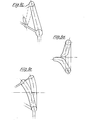
- the arrangement of the embodiments discussed above may be represented schematically by Figure 4,in which the respective passages are indicated by solid lines, the plenum chambers by solid spots and the control rings 102, 11, 12 by respective arrows.
- Figure 5 illustrates an arrangement in which the flow passages 48 and 52 extend radially inwardly from the respective plenum chambers 46, 50 for some way before proceeding in conical fashion towards the extrusion passage 18 as in the arrangement of Figure 4.
- control rings lla, 12a corresponding to control rings 11 and 12 in the arrangement of Figure 4 are arranged to cooperate with the radially extending portions of the respective passages 48, 52 and are movable axially with respect to the extrusion head axis to adjust the axial width of the radially extending portions of the passages 48, 52.
- the arrangement may be such that limited tilting of the planes of the rings lla and 12a relative to the planes of the corresponding radially extending portions of the passages 48, 52 may be effected by way of adjustment, so that the effective axial width of the flow passages 48, 52 at the positions of the rings lla, 12a may be varied around the circumference of the extrusion head.
- the passages 48, 52 each have, extending from the respective plenum chambers 46, 50, respective generally cylindrical portions, extending in the axial direction towards the extrusion outlet, which cylindrical portions connect with respective conical portions, arranged in substantially the same manner as the conical passages 48, 52 in the embodiment of Figure 4, which conical portions, as in Figure 4, communicate at their narrow ends with the extrusion passage 18.
- the control rings 11, 12 associated with the passages 48, 52 respectively are, as in the arrangement of Figure 4, adjustable diametrally with respect to the longitudinal axis of the extrusion head, but the rings 11, 12, in the arrangement of Figure 6, cooperate with the axially extending cylindrical portions of the passages 48, 52.
- plenum chambers 46 and 50 are substantially toroidal, i.e. in cross section perpendicular to the longitudinal axis of the extrusion head, (hereinafter referred to simply as “perpendicular section”), the plenum chambers 46 and 50 have the form of a circular band defined between radially inner and radially outer concentric circular edges, whereas in longitudinal section along the longitudinal axis of the extrusion head (hereinafter referred to simply as “longitudinal section”) the chambers 46 and 50 are substantially circular.
- the plenum chamber 40 although having a circular form in perpendicular section has, in longitudinal section, a semi-circular or "D" shape.
- the plenum chambers 46 and 50 could, if preferred, although having the form of circular rings in perpendicular section, have, in longitudinal section, the form of semi-circles surmounted, on their diameters, by triangles, to afford kite-like shapes, in longitudinal section.
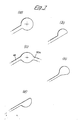
- Figure 7a illustrates a shape, in longitudinal section, corresponding to that of the plenum chambers 46 and 50 in Figure 1
- Figure 7b illustrates a shape in longitudinal section corresponding to that of the variant referred to above.
- Figure 7c illustrates a modified form of plenum chamber in which the shape in longitudinal section is generally ellipsoidal, with the resin flow passage, such as passage 48 or 50 and shown extending to the left from the plenum chamber, meeting the plenum chamber at a point on the major axis of the ellipse, and an inlet port 60a meeting the plenum chamber at an opposing position on said major axis, i.e. at the right in Figure 7c.
- the form illustrated in Figure 7c is particularly suitable for use with heat-sensitive materials such as PVC which require a more streamlined shape in longitudinal section, for the plenum chamber.
- Figure 7d illustrates a plenum chamber which is, in longitudinal section, substantially semi-circular in form, i.e.
- FIG. 7d a form similar to that of the plenum chamber 40 in the embodiments of Figures 1 to 4. It will be appreciated however that, as shown in Figure 7d, such a form may also be utilised in conjunction with a resin flow passage extending from the plenum chamber substantially conically towards the axis of the extrusion head, so that the "flat" side of the sectional shape is afforded by a frusto-conical radially outer surface defining part of the plenum chamber.
- the plenum chamber form shown in Figure 7e is effectively a hybrid between the form of Figure 7a and Figure 7b, with the contours more gently rounded to reduce turbulence etc.
- each plenum chamber has the form of a ring in perpendicular section, (as herein defined).
- the plenum chamber has a form such that, although the chamber still forms a closed loop, the longitudinal position and radial distance from the longitudinal axis x of the chamber varies with angular position around said axis in the manner indicated.
- the resin flow passage extending to the left, is still of substantially conical form, i.e.
- each plenum chamber may take the form of a closed loop encircling the longitudinal axis of the extrusion head.
- a plenum chamber may take any desired form intersecting with the respective resin flow passage.
- a plenum chamber may take the form of a spiral about the longitudinal axis of the head, for example being defined by opposing grooves formed in opposing substantially conical surfaces, which surfaces between them define the respective resin flow passage connecting the plenum chamber with the extrusion passage. As shown in Figure 8c, the spiral may extend over more than one complete turn about the axis of the head.
- a plenum chamber may likewise take the form of an open loop about the axis of the extrusion head, of the form illustrated in Figures 8d and 8e, the resin supply passage 60b which supplies plastics to the plenum chamber meeting the plenum chamber at a point intermediate the ends thereof.
- a single plastics supply passage may communicate with a toroidal plenum chamber at one angular position about the longitudinal axis of the head, or a single inlet port to the head may divide, within the head, into a plurality of supply passages which connect with the plenum chamber via respective ports arranged at different angular positions around the longitudinal axis of the head.
- Figure 9 illustrates, in solid lines, an arrangement in which a plurality of supply passages 400 branch from a single axial inlet passage 404, and diverge, at an angle to the axis of the head, to meet the plenum chamber 405, in an arrangement similar to that described in respect of the plenum chamber 46 and 40 in Figure 1.
- further passages 406 may branch from the passages 400 to meet the plenum chamber in respective further ports.
- a single inlet passage 404 may thus communicate with the respective plenum chamber via one, two, four or eight supply passages.
- each supply passage need not be of uniform cross section throughout their length, but may be profiled and shaped in such a way as to improve the resin flow characteristics.
- each supply passage may spread or fan out towards the plenum chamber, to enter the plenum chamber via a circumferentially elongate feed port.
- One way in which this may be achieved, as shown in Figure 10, is to form the plastics supply passages as respective parts of a conical supply passage, similar to the conical resin flow passages described above, i.e.
- the conical supply passage being defined between an internal and an external conical surface, and to form at least one of these conical surfaces with projections or "islands" 410 adapted to engage the opposing conical surface to block the passage at these points and to define between adjacent islands respective supply passages 412.
- each passage 412 from a relatively narrow region, fans out circumferentially in the direction towards the plenum chamber, the passages 412, in the arrangement shown, connecting with one another again just upstream of the plenum chamber 405.
- the "islands" 410 also, of course, provide regions whereby mechanical support for the member providing the inner, convex conical surface may be provided from the member providing the outer, concave conical surface.
- the fanned supply passage construction of Figure 10 provides a more even flow into the plenum chamber than do passages in the form of individual bores of the type shown in Figure 9.
- Figure 11 shows a further variant of the apparatus of Figure 1, which may be utilised for coating with plastics material a continuous elongate member such as a cable, metal bar or tube, or the like member, whether provided with a metal surface or not.
- the apparatus of Figure 11 corresponds approximately with the apparatus of Figure 1 with the central mandrel removed to leave, extending axially entirely through the head, a central passage to receive the cable or the like to be coated.
- parts which are like to parts in Figure 1 have reference numerals which are 400 greater than the corresponding reference parts in Figure 1.
- a rearwardmost annular member 408 has an axial bore therethrough through which the cable, indicated at 420, passes sealingly along the head axis.
- Plastics material fed from a first plenum chamber 446 passes along a conically tapering supply passage 448 and is applied to the surface of the cable 420 as the latter passes, in the direction of the arrow 423, the exit from the passage 448.
- Plastics material from a second plenum chamber 450 similarly passes along a conically tapering supply passage 452 and is applied to the exterior of the layer of plastics material supplied from the passage 448, the cable, thus provided with two concentric layers of plastics coating, passing through the exit die 402.
- the head of Figure 11 has control rings 411, 412, and a similar adjustable exit die 402 whereby the concentricity of the extruded plastics layers relative to the cable, and variation in thickness of the plastics layers around the cable may be adjusted as desired.
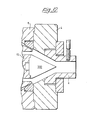
- Figure 12 shows a further variant of the apparatus of Figure 1, intended for the extrusion of solid, as opposed to hollow, members.
- the apparatus of Figure. 12 might be used for extruding a composite plastics member comprising a foamed plastics core enclosed in two non-foamed plastics coating layers.
- foamed material of the core is rigid at normal temperatures, such a product, cut into appropriate lengths, might form lightweight structural members or utilitarian articles such as broom handles, etc.
- the plastics materials used are of a flexible or resilient nature at normal temperatures, such a product might be used, for example, for wood substitutes, and polymeric or elastomeric composite extrusions, for sealing or draught preventative purposes, or for packaging etc.
- the apparatus of Figure 12 differs from that of Figure 1 only in that the free end portion of the mandrel indicated at 500, instead of tapering to a cylindrical portion which extends through the outlet die 2, tapers conically to a point just at the entrance to the cylindrical portion of the bore through the die member 2.
- material from the plenum chambers 40, 46 and 50 proceeds along the respective supply passages to the central extrusion passage to proceed, as three concentric layers, towards the outlet die.
- the material of the innermost layer closes up again at the point of the mandrel, so that the material of the innermost layer forms a solid cylindrical core during passage of the plastics through the cylindrical part of the outlet die 2.
- the plastics material fed to the plenum chamber 40, supplying the innermost layer will in this case be plastics material incorporating a foaming agent, and that, due to the nature of the molten plastics material incorporating such a foaming agent, most of the illustrated expansion of the cross-sectional flow area of the extrusion passage downstream of the control ring 102 will be taken up by foaming or expansion of the material of the innermost layer, so that the intermediate and outermost layers will form a relatively thin coat on the relatively thick central core.
- a single layer, or the core, of the extruded product is produced by plastics material fed to a single plenum chamber defined by a groove around the mandrel
- the remaining, intermediate and outermost layers are formed by plastics material supplied from plenum chambers provided within the outer die structure which surrounds the mandrel, with the plastics material passing forwardly and inwardly towards the central extrusion passage
- two or more layers may, if desired, be formed by plastics material supplied from a corresponding number of mandrel plenum chambers defined by respective grooves formed around the mandrel, in a manner similar to the plenum chamber 40, the material for the innermost layer, (or, in the case of a solid core product, the material for the core), being supplied from that one of the mandrel plenum chambers which is furthest downstream, with the or each of the remaining mandrel plenum chambers supplying material for respective intermediate layers of the product.
- each of the mandrel plenum chambers might have a respective control ring, corresponding to control ring 102, disposed downstream thereof, with similar adjustment means provided therefor, so that the thickness, or the peripheral thickness distribution around the head axis, of each of the layers derived from any of the mandrel plenum chambers, may be adjusted, independently of any of the other layers, by operation of the adjustment means associated with the ring associated with that particular layer, which adjustment means extends through the mandrel in the same way as the adjustment means for the ring 102.
- the mandrel may be so configured as to define, within the mandrel, a plurality of plenum chambers connected with radially or conically outwardly extending resin flow passages which in turn meet, in respective annular outlets, the passage defined between the mandrel and the outer structure, each of the last-mentioned passages having a respective, independently adjustable control ring disposed on its radially outer, or radially inner side, as desired.
- the various layers of the product are of materials having characteristics which differ in some way.
- it may also be advantageous to form two or more contiguous layers of precisely the same plastics material for example to use apparatus such as that of Figure 1 for forming a pipe of single plastics material, as it has been found possible thereby to minimise the effects of the localised variations which tend to occur in a single extruded plastics layer, for example as a result of different durations and histories of passage of some portions of the plastics material through an extrusion head as compared with others.
- the number of concentric layers which may be produced in a product is not limited to any particular number, so that four or more such layers may be produced using a head having a corresponding number of plenum chambers with associated control rings and resin flow passages, so that, for example, three, four or more outer layers might be produced from a corresponding number of plenum chambers in the outer head structure, and three or more inner layers might be produced from respective mandrel plenum chambers, or any desired number of layers might be allotted to corresponding numbers of mandrel plenum-chambers and plenum chambers in the outer head structure, with each plenum chamber having associated therewith a respective independently adjustable control ring.
- Figures 1, 11 and 12 relate to arrangements in which the extruded or coated product is substantially circular in cross section, with the plenum chambers, supply passages, etc. being correspondingly circular in cross section perpendicular to the head axis, it will be appreciated that similar apparatus could be used for extruding solid or hollow articles of any desired cross sectional shape, and that in such cases the cross sectional shapes of the extrusion passage, plastics supply passages, plenum chambers etc. would in general require to be modified correspondingly. Accordingly, the term "annular" as used herein is intended to cover any configuration of closed loop, e.g. whether circular, oval, rectangular etc. in form.
- control rings have been assumed to be annular, (as herein defined), in certain applications control elements may be utilised which are not in the form of a closed loop, but are, for example, of helical or U-shaped form and are accommodated in grooves of complementary form formed in the mandrel or outer head structure, as appropriate.
Landscapes
- Engineering & Computer Science (AREA)
- Mechanical Engineering (AREA)
- Manufacturing & Machinery (AREA)
- Extrusion Moulding Of Plastics Or The Like (AREA)
Applications Claiming Priority (4)
| Application Number | Priority Date | Filing Date | Title |
|---|---|---|---|
| GB8127659 | 1981-09-11 | ||
| GB8127659 | 1981-09-11 | ||
| GB8202792 | 1982-02-01 | ||
| GB8202792 | 1982-02-01 |
Publications (1)
| Publication Number | Publication Date |
|---|---|
| EP0074812A2 true EP0074812A2 (fr) | 1983-03-23 |
Family
ID=26280700
Family Applications (1)
| Application Number | Title | Priority Date | Filing Date |
|---|---|---|---|
| EP82304760A Withdrawn EP0074812A2 (fr) | 1981-09-11 | 1982-09-09 | Procédé et dispositif pour la fabrication de produits multi-couches en matière synthétique |
Country Status (5)
| Country | Link |
|---|---|
| EP (1) | EP0074812A2 (fr) |
| AU (1) | AU8814882A (fr) |
| FI (1) | FI823109A7 (fr) |
| GB (1) | GB2107243A (fr) |
| NO (1) | NO823054L (fr) |
Cited By (7)
| Publication number | Priority date | Publication date | Assignee | Title |
|---|---|---|---|---|
| GB2139553A (en) * | 1983-04-15 | 1984-11-14 | Cosden Technology | Valve plate and feedblock design for co-extrusion apparatus and co-extrusion process using same |
| EP0323089A3 (en) * | 1987-12-31 | 1990-05-09 | American Maplan Corp. | Extrusion apparatus |
| DE4115229C2 (de) * | 1991-05-10 | 2002-05-16 | Collin Gmbh Dr | Verfahren und Vorrichtung zur Herstellung von mehrschichtigen Schlauchfolien oder Rohren |
| WO2011069657A1 (fr) * | 2009-12-11 | 2011-06-16 | Carl Freudenberg Kg | Manche pour dispositif de nettoyage |
| CN111152438A (zh) * | 2020-01-10 | 2020-05-15 | 潍坊市华玉塑料机械有限公司 | 生产带防静电涂层的ibc桶和双环桶用多层储料缸模头 |
| CN115476476A (zh) * | 2022-09-07 | 2022-12-16 | 青岛海尔模具有限公司 | 一种洗衣机平衡环的注塑模具及注塑方法 |
| IT202100032852A1 (it) * | 2021-12-29 | 2023-06-29 | Semplice S P A | Testa di estrusione perfezionata, in particolare per l’estrusione di un materiale polimerico per formare il rivestimento di un filo o cavo o simili. |
-
1982
- 1982-09-08 NO NO823054A patent/NO823054L/no unknown
- 1982-09-08 FI FI823109A patent/FI823109A7/fi not_active Application Discontinuation
- 1982-09-09 GB GB08225788A patent/GB2107243A/en not_active Withdrawn
- 1982-09-09 AU AU88148/82A patent/AU8814882A/en not_active Abandoned
- 1982-09-09 EP EP82304760A patent/EP0074812A2/fr not_active Withdrawn
Cited By (9)
| Publication number | Priority date | Publication date | Assignee | Title |
|---|---|---|---|---|
| GB2139553A (en) * | 1983-04-15 | 1984-11-14 | Cosden Technology | Valve plate and feedblock design for co-extrusion apparatus and co-extrusion process using same |
| EP0323089A3 (en) * | 1987-12-31 | 1990-05-09 | American Maplan Corp. | Extrusion apparatus |
| DE4115229C2 (de) * | 1991-05-10 | 2002-05-16 | Collin Gmbh Dr | Verfahren und Vorrichtung zur Herstellung von mehrschichtigen Schlauchfolien oder Rohren |
| WO2011069657A1 (fr) * | 2009-12-11 | 2011-06-16 | Carl Freudenberg Kg | Manche pour dispositif de nettoyage |
| CN102753074A (zh) * | 2009-12-11 | 2012-10-24 | 卡尔·弗罗伊登伯格公司 | 用于清洁器具的柄杆 |
| CN111152438A (zh) * | 2020-01-10 | 2020-05-15 | 潍坊市华玉塑料机械有限公司 | 生产带防静电涂层的ibc桶和双环桶用多层储料缸模头 |
| CN111152438B (zh) * | 2020-01-10 | 2025-05-16 | 潍坊市华玉塑料机械有限公司 | 生产带防静电涂层的ibc桶和双环桶用多层储料缸模头 |
| IT202100032852A1 (it) * | 2021-12-29 | 2023-06-29 | Semplice S P A | Testa di estrusione perfezionata, in particolare per l’estrusione di un materiale polimerico per formare il rivestimento di un filo o cavo o simili. |
| CN115476476A (zh) * | 2022-09-07 | 2022-12-16 | 青岛海尔模具有限公司 | 一种洗衣机平衡环的注塑模具及注塑方法 |
Also Published As
| Publication number | Publication date |
|---|---|
| FI823109A7 (fi) | 1983-03-12 |
| AU8814882A (en) | 1983-03-17 |
| GB2107243A (en) | 1983-04-27 |
| FI823109A0 (fi) | 1982-09-08 |
| NO823054L (no) | 1983-03-14 |
Similar Documents
| Publication | Publication Date | Title |
|---|---|---|
| US4365949A (en) | Co-extrusion die apparatus for co-extruding plastics materials | |
| CA2082437C (fr) | Filiere d'extrusion de produits tubulaires multicouches a alimentation en spirale | |
| EP0830067B1 (fr) | Filiere a pate | |
| AU662981B2 (en) | A welding method in the manufacture of a spirally wound tube and a welding head for performing the method | |
| US4280801A (en) | Crosshead | |
| EP2261003B1 (fr) | Outil de filière pour extruder un produit tubulaire | |
| CA1061971A (fr) | Tetes extrudeuses pour la production de tubes en plastique composites avec soudures en quinconce | |
| CA1053426A (fr) | Presse pour extrusions multiples | |
| US4889477A (en) | Extruder head | |
| US5616350A (en) | Dual flow divider with diverter valve | |
| US3994644A (en) | Extruder head for extruding an outer tube or sheath about an inner tube or cable | |
| EP0457991B1 (fr) | Filière pour multicouches présentant des ouvertures réglables | |
| IE43414B1 (en) | Apparatus for forming patterned thermoplastic plastics sheets | |
| US5672303A (en) | Process and extruding head for the manufacture and/or coating of extruding profiles | |
| US4547246A (en) | Extrusion method | |
| JPH0232827A (ja) | 方向付けられた流れダイ装置 | |
| CA1308531C (fr) | Matrice d'extrusion | |
| AU596630B2 (en) | Distributing device for manufacturing multi-layer sheets | |
| US4723902A (en) | Balanced flow extrusion crosshead and die assembly | |
| JPH0751308B2 (ja) | 複合壁を有するプラスチックパイプの押出し装置 | |
| GB2107243A (en) | A method of and apparatus for producing multi-layered plastics products | |
| US4931237A (en) | Extrusion die apparatus and process for producing tubular film from thermoplastic molten material | |
| JP2949421B2 (ja) | 押出し成形品の色を変える装置を備えた押出し成形ヘッド | |
| US3349435A (en) | Precision die for manufacture of foamed plastics and the like | |
| US4347050A (en) | Extrusion vessel with controlled circular distribution of the extruded material |
Legal Events
| Date | Code | Title | Description |
|---|---|---|---|
| PUAI | Public reference made under article 153(3) epc to a published international application that has entered the european phase |
Free format text: ORIGINAL CODE: 0009012 |
|
| AK | Designated contracting states |
Designated state(s): AT CH DE FR IT LI NL SE |
|
| STAA | Information on the status of an ep patent application or granted ep patent |
Free format text: STATUS: THE APPLICATION IS DEEMED TO BE WITHDRAWN |
|
| 18D | Application deemed to be withdrawn |
Effective date: 19850402 |
|
| RIN1 | Information on inventor provided before grant (corrected) |
Inventor name: BATTYE, PHILIP GERALD Inventor name: NASH, DAVID DANIEL |