EP0074822A1 - Erkennung von Sprache oder sprachähnlichen Lauten - Google Patents
Erkennung von Sprache oder sprachähnlichen Lauten Download PDFInfo
- Publication number
- EP0074822A1 EP0074822A1 EP82304782A EP82304782A EP0074822A1 EP 0074822 A1 EP0074822 A1 EP 0074822A1 EP 82304782 A EP82304782 A EP 82304782A EP 82304782 A EP82304782 A EP 82304782A EP 0074822 A1 EP0074822 A1 EP 0074822A1
- Authority
- EP
- European Patent Office
- Prior art keywords
- self
- speech
- correlation functions
- recognition
- sound
- Prior art date
- Legal status (The legal status is an assumption and is not a legal conclusion. Google has not performed a legal analysis and makes no representation as to the accuracy of the status listed.)
- Granted
Links
- 238000005314 correlation function Methods 0.000 claims abstract description 41
- 238000000034 method Methods 0.000 claims abstract description 28
- 230000005236 sound signal Effects 0.000 claims abstract description 6
- 230000006870 function Effects 0.000 claims description 4
- 239000013598 vector Substances 0.000 description 11
- 238000005070 sampling Methods 0.000 description 5
- 238000010606 normalization Methods 0.000 description 4
- 230000006835 compression Effects 0.000 description 3
- 238000007906 compression Methods 0.000 description 3
- 238000010586 diagram Methods 0.000 description 2
- 238000012986 modification Methods 0.000 description 2
- 230000004048 modification Effects 0.000 description 2
- 238000001228 spectrum Methods 0.000 description 2
- 238000012795 verification Methods 0.000 description 2
- 238000006243 chemical reaction Methods 0.000 description 1
- 230000001143 conditioned effect Effects 0.000 description 1
- 230000007423 decrease Effects 0.000 description 1
- 230000002950 deficient Effects 0.000 description 1
- 230000001419 dependent effect Effects 0.000 description 1
- 238000000605 extraction Methods 0.000 description 1
- 238000004904 shortening Methods 0.000 description 1
- 210000001260 vocal cord Anatomy 0.000 description 1
Images

Classifications
-
- G—PHYSICS
- G10—MUSICAL INSTRUMENTS; ACOUSTICS
- G10L—SPEECH ANALYSIS TECHNIQUES OR SPEECH SYNTHESIS; SPEECH RECOGNITION; SPEECH OR VOICE PROCESSING TECHNIQUES; SPEECH OR AUDIO CODING OR DECODING
- G10L15/00—Speech recognition
Definitions
- This invention relates to a method of speech recognition.
- a so-called preliminary selection or pre-verification may be carried out to limit the number of object words for recognition prior to execution of a recognition step using the DP matching method or the like.
- preliminary selection Several ways of preliminary selection are well known. For instance, a method is reported by which feature parameters characteristic of the lengths of words and the spectra of the beginning and ending of words are used. This method, however, is not suited for simple type speech recognition systems because it involves complex operation and requires setup of those feature parameters for preliminary selection.
- the present invention provides in one aspect a method of speech recognition using short time self-correlation functions as feature parameters for recognition of speech or speech-like words and especially effecting preliminary selection utilizing part of data for final recoginition, that is, short time self-correlation functions of lower degrees (typically, primary to cubic).
- the present invention provides a method of speech recognition comprising the steps of creating self-correlation functions for input sound signals, deciding the intervals of the sound signals, normalizing the time axis in conjunction with the sound intervals, and conducting recognization of words or the like through deciding using said self-correlation functions as feature parameters whether there is matching with reference patterns, said method further comprising the step of effecting preliminary selection prior to the final recognization step by means of linear matching using said self-correlation functions of lower degrees.
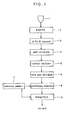
- step 1 Sound inputs introduced via a microphone (step 1) are amplified through an amplifier (step 2) and converted into digital signals via an analog-to-digital converter (step 3).
- step 2 Sound inputs introduced via a microphone
- step 3 Sound inputs introduced via a microphone
- step 3 Sound inputs introduced via a microphone
- step 3 Sound inputs introduced via a microphone
- step 3 Digital signals
- step 4 Self-correlation functions are set up by a self-correlation circuit (step 4).
- the intervals of the sound inputs are decided (step 5) and normalized as to its time axies to expand or compress these intervals to frames of a predetermined number (step 6).
- Preliminary selection is carried out with reference patterns (step 7) by means of self-correlation functions of lower degrees (step 8) to thereby limit the number of object words for recognition to a proper number.
- Fine recognition is then conducted with preliminarily selected ones of the reference patterns through the DP matching method or other methods (step 9). The results of such recognition are outputted.
- the steps from the decision as to the intervals of the sound inputs (step 5) through the final recognition (step 9) are accomplished mainly by a software.
- the amplifier (step 2) has a frequency characteristic of 6 dB/oct. In the light of the fact that the higher frequencies in the frequency spectra of the vocal cords the lower energy, this offers correction that keeps the level of energy as constant as possible.
- the sound inputs or analog signals are converted into the digital signals through the analog-to-digital converter (step 3).
- the signals are generally sampled at a frequency of between 8 and 24 KHz into samples each represented by the digital signals of 6 to 12 bits.
- the sampling frequency is 8 KHz and the representation of the digital signals consists of 8 bits.
- the self-correlation circuit 4 evaluates the self-correlation function ⁇ (m) as follows: where / (n) is the sample value from the analog-to-digital converter 3, m is the number of the degree of the self-correlation functions, N is the number of the samples in a frame, ⁇ (o) is the square of the sample value, i.e., the power of voice and especially ⁇ (1) is the linear self-correlation function, ? (2), ⁇ (3) and so forth are the quadratic, cubic and so forth self-correlation functions.
- the self-corrrelation functions of up to the 24th degree are generally used as feature parameters for recognition of speech or speech-like sounds and the number of necessary degrees is dependent upon the sampling frequency, whereas those of up to the eighth degree are used in the illustrated example.
- the length of the interval where the self-correlation functions ⁇ (m) are evaluated i.e., the width of frames is determined by N and the sampling frequency and generally selected within 8 to 30 msec.
- N 128 and the sampling frequency is 8 KHz so that the frame with is 16 msec.
- the self-correlation functions of Oth to 8th degrees so calculated are represented by 16 bit digital numbers. Since the self- correlat on functions ⁇ (m) so calculated vary with the amplitude of the sound inputs, the self-correlation functions ⁇ (m) are normalized with ⁇ (0) so as to avoid the impact of such variation. That is, preliminary selection and recognition are effected using the self-correlation functions R(m) whch are evaluated below:
- the beginning and ending of words are sensed to determine the intervals of the sound inputs based only upon the power (p (0) in the illustrated example.
- the length of words is properly selected and typically its frame numbers are selected between 13 and 96 (that is, time conversion shows that it lasts for 0.2 to 1.5 sec).
- the sound inputs passing through all of the foregoing steps include patterns of different lengths covering from 13 frames to 96 frames. If those patterns are loaded into a memory as they are, then not only a memory of a large capacity is necessary but also matching processes among patterns of unequal lengths becomes more complex. To avoid this normalization is necessary as for the time axies of the respective intervals of the sound inputs.
- the normalization of time axies is to expand or compress the patterns of different lengths into those of a proper uniform length. Although various ways of expansion and compression seem available for this purpose, linear expansion and compression is used to normalize those patterns into 16 frames in the illustrated example.
- a(i) the frame number of the input as deemed as a voice input is 1 with its feature vector a(i).
- b(r) the feature vector of a signal obtained from the normalization of time axles.
- the first frame b(1) of the normalized signal is the average of a(l) and a(2).
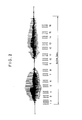
- FIG. 2 An example of expansion and compression of frames is depicted in FIG. 2 when a voice input "TOKYO" is normalized as for time axies.
- a voice input "TOKYO” typically, 640 msec
- a frame width of 16 msec there are 40 frames.
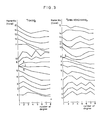
- FIG. 3 depicts variations in the self-correlation functions of the 1th to 8th degrees as for the sound inputs with normalized time axies in the 1st to 16th frames when the sound inputs are "TOKYO” and "SHIN-YOKOHAMA", respectively.
- the self-correlation functions of lower degrees are selected from the self-correlation functions of the sound inputs for the preliminary selection.
- FIG. 4 shows the linear self-correlation functions in time sequence or the order of frame numbers as for five different kinds of the normalized sound inputs.
- the preliminary selection is carried out by matching between the self-correlation functions of such lower degrees as for the sound inputs and reference patterns composed of lower degree self-correlation functions of sound inputs as registered in advance.
- the distance D K between the sound input and (K)th reference pattern is evaluated as follows where b l (r) is the self-correlation function of the sound input in (r)th frame and C K1 (r) is the self-correlation function of (K)th reference pattern in (r)th frame.
- Recognition and acknowledgement are effected between the sound inputs and all of the preliminarily selected ones of the reference patterns. Although various ways of recognition and acknowledgement seem available, the well-known DP matching method using all of the self- corrleation functions of the 1st to 8th degrees is employed in the illustrated embodiment.
- the illustrated embodiment is adapted to see if there is DP matching between the sound input B bearing the feature vectors and the normalized time system and the reference patterns C where B and C are as follows:
- C K is (K)th reference pattern.
- the matching window is conditioned as follows:
- the partial sum g(i, j) of the distance between the sound input B and the reference pattern C is defined below: where b m (i) is (m)th self-correlation function of the sound input B in (i)th frame and C Km (j) is (m)th self-correlation function of (K)th reference pattern in (j)th frame.
- the distance g (16, 16) traversing the path for the minimum of the partial sum corresponds to the distance between the sound input B and the (K)th reference pattern C K .
- the distance g (16, 16) is evaluated for all of the preliminarily selected ones of the reference patterns and the reference pattern that gives the minimum distance is acknowledged as equivalent to the sound input B.
- the speech recognition according to the present invention does not require setup of new feature parameters for the preliminary selection and offers a most effective tool in putting compact type speech recognition systems into practice because it takes the full advantage of the self-correlation functions as absolutely required for the final recognition step.
Landscapes
- Engineering & Computer Science (AREA)
- Computational Linguistics (AREA)
- Health & Medical Sciences (AREA)
- Audiology, Speech & Language Pathology (AREA)
- Human Computer Interaction (AREA)
- Physics & Mathematics (AREA)
- Acoustics & Sound (AREA)
- Multimedia (AREA)
- Compression, Expansion, Code Conversion, And Decoders (AREA)
- Measurement Of Mechanical Vibrations Or Ultrasonic Waves (AREA)
- Telephonic Communication Services (AREA)
Applications Claiming Priority (2)
| Application Number | Priority Date | Filing Date | Title |
|---|---|---|---|
| JP144449/81 | 1981-09-11 | ||
| JP56144449A JPS5844500A (ja) | 1981-09-11 | 1981-09-11 | 音声認識方式 |
Publications (2)
| Publication Number | Publication Date |
|---|---|
| EP0074822A1 true EP0074822A1 (de) | 1983-03-23 |
| EP0074822B1 EP0074822B1 (de) | 1987-03-18 |
Family
ID=15362486
Family Applications (1)
| Application Number | Title | Priority Date | Filing Date |
|---|---|---|---|
| EP82304782A Expired EP0074822B1 (de) | 1981-09-11 | 1982-09-10 | Erkennung von Sprache oder sprachähnlichen Lauten |
Country Status (4)
| Country | Link |
|---|---|
| US (1) | US4516215A (de) |
| EP (1) | EP0074822B1 (de) |
| JP (1) | JPS5844500A (de) |
| DE (1) | DE3275779D1 (de) |
Cited By (2)
| Publication number | Priority date | Publication date | Assignee | Title |
|---|---|---|---|---|
| EP0083509A3 (en) * | 1981-12-25 | 1983-08-24 | Sharp Kabushiki Kaisha | Speech recognition with preliminary matching |
| CN105355202A (zh) * | 2014-08-22 | 2016-02-24 | 现代自动车株式会社 | 语音识别装置、具有语音识别装置的车辆及其控制方法 |
Families Citing this family (22)
| Publication number | Priority date | Publication date | Assignee | Title |
|---|---|---|---|---|
| JPS59216284A (ja) * | 1983-05-23 | 1984-12-06 | Matsushita Electric Ind Co Ltd | パタ−ン認識装置 |
| JPS60181798A (ja) * | 1984-02-28 | 1985-09-17 | 電子計算機基本技術研究組合 | 音声認識装置 |
| US4718094A (en) * | 1984-11-19 | 1988-01-05 | International Business Machines Corp. | Speech recognition system |
| DE3514286A1 (de) * | 1985-04-19 | 1986-10-23 | Siemens AG, 1000 Berlin und 8000 München | System zur erkennung einzeln gesprochener woerter |
| JPS61252594A (ja) * | 1985-05-01 | 1986-11-10 | 株式会社リコー | 音声パタ−ン照合方式 |
| US5774851A (en) * | 1985-08-15 | 1998-06-30 | Canon Kabushiki Kaisha | Speech recognition apparatus utilizing utterance length information |
| JPH0638199B2 (ja) * | 1985-09-02 | 1994-05-18 | 日本電気株式会社 | 音声認識装置 |
| JPS62169199A (ja) * | 1986-01-22 | 1987-07-25 | 株式会社デンソー | 音声認識装置 |
| US5027407A (en) * | 1987-02-23 | 1991-06-25 | Kabushiki Kaisha Toshiba | Pattern recognition apparatus using a plurality of candidates |
| JP2815579B2 (ja) * | 1987-03-10 | 1998-10-27 | 富士通株式会社 | 音声認識における単語候補削減装置 |
| JPH01319099A (ja) * | 1988-06-17 | 1989-12-25 | Matsushita Electric Ind Co Ltd | 音声認識装置 |
| JP2764277B2 (ja) * | 1988-09-07 | 1998-06-11 | 株式会社日立製作所 | 音声認識装置 |
| US5179624A (en) * | 1988-09-07 | 1993-01-12 | Hitachi, Ltd. | Speech recognition apparatus using neural network and fuzzy logic |
| CN1013525B (zh) * | 1988-11-16 | 1991-08-14 | 中国科学院声学研究所 | 认人与不认人实时语音识别的方法和装置 |
| WO1990008439A2 (en) * | 1989-01-05 | 1990-07-26 | Origin Technology, Inc. | A speech processing apparatus and method therefor |
| JP2658426B2 (ja) * | 1989-09-26 | 1997-09-30 | 松下電器産業株式会社 | 音声認識方法 |
| US5146502A (en) * | 1990-02-26 | 1992-09-08 | Davis, Van Nortwick & Company | Speech pattern correction device for deaf and voice-impaired |
| US5651030A (en) * | 1991-05-06 | 1997-07-22 | Motorola, Inc. | Receiver with signal classifier |
| US7630895B2 (en) * | 2000-01-21 | 2009-12-08 | At&T Intellectual Property I, L.P. | Speaker verification method |
| US6076055A (en) * | 1997-05-27 | 2000-06-13 | Ameritech | Speaker verification method |
| US6375467B1 (en) * | 2000-05-22 | 2002-04-23 | Sonia Grant | Sound comprehending and recognizing system |
| JP6677690B2 (ja) * | 2017-10-02 | 2020-04-08 | 株式会社ナイガイ | 襠付き靴下の編成方法 |
Citations (3)
| Publication number | Priority date | Publication date | Assignee | Title |
|---|---|---|---|---|
| FR2337393A1 (fr) * | 1975-12-29 | 1977-07-29 | Dialog Syst | Procede et appareil d'analyse et de reconnaissance de parole |
| US4059725A (en) * | 1975-03-12 | 1977-11-22 | Nippon Electric Company, Ltd. | Automatic continuous speech recognition system employing dynamic programming |
| DE3101851A1 (de) * | 1980-01-23 | 1981-12-17 | Hitachi, Ltd., Tokyo | Verfahren zur abtastung von sprache |
Family Cites Families (2)
| Publication number | Priority date | Publication date | Assignee | Title |
|---|---|---|---|---|
| JPS5525150A (en) * | 1978-08-10 | 1980-02-22 | Nec Corp | Pattern recognition unit |
| JPS5672499A (en) * | 1979-11-19 | 1981-06-16 | Hitachi Ltd | Pretreatment for voice identifier |
-
1981
- 1981-09-11 JP JP56144449A patent/JPS5844500A/ja active Granted
-
1982
- 1982-09-09 US US06/416,165 patent/US4516215A/en not_active Expired - Lifetime
- 1982-09-10 EP EP82304782A patent/EP0074822B1/de not_active Expired
- 1982-09-10 DE DE8282304782T patent/DE3275779D1/de not_active Expired
Patent Citations (3)
| Publication number | Priority date | Publication date | Assignee | Title |
|---|---|---|---|---|
| US4059725A (en) * | 1975-03-12 | 1977-11-22 | Nippon Electric Company, Ltd. | Automatic continuous speech recognition system employing dynamic programming |
| FR2337393A1 (fr) * | 1975-12-29 | 1977-07-29 | Dialog Syst | Procede et appareil d'analyse et de reconnaissance de parole |
| DE3101851A1 (de) * | 1980-01-23 | 1981-12-17 | Hitachi, Ltd., Tokyo | Verfahren zur abtastung von sprache |
Non-Patent Citations (3)
| Title |
|---|
| IEEE TRANSACTIONS ON AUDIO AND ELECTROACOUSTICS, vol. AU-16, no. 2, June 1968, pages 235-239, New York (USA); * |
| IEEE TRANSACTIONS ON COMMUNICATIONS, vol. COM-29, no. 5, May 1981, pages 621-659, New York (USA); * |
| THE BELL SYSTEM TECHNICAL JOURNAL, vol. 60, no. 5, May-June 1981, pages 739-765, Murray Hill, (USA); * |
Cited By (3)
| Publication number | Priority date | Publication date | Assignee | Title |
|---|---|---|---|---|
| EP0083509A3 (en) * | 1981-12-25 | 1983-08-24 | Sharp Kabushiki Kaisha | Speech recognition with preliminary matching |
| CN105355202A (zh) * | 2014-08-22 | 2016-02-24 | 现代自动车株式会社 | 语音识别装置、具有语音识别装置的车辆及其控制方法 |
| CN105355202B (zh) * | 2014-08-22 | 2021-03-09 | 现代自动车株式会社 | 语音识别装置、具有语音识别装置的车辆及其控制方法 |
Also Published As
| Publication number | Publication date |
|---|---|
| DE3275779D1 (en) | 1987-04-23 |
| EP0074822B1 (de) | 1987-03-18 |
| JPS634200B2 (de) | 1988-01-27 |
| JPS5844500A (ja) | 1983-03-15 |
| US4516215A (en) | 1985-05-07 |
Similar Documents
| Publication | Publication Date | Title |
|---|---|---|
| US4516215A (en) | Recognition of speech or speech-like sounds | |
| US4720863A (en) | Method and apparatus for text-independent speaker recognition | |
| US4852181A (en) | Speech recognition for recognizing the catagory of an input speech pattern | |
| US5056150A (en) | Method and apparatus for real time speech recognition with and without speaker dependency | |
| US4394538A (en) | Speech recognition system and method | |
| US4918732A (en) | Frame comparison method for word recognition in high noise environments | |
| AU685788B2 (en) | A method and apparatus for speaker recognition | |
| US4633499A (en) | Speech recognition system | |
| US3812291A (en) | Signal pattern encoder and classifier | |
| US5025471A (en) | Method and apparatus for extracting information-bearing portions of a signal for recognizing varying instances of similar patterns | |
| US4715004A (en) | Pattern recognition system | |
| EP0178509A1 (de) | System zum Lernen von Referenzmustern für Spracherkennung | |
| EP0109190A1 (de) | Einsilbenerkennungseinrichtung | |
| US5144672A (en) | Speech recognition apparatus including speaker-independent dictionary and speaker-dependent | |
| US4589131A (en) | Voiced/unvoiced decision using sequential decisions | |
| US4776017A (en) | Dual-step sound pattern matching | |
| EP0487307A2 (de) | Methode und System zur Spracherkennung ohne Rauschbeeinflussung | |
| Cheung et al. | Feature selection via dynamic programming for text-independent speaker identification | |
| US5191635A (en) | Pattern matching system for speech recognition system, especially useful for discriminating words having similar vowel sounds | |
| US5101434A (en) | Voice recognition using segmented time encoded speech | |
| GB2137791A (en) | Noise Compensating Spectral Distance Processor | |
| EP0074769A1 (de) | Erkennung von Sprache oder sprachähnlichen Lauten unter Anwendung eines assoziativen Speichers | |
| US3304369A (en) | Sound actuated devices | |
| US5159637A (en) | Speech word recognizing apparatus using information indicative of the relative significance of speech features | |
| EP0240329A2 (de) | Geräuschkompensation zur Spracherkennung |
Legal Events
| Date | Code | Title | Description |
|---|---|---|---|
| PUAI | Public reference made under article 153(3) epc to a published international application that has entered the european phase |
Free format text: ORIGINAL CODE: 0009012 |
|
| AK | Designated contracting states |
Designated state(s): DE FR GB IT |
|
| 17P | Request for examination filed |
Effective date: 19830917 |
|
| ITF | It: translation for a ep patent filed | ||
| GRAA | (expected) grant |
Free format text: ORIGINAL CODE: 0009210 |
|
| AK | Designated contracting states |
Kind code of ref document: B1 Designated state(s): DE FR GB IT |
|
| REF | Corresponds to: |
Ref document number: 3275779 Country of ref document: DE Date of ref document: 19870423 |
|
| ET | Fr: translation filed | ||
| PLBE | No opposition filed within time limit |
Free format text: ORIGINAL CODE: 0009261 |
|
| STAA | Information on the status of an ep patent application or granted ep patent |
Free format text: STATUS: NO OPPOSITION FILED WITHIN TIME LIMIT |
|
| 26N | No opposition filed | ||
| ITTA | It: last paid annual fee | ||
| PGFP | Annual fee paid to national office [announced via postgrant information from national office to epo] |
Ref country code: GB Payment date: 19960902 Year of fee payment: 15 |
|
| PGFP | Annual fee paid to national office [announced via postgrant information from national office to epo] |
Ref country code: FR Payment date: 19960910 Year of fee payment: 15 |
|
| PGFP | Annual fee paid to national office [announced via postgrant information from national office to epo] |
Ref country code: DE Payment date: 19960913 Year of fee payment: 15 |
|
| PG25 | Lapsed in a contracting state [announced via postgrant information from national office to epo] |
Ref country code: GB Free format text: LAPSE BECAUSE OF NON-PAYMENT OF DUE FEES Effective date: 19970910 |
|
| PG25 | Lapsed in a contracting state [announced via postgrant information from national office to epo] |
Ref country code: FR Free format text: THE PATENT HAS BEEN ANNULLED BY A DECISION OF A NATIONAL AUTHORITY Effective date: 19970930 |
|
| GBPC | Gb: european patent ceased through non-payment of renewal fee |
Effective date: 19970910 |
|
| PG25 | Lapsed in a contracting state [announced via postgrant information from national office to epo] |
Ref country code: DE Free format text: LAPSE BECAUSE OF NON-PAYMENT OF DUE FEES Effective date: 19980603 |
|
| REG | Reference to a national code |
Ref country code: FR Ref legal event code: ST |