EP0075242A2 - N-Substituierte 2.4-Diamino-m-Xylole und diese enthaltende Haarfärbemittel - Google Patents
N-Substituierte 2.4-Diamino-m-Xylole und diese enthaltende Haarfärbemittel Download PDFInfo
- Publication number
- EP0075242A2 EP0075242A2 EP82108428A EP82108428A EP0075242A2 EP 0075242 A2 EP0075242 A2 EP 0075242A2 EP 82108428 A EP82108428 A EP 82108428A EP 82108428 A EP82108428 A EP 82108428A EP 0075242 A2 EP0075242 A2 EP 0075242A2
- Authority
- EP
- European Patent Office
- Prior art keywords
- carbon atoms
- diamino
- group
- substituted
- customary
- Prior art date
- Legal status (The legal status is an assumption and is not a legal conclusion. Google has not performed a legal analysis and makes no representation as to the accuracy of the status listed.)
- Granted
Links
- -1 N-substituted 2,4-diamino-m-xylols Chemical class 0.000 title claims description 16
- 239000000203 mixture Substances 0.000 title description 10
- 238000004040 coloring Methods 0.000 title description 4
- 239000000118 hair dye Substances 0.000 claims abstract description 23
- XVBLEUZLLURXTF-UHFFFAOYSA-N 2,4-dimethylbenzene-1,3-diamine Chemical class CC1=CC=C(N)C(C)=C1N XVBLEUZLLURXTF-UHFFFAOYSA-N 0.000 claims abstract description 20
- 239000001257 hydrogen Substances 0.000 claims abstract description 6
- 229910052739 hydrogen Inorganic materials 0.000 claims abstract description 6
- 125000004103 aminoalkyl group Chemical group 0.000 claims abstract description 5
- 125000004990 dihydroxyalkyl group Chemical group 0.000 claims abstract description 5
- 125000002768 hydroxyalkyl group Chemical group 0.000 claims abstract description 5
- 125000004433 nitrogen atom Chemical group N* 0.000 claims abstract description 5
- 125000004432 carbon atom Chemical group C* 0.000 claims description 34
- 150000001875 compounds Chemical class 0.000 claims description 11
- 125000000217 alkyl group Chemical group 0.000 claims description 9
- 238000002360 preparation method Methods 0.000 claims description 6
- 239000000654 additive Substances 0.000 claims description 5
- 238000000034 method Methods 0.000 claims description 5
- 229910052757 nitrogen Inorganic materials 0.000 claims description 5
- 150000003839 salts Chemical class 0.000 claims description 5
- 125000004183 alkoxy alkyl group Chemical group 0.000 claims description 4
- 125000004390 alkyl sulfonyl group Chemical group 0.000 claims description 4
- 229940100198 alkylating agent Drugs 0.000 claims description 4
- 239000002168 alkylating agent Substances 0.000 claims description 4
- 239000003795 chemical substances by application Substances 0.000 claims description 4
- 239000000975 dye Substances 0.000 claims description 4
- 238000009903 catalytic hydrogenation reaction Methods 0.000 claims description 3
- 238000006243 chemical reaction Methods 0.000 claims description 3
- 230000008878 coupling Effects 0.000 claims description 3
- 238000010168 coupling process Methods 0.000 claims description 3
- 238000005859 coupling reaction Methods 0.000 claims description 3
- 239000000982 direct dye Substances 0.000 claims description 3
- 150000002431 hydrogen Chemical class 0.000 claims description 3
- XUUSVHGZGPBZLS-UHFFFAOYSA-N 1,3-dimethyl-2,4-dinitrobenzene Chemical group CC1=CC=C([N+]([O-])=O)C(C)=C1[N+]([O-])=O XUUSVHGZGPBZLS-UHFFFAOYSA-N 0.000 claims description 2
- UFHFLCQGNIYNRP-UHFFFAOYSA-N Hydrogen Chemical compound [H][H] UFHFLCQGNIYNRP-UHFFFAOYSA-N 0.000 claims description 2
- 125000005843 halogen group Chemical group 0.000 claims description 2
- 239000008096 xylene Substances 0.000 claims description 2
- 239000000126 substance Substances 0.000 abstract description 13
- 230000003647 oxidation Effects 0.000 abstract description 11
- 238000007254 oxidation reaction Methods 0.000 abstract description 11
- 239000003086 colorant Substances 0.000 abstract description 5
- 125000004178 (C1-C4) alkyl group Chemical group 0.000 abstract 2
- 125000004769 (C1-C4) alkylsulfonyl group Chemical group 0.000 abstract 1
- 125000004435 hydrogen atom Chemical class [H]* 0.000 abstract 1
- RTZKZFJDLAIYFH-UHFFFAOYSA-N Diethyl ether Chemical compound CCOCC RTZKZFJDLAIYFH-UHFFFAOYSA-N 0.000 description 12
- VTYYLEPIZMXCLO-UHFFFAOYSA-L Calcium carbonate Chemical compound [Ca+2].[O-]C([O-])=O VTYYLEPIZMXCLO-UHFFFAOYSA-L 0.000 description 10
- 239000000839 emulsion Substances 0.000 description 9
- XLYOFNOQVPJJNP-UHFFFAOYSA-N water Substances O XLYOFNOQVPJJNP-UHFFFAOYSA-N 0.000 description 9
- 238000004043 dyeing Methods 0.000 description 7
- 239000003921 oil Substances 0.000 description 7
- PLIKAWJENQZMHA-UHFFFAOYSA-N 4-aminophenol Chemical compound NC1=CC=C(O)C=C1 PLIKAWJENQZMHA-UHFFFAOYSA-N 0.000 description 6
- MHAJPDPJQMAIIY-UHFFFAOYSA-N Hydrogen peroxide Chemical compound OO MHAJPDPJQMAIIY-UHFFFAOYSA-N 0.000 description 6
- HEMHJVSKTPXQMS-UHFFFAOYSA-M Sodium hydroxide Chemical compound [OH-].[Na+] HEMHJVSKTPXQMS-UHFFFAOYSA-M 0.000 description 6
- YXFVVABEGXRONW-UHFFFAOYSA-N Toluene Chemical compound CC1=CC=CC=C1 YXFVVABEGXRONW-UHFFFAOYSA-N 0.000 description 6
- ZMANZCXQSJIPKH-UHFFFAOYSA-N Triethylamine Chemical compound CCN(CC)CC ZMANZCXQSJIPKH-UHFFFAOYSA-N 0.000 description 6
- 125000003277 amino group Chemical group 0.000 description 5
- 229910000019 calcium carbonate Inorganic materials 0.000 description 5
- 238000001816 cooling Methods 0.000 description 5
- 238000000921 elemental analysis Methods 0.000 description 5
- 239000000047 product Substances 0.000 description 5
- 238000009835 boiling Methods 0.000 description 4
- 239000006071 cream Substances 0.000 description 4
- 239000012259 ether extract Substances 0.000 description 4
- 239000000706 filtrate Substances 0.000 description 4
- 239000007800 oxidant agent Substances 0.000 description 4
- 238000005691 oxidative coupling reaction Methods 0.000 description 4
- 238000010992 reflux Methods 0.000 description 4
- 238000003756 stirring Methods 0.000 description 4
- OKKJLVBELUTLKV-UHFFFAOYSA-N Methanol Chemical compound OC OKKJLVBELUTLKV-UHFFFAOYSA-N 0.000 description 3
- 230000029936 alkylation Effects 0.000 description 3
- 238000005804 alkylation reaction Methods 0.000 description 3
- 150000002191 fatty alcohols Chemical class 0.000 description 3
- 239000000499 gel Substances 0.000 description 3
- 230000037308 hair color Effects 0.000 description 3
- MMYKTRPLXXWLBC-UHFFFAOYSA-N 1-bromo-2-ethoxyethane Chemical compound CCOCCBr MMYKTRPLXXWLBC-UHFFFAOYSA-N 0.000 description 2
- LDLCZOVUSADOIV-UHFFFAOYSA-N 2-bromoethanol Chemical compound OCCBr LDLCZOVUSADOIV-UHFFFAOYSA-N 0.000 description 2
- XSFKCGABINPZRK-UHFFFAOYSA-N 4-aminopyrazol-3-one Chemical class NC1=CN=NC1=O XSFKCGABINPZRK-UHFFFAOYSA-N 0.000 description 2
- QGZKDVFQNNGYKY-UHFFFAOYSA-N Ammonia Chemical compound N QGZKDVFQNNGYKY-UHFFFAOYSA-N 0.000 description 2
- IJGRMHOSHXDMSA-UHFFFAOYSA-N Atomic nitrogen Chemical compound N#N IJGRMHOSHXDMSA-UHFFFAOYSA-N 0.000 description 2
- OKTJSMMVPCPJKN-UHFFFAOYSA-N Carbon Chemical compound [C] OKTJSMMVPCPJKN-UHFFFAOYSA-N 0.000 description 2
- CTKINSOISVBQLD-UHFFFAOYSA-N Glycidol Chemical compound OCC1CO1 CTKINSOISVBQLD-UHFFFAOYSA-N 0.000 description 2
- KDLHZDBZIXYQEI-UHFFFAOYSA-N Palladium Chemical compound [Pd] KDLHZDBZIXYQEI-UHFFFAOYSA-N 0.000 description 2
- 150000001793 charged compounds Chemical class 0.000 description 2
- HVYWMOMLDIMFJA-DPAQBDIFSA-N cholesterol Chemical compound C1C=C2C[C@@H](O)CC[C@]2(C)[C@@H]2[C@@H]1[C@@H]1CC[C@H]([C@H](C)CCCC(C)C)[C@@]1(C)CC2 HVYWMOMLDIMFJA-DPAQBDIFSA-N 0.000 description 2
- 239000000470 constituent Substances 0.000 description 2
- 235000014113 dietary fatty acids Nutrition 0.000 description 2
- 239000003995 emulsifying agent Substances 0.000 description 2
- 239000000194 fatty acid Substances 0.000 description 2
- 229930195729 fatty acid Natural products 0.000 description 2
- 150000004665 fatty acids Chemical class 0.000 description 2
- 125000000524 functional group Chemical group 0.000 description 2
- 238000004519 manufacturing process Methods 0.000 description 2
- 238000001819 mass spectrum Methods 0.000 description 2
- QARBMVPHQWIHKH-UHFFFAOYSA-N methanesulfonyl chloride Chemical compound CS(Cl)(=O)=O QARBMVPHQWIHKH-UHFFFAOYSA-N 0.000 description 2
- 230000001590 oxidative effect Effects 0.000 description 2
- ZZYXNRREDYWPLN-UHFFFAOYSA-N pyridine-2,3-diamine Chemical class NC1=CC=CN=C1N ZZYXNRREDYWPLN-UHFFFAOYSA-N 0.000 description 2
- 239000002453 shampoo Substances 0.000 description 2
- 239000007787 solid Substances 0.000 description 2
- 239000002562 thickening agent Substances 0.000 description 2
- 230000002110 toxicologic effect Effects 0.000 description 2
- 231100000027 toxicology Toxicity 0.000 description 2
- 238000009736 wetting Methods 0.000 description 2
- 239000000080 wetting agent Substances 0.000 description 2
- UFPKLWVNKAMAPE-UHFFFAOYSA-N (4-aminophenyl)azanium;hydrogen sulfate Chemical compound OS(O)(=O)=O.NC1=CC=C(N)C=C1 UFPKLWVNKAMAPE-UHFFFAOYSA-N 0.000 description 1
- NZTCRHBIQWZHEY-UHFFFAOYSA-N (4-azaniumylphenyl)-methylazanium;sulfate Chemical compound OS(O)(=O)=O.CNC1=CC=C(N)C=C1 NZTCRHBIQWZHEY-UHFFFAOYSA-N 0.000 description 1
- 150000005207 1,3-dihydroxybenzenes Chemical class 0.000 description 1
- CBCKQZAAMUWICA-UHFFFAOYSA-N 1,4-phenylenediamine Chemical compound NC1=CC=C(N)C=C1 CBCKQZAAMUWICA-UHFFFAOYSA-N 0.000 description 1
- NXVHEHXRZVQDCR-UHFFFAOYSA-N 1-n,1-n-diethyl-2-methylbenzene-1,4-diamine Chemical compound CCN(CC)C1=CC=C(N)C=C1C NXVHEHXRZVQDCR-UHFFFAOYSA-N 0.000 description 1
- KZTWOUOZKZQDMN-UHFFFAOYSA-N 2,5-diaminotoluene sulfate Chemical compound OS(O)(=O)=O.CC1=CC(N)=CC=C1N KZTWOUOZKZQDMN-UHFFFAOYSA-N 0.000 description 1
- HQCHAOKWWKLXQH-UHFFFAOYSA-N 2,6-Dichloro-para-phenylenediamine Chemical compound NC1=CC(Cl)=C(N)C(Cl)=C1 HQCHAOKWWKLXQH-UHFFFAOYSA-N 0.000 description 1
- LECMBPWEOVZHKN-UHFFFAOYSA-N 2-(2-chloroethoxy)ethanol Chemical compound OCCOCCCl LECMBPWEOVZHKN-UHFFFAOYSA-N 0.000 description 1
- WFXLRLQSHRNHCE-UHFFFAOYSA-N 2-(4-amino-n-ethylanilino)ethanol Chemical compound OCCN(CC)C1=CC=C(N)C=C1 WFXLRLQSHRNHCE-UHFFFAOYSA-N 0.000 description 1
- RCANFVUNFLBTJG-UHFFFAOYSA-N 2-bromo-6-chlorobenzene-1,4-diamine Chemical compound NC1=CC(Cl)=C(N)C(Br)=C1 RCANFVUNFLBTJG-UHFFFAOYSA-N 0.000 description 1
- MPUYRZSQOVOWER-UHFFFAOYSA-N 2-chloro-6-methylbenzene-1,4-diamine Chemical compound CC1=CC(N)=CC(Cl)=C1N MPUYRZSQOVOWER-UHFFFAOYSA-N 0.000 description 1
- YMDNODNLFSHHCV-UHFFFAOYSA-N 2-chloro-n,n-diethylethanamine Chemical compound CCN(CC)CCCl YMDNODNLFSHHCV-UHFFFAOYSA-N 0.000 description 1
- RAGSWDIQBBZLLL-UHFFFAOYSA-N 2-chloroethyl(diethyl)azanium;chloride Chemical compound Cl.CCN(CC)CCCl RAGSWDIQBBZLLL-UHFFFAOYSA-N 0.000 description 1
- 125000000954 2-hydroxyethyl group Chemical group [H]C([*])([H])C([H])([H])O[H] 0.000 description 1
- KNRVAYVZVIKHHL-UHFFFAOYSA-N 2-methoxy-5-methylbenzene-1,4-diamine Chemical compound COC1=CC(N)=C(C)C=C1N KNRVAYVZVIKHHL-UHFFFAOYSA-N 0.000 description 1
- HGUYBLVGLMAUFF-UHFFFAOYSA-N 2-methoxybenzene-1,4-diamine Chemical compound COC1=CC(N)=CC=C1N HGUYBLVGLMAUFF-UHFFFAOYSA-N 0.000 description 1
- OBCSAIDCZQSFQH-UHFFFAOYSA-N 2-methyl-1,4-phenylenediamine Chemical compound CC1=CC(N)=CC=C1N OBCSAIDCZQSFQH-UHFFFAOYSA-N 0.000 description 1
- HSVBSQWCIQIJNQ-UHFFFAOYSA-N 2-n,4-n-dimethylpyrimidine-2,4,5,6-tetramine Chemical compound CNC1=NC(N)=C(N)C(NC)=N1 HSVBSQWCIQIJNQ-UHFFFAOYSA-N 0.000 description 1
- RCXHRHWRRACBTK-UHFFFAOYSA-N 3-(oxiran-2-ylmethoxy)propane-1,2-diol Chemical compound OCC(O)COCC1CO1 RCXHRHWRRACBTK-UHFFFAOYSA-N 0.000 description 1
- LVGGDFVLXAIAFJ-UHFFFAOYSA-N 4-(2-ethylhydrazinyl)-N,N-dihydroxyaniline Chemical compound ON(C1=CC=C(C=C1)NNCC)O LVGGDFVLXAIAFJ-UHFFFAOYSA-N 0.000 description 1
- CSGNEKGWOJHKOI-UHFFFAOYSA-N 4-(4-azaniumyl-n-butylanilino)butane-1-sulfonate Chemical compound OS(=O)(=O)CCCCN(CCCC)C1=CC=C(N)C=C1 CSGNEKGWOJHKOI-UHFFFAOYSA-N 0.000 description 1
- ZJSSDJCFSASGNQ-UHFFFAOYSA-N 4-(hydroxymethyl)pyridine-2-carbonitrile Chemical compound OCC1=CC=NC(C#N)=C1 ZJSSDJCFSASGNQ-UHFFFAOYSA-N 0.000 description 1
- RDURCWNWCVUFEG-UHFFFAOYSA-N 4-n,4-n-diethyl-6-n-methylpyrimidine-2,4,5,6-tetramine Chemical compound CCN(CC)C1=NC(N)=NC(NC)=C1N RDURCWNWCVUFEG-UHFFFAOYSA-N 0.000 description 1
- BKIIRHXARCYZNY-UHFFFAOYSA-N 4-n,4-n-dimethylpyrimidine-2,4,5,6-tetramine Chemical compound CN(C)C1=NC(N)=NC(N)=C1N BKIIRHXARCYZNY-UHFFFAOYSA-N 0.000 description 1
- YOJKEVXNAVNUGW-UHFFFAOYSA-N 4-n-chlorobenzene-1,4-diamine Chemical compound NC1=CC=C(NCl)C=C1 YOJKEVXNAVNUGW-UHFFFAOYSA-N 0.000 description 1
- VVYWUQOTMZEJRJ-UHFFFAOYSA-N 4-n-methylbenzene-1,4-diamine Chemical compound CNC1=CC=C(N)C=C1 VVYWUQOTMZEJRJ-UHFFFAOYSA-N 0.000 description 1
- SGWBUDIVEVIHND-UHFFFAOYSA-N 4-n-phenylpyrimidine-2,4,5,6-tetramine Chemical compound NC1=NC(N)=C(N)C(NC=2C=CC=CC=2)=N1 SGWBUDIVEVIHND-UHFFFAOYSA-N 0.000 description 1
- DUHATDNXRFRRFH-UHFFFAOYSA-N 6-morpholin-4-ylpyrimidine-2,4,5-triamine Chemical compound NC1=NC(N)=C(N)C(N2CCOCC2)=N1 DUHATDNXRFRRFH-UHFFFAOYSA-N 0.000 description 1
- QKEUDMVNJHDWNZ-UHFFFAOYSA-N 6-piperidin-1-ylpyrimidine-2,4,5-triamine Chemical compound NC1=NC(N)=C(N)C(N2CCCCC2)=N1 QKEUDMVNJHDWNZ-UHFFFAOYSA-N 0.000 description 1
- RYGMFSIKBFXOCR-UHFFFAOYSA-N Copper Chemical compound [Cu] RYGMFSIKBFXOCR-UHFFFAOYSA-N 0.000 description 1
- IAYPIBMASNFSPL-UHFFFAOYSA-N Ethylene oxide Chemical compound C1CO1 IAYPIBMASNFSPL-UHFFFAOYSA-N 0.000 description 1
- 229920000877 Melamine resin Polymers 0.000 description 1
- OKIZCWYLBDKLSU-UHFFFAOYSA-M N,N,N-Trimethylmethanaminium chloride Chemical compound [Cl-].C[N+](C)(C)C OKIZCWYLBDKLSU-UHFFFAOYSA-M 0.000 description 1
- BZORFPDSXLZWJF-UHFFFAOYSA-N N,N-dimethyl-1,4-phenylenediamine Chemical compound CN(C)C1=CC=C(N)C=C1 BZORFPDSXLZWJF-UHFFFAOYSA-N 0.000 description 1
- 229910019142 PO4 Inorganic materials 0.000 description 1
- 239000005662 Paraffin oil Substances 0.000 description 1
- XBDQKXXYIPTUBI-UHFFFAOYSA-N Propionic acid Chemical class CCC(O)=O XBDQKXXYIPTUBI-UHFFFAOYSA-N 0.000 description 1
- 229920002472 Starch Polymers 0.000 description 1
- XSQUKJJJFZCRTK-UHFFFAOYSA-N Urea Chemical compound NC(N)=O XSQUKJJJFZCRTK-UHFFFAOYSA-N 0.000 description 1
- 150000001242 acetic acid derivatives Chemical class 0.000 description 1
- 230000002378 acidificating effect Effects 0.000 description 1
- 230000007059 acute toxicity Effects 0.000 description 1
- 231100000403 acute toxicity Toxicity 0.000 description 1
- 230000000996 additive effect Effects 0.000 description 1
- 229940045714 alkyl sulfonate alkylating agent Drugs 0.000 description 1
- 150000008052 alkyl sulfonates Chemical class 0.000 description 1
- 125000002947 alkylene group Chemical group 0.000 description 1
- 150000001412 amines Chemical class 0.000 description 1
- 229910021529 ammonia Inorganic materials 0.000 description 1
- 229940051880 analgesics and antipyretics pyrazolones Drugs 0.000 description 1
- 125000000129 anionic group Chemical group 0.000 description 1
- QVGXLLKOCUKJST-UHFFFAOYSA-N atomic oxygen Chemical compound [O] QVGXLLKOCUKJST-UHFFFAOYSA-N 0.000 description 1
- 230000015572 biosynthetic process Effects 0.000 description 1
- 229910021538 borax Inorganic materials 0.000 description 1
- 239000004202 carbamide Substances 0.000 description 1
- 239000003054 catalyst Substances 0.000 description 1
- 239000007795 chemical reaction product Substances 0.000 description 1
- 150000001805 chlorine compounds Chemical class 0.000 description 1
- 235000012000 cholesterol Nutrition 0.000 description 1
- 150000001860 citric acid derivatives Chemical class 0.000 description 1
- 238000004440 column chromatography Methods 0.000 description 1
- 239000010949 copper Substances 0.000 description 1
- 229910052802 copper Inorganic materials 0.000 description 1
- 239000002537 cosmetic Substances 0.000 description 1
- 230000006735 deficit Effects 0.000 description 1
- 210000002468 fat body Anatomy 0.000 description 1
- 210000001035 gastrointestinal tract Anatomy 0.000 description 1
- 125000000623 heterocyclic group Chemical group 0.000 description 1
- 238000005984 hydrogenation reaction Methods 0.000 description 1
- 125000002887 hydroxy group Chemical group [H]O* 0.000 description 1
- 238000002955 isolation Methods 0.000 description 1
- 150000003893 lactate salts Chemical class 0.000 description 1
- JDSHMPZPIAZGSV-UHFFFAOYSA-N melamine Chemical compound NC1=NC(N)=NC(N)=N1 JDSHMPZPIAZGSV-UHFFFAOYSA-N 0.000 description 1
- 238000002844 melting Methods 0.000 description 1
- 230000008018 melting Effects 0.000 description 1
- 229920000609 methyl cellulose Polymers 0.000 description 1
- 239000001923 methylcellulose Substances 0.000 description 1
- 235000010981 methylcellulose Nutrition 0.000 description 1
- 150000007522 mineralic acids Chemical class 0.000 description 1
- YHHHQLCTJCJHKQ-UHFFFAOYSA-N n-(2,6-dimethylphenyl)-n',n'-diethylethane-1,2-diamine Chemical group CCN(CC)CCNC1=C(C)C=CC=C1C YHHHQLCTJCJHKQ-UHFFFAOYSA-N 0.000 description 1
- 150000004780 naphthols Chemical class 0.000 description 1
- 230000007935 neutral effect Effects 0.000 description 1
- 150000007524 organic acids Chemical class 0.000 description 1
- 235000005985 organic acids Nutrition 0.000 description 1
- 150000002924 oxiranes Chemical class 0.000 description 1
- 239000001301 oxygen Substances 0.000 description 1
- 229910052760 oxygen Inorganic materials 0.000 description 1
- 150000004989 p-phenylenediamines Chemical class 0.000 description 1
- 229910052763 palladium Inorganic materials 0.000 description 1
- 239000002304 perfume Substances 0.000 description 1
- 150000002989 phenols Chemical class 0.000 description 1
- 235000021317 phosphate Nutrition 0.000 description 1
- 150000003013 phosphoric acid derivatives Chemical class 0.000 description 1
- USHAGKDGDHPEEY-UHFFFAOYSA-L potassium persulfate Chemical compound [K+].[K+].[O-]S(=O)(=O)OOS([O-])(=O)=O USHAGKDGDHPEEY-UHFFFAOYSA-L 0.000 description 1
- 235000019394 potassium persulphate Nutrition 0.000 description 1
- 238000012746 preparative thin layer chromatography Methods 0.000 description 1
- 150000003142 primary aromatic amines Chemical class 0.000 description 1
- JEXVQSWXXUJEMA-UHFFFAOYSA-N pyrazol-3-one Chemical class O=C1C=CN=N1 JEXVQSWXXUJEMA-UHFFFAOYSA-N 0.000 description 1
- PZRKPUQWIFJRKZ-UHFFFAOYSA-N pyrimidine-2,4,5,6-tetramine Chemical compound NC1=NC(N)=C(N)C(N)=N1 PZRKPUQWIFJRKZ-UHFFFAOYSA-N 0.000 description 1
- 239000011541 reaction mixture Substances 0.000 description 1
- 159000000000 sodium salts Chemical class 0.000 description 1
- 235000010339 sodium tetraborate Nutrition 0.000 description 1
- 239000008107 starch Substances 0.000 description 1
- 235000019698 starch Nutrition 0.000 description 1
- 238000006467 substitution reaction Methods 0.000 description 1
- 150000003467 sulfuric acid derivatives Chemical class 0.000 description 1
- 238000003786 synthesis reaction Methods 0.000 description 1
- BSVBQGMMJUBVOD-UHFFFAOYSA-N trisodium borate Chemical compound [Na+].[Na+].[Na+].[O-]B([O-])[O-] BSVBQGMMJUBVOD-UHFFFAOYSA-N 0.000 description 1
Classifications
-
- A—HUMAN NECESSITIES
- A61—MEDICAL OR VETERINARY SCIENCE; HYGIENE
- A61K—PREPARATIONS FOR MEDICAL, DENTAL OR TOILETRY PURPOSES
- A61K8/00—Cosmetics or similar toiletry preparations
- A61K8/18—Cosmetics or similar toiletry preparations characterised by the composition
- A61K8/30—Cosmetics or similar toiletry preparations characterised by the composition containing organic compounds
- A61K8/40—Cosmetics or similar toiletry preparations characterised by the composition containing organic compounds containing nitrogen
- A61K8/41—Amines
- A61K8/411—Aromatic amines, i.e. where the amino group is directly linked to the aromatic nucleus
-
- A—HUMAN NECESSITIES
- A61—MEDICAL OR VETERINARY SCIENCE; HYGIENE
- A61Q—SPECIFIC USE OF COSMETICS OR SIMILAR TOILETRY PREPARATIONS
- A61Q5/00—Preparations for care of the hair
- A61Q5/10—Preparations for permanently dyeing the hair
Definitions
- the invention relates to new, N-substituted 2,4-diamino-m-xylenes and agents for the oxidative coloring of hair, which contain these N-substituted 2,4-diamino-m-xylenes as coupling component.
- oxidation colors which result from the oxidative coupling of a developer component with a coupler component, play a preferred role for dyeing hair because of their intense colors and very good fastness properties.
- Nitrogen bases such as p-phenylenediamine derivatives, diaminopyridines, 4-amino-pyrazolone derivatives and heterocyclic hydrozones, are usually used as developer substances. Phenols, naphthols, resorcinol derivatives and pyrazolones are mentioned as so-called coupler components.
- the hair to be dyed should also be safe from a toxicological and dermatological point of view. It is also important that the hair to be dyed be as strong as possible and largely match the natural hair color shades. Furthermore, the general stability of the dyes formed and their light fastness, wash fastness and thermal stability are of particular importance in order to avoid color shifts from the original color shade or even color changes to other colors.
- the invention relates to 2,4-diamino-m-xylenes of the general formula I. in which one of the two radicals, R or R, is hydrogen, the other an alkyl group with 1-4 carbon atoms, an alkylsulfonyl group with 1-4 carbon atoms, a mono- or dihydroxyalkyl group with 2-4 carbon atoms, an alkoxyalkyl group with 1-4 Carbon atoms in the alkoxy radical and 2-4 carbon atoms in the alkyl radical or an aminoalkyl group with 2-4 carbon atoms which is optionally substituted on the nitrogen atom by one or two alkyl groups with 1-4 carbon atoms or one or two hydroxyalkyl groups with 2-4 carbon atoms.
- the invention further relates to hair colorants consisting of at least one N-substituted 2,4-diamino-m-xylene of the formula I or its inorganic or organic salt, at least one customary development component, optionally further customary coupler components and optionally customary direct dyes and customary other additives .
- the compounds of the formula I according to the invention When used as coupler components, the compounds of the formula I according to the invention, with the developer substances generally used for oxidation hair dyeing, give very intense color shades which, depending on the type of developer substance used, enable the production of green-gray, red-brown, black-blue or dark purple hues.
- the new coupler substances thus represent a significant enrichment of the oxidative hair dyeing possibilities.
- the 2,4-diamino-m-xylenes according to the invention are also readily water-soluble and therefore easy to use in hair dyes to process. They show a very low acute toxicity and are therefore to be regarded as toxicologically and dermatologically harmless.
- the oxidation hair colors produced with the 2,4-diamino-m-xylenes according to the invention are notable for very good fastness properties of the dyeings obtained therewith.
- Oxidation hair colorants containing the 2,4-diamino-m-xylenes of the formula I according to the invention and / or their inorganic or organic salts are therefore particularly valuable compositions in the field of oxidation hair colorants.
- the N-substituted 2,4-diamino-m-xylenes of the formula I according to the invention are advantageously prepared starting from the unsubstituted 2,4-diamino-m-xylene.
- This compound is accessible by catalytic hydrogenation from the commercially available 2,4-dinitro-m-xylene.
- the catalytic hydrogenation is carried out by reaction with hydrogen in the presence of hydrogenation catalysts such as, for example, palladium on activated carbon, by a process known per se.
- N-substituted for producing the inventive 2.4- iAmino D-m-xylenes is 2.4-diamino-m-xylene in a molar ratio 1: 1 is reacted with suitable alkylating agents in the presence of bases.
- Suitable alkylating agents are compounds of the general formula R - X, in which X represents a halogen atom and R is an alkyl group with 1-4 carbon atoms, an alkylsulfonyl group with 1-4 carbon atoms, a mono- or dihydroxyalkyl group with 2-4 carbon atoms, an alkoxyalkyl group with 1 - 4 carbon atoms in the alkoxy radical and 2 - 4 carbon atoms represents in the alkyl radical or an aminoalkyl group with 2-4 carbon atoms, which is optionally substituted on the nitrogen atom by one or two alkyl groups with 1-4 carbon atoms or by one or two hydroxyalkyl groups with 2-4 carbon atoms.
- Suitable alkylating agents are, for example, 2-bromoethanol, 2-bromoethyl ethyl ether, 2-diethylaminoethyl chloride, 2- (2-chloroethoxy) ethanol, methanesulfonic acid chloride, etc.
- Suitable bases are, for example, triethylamine or calcium carbonate.
- the alkylation can also be carried out using suitable oxirane compounds, for example using alkylene oxides having 1-4 carbon atoms or glycidol.
- the substitution can take place both on the amino group in the 2-position and on the amino group in the 4-position.
- the alkylation of the amino groups in the 4-position is slightly preferred, mixtures of the two structurally isomeric compounds are always formed.
- the two compounds can be separated from one another by methods known per se and represented purely, e.g. by column chromatography or by preparative thin layer chromatography.
- the mixture of the isomers, on the amino group in the 2-position and the 2,4-diamino-m-xylene substituted on the amino group in the 4-position is equally suitable for use as a coupler component in oxidation hair dyes and shows all of the application-related, toxicological ones mentioned and dyeing advantages.
- 2,4-diamino-m-xylenes are, for example, 2 (4) -amino-4 (2) - (2-hydroxyethyl) -amino-m-xylene, 2 (4) -Amino-4 (2) - [(2-hydroxypropyl) amine] -m-xylene, 2 (4) -amino-4 (2) - [(2-ethoxyethyl) -amino] -m- xylene, 2 (4) -amino-4 (2) - [(2.3-dihydroxypropyl) -amino] -m-xylene 2 (4) -amino-4 (2) - [(2-diethylaminoethyl) -amino] -m -xylene 2 (4) -amino-4 (2) - [2-di- (2-hydroxyethyl) -aminoethyl] -amino-m-xylene 2 (4) -amino-4 (2)
- the substituted 2,4-diamino-m-xylenes to be used according to the invention as coupler components can be used either as such or in the form of their salts with inorganic or organic acids, such as e.g. can be used as chlorides, sulfates, phosphates, acetates, propionates, lactates, citrates.
- developer substances which can be used in the hair colorants according to the invention are primary aromatic amines with a further functional group located in the p-position, such as p-phenylenediamine, p-toluenediamine, p-aminophenol, N-methyl-p-phenylenediamine, N , N-dimethyl-p-phenylenediamine, N, N-diethyl-2-methyl-p-phenylenediamine,.
- the coupler components are generally used in approximately molar amounts, based on the developer substances used. If molar use also proves to be expedient, it is not disadvantageous, however, if the coupler component is used in a certain excess or deficit.
- developer component and the coupler substance are uniform products; rather, both the developer component and mixtures of the developer compounds to be used according to the invention and the coupler substance can be mixtures of the N-substituted 2,4-diamino-m-xylenes to be used according to the invention.
- the hair colorants according to the invention can optionally contain conventional direct dyes in the mixture, if this is necessary to achieve certain color nuances.
- the oxidative coupling i.e. the development of the coloring, in principle, as with other oxidation hair dyes, can take place through atmospheric oxygen.
- chemical oxidizing agents are expediently used.
- hydrogen peroxide or its adducts with urea, melamine and sodium borate as well as mixtures of such hydrogen peroxide additive compounds with potassium peroxydisulfate come into consideration as such.
- the hair colorants according to the invention are incorporated into corresponding cosmetic preparations such as creams, emulsions, gels or simple solutions for use, and one of the oxidizing agents mentioned is added to the hair immediately before use.
- concentration of such dye preparations on coupler-developer combination is 0.2 to 5 percent by weight, preferably 1 to 3 percent by weight.
- the dye components are mixed with the other constituents customary for such preparations.
- wetting or emulsifying agents of the anionic or nonionic type such as alkylbenzenesulfonates, fatty alcohol sulfates, alkylsulfonates, fatty acid alkanolamides, adducts of ethylene oxide with fatty alcohols, thickeners such as methyl cellulose, starch, higher fatty alcohols, paraffin oil, fatty acids, and also perfume oils and pantothelic oils and hair care products To call cholesterol.
- the additives mentioned are used in the amounts customary for these purposes, such as wetting and emulsifying agents in concentrations of 0.5 to 30 percent by weight and thickeners in concentrations of 0.1 to 25 percent by weight, based in each case on the entire preparation.
- the hair colorants according to the invention can be used in a weakly acidic, neutral or, in particular, alkaline medium at a pH of 8 to 10.
- the application temperatures range from 15 to 40 ° C.
- the hair dye is removed from the hair to be colored by rinsing. The hair is then washed with a mild shampoo and dried.
Landscapes
- Life Sciences & Earth Sciences (AREA)
- Health & Medical Sciences (AREA)
- Animal Behavior & Ethology (AREA)
- General Health & Medical Sciences (AREA)
- Public Health (AREA)
- Veterinary Medicine (AREA)
- Birds (AREA)
- Epidemiology (AREA)
- Cosmetics (AREA)
- Organic Low-Molecular-Weight Compounds And Preparation Thereof (AREA)
Abstract

Description
- Gegenstand der Erfindung sind neue, N-substituierte 2.4-Diamino-m-Xylole sowie Mittel zur oxidativen Färbung von Haaren, welche diese N-substituierten 2.4-Diamino-m-Xylole als Kupplungskomponente enthalten.
- Für das Färben von Haaren spielen die sogenannten Oxidationsfarben, die durch oxidative Kupplung einer Entwicklerkomponente mit einer Kupplerkomponente entstehen, wegen ihrer intensiven Farben und sehr guten Echtheitseigenschaften eine bevorzugte Rolle. Als Entwicklersubstanzen werden üblicherweise Stickstoffbasen, wie p-Phenylendiaminderivate, Diaminopyridine, 4-Amino-pyrazolon-derivate, heterocyclische Hydrozone eingesetzt. Als sogenannte Kupplerkomponenten werden Phenole, Naphthole, Resorcinderivate und Pyrazolone genannt.
- Gute Oxidationshaarfarbstoffkomponenten müssen in erster Linie folgende Voraussetzungen erfüllen:
- Sie müssen bei der oxidativen Kupplung mit den jeweiligen Entwickler- bzw. Kupplerkomponenten die gewünschten Farbnuancen in ausreichender Intensität ausbilden.
- Sie müssen ferner ein ausreichendes bis sehr gutes Aufziehvermögen auf menschlichem Haar besitzen, und sie
- sollen darüber hinaus in toxikologischer und dermatologischer Hinsicht unbedenklich sein. Weiterhin ist von Bedeutung, daß auf dem zu färbenden Haar möglichst kräftige und den natürlichen Haarfarbnuancen weitgehend entsprechende Farbtöne erhalten werden. Ferner kommt der allgemeinen Stabilität der gebildeten Farbstoffe sowie deren Lichtechtheit, Waschechtheit und Thermostabilität ganz besondere Bedeutung zu, um Farbverschiebungen von der ursprünglichen Farbnuance oder gar Farbumschläge in andere Farbtöne zu vermeiden.
- Es bestand daher bei der Suche nach brauchbaren Oxidationshaarfarbstoffen die Aufgabe, geeignete Komponenten aufzufinden, die vorgenannte Voraussetzungen in optimaler Weise erfüllen.
- Es wurde nun gefunden, daß man zu Oxidationshaarfarben gelangt, welche den gestellten Anforderungen in besonders hohem Maße gerecht werden, wenn man als Kupplerkomponenten die nachstehend beschriebenen neuen Verbindungen in Kombination mit üblichen Entwicklersubstanzen verwendet.
- Gegenstand der Erfindung sind 2.4-Diamino-m-Xylole der allgemeinen Formel I
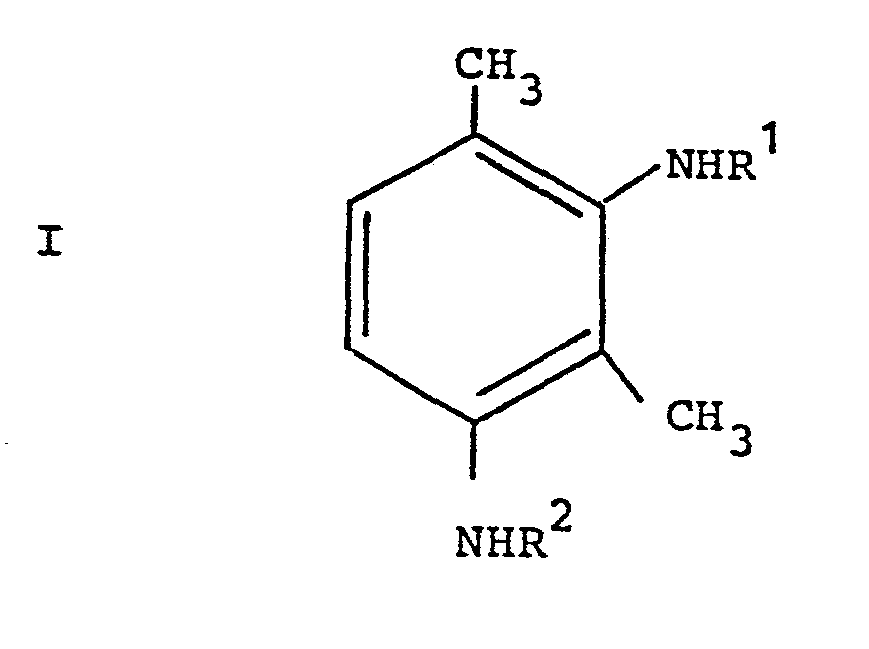
- Ein weiterer Gegenstand der Erfindung sind Haarfärbemittel, bestehend aus mindestens einem N-substituierten 2.4-Diamino-m-Xylol der Formel I oder dessen anorganischem oder organischem Salz, mindestens einer üblichen Entwicklungskomponente, gegebenenfalls weiteren üblichen Kupplerkomponenten sowie gegebenenfalls üblichen direktziehenden Farbstoffen und üblichen weiteren Zusätzen.
- Bei ihrem Einsatz als Kupplerkomponenten liefern die erfindungsgemäßen Verbindungen der Formel I mit den im allgemeinen für die Oxidationshaarfärbung verwendeten Entwicklersubstanzen sehr intensive Farbtöne, die, je nach Art der verwendeten Entwicklersubstanz die Erzeugung von grüngrauen, rotbraunen, schwarzblauen oder dunkelvioletten Farbtönen ermöglichen. Die neuen Kupplersubstanzen stellen somit eine wesentliche Bereicherung der oxidativen Haarfärbemöglichkeiten dar.Die erfindungsgemäßen 2.4-Diamino-m-Xylole sind außerdem gut wasserlöslich und daher leicht in Haarfärbemitteln zu verarbeiten. Sie zeigen eine sehr niedrige akute Giftigkeit und sind daher als toxikologisch und dermatologisch unbedenklich anzusehen. Darüber hinaus zeichnen sich die mit den erfindungsgemäßen 2.4-Diamino-m-Xylolen hergestellten Oxidationshaarfarben durch sehr gute Echtheitseigenschaften der damit erzielten Färbungen aus.
- Oxidationshaarfärbemittel mit einem Gehalt an den erfindungsgemäßen 2.4-Diamino-m-Xylolender Formel I und/ oder deren anorganischen oder organischen Salzen stellen daher besonders wertvolle Kompositionen auf dem Gebiet der Oxidationshaarfärbemittel dar.
- Die Herstellung der erfindungsgemäßen N-substituierten 2.4-Diamino-m-Xylole der Formel I erfolgt zweckmäßig ausgehend vom unsubstituierten 2.4-Diamino-m-Xylol. Diese Verbindung ist durch katalytische Hydrierung aus dem im Handel erhältlichen 2.4-Dinitro-m-Xylol zugänglich. Die katalytische Hydrierung erfolgt durch Umsetzung mit Wasserstoff in Gegenwart von Hydrierkatalysatoren wie z.B. Palladium auf Aktivkohle nach an sich bekanntem Verfahren. Zur Herstellung der erfindungsgemäßen N-substituierten 2.4-Diamino-m-Xylole wird 2.4-Diamino-m-Xylol im Molverhältnis 1 : 1 mit geeigneten Alkylierungsmitteln in Gegenwart von Basen umgesetzt. Als geeignete Alkylierungsmittel kommen Verbindungen der allgemeinen Formel R - X infrage, in welchen X ein Halogenatom darstellt und R eine Alkylgruppe mit 1 - 4 Kohlenstoffatomen, eine Alkylsulfonylgruppe mit 1 - 4 Kohlenstoffatomen, eine Mono- oder Dihydroxyalkylgruppe mit 2 - 4 Kohlenstoffatomen, eine Alkoxyalkylgruppe mit 1 - 4 Kohlenstoffatomen im Alkoxyrest und 2 - 4 Kohlenstoffatomen im Alkylrest oder eine Aminoalkylgruppe mit 2 - 4 Kohlenstoffatomen darstellt, die gegebenenfalls am Stickstoffatom durch eine oder zwei Alkylgruppen mit 1 - 4 Kohlenstoffatomen oder durch eine oder zwei Hydroxyalkylgruppen mit 2 - 4 Kohlenstoffatomen substituiert ist. Geeignete Alkylierungsmittel sind z.B. 2-Bromethanol, 2-Bromethyl-ethylether, 2-Diethylaminoethylchlorid, 2-(2-Chlorethoxy)-ethanol, Methansulfonsäurechlorid usw. Geeignete Basen sind z.B. Triethylamin oder Calciumcarbonat. Die Alkylierung kann auch mit geeigneten Oxiranverbindungen durchgeführt werden, z.B. mit Alkylenoxiden mit 1 - 4 Kohlenstoffatomen oder Glycidol.
- Bei der Alkylierung des 2.4-Diamino-m-xylols kann die Substitution sowohl an der Aminogruppe in 2-Position als auch an der Aminogruppe in 4-Position stattfinden. Obwohl die Alkylierung der Aminogruppen in 4-Position leicht bevorzugt ist, entstehen stets Mischungen der beiden strukturisomeren Verbindungen. Die beiden Verbindungen lassen sich zwar durch an sich bekannte Methoden voneinander trennen und rein darstellen, z.B. durch Säulenchromatographie oder durch präparative Dünnschichtchromatographie. Für die Verwendung als Kupplerkomponente in Oxidationshaarfärbemitteln ist jedoch das Gemisch der Isomeren, an der Aminogruppe in 2-Position und der an der Aminogruppe in 4-Position substituierten 2.4-Diamino-m-xylole in gleicher Weise geeignet und zeigt alle die genannten anwendungstechnischen, toxikologischen und färbetechnischen Vorzüge.
- Beispiele für erfindungsgemäße 2.4-Diamino-m-xylole sind z.B. 2(4)-Amino-4(2)-(2-hydroxyethyl)-amino-m-xylol, 2(4)-Amino-4(2)-[(2-hydroxypropyl)-amin]-m-xylol, 2(4)-Amino-4(2)-[(2-ethoxyethyl)-amino]-m-xylol, 2(4)-Amino-4(2)-[(2.3-dihydroxypropyl)-amino]-m-xylol 2(4)-Amino-4(2)-[(2-diethylaminoethyl)-amino]-m-xylol 2(4)-Amino-4(2)-[2-di-(2-hydroxyethyl)-aminoethyl]-amino-m-xylol 2(4) -Amino-4 (2) - [2-(2-hydroxy -ethoxy) -ethyll-amino-m-xylol
- Die erfindungsgemäß als Kupplerkomponenten zu verwendenden substituierten 2.4-Diamino-m-xylole können entweder als solche oder in Form ihrer Salze mit anorganischen oder organischen Säuren, wie z.B. als Chloride, Sulfate, Phosphate, Acetate, Propionate, Lactate, Citrate eingesetzt werden.
- Als Beispiele für Entwicklersubstanzen, die in den erfindungsgemäßen Haarfärbemitteln eingesetzt werden können, sind primäre aromatische Amine mit einer weiteren in p-Stellung befindlichen funktionellen Gruppe wie p-Phenylendiamin, p-Toluylendiamin, p-Aminophenol, N-Methyl-p-phenylendiamin, N,N-Dimethyl-p-phenylendiamin, N,N-Diethyl-2-methyl-p-phenylendiamin, . N-Ethyl-N-hydroxyethyl-p-phenylendiamin, Chlor-p-phenylendiamin, N,N-Bis-hydroxy-ethylamino-p-phenylendiamin, Methoxy-p-phenylendiamin, 2,6-Dichlor-p-phenylendiamin, 2-Chlor-6-brom-p-phenylendiamin, 2-Chlor-6-methyl-p-phenylendiamin, 6-Methoxy-3-methyl-p-phenylendiamin, andere Verbindungen der genannten Art, die weiterhin eine oder mehrere funktionelle Gruppen wie OH-Gruppen, NH2-Gruppen, NHR-Gruppen, NR2-Gruppen, wobei R einen Alkyl- oder Hydroxyalkylrest mit 1 - 4 Kohlenstoffatomen darstellt, ferner Diaminopyridinderivate, heterocyclische Hydrazonderivate wie 1-Methylpyrrolidon-(2)-hydrazon, 4-Aminopyrazolonderivate wie 4-Amino-1-phenyl-3-carbamoyl-pyrazolon-5, N-Butyl-N-sulfobutyl-p-phenylendiamin, Tetraaminopyrimidine wie 2,4,5,6-Tetraaminopyrimidin, 4,5-Diamino-2,6-bismethyl- aminopyrimidin, 2,5-Diamino-4-diethylamino-6-methyl- aminopyrimidin, 2,4,5-Triamino-6-dimethylaminopyrimi- din, 2,4,5-Triamino-6-piperidinopyrimidin, 2,4,5-Tri- amino-6-anilino-pyrimidin, 2,4,5-Triamino-6-morpho- linopyrimidin, 2,4,5-Triamino-6-ß-hydroxy-ethylamino- pyrimidin anzuführen.
- In den erfindungsgemäßen Haarfärbemitteln werden die Kupplerkomponenten im allgemeinen in etwa molaren Mengen, bezogen auf die verwendeten Entwicklersubstanzen, eingesetzt. Wenn sich auch der molare Einsatz als zweckmäßig erweist, so ist es jedoch nicht nachteilig, wenn die Kupplerkomponente in einem gewissen Überschuß oder Unterschuß zum Einsatz gelangt.
- Es ist ferner nicht erforderlich, daß die Entwicklerkomponente und die Kupplersubstanz einheitliche Produkte darstellen, vielmehr können sowohl die Entwicklerkomponente Gemische der erfindungsgemäß zu verwendenden Entwicklerverbindungen als auch die Kupplersubstanz Gemische der erfindungsgemäß einzusetzenden N-substituierten 2,4-Diamino-m-xylole darstellen.
- Es ist insbesondere aus wirtschaftlichen Gründen vorteilhaft, die bei der beschriebenen Synthese der erfindungsgemäßen 2,4-Diamino-m-xylole anfallenden Gemische der in 2-Position und der in 4-Position substituierten 2,4-Diamino-m-xylöle direkt ohne Isolierung der einzelnen Isomeren einzusetzen.
- Darüber hinaus können die erfindungsgemäßen Haarfärbemittel gegebenenfalls übliche direktziehende Farbstoffe im Gemisch enthalten, falls dies zur Erzielung gewisser Farbnuancen erforderlich ist.
- Die oxidative Kupplung, d.h. die Entwicklung der Färbung, kann grundsätzlich wie bei anderen Oxidationshaarfarbstoffen auch, durch Luftsauerstoff erfolgen. Zweckmäßigerweise werden jedoch chemische Oxidationsmittel eingesetzt. Als solche kommen insbesondere Wasserstoffperoxid oder dessen Anlagerungsprodukte an Harnstoff, Melamin und Natriumborat sowie Gemische aus derartigen Wasserstoffperoxidanlagerungsverbindungen mit Kaliumperoxidisulfat in Betracht.
- Die erfindungsgemäßen Haarfärbemittel werden für den Einsatz in entsprechende kosmetische Zubereitungen wie Cremes, Emulsionen, Gele oder auch einfache Lösungen eingearbeitet und unmittelbar vor der Anwendung auf dem Haar mit einem der genannten Oxidationsmittel versetzt. Die Konzentration derartiger färberischer Zubereitungen an Kuppler-Entwicklerkombination beträgt 0,2 bis 5 Gewichtsprozent, vorzugsweise 1 bis 3 Gewichtsprozent. Zur Herstellung von Cremes, Emulsionen oder Gelen werden die Farbstoffkomponenten mit den für derartige Präparationen üblichen weiteren Bestandteilen gemischt. Als solche zusätzlichen Bestandteile sind z.B. Netz- oder Emulgiermittel vom anionischen oder nichtionogenen Typ wie Alkylbenzolsulfonate, Fettalkoholsulfate, Alkylsulfonate, Fettsäurealkanolamide, Anlagerungsprodukte von Ethylenoxid an Fettalkohole, Verdickungsmittel wie Methylcellulose, Stärke, höhere Fettalkohole, Paraffinöl, Fettsäuren, ferner Parfümöle und Haarpflegemittel wie Pantothensäure und Cholesterin zu nennen. Die genannten Zusatzstoffe werden dabei in den für diese Zwecke üblichen Mengen eingesetzt, wie z.B. Netz- und Emulgiermittel in Konzentrationen von 0,5 bis 30 Gewichtsprozent und Verdickungsmittel in Konzentrationen von 0,1 bis 25 Gewichtsprozent, jeweils bezogen auf die gesamte Zubereitung.
- Die Anwendung der erfindungsgemäßen Haarfärbemittel kann, unabhängig davon, ob es sich um eine Lösung, eine Emulsion, eine Creme oder ein Gel handelt, im schwach sauren, neutralen oder insbesondere alkalischen Milieu bei einem pH-Wert von 8 bis 10 erfolgen. Die Anwendungstemperaturen bewegen sich dabei im Bereich von 15 bis 40°C. Nach einer Einwirkungsdauer von ca. 30 Minuten wird das Haarfärbemittel vom zu färbenden Haar durch Spülen entfernt. Hernach wird das Haar mit einem milden Shampoo nachgewaschen und getrocknet.
- Die nachfolgenden Beispiele sollen den Erfindungsgegenstand näher erläutern, ohne ihn jedoch hierauf zu beschränken.
- Zunächst wird die Herstellung der in den folgenden Beispielen für die verschiedenen Ausfärbungen als Kupplerkömponenten eingesetzten erfindungsgemäßen N-substituierten 2.4-Diamino-m-xylole (K 1 - 6) beschrieben.
- 4,1 g 2,4-Diamino-m-xylol (0,03Mol), 4,1 g 2-Bromethanol (0,0328Mol) und 2 g Calciumcarbonat wurden in 125 ml Wasser gegeben und unter Rühren 4 Stunden unter Rückflußkühlung zum Sieden erhitzt. Nach Abkühlung wurde vom ungelösten Festkörper abfiltriert. Das eingeengte Filtrat wurde mit Diethylether extrahiert. Nach Einengen des Ether-Extraktes wurden 4,1 g eines dunklen öles erhalten.
- berechnet (Gew.-%) C:66,64 H:8,95 N:15,54 0:8,88 gefunden (Gew.-%) C:66,4 H:8,79 N:15.6 0:8,82
- 4,1 g 2,4-Diamino-m-xylol (0,03 Mol), 4,6 g 2-Bromethyl-ethylether (0,03 Mol) und 2 g Calciumcarbonat wurden in 125 ml Wasser gegeben und unter Rühren 4 Stunden unter Rückflußkühlung zum Sieden erhitzt. Nach Abkühlung wurde vom ungelösten Fettkörper abfiltriert. Das eingeengte Filtrat wurde mit Diethylether extrahiert. Nach Einengen des Ether-Extraktes wurden 3,7 g eines viskosen öles erhalten.
- berechnet (Gew.-%) C : 69,19 H : 9,68 N : 13,45 gefunden (Gew.-%) C : 69,5 H : 9,91 N : 13,4
- 13,6 g 2.4-Diamino-m-xylol (0,1 Mol), 8,7 g Glycidol (85 %ig)(0,1 Mol) und 0,05 g Tetramethylammoniumchlorid wurden in 100 ml Methanol unter Rühren 6 Stunden auf 60°C erhitzt. Nach dem Abkühlen wurde die Reaktionslösung eingedampft. Als Rückstand wurden 20 g eines dunklen öligen Produktes erhalten. Die Identifikation durch Massenspektrum ergab ein Molekülion von 210 Einheiten. Daneben wurden geringe Mengen des Anlagerungsproduktes von Glyceringlycidylether an 2.4-Diamino-m-xylol im Massenspektrum als Molekülion mit 284 Einheiten idenfiziert.
- 4,1 g 2.4-Diamino-m-xylol (0,03 Mol), 7 g Calciumcarbonat und 80 ml Wasser wurden unter Rühren zum Sieden erhitzt. Dann wurden 5,2 g Diethylaminoethylchlorid-hydrochlorid (0,03 Mol) portionsweise zugesetzt. Das Reaktionsgemisch wurde nach 10 Stunden unter Rückflußkühlung zum Sieden erhitzt. Nach dem Abkühlen wurde vom ungelösten Festkörper abfiltriert. Das Filtrat wurde durch Zusatz von verdünnter Natronlauge auf PH9 eingestellt, eingeengt und mit Diethylether extrahiert. Nach Einengen des Ether-Extraktes wurden 5,9 g eines viskosen öles erhalten.
- berechnet (Gew.-%) C : 71,44 H : 10,71 N : 17,85 gefunden (Gew.-%) C : 71,30 H : 11,20 N : 18,00
- 6,8 g 2,4-Diamino-m-xylol (0,05 Mol), 6,3 g 2-(2-Chlor-ethoxy)-ethanol(0,063 Mol) und 3 g Calciumcarbonat wurden in 125 ml Wasser gegeben und unter Rühren und Rückflußkühlung 8 Stunden zum Sieden erhitzt. Nach dem Abkühlen und 12 stündigem Stehen wurde vom Bodenkörper abfiltriert. Das Filtrat wurde eingeengt, durch Zugabe von verdünnter Natronlauge alkalisch eingestellt und mit Diethylether extrahiert. Der Ether-Extrakt wurde eingeengt und ergab als Rückstand 6,5 g eines viskosen öles.
- berechnet (Gew.-%) C : 64,26 H : 8,99 N : 12,49 gefunden (Gew.-%) C : 64,50 H : 8,89 N : 12,20
- 6,8 g 2,4-Diamino-m-xylol (0,05 Mol) und 5,1 g Triethylamin wurden in 100 ml Toluol gelöst. In dieser Lösung wurden 5,7 g Methansulfonsäurechlorid (0,05 Mol) zugetropft. Nach beendeter Zugabe wurde noch 2 Stunden bei 20° C gerührt. Das ausgeschiedene Produkt wurde abfiltriert und mit wenig Wasser gewaschen. Das Produkt wurde zunächst aus Wasser, dann aus Toluol umkristallisiert. Dabei wurden 8,1 g Reaktionsprodukt mit einem Schmelzpunkt von 123° C gewonnen.
- berechnet (Gew.-%) C : 50,69 H : 13,13 S : 15,03 gefunden (Gew.-%) C : 50,3 H : 13,0 S : 15,0
- Die erfindungsgemäßen Kupplerkomponenten K1 - K6 wurden mit den folgenden Entwicklerkomponenten in Haarfärbemittel eingesetzt:
- E 1 : 2.4.5.6-Tetraaminopyrimidin-sulfat
- E 2 : p-Toluylendiamin-sulfat
- E 3 : N-Methyl-p-phenylendiamin-sulfat
- E 4 : p-Phenylendiamin-sulfat
- E 5 : p-Aminophenol
- E 6 : 2,5-Diaminoanisol-sulfat Die erfindungsgemäßen Haarfärbemittel wurden in Form einer Cremeemulsion eingesetzt. Dabei wurden in eine Emulsion aus
- 10 Gewichtsteilen Fettalkoholen der Kettenlänge C12 - C18,
- 10 Gewichtsteilen Fettalkoholsulfat (Natriumsalz) der Kettenlänge C12 - C18'
- 75 Gewichtsteilen Wasser
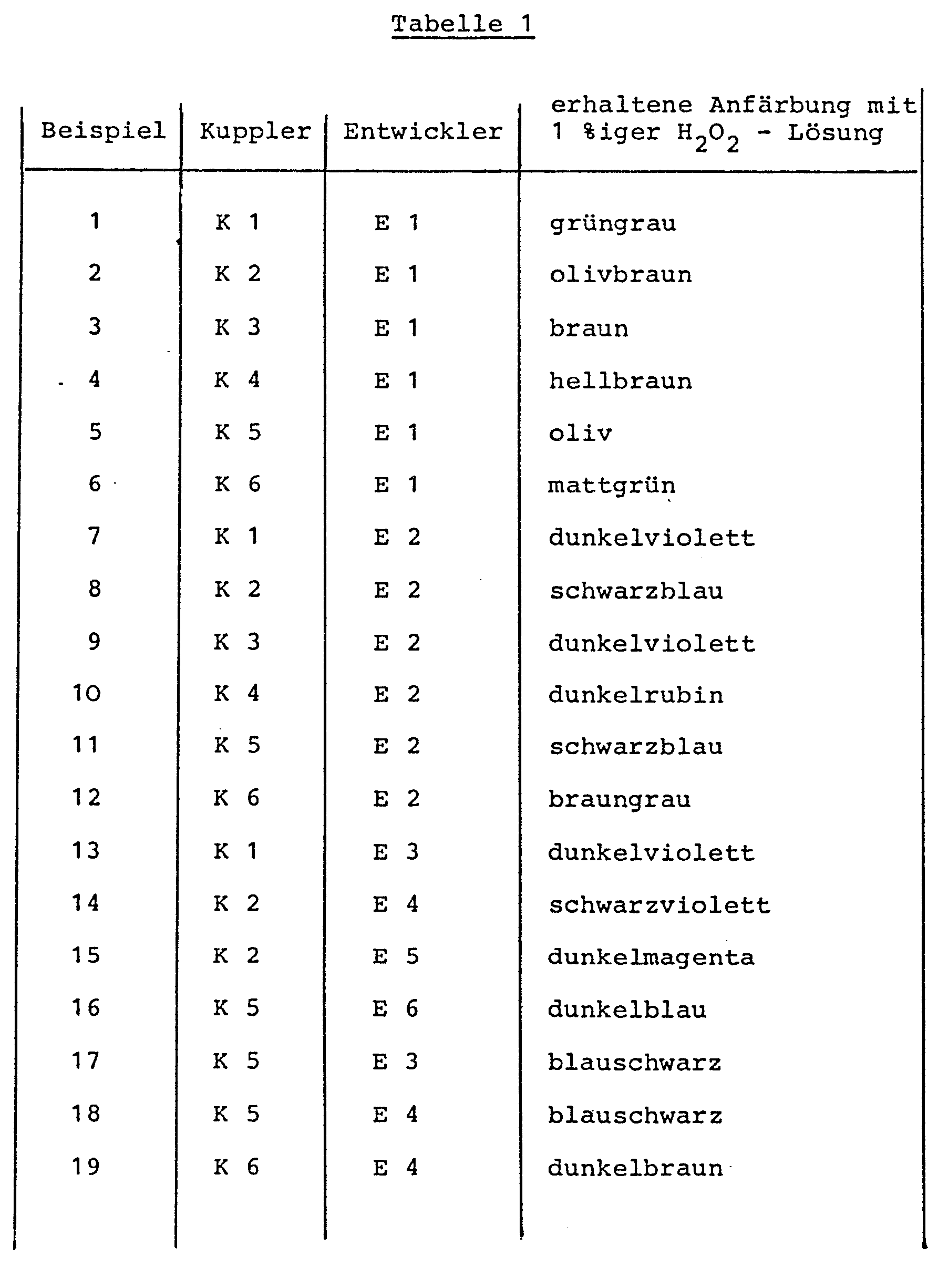
- jeweils 0,01 Mol der in der nachstehenden Tabelle aufgeführten Entwicklersubstanzen und Kupllersubstanzen eingearbeitet. Danach wurde der pH-Wert--der Emulsion mittels Ammoniak auf 9,5 eingestellt und die Emulsion mit Wasser auf 100 Gewichtsteile aufgefüllt. Die oxidative Kupplung wurde mit 1 %iger Wasserstoffperoxidlösung als Oxidationsmittel durchgeführt, wobei zu 100 Gewichtsteilen der Emulsion 10 Gewichtsteile Wasserstoffperoxidlösung gegeben wurden. Die jeweilige Färbecreme mit zusätzlichem Oxidationsmittel wurde auf zu 90 % ergrautes, nicht besonders vorbehandeltes Menschenhaar aufgetragen und dort 30 Minuten belassen. Nach Beendigung des Färbeprozesses wurde das Haar mit einem üblichen Haarwaschmittel ausgewaschen und anschließend getrocknet. Die dabei erhaltenen Färbungen sind nachstehender Tabelle 1 zu entnehmen.
Claims (6)


Priority Applications (1)
| Application Number | Priority Date | Filing Date | Title |
|---|---|---|---|
| AT82108428T ATE12096T1 (de) | 1981-09-21 | 1982-09-13 | N-substituierte 2.4-diamino-m-xylole und diese enthaltende haarfaerbemittel. |
Applications Claiming Priority (2)
| Application Number | Priority Date | Filing Date | Title |
|---|---|---|---|
| DE3137473 | 1981-09-21 | ||
| DE19813137473 DE3137473A1 (de) | 1981-09-21 | 1981-09-21 | "n-substituierte 2.4-diamino-m-xylole und diese enthaltende haarfaerbemittel" |
Publications (3)
| Publication Number | Publication Date |
|---|---|
| EP0075242A2 true EP0075242A2 (de) | 1983-03-30 |
| EP0075242A3 EP0075242A3 (en) | 1983-07-13 |
| EP0075242B1 EP0075242B1 (de) | 1985-03-13 |
Family
ID=6142219
Family Applications (1)
| Application Number | Title | Priority Date | Filing Date |
|---|---|---|---|
| EP82108428A Expired EP0075242B1 (de) | 1981-09-21 | 1982-09-13 | N-Substituierte 2.4-Diamino-m-Xylole und diese enthaltende Haarfärbemittel |
Country Status (3)
| Country | Link |
|---|---|
| EP (1) | EP0075242B1 (de) |
| AT (1) | ATE12096T1 (de) |
| DE (2) | DE3137473A1 (de) |
Cited By (9)
| Publication number | Priority date | Publication date | Assignee | Title |
|---|---|---|---|---|
| EP0145513A3 (en) * | 1983-09-08 | 1985-12-27 | L'oreal | Derivatives of dimethyl-3-nitro-4-amino-aniline, process for their preparation and their use in the dyeing of keratin fibres |
| FR2569401A1 (fr) * | 1984-08-23 | 1986-02-28 | Oreal | Nouveaux derives dimethyles de nitro-3 amino-4 aniline, leur procede de preparation et leur utilisation en teinture des fibres keratiniques |
| FR2615732A1 (fr) * | 1987-05-29 | 1988-12-02 | Oreal | Utilisation comme coupleur du 2,4-diamino-1,3-dimethoxybenzene ou l'un de ses sels, en association avec des precurseurs de colorants d'oxydation, pour la teinture des cheveux humains, composition de teinture capillaire contenant ledit coupleur et procede de preparation dudit coupleur |
| EP0294669A1 (de) * | 1987-05-29 | 1988-12-14 | L'oreal | Metaphenylendiamine, Verfahren zu deren Herstellung, Zwischenprodukte und Verwendung dieser Metaphenylendiamine als Kuppler für die oxidative Färbung von Keratinfasern insbesondere von menschlichem Haar |
| EP0295474A1 (de) * | 1987-05-29 | 1988-12-21 | L'oreal | Clorometaphenylendiamine, deren Verwendung als Kuppler für die oxidative Färbung von Keratinfasern, Haarfärbezusammensetzungen, die diese Verbindungen enthalten und Färbeverfahren mit diesen Zusammensetzungen |
| FR2681860A1 (fr) * | 1991-10-01 | 1993-04-02 | Schwarzkopf Gmbh Hans | Nouveaux 2,6-diaminotoluenes substitues, procede pour leur obtention ainsi que teintures pour fibres keratiniques qui les contiennent. |
| WO2015086676A1 (en) * | 2013-12-13 | 2015-06-18 | L'oreal | Method for dyeing keratinous substances starting from coloured oligomers and/or polymers resulting from meta-phenylenediamines, composition and dyeing agent |
| WO2015086675A1 (en) * | 2013-12-13 | 2015-06-18 | L'oreal | Process for dyeing keratin fibres using coloured oligomers and/or polymers derived from self-oxidizing compounds, composition and colouring agent for the same |
| FR3014687A1 (fr) * | 2013-12-13 | 2015-06-19 | Oreal | Procede de coloration des matieres keratiniques a partir d'oligomeres et/ou de polymeres colores issus de coupleurs, composition et agent de coloration |
Families Citing this family (1)
| Publication number | Priority date | Publication date | Assignee | Title |
|---|---|---|---|---|
| DE3741236A1 (de) * | 1987-12-05 | 1989-06-15 | Henkel Kgaa | Phenylamino- und phenylaminomethyl-pyridine und diese enthaltende haarfaerbemittel |
Family Cites Families (1)
| Publication number | Priority date | Publication date | Assignee | Title |
|---|---|---|---|---|
| US3963764A (en) * | 1970-12-30 | 1976-06-15 | L'oreal | Indoanilines |
-
1981
- 1981-09-21 DE DE19813137473 patent/DE3137473A1/de not_active Withdrawn
-
1982
- 1982-09-13 DE DE8282108428T patent/DE3262565D1/de not_active Expired
- 1982-09-13 AT AT82108428T patent/ATE12096T1/de active
- 1982-09-13 EP EP82108428A patent/EP0075242B1/de not_active Expired
Cited By (19)
| Publication number | Priority date | Publication date | Assignee | Title |
|---|---|---|---|---|
| EP0145513A3 (en) * | 1983-09-08 | 1985-12-27 | L'oreal | Derivatives of dimethyl-3-nitro-4-amino-aniline, process for their preparation and their use in the dyeing of keratin fibres |
| US4736067A (en) * | 1983-09-08 | 1988-04-05 | L'oreal | New dimethyl derivatives of 3-nitro-4-aminoaniline, process for their preparation and their use for dyeing keratinic fibers |
| FR2569401A1 (fr) * | 1984-08-23 | 1986-02-28 | Oreal | Nouveaux derives dimethyles de nitro-3 amino-4 aniline, leur procede de preparation et leur utilisation en teinture des fibres keratiniques |
| US4865618A (en) * | 1987-05-29 | 1989-09-12 | L'oreal | New chloro-meta-phenylenediamines, their use as couplers in the oxidation dyeing of keratinous fibres, dyeing compositions for hair containing these compounds and dyeing process using the said |
| BE1002823A4 (fr) * | 1987-05-29 | 1991-06-25 | Oreal | Utilisation comme coupleur du 2,4-diamino-1,3-dimethoxybenzene ou l'un de ses sels, en association avec des precurseurs de colorants d'oxydation, pour la teinture des cheveux humains, composition de teinture capillaire contenant ledit coupleur et procede de preparation dudit coupleur. |
| EP0295474A1 (de) * | 1987-05-29 | 1988-12-21 | L'oreal | Clorometaphenylendiamine, deren Verwendung als Kuppler für die oxidative Färbung von Keratinfasern, Haarfärbezusammensetzungen, die diese Verbindungen enthalten und Färbeverfahren mit diesen Zusammensetzungen |
| GR880100352A (el) * | 1987-05-29 | 1989-02-23 | Oreal | Χρησιμοποίηση ως μέσου σύζευξης του 2,4-διαμινο-1,3-διμεθοξυβενζολίου ή ενός των αλάτων του, σε συνδυασμό με προδρόμους χρωστικών οξείδωσης για την βαφή των ανθρώπινων μαλλιών, σύνθεση βαφής τριχών περιέχουσα το εν λόγω μέσο σύζευξης και μέθοδος παρασ... |
| US4865619A (en) * | 1987-05-29 | 1989-09-12 | L'oreal | Use, as a coupler, of 2,4-diamino-1,3-dimethoxybenzene or one of its salts, in combination with oxidation dye precursors, for dyeing human hair, hair dyeing composition containing the said coupler and process for preparing the said coupler |
| FR2615732A1 (fr) * | 1987-05-29 | 1988-12-02 | Oreal | Utilisation comme coupleur du 2,4-diamino-1,3-dimethoxybenzene ou l'un de ses sels, en association avec des precurseurs de colorants d'oxydation, pour la teinture des cheveux humains, composition de teinture capillaire contenant ledit coupleur et procede de preparation dudit coupleur |
| US4960432A (en) * | 1987-05-29 | 1990-10-02 | L'oreal | Meta-phenylenediamines, process for preparation thereof, intermediate compounds and use of these meta-phenylenediamines as couplers for the oxidation dyeing of keratinous fibres and especially human hair |
| EP0294669A1 (de) * | 1987-05-29 | 1988-12-14 | L'oreal | Metaphenylendiamine, Verfahren zu deren Herstellung, Zwischenprodukte und Verwendung dieser Metaphenylendiamine als Kuppler für die oxidative Färbung von Keratinfasern insbesondere von menschlichem Haar |
| AT402606B (de) * | 1987-05-29 | 1997-07-25 | Oreal | Verwendung von 2,4-diamino-1,3-dimethoxybenzol verwendung von 2,4-diamino-1,3-dimethoxybenzol oder eines der salze davon als kuppler in oder eines der salze davon als kuppler in verbindung mit oxidationsfarbstoff-prekursoren, verbindung mit oxidationsfarbstoff-prekursoren, zum färben menschlicher haare, haarfärbemittel, zum färben menschlicher haare, haarfärbemittel, welches diesen kuppler enthält und welches diesen kuppler enthält und haarfärbeverfahren haarfärbeverfahren |
| USRE34300E (en) * | 1987-05-29 | 1993-07-06 | L'oreal | Chloro-meta-phenylenediamines, their use as couplers in the oxidation dyeing of keratinous fibres, dyeing compositions for hair containing these compounds and dyeing process using the said compositions |
| FR2681860A1 (fr) * | 1991-10-01 | 1993-04-02 | Schwarzkopf Gmbh Hans | Nouveaux 2,6-diaminotoluenes substitues, procede pour leur obtention ainsi que teintures pour fibres keratiniques qui les contiennent. |
| WO2015086676A1 (en) * | 2013-12-13 | 2015-06-18 | L'oreal | Method for dyeing keratinous substances starting from coloured oligomers and/or polymers resulting from meta-phenylenediamines, composition and dyeing agent |
| WO2015086675A1 (en) * | 2013-12-13 | 2015-06-18 | L'oreal | Process for dyeing keratin fibres using coloured oligomers and/or polymers derived from self-oxidizing compounds, composition and colouring agent for the same |
| FR3014686A1 (fr) * | 2013-12-13 | 2015-06-19 | Oreal | Procede de coloration des matieres keratiniques a partir d'oligomeres et/ou de polymeres colores issus de composes auto-oxydables, composition et agent de coloration |
| FR3014685A1 (fr) * | 2013-12-13 | 2015-06-19 | Oreal | Procede de coloration des matieres keratiniques a partir d'oligomeres et/ou de polymeres colores issus de metaphenylenediamines, composition, et agent de coloration |
| FR3014687A1 (fr) * | 2013-12-13 | 2015-06-19 | Oreal | Procede de coloration des matieres keratiniques a partir d'oligomeres et/ou de polymeres colores issus de coupleurs, composition et agent de coloration |
Also Published As
| Publication number | Publication date |
|---|---|
| ATE12096T1 (de) | 1985-03-15 |
| EP0075242A3 (en) | 1983-07-13 |
| DE3137473A1 (de) | 1983-04-07 |
| DE3262565D1 (en) | 1985-04-18 |
| EP0075242B1 (de) | 1985-03-13 |
Similar Documents
| Publication | Publication Date | Title |
|---|---|---|
| EP0055386B1 (de) | Haarfärbemittel | |
| EP0039030B1 (de) | Neue Kupplerkomponenten für Oxidationshaarfarben, deren Herstellung und Verwendung sowie diese enthaltende Haarfärbemittel | |
| EP0075242B1 (de) | N-Substituierte 2.4-Diamino-m-Xylole und diese enthaltende Haarfärbemittel | |
| EP0008079B1 (de) | Neue Bis-Aminopyridine, deren Herstellung und Verwendung als Komponenten in Oxidationshaarfarben sowie diese enthaltende Haarfärbemittel | |
| EP0011844A1 (de) | Neue Kupplerkomponenten für Oxidationshaarfarben, deren Herstellung sowie diese enthaltende Haarfärbemittel | |
| DE2934330C2 (de) | ||
| EP0036591B1 (de) | Neue Kupplerkomponenten für Oxidationshaarfarben, deren Herstellung und Verwendung sowie diese enthaltende Haarfärbemittel | |
| EP0063736A2 (de) | Verwendung von Dihydroxypyridinen als Kupplerkomponente in Oxidationshaarfarbstoffen und Haarfärbemittel | |
| EP0687669A1 (de) | Mittel zu oxidativen Färbung von Haaren und neue 2-Alkylamino-4-amino-1-alkylbenzole | |
| EP0023257B1 (de) | Dichlor-Hydroxyethylaminophenole, Verfahren zu deren Herstellung, deren Verwendung und sie enthaltende Haarfärbemittel | |
| EP0170069A1 (de) | Haarfärbemittel | |
| EP0426719A1 (de) | Haarfärbemittel | |
| EP0029964A1 (de) | Neue Kupplerkomponenten für Oxidationshaarfarben, deren Herstellung und Verwendung sowie diese enthaltende Haarfärbemittel | |
| EP0107027B1 (de) | Haarfärbemittel | |
| EP0470099B1 (de) | Haarfärbemittel | |
| DE2852156C2 (de) | Haarfärbemittel auf der Basis von Oxidationsfarbstoffen und Bis-(2,4-diaminophenoxy)-alkane | |
| EP0039806B1 (de) | Haarfärbemittel | |
| EP0039455B1 (de) | Neue Kupplerkomponenten für Oxidationshaarfarben, deren Herstellung sowie diese enthaltende Haarfärbemittel | |
| DE2934329C2 (de) | ||
| EP0004368A2 (de) | Haarfärbemittel | |
| DE3007997C2 (de) | ||
| DE3045959C2 (de) | ||
| EP0128272B1 (de) | 2,4-Diaminobenzolderivate, ihre Herstellung und Verwendung als Kuppler für Oxidationshaarfärbemittel | |
| EP0081790A1 (de) | Neue p-Phenylendiamine, deren Herstellung und Verwendung | |
| EP0039034B1 (de) | Kupplerkomponenten für Oxidationshaarfarben und deren Verwendung, sowie diese enthaltende Haarfärbemittel |
Legal Events
| Date | Code | Title | Description |
|---|---|---|---|
| PUAI | Public reference made under article 153(3) epc to a published international application that has entered the european phase |
Free format text: ORIGINAL CODE: 0009012 |
|
| AK | Designated contracting states |
Designated state(s): AT BE CH DE FR GB IT LI LU NL SE |
|
| PUAL | Search report despatched |
Free format text: ORIGINAL CODE: 0009013 |
|
| AK | Designated contracting states |
Designated state(s): AT BE CH DE FR GB IT LI LU NL SE |
|
| 17P | Request for examination filed |
Effective date: 19830916 |
|
| ITF | It: translation for a ep patent filed | ||
| GRAA | (expected) grant |
Free format text: ORIGINAL CODE: 0009210 |
|
| AK | Designated contracting states |
Designated state(s): AT BE CH DE FR GB IT LI LU NL SE |
|
| REF | Corresponds to: |
Ref document number: 12096 Country of ref document: AT Date of ref document: 19850315 Kind code of ref document: T |
|
| REF | Corresponds to: |
Ref document number: 3262565 Country of ref document: DE Date of ref document: 19850418 |
|
| ET | Fr: translation filed | ||
| PLBE | No opposition filed within time limit |
Free format text: ORIGINAL CODE: 0009261 |
|
| STAA | Information on the status of an ep patent application or granted ep patent |
Free format text: STATUS: NO OPPOSITION FILED WITHIN TIME LIMIT |
|
| 26N | No opposition filed | ||
| ITTA | It: last paid annual fee | ||
| PGFP | Annual fee paid to national office [announced via postgrant information from national office to epo] |
Ref country code: CH Payment date: 19930823 Year of fee payment: 12 |
|
| PGFP | Annual fee paid to national office [announced via postgrant information from national office to epo] |
Ref country code: GB Payment date: 19930903 Year of fee payment: 12 Ref country code: AT Payment date: 19930903 Year of fee payment: 12 |
|
| PGFP | Annual fee paid to national office [announced via postgrant information from national office to epo] |
Ref country code: FR Payment date: 19930909 Year of fee payment: 12 Ref country code: DE Payment date: 19930909 Year of fee payment: 12 |
|
| PGFP | Annual fee paid to national office [announced via postgrant information from national office to epo] |
Ref country code: SE Payment date: 19930917 Year of fee payment: 12 |
|
| PGFP | Annual fee paid to national office [announced via postgrant information from national office to epo] |
Ref country code: NL Payment date: 19930930 Year of fee payment: 12 Ref country code: LU Payment date: 19930930 Year of fee payment: 12 |
|
| PGFP | Annual fee paid to national office [announced via postgrant information from national office to epo] |
Ref country code: BE Payment date: 19931012 Year of fee payment: 12 |
|
| EPTA | Lu: last paid annual fee | ||
| PG25 | Lapsed in a contracting state [announced via postgrant information from national office to epo] |
Ref country code: LU Free format text: LAPSE BECAUSE OF NON-PAYMENT OF DUE FEES Effective date: 19940913 Ref country code: GB Effective date: 19940913 Ref country code: AT Effective date: 19940913 |
|
| PG25 | Lapsed in a contracting state [announced via postgrant information from national office to epo] |
Ref country code: SE Effective date: 19940914 |
|
| PG25 | Lapsed in a contracting state [announced via postgrant information from national office to epo] |
Ref country code: LI Effective date: 19940930 Ref country code: CH Effective date: 19940930 Ref country code: BE Effective date: 19940930 |
|
| EAL | Se: european patent in force in sweden |
Ref document number: 82108428.2 |
|
| BERE | Be: lapsed |
Owner name: HENKEL K.G.A.A. Effective date: 19940930 |
|
| PG25 | Lapsed in a contracting state [announced via postgrant information from national office to epo] |
Ref country code: NL Effective date: 19950401 |
|
| GBPC | Gb: european patent ceased through non-payment of renewal fee |
Effective date: 19940913 |
|
| NLV4 | Nl: lapsed or anulled due to non-payment of the annual fee | ||
| PG25 | Lapsed in a contracting state [announced via postgrant information from national office to epo] |
Ref country code: FR Effective date: 19950531 |
|
| REG | Reference to a national code |
Ref country code: CH Ref legal event code: PL |
|
| PG25 | Lapsed in a contracting state [announced via postgrant information from national office to epo] |
Ref country code: DE Effective date: 19950601 |
|
| EUG | Se: european patent has lapsed |
Ref document number: 82108428.2 |
|
| REG | Reference to a national code |
Ref country code: FR Ref legal event code: ST |