EP0075744A2 - Recentrage automatique des entrées de colonnes de texte - Google Patents
Recentrage automatique des entrées de colonnes de texte Download PDFInfo
- Publication number
- EP0075744A2 EP0075744A2 EP82108070A EP82108070A EP0075744A2 EP 0075744 A2 EP0075744 A2 EP 0075744A2 EP 82108070 A EP82108070 A EP 82108070A EP 82108070 A EP82108070 A EP 82108070A EP 0075744 A2 EP0075744 A2 EP 0075744A2
- Authority
- EP
- European Patent Office
- Prior art keywords
- column
- text
- cursor
- center
- characters
- Prior art date
- Legal status (The legal status is an assumption and is not a legal conclusion. Google has not performed a legal analysis and makes no representation as to the accuracy of the status listed.)
- Granted
Links
Images



Classifications
-
- G—PHYSICS
- G06—COMPUTING OR CALCULATING; COUNTING
- G06F—ELECTRIC DIGITAL DATA PROCESSING
- G06F40/00—Handling natural language data
- G06F40/10—Text processing
- G06F40/189—Automatic justification
Definitions
- This invention relates to word processing, and more particularly to a machine assisted method for center centering tab stops in a column layout by example formatted multitext column table.
- Kolpek in the IBM Technical Disclosure Bulletin, Vol. 16, No. 2, pp. 391-394, July 1973, describes centering operation upon segments of text within a column in an interactive word processing system. Kolpek required the operator to center the type element, after which the system recorded for playback printing coded keystroke representations of the centering function, backspaces, and the text character segment. Upon the centering mode selection, the system was placed in a non-printing mode wherein the system counted half the number of characters entered and recorded half of the count as backspace control characters. The text stream was recorded in a multiple shift register page memory.
- the invention takes place in a multiple text column formatting method executed in an interactive word processing system having a display screen, a keyboard, a memory for storing formatted information, and an intercoupling microprocessor.
- the method steps include formatting the column widths and gutters, defining a multicolumn table by way of an operator keyed in example line of repeated text and control characters; and vector encoding and saving of the example line in the memory suitable for revision upon recall.
- multiple text column tables are formatted prior to text entry by invoking a column layout function mode.
- menued prompts prominently displayed guide the operator in order to structure the column widths and gutters intercolumn spacing by repeated keying of text characters or widths and then inserting space characters over to the next column position and repeatedly keying in text characters again to define the width of yet another column.
- This single entry permits the columns and gutter widths to be automatically aligned with tab stops.
- the formatted column example line is then vector encoded and saved. If it is subsequently desired to revise a saved table, its encoded format line is recalled, rebuilt, and then revised by entering repeated text and control characters to define an altered width of an existing column or a new column. In turn, the revised column example line may be encoded and saved.
- Such a method should be invocable in an interactive word processing system in which an operator keyboard entered and system displayed example line of repeated text and control characters defines column widths and gutters of a multiple text column table.
- a method comprising the steps of an operator cursor move to a column margin to define an end position; and responsive to a function keystroke, the machine steps of concurrently moving the cursor to the other column margin and counting the text characters of the example; calculating the distance to the column center position; concurrently moving the cursor to the calculated center position, and inserting a centered tab stop control character therein; and resetting the cursor to the end position.
- the system can ascertain the column widths, it further determines the midpoint of the column example and the insertion of the center tab stop. This is in contrast to the prior art which requires operator positioning of the centerpoint and then requires the system to determine the column text segment width. Further, if the column example is moved as by way of revising of an existing table, the center tab settings are automatically adjusted in order to retain the relative position of the tab stop within the example.
- a word processing system 10 which includes a keyboard 12 for receiving text character entries and transmitting the text through a path 14 to a microprocessor 16.
- a memory bus 18 couples processor 16 to a display 20 such as a CRT, a diskette drive 22, a printer 24, and a random access memory 26.
- An operator enters a text stream through the keyboard 12. Each page of text is stored and processed in the memory 26. As the text stream is received in the memory, it is simultaneously presented to display 20. After the buffering of the text in text storage buffer 28 of memory 26, the stream can be saved on diskette 22 or hard copy printed out on printer 24.
- Memory 26 includes a number of data areas and functional programs for operating with the text stored in system 10.
- the text and related control functions are saved in a text storage buffer 28 which includes an active format storage section 30 and a diskette buffer 32.
- the keyboard character set (KB/CS) for the documenting process is available in the active format section 30.
- a text storage buffer control block 34 serves as the data area for the text storage buffer 28.
- a cursor control section 36 is included within the text storage control block 34. Block 34 is linked through a channel 38 to the active format section 30 and through a channel 40 to the text storage buffer 28. The cursor block 36 is connected through a channel 42 to the text storage buffer 28.
- a text storage buffer manager block 44 is coupled to a channel 46 to the next storage buffer 28.
- Buffer 44 is further coupled through a channel 48 to the TSB control block 34.
- a key stroke control unit block 52 is a data area which determines the selected key stroke routine for processing the received character. Block 52 is linked to the key stroke service routine 50 through a channel 54. The key stroke service routine block 50 is further linked through a channel 56 to the text storage buffer control block 34 and through channels 58 and 60 to TSB manager block 44.
- the active format section 30 is connected through channel 62 to the key stroke service routines block 50.
- the diskette buffer is connected through a channel 64 to the key stroke service routines 50.
- the text characters and control information in text storage buffer 28 is communicated through channel 66 to a display access method block 68.
- This serves as an interface for the display 20.
- Corresponding access method blocks for the keyboard, diskette, and printer are substituted when communication with these units is required.
- Display control block 70 is connected through path 72 to the access method block 68.
- the display control block 70 and display access method block 68 provide a window which may be scrolled relative to the contents of the TSB 28.
- Text information from the text storage buffer is transmitted through path 74 to a display refresh buffer 76.
- the information stored in buffer 76 is that which is shown on display 20.
- a buffer is similarly provided for supplying data to other input and output units such as diskette 22 and printer 24.
- block 70 serves to store flags and status information as required by the operation of block 68.
- a corresponding signal is transmitted to processor 16 over path 14 which enters the keystroke command to the memory 26.
- the keystroke routine is invoked for block 50 to process the keyed command. It is processed by processor 16 according as to whether it is a control command or a graphic command text character entry. The processing result is entered into TSB 28. While graphics and commands are built up in TSB 28, the text information is retained in display refresh buffer 76 and presented at display 20.
- the operator can transfer information among the memory, display, diskette and printer. Selected pages can be called from the diskette 22 and to the memory 26 so that the operator can make changes and corrections to the text and then reenter the corrected text into diskette 22 or have the corrected text hard copied on printer 24.
- FIG. 2 there is illustrated the contemporary machine register organization of processor 16.
- processor 16 Such a processor may be commercially implemented as for example by an Intel Corporation Microprocessor Model 8086.
- the processor includes a control logic unit 80, which responds to interrupt on a device bus 82 from keyboard 12.
- Logic unit 80 is also connected to a data and address bus 84 intercoupling other logic elements.
- logic unit 80 In response to a fetch instruction from a random access memory 26, logic unit 80 generates control signals to other elements. The signals are coupled by way of control paths 86, illustratively connecting ALU (Arithmetic Logic Unit) 88. Synchronous operation of unit 80 and other logic elements is insured by way of clock pulses from an external clock source transmitted over lines 90. Data and instructions to be processed by processor 16 are entered over Bus Control logic unit 92. Data also may be entered by way of a programmed input/output logic control 94. Logic 92 couples storage elements of RAM 26 and receives instructions by processing data from the I/O control 94 or from RAM 26.
- ALU Arimetic Logic Unit
- I/O control unit 94 Input on the data bus 98 from keyboard 12 is processed internally through processor 16 4by instructions over bus 84 to logic unit 80 by ALU 88.
- the ALU in response to a signal on path 86 and in accordance with instructions received on bus 18 executes arithmetic operations stored in temporary register 102.
- the program counter 104 and the registers, such as Data Pointer Register 106, stack Pointer Register 108 and status Register 110 are well known devices of a microprocessor and will not be described further.
- display device 20 could be of the CRT type and be capable of setting out monospaced characters.
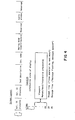
- FIG. 4 A typical display is partitioned such that lines 1 and 2 are status lines reflecting the information state of the display.
- line 1 consists of 4 fields, including a context field, document name, audit window and reserve.
- the context field displays the current function being performed by the operator.
- the document name field displays the name of the document currently being processed.
- the audit window field is a special purpose field relating to cursive characters and control codes.
- the second status line is used to present to the operator information about the current state of the system and to indicate the names of the mounted diskettes.
- the fields in this second status line are diskette volume IDs reserved space, page number, line number, keyboard number, and pitch.
- lines 3 through 23 define a viewport in which are displayed menus, text, and information necessary for interactive processing.
- Line 24 is a prompt line which provides information stepping the operator to the next menu function or activity.
- line 25 is a message line which displays messages or which indicates queued messages.
- a scale line appearing as the third line of the display image in the viewport or text application window. This line shows the format of a currently cursored line.
- the scale line is displayed so as to match the text and be segmented as the text is segmented. It is apparent that the text/menu viewport which occupies lines 4 through 23 permits the operator to see portions of the document. As mentioned, contemporary word processors with text editors permit viewing different portions of a document by segmenting or scrolling of the screen contents relative to a memory such as TSB 28.
- the purpose of column layout functions in an interactive prompting word processing system is to provide an opportunity for an operator to specify all of the attributes of a column table format so as to permit implementing column functions such as delete, move, copy, and revise. These attributes include the widths of each column, the tab stops within each column, and the spacing (gutters) between columns.
- the table formatting is executed by way of operator keying of repeated text characters and controls as an example. The "example line" is then encoded and saved.
- the operator keys a new format under a displayed scale line designated the "column example line" by repetitively keying text and control characters.
- the tab rack as column and gutter width information is encoded as control bytes associated with the BEGIN TABLE (BT) control character. This information is saved.
- BT BEGIN TABLE
- the operator can key in revisions by way of example. Again, the revised layout is saved.
- FIG. 5 there is shown a layout frame for an existing table in which the column example line appears as a sequence of repeated lower case character "a"s. Each sequence is spaced apart and defines a separate column. The distance between examples constitutes a column gutter while the repeated characters themselves determine the maximum entry width of the column.
- Fig. 3 there is shown the method steps of the invention.
- an operator after entry of the example line (step 12), moves a cursor to the column margin and strokes a dedicated function (centering) key (step 113). If the centering key is not stroked it is proceeded to the next entry (step 114 and branch A). If the cursor is within or adjacent to column example line (step 115) the system concurrently to the keystroke moves the cursor to the other column margin and counts the text characters of the entered example. The system then calculates the distance to the column center position and concurrently moves the cursor to the center position and inserts a center tab stop control character thereat (step 116).
- step 117 The operator is, of course, free prior to the stroking of the function key to position the cursor at any arbitrary point between column examples. If this is done, a center tab stop at the cursored position would be inserted (step 117). Provision is also made that in the event a column is moved or revised (step 118), the center tab stop setting is automatically adjusted by the system to retain its relative position within the example (step 119). If the column example has not been moved or if the tab setting has been adjusted the system is ready for a new operation (branch A).
- a PASCAL source code illustration of the machine response to the operative function key stroke is set out as follows:
- the PASCAL implementation sets Q ut a procedure labeled "centering". This procedure is invoked by a procedure call passing a numerical parameter value of "i" to the procedure as the current cursor position at display 20.
- the variables j and k are integer type and respectively denote the cursor end position and the character count of a keyed in text stream also appearing on the display.
- the text stream is represented by the variable "buffer”.
- a character stream must be represented as a packed array of type char.
- the first "while-do loop” moves the cursor to the end of the example character sequence. Such an end would be recognizable by either the space character or as the ordinal value of an automatic return carry signal (rcr).
- the "repeat-until loop” determines the length of the example by counting and testing from the right end back to the left end. Note, that the cursor positioning assumes a monotonic (integer) increase from left to right. Since counting is proceeding from right to left, then for each character the cursor position will be diminished by one while a character count will be incremented by one. Also, it is the value in the array location "buffer[i]" that is being tested or examined. If buffer[i] is a space (' ') or an ordinal rcr value, then the left-hand edge of the character string has been detected.
- the next two lines of code determine the center point. Since the center tab stop is to be inserted, the method takes into account an example of width 0 to that of m characters in length. Consequently, the "if-then" conditional state defines insertion upon the condition of positioning the cursor between columns.
- the next statement references the insertion of center tab stop at the current array value location.
- the last statement positions the cursor position at the previously determined end position.
- a PASCAL source code implementation was selected to express aspects of the invention in view of the compactness of its expression and currency among persons having ordinary skill in this art.
- Other method implementations can be formulated in assembly level language as, for example, set out in Osborne, "8080 Programming For Logic Design", Sybex, Berkeley, California, 1976.
Landscapes
- Engineering & Computer Science (AREA)
- Theoretical Computer Science (AREA)
- Health & Medical Sciences (AREA)
- Artificial Intelligence (AREA)
- Audiology, Speech & Language Pathology (AREA)
- Computational Linguistics (AREA)
- General Health & Medical Sciences (AREA)
- Physics & Mathematics (AREA)
- General Engineering & Computer Science (AREA)
- General Physics & Mathematics (AREA)
- Document Processing Apparatus (AREA)
- Digital Computer Display Output (AREA)
Applications Claiming Priority (2)
| Application Number | Priority Date | Filing Date | Title |
|---|---|---|---|
| US305251 | 1981-09-24 | ||
| US06/305,251 US4457638A (en) | 1981-09-24 | 1981-09-24 | Automatic centering of text column entries |
Publications (3)
| Publication Number | Publication Date |
|---|---|
| EP0075744A2 true EP0075744A2 (fr) | 1983-04-06 |
| EP0075744A3 EP0075744A3 (en) | 1984-02-01 |
| EP0075744B1 EP0075744B1 (fr) | 1986-12-30 |
Family
ID=23180025
Family Applications (1)
| Application Number | Title | Priority Date | Filing Date |
|---|---|---|---|
| EP82108070A Expired EP0075744B1 (fr) | 1981-09-24 | 1982-09-02 | Recentrage automatique des entrées de colonnes de texte |
Country Status (5)
| Country | Link |
|---|---|
| US (1) | US4457638A (fr) |
| EP (1) | EP0075744B1 (fr) |
| JP (1) | JPS5856024A (fr) |
| CA (1) | CA1172370A (fr) |
| DE (1) | DE3274911D1 (fr) |
Cited By (1)
| Publication number | Priority date | Publication date | Assignee | Title |
|---|---|---|---|---|
| EP0131457A3 (en) * | 1983-07-06 | 1985-05-08 | Kabushiki Kaisha Toshiba | Document creating apparatus |
Families Citing this family (7)
| Publication number | Priority date | Publication date | Assignee | Title |
|---|---|---|---|---|
| EP0089190B1 (fr) * | 1982-03-11 | 1989-06-14 | Kabushiki Kaisha Ishida Koki Seisakusho | Production d'étiquettes descriptives pour des articles différents |
| JPS609788A (ja) * | 1983-06-29 | 1985-01-18 | Canon Inc | 印字装置 |
| JPS60173622A (ja) * | 1984-02-18 | 1985-09-07 | Canon Inc | 電子機器 |
| US5060147A (en) * | 1987-05-01 | 1991-10-22 | General Electric Company | String length determination on a distributed processing system |
| US5768606A (en) * | 1995-08-31 | 1998-06-16 | International Business Machines Corporation | Method, system, computer program product and program storage device for declaring column widths of matrices |
| US7168039B2 (en) | 1998-06-02 | 2007-01-23 | International Business Machines Corporation | Method and system for reducing the horizontal space required for displaying a column containing text data |
| WO2016025994A1 (fr) * | 2014-08-18 | 2016-02-25 | Listium Pty Ltd | Procédés et systèmes pour améliorer la lisibilité de données mises en tableau |
Family Cites Families (6)
| Publication number | Priority date | Publication date | Assignee | Title |
|---|---|---|---|---|
| US3256516A (en) * | 1962-06-20 | 1966-06-14 | Ibm | Data display centering and expansion system |
| US3812945A (en) * | 1972-10-18 | 1974-05-28 | Wang Laboratories | Typewriter system |
| US3968868A (en) * | 1973-12-21 | 1976-07-13 | International Business Machines Corporation | Format control system for positioning final copy printed text |
| US3924723A (en) * | 1973-12-26 | 1975-12-09 | Ibm | Centering of textual character fields about a point |
| JPS5821729B2 (ja) * | 1977-08-11 | 1983-05-02 | 株式会社リコー | ワ−ド・プロセッサ |
| US4194197A (en) * | 1977-09-12 | 1980-03-18 | Burroughs Corporation | Automatic centering of character strings |
-
1981
- 1981-09-24 US US06/305,251 patent/US4457638A/en not_active Expired - Lifetime
-
1982
- 1982-08-04 CA CA000408725A patent/CA1172370A/fr not_active Expired
- 1982-08-20 JP JP57143534A patent/JPS5856024A/ja active Granted
- 1982-09-02 DE DE8282108070T patent/DE3274911D1/de not_active Expired
- 1982-09-02 EP EP82108070A patent/EP0075744B1/fr not_active Expired
Cited By (2)
| Publication number | Priority date | Publication date | Assignee | Title |
|---|---|---|---|---|
| EP0131457A3 (en) * | 1983-07-06 | 1985-05-08 | Kabushiki Kaisha Toshiba | Document creating apparatus |
| US4755955A (en) * | 1983-07-06 | 1988-07-05 | Kabushiki Kaisha Toshiba | Document creating apparatus |
Also Published As
| Publication number | Publication date |
|---|---|
| CA1172370A (fr) | 1984-08-07 |
| EP0075744B1 (fr) | 1986-12-30 |
| US4457638A (en) | 1984-07-03 |
| EP0075744A3 (en) | 1984-02-01 |
| JPS6214853B2 (fr) | 1987-04-04 |
| DE3274911D1 (en) | 1987-02-05 |
| JPS5856024A (ja) | 1983-04-02 |
Similar Documents
| Publication | Publication Date | Title |
|---|---|---|
| EP0075734B1 (fr) | Méthode de tabulation automatique d'un texte | |
| US4484302A (en) | Single screen display system with multiple virtual display having prioritized service programs and dedicated memory stacks | |
| US5067102A (en) | Method and apparatus for displaying and editing mathematical expressions in textbook format | |
| US4506343A (en) | Column layout reference area display management | |
| EP0094517B1 (fr) | Gestion d'assemblage de renvois au bas de page | |
| CA1172377A (fr) | Machine de traitement de texte a terminal d'affichage interactif servant aussi de terminal de traitement de donnees | |
| US4454592A (en) | Prompt line display in a word processing system | |
| EP0062121A1 (fr) | Appareil de traitement de texte avec contrôle de format du texte en deux étapes | |
| US4393463A (en) | Insertion of character set change codes in an altered text stream | |
| US4587631A (en) | Automatic text adjustment | |
| EP0075744B1 (fr) | Recentrage automatique des entrées de colonnes de texte | |
| US4445194A (en) | Multidirectional cursor motion | |
| US4370645A (en) | Ghost cursor in display all codes mode | |
| US4448557A (en) | Method and means for inhibiting interleaving or cave-in among table text columns resulting from column insertion | |
| EP0185845A2 (fr) | Positionnement sur l'écran de "HELP" pour l'utilisateur d'un ordinateur | |
| US5089990A (en) | Word processor with column layout function | |
| EP0075731A2 (fr) | Contrôle de format de colonnes par un exemple tapé | |
| EP0043392A1 (fr) | Appareil de traitement de texte avec mise au format directe du texte | |
| US5105381A (en) | Word processor with selectable line-lengths which uses memory table for detecting characters not permitted at line-head or line-end | |
| CA1168375A (fr) | Dispositif de correction de frappe | |
| EP0094516B1 (fr) | Mise en formation de renvois en bas de page | |
| EP0052754A1 (fr) | Méthode de commande de luminosité accentuée pour machine de composition de texte | |
| CA1168368A (fr) | Justification automatique de texte | |
| JP2571043B2 (ja) | 文字置換装置 | |
| JP2697901B2 (ja) | 文字処理装置 |
Legal Events
| Date | Code | Title | Description |
|---|---|---|---|
| PUAI | Public reference made under article 153(3) epc to a published international application that has entered the european phase |
Free format text: ORIGINAL CODE: 0009012 |
|
| AK | Designated contracting states |
Designated state(s): DE FR GB IT |
|
| PUAL | Search report despatched |
Free format text: ORIGINAL CODE: 0009013 |
|
| AK | Designated contracting states |
Designated state(s): DE FR GB IT |
|
| 17P | Request for examination filed |
Effective date: 19830722 |
|
| GRAA | (expected) grant |
Free format text: ORIGINAL CODE: 0009210 |
|
| AK | Designated contracting states |
Kind code of ref document: B1 Designated state(s): DE FR GB IT |
|
| REF | Corresponds to: |
Ref document number: 3274911 Country of ref document: DE Date of ref document: 19870205 |
|
| ITF | It: translation for a ep patent filed | ||
| ET | Fr: translation filed | ||
| PLBE | No opposition filed within time limit |
Free format text: ORIGINAL CODE: 0009261 |
|
| 26N | No opposition filed | ||
| ITTA | It: last paid annual fee | ||
| PGFP | Annual fee paid to national office [announced via postgrant information from national office to epo] |
Ref country code: GB Payment date: 20010903 Year of fee payment: 20 |
|
| PGFP | Annual fee paid to national office [announced via postgrant information from national office to epo] |
Ref country code: FR Payment date: 20010918 Year of fee payment: 20 |
|
| PGFP | Annual fee paid to national office [announced via postgrant information from national office to epo] |
Ref country code: DE Payment date: 20010925 Year of fee payment: 20 |
|
| REG | Reference to a national code |
Ref country code: GB Ref legal event code: IF02 |
|
| PG25 | Lapsed in a contracting state [announced via postgrant information from national office to epo] |
Ref country code: GB Free format text: LAPSE BECAUSE OF EXPIRATION OF PROTECTION Effective date: 20020901 |
|
| REG | Reference to a national code |
Ref country code: GB Ref legal event code: PE20 Effective date: 20020901 |