EP0075850A2 - Arzneimittel, darin enthaltene vicinale Dihydroxyalkylxanthine, Herstellungsverfahren für diese Xanthinverbindungen und dafür geeignete Zwischenprodukte - Google Patents
Arzneimittel, darin enthaltene vicinale Dihydroxyalkylxanthine, Herstellungsverfahren für diese Xanthinverbindungen und dafür geeignete Zwischenprodukte Download PDFInfo
- Publication number
- EP0075850A2 EP0075850A2 EP82108751A EP82108751A EP0075850A2 EP 0075850 A2 EP0075850 A2 EP 0075850A2 EP 82108751 A EP82108751 A EP 82108751A EP 82108751 A EP82108751 A EP 82108751A EP 0075850 A2 EP0075850 A2 EP 0075850A2
- Authority
- EP
- European Patent Office
- Prior art keywords
- formula
- alkyl
- carbon atoms
- radicals
- hydrogen
- Prior art date
- Legal status (The legal status is an assumption and is not a legal conclusion. Google has not performed a legal analysis and makes no representation as to the accuracy of the status listed.)
- Granted
Links
- 0 CC1CC*CC1 Chemical compound CC1CC*CC1 0.000 description 5
Classifications
-
- C—CHEMISTRY; METALLURGY
- C07—ORGANIC CHEMISTRY
- C07D—HETEROCYCLIC COMPOUNDS
- C07D473/00—Heterocyclic compounds containing purine ring systems
- C07D473/02—Heterocyclic compounds containing purine ring systems with oxygen, sulphur, or nitrogen atoms directly attached in positions 2 and 6
- C07D473/04—Heterocyclic compounds containing purine ring systems with oxygen, sulphur, or nitrogen atoms directly attached in positions 2 and 6 two oxygen atoms
- C07D473/06—Heterocyclic compounds containing purine ring systems with oxygen, sulphur, or nitrogen atoms directly attached in positions 2 and 6 two oxygen atoms with radicals containing only hydrogen and carbon atoms, attached in position 1 or 3
- C07D473/08—Heterocyclic compounds containing purine ring systems with oxygen, sulphur, or nitrogen atoms directly attached in positions 2 and 6 two oxygen atoms with radicals containing only hydrogen and carbon atoms, attached in position 1 or 3 with methyl radicals in positions 1 and 3, e.g. theophylline
-
- A—HUMAN NECESSITIES
- A61—MEDICAL OR VETERINARY SCIENCE; HYGIENE
- A61P—SPECIFIC THERAPEUTIC ACTIVITY OF CHEMICAL COMPOUNDS OR MEDICINAL PREPARATIONS
- A61P11/00—Drugs for disorders of the respiratory system
- A61P11/08—Bronchodilators
-
- C—CHEMISTRY; METALLURGY
- C07—ORGANIC CHEMISTRY
- C07C—ACYCLIC OR CARBOCYCLIC COMPOUNDS
- C07C29/00—Preparation of compounds having hydroxy or O-metal groups bound to a carbon atom not belonging to a six-membered aromatic ring
- C07C29/09—Preparation of compounds having hydroxy or O-metal groups bound to a carbon atom not belonging to a six-membered aromatic ring by hydrolysis
- C07C29/10—Preparation of compounds having hydroxy or O-metal groups bound to a carbon atom not belonging to a six-membered aromatic ring by hydrolysis of ethers, including cyclic ethers, e.g. oxiranes
-
- C—CHEMISTRY; METALLURGY
- C07—ORGANIC CHEMISTRY
- C07C—ACYCLIC OR CARBOCYCLIC COMPOUNDS
- C07C31/00—Saturated compounds having hydroxy or O-metal groups bound to acyclic carbon atoms
- C07C31/34—Halogenated alcohols
- C07C31/42—Polyhydroxylic acyclic alcohols
-
- C—CHEMISTRY; METALLURGY
- C07—ORGANIC CHEMISTRY
- C07D—HETEROCYCLIC COMPOUNDS
- C07D303/00—Compounds containing three-membered rings having one oxygen atom as the only ring hetero atom
- C07D303/02—Compounds containing oxirane rings
- C07D303/08—Compounds containing oxirane rings with hydrocarbon radicals, substituted by halogen atoms, nitro radicals or nitroso radicals
-
- C—CHEMISTRY; METALLURGY
- C07—ORGANIC CHEMISTRY
- C07D—HETEROCYCLIC COMPOUNDS
- C07D317/00—Heterocyclic compounds containing five-membered rings having two oxygen atoms as the only ring hetero atoms
- C07D317/08—Heterocyclic compounds containing five-membered rings having two oxygen atoms as the only ring hetero atoms having the hetero atoms in positions 1 and 3
- C07D317/10—Heterocyclic compounds containing five-membered rings having two oxygen atoms as the only ring hetero atoms having the hetero atoms in positions 1 and 3 not condensed with other rings
- C07D317/14—Heterocyclic compounds containing five-membered rings having two oxygen atoms as the only ring hetero atoms having the hetero atoms in positions 1 and 3 not condensed with other rings with substituted hydrocarbon radicals attached to ring carbon atoms
- C07D317/16—Radicals substituted by halogen atoms or nitro radicals
-
- C—CHEMISTRY; METALLURGY
- C07—ORGANIC CHEMISTRY
- C07D—HETEROCYCLIC COMPOUNDS
- C07D317/00—Heterocyclic compounds containing five-membered rings having two oxygen atoms as the only ring hetero atoms
- C07D317/08—Heterocyclic compounds containing five-membered rings having two oxygen atoms as the only ring hetero atoms having the hetero atoms in positions 1 and 3
- C07D317/10—Heterocyclic compounds containing five-membered rings having two oxygen atoms as the only ring hetero atoms having the hetero atoms in positions 1 and 3 not condensed with other rings
- C07D317/14—Heterocyclic compounds containing five-membered rings having two oxygen atoms as the only ring hetero atoms having the hetero atoms in positions 1 and 3 not condensed with other rings with substituted hydrocarbon radicals attached to ring carbon atoms
- C07D317/18—Radicals substituted by singly bound oxygen or sulfur atoms
- C07D317/20—Free hydroxyl or mercaptan
-
- C—CHEMISTRY; METALLURGY
- C07—ORGANIC CHEMISTRY
- C07D—HETEROCYCLIC COMPOUNDS
- C07D473/00—Heterocyclic compounds containing purine ring systems
- C07D473/02—Heterocyclic compounds containing purine ring systems with oxygen, sulphur, or nitrogen atoms directly attached in positions 2 and 6
- C07D473/04—Heterocyclic compounds containing purine ring systems with oxygen, sulphur, or nitrogen atoms directly attached in positions 2 and 6 two oxygen atoms
- C07D473/06—Heterocyclic compounds containing purine ring systems with oxygen, sulphur, or nitrogen atoms directly attached in positions 2 and 6 two oxygen atoms with radicals containing only hydrogen and carbon atoms, attached in position 1 or 3
Definitions
- the invention relates to new pharmaceutical compositions which are especially suitable for the treatment of obstructive respiratory diseases they contain pharmacologically active vicinal Dihydroxyalkylxanthine, methods for preparing these H xanthine derivatives and intermediates thereto.
- the xanthine compounds acting as phosphodiesterase inhibitors occupy a preferred position (cf. B. Hellwig, Moderne Arzneistoff, Stuttgart 1980, p. 1274), since they have no ⁇ 2 -sympathomimetic activity and are therefore particularly good for In the case of chronic obstructive respiratory ailments, the necessary long-term therapy is always suitable. From this group of substances, the naturally occurring xanthine derivative theophylline (1,3-dimethylxanthine) has been the undisputed agent of choice in asthma therapy for several decades now.
- the only synthetic theophyllin derivative that has found some therapeutic use is dyphylline [7- (2,3-dihydroxypropyl) -1,3-dimethylyanthine].
- the 7-hour 2,3-dihydroxypropyl group gives this preparation good water solubility, so that the undesired use of solubilizers in parenteral administration is unnecessary, and the troublesome theophylline-like side effects are markedly less pronounced, but these advantages are also at the same time a drastic drop in bronchospasmolytic activity compared to that of theophylline.
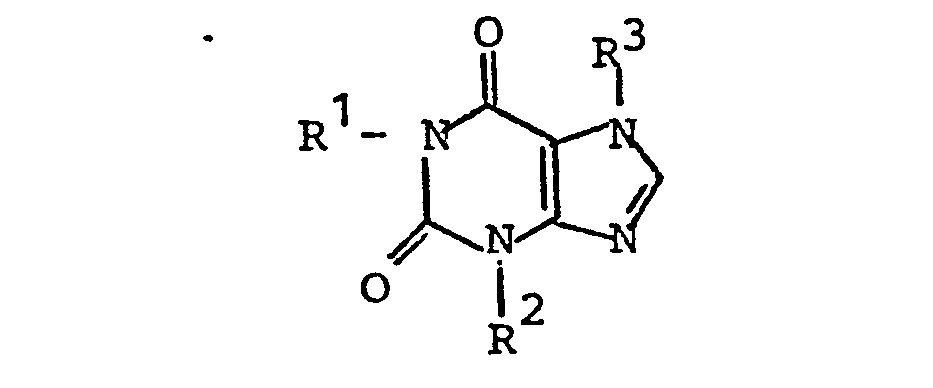
- the present invention thus relates to medicaments which contain vicinal dihydroxyalkylxanthines of the general formula I wherein one of the radicals R 1 , R2 or R 3 is a straight-chain alkyl group with 4 to 8 C atoms and two vicinal hydroxyl groups in ( ⁇ , ⁇ -1) - or ⁇ -1, ⁇ -2) position and the other two radicals represent straight-chain or branched alkyl groups with up to 12 C atoms in the position of R 1 and R 3 and up to 4 C atoms in the position of R 2 , the sum of the C atoms of these two alkyl substituents being at most 14.
- R 1 or R 2 is a ( ⁇ , ⁇ -1) -Dihydroxyalkylrest having 5 or 6 carbon atoms and the two alkyl substituents R 2 and R 3 or R and R 3 together comprise 3 to 6 carbon atoms.
- a further preferred embodiment of the invention relates to medicaments which contain those compounds of the formula I in which R 3 denotes a ( ⁇ , ⁇ -1) -dihydroxyalkyl group having 4 to 7 C atoms or a 4,5-dihydroxyhexyl group and the sum of the C -Atoms of the two alkyl radicals R 1 and R 2 is 3 to 7.
- R 3 denotes a 5,6-dihydroxyhexyl radical, such as in 3-ethyl-7- (5,6-dihydroxyhexyl) -1-propylxanthine, are again particularly preferred.
- a further particular embodiment of the invention consists in that the compounds of formula I are administered not in themselves but in prodrug form, from which the bronchospasmolytically active dihydroxyalkylxanthines with their previously defined substituents R 1 , R 2 and R 3 are obtained by biotransformation only in the organism can be released.
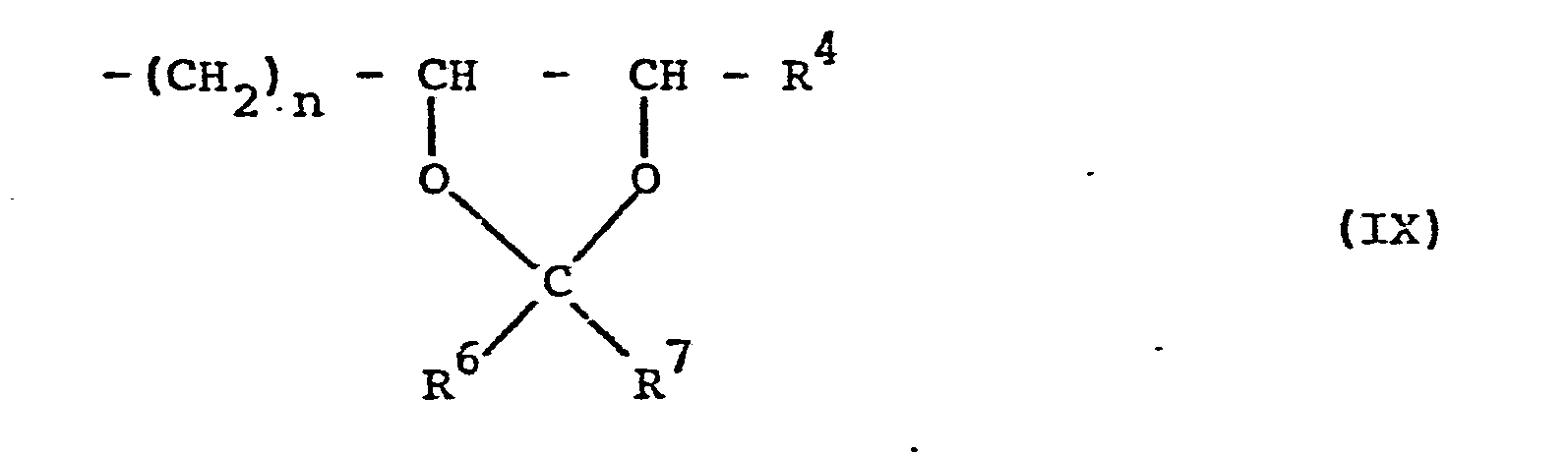
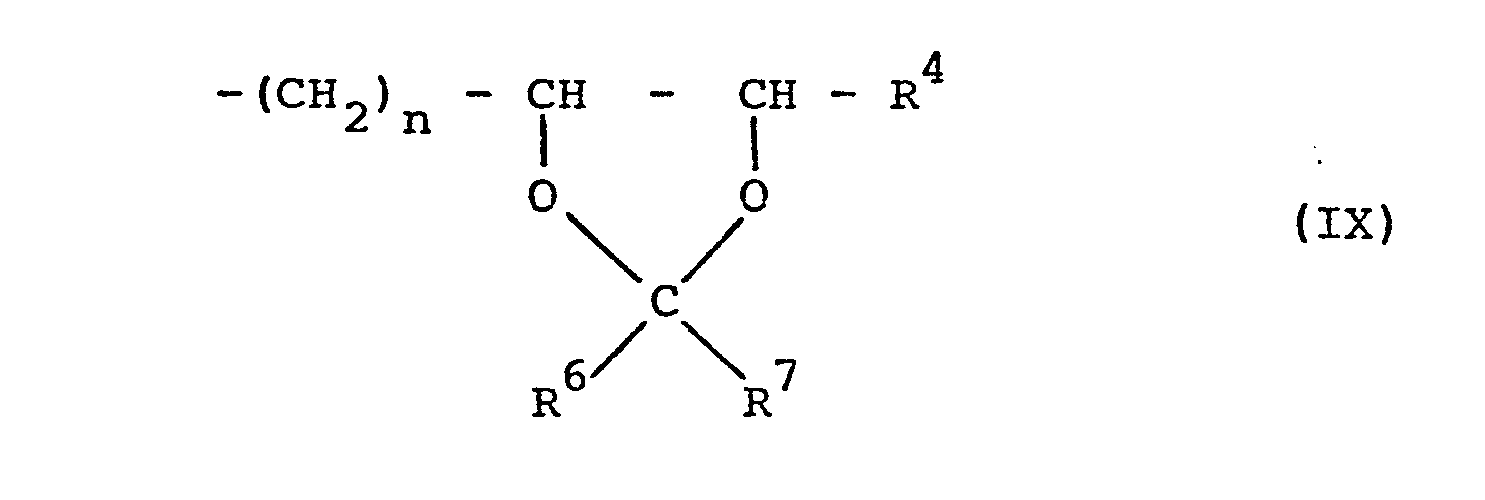
- the epoxides of the formula II which are subsequently treated as intermediates in the production processes are also suitable for this the structural element of formula IV and in particular the acetals according to formula VII with the structural element of formula IX, insofar as these are fully alkylated.
- the invention also relates to new vicinal dihydroxyalkylxanthines of the formula I in which one of the radicals R 1 , R 2 or R 3 is a straight-chain alkyl group with 4 to 8 C atoms and two vicinal hydroxyl groups in ( ⁇ , ⁇ -1) - or ( ⁇ -1, ⁇ -2) position means and the other two radicals represent straight-chain or branched alkyl groups with up to 12 C atoms in the position of R 1 and R 3 and up to 4 C atoms in the position of R 2 , but the sum of the carbon atoms of these two alkyl substituents is at most 14 and wherein R 2 and R 3 are not simultaneously methyl if R 1 is a 4,5- or 5,6-dihydroxyhexyl radical.
- Particularly suitable compounds are both those in which R 1 or R 2 is a ( ⁇ , ⁇ -1) -dihydroxyalkyl radical having 5 or 6 carbon atoms and the two alkyl substituents R 2 and R 3 or R 1 and R 3 together Contain 3 to 6 carbon atoms, as well as those in which R 3 is a ( ⁇ , ⁇ -1) -dihydroxyalkyl group having 4 to 7 carbon atoms or a 4,5-dihydroxyhexyl group and the two alkyl radicals R 1 and R 2 together Contain 3 to 7 carbon atoms.
- the invention furthermore relates to processes for the preparation of the vicinal dihydroxyalkylxanthines of the formula I.
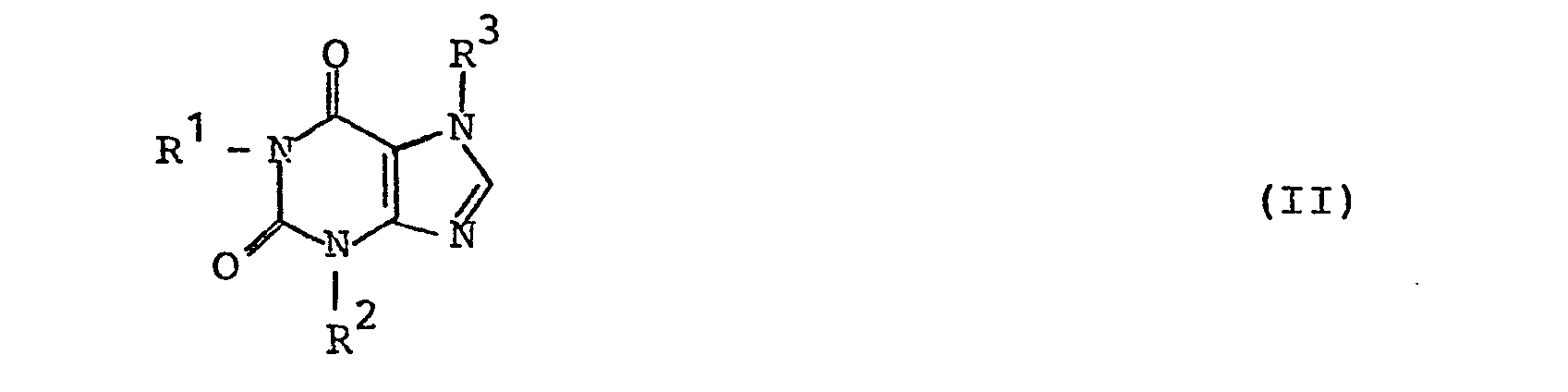
- alkenyl, monoalkyl and dialkyl alkenylxanthines of the formula II used here as starting materials are known, inter alia, from German Offenlegungsschriften 27 14 953 and 28 36 147.
- Suitable oxidizing agents for the epoxidation of the olefinic side chain according to formula III are, for example, chromium (VI) oxide, preferably in acetic acid canohydride and carbon disulfide or carbon tetrachloride; * potassium peroxomonosulfate in the presence of ketones, preferably acetone, in a homogeneous phase or in a two-phase system with phase transfer catalysis ; Peroxyboranes, which are advantageously generated in situ from boric acid or its derivatives and hydroperoxides; Triphenylsilyl hydroperoxide; Hydrogen peroxide in the presence of coreactants, such as, for example, aliphatic or aromatic carboxylic acid nitriles (for example aceto- or benzonitrile), optionally substituted cyanamide or isocyanates * or compounds containing peroxide groups, such as (eg phenyl isocyanate); Hydrogen peroxide or alkyl or aralkyl
- the epoxidation with the aid of percarboxylic acids is expediently carried out in a solvent or distribution medium which is inert to the reaction participants and which, experience has shown, has a considerable influence on the reaction rate. Since solvents which can form hydrogen bonds with the percarboxylic acids generally reduce the reaction rate, aromatic hydrocarbons, such as benzene or toluene, and halogenated hydrocarbons, such as dichloromethane, chloroform or tetrachloromethane, are compared to ethers such as diethyl ether, dioxane, tetrahydrofuran or ethylene glycol dimethyl ether, alcohols , Esters and carboxylic acids are often preferred.
- the reaction is usually carried out at temperatures between -10 ° and + 40 ° C, preferably at room temperature, the reaction time ranging from a few minutes to several hours.
- Percarboxylic acids are usually used in an isolated form for the reaction, but they can also be generated, for example, from the corresponding carboxylic acid and hydrogen peroxide in the reaction mixture in situ.
- the epoxyalkylxanthines according to formula II with the structural feature of formula IV can, however, also be obtained by base-catalyzed dehydrohalogenation of corresponding halohydrins, which in turn are caused, for example, by addition of subhalogenous acids, such as hypochlorous acid, to the olefinic double bond of the alkenylxanthines according to formulas II and II I let win.
- subhalogenous acids such as hypochlorous acid
- the basic dehydrohalogenating agents used are usually alkali metal or alkaline earth metal hydroxides or carbonates, preferably sodium, potassium or calcium hydroxide or sodium or potassium carbonate, but organic bases or other oxiranes, such as ethylene oxide or 1,2-epoxypropane, can also be used successfully .
- the epoxyalkylxanthines can either be isolated in pure form or processed further as raw products.
- the hydrolytic cleavage of the epoxyalkylxanthines to give the vicinal diols with the structural element of the formula V is advantageously carried out in an aqueous medium to which a water-miscible organic solvent, for example tetrahydrofuran, dioxane or ethylene glycol dimethyl ether, is added to improve the solution
- a water-miscible organic solvent for example tetrahydrofuran, dioxane or ethylene glycol dimethyl ether
- acidic catalysts preferably weakly nucleophilic acids, such as sulfuric, perchloric or p-toluenesulfonic acid or also strongly acidic cation exchange resins (for example Nafion-H), at temperatures between 20 ° and 100 ° C., but preferably with stirring for several hours at room temperature .
- the opening of the oxirane ring is also possible under neutral or alkaline conditions.
- Customary oxidizing agents for the direct vicinal dihydroxylation of the alkenylxanthines according to formulas II and III to the dihydroxyalkylxanthines characterized by the structural feature of the formula V are, for example, hydrogen peroxide in the presence of formic acid or glacial acetic acid, chromyl chloride, potassium permanganate, triphenylmethylphosphonium permanganate or iodine in the presence of silver (I) carboxylates, such as Thallium (I) acetate, selenium dioxide, molybdenum (VI) oxide and in particular osmium tetroxide.
- the reagent can be used either in a stoichiometric amount or in catalytic amounts with the addition of a secondary oxidizing agent which regenerates the osmium tetroxide from the primary cyclic esters under oxidative hydrolysis to the diols.
- non-reducing solvents preferably ethers, such as diethyl ether, tetrahydrofuran and dioxane, or hydrocarbons, such as benzene, cyclopentane or hexane, optionally with the addition of a tertiary amine , like especially pyridine but also quinoline, isoquinoline, 3- or 4-picoline, at temperatures between 0 ° C and the boiling point of the respective solvent, preferably around Room temperature, the reaction times can be from a few minutes to several hours.
- the osmium (VI) ester complexes formed as intermediates are advantageously reductively hydrolyzed, the use of sodium or potassium sulfite or hydrogen sulfite, hydrogen sulfide, lithium aluminum hydride or pyrocatechol or alkaline mannitol solution in aqueous or aqueous-alcoholic medium being particularly useful.
- oxidative hydrolysis of the complexes is also possible; however, in this case it is recommended that dihydroxylation be carried out from the start with catalytic amounts of osmium tetroxide in the presence of secondary oxidizing agents, such as hydrogen peroxide, metal chlorates (for example sodium or potassium and in particular silver or barium chlorate), sodium perchlorate, oxygen, sodium periodate or hypochlorite and especially tert-butyl hydroperoxide or trialkylamine N-oxides (for example N-methylmorpholine-N-oxide, trimethyl- or triethylamine-N-oxide).
- secondary oxidizing agents such as hydrogen peroxide, metal chlorates (for example sodium or potassium and in particular silver or barium chlorate), sodium perchlorate, oxygen, sodium periodate or hypochlorite and especially tert-butyl hydroperoxide or trialkylamine N-oxides (for example N-methylmorpholine-N-oxide, trimethyl- or triethylamine-
- Dipolar, aprotic solvents for example formamide, dimethylformamide, dimethylacetamide, N-methylpyrrolidone, tetra-methylurea, hexamethylphosphoric triamide, dimethyl sulfoxide, acetone or butanone, are particularly suitable as such; but it can also alcohols, such as methanol, ethylene glycol and its ether, ethanol, propanol, isopropanol and the various butanols; Hydrocarbons such as benzene, toluene or xylenes; halogenated hydrocarbons such as dichloromethane or chloroform; Pyridine and mixtures of the solvents mentioned or mixtures thereof with water are used.
- the reactions are expediently carried out in the presence of a basic condensing agent.
- a basic condensing agent for example, alkali or alkaline earth metal hydroxides, carbonates, hydrides, alcoholates or organic bases, such as trialkylamines (e.g. triethyl or tributylamine), quaternary ammonium or phosphonium hydroxides and crosslinked resins with fixed, optionally substituted ammonium or phosphonium groups are suitable.
- the xanthine derivatives can also be used directly in the form of their separately prepared salts, for example the alkali metal, alkaline earth metal or optionally substituted ammonium or phosphonium salts, in the alkylation reaction.
- the dihydroxyalkylxanthines and their monoalkylated derivatives can be used both in the presence of the aforementioned inorganic condensing agents and in the form of their alkali metal or alkaline earth metal salts with the aid of so-called phase transfer catalysts, for example tertiary amines, quaternary ammonium or phosphonium salts or also crown ethers, preferably in a two-phase system alkylate the conditions of phase transfer catalysis conveniently.
- the reaction is generally carried out at a reaction temperature between 0 ° C. and the boiling point of the reaction medium used in each case, preferably between 20 ° and 130 ° C., if appropriate at elevated or reduced pressure, but usually at atmospheric pressure, the reaction time can be from less than an hour to several hours.
- the monoalkyl or dialkylxanthines of the formula VII and alkylating agents of the formulas VIII and X used as starting materials are largely known or can be easily prepared by methods known from the literature.
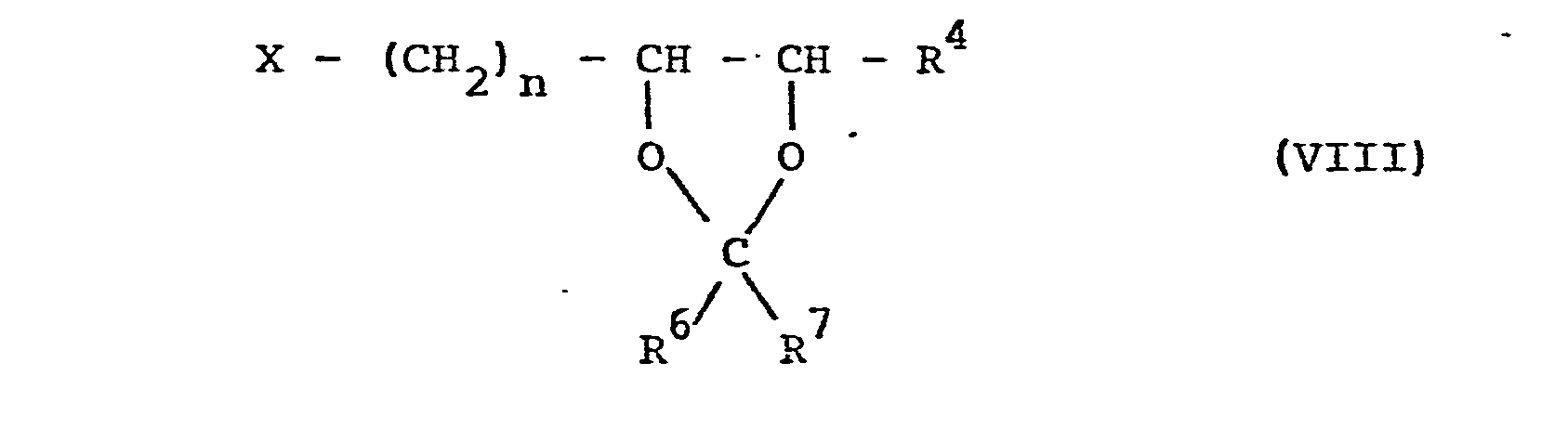
- the compounds of the formula VIII can be obtained from the triols of the formula XI can be obtained by reacting the two vicinal hydroxyl groups with aldehydes or ketones or their acetals with proton catalysis and then exchanging the isolated, terminal hydroxyl function for halogen by means of inorganic acid halides or esterifying them with sulfonic acid or phosphonic acid halides or anhydrides in a distributed manner in the presence of basic agents which in turn can be prepared by acid hydrolysis of the 1,3-dioxolane ring, the compounds of formula X.
- the alkenyl halides of the formula XII can be used as starting materials for .
- the compounds of the formulas VIII and X are prepared by epoxidizing them on the olefinic double bond as described for the alkenylxanthines and then hydrolyzing the oxirane ring with acid or oxidizing them directly to the dihydroxyalkyl halides of the formula X and, if appropriate, using aldehydes or ketones or their acetals are converted into 1,3-dioxolanes of the formula VIII.
- the compounds of the formula X are used to introduce the dihydroxyalkyl radical, preference is given to those whose alkyl chain contains a total of either 6 to 8 carbon atoms, if R 4 is hydrogen, or 7 or 8 carbon atoms if R 4 is a methyl group, since the shorter-chain diols of the formula X tend to form tetrahydrofuran derivatives, especially under the alkaline conditions of the alkylation reaction, which can lead to a marked reduction in the yield of the desired alkylation product.
- the hydrolytic cleavage of the 1,3-dioxolane ring in the xanthines of the formula VII with the structural element of the formula IX to give the dihydroxyalkylxanthines characterized by the structural feature of the formula V is normally carried out in an aqueous medium, if appropriate with the addition of a solubilizer such as tetrahydrofuran, dioxane or ethylene glycol dimethyl ether, advantageous in the presence of acids, for example formic acid, oxalic acid, wine acid, citric acid, sulfuric acid, perchloric acid, phosphoric acid or p-toluenesulfonic acid, or an acidic ion exchanger (for example Nafion-H) at temperatures between 20 ° C and the boiling point of the reaction mixture, preferably 50 ° and 100 ° C, carried out, the reaction time being from several minutes to a few hours.
- a solubilizer such as tetrahydrofuran, dioxan
- Moist silica gel with a water content of up to 10% is also a useful reagent for deacetalization, preference being given to working in optionally halogenated hydrocarbons, such as benzene, toluene, dichloromethane or chloroform, at room temperature.
- Another method of preparation for the xanthines of the formula VII with the structural element of the formula IX containing the dioxolane ring consists in the addition of carbonyl compounds of the formula R 6 -CO-R 7 to the oxirane ring of the epoxyalkylxanthines according to formula II with the structural feature of the formula IV.
- This reaction is advantageously carried out in the presence of acidic catalysts, preferably Lewis acids such as boron trifluoride, zinc (II) chloride, tin (IV) chloride or also Kugfer (II) sulfate, at temperatures between 0 ° and 60 ° C.
- Quaternary ammonium salts for example tetraethylammonium halides, are also able to catalyze the addition reaction to the cyclic acetals.
- the vicinal dihydroxyalkylxanthines of the formula I have either one or two asymmetric carbon atoms and can therefore be present in stereoisomeric forms.
- the invention therefore relates both to the pure stereoisomeric compounds and to their mixtures.
- the medicaments according to the invention can be administered orally, rectally, parenterally or as an aerosol.
- Suitable solid or liquid pharmaceutical preparation forms are, for example, granules, powders, tablets, Dragees; (Micro) capsules, suppositories, syrups, emulsions, suspensions, aerosols, drops or injectable solutions as well as preparations with protracted active ingredient release, in the production of which usually auxiliaries such as carriers, explosives, binders, coatings, swellings, lubricants or lubricants, flavors, sweeteners or solubilizers. Examples of commonly used auxiliaries are lactose, mannitol and other sugars, talc, milk protein, gelatin, starch, cellulose and its derivatives, animal and vegetable oils, polyethylene glycols and solvents such as sterile water.
- auxiliaries such as carriers, explosives, binders, coatings, swellings, lubricants or lubricants, flavors, sweeteners or solubilizers.
- auxiliaries are lactose, mannitol and other sugars,
- the preparations are preferably produced and administered in dosage units, each unit containing a certain dose of active substance according to formula I.
- this dose can be up to 1000 mg, but preferably 50 to 300 mg, and in the case of injection solutions in ampoule form up to 200 mg, but preferably 20 to 100 mg.
- daily doses for the treatment of an adult patient suffering from bronchial obstructions, depending on the effectiveness of the compounds of the formula I in humans, daily doses of 100 to 500 mg of active ingredient, preferably 200 to 300 mg, by oral administration and from 20 to 150 mg, preferably 40 to 80 mg, indicated for intravenous administration. Under certain circumstances, however, higher or lower daily doses may also be appropriate.
- the daily dose can be administered either by single administration in the form of a single dosage unit or else several smaller dosage units, or by multiple administration of divided doses at certain intervals.
- the xanthine derivatives of the formula I can also be formulated together with other suitable active compounds, for example antiallergics, antitussives, secretolytics, sedatives, peripheral vasotherapeutics, antihistamines and also other bronchospasmolytics such as ⁇ 2 -sympathomimetics or parasympatholytics in the preparation of the aforementioned pharmaceutical preparation forms .
- suitable active compounds for example antiallergics, antitussives, secretolytics, sedatives, peripheral vasotherapeutics, antihistamines and also other bronchospasmolytics such as ⁇ 2 -sympathomimetics or parasympatholytics in the preparation of the aforementioned pharmaceutical preparation forms .
- the crude product is recrystallized from methylene chloride / diethyl ether.
- osmium tetroxide 0.73 g of 1,3-diethyl-7- (5-hexenyl) -xanthine in 11 ml of diethyl ether are added dropwise at room temperature with stirring to 0.65 g of osmium tetroxide in 11 ml of diethyl ether in 5 minutes.
- the crude product is purified by column chromatography on silica gel (mobile phase: methylene chloride / acetone, volume ratio 7/3) and by recrystallization from petroleum ether.
- This diol can alternatively by single-stage oxidation of 1,3-dibutyl-7- (3-butenyl) -xanthine with osmium tetroxide analogously to Example 2 C or by alkylation of 1,3-dibutylxanthine with the 1-halogen-3,4 known from the literature -isopropylidenedioxy-butanes (eg Tetrahedron 34 (1978), pp. 2873-2878) and subsequent acid hydrolysis of the dioxolane ring analogously to Example 1.
- the 1-bromo-6,7-dihydroxyheptane produced in stage b) can also be used directly for the alkylation of 1,3-diethylxanthine in stage d) without prior reaction with 2,2-dimethoxypropane to give the dioxolane derivative.
- the 37.7 g of epoxide are dissolved in a mixture of 200 ml of tetrahydrofuran and 135 ml of water, and 0.61 ml of perchloric acid (70% strength) is added dropwise with stirring at room temperature over the course of about 10 minutes. After stirring for 14 hours at room temperature, the mixture is neutralized with saturated sodium bicarbonate solution and evaporated under reduced pressure.
- the remaining oily crude product (100% of theory) can be purified by column chromatography on silica gel with chloroform / methanol (volume ratio 10/1) as eluent and subsequent recrystallization from ethyl acetate with the addition of petroleum ether at the boiling point until cloudy.
- the residue is purified by column chromatography on silica gel with methylene chloride / ethanol (volume ratio 8/2) as the eluent and by subsequent recrystallization from methylene chloride / diethyl ether.
- This diol can also be obtained by reacting 1,7-diethyl-3- (5-hexenyl) xanthine with osmium tetroxide analogously to Example 2 C or by epoxidation of the aforementioned xanthine compound followed by acid hydrolysis of the epoxy ring analogously to Examples 3, 4 and 7.
- composition 100 g of 3-ethyl-7- (5,6-dihydroxyhexyl) -1-propylxanthine (compound according to Example 1), 20 g of lactose, 30 g of corn starch, 8.5 g of talc, 0 , 5 g of colloidal silica and 1 g of magnesium stearate are mixed and pressed to dragee cores of 160 mg in weight, which are then treated with a coating mixture of 40 g of cane sugar, 23.5 g of talc and very small additions of wax, titanium dioxide and Arabic gum so that the The final weight of the coated tablets is 225 mg each.
- composition For the preparation of 1000 coated tablets, 111.8 g of 3-ethyl-7- (5,6-isopropylidendioxyhexyl) -1-propylxanthine (from Example 1), 20 g of lactose, 30 g of corn starch, 8.5 g Talc, 0.5 g colloidal silica and 1 g magnesium stearate mixed and pressed to dragee cores weighing 171.8 mg, which were then coated with a coating mixture of 40 g cane sugar, 23.5 g talc and very small additions of wax, titanium dioxide and arabic gum be treated so that the final weight of the coated tablets is 240 mg each.
- composition 100 g of 1,3-diethyl-7- (5,6-epoxyhexyl) xanthine (from Example 2 B), 20 g of lactose, 30 g of corn starch, 8.5 g of talc, 5 g of colloidal silica and 1 g of magnesium stearate are mixed and pressed to dragee cores of 160 mg in weight, which are then treated with a coating mixture of 40 g of cane sugar, 23.5 g of talc and very small additions of wax, titanium dioxide and Arabic gum so that the The final weight of the coated tablets is 225 mg each.
- the compounds according to the invention were tested for bronchospasmolytic activity essentially using the experimental arrangement described by H. Konzett and R. Roessler (Arch. Exp. Path. And Pharmak. 195 (1940) 71) in comparison with the standard therapeutic agent theophylline-ethylenediamine and two previously described 2,3-dihydroxypropyl compounds dyphylline [7- (2,3-dihydroxypropyl) -1,3-dimethylxanthine] and 7- (2,3-dihydroxypropyl) -1,3-dipropylxanthine.
- test substances were administered in aqueous solution either intravenously (iv) or intraduodenally (id).
- ED 50 values which represent the dose in mg / kg at which the experimentally generated spasm is reduced by half compared to that of untreated animals, were determined graphically from the dose-response curves.
- the LD 50 values were determined as standard using the mortality occurring within 7 days in NMRI mice after a single intravenous (iv), intraperitoneal (ip) or oral (po) administration.
- the compounds of formula I also exert a strong inhibitory effect on the bronchospasm induced on presensitized guinea pigs with ovalbumin (1 mg / kg iv), which can hardly be influenced by the conventional xanthine derivatives.
- the ED 50 value for the compound of Example 1 is between 6 and 12 mg / kg iv, while the theophylline-ethylenediamine with doses up to 10 mg / kg shows no effect in this test arrangement.
- the superior bronchospasmolytic activity of the xanthines according to formula I could finally also be demonstrated in the lung function test on anesthetized dogs on the basis of the inhibition of the bronchospastic reactions triggered with acetylcholine, histamine and ascaris extract aerosols.
- the compound of Example 1 already showed a significant inhibitory effect with 12 mg / kg iv, while theophylline in doses up to 20 mg / kg iv proved ineffective.
- the clinically well-established bronchospasmolytic effect of the basic body of theophylline is associated with the considerable disadvantage of a very narrow therapeutic range combined with serious side effects, especially in the cardiovascular area (hypotensive activity, decrease in cerebral blood flow) and in the central nervous system (e.g. restlessness , Insomnia, dizziness).
- the central arousal is particularly disturbing for patients and clinicians, since it often leads to insomnia and thus has a lasting impact on the general condition of the asthmatics.
- theophylline-ethylenediamine increases the spontaneous motility of white male mice by 1 8 6% over a period of 7 hours after oral administration of 30 mg / kg.
- the two other comparative preparations dyphylline and 7- (2,3-dihydroxypropyl) -1,3-dipropylxanthine also cause central stimulation in mice; although these effects are much weaker than with theophylline.
- the compounds of the formula I according to the invention have no central excitation component, but on the contrary exert a slightly depressant effect on the central nervous system, which can be assessed particularly advantageously from a therapeutic point of view. For example, after oral administration of 50 mg / kg of the compound of Example 1, the spontaneous motility of the mice is reduced by 53% for a period of 11 hours.
Landscapes
- Chemical & Material Sciences (AREA)
- Organic Chemistry (AREA)
- Health & Medical Sciences (AREA)
- Animal Behavior & Ethology (AREA)
- Public Health (AREA)
- Chemical Kinetics & Catalysis (AREA)
- General Chemical & Material Sciences (AREA)
- Medicinal Chemistry (AREA)
- Nuclear Medicine, Radiotherapy & Molecular Imaging (AREA)
- Bioinformatics & Cheminformatics (AREA)
- Pharmacology & Pharmacy (AREA)
- Life Sciences & Earth Sciences (AREA)
- Engineering & Computer Science (AREA)
- General Health & Medical Sciences (AREA)
- Pulmonology (AREA)
- Veterinary Medicine (AREA)
- Pharmaceuticals Containing Other Organic And Inorganic Compounds (AREA)
- Organic Low-Molecular-Weight Compounds And Preparation Thereof (AREA)
- Acyclic And Carbocyclic Compounds In Medicinal Compositions (AREA)
- Saccharide Compounds (AREA)
- Epoxy Compounds (AREA)
- Steroid Compounds (AREA)
- Pyrane Compounds (AREA)
- Compounds Of Unknown Constitution (AREA)
Abstract

Description
- Die Erfindung betrifft neue Arzneimittel, die sich insbesondere zur Behandlung obstruktiver Atemwegserkrankungen eignen, die in ihnen enthaltenen pharmakologisch aktiven vicinalen Dihydroxyalkylxanthine, -Verfahren zur Herstellung dieser Xanthinderivate und Zwischenprodukte hierzu.
- Unter den bislang bekannten Bronchospasmolytika nehmen die als Phosphodiesterase-Inhibitoren agierenden Xanthinverbindungen eine Vorzugsstellung ein (vergl. B. Hellwig, Moderne Arzneimittel, Stuttgart 1980, S. 1274), da sie keine β2-sympathikomimetische Aktivität besitzen und sich deshalb besonders gut für die bei chronisch-obstruktiven Atemwegsleiden stets notwendige Dauertherapie eignen. Aus dieser Stoffgruppe stellt das natürlich vorkommende Xanthinderivat Theophyllin (1,3-Dimethylxanthin) seit nunmehr einigen Jahrzehnten unangefochten das Mittel der Wahl in der Asthmatherapie dar. Seiner klinisch gut etablierten Wirkung stehen jedoch die Nachteile einer sehr engen therapeutischen Breite, gravierender Nebenwirkungen im gastrointestinalen, kardiovaskulären und renalen Bereich sowie im zentralen Nervensystem und seiner nur enteralen Anwendbarkeit aufgrund mangelnder Wasserlöslichkeit gegenüber, -die den Wunsch der Kliniker und die Suche der pharmazeutischen Forschung nach Präparaten mit einer größeren Therapiesicherheit begründen.
- Mit der Herstellung wasserlöslicher Salze oder Additionsverbindungen, wie etwa dem Theophyllin-Ethylendiamin (Aminophyllin), ist es inzwischen zwar gelangen, auch parenteral verabreichbare Theophyllin-Zubereitungen zu erhalten, die aber keine nennenswerte Vergrößerung der therapeutischen Breite und keine Verminderung der oben erwähnten unerwünschten Nebenwirkungen mit sich brachten; zumal das beim Aminophyllin als Lösungsvermittler fungierende Ethylendiamin selbst eine nachteilige Wirkung auf das kardiovaskuläre System ausübt.
- Es hat daher nicht an Versuchen gefehlt, durch Strukturvariationen am Theophyllinmolekül zu besser verträglichen Verbindungen mit womöglich stärkerer nronchospasmolytischer Aktivität zu gelangen.
- Das einzige synthetische Theophyllinderivat, das eine gewisse therapeutische Anwendung gefunden hat, ist Dyphyllin [7-(2,3-Dihydroxypropyl)-1,3-dimethylyanthin]. Die 7-ständige 2,3-Dihydroxypropylgruppe verleiht diesem Präparat zwar eine gute Wasserlöslichkeit, so daß sich die unerwünschte Anwendung von Lösungsvermittlern bei der parenteralen Applikation erübrigt, und auch die störenden Theophyllin-artigen Nebenwirkungen sind deutlich schwächer ausgeprägt, doch werden diese Vorteile gleichzeitig mit einem drastischen Abfall der bronchospasmolytischen Aktivität gegenüber jener des Theophyllins bezahlt.
- In systematischer Fortführung dieser Arbeiten wurden dann unter Beibehaltung des 2,3-Dihydroxypropylrestes in der 7-Stellung des Xanthingerüstes die beiden 1- und 3- ständigen Methylgruppen gegen längeres Alkyl ausgetauscht. Dies führte zu dem in der deutschen Offenlegungsschrift 27 16 402 beschriebenen 7-(2,3-Dihydroxypropyl)-1,3- dipropylxanthin, einer gut wasserlöslichen Verbindung, die fast die bronchospasmolytische Wirkung von Theophyllin erreichen und gleichzeitig eine geringere akute Toxizität sowie weniger nachteilige Nebenwirkungen aufweisen soll. Dennoch hat dieses Präparat bisher keinen Eingang in die Asthmatherapie gefunden.- Darüberhinaus ruft es laut vorgenannter Offenlegungsschrift eine wenn auch deutlich schwächere zentrale Stimulierung als Theophyllin hervor, die zu Unruhe und Schlafstörungen führen kann. Demzufolge würden wasserlösliche Xanthinverbindungen, die dem Theophyllin an Wirkungsstärke und therapeutischer Breite überlegen sind und keine nennenswerten Nebenwirkungen,insbesondere keine zentrale Erregung, auslösen, nach wie vor eine echte Bereicherung der Therapie von obstruktiven Atemwegsleiden darstellen.
- Überraschend wurde nun gefunden, daß die bislang nicht untersuchte Verlängerung des Dihydroxypropylrestes unabhängig von dessen Stellung am Xanthingerüst zu Verbindungen führt, die diese strengen therapeutischen Anforderungen erfüllen. Zwar sind in der Literatur bereits zwei derartige Xanthinkörper, nämlich 1-(5,6-Dihydroxyhexyl)-3,7-dimethylxanthin und 1-(4,5-Dihydroxyhexyl)-3,7-dimethylxanthin in der threo- und erythro-Form, beschrieben worden (Arzneimittelforschung (Drug Res.) 22, 1144 - 1151 (1972)), doch wurden diese Verbindungen lediglich als Metabolite des Vasotherapeutikums Pentoxifyllin isoliert und identifiziert. Dementsprechend finden sich in dieser Publikation auch keinerlei Angaben über deren pharmakologische Eigenschaften.
- Gegenstand der vorliegenden Erfindung sind somit Arzneimittel, die vicinale Dihydroxyalkylxanthine der allgemeinen Formel I enthalten,

- Bevorzugt sind dabei solche Arzneimittel, die-Verbindungen der Formel I enthalten, in denen R1 oder R2 einen (ω, ω-1)-Dihydroxyalkylrest mit 5 oder 6 C-Atomen darstellt und die beiden Alkylsubstituenten R 2 und R 3 bzw. R und R 3 zusammen 3 bis 6 C-Atome umfassen.
- Eine weitere bevorzugte Ausführungsform der Erfindung betrifft Arzneimittel, die solche Verbindungender Formel I enthalten, in denen R3 eine (ω, ω-1)-Dihydroxyalkylgruppe mit 4 bis 7 C-Atomen oder eine 4,5-Dihydroxyhexylgruppe bedeutet und die Summe der C-Atome der beiden Alkylreste R1 und R2 3 bis 7 beträgt. Unter diesen Arzneimitteln sind wiederum jene mit solchen Verbindungen der Formel I besonders bevorzugt, in denen R3 einen 5,6-Dihydroxyhexylrest, wie etwa im 3-Ethyl-7-(5,6-dihydroxyhexyl)-1-propylxanthin, darstellt.
- Eine weitere besondere Ausführungsform der Erfindung besteht darin, daß die Verbindungen der Formel I nicht per se sondern in Prodrug-Form verabreicht werden, aus der erst im Organismus die bronchospasmolytisch aktiven Dihydroxyalkylxanthine mit ihren voranstehend definierten Substituenten R1, R2 und R3 durch Biotransformation freigesetzt werden können. Hierfür eignen sich beispielsweise die nachfolgend bei den Herstellungsverfahren als Zwischenprodukte abgehandelten Epoxide gemäß Formel II mit dem Strukturelement der Formel IV und insbesondere die Acetale gemäß Formel VII mit dem Strukturelement der Formel IX, soweit diese vollständig alkyliert sind.
- Gegenstand der Erfindung sind auch neue vicinale Dihydroxyalkylxanthine der Formel I, in denen einer der Reste R 1, R 2 oder R 3 eine geradkettige Alkylgruppe mit 4 bis 8 C-Atomen und zwei vicinalen Hydroxylgruppen in (ω, ω-1)- oder (ω-1, ω-2)-Stellung bedeutet und die beiden anderen Reste geradkettige oder verzweigte Alkylgruppen mit bis zu 12 C-Atomen in der Position von R1 und R 3 und bis zu 4 C-Atomen in der Position von R 2 darstellen, wobei die Summe der C-Atome dieser beiden Alkylsubstituenten jedoch höchstens 14 beträgt und wobei R2 und R 3 nicht gleichzeitig Methyl sind, wenn R1 einen 4,5- oder 5,6-Dihydroxyhexylrest darstellt.
- Besonders geeignete Verbindungen sind dabei sowohl solche, in denen R 1 oder R 2 einen (ω,ω-1)-Dihydroxyalkylrest mit 5 oder 6 C-Atomen darstellt und die beiden Alkylsubstituenten R 2 und R 3 bzw. R1 und R3 zusammen 3 bis 6 C-Atome enthalten, als auch jene, worin R3 eine (ω, ω-1)-Dihydroxyalkylgruppe mit 4 bis 7 C-Atomen oder eine 4,5-Dihydroxyhexylgruppe bedeutet und die beiden Alkylreste R 1 und R 2 zusammen 3 bis 7 C-Atome enthalten. Unter den zuletzt genannten Verbindungen wieder stellen die 7-(5,6-Dihydroxyhexyl)-1,3-dialkylxanthine mit insgesamt 3 bis 7 C-Atomen in den beiden Alkylresten R 1 und R 2, wie etwa das 3-Ethyl-7-(5,6-dihydroxyhexyl)-1-propyl- xanthin, besonders bevorzugte Verbindungen gemäß Formel I dar.
- Gegenstand der Erfindung sind weiterhin Verfahren zur Herstellung der vicinalen Dihydroxyalkylxanthine gemäß Formel I.
- Ein Verfahren besteht beispielsweise darin, daß man Xanthine der Formel II,


- a) mit geeigneten Oxidationsmitteln an der olefinischen Doppelbindung zu neuen Epoxyalkmlxanthinen mit dem Strukturelement der Formel IV


- b) mit üblichen Oxidationsmitteln an der olefinischen Doppelbindung direkt zu den Dihydroxyalkylxanthinen mit dem durch Formel V gekennzeichneten Strukturelement dihydroxyliert
- Die hierbei als Ausgangsstoffe benutzten Alkenyl-, Monoalkyl- und Dialkyl-alkenylxanthine der Formel II sind unter anderem aus den deutschen Offenlegungsschriften 27 14 953 und 28 36 147 bekannt.
- Als geeignete Oxidationsmittel für die Epoxidation der olefinischen Seitenkette gemäß Formel III kommen beispielsweise Chrom-(VI)oxid, vorzugsweise in Essigsäurcanhydrid und Schwefelkohlenstoff bzw. Tetrachlorkohlenstoff;*Kaliumperoxomonosulfat in Gegenwart von Ketonen, bevorzugt Aceton, in homogener Phase oder aber in einem ZweiphasenSystem unter Phasentransferkatalyse; Peroxyborane, die man vorteilhafterweise aus Borsäure oder deren Derivaten und Hydroperoxiden in situ erzeugt; Triphenylsilylhydroperoxid; Wasserstoffperoxid in Gegenwart von Coreaktanden, wie beispielsweise aliphatischen oder aromatischen Carbonsäurenitrilen (z.B. Aceto- oder Benzonitril), gegebcnenfalls substituiertem Cyanamid oder Isocyanaten * oder peroxidgruppenhaltige Verbindungen wie (z.B. Phenylisocyanat); Wasserstoffperoxid oder Alkyl- bzw. Aralkylhydroperoxide, wie etwa tert.-Butylhydroperoxid, 1-Phenylethylhydroperoxid und Cumolhydroperoxid, in Gegenwart entweder basischer Mittel oder bevorzugt spezieller Katalysatoren, wie beispielsweise Wolframsäure, Vanadium(V)oxid, Molybdänhexacarbonyl und Vanadium-oder Molybdänacetylacetonate; und insbesondere Percarbonsäuren, wie z.B. Perameisen-, Peressig-, Trifluorperessig-, Monopermalein-, Monoperbernstein-, Perbenzoe-, 4-Nitroperbenzoe- und vorzugsweise 3-Chlorperbenzoe- und Monoperphthalsäure, in Frage.
- Die Epoxidation mit Hilfe von Percarbonsäuren (Prileschajew-Reaktion) wird zweckmäßig in einem gegenüber den Reaktionsteilnehmern inerten Lösungs- oder Verteilungsmittel durchgeführt, das erfahrungsgemäß einen beachtlichen Einfluß auf die Reaktionsgeschwindigkeit ausübt. Da Lösungsmittel, die mit den Percarbonsäuren Wasserstoffbrückenbindungen bilden können, im allgemeinen die Reaktionsgeschwindigkeit herabsetzen, sind aromatische Kohlenwasserstoffe, wie Benzol oder Toluol, und halogenierte Kohlenwasserstoffe, wie Dichlormethan, Chloroform oder Tetrachlormethan, gegenüber Ethern, wie Diethylether, Dioxan, Tetrahydrofuran oder Ethylenglykoldimethylether, Alkoholen, Estern und Carbonsäuren häufig bevorzugt. Die Umsetzung erfolgt üblicherweise bei Temperaturen zwischen -10° und +40°C, vorzugsweise bei Raumtemperatur, wobei die Reaktionszeit von wenigen Minuten bis zu mehreren Stunden reichen kann.
- Gewöhnlich setzt man Percarbonsäuren in isolierter Form zur Reaktion ein, sie können aber auch beispielsweise aus der entsprechenden Carbonsäure und Wasserstoffperoxid im Reaktionsansatz in situ erzeugt werden.
- Bei der Verwendung von Persäuren starker Carbonsäuren, wie etwa der Trifluorperessigsäure, empfiehlt es sich, die Säurekonzentration durch Arbeiten im heterogenen System oder durch Zusatz von Puffersubstanzen, wie Natriumcarbonat, Natriumhydrogencarbonat oder Dinatriumhydrogenphosphat, herabzusetzen, um unerwünschte Folgereaktionen der bei der Reaktion entstehenden Carbonsäure mit dem primär gebildeten Epoxid zu unterdrücken.
- Die Epoxyalkylxanthine gemäß Formel II mit dem Strukturmerkmal der Formel IV können aber auch durch basenkatalysierte Dehydrohalogenierung von entsprechenden Halogenhydrinen erhalten werden, die sich ihrerseits z.B. durch Anlagerung von unterhalogenigen Säuren, wie etwa unterchloriger Säure, an die olefinische Doppelbindung der Alkenylxanthine gemäß den Formeln II und IIIgewinnen lassen. Auch die Umsetzung dieser Olefine mit N-Halogensuccinimiden, wie N-Bromsuccinimid, oder Chloramin T in Wasser oder wasserhaltigen Lösungsmittelgemischen führt zu den Halogenhydrinen. Als basische Dehydrohalogenierungsmittel verwendet man gewöhnlich Alkali- oder Erdalkalihydroxide oder -carbonate, vorzugsweise Natrium-, Kalium-oder Calciumhydroxid oder Natrium- oder Kaliumcarbonat, aber auch organische Basen oder andere Oxirane, wie Ethylenoxid oder 1,2-Epoxypropan, können mit Erfolg eingesetzt werden.
- Die Epoxyalkylxanthine können entweder in reiner Form isoliert oder aber als Rohprodukte weiterverarbeitet werden.
- Die hydrolytische Spaltung der Epoxyalkylxanthine zu den vicinalen Diolen mit dem Strukturelement der Formel V wird in wäßrigem Medium, dem man gegebenenfalls zur Lösungsverbesserung ein mit Wasser mischbares organisches Lösungsmittel, beispielsweise Tetrahydröfuran, Dioxan oder Ethylenglykoldimethylether, zusetzt, vorteilhaft in Gegenwart saurer Katalysatoren, vorzugsweise schwach nucleophiler Säuren, wie Schwefel-, Perchlor- oder p-Toluolsulfonsäure oder auch stark saurer Kationenaustauscherharze (z.B. Nafion-H), bei Temperaturen zwischen 20° und 100°C, bevorzugt aber unter mehrstündigem Rühren bei Raumtemperatur, durchgeführt. Aber auch unter neutralen oder alkalischen Bedingungen ist die Oxiranringöffnung prinzipiell möglich.
- Übliche Oxidationsmittel für die direkte vicinale Dihydroxylierung der Alkenylxanthine gemäß Formeln II und III zu den durch das Strukturmerkmal der Formel V gekennzeichneten Dihydroxyalkylxanthinen stellen beispielsweise Wasserstoffperoxid in Gegenwart von Ameisensäure oder Eisessig, Chromylchlorid, Kaliumpermanganat, Triphenylmethyl- phosphoniumpermanganat,Jod in Gegenwart von Silber- oder Thallium(I)carboxylaten, wie z.B. Thallium(I)acetat, Selendioxid, Molybdän(VI)oxid und insbesondere Osmiumtetroxid dar.
- Bei der Verwendung von Osmi.umtetroxid als Oxidationsmittel kann das Reagens entweder in stöchiometrischer Menge oder aber in katalytischen Mengen unter Zusatz eines sekundären Oxidationsmittels, das das Osmiumtetroxid aus den primär entstehenden cyclischen Estern unter oxidativer Hydrolyse zu den Diolen regeneriert, eingesetzt werden.
- Bei der nicht-katalytischen Dihydroxylierung der olefinischen Doppelbindung mit stöchiometrischen Mengen an Osmiumtetroxid arbeitet man zweckmäßig in nicht reduzierend wirkenden Lösungsmitteln, vorzugsweise Ethern, wie Diethylether, Tetrahydrofuran und Dioxan, oder Kohlenwasserstoffen, wie Benzol, Cyclopentan oder -hexan, gegebenenfalls unter Zusatz eines tertiären Amins, wie vor allem Pyridin aber auch Chinolin, Isochinolin, 3- oder 4-Picolin, bei Temperaturen zwischen 0°C und dem Siedepunkt des jeweiligen Lösungsmittels, vorzugsweise um Raumtemperatur, wobei die Reaktionszeiten von einigen Minuten bis zu mehreren Stunden betragen können. Anschließend werden die hierbei intermediär entstehenden Osmium(VI)ester-Komplexe vorteilhafterweise reduktiv hydrolysiert, wobei sich insbesondere der Einsatz von Natrium- oder Kaliumsulfit oder -hydrogensulfit, Schwefelwasserstoff, Lithiumaluminiumhydrid oder auch Brenzcatechin oder alkalischer Mannitol-Lösung in wäßrigem oder wäßrigalkoholischem Medium bewährt. Aber auch die oxidative Hydrolyse der Komplexe ist möglich; allerdings empfiehlt es sich in diesem.Falle die Dihydroxylierung von vornherein mit katalytischen Mengen an Osmiumtetroxid in Gegenwart sekundärer Oxidationsmittel, wie beispielsweise Hydrogenperoxid, Metallchloraten (z.B. Natrium- oder Kalium-und insbesondere Silber- oder Bariumchlorat), Natriumperchlorat, Sauerstoff, Natriumperjodat oder -hypochlorit und vor allem tert.-Butylhydroperoxid oder Trialkylamin-N-oxiden (z.B. N-Methylmorpholin-N-oxid, Trimethyl- oder Triethylamin-N-oxid), durchzuführen.
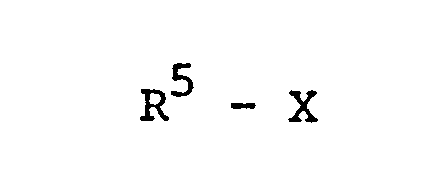
- Die Alkylierung der Dihydroxyalkylxanthine mit den Ver- bindungen der Formel VI erfolgt gewöhnlich in einem gegenüber den Reaktionsteilnehmern inerten Verteilungs-oder Lösungsmittel. Als solche kommen vor allem dipolare, aprotische Solventien, beispielsweise Formamid, Dimethylformamid, Dimethylacetamid, N-Methylpyrrolidon, Tetra- .methylharnstoff, Hexamethylphosphorsäuretriamid, Dimethylsulfoxid, Aceton oder Butanon, in Frage; es können aber auch Alkohole, wie Methanol, Ethylenglykol und dessen Ether, Ethanol, Propanol, Isopropanol und die verschiedenen Butanole; Kohlenwasserstoffe, wie Benzol, Toluol oder Xylole; halogenierte Kohlenwasserstoffe, wie Dichlormethan oder Chloroform; Pyridin sowie Mischungen der genannten Lösungsmittel oder deren Gemische mit ' Wasser Verwendung finden.
- Die Umsetzungen werden zweckmäßig in Gegenwart eines basischen Kondensationsmittels durchgeführt. Hierfür eignen sich beispielsweise Alkali- oder Erdalkalihydroxide, -carbonate, -hydride, alkoholate oder organische Basen, wie Trialkylamine (z.B. Triethyl- oder Tributylamin), quartäre Ammonium- oder Phosphoniumhydroxide und vernetzte Harze mit fixierten, gegebenenfalls substituierten Ammonium-oder Phosphoniumgruppen.
- Die Xanthinderivate können aber auch unmittelbar in Form ihrer gesondert hergestellten Salze, etwa der Alkali-, Erdalkali- oder gegebenenfalls substituierten Ammonium-oder Phosphoniumsalze, in die Alkylierungsreaktion eingesetzt werden. Weiterhin lassen sich die Dihydroxyalkylxanthine und deren monoalkylierten Derivate sowohl in Gegenwart der vorgenannten anorganischen Kondensationsmittel als auch in Form ihrer Alkali- oder Erdalkalisalze unter Mithilfe von sogenannten Phasentransferkatalysatoren, beispielsweise tertiären Aminen, quartären Ammonium- oder Phosphoniumsalzen oder auch Kronenethern, bevorzugt in einem zweiphasigen System unter den Bedingungen einer Phasentransferkatalyse bequem alkylieren.
- Bei der Einführung der Alkylreste nach den voranstehend beschriebenen Verfahrensweisen arbeitet man im allgemeinen bei einer Reaktionstemperatur zwischen 0°C und dem Siedepunkt des jeweils verwendeten Reaktionsmediums, vorzugsweise zwischen 20° und 130°C, gegebenenfalls bei erhöhtem oder vermindertem Druck, aber gewöhnlich bei Atmosphärendruck, wobei die Reaktionszeit von weniger als eine Stunde bis zu mehreren Stunden betragen kann.
- Bei jenen Dihydroxyalkylxanthinen, in die noch zwei Alkylreste einzuführen sind, können hierbei entweder nacheinander gleiche oder verschiedene Substituenten oder auch zwei gleichartige Alkylgruppen ohne Isolierung von Zwischenprodukten in einer Eintopfreaktion mit dem Xanthingerüst verknüpft werden.
- Ein weiteres ebenfalls bevorzugtes Verfahren zur Herstellung von Verbindungen der Formel I besteht darin, daß man Xanthine der Formel VII,

- a) mit Alkylierungsmitteln der Formel VIII,


- b) mit Alkylierungsmitteln der Formel X

- Die hierbei als Ausgangsstoffe verwendeten Monoalkyl-oder Dialkylxanthine der Formel VII und Alkylierungsmittel der Formeln VIII und X sind größtenteils bekannt oder lassen sich nach literaturbekannten Methoden leicht herstellen.
- So können die Verbindungen der Formel VIII beispielsweise aus den Triolen der Formel XI


- Die Umsetzungen der Xanthinderivate mit den Alkylierungsmitteln der Formeln VI, VIII und X erfolgen zweckmäßig unter den für die Alkylierung der Dihydroxyalkyl- und Monoalkyldihydroxyalkylxanthine mit den Verbindungen der Formel VI bereits ausführlich beschriebenen Reaktionsbedingungen. Verwendet man allerdings die Verbindungen der Formel X zur Einführung des Dihydroxyalkylrestes, so sind unter ihnen jene bevorzugt, deren Alkylkette insgesamt entweder 6 bis 8 C-Atome enthält-wenn R4 die-Bedeutung von Wasserstoff hat, oder aber 7 oder 8 C-Atome aufweist, wenn R4 eine Methylgruppe bedeutet, da die kürzerkettigen Diole der Formel X speziell unter den alkalischen Bedingungen der Alkylierungsreaktion zur Bildung von Tetrahydrofuranderivaten neigen, was zu einer merklichen Schmälerung der Ausbeute an erwünschtem Alkylierungsprodukt führen kann.
- Die hydrolytische Spaltung des 1,3-Dioxolanringes in den Xanthinen der Formel VII mit dem Strukturelement der Formel IX zu den durch das Strukturmerkmal der Formel V gekennzeichneten Dihydroxyalkylxanthinen wird normalerweise in wäßrigem Medium, gegebenenfalls unter Zusatz eines Lösungsvermittlers, wie Tetrahydrofuran, Dioxan oder Ethylenglykoldimethylether, vorteilhaft in Gegenwart von Säuren, beispielsweise Ameisen-, Oxal-, Wein-, Citronen-, Schwefel-, Perchlor-, Phosphor- oder p-Toluolsulfonsäure, oder eines sauren Ionenaustauschers (z.B. Nafion-H) bei Temperaturen zwischen 20°C und dem Siedepunkt des Reaktionsgemisches, vorzugsweise 50° und 100°C, durchgeführt, wobei die Reaktionszeit von mehreren Minuten bis zu wenigen Stunden betragen kann. Auch feuchtes Silicagel mit einem Wassergehalt bis zu 10 % stellt ein brauchbares Reagens für die Deacetalisierung dar, wobei bevorzugt in gegebenenfalls halogenierten Kohlenwasserstoffen, wie Benzol, Toluol, Dichlormethan oder Chloroform, bei Raumtemperatur gearbeitet wird.
- Eine weitere Darstellungsmethode für die Xanthine der Formel VII mit dem den Dioxolanring enthaltenden Strukturelement der Formel IX besteht in der Addition von Carbonylverbindungen der Formel R6-CO-R7 an den Oxiranring der Epoxyalkylxanthine gemäß Formel II mit dem Strukturmerkmal der Formel IV. Diese Umsetzung wird vorteilhaft in Gegenwart von sauren Katalysatoren, vorzugsweise Lewis-Säuren wie Bortrifluorid, Zink(II)chlorid, Zinn (IV) chlorid oder auch Kugfer (II) sulfat, bei Temperaturen zwischen 0° und 60°C ausgeführt. Aber auch quartäre Ammoniumsalze, beispielsweise Tetraethylammoniunhalogenide, vermögen die Additionsreaktion zu den cyclischen Acetalen zu katalysieren.
- Die vicinalen Dihydroxyalkylxanthine der Formel I besitzen in Abhängigkeit von der Stellung der beiden Hydroxylgruppen in der Seitenkette gemäß Formel V entweder ein oder zwei asymmetrische C-Atome und können somit in stereoisomeren Formen vorliegen. Die Erfindung betrifft daher sowohl die reinen stereoisomeren Verbindungen als auch deren Gemische.
- Die erfindungsgemäßen Arzneimittel können oral, rektal, parenteral oder als Aerosol verabreicht werden.
- Geeignete feste oder flüssige galenische Zubereitungsformen sind beispielsweise Granulate, Pulver, Tabletten, Dragees; (Mikro)Kapseln, Zäpfchen, Sirupe, Emulsionen, Suspensionen, Aerosole, Tropfen oder injizierbare Lösungen sowie Präparate mit protrahierter Wirkstoff-Freigabe, bei deren Herstellung üblicherweise Hilfsmittel, wie Trägerstoffe, Spreng-, Binde-, Überzugs-, Quellungs-, Gleit- oder Schmiermittel, Geschmackstoffe, Süßungsmittel oder Lösungsvermittler, Verwendung finden. Als häufig verwendete Hilfsstoffe seien z.B. Laktose, Mannit und andere Zucker, Talkum, Milcheiweiß, Gelatine, Stärke, Cellulose und ihre Derivate, tierische und pflanzliche öle, Polyethylenglykole und Lösungsmittel, wie etwa steriles Wasser, genannt.
- Vorzugsweise werden die Präparate in Dosierungseinheiten hergestellt und verabreicht, wobei jede Einheit eine bestimmte Dosis an aktiver Substanz gemäß Formel I enthält. Bei festen Dosierungseinheiten, wie Tabletten, Kapseln und Suppositorien, kann diese Dosis bis zu 1000 mg, bevorzugt jedoch 50 bis 300 mg, und bei Injektionslösungen in Ampullenform bis zu 200 mg, vorzugsweise aber 20 bis 100 mg, betragen.
- Für die Behandlung eines an bronchialen Obstruktionen leidenden erwachsenen Patienten sind - je nach Wirksamkeit der Verbindungen gemäß Formel I am Menschen - Tagesdosen von 100 bis 500 mg Wirkstoff, vorzugsweise 200 bis 300 mg, bei oraler Verabreichung und von 20 bis 150 mg, bevorzugt 40 bis 80 mg, bei intravenöser Applikation indiziert. Unter Umständen können jedoch auch höhere oder niedrigere Tagesdosen angebracht sein. Die Verabreichung der Tagesdosis kann sowohl durch Einmalgabe in Form einer einzelnen Dosierungseinheit oder aber mehrerer kleinerer Dosierungseinheiten als auch durch Mehrfachgabe unterteilter Dosen in bestimmten Intervallen erfolgen.
- Schließlich können die Xanthinderivate der Formel I bei der Herstellung der vorgenannten galenischen Zubereitungsformen auch zusammen mit anderen geeigneten Wirkstoffen, beispielsweise Antiallergika, Antitussiva, Sekretolytika, Sedativa, peripheren Vasotherapeutika, Antihistaminika und auch anderen Bronchospasmolytika, wie β2-Sympatho- mimetika oder Parasympatholytika formuliert werden.
- Die Struktur aller nachstehend beschriebenen Verbindungen wurde durch Elementaranalyse und IR- sowie 1H-NMR-Spektren gesichert.
-
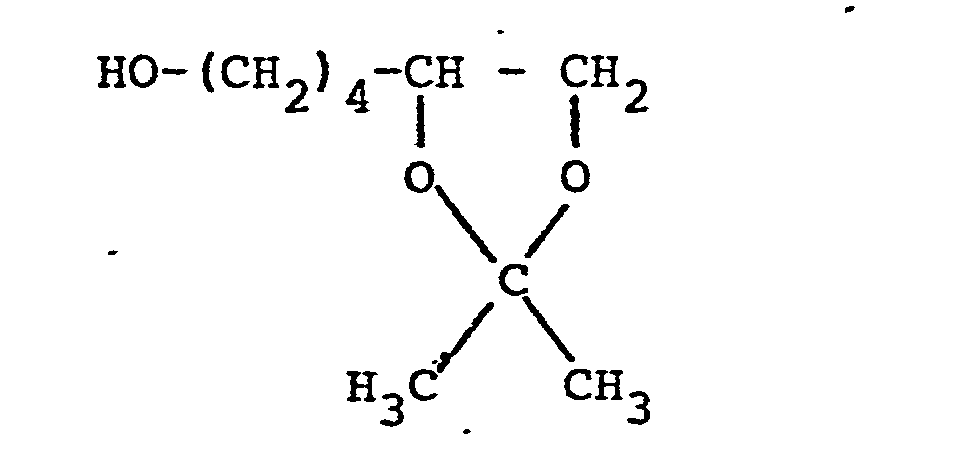
- Ausbeute: 897 g (86 % der Theorie) Siedepunkt (0,5 m bar) 83 - 87°C Brechungsindex

-

- Zur Lösung von 176,4 g 1-Hydroxy-5,6-isopropyliden- dioxy-hexan und 155 ml Triethylamin in 1300 ml Toluol werden unter Rühren bei 5 - 7°C Innentemperatur 77 ml Thionylchlorid innerhalb 3 Stunden zugetropft. Nach halbstündigem Nachrühren bei 20-25°C erhitzt man bis zur Beendigung der S02-Entwicklung auf 70°C (ca. 4 Stunden). Danach wird abgekühlt und vom ausgefallenen Niederschlag abgenutscht. Nach Nachwaschen mit 100 ml Toluol werden die Toluolphasen vereinigt, neutralgewaschen, getrocknet und unter vermindertem Druck eingeengt. Den Rückstand versetzt man mit 15 g Kaliumcarbonat und destilliert im Vakuum über eine Füllkörperkolonne.
- Ausbeute: 149,6 g (77,6 % der Theorie) Siedepunkt (0,15 m bar) 48 - 50°C Brechungsindex

-
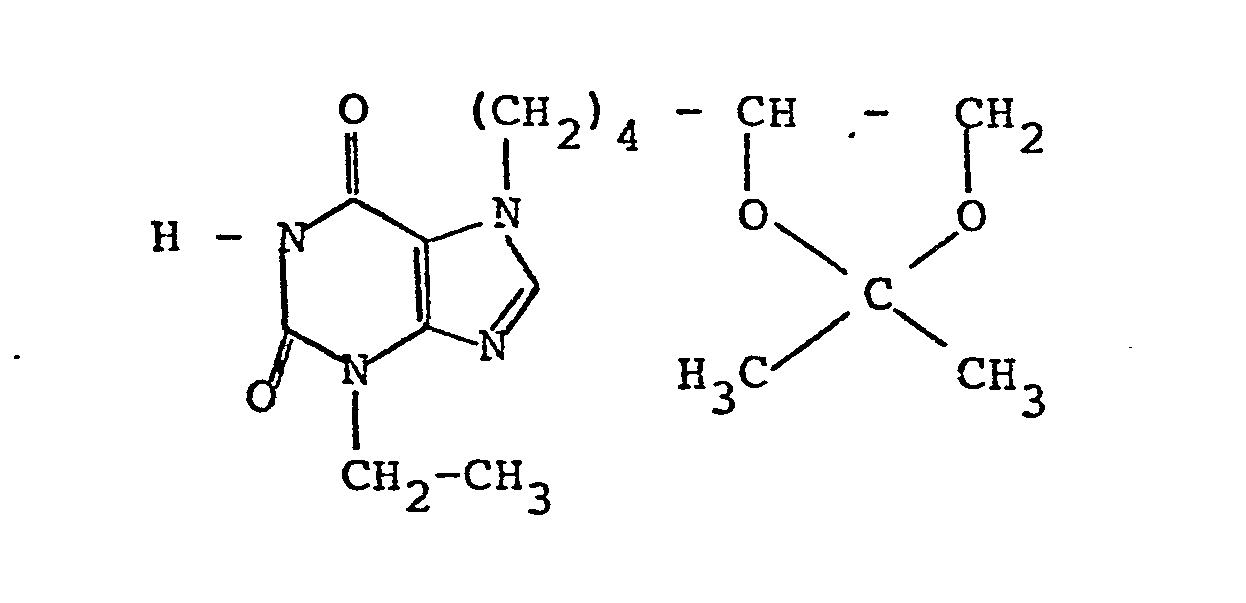
- Man erhält 94,5 g rohes 3-Ethyl-1,7-bis-(5,6-isopropyliden- dioxy-hexyl)-xanthin als Nebenprodukt. Die vereinigten wäßrig-natronalkalischen Phasen werden unter Rühren bei Raumtemperatur tropfenweise mit 33%iger Schwefelsäure bis zum Erreichen von pH = 10 versetzt. Der Niederschlag wird abgenutscht, neutralgewaschen und bei 100°C im Vakuum getrocknet.
- Ausbeute: 508 g (75,5 % der Theorie); Schmelzpunkt: 123 - 124°C C16H24N4O4 (MG = 336,4)
- Analyse: Berechnet: C 57,13 % H 7,19 % N 16,66 % Gefunden : C 56,92 % H 7,21 % N 16,68 %
-

- Der Rückstand wird in 1 1 Schwefelsäure beim pH-Wert = 0,5 2 Stunden auf 100°C erhitzt. Nach dem Abkühlen neutralisiert man, engt bei vermindertem Druck ein und nimmt den Rückstand mit Methylenchlorid auf. Die Methylenchloridphase wird mit verdünnter Natronlauge und mit Wasser gewaschen, getrocknet und bei vermindertem Druck eingeengt.
- Das Rohprodukt wird aus Methylenchlorid/Diethylether umkristallisiert.
- Ausbeute: 259 g (76,5 % der Theorie); Schmelzpunkt: 96 - 98°C C16H26N4O4 (MG = 338,4)
- Analyse: Berechnet: C 56,79 % H 7,74 % N 16,56 % Gefunden: C 56,86 % H 7,56 % N 16,60 %
-

-

- Ausbeute: 81,7 g (83,9 % der Theorie); Schmelzpunkt: 94 - 95°C C15H24N4O4 (MG = 324,4)
- Analyse: Berechnet: C 55,54 % H 7,46 % N 17,27 % Gefunden: C 55,52 % H 7,52 % N 17,02 %
-

-
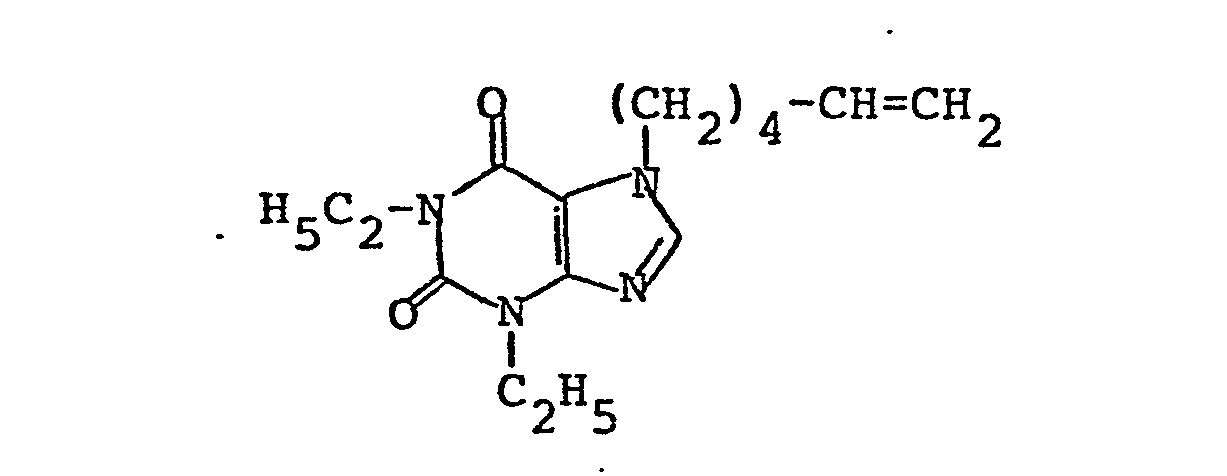
- Nach Stehen über Nacht wird vom Niederschlag (1,2 g) abgesaugt. Dieser wird im Gemisch mit 55 ml Wasser, 15 ml Ethanol und 11,2 g Natriumsulfit-heptahydrat 3 Stunden unter Rückfluß gerührt. Nach dem Abkühlen trennt man von entstandenen Niederschlag ab und extrahiert das Filtrat mit Methylenchlorid. Nach Trocknen und Einengen der gesammelten Methylenchloridphasen bei vermindertem Druck erhält man 0,6 g Rohprodukt, das nach Umkristallisation aus Diethylether das 1,3-Diethyl-7-(5,6-dihydroxyhexyl)-xanthin als Monohydrat ergibt.
- Ausbeute: 0,47 g (57,7 % der Theorie) Schmelzpunkt: 77-78°C (Monohydrat) C15H24N4O4 · H2O (MG = 342,4)
- Analyse: Berechnet: C 52,62 % H 7,65 % N 16,36 % Gefunden: C 52,48 % H 7,69 % N 16,20 %
-

- Die Reinigung des Rohproduktes erfolgt durch Säulenchromatographie an Kieselgel (Laufmittel: Methylenchlorid/Aceton, Volumenverhältnis 7/3) und durch Umkristallisation aus Petrolether.
- Ausbeute: 20,8 g (63,2 % der Theorie), Schmelzpunkt 59-60°C C13H18N4O3 (MG = 278,3)
- Analyse: Berechnet: C 56,10% H 6,52 % N 20,13 % Gefunden: C 55,87 % H 6,51 % N 19,91 %
-

- Ausbeute: 3 g (78,3 % der Theorie) Schmelzpunkt: 98 -100°C C13H20N4O4 (MG = 296,3)
- Analyse: Berechnet: C 52,69 % H 6,80 % N 18,91 % Gefunden: C 52,39 % H 6,72 % N 18,83 %
- Sowohl die Umsetzung von 1,3-Dimethyl-7-(5-hexenyl)-xanthin mit Osmiumtetroxid analog Beispiel 2 C) als auch die Alkylierung von 1,3-Dimethylxanthin mit 1-Chlor-5,6-isopropylidendioxy-hexan und anschließende saure Hydrolyse des Dioxolanringes gemäß Beispiel 1 bzw. 2 A) führen zu derselben Verbindung
-

- Ausbeute: 19 g (42,4 % der Theorie) Schmelzpunkt: 52 - 53°C C17H26N4O3 (MG = 334,4)
- Analyse: Berechnet: C 61,06 % H 7,84 % N 16,75 % Gefunden: C 61,01 % H 7,89 % N 16,74 %
-

- Zu der Lösung von 7 g 1,3-Dibutyl-7-(3,4-epoxybutyl)-xanthin in 300 ml eines Gemisches aus Ethylenglykoldimethylether/Wasser (Volumenverhältnis 3:2) tropft man bei Raumtemperatur unter Rühren in 5 Minuten 0,4 ml Perchlorsäure (70 %ig). Nach 45 Stunden Rühren bei Raumtemperatur wird mit Natriumbicarbonat neutralisiert und die.Lösung eingedampft. Der Rückstand wird mit Methylenchlorid aufgenommen und durch Säulenchromatographie an Kieselgel mit dem Gemisch von Chloroform/Ethanol (Volumenverhältnis 8 : 2) als Laufmittel und durch Umkristallisation aus Methylenchlorid/ Petrolether gereinigt.
- Ausbeute: 4,8 g (65 % der Theorie) Schmelzpunkt: 92 - 93°C C 17 H 28 N 4 0 4 (MG = 352,4)
- Analyse: Berechnet: C 57,94 % H 8,00 % N 15,90 % Gefunden: C 58,06 % H 8,06 % N 15,77 %
- Dieses Diol läßt sich alternativ durch einstufige-Oxidation von 1,3-Dibutyl-7-(3-butenyl)-xanthin mit Osmiumtetroxid analog Beispiel 2 C oder durch Alkylierung von 1,3-Dibutylxanthin mit den literaturbekannten 1-Halogen-3,4-isopropylidendioxy-butanen (z.B. Tetrahedron 34 (1978), S. 2873 - 2878) und nachfolgende saure Hydrolyse des Dioxolanringes analog Beispiel 1 gewinnen.
-

- Zu 50,9 g m-Chlorperbenzoesäure (85 %ig) in 300 ml Methylenchlorid werden unter Rühren und Spülen mit Stickstoff bei Raumtemperatur 37,3 g 1-Brom-6-hepten innerhalb von 40 Minuten zugetropft.
- Nach Stehenüber Nacht wird vom Niederschlag abgesaugt und das Filtrat mit 10%iger Na2S204-Lösung, mit gesättigter Natriumbicarbonatlösung und mit Wasser gewaschen und (nach Trocknen) unter vermindertem Druck eingeengt. Man erhält 42,2 g rohes 1-Brom-6,7-epoxyheptan.
-

-

- Schwefelsäure hinzugefügt. Nach 4 Stunden werden 0,6 g Natriumbicarbonat zugegeben. Nach einstündigem Weiterrühren wird abfiltriert, bei vermindertem Druck eingeengt und der Rückstand einer fraktionierten Vakuumdestillation unterworfen.
- Ausbeute: 38 g (77,9 % der Theorie) Siedepunkt (0,4 m bar ) 73 - 76°C Brechungsindex

-

- Ausbeute: 13,8 g (61,1 % der Theorie), Schmelzpunkt 105°C C16H26N4O4 (MG = 338,4)
- Analyse: Berechnet: C 56,79 % H 7,74 % N 16,56 % Gefunden: C 56,83 % H 7,70 % N 16,67 %
- Das auf Stufe b) hergestellte 1-Brom-6,7-dihydroxyheptan kann auch ohne vorherige Umsetzung mit 2,2-Dimethoxypropan zum Dioxolan-Derivat unmittelbar zur Alkylierung des 1,3-Diethylxanthins in Stufe d) eingesetzt werden.
-

- Ausbeute: 196,2 g (50,1 % der Theorie) Siedepunkt (140 m bar) 80°C Brechungsindex

-

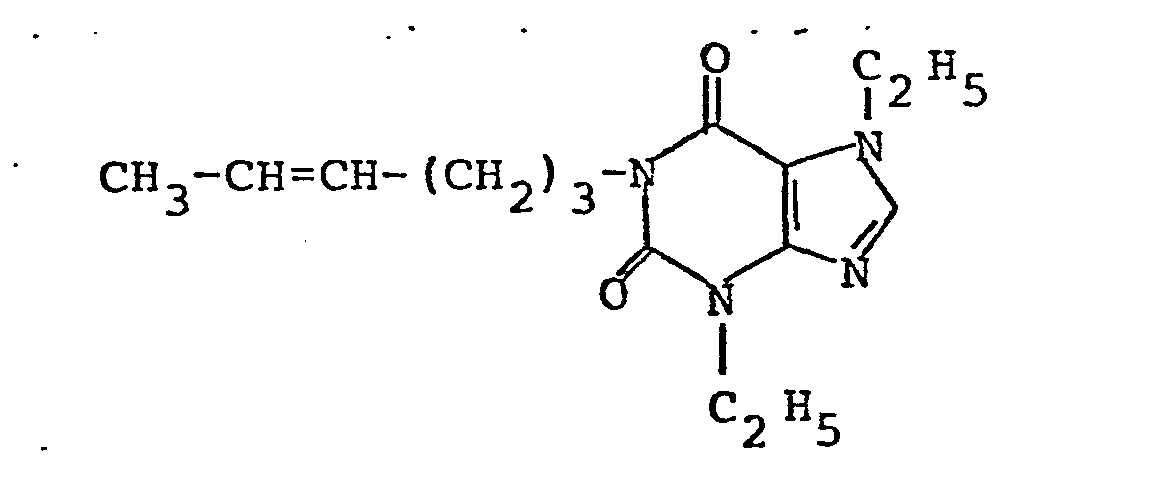

- Ausbeute: 21,5 g (70 % der Theorie); Schmelzpunkt 91-93°C C15H24N4O4 (MG = 324,4)
- Analyse: Berechnet: C 55,54 % H 7,46 % N 17,27 % Gefunden: C 55,54 % H 7,59 % N 16,97 %
- Dieselbe Verbindung wird durch einstufige Oxidation von 3,7-Diethyl-1-(4-hexenyl)-xanthin mit Osmiumtetroxid analog Beispiel 2 C erhalten.
-


- Ausschütteln mit 10 %iger Natriumdithionitlösung bis zum Verschwinden der Jod-Stärke-Reaktion, Waschen zunächst mit 10%iger Natriumhydrogencarbonat-Lösung und dann mit Wasser, Trocknen über Natriumsulfat und Einengen unter vermindertem Druck liefert 37,7 g (84,7 % der Theorie) rohes -3-Butyl-1-(4,5-epoxypentyl)-7-methylxanthin,

- Ausbeute: 29,2 g (73,2 % der Theorie); Schmelzpunkt 76-78°C C15H24N4O4 (MG = 324,4)
- Analyse: Berechnet: C 55,54 % H 7,46 % N 17,27 % Gefunden: C 55,38 % H 7,45 % N 17,62 %
- Zu derselben Verbindung gelangt man durch direkte Dihydroxylierung der C=C-Doppelbindung von 3-Butyl-7-methyl-1-(4-pentenyl)-xanthin mit Osmiumtetroxid analog Beispiel 2 C).
-

- Aus der Methylenchloridphase werden 4,6 g 3-Benzyl-1,7-diethylxanthin zurückgewonnen.
-

- Das Gemisch aus 7 g 1,7-Diethylxanthin, 7,2 g 1-Chlor-5,6-isopropyliäendioxy-hexan, 5 g Kaliumcarbonat und 50 ml Dimethylformamid wird 8 Stunden bei 120°C gerührt. Nach Einengen bei vermindertem Druck nimmt man mit 50 ml 1 n Natronlauge auf und extrahiert mit Methylenchlorid. Die Methylenchloridphase wird mit verdünnter Natronlauge nachgewaschen, neutralgewaschen, getrocknet und bei vermindertem Druck eingeengt. Den Rückstand destilliert man bei 0,01 bis 0,02 m bar und 120 - 150°C Badtemperatur in einem Dünnschichtverdampfer und erhält 11,5 g 1,7-Diethyl-3-(5,6-iso- propylidendioxy-hexyl)-xanthin. Dieses wird mit 325 ml Methanol und 80 ml Wasser aufgenommen und nach Zugabe von 0,4 ml Perchlorsäure (70 %ig) 1 Stunde bei 70°C gerührt. Nach dem Abkühlen auf Zimmertemperatur neutralisiert man mit Natriumbicarbonatlösung und engt bei vermindertem Druck zur Trockne ein. Es wird mit 200 ml Methylenchlorid aufgenommen und der Extrakt eingeengt.
- Den Rückstand reinigt man durch Säulenchromatographie an Kieselgel mit Methylenchlorid/Ethanol (Volumenverhältnis 8/2) als Laufmittel und durch anschließende Umkristallisation.aus Methylenchlorid/Diethylether.
- Ausbeute: 7,9 g (72,5 % der Theorie); Schmelzpunkt: 115 - 116°C C15H24N4O4 (MG = 324,4)
- Analyse: Berechnet: C 55,54 % H 7,46 % N 17,27 % Gefunden: C 55,37 % H 7,51 % N 17,08 %
- Zu diesem Diol gelangt man auch durch Umsetzung von 1,7-Diethyl-3-(5-hexenyl)-xanthin mit Osmiumtetroxid analog Beispiel 2 C oder durch Epoxidation von vorge- nannter Xanthinverbindung gefolgt von der sauren Hydrolyse des Epoxidringes analog den Beispielen 3,4 und 7.
-
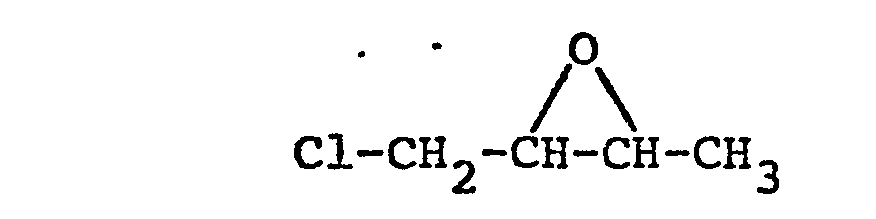
- Ausbeute: 58 g (54,3 % der Theorie) Siedepunkt (133 m bar) 70 - 73°C Brechungsindex

- Analyse: Berechnet: C 45,09 % H 6,62 % Cl 33,27 % Gefunden: C 45,28 % H 6,78 % Cl 33,30 %
-

- Ausbeute: 54 g (81 % der Theorie)
-

- Ausbeute: 36,8 g (52,5 % der Theorie) Siedepunkt (6,5 m bar) 49-53°C
-
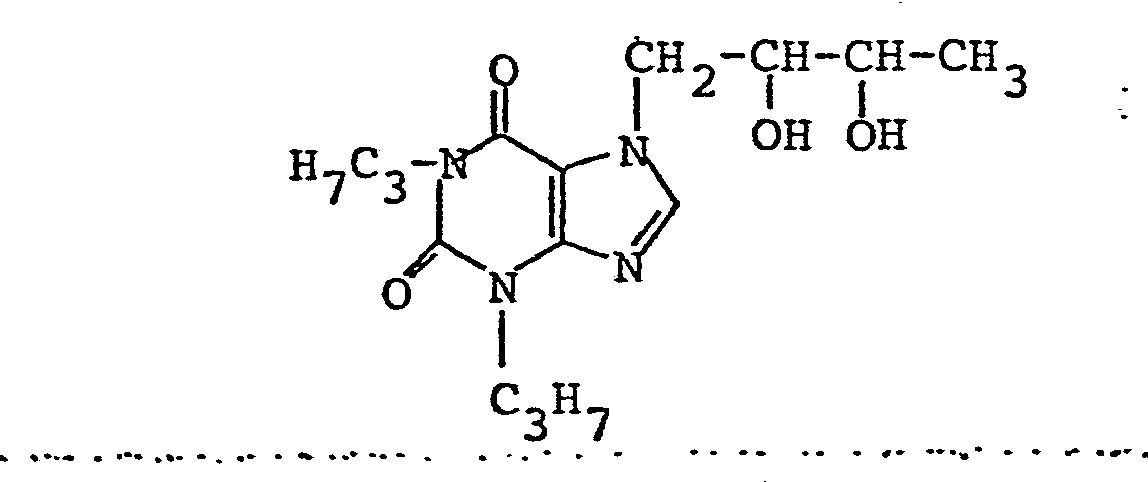
- Das Gemisch aus 47,2 g 1,3-Dipropylxanthin, 33,6 g 1-Chlor-2,3-isopropyliden-dioxybutan, 28,2 g Kaliumcarbonat und 300 ml Dimethylformamid wird 8 Stunden bei 120°C gerührt. Man engt bei vermindertem Druck ein und nimmt den Rückstand mit 250 ml 1 n Natronlauge und 500 ml Methylenchlorid auf. Nach Nachwaschen der wäßrigen Phase mit Methylenchlorid werden die vereinigten Methylenchloridphasen mit 1 n Natronlauge und Wasser gewaschen, getrocknet und bei vermindertem Druck eingeengt. Den Rückstand destilliert man bei 0,03 - 0,07 m bar und 90°C Badtemperatur im Kugelrohr. Man erhält 26,8 g 7-(2,3-Isopropylidendioxybutyl)-1,3-dipropylxanthin (91,5 % der Theorie bezogen auf umgesetztes 1,3-Dipropyl-xanthin), das

- Ausbeute: 20,9 g (87,6 % der Theorie) Schmelzpunkt: 99 - 101°C C15H24N4O4 (MG = 324,39)
- Analyse: Berechnet: C 55,54 % H 7,46 % N 17,27 % Gefunden: C 55,49 % H 7,49 % N 17,18 %
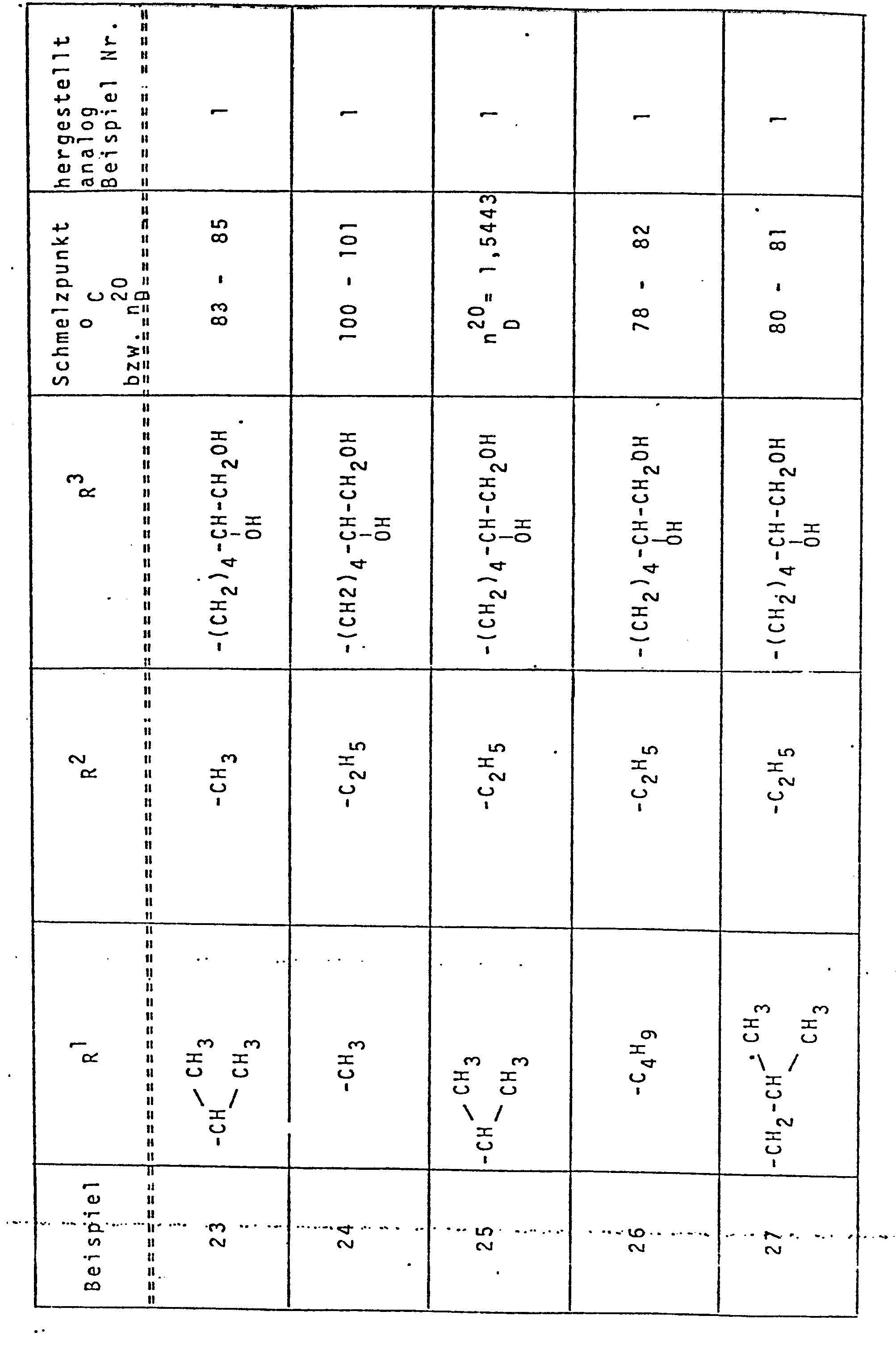
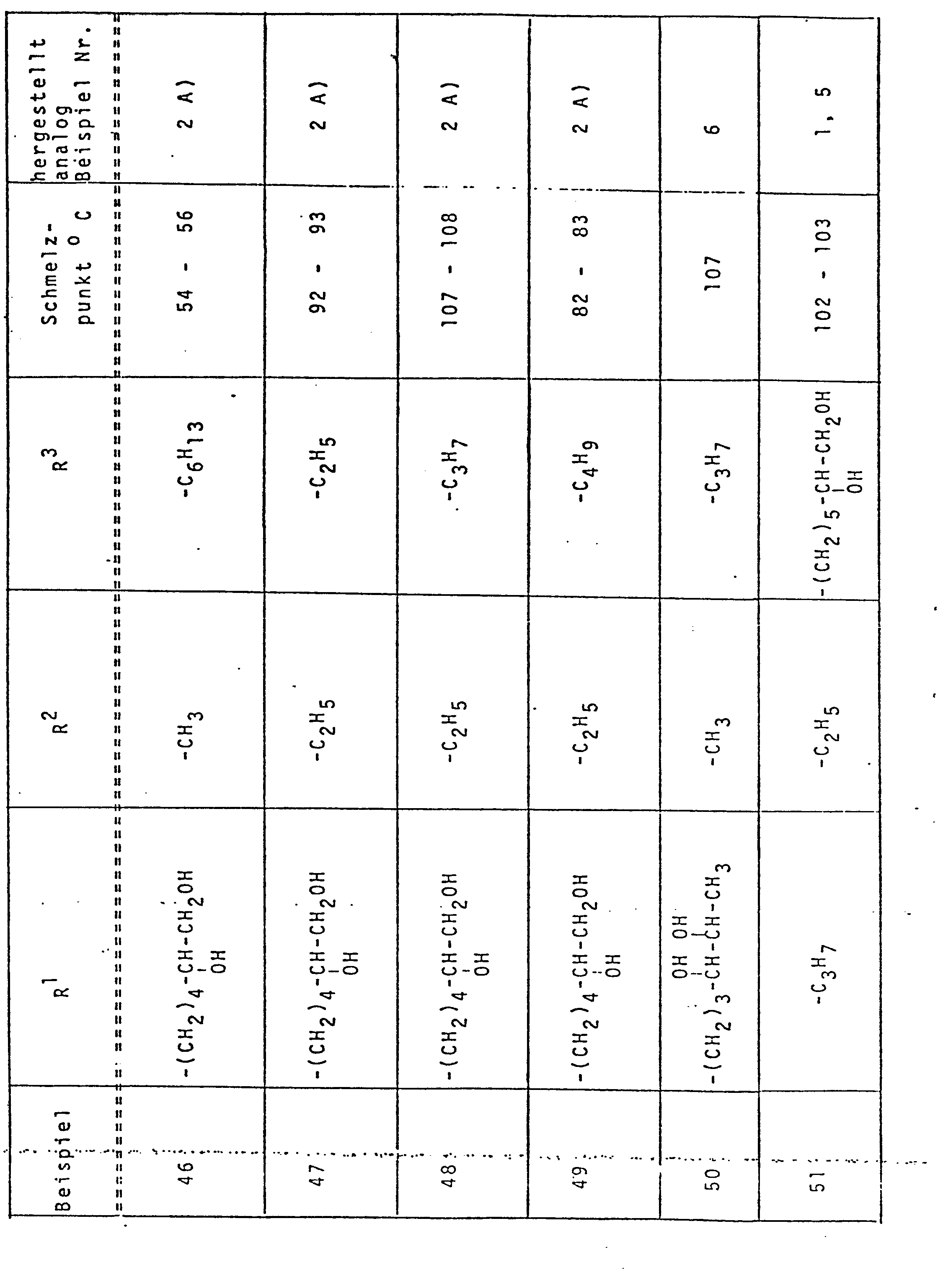
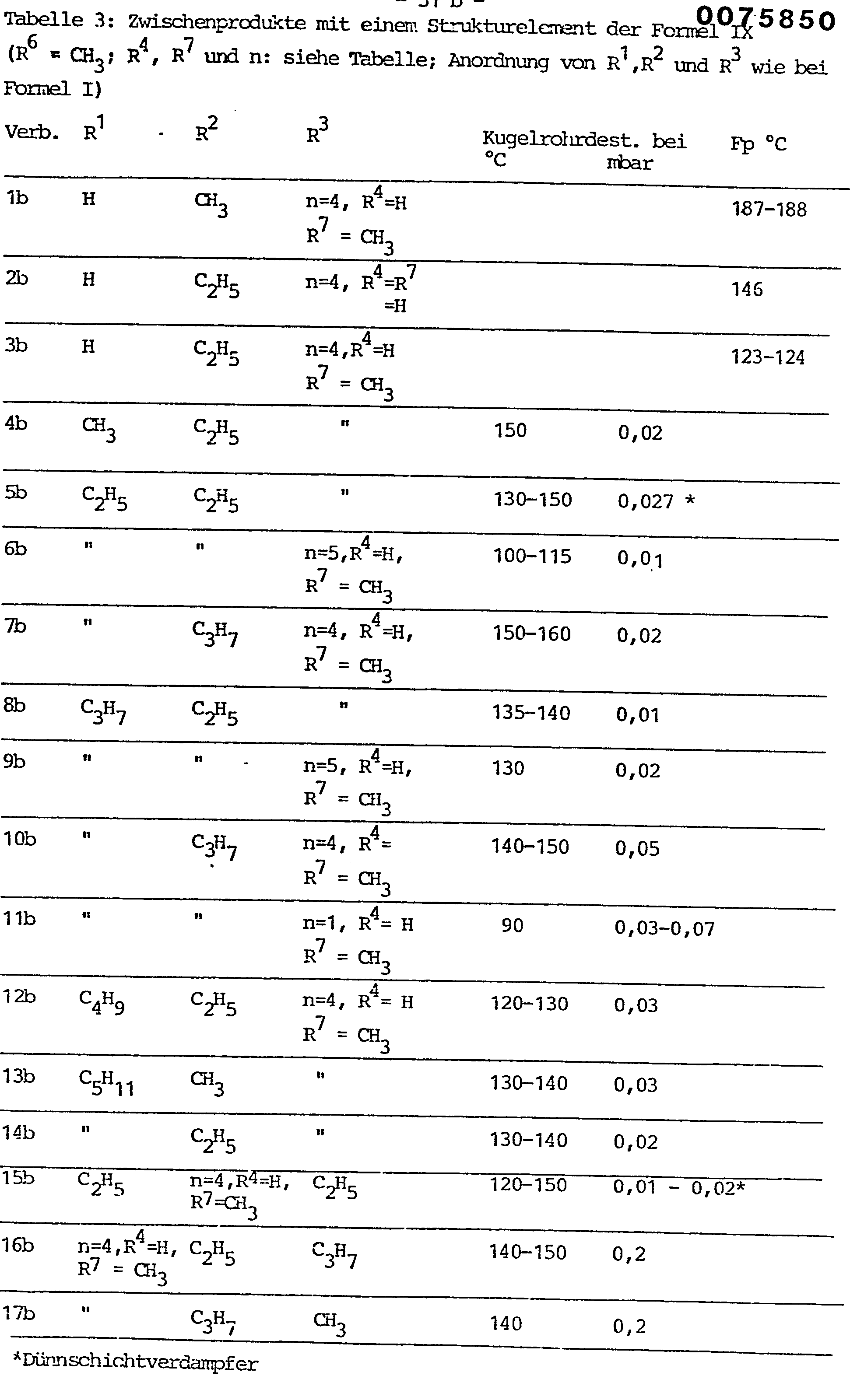
- Die vorgenannten und die auf analoge Weise hergestellten Verbindungen sind in Tabelle 1 zusammengefaßt.





- Arzneimittelzubereitung: Für die Herstellung von 1000 Dragees werden 100 g 3-Ethyl-7-(5,6-dihydroxyhexyl)-1-propylxanthin (Verbindung gemäß Beispiel 1), 20 g Laktose, 30 g Maisstärke, 8,5 g Talkum, 0,5 g kolloidale Kieselsäure und 1 g Magnesiumstearat gemischt und zu Drageekernen von 160 mg Gewicht verpreßt, die anschließend mit einemDragiergemisch aus 40 g Rohrzucker, 23,5 g Talkum und sehr kleinen Zusätzen von Wachs, Titandioxid und arabischem Gummi so behandelt werden, daß das Endgewicht der Dragees jeweils 225 mg beträgt.
- Arzneimittelzubereitung: Für die Herstellung von 1000 Dragees werden 111,8 g 3-Ethyl-7-(5,6-isopropylidendioxy- hexyl)-1-propylxanthin (aus Beispiel 1), 20 g Laktose, 30 g Maisstärke, 8,5 g Talkum, 0,5 g kolloidale Kieselsäure und 1 g Magnesiumstearat gemischt und zu Drageekernen von 171,8 mg Gewicht verpreßt, die anschließend mit einem Dragiergemisch aus 40 g Rohrzucker, 23,5 g Talkum und sehr kleinen Zusätzen von Wachs, Titandioxid und arabischem Gummi so behandelt werden, daß das Endgewicht der Dragees jeweils 240 mg beträgt.
- Arzneimittelzubereitung: Zur Herstellung von 1000 Dragees werden 100 g 1,3-Diethyl-7-(5,6-epoxyhexyl)-xanthin (aus Beispiel 2 B), 20 g Laktose, 30 g Maisstärke, 8,5 g Talkum, 0,5 g kolloidale Kieselsäure und 1 g Magnesiumstearat gemischt und zu Drageekernen von 160 mg Gewicht verpreßt, die anschließend mit einem Dragiergemisch aus 40 g Rohrzucker, 23,5 g Talkum und sehr kleinen Zusätzen von Wachs, Titandioxid und arabischem Gummi so behandelt werden, daß das Endgewicht der Dragees jeweils 225 mg beträgt.
- Pharmakologische Prüfung und Ergebnisse
- Die Prüfung der erfindungsgemäßen Verbindungen auf bronchospasmolytische Aktivität erfolgte im wesentlichen mit der von H.Konzett und R.Rössler beschriebenen Versuchsanordnung (Arch. exp. Path. u. Pharmak. 195 (1940) 71) im Vergleich mit dem Standardtherapeutikum Theophyllin-Ethylendiamin sowie den beiden vorbeschriebenen 2,3-Dihydroxypropyl-Verbindungen Dyphyllin [7-(2,3-Dihydroxypropyl)-1,3-dimethylxanthin] und 7-(2,3-Dihydroxypropyl)-1,3-dipropylxanthin. Bei dieser Methode wird die Hemmung experimenteller Bronchialspasmen - ausgelöst durch intravenöse Gabe spasmogen wirkender Amine, wie Acetylcholin, Histamin und Serotonin - an Meerschweinchen beiderlei Geschlechts in Urethan-Narkose (1,25 g/kg i.p.) untersucht.
- Die Prüfsubstanzen wurden in wäßriger Lösung entweder intravenös (i.v.) oder intraduodenal (i.d.) verabreicht. Die ED50-Werte, die jene Dosis in mg/kg darstellen, bei der der experimentell erzeugte Spasmus auf die Hälfte gegenüber jenem.unbehandelter Tiere herabgesetzt ist, wurden graphisch aus den Dosiswirkungskurven bestimmt.
- Die Bestimmung der LD50-Werte erfolgte standardgemäß über die innerhalb von 7 Tagen bei NMRI-Mäusen nach einmaliger intravenöser (i.v.), intraperitonealer (i.p.) bzw. oraler (p.o.) Gabe auftretende Mortalität.
- Die Ergebnisse dieser Untersuchungen, die die Überlegenheit der erfindungsgemäßen Verbindungen entsprechend Formel I gegenüber demStandardpräparat Theophyllin-Ethylendiamin und den beiden anderen Vergleichssubstanzen demonstrieren (insbesondere auch unter Berücksichtigung des günstigeren Verhältnisses von LD50 zu ED50), sind in der nachfolgenden Tabelle 4 zusammengefaßt.


- Die eindeutige Überlegenheit der erfindungsgemäßen Verbindungen insbesondere gegenüber dem am häufigsten zur Therapie obstruktiver Atemwegserkrankungen eingesetzten Xanthinderivat, dem Theophyllin-Ethylendiamin (Aminophyllin), ließ sich auch in weiteren Spezialversuchen eindrucksvoll bestätigen:
- Da es als erwiesen gilt, daß neben den in Tabelle 4 aufgeführten biogenen Aminen Acetylcholin, Histamin und Serotonin auch das Bradykinin eine wichtige Rolle als Mediatorsubstanz bei der Auslösung von Asthmaanfällen spielt, wurde die Hemmwirkung auf den am Meerschweinchen mit Bradykinin ausgelösten Bronchospasmus untersucht. Hierbei erwies sich beispielsweise die Verbindung aus Beispiel 1 bei intravenöser (i.v.) Verabreichung mit einer ED50 von 1-3 mg/kg etwa 3 mal und nach intraduodenaler (i.d.) Applikation mit einer ED50 von 4,0 - 6,3 mg/kg ca. 6 mal stärker wirksam als Theophyllin-Ethylendiamin, für das die entsprechenden ED50-Werte zu 3 - 10 mg/kg i.v. und 25 - 40 mg/kg i.d. ermittelt wurden.
- Auf den am präsensibilisierten Meerschweinchen mit Ovalbumin (1 mg/kg i.v.) induzierten Bronchospasmus, der mit den herkömmlichen Xanthinderivaten kaum zu beeinflussen ist, üben die Verbindungen der Formel I ebenfalls eine starke Hemmwirkung aus. So liegt beispielsweise der ED50-Wert für die Verbindung des Beispiels 1 zwischen 6 und 12 mg/kg i.v., während das Theophyllin-Ethylendiamin mit Dosen bis zu 10 mg/kg keine Wirkung in dieser Versuchsanordnung zeigt.
- Die überlegene bronchospasmolytische Aktivität der Xanthine gemäß Formel I konnte schließlich auch im Lungenfunktionstest am narkotisierten Hund anhand der Hemmung der mit Acetylcholin-, Histamin- und Ascarisextrakt-Aerosolen ausgelösten bronchospastischcn Reaktionen nachgewiesen werden. So zeigte etwa die Verbindung-des Beispiels 1 bereits mit 12 mg/kg i.v. eine signifikante Hemmwirkung, während sich Theophyllin in Dosen bis zu 20 mg/kg i.v. als wirkungslos erwies.
- Wie bereits eingangs erwähnt, steht der klinisch gut etablierten bronchospasmolytischen Wirkung des Theophyllin-Grundkörpers der erhebliche Nachteil einer sehr engen therapeutischen Breite verbunden mit gravierenden Nebenwirkungen, vor allem im kardiovaskulären Bereich (hypotensive Aktivität, Abnahme der cerebralen Durchblutung) und im zentralen Nervensystem (z.B. Unruhe, Schlaflosigkeit, Schwindel) gegenüber. Besonders störend wird von PatientenundKlinikern die zentrale Erregung empfunden, da sie häufig zu Schlaflosigkeit führt und damit den Allgemeinzustand des Asthmatikers nachhaltig beeinträchtigt. Als Ausdruck dieser zentralen Erregung erhöht Theophyllin-Ethylendiamin die Spontanmotilität weißer männlicher Mäuse nach oraler Verabreichung von 30 mg/kg um 186 % über einen Zeitraum von 7 Stunden. Laut DOS 27 16 402 rufen auch die beiden anderen Vergleichspräparate Dyphyllin und 7-(2,3-Dihydroxypropyl)-1,3-dipropylxanthin eine zentrale Stimulierung bei Mäusen hervor; wenngleich diese Effekte deutlich schwächer als beim Theophyllin ausgeprägt sind. Demgegenüber besitzen die erfindungsgemäßen Verbindungen der Formel I keine zentralerregende Wirkungskomponente, sondern üben im Gegenteil eine leicht dämpfende Wirkung auf das zentrale Nervensystem aus, die aus therapeutischer Sicht besonders vorteilhaft zu beurteilen ist. So wird die Spontanmotilität der Mäuse beispielsweise nach oraler Gabe von 50 mg/kg der Verbindung des Beispiels 1 um 53 % für die Dauer von 11 Stunden herabgesetzt.
- Die an Ratten und Hunden im Vergleich mit Theophyllin-Ethylendiamin durchgeführten Kreislaufuntersuchungen haben gezeigt, daß die Verbindungen der Formel I, wenn überhaupt, deutlich geringere hypotensive Aktivität besitzen und keine Abnahme der cerebralen Durchblutung verursachen.
und anschließend jene der nach a) oder b) erhaltenen Diole, die noch Wasserstoff in den Positionen von R 1, R und/ oder R3 tragen, gegebenenfalls in Gegenwart basischer Mittel oder in Form ihrer Salze mit Alkylierungsmitteln der Formel VI,

und anschließend die nach a) oder b) erhaltenen Monoalkyldihydroxyalkylxanthine, die noch ein Wasserstoffatom in der Position von R1, R 2 oder R3 tragen, gegebenenfalls in Gegenwart basischer Mittel oder in Form ihrer Salze mit Alkylierungsmitteln der Formel VI,

oder aber die nach a) hergestellten dialkylierten Xanthine mit dem Strukturelement der Formel IX zuerst mit den Verbindungen der Formel R5 - X (VI) alkyliert und dann den Dioxolanring unter Bildung der Dihydroxyalkylxanthine gemäß Formel I hydrolytisch spaltet.
Claims (28)


und anschließend jene der nach a) oder b) erhaltenen Diole, die noch Wasserstoff in den Positionen von R1, R 2 und/oder R3 tragen, gegebenenfalls in Gegenwart basischer Mittel oder in Form ihrer Salze mit Alkylierungsmitteln der Formel VI,




und anschließend die nach a) oder b) erhaltenen Monoalkyldihydroxyalkylxanthine, die noch ein Wasserstoffatom in der Position von R 1, R 2 oder R3 tragen, gegebenenfalls in Gegenwart basischer Mittel oder in Form ihrer Salze mit Alkylierungsmitteln der Formel VI,

oder aber die nach a) hergestellten dialkylierten Xanthine mit dem Strukturelement der Formel IX zuerst mit den Verbindungen der Formel RS - X (VI) alkyliert und dann den Dioxolanring unter Bildung der Dihydroxyalkylxanthine gemäß Formel I hydrolytisch spaltet.



R5 - x
in der X Halogen oder eine Sulfonsäureester- oder Phosphorsäureester-Gruppierung und R5 die bei Formel I definierten Alkylreste bedeuten, zu den Verbindungen der Formel I alkyliert, oder Verbindungen der Formel II, in der höchstens zwei der Substituenten R1 bis R3 für das bei Formel I definierte Alkyl stehen und höchstens zwei dieser Reste Wasserstoff bedeuten, gegebenenfalls in Gegenwart basischer Mittel oder in Form ihrer Salze, mit Alkylierungsmitteln der Formel




Priority Applications (1)
| Application Number | Priority Date | Filing Date | Title |
|---|---|---|---|
| AT82108751T ATE17005T1 (de) | 1981-09-26 | 1982-09-22 | Arzneimittel, darin enthaltene vicinale dihydroxyalkylxanthine, herstellungsverfahren fuer diese xanthinverbindungen und dafuer geeignete zwischenprodukte. |
Applications Claiming Priority (2)
| Application Number | Priority Date | Filing Date | Title |
|---|---|---|---|
| DE19813138397 DE3138397A1 (de) | 1981-09-26 | 1981-09-26 | "arzneimittel, darin enthaltene vicinale dihydroxyalkylxanthine und herstellungsverfahren fuer diese xanthinverbindungen" |
| DE3138397 | 1981-09-26 |
Publications (3)
| Publication Number | Publication Date |
|---|---|
| EP0075850A2 true EP0075850A2 (de) | 1983-04-06 |
| EP0075850A3 EP0075850A3 (en) | 1983-07-27 |
| EP0075850B1 EP0075850B1 (de) | 1985-12-18 |
Family
ID=6142714
Family Applications (1)
| Application Number | Title | Priority Date | Filing Date |
|---|---|---|---|
| EP82108751A Expired EP0075850B1 (de) | 1981-09-26 | 1982-09-22 | Arzneimittel, darin enthaltene vicinale Dihydroxyalkylxanthine, Herstellungsverfahren für diese Xanthinverbindungen und dafür geeignete Zwischenprodukte |
Country Status (18)
| Country | Link |
|---|---|
| US (2) | US4616020A (de) |
| EP (1) | EP0075850B1 (de) |
| JP (1) | JP2550301B2 (de) |
| KR (1) | KR880002300B1 (de) |
| AT (1) | ATE17005T1 (de) |
| AU (1) | AU554227B2 (de) |
| CA (1) | CA1286292C (de) |
| DE (2) | DE3138397A1 (de) |
| DK (1) | DK148844C (de) |
| ES (3) | ES8606346A1 (de) |
| FI (1) | FI73681C (de) |
| GR (1) | GR76734B (de) |
| HU (1) | HU186125B (de) |
| IE (1) | IE53911B1 (de) |
| IL (1) | IL66864A0 (de) |
| NO (1) | NO158678C (de) |
| PT (1) | PT75604B (de) |
| ZA (1) | ZA827012B (de) |
Cited By (4)
| Publication number | Priority date | Publication date | Assignee | Title |
|---|---|---|---|---|
| EP0232438A1 (de) * | 1984-04-30 | 1987-08-19 | Hoechst-Roussel Pharmaceuticals Incorporated | Verwendung von Xanthinderivaten zur Verstärkung des defensiven Mechanismus des Wirts |
| FR2611716A1 (fr) * | 1987-03-06 | 1988-09-09 | Uriach Cia Sa J | Derives de diisobutylxanthine substituee en position 7 utiles comme bronchodilatateurs, procede pour leur preparation et composition pharmaceutique les contenant |
| EP0330031A1 (de) * | 1988-02-19 | 1989-08-30 | Hoechst Japan Limited | Therapeutische Mittel zur Behandlung von Magengeschwüren |
| EP0669825A4 (de) * | 1992-11-16 | 1996-04-03 | Cell Therapeutics Inc | Hydroxyl-gruppen enthaltende verbindungen. |
Families Citing this family (19)
| Publication number | Priority date | Publication date | Assignee | Title |
|---|---|---|---|---|
| DE3525801A1 (de) * | 1985-07-19 | 1987-01-22 | Hoechst Ag | Tertiaere hydroxyalkylxanthine, verfahren zu ihrer herstellung, die sie enthaltenden arzneimittel und ihre verwendung |
| CA1321144C (en) * | 1986-08-07 | 1993-08-10 | Henrich H. Paradies | Pharmaceutical preparations |
| DE4109169A1 (de) * | 1991-03-20 | 1992-09-24 | Koehler Chemie Dr Franz | Wasserloesliche nicht ionische roentgenkontrastmittel sowie mittel und verfahren zu ihrer herstellung |
| US5342841A (en) * | 1992-03-12 | 1994-08-30 | Kyowa Hakko Kogyo Co., Ltd. | Xanthine derivatives |
| US6469017B1 (en) * | 1998-01-16 | 2002-10-22 | Cell Therapeutics, Inc. | Method of inhibiting interleukin-12 signaling |
| GB9312853D0 (en) * | 1993-06-22 | 1993-08-04 | Euro Celtique Sa | Chemical compounds |
| US5736528A (en) * | 1993-10-28 | 1998-04-07 | University Of Florida Research Foundation, Inc. | N6 -(epoxynorborn-2-yl) adenosines as A1 adenosine receptor agonists |
| US5446046A (en) * | 1993-10-28 | 1995-08-29 | University Of Florida Research Foundation | A1 adenosine receptor agonists and antagonists as diuretics |
| US5922751A (en) * | 1994-06-24 | 1999-07-13 | Euro-Celtique, S.A. | Aryl pyrazole compound for inhibiting phosphodiesterase IV and methods of using same |
| US5591776A (en) * | 1994-06-24 | 1997-01-07 | Euro-Celtique, S.A. | Pheynl or benzyl-substituted rolipram-based compounds for and method of inhibiting phosphodiesterase IV |
| JPH10508032A (ja) * | 1994-12-13 | 1998-08-04 | ユーロ−セルティーク,エス.エイ. | アリールチオキサンチン類 |
| EP0799040B1 (de) * | 1994-12-13 | 2003-08-20 | Euroceltique S.A. | Dreifachsubstituierte thioxanthine |
| US6166041A (en) * | 1995-10-11 | 2000-12-26 | Euro-Celtique, S.A. | 2-heteroaryl and 2-heterocyclic benzoxazoles as PDE IV inhibitors for the treatment of asthma |
| US6075016A (en) * | 1996-04-10 | 2000-06-13 | Euro-Celtique S.A. | 6,5-fused aromatic ring systems having enhanced phosphodiesterase IV inhibitory activity |
| US5864037A (en) | 1996-06-06 | 1999-01-26 | Euro-Celtique, S.A. | Methods for the synthesis of chemical compounds having PDE-IV inhibitory activity |
| US5789416B1 (en) * | 1996-08-27 | 1999-10-05 | Cv Therapeutics Inc | N6 mono heterocyclic substituted adenosine derivatives |
| US6576619B2 (en) | 1999-05-24 | 2003-06-10 | Cv Therapeutics, Inc. | Orally active A1 adenosine receptor agonists |
| JP2004508336A (ja) * | 2000-09-08 | 2004-03-18 | スィーヴィー セラピューティクス インコーポレイテッド | 抗不整脈薬としてのプリンリボシド |
| JP4483683B2 (ja) | 2005-04-28 | 2010-06-16 | 日立工機株式会社 | 連ねじドライバ |
Family Cites Families (8)
| Publication number | Priority date | Publication date | Assignee | Title |
|---|---|---|---|---|
| US2575344A (en) * | 1946-03-01 | 1951-11-20 | State Of Iowa | Dihydroxypropyl theophylline |
| US2517410A (en) * | 1947-08-15 | 1950-08-01 | Searle & Co | Hydroxy alkyl xanthines and the production thereof |
| DE2335170C2 (de) * | 1973-07-11 | 1989-07-20 | Hoechst Ag, 6230 Frankfurt | 1,3-Dialkyl-7-(hydroxyalkyl)-xanthine, Verfahren zu ihrer Herstellung und diese enthaltende Arzneimittel |
| DE1911279A1 (de) * | 1969-03-05 | 1970-11-12 | Eckert Dr Theodor | Verfahren zur Erhoehung der Resorptionsfaehigkeit von Arzneistoffen |
| US4031218A (en) * | 1976-04-28 | 1977-06-21 | Mallinckrodt, Inc. | 7-(2,3-Dihydroxypropyl-1,3-di-n-propylxanthine and a pharmaceutical composition containing same useful as a bronchial muscle relaxant |
| US4397779A (en) * | 1978-08-09 | 1983-08-09 | Baxter Travenol Laboratories, Inc. | Preparation of xanthine tracers |
| IL59664A0 (en) * | 1979-04-05 | 1980-06-30 | Wuelfing J Kg | Xanthine derivatives,process for their preparation and their use in pharmaceutical compositions |
| IT1195267B (it) * | 1980-04-15 | 1988-10-12 | Abc Ist Biolog Chem Spa | Derivati teofillinmetildiossolanici,procedimento per la loro preparazione e relative composizioni farmaceutiche |
-
1981
- 1981-09-26 DE DE19813138397 patent/DE3138397A1/de not_active Withdrawn
-
1982
- 1982-09-17 US US06/420,932 patent/US4616020A/en not_active Expired - Lifetime
- 1982-09-22 DE DE8282108751T patent/DE3268041D1/de not_active Expired
- 1982-09-22 EP EP82108751A patent/EP0075850B1/de not_active Expired
- 1982-09-22 AT AT82108751T patent/ATE17005T1/de not_active IP Right Cessation
- 1982-09-23 PT PT75604A patent/PT75604B/de unknown
- 1982-09-23 FI FI823274A patent/FI73681C/fi not_active IP Right Cessation
- 1982-09-24 NO NO823239A patent/NO158678C/no unknown
- 1982-09-24 GR GR69358A patent/GR76734B/el unknown
- 1982-09-24 IL IL66864A patent/IL66864A0/xx not_active IP Right Cessation
- 1982-09-24 HU HU823086A patent/HU186125B/hu not_active IP Right Cessation
- 1982-09-24 AU AU88663/82A patent/AU554227B2/en not_active Ceased
- 1982-09-24 DK DK426982A patent/DK148844C/da not_active IP Right Cessation
- 1982-09-24 CA CA000412172A patent/CA1286292C/en not_active Expired - Fee Related
- 1982-09-24 KR KR8204320A patent/KR880002300B1/ko not_active Expired
- 1982-09-24 JP JP57165147A patent/JP2550301B2/ja not_active Expired - Lifetime
- 1982-09-24 ES ES515936A patent/ES8606346A1/es not_active Expired
- 1982-09-24 ZA ZA827012A patent/ZA827012B/xx unknown
- 1982-09-24 IE IE2322/82A patent/IE53911B1/en not_active IP Right Cessation
-
1983
- 1983-12-16 ES ES528122A patent/ES8406479A1/es not_active Expired
- 1983-12-16 ES ES528123A patent/ES8407048A1/es not_active Expired
-
1986
- 1986-04-04 US US06/848,139 patent/US4713455A/en not_active Expired - Lifetime
Cited By (4)
| Publication number | Priority date | Publication date | Assignee | Title |
|---|---|---|---|---|
| EP0232438A1 (de) * | 1984-04-30 | 1987-08-19 | Hoechst-Roussel Pharmaceuticals Incorporated | Verwendung von Xanthinderivaten zur Verstärkung des defensiven Mechanismus des Wirts |
| FR2611716A1 (fr) * | 1987-03-06 | 1988-09-09 | Uriach Cia Sa J | Derives de diisobutylxanthine substituee en position 7 utiles comme bronchodilatateurs, procede pour leur preparation et composition pharmaceutique les contenant |
| EP0330031A1 (de) * | 1988-02-19 | 1989-08-30 | Hoechst Japan Limited | Therapeutische Mittel zur Behandlung von Magengeschwüren |
| EP0669825A4 (de) * | 1992-11-16 | 1996-04-03 | Cell Therapeutics Inc | Hydroxyl-gruppen enthaltende verbindungen. |
Also Published As
Similar Documents
| Publication | Publication Date | Title |
|---|---|---|
| EP0075850B1 (de) | Arzneimittel, darin enthaltene vicinale Dihydroxyalkylxanthine, Herstellungsverfahren für diese Xanthinverbindungen und dafür geeignete Zwischenprodukte | |
| EP0247320B1 (de) | 5-Arylalkyl-4-alkoxy-2(5H)-furanone, Zwischenprodukte und Verfahren zu ihrer Herstellung sowie ihre Anwendung als therapeutische Wirkstoffe | |
| EP0167008B1 (de) | 1,4:3,6-Dianhydro-hexit-Derivate, Verfahren zu ihrer Herstellung und ihre Verwendung als Arzneimittel | |
| EP0046590B1 (de) | Phen(alk)oxy-substituierte Oxirancarbonsäuren, Verfahren zu ihrer Herstellung, ihre Anwendung und sie enthaltende Arzneimittel | |
| DE68918406T2 (de) | Xanthinderivate, Verfahren zu ihrer Herstellung und sie enthaltende pharmazeutische Präparate. | |
| EP0095454A2 (de) | Neue kernsubstituierte Pyrogallol-Derivate | |
| DE2816785A1 (de) | Neue cinnamoyl-piperazine und homo-piperazine, verfahren zu ihrer herstellung und sie enthaltende arzneimittel | |
| DE3419947A1 (de) | "3-(3-hydroxybutoxy)-1-butanol, verfahren zu seiner herstellung und diese verbindung enthaltende arzneimittel | |
| EP0046243B1 (de) | Cytostatisch wirkende Arzneimittel, neue Isocyanursäurederivate und Verfahren zu ihrer Herstellung | |
| EP0217207B1 (de) | In 6- und 9-Stellung substituierte 2-Aminopurine, ihre Verwendung, diese Purine enthaltende Arzneimittel und Verfahren zur Herstellung der Purine | |
| CH651563A5 (de) | Hydroxyimino-oktahydro-indolo(2,3-a)chinolizin-derivate sowie verfahren zu ihrer herstellung. | |
| DE3328636A1 (de) | Xanthinderivate, Verfahren zu ihrer Herstellung und ihre Verwendung | |
| DE69707860T2 (de) | Verfahren zur herstellung von tetrahydroindolizinen | |
| EP0045910A1 (de) | Indolderivate und Verfahren zu ihrer Herstellung | |
| DE2721262A1 (de) | Neue thiazolderivate, verfahren zu ihrer herstellung und die sie enthaltenden arzneimittel | |
| EP0044927B1 (de) | Durch Purinbasen substituierte Alkylamino-desoxy-1.4;3.6-dianhydro-hexit-nitrate, Verfahren zu ihrer Herstellung und pharmazeutische Zubereitung | |
| DE3028912A1 (de) | Neue derivate des 3,45-trimethoxycinnamoyl-piperazins, verfahren zu ihrer herstellung und solche derivate | |
| EP0313935A2 (de) | Enolether von 6-Chlor-4-hydroxy-2-methyl-N-(2-pyridyl)-2H-thieno(2,3-e)-1,2-thiazin-3-carbonsäureamid-1,1-dioxid, ein Verfahren zu ihrer Herstellung sowie ihre Verwendung | |
| CA1263387A (en) | Medicaments, vicinal dihydroxyalkylxanthines contained therein, process for the preparation of these xanthine compounds and intermediate products suitable for these | |
| DE2136643A1 (de) | Neue basisch substituierte Alkyltheo phylline mit verzweigter Alkylgruppe | |
| EP0004335A2 (de) | Neue Analoga von Prostacyclin, Verfahren und Zwischenprodukte zu ihrer Herstellung und ihre Verwendung als Arzneimittel | |
| DE4411660A1 (de) | Verwendung von Xanthinderivaten zur Reduktion der pathologischen Hyperreagibilität eosinophiler Granulozyten, neue Xanthinverbindungen und Verfahren zu deren Herstellung | |
| DE2461307B2 (de) | 2-Hydroxymethyl-3-hydroxypyridin-6-epoxyäthan-Derivate, Verfahren zu ihrer Herstellung und ihre Verwendung zur Herstellung von 2-Hydroxymethyl-3hydroxy-6-(l -hydroxy-2-tert.butylaminoäthyOpyridin | |
| EP0071175A2 (de) | Phenylalkyloxirancarbonsäuren, Verfahren zu ihrer Herstellung, ihre Anwendung und sie enthaltende Arzneimittel | |
| EP0481253B1 (de) | Neue p-Oxibenzoesäurederivate, Verfahren zu ihrer Herstellung und ihre Verwendung als Arzneimittel |
Legal Events
| Date | Code | Title | Description |
|---|---|---|---|
| PUAI | Public reference made under article 153(3) epc to a published international application that has entered the european phase |
Free format text: ORIGINAL CODE: 0009012 |
|
| AK | Designated contracting states |
Designated state(s): AT BE CH DE FR GB IT LI LU NL SE |
|
| PUAL | Search report despatched |
Free format text: ORIGINAL CODE: 0009013 |
|
| AK | Designated contracting states |
Designated state(s): AT BE CH DE FR GB IT LI LU NL SE |
|
| 17P | Request for examination filed |
Effective date: 19840112 |
|
| GRAA | (expected) grant |
Free format text: ORIGINAL CODE: 0009210 |
|
| AK | Designated contracting states |
Designated state(s): AT BE CH DE FR GB IT LI LU NL SE |
|
| REF | Corresponds to: |
Ref document number: 17005 Country of ref document: AT Date of ref document: 19860115 Kind code of ref document: T |
|
| REF | Corresponds to: |
Ref document number: 3268041 Country of ref document: DE Date of ref document: 19860130 |
|
| ITF | It: translation for a ep patent filed | ||
| ET | Fr: translation filed | ||
| PLBE | No opposition filed within time limit |
Free format text: ORIGINAL CODE: 0009261 |
|
| STAA | Information on the status of an ep patent application or granted ep patent |
Free format text: STATUS: NO OPPOSITION FILED WITHIN TIME LIMIT |
|
| 26N | No opposition filed | ||
| ITTA | It: last paid annual fee | ||
| EPTA | Lu: last paid annual fee | ||
| EAL | Se: european patent in force in sweden |
Ref document number: 82108751.7 |
|
| PGFP | Annual fee paid to national office [announced via postgrant information from national office to epo] |
Ref country code: DE Payment date: 20000616 Year of fee payment: 19 |
|
| PGFP | Annual fee paid to national office [announced via postgrant information from national office to epo] |
Ref country code: NL Payment date: 20000817 Year of fee payment: 19 Ref country code: FR Payment date: 20000817 Year of fee payment: 19 Ref country code: AT Payment date: 20000817 Year of fee payment: 19 |
|
| PGFP | Annual fee paid to national office [announced via postgrant information from national office to epo] |
Ref country code: SE Payment date: 20000818 Year of fee payment: 19 |
|
| PGFP | Annual fee paid to national office [announced via postgrant information from national office to epo] |
Ref country code: CH Payment date: 20000822 Year of fee payment: 19 |
|
| PGFP | Annual fee paid to national office [announced via postgrant information from national office to epo] |
Ref country code: GB Payment date: 20000902 Year of fee payment: 19 |
|
| PGFP | Annual fee paid to national office [announced via postgrant information from national office to epo] |
Ref country code: BE Payment date: 20000907 Year of fee payment: 19 |
|
| PGFP | Annual fee paid to national office [announced via postgrant information from national office to epo] |
Ref country code: LU Payment date: 20000915 Year of fee payment: 19 |
|
| PG25 | Lapsed in a contracting state [announced via postgrant information from national office to epo] |
Ref country code: LU Free format text: LAPSE BECAUSE OF NON-PAYMENT OF DUE FEES Effective date: 20010922 Ref country code: GB Free format text: LAPSE BECAUSE OF NON-PAYMENT OF DUE FEES Effective date: 20010922 Ref country code: AT Free format text: LAPSE BECAUSE OF NON-PAYMENT OF DUE FEES Effective date: 20010922 |
|
| PG25 | Lapsed in a contracting state [announced via postgrant information from national office to epo] |
Ref country code: SE Free format text: LAPSE BECAUSE OF NON-PAYMENT OF DUE FEES Effective date: 20010923 |
|
| PG25 | Lapsed in a contracting state [announced via postgrant information from national office to epo] |
Ref country code: LI Free format text: LAPSE BECAUSE OF NON-PAYMENT OF DUE FEES Effective date: 20010930 Ref country code: CH Free format text: LAPSE BECAUSE OF NON-PAYMENT OF DUE FEES Effective date: 20010930 Ref country code: BE Free format text: LAPSE BECAUSE OF NON-PAYMENT OF DUE FEES Effective date: 20010930 |
|
| REG | Reference to a national code |
Ref country code: GB Ref legal event code: IF02 |
|
| BERE | Be: lapsed |
Owner name: HOECHST A.G. Effective date: 20010930 |
|
| PG25 | Lapsed in a contracting state [announced via postgrant information from national office to epo] |
Ref country code: NL Free format text: LAPSE BECAUSE OF NON-PAYMENT OF DUE FEES Effective date: 20020401 |
|
| PG25 | Lapsed in a contracting state [announced via postgrant information from national office to epo] |
Ref country code: DE Free format text: LAPSE BECAUSE OF NON-PAYMENT OF DUE FEES Effective date: 20020501 |
|
| EUG | Se: european patent has lapsed |
Ref document number: 82108751.7 |
|
| GBPC | Gb: european patent ceased through non-payment of renewal fee |
Effective date: 20010922 |
|
| REG | Reference to a national code |
Ref country code: CH Ref legal event code: PL |
|
| PG25 | Lapsed in a contracting state [announced via postgrant information from national office to epo] |
Ref country code: FR Free format text: LAPSE BECAUSE OF NON-PAYMENT OF DUE FEES Effective date: 20020531 |
|
| NLV4 | Nl: lapsed or anulled due to non-payment of the annual fee |
Effective date: 20020401 |
|
| REG | Reference to a national code |
Ref country code: FR Ref legal event code: ST |
|
| NLV4 | Nl: lapsed or anulled due to non-payment of the annual fee |
Effective date: 20020401 |