EP0075906A2 - Haar- und Körperreinigungsmittel mit einem Gehalt an Alkylsulfatobetainen - Google Patents
Haar- und Körperreinigungsmittel mit einem Gehalt an Alkylsulfatobetainen Download PDFInfo
- Publication number
- EP0075906A2 EP0075906A2 EP82108891A EP82108891A EP0075906A2 EP 0075906 A2 EP0075906 A2 EP 0075906A2 EP 82108891 A EP82108891 A EP 82108891A EP 82108891 A EP82108891 A EP 82108891A EP 0075906 A2 EP0075906 A2 EP 0075906A2
- Authority
- EP
- European Patent Office
- Prior art keywords
- alkyl
- hair
- mol
- formula
- alkylsulfatobetaines
- Prior art date
- Legal status (The legal status is an assumption and is not a legal conclusion. Google has not performed a legal analysis and makes no representation as to the accuracy of the status listed.)
- Withdrawn
Links
- 239000012459 cleaning agent Substances 0.000 title description 6
- 125000000217 alkyl group Chemical group 0.000 claims abstract description 25
- 125000002853 C1-C4 hydroxyalkyl group Chemical group 0.000 claims abstract description 3
- 125000003342 alkenyl group Chemical group 0.000 claims abstract description 3
- 125000002496 methyl group Chemical group [H]C([H])([H])* 0.000 claims abstract description 3
- WEVYAHXRMPXWCK-UHFFFAOYSA-N Acetonitrile Chemical compound CC#N WEVYAHXRMPXWCK-UHFFFAOYSA-N 0.000 description 27
- 239000000243 solution Substances 0.000 description 20
- HEMHJVSKTPXQMS-UHFFFAOYSA-M Sodium hydroxide Chemical compound [OH-].[Na+] HEMHJVSKTPXQMS-UHFFFAOYSA-M 0.000 description 15
- -1 alkane sulfonates Chemical group 0.000 description 13
- XLYOFNOQVPJJNP-UHFFFAOYSA-N water Substances O XLYOFNOQVPJJNP-UHFFFAOYSA-N 0.000 description 12
- 239000002904 solvent Substances 0.000 description 11
- 238000006243 chemical reaction Methods 0.000 description 10
- 239000003599 detergent Substances 0.000 description 9
- 239000000203 mixture Substances 0.000 description 9
- 238000010992 reflux Methods 0.000 description 9
- 238000003756 stirring Methods 0.000 description 9
- 239000004094 surface-active agent Substances 0.000 description 9
- 239000002453 shampoo Substances 0.000 description 8
- KEQGZUUPPQEDPF-UHFFFAOYSA-N 1,3-dichloro-5,5-dimethylimidazolidine-2,4-dione Chemical compound CC1(C)N(Cl)C(=O)N(Cl)C1=O KEQGZUUPPQEDPF-UHFFFAOYSA-N 0.000 description 7
- XTHPWXDJESJLNJ-UHFFFAOYSA-N chlorosulfonic acid Substances OS(Cl)(=O)=O XTHPWXDJESJLNJ-UHFFFAOYSA-N 0.000 description 7
- 238000004140 cleaning Methods 0.000 description 7
- 238000005187 foaming Methods 0.000 description 7
- 238000000034 method Methods 0.000 description 7
- ZCYVEMRRCGMTRW-UHFFFAOYSA-N 7553-56-2 Chemical compound [I] ZCYVEMRRCGMTRW-UHFFFAOYSA-N 0.000 description 6
- 244000060011 Cocos nucifera Species 0.000 description 6
- 235000013162 Cocos nucifera Nutrition 0.000 description 6
- NEHMKBQYUWJMIP-UHFFFAOYSA-N chloromethane Chemical compound ClC NEHMKBQYUWJMIP-UHFFFAOYSA-N 0.000 description 6
- 150000001875 compounds Chemical class 0.000 description 6
- VAYGXNSJCAHWJZ-UHFFFAOYSA-N dimethyl sulfate Chemical compound COS(=O)(=O)OC VAYGXNSJCAHWJZ-UHFFFAOYSA-N 0.000 description 6
- 229910052740 iodine Inorganic materials 0.000 description 6
- 239000011630 iodine Substances 0.000 description 6
- 239000011541 reaction mixture Substances 0.000 description 6
- 150000003973 alkyl amines Chemical class 0.000 description 5
- 238000004061 bleaching Methods 0.000 description 5
- 230000003766 combability Effects 0.000 description 5
- 238000005956 quaternization reaction Methods 0.000 description 5
- 239000007787 solid Substances 0.000 description 5
- PSBDWGZCVUAZQS-UHFFFAOYSA-N (dimethylsulfonio)acetate Chemical compound C[S+](C)CC([O-])=O PSBDWGZCVUAZQS-UHFFFAOYSA-N 0.000 description 4
- FAPWRFPIFSIZLT-UHFFFAOYSA-M Sodium chloride Chemical compound [Na+].[Cl-] FAPWRFPIFSIZLT-UHFFFAOYSA-M 0.000 description 4
- 239000003795 chemical substances by application Substances 0.000 description 4
- 239000002537 cosmetic Substances 0.000 description 4
- 239000006260 foam Substances 0.000 description 4
- 239000000126 substance Substances 0.000 description 4
- 229940117986 sulfobetaine Drugs 0.000 description 4
- AKEJUJNQAAGONA-UHFFFAOYSA-N sulfur trioxide Chemical compound O=S(=O)=O AKEJUJNQAAGONA-UHFFFAOYSA-N 0.000 description 4
- KWIUHFFTVRNATP-UHFFFAOYSA-N Betaine Natural products C[N+](C)(C)CC([O-])=O KWIUHFFTVRNATP-UHFFFAOYSA-N 0.000 description 3
- LFQSCWFLJHTTHZ-UHFFFAOYSA-N Ethanol Chemical compound CCO LFQSCWFLJHTTHZ-UHFFFAOYSA-N 0.000 description 3
- PEDCQBHIVMGVHV-UHFFFAOYSA-N Glycerine Chemical compound OCC(O)CO PEDCQBHIVMGVHV-UHFFFAOYSA-N 0.000 description 3
- 150000008051 alkyl sulfates Chemical class 0.000 description 3
- 150000001412 amines Chemical class 0.000 description 3
- 229960003237 betaine Drugs 0.000 description 3
- 125000002091 cationic group Chemical group 0.000 description 3
- 229940050176 methyl chloride Drugs 0.000 description 3
- 229920000151 polyglycol Polymers 0.000 description 3
- 239000010695 polyglycol Substances 0.000 description 3
- 239000000344 soap Substances 0.000 description 3
- 239000011734 sodium Substances 0.000 description 3
- 229910052708 sodium Inorganic materials 0.000 description 3
- QAOWNCQODCNURD-UHFFFAOYSA-N sulfuric acid Substances OS(O)(=O)=O QAOWNCQODCNURD-UHFFFAOYSA-N 0.000 description 3
- NLXLAEXVIDQMFP-UHFFFAOYSA-N Ammonia chloride Chemical compound [NH4+].[Cl-] NLXLAEXVIDQMFP-UHFFFAOYSA-N 0.000 description 2
- 208000001840 Dandruff Diseases 0.000 description 2
- KFZMGEQAYNKOFK-UHFFFAOYSA-N Isopropanol Chemical compound CC(C)O KFZMGEQAYNKOFK-UHFFFAOYSA-N 0.000 description 2
- TWRXJAOTZQYOKJ-UHFFFAOYSA-L Magnesium chloride Chemical compound [Mg+2].[Cl-].[Cl-] TWRXJAOTZQYOKJ-UHFFFAOYSA-L 0.000 description 2
- KWIUHFFTVRNATP-UHFFFAOYSA-O N,N,N-trimethylglycinium Chemical compound C[N+](C)(C)CC(O)=O KWIUHFFTVRNATP-UHFFFAOYSA-O 0.000 description 2
- 244000170916 Paeonia officinalis Species 0.000 description 2
- DNIAPMSPPWPWGF-UHFFFAOYSA-N Propylene glycol Chemical compound CC(O)CO DNIAPMSPPWPWGF-UHFFFAOYSA-N 0.000 description 2
- DBMJMQXJHONAFJ-UHFFFAOYSA-M Sodium laurylsulphate Chemical compound [Na+].CCCCCCCCCCCCOS([O-])(=O)=O DBMJMQXJHONAFJ-UHFFFAOYSA-M 0.000 description 2
- ULUAUXLGCMPNKK-UHFFFAOYSA-N Sulfobutanedioic acid Chemical class OC(=O)CC(C(O)=O)S(O)(=O)=O ULUAUXLGCMPNKK-UHFFFAOYSA-N 0.000 description 2
- POJWUDADGALRAB-UHFFFAOYSA-N allantoin Chemical compound NC(=O)NC1NC(=O)NC1=O POJWUDADGALRAB-UHFFFAOYSA-N 0.000 description 2
- 125000000129 anionic group Chemical group 0.000 description 2
- 239000003945 anionic surfactant Substances 0.000 description 2
- 239000007864 aqueous solution Substances 0.000 description 2
- 150000001735 carboxylic acids Chemical class 0.000 description 2
- 235000019864 coconut oil Nutrition 0.000 description 2
- 239000003240 coconut oil Substances 0.000 description 2
- 239000007859 condensation product Substances 0.000 description 2
- 235000014113 dietary fatty acids Nutrition 0.000 description 2
- 230000000694 effects Effects 0.000 description 2
- 150000002170 ethers Chemical class 0.000 description 2
- 239000000194 fatty acid Substances 0.000 description 2
- 229930195729 fatty acid Natural products 0.000 description 2
- 150000004665 fatty acids Chemical class 0.000 description 2
- 239000007788 liquid Substances 0.000 description 2
- 238000004519 manufacturing process Methods 0.000 description 2
- 239000011780 sodium chloride Substances 0.000 description 2
- 238000003860 storage Methods 0.000 description 2
- 230000001180 sulfating effect Effects 0.000 description 2
- 239000008399 tap water Substances 0.000 description 2
- 235000020679 tap water Nutrition 0.000 description 2
- VZSRBBMJRBPUNF-UHFFFAOYSA-N 2-(2,3-dihydro-1H-inden-2-ylamino)-N-[3-oxo-3-(2,4,6,7-tetrahydrotriazolo[4,5-c]pyridin-5-yl)propyl]pyrimidine-5-carboxamide Chemical compound C1C(CC2=CC=CC=C12)NC1=NC=C(C=N1)C(=O)NCCC(N1CC2=C(CC1)NN=N2)=O VZSRBBMJRBPUNF-UHFFFAOYSA-N 0.000 description 1
- POJWUDADGALRAB-PVQJCKRUSA-N Allantoin Natural products NC(=O)N[C@@H]1NC(=O)NC1=O POJWUDADGALRAB-PVQJCKRUSA-N 0.000 description 1
- 229920000742 Cotton Polymers 0.000 description 1
- 206010013786 Dry skin Diseases 0.000 description 1
- 206010019049 Hair texture abnormal Diseases 0.000 description 1
- DGAQECJNVWCQMB-PUAWFVPOSA-M Ilexoside XXIX Chemical compound C[C@@H]1CC[C@@]2(CC[C@@]3(C(=CC[C@H]4[C@]3(CC[C@@H]5[C@@]4(CC[C@@H](C5(C)C)OS(=O)(=O)[O-])C)C)[C@@H]2[C@]1(C)O)C)C(=O)O[C@H]6[C@@H]([C@H]([C@@H]([C@H](O6)CO)O)O)O.[Na+] DGAQECJNVWCQMB-PUAWFVPOSA-M 0.000 description 1
- VYPSYNLAJGMNEJ-UHFFFAOYSA-N Silicium dioxide Chemical compound O=[Si]=O VYPSYNLAJGMNEJ-UHFFFAOYSA-N 0.000 description 1
- QAOWNCQODCNURD-UHFFFAOYSA-L Sulfate Chemical compound [O-]S([O-])(=O)=O QAOWNCQODCNURD-UHFFFAOYSA-L 0.000 description 1
- 239000006096 absorbing agent Substances 0.000 description 1
- 230000002378 acidificating effect Effects 0.000 description 1
- 239000004480 active ingredient Substances 0.000 description 1
- 239000013543 active substance Substances 0.000 description 1
- 150000001298 alcohols Chemical class 0.000 description 1
- 150000004996 alkyl benzenes Chemical class 0.000 description 1
- 150000001350 alkyl halides Chemical class 0.000 description 1
- 229960000458 allantoin Drugs 0.000 description 1
- 235000019270 ammonium chloride Nutrition 0.000 description 1
- 239000002280 amphoteric surfactant Substances 0.000 description 1
- 230000015572 biosynthetic process Effects 0.000 description 1
- 238000009835 boiling Methods 0.000 description 1
- 239000006227 byproduct Substances 0.000 description 1
- 229920006317 cationic polymer Polymers 0.000 description 1
- 239000003093 cationic surfactant Substances 0.000 description 1
- 229920003086 cellulose ether Polymers 0.000 description 1
- 239000007795 chemical reaction product Substances 0.000 description 1
- 230000003750 conditioning effect Effects 0.000 description 1
- 239000000470 constituent Substances 0.000 description 1
- 238000005260 corrosion Methods 0.000 description 1
- 230000007797 corrosion Effects 0.000 description 1
- 239000012153 distilled water Substances 0.000 description 1
- 238000001035 drying Methods 0.000 description 1
- 239000000975 dye Substances 0.000 description 1
- 239000003792 electrolyte Substances 0.000 description 1
- 150000002148 esters Chemical class 0.000 description 1
- RTZKZFJDLAIYFH-UHFFFAOYSA-N ether Substances CCOCC RTZKZFJDLAIYFH-UHFFFAOYSA-N 0.000 description 1
- 230000001815 facial effect Effects 0.000 description 1
- 150000002191 fatty alcohols Chemical class 0.000 description 1
- 238000009472 formulation Methods 0.000 description 1
- 239000000499 gel Substances 0.000 description 1
- 239000011521 glass Substances 0.000 description 1
- 230000003699 hair surface Effects 0.000 description 1
- 150000008282 halocarbons Chemical class 0.000 description 1
- 239000012535 impurity Substances 0.000 description 1
- 239000012263 liquid product Substances 0.000 description 1
- 229910001629 magnesium chloride Inorganic materials 0.000 description 1
- 210000004877 mucosa Anatomy 0.000 description 1
- 230000007935 neutral effect Effects 0.000 description 1
- 239000002736 nonionic surfactant Substances 0.000 description 1
- JRZJOMJEPLMPRA-UHFFFAOYSA-N olefin Natural products CCCCCCCC=C JRZJOMJEPLMPRA-UHFFFAOYSA-N 0.000 description 1
- 229920002401 polyacrylamide Polymers 0.000 description 1
- 229920001223 polyethylene glycol Polymers 0.000 description 1
- 230000003774 positive effect on hair Effects 0.000 description 1
- 239000000843 powder Substances 0.000 description 1
- 238000002360 preparation method Methods 0.000 description 1
- 239000003755 preservative agent Substances 0.000 description 1
- 239000000047 product Substances 0.000 description 1
- 102000004169 proteins and genes Human genes 0.000 description 1
- 108090000623 proteins and genes Proteins 0.000 description 1
- 150000003856 quaternary ammonium compounds Chemical class 0.000 description 1
- 150000003254 radicals Chemical class 0.000 description 1
- 239000013558 reference substance Substances 0.000 description 1
- 210000002374 sebum Anatomy 0.000 description 1
- 235000019333 sodium laurylsulphate Nutrition 0.000 description 1
- 230000019635 sulfation Effects 0.000 description 1
- 238000005670 sulfation reaction Methods 0.000 description 1
- 150000003871 sulfonates Chemical class 0.000 description 1
- 238000003786 synthesis reaction Methods 0.000 description 1
- 239000004711 α-olefin Substances 0.000 description 1
Classifications
-
- A—HUMAN NECESSITIES
- A61—MEDICAL OR VETERINARY SCIENCE; HYGIENE
- A61K—PREPARATIONS FOR MEDICAL, DENTAL OR TOILETRY PURPOSES
- A61K8/00—Cosmetics or similar toiletry preparations
- A61K8/18—Cosmetics or similar toiletry preparations characterised by the composition
- A61K8/30—Cosmetics or similar toiletry preparations characterised by the composition containing organic compounds
- A61K8/46—Cosmetics or similar toiletry preparations characterised by the composition containing organic compounds containing sulfur
- A61K8/463—Cosmetics or similar toiletry preparations characterised by the composition containing organic compounds containing sulfur containing sulfuric acid derivatives, e.g. sodium lauryl sulfate
-
- A—HUMAN NECESSITIES
- A61—MEDICAL OR VETERINARY SCIENCE; HYGIENE
- A61Q—SPECIFIC USE OF COSMETICS OR SIMILAR TOILETRY PREPARATIONS
- A61Q19/00—Preparations for care of the skin
- A61Q19/10—Washing or bathing preparations
-
- A—HUMAN NECESSITIES
- A61—MEDICAL OR VETERINARY SCIENCE; HYGIENE
- A61Q—SPECIFIC USE OF COSMETICS OR SIMILAR TOILETRY PREPARATIONS
- A61Q5/00—Preparations for care of the hair
-
- A—HUMAN NECESSITIES
- A61—MEDICAL OR VETERINARY SCIENCE; HYGIENE
- A61Q—SPECIFIC USE OF COSMETICS OR SIMILAR TOILETRY PREPARATIONS
- A61Q5/00—Preparations for care of the hair
- A61Q5/02—Preparations for cleaning the hair
-
- C—CHEMISTRY; METALLURGY
- C11—ANIMAL OR VEGETABLE OILS, FATS, FATTY SUBSTANCES OR WAXES; FATTY ACIDS THEREFROM; DETERGENTS; CANDLES
- C11D—DETERGENT COMPOSITIONS; USE OF SINGLE SUBSTANCES AS DETERGENTS; SOAP OR SOAP-MAKING; RESIN SOAPS; RECOVERY OF GLYCEROL
- C11D1/00—Detergent compositions based essentially on surface-active compounds; Use of these compounds as a detergent
- C11D1/88—Ampholytes; Electroneutral compounds
- C11D1/92—Sulfobetaines ; Sulfitobetaines
-
- A—HUMAN NECESSITIES
- A61—MEDICAL OR VETERINARY SCIENCE; HYGIENE
- A61Q—SPECIFIC USE OF COSMETICS OR SIMILAR TOILETRY PREPARATIONS
- A61Q5/00—Preparations for care of the hair
- A61Q5/006—Antidandruff preparations
-
- A—HUMAN NECESSITIES
- A61—MEDICAL OR VETERINARY SCIENCE; HYGIENE
- A61Q—SPECIFIC USE OF COSMETICS OR SIMILAR TOILETRY PREPARATIONS
- A61Q5/00—Preparations for care of the hair
- A61Q5/12—Preparations containing hair conditioners
Definitions
- Anionic, cationic, amphoteric or nonionic compounds are used alone or in combination as surfactants.
- soaps, alkyl sulfates, secondary alkane sulfonates, alkyl ether sulfates, 4G olefin sulfonates, amine oxides, acylamine polyglycol ether sulfates, fatty acid condensation products, sulfosuccinic acid esters, sarcosides, fatty alcohol polyglycol ethers are frequently used for cleaning. These cleaning agents have the primary task of removing foreign impurities and excess sebum from the body and hair surfaces.
- the amount of foam generated by mechanics when using the aqueous surfactants during the cleaning process serves as an indicator of the course of the cleaning process.
- the type and amount of foam obtained is very different.
- the same also applies to the cleaning effect that can be achieved in each case.
- anionic surfactants such as alkyl sulfates, alkyl benzene sulfonates or soaps in the application of a very strong cleaning effect, which causes the feeling of "dry * skin surface to the consumer after the application and significantly complicates the combability of washed hair especially in shampoos.
- alkyl betaines While cationic polymeric substances are characterized by a low solubility in water and a difficult synthesis as well as very low foaming properties, alkyl betaines such as coco dimethyl betaine have the disadvantage of poor tolerance to the eye mucosa. In contrast, alkylamidobetaines have a high sodium chloride content as by-products that can often lead to corrosion during storage or processing. Finally, the aforementioned surfactants show only moderate foaming behavior when used alone and, in combination with other surfactants, do not result in a marked improvement in the wet and dry combability properties of human hair.
- alkylsulfatobetaines described below do not have these disadvantages and can therefore be used to produce skin and hair detergents which are characterized by very good foaming properties and also have a positive effect on hair feel and combability.
- the alkylsulfatobetaines for example in shampoos, bubble baths, shower baths or intimate detergents or other skin detergents, do not show the disadvantage of the "sticky" feeling on the skin after use.
- the present invention relates to hair and body cleansers containing alkyl sulfatobetaine of the formula wherein R 1 is C 8 -C 22 alkyl or alkenyl, preferably C 12 -C 18 alkyl, R 2 C 1 -C 4 alkyl, preferably methyl, R 3 C 1 -C 4 hydroxyalkyl or a group of the formula - (CH 2 CH 2 0) n H and n is a number from 1 to 10.
- the sulfobetaines of the above formula are prepared by known methods by using an amine of the formula first quaternized with introduction of the radical R 2 and the quaternary ammonium compound thus obtained is then sulfated.
- Suitable quaternizing agents are the compounds known for this reaction, such as alkyl halides, alkyl sulfuric acid esters or alkyl phosphoric acid esters. Methyl chloride and dimethyl sulfate are preferred.
- the reaction is carried out in a suitable solvent at its boiling point. Suitable solvents are, for example, lower alcohols and acetonitrile.
- the sulfation then takes place in the same or in a different solvent at temperatures from 0 to 60 ° C., preferably at 30 ° C.
- suitable solvents for this reaction are halogenated hydrocarbons.
- the sulfating agent used is, for example, concentrated sulfuric acid, solutions of sulfur trioxide in sulfuric acid, and in particular chlorosulfonic acid and sulfur trioxide. The amount of sulfating agent is chosen so that only one sulfato group is introduced into the quaternized amine.
- the alkyl sulfatobetaines synthesized by the above processes can be used without problems for the production of hair and body cleansing agents.
- the surfactants can be processed alone or in combination with other commonly used anionic, cationic, amphoteric and / or nonionic surfactants. For example, they can be incorporated into hair shampoos, foam baths, facial detergents, shower baths, hand and foot detergents, intimate detergents and other special cosmetic cleaning agents.
- the alkyl sulfatobetaines are well ... compatible with most of the components used for these cosmetic cleaning agents. For example, this can increase viscosity.
- Substances such as cellulose ethers, electrolytes such as sodium chloride, magnesium chloride, ammonium chloride, or magnesium aluminum silicates, highly disperse, amorphous silica, polyacrylamides or similar substances.
- Active ingredients such as allantoin, anti-dandruff agents, preservatives, UV absorbers, dyes can also be incorporated into the cleaning preparations containing alkyl sulfatobetaine.
- the cleaning agents can be made in powder, gel or liquid form. In addition to water, other liquid constituents such as 1,2-propylene glycol, polyethylene glycols, glycerol and ethanol can be added to the production of the liquid products.
- the pH of these cleaning agents can be adjusted between 4 and 9 depending on the application.
- alkyl sulfatobetaines used are generally between 1 and 50%, but preferably between 5 and 20%, based on the weight of the finished formulation. It is also possible to combine the alkyl sulfatobetaines with other surface-active substances, such as e.g. To combine alkyl sulfates, alkyl ether sulfates, soaps, carboxylic acid sarcosides, carboxylic acid protein condensation products, sulfosuccinic acid esters, ⁇ -olefin sulfonates, secondary alkane sulfonates and with nonionic alcohol polyglycol ethers or esters.
- This reaction product is diluted with a further 500 ml of acetonitrile and introduced into a 4 liter three-necked flask equipped with a stirrer, dropping funnel, reflux condenser and thermometer. Then 175 g (1.5 mol) of chlorosulfonic acid are added with stirring so that the temperature in the reaction vessel does not exceed 30 ° C. The mixture is then heated under reflux for one hour with stirring. The solvent is then distilled off and the residue is taken up in water to form a 30% solution of the compound of the formula
- R coconut fatty alkyl
- the dry residue from the quaternization is taken up in 1000 ml of acetonitrile and placed in a 4 liter three-necked flask with dropping funnel, agitator, reflux condenser and thermometer. Then 295 g (2.53 mol) of chlorosulfonic acid are added with stirring so that the temperature in the reaction vessel does not exceed 30 ° C. The mixture is then heated under reflux for one hour, the solvent is then distilled off on a rotary evaporator and the residue is taken up in water to give a 30% solution of the compound of the formula
- R coconut fatty alkyl
- the solution is adjusted to pH 7 with sodium hydroxide solution. By bleaching with H 2 0 2 (2% calculated on the solid), the solution of iodine color number 3 after 1 is brightened.
- R coconut fatty alkyl
- R coconut fatty alkyl
- the reaction mixture from the quaternization is slowly added dropwise, the temperature in the reaction vessel should not rise above 30 ° C., 90.3 g (0.78 mol) of chlorosulfonic acid are added, and the mixture is then left to react at 30 ° C. for two hours.
- the HCl gas formed is removed under slightly reduced pressure.
- the solvent is then removed on a rotary evaporator.
- the dry residue is taken up in water to a 30% solution and adjusted to pH 7 with sodium hydroxide solution. By bleaching with H 2 0 2 (2% calculated on the solid), the solution is brightened from iodine color number 8 to 3.
- the sulfobetaine obtained in this way has the formula
- R coconut fatty alkyl
- R coconut fatty alkyl
- the foaming power was based on the method according to ROSS-MILES (SJ Gohlke, "The determination of the foaming power of detergents according to ROSS-MILES” Perfumery and Cosmetics 45, 359-63 (1964) in water of 20 ° dH at a temperature of + 43 ° C.
- a fatty acid amidoalkyl betaine of the following composition was used as reference substance:
Landscapes
- Health & Medical Sciences (AREA)
- Life Sciences & Earth Sciences (AREA)
- Public Health (AREA)
- Animal Behavior & Ethology (AREA)
- Veterinary Medicine (AREA)
- General Health & Medical Sciences (AREA)
- Chemical & Material Sciences (AREA)
- Organic Chemistry (AREA)
- Engineering & Computer Science (AREA)
- Epidemiology (AREA)
- Birds (AREA)
- Chemical Kinetics & Catalysis (AREA)
- Wood Science & Technology (AREA)
- Oil, Petroleum & Natural Gas (AREA)
- Dermatology (AREA)
- Cosmetics (AREA)
Abstract

Description
- Die Reinigung der menschlischen Haut und Haare erfolgt im allgemeinen mit wäßrigen tensidhaltigen Lösungen. Als Tenside werden dabei anionische, kationische, amphotere oder nichtionische Verbindungen allein oder in Kombination benutzt. Beispielsweise werden häufig Seifen, Alkylsulfate, sekundäre Alkansulfonate, Alkylethersulfate, 4G-Olefinsulfonate, Aminoxide, Acylaminpolyglykolethersulfate, Fettsäurekondensationsprodukte, Sulfobernsteinsäureester, Sarcoside, Fettalkoholpolyglykolether zur Reinigung benutzt. Diese Reinigungsmittel haben die primäre Aufgabe, körperfremde Verunreinigungen und überschüssigen Hauttalg von den Körper- und Haaroberflächen zu entfernen. Als Indikator für den Ablauf des Reinigungsvorganges dient die durch Mechanik erzeugte Schaummenge bei der Anwendung der wäßrigen Tenside während des Reinigungsprozesses. Je nach verwendetem Tensidtyp ist die Art und Menge des erzielten Schaumes sehr unterschiedlich. Das gleiche gilt auch für den jeweils erzielbaren Reinigungseffekt. Beispielsweise ergeben anionische Tenside, wie Alkylsulfate, Alkylbenzolsulfonate oder Seifen bei der Anwendung einen sehr starken Reinigungseffekt, der beim Verbraucher nach der Anwendung das Gefühl der "ausgetrockneten* Hautoberfläche hervorruft und speziell bei Haarwaschmitteln die Kämmbarkeit des gewaschenen Haares wesentlich erschwert.
- Es wurde deshalb versucht, durch Zusätze von kationischen Polymeren, Alkylbetainen oder Alkylamidobetainen diese Nachteile zu vermindern. Während kationische polymere Substanzen durch eine geringe Wasserlöslichkeit und eine schwierige Synthese sowie sehr geringe Schaumeigenschaften charakterisiert sind, besitzen Alkylbetaine, wie z.B. Cocosdimethylbetain den Nachteil der schlechten Augenschleimhautverträglichkeit. Alkylamidobetaine hingegen weisen als Nebenprodukte einen hohen Natriumchloridgehalt auf, der häufig zu Korrosionen bei der Lagerung bzw. Verarbeitung führen kann. Schließlich zeigen die vorerwähnten Tenside bei alleiniger Verwendung nur mittleres Schaumverhalten und ergeben in Kombination mit anderen Tensiden keine ausgeprägte Verbesserung der Naß- und Trockenkämmbarkeiteigenschaften von Humanhaaren.
- Es wurde nun gefunden, daß die nachstehend beschriebenen Alkylsulfatobetaine diese Nachteile nicht besitzen und sich somit mit diesen Substanzen Haut- und Haarwaschmittel herstellen lassen, die durch sehr gute Schaumeigenschaften charakterisiert sind und außerdem den Griff der Haare und die Kämmbarkeit positiv beeinflussen. Außerdem zeigen die Alkylsulfatobetaine beispielsweise in Shampoos, Schaumbädern, Duschbädern oder Intimwaschmitteln oder anderen Hautwaschmitteln nicht den Nachteil des "klebrigen" Hautgefühls nach der Anwendung.
- Gegenstand der vorliegenden Erfindung sind Haar- und Körperreinigungsmittel mit einem Gehalt an Alkylsulfatobetain der Formel

- Die Sulfobetaine der obigen Formel werden hergestellt nach bekannten Verfahren, indem man ein Amin der Formel

- Die Sulfatierung erfolgt anschließend im gleichen oder in einem anderen Lösemittel bei Temperaturen von 0 bis 60°C, vorzugsweise bei 30°C. Geeignete Lösemittel für diese Reaktion sind außer Acetonitril auch halogenierte Kohlenwasserstoffe. Als Sulfatierungsmittel nimmt man beispielsweise konzentrierte Schwefelsäure, Lösungen von Schwefeltrioxid in Schwefelsäure, sowie insbesondere Chlorsulfonsäure und Schwefeltrioxid. Die Menge an Sulfatierungsmittel wird so gewählt, daß in das quaternierte Amin nur eine Sulfatogruppe eingeführt wird.
- Die nach den vorstehenden Verfahren synthetisierten Alkylsulfatobetaine lassen sich problemlos zur Herstellung von Haar- und Körperreinigungsmitteln verwenden. Die Tenside können allein oder in Kombination mit anderen üblicherweise verwendeten anionischen, kationischen, amphoteren.und/oder nichtionischen Tensiden verarbeitet werden. Sie lassen sich beispielsweise in Haarshampoos, Schaumbädern, Gesichtswaschmitteln, Duschbädern, Hand- und Fußwaschmitteln, Intimwaschmitteln und anderen speziellen kosmetischen Reinigungsmitteln einarbeiten.
- Die Alkylsulfatobetaine sind mit den meisten der für diese kosmetischen Reinigungsmittel verwendeten Komponenten gut ..verträglich. Dies können beispielsweise viskositätserhöhende. Substanzen, wie Celluloseether, Elektrolyte, wie Natriumchlorid, Magnesiumchlorid, Ammoniumchlorid, oder Magnesiumaluminiumsilikate, hochdisperse, amorphe Kieselsäure, Polyacrylamide oder ähnliche Substanzen sein. Auch Wirkstoffe, wie z.B. Allantoin, Antischuppenwirkstoffe, Konservierungsmittel, UV-Absorber, Farbstoffe können in die Alkylsulfatobetain-haltigen Reinigungspräparate eingearbeitet werden. Je nach Anwendungszweck können die Reinigungsmittel pulverförmig, gelförmig oder flüssig hergestellt werden. Bei der Herstellung der flüssigen Produkte können neben Wasser noch weitere flüssige Bestandteile wie 1,2-Propylenglycol, Polyethylenglycole, Glycerin, Ethanol zugesetzt werden. Der pH-Wert dieser Reinigungsmittel kann je nach Anwendungszweck zwischen 4 und 9 eingestellt werden.
- Die Einsatzmengen der Alkylsulfatobetaine liegen im allgemeinen zwischen 1 und 50 %, vorzugsweise jedoch zwischen 5 und 20 %, bezogen auf das Gewicht der fertigen Formulierung. Es ist auch möglich, die Alkylsulfatobetaine mit anderen, üblicherweise in kosmetischen Reinigungsmitteln eingesetzten grenzflächenaktiven Substanzen, wie z.B. Alkylsulfaten, Alkylethersulfaten, Seifen, Carbonsäuresarcosiden, Carbonsäureeiweißkondensationsprodukten, Sulfobernsteinsäureestern, α-Olefinsulfonaten, sekundären Alkansulfonaten sowie mit nichtionischen Alkoholpolyglykolethern - oder Estern zu kombinieren.
- In einem 1-Liter Glasautoklaven werden 447 g (1,5 mol) N,N-Bis-hydroroxyethyl-cocosfett-alkylamin und 300 ml Acetonitril eingegeben. Dann drückt man die benötigte Menge Methylchlorid in Portionen bei 80°C auf. Die Reaktion ist praktisch beendet, wenn kein Methylchlorid mehr aufgenommen wird. Das Reakticnsprodukt enthält 97,3 % der quaternierten Verbindung.
- Dieses Reaktionsprodukt wird mit weiteren 500 ml Acetonitril verdünnt in einen 4-Liter Dreihalskolben mit Rührer, Tropftrichter, Rückflußkühler und Thermometer eingebracht. Dann setzt man unter Rühren 175 g (1,5 mol) Chlorsulfonsäure so zu, daß die Temperatur im Reaktionsgefäß 30°C nicht übersteigt. Danach erhitzt man den Ansatz eine Stunde unter Rühren am Rückfluß. Man destilliert anschließend das Lösemittel ab und nimmt den Rückstand mit Wasser auf zu einer 30 %igen Lösung der Verbindung der Formel
-

- R = Cocosfettalkyl.
- In einen 2-Liter Dreihalskolben mit Rührer, Tropftrichter, Rückflußkühler und Thermometer gibt man 745 g (2,5 mol) N,N-Bis-hydroxyethyl-cocosfett-alkylamin und löst in 500 ml i Isopropanol. Bei 50 - 60°C werden dann unter Rühren 320 g Dimethylsulfat (2,54 mol) langsam zugetropft. Man läßt das Reaktionsgemisch 2 Stunden bei 60°C nachreagieren. Anschließend wird das Lösemittel am Rotationsverdampfer bei 60°C und im Wasserstrahlvakuum abgezogen. Der quaternäre i Anteil wurde mit 97 % ermittelt. Der Trockenrückstand aus der Quaternisierung wird in 1000 ml Acetonitril aufgenommen und in einen 4-Liter Dreihalskolben mit Tropftrichter, Rühter, Rückflußkühler und Thermometer eingebracht. Dann setzt man unter Rühren 295 g (2,53 mol) Chlorsulfonsäure so zu, daß die Temperatur im Reaktionsgefäß 30°C nicht übersteigt. Danach erhitzt man den Ansatz eine Stunde unter Rühren am Rückfluß, destilliert anschließend das Lösemittel am Rotationsverdampfer ab und nimmt den Rückstand mit Wasser auf zu einer 30 %igen Lösung der Verbindung der Formel

- Die Lösung wird mit Natronlauge auf den pH-Wert 7 eingestellt. Durch Bleichen mit H202 (2 % berechnet auf den Feststoff) erreicht man eine Aufhellung der Lösung von Jod-Farbzahl 3 nach 1.
- Freies SO4 = 0,4 % Hydrolysierbares SO4 9,8 %
- In einen 1-Liter Dreihalskolben mit Rührer, Tropftrichter, Rückflußkühler und Thermometer gibt man 146 g (0,5 mol) N,N-Bis-hydroxyethyl-cccosfett-alkylamin, löst in 200 ml Acetonitril und tropft unter Rühren bei 50 - 60°C 63 g (0,5 mol) Dimethylsulfat zu. Man läßt dann noch eine Stunde bei 60°C nachreagieren.
- Zu dieser Reaktionsmischung aus der Quaternisierung tropft man langsam, die Temperatur im Reaktionsgefäß soll 30°C nicht übersteigen, 58,3 g (0,5 mol) Chlorsulfonsäure zu und läßt anschließend noch zwei Stunden bei 30°C nachreagieren. Dabei wird ein schwaches Vakuum angelegt, um das restliche HCl-Gas zu entfernen.
- Anschließend dampft man das Lösemittel am Rotationsver-' dampfer ab. Der Trockenrückstand wird mit Wasser zu einer 30 %igen Lösung aufgenommen und mit Natronlauge auf einen pH-Wert 7 eingestellt. Durch Bleichen mit H202 (2 % berechnet auf den Feststoff) erreicht man eine Aufhellung der Lösung auf eine Jod-Farbzahl von 4 nach 1. Das so erhaltene Sulfobetain hat die Formel

- In einen 1-Liter Dreihalskolben mit Rührer, Tropftrichter, Rückflußkühler und Thermometer gibt man 422 g (1 mol) N,N-Bis-pentaoxyethylen-cocosfettalkylamin in 400 ml Acetonitril, tropft unter Rühren 126 g (1 mol) Dimethylsulfat bei 50 - 60°C zu und läßt eine Stunde bei 60°C nachreagieren. Zu der Reaktionsmischung aus der Quaternisierung tropft man dann langsam, die Temperatur im Reaktionsgefäß soll dabei nicht über 30°C ansteigen, 116,5 g (1 mol) Chlorsulfonsäure zu und läßt zwei Stunden bei 60°C nachreagieren. Dabei setzt man ein schwaches Vakuum an, um das restliche HCl-Gas zu entfernen. Anschließend wird das Lösemittel am Rotationsverdampfer abgezogen. Der Trockenrückstand wird mit Wasser zu einer 30 %igen Lösung aufgenommen und mit Natronlauge auf einen pH-Wert 7 eingestellt. Durch Bleichen mit H202 (2 % berechnet auf den Feststoff) erreicht man eine Aufhellung von Jod-Farbzahl 20 auf 3. Das so erhaltene Sulfobetain hat die Formel

- In einen 1-Liter Dreihalskolben mit Rührer, Tropftrichter, Rückflußkühler und Thermometer gibt man 500 g (0,78 mol) N,N-Bis-decaoxyethylen-cocosfettalkylamin, löst in 400 ml Acetonitril und tropft unter Rühren bei 50 - 60°C 98 g (0,78 mol) Dimethylsulfat zu. Man läßt das Reaktionsgemisch noch eine Stunde bei 60°C nachreagieren. Zu der Reaktionsmischung aus der Quaternisierung tropft man langsam, die Temperatur im Reaktionsgefäß soll dabei nicht über 30°C ansteigen, 90,3 g (0,78 mol) Chlorsulfonsäure zu und läßt anschließend bei 30°C zwei Stunden lang nachreagieren. Das entstandene HCl-Gas wird dabei unter leicht vermindertem Druck entfernt. Anschließend wird das Lösemittel am Rotationsverdampfer abgezogen. Der Trockenrückstand wird in Wasser zu einer 30 %igen Lösung aufgenommen und mit Natronlauge auf einen pH-Wert 7 eingestellt. Durch Bleichen mit H202 (2 % berechnet auf den Feststoff) erreicht man eine Aufhellung der Lösung von Jod-Farbzahl 8 nach 3. Das so erhaltene Sulfobetain hat die Formel
-

- R = Cocosfettalkyl.
- In einen 1-Liter Dreihalskolben mit Rührer, Tropftrichter, Rückflußkühler und Thermometer gibt man 460 g (1,28 mol) N,N,-Bis-hydroxyethyl-cocosfettalkylamin, löst in.400 mol Acetonitril und tropft unter Rühren 161,3 g (1,28 mol) Dimethylsulfat zu bei 50 - 60°C. Zu der Reaktionsmischung aus der Quaternisierung tropft man langsam, die Temperatur im Reaktionsgefäß soll dabei nicht über 30°C ansteigen, 149, 1 g. (1,28 mol) Chlorsulfonsäure zu. Man läßt 2 Stunden bei 30°C nachrcagiercn, wobei das restliche HCl-Gas durch ein schwaches Vakuum entfernt wird. Anschließend wird das Lösemittel am Rotationsverdampfer abgezogen. Der Trockenrückstand wird in Wasser zu einer 30 %igen Lösung aufgenommen und mit Natronlauge auf einen pH-Wert 7 eingestellt. Durch Bleichen mit H202 (2 % berechnet auf den Feststoff) erreicht man eine Aufhellung der Lösung von Jod-Farbzahl 12 nach 2. Man erhält so ein Sulfobetain der Formel
-

- Die nachstehenden Prüfungen lassen die Vorteile, die man beim Einsatz von Alkylsulfatobetainen in kosmetischen Körper-und Haarreinigungsmitteln erhält, erkennen:
- Das Schaumvermögen wurde in Anlehnung an die Methode nach ROSS-MILES (S.J. Gohlke, "Die Bestimmung des Schaumvermögens von Detergentien nach ROSS-MILES" Parfümerie und Kosmetik 45, 359 - 63 (1964) in Wasser von 20° dH bei einer Temperatur von + 43° C bestimmt. Als Vergleichssubstanz diente ein Fettsäureamidoalkylbetain folgender Zusammensetzung:


- Dieser Betaintyp wurde mit einem Alkylsulfatobetain der Formel


- verglichen. Dabei wurden die in der folgenden Tabelle angegebenen Schaumwerte gemessen. In beiden Fällen ist das Schaumverhalten des erfindungsgemäß zu verwendenden Alkylsulfatobetains besser.

- Die Prüfung des "Hautgefühls" nach dem Reinigungsprozeß wurde nach folgender Methode durchgeführt:
- Jeweils 10 g Tensid wurden unter Rühren in 90 g destilliertem Wasser gelöst. Mit 20 g dieser Lösung wuschen sich
- 10 neutrale Versuchspersonen 25 sec lang die Hände und spülten mit 300 ml Leitungswasser von 35° C nach. An-schließend wurden die Hände mit einem sauberen Baumwollhandtuch getrocknet und das vorhandene Hautgefühl nach dem Abtrocknen subjektiv wiedergegeben. Die Beurteilungen
- brachten folgende Ergebnisse:
- Alkylsulfatobetain: weiches, angenehmes Hautgefühl gemäß Beispiel 1
- Natriumlautylsulfat: sehr klebriges unangenehmes Hautgefühl
- Alkyldiglycolether- sulfat-Natriumsalz: klebriges, unangenehmes Hautgefühl
- Nach 5 Minuten erfolgte eine Wiederholung der Beurteilung mit folgendem Ergebnis:
- Alkylsulfatobetain: weiches, angenehmes Hautgefühl Natriumlaurylsulfat: trockene, entfettete Haut, die "spannt".
- Alkyldiglycolethersulfat-Natriumsalz: trockenes, rauhes Hautgefühl, leicht "spannend"
- Es wurden 15 cm lange mitteleuropäische Haarsträhnen mit einem Durchmesser von 1,5 cm jeweils mit der zu testenden, 15 % Tensid enthaltenden wäßrigen Lösung gewaschen und anschließend nach dem Spülen mit Leitungswasser von 35 C sowohl die Kämmbarkeit des nassen Haares als auch der Griff und die Beschaffenheit der Haare beurteilt. Die Ergebnisse sind aus der nachstehenden Tabelle zu ersehen.

- Proben einer 1%igen wäßrigen Lösung der Verbindungen der Beispiele 1 - 6 wurden 5 Monate bei +25°C und +40° C gelagert. Nach jeweils 14 Tagen wurde elektrometrisch der pH-Wert und die Jodfarbzahlen, nach DIN 6162, gemessen. Es konnten keine gravierenden Änderungen des pH-Wertes und der Farbe festgestellt werden.
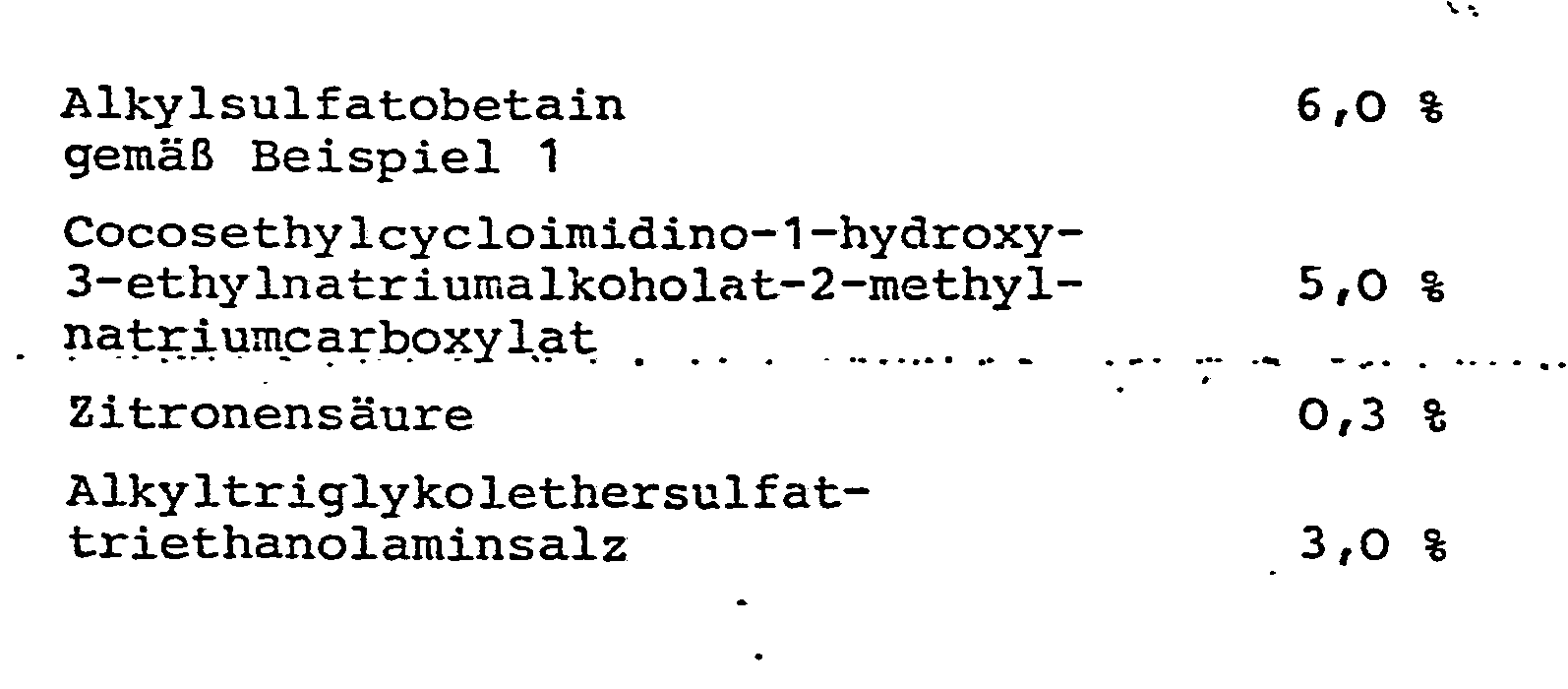
- Die nachfolgend aufgeführten Beispiele sollen die Einsatzmöglichkeiten der Alkylsulfatobetaine in Haar- und Körperreinigungsmitteln veranschaulichen. Die Mengen und %-Angaben in den Beispielen beziehen sich, sofern nicht anders erwähnt, jeweils auf das Gewicht.
-

-

-

-

-

-


-

-

-

-

Claims (1)
- Haar- und Körperreinigungsmittel mit einem Gehalt an Alkylsulfatobetain der Formel

Applications Claiming Priority (2)
| Application Number | Priority Date | Filing Date | Title |
|---|---|---|---|
| DE3138770 | 1981-09-30 | ||
| DE19813138770 DE3138770A1 (de) | 1981-09-30 | 1981-09-30 | "haar- und koerperreinigungsmittel mit einem gehalt an alkylsulfatobetainen" |
Publications (2)
| Publication Number | Publication Date |
|---|---|
| EP0075906A2 true EP0075906A2 (de) | 1983-04-06 |
| EP0075906A3 EP0075906A3 (de) | 1984-10-10 |
Family
ID=6142954
Family Applications (1)
| Application Number | Title | Priority Date | Filing Date |
|---|---|---|---|
| EP82108891A Withdrawn EP0075906A3 (de) | 1981-09-30 | 1982-09-25 | Haar- und Körperreinigungsmittel mit einem Gehalt an Alkylsulfatobetainen |
Country Status (5)
| Country | Link |
|---|---|
| US (1) | US4564520A (de) |
| EP (1) | EP0075906A3 (de) |
| JP (1) | JPS5869300A (de) |
| BR (1) | BR8205711A (de) |
| DE (1) | DE3138770A1 (de) |
Cited By (1)
| Publication number | Priority date | Publication date | Assignee | Title |
|---|---|---|---|---|
| EP0256656A1 (de) * | 1986-07-11 | 1988-02-24 | The Procter & Gamble Company | Flüssige Reinigungsmittelzusammensetzung |
Families Citing this family (10)
| Publication number | Priority date | Publication date | Assignee | Title |
|---|---|---|---|---|
| DE3423589A1 (de) * | 1984-06-27 | 1986-01-09 | Wella Ag, 6100 Darmstadt | Oxidationshaarfaerbemittel auf basis einer niedrigviskosen traegermasse |
| DE3644473C2 (de) * | 1986-12-24 | 1997-05-28 | Wella Ag | Konservierte Haar- und Körperreinigungsmittel sowie Verwendung einer Konservierungsstoff-Kombination |
| US4793992A (en) * | 1987-03-25 | 1988-12-27 | Redken Laboratories, Inc. | Hair treatment composition |
| DE3914336A1 (de) * | 1989-04-29 | 1990-10-31 | Hamburger Pharma Kontor Gmbh | Geschirrspuelmittel |
| US5641479A (en) * | 1991-02-12 | 1997-06-24 | Richardson-Vicks Inc. | Cosmetic compositions comprising an imidazolium derivative and branched polyethylene glycol |
| US5314917A (en) | 1991-03-22 | 1994-05-24 | E. B. Michaels Research Associates, Inc. | Method for inactivating enveloped viruses and sperm |
| US5389676A (en) * | 1991-03-22 | 1995-02-14 | E. B. Michaels Research Associates, Inc. | Viscous surfactant emulsion compositions |
| US5914300A (en) * | 1994-06-01 | 1999-06-22 | Lever Brothers Company | Mild antimicrobial liquid cleansing formulations comprising hydroxy acid buffering compound or compounds as potentiator of antimicrobial effectiveness |
| US6071866A (en) * | 1994-06-01 | 2000-06-06 | Lever Brothers Company, Division Of Conopco, Inc. | Mild antimicrobial liquid cleansing formulations comprising hydroxy acid buffering compound or compounds as potentiator of antimicrobial effectiveness |
| DE102006031377A1 (de) * | 2006-07-06 | 2007-02-15 | Clariant International Limited | Kosmetische oder dermatologische Reinigungsmittel enthaltend sekundäre Alkansulfonate |
Family Cites Families (6)
| Publication number | Priority date | Publication date | Assignee | Title |
|---|---|---|---|---|
| DE1249433B (de) * | 1964-09-25 | |||
| DE2437090A1 (de) * | 1974-08-01 | 1976-02-19 | Hoechst Ag | Reinigungsmittel |
| US4000091A (en) * | 1975-04-02 | 1976-12-28 | The Procter & Gamble Company | Built detergent compositions |
| AU513305B2 (en) * | 1975-04-02 | 1980-11-27 | E.B. Michaels Research Associates, Inc. | Antimicrobial compositions |
| JPS52114604A (en) * | 1976-03-22 | 1977-09-26 | Kao Corp | Shampoo composition |
| US4186113A (en) * | 1978-04-03 | 1980-01-29 | Johnson & Johnson | Low irritating detergent compositions |
-
1981
- 1981-09-30 DE DE19813138770 patent/DE3138770A1/de not_active Withdrawn
-
1982
- 1982-09-24 US US06/423,271 patent/US4564520A/en not_active Expired - Fee Related
- 1982-09-25 EP EP82108891A patent/EP0075906A3/de not_active Withdrawn
- 1982-09-29 JP JP57168684A patent/JPS5869300A/ja active Pending
- 1982-09-29 BR BR8205711A patent/BR8205711A/pt unknown
Cited By (1)
| Publication number | Priority date | Publication date | Assignee | Title |
|---|---|---|---|---|
| EP0256656A1 (de) * | 1986-07-11 | 1988-02-24 | The Procter & Gamble Company | Flüssige Reinigungsmittelzusammensetzung |
Also Published As
| Publication number | Publication date |
|---|---|
| JPS5869300A (ja) | 1983-04-25 |
| US4564520A (en) | 1986-01-14 |
| BR8205711A (pt) | 1983-08-30 |
| EP0075906A3 (de) | 1984-10-10 |
| DE3138770A1 (de) | 1983-04-14 |
Similar Documents
| Publication | Publication Date | Title |
|---|---|---|
| DE68905770T2 (de) | Topische zusammensetzung. | |
| DE69508762T2 (de) | Quaternäre ammoniumderivate, verfahren zu ihrer herstellung und ihre verwendung als oberflächenaktive verbindungen | |
| EP3238786B1 (de) | Verwendung von speziellen n-methyl-n-acylglucaminen in hautreinigungsmitteln | |
| DE69118944T2 (de) | Topisches Präparat | |
| DE69309955T2 (de) | Alkylglycerinsäureamide und deren verwendung als grenzflächenaktive substanzen | |
| DE68905771T2 (de) | Topische zusammensetzung. | |
| DE68903474T2 (de) | Topische zusammensetzung. | |
| DE69202771T2 (de) | Flüssiges Waschmittel. | |
| WO1994022997A1 (de) | Detergensgemische | |
| DE3138770A1 (de) | "haar- und koerperreinigungsmittel mit einem gehalt an alkylsulfatobetainen" | |
| DE69219279T2 (de) | Hautreinigungsmittel | |
| EP0508038B1 (de) | Citronensäurefettalkoholesterpolyglykolethersulfosuccinate, Verfahren zu ihrer Herstellung und ihre Verwendung | |
| EP0371339B1 (de) | Oberflächenaktive Mischungen | |
| EP0641377B1 (de) | Milde tensidgemische | |
| EP0081691B1 (de) | Bis-Betaine, Verfahren zu deren Herstellung und diese enthaltende Reinigungsmittel | |
| EP0499229A1 (de) | Alkylethercarbonsäuretauride | |
| EP0455657B1 (de) | Oberflächenaktive mischungen | |
| WO1992018470A1 (de) | Fettsäuremonoglyceridpolyglykolethersulfosuccinate, verfahren zu ihrer herstellung und ihre verwendung | |
| EP0540823A1 (de) | Polyolpolyethersulfosuccinate, Verfahren zu ihrer Herstellung und ihre Verwendung | |
| DE4104662C2 (de) | Mittel mit reinigender und hautpflegender Wirkung | |
| EP3458024B1 (de) | Wässrige tensid-zusammensetzungen | |
| EP0519942A1 (de) | Kosmetische reinigungsmittel. | |
| DE19608367A1 (de) | Polyglycerinestersulfosuccinate, Verfahren zu ihrer Herstellung und ihre Verwendung | |
| DE29508078U1 (de) | Hanfsamenöl, Hanfsamenderivate oder/und Hanföltrub enthaltende Zusammensetzungen für kosmetische Zwecke und Reinigungszwecke | |
| EP0519946A1 (de) | Oberflächenaktive mischungen |
Legal Events
| Date | Code | Title | Description |
|---|---|---|---|
| PUAI | Public reference made under article 153(3) epc to a published international application that has entered the european phase |
Free format text: ORIGINAL CODE: 0009012 |
|
| AK | Designated contracting states |
Designated state(s): BE CH DE FR GB IT LI NL |
|
| PUAL | Search report despatched |
Free format text: ORIGINAL CODE: 0009013 |
|
| AK | Designated contracting states |
Designated state(s): BE CH DE FR GB IT LI NL |
|
| 17P | Request for examination filed |
Effective date: 19841211 |
|
| STAA | Information on the status of an ep patent application or granted ep patent |
Free format text: STATUS: THE APPLICATION HAS BEEN WITHDRAWN |
|
| 18W | Application withdrawn |
Withdrawal date: 19861006 |
|
| RIN1 | Information on inventor provided before grant (corrected) |
Inventor name: RENG, ALWIN Inventor name: EHRL, WINFRIED, DR. Inventor name: QUACK, JOCHEN MEINHARD |