EP0075909A2 - Appareil d'enregistrement et/ou de reproduction d'information pour indiquer des longueurs d'informations enregistrées - Google Patents
Appareil d'enregistrement et/ou de reproduction d'information pour indiquer des longueurs d'informations enregistrées Download PDFInfo
- Publication number
- EP0075909A2 EP0075909A2 EP82108902A EP82108902A EP0075909A2 EP 0075909 A2 EP0075909 A2 EP 0075909A2 EP 82108902 A EP82108902 A EP 82108902A EP 82108902 A EP82108902 A EP 82108902A EP 0075909 A2 EP0075909 A2 EP 0075909A2
- Authority
- EP
- European Patent Office
- Prior art keywords
- recording
- line
- printer
- playback device
- computer
- Prior art date
- Legal status (The legal status is an assumption and is not a legal conclusion. Google has not performed a legal analysis and makes no representation as to the accuracy of the status listed.)
- Ceased
Links
Images
Classifications
-
- G—PHYSICS
- G11—INFORMATION STORAGE
- G11B—INFORMATION STORAGE BASED ON RELATIVE MOVEMENT BETWEEN RECORD CARRIER AND TRANSDUCER
- G11B27/00—Editing; Indexing; Addressing; Timing or synchronising; Monitoring; Measuring tape travel
- G11B27/02—Editing, e.g. varying the order of information signals recorded on, or reproduced from, record carriers
- G11B27/022—Electronic editing of analogue information signals, e.g. audio or video signals
- G11B27/029—Insert-editing
-
- G—PHYSICS
- G06—COMPUTING OR CALCULATING; COUNTING
- G06K—GRAPHICAL DATA READING; PRESENTATION OF DATA; RECORD CARRIERS; HANDLING RECORD CARRIERS
- G06K17/00—Methods or arrangements for effecting co-operative working between equipments covered by two or more of main groups G06K1/00 - G06K15/00, e.g. automatic card files incorporating conveying and reading operations
- G06K17/0016—Selecting or retrieving of images by means of their associated code-marks, e.g. coded microfilm or microfiche
- G06K17/0019—Selecting or retrieving of images by means of their associated code-marks, e.g. coded microfilm or microfiche for images on filmstrips
-
- G—PHYSICS
- G11—INFORMATION STORAGE
- G11B—INFORMATION STORAGE BASED ON RELATIVE MOVEMENT BETWEEN RECORD CARRIER AND TRANSDUCER
- G11B27/00—Editing; Indexing; Addressing; Timing or synchronising; Monitoring; Measuring tape travel
- G11B27/10—Indexing; Addressing; Timing or synchronising; Measuring tape travel
- G11B27/102—Programmed access in sequence to addressed parts of tracks of operating record carriers
- G11B27/105—Programmed access in sequence to addressed parts of tracks of operating record carriers of operating discs
-
- G—PHYSICS
- G11—INFORMATION STORAGE
- G11B—INFORMATION STORAGE BASED ON RELATIVE MOVEMENT BETWEEN RECORD CARRIER AND TRANSDUCER
- G11B27/00—Editing; Indexing; Addressing; Timing or synchronising; Monitoring; Measuring tape travel
- G11B27/10—Indexing; Addressing; Timing or synchronising; Measuring tape travel
- G11B27/11—Indexing; Addressing; Timing or synchronising; Measuring tape travel by using information not detectable on the record carrier
-
- G—PHYSICS
- G11—INFORMATION STORAGE
- G11B—INFORMATION STORAGE BASED ON RELATIVE MOVEMENT BETWEEN RECORD CARRIER AND TRANSDUCER
- G11B27/00—Editing; Indexing; Addressing; Timing or synchronising; Monitoring; Measuring tape travel
- G11B27/10—Indexing; Addressing; Timing or synchronising; Measuring tape travel
- G11B27/34—Indicating arrangements
-
- G—PHYSICS
- G11—INFORMATION STORAGE
- G11B—INFORMATION STORAGE BASED ON RELATIVE MOVEMENT BETWEEN RECORD CARRIER AND TRANSDUCER
- G11B2220/00—Record carriers by type
- G11B2220/60—Solid state media
- G11B2220/65—Solid state media wherein solid state memory is used for storing indexing information or metadata
-
- G—PHYSICS
- G11—INFORMATION STORAGE
- G11B—INFORMATION STORAGE BASED ON RELATIVE MOVEMENT BETWEEN RECORD CARRIER AND TRANSDUCER
- G11B2220/00—Record carriers by type
- G11B2220/80—Indexing information stored in optical or magnetic or other strip attached to cassette or disc, e.g. barcodes attached to a recording medium
-
- G—PHYSICS
- G11—INFORMATION STORAGE
- G11B—INFORMATION STORAGE BASED ON RELATIVE MOVEMENT BETWEEN RECORD CARRIER AND TRANSDUCER
- G11B2220/00—Record carriers by type
- G11B2220/90—Tape-like record carriers
Definitions
- the invention relates to a signal recording and / or reproducing device for displaying information lengths recorded on a recording medium and the beginning and end of which are marked by marks, characters, markings or the like, with a scanning device for scanning the recording medium in the recording - And / or playback device and with a device for detecting the recorded signals which represent the marks, characters, markings or the like information.
- a scanning device for scanning the recording medium in the recording - And / or playback device and with a device for detecting the recorded signals which represent the marks, characters, markings or the like information.
- Such a device can be used in dictation machine systems, answering machines, audio and video devices and the like.
- a device which comprises a number of selectively actuatable light sources and an indexing or switching mechanism with which the light sources are scanned in synchronism with the scanning of the record carrier, the switching mechanism being in succession with each of the light sources is connected.
- the actuation signal is stored in a memory circuit until the switching mechanism comes into contact with a light source that is not switched on, in order to then put this light source into operation.
- the switching device with the aid of which the recognized marks or instructions for reproduction by the display units are reproduced taking into account a reference point, is a switching mechanism and is mechanical except for electrical switching contacts. This arrangement is difficult to repair in the event of a fault and, because of its mechanical parts, has inertias which slow down the speed of the display.
- a device for displaying the location of special information, marks or instructions on a recording medium in which the switching device has a running counter, the current status of each special information, brand or instruction recognized by a brand recognition device is held in one of several memories. After the record carrier has been read out, the contents of the memories are converted in a microprocessor in order to reproduce an image of the location of all special information, marks or instructions by means of the selectively operable light sources.
- the assignment of the information, marks or instructions on the recording medium to the light sources can be processed directly as electrical quantities without having to choose the detour via mechanical quantities. By avoiding mechanical components, the reliability compared to devices that are equipped with such units is significantly increased.
- the marks recorded during recording on the recording medium are usually calculated back when the recording medium returns, after the end of the transfer to the beginning of the recording medium, when using a tape on the beginning thereof, so that when the recording medium is inserted for the playback is always automatically referred to the defined start of the recording medium.
- the invention is based on the object of having a numerical display made available both during recording and during playback from the recording medium, the individual and total length of events conditions, the finding of certain text passages, dates and times within the overall recording.
- the recording / playback device is connected via a pulse line for the forward and return signals and a count line to a runtime counter, which is an up and down counter, and are the forward and return signals of the recording / playback device Can be fed to the buffer / computer as well as the printer via a further line, which branches off from the forward / return pulse line.
- a line of the recording / playback device advantageously connects both directly and via a first timing element to the running counter, and the timing element resets the running time counter according to the return signals during the return of the dictation and playback device.
- the first timing element is further followed by a second timing element, which is connected to the recording / playback device via a line and which starts again after being reset by the first timing element.
- the total task time, individual task times and task start as well as further information, such as date and time can be printed out.
- the advantage of the invention is that the index strip is automatically created in digital form by the printer of the recording / reproducing device when the recording is made or after the end of the recording before the playback starts.
- the computer can begin to take over information at any point on the record carrier, so that the printer can also begin printing at any point on the record carrier.
- preference is given to the end of the recordings on the record carrier, with all recorded data being converted to the defined start of the record carrier after the return of the record carrier has ended, so that the markings and the marking positions, based on the start of the record carrier, are on the index strip. can be printed out.
- the characters can also be read in and printed out during the rewind as they occur, the characters being printed upside down. At the end of the rewind process, the total running time is also printed out.
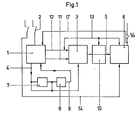
- a recording / reproducing device 1 is connected via a pulse line 12 for the forward and return signals and via a counting line 11 to a runtime counter 3 which is designed as an up and down counter.
- the recording / reproducing device 1 contains a drive (not shown in detail) for the recording medium, for example a magnetic tape, which emits rotation signals which are formed when the winding or unwinding spool is rotated.
- This drive is connected with one of its outputs to the runtime counter 3, which counts the length of the rewound or rewound recording medium.
- the forward and reverse signals of the recording / playback device 1 or the drive for the recording medium within the device 1 are fed via the impulse line 12 to the runtime counter 3 and identify the forward and the return of the recording medium.
- a line 13 branches off from the impulse line 12 in front of the runtime counter 3 and is connected both to a buffer / computer 10 and to a printer 6.
- the latch / computer 10 consecutively numbered information in the recording, the length of information recognizes between two markers and converts them in the form of individual length of information, cumulative length of information, typewritten lines, syllables, standard words need for standard write pages or the like 'in order that then from the downstream printer 6 during recording or before playback after completion of the rewinding of the recording medium, possibly. digitally printed out together with the serial number.
- Another line 4 connects the recording / playback device 1 both directly to the runtime counter 3 and via a first timing element 7, which resets the runtime counter 3 in accordance with the return signals during the return of the recording / playback device 1.
- the first timer 7 is followed by a second timer 8, which is connected via a line 9 to the recording / playback device 1 and starts again after the reset by the first timer 7.
- the recording / playback device 1 has a switch 2 which is closed for the transmission of the information and at the same time triggers the return of the device 1.
- the switch 2 is connected via a line 14 to the printer 6, which prints out the individual marks, characters, markings or the like information each time the device 1 is stopped or during the transmission of this information.
- the pulse sequence of the pulses fed from the drive of the device 1 to the runtime counter 3 is designed such that it represents the process time or the number of typewriter lines.
- the counter reading in the buffer / computer 10 is fed to the printer 6 via line 5 and to the runtime counter 3 via line 13. The printer then prints the direction of travel between two marks together with the counter reading.
- a timer is integrated in the recording / playback device 1, for example, which controls the printing of the total recording time, the individual recording time, the time at the start of recording, the date and the like, and feeds the corresponding signals into the printer 6 for printing.
- This can be structurally either in the recording / playback device 1 be integrated or be designed as an independent structural unit which is then connected as an additional device to the recording / playback device 1, for example in the form of an adapter which is plugged into the device 1 and receives its control signals from the device 1.
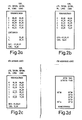
- An index strip 15, as shown in FIGS. 2a and 2b, is created in printer 6, for example.
- the process information during the recording on the recording medium is printed out by the device 1 on the index strip 15, for example as in the form shown in FIG. 2a:
- one memory is sufficient: for a five or six digit number - out.
- FIG. 2b shows an index strip 15 which is printed out after the mark transfer has taken place, that is to say after the return of the recording medium has ended, but before the start of the playback operation. Since in this mode of operation the information relates, as mentioned above, to the beginning of the recording medium, the printout on index strip 15 begins with the first dictation, which in this case comprises 1.25 units and was ended at 7:00 p.m .:
- a mark is made in the playback position of the device 1, this means, for example, an insertion which the dictator has carried out at specific positions on the record carrier.
- These insertions of information are then printed out, for example, with corresponding markings directly after the printout for the information lengths of the individual dictations, so that, for example, the printout according to the following pattern can be done:
- the two insertions are marked with the numbers 1 and 2. In an expedient embodiment, up to thirty insertions are possible, but the number can also be greater.
- the date and time can also be printed out after recording by an additional switch on the printer.
- the above tabular printouts are not made exactly according to the above-mentioned patterns, but rather the printouts for the information lengths and for the insertions are printed out in the order in which they occur, as is shown in FIG. 2c is shown.
- the second operating possibility of the recording / reproducing device 1 is such that all the information which arises is stored and then called up.
- the printout during the recording by the device 1 takes place according to the previously specified tabular patterns. If the recording / playback device 1 is switched to playback mode, all information stored on the recording medium has been read in beforehand and stored and is only available for printing on the index strip 15 after the recording medium has returned.
- the process lengths during rewinding can also be printed out on the playback device as they occur.
- the printout is then done upside down, so that after the index strip has been removed, the information is available in the correct order from top to bottom, as can be seen from FIG. 2d.
- a switch 16 is arranged in the printer, buffer / computer or on the recording / playback device, which in the closed state sets the recording / playback device 1 in the return.
- the device described above is in no way limited to dictation devices, but can also be used, for example, as an additional device for answering machines and dictation systems.
- Applications in the video area are also planned for the entire audio area.
Landscapes
- Engineering & Computer Science (AREA)
- Physics & Mathematics (AREA)
- General Physics & Mathematics (AREA)
- Theoretical Computer Science (AREA)
- Multimedia (AREA)
- Indexing, Searching, Synchronizing, And The Amount Of Synchronization Travel Of Record Carriers (AREA)
- Record Information Processing For Printing (AREA)
Applications Claiming Priority (4)
| Application Number | Priority Date | Filing Date | Title |
|---|---|---|---|
| DE3138433 | 1981-09-26 | ||
| DE3138433 | 1981-09-26 | ||
| DE3205489 | 1982-02-16 | ||
| DE3205489 | 1982-02-16 |
Publications (2)
| Publication Number | Publication Date |
|---|---|
| EP0075909A2 true EP0075909A2 (fr) | 1983-04-06 |
| EP0075909A3 EP0075909A3 (fr) | 1985-10-30 |
Family
ID=25796361
Family Applications (1)
| Application Number | Title | Priority Date | Filing Date |
|---|---|---|---|
| EP82108902A Ceased EP0075909A3 (fr) | 1981-09-26 | 1982-09-25 | Appareil d'enregistrement et/ou de reproduction d'information pour indiquer des longueurs d'informations enregistrées |
Country Status (1)
| Country | Link |
|---|---|
| EP (1) | EP0075909A3 (fr) |
Family Cites Families (6)
| Publication number | Priority date | Publication date | Assignee | Title |
|---|---|---|---|---|
| GB795256A (en) * | 1954-08-07 | 1958-05-21 | Stefano Tyszkiewicz | Device operable by electrical pulses for impressing conventional signs (figures, letters and the like) |
| US3660616A (en) * | 1970-06-29 | 1972-05-02 | Ibm | Dictating and transcribing systems featuring random sentence arrangement with recognition and location of sentences in a preferred sequence |
| US4301525A (en) * | 1977-03-30 | 1981-11-17 | Lanier Business Products, Inc. | Central control system for dictation |
| DE2816732B1 (de) * | 1978-04-18 | 1979-07-12 | Assmann Gmbh | Vorrichtung zur Anzeige der Lage von besonderen Informationen,Marken oder Anweisungen auf einem mit Aufzeichnungen versehenen Aufzeichnungstraeger |
| US4200893A (en) * | 1978-05-17 | 1980-04-29 | Dictaphone Corporation | Instruction indicating apparatus for a record and/or playback device |
| US4319337A (en) * | 1979-10-12 | 1982-03-09 | Dictaphone Corporation | Apparatus for displaying the status of individual dictated messages in a central dictation system |
-
1982
- 1982-09-25 EP EP82108902A patent/EP0075909A3/fr not_active Ceased
Also Published As
| Publication number | Publication date |
|---|---|
| EP0075909A3 (fr) | 1985-10-30 |
Similar Documents
| Publication | Publication Date | Title |
|---|---|---|
| DE3012134C2 (fr) | ||
| DE2919475C2 (fr) | ||
| AT389952B (de) | Wortprozessor | |
| DE68908907T2 (de) | Datenspeicherverfahren auf ein Aufzeichnungsband. | |
| DE2918846B2 (de) | Anordnung zur Bildschirmauflistung vorprogrammierbarer Aufnahmedaten von Videoaufzeichnungs- und Wiedergabegeräten | |
| DE2656123B2 (de) | Eingabeeinrichtung zum Zuführen einer Vielzahl von Zeichen, die ein Datenfeld bilden | |
| DE3116068C2 (fr) | ||
| DE3726367C2 (de) | Markierungssignale und Markierungsdatenblöcke für den Einsatz mit aufgenommenen Mitteilungen | |
| DE2506440A1 (de) | Magnetischer aufzeichnungstraeger | |
| DE3016059C2 (de) | Bandstellensucheinrichtung für ein magnetisches Aufnahme- und Wiedergabegerät | |
| DE1611462A1 (de) | Verfahren und Vorrichtung zum automatischen Zeilenausschliessen von nichtausgeschlossenem Rohtext | |
| DE2500263B2 (de) | Schnelldrucker mit einer Anzeigevorrichtung zur Identifizierung der Typenträger | |
| DE2816732B1 (de) | Vorrichtung zur Anzeige der Lage von besonderen Informationen,Marken oder Anweisungen auf einem mit Aufzeichnungen versehenen Aufzeichnungstraeger | |
| DE2717198A1 (de) | Anweisungen anzeigendes geraet fuer aufnahme- und/oder wiedergabegeraete | |
| DE2265112B2 (de) | Aufzeichnungsgeraet | |
| EP0274703B1 (fr) | Méthode et dispositif de mémorisation intermédiaire de données | |
| DE2416587A1 (de) | Vorrichtung zur informationsaufzeichnung | |
| EP0609290B1 (fr) | Lecteur de la memoire statique d'une cassette | |
| EP0406744B1 (fr) | Dispositif pour éditer un texte parlé, enregistré sur une bande magnétique et/ou dans une mémoire semi-conductrice | |
| DE3225036A1 (de) | Signalaufnahme- und/oder -wiedergabegeraet zur anzeige von informationslaengen | |
| EP0075909A2 (fr) | Appareil d'enregistrement et/ou de reproduction d'information pour indiquer des longueurs d'informations enregistrées | |
| DE2921544A1 (de) | Verfahren zum steuern drehbarer speichervorrichtungen | |
| EP0320744A2 (fr) | Magnétoscope avec un dispositif pour enregistrer une piste de contrôle additionnelle sur une bande vidéo | |
| EP0594665B1 (fr) | Systeme pour la programmation de la reproduction de morceaux enregistres sur un support d'enregistrement | |
| DE3726416C2 (de) | Anzeigevorrichtung für ein Diktier/Übertragungsgerät und Verfahren zur Anzeige in einem Diktier/Übertragungsgerät |
Legal Events
| Date | Code | Title | Description |
|---|---|---|---|
| PUAI | Public reference made under article 153(3) epc to a published international application that has entered the european phase |
Free format text: ORIGINAL CODE: 0009012 |
|
| AK | Designated contracting states |
Designated state(s): AT BE CH FR GB IT LI LU NL SE |
|
| RAP1 | Party data changed (applicant data changed or rights of an application transferred) |
Owner name: ASSMANN INFORMATIK 2000 GMBH |
|
| PUAL | Search report despatched |
Free format text: ORIGINAL CODE: 0009013 |
|
| AK | Designated contracting states |
Designated state(s): AT BE CH FR GB IT LI LU NL SE |
|
| 17P | Request for examination filed |
Effective date: 19860416 |
|
| 17Q | First examination report despatched |
Effective date: 19871014 |
|
| STAA | Information on the status of an ep patent application or granted ep patent |
Free format text: STATUS: THE APPLICATION HAS BEEN REFUSED |
|
| 18R | Application refused |
Effective date: 19880321 |
|
| RIN1 | Information on inventor provided before grant (corrected) |
Inventor name: ECKHOF, GUIDO Inventor name: WOELFLICK, FRANZ |