EP0076341A1 - Vertauvorrichtung mit starrem Ausleger an einem Einpunktankersystem - Google Patents
Vertauvorrichtung mit starrem Ausleger an einem Einpunktankersystem Download PDFInfo
- Publication number
- EP0076341A1 EP0076341A1 EP81201122A EP81201122A EP0076341A1 EP 0076341 A1 EP0076341 A1 EP 0076341A1 EP 81201122 A EP81201122 A EP 81201122A EP 81201122 A EP81201122 A EP 81201122A EP 0076341 A1 EP0076341 A1 EP 0076341A1
- Authority
- EP
- European Patent Office
- Prior art keywords
- vessel
- rigid
- riser
- buoyancy chamber
- water
- Prior art date
- Legal status (The legal status is an assumption and is not a legal conclusion. Google has not performed a legal analysis and makes no representation as to the accuracy of the status listed.)
- Withdrawn
Links
- XLYOFNOQVPJJNP-UHFFFAOYSA-N water Substances O XLYOFNOQVPJJNP-UHFFFAOYSA-N 0.000 claims abstract description 29
- 238000007667 floating Methods 0.000 claims abstract description 10
- 239000012530 fluid Substances 0.000 abstract description 23
- 239000007789 gas Substances 0.000 abstract 1
- 210000003414 extremity Anatomy 0.000 description 3
- 230000033001 locomotion Effects 0.000 description 3
- 238000004873 anchoring Methods 0.000 description 2
- 230000001066 destructive effect Effects 0.000 description 2
- 230000000694 effects Effects 0.000 description 2
- 238000009434 installation Methods 0.000 description 2
- 238000004519 manufacturing process Methods 0.000 description 2
- 230000002411 adverse Effects 0.000 description 1
- 238000004891 communication Methods 0.000 description 1
- 238000010276 construction Methods 0.000 description 1
- 230000007423 decrease Effects 0.000 description 1
- 238000006073 displacement reaction Methods 0.000 description 1
- 238000005516 engineering process Methods 0.000 description 1
- 210000003141 lower extremity Anatomy 0.000 description 1
- 230000007935 neutral effect Effects 0.000 description 1
Images

Classifications
-
- B—PERFORMING OPERATIONS; TRANSPORTING
- B63—SHIPS OR OTHER WATERBORNE VESSELS; RELATED EQUIPMENT
- B63B—SHIPS OR OTHER WATERBORNE VESSELS; EQUIPMENT FOR SHIPPING
- B63B22/00—Buoys
- B63B22/02—Buoys specially adapted for mooring a vessel
- B63B22/021—Buoys specially adapted for mooring a vessel and for transferring fluids, e.g. liquids
- B63B22/025—Buoys specially adapted for mooring a vessel and for transferring fluids, e.g. liquids and comprising a restoring force in the mooring connection provided by means of weight, float or spring devices
Definitions
- the present invention relates generally to a novel apparatus for mooring a vessel floating on the surface of a body of water to the floor beneath that body of water by means of a single point mooring. More particularly, the present invention relates to an apparatus that comprises of two rigid yokes or frames, pipes or conduits for transferring fluid into and out from a vessel, and a tensioned riser-type anchoring arrangement to moor the vessel permanently at an offshore location in the vicinity of a pipeline or oil field.
- the storage vessel is preferably permanently moored.
- the mooring must have sufficient integrity not to collapse or fail during the most severe sea conditions.
- most commonly such storage vessels are moored to a single point mooring, allowing the vessels to respond to the combination of wind, waves and current, seeking automatically the position of least resistance.
- the most common form of a single point mooring is a buoy floating on the surface of a body of water and anchored to the floor of that body of water at anchor points with a number of anchor chains.
- a flexible pipe terminates at the buoy and connects the buoy with the pipeline on the floor of that body of water.
- a turntable mounted on top of the buoy is a turntable supported by a bearing.
- a fluid swivel mounted concentrically with the turntable is a fluid swivel which is coupled to the turntable.
- the fluid swivel is of course in fluid communication with the terminus of the flexible pipe leading to the source of production.
- the combination of turntable and swivel can rotate freely around the vertical axis of the buoy.
- the vessel is moored to the buoy with ropes, and a floating hose connects the fluid swivel on the turntable of the buoy with the vessel piping.
- a fluid connection between the pipeline on the floor of the body of water and the vessel piping is established, allowing free rotation of the vessel around the single point mooring without spillage of fluid or gas.
- the disclosures describe a rigid yoke single point mooring consisting of a rigid yoke which includes a buoyancy chamber.
- the rigid yoke can pivot about a horizontal axis at the extremity connected to the vessel.
- the other extremity of the rigid yoke consists of an attachment point on a tension riser; that is, a rigid, substantially vertical length of pipe or tube maintained under tension.
- the attachment point of the yoke to the tension riser consists of a universal joint.
- the lower extremity of the tension riser is connected via a universal joint to an anchor point placed on the floor of the body of water.
- the riser incorporates an axial rotation point so that the vessel and rigid yoke can freely rotate around the single point mooring.
- the tension riser is kept under tension by the permanently submerged buoyancy chamber connected to the rigid yoke.
- the rigid yoke provides a constant vertical force on the riser via the universal joint connection.
- the resulting horizontal force due to waves, wind and current working on the vessel is the horizontal force component acting on the tension riser connection.
- the combination of the horizontal and vertical forces acting on the riser determines the inclination of the tension riser, since the riser can only be loaded in tension.
- the tension in the riser In order to limit the riser angles away from the vertical, the tension in the riser must be large. Because the riser is able to withstand large inclinations, relatively large horizontal excursions can be obtained, making this type of rigid yoke single point mooring more suitable in relatively high waves and shallow water bodies. If the buoyancy chamber is connected to the rigid yoke between vessel and riser, the riser attachment point to the rigid yoke can be placed above the surface of the water body, and larger excursions can be facilitated.
- the list angle of the rigid yoke can be minimised by increasing the length of the rigid yoke, which results in a heavy structure with large forces on the hinges at the vessel end of the rigid yoke.
- the inclination angle of the tension riser can be limited by increasing the tension of the riser.
- the large riser tension requires a strong rigid yoke construction and a large buoyancy chamber.
- the buoyancy chamber Since the buoyancy chamber is integrated into the rigid yoke between riser and vessel hinges, the buoyancy force of the chamber which pushes the rigid yoke upwards is divided between the tension riser and the vessel hinges, according to a ratio which is unversely proportional to the horizontal distance between buoyancy chamber and riser and the horizontal distance between buoyancy chamber and vessel hinges. As a result, the buoyancy chamber must be large to provide an adequate riser tension, since part of the buoyancy force of the said buoyancy chamber is lost in unnecessary upward loading of the vessel hinges.
- the wave-induced forces on the buoyancy chamber are directly proportional to its displacement, and dynamic loading may be destructive to the apparatus.
- the single pair of hinges at the vessel end of the rigid yoke must provide all the support needed to counteract the tensional and longitudinal loading on the rigid yoke as a result of wave action and vessel motion.
- an apparatus for mooring a vessel floating on the surface of a body of water and anchored to the floor of that body of water comprising of two rigid yokes which at one end are connected to the vessel by means of two pairs of hinges, usually at vertical intervals, which allow the rigid yokes to pivot about horizontal axes.
- the other ends of the rigid yokes are connected to an integrated support structure/buoyancy chamber by means of another two pairs of hinges which also allow the rigid yokes to pivot about horizontal axes.
- the buoyancy chamber which is generally submerged, provides an uplifting force that counterbalances the weight of the rigid yokes and the tension load of the riser, which is supported by the support structure at a location clearly above the surface level of the body of water by means of a rotary member and universal joint.
- the rotary member or turntable, allows the support structure and buoyancy chamber (and rigid yokes and vessel) to rotate freely about the vertical axis of the tension riser.
- Generally concentric with the rotary member is a fluid swivel.
- the tension riser is anchored to the floor of the body of water via a universal joint that allows the riser to incline in any direction.
- a pipe and flexible hoses, or flexible pipes, are connected to a pipeline on the floor of the water body.
- the buoyancy chamber and support structure will not incline if the vessel is loaded, or if the vessel is drifting away from the mooring point under the influences of waves and wind.
- the universal joint which forms the connection between the tension riser and the support structure will rotate in a similar manner as the universal joint located at the lower end of the tension riser.
- the vertical tension load force component in the tension riser remains basically constant, providing a continuously increasing restoring mooring force as a function of the vessel drift distance away from the neutral mooring point.
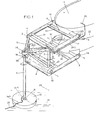
- a vessel (1) is moored to the floor (21) of a body of water (26) by means of a rigid tension riser (6), and support structure (5) with integrated buoyancy chamber (4), and a pair of rigid yokes (2) and (3).
- This mooring apparatus also comprises a fluid connection (24) connecting the vessel (1) with a fluid pipeline (25) on the floor (21) of the body of water (26).
- the tension riser (6) is attached to the floor (21) of the body of water (26) at an anchor structure (10), such as a concrete block which may be piled into the floor (21), or by any other suitable anchoring means designed to resist the horizontal and vertical forces acting upon it.
- the tension riser (6) is connected to the anchor structure (10) by means of a universal joint (11) which allows inclination of the tension riser (6) in any direction.
- the fluid pipeline (25) on the floor (21) runs across the anchor structure (10), enters the fluid pipeline (24a) which is raised above the surface of the anchor structure (10), and penetrates the tension riser (6) immediately above the universal joint (11). It then runs upwards through the tension riser (6).
- a flexible hose (27) is used to jump the universal joint (11).
- the tension riser (6) is connected to the support structure (5) with integrated buoyancy chamber (4) by the universal joint (20) and the rotary member (28).
- This combination allows completely free movement of the integrated buoyancy chamber/support structure (4)(5) with respect to the tension riser (6), including rotation about a vertical axis.
- the vessel (1) is free to rotate about the tension riser (6) and find the position of least resistance with respect to wind and wave conditions.
- the rotary member (28) is mounted on the universal joint (20) and the support structure (5) with integrated buoyancy chamber (4) -is rigidly fixed to the rotary member (28).
- the support structure (5) with integrated buoyancy chamber (4) includes four rigid struts (23) extending from the rotary member (28) to immediately interior from each of the four corners of the rectangle.
- the buoyancy chamber(4) normally submerged beneath the water surface (22) and fitted rigidly to the struts (23), is usually of a circular cross-section.
- the pair of hinges (18)(19) is fitted to the extremities of the said buoyancy chamber (4), the purpose of which is to allow the first rigid yoke (3) to rotate freely about the horizontal axis (T-T).
- a second pair of hinges (16) (17) is fitted to the upper side of the support structure (5), the purpose of which is to allow the second rigid yoke (2) to rotate freely about the horizontal axis (Z-Z).
- the two rigid yokes (2) and (3) connect the support structure (5) with the integrated buoyancy chamber (4) to the vessel (1).
- Each of the rigid yokes (2) and (3) is connected to the vessel (1) by hinges.
- the rigid yoke (2) is connected to the vessel by hinges (13) and-(12) to_allow free rotation about the horizontal axis (X-X).
- the rigid yoke (3) is connected to the vessel by hinges (14) and (15) to allow free rotation about the horizontal axis (Y-Y).
- the two rigid yokes (2) and (3) are usually strengthened by means of four struts (30) (31) and (32) (33). This arrangement means that motions of the vessel (1) can take place under variable weather and sea conditions, yet the rigid yokes (2) and (3) will remain parallel.
- the fluid pipeline (24b) emerges from the tension riser (6) immediately below the universal joint (20).
- a flexible hose (36) is used to jump the universal joint (20), and the fluid pipeline (24c) then enters the fluid swivel (34) which is concentric with respect to the rotary member (28).
- This fluid swivel (34) is of a type known to those skilled in the art, and may be capable of carrying several barallel fluid conduits
- the fluid pipeline (24c) emerges from out of the top of the rotary member (28) and is arranged across the struts (23) and one of the arms of the. rigid yoke (2), ultil it finally reaches the connection point (35) with the vessel (1).
Landscapes
- Chemical & Material Sciences (AREA)
- Engineering & Computer Science (AREA)
- Combustion & Propulsion (AREA)
- Mechanical Engineering (AREA)
- Ocean & Marine Engineering (AREA)
- Pharmaceuticals Containing Other Organic And Inorganic Compounds (AREA)
- Wind Motors (AREA)
Priority Applications (3)
| Application Number | Priority Date | Filing Date | Title |
|---|---|---|---|
| EP81201122A EP0076341A1 (de) | 1981-10-07 | 1981-10-07 | Vertauvorrichtung mit starrem Ausleger an einem Einpunktankersystem |
| BR8205575A BR8205575A (pt) | 1981-10-07 | 1982-09-23 | Amarracao para uma embarcacao flutuando na superficie de u'a massa d'agua |
| NO823349A NO823349L (no) | 1981-10-07 | 1982-10-05 | Ett punkt fortoeyningsboeye. |
Applications Claiming Priority (1)
| Application Number | Priority Date | Filing Date | Title |
|---|---|---|---|
| EP81201122A EP0076341A1 (de) | 1981-10-07 | 1981-10-07 | Vertauvorrichtung mit starrem Ausleger an einem Einpunktankersystem |
Publications (1)
| Publication Number | Publication Date |
|---|---|
| EP0076341A1 true EP0076341A1 (de) | 1983-04-13 |
Family
ID=8188156
Family Applications (1)
| Application Number | Title | Priority Date | Filing Date |
|---|---|---|---|
| EP81201122A Withdrawn EP0076341A1 (de) | 1981-10-07 | 1981-10-07 | Vertauvorrichtung mit starrem Ausleger an einem Einpunktankersystem |
Country Status (3)
| Country | Link |
|---|---|
| EP (1) | EP0076341A1 (de) |
| BR (1) | BR8205575A (de) |
| NO (1) | NO823349L (de) |
Cited By (6)
| Publication number | Priority date | Publication date | Assignee | Title |
|---|---|---|---|---|
| GB2136375A (en) * | 1983-03-14 | 1984-09-19 | Tecnomare Spa | Mooring system for tanker ships |
| GB2139584A (en) * | 1983-05-05 | 1984-11-14 | Mobil Oil Corp | Submerged single point mooring system |
| US4665856A (en) * | 1985-10-03 | 1987-05-19 | Sofec, Inc. | Mooring apparatus |
| GB2198407A (en) * | 1986-06-19 | 1988-06-15 | Peter William George Burridge | Single point buoy |
| CN104071304A (zh) * | 2014-07-07 | 2014-10-01 | 中国核动力研究设计院 | 适用于船体式浮动核电站的单点系泊系统 |
| RU2651401C1 (ru) * | 2017-02-27 | 2018-04-19 | Акционерное общество "Центральное конструкторское бюро морской техники "Рубин" | Адаптивное погруженное швартовное устройство для передачи нефти или газа с подводного терминала на плавучее сооружение |
Citations (2)
| Publication number | Priority date | Publication date | Assignee | Title |
|---|---|---|---|---|
| GB1360743A (en) * | 1972-10-26 | 1974-07-24 | Continental Oil Co | Submersible single point mooring facility |
| FR2303702A1 (fr) * | 1975-03-10 | 1976-10-08 | Ihc Holland Nv | Structure flottante |
-
1981
- 1981-10-07 EP EP81201122A patent/EP0076341A1/de not_active Withdrawn
-
1982
- 1982-09-23 BR BR8205575A patent/BR8205575A/pt unknown
- 1982-10-05 NO NO823349A patent/NO823349L/no unknown
Patent Citations (2)
| Publication number | Priority date | Publication date | Assignee | Title |
|---|---|---|---|---|
| GB1360743A (en) * | 1972-10-26 | 1974-07-24 | Continental Oil Co | Submersible single point mooring facility |
| FR2303702A1 (fr) * | 1975-03-10 | 1976-10-08 | Ihc Holland Nv | Structure flottante |
Cited By (8)
| Publication number | Priority date | Publication date | Assignee | Title |
|---|---|---|---|---|
| GB2136375A (en) * | 1983-03-14 | 1984-09-19 | Tecnomare Spa | Mooring system for tanker ships |
| GB2139584A (en) * | 1983-05-05 | 1984-11-14 | Mobil Oil Corp | Submerged single point mooring system |
| US4546721A (en) * | 1983-05-05 | 1985-10-15 | Mobil Oil Corporation | Submerged single point mooring system |
| US4665856A (en) * | 1985-10-03 | 1987-05-19 | Sofec, Inc. | Mooring apparatus |
| GB2198407A (en) * | 1986-06-19 | 1988-06-15 | Peter William George Burridge | Single point buoy |
| GB2198407B (en) * | 1986-06-19 | 1990-01-17 | Peter William George Burridge | Bearing assembly |
| CN104071304A (zh) * | 2014-07-07 | 2014-10-01 | 中国核动力研究设计院 | 适用于船体式浮动核电站的单点系泊系统 |
| RU2651401C1 (ru) * | 2017-02-27 | 2018-04-19 | Акционерное общество "Центральное конструкторское бюро морской техники "Рубин" | Адаптивное погруженное швартовное устройство для передачи нефти или газа с подводного терминала на плавучее сооружение |
Also Published As
| Publication number | Publication date |
|---|---|
| BR8205575A (pt) | 1983-08-30 |
| NO823349L (no) | 1983-04-08 |
Similar Documents
| Publication | Publication Date | Title |
|---|---|---|
| US5288253A (en) | Single point mooring system employing a submerged buoy and a vessel mounted fluid swivel | |
| US3605668A (en) | Underwater riser and ship connection | |
| US5041038A (en) | Offshore loading system | |
| US4088089A (en) | Riser and yoke mooring system | |
| US4031919A (en) | Articulated riser | |
| EP0059499A1 (de) | Vertäuungssystem mit einem an dem Meeresboden verankerten schwimmenden Behälter | |
| EP2025591A2 (de) | Flüssigerdgas-Entladesystem bei Seitenwind | |
| US5816183A (en) | Submerged CALM buoy | |
| RU2133687C1 (ru) | Способ одноопорной швартовки судов и система для его осуществления (варианты) | |
| US3834432A (en) | Transfer system for suboceanic oil production | |
| US4406636A (en) | Single-point mooring systems | |
| US3595278A (en) | Transfer system for suboceanic oil production | |
| US3756293A (en) | Loading terminal for tankers or other large ships with flowable cargo | |
| US4567843A (en) | Mooring system | |
| US4546721A (en) | Submerged single point mooring system | |
| EP0076341A1 (de) | Vertauvorrichtung mit starrem Ausleger an einem Einpunktankersystem | |
| GB2328197A (en) | Fluid transfer system | |
| US4309955A (en) | Riser-to-vessel-mooring-terminal | |
| US3999498A (en) | Articulated loading arm with end hoses for single point mooring | |
| EP0079404B2 (de) | Einpunkt-Verankerungsboje mit starrem Arm | |
| US4441448A (en) | Controlled mooring | |
| US3837380A (en) | Marine loading/unloading system | |
| EP0049549A1 (de) | Vertäuboje | |
| US4468205A (en) | Apparatus for single point mooring | |
| EP0134596A1 (de) | Verankerungsboje |
Legal Events
| Date | Code | Title | Description |
|---|---|---|---|
| PUAI | Public reference made under article 153(3) epc to a published international application that has entered the european phase |
Free format text: ORIGINAL CODE: 0009012 |
|
| STAA | Information on the status of an ep patent application or granted ep patent |
Free format text: STATUS: THE APPLICATION HAS BEEN WITHDRAWN |
|
| AK | Designated contracting states |
Designated state(s): DE FR GB IT NL SE |
|
| 18W | Application withdrawn |
Withdrawal date: 19830304 |
|
| RIN1 | Information on inventor provided before grant (corrected) |
Inventor name: DE BAAN, JACOB Inventor name: VAN HEIJST, WILLEM JAN |