EP0076582B1 - Compositions de polyester; objets formés à partir de ces compositions et procédé pour leur préparation - Google Patents
Compositions de polyester; objets formés à partir de ces compositions et procédé pour leur préparation Download PDFInfo
- Publication number
- EP0076582B1 EP0076582B1 EP82304846A EP82304846A EP0076582B1 EP 0076582 B1 EP0076582 B1 EP 0076582B1 EP 82304846 A EP82304846 A EP 82304846A EP 82304846 A EP82304846 A EP 82304846A EP 0076582 B1 EP0076582 B1 EP 0076582B1
- Authority
- EP
- European Patent Office
- Prior art keywords
- hydroxy
- residues
- linear polyester
- glycol
- bis
- Prior art date
- Legal status (The legal status is an assumption and is not a legal conclusion. Google has not performed a legal analysis and makes no representation as to the accuracy of the status listed.)
- Expired
Links
- 0 *C(C1)C=*C2=C1Oc(cc(*)cc1*)c1C2=O Chemical compound *C(C1)C=*C2=C1Oc(cc(*)cc1*)c1C2=O 0.000 description 1
Classifications
-
- C—CHEMISTRY; METALLURGY
- C08—ORGANIC MACROMOLECULAR COMPOUNDS; THEIR PREPARATION OR CHEMICAL WORKING-UP; COMPOSITIONS BASED THEREON
- C08G—MACROMOLECULAR COMPOUNDS OBTAINED OTHERWISE THAN BY REACTIONS ONLY INVOLVING UNSATURATED CARBON-TO-CARBON BONDS
- C08G63/00—Macromolecular compounds obtained by reactions forming a carboxylic ester link in the main chain of the macromolecule
- C08G63/66—Polyesters containing oxygen in the form of ether groups
- C08G63/668—Polyesters containing oxygen in the form of ether groups derived from polycarboxylic acids and polyhydroxy compounds
- C08G63/672—Dicarboxylic acids and dihydroxy compounds
Definitions
- Linear polyesters have only poor stability under the influence of UV irradiation. It is an object of this invention to improve the UV stability of linear polyesters.
- Linear polyesters are well known thermoplastic polymers which have chains consisting of alternating residues of glycols and dicarboxylic acids, the residues being connected by means of ester linkages.
- Many acids and glycols have been proposed for the preparation of linear polyesters.
- the acids include (a) terephthalic acid (b) isophthalic acid, (c) napthalene-2,6-dicarboxylic acid, and (d) bis(carboxyphenoxy)ethane.
- the glycols include alkane diols with 2 to 10 carbon atoms (e.g. ethylene glycol and 1,4-butane-diol), and 1,4 dimethylol cyclohexane. By far the commonest polyester is poly(ethylene terephthalate).
- linear polyesters include (a) a copolymer of ethylene glycol with a mixture of terephthalic acid and isophthalic acid said mixture containing 80 to 95 mole % of the terephthalic acid, (b) a polymer of 1,4-butanediol and terephthalic acid, and (c) homopolymer of terephthalic acid and 1,4-dimethylolcylohexane.
- a linear polyester contains in its molecule esterification residues of a hydroxy-3,6-bis(hydroxy-alkoxy)xanth-9-one, the amount of the said esterification residues being 0.01 to 30% by weight, preferably 0.05 to 5% by weight, based on the total polymer.
- the alkoxy groups are preferably C 1 to C 10 alkoxy more preferably C 2 to C 4 alkoxy e.g. ethoxy groups.
- such a linear polyester has an IV (intrinsic viscosity) above 0.50 and it contains in its molecule esterification residues of:-
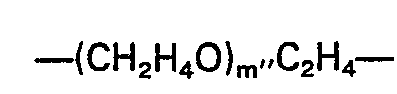
- Another important class of elastomeric polyesters according to the invention has a repeating unit:- wherein:
- a composition resistant to UV radiation which comprises a polymer and a 1-hydroxyxanthone stabiliser.
- the polymer may, inter alia be a polyester, exemplified by polyethyleneglycol terephthalate, and the xanthone inter alia 1,3,6-tri-hydroxyxanthone or 1-hydroxy-3,6- bis-(f3-hydroxyethoxy)xanthone.
- the polymer and stabiliser are however merely in physical admixture and there is no indication that the stabiliser may form an integral part of the polymer.
- Linear polyesters are obtained by a two-stage process.
- a precursor is obtained in the first stage. This precursor is a low molecular weight ester of the glycol and the dicarboxylic acid.
- the precursor is subjected to polycondensation to increase its molecular weight and thereby obtain the polyester.
- ester interchange There are two common methods for preparing the precursor.
- the glycol is reacted with a dialkyl ester of the dicarboxylic acid.
- a low molecular weight alcohol is removed thus forming the glycol ester by ester interchange.
- ethylene glycol is reacted with dimethyl terephthalate to form ethylene glycol terephthalate and methyl alcohol (which is removed by distillation).
- the rate of reaction can be increased by incorporating ester interchange catalysts in the reaction mixture.
- Suitable ester interchange catalysts include zinc acetate, manganese acetate, calcium acetate; cobalt acetate and titanium tetraisopropoxide.
- diethylene glycol produced by this reaction gets incorporated into the polymer chain but small amounts cause no adverse effects except a lowering of the softening point.
- the formation of diethylene glycol can be reduced, and hence the softening point kept at a satisfactory level, by including an alkaline compound, e.g. sodium hydroxide, in the direct esterification reaction mixture.
- an alkaline compound e.g. sodium hydroxide
- the second stage is carried out by heating the precursor at a temperature above its melting point under low pressure, e.g. below 5 mbar (5.1Q 2 Pa), with stirring. During polycondensation glycol is eliminated (and removed by distillation). As the reaction proceeds the molecular weight and viscosity increase. The increase in viscosity can be used to ascertain when the desired molecular weight has been achieved.
- Polycondensation catalysts are usually incorporated during the polycondensation. Suitable polycondensation catalysts include antimony trioxide, germanium dioxide, mixtures of these two, titanium alkoxides, lead oxides and zinc. Some catalysts, e.g. germanium dioxide, are conveniently dissolved in alkali before they are added to the reaction system. In such cases it is particularly appropriate to utilise the alkali which is present in the direct esterification stage to dissolve the catalyst (even though the catalyst has no effect upon the direct esterification).
- the metals present during reaction remain in the polymer and, when colourless products are needed, it is necessary to avoid the residues being in the form of coloured derivatives.
- An acid of phosphorus or an ester of such an acid can be added to the polycondensation mixture; these compounds reduce the colour caused by the metals.
- Specific examples of phosphorus compounds suitable for adding to the polycondensation reaction include phosphoric acid, triphenyl phosphates and phosphorous acid.
- linear polyesters especially polyethylene terephthalate
- polyethylene terephthalate are prepared by adding 0.04% to 10% by weight, preferably 0.04 to 5% by weight, based on the polymer to be produced, of the 1,3,6-isomer of trihydroxyxanth-9-one, to either the precursor or the ingredients from which it was produced so that condensation takes place in the presence of the trihydroxyxanthone.
- 1,3,6-trihydroxyxanth-9-one is included in a polycondensation mixture the 1-hydroxyl group remains unchanged whereas the other two i.e.
- the 3-hydroyl and 6-hydroxyl groups react with (combined or uncombined) glycol present in the system to form an ether linkage thereby converting the xanthone to a bis(hydroxyalkoxy) derivative.
- This derivative forms ester linkages with acid residues in the precursor.
- the overall reaction can be represented as follows (where HOOCACOOH represents the dicarboxylic acid; HOGOH represents the glycol and HOX(OH)OH represents the xanthone).
- linear polyesters as described above are prepared by incorporating the 1,3,6 isomer of hydroxy-bis(hydroxyalkoxy)xanth-9-one, in either the precursor or into the ingredients from which the precursor is prepared.
- the preferred alkoxy group is ethoxy.
- Method 2 is particularly suitable for polyesters based on glycols other than ethylene glycol e.g. polybutyleneterephtha I ate.
- the polyesters according to the invention can be converted to shaped articles which have good stability to UV irradiation.
- the shaped articles include fibre and films, e.g. metallised film and coextruded laminates which have the polymer according to the invention as one or both outer layers.
- the metallised films may be used as reflectors in solar energy collectors.
- the transparent films may be used as windows, greenhouses, cloches, transparent coverings for solar cells.
- the shaped articles may be made entirely from the polyesters according to the invention or they may be made from blends of this polymer and conventional polyesters.
- This Example describes the preparation of a linear polyester according to the invention using a two-stage process comprising (1) direct esterification followed by (2) polycondensation.
- the autoclave was pressurised to about 3 atm and heated with stirring.
- the reaction commenced and water of esterification was removed with some of the excess of glycol.
- the temperature remained at the reflux temperature. All the water of esterification had been removed in about 2.5 hours when the temperature had risen to 248°C.
- the pressure was released over a period of about 5 minutes and a small amount (about 5 litres) of glycol removed.
- This completed the (conventional) direct esterification and 119 g of triphenylphosphate (in methanol) were added.
- 77 kg of product which was a conventional precursor for the preparation of polyethylene terephthalate, were obtained and used for polycondensation.
- the precursor was then transferred to the polycondensation vessel and prepared for Stage 2, i.e. polycondensation, was begun by the-additiion of 2100 g 136THX, i.e. 2.7% by weight of the precursor, and 21 g of antimony trioxide. Removal of glycol was started by distillation at 230°C under atmospheric pressure with stirring. When the distillation had started, the pressure was slowly reduced to 0.03 mbar (30Pa) and the temperature was kept at 290°C. The pressure was allowed to return to atmospheric, the polymer was removed from the polycondensation vessel and cut into chip. The total weight of the polymer was 61 kgs.
- Example 1 the preparation described in Example 1 is conventional except for the addition of 136THX.
- This Example also describes the preparation of a linear polyester according to the invention using two-stage process comprising (1) direct esterification followed by (2) polycondensation but the 136THX is added at the start of direct esterification.
- the autoclave was pressurised to about 3 atm and heated with stirring.
- the reaction commenced and water of esterification was removed with some of the excess of glycol.
- the temperature remained at the reflux temperature. All the water of esterification had been removed in about 2.5 hours when the temperature had risen to 248°C.
- the pressure was released over a period of about 5 minutes and a small amount (about 5 litres) of glycol removed.
- This completed the (conventional) direct esterification and 119 g of triphenylphosphate (in methanol) were added.
- some of the 136THX is probably esterified to a hydroxyethoxy derivative.
- the precursor was then transferred to the polycondensation vessel and prepared for Stage 2, i.e. polycondensation, by the addition of 21 g of antimony trioxide. Removal of glycol was started by distillation at 230°C under pressure with stirring. When the distillation had started, the pressure was slowly reduced to 0.03 mbar (30Pa) and the temperature was kept at 290°C. The pressure was allowed to return to atmospheric, the polymer was removed from the polycondensation vessel and cut into chip. The total weight of the polymer was 61 kgs.
- Example 2 the preparation described in Example 2 is conventional except for the addition of 136THX.
- the polyglycols were poly(ethylene glycol), abbreviated to PEG and poly(1,4-butane-diol), abbreviated to PBG, with molecular weight of 1000 and 2000 as indicated in Table 1.
- the aliphatic acids used were (a) a composition sold by Unilever-Emery under the trade name'EMPOL 1014' which is an aliphatic dicarboxylic acid with molecular weight about 500 to 700 and (b) azelaic acid.
- polyesters were prepared as described in Example 2, there being charged to the autoclave the reactants specified in Table 2.
- each product was a polyester of film forming quality. As compared with conventional PET each product had improved UV stability and lower elastic modulus.
Landscapes
- Chemical & Material Sciences (AREA)
- Health & Medical Sciences (AREA)
- Chemical Kinetics & Catalysis (AREA)
- Medicinal Chemistry (AREA)
- Polymers & Plastics (AREA)
- Organic Chemistry (AREA)
- Polyesters Or Polycarbonates (AREA)
Claims (14)






Priority Applications (1)
| Application Number | Priority Date | Filing Date | Title |
|---|---|---|---|
| AT82304846T ATE34399T1 (de) | 1981-10-02 | 1982-09-14 | Polyester-zusammensetzungen; geformte gegenstaende daraus und verfahren zu ihrer herstellung. |
Applications Claiming Priority (4)
| Application Number | Priority Date | Filing Date | Title |
|---|---|---|---|
| GB8129808 | 1981-10-02 | ||
| GB8129808 | 1981-10-02 | ||
| GB8131765 | 1981-10-21 | ||
| GB8131765 | 1981-10-21 |
Publications (2)
| Publication Number | Publication Date |
|---|---|
| EP0076582A1 EP0076582A1 (fr) | 1983-04-13 |
| EP0076582B1 true EP0076582B1 (fr) | 1988-05-18 |
Family
ID=26280875
Family Applications (1)
| Application Number | Title | Priority Date | Filing Date |
|---|---|---|---|
| EP82304846A Expired EP0076582B1 (fr) | 1981-10-02 | 1982-09-14 | Compositions de polyester; objets formés à partir de ces compositions et procédé pour leur préparation |
Country Status (5)
| Country | Link |
|---|---|
| US (1) | US4456746A (fr) |
| EP (1) | EP0076582B1 (fr) |
| AU (1) | AU562661B2 (fr) |
| DE (1) | DE3278504D1 (fr) |
| NZ (1) | NZ201954A (fr) |
Families Citing this family (22)
| Publication number | Priority date | Publication date | Assignee | Title |
|---|---|---|---|---|
| US4584335A (en) * | 1984-12-28 | 1986-04-22 | Chevron Research Company | 5-keto-bis(hydroxyphenyl)anthracene polyarylate copolymers and alloys |
| US4691059A (en) * | 1985-08-30 | 1987-09-01 | Minnesota Mining And Manufacturing Company | Copolymerizable UV stabilizers |
| US4740581A (en) * | 1987-02-24 | 1988-04-26 | Eastman Kodak Company | Condensation copolymers containing copolymerized isoquinoline derivative colorants and products therefrom |
| US4745173A (en) * | 1987-02-24 | 1988-05-17 | Eastman Kodak Company | Condensation copolymers containing 2,5-diarylaminoterephthalic acid type colorants and products therefrom |
| US6270888B1 (en) | 1997-08-07 | 2001-08-07 | Dupont Teijin Films Us Limited Partner | Polymeric film |
| DE10007722A1 (de) | 2000-02-19 | 2001-08-23 | Mitsubishi Polyester Film Gmbh | Einseitig matte, siegelfähige, UV stabilisierte, koextrudierte, biaxial orientierte Folie, Verfahren zu ihrer Herstellung und Verwendung |
| DE10007725A1 (de) | 2000-02-19 | 2001-08-23 | Mitsubishi Polyester Film Gmbh | Einseitig matte, siegelfähige, UV stabilisierte und flammhemmend ausgerüstete, koextrudierte, biaxial orientierte Polyesterfolie, Verfahren zu ihrer Herstellung ihre Verwendung |
| DE10007726A1 (de) | 2000-02-19 | 2001-08-23 | Mitsubishi Polyester Film Gmbh | Transparente, siegelfähige, UV-stabilisierte und flammhemmend ausgerüstete Polyesterfolie, Verfahren zu ihrer Herstellung und ihre Verwendung |
| DE102007054132A1 (de) | 2007-11-14 | 2009-05-20 | Mitsubishi Polyester Film Gmbh | Antimikrobiell ausgerüstete, biaxial orientierte Polyesterfolie |
| DE102007054133A1 (de) | 2007-11-14 | 2009-05-20 | Mitsubishi Polyester Film Gmbh | Antimikrobiell ausgerüstete, gecoatete, biaxial orientierte Polyesterfolie |
| US9062022B2 (en) * | 2008-12-04 | 2015-06-23 | The University Of Akron | Polymer composition and dialysis membrane formed from the polymer composition |
| US20100294363A1 (en) * | 2009-05-22 | 2010-11-25 | Mitsubishi Polyester Film, Inc. | Coated Polyester Film For Lamination to Ethylene-Vinyl Acetate Layers |
| GB0915687D0 (en) | 2009-09-08 | 2009-10-07 | Dupont Teijin Films Us Ltd | Polyester films |
| GB201001947D0 (en) | 2010-02-05 | 2010-03-24 | Dupont Teijin Films Us Ltd | Polyester films |
| CA2796050A1 (fr) * | 2010-04-14 | 2011-10-20 | The University Of Akron | Composition de polymere comportant un agent phytochimique et membrane a dialyse formee a partir de la composition de polymere |
| GB2488787A (en) | 2011-03-07 | 2012-09-12 | Dupont Teijin Films Us Ltd | Stabilised polyester films |
| GB201104565D0 (en) | 2011-03-17 | 2011-05-04 | Dupont Teijin Films Us Ltd | Polyester films |
| GB201310837D0 (en) | 2013-06-18 | 2013-07-31 | Dupont Teijin Films Us Ltd | Polyester film -IV |
| GB201317551D0 (en) | 2013-10-03 | 2013-11-20 | Dupont Teijin Films Us Ltd | Co-extruded polyester films |
| GB201412153D0 (en) | 2014-07-08 | 2014-08-20 | Dupont Teijin Films Us Ltd | Polyester film |
| GB201504291D0 (en) | 2015-03-13 | 2015-04-29 | Dupont Teijin Films Us Ltd | PV cells |
| GB201504760D0 (en) | 2015-03-20 | 2015-05-06 | Dupont Teijin Films Us Ltd Partnership | PV cells |
Family Cites Families (8)
| Publication number | Priority date | Publication date | Assignee | Title |
|---|---|---|---|---|
| NL260151A (fr) * | 1960-01-18 | |||
| US3385910A (en) * | 1964-04-15 | 1968-05-28 | Du Pont | Polymeric light stabilizers and compositions thereof |
| US3577211A (en) * | 1967-05-22 | 1971-05-04 | Goodyear Tire & Rubber | Stabilization of polyesters |
| EP0006686B1 (fr) * | 1978-06-09 | 1982-09-15 | Imperial Chemical Industries Plc | Le composé 3,6-bis(hydroxyéthoxy)xanth-9-one, polyesters linéaires, et des articles formés obtenus de polyesters linéaires |
| GB2030158B (en) * | 1978-08-08 | 1982-12-01 | Du Pont | Polyesters derived from 3,4'-dihydroxybenzophenones or 3-hydroxy-4'-(4-hydroxyphenyl-) benzophenone and certain aromatic dicarboxylic acids and filaments thereof |
| US4224433A (en) * | 1979-03-16 | 1980-09-23 | Celanese Corporation | Thermotropic polyesters of 2,6-dihydroxyanthraquinone |
| US4188476A (en) * | 1979-04-06 | 1980-02-12 | E. I. Du Pont De Nemours And Company | Aromatic polyester consisting essentially of p-oxybenzoyl units, terephthaloyl units, 2,6-dioxynaphthalene or 2,6-dioxyanthraquinone units and m-oxybenzoyl or 1,3-dioxyphenylene units |
| US4341688A (en) * | 1981-04-07 | 1982-07-27 | Celanese Corporation | Poly(ester-amide) capable of forming an anisotropic melt phase derived from dihydroxyanthraquinone, hydroxybenzoic acid, dicarboxylic acid, and aromatic monomer capable of forming an amide linkage |
-
1982
- 1982-09-14 EP EP82304846A patent/EP0076582B1/fr not_active Expired
- 1982-09-14 DE DE8282304846T patent/DE3278504D1/de not_active Expired
- 1982-09-20 NZ NZ201954A patent/NZ201954A/en unknown
- 1982-09-24 AU AU88681/82A patent/AU562661B2/en not_active Ceased
- 1982-09-27 US US06/424,294 patent/US4456746A/en not_active Expired - Lifetime
Non-Patent Citations (1)
| Title |
|---|
| Encyclopedia of chemical technology pp.,617-619,KIRK-OTHMER, Volume 23 (1983) * |
Also Published As
| Publication number | Publication date |
|---|---|
| DE3278504D1 (en) | 1988-06-23 |
| NZ201954A (en) | 1985-08-16 |
| EP0076582A1 (fr) | 1983-04-13 |
| AU562661B2 (en) | 1987-06-18 |
| US4456746A (en) | 1984-06-26 |
| AU8868182A (en) | 1983-04-14 |
Similar Documents
| Publication | Publication Date | Title |
|---|---|---|
| US4456746A (en) | Polyester containing residues of a 1-hydroxy-3-6-bis(hydroxyalkoxy)xanth-9-one, process for preparing same and shaped articles thereof | |
| EP0031202B1 (fr) | Compositions de polyesters; articles formés obtenus à partir de ces compositions et procédés pour leur préparation | |
| EP0031203B2 (fr) | Procédé de préparation de polyesters linéaires, et articles formés, obtenus à partir de ces polyesters | |
| US4356299A (en) | Catalyst system for a polyethylene terephthalate polycondensation | |
| EP0006686B1 (fr) | Le composé 3,6-bis(hydroxyéthoxy)xanth-9-one, polyesters linéaires, et des articles formés obtenus de polyesters linéaires | |
| AU682017B2 (en) | Thermoplastic biodegradable resins and a process of preparation thereof | |
| CA1076739A (fr) | Poly (ethylene/alcylene) terephthalates a cristallisation rapide | |
| US4501878A (en) | Process for the preparation of high molecular weight polyesters | |
| JPS6345732B2 (fr) | ||
| JPS632974B2 (fr) | ||
| US4390687A (en) | High melt strength elastometric copolyesters | |
| JPS6340444B2 (fr) | ||
| US4123454A (en) | Thermoplastic copolyesters | |
| US4223106A (en) | Block copolyesters which crystallize rapidly | |
| CA1068849A (fr) | Copolyesters thermoplastiques modifies par l'addition de carbonate et procede pour leur preparation | |
| EP0119731B1 (fr) | Copolyester de polytéréphtalate d'éthylène, procédé pour sa préparation et son utilisation pour la fabrication des articles moulés | |
| KR830000886B1 (ko) | 선형폴리에스테르의 제조방법 | |
| CA1159461A (fr) | 3,6-bis-(hydroxyethoxy)-xanth-9-one | |
| JPH0420011B2 (fr) | ||
| EP0107503A1 (fr) | Utilisation de copolyester de térephtalate de polyéthylène dans la production de films et de masses à mouler | |
| JPS6310731B2 (fr) | ||
| JPS591416B2 (ja) | ポリエステルの製造方法 |
Legal Events
| Date | Code | Title | Description |
|---|---|---|---|
| PUAI | Public reference made under article 153(3) epc to a published international application that has entered the european phase |
Free format text: ORIGINAL CODE: 0009012 |
|
| AK | Designated contracting states |
Designated state(s): AT BE CH DE FR GB IT LI LU NL SE |
|
| 17P | Request for examination filed |
Effective date: 19830906 |
|
| GRAA | (expected) grant |
Free format text: ORIGINAL CODE: 0009210 |
|
| AK | Designated contracting states |
Kind code of ref document: B1 Designated state(s): AT BE CH DE FR GB IT LI LU NL SE |
|
| REF | Corresponds to: |
Ref document number: 34399 Country of ref document: AT Date of ref document: 19880615 Kind code of ref document: T |
|
| ITF | It: translation for a ep patent filed | ||
| REF | Corresponds to: |
Ref document number: 3278504 Country of ref document: DE Date of ref document: 19880623 |
|
| ET | Fr: translation filed | ||
| PLBE | No opposition filed within time limit |
Free format text: ORIGINAL CODE: 0009261 |
|
| STAA | Information on the status of an ep patent application or granted ep patent |
Free format text: STATUS: NO OPPOSITION FILED WITHIN TIME LIMIT |
|
| 26N | No opposition filed | ||
| PGFP | Annual fee paid to national office [announced via postgrant information from national office to epo] |
Ref country code: AT Payment date: 19930810 Year of fee payment: 12 |
|
| PGFP | Annual fee paid to national office [announced via postgrant information from national office to epo] |
Ref country code: SE Payment date: 19930813 Year of fee payment: 12 Ref country code: CH Payment date: 19930813 Year of fee payment: 12 |
|
| PGFP | Annual fee paid to national office [announced via postgrant information from national office to epo] |
Ref country code: BE Payment date: 19930823 Year of fee payment: 12 |
|
| ITTA | It: last paid annual fee | ||
| EPTA | Lu: last paid annual fee | ||
| PG25 | Lapsed in a contracting state [announced via postgrant information from national office to epo] |
Ref country code: AT Effective date: 19940914 |
|
| PG25 | Lapsed in a contracting state [announced via postgrant information from national office to epo] |
Ref country code: SE Effective date: 19940915 |
|
| PG25 | Lapsed in a contracting state [announced via postgrant information from national office to epo] |
Ref country code: LI Effective date: 19940930 Ref country code: CH Effective date: 19940930 Ref country code: BE Effective date: 19940930 |
|
| EAL | Se: european patent in force in sweden |
Ref document number: 82304846.7 |
|
| BERE | Be: lapsed |
Owner name: IMPERIAL CHEMICAL INDUSTRIES P.L.C. Effective date: 19940930 |
|
| REG | Reference to a national code |
Ref country code: CH Ref legal event code: PL |
|
| EUG | Se: european patent has lapsed |
Ref document number: 82304846.7 |
|
| PGFP | Annual fee paid to national office [announced via postgrant information from national office to epo] |
Ref country code: FR Payment date: 19980602 Year of fee payment: 17 |
|
| PGFP | Annual fee paid to national office [announced via postgrant information from national office to epo] |
Ref country code: DE Payment date: 19980605 Year of fee payment: 17 |
|
| PGFP | Annual fee paid to national office [announced via postgrant information from national office to epo] |
Ref country code: NL Payment date: 19980612 Year of fee payment: 17 |
|
| PGFP | Annual fee paid to national office [announced via postgrant information from national office to epo] |
Ref country code: GB Payment date: 19980625 Year of fee payment: 17 |
|
| PGFP | Annual fee paid to national office [announced via postgrant information from national office to epo] |
Ref country code: LU Payment date: 19980709 Year of fee payment: 17 |
|
| PG25 | Lapsed in a contracting state [announced via postgrant information from national office to epo] |
Ref country code: LU Free format text: LAPSE BECAUSE OF NON-PAYMENT OF DUE FEES Effective date: 19990914 Ref country code: GB Free format text: LAPSE BECAUSE OF NON-PAYMENT OF DUE FEES Effective date: 19990914 |
|
| PG25 | Lapsed in a contracting state [announced via postgrant information from national office to epo] |
Ref country code: NL Free format text: LAPSE BECAUSE OF NON-PAYMENT OF DUE FEES Effective date: 20000401 |
|
| GBPC | Gb: european patent ceased through non-payment of renewal fee |
Effective date: 19990914 |
|
| PG25 | Lapsed in a contracting state [announced via postgrant information from national office to epo] |
Ref country code: FR Free format text: LAPSE BECAUSE OF NON-PAYMENT OF DUE FEES Effective date: 20000531 |
|
| NLV4 | Nl: lapsed or anulled due to non-payment of the annual fee |
Effective date: 20000401 |
|
| PG25 | Lapsed in a contracting state [announced via postgrant information from national office to epo] |
Ref country code: DE Free format text: LAPSE BECAUSE OF NON-PAYMENT OF DUE FEES Effective date: 20000701 |
|
| REG | Reference to a national code |
Ref country code: FR Ref legal event code: ST |