EP0076665A2 - Method and apparatus for plasmapheresis - Google Patents
Method and apparatus for plasmapheresis Download PDFInfo
- Publication number
- EP0076665A2 EP0076665A2 EP82305238A EP82305238A EP0076665A2 EP 0076665 A2 EP0076665 A2 EP 0076665A2 EP 82305238 A EP82305238 A EP 82305238A EP 82305238 A EP82305238 A EP 82305238A EP 0076665 A2 EP0076665 A2 EP 0076665A2
- Authority
- EP
- European Patent Office
- Prior art keywords
- plasma
- membrane
- reducing
- pressure difference
- attained
- Prior art date
- Legal status (The legal status is an assumption and is not a legal conclusion. Google has not performed a legal analysis and makes no representation as to the accuracy of the status listed.)
- Granted
Links
- 238000002616 plasmapheresis Methods 0.000 title claims abstract description 17
- 238000000034 method Methods 0.000 title claims description 13
- 239000012528 membrane Substances 0.000 claims abstract description 42
- 210000004369 blood Anatomy 0.000 claims abstract description 38
- 239000008280 blood Substances 0.000 claims abstract description 38
- 238000001914 filtration Methods 0.000 claims abstract description 13
- 230000001133 acceleration Effects 0.000 claims description 10
- 125000004122 cyclic group Chemical group 0.000 claims description 2
- 210000002381 plasma Anatomy 0.000 description 49
- 238000000926 separation method Methods 0.000 description 7
- 230000017531 blood circulation Effects 0.000 description 4
- 208000014674 injury Diseases 0.000 description 4
- 239000011148 porous material Substances 0.000 description 4
- 230000008733 trauma Effects 0.000 description 4
- 238000009285 membrane fouling Methods 0.000 description 3
- 230000000541 pulsatile effect Effects 0.000 description 3
- 0 *CCC1CCCC1 Chemical compound *CCC1CCCC1 0.000 description 2
- GDOPTJXRTPNYNR-UHFFFAOYSA-N CC1CCCC1 Chemical compound CC1CCCC1 GDOPTJXRTPNYNR-UHFFFAOYSA-N 0.000 description 2
- 230000001413 cellular effect Effects 0.000 description 2
- 201000010099 disease Diseases 0.000 description 2
- 208000037265 diseases, disorders, signs and symptoms Diseases 0.000 description 2
- 239000012982 microporous membrane Substances 0.000 description 2
- 210000000056 organ Anatomy 0.000 description 2
- 102000004169 proteins and genes Human genes 0.000 description 2
- 108090000623 proteins and genes Proteins 0.000 description 2
- 238000007873 sieving Methods 0.000 description 2
- 102000007562 Serum Albumin Human genes 0.000 description 1
- 108010071390 Serum Albumin Proteins 0.000 description 1
- 210000001772 blood platelet Anatomy 0.000 description 1
- 239000006143 cell culture medium Substances 0.000 description 1
- 238000005119 centrifugation Methods 0.000 description 1
- 150000001875 compounds Chemical class 0.000 description 1
- 230000007423 decrease Effects 0.000 description 1
- 238000000151 deposition Methods 0.000 description 1
- 238000010586 diagram Methods 0.000 description 1
- 210000003743 erythrocyte Anatomy 0.000 description 1
- 238000005194 fractionation Methods 0.000 description 1
- 239000004023 fresh frozen plasma Substances 0.000 description 1
- 230000001788 irregular Effects 0.000 description 1
- 230000002427 irreversible effect Effects 0.000 description 1
- 210000000265 leukocyte Anatomy 0.000 description 1
- 238000012423 maintenance Methods 0.000 description 1
- 238000012986 modification Methods 0.000 description 1
- 230000004048 modification Effects 0.000 description 1
- 239000003607 modifier Substances 0.000 description 1
- 238000002360 preparation method Methods 0.000 description 1
- 238000005086 pumping Methods 0.000 description 1
- 238000002560 therapeutic procedure Methods 0.000 description 1
- XLYOFNOQVPJJNP-UHFFFAOYSA-N water Substances O XLYOFNOQVPJJNP-UHFFFAOYSA-N 0.000 description 1
Images

Classifications
-
- B—PERFORMING OPERATIONS; TRANSPORTING
- B01—PHYSICAL OR CHEMICAL PROCESSES OR APPARATUS IN GENERAL
- B01D—SEPARATION
- B01D61/00—Processes of separation using semi-permeable membranes, e.g. dialysis, osmosis or ultrafiltration; Apparatus, accessories or auxiliary operations specially adapted therefor
- B01D61/14—Ultrafiltration; Microfiltration
- B01D61/147—Microfiltration
-
- A—HUMAN NECESSITIES
- A61—MEDICAL OR VETERINARY SCIENCE; HYGIENE
- A61M—DEVICES FOR INTRODUCING MEDIA INTO, OR ONTO, THE BODY; DEVICES FOR TRANSDUCING BODY MEDIA OR FOR TAKING MEDIA FROM THE BODY; DEVICES FOR PRODUCING OR ENDING SLEEP OR STUPOR
- A61M1/00—Suction or pumping devices for medical purposes; Devices for carrying-off, for treatment of, or for carrying-over, body-liquids; Drainage systems
- A61M1/34—Filtering material out of the blood by passing it through a membrane, i.e. hemofiltration or diafiltration
- A61M1/3496—Plasmapheresis; Leucopheresis; Lymphopheresis
-
- A—HUMAN NECESSITIES
- A61—MEDICAL OR VETERINARY SCIENCE; HYGIENE
- A61M—DEVICES FOR INTRODUCING MEDIA INTO, OR ONTO, THE BODY; DEVICES FOR TRANSDUCING BODY MEDIA OR FOR TAKING MEDIA FROM THE BODY; DEVICES FOR PRODUCING OR ENDING SLEEP OR STUPOR
- A61M60/00—Blood pumps; Devices for mechanical circulatory actuation; Balloon pumps for circulatory assistance
- A61M60/10—Location thereof with respect to the patient's body
- A61M60/104—Extracorporeal pumps, i.e. the blood being pumped outside the patient's body
- A61M60/109—Extracorporeal pumps, i.e. the blood being pumped outside the patient's body incorporated within extracorporeal blood circuits or systems
- A61M60/113—Extracorporeal pumps, i.e. the blood being pumped outside the patient's body incorporated within extracorporeal blood circuits or systems in other functional devices, e.g. dialysers or heart-lung machines
-
- A—HUMAN NECESSITIES
- A61—MEDICAL OR VETERINARY SCIENCE; HYGIENE
- A61M—DEVICES FOR INTRODUCING MEDIA INTO, OR ONTO, THE BODY; DEVICES FOR TRANSDUCING BODY MEDIA OR FOR TAKING MEDIA FROM THE BODY; DEVICES FOR PRODUCING OR ENDING SLEEP OR STUPOR
- A61M60/00—Blood pumps; Devices for mechanical circulatory actuation; Balloon pumps for circulatory assistance
- A61M60/20—Type thereof
- A61M60/247—Positive displacement blood pumps
- A61M60/253—Positive displacement blood pumps including a displacement member directly acting on the blood
- A61M60/268—Positive displacement blood pumps including a displacement member directly acting on the blood the displacement member being flexible, e.g. membranes, diaphragms or bladders
- A61M60/279—Peristaltic pumps, e.g. roller pumps
-
- A—HUMAN NECESSITIES
- A61—MEDICAL OR VETERINARY SCIENCE; HYGIENE
- A61M—DEVICES FOR INTRODUCING MEDIA INTO, OR ONTO, THE BODY; DEVICES FOR TRANSDUCING BODY MEDIA OR FOR TAKING MEDIA FROM THE BODY; DEVICES FOR PRODUCING OR ENDING SLEEP OR STUPOR
- A61M60/00—Blood pumps; Devices for mechanical circulatory actuation; Balloon pumps for circulatory assistance
- A61M60/30—Medical purposes thereof other than the enhancement of the cardiac output
- A61M60/36—Medical purposes thereof other than the enhancement of the cardiac output for specific blood treatment; for specific therapy
- A61M60/37—Haemodialysis, haemofiltration or diafiltration
-
- A—HUMAN NECESSITIES
- A61—MEDICAL OR VETERINARY SCIENCE; HYGIENE
- A61M—DEVICES FOR INTRODUCING MEDIA INTO, OR ONTO, THE BODY; DEVICES FOR TRANSDUCING BODY MEDIA OR FOR TAKING MEDIA FROM THE BODY; DEVICES FOR PRODUCING OR ENDING SLEEP OR STUPOR
- A61M60/00—Blood pumps; Devices for mechanical circulatory actuation; Balloon pumps for circulatory assistance
- A61M60/50—Details relating to control
- A61M60/508—Electronic control means, e.g. for feedback regulation
- A61M60/562—Electronic control means, e.g. for feedback regulation for making blood flow pulsatile in blood pumps that do not intrinsically create pulsatile flow
-
- B—PERFORMING OPERATIONS; TRANSPORTING
- B01—PHYSICAL OR CHEMICAL PROCESSES OR APPARATUS IN GENERAL
- B01D—SEPARATION
- B01D61/00—Processes of separation using semi-permeable membranes, e.g. dialysis, osmosis or ultrafiltration; Apparatus, accessories or auxiliary operations specially adapted therefor
- B01D61/14—Ultrafiltration; Microfiltration
- B01D61/22—Controlling or regulating
-
- B—PERFORMING OPERATIONS; TRANSPORTING
- B01—PHYSICAL OR CHEMICAL PROCESSES OR APPARATUS IN GENERAL
- B01D—SEPARATION
- B01D65/00—Accessories or auxiliary operations, in general, for separation processes or apparatus using semi-permeable membranes
- B01D65/08—Prevention of membrane fouling or of concentration polarisation
-
- B—PERFORMING OPERATIONS; TRANSPORTING
- B01—PHYSICAL OR CHEMICAL PROCESSES OR APPARATUS IN GENERAL
- B01D—SEPARATION
- B01D2321/00—Details relating to membrane cleaning, regeneration, sterilization or to the prevention of fouling
- B01D2321/20—By influencing the flow
- B01D2321/2066—Pulsated flow
-
- B—PERFORMING OPERATIONS; TRANSPORTING
- B01—PHYSICAL OR CHEMICAL PROCESSES OR APPARATUS IN GENERAL
- B01D—SEPARATION
- B01D2321/00—Details relating to membrane cleaning, regeneration, sterilization or to the prevention of fouling
- B01D2321/20—By influencing the flow
- B01D2321/2083—By reversing the flow
Definitions
- This invention relates to plasmapheresis by filtration.
- Plasmapheresis is a process of separating plasma from whole blood.
- the plasma-depleted blood is comprised principally of cellular components, i.e., red blood cells, white blood cells and platelets.
- Plasma is comprised largely of water, but also contains proteins and various other noncellular compounds, both organic and inorganic.
- Continuous plasmapheresis is a process of continuously removing whole blood from a subject, separating plasma from the blood and returning the plasma-depleted blood to the subject in a continuous extracorporeal circuit.
- Plasmapheresis is currently used to obtain plasma for various transfusion needs, for preparation of fresh-frozen plasma, for subsequent fractionation to obtain specific proteins such as serum albumin, to produce cell culture media, and for disease therapies involving either the replacement of plasma or removal of specific disease-contributing factors from the plasma.
- Plasmapheresis can be carried out by centrifugation or by filtration.
- whole blood is conducted in a laminar flow path across one surface, i.e., the blood side surface, of a micro-porous membrane filter.
- Useful micro-porous membrane filters have pores which substantially retain the cellular components of blood but'allow plasma to pass through. Such pores are referred to herein as cell-retaining pores. Typically, cell-retaining pore diameters are 0.1 ⁇ m to 1.0 ⁇ m.
- U.S. 3,705,100 discloses a center-fed circular membrane having a spiral flow path.
- U.S. 4,212,743 discloses a device having divergent flow channels.
- German Patent 2,925,143 discloses a filtration apparatus having parallel blood flow paths on one side of a membrane and parallel plasma flow paths, which are perpendicular to the blood flow paths, on the opposite surface of the membrane.
- U.K. Patent Application 2,037,614 discloses a rectilinear double-membrane envelope in which the membranes are sealed together at the ends of the blood flow path.
- Patent Specification 1,555,389 discloses a circular, center-fed, double-membrane envelope in which the membranes are sealed around their peripheries.
- German Patent 2,653,875 discloses a circular, center-fed double-membrane device in which blood flows through slot-shaped filter chambers.
- transmembrane pressure difference As fouling progresses, plasma flow will decline or can be maintained by increasing the difference in pressure between the blood side and plasma side of the membrane, i.e., transmembrane pressure difference. High transmembrane pressure difference may cause undesirable molecular scale sieving and blood trauma.
- the invention resides in the discovery that plasmapheresis by filtration through a membrane can be carried out with high plasma separation efficiency for long periods of time by conducting blood over a surface of a membrane and, in a cyclic manner, (a) passing plasma through the membrane and, when the ceiling system transmembrane pressure difference is attained, (b) reducing the flow of plasma through the membrane and reducing system transmembrane pressure difference (STMP), preferably to about zero.
- STMP system transmembrane pressure difference
- the invention also resides in apparatus for carrying out plasmapheresis by filtration through a membrane which comprises a membrane, means for conducting blood over a surface of the membrane and means for passing plasma through the membrane, and means for reducing the flow of plasma through the membrane and reducing STMP, preferably to about zero, when the ceiling STMP is attained.
- the invention resides in said process which comprises passing plasma at an accelerating rate until the threshold level is attained and in said process which further comprises reducing the rate of acceleration preferably to about zero and, when the ceiling STMP is attained, substantially terminating the passing of plasma and reducing STMP to about zero, and in apparatus comprising means for carrying out these steps.
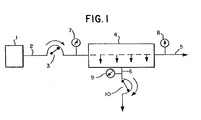
- FIG. 1 illustrates the preferred scheme for carrying out the invention
- blood is continuously conducted from a source 1, e.g., human donor or patient through a blood line 2, by means of a pump 3 into plasmapheresis membrane filter module 4.
- a source e.g., human donor or patient
- a pump 3 into plasmapheresis membrane filter module 4.
- plasma is separated from the blood by filtration.
- Plasma-depleted blood exits from the module via line 5 while plasma exits via line 6.
- Pressure transducers 7, 8, 9 are located near the inlet to the module on line 2, near the plasma-depleted blood outlet on line 5 and near the plasma outlet on line 6, respectively.
- a plasma pump, 10 draws plasma through the membrane in the module by pumping plasma away from the membrane.
- Pressure transducers 7, 8, 9 are used to monitor STMP which is defined as follows:
- the modifier, "system” is used to indicate that the transmembrane pressure difference being monitored is the average across the entire module and not the transmembrane pressure difference at any one point on a membrane within the module.
- FIGS. 2a and 2b The preferred manner of passing plasma r through the membrane and reducing the passing of plasma and reducing STMP is illustrated by FIGS. 2a and 2b.
- plasma is initially drawn at a slow rate.
- the rate of drawing is accelerated during time period 11, e.g., 5 ml-min -1 -min -1 , providing an accelerating increase in STMP.
- This acceleration is continued, typically for less than about 5 minutes to about 10 minutes, until the STMP reaches the threshold level 14, e.g., about 50 mm Hg (6.7 kPa), after which the rate of acceleration is reduced to zero, i.e., the plasma flow rate (Q f ) is maintained constant, during time period 12.
- Q f plasma flow rate
- the plasma pump When STMP reaches ceiling pressure 15, e.g., about 100 mm Hg (13.3 kPa), the plasma pump is turned off and STMP is thereby reduced to about zero, allowing the membrane to be cleared during time period 13, typically less than about 5 minutes.
- Membrane clearing during time period 13 is enhanced by the use of fouling-reducing techniques while conducting the blood over the surface of the membrane, e.g., reciprocatory pulsatile flow, high blood velocity and blood recycle.
- Reciprocatory pulsatile flow is the preferred manner of conducting blood over the membrane in carrying out this invention, although it is to be noted that plasmapheresis by filtration using reciprocatory pulsatile flow is the invention of another. It comprises, in summary, oscillating blood in a flow path on a surface of a membrane with a net movement of blood from inlet to outlet of the flowpath while collecting plasma which passes through the membrane. Means for carrying out this process include, e.g., a plurality of coordinated pumps and valves positioned on blood inlet, plasma-depleted blood outlet and plasma lines; pressure accumulators, or surge chambers, may also be useful. Blood recycle is a means of achieving high blood velocity which has also been shown to reduce membrane fouling.
- the Of is controlled electronically in response to the STMP, e.g., an electronic device such as a microprocessor which automatically accelerates Q fr ceases the acceleration when the threshold level is attained, reduces Of and STMP when the ceiling pressure is attained and repeats the cycle after a fixed duration.
- the threshold level is the STMP or rate of STMP increase which provides the optimal plasma separation efficiency, i.e., high Of with a moderate rate of STMP increase without unacceptable sieving and blood trauma. If the rate of passing plasma is accelerated beyond the optimal threshold level, a very high Q f may be achieved, but STMP will rapidly increase to the ceiling pressure resulting in a short time period during which plasma is separated and, possibly, in irreversible fouling. If the rate of passing plasma does not attain the threshold level, or does so too slowly, Q f will be undesirably low even though the ceiling STMP may be reached very slowly.
- the ceiling pressure is the pressure above which unacceptable fouling and blood trauma begin to occur.
- Q f increases during time period 11' until the threshold level 14' is attained, after which, during time period 12', Q is substantially constant.
- Qf substantially ceases, i.e., during time period 13'.
- Q f resumes when the cycle is repeated.
- the specified Q f acceleration rate, threshold level and ceiling pressure may not be optimal. They are typical of a plasmapheresis treatment allowing for a substantial margin of safety in avoiding blood trauma while providing acceptable plasma separation efficiency.
- the optimal values in a particular case may vary with several factors, e.g., module design, manner of conducting the blood over the membrane and characteristics of the blood.
Landscapes
- Health & Medical Sciences (AREA)
- Engineering & Computer Science (AREA)
- Heart & Thoracic Surgery (AREA)
- Cardiology (AREA)
- Life Sciences & Earth Sciences (AREA)
- Public Health (AREA)
- Veterinary Medicine (AREA)
- Anesthesiology (AREA)
- Biomedical Technology (AREA)
- Hematology (AREA)
- General Health & Medical Sciences (AREA)
- Animal Behavior & Ethology (AREA)
- Mechanical Engineering (AREA)
- Water Supply & Treatment (AREA)
- Chemical & Material Sciences (AREA)
- Chemical Kinetics & Catalysis (AREA)
- Urology & Nephrology (AREA)
- Pulmonology (AREA)
- Vascular Medicine (AREA)
- External Artificial Organs (AREA)
- Physical Or Chemical Processes And Apparatus (AREA)
- Separation Using Semi-Permeable Membranes (AREA)
- Organic Low-Molecular-Weight Compounds And Preparation Thereof (AREA)
Abstract
Description
- This invention relates to plasmapheresis by filtration.
- Plasmapheresis is a process of separating plasma from whole blood. The plasma-depleted blood is comprised principally of cellular components, i.e., red blood cells, white blood cells and platelets. Plasma is comprised largely of water, but also contains proteins and various other noncellular compounds, both organic and inorganic.
- Continuous plasmapheresis is a process of continuously removing whole blood from a subject, separating plasma from the blood and returning the plasma-depleted blood to the subject in a continuous extracorporeal circuit.
- Plasmapheresis is currently used to obtain plasma for various transfusion needs, for preparation of fresh-frozen plasma, for subsequent fractionation to obtain specific proteins such as serum albumin, to produce cell culture media, and for disease therapies involving either the replacement of plasma or removal of specific disease-contributing factors from the plasma.
- Plasmapheresis can be carried out by centrifugation or by filtration. Generally, in known filtration apparatus, whole blood is conducted in a laminar flow path across one surface, i.e., the blood side surface, of a micro-porous membrane filter.
- Useful micro-porous membrane filters have pores which substantially retain the cellular components of blood but'allow plasma to pass through. Such pores are referred to herein as cell-retaining pores. Typically, cell-retaining pore diameters are 0.1 µm to 1.0 µm.
- Various filtration devices for plasmapheresis are disclosed in the literature. U.S. 3,705,100 discloses a center-fed circular membrane having a spiral flow path. U.S. 4,212,743 discloses a device having divergent flow channels. German Patent 2,925,143 discloses a filtration apparatus having parallel blood flow paths on one side of a membrane and parallel plasma flow paths, which are perpendicular to the blood flow paths, on the opposite surface of the membrane. U.K. Patent Application 2,037,614 discloses a rectilinear double-membrane envelope in which the membranes are sealed together at the ends of the blood flow path. U.K. Patent Specification 1,555,389 discloses a circular, center-fed, double-membrane envelope in which the membranes are sealed around their peripheries. German Patent 2,653,875 discloses a circular, center-fed double-membrane device in which blood flows through slot-shaped filter chambers.
- During plasmapheresis, it is desirable to attain high plasma separation efficiency. High plasma separation efficiency means that a large percentage of available plasma is removed. Membrane fouling, however, may impede maintenance of high separation efficiency for an extended period of time. Membrane fouling is discussed in Asanuma, Y.., et al., Proc. Euro. Soc. Artif. Organs 6: 308, 1979 and Folstrom, R.J., et. al., Trans. Am. Soc. Artif. Organs 21: 602, 1975. It is believed to be a response to convective forces depositing components of the blood on the membrane. As fouling progresses, plasma flow will decline or can be maintained by increasing the difference in pressure between the blood side and plasma side of the membrane, i.e., transmembrane pressure difference. High transmembrane pressure difference may cause undesirable molecular scale sieving and blood trauma.
- It is an object of this invention to provide a method for plasmapheresis by filtration which can be carried out with high plasma separation efficiency for long periods of time by passing plasma through a membrane in an efficient manner, and apparatus therefor.
-
- FIG. 1 is a flow diagram of the preferred embodiment of the invention.
- FIG. 2a is a plot of system transmembrane pressure difference versus time.
- FIG. 2b is a plot of plasma flow rate versus time and is superimposable upon FIG. 2a.
- For further comprehension of the invention and of the objects and advantages thereof, reference may be had to the following description and to the appended claims in which the various novel features of the invention are more particularly set forth.
- The invention resides in the discovery that plasmapheresis by filtration through a membrane can be carried out with high plasma separation efficiency for long periods of time by conducting blood over a surface of a membrane and, in a cyclic manner, (a) passing plasma through the membrane and, when the ceiling system transmembrane pressure difference is attained, (b) reducing the flow of plasma through the membrane and reducing system transmembrane pressure difference (STMP), preferably to about zero.
- The invention also resides in apparatus for carrying out plasmapheresis by filtration through a membrane which comprises a membrane, means for conducting blood over a surface of the membrane and means for passing plasma through the membrane, and means for reducing the flow of plasma through the membrane and reducing STMP, preferably to about zero, when the ceiling STMP is attained.
- In its preferred embodiment, the invention resides in said process which comprises passing plasma at an accelerating rate until the threshold level is attained and in said process which further comprises reducing the rate of acceleration preferably to about zero and, when the ceiling STMP is attained, substantially terminating the passing of plasma and reducing STMP to about zero, and in apparatus comprising means for carrying out these steps.
- The invention may be best understood by reference to the following illustrative figures. Referring to FIG. 1, which illustrates the preferred scheme for carrying out the invention, blood is continuously conducted from a source 1, e.g., human donor or patient through a
blood line 2, by means of apump 3 into plasmapheresis membrane filter module 4. Within module 4, plasma is separated from the blood by filtration. Plasma-depleted blood exits from the module vialine 5 while plasma exits via line 6.Pressure transducers line 2, near the plasma-depleted blood outlet online 5 and near the plasma outlet on line 6, respectively. A plasma pump, 10, draws plasma through the membrane in the module by pumping plasma away from the membrane. -
Pressure transducers - [(blood inlet pressure + blood outlet pressure) 7 2] - plasma outlet pressure.
- The modifier, "system", is used to indicate that the transmembrane pressure difference being monitored is the average across the entire module and not the transmembrane pressure difference at any one point on a membrane within the module.
- The preferred manner of passing plasma r through the membrane and reducing the passing of plasma and reducing STMP is illustrated by FIGS. 2a and 2b. Referring to FIG. 2a, plasma is initially drawn at a slow rate. The rate of drawing is accelerated during
time period 11, e.g., 5 ml-min-1-min-1, providing an accelerating increase in STMP. This acceleration is continued, typically for less than about 5 minutes to about 10 minutes, until the STMP reaches thethreshold level 14, e.g., about 50 mm Hg (6.7 kPa), after which the rate of acceleration is reduced to zero, i.e., the plasma flow rate (Qf) is maintained constant, duringtime period 12. Despite the constant Qffl STMP continues to rise. When STMP reachesceiling pressure 15, e.g., about 100 mm Hg (13.3 kPa), the plasma pump is turned off and STMP is thereby reduced to about zero, allowing the membrane to be cleared duringtime period 13, typically less than about 5 minutes. Membrane clearing duringtime period 13 is enhanced by the use of fouling-reducing techniques while conducting the blood over the surface of the membrane, e.g., reciprocatory pulsatile flow, high blood velocity and blood recycle. - Reciprocatory pulsatile flow is the preferred manner of conducting blood over the membrane in carrying out this invention, although it is to be noted that plasmapheresis by filtration using reciprocatory pulsatile flow is the invention of another. It comprises, in summary, oscillating blood in a flow path on a surface of a membrane with a net movement of blood from inlet to outlet of the flowpath while collecting plasma which passes through the membrane. Means for carrying out this process include, e.g., a plurality of coordinated pumps and valves positioned on blood inlet, plasma-depleted blood outlet and plasma lines; pressure accumulators, or surge chambers, may also be useful. Blood recycle is a means of achieving high blood velocity which has also been shown to reduce membrane fouling.
- In a preferred apparatus for carrying out the invention, the Of is controlled electronically in response to the STMP, e.g., an electronic device such as a microprocessor which automatically accelerates Qfr ceases the acceleration when the threshold level is attained, reduces Of and STMP when the ceiling pressure is attained and repeats the cycle after a fixed duration. The threshold level is the STMP or rate of STMP increase which provides the optimal plasma separation efficiency, i.e., high Of with a moderate rate of STMP increase without unacceptable sieving and blood trauma. If the rate of passing plasma is accelerated beyond the optimal threshold level, a very high Qf may be achieved, but STMP will rapidly increase to the ceiling pressure resulting in a short time period during which plasma is separated and, possibly, in irreversible fouling. If the rate of passing plasma does not attain the threshold level, or does so too slowly, Qf will be undesirably low even though the ceiling STMP may be reached very slowly. The ceiling pressure is the pressure above which unacceptable fouling and blood trauma begin to occur.
- Referring to FIG. 2b, Qf increases during time period 11' until the threshold level 14' is attained, after which, during time period 12', Q is substantially constant. When STMP is reduced, Qf substantially ceases, i.e., during time period 13'. Qf resumes when the cycle is repeated.
- It should be emphasized that the above description is an example only. The specified Qf acceleration rate, threshold level and ceiling pressure may not be optimal. They are typical of a plasmapheresis treatment allowing for a substantial margin of safety in avoiding blood trauma while providing acceptable plasma separation efficiency. The optimal values in a particular case may vary with several factors, e.g., module design, manner of conducting the blood over the membrane and characteristics of the blood. Further, while it is believed to be preferable to substantially terminate Qf and reduce STMP to about zero when the ceiling STMP is attained, reversing the flow of plasma or reducing STMP to below zero is not precluded, just as other variations not specifically discussed herein, e.g., irregular acceleration of Qf, are not precluded.
- While the preferred embodiments of the invention are described above, it is to be understood that the invention is not limited to the precise embodiments herein disclosed and that the right to all changes and modifications coming within the scope of the invention as defined in the following claims is reserved.
Claims (10)
Priority Applications (1)
| Application Number | Priority Date | Filing Date | Title |
|---|---|---|---|
| AT82305238T ATE24839T1 (en) | 1981-10-02 | 1982-10-01 | METHOD AND DEVICE FOR PLASMAPHORESIS. |
Applications Claiming Priority (2)
| Application Number | Priority Date | Filing Date | Title |
|---|---|---|---|
| US30805581A | 1981-10-02 | 1981-10-02 | |
| US308055 | 1981-10-02 |
Publications (3)
| Publication Number | Publication Date |
|---|---|
| EP0076665A2 true EP0076665A2 (en) | 1983-04-13 |
| EP0076665A3 EP0076665A3 (en) | 1983-05-18 |
| EP0076665B1 EP0076665B1 (en) | 1987-01-14 |
Family
ID=23192346
Family Applications (1)
| Application Number | Title | Priority Date | Filing Date |
|---|---|---|---|
| EP82305238A Expired EP0076665B1 (en) | 1981-10-02 | 1982-10-01 | Method and apparatus for plasmapheresis |
Country Status (13)
| Country | Link |
|---|---|
| EP (1) | EP0076665B1 (en) |
| JP (1) | JPS5867260A (en) |
| AT (1) | ATE24839T1 (en) |
| AU (1) | AU560493B2 (en) |
| BR (1) | BR8205658A (en) |
| CA (1) | CA1199878A (en) |
| DE (1) | DE3275062D1 (en) |
| DK (1) | DK160353C (en) |
| ES (1) | ES516166A0 (en) |
| GR (1) | GR77346B (en) |
| IE (1) | IE54151B1 (en) |
| IL (1) | IL66918A (en) |
| ZA (1) | ZA827183B (en) |
Cited By (11)
| Publication number | Priority date | Publication date | Assignee | Title |
|---|---|---|---|---|
| US4708713A (en) * | 1984-11-16 | 1987-11-24 | Anisa Medical, Inc. | Method and system for removing immunosuppressive components from the blood of mammals |
| EP0263384A3 (en) * | 1986-09-30 | 1989-07-26 | Yokogawa Electric Corporation | Regeneration type body fluid treating circuit and method for treating body fluid |
| EP0382886A3 (en) * | 1989-02-16 | 1991-10-30 | Richard C. K. Yen | Vacuum suction type anti-clogging and dialysis device for filtration systems |
| US5194145A (en) * | 1984-03-21 | 1993-03-16 | William F. McLaughlin | Method and apparatus for separation of matter from suspension |
| US5376263A (en) * | 1982-12-13 | 1994-12-27 | William F. McLaughlin | Pump control apparatus for cellular filtration systems employing rotating microporous membranes |
| WO1995008386A1 (en) * | 1993-09-22 | 1995-03-30 | Seitz-Filter-Werke Gmbh Und Co. | Process and device for filtering fluids by means of mf modules |
| WO1996039208A1 (en) * | 1995-06-06 | 1996-12-12 | Quantic Biomedical Partners | Device and method for concentrating plasma |
| EP0893130A1 (en) * | 1997-07-18 | 1999-01-27 | Fuji Photo Film Co., Ltd. | Method of filtering blood |
| US6863821B2 (en) | 2002-02-02 | 2005-03-08 | Baxter International Inc. | Shear-enhanced systems and methods for removing waste materials and liquid from the blood |
| US8501918B2 (en) | 2005-09-22 | 2013-08-06 | Cytologic, Inc. | Immobilized tumor necrosis factor-α muteins for enhancing immune response in mammals |
| US8961789B2 (en) | 2008-10-31 | 2015-02-24 | Baxter International Inc. | Systems and methods for performing hemodialysis |
Families Citing this family (3)
| Publication number | Priority date | Publication date | Assignee | Title |
|---|---|---|---|---|
| US6620382B1 (en) | 1998-05-22 | 2003-09-16 | Biopheresis Technologies, Llc. | Method and compositions for treatment of cancers |
| US8197430B1 (en) | 1998-05-22 | 2012-06-12 | Biopheresis Technologies, Inc. | Method and system to remove cytokine inhibitor in patients |
| DE102011076228A1 (en) * | 2011-05-20 | 2012-11-22 | Siemens Ag | Arrangement and method for filtration |
Family Cites Families (4)
| Publication number | Priority date | Publication date | Assignee | Title |
|---|---|---|---|---|
| GB1381410A (en) * | 1971-12-10 | 1975-01-22 | Kroyer K K K | Process of diluting or concentrating a solution by osmosis dialysis or ultra-filtration and apparatus for carrying out said process |
| US4191182A (en) * | 1977-09-23 | 1980-03-04 | Hemotherapy Inc. | Method and apparatus for continuous plasmaphersis |
| PL129007B1 (en) * | 1980-01-25 | 1984-03-31 | Polska Akademia Nauk Instytut | Plasma isolating apparatus utilizing a membrane |
| JPS56145860A (en) * | 1980-04-16 | 1981-11-12 | Kuraray Co | Devide for treating blood |
-
1982
- 1982-09-28 BR BR8205658A patent/BR8205658A/en not_active IP Right Cessation
- 1982-09-29 JP JP57168691A patent/JPS5867260A/en active Granted
- 1982-09-30 AU AU88941/82A patent/AU560493B2/en not_active Ceased
- 1982-09-30 DK DK434682A patent/DK160353C/en not_active IP Right Cessation
- 1982-09-30 CA CA000412585A patent/CA1199878A/en not_active Expired
- 1982-09-30 ZA ZA827183A patent/ZA827183B/en unknown
- 1982-09-30 IL IL66918A patent/IL66918A/en unknown
- 1982-10-01 DE DE8282305238T patent/DE3275062D1/en not_active Expired
- 1982-10-01 IE IE2384/82A patent/IE54151B1/en not_active IP Right Cessation
- 1982-10-01 EP EP82305238A patent/EP0076665B1/en not_active Expired
- 1982-10-01 AT AT82305238T patent/ATE24839T1/en not_active IP Right Cessation
- 1982-10-01 GR GR69419A patent/GR77346B/el unknown
- 1982-10-01 ES ES516166A patent/ES516166A0/en active Granted
Cited By (20)
| Publication number | Priority date | Publication date | Assignee | Title |
|---|---|---|---|---|
| US5376263A (en) * | 1982-12-13 | 1994-12-27 | William F. McLaughlin | Pump control apparatus for cellular filtration systems employing rotating microporous membranes |
| US5464534A (en) * | 1982-12-13 | 1995-11-07 | William F. McLaughlin | Blood fractionation system and method |
| US5738792A (en) * | 1984-03-21 | 1998-04-14 | Baxter International Inc. | Method for separation of matter from suspension |
| US5194145A (en) * | 1984-03-21 | 1993-03-16 | William F. McLaughlin | Method and apparatus for separation of matter from suspension |
| US4708713A (en) * | 1984-11-16 | 1987-11-24 | Anisa Medical, Inc. | Method and system for removing immunosuppressive components from the blood of mammals |
| EP0263384A3 (en) * | 1986-09-30 | 1989-07-26 | Yokogawa Electric Corporation | Regeneration type body fluid treating circuit and method for treating body fluid |
| EP0382886A3 (en) * | 1989-02-16 | 1991-10-30 | Richard C. K. Yen | Vacuum suction type anti-clogging and dialysis device for filtration systems |
| WO1995008386A1 (en) * | 1993-09-22 | 1995-03-30 | Seitz-Filter-Werke Gmbh Und Co. | Process and device for filtering fluids by means of mf modules |
| AU712934B2 (en) * | 1995-06-06 | 1999-11-18 | Interpore International Inc. | Device and method for concentrating plasma |
| WO1996039208A1 (en) * | 1995-06-06 | 1996-12-12 | Quantic Biomedical Partners | Device and method for concentrating plasma |
| US6010627A (en) * | 1995-06-06 | 2000-01-04 | Quantic Biomedical Partners | Device for concentrating plasma |
| US6342157B1 (en) | 1995-06-06 | 2002-01-29 | Interpore Orthopedics, Inc. | Device and method for concentrating plasma |
| EP0893130A1 (en) * | 1997-07-18 | 1999-01-27 | Fuji Photo Film Co., Ltd. | Method of filtering blood |
| US6045699A (en) * | 1997-07-18 | 2000-04-04 | Fuji Photo Film Co., Ltd. | Method of filtering blood |
| US6863821B2 (en) | 2002-02-02 | 2005-03-08 | Baxter International Inc. | Shear-enhanced systems and methods for removing waste materials and liquid from the blood |
| US7182867B2 (en) | 2002-02-02 | 2007-02-27 | Baxter International Inc. | Shear-enhanced systems and methods for removing waste materials and liquid from the blood |
| US7494591B2 (en) | 2002-02-02 | 2009-02-24 | Baxter International Inc. | Shear-enhanced systems and methods for removing waste materials and liquid from the blood |
| US8501918B2 (en) | 2005-09-22 | 2013-08-06 | Cytologic, Inc. | Immobilized tumor necrosis factor-α muteins for enhancing immune response in mammals |
| US8961789B2 (en) | 2008-10-31 | 2015-02-24 | Baxter International Inc. | Systems and methods for performing hemodialysis |
| US9757504B2 (en) | 2008-10-31 | 2017-09-12 | Baxter International Inc. | Systems and methods for performing hemodialysis |
Also Published As
| Publication number | Publication date |
|---|---|
| DE3275062D1 (en) | 1987-02-19 |
| DK160353B (en) | 1991-03-04 |
| DK160353C (en) | 1991-08-26 |
| ES8400243A1 (en) | 1983-10-16 |
| IL66918A0 (en) | 1982-12-31 |
| IE54151B1 (en) | 1989-07-05 |
| GR77346B (en) | 1984-09-11 |
| JPS5867260A (en) | 1983-04-21 |
| CA1199878A (en) | 1986-01-28 |
| IL66918A (en) | 1986-11-30 |
| IE822384L (en) | 1983-04-02 |
| EP0076665B1 (en) | 1987-01-14 |
| JPH0347869B2 (en) | 1991-07-22 |
| BR8205658A (en) | 1983-08-30 |
| ZA827183B (en) | 1984-05-30 |
| EP0076665A3 (en) | 1983-05-18 |
| AU560493B2 (en) | 1987-04-09 |
| ES516166A0 (en) | 1983-10-16 |
| ATE24839T1 (en) | 1987-01-15 |
| AU8894182A (en) | 1983-04-14 |
| DK434682A (en) | 1983-04-03 |
Similar Documents
| Publication | Publication Date | Title |
|---|---|---|
| EP0112173B1 (en) | Plasmapheresis process | |
| EP0038203B1 (en) | Blood treatment apparatus | |
| EP0076665B1 (en) | Method and apparatus for plasmapheresis | |
| US4735726A (en) | Plasmapheresis by reciprocatory pulsatile filtration | |
| US4936980A (en) | Apparatus and method for plasma separation | |
| US5234608A (en) | Systems and methods for processing cellular rich suspensions | |
| EP1351725B1 (en) | Apparatus for in-vivo plasmapheresis and cleansing method using backflush | |
| EP0232885B1 (en) | Method and apparatus for separating liquid compositions on the basis of molecular weight | |
| DE69934988D1 (en) | METHOD AND APPARATUS FOR CARRYING OUT CONTROLLED ULTRAFILTRATION OF DIALYSIS DURING HEMODIALYSIS | |
| US6960178B2 (en) | Apparatus for enhanced plasmapheresis and methods thereof | |
| US4729829A (en) | Hollow fiber plasmapheresis module | |
| US4753733A (en) | Plasmapheresis method and apparatus for overcoming membrane fouling | |
| US4728430A (en) | Diafiltration method | |
| JPH04230853A (en) | Separation of blood plasma | |
| EP0016014A1 (en) | Process for separating blood cell-containing liquid suspensions by filtration | |
| US6423023B1 (en) | Method and apparatus for enhanced plasmapheresis | |
| Ding et al. | Dynamic filtration of blood: A new concept for enhancing plasma filtration | |
| JPS5911865A (en) | Blood purifier | |
| EP0112094B1 (en) | Apparatus for blood treatment | |
| US4565626A (en) | Apparatus for blood treatment by pressing blood into treating material and then drawing it out | |
| Ding et al. | Albumin recovery enhancement in membrane plasma fractionation using pulsatile flow | |
| Lysaght et al. | Contemporary technical issues in membrane plasmapheresis: Controversies and reconciliation | |
| Sato et al. | Characterization of polyethylene membrane for plasma separation | |
| Jaffrin | Blood cross flow filtration through artificial membranes | |
| Jaffrin et al. | High Performance Systems for Membrane Plasmapheresis |
Legal Events
| Date | Code | Title | Description |
|---|---|---|---|
| PUAI | Public reference made under article 153(3) epc to a published international application that has entered the european phase |
Free format text: ORIGINAL CODE: 0009012 |
|
| PUAL | Search report despatched |
Free format text: ORIGINAL CODE: 0009013 |
|
| AK | Designated contracting states |
Designated state(s): AT BE CH DE FR GB IT LI LU NL SE |
|
| AK | Designated contracting states |
Designated state(s): AT BE CH DE FR GB IT LI LU NL SE |
|
| 17P | Request for examination filed |
Effective date: 19831020 |
|
| GRAA | (expected) grant |
Free format text: ORIGINAL CODE: 0009210 |
|
| AK | Designated contracting states |
Kind code of ref document: B1 Designated state(s): AT BE CH DE FR GB IT LI LU NL SE |
|
| REF | Corresponds to: |
Ref document number: 24839 Country of ref document: AT Date of ref document: 19870115 Kind code of ref document: T |
|
| ITF | It: translation for a ep patent filed | ||
| REF | Corresponds to: |
Ref document number: 3275062 Country of ref document: DE Date of ref document: 19870219 |
|
| ET | Fr: translation filed | ||
| PLBE | No opposition filed within time limit |
Free format text: ORIGINAL CODE: 0009261 |
|
| STAA | Information on the status of an ep patent application or granted ep patent |
Free format text: STATUS: NO OPPOSITION FILED WITHIN TIME LIMIT |
|
| 26N | No opposition filed | ||
| PGFP | Annual fee paid to national office [announced via postgrant information from national office to epo] |
Ref country code: FR Payment date: 19910827 Year of fee payment: 10 |
|
| PGFP | Annual fee paid to national office [announced via postgrant information from national office to epo] |
Ref country code: CH Payment date: 19910828 Year of fee payment: 10 |
|
| PGFP | Annual fee paid to national office [announced via postgrant information from national office to epo] |
Ref country code: DE Payment date: 19910829 Year of fee payment: 10 |
|
| PGFP | Annual fee paid to national office [announced via postgrant information from national office to epo] |
Ref country code: SE Payment date: 19910904 Year of fee payment: 10 |
|
| PGFP | Annual fee paid to national office [announced via postgrant information from national office to epo] |
Ref country code: LU Payment date: 19910925 Year of fee payment: 10 Ref country code: GB Payment date: 19910925 Year of fee payment: 10 |
|
| PGFP | Annual fee paid to national office [announced via postgrant information from national office to epo] |
Ref country code: BE Payment date: 19911003 Year of fee payment: 10 |
|
| PGFP | Annual fee paid to national office [announced via postgrant information from national office to epo] |
Ref country code: AT Payment date: 19911010 Year of fee payment: 10 |
|
| ITTA | It: last paid annual fee | ||
| PGFP | Annual fee paid to national office [announced via postgrant information from national office to epo] |
Ref country code: NL Payment date: 19911031 Year of fee payment: 10 |
|
| EPTA | Lu: last paid annual fee | ||
| PG25 | Lapsed in a contracting state [announced via postgrant information from national office to epo] |
Ref country code: LU Free format text: LAPSE BECAUSE OF NON-PAYMENT OF DUE FEES Effective date: 19921001 Ref country code: GB Effective date: 19921001 Ref country code: AT Effective date: 19921001 |
|
| PG25 | Lapsed in a contracting state [announced via postgrant information from national office to epo] |
Ref country code: SE Effective date: 19921002 |
|
| PG25 | Lapsed in a contracting state [announced via postgrant information from national office to epo] |
Ref country code: LI Effective date: 19921031 Ref country code: CH Effective date: 19921031 Ref country code: BE Effective date: 19921031 |
|
| BERE | Be: lapsed |
Owner name: E.I. DU PONT DE NEMOURS AND CY Effective date: 19921031 |
|
| PG25 | Lapsed in a contracting state [announced via postgrant information from national office to epo] |
Ref country code: NL Effective date: 19930501 |
|
| GBPC | Gb: european patent ceased through non-payment of renewal fee |
Effective date: 19921001 |
|
| NLV4 | Nl: lapsed or anulled due to non-payment of the annual fee | ||
| PG25 | Lapsed in a contracting state [announced via postgrant information from national office to epo] |
Ref country code: FR Effective date: 19930630 |
|
| REG | Reference to a national code |
Ref country code: CH Ref legal event code: PL |
|
| PG25 | Lapsed in a contracting state [announced via postgrant information from national office to epo] |
Ref country code: DE Effective date: 19930701 |
|
| REG | Reference to a national code |
Ref country code: FR Ref legal event code: ST |
|
| EUG | Se: european patent has lapsed |
Ref document number: 82305238.6 Effective date: 19930510 |