EP0077128B1 - Recovery of platinum group metals from scrap and residues - Google Patents
Recovery of platinum group metals from scrap and residues Download PDFInfo
- Publication number
- EP0077128B1 EP0077128B1 EP19820304715 EP82304715A EP0077128B1 EP 0077128 B1 EP0077128 B1 EP 0077128B1 EP 19820304715 EP19820304715 EP 19820304715 EP 82304715 A EP82304715 A EP 82304715A EP 0077128 B1 EP0077128 B1 EP 0077128B1
- Authority
- EP
- European Patent Office
- Prior art keywords
- matte
- phase
- weight
- platinum group
- process according
- Prior art date
- Legal status (The legal status is an assumption and is not a legal conclusion. Google has not performed a legal analysis and makes no representation as to the accuracy of the status listed.)
- Expired
Links
- 229910052751 metal Inorganic materials 0.000 title claims description 33
- 239000002184 metal Substances 0.000 title claims description 33
- -1 platinum group metals Chemical class 0.000 title claims description 21
- 238000011084 recovery Methods 0.000 title claims description 14
- XEEYBQQBJWHFJM-UHFFFAOYSA-N iron Substances [Fe] XEEYBQQBJWHFJM-UHFFFAOYSA-N 0.000 claims description 38
- 239000010949 copper Substances 0.000 claims description 29
- 229910052802 copper Inorganic materials 0.000 claims description 24
- 238000000034 method Methods 0.000 claims description 24
- RYGMFSIKBFXOCR-UHFFFAOYSA-N Copper Chemical compound [Cu] RYGMFSIKBFXOCR-UHFFFAOYSA-N 0.000 claims description 22
- 229910052709 silver Inorganic materials 0.000 claims description 22
- BQCADISMDOOEFD-UHFFFAOYSA-N Silver Chemical compound [Ag] BQCADISMDOOEFD-UHFFFAOYSA-N 0.000 claims description 21
- 229910052742 iron Inorganic materials 0.000 claims description 21
- PXHVJJICTQNCMI-UHFFFAOYSA-N nickel Substances [Ni] PXHVJJICTQNCMI-UHFFFAOYSA-N 0.000 claims description 21
- 239000004332 silver Substances 0.000 claims description 21
- 239000010970 precious metal Substances 0.000 claims description 18
- 239000010931 gold Substances 0.000 claims description 17
- UQSXHKLRYXJYBZ-UHFFFAOYSA-N Iron oxide Chemical compound [Fe]=O UQSXHKLRYXJYBZ-UHFFFAOYSA-N 0.000 claims description 16
- 229910052737 gold Inorganic materials 0.000 claims description 16
- PCHJSUWPFVWCPO-UHFFFAOYSA-N gold Chemical compound [Au] PCHJSUWPFVWCPO-UHFFFAOYSA-N 0.000 claims description 15
- 229910052759 nickel Inorganic materials 0.000 claims description 13
- VYPSYNLAJGMNEJ-UHFFFAOYSA-N silicon dioxide Inorganic materials O=[Si]=O VYPSYNLAJGMNEJ-UHFFFAOYSA-N 0.000 claims description 13
- 239000002893 slag Substances 0.000 claims description 10
- 238000003723 Smelting Methods 0.000 claims description 9
- QVGXLLKOCUKJST-UHFFFAOYSA-N atomic oxygen Chemical compound [O] QVGXLLKOCUKJST-UHFFFAOYSA-N 0.000 claims description 8
- 230000004907 flux Effects 0.000 claims description 8
- 229910052760 oxygen Inorganic materials 0.000 claims description 8
- 239000001301 oxygen Substances 0.000 claims description 8
- 239000007788 liquid Substances 0.000 claims description 6
- 235000008733 Citrus aurantifolia Nutrition 0.000 claims description 5
- 235000011941 Tilia x europaea Nutrition 0.000 claims description 5
- 239000004571 lime Substances 0.000 claims description 5
- 238000004519 manufacturing process Methods 0.000 claims description 5
- 239000000203 mixture Substances 0.000 claims description 5
- 230000003647 oxidation Effects 0.000 claims description 5
- 238000007254 oxidation reaction Methods 0.000 claims description 5
- 239000000377 silicon dioxide Substances 0.000 claims description 5
- 229910052714 tellurium Inorganic materials 0.000 claims description 5
- BPQQTUXANYXVAA-UHFFFAOYSA-N Orthosilicate Chemical compound [O-][Si]([O-])([O-])[O-] BPQQTUXANYXVAA-UHFFFAOYSA-N 0.000 claims description 4
- NINIDFKCEFEMDL-UHFFFAOYSA-N Sulfur Chemical compound [S] NINIDFKCEFEMDL-UHFFFAOYSA-N 0.000 claims description 4
- 239000005864 Sulphur Substances 0.000 claims description 4
- 150000001875 compounds Chemical class 0.000 claims description 4
- 229910052711 selenium Inorganic materials 0.000 claims description 4
- ODINCKMPIJJUCX-UHFFFAOYSA-N calcium oxide Inorganic materials [Ca]=O ODINCKMPIJJUCX-UHFFFAOYSA-N 0.000 claims description 3
- 229910052681 coesite Inorganic materials 0.000 claims description 3
- 229910052906 cristobalite Inorganic materials 0.000 claims description 3
- 238000011065 in-situ storage Methods 0.000 claims description 3
- 229910052682 stishovite Inorganic materials 0.000 claims description 3
- 229910052905 tridymite Inorganic materials 0.000 claims description 3
- 239000002253 acid Substances 0.000 claims description 2
- 229910000288 alkali metal carbonate Inorganic materials 0.000 claims description 2
- 150000008041 alkali metal carbonates Chemical class 0.000 claims description 2
- 229910001514 alkali metal chloride Inorganic materials 0.000 claims description 2
- 239000010953 base metal Substances 0.000 claims description 2
- AXCZMVOFGPJBDE-UHFFFAOYSA-L calcium dihydroxide Chemical compound [OH-].[OH-].[Ca+2] AXCZMVOFGPJBDE-UHFFFAOYSA-L 0.000 claims description 2
- 239000000920 calcium hydroxide Substances 0.000 claims description 2
- 229910001861 calcium hydroxide Inorganic materials 0.000 claims description 2
- 238000002386 leaching Methods 0.000 claims description 2
- 229910052976 metal sulfide Inorganic materials 0.000 claims description 2
- 238000007670 refining Methods 0.000 claims description 2
- 229910052717 sulfur Inorganic materials 0.000 claims description 2
- 239000011669 selenium Substances 0.000 claims 1
- 150000003568 thioethers Chemical group 0.000 claims 1
- BASFCYQUMIYNBI-UHFFFAOYSA-N platinum Chemical group [Pt] BASFCYQUMIYNBI-UHFFFAOYSA-N 0.000 description 5
- 238000000926 separation method Methods 0.000 description 3
- QAOWNCQODCNURD-UHFFFAOYSA-N Sulfuric acid Chemical compound OS(O)(=O)=O QAOWNCQODCNURD-UHFFFAOYSA-N 0.000 description 2
- BWFPGXWASODCHM-UHFFFAOYSA-N copper monosulfide Chemical compound [Cu]=S BWFPGXWASODCHM-UHFFFAOYSA-N 0.000 description 2
- 230000002939 deleterious effect Effects 0.000 description 2
- CPLXHLVBOLITMK-UHFFFAOYSA-N magnesium oxide Inorganic materials [Mg]=O CPLXHLVBOLITMK-UHFFFAOYSA-N 0.000 description 2
- 229910052609 olivine Inorganic materials 0.000 description 2
- 239000010450 olivine Substances 0.000 description 2
- 241001062472 Stokellia anisodon Species 0.000 description 1
- UCKMPCXJQFINFW-UHFFFAOYSA-N Sulphide Chemical compound [S-2] UCKMPCXJQFINFW-UHFFFAOYSA-N 0.000 description 1
- PNEYBMLMFCGWSK-UHFFFAOYSA-N aluminium oxide Inorganic materials [O-2].[O-2].[O-2].[Al+3].[Al+3] PNEYBMLMFCGWSK-UHFFFAOYSA-N 0.000 description 1
- 238000007664 blowing Methods 0.000 description 1
- 239000003054 catalyst Substances 0.000 description 1
- 238000006243 chemical reaction Methods 0.000 description 1
- 239000003795 chemical substances by application Substances 0.000 description 1
- YCKOAAUKSGOOJH-UHFFFAOYSA-N copper silver Chemical compound [Cu].[Ag].[Ag] YCKOAAUKSGOOJH-UHFFFAOYSA-N 0.000 description 1
- 230000001419 dependent effect Effects 0.000 description 1
- 230000000694 effects Effects 0.000 description 1
- 230000008030 elimination Effects 0.000 description 1
- 238000003379 elimination reaction Methods 0.000 description 1
- 238000005516 engineering process Methods 0.000 description 1
- 239000007789 gas Substances 0.000 description 1
- 238000002347 injection Methods 0.000 description 1
- 239000007924 injection Substances 0.000 description 1
- 238000002955 isolation Methods 0.000 description 1
- 239000000463 material Substances 0.000 description 1
- 238000002844 melting Methods 0.000 description 1
- 230000008018 melting Effects 0.000 description 1
- 150000002739 metals Chemical class 0.000 description 1
- 238000005204 segregation Methods 0.000 description 1
- 239000000126 substance Substances 0.000 description 1
- WWNBZGLDODTKEM-UHFFFAOYSA-N sulfanylidenenickel Chemical compound [Ni]=S WWNBZGLDODTKEM-UHFFFAOYSA-N 0.000 description 1
- 150000004763 sulfides Chemical group 0.000 description 1
- 230000035899 viability Effects 0.000 description 1
Classifications
-
- C—CHEMISTRY; METALLURGY
- C22—METALLURGY; FERROUS OR NON-FERROUS ALLOYS; TREATMENT OF ALLOYS OR NON-FERROUS METALS
- C22B—PRODUCTION AND REFINING OF METALS; PRETREATMENT OF RAW MATERIALS
- C22B11/00—Obtaining noble metals
- C22B11/02—Obtaining noble metals by dry processes
- C22B11/021—Recovery of noble metals from waste materials
- C22B11/026—Recovery of noble metals from waste materials from spent catalysts
-
- C—CHEMISTRY; METALLURGY
- C22—METALLURGY; FERROUS OR NON-FERROUS ALLOYS; TREATMENT OF ALLOYS OR NON-FERROUS METALS
- C22B—PRODUCTION AND REFINING OF METALS; PRETREATMENT OF RAW MATERIALS
- C22B11/00—Obtaining noble metals
- C22B11/02—Obtaining noble metals by dry processes
- C22B11/021—Recovery of noble metals from waste materials
-
- Y—GENERAL TAGGING OF NEW TECHNOLOGICAL DEVELOPMENTS; GENERAL TAGGING OF CROSS-SECTIONAL TECHNOLOGIES SPANNING OVER SEVERAL SECTIONS OF THE IPC; TECHNICAL SUBJECTS COVERED BY FORMER USPC CROSS-REFERENCE ART COLLECTIONS [XRACs] AND DIGESTS
- Y02—TECHNOLOGIES OR APPLICATIONS FOR MITIGATION OR ADAPTATION AGAINST CLIMATE CHANGE
- Y02P—CLIMATE CHANGE MITIGATION TECHNOLOGIES IN THE PRODUCTION OR PROCESSING OF GOODS
- Y02P10/00—Technologies related to metal processing
- Y02P10/20—Recycling
Definitions
- This invention relates to the recovery of platinum group metals and gold and silver from scrap and non-leach residues and also to the separation of silver from the other precious metals referred to.
- Residues containing precious metals arise from many sources.
- residues which may advantageously be treated by this invention is that of residues arising from processes employing precious metals as catalysts in chemical or metallurgical operations.
- residues There are numerous other residue materials which will be known to those familiar with precious metal technology and use, and this invention will be readily adaptable to give an advantageous recovery procedure.
- non-leach residues are collectively referred to herein as "precious metal containing residue”.
- step (a) comprises smelting a mixture consisting substantially of a flux and a leach residue, i.e. in the absence of the non-leach residue or scrap required in the process of the present invention.
- the platinum group metal content of the combined residues. may be up to 10% by weight and the silver content should preferably not exceed 5% by weight of the combined weight of precious metal containing residue and leach residue.
- Smelting may be carried out at step (a) of this invention by any convenient method.
- Suitable fluxes for smelting the precious metal containing and leach residues at step (a) are iron oxide, silica, lime, Ca(OH) 2 , alkali metal carbonate, alkali metal chloride and an iron silicate based slag also containing CaO and MgO.
- the preferred flux is iron silicate which has an approximate composition range: where the preferred composition is given in parentheses. It is preferred to add flux within the range 2-3 times the weight of the combined weight of precious metal-containing residue and leach residue.
- the smelting operation is preferably carried out in air at a temperature within the range 1100-1300°C. S0 2 may be evolved as a gas during the smelting operation.
- Copper is the major element present in the copper matte phase produced at step (a). If the proposed matte:bullion rate is 4:1 the iron and nickel contents of the matte plus bullion should not exceed the following concentrations, namely Fe 7%, Ni 10% and Fe plus Ni 13% with the stated maximum for each element (combined or uncombined). If the matte:bullion rate is 1:1 the corresponding figures are Fe 10%, Ni 15% and Fe plus Ni 20% with the stated maximum for each element (combined or uncombined). The excess quantities of these metals need to be removed from the matte phase. We prefer to perform this operation at step (i) by conversion of the said elements to their respective oxides which then redistribute to the slag. Fe and Fe compounds are converted to FeO and Ni and Ni compounds to NiO. A suitable method of oxidation is by oxygen or air lancing at a temperature of 1200-1250°C.
- step (i) a separate immiscible metallic phase is produced and is formed by the said Cu which is added.
- the distribution coefficients of the platinum group metals and gold favour the metallic rather than the matte phase and these elements therefore collect in the metallic phase.
- the distribution coefficients of Se and Te which are deleterious to subsequent platinum group metal separation favour and matte phase, however.
- An alternative to the addition of copper to the matte at step (b) is to continue the oxidation step (i) by continuing injection of oxygen or air into the matte phase until a sufficient proportion of Cu 2 S is converted to Cu metal: Some Cu converts to the oxide and becomes associated with the slag but we nave found sufficient Cu metal is formed by this procedure to form a separate immiscible metallic phase which can act as a collector for the platinum group metals and gold.
- Contacting at step (b) may therefore take place either by specific addition of metal or by the production of metal in situ.
- step (ii) in which the immiscible metallic (bullion) phase is recirculated to contact a separately produced matte phase produced by a step (a) or a combination of steps (a) and (i).
- this separately produced phase is preferably produced subsequently although it may of course be produced earlier.
- Step (c) and (ii) may be performed by known methods. Examples of processes which may be used to recover the silver in the matte are as follows:
- a leach residue and a precious metal-containing residue were used containing:
- the residues were smelted together in the ratio 20:1 with 10% by weight iron oxide, 2% by weight silica and 5% by weight lime to produce an olivine slag and a matte.
- the weight of the matte represented approximately 50% of the total input residues and containined the following:
- the iron was blown down by oxygen lancing to 5.8% by weight and a 1:4 addition of copper added to the matte.
- the bullion phase was analysed and the overall recovery of platinum group metals, gold and silver into the bullion was as follxws: _
- Example 2 The leach residue described in Example 1 was smelted with two additional precious metal-containing residues (designated No. 1 and No. 2) in the ratio 10:0.5:0.7, and approximately 10% iron oxide, 2% silica and 5% lime by weight, overall.
- the matte produced represented approximately 45% of the input residue weight and the iron removal stage reduced the matte weight to approximately 10% of the input residue weight.
- the final matte contained the following:
- the above matte was diluted. Copper sulphide and nickel sulphide were added to give concentrations of PGMs approximately 4.4% by weight.
- the resulting matte contained 55.5% Cu, 15.3% Ni, 0.1 % Fe, 19.9% S and approximately 4.4% (PGMs+Au). Copper was added so that the bullion produced had a melting point consistent with operation of the process at 1200-1300°C.
- the addition of 25 wt% copper to this matte gave the following recoveries into the bullion: Overall, recovery into the bullion was:
- the leach residue was melted with 5 wt% of the precious metal-containing residue described in Example 1 and fluxes comprising 10 wt% iron oxide, 2 wt% silica and 6 wt% lime to produce matte and slag in the ratios 1:1.5; the matte contained the following:
- the iron content of the matte was reduced to less than 1% by oxygen blowing.
- the resulting matte comprised only 15 wt% of the smelt matte and contained the following.
- the blown matte was diluted with copper sulphide in order to produce a matte containing lower levels of nickel plus iron and hence maximise recovery of platinum group metals in bullion production.
- the matte contained:
Landscapes
- Chemical & Material Sciences (AREA)
- Engineering & Computer Science (AREA)
- Manufacturing & Machinery (AREA)
- Materials Engineering (AREA)
- Mechanical Engineering (AREA)
- Metallurgy (AREA)
- Organic Chemistry (AREA)
- Chemical Kinetics & Catalysis (AREA)
- Manufacture And Refinement Of Metals (AREA)
Description
- This invention relates to the recovery of platinum group metals and gold and silver from scrap and non-leach residues and also to the separation of silver from the other precious metals referred to.
- Residues containing precious metals arise from many sources.
- An example of residues which may advantageously be treated by this invention is that of residues arising from processes employing precious metals as catalysts in chemical or metallurgical operations. There are numerous other residue materials which will be known to those familiar with precious metal technology and use, and this invention will be readily adaptable to give an advantageous recovery procedure. These non-leach residues are collectively referred to herein as "precious metal containing residue".
- In a known process according to US Patent No. 1896807 a copper matte containing precious metals and not substantially less than sixty percent of copper is caused to react at smelting heat with a relatively large amount of copper as collecting metal, resulting in substantially the whole of the precious metals being taken up by the metallic copper.
- It is an important object of the present invention to enable a major portion of any silver present in the input residues to be recovered in isolation from the platinum group metals and gold.
- In primary refining operations for platinum group metals, high sulphur content base metal sulphide residues are produced which contain Ag, Te, Se and platinum group metals, gold and other elements which may be deleterious to subsequent operations. During the production of the aforesaid residues acid leaching has removed the bulk of the Cu and Ni present and the leach residue which then remains, contains elemental and combined sulphur, platinum group metals and gold, Ag, Se and Te and refractory oxides such as Si02, AI203, MgO and CaO. This product is referred to herein as "leach residue". Such a product cannot be recirculated to earlier stages of the process without the prior elimination of elements such as Se and Te which would otherwise build up to unacceptable levels.
- The process for the recovery of platinum group metals, silver and gold according to the present invention is defined in claim 1. Preferred features of the process are defined in the dependent claims.
- In co-pending European patent application No. 82304713.9 there is described a process for the recovery of platinum group metals, silver and gold from leach residues wherein step (a) comprises smelting a mixture consisting substantially of a flux and a leach residue, i.e. in the absence of the non-leach residue or scrap required in the process of the present invention.
- The platinum group metal content of the combined residues.may be up to 10% by weight and the silver content should preferably not exceed 5% by weight of the combined weight of precious metal containing residue and leach residue.
- Smelting may be carried out at step (a) of this invention by any convenient method. Suitable fluxes for smelting the precious metal containing and leach residues at step (a) are iron oxide, silica, lime, Ca(OH)2, alkali metal carbonate, alkali metal chloride and an iron silicate based slag also containing CaO and MgO. The preferred flux is iron silicate which has an approximate composition range:

- Copper is the major element present in the copper matte phase produced at step (a). If the proposed matte:bullion rate is 4:1 the iron and nickel contents of the matte plus bullion should not exceed the following concentrations, namely Fe 7%, Ni 10% and Fe plus Ni 13% with the stated maximum for each element (combined or uncombined). If the matte:bullion rate is 1:1 the corresponding figures are Fe 10%, Ni 15% and Fe plus Ni 20% with the stated maximum for each element (combined or uncombined). The excess quantities of these metals need to be removed from the matte phase. We prefer to perform this operation at step (i) by conversion of the said elements to their respective oxides which then redistribute to the slag. Fe and Fe compounds are converted to FeO and Ni and Ni compounds to NiO. A suitable method of oxidation is by oxygen or air lancing at a temperature of 1200-1250°C.
- In step (i) a separate immiscible metallic phase is produced and is formed by the said Cu which is added. The distribution coefficients of the platinum group metals and gold favour the metallic rather than the matte phase and these elements therefore collect in the metallic phase. The distribution coefficients of Se and Te which are deleterious to subsequent platinum group metal separation favour and matte phase, however.
- An alternative to the addition of copper to the matte at step (b) is to continue the oxidation step (i) by continuing injection of oxygen or air into the matte phase until a sufficient proportion of Cu2S is converted to Cu metal:

- "Contacting" at step (b) may therefore take place either by specific addition of metal or by the production of metal in situ.
- The economic viability of the present invention may be improved by increasing the level of platinum group metals recovered in the separate immiscible metallic phase and at the same time minimising the concentration of Ag metal therein. These objectives are achieved by step (ii) in which the immiscible metallic (bullion) phase is recirculated to contact a separately produced matte phase produced by a step (a) or a combination of steps (a) and (i). For ease of operation this separately produced phase is preferably produced subsequently although it may of course be produced earlier.
- We have found that by bringing the phases into contact in this way the concentration of platinum group metal in the metallic or bullion phase is increased without detriment to its recovery. However, because the distribution coefficient of Ag between the two phases is close to unity, subsequent segregation of silver into the metallic phase is considerably reduced. The net effect of recirculation is to significantly improve the effective separation of the platinum group metals from the silver.
- Recovery of the silver, platinum group metals and gold from their respective phases in step (c) and (ii) may be performed by known methods. Examples of processes which may be used to recover the silver in the matte are as follows:
- (a) The matte may be blown either in a Pierce Smith or Top Blown Rotary converter to blister copper-silver. The latter can then be either electro-refined, preferably in a divided cell where the silver may be cemented with copper or the blister copper can be atomised and leached in H2SO4 with an oxidiing agent, such as HN03. The silver in the residue may then be refined in a Balbach cell.
- (b) The matte is crushed, ground and leached directly in an autoclave with H2S04 under air pressure of greater than 20x105 Nm-2 (bar) and a temperature greater than 120°C. The silver in the residue may be electro-refined either in a Balbach cell or dissolved in HN03 and electro-refined in a Moebuis cell.
- (c) The matte is crushed, ground and roasted at a temperature greater than 750°C to oxidise the sulphide. The roasted product can then be leached with H2SO4 at atmospheric pressure and a temperature greater than 80°C. The silver in the residue may be recovered as in (b) above.
- A leach residue and a precious metal-containing residue were used containing:

- The residues were smelted together in the ratio 20:1 with 10% by weight iron oxide, 2% by weight silica and 5% by weight lime to produce an olivine slag and a matte. The weight of the matte represented approximately 50% of the total input residues and containined the following:

- In accordance with the present invention the iron was blown down by oxygen lancing to 5.8% by weight and a 1:4 addition of copper added to the matte. The bullion phase was analysed and the overall recovery of platinum group metals, gold and silver into the bullion was as follxws: _

- A further sample of the leach residue was smelted with 1% of a precious metal-containing residue to produce a matte containing:

- Approximately 3 times the weight of preformed CuO.FeO.Si02 (Olivine) slag was added to the matte and oxygen introduced until the iron content of the matte was reduced to 2.0% the so-formed matte contained:

- Molten copper in an amount of 25 wt% was brought into contact with the above liquid matte, in accordance with the present invention, to give a matte and bullion phase containing the following:

- Overall recovery into the bullion was as follows:

- The leach residue described in Example 1 was smelted with two additional precious metal-containing residues (designated No. 1 and No. 2) in the ratio 10:0.5:0.7, and approximately 10% iron oxide, 2% silica and 5% lime by weight, overall.

- The matte produced represented approximately 45% of the input residue weight and the iron removal stage reduced the matte weight to approximately 10% of the input residue weight. The final matte contained the following:

- Because of the relatively high platinum group metal content the above matte was diluted. Copper sulphide and nickel sulphide were added to give concentrations of PGMs approximately 4.4% by weight. The resulting matte contained 55.5% Cu, 15.3% Ni, 0.1 % Fe, 19.9% S and approximately 4.4% (PGMs+Au). Copper was added so that the bullion produced had a melting point consistent with operation of the process at 1200-1300°C. The addition of 25 wt% copper to this matte gave the following recoveries into the bullion:


- The leach residue was melted with 5 wt% of the precious metal-containing residue described in Example 1 and fluxes comprising 10 wt% iron oxide, 2 wt% silica and 6 wt% lime to produce matte and slag in the ratios 1:1.5; the matte contained the following:
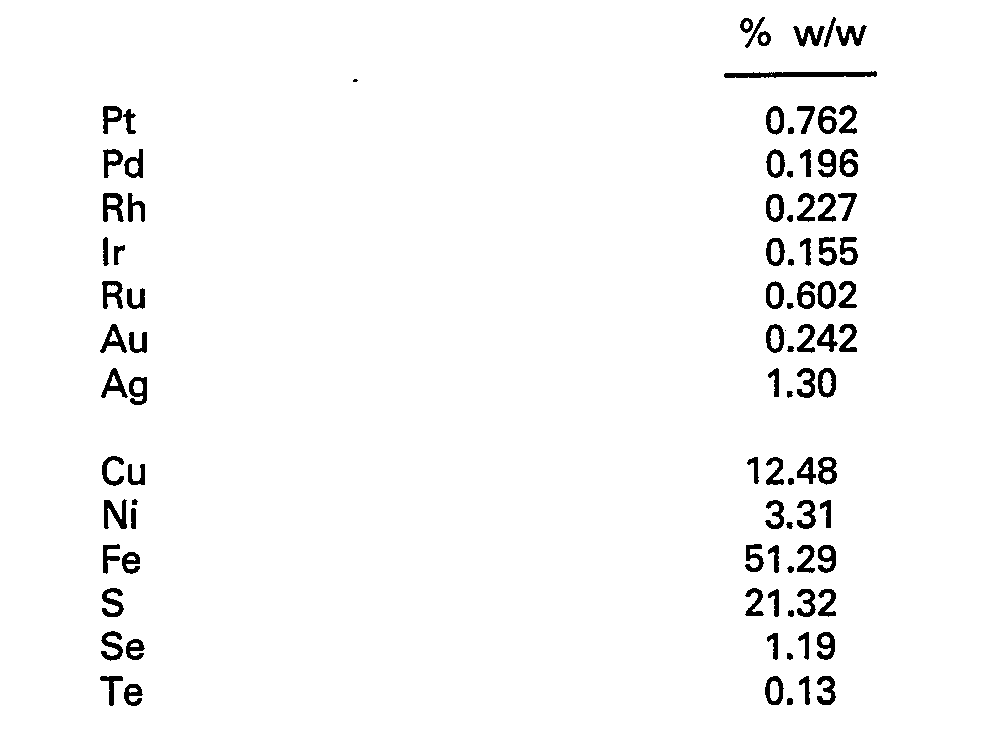
- The iron content of the matte was reduced to less than 1% by oxygen blowing. The resulting matte comprised only 15 wt% of the smelt matte and contained the following.

- The blown matte was diluted with copper sulphide in order to produce a matte containing lower levels of nickel plus iron and hence maximise recovery of platinum group metals in bullion production. The matte contained:

- Molten copper in an amount of 25 wt% copper was added to the above matte and bullion phase having the following composition:


Claims (10)

Applications Claiming Priority (2)
| Application Number | Priority Date | Filing Date | Title |
|---|---|---|---|
| GB8127976 | 1981-09-16 | ||
| GB8127976 | 1981-09-16 |
Publications (2)
| Publication Number | Publication Date |
|---|---|
| EP0077128A1 EP0077128A1 (en) | 1983-04-20 |
| EP0077128B1 true EP0077128B1 (en) | 1989-04-19 |
Family
ID=10524542
Family Applications (1)
| Application Number | Title | Priority Date | Filing Date |
|---|---|---|---|
| EP19820304715 Expired EP0077128B1 (en) | 1981-09-16 | 1982-09-08 | Recovery of platinum group metals from scrap and residues |
Country Status (5)
| Country | Link |
|---|---|
| US (1) | US4451290A (en) |
| EP (1) | EP0077128B1 (en) |
| CA (1) | CA1204288A (en) |
| DE (1) | DE3279625D1 (en) |
| ZA (1) | ZA826731B (en) |
Families Citing this family (19)
| Publication number | Priority date | Publication date | Assignee | Title |
|---|---|---|---|---|
| SE8500959L (en) * | 1985-02-27 | 1986-08-28 | Boliden Ab | PROCEDURE FOR REPAIR OF WORLD METAL CONTAINING WASTE PRODUCTS |
| JP3222894B2 (en) * | 1991-04-10 | 2001-10-29 | 田中貴金属工業株式会社 | Platinum group metal recovery method |
| CN1039136C (en) * | 1995-05-24 | 1998-07-15 | 昆明贵金属研究所 | Enrichment, activation and dissolution method of low-grade and difficult-to-process precious metal material |
| US6264039B1 (en) | 1999-10-21 | 2001-07-24 | The University Of Akron | Method for precious metal recovery from slag |
| US6461400B1 (en) | 2000-04-12 | 2002-10-08 | Art J. Parker | Process for extracting quantities of precious metals |
| RU2224034C1 (en) * | 2002-06-07 | 2004-02-20 | Институт экспериментальной минералогии РАН | Platinum metal extraction method |
| JP3734779B2 (en) * | 2002-08-05 | 2006-01-11 | 同和鉱業株式会社 | Dry recovery of platinum group elements |
| WO2005031013A1 (en) * | 2003-09-25 | 2005-04-07 | Newall, Alan, Francis | Platinum group metal extraction by ore smelting and conversion |
| RU2268315C1 (en) * | 2004-06-15 | 2006-01-20 | Открытое акционерное общество "Красноярский завод цветных металлов имени В.Н. Гулидова" (ОАО "Красцветмет") | Method of stripping concentrate of platinum group members |
| CN100441709C (en) * | 2006-04-11 | 2008-12-10 | 肇庆市大鸿明贵金属有限公司 | Method of refining noble lead or dore silver |
| RU2318886C1 (en) * | 2006-07-28 | 2008-03-10 | Николай Викторович СТЕПАНОВ | Noble metal refining method |
| MX2010006407A (en) * | 2007-12-10 | 2011-04-26 | Prior Engineering Services Ag | Reduction of metal chloride. |
| RU2378399C1 (en) * | 2008-04-23 | 2010-01-10 | Открытое акционерное общество "Красноярский завод цветных металлов имени В.Н. Гулидова" (ОАО "Красцветмет") | Development method of ruthenium concentrate |
| US8623114B2 (en) * | 2010-02-16 | 2014-01-07 | Praxair Technology, Inc. | Copper anode refining system and method |
| CN101892392B (en) * | 2010-08-09 | 2013-01-16 | 山东方泰循环金业股份有限公司 | Method for extracting yellow gold from gold extracting residue and complex and unmanageable hard-to-deal electrum |
| JP5689340B2 (en) * | 2011-03-11 | 2015-03-25 | 田中貴金属工業株式会社 | Method for recovering platinum group elements |
| RU2490341C1 (en) * | 2011-12-15 | 2013-08-20 | Евгений Владимирович Андреев | Method for purifying copper or nickel alloys or copper, and plant for method's implementation |
| CN103276216B (en) * | 2013-06-11 | 2014-11-19 | 贵研资源(易门)有限公司 | Method for recovering silver from waste silver catalyst |
| CN113355525B (en) * | 2021-04-29 | 2022-07-29 | 中南大学 | A method for cooperating with copper smelting slag to treat gold-containing waste slag |
Family Cites Families (5)
| Publication number | Priority date | Publication date | Assignee | Title |
|---|---|---|---|---|
| US1896807A (en) * | 1929-01-24 | 1933-02-07 | Bauer Georg | Process for the recovery of platimum and its bymetals from mattes |
| ZA75593B (en) * | 1975-01-29 | 1976-09-29 | Nat Inst Metallurg | A process for the treatment of mixtures of platinum group metals and gold |
| GB1601450A (en) * | 1976-11-23 | 1981-10-28 | Johnson Matthey Co Ltd | Extraction of precious metals |
| GB2049734A (en) * | 1979-04-11 | 1980-12-31 | Rio Tinto Rhodesia Ltd | Extracting precious metals from mattes |
| GB2092618B (en) * | 1981-02-05 | 1985-06-26 | Johnson Matthey Plc | Recovery of precious metals from association with ceramics |
-
1982
- 1982-09-08 DE DE8282304715T patent/DE3279625D1/en not_active Expired
- 1982-09-08 EP EP19820304715 patent/EP0077128B1/en not_active Expired
- 1982-09-14 ZA ZA826731A patent/ZA826731B/en unknown
- 1982-09-15 CA CA000411419A patent/CA1204288A/en not_active Expired
- 1982-09-15 US US06/418,541 patent/US4451290A/en not_active Expired - Fee Related
Also Published As
| Publication number | Publication date |
|---|---|
| ZA826731B (en) | 1983-07-27 |
| US4451290A (en) | 1984-05-29 |
| EP0077128A1 (en) | 1983-04-20 |
| DE3279625D1 (en) | 1989-05-24 |
| CA1204288A (en) | 1986-05-13 |
Similar Documents
| Publication | Publication Date | Title |
|---|---|---|
| EP0077128B1 (en) | Recovery of platinum group metals from scrap and residues | |
| AU662961B2 (en) | Upgrading copper sulphide residues containing nickel and arsenic | |
| US4135923A (en) | Extraction of metals | |
| CA1154971A (en) | Method for working-up arsenic-containing waste products | |
| US4162915A (en) | Process for treating lead-copper-sulphur charges | |
| EP0076049B1 (en) | Recovery of precious metals from leach residues | |
| CN110172570B (en) | Method for treating noble lead | |
| US4442072A (en) | Selective recovery of base metals and precious metals from ores | |
| US4135918A (en) | Roast-reductive leach process for copper recovery | |
| AU7804181A (en) | A method for separating and recovering nickel and copper fromcomplex materials | |
| CA1068116A (en) | Process for the treatment of platinum group metals and gold | |
| Mankhand et al. | Lime-enhanced hydrogen reduction of molybdenite | |
| EP0176491B1 (en) | A method for recovering precious metals | |
| US4487628A (en) | Selective reduction of heavy metals | |
| AU657623B2 (en) | Method for producing high-grade matte and metallized sulfide matte | |
| CA1214045A (en) | Process for the recovery of indium and tin | |
| US1896807A (en) | Process for the recovery of platimum and its bymetals from mattes | |
| US3615361A (en) | Fire refining of copper | |
| EP0185004B1 (en) | A method for processing of secondary metallic copper-containing smelt materials | |
| US3932170A (en) | Use of scavenger in recovery of metal values | |
| CN115821054B (en) | Smelting method of lead concentrate | |
| US4168217A (en) | Roast-leach copper recovery | |
| EP0053594A1 (en) | The manufacture of lead from sulphidic lead raw material | |
| US4334924A (en) | Pyrometallurgical oxidation of molybdenum rich matte | |
| RU2086685C1 (en) | Method for pyrometallurgical refining gold- and silver-containing wastes |
Legal Events
| Date | Code | Title | Description |
|---|---|---|---|
| PUAI | Public reference made under article 153(3) epc to a published international application that has entered the european phase |
Free format text: ORIGINAL CODE: 0009012 |
|
| AK | Designated contracting states |
Designated state(s): BE DE FR GB IT |
|
| 17P | Request for examination filed |
Effective date: 19831008 |
|
| 17Q | First examination report despatched |
Effective date: 19860729 |
|
| GRAA | (expected) grant |
Free format text: ORIGINAL CODE: 0009210 |
|
| AK | Designated contracting states |
Kind code of ref document: B1 Designated state(s): BE DE FR GB IT |
|
| PG25 | Lapsed in a contracting state [announced via postgrant information from national office to epo] |
Ref country code: IT Free format text: LAPSE BECAUSE OF FAILURE TO SUBMIT A TRANSLATION OF THE DESCRIPTION OR TO PAY THE FEE WITHIN THE PRESCRIBED TIME-LIMIT;WARNING: LAPSES OF ITALIAN PATENTS WITH EFFECTIVE DATE BEFORE 2007 MAY HAVE OCCURRED AT ANY TIME BEFORE 2007. THE CORRECT EFFECTIVE DATE MAY BE DIFFERENT FROM THE ONE RECORDED. Effective date: 19890419 |
|
| REF | Corresponds to: |
Ref document number: 3279625 Country of ref document: DE Date of ref document: 19890524 |
|
| ET | Fr: translation filed | ||
| PLBE | No opposition filed within time limit |
Free format text: ORIGINAL CODE: 0009261 |
|
| STAA | Information on the status of an ep patent application or granted ep patent |
Free format text: STATUS: NO OPPOSITION FILED WITHIN TIME LIMIT |
|
| 26N | No opposition filed | ||
| PGFP | Annual fee paid to national office [announced via postgrant information from national office to epo] |
Ref country code: FR Payment date: 19900816 Year of fee payment: 9 |
|
| PGFP | Annual fee paid to national office [announced via postgrant information from national office to epo] |
Ref country code: DE Payment date: 19900817 Year of fee payment: 9 |
|
| PGFP | Annual fee paid to national office [announced via postgrant information from national office to epo] |
Ref country code: GB Payment date: 19900829 Year of fee payment: 9 Ref country code: BE Payment date: 19900829 Year of fee payment: 9 |
|
| PG25 | Lapsed in a contracting state [announced via postgrant information from national office to epo] |
Ref country code: GB Effective date: 19910908 |
|
| PG25 | Lapsed in a contracting state [announced via postgrant information from national office to epo] |
Ref country code: BE Effective date: 19910930 |
|
| BERE | Be: lapsed |
Owner name: MATTHEY RUSTENBURG REFINERS LTD Effective date: 19910930 |
|
| GBPC | Gb: european patent ceased through non-payment of renewal fee | ||
| PG25 | Lapsed in a contracting state [announced via postgrant information from national office to epo] |
Ref country code: FR Effective date: 19920529 |
|
| PG25 | Lapsed in a contracting state [announced via postgrant information from national office to epo] |
Ref country code: DE Effective date: 19920602 |
|
| REG | Reference to a national code |
Ref country code: FR Ref legal event code: ST |