EP0077147A2 - Überwachungseinheit für Datenprozessor - Google Patents
Überwachungseinheit für Datenprozessor Download PDFInfo
- Publication number
- EP0077147A2 EP0077147A2 EP82305138A EP82305138A EP0077147A2 EP 0077147 A2 EP0077147 A2 EP 0077147A2 EP 82305138 A EP82305138 A EP 82305138A EP 82305138 A EP82305138 A EP 82305138A EP 0077147 A2 EP0077147 A2 EP 0077147A2
- Authority
- EP
- European Patent Office
- Prior art keywords
- signals
- bus
- latches
- system bus
- signal
- Prior art date
- Legal status (The legal status is an assumption and is not a legal conclusion. Google has not performed a legal analysis and makes no representation as to the accuracy of the status listed.)
- Granted
Links
Images




Classifications
-
- G—PHYSICS
- G06—COMPUTING OR CALCULATING; COUNTING
- G06F—ELECTRIC DIGITAL DATA PROCESSING
- G06F9/00—Arrangements for program control, e.g. control units
-
- G—PHYSICS
- G06—COMPUTING OR CALCULATING; COUNTING
- G06F—ELECTRIC DIGITAL DATA PROCESSING
- G06F11/00—Error detection; Error correction; Monitoring
- G06F11/30—Monitoring
- G06F11/34—Recording or statistical evaluation of computer activity, e.g. of down time, of input/output operation ; Recording or statistical evaluation of user activity, e.g. usability assessment
- G06F11/3466—Performance evaluation by tracing or monitoring
- G06F11/348—Circuit details, i.e. tracer hardware
-
- G—PHYSICS
- G06—COMPUTING OR CALCULATING; COUNTING
- G06F—ELECTRIC DIGITAL DATA PROCESSING
- G06F11/00—Error detection; Error correction; Monitoring
- G06F11/30—Monitoring
- G06F11/34—Recording or statistical evaluation of computer activity, e.g. of down time, of input/output operation ; Recording or statistical evaluation of user activity, e.g. usability assessment
- G06F11/3466—Performance evaluation by tracing or monitoring
- G06F11/349—Performance evaluation by tracing or monitoring for interfaces, buses
Definitions
- the invention relates generally to the monitoring of activity of a data processing system and more specifically to the monitoring of the occurrence of predetermined combinations of system bus signals representative of information being transferred between the subsystems of the data processing system for generating statistical data.
- the throughput of data processing systems was measured by writing software routines and measuring the time it took for the system to execute the routines. When new systems were designed, the same software routines were executed on the new and the old systems and the difference in running time noted. Central processor unit (CPU) limited and peripheral limited software routines were used to compare the throughput of the old and new systems. The execution time of a particular instruction was determined with an oscilloscope.
- CPU Central processor unit
- Monitoring devices were developed having counters and magnetic tape drivers. Typical of these devices is the NCR Comten Model 7916. Probes coupled to the monitoring device are placed on the background pins of the system being monitored. The signals received by the monitoring device are wired to logic elements such as AND gates, OR gates, inverters and counters to develop performance data. The probes and gates can be regarded as forming a monitor interface.
- the object of the invention is to provide an improved data processing system interface monitor.
- the present invention provides a data processing system including a memory subsystem, a plurality of I/O controllers, and a central processor unit all coupled to a system bus,
- a data processing system includes a number of subsystems, a main memory, a central processor unit (CPU), a cache memory and a number of peripheral controllers, all coupled in common to a system bus.
- the CPU is also directly coupled to cache. Information is transferred between subsystems via the system bus as well as between the CPU and cache.
- a hardware monitoring interface unit is also coupled to the system bus as well as the CPU and cache for monitoring the information.
- the information is received by the HMIU and applied to a plurality of programmable hit matrices (PHM's).
- PPM's programmable hit matrices
- a PHM includes input latches, memory circuits and output latches. Functionally, the PHM compares the input information stored in the input latches with predetermined information stored in the memory circuits to generate "hit" signals which are stored in the output latches when there is agreement.
- the input information stored in the input latches addresses the memory circuits.
- the memory circuits store binary ONE's in predetermined address locations.
- the predetermined information selects a location in the memory circuit storing a binary ONE which generates the "hit" signal.
- Selected hit signals stored in the output latches are plug-wired into logic circuits, counters or storage devices in a monitor to generate the desired statistical data.
- Figure 1 shows an overall block.diagram of data processing system 1, a hardware monitor interface unit (HMIU) 4 and monitors 6.
- Data processing system 1 includes a memory 12, a plurality of I/O controllers 16-1 to 16-n, a central processing unit (CPU) 10, and a cache memory 8, all coupled to a system bus 2.
- I/O devices 14-1 to 14-m are coupled to I/O controller 16-1 and I/O devices 14-n to 14-p are coupled to I/O controller 16-n.
- the CPU 10 is coupled to the cache memory 8 by a bus 20.
- the HMIU 4 is coupled to the system bus 2, to the CPU 10 by bus 19, and to the cache memory 8 by bus 18.
- Monitor 6 is coupled to the HMIU 4 by a bus 22.
- Memory 12 stores information including instructions and data.
- Cache 8 stores some of the information that is also stored in memory 12 that is most likely to be requested by CPU 10. Since cache 8 has a much faster access time than memory 12, use of the information stored in cache 8 by CPU 10 increases the system throughput over the CPU 10 requesting the information of memory 12. With the exception of the transfer of information over bus 20, all information between subsystems is transferred over system bus 2. Since the HMUI 4 is coupled to system bus 2 as well as to CPU 10 and cache 8; HMIU 4 can sample all information passing through data processing system 1 and send desired portions of that information to monitors 6. For example, the HMIU 4 may send over bus 22 to monitors 6 signals indicating a memory 12 read cycle, an add instruction, a cache 8 "hit" or "miss”, etc.
- monitors 6 to generate performance information to indicate, for example, the overall system throughput, or whether the system is CPU or peripheral limited.
- the HMIU 4 is primarily used in providing information which allows the system to be timed to optimum performance. This information is a help to the hardware designer or software designer to enable bottlenecks to be designed out of the hardware or software system and is also an aid in debugging both the hardware and software.
- the monitors 6 which are commercially available may include a patchboard, a number of logic gates, some counters and possibly a magnetic tape unit.
- the HMIU 4 output signals terminate in the patchboard and may be plugged into the logic gates and counters. An example of the use of the HMIU 4 and monitors 6 is described below.
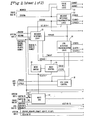
- FIG. 2 is a logic block diagram of the HMIU 4 which includes six programmable hit matrices (PHM's) 0-5 42 and three programmable hit matrices 6-8 45.
- PPM's programmable hit matrices
- the 44 input signals to PHM 0-5 42 are stored in 44 latches 40 and the 28 input signals to PHM 6-8 45 are stored in 7 multiplexer (MUX) latches 41.
- the number by a diagonal slash on a line indicates the number of signal lines.
- the latches 40 generate 44 signals to PHM 0-5 42 and 40 signals to latches 50.
- the 48 output signals from PHM 0-5 42 are stored in 48 latches 44 and the 24 output signals from PHM 6-8 42 are stored in 24 latches 52.
- Each of the nine PHM's includes a number of random access memories (RAM's). Each RAM stores 4 bits in each of 16 address locations. Each of the nine PHM's provides 8 output signals to monitors 6 via latches 44 and 52.
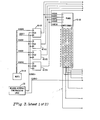
- FIG. 3 shows a possible layout of PHMOU 42-01 and PHMOL 42-02 which can be viewed as a matrix of binary cells having 16 rows and 8 columns.
- PHMOU 42-01 has 4 columns and PHMOL 42-02 has 4 columns.
- Each of the 8 hit latches 44-011 to 44-018 is associated with one of the 8 columns.
- a binary ONE in a column of a selected row indicates a "hit”.
- Latches 40-011 to 40-014 are set by signals H1AD 00-03 on the rise of clock signal CLKBUS+ from a megabus interface synchronization logic 32 to select one of the 16 rows.
- a "hit" will set latch 44-011 when row 6 is addressed and force signal MSELHO to logical ONE.
- a “hit” will set latch 44-012 when row 6 A 16 or E 16 is addressed and force signal MSELH1 to logical ONE.
- a “hit” will be indicated in hit register 44-016 when row 7 or 9 is addressed and a “hit” will set latch 44-018 when one of the rows 8 16 to E 16 is addressed and force signal MSELH7.to logical ONE.
- Latches 44-011 to 44-018 are set on the rise of clock signal CLKBUS- from megabus interface synchronization logic 32.
- a mode switch 30 has 5 positions. In a load mode, the mode switch 30 in which position 4 conditions mode control 36 to provide complementary signals H1ACKE+ and H1ACKE-.
- a megabus response logic 33 is responsive to signal H1ACKE+ to receive system bus 2 control signals addressing the HMIU 4 for transferring data signals BSDT 00-15 from memory 12 through MUX's 34 and 41 and using PHM loading logic 43 for storing in the PHM's 0-5 42 and the PHM's 6-8 45.
- switch positions 0 and 2 no such signals are generated making MUX's 34 responsive to the system bus 2 address signals BSAD 00-23, data signals BSDT 00-15 and the control signals BSMREF, BSLOCK, BSWRIT and BSSHBC; and MUX latches 41 responsive to bus 19 signals BIXX 10-19, 1A-1F and CPNA 00-11.
- select signals SELADO-1 from mode control 36 activate MUX's 34 to condition the HMIU 4 to be responsive to the cache memory 8 signals CADP 01-08, 10-17 received over bus 18.
- Switch positions 2 and 3 generate signal CPSTRE.
- CPU clock control 38 is responsive to signal CPSTPE to generate a STPCLK signal to slowdown or stop the CPU 2 clock.
- Switch position 2 conditions the HMIU 4 to be responsive to system bus 2 signals and switch position 3 conditions the HMIU 4 to be responsive to cache memory 8 signals received over bus 18.
- Megabus interface synchronization logic 32 synchronizes the timing of the HMIU 4 to the system bus 2 in response to a timing signal BSDCND or to a load mode signal PCMADR, and to the CPU bus 18 in response to the cache done timing signal CYCADN for generating the clock signal CLKBUS+, the delayed clock signal CLKBUS- and a strobe signal STBBUS.
- Mode control 36 signals SELADO-1 to select the system bus 2 timing signal BSDCND, the load mode signal PCY I ADR, or the cache bus 18 timing signal CYCADN for generating the signals CLKBUS and STBBUS.
- CPU interface synchronization logic 46 synchronizes the timing of the HMIU 4 to bus 19 via signal CPUCLK from CPU 10 for generating clock signal CLKCPU+, the delayed clock signal CLKCPU- and a strobe signal STBCPU.
- Signal H1ACKE- disables the CPU interface synchronization logic 46 during the load mode.
- CPU clock control 38 receives the CPUCLK clock signal from the CPU 10 over bus 19 and sends back a STPCLK signal.
- the CPU clock control 38 is responsive to a CPSTPE signal from the mode control 36 and also manually operated potentiometer to control the clock rate of the STPCLK signal.
- CPU 10 is responsive to the STPLCK signal received over bus 19 to operate in either a slowdown or a stop mode.
- Mode switch 30 position 4 selects the load mode operation resulting in mode control 36 generating signal H1ACKE+.
- This enables megabus response logic 33 to receive information on system bus 2 read from memory 12 which is addressed to the HMIU 4.
- Signals BSAD 8-17 designate a channel number. Switches (not shown) in the megabus response logic 33 are set to respond to an assigned channel number. When that assigned channel number appears on the system bus 2, megabus response logic 33 generates signal PCMADR on a first system bus 2. cycle and signal PCMDAT on a second system bus 2 cycle.
- Signal PCMADR is applied to the megabus interface synchronization logic 32 and the CPU interface synchronization logic 46 to generate clock signals and strobe signals during the first system bus 2 cycle.
- Signal PCMDAT is applied to PHM loading logic 43.
- the data signals BSDT 00-15 are clocked into the PHM loading logic 43 by signal PCMDAT. Address signal BSAD 21, signal PCMDAT and the data signals BSDT 00-03 to select one of the six PHM's 0-5 42 or one of the three PHM's 6-8 45 into which signals BSDT 04-15 received on the second system bus 2 cycle are written at an address specified by signals BSDT 00-15 received during the first system bys 2 cycle applied to MUX's 34 for writing into PHM's 0-5 42 and signals BSDT 04-15 applied to MUX latches 41 for writing onto PHM's 6-8 45.
- An ordered pair of separate system 2 bus cycles are required for writing into each address location for each desired PHM. Since the RAM has 4 outputs and 8 outputs are required for each of the nine PHM's, the RAM's operate in pairs similar to RAM's 42-01 and 42-02 of Figure 3.
- One of the write enable signals H1WEU 0-8 from PHM loading logic 43 of Figure 2 selects the upper random access memory in the selected PHM.
- One of the write enable signals H1WEL 0-8 selects the lower random access memory in the selected PHM.
- the 44 MUX's 34 under the control of the mode control signals SELADO-1 select the system bus 2 address signals BSAD 00-23, the system bus 2 data signals BSDT 00-15, the cache bus 18 address signals CAHA 03-12 and the cache bus 18 data signals CADP 01-08, 10-17. Also applied to b2UX's 34 are the system bus 2 control signals BSMREF, BSLOCK, BSWRIT and BSSHBC.
- Signal BSMREF indicates a memory 12 system bus 2 cycle
- signal BSWRIT indicates a system bus 2 write cycle
- signal BSLOCK indicates that the memory 12 is locked out and not available to memory requests since the memory 12 has not completed a multicycle transfer
- signal BSSHBC indicates a second half bus cycle, that is, a response to a previous bus cycle which requested information.
- the outputs of MUX's 34 are stored in 44 latches 40 on the rise of clock signal CLKBUS+ from megabus interface synchronization logic 32.
- the 44 output signals of latches 40 are applied to the address terminals of PHM 0-5 42.
- the 40 output signals of latches 40 representative of the 24 bus address signals and the 16 data signals received over either system bus 2 or cache bus 18 are stored in the 40 latches 50 on the rise of the CLKBUS- clock signal for transfer to monitors 6.
- Four of the MUX latches 41 store the 16 system bus 2 data signals BSDT 00-15 or the 16 CPU bus 19 signals BIXX 10-1F from the CPU 10 internal bus for addressing PHM's 6 and 7 45.
- the 4 CPU bus signals BIXX OC-OF are stored in 4 input latches 47 on the rise of the clock signal CLKCPU-and stored in 4 of the 32 latches 54 on the next rise of the CLKCPU- clock signal.
- the remaining three of the MUX latches 41 store the data signals BSDT 08-15 or the CPU 10 control store address signals CPNA 00-11 received over CPU bus 19 for addressing PHM 8 45. These signals are stored in MUX latches 41 on the rise of clock signal CLKCPU+.
- the PHM 6-8 output signals are stored in 24 latches 52 on the rise of the clock signal CLKCPU-.
- the output signals of the 7 MUX latches 41 are stored in 28 latches 54 on the rise of the clock signal CLKCPU-.
- a cache miss logic 51 receives a MEMREQ signal and the CYCADN signal from cache 8 via bus 18.
- the MEMREQ signal indicates that the CPU 10 requested information from cache 8 which was not stored in cache 8.
- Signal CYCADN indicates that the information was found in or received by cache 8 and sent to CPU 10.
- Cache miss logic 51 generates signal CAHREF to indicate a cache 8 request and a signal CAHMIS to indicate that the information was not found in cache 8.
- Signals CAHREF and CAHMIS are applied to monitors 6 to measure the cache 8 "hit" rate.
- the 149 output signals from latches 44, 50, 52, 54 and 56, two strobe signals STBBUS and STBCPU, and the two cache miss logic 51 signals CAHREF and CAHMIS are applied to the monitors 6.
- the PHM loading logic 43 generates the write enable signal H1WEOL to write into PHMOL 42-02 or the write enable signal H1WEOU to write into PHMOU 42-01.
- Signals BSDT 00-15 are stored in the PHM loading logic 43, Figure 2, on the second system bus 2 cycle and written into PHMOU 42-01 or PHMOL 42-02 via signals PCMD 08-11 at an address specified by signals H1AD 00-03 received and stored in latches 40-011 to 40-014 from MUX's.34-01 during the first system bus 2 cycle.
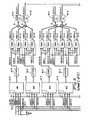
- Figure 4 is a block diagram showing the information sent by the HMIU 4 to the monitors 6.
- the table below describes the function of the 5 system bus 2 signals received over a control bus 21 of system bus 2 and stored in latches 49 for transfer to monitors 6 via latches 56:
- cache miss logic 51 The following two cache signals are generated in cache miss logic 51:
- Figures 5a-5k show the various formats received by HMIU 4.
- Figure 4 uses the address format of Figure 5g and the data format of Figure 5k to describe the relationship of the PHM's to the system bus 2 or cache bus 18 information. This is an arbitrary selection.
- address bus 23 signals CAHA 03-07 address PHM 0 42-0 to verify the memory 12 module.
- the PHM 0 42-0 output signals are stored in 8 latches 44-0.
- the latches 44-0 output signals MSELH 0-7 are applied to monitors 6 to designate a hit on designated memory 12 module or modules.
- address bus 23 signals BSAD 08-17 address PHM 1 42-1 to, for example, verify the channel number of the subsystem which is the destination of the information being transferred over subsystem bus 2 during this bus cycle.
- address bus 23 signals CAHA 08-17 address PHM 1 42-1 to, for example, verify the destination channel numbers.
- the PHM 1 42-1 output signals are stored in 8 latches 44-1.
- the latches 44-1 output signals CDSTH 0-7 are applied to monitors 6 to designate a "hit" on channel number.
- address bus 23 signals BSAD 18-23 address PHM 2 42-2 to, for example, verify the function code.
- the function code specifies the function to be performed by an I/O device 14 - n and whether it is input or output data transferred from or to the device.
- address bus 23 signals CAHA 18-22 address PHM 2 42-2 to, for example, verify the function code.
- the PHM 2 42-2 output signals are stored in 8 latches 44-2.
- the latches 44-2 output signals FCNCH 0-7 are applied to monitors 6 to designate a "hit" on function code.
- the 24 address bus 23 signals are applied through the MUX's 34 to 24 latches 50-1 of latches 50, Figure 2.
- the output signals ADBS 0-23 are applied to monitors 6.
- data bus 25 signals BSDT 00-09 address PHM 42-3 to, for example, verify the channel number of the source.
- data bus 25 signals CADP 01-08, 10-11 address PHM 3 42-3.
- the PHM 3 42-3 output signals are stored in 8 latches 44-3.
- the latches 44-3 output signlas CSCEH 0-7 are applied to monitors 6 to designate the specified source channel number "hit".
- data bus 25 signals BSDT 10-15 address PHM 4 42-4 to for example, verify the level number which is an indication of the priority of an interrupt. A lower level number indicates a higher priority.
- data bus 25 signals CADP 12-17 address PHM 4 42-4.
- the PHM 4 42-4 output signals are stored in 8 latches 44-4.
- the latches 44-4 output signals ILEVH 0-7 are applied to monitors 6 to designate an interrupt priority level number.
- the 16 data bus 25 signals are applied through MUX's
- the control bus 21 signals BSMREF, BSLOCK, BSWRIT and BSSHBC address PHM 5 42-5.
- the PHM 5 42-5 output signals are stored in latches 44-5.
- the latches 44-5 output signals BFMTH 0-7 are applied to monitors 6.
- MUX latches 41 select signals BIXX 10-17 from CPU bus 19 for addressing PHM 6 45-6 and signals BIXX 18, 19, 1A-1F from CPU bus 19 for addressing PHM 7 45-7.
- CPU bus 19 brings over, for example, the 4 hexadecimal digits making up the instruction operation code, 2 of the 4 hexadecimal digits address PHM 6 45-6, and 2 of the 4 hexidecimal digits address PHM 7 45-7.
- the PHM 6 45-6 and PHM 7 45-7 output signals are stored in latches 52-6 and 52-7 respectively, and the output signals CBIUH 0-7 and CBILH 0-7 are applied to the monitors 6 to indicate an operation code "hit", the operation code received over internal CPU bus 27 is stored in 16 latches 54-1 of latches 54, Figure 2.
- Signals BIXX OC-OF are stored in 20 output latches 54-1 and are transferred to monitors 6 as signals CPBI OC-1F.
- MUX latches 41 also store the CPU 10 control store address signals CPNA 00-11 from bus 19 for addressing PHM 8 45-8.
- the PHM 8 45-8 output signals are stored in 8 latches 52-8.
- the latches 52-8 output signals CPCSH 0-7 are applied to monitors 6 to indicate control store address "hits".
- the control store address is also stored in latches 54-2 of latches 54, Figure 2, for transfer to monitors 6 as signals CPCS 00-11.
- Figures 5a-5k show the various address bus 23 and data bus 25 formats, a combination of which is shown in Figure 4.
- Figure 5a shows the formats of the information on system bus 2 during a memory 12 write cycle. Bit position 23 of address bus 23 indicates if the data bus 25 is in a byte or word format.
- Figure 5b shows the format of the information on system bus 2 during a first cycle of a memory 12 read sequence.
- Figure 5c shows the format during a second cycle of a memory read sequence.
- Figure 5d shows the format of the information on the system bus 2 during an I/O output command.
- Figure 5e shows the format of the information on system bus 2 during an I/O input command and
- Figure 5f shows the format of the response.
- Figures 5g and 5h show the two system bus 2 cycles of information responsive to an I/O load command.
- Figure 5j shows the system bus 2 information requesting a CPU 10 action.
- Figure 5k shows the system bus 2 information during an interrupt by one of the devices 14.
- Figure 6 shows formats of the different types of bus transfers as identified by the control signals.
- the following example shows how the HMIU 4 monitors the data processing system 1 operation.
- signal BSMREF is at logical ONE
- signal BSMLOCK is either at logical ONE or logical ZERO indicating a "don't care”
- signal BSWRIT is at logical ONE
- signal BSSHBC is a "don't care”.
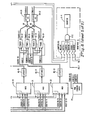
- binary ONE's are written into address locations 1010 2 , 10112, 1110 2 and 1 1 11 2 or A16, B 16' E 16 and F 16 fo PHM5U 42-51 or PHM5L 42-52 of Figure 7.
- the addresses are selected during the load mode by data signals BSDT 12-15 since select signal SELADO from mode control 36 selects input terminal 2 of MUX's 34-1 through 34-4.
- the MUX's 34-1 to 34-4 output signals H1MREF, H1LOCK, H1WRIT and H1SHBC are stored in latches 40-51 to 40-54 to address PHM5U 42-51 and PHM5L 42-52.
- the signals for writing the binary ONE's in the selected addresses are not shown.
- Address bus 23 of Figure 5 will receive the information in the format of Figure 5a.
- Signals BSAD 03-22 indicates an address location 00004 16 .
- Signal BSAD 20 is at logical ONE and signals BSAD 03-19, 21-22 are at logical ZERO.
- signals BSAD 0-23 are applied through MUX's 34-01, 34-02, 34-11, 34-12, 34-13, 34-21 and 34-22 to be stored in their respective latches 40-01, 40-02, 40-11, 40-12, 40-13. 40-21 and 40-22 since signals SELADO-1 are both at logical zero. Assuming a memory 12 write operation, signal BEMTHO, Figure 7, at logical ONE, then signals BSAD 0-2 at logical ZERO and the memory 12 address location signals BSAD 3-22 indicate the memory 12 address location.
- Signals BSAD 0-3 at logical ZERO applied to MUX's 34-01 are stored in latches 40-01 as logical ZERO's.
- Signals H1AD 00-03 at logical ZERO's are applied to the address terminals of PHMOU 42-01 and PHMOL 42-02 where locations 016 are addressed.
- Signal PCMOH4 an output of PHMOL 42-02, is forced to logical ONE.
- signals BSAD 4-7 at logical ZERO are stored in latches 40-02 through MUX's 34-02.
- Both signals PCMOH4 are applied to an AND junction 81. If both are at logical ONE, then a selected latch of latches 44-02 is set and signal MSELH4 is forced to logical ONE.
- Signals BSAD 8-9, BSAD 10-13 and BSAD 14-17 at logical ZERO applied to MUX's 34-11, 34-12 and 34-13 respectively are stored.in latches 40-11, 40-12 and 40-13 respectively.
- the PCM1H5 output signals at logical ONE from PHM1L 42-12, 42-14 and 42-16 are applied to an AND junction 83.
- a selected latch of latches 44-12 is set, forcing signal CDSTH5 to logical ONE.
- Signals BSAD 18-19, 21-22 at logical ZERO, signal BSAD 20 at logical ONE and signal BSAD 23 at either logical ONE or logical ZERO (a "dont't care" indication) generate signal FCNCH6 at logical ONE via MUX's 34-21 and 34-22, latches 40-21 which stores 0 16 and latches 40-22 which stores 8 16 or 9 16'
- Signals H1AD 18-19, 21-22 are at logical ZERO
- signal H1AD 23 is at either logical ONE or logical ZERO.
- the output signals PCM2H6 from PHM2L 42-22 and PHM2L 42-24 at logical ONE applied to AND junction 85 set a selected one of the latches 44-22 forcing FCNCH6 to logical ONE.
- Signals MSELH4, CDSTHS, FCNCH6 and BEMTHO at logical ONE indicating a memory 12 write cycle at address location 00004 are plug-wired to an AND gate 6-2 in monitors 6.
- signal BSACKR, Figure 2 applied to AND gate 6-2 is at logical ONE indicating that the memory 12 acknowledged the system bus 2 cycle and when the strobe signal STBBUS from megabus interface synchronization logic 32, Figure 2, is at logical ONE, counter 6-4 is incremented.
Landscapes
- Engineering & Computer Science (AREA)
- Theoretical Computer Science (AREA)
- General Engineering & Computer Science (AREA)
- Physics & Mathematics (AREA)
- General Physics & Mathematics (AREA)
- Computer Hardware Design (AREA)
- Quality & Reliability (AREA)
- Software Systems (AREA)
- Memory System Of A Hierarchy Structure (AREA)
- Bus Control (AREA)
- Debugging And Monitoring (AREA)
Applications Claiming Priority (2)
| Application Number | Priority Date | Filing Date | Title |
|---|---|---|---|
| US307566 | 1981-10-01 | ||
| US06/307,566 US4521849A (en) | 1981-10-01 | 1981-10-01 | Programmable hit matrices used in a hardware monitoring interface unit |
Publications (3)
| Publication Number | Publication Date |
|---|---|
| EP0077147A2 true EP0077147A2 (de) | 1983-04-20 |
| EP0077147A3 EP0077147A3 (en) | 1985-11-27 |
| EP0077147B1 EP0077147B1 (de) | 1989-08-16 |
Family
ID=23190301
Family Applications (1)
| Application Number | Title | Priority Date | Filing Date |
|---|---|---|---|
| EP82305138A Expired EP0077147B1 (de) | 1981-10-01 | 1982-09-29 | Überwachungseinheit für Datenprozessor |
Country Status (7)
| Country | Link |
|---|---|
| US (1) | US4521849A (de) |
| EP (1) | EP0077147B1 (de) |
| JP (1) | JPS5870364A (de) |
| KR (1) | KR880000339B1 (de) |
| AU (1) | AU553870B2 (de) |
| CA (1) | CA1184666A (de) |
| DE (1) | DE3279895D1 (de) |
Cited By (3)
| Publication number | Priority date | Publication date | Assignee | Title |
|---|---|---|---|---|
| GB2246649A (en) * | 1990-08-02 | 1992-02-05 | Granada Computer Services | Computer error code diagnostic apparatus and method |
| EP0520766A3 (en) * | 1991-06-24 | 1993-10-27 | Compaq Computer Corp | Innate bus monitor for computer system manager |
| US5796633A (en) * | 1996-07-12 | 1998-08-18 | Electronic Data Systems Corporation | Method and system for performance monitoring in computer networks |
Families Citing this family (29)
| Publication number | Priority date | Publication date | Assignee | Title |
|---|---|---|---|---|
| US5115502A (en) * | 1984-11-02 | 1992-05-19 | Tektronix, Inc. | Method and apparatus for determining internal status of a processor using simulation guided by acquired data |
| US5237671A (en) * | 1986-05-02 | 1993-08-17 | Silicon Graphics, Inc. | Translation lookaside buffer shutdown scheme |
| EP0249961B1 (de) * | 1986-06-17 | 1994-09-14 | Sharp Kabushiki Kaisha | Datenverarbeitungseinrichtung zur Verwendung in statistischer Berechnung |
| JPS6429966A (en) * | 1987-07-24 | 1989-01-31 | Sharp Kk | Data processor |
| US5226153A (en) * | 1989-12-22 | 1993-07-06 | Bull Hn Information Systems Inc. | Bus monitor with time stamp means for independently capturing and correlating events |
| WO1993002416A1 (en) * | 1991-07-22 | 1993-02-04 | Banyan Systems, Inc. | System bus monitor for compiling data regarding use of a system bus |
| US5493689A (en) * | 1993-03-01 | 1996-02-20 | International Business Machines Corporation | System for configuring an event driven interface including control blocks defining good loop locations in a memory which represent detection of a characteristic pattern |
| US5375070A (en) * | 1993-03-01 | 1994-12-20 | International Business Machines Corporation | Information collection architecture and method for a data communications network |
| US5365514A (en) * | 1993-03-01 | 1994-11-15 | International Business Machines Corporation | Event driven interface for a system for monitoring and controlling a data communications network |
| US5586266A (en) * | 1993-10-15 | 1996-12-17 | International Business Machines Corporation | System and method for adaptive, active monitoring of a serial data stream having a characteristic pattern |
| US5414833A (en) * | 1993-10-27 | 1995-05-09 | International Business Machines Corporation | Network security system and method using a parallel finite state machine adaptive active monitor and responder |
| US5974457A (en) * | 1993-12-23 | 1999-10-26 | International Business Machines Corporation | Intelligent realtime monitoring of data traffic |
| US5446874A (en) * | 1993-12-23 | 1995-08-29 | International Business Machines Corp. | Automated benchmarking with self customization |
| US5548775A (en) * | 1993-12-30 | 1996-08-20 | International Business Machines Corporation | System and method for adaptive active monitoring of high speed data streams using finite state machines |
| US5544077A (en) * | 1994-01-19 | 1996-08-06 | International Business Machines Corporation | High availability data processing system and method using finite state machines |
| US5495426A (en) * | 1994-01-26 | 1996-02-27 | Waclawsky; John G. | Inband directed routing for load balancing and load distribution in a data communication network |
| EP0669736A3 (de) * | 1994-01-26 | 1997-01-08 | Ibm | Dynamische Echtzeit-Leitweglenkung im Datennetz. |
| US5526488A (en) * | 1994-01-26 | 1996-06-11 | International Business Machines Corporation | Dynamic switching system for switching between event driven interfaces in response to switching bit pattern including in data frame in a data communications network |
| JP2669604B2 (ja) * | 1994-01-26 | 1997-10-29 | インターナショナル・ビジネス・マシーンズ・コーポレイション | 位置決定方法および装置 |
| US5500855A (en) * | 1994-01-26 | 1996-03-19 | International Business Machines Corporation | Realtime event classification for a data communications network |
| US5526283A (en) * | 1994-01-26 | 1996-06-11 | International Business Machines Corporation | Realtime high speed data capture in response to an event |
| US5581482A (en) * | 1994-04-26 | 1996-12-03 | Unisys Corporation | Performance monitor for digital computer system |
| US5629927A (en) * | 1995-05-31 | 1997-05-13 | International Business Machines Corporation | Monitoring ATM networks for burstiness using cell full or cell empty latency with minimum information |
| US5802041A (en) * | 1995-05-31 | 1998-09-01 | International Business Machines Corporation | Monitoring ethernet lans using latency with minimum information |
| US5991708A (en) * | 1997-07-07 | 1999-11-23 | International Business Machines Corporation | Performance monitor and method for performance monitoring within a data processing system |
| US6405327B1 (en) | 1998-08-19 | 2002-06-11 | Unisys Corporation | Apparatus for and method of automatic monitoring of computer performance |
| US6542985B1 (en) | 1999-09-23 | 2003-04-01 | Unisys Corporation | Event counter |
| US7373557B1 (en) | 2003-04-04 | 2008-05-13 | Unisys Corporation | Performance monitor for data processing systems |
| EP1667025A1 (de) * | 2004-12-01 | 2006-06-07 | Infineon Technologies AG | Vorrichtung und Verfahren zur Überwachung von Bussignalen und zum Messen derer Event-Dauer |
Family Cites Families (7)
| Publication number | Priority date | Publication date | Assignee | Title |
|---|---|---|---|---|
| US3906454A (en) * | 1973-05-18 | 1975-09-16 | Bell Telephone Labor Inc | Computer monitoring system |
| US4040035A (en) * | 1974-10-30 | 1977-08-02 | Motorola, Inc. | Microprocessor having index register coupled to serial-coupled address bus sections and to data bus |
| US4030075A (en) * | 1975-06-30 | 1977-06-14 | Honeywell Information Systems, Inc. | Data processing system having distributed priority network |
| US4000485A (en) * | 1975-06-30 | 1976-12-28 | Honeywell Information Systems, Inc. | Data processing system providing locked operation of shared resources |
| US4167782A (en) * | 1977-12-22 | 1979-09-11 | Honeywell Information Systems Inc. | Continuous updating of cache store |
| US4195342A (en) * | 1977-12-22 | 1980-03-25 | Honeywell Information Systems Inc. | Multi-configurable cache store system |
| US4225921A (en) * | 1978-10-02 | 1980-09-30 | Honeywell Information Systems Inc. | Transfer control technique between two units included in a data processing system |
-
1981
- 1981-10-01 US US06/307,566 patent/US4521849A/en not_active Expired - Fee Related
-
1982
- 1982-09-27 AU AU88751/82A patent/AU553870B2/en not_active Ceased
- 1982-09-29 EP EP82305138A patent/EP0077147B1/de not_active Expired
- 1982-09-29 DE DE8282305138T patent/DE3279895D1/de not_active Expired
- 1982-09-30 JP JP57169927A patent/JPS5870364A/ja active Pending
- 1982-09-30 CA CA000412547A patent/CA1184666A/en not_active Expired
- 1982-09-30 KR KR8204416A patent/KR880000339B1/ko not_active Expired
Cited By (5)
| Publication number | Priority date | Publication date | Assignee | Title |
|---|---|---|---|---|
| GB2246649A (en) * | 1990-08-02 | 1992-02-05 | Granada Computer Services | Computer error code diagnostic apparatus and method |
| GB2246649B (en) * | 1990-08-02 | 1994-01-19 | Granada Computer Services | Computer error code diagnostic apparatus and method |
| EP0520766A3 (en) * | 1991-06-24 | 1993-10-27 | Compaq Computer Corp | Innate bus monitor for computer system manager |
| US5402431A (en) * | 1991-06-24 | 1995-03-28 | Compaq Computer Corporation | Innate bus monitoring system for computer system manager |
| US5796633A (en) * | 1996-07-12 | 1998-08-18 | Electronic Data Systems Corporation | Method and system for performance monitoring in computer networks |
Also Published As
| Publication number | Publication date |
|---|---|
| AU553870B2 (en) | 1986-07-31 |
| KR840001730A (ko) | 1984-05-16 |
| EP0077147B1 (de) | 1989-08-16 |
| CA1184666A (en) | 1985-03-26 |
| AU8875182A (en) | 1983-04-14 |
| DE3279895D1 (en) | 1989-09-21 |
| US4521849A (en) | 1985-06-04 |
| KR880000339B1 (ko) | 1988-03-20 |
| JPS5870364A (ja) | 1983-04-26 |
| EP0077147A3 (en) | 1985-11-27 |
Similar Documents
| Publication | Publication Date | Title |
|---|---|---|
| EP0077147B1 (de) | Überwachungseinheit für Datenprozessor | |
| US4458309A (en) | Apparatus for loading programmable hit matrices used in a hardware monitoring interface unit | |
| US4459656A (en) | Clocking system for a computer performance monitoring device | |
| US4438490A (en) | Clock control of a central processing unit from a monitor interface unit | |
| US5193179A (en) | Activity monitor system non-obtrusive statistical monitoring of operations on a shared bus of a multiprocessor system | |
| US4769817A (en) | Concurrent fault simulation for logic designs | |
| EP0130469A2 (de) | Internverteiltes Monitorsystem | |
| US4367525A (en) | CPU Channel monitoring system | |
| CA1148264A (en) | Diagnostic-debug machine architecture | |
| Rudolph | A production implementation of an associative array processor: STARAN | |
| US3540003A (en) | Computer monitoring system | |
| US5327361A (en) | Events trace gatherer for a logic simulation machine | |
| EP0217922B1 (de) | Anordnung zur simulation von rechnerfunktionen von grossrechenanlagen | |
| EP0067324A2 (de) | Monitorsystem zum Software-Hardware-Korrelieren | |
| US6278959B1 (en) | Method and system for monitoring the performance of a data processing system | |
| US4298935A (en) | Interface circuit for coupling an automated maintenance system to a CPU | |
| US6311303B1 (en) | Monitor port with selectable trace support | |
| US4198682A (en) | Symptom compression device | |
| KR0171774B1 (ko) | 컴퓨터 시스템의 시스템 버스 분석장치 | |
| KR0171767B1 (ko) | 컴퓨터 시스템의 시스템 버스 분석장치 | |
| KR0171768B1 (ko) | 컴퓨터 시스템의 시스템 버스 분석장치 | |
| JPS61235956A (ja) | 事象記録方式 | |
| JPH0255815B2 (de) | ||
| Honig | Data path analysis: analyzing large I/O environments | |
| Crooke et al. | Analysis of data processing systems |
Legal Events
| Date | Code | Title | Description |
|---|---|---|---|
| PUAI | Public reference made under article 153(3) epc to a published international application that has entered the european phase |
Free format text: ORIGINAL CODE: 0009012 |
|
| AK | Designated contracting states |
Designated state(s): DE FR GB IT SE |
|
| PUAL | Search report despatched |
Free format text: ORIGINAL CODE: 0009013 |
|
| AK | Designated contracting states |
Designated state(s): DE FR GB IT SE |
|
| 17P | Request for examination filed |
Effective date: 19860522 |
|
| 17Q | First examination report despatched |
Effective date: 19870728 |
|
| RAP1 | Party data changed (applicant data changed or rights of an application transferred) |
Owner name: HONEYWELL BULL INC. |
|
| GRAA | (expected) grant |
Free format text: ORIGINAL CODE: 0009210 |
|
| ITF | It: translation for a ep patent filed | ||
| AK | Designated contracting states |
Kind code of ref document: B1 Designated state(s): DE FR GB IT SE |
|
| PGFP | Annual fee paid to national office [announced via postgrant information from national office to epo] |
Ref country code: SE Payment date: 19890821 Year of fee payment: 8 |
|
| PGFP | Annual fee paid to national office [announced via postgrant information from national office to epo] |
Ref country code: GB Payment date: 19890831 Year of fee payment: 8 |
|
| PGFP | Annual fee paid to national office [announced via postgrant information from national office to epo] |
Ref country code: FR Payment date: 19890914 Year of fee payment: 8 |
|
| REF | Corresponds to: |
Ref document number: 3279895 Country of ref document: DE Date of ref document: 19890921 |
|
| ITTA | It: last paid annual fee | ||
| ET | Fr: translation filed | ||
| PG25 | Lapsed in a contracting state [announced via postgrant information from national office to epo] |
Ref country code: DE Effective date: 19900601 |
|
| PLBE | No opposition filed within time limit |
Free format text: ORIGINAL CODE: 0009261 |
|
| STAA | Information on the status of an ep patent application or granted ep patent |
Free format text: STATUS: NO OPPOSITION FILED WITHIN TIME LIMIT |
|
| 26N | No opposition filed | ||
| PG25 | Lapsed in a contracting state [announced via postgrant information from national office to epo] |
Ref country code: GB Effective date: 19900929 |
|
| PG25 | Lapsed in a contracting state [announced via postgrant information from national office to epo] |
Ref country code: SE Effective date: 19900930 |
|
| GBPC | Gb: european patent ceased through non-payment of renewal fee | ||
| PG25 | Lapsed in a contracting state [announced via postgrant information from national office to epo] |
Ref country code: FR Effective date: 19910530 |
|
| REG | Reference to a national code |
Ref country code: FR Ref legal event code: ST |
|
| EUG | Se: european patent has lapsed |
Ref document number: 82305138.8 Effective date: 19910527 |