EP0077150B1 - Dental amalgam capsules - Google Patents
Dental amalgam capsules Download PDFInfo
- Publication number
- EP0077150B1 EP0077150B1 EP82305201A EP82305201A EP0077150B1 EP 0077150 B1 EP0077150 B1 EP 0077150B1 EP 82305201 A EP82305201 A EP 82305201A EP 82305201 A EP82305201 A EP 82305201A EP 0077150 B1 EP0077150 B1 EP 0077150B1
- Authority
- EP
- European Patent Office
- Prior art keywords
- chamber
- capsule
- mercury
- section
- valve
- Prior art date
- Legal status (The legal status is an assumption and is not a legal conclusion. Google has not performed a legal analysis and makes no representation as to the accuracy of the status listed.)
- Expired
Links
- 239000002775 capsule Substances 0.000 title claims abstract description 91
- 229910001312 Amalgam (dentistry) Inorganic materials 0.000 title claims abstract description 14
- 239000000448 dental amalgam Substances 0.000 title claims abstract description 14
- QSHDDOUJBYECFT-UHFFFAOYSA-N mercury Chemical compound [Hg] QSHDDOUJBYECFT-UHFFFAOYSA-N 0.000 claims abstract description 46
- 229910052753 mercury Inorganic materials 0.000 claims abstract description 46
- 239000000843 powder Substances 0.000 claims abstract description 17
- 229910052751 metal Inorganic materials 0.000 claims abstract description 16
- 239000002184 metal Substances 0.000 claims abstract description 16
- 229910045601 alloy Inorganic materials 0.000 claims description 8
- 239000000956 alloy Substances 0.000 claims description 8
- 238000007789 sealing Methods 0.000 claims description 8
- 239000000203 mixture Substances 0.000 claims description 4
- 229910000497 Amalgam Inorganic materials 0.000 description 14
- 230000007704 transition Effects 0.000 description 10
- 239000000463 material Substances 0.000 description 6
- 238000005192 partition Methods 0.000 description 4
- 238000004891 communication Methods 0.000 description 3
- 238000000034 method Methods 0.000 description 3
- 238000000465 moulding Methods 0.000 description 3
- 230000008569 process Effects 0.000 description 3
- 238000003860 storage Methods 0.000 description 3
- 238000010276 construction Methods 0.000 description 2
- 238000006073 displacement reaction Methods 0.000 description 2
- 239000004698 Polyethylene Substances 0.000 description 1
- 238000005267 amalgamation Methods 0.000 description 1
- 238000011109 contamination Methods 0.000 description 1
- 239000006185 dispersion Substances 0.000 description 1
- 230000000694 effects Effects 0.000 description 1
- 238000004519 manufacturing process Methods 0.000 description 1
- 238000010915 one-step procedure Methods 0.000 description 1
- 239000008188 pellet Substances 0.000 description 1
- 229920003023 plastic Polymers 0.000 description 1
- 239000004033 plastic Substances 0.000 description 1
- -1 polyethylene Polymers 0.000 description 1
- 229920000573 polyethylene Polymers 0.000 description 1
- 230000004044 response Effects 0.000 description 1
- 230000036962 time dependent Effects 0.000 description 1
- 238000001665 trituration Methods 0.000 description 1
Images

Classifications
-
- A—HUMAN NECESSITIES
- A61—MEDICAL OR VETERINARY SCIENCE; HYGIENE
- A61C—DENTISTRY; APPARATUS OR METHODS FOR ORAL OR DENTAL HYGIENE
- A61C5/00—Filling or capping teeth
- A61C5/60—Devices specially adapted for pressing or mixing capping or filling materials, e.g. amalgam presses
- A61C5/66—Capsules for filling material
Definitions
- the invention relates to dentistry and is concerned, in particular, with improvements in dental amalgam capsules, preferably of the two-piece two-chamber self-activating type, for storing dental amalgam components in unmixed condition, until the dental amalgam is required for use, the improved capsule also enabling the components to be mixed and triturated together.
- dental amalgam capsules which meet these desirable conditions contain the requisite components as supplied to the dentist and can be used to prepare a quantity of amalgam without any other component having to be added to the capsule.
- FR-A-2470739 discloses a two-chamber capsule made of two interfitting parts which define the separate chambers when fully fitted together; this capsule is not self-activating and, instead, operation to mix the components and form the amalgam necessitates partially opening the capsule, which causes the chamber containing the mercury to open into the other container. None of these prior art capsules combines two-piece construction with one-step charging and self-activation, and it is the overall purpose of this invention to provide a capsule which has this advantageous combination of features.
- a capsule comprising a first section and a second section, which fit together to define a first chamber and a separate second chamber within the capsule, the first chamber serving to receive a quantity of an alloy component and the second chamber serving to receive a quantity of mercury, which when transferred to the first chamber and mixed with the alloy component, forms a dental amalgam, characterized in that a normally-closed valve is provided between the first chamber and the second chamber and is arranged, when mercury is present in the second chamber to open under the influence of inertial force exerted of the valve by the mercury and caused by shaking the capsule, whereby the mercury can pass from the second chamber into the first chamber and whereby, when the alloy component is present in the first chamber, the dental amalgam is formed in the first chamber.
- a capsule containing a first chamber and a second chamber respectively containing predetermined quantities of a metal powder and mercury which mix to form a dental amalgam, characterized in that the mercury is prevented from passing from the second chamber into the first chamber by a one-way valve comprising parts which operate solely by flexion and that operation of the valve is caused solely by impact of the mercury upon the valve caused by shaking the capsule.
- This invention provides a self-activating two-chamber capsule containing the components required for forming a dental amalgam.
- the structure requires no pestle and no movable, slidable or frangible partitions. Communication between the chambers is controlled by a normally-closed valve.
- the inertia of the mercury opens the valve, so that the mercury can pass into the other chamber, containing the metal powder, and is triturated with it to form the usual amalgam for filling teeth.
- this invention provides self-activation and one-step charging in a two-piece two-chamber capsule structure.
- the one-way valve comprises a portion of each piece of the capsule structure and both chambers are provided in one of the pieces.
- the two chambers open separately to the exterior and the other piece of the capsule closes both of these openings, so that the aforesaid valve-forming portions then normally prevent communication between the chambers.
- one-step charging is provided, whereby appropriate quantities of metal powder and alloy can be poured simultaneously into their respective chambers via the openings provided, after which the two pieces can be assembled without further manipulation. This is a one-step procedure, because the piece having the openings need only be oriented properly (i.e.
- the capsule can simply be taken from a box or other storage means, placed in an amalgamator and shaken for a predetermined time suitable for reducing the separate components to an amalgam of properties appropriate for filling teeth. Immediately, the shaking begins, the aforesaid valve opens and admits the mercury to the chamber containing the metal powder. At this point, the amalgamating process occurs just as in prior art capsules, with or without a pestle.
- the capsule according to the invention is a generally cylindrical pwo-piece structure consisting of a front section 30 and a rear section 31.
- Each of these capsule sections consists of a round ended portion integral with a right cylindrical portion.
- the front section 30 comprises a round-ended, e.g. hemispherical, portion 1 and an integral right cylindrical portion 3
- the rear section 31 comprises a round-ended portion 2 and an integral right cylindrical portion 4.
- the rear section 31 fits telescopically into the front section 30 by reason of the respective overlapping cylindrical portions 3 and 4.
- These portions 3 and 4 are ribbed, the ribs running circumferentially, for preference, as indicated at 5 and 6 respectively, in order to facilitate handling of the capsule 30, 31.
- Fig. 1 shows a cross-section in the vertical plane containing the common longitudinal axes of the portions 3 and 4 and therefore of the longitudinal axis of the whole capsule 30, 31.
- the rear section 31 has chambers 7 and 8 in it.
- a small quantity of mercury is contained in the chamber 7 and a small quantity of metal powder is contained in the chamber 8, the relative proportions of the mercury and the powder being those suitable for making a tooth-filling amalgam when mixed.
- the chamber 8 is cylindrical and is closed inside the round-ended portion 2 by a rounded base surface 10a.
- the chamber 7 is annular, being formed between the chamber 8 and the exterior of the capsule section 31.
- the chambers 7 and 8 are thus concentric circularly right-cylindrical spaces separated by a cylindrical wall member 9, which is an integral part of the one-piece structure comprising the capsule section 31.
- the annular chamber 7 is closed inside the round-ended portion 2 by a rounded base surface 10b.
- the other ends of the chambers 7 and 8 from the respective base surfaces 10a and 10b are open and are separated from one another by the free annular end part 11 of the wall member 9.
- This end part 11 is of reduced thickness compared with the remainder of the wall member 9, a chamfered portion 12a forming a transition between the thinner-walled end part 11 and the inside of the main part of the chamber 8.
- the end part 11 has a number of axial channels 13 extending along its inside surface from the chamfered portion 12a to the extremity of the end part 11 and a rib 12b is formed between adjacent channels 13 and includes at the end an axial slot or notch 12c.
- the front section 30 has a chamber 15 in it, having a rounded base surface 14a, corresponding to the surface 10a of the chamber 8, an inner circular right-cylindrical or first bore portion 14b of lesser internal diameter and a second or outer bore portion 14c of greater internal diameter, the bore portion 14c extending to the open end of the capsule front section 30.
- the inner and outer bore portions 14b and 14c have their internal surfaces joined by a frusto-conical transition portion 16 which, adjacent the inner bore portion 14b, merges with the latter by way of a chamfered surface 17.
- the internal diameter of the outer bore portion 14c is slightly greater than the external diameter of the cylindrical portion 4 of the capsule rear section 31, except adjacent the free rim 22 of the latter.
- the extremity of the wall part 19 of the cylindrical portion 4 is of a larger diameter, shown at 20a, so as to fit sealingly inside the outer bore portion 14c of the front capsule section 30 when the capsule is assembled.
- a small shoulder 20b is formed between this sealing portion 20a of larger diameter and the remainder of the portion 4.
- the end surface 21 of the wall part 19 is of frusto-conical form and matches the conicity of the transition portion 16 between the inner and outer bore portions 14b and 14c.
- the sealing portion 20a fits within the outer bore portion 14c, the coned end surface 21 of the wall portion 19 extending from the rim 22 to the sealing portion 20a abuts the transition portion 16 and the external extremity of the wall member 9 comprising the ends of the ribs 12b with the notches 12c and the ends of the channels 13 abuts the inner bore portion 14b adjacent the surface 17.
- annular sealing areas are thus produced between the inter-nesting capsule sections 30 and 31.
- annular seal is formed by the inside surface of the bore portion 14b being in continuous contact with the outer circumferential area of the open end 11 of the wall member 9.
- the width of this seal is the distance between the inner edge of the chamber surface 17 and the rim 18 of the wall member 9.
- a second and similar annular seal extends circumferentially about the exterior surface of the thicker wall part 19, the width of the seal area being the distance from the end of the wall part 19 to the shoulder 20b.
- a third sealing area is defined by the frusto-conical end surface 21 of the wall member 19 as it makes abutting contact with the surface of the correspondingly shaped transition portion 16, the width of this seal area being the distance between the end of the sealing portion 20a and the rim 22.
- the capsule front and rear sections are preferably manufactured by moulding from suitable plastics materials. Charging and assembly consist of supporting each of the capsule rear sections 31 on its end portion 2 with its axis upright, whereupon suitable quantities of mercury and metal powder can be dropped, separately but simultaneously, into the respective chambers 7 and 8.
- One of the capsule front sections 30 is then positioned with its end portion 1 uppermost and is fitted over the open end of the rear section 31, in order to seal the respective amalgam components into their separate chambers 7 and 8.
- the three seals described above are formed as the capsule sections are fitted together and prevent the mercury from leaving the chamber 7 and the metal powder from leaving the chamber 8, so that they remain separate.
- the closed capsule can then be packaged for storage and despatch.
- the capsule is then opened by separating the two sections in order to remove the amalgam for dental use.
- the capsule is preferably positioned upright for opening, most preferably with the rear section 31 uppermost, so that removal of it leaves the prepared amalgam in the chamber 15 in the front section 30, from which it can be readily removed.
- the free end 11 of the wall member 9 is made of relatively thin material compared with the other wall parts, such as the rest of the wall member 9, and because of the notches 12c and the channels 13, this open end from the chamfered surface 12a to the rim 18 is flexible, as compared to the main portion 1 of the wall member 9. Accordingly, when the filled capsule is put into an amalgamator, so as to be shaken in a direction substantially along the main axis of the cylindrical portions 3 and 4, the initially separate contents of the capsule are flung from one end to the other of the chambers 7 and 8. Consequently, the inertial force of the mercury as it strikes the end of the annular chamber 7 adjacent the transition portion 16 and the adjacent surfaces of the end 11 (to the right of the surface 17 as seen in Fig.
- any part of the end 11 which has been flexed returns to make sealing contact with the adjacent surface of the bore portion 14b, before the displacement which flung the mercury against the transition portion 16 and the flexible end 11 is followed by the next displacement of the capsule which could otherwise cause the mercury to be flung toward the end 11.
- the chambered surface 17 adjacent the transition portion 16 facilitates passage of the mercury.
- the detailed construction of the thin part of the wall member 9, between the chamfered portion 12a and the rim 18, causes it to operate as a one-way valve between the annular mercury chamber 7 and the central mixing compartment of the capsule comprising the metal powder chamber 8 and the front section chamber 15.
- the seal area between the chamfer surface 17 and the rim 18 is thus a passageway controlled by a normally-closed valve, the actuator of which is in effect the transition portion 16 and the end 11, since the former directs the mercury towards the end 11.
- the mercury is confined to this compartment, because the end 11 has no part which could cause it to flex inwards in response to impact of the mercury in the chamber 8. Moreover, once it is out of the relatively narrow confines of the chamber 7, the mercury breaks up into many small globules and, along with the metal powder; forms a sort of dispersion, the kinetic energy of which is mainly absorbed by the ends of the compartment formed by the chambers 8 and 15, which are provided for this purpose with the rather robust wall portions between the surfaces 14a, 14b and 10a and the exterior surfaces of the round-ended portions 1 and 2.
- valve is substantially instantaneous for all practical purposes and occurs practically immediately upon the beginning of shaking. In other words, the time necessary for proper amalgamation does not have to take into account the very short period which elapses between setting the capsule in motion and entry of the mercury into the chamber 15.
- the capsule according to this invention is normally supplied ready charged with mercury and metal powder, so that in order to use the capsule it is merely necessary to make it out of a box or other storage arrangement, put it into any desired form of amalgamator machine and operate the machine so that it shakes the capsule for a time dependent upon the composition of the metal powder (usually one of several alloys), the user's preference as to amalgam texture and/or the number of "spills" in the capsule.
- the concentric form of the chambers 7 and 8 in the rear section 31 provides an axial symmetry suitable for forming both of the capsule sections by a conventional moulding process.
- the chambers 7 and 8 could be arranged differently, for instance side by side, and in any event the chamber 7 need not extend all the way around the wall member 9.
- the optimum volume for the capsule depends upon the quantities of amalgam proposed to be used and its optimum length depends upon the kinetics of the amalgamator.
- the volume of the chamber 7, as shown, is rather more generous than is necessary just to contain the mercury.
- the length shown has been found suitable to develop sufficient inertial force by movement of the mercury to actuate the valve.
- the mercury tends to collect at the lowest point in the chamber 7, when the capsule is used in an amalgamator having a horizontally- directed shaking motion, corresponding portions of the end 11 of the transition portion 16 are acted on substantially by a unitary body of mercury.
- the chamber 7 is a simple tubular bore of the length shown in Figure 1, located alongside the chamber 8 and having a diameter of approximately the radial distance between the wall member 9 and the exterior of the portion 4. If the mercury is concentrated into a unitary body, it flexes only a minor portion of the end 11. Again, the moulding process preferred makes it convenient to form the end 11 so as to be capable of flexing at any place around its circumference.
- the material of the capsule can be polyethylene, a "hard” form being desirable for the front section 30 and a “medium hard” form being desirable for the rear section 31. Using sufficiently dense material reduces the chance of contamination between the chambers. Tolerances for the fit between the two capsule sections 30 and 31 must be such as to prevent leakage of mercury from the chamber 7.
- a preferred set of dimensions for the capsule includes a longest dimension of 3.35 cm, for the assembled capsule as shown to scale in Figure 1.
- the capsule of the invention provides to the utmost the desirable advantages of economy, ease and simplicity of manufacture, charging and use, in contrast to capsules already known or in use.
Landscapes
- Health & Medical Sciences (AREA)
- Oral & Maxillofacial Surgery (AREA)
- Dentistry (AREA)
- Epidemiology (AREA)
- Life Sciences & Earth Sciences (AREA)
- Animal Behavior & Ethology (AREA)
- General Health & Medical Sciences (AREA)
- Public Health (AREA)
- Veterinary Medicine (AREA)
- Dental Tools And Instruments Or Auxiliary Dental Instruments (AREA)
- Dental Preparations (AREA)
- Agricultural Chemicals And Associated Chemicals (AREA)
Abstract
Description
- The invention relates to dentistry and is concerned, in particular, with improvements in dental amalgam capsules, preferably of the two-piece two-chamber self-activating type, for storing dental amalgam components in unmixed condition, until the dental amalgam is required for use, the improved capsule also enabling the components to be mixed and triturated together. Dental amalgam capsules which meet these desirable conditions contain the requisite components as supplied to the dentist and can be used to prepare a quantity of amalgam without any other component having to be added to the capsule.
- Two-piece two-chamber capsules for containing amalgam components, which can be charged with these components in one step, are disclosed in US-A-3,917,062 and 4,142,629. Two-chamber capsules requiring the use of pestles and/or partitions between the chambers, but not having one-step charging, are disclosed in US-A-3,796,303, 4,182,447 and 4,185,740; the two last-mentioned publications also describe self-activation of the capsules disclosed, caused by including a pestle or pellet un one of the capsule chambers which, in use, breaks or moves a partition between the chambers so that the amalgam components can come together and mix to form the amalgam. Other forms of two-chamber capsules having movable or rupturable partitions are disclosed in AU-B-56748/80 and SE-A-7904822-9. FR-A-2470739 discloses a two-chamber capsule made of two interfitting parts which define the separate chambers when fully fitted together; this capsule is not self-activating and, instead, operation to mix the components and form the amalgam necessitates partially opening the capsule, which causes the chamber containing the mercury to open into the other container. None of these prior art capsules combines two-piece construction with one-step charging and self-activation, and it is the overall purpose of this invention to provide a capsule which has this advantageous combination of features.
- According to one aspect of this invention, a capsule is provided, comprising a first section and a second section, which fit together to define a first chamber and a separate second chamber within the capsule, the first chamber serving to receive a quantity of an alloy component and the second chamber serving to receive a quantity of mercury, which when transferred to the first chamber and mixed with the alloy component, forms a dental amalgam, characterized in that a normally-closed valve is provided between the first chamber and the second chamber and is arranged, when mercury is present in the second chamber to open under the influence of inertial force exerted of the valve by the mercury and caused by shaking the capsule, whereby the mercury can pass from the second chamber into the first chamber and whereby, when the alloy component is present in the first chamber, the dental amalgam is formed in the first chamber.
- According to another aspect of this invention, a capsule is provided, containing a first chamber and a second chamber respectively containing predetermined quantities of a metal powder and mercury which mix to form a dental amalgam, characterized in that the mercury is prevented from passing from the second chamber into the first chamber by a one-way valve comprising parts which operate solely by flexion and that operation of the valve is caused solely by impact of the mercury upon the valve caused by shaking the capsule.
- This invention provides a self-activating two-chamber capsule containing the components required for forming a dental amalgam. The structure requires no pestle and no movable, slidable or frangible partitions. Communication between the chambers is controlled by a normally-closed valve. When the capsule is shaken in a manner normally used for trituration, the inertia of the mercury opens the valve, so that the mercury can pass into the other chamber, containing the metal powder, and is triturated with it to form the usual amalgam for filling teeth.
- In the preferred form this invention provides self-activation and one-step charging in a two-piece two-chamber capsule structure. In particular, the one-way valve comprises a portion of each piece of the capsule structure and both chambers are provided in one of the pieces. The two chambers open separately to the exterior and the other piece of the capsule closes both of these openings, so that the aforesaid valve-forming portions then normally prevent communication between the chambers. With this arrangement, one-step charging is provided, whereby appropriate quantities of metal powder and alloy can be poured simultaneously into their respective chambers via the openings provided, after which the two pieces can be assembled without further manipulation. This is a one-step procedure, because the piece having the openings need only be oriented properly (i.e. with the chamber openings at the highest point) and, after the mercury and metal powder are in place, it is then only necessary to put the other piece in place. In use by the dentist, the capsule can simply be taken from a box or other storage means, placed in an amalgamator and shaken for a predetermined time suitable for reducing the separate components to an amalgam of properties appropriate for filling teeth. Immediately, the shaking begins, the aforesaid valve opens and admits the mercury to the chamber containing the metal powder. At this point, the amalgamating process occurs just as in prior art capsules, with or without a pestle.
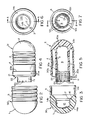
- In order that the invention may be fully understood and appreciated, a preferred embodiment is described below by way of example, in conjunction with the accompanying drawings, in which Fig. 1 shows an actual working example on a considerably enlarged scale and Figs. 2 to 7 show components of the same capsule on a scale enlarged to a lesser extent than Fig. 1; in the drawings:
- Fig. 1 shows a part-sectional part-elevational view of the preferred form of assembled capsule according to the invention;
- Fig. 2 shows an elevational view of one part of the capsule, namely the front section shown at the left-hand side in Fig. 1;
- Fig. 3 shows a sectional view of the capsule part of Fig. 2, as seen on the line A-A of Fig. 6;
- Fig. 4 shows an elevational view, similar to Fig. 2 of the other part of the capsule, namely the rear section shown at the right-hand side in Fig. 1;
- Fig. 5 shows a sectional view of the capsule part of Fig. 4, as seen on the line B-B of Fig. 7;
- Fig. 6 shows an end view from the right of the capsule part shown in Figs. 2 and 3;
- Fig. 7 shows an end view from the left of the capsule part shown in Figs. 4 and 5.
- Referring to Fig. 1, the capsule according to the invention, as best seen in the top half of the Figure, is a generally cylindrical pwo-piece structure consisting of a
front section 30 and arear section 31. Each of these capsule sections consists of a round ended portion integral with a right cylindrical portion. Thefront section 30 comprises a round-ended, e.g. hemispherical,portion 1 and an integral rightcylindrical portion 3 and therear section 31 comprises a round-ended portion 2 and an integral rightcylindrical portion 4. Therear section 31 fits telescopically into thefront section 30 by reason of the respective overlappingcylindrical portions portions capsule - The lower half of Fig. 1 shows a cross-section in the vertical plane containing the common longitudinal axes of the
portions whole capsule rear section 31 haschambers capsule 30, 31 a small quantity of mercury is contained in thechamber 7 and a small quantity of metal powder is contained in thechamber 8, the relative proportions of the mercury and the powder being those suitable for making a tooth-filling amalgam when mixed. Thechamber 8 is cylindrical and is closed inside the round-ended portion 2 by arounded base surface 10a. Thechamber 7 is annular, being formed between thechamber 8 and the exterior of thecapsule section 31. Thechambers capsule section 31. Similarly to thecylindrical chamber 8, theannular chamber 7 is closed inside the round-ended portion 2 by arounded base surface 10b. - The other ends of the
chambers respective base surfaces annular end part 11 of the wall member 9. Thisend part 11 is of reduced thickness compared with the remainder of the wall member 9, a chamferedportion 12a forming a transition between the thinner-walled end part 11 and the inside of the main part of thechamber 8. Theend part 11 has a number ofaxial channels 13 extending along its inside surface from thechamfered portion 12a to the extremity of theend part 11 and arib 12b is formed betweenadjacent channels 13 and includes at the end an axial slot ornotch 12c. - The
front section 30 has achamber 15 in it, having arounded base surface 14a, corresponding to thesurface 10a of thechamber 8, an inner circular right-cylindrical orfirst bore portion 14b of lesser internal diameter and a second orouter bore portion 14c of greater internal diameter, thebore portion 14c extending to the open end of thecapsule front section 30. The inner andouter bore portions conical transition portion 16 which, adjacent theinner bore portion 14b, merges with the latter by way of achamfered surface 17. - The internal diameter of the
outer bore portion 14c is slightly greater than the external diameter of thecylindrical portion 4 of the capsulerear section 31, except adjacent thefree rim 22 of the latter. The extremity of thewall part 19 of thecylindrical portion 4 is of a larger diameter, shown at 20a, so as to fit sealingly inside theouter bore portion 14c of thefront capsule section 30 when the capsule is assembled. Asmall shoulder 20b is formed between this sealingportion 20a of larger diameter and the remainder of theportion 4. Theend surface 21 of thewall part 19 is of frusto-conical form and matches the conicity of thetransition portion 16 between the inner andouter bore portions rear sections portion 20a fits within theouter bore portion 14c, theconed end surface 21 of thewall portion 19 extending from therim 22 to thesealing portion 20a abuts thetransition portion 16 and the external extremity of the wall member 9 comprising the ends of theribs 12b with thenotches 12c and the ends of thechannels 13 abuts theinner bore portion 14b adjacent thesurface 17. - As can be readily seen from Fig. 1, three annular sealing areas are thus produced between the
inter-nesting capsule sections bore portion 14b being in continuous contact with the outer circumferential area of theopen end 11 of the wall member 9. The width of this seal is the distance between the inner edge of thechamber surface 17 and therim 18 of the wall member 9. A second and similar annular seal extends circumferentially about the exterior surface of thethicker wall part 19, the width of the seal area being the distance from the end of thewall part 19 to theshoulder 20b. In addition, a third sealing area is defined by the frusto-conical end surface 21 of thewall member 19 as it makes abutting contact with the surface of the correspondinglyshaped transition portion 16, the width of this seal area being the distance between the end of thesealing portion 20a and therim 22. - The capsule front and rear sections, such as shown at 30 and 31, are preferably manufactured by moulding from suitable plastics materials. Charging and assembly consist of supporting each of the capsule
rear sections 31 on itsend portion 2 with its axis upright, whereupon suitable quantities of mercury and metal powder can be dropped, separately but simultaneously, into therespective chambers capsule front sections 30 is then positioned with itsend portion 1 uppermost and is fitted over the open end of therear section 31, in order to seal the respective amalgam components into theirseparate chambers chamber 7 and the metal powder from leaving thechamber 8, so that they remain separate. The closed capsule can then be packaged for storage and despatch. No further manipulation of the two sections of thecapsule rear section 31 uppermost, so that removal of it leaves the prepared amalgam in thechamber 15 in thefront section 30, from which it can be readily removed. - As the
free end 11 of the wall member 9 is made of relatively thin material compared with the other wall parts, such as the rest of the wall member 9, and because of thenotches 12c and thechannels 13, this open end from thechamfered surface 12a to therim 18 is flexible, as compared to themain portion 1 of the wall member 9. Accordingly, when the filled capsule is put into an amalgamator, so as to be shaken in a direction substantially along the main axis of thecylindrical portions chambers annular chamber 7 adjacent thetransition portion 16 and the adjacent surfaces of the end 11 (to the right of thesurface 17 as seen in Fig. 1), causes flexion of the relatively thin portions forming theend region 11. These portions flex toward the longitudinal axis of thecapsule portions chamber 7 and thechamber 8, as parts of the outer surface of theend 11 are forced away from the surface of theinner bore portion 14b of thechamber 15. In reality, the flexing occurs substantially instantaneously. As soon as the mercury opens the seal between theend 11 and thebore portion 14b, so producing a passageway (not shown, as it is of indeterminate form), it passes through into thechamber 15. Due to the inherent elasticity of the material, any part of theend 11 which has been flexed returns to make sealing contact with the adjacent surface of thebore portion 14b, before the displacement which flung the mercury against thetransition portion 16 and theflexible end 11 is followed by the next displacement of the capsule which could otherwise cause the mercury to be flung toward theend 11. The chamberedsurface 17 adjacent thetransition portion 16 facilitates passage of the mercury. - In practice, the detailed construction of the thin part of the wall member 9, between the chamfered
portion 12a and therim 18, causes it to operate as a one-way valve between theannular mercury chamber 7 and the central mixing compartment of the capsule comprising themetal powder chamber 8 and thefront section chamber 15. The seal area between thechamfer surface 17 and therim 18 is thus a passageway controlled by a normally-closed valve, the actuator of which is in effect thetransition portion 16 and theend 11, since the former directs the mercury towards theend 11. The impact of the mercury on the place or places struck by it produces a valve-opening force which flexes theend 11 inwardly against a restoring force provided by the natural elasticity of theend 11, as determined by its dimensions, material and form, including thenotches 12c and thechannels 13. - Once it has entered the part of the
chamber 15 within theinner bore portion 14b, which forms with thechamber 8 the normally-closed mixing compartment, the mercury is confined to this compartment, because theend 11 has no part which could cause it to flex inwards in response to impact of the mercury in thechamber 8. Moreover, once it is out of the relatively narrow confines of thechamber 7, the mercury breaks up into many small globules and, along with the metal powder; forms a sort of dispersion, the kinetic energy of which is mainly absorbed by the ends of the compartment formed by thechambers surfaces portions - The operation of the valve is substantially instantaneous for all practical purposes and occurs practically immediately upon the beginning of shaking. In other words, the time necessary for proper amalgamation does not have to take into account the very short period which elapses between setting the capsule in motion and entry of the mercury into the
chamber 15. - The capsule according to this invention is normally supplied ready charged with mercury and metal powder, so that in order to use the capsule it is merely necessary to make it out of a box or other storage arrangement, put it into any desired form of amalgamator machine and operate the machine so that it shakes the capsule for a time dependent upon the composition of the metal powder (usually one of several alloys), the user's preference as to amalgam texture and/or the number of "spills" in the capsule.
- The concentric form of the
chambers rear section 31 provides an axial symmetry suitable for forming both of the capsule sections by a conventional moulding process. However, thechambers chamber 7 need not extend all the way around the wall member 9. As is known, the optimum volume for the capsule depends upon the quantities of amalgam proposed to be used and its optimum length depends upon the kinetics of the amalgamator. The volume of thechamber 7, as shown, is rather more generous than is necessary just to contain the mercury. However, the length shown has been found suitable to develop sufficient inertial force by movement of the mercury to actuate the valve. - Because the mercury tends to collect at the lowest point in the
chamber 7, when the capsule is used in an amalgamator having a horizontally- directed shaking motion, corresponding portions of theend 11 of thetransition portion 16 are acted on substantially by a unitary body of mercury. The same result can be achieved if thechamber 7 is a simple tubular bore of the length shown in Figure 1, located alongside thechamber 8 and having a diameter of approximately the radial distance between the wall member 9 and the exterior of theportion 4. If the mercury is concentrated into a unitary body, it flexes only a minor portion of theend 11. Again, the moulding process preferred makes it convenient to form theend 11 so as to be capable of flexing at any place around its circumference. - The material of the capsule can be polyethylene, a "hard" form being desirable for the
front section 30 and a "medium hard" form being desirable for therear section 31. Using sufficiently dense material reduces the chance of contamination between the chambers. Tolerances for the fit between the twocapsule sections chamber 7. A preferred set of dimensions for the capsule includes a longest dimension of 3.35 cm, for the assembled capsule as shown to scale in Figure 1. - The capsule of the invention provides to the utmost the desirable advantages of economy, ease and simplicity of manufacture, charging and use, in contrast to capsules already known or in use.
Claims (6)
Priority Applications (1)
| Application Number | Priority Date | Filing Date | Title |
|---|---|---|---|
| AT82305201T ATE18130T1 (en) | 1981-10-02 | 1982-09-30 | MIXING CAPSULE FOR MAKING AMALGAMS FOR DENTAL FILLINGS. |
Applications Claiming Priority (2)
| Application Number | Priority Date | Filing Date | Title |
|---|---|---|---|
| US30799281A | 1981-10-02 | 1981-10-02 | |
| US307992 | 1981-10-02 |
Publications (2)
| Publication Number | Publication Date |
|---|---|
| EP0077150A1 EP0077150A1 (en) | 1983-04-20 |
| EP0077150B1 true EP0077150B1 (en) | 1986-02-26 |
Family
ID=23192062
Family Applications (1)
| Application Number | Title | Priority Date | Filing Date |
|---|---|---|---|
| EP82305201A Expired EP0077150B1 (en) | 1981-10-02 | 1982-09-30 | Dental amalgam capsules |
Country Status (6)
| Country | Link |
|---|---|
| EP (1) | EP0077150B1 (en) |
| JP (1) | JPS5867255A (en) |
| AT (1) | ATE18130T1 (en) |
| AU (1) | AU553446B2 (en) |
| BR (1) | BR8205730A (en) |
| DE (1) | DE3269429D1 (en) |
Families Citing this family (2)
| Publication number | Priority date | Publication date | Assignee | Title |
|---|---|---|---|---|
| US5129825A (en) * | 1987-12-21 | 1992-07-14 | Discko John Jr | Dental syringe and capsule for use therewith |
| US10874482B2 (en) | 2015-02-04 | 2020-12-29 | Rock Dental Ag | Mixing capsule for dental material, and method for producing dental material |
Citations (2)
| Publication number | Priority date | Publication date | Assignee | Title |
|---|---|---|---|---|
| SE417077B (en) * | 1979-06-01 | 1981-02-23 | K Ruben F Thunberg | Capsule for mixing two DOSED SUBSTANCES |
| FR2470739A1 (en) * | 1979-12-03 | 1981-06-12 | Rimbaud Henri | Capsule containing two separated products for mixing - has one product in capsule and one in external collar closed by flange |
Family Cites Families (3)
| Publication number | Priority date | Publication date | Assignee | Title |
|---|---|---|---|---|
| US2647638A (en) * | 1949-12-30 | 1953-08-04 | Louis L Shore | Means for separating and recovering excess mercury from amalgam mix |
| US2687130A (en) * | 1950-01-13 | 1954-08-24 | Milton J Cohen | Medicament and container therefor |
| GB934235A (en) * | 1961-06-12 | 1963-08-14 | Donald George Smith | Improvements in or relating to dental instruments |
-
1982
- 1982-09-29 AU AU88857/82A patent/AU553446B2/en not_active Ceased
- 1982-09-30 DE DE8282305201T patent/DE3269429D1/en not_active Expired
- 1982-09-30 JP JP57169949A patent/JPS5867255A/en active Pending
- 1982-09-30 BR BR8205730A patent/BR8205730A/en unknown
- 1982-09-30 AT AT82305201T patent/ATE18130T1/en not_active IP Right Cessation
- 1982-09-30 EP EP82305201A patent/EP0077150B1/en not_active Expired
Patent Citations (2)
| Publication number | Priority date | Publication date | Assignee | Title |
|---|---|---|---|---|
| SE417077B (en) * | 1979-06-01 | 1981-02-23 | K Ruben F Thunberg | Capsule for mixing two DOSED SUBSTANCES |
| FR2470739A1 (en) * | 1979-12-03 | 1981-06-12 | Rimbaud Henri | Capsule containing two separated products for mixing - has one product in capsule and one in external collar closed by flange |
Also Published As
| Publication number | Publication date |
|---|---|
| EP0077150A1 (en) | 1983-04-20 |
| JPS5867255A (en) | 1983-04-21 |
| AU8885782A (en) | 1983-04-14 |
| ATE18130T1 (en) | 1986-03-15 |
| BR8205730A (en) | 1983-09-06 |
| AU553446B2 (en) | 1986-07-17 |
| DE3269429D1 (en) | 1986-04-03 |
Similar Documents
| Publication | Publication Date | Title |
|---|---|---|
| US3831742A (en) | Dental mixing capsule | |
| US4182447A (en) | Device for storing, transporting and mixing reactive ingredients | |
| US5509530A (en) | Compartmentalized dental amalgam mixing capsule | |
| US3907106A (en) | Compounding vessel | |
| CN1882481B (en) | Container with pill dispensing insert | |
| US4863017A (en) | Amalgam capsule | |
| US6387073B1 (en) | Hermetically sealed container with medicament storing and dispensing insert | |
| US4557376A (en) | Self activating amalgam capsule | |
| GB2041763A (en) | An inhalor for pulverulent medicinal substances | |
| US4396117A (en) | Capsule for the storage and vibration-mixing of two components particularly for dental purposes | |
| EP0705202A1 (en) | Dual chamber dispenser | |
| JPS62268555A (en) | Mixing and discharge capsule | |
| TWI228403B (en) | Kit for mixing substances for the creation of cosmetic products | |
| JP2013542891A (en) | Capsule closure for administration of active ingredients | |
| EP0077150B1 (en) | Dental amalgam capsules | |
| US4185740A (en) | Disposable capsules | |
| JPH11227774A (en) | Mixing container for two kinds of contents | |
| US7311195B2 (en) | Mixing capsule and method for activating the same | |
| EP0439468B1 (en) | Shotshell casing with reduced volume basewad and increased interior volume for larger shot loads | |
| US4197943A (en) | Dental alloy container | |
| US20200156851A1 (en) | Container for packaging a first fluid comprising a capsule for packaging a second fluid, and a capsule suitable for said container | |
| HK1008079B (en) | Shortshell casing with reduced volume basewad and increased interior volume for larger shot loads | |
| US4542823A (en) | Mixing container | |
| US4450957A (en) | Dental capsule | |
| US4552266A (en) | Disposable dental capsule |
Legal Events
| Date | Code | Title | Description |
|---|---|---|---|
| PUAI | Public reference made under article 153(3) epc to a published international application that has entered the european phase |
Free format text: ORIGINAL CODE: 0009012 |
|
| AK | Designated contracting states |
Designated state(s): AT BE CH DE FR GB IT LI NL SE |
|
| 17P | Request for examination filed |
Effective date: 19830815 |
|
| ITF | It: translation for a ep patent filed | ||
| GRAA | (expected) grant |
Free format text: ORIGINAL CODE: 0009210 |
|
| AK | Designated contracting states |
Designated state(s): AT BE CH DE FR GB IT LI NL SE |
|
| REF | Corresponds to: |
Ref document number: 18130 Country of ref document: AT Date of ref document: 19860315 Kind code of ref document: T |
|
| REF | Corresponds to: |
Ref document number: 3269429 Country of ref document: DE Date of ref document: 19860403 |
|
| ET | Fr: translation filed | ||
| PGFP | Annual fee paid to national office [announced via postgrant information from national office to epo] |
Ref country code: AT Payment date: 19860915 Year of fee payment: 5 |
|
| PGFP | Annual fee paid to national office [announced via postgrant information from national office to epo] |
Ref country code: NL Payment date: 19860930 Year of fee payment: 5 |
|
| BECA | Be: change of holder's address |
Free format text: 860226 *KEER MFG CY28200 WICK ROAD BOX 455, ROMULUS MICHIGAN 48174 |
|
| BECH | Be: change of holder |
Free format text: 860226 *KEER MFG CY28200 WICK ROAD BOX 455, ROMULUS MICHIGAN 48174 |
|
| PLBE | No opposition filed within time limit |
Free format text: ORIGINAL CODE: 0009261 |
|
| STAA | Information on the status of an ep patent application or granted ep patent |
Free format text: STATUS: NO OPPOSITION FILED WITHIN TIME LIMIT |
|
| 26N | No opposition filed | ||
| PG25 | Lapsed in a contracting state [announced via postgrant information from national office to epo] |
Ref country code: LI Effective date: 19870930 Ref country code: CH Effective date: 19870930 Ref country code: BE Effective date: 19870930 Ref country code: AT Effective date: 19870930 |
|
| PG25 | Lapsed in a contracting state [announced via postgrant information from national office to epo] |
Ref country code: SE Effective date: 19871001 |
|
| REG | Reference to a national code |
Ref country code: GB Ref legal event code: 732 |
|
| BECA | Be: change of holder's address |
Free format text: 871014 *KEER MFG CY:28200 WICK ROAD BOX 455, ROMULUS MICHIGAN 48174 |
|
| BERE | Be: lapsed |
Owner name: KEER MFG CY Effective date: 19870930 |
|
| PG25 | Lapsed in a contracting state [announced via postgrant information from national office to epo] |
Ref country code: NL Effective date: 19880401 |
|
| NLV4 | Nl: lapsed or anulled due to non-payment of the annual fee | ||
| PG25 | Lapsed in a contracting state [announced via postgrant information from national office to epo] |
Ref country code: FR Free format text: LAPSE BECAUSE OF NON-PAYMENT OF DUE FEES Effective date: 19880531 |
|
| REG | Reference to a national code |
Ref country code: CH Ref legal event code: PL |
|
| PG25 | Lapsed in a contracting state [announced via postgrant information from national office to epo] |
Ref country code: DE Effective date: 19880601 |
|
| GBPC | Gb: european patent ceased through non-payment of renewal fee | ||
| REG | Reference to a national code |
Ref country code: FR Ref legal event code: ST |
|
| PG25 | Lapsed in a contracting state [announced via postgrant information from national office to epo] |
Ref country code: GB Free format text: LAPSE BECAUSE OF NON-PAYMENT OF DUE FEES Effective date: 19881121 |
|
| ITPR | It: changes in ownership of a european patent |
Owner name: CESSIONE;KERR MANUFACTURING COMPANY |
|
| EUG | Se: european patent has lapsed |
Ref document number: 82305201.4 Effective date: 19880712 |