EP0077164B1 - Adhesives containing sulfonated copolymers or terpolymers - Google Patents
Adhesives containing sulfonated copolymers or terpolymers Download PDFInfo
- Publication number
- EP0077164B1 EP0077164B1 EP82305269A EP82305269A EP0077164B1 EP 0077164 B1 EP0077164 B1 EP 0077164B1 EP 82305269 A EP82305269 A EP 82305269A EP 82305269 A EP82305269 A EP 82305269A EP 0077164 B1 EP0077164 B1 EP 0077164B1
- Authority
- EP
- European Patent Office
- Prior art keywords
- monomer
- sulfonate
- acrylate
- copolymer
- terpolymer
- Prior art date
- Legal status (The legal status is an assumption and is not a legal conclusion. Google has not performed a legal analysis and makes no representation as to the accuracy of the status listed.)
- Expired
Links
Classifications
-
- C—CHEMISTRY; METALLURGY
- C08—ORGANIC MACROMOLECULAR COMPOUNDS; THEIR PREPARATION OR CHEMICAL WORKING-UP; COMPOSITIONS BASED THEREON
- C08F—MACROMOLECULAR COMPOUNDS OBTAINED BY REACTIONS ONLY INVOLVING CARBON-TO-CARBON UNSATURATED BONDS
- C08F220/00—Copolymers of compounds having one or more unsaturated aliphatic radicals, each having only one carbon-to-carbon double bond, and only one being terminated by only one carboxyl radical or a salt, anhydride ester, amide, imide or nitrile thereof
- C08F220/02—Monocarboxylic acids having less than ten carbon atoms; Derivatives thereof
- C08F220/10—Esters
- C08F220/12—Esters of monohydric alcohols or phenols
Definitions
- Copolymers and terpolymers containing sulfonate monomers at low levels have been described previously in the art.
- U.S. Patent US-A-3,306,871 describes the preparation of latices based on several different vinyl monomers. This prior art is particularly relevant to the present invention because it distinguishes those features which are characteristic of much of the prior art in the area of metal sulfonate ionomers.
- Sulfonate ionomers can manifest many perculiarities which make their characterization extremely difficult. The foremost of these is a strong ionic cross-linking which makes such materials difficult to dissolve in solution or to achieve melt flow. These techniques are necessary to characterise a polymeric product for subsequent use, as a thermoplastic elastomer or as an oil additive or in similar polymeric applications. The quantification of melt flow properties or selected solution properties, therefore, becomes an extremely important step in order to known whether these ionomeric products are even being prepared in a reproducible fashion, or whether they are suited for selected applications.
- the present invention is directed to the use of a different class of copolymers of acrylates or methacrylates and metal or amine sulfonate containing monomers.
- This invention is concerned with the preparation and resultant compositions of acrylates or methacrylates and sulfonate monomers which are of desirable molecular weight, are substantially free of covalent cross-linking (less than 10 percent of the product appears as gel in prescribed tests), contain sulfonate levels equivalent to from 0.5 weight percent chemically combined sulfur up to 5 weight percent chemically combined sulfur, are water insoluble, and are prepared by a process designed to give products substantially free of homopolymers of any of the polymerizable components, and are solid products, characterizable in terms of reduced viscosity, molecular weight and/or melt flow (at elevated temperatures).
- GB-A-895,033 concerns specifically, latices based on the copolymerization of a suitable aromatic vinyl sulfonic acid derivative with a variety of different polymerizable monomers. It is important to note that all aspects of that invention are solely concerned with the resultant latices and that the products are not described as isolated entities.
- the present invention is directed towards products which are demonstrated to be substantially free of covalent cross-linking, and techniques whereby the ionic cross-linking desired in such systems can be separated from the covalent cross-linking.
- This demonstration has not been illustrated in the prior art for copolymers of sulfonate containing monomers with polymerizable conjugated diolefins. Without this illustration, it would be difficult, if not impossible, to employ resultant products in some of their intended applications.
- US ⁇ A ⁇ Patent 3,322,734 teaches that ionically cross-linked copolymers may be prepared via direct copolymerization and teaches how such ionic cross-linking can change the properties of polymers.
- that patent specifically is directed at neutralization levels of between 10 and 90 percent of the acid species present.
- the present invention is directed at neutralization levels of 95 percent and above and preferably at ionomers which are 100 percent neutralized.
- the properties of the resulting material which are 100 percent neutralized are substantially different from those which are only 50 percent or 90 percent neutralized. Therefore, the present invention is substantially different from that of US ⁇ A ⁇ 3,322,734.
- US-A-Patent 2,913,429 is concerned with synthetic latices designed to form films which are based on aqueous dispersions of copolymers of one or more aliphatic conjugated diolefins with at least two monovinyl aromatic compounds including a monovinyl aromatic sulfonate.
- the present invention relates to the formation of sulfonate containing co- or terpolymers which are preferably formed by a free radical copolymerization process.
- the monomers used in the free radical emulsion copolymerization processes are alkyl acrylates or alkyl methacrylates which are copolymerized with sulfonate containing monomers.
- the acrylate or methacrylate and sulfonate containing monomer are dispersed in a water phase in the presence of an initiator, a water soluble reducing agent, and a suitable surfactant, wherein the temperature is sufficient to initiate polymerization.
- the resultant latex is coagulated usually by the addition of an aqueous salt solution and the recovered co- or terpolymer is washed with water and subsequently dried under vacuum at room temperature.
- the co- or terpolymers formed from the free radical emulsion copolymerization process of the present invention can be generally described as having a Mn of 5,000 to 200,000.
- the co- or terpolymers of the present invention contain 0.5 to 5 weight percent of chemical combined sulfur.
- the co- or terpolymers of the present invention are water insoluble, substantially gel-free, thermally stable, and oxidatively stable.
- Typical, but non-limiting examples of the copolymers which can be formed by the present free radical emulsion copolymerization process are: ethyl-acrylate/potassium styrene sulfonate copolymer, n-butyl- acrylate/potassium styrene sulfonate copolymer, 2-ethyl hexyl-methacrylate/potassium styrene sulfonate copolymer.
- a large number of copolymers and even terpolymers can be formed by the present free radical copolymerization process.
- the copolymerization of any C 1 to C 15 alkyl acrylate or C 1 to C 15 alkyl methacrylate can be readily copolymerized with any sulfonate containing monomer as is defined herein.
- Terpolymers with styrene, acrylonitrile, vinyl chloride as the termonomers with the aforementioned acrylates are also contemplated, provided that less than 20 weight percent of the termonomer is combined therein.
- the acrylates of the present invention are generally, defined as alkyl acrylates or alkyl methacrylate monomers having 1 to 15 carbon atoms in the alkyl moiety.
- Typical, but non-limiting examples of acrylates and methacrylates useful in the present invention are: methyl acrylate, ethylacrylate, propylacrylate, n-butylacrylate, n-butyl methacrylate, 2-ethylhexylacrylate, 2-ethyl-hexylmethacrylate, isodecylacrylate, isodecyl methacrylase, and methylmethacrylates.
- the preferred monomers are n-butylacrylate, 2-ethylhexylmethacrylate, ethylacrylate, 2-ethylhexylacrylate.
- one copolymer izes one of the aforementioned acrylates or methacrylates with the sulfonate containing monomer.
- the sulfonate containing monomers of the present invention which are water soluble can be generally described as a monomer having unsaturation and a metal or amine sulfonate group.
- Particularly suitable metal cations are sodium, potassium, and zinc, and an especially preferred metal cation is sodium.
- suitable sulfonate containing monomers are:
- An especially preferred sulfonate containing monomer is metal sulfonated styrene.
- the molar ratio of sulfonate containing monomer to acrylate or methacrylate monomer is 1/200 to 1/5.
- a redox emulsion polymerization recipe used in this invention is effective in initiating the copolymerization of water insoluble and water soluble comonomers in an emulsion system.
- the surface of the micelle/growing polymer particle is believed to be the locus of formation of initiator molecules as well as the polymerization locus. Water phase homopolymerization of the polar, water soluble monomer is effectively depressed because of low primary radical concentration in the aqueous phase.
- the activity of the free radical catalyst in the hydrocarbon monomer phase is substantially less than in the vicinity of the reducing agent. As a result the polymerization of homopolymers is believed to be effectively depressed.
- Reducing agents suitable for this invention are those known in the art with the additional requirement that they be soluble in water.
- a preferred reducing agent is triethylenetetramine.
- a variety of free radical catalysts can be employed in this invention.
- free radical initiators such as benzoyl peroxide, cumene peroxide, diisopropylbenzene hydroperoxide, t-butyl hydroperoxide and similar systems which will be preferentially soluble in the monomer phase as opposed to the aqueous phase.
- peroxides used in the art and those having the appropriate solubility behavior and suitable decomposition temperatures in the presence of the reducing agents are satisfactory for the purposes of this invention.
- water soluble initiators can be employed in this invention.
- a variety of such systems are known and are employed as redox initiators.
- a preferred catalyst system is potassium persulf
- non-ionic surfactants employed for this invention are varied and well known in the art.
- the typical emulsifiers or surfactants can be employed; however, some are more effective than others in generating latices of better stability.
- a preferred emulsifier is Atlox 8916TF. (The word "Atlox" is a registered Trade Mark). The choice of the emulsifier is not critical.
- the buffering agents employed in the polymerization process are selected from sodium carbonate, ammonia, sodium acetate, trisodium phosphate, etc. These buffering agents are typically employed at a concentration of about 0.1 to about 5 grams per 100 grams water employed in the emulsion system.
- Chain transfer agents can be readily employed in the present polymerization process for controlling the molecular weight of the resultant copolymer.
- concentration of chain transfer agent is from 0 to 1.0 grams per 100 grams of the combined weight of the sulfonate containing monomer and the acrylate or methacrylate monomer.
- the free radical emulsion copolymerization of the water soluble sulfonate containing polymer and the acrylate or methacrylate monomer yields a stable latex, wherein the resultant water insoluble copolymer is not covalently cross-linked and possesses substantial ionic cross-linking, and has 0.5 to ⁇ 5 weight percent of chemically combined sulfur, more preferably 0.5 to 3.
- the resultant latex can be coagulated by the addition of an aqueous salt solution to the emulsion at a volume ratio of the aqueous salt solution to total volume of the emulsion of 10 to 0.5.
- the water insoluble copolymer is recovered by filtration and subsequently washed with water and dried under vacuum conditions.
- the polymer can be coagulated by precipitation with alcohol such as methanol.
- the latex can be used to form ionically cross-linked films by evaporation to dryness.
- thermoplastic elastomers being elastomeric and thermoplastic in nature. These materials are useful in adhesive, (both hot melt and pressure sensitive) water based coatings, films, hydrocarbon viscosifiers and coatings.
- copolymers can be quite strong and extensible, as shown in Table III. These preliminary data were obtained by compression molding at ⁇ 170°C.
- Example 1 represents a copolymer of n-butylacrylate and sodium styrene sulphonate
- Example 5 represents the homopolymer of sodium styrene sulfonate.
- the tensile stress at break for the poly-n-butyl acrylate is less than 8 kg. per cm 2 while the sulfonate copolymers have tensile strengths as much as 5000% greater.
- the reduction in elongation with increasing sulfonate content is a measure of the ionic cross-linking of these polymers.
- the fact that these materials can be compression molded, and yet retain good elastomeric properties, as well as high tensile strengths, shows that they are excellent candidates as thermoplastic elastomers.
Landscapes
- Chemical & Material Sciences (AREA)
- Health & Medical Sciences (AREA)
- Chemical Kinetics & Catalysis (AREA)
- Medicinal Chemistry (AREA)
- Polymers & Plastics (AREA)
- Organic Chemistry (AREA)
- Addition Polymer Or Copolymer, Post-Treatments, Or Chemical Modifications (AREA)
Description
- The formation of sulfonate containing polymers has been clearly defined in a number of US-A-3,642,728; US―A―3,836,511; US―A―3,847,854; US-A-3,870,841; and US-A-3,877,530. These patents teach the formation of sulfonate polymers by contacting a polymer having olefinic unsaturation with a sulfonating agent.
- Copolymers and terpolymers containing sulfonate monomers at low levels have been described previously in the art. For example, U.S. Patent US-A-3,306,871 describes the preparation of latices based on several different vinyl monomers. This prior art is particularly relevant to the present invention because it distinguishes those features which are characteristic of much of the prior art in the area of metal sulfonate ionomers.
- Sulfonate ionomers can manifest many perculiarities which make their characterization extremely difficult. The foremost of these is a strong ionic cross-linking which makes such materials difficult to dissolve in solution or to achieve melt flow. These techniques are necessary to characterise a polymeric product for subsequent use, as a thermoplastic elastomer or as an oil additive or in similar polymeric applications. The quantification of melt flow properties or selected solution properties, therefore, becomes an extremely important step in order to known whether these ionomeric products are even being prepared in a reproducible fashion, or whether they are suited for selected applications.
- This particular problem is exacerbated even more when describing copolymers of acrylate monomers and metal or amine sulfonate containing monomers, for in this latter case, the probability of a high degree of covalent cross-linking is extremely likely. When concurrent problems of ionic cross-linking and covalent cross-linking are now combined with problems of uniform copolymers obtained from a relatively non-polar hydrocarbon monomer and a highly polar salt molecular which are normally completely immiscible, and the normal problems of molecular weight control desired of all polymer systems, it becomes evident why there is paucity of information concerning the characteristics of the isolated sulfonate ionomers obtained by copolymerization of dienes and metal or amine sulfonate containing monomers. A review of the patent art and the literature suggests that a complete characterization of such systems has not often, if ever, been previously attempted.
- Most of the patent art in this area describes the latices achieved by the presumed reaction of such sulfonate monomers with selected vinyl and diene monomers. That the products are copolymers is presumed by suggestions that the resulting latices are more stable, more water resistant, and more adherent than those obtained in the absence of the sulfonate monomer.
- The present invention is directed to the use of a different class of copolymers of acrylates or methacrylates and metal or amine sulfonate containing monomers. This invention is concerned with the preparation and resultant compositions of acrylates or methacrylates and sulfonate monomers which are of desirable molecular weight, are substantially free of covalent cross-linking (less than 10 percent of the product appears as gel in prescribed tests), contain sulfonate levels equivalent to from 0.5 weight percent chemically combined sulfur up to 5 weight percent chemically combined sulfur, are water insoluble, and are prepared by a process designed to give products substantially free of homopolymers of any of the polymerizable components, and are solid products, characterizable in terms of reduced viscosity, molecular weight and/or melt flow (at elevated temperatures).
- GB-A-895,033 concerns specifically, latices based on the copolymerization of a suitable aromatic vinyl sulfonic acid derivative with a variety of different polymerizable monomers. It is important to note that all aspects of that invention are solely concerned with the resultant latices and that the products are not described as isolated entities.
- For the purposes of the present invention, many of the features of the products in GB-A-895,033 are undesirable. For example, it is emphasized in that application that improved latex stability is an asset whereas for the purpose of the present invention improved latex stability can be a debit in that difficulties may be encountered in isolating the solid polymer.
- The present invention is directed towards products which are demonstrated to be substantially free of covalent cross-linking, and techniques whereby the ionic cross-linking desired in such systems can be separated from the covalent cross-linking. This demonstration has not been illustrated in the prior art for copolymers of sulfonate containing monomers with polymerizable conjugated diolefins. Without this illustration, it would be difficult, if not impossible, to employ resultant products in some of their intended applications.
- Finally, and most importantly, US-A-3,306,871 and GB-A-895,033 specifically state in column 1, second paragraph of both applications that those inventions were concerned with polymer latices wherein the sulfonic acid salt is incorporated as an anionic stabilizer. It is important to emphasize that, in the present invention, the sulfonate is incorporated at specific levels to function as an ionic cross-linking agent. In these systems the neutralized sulfonate provides a salt species which interacts with other salt species to provide a strong ionic cross-link. This characteristic is observed and desired, not in the latex form, but is extremely important in determining the bulk physical properties. It is apparant that the products of this invention differ markedly from these of the prior art in properties, in composition and in their specific structural features.
- US―A―Patent 3,322,734 teaches that ionically cross-linked copolymers may be prepared via direct copolymerization and teaches how such ionic cross-linking can change the properties of polymers. However, that patent specifically is directed at neutralization levels of between 10 and 90 percent of the acid species present. The present invention is directed at neutralization levels of 95 percent and above and preferably at ionomers which are 100 percent neutralized. The properties of the resulting material which are 100 percent neutralized are substantially different from those which are only 50 percent or 90 percent neutralized. Therefore, the present invention is substantially different from that of US―A―3,322,734.
- US-A-Patent 2,913,429 is concerned with synthetic latices designed to form films which are based on aqueous dispersions of copolymers of one or more aliphatic conjugated diolefins with at least two monovinyl aromatic compounds including a monovinyl aromatic sulfonate.
- This invention differs from that prior art in the following:
- (1) This application is not concerned with films from latices.
- (2) That invention contains from 4 to 35, preferably from 5 to 15 weight percent sulfur monomer and thereby provides coatings or films which can readily be removed from substrates by washing or scrubbing with water. Obviously, those cited systems are designed to be water sensitive and thereby removable.
- (3) That cited patent requires 93 to 25, preferably from 77 to 45 percent vinyl aromatic compound such as styrene. The present application does not permit more than 20 percent styrene.
- (4) That invention requires a water soluble peroxy compound as initiator whereas this application requires a hydrocarbon soluble peroxy initiator.
- (5) The present invention is directed to copolymers of acrylates and/or methacrylates.
- There are many other distinctions, but it is obvious that the above invention is directed at essentially rigid removable paint films, wherein the sulfonate groups provide adequate water sensitivity to permit the formation of a stable latex which further can be deposited as a removable film. Nowhere in that invention is the concept of a metal sulfonate copolymer possessing strong ionic cross-links in the bulk product taught, inferred, or even desired.
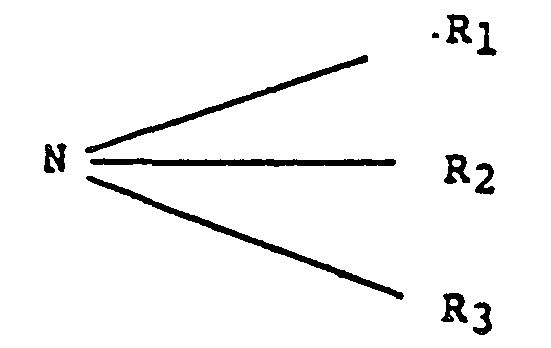
- The solid elastomeric co- or terpolymer used in the invention comprises at least 80 percent by weight of units derived from at least one alkyl acrylate or alkyl methacrylate monomer, the alkyl group having from 1 to 15 carbon atoms and of units derived from a metal or amine neutralised sulfonate monomer characterized by the formula:


- The present invention relates to the formation of sulfonate containing co- or terpolymers which are preferably formed by a free radical copolymerization process. The monomers used in the free radical emulsion copolymerization processes are alkyl acrylates or alkyl methacrylates which are copolymerized with sulfonate containing monomers.
- The acrylate or methacrylate and sulfonate containing monomer are dispersed in a water phase in the presence of an initiator, a water soluble reducing agent, and a suitable surfactant, wherein the temperature is sufficient to initiate polymerization. The resultant latex is coagulated usually by the addition of an aqueous salt solution and the recovered co- or terpolymer is washed with water and subsequently dried under vacuum at room temperature.
- The co- or terpolymers formed from the free radical emulsion copolymerization process of the present invention can be generally described as having a Mn of 5,000 to 200,000. The co- or terpolymers of the present invention contain 0.5 to 5 weight percent of chemical combined sulfur. The co- or terpolymers of the present invention are water insoluble, substantially gel-free, thermally stable, and oxidatively stable. Typical, but non-limiting examples of the copolymers which can be formed by the present free radical emulsion copolymerization process are: ethyl-acrylate/potassium styrene sulfonate copolymer, n-butyl- acrylate/potassium styrene sulfonate copolymer, 2-ethyl hexyl-methacrylate/potassium styrene sulfonate copolymer. A large number of copolymers and even terpolymers can be formed by the present free radical copolymerization process. Typically, the copolymerization of any C1 to C15 alkyl acrylate or C1 to C15 alkyl methacrylate can be readily copolymerized with any sulfonate containing monomer as is defined herein. Terpolymers with styrene, acrylonitrile, vinyl chloride as the termonomers with the aforementioned acrylates are also contemplated, provided that less than 20 weight percent of the termonomer is combined therein.
- The acrylates of the present invention are generally, defined as alkyl acrylates or alkyl methacrylate monomers having 1 to 15 carbon atoms in the alkyl moiety. Typical, but non-limiting examples of acrylates and methacrylates useful in the present invention are: methyl acrylate, ethylacrylate, propylacrylate, n-butylacrylate, n-butyl methacrylate, 2-ethylhexylacrylate, 2-ethyl-hexylmethacrylate, isodecylacrylate, isodecyl methacrylase, and methylmethacrylates. The preferred monomers are n-butylacrylate, 2-ethylhexylmethacrylate, ethylacrylate, 2-ethylhexylacrylate. In the formation of the sulfonate containing copolymer, one copolymerizes one of the aforementioned acrylates or methacrylates with the sulfonate containing monomer.
- The sulfonate containing monomers of the present invention which are water soluble can be generally described as a monomer having unsaturation and a metal or amine sulfonate group. The metal or amine neutralized sulfonate monomer is characterized for the formula:


- 1) CH2 = CHSO3 -Na+ sodium vinyl sulfonate
- 2) CH2 = CHCH2SO3 -Na+ sodium allyl sulfonate

- An especially preferred sulfonate containing monomer is metal sulfonated styrene. The molar ratio of sulfonate containing monomer to acrylate or methacrylate monomer is 1/200 to 1/5.
- A redox emulsion polymerization recipe used in this invention is effective in initiating the copolymerization of water insoluble and water soluble comonomers in an emulsion system. The surface of the micelle/growing polymer particle is believed to be the locus of formation of initiator molecules as well as the polymerization locus. Water phase homopolymerization of the polar, water soluble monomer is effectively depressed because of low primary radical concentration in the aqueous phase.
- Similarly, the activity of the free radical catalyst in the hydrocarbon monomer phase is substantially less than in the vicinity of the reducing agent. As a result the polymerization of homopolymers is believed to be effectively depressed.
- Reducing agents suitable for this invention are those known in the art with the additional requirement that they be soluble in water. A preferred reducing agent is triethylenetetramine.
- A variety of free radical catalysts can be employed in this invention. This includes a preferential class of free radical initiators such as benzoyl peroxide, cumene peroxide, diisopropylbenzene hydroperoxide, t-butyl hydroperoxide and similar systems which will be preferentially soluble in the monomer phase as opposed to the aqueous phase. There are a large number of such peroxides used in the art and those having the appropriate solubility behavior and suitable decomposition temperatures in the presence of the reducing agents are satisfactory for the purposes of this invention. Also a large number of water soluble initiators can be employed in this invention. A variety of such systems are known and are employed as redox initiators. A preferred catalyst system is potassium persulfate and sodium bisulfite. Others can also be employed.
- The non-ionic surfactants employed for this invention are varied and well known in the art. The typical emulsifiers or surfactants can be employed; however, some are more effective than others in generating latices of better stability. A preferred emulsifier is Atlox 8916TF. (The word "Atlox" is a registered Trade Mark). The choice of the emulsifier is not critical.
- The buffering agents employed in the polymerization process are selected from sodium carbonate, ammonia, sodium acetate, trisodium phosphate, etc. These buffering agents are typically employed at a concentration of about 0.1 to about 5 grams per 100 grams water employed in the emulsion system.
- . Chain transfer agents can be readily employed in the present polymerization process for controlling the molecular weight of the resultant copolymer. The concentration of chain transfer agent is from 0 to 1.0 grams per 100 grams of the combined weight of the sulfonate containing monomer and the acrylate or methacrylate monomer.
- The free radical emulsion copolymerization of the water soluble sulfonate containing polymer and the acrylate or methacrylate monomer yields a stable latex, wherein the resultant water insoluble copolymer is not covalently cross-linked and possesses substantial ionic cross-linking, and has 0.5 to <5 weight percent of chemically combined sulfur, more preferably 0.5 to 3. The resultant latex can be coagulated by the addition of an aqueous salt solution to the emulsion at a volume ratio of the aqueous salt solution to total volume of the emulsion of 10 to 0.5. The water insoluble copolymer is recovered by filtration and subsequently washed with water and dried under vacuum conditions. Alternatively, the polymer can be coagulated by precipitation with alcohol such as methanol. Alternatively, the latex can be used to form ionically cross-linked films by evaporation to dryness.
- While there is a wide spectrum of polymers which can be prepared via this invention, it is important to emphasize that the properties of these polymers will be much different from those polymers not possessing ionic associations. In addition, the properties of these sulfonate copolymers are very dependent on the type of acrylate or methacrylate contained in this polymer. While the properties of this family of polymers is well-known to be dependent on the length of the alkyl group in the acrylate or methacrylate ester group, the difference in the current family of polymers goes beyond this widely known characteristic. The presence of a metal or amine neutralized sulfonate group in the polymer backbone promotes strong ionic association. The nature, extent and consequences of this association is very dependent on the polarity of the polymer backbone. For example, an ethylacrylate backbone and a 2-ethyl-hexylacrylate copolymer with sodium styrene sulfonate as the ionic moiety, can give quite different results in terms of the ionic association. In the case of the ethylacrylate, the more polar backbone can result in greater interaction with the ionic group and thereby weaken the ionic associations. In the case of the lesser polar monomer, stronger ionic associations can prevail with some important technological differences. The difference of this degree of ionic interaction with the polymer backbone can be labeled a form of internal plasticization. As such, differences in polymer solubility tensile properties, etc., can result.
- These unexpected results are one consequence of this family of acrylate or methacrylate copolymers with sulfonate monomers.
- The uses for these copolymers are varied and extensive. Selected compositions of n-butyl-acrylate sulfonate copolymers and similar systems are as thermoplastic elastomers - being elastomeric and thermoplastic in nature. These materials are useful in adhesive, (both hot melt and pressure sensitive) water based coatings, films, hydrocarbon viscosifiers and coatings.
- As exemplified in the following illustrative Examples, a series of copolymers were prepared.
- Ethyl, n-butyl and 2-ethyl hexyl (2, 3, 4) acrylate and potassium styrene sulfonate (KSS) copolymerize readily. All of the experiments have been done under emulsion conditions using a non-ionic surfactant, as shown in Table I (only butyl acrylate data shown). The data in Table I indicate high conversions of reasonably stable latex can be achieved under practical conditions. Thermal analysis studies (DSC) have now been conducted on several of the copolymers and are summarized in Table II. It is interesting to note that the acrylate Tg is unchanged over the range potassium styrene sulfonate uninvestigated. This, of course, is evidence for the presence of a second ionomeric phase.
- The copolymers can be quite strong and extensible, as shown in Table III. These preliminary data were obtained by compression molding at ―170°C.
- Example 1 represents a copolymer of n-butylacrylate and sodium styrene sulphonate, while Example 5 represents the homopolymer of sodium styrene sulfonate. The tensile stress at break for the poly-n-butyl acrylate is less than 8 kg. per cm2 while the sulfonate copolymers have tensile strengths as much as 5000% greater. Similarly, the reduction in elongation with increasing sulfonate content is a measure of the ionic cross-linking of these polymers. The fact that these materials can be compression molded, and yet retain good elastomeric properties, as well as high tensile strengths, shows that they are excellent candidates as thermoplastic elastomers.


Claims (5)

Applications Claiming Priority (2)
| Application Number | Priority Date | Filing Date | Title |
|---|---|---|---|
| US30842581A | 1981-10-05 | 1981-10-05 | |
| US308425 | 1981-10-05 |
Publications (2)
| Publication Number | Publication Date |
|---|---|
| EP0077164A1 EP0077164A1 (en) | 1983-04-20 |
| EP0077164B1 true EP0077164B1 (en) | 1989-07-26 |
Family
ID=23193942
Family Applications (1)
| Application Number | Title | Priority Date | Filing Date |
|---|---|---|---|
| EP82305269A Expired EP0077164B1 (en) | 1981-10-05 | 1982-10-04 | Adhesives containing sulfonated copolymers or terpolymers |
Country Status (3)
| Country | Link |
|---|---|
| EP (1) | EP0077164B1 (en) |
| JP (1) | JPS5871908A (en) |
| DE (1) | DE3279837D1 (en) |
Families Citing this family (6)
| Publication number | Priority date | Publication date | Assignee | Title |
|---|---|---|---|---|
| US4529527A (en) * | 1984-05-14 | 1985-07-16 | Exxon Research And Engineering Co. | Method for controlling viscosity of lubricating oils |
| US4629663A (en) * | 1984-10-29 | 1986-12-16 | Minnesota Mining And Manufacturing Company | Removable pressure-sensitive adhesive tape |
| US4835217A (en) * | 1985-10-17 | 1989-05-30 | Minnesota Mining And Manufacturing Company | Pressure-sensitive adhesive having broad useful temperature range |
| US4699842A (en) * | 1985-10-17 | 1987-10-13 | Minnesota Mining And Manufacturing Company | Pressure-sensitive adhesive having broad useful temperature range |
| US5080121A (en) * | 1990-08-06 | 1992-01-14 | Council Of Scientific & Industrial Research | Process for the preparation of a new polymer useful for drag reduction in hydrocarbon fluids in exceptionally dilute polymer solutions |
| JP2624917B2 (en) * | 1991-09-12 | 1997-06-25 | 日東電工株式会社 | Water-soluble or water-dispersible pressure-sensitive adhesive composition |
Family Cites Families (2)
| Publication number | Priority date | Publication date | Assignee | Title |
|---|---|---|---|---|
| BE786002A (en) * | 1971-07-08 | 1973-01-08 | Montedison Spa | ALCENYLSULFONATE COPOLYMERS, PERMEABLE MEMBRANES SELECTIVELY WITH THE CATIONS BASED ON THESE COPOLYMERS AND PROCESS FOR PREPARING SELECTIVE PERMEABILITY MEMBRANES FROM THESE COPOLYMERS |
| US4197127A (en) * | 1976-10-08 | 1980-04-08 | Eastman Kodak Company | Photographic silver halide composition and element containing sulfonate copolymers |
-
1982
- 1982-10-04 DE DE8282305269T patent/DE3279837D1/en not_active Expired
- 1982-10-04 EP EP82305269A patent/EP0077164B1/en not_active Expired
- 1982-10-05 JP JP57176040A patent/JPS5871908A/en active Pending
Also Published As
| Publication number | Publication date |
|---|---|
| DE3279837D1 (en) | 1989-08-31 |
| EP0077164A1 (en) | 1983-04-20 |
| JPS5871908A (en) | 1983-04-28 |
Similar Documents
| Publication | Publication Date | Title |
|---|---|---|
| US3404114A (en) | Method for preparing latexes having improved adhesive properties | |
| US4912169A (en) | Adhesive compositions containing low molecular weight polymer additives | |
| US5407993A (en) | Polychloroprene blend composition | |
| US3321431A (en) | Aqueous resin emulsions | |
| US4665115A (en) | Method for controlling viscosity of organic liquids and compositions | |
| DK168017B1 (en) | PROCEDURE FOR INSULATING A VINYLAROMATIC MONOMER AND AN ACRYLIC MONOMER ON POLYBUTADIA BY EMULSION POLYMERIZATION | |
| EP0077164A1 (en) | Adhesives containing sulfonated copolymers or terpolymers | |
| CA1091392A (en) | Mercaptan activation by acid in the copolymerization of acrylonitrile | |
| JPS581683B2 (en) | Manufacturing method of impact resistant resin | |
| EP0112708A2 (en) | Film-forming olefinic nitrile polymer latex and method of preparing same | |
| US5066694A (en) | Novel pressure sensitive adhesive compositions (C-2511) | |
| CA1204550A (en) | Sulfonated polymer and compositions thereof | |
| US4530987A (en) | Sulfonated copolymers and process for forming the sulfonated copolymers | |
| US3629370A (en) | Process for the production of thermoplastic-elastic moulding compositions of high impact and notched impact strength | |
| US5216048A (en) | Emulsion-type adhesive compositions | |
| CA1255436A (en) | Sulphur-containing polymers | |
| US4000359A (en) | Interpolymer of a nitrile, vinylidene chloride and acrylate monomers | |
| US4526951A (en) | Polymeric compositions of co- and terpolymers | |
| EP0375447B1 (en) | Adhesive composition | |
| US4530986A (en) | Elastomeric sulfonate terpolymers and process for forming the sulfonated terpolymers | |
| US3396153A (en) | Sulfo-nu-alkylpropionamide salts as emulsifying agents in polymerization of unsaturated compounds | |
| US3265677A (en) | Process for regulating molecular weight in polymerization of vinylidene monomers using 1-methylcyclohexene-1 as regulator | |
| US4027090A (en) | Mercaptan-hydrocarbon chain modifiers in acrylonitrile copolymers | |
| US3467614A (en) | Cross-linkable copolymer dispersions | |
| EP0065603B1 (en) | An adhesive composition |
Legal Events
| Date | Code | Title | Description |
|---|---|---|---|
| PUAI | Public reference made under article 153(3) epc to a published international application that has entered the european phase |
Free format text: ORIGINAL CODE: 0009012 |
|
| AK | Designated contracting states |
Designated state(s): BE DE FR GB IT NL |
|
| 17P | Request for examination filed |
Effective date: 19830921 |
|
| GRAA | (expected) grant |
Free format text: ORIGINAL CODE: 0009210 |
|
| AK | Designated contracting states |
Kind code of ref document: B1 Designated state(s): BE DE FR GB IT NL |
|
| ITF | It: translation for a ep patent filed | ||
| REF | Corresponds to: |
Ref document number: 3279837 Country of ref document: DE Date of ref document: 19890831 |
|
| ET | Fr: translation filed | ||
| PLBE | No opposition filed within time limit |
Free format text: ORIGINAL CODE: 0009261 |
|
| STAA | Information on the status of an ep patent application or granted ep patent |
Free format text: STATUS: NO OPPOSITION FILED WITHIN TIME LIMIT |
|
| 26N | No opposition filed | ||
| ITTA | It: last paid annual fee | ||
| PGFP | Annual fee paid to national office [announced via postgrant information from national office to epo] |
Ref country code: FR Payment date: 19931008 Year of fee payment: 12 |
|
| PGFP | Annual fee paid to national office [announced via postgrant information from national office to epo] |
Ref country code: DE Payment date: 19931011 Year of fee payment: 12 |
|
| PGFP | Annual fee paid to national office [announced via postgrant information from national office to epo] |
Ref country code: GB Payment date: 19931015 Year of fee payment: 12 |
|
| PGFP | Annual fee paid to national office [announced via postgrant information from national office to epo] |
Ref country code: NL Payment date: 19931031 Year of fee payment: 12 |
|
| PGFP | Annual fee paid to national office [announced via postgrant information from national office to epo] |
Ref country code: BE Payment date: 19931105 Year of fee payment: 12 |
|
| PG25 | Lapsed in a contracting state [announced via postgrant information from national office to epo] |
Ref country code: GB Effective date: 19941004 |
|
| PG25 | Lapsed in a contracting state [announced via postgrant information from national office to epo] |
Ref country code: BE Effective date: 19941031 |
|
| BERE | Be: lapsed |
Owner name: EXXON RESEARCH AND ENGINEERING CY Effective date: 19941031 |
|
| PG25 | Lapsed in a contracting state [announced via postgrant information from national office to epo] |
Ref country code: NL Effective date: 19950501 |
|
| GBPC | Gb: european patent ceased through non-payment of renewal fee |
Effective date: 19941004 |
|
| NLV4 | Nl: lapsed or anulled due to non-payment of the annual fee | ||
| PG25 | Lapsed in a contracting state [announced via postgrant information from national office to epo] |
Ref country code: FR Effective date: 19950630 |
|
| PG25 | Lapsed in a contracting state [announced via postgrant information from national office to epo] |
Ref country code: DE Effective date: 19950701 |
|
| REG | Reference to a national code |
Ref country code: FR Ref legal event code: ST |